CHAPTER 2
Reading edition
World War II: The Army
Civil rights leaders adopted the "Double V" slogan as their rallying cry during World War II. Demanding victory against fascism abroad and discrimination at home, they exhorted black citizens to support the war effort and to fight for equal treatment and opportunity for Negroes everywhere. Although segregation was their main target, their campaign was directed against all forms of discrimination, especially in the armed forces. They flooded the services with appeals for a redress of black grievances and levied similar demands on the White House, Congress, and the courts.
Black leaders concentrated on the services because they were public institutions, their officials sworn to uphold the Constitution. The leaders understood, too, that disciplinary powers peculiar to the services enabled them to make changes that might not be possible for other organizations; the armed forces could command where others could only persuade. The Army bore the brunt of this attention, but not because its policies were so benighted. In 1941 the Army was a fairly progressive organization, and few institutions in America could match its record. Rather, the civil rights leaders concentrated on the Army because the draft law had made it the nation's largest employer of minority groups.
For its part, the Army resisted the demands, its spokesmen contending that the service's enormous size and power should not be used for social experiment, especially during a war. Further justifying their position, Army officials pointed out that their service had to avoid conflict with prevailing social attitudes, particularly when such attitudes were jealously guarded by Congress. In this period of continuous demand and response, the Army developed a racial policy that remained in effect throughout the war with only superficial modifications sporadically adopted to meet changing conditions.
A War Policy: Reaffirming Segregation
The President's "OK, F.D.R." on the War Department statement transformed what had been a routine prewar mobilization plan into a racial policy that would remain in effect throughout the war. In fact, quickly elevated in importance by War Department spokesmen who made constant reference to the "Presidential Directive," the statement would be used by some Army officials as a presidential sanction for introducing segregation in new situations, as, for example, in the pilot training of black officers in the Army Air Corps. Just as quickly, the civil rights leaders, who had expected more from the tone of the President's own comments and more also from the egalitarian implications of the new draft law, bitterly attacked the Army's policy.
Black criticism came at an awkward moment for President Roosevelt, who was entering a heated campaign for an unprecedented third term and whose New Deal coalition included the urban black vote. His opponent, the articulate Wendell L. Willkie, was an unabashed champion of civil rights and was reportedly attracting a wide following among black voters. In the weeks preceding the election the President tried to soften the effect of the Army's announcement. He promoted Col. Benjamin O. Davis, Sr., to brigadier general, thereby making Davis the first Negro to hold this rank in the Regular Army. He appointed the commander of reserve officers' training at Howard University, Col. Campbell C. Johnson, Special Aide to the Director of Selective Service. And, finally, he named Judge William H. Hastie, dean of the Howard University Law School, Civilian Aide to the Secretary of War.
Judge Hastie spent his first ten months in office observing what was happening to the Negro in the Army. He did not like what he saw. To him, separating black soldiers from white soldiers was a fundamental error. First, the effect on black morale was devastating. "Beneath the surface," he wrote, "is widespread discontent. Most white persons are unable to appreciate the rancor and bitterness which the Negro, as a matter of self-preservation, has learned to hide beneath a smile, a joke, or merely an impassive face." The inherent paradox of trying to inculcate pride, dignity, and aggressiveness in a black soldier while inflicting on him the segregationist's concept of the Negro's place in society created in him an insupportable tension. Second, segregation wasted black manpower, a valuable military asset. It was impossible, Hastie charged, to employ skilled Negroes at maximum efficiency within the traditionally narrow limitations of black units. Third, to insist on an inflexible separation of white and black soldiers was "the most dramatic evidence of hypocrisy" in America's professed concern for preserving democracy.
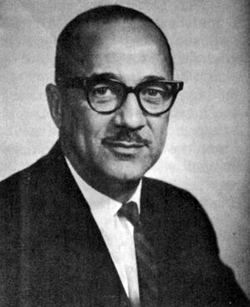
Judge Hastie
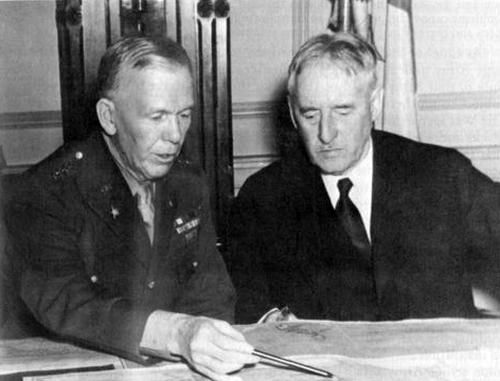
General Marshall and Secretary Stimson
These opinions were clearly evident on 8 December 1941, the day the United States entered World War II, when the Army's leaders met with a group of black publishers and editors. Although General Marshall admitted that he was not satisfied with the department's progress in racial matters and promised further changes, the conference concluded with a speech by a representative of The Adjutant General who delivered what many considered the final word on integration during the war.
Thus very early in World War II, even before the United States was actively engaged, the issues surrounding the use of Negroes in the Army were well defined and the lines sharply drawn. Was segregation, a practice in conflict with the democratic aims of the country, also a wasteful use of manpower? How would modifications of policy come—through external pressure or internal reform? Could traditional organizational and social patterns in the military services be changed during a war without disrupting combat readiness?
Segregation and Efficiency
The effect of segregation on manpower efficiency became apparent only as the Army tried to translate policy into practice. In the face of rising black protest and with direct orders from the White House, the Army had announced that Negroes would be assigned to all arms and branches in the same ratio as whites. Several forces, however, worked against this equitable distribution. During the early months of mobilization the chiefs of those arms and services that had traditionally been all white accepted less than their share of black recruits and thus obliged some organizations, the Quartermaster Corps and the Engineer Corps in particular, to absorb a large percentage of black inductees. The imbalance worsened in 1941. In December of that year Negroes accounted for 5 percent of the Infantry and less than 2 percent each of the Air Corps, Medical Corps, and Signal Corps. The Quartermaster Corps was 15 percent black, the Engineer Corps 25 percent, and unassigned and miscellaneous detachments were 27 percent black.
The rejection of black units could not always be ascribed to racism alone. With some justification the arms and services tried to restrict the number and distribution of Negroes because black units measured far below their white counterparts in educational achievement and ability to absorb training, according to the Army General Classification Test (AGCT). The Army had introduced this test system in March 1941 as its principal instrument for the measurement of a soldier's learning ability. Five categories, with the most gifted in category I, were used in classifying the scores made by the soldiers taking the test (Table 1). The Army planned to take officers and enlisted specialists from the top three categories and the semiskilled soldiers and laborers from the two lowest.
Table 1—Classification of All Men Tested From March 1941 Through December 1942
AGCT Category White Black
Number Percentage Number Percentage
I 273,626 6.6 1,580 0.4
II 1,154,700 28.0 14,891 3.4
III 1,327,164 32.1 54,302 12.3
IV 1,021,818 24.8 152,725 34.7
V 351,951 8.5 216,664 49.2
Total 4,129,259 100.0 440,162 100.0
Source: Tab A, Memo, G-3 for CofS, 10 Apr 43, AG 201.2 (19 Mar 43) (1).
Segregation further hindered the efficient use of black manpower by complicating the training of black soldiers. Although training facilities were at a premium, the Army was forced to provide its training and replacement centers with separate housing and other facilities. With an extremely limited number of Regular Army Negroes to draw from, the service had to create cadres for the new units and find officers to lead them. Black recruits destined for most arms and services were assured neither units, billets, nor training cadres. The Army's solution to the problem: lower the quotas for black inductees.
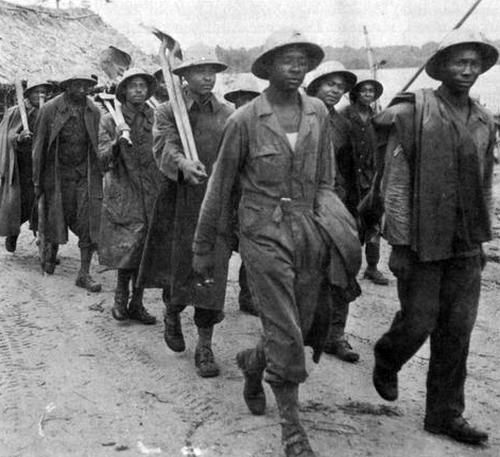
Engineer Construction Troops in Liberia, July 1942
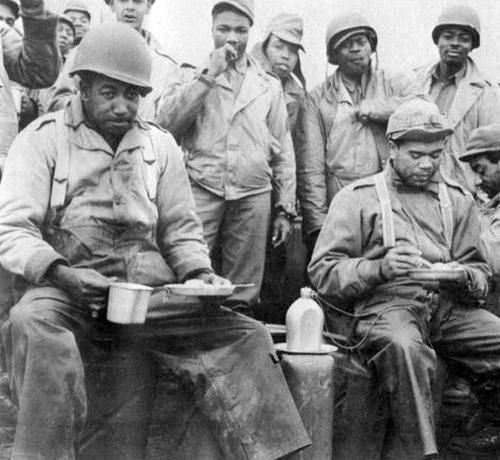
Labor Battalion Troops in the Aleutian Islands, May 1943. Stevedores pause for a hot meal at Massacre Bay.
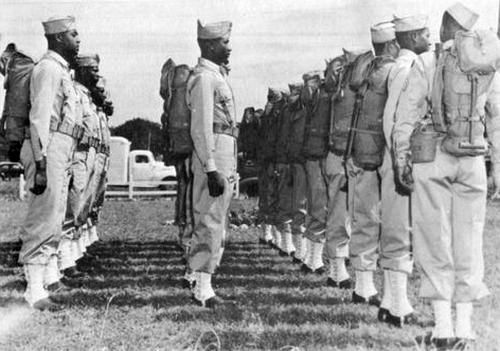
Sergeant Addressing the Line. Aviation squadron standing inspection, 1943.
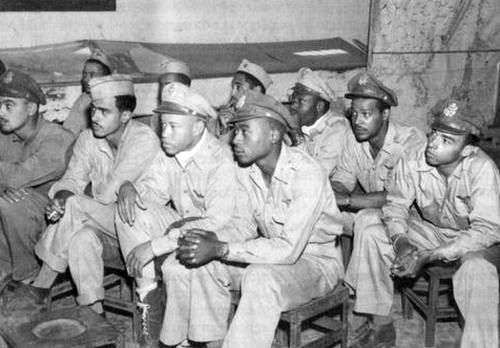
Pilots of the 332d Fighter Group Being Briefed for combat mission in Italy.
The Army Air Forces found it easier to absorb the thousands of black enlisted men than to handle the black flying squadrons. For the enlisted men it created a series of units with vaguely defined duties, usually common labor jobs operating for the most part under a bulk allotment system that allowed the Air Forces to absorb great numbers of new men. Through 1943 hundreds of these aviation training squadrons, quartermaster truck companies, and engineer aviation and air base security battalions were added to the Air Forces' organization tables. Practically every American air base in the world had its contingent of black troops performing the service duties connected with air operations.
The Air Corps, like the Armor and the Artillery branches, was able to form separate squadrons or battalions for black troops, but the Infantry and Cavalry found it difficult to organize the growing number of separate black battalions and regiments. The creation of black divisions was the obvious solution, although this arrangement would run counter to current practice, which was based in part on the Army's experience with the 92d Division in World War I. Convinced of the poor performance of that unit in 1918, the War Department had decided in the 1920's not to form any more black divisions. The regiment would serve as the basic black unit, and from time to time these regiments would be employed as organic elements of divisions whose other regiments and units would be white. In keeping with this decision, the black 9th and 10th Cavalry regiments were combined in October 1940 with white regiments to form the 2d Cavalry Division.
The Chamberlain Plan and a variant proposed the following spring prompted discussion in the Army staff that clearly revealed general dissatisfaction with the current policy. Nonetheless, in the face of opposition from the service and ground forces, the plan was abandoned. Yet because something had to be done with the mounting numbers of black draftees, the Army staff reversed the decision made in its prewar mobilization plans and turned once more to the concept of the all-black division. The 93d Infantry Division was reactivated in the spring of 1942 and the 92d the following fall. The 2d Cavalry Division was reconstituted as an all-black unit and reactivated in February 1943. These units were capable of absorbing 15,000 or more men each and could use men trained in the skills of practically every arm and service.
But the best efforts of good officers could not avail against poor policy. Although the Army maintained that Negroes had to bear a proportionate share of the casualties, by policy it assigned the majority to noncombat units and thus withheld the chance for them to assume an equal risk. Subscribing to the advantage of making full use of individual abilities, the Army nevertheless continued to consider Negroes as a group and to insist that military efficiency required racially segregated units. Segregation in turn burdened the service with the costly provision of separate facilities for the races. Although a large number of Negroes served in World War II, their employment was limited in opportunity and expensive for the service.
The Need for Change
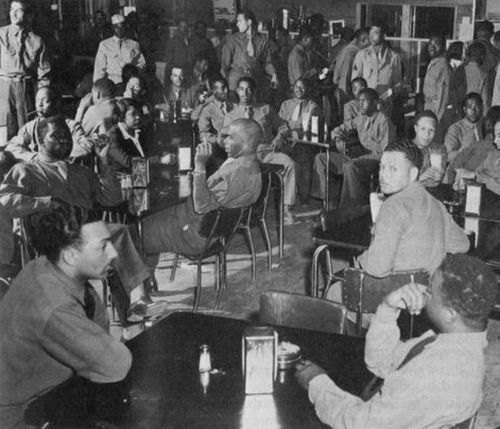
Service Club, Fort Huachuca
Some of these humiliations might have been less demeaning had the black soldier been convinced that he was a full partner in the crusade against fascism. As news of the conversion of black units from combat to service duties and the word that no new black combat units were being organized became a matter of public knowledge, the black press asked: Will any black combat units be left? Will any of those left be allowed to fight? In fact, would black units ever get overseas?
Ultimately, theater commanders decided which troops would be committed to action and which units would be needed overseas; their decisions were usually respected by the War Department where few believed that Washington should dictate such matters. Unwilling to add racial problems to their administrative burdens, some commanders had been known to cancel their request for troops rather than accept black units. Consequently, very few Negroes were sent overseas in the early years of the war.
Internal Reform: Amending Racial Practices
There has been a tendency to allow the situation to develop where selections are made on the basis of efficiency with the result that the colored units are discarded for combat service, but little is done by way of studying new means to put them in shape for combat service.
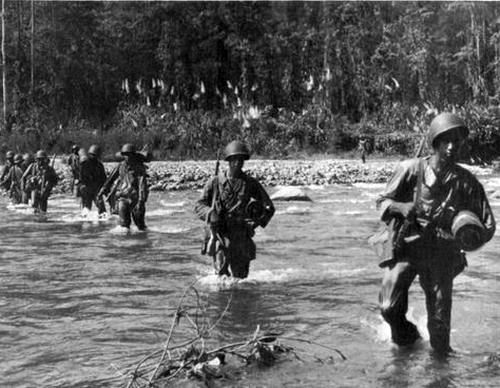
93d Division Troops in Bougainville, April 1944. Men, packing mortar shells, cross the West Branch Texas River.
Widely disseminated by the black press as the "anti-Jim Crow law," the directive and its interpretation by senior officials produced the desired result. Although soldiers most often continued to frequent the facilities in their own base areas, in effect maintaining racial separation, they were free to use any facilities, and this knowledge gradually dispelled some of the tensions on posts where restrictions of movement had been a constant threat to good order.
Two Exceptions
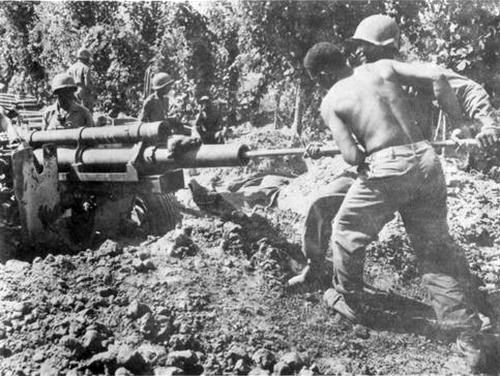
Gun Crew of Battery B, 598th Field Artillery, moving into position near the Arno River, Italy, September 1944.
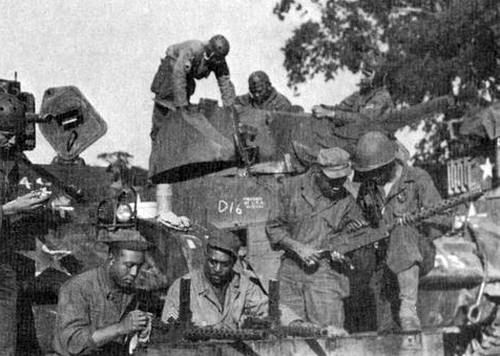
Tankers of the 761st Medium Tank Battalion prepare for action in the European theater, August 1944.
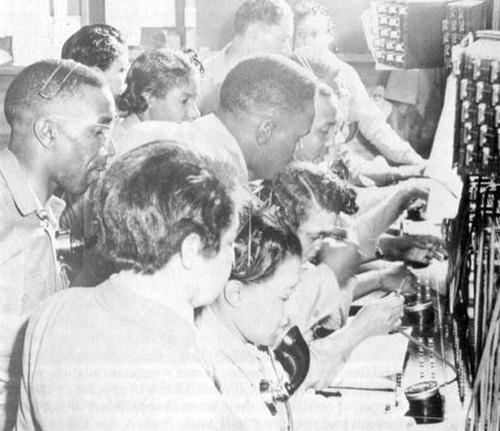
WAAC Replacements training at Fort Huachuca, December 1942.
The revolutionary nature of General Lee's plan was not lost on Supreme Headquarters, Allied Expeditionary Force. Arguing that the circular promising integrated service would embarrass the Army, Lt. Gen. Walter Bedell Smith, the chief of staff, recommended that General Eisenhower warn the War Department that civil rights spokesmen might seize on this example to demand wider integration. To avoid future moves that might compromise Army policy, Smith wanted permission to review any Communications Zone statements on Negroes before they were released.
Unaware of how close they had come to being integrated as individuals, so many Negroes volunteered for combat training and duty that the operations of some service units were threatened. To prevent disrupting these vital operations, the theater limited the number to 2,500, turning down about 3,000 men. Early in January 1945 the volunteers assembled for six weeks of standard infantry conversion training. After training, the new black infantrymen were organized into fifty-three platoons, each under a white platoon leader and sergeant, and were dispatched to the field, two to work with armored divisions and the rest with infantry divisions. Sixteen were shipped to the 6th Army Group, the rest to the 12th Army Group, and all saw action with a total of eleven divisions in the First and Seventh Armies.
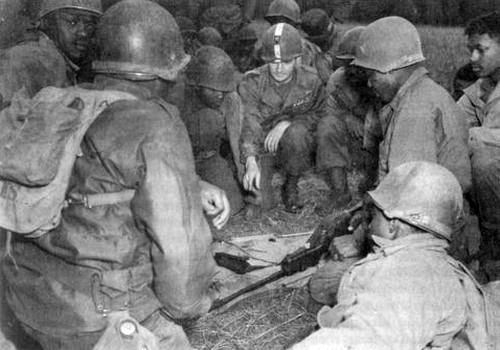
Volunteers for Combat in Training, 47th Reinforcement Depot, February 1945.
The experiment with integration of platoons was carefully scrutinized. In May and June 1945, the Research Branch of the Information and Education Division of Eisenhower's theater headquarters made a survey solely to discover what white company-grade officers and platoon sergeants thought of the combat performance of the black rifle platoons. Trained interviewers visited seven infantry divisions and asked the same question of 250 men—all the available company officers and a representative sample of platoon sergeants in twenty-four companies that had had black platoons. In addition, a questionnaire, not to be signed, was submitted to approximately 1,700 white enlisted men in other field forces for the purpose of discovering what their attitudes were toward the use of black riflemen. No Negro was asked his opinion.
The platoon experiment was illuminating in several respects. The fact that so late in the war thousands of Negroes volunteered to trade the safety of the rear for duty at the front said something about black patriotism and perhaps something about the Negro's passion for equality. It also demonstrated that, when properly trained and motivated and treated with fairness, blacks, like whites, performed with bravery and distinction in combat. Finally, the experiment successfully attacked one of the traditionalists' shibboleths, that close association of the races in Army units would cause social dissension.
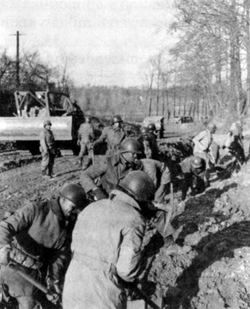
Road Repairmen, Company A, 279th Engineer Battalion, near Rimberg, Germany, December 1944.
It is now apparent that World War II had little immediate effect on the quest for racial equality in the Army. The Double V campaign against fascism abroad and racism at home achieved considerably less than the activists had hoped. Although Negroes shared in the prosperity brought by war industries and some 800,000 of them served in uniform, segregation remained the policy of the Army throughout the war, just as Jim Crow still ruled in large areas of the country. Probably the campaign's most important achievement was that during the war the civil rights groups, in organizing for the fight against discrimination, began to gather strength and develop techniques that would be useful in the decades to come. The Army's experience with black units also convinced many that segregation was a questionable policy when the country needed to mobilize fully.
For its part the Army defended the separation of the races in the name of military efficiency and claimed that it had achieved a victory over racial discrimination by providing equal treatment and job opportunity for black soldiers. But the Army's campaign had also been less than completely successful. True, the Army had provided specialist training and opened job opportunities heretofore denied to thousands of Negroes, and it had a cadre of potential leaders in the hundreds of experienced black officers. For the times, the Army was a progressive minority employer. Even so, as an institution it had defended the separate but equal doctrine and had failed to come to grips with segregation. Under segregation the Army was compelled to combine large numbers of undereducated and undertrained black soldiers in units that were often inefficient and sometimes surplus to its needs. This system in turn robbed the Army of the full services of the educated and able black soldier, who had every reason to feel restless and rebellious.
The Army received no end of advice on its manpower policy during the war. Civil rights spokesmen continually pointed out that segregation itself was discriminatory, and Judge Hastie in particular hammered on this proposition before the highest officials of the War Department. In fact Hastie's recommendations, criticisms, and arguments crystallized the demands of civil rights leaders. The Army successfully resisted the proposition when its Advisory Committee on Negro Troop Policies under John McCloy modified but did not appreciably alter the segregation policy. It was a predictable course. The Army's racial policy was more than a century old, and leaders considered it dangerous if not impossible to revise traditional ways during a global war involving so many citizens with pronounced and different views on race.