CHAPTER 10
Reading edition
The Postwar Marine Corps
Unlike the Army and Navy, the all-white Marine Corps seemed to consider the wartime enlistment of over 19,000 Negroes a temporary aberration. Forced by the Navy's nondiscrimination policy to retain Negroes after the war, Marine Corps officials at first decided on a black representation of some 2,200 men, roughly the same proportion as during the war. But the old tradition of racial exclusion remained strong, and this figure was soon reduced. The corps also ignored the Navy's integration measures, adopting instead a pattern of segregation that Marine officials claimed was a variation on the Army's historic "separate but equal" black units. In fact, separation was real enough in the postwar corps; equality remained elusive.
Racial Quotas and Assignments
The problem was that any "separate but equal" race policy, no matter how loosely enforced, was incompatible with the corps' postwar manpower resources and mission and would conflict with its determination to restrict black units to a token number. The dramatic manpower reductions of 1946 were felt immediately in the two major elements of the Marine Corps. The Fleet Marine Force, the main operating unit of the corps and usually under control of the Chief of Naval Operations, retained three divisions, but lost a number of its combat battalions. The divisions kept a few organic and attached service and miscellaneous units. Under such severe manpower restrictions, planners could not reserve one of the large organic elements of these divisions for black marines, thus leaving the smaller attached and miscellaneous units as the only place to accommodate self-contained black organizations. At first the Plans and Policies Division decided to assign roughly half the black marines to the Fleet Marine Force. Of these some were slated for an antiaircraft artillery battalion at Montford Point which would provide training as well as an opportunity for Negroes' overseas to be rotated home. Others were placed in three combat service groups and one service depot where they would act as divisional service troops, and the rest went into 182 slots, later increased to 216, for stewards, the majority in aviation units.
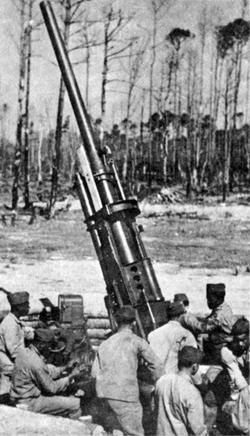
Marine Artillery Team. Men of the 51st Defense Battalion in training at Montford Point with 90-mm. antiaircraft gun.
To assign Negroes to unskilled jobs because they were accustomed to such duties and because the jobs were located in communities that would accept black marines might be satisfactory to Marine officials, but it was considered racist by many civil rights spokesmen and left the Marine Corps open to charges of discrimination. The policy of tying the number of Negroes to the number of available, appropriate slots also meant that the number of black marines, and consequently the acceptability of black volunteers, was subject to chronic fluctuation. More important, it permitted if not encouraged further restrictions on the use of the remaining black marines who had combat training, thereby allowing the traditionalists to press for a segregated service in which the few black marines would be mostly servants and laborers.
Recruitment
These rapid changes, indeed the whole pattern of black enlistment in the postwar Marine Corps, demonstrated that the staff's manpower practices were out of joint with the times. Not only did they invite attack from the increasingly vocal civil rights forces, but they also fostered a general distrust among black marines themselves and among those young Negroes the corps hoped to attract.
Segregation and Efficiency
The assignment policies and recruitment practices of the corps were the inevitable result of its segregation policy. Prejudice and discrimination no doubt aggravated the situation, but the policy of separation limited the ways Negroes could be employed and places to which they might be assigned. Segregation explained, for example, why Negroes were traditionally employed in certain types of combat units, and why, when changing missions and manpower restrictions caused a reduction in the number of such units, Negroes were not given other combat assignments. Most Negroes with combat military occupational specialties served in defense battalions during World War II. These units, chiefly antiaircraft artillery, were self-contained and could therefore be segregated; at the same time they cloaked a large group of men with the dignity of a combat assignment. But what was possible during the war was no longer practical and efficient in the postwar period. Some antiaircraft artillery units survived the war, but they no longer operated as battalions and were divided instead into battery-size organizations that simply could not be segregated in terms of support and recreational facilities. In fact, the corps found it impossible after the war to maintain segregation in any kind of combat unit.
Obviously the corps had in its ranks some Negroes capable of performing any task required in an artillery battalion. Yet because the segregation policy demanded that there be enough qualified men to form and sustain a whole black battalion, the abilities of these high-scoring individuals were wasted. On the other hand, many billets in antiaircraft artillery or other types of combat battalions could be filled by men with low test scores, but less gifted black marines were excluded because they had to be assigned to one of the few black units. Segregation, in short, was doubly inefficient, it kept both able and inferior Negroes out of combat units that were perpetually short of men.
Segregation also promoted inefficiency in the placement of black Marine units. While the assignment of an integrated unit with a few black marines would probably go unnoticed in most naval districts—witness the experience of the Navy itself—the task of finding a naval district and an American community where a large segregated group of black marines could be peacefully assimilated was infinitely more difficult.
The original postwar racial program called for the assignment of black security units to the Marine Barracks at McAlester, Oklahoma, and Earle, New Jersey. Noting that the station was in a strict Jim Crow area where recreational facilities for Negroes were limited and distant, the commanding officer of the Marine Barracks at McAlester recommended that no Negroes be assigned. He reminded the commandant that guard duty required marines to question and apprehend white civilian employees, a fact that would add to the racial tension in the area. His conclusions, no doubt shared by commanders in many parts of the country, summed up the problem of finding assignments for black marines: any racial incident which might arise out of disregard for local racial custom, he wrote,
Approved on 8 November 1946, the postwar plan to assign black units to security guard assignments in the United States was not fully put into practice until 15 August 1948, almost two years later. This episode in the history of discrimination against Americans in uniform brought little glory to anyone involved and revealed much about the extent of race prejudice in American society. It was an indictment of people in areas as geographically diverse as Oklahoma, New York, Massachusetts, and New Jersey who objected to the assignment of black servicemen to their communities. It was also an indictment of a great many individual commanders, both in the Navy and Marine Corps, some perhaps for personal prejudices, others for so readily bowing to community prejudices. But most of all the blame must fall on the Marine Corps' policy of segregation. Segregation made it necessary to find assignments for a whole enlisted complement and placed an intolerable administrative burden on the corps. The dictum that black marines could not deal with white civilians, especially in situations in which they would give orders, further limited assignments since such duties were routine in any security unit. Thus, bound to a policy that was neither just nor practical, the commandant spent almost two years trying to place four hundred men.
Toward Integration
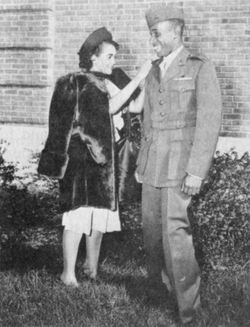
Lieutenant and Mrs. Branch
The brief active career of one black officer was hardly evidence of a great racial reform, but it represented a significant breakthrough because it affirmed the practice of integrated officer training and established the right of Negroes to command. And Rudder was quickly followed by other black officer candidates, some of whom made careers in the corps. Rudder's appointment marked a permanent change in Marine Corps policy.
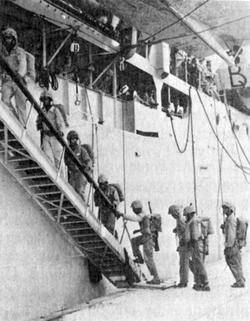
Training Exercises. Black Marine unit boards ship at Morehead City, North Carolina, 1949.
But these reforms, which did very little for a very few men, scarcely dented the Marine Corps' racial policy. Corps officials were still firmly committed to strict segregation in 1948, and change seemed very distant. Any substantial modification in racial policy would require a revolution against Marine tradition, a movement dictated by higher civilian authority or touched off by an overwhelming military need.