CHAPTER 12
Reading edition
The President Intervenes
On 26 July 1948 President Harry S. Truman signed Executive Order 9981, calling on the armed forces to provide equal treatment and opportunity for black servicemen. This act has variously been described as an example of presidential initiative, the capstone of the Truman civil rights program, and the climax of the struggle for racial equality in the armed forces. But in some ways the order was simply a practical response to a presidential dilemma.
Integration of the armed forces hardly loomed large on the international scene, but if the problem of race appeared insignificant to military planners, the sheer number of Negroes in the armed forces gave them new prominence in national defense. Because of postwar racial quotas, particularly in the Army and Air Force, black servicemen now constituted a significant segment of the service population, and consequently their abilities and well-being had a direct bearing on the nation's cold war defenses. The black community represented 10 percent of the country's manpower, and this also influenced defense planning. Black threats to boycott the segregated armed forces could not be ignored, and civil rights demands had to be considered in developing laws relating to selective service and universal training. Nor could the administration overlook the fact that the United States had become a leading protagonist in a cold war in which the sympathies of the undeveloped and mostly colored world would soon assume a special importance. Inasmuch as integration of the services had become an almost universal demand of the black community, integration became, willy-nilly, an important defense issue.
A second stimulus to improvement of the black serviceman's position was the Truman administration's strong civil rights program, which gave executive sanction to a national movement started some years before. The civil rights movement was the product of many factors, including the federal government's increased sense of responsibility for the welfare of all its citizens, a sense that had grown out of the New Deal and a world war which expanded horizons and increased economic power for much of the black population. The Supreme Court had recently accelerated this movement by broadening its interpretation of the Fourteenth Amendment. In the black community itself greater participation in elections and new techniques in community action were eroding discriminatory traditions and practices in many communities.
The civil rights movement had in fact progressed by 1948 to a stage at which it was politically attractive for a Democratic president to assume a vigorous civil rights stance. The urban black vote had become a major goal of Truman's election campaign, and he was being pressed repeatedly by his advisers to demonstrate his support for black interests. A presidential order on armed forces integration logically followed because the services, conspicuous practitioners of segregation and patently susceptible to unilateral action on the part of the Chief Executive, were obvious and necessary targets in the black voters' campaign for civil rights.
Finally, the integration order resulted in part from the move toward service unification and the emergence of James V. Forrestal as Secretary of Defense. Despite misgivings over centralized control of the nation's defense establishment and overconcentration of power in the hands of a Secretary of Defense, Forrestal soon discovered that certain problems rising out of common service experiences naturally converged on the office of the secretary. Both by philosophy and temperament he was disposed to avoid a clash with the services over integration. He remained sensitive to their interests and rights, and he frankly doubted the efficacy of social change through executive fiat. Yet Forrestal was not impervious to the aspirations of the civil rights activists; guided by a humane interest in racial equality, he made integration a departmental goal. His technique for achieving integration, however, proved inadequate in the face of strong service opposition, and finally the President, acting on the basis of these seemingly unrelated motives, had to issue the executive order to strengthen the defense secretary's hand.
The Truman Administration and Civil Rights
It was probably just as well that Truman adopted a pragmatic approach to civil rights, for there was little social legislation a reform president could hope to get through the postwar Congresses. Dominated by a conservative coalition that included the Dixiecrats, a group of sometimes racially reactionary southerners, Congress showed little interest in civil rights. The creation of a permanent Fair Employment Practices Commission, the one piece of legislation directly affecting Negroes and the only current test of congressional intent in civil rights, was floundering on Capitol Hill. Truman conspicuously supported the fair employment measure, but did little else specifically in the first year after the war to advance civil rights. Instead he seemed content to carry on with the New Deal approach to the problem: improve the social condition of all Americans and the condition of the minorities will also improve. In this vein his first domestic program concentrated on national projects for housing, health, and veterans' benefits.
But the Truman administration had nearly exhausted the usual remedies open to it. The Attorney General had investigated the lynchings and Klan activities and the President had spoken out strongly and repeatedly against mob violence but without clear and pertinent civil rights legislation presidential exhortations and investigations counted for very little. Civil rights leaders like White understood this, and, given the mood of Congress, they were resigned to the lack of legislative support. Nevertheless, it was in this context that the President decided to create a committee to investigate and report on the status of civil rights in America.
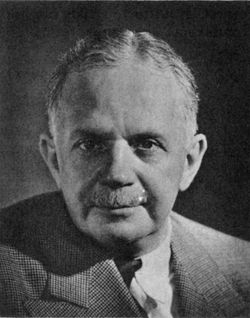
Walter White
To press for civil rights legislation for the armed forces or even to mention segregation was politically imprudent. Truman had two pieces of military legislation to get through Congress: a new draft law and a provision for universal military training. These he considered too vital to the nation's defense to risk grounding on the shoals of racial controversy. For the time being at least, integration of the armed forces would have to be played down, and any civil rights progress in the Department of Defense would have to depend on the persuasiveness of James Forrestal.
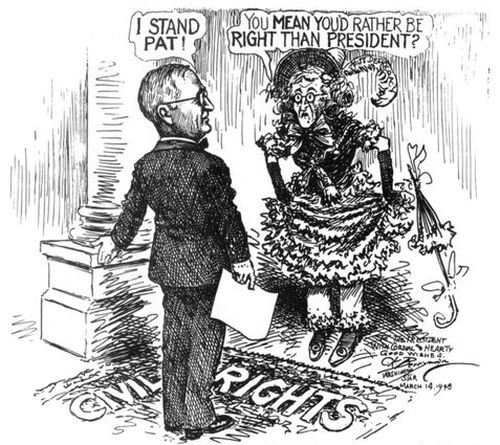
Truman's Civil Rights Campaign as seen by Washington Star cartoonist Clifford K. Berryman, March 14, 1948.
Civil Rights and the Department of Defense
The basic postwar reorganization of the National Military Establishment, the National Security Act of 1947, created the Office of the Secretary of Defense, a separate Department of the Air Force, the Central Intelligence Agency, and the National Security Council. It also reconstituted the War Department as the Department of the Army and gave legal recognition as a permanent agency to the Joint Chiefs of Staff. The principle of military unification that underlay the reorganization plan was muted in the legislation that finally emerged from Congress. Although the Secretary of Defense was given authority to establish general policies and to exercise general direction and control of the services, the services themselves retained a large measure of autonomy in their internal administration and individual service secretaries retained cabinet rank. In effect, the act created a secretary without a department, a reorganization that largely reflected the viewpoint of the Navy. The Army had fought for a much greater degree of unification, which would not be achieved until the passage of the National Security Act amendments of 1949. This legislation redesignated the unified department the Department of Defense, strengthened the powers of the Secretary of Defense, and provided for uniform budgetary procedures. Although the services were to be "separately administered," their respective secretaries henceforward headed "military departments" without cabinet status.
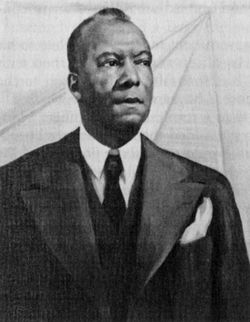
A. Philip Randolph. (Detail from painting by Betsy G. Reyneau.)
Black spokesmen were particularly incensed by the attitude of the Secretary of the Army and his staff. Walter White pointed out that these officials continued to justify segregated units on the grounds that segregation was—he quoted them—"in the interest of national defense." White went to special pains to refute the Army's contention that segregation was necessary because the Army had to conform to local laws and customs. "How," he asked Secretary Forrestal,
The showdown between civil rights organizations and the administration over universal military training never materialized. Faced with chronic opposition to the program and the exigencies of the cold war, the administration quietly shelved universal training and concentrated instead on the reestablishment of the selective service system. When black attention naturally shifted to the new draft legislation, Randolph was able to capitalize on the determination of many leaders in the civil rights movement to defeat any draft law that countenanced the Army's racial policy. Appearing at the Senate Armed Services Committee hearings on the draft bill, Randolph raised the specter of civil disobedience, pledging
to openly counsel, aid, and abet youth, both white and Negro, to quarantine any Jim Crow conscription system, whether it bear the label of universal military training or selective service....
From coast to coast in my travels I shall call upon all Negro veterans to join this civil disobedience movement and to recruit their younger brothers in an organized refusal to register and be drafted....
I shall appeal to the thousands of white youths ... to demonstrate their solidarity with Negro youth by ignoring the entire registration and induction machinery....
This adamant stand should not have surprised the Secretary of Defense. Forrestal could appreciate more than most the pressures operating on the group. In the aftermath of the report of the President's Committee on Civil Rights and in the heightened atmosphere caused by the rhetoric of the Randolph campaign, these men were also caught up in the militants' cause. If they were reluctant to attack the services too severely lest they lose their chance to influence the course of racial events in the department, they were equally reluctant to accept the pace of reform dictated by the traditionalists. In the end they chose to side with their more radical colleagues. Thus despite Lester Granger's attempt to soften the blow, the conference designed to bring the opponents together ended with yet another condemnation of Forrestal's gradualism.
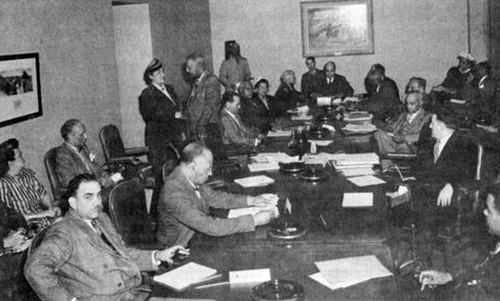
National Defense Conference on Negro Affairs. Conferees prepare to meet with the press, 26 April 1948.
Given the vast size of the Army, it was perfectly feasible to open all training to qualified Negroes and yet continue for years racial practices that had so quickly proved impossible in the Navy's smaller general service. Of course, even in the Army the number of segregated jobs that could be created was limited, and in time Forrestal's tactics might, it could be argued, have succeeded despite the Army's size and the intractability of its leaders. Time, however, was precisely what Forrestal lacked, given the increasing political strength of the civil rights movement.
The proposal for an advisory board proved to be Forrestal's last attempt to change the racial practices of the armed forces through gradualism. In the next few weeks the whole problem would be taken out of his hands by a White House grown impatient with his methods. There, in contrast to the comparatively weak position of the Secretary of Defense, who had not yet consolidated his authority, the full force and power of the Commander in Chief would be used to give a dramatic new meaning to equal treatment and opportunity in the armed forces. Given the temper of the times, Forrestal's surrender was inevitable, for a successful reform program had to show measurable improvements, and despite his maneuvers with the civil rights activists, the Congress, and the services, Forrestal had no success worth proclaiming in his first eight months of office.
This lack of progress disappointed civil rights leaders, who had perhaps overestimated the racial reforms made when Forrestal was Secretary of the Navy. It can be argued that as Secretary of Defense Forrestal himself was inclined to overestimate them. Nevertheless, he could demonstrate some systematic improvement in the lot of the black sailor, enough improvement, according to his gradualist philosophy, to assure continued progress. Ironically, considering Forrestal's faith in the efficacy of education and persuasion, whatever can be counted as his success in the Navy was accomplished by the firm authority he and his immediate subordinates exercised during the last months of the war. Yet this authority was precisely what he lacked in his new office, where his power was limited to only a general control over intransigent services that still insisted on their traditional autonomy.
In any case, by 1948 there was no hope for widespread reform through a step-by-step demonstration of the practicality and reasonableness of integration. Too much of the remaining opposition was emotional, rooted in prejudice and tradition, to yield to any but forceful methods. If the services were to be integrated in the short run, integration would have to be forced upon them.
Executive Order 9981
The historic document, signed by Truman on 26 July 1948, read as follows:
Executive Order 9981
Whereas it is essential that there be maintained in the armed services of the United States the highest standards of democracy, with equality of treatment and opportunity for all those who serve in our country's defense:
Now, therefore, by virtue of the authority vested in me as President of the United States, and as Commander in Chief of the armed services, it is hereby ordered as follows:
1. It is hereby declared to be the policy of the President that there shall be equality of treatment and opportunity for all persons in the armed services without regard to race, color, religion or national origin. This policy shall be put into effect as rapidly as possible, having due regard to the time required to effectuate any necessary changes without impairing efficiency or morale.
2. There shall be created in the National Military Establishment an advisory committee to be known as the President's Committee on Equality of Treatment and Opportunity in the Armed Services, which shall be composed of seven members to be designated by the President.
3. The Committee is authorized on behalf of the President to examine into the rules, procedures and practices of the armed services in order to determine in what respect such rules, procedures and practices may be altered or improved with a view to carrying out the policy of this order. The Committee shall confer and advise with the Secretary of Defense, the Secretary of the Army, the Secretary of the Navy, and the Secretary of the Air Force, and shall make such recommendations to the President and to said Secretaries as in the judgment of the Committee will effectuate the policy hereof.
4. All executive departments and agencies of the Federal Government are authorized and directed to cooperate with the Committee in its work, and to furnish the Committee such information or the services of such persons as the Committee may require in the performance of its duties.
5. When requested by the Committee to do so, persons in the armed services or in any of the executive departments and agencies of the Federal Government shall testify before the Committee and shall make available for the use of the Committee such documents and other information as the Committee may require.
6. The Committee shall continue to exist until such time as the President shall terminate its existence by Executive Order.
Harry S. Truman
The White House July 26, 1948
These were the men with whom, for a time at least, the Secretary of Defense would share his direction over the racial policies of the armed forces.