CHAPTER 22
Reading edition
Equal Opportunity in the Military Community
When Secretary McNamara issued his equal opportunity directive in 1963, all segregated public accommodations, schools, and even housing near military reservations became potential targets of the Department of Defense's integration drive. This change in policy was substantive, but the traditionalists who feared the sudden intrusion of the services into local community affairs and the reformers who later charged McNamara with procrastination missed the point. More than a declaration of racial principles, the directive was a guideline for the progressive application of a series of administrative pressures. Endorsing the Gesell Committee's concept of command responsibility, McNamara enjoined the local commander to oppose discrimination and foster equal opportunity both on and off the military base. He also endorsed the committee's recommendation for the use of economic sanctions in cases where voluntary compliance could not be obtained. By demanding the approval of the service secretaries for the use of sanctions, McNamara served notice that this serious application of the commander's authority would be limited and infrequent. He avoided altogether the committee's call for closing military bases.
In the weeks and months following publication of the equal opportunity directive, official replies to the demands and complaints of black servicemen and their allies in the civil rights organizations continued to be carefully circumscribed. Whatever skepticism such restricted application of the Gesell recommendations may have produced among the civil rights leaders, the department found itself surprisingly free from outside pressure. It was able to set the pace of its own reform and to avoid meanwhile a clash with either reformers or segregationists over major civil rights issues of the day.
Creating a Civil Rights Apparatus
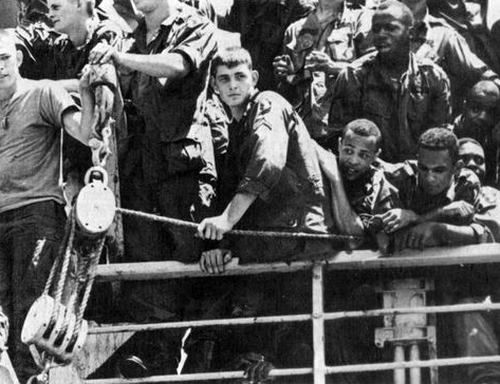
Arriving in Vietnam. 101st Airborne Division troops aboard the USNS General Le Roy Eltinge.
Only the Army's outline plan explicitly adopted the committee's controversial recommendation that "the effective performance of commanders in this area will be considered along with other responsibilities in determining his overall manner of duty performance." The Navy equivocated. Commanders would "monitor continually racial matters with a goal toward improvement." The Inspectors General of the Navy and Marine Corps were "instructed to appraise" all command procedures. The Air Force expected base base commanders to concern themselves with the welfare nondiscriminatory treatment of its servicemen when they were away from the base, but it left them considerable freedom in the matter. "The military mission is predominant," the Air Force announced, and the local commander must be given wide latitude in dealing with discrimination cases since "each community presented a different situation for which local solutions must be developed."
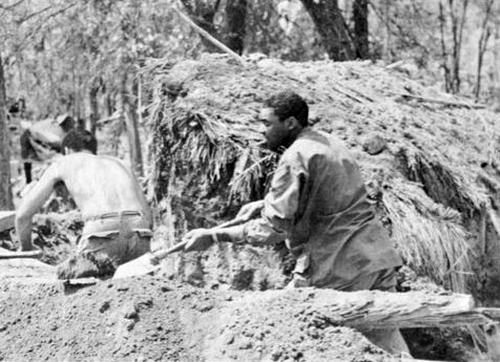
Digging In. Men of M Company, 7th Marines, construct a defense bunker during "Operation Desoto," Vietnam.
There were several reasons for the delay. The first was the protracted congressional debate over the civil rights bill. Some service officials strongly supported the stand that off-base complaints of black servicemen were chiefly the concern of the Justice Department. On a more practical level, however, the Department of Defense was reluctant to issue new directives while legislation bearing directly on discrimination affecting servicemen was being formulated. Accepting these arguments, Paul postponed the services' submission of new regulations and manuals until the act assumed final form.
Fighting Discrimination Within the Services
The immediate test for the services' belatedly organized civil rights apparatus was the racial discrimination lingering within the armed forces themselves. The Civil Rights Commission and the Gesell Committee had been concerned with the exceptions to the services' generally satisfactory equal opportunity record. It was these exceptions, such chronic problems as underrepresentation of Negroes in some services, in the higher military grades, and in skilled military occupations, that continued to concern the Defense Department civil rights organization and the services as they tried to carry out McNamara's directive. Seemingly minor compared to the discrimination faced by black servicemen outside the military reservation, racial problems within the military family and how the services dealt with them would have direct bearing on the tranquility of the armed forces in the 1970's.
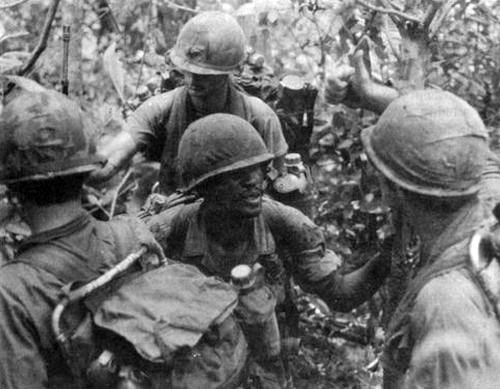
Listening To the Squad Leader. Men of Company D, 21st Infantry, prepare to move out, Quang Tin Province, Vietnam.
The services were unable to bring off a dramatic change in black enlistment patterns in the 1960's. With the exception of the Marine Corps, in which the proportion of black enlisted men increased 4 percent, the percentage of Negroes in the services remained relatively stationary between 1962 and 1968 (Table 24). In 1968, when Negroes accounted for 11 percent of the American population, their share of the enlisted service population remained at 8.2, with significant differences among the services. Nor did there seem much chance of increasing the number of black servicemen since the percentage of Negroes among draftees and first-time enlistees was rising very slowly while black reenlistment rates, for some twenty years a major factor in holding black strength steady, began to decline (Table 25). Actually, enlistment figures for both whites and blacks declined, a circumstance usually attributed to the unpopularity of the Vietnam War, although in the midst of the war, in 1967, black first-term reenlistment rates continued to exceed white rates 2 to 1.
Table 24—Black Percentages, 1962-1968
Year Army Navy Marine Corps Air Force
Officers Enlisted Men Officers Enlisted Men Officers Enlisted Men Officers Enlisted Men
1962 3.2 12.2 .2 5.2 .2 7.6 1.2 9.2
1964 3.4 13.4 .3 5.8 .4 8.7 1.5 10.0
1965 3.5 13.9 .3 5.8 .4 8.7 1.6 10.7
1967 3.4 12.1 .3 4.7 .7 10.3 1.8 10.4
1968 3.3 12.6 .4 5.0 .9 11.5 1.8 10.2
Source: Records of ASD (M) 291.2.
Table 25—Rates for Reenlistments, 1964-1967
Year Army Navy Marine Corps Air Force
White Black White Black White Black White Black
1964 18.5 49.3 21.6 41.3 12.9 25.1 27.4 50.3
1965 13.7 49.3 24.2 44.8 18.9 38.9 19.1 39.2
1966 20.0 66.5 17.6 24.7 10.5 19.5 16.0 30.1
1967 12.9 31.7 16.7 22.5 10.7 17.4 17.3 26.9
Source: Records of ASD (M) 291.2; see especially Paul Memo.
Table 26—Black Attendance at the Military Academies, July 1968
Academy Class of 1969 Class of 1970 Class of 1971 Class of 1972 Total Negro Total Attendance
Army 10 7 5 9 31 3,285
Navy 2 8 8 15 33 4,091
Air Force 6 10 13 23 52 3,028
Totals 18 25 26 47 116
Source: Office, Deputy Assistant Secretary of Defense (Civil Rights).
Table 27—Army and Air Force Commissions Granted at Predominantly Black Schools
Army Commissions
School Class of 1964 Class of 1965 Class of 1966 Class of 1967
A&T College, N.C. 24 22 10 17
Central State College, Ohio 29 14 26 25
Florida A&M College 29 15 23 15
Hampton University, Va. 29 34 20 19
Lincoln University, Pa. 19 14 16 19
Morgan State College, Md. 21 27 12 16
Prairie View A&M College, Tex. 20 27 31 38
South Carolina State College 16 23 24 24
Southern University, La. 23 37 19 21
Tuskegee Institute, Ala. 14 14 20 26
Virginia State College 21 14 18 21
West Virginia State College 22 19 15 14
Howard University, Washington, D.C. 19 37 30 23
Total 286 297 264 278
Percentage of total such commissions granted 2.4 2.7 2.5 2.6
Army Commissions
School Class of 1964 Class of 1965 Class of 1966
A&T College, N.C. 12 10 33
Howard University, Washington, D.C. 24 31 23
Maryland State College 2 4 4
Tennessee A&I University 13 26 32
Tuskegee Institute, Ala. 14 33 41
Total 65 104 133
Source: Office, Deputy Assistant Secretary of Defense (Civil Rights).
Chance of promotion for officers and men was one factor in judging equal treatment and opportunity in the services. A statistical comparison of the ranks of enlisted black servicemen between 1964 and 1966 reveals a steady advance (Table 28). With the exception of the Air Force, the percentage of Negroes in the higher enlisted ranks compared favorably with the total black percentage in each service. The advance was less marked for officers, but here too the black share of the O-4 grade (major or lieutenant commander) was comparable with the black percentage of the service's total strength. The services could declare with considerable justification that reform in this area was necessarily a drawn-out affair; promotion to the senior ranks must be won against strong competition.
Table 28—Percentage of Negroes in Certain Military Ranks, 1964-1966
E-6 (Staff Sergeant or Petty Officer, First Class)
1964 1965 1966
Army 13.9 15.5 18.1
Navy 4.7 5.0 5.6
Marine Corps 5.0 5.3 10.4
Air Force 5.3 5.6 6.6
O-4 (Major or Lieutenant Commander)
Army 3.6 4.5 5.2
Navy 0.3 0.3 0.3
Marine Corps 0.3 0.3 0.2
Air Force 0.8 0.9 1.6
Source: Office, Deputy Assistant Secretary of Defense (Civil Rights).
Since promotion in the military ranks depended to a great extent on a man's skills, training in and assignment to vital job categories were important to enlisted men. Here, too, the statistics revealed that the percentage of Negroes in the technical occupations, which had begun to rise in the years after Korea, had continued to increase but that a large proportion still held unskilled or semiskilled military occupational specialties (Table 29). Eligibility for the various military occupations depended to a great extent on the servicemen's mental aptitude, with men scoring in the higher categories usually winning assignment to technical occupations. When the Army began drafting large numbers of men in the mid-1960's, the number of men in category IV, which included many Negroes, began to go up. Given the fact that many Negroes with the qualifications for technical training were ignoring the services for other vocations while the less qualified were once again swelling the ranks, the Department of Defense could do little to insure a fair representation of Negroes in technical occupations or increase the number of black soldiers in higher grades. The problem tended to feed upon itself. Not only were the statistics the bane of civil rights organizations, but they also influenced talented young blacks to decide against a service career, in effect creating a variation of Gresham's law in the Army wherein men of low mentality were keeping out men of high intelligence. There seemed little to be done, although the department's civil rights office pressed the services to establish remedial training for category IV men so that they might become eligible for more technical assignments.
Table 29—Distribution of Servicemen in Occupational Groups by Race, 1967
Group / Activity White Black Unknown Total
Number Percent Dist. Number Percent Dist. Percent of Total in Each Group / Activity Number Number
Combat troops 324,560 12.1 55,518 18.7 14.5 2,646 382,724
Electronics
repairmen 239,595 9.0 13,843 4.7 5.5 204 253,642
Communications
specialists 191,372 7.2 12,856 4.4 6.3 392 204,620
Medical personnel 101,793 3.8 11,074 3.8 9.8 76 112,943
Other technicians 52,132 1.9 3,812 1.3 6.8 86 56,030
Administrative
personnel 430,186 16.1 55,543 18.8 11.4 986 486,715
Mechanical
repairmen 498,899 18.6 39,820 13.5 7.4 794 539,513
Draftsmen 144,070 5.4 15,728 5.3 9.8 248 160,046
Service & supply
personnel 283,976 10.6 53,136 18.0 15.7 998 338,110
Miscellaneous / unknown 245,055 9.1 14,964 5.1 13.5 1,337 261,356
Trainees[a] 166,478 6.2 18,753 6.4 10.1 1,194 186,425
Total 2,678,116 100.0 295,047 100.0 9.9 8,961 2,982,124
Tablenote a: Represents an Army category only.
Source: Bahr, "The Expanding Role of the Department of Defense As an Instrument of Social Change." Bahr's table is based on unpublished data from the DASD (CR).
If a man's assignment and promotion depended ultimately on his aptitude category, that category depended upon his performance in the Armed Forces Qualifying Test and other screening tests usually administered at induction. These tests have since been widely criticized as being culturally biased, more a test of an individual's understanding of the majority race's cultural norms than his mental aptitude. Even the fact that the tests were written also left them open to charges of bias. Some educational psychologists have claimed that an individual's performance in written tests measured his cultural and educational background, not his mental aptitude. It is true that the accuracy of test measurements was never reassessed in light of the subsequent performance of those tested. The services paid little attention to these serious questions in the 1960's, yet as a Defense Department task force studying the administration of military justice was to observe later:
The Department of Defense depended on the "limited predictive capability of these tests," the task force charged, in deciding whether a serviceman was assigned to a "soft core" field, that is, given a job in such categories as transportation or supply, or whether he could enter one of the more profitable and prestigious "hard core" fields that would bring more rapid advancement.
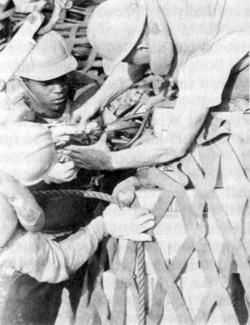
Supplying the Seventh Fleet. USS Procyon crewmen rig netload of supplies for a warship.
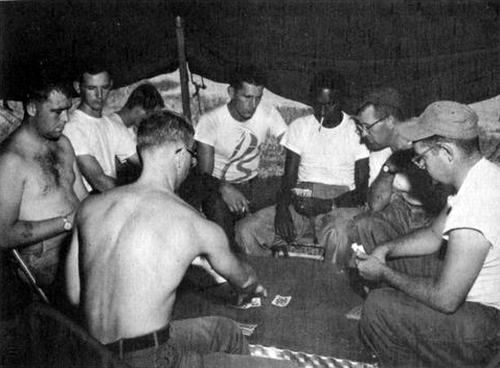
USAF Ground Crew, Tan Son Nhut Air Base, Vietnam, relaxes over cards in the alert tent.
The sense of satisfaction that pervaded Fitt's comment, however understandable, was lamentable because it helped insure that certain inequities in the military community would linger. The failure of Negroes to win skilled job assignments and promotions, for example, would remain to fester and contribute significantly to the bitterness visited upon a surprised Department of Defense in later years. In brief, because the services had become a model of racial equality when judged by contemporary standards, the impulse of almost all concerned was to play down the reforms still needed on base and turn instead to the pressing and spectacular challenges that lay in wait outside the gates.