CHAPTER 19
Reading edition
A New Era Begins
The new era's turbulence was caused in part by the decade-long debate that immediately ensued over the scope of President Truman's guarantee of equal treatment and opportunity for servicemen. On one side were ranged most service officials, who argued that integration, now a source of pride to the services and satisfaction to the civil rights movement, had ceased to be a public issue. Abolishing segregated units, they claimed, fulfilled the essential elements of the executive order, leaving the armed forces only rare vestiges of discrimination to correct. Others, at first principally the civil rights bloc in Congress and civil rights organizations, but later black servicemen themselves, contended that the Truman order committed the Department of Defense to far more than integration of military units. They believed that off-base discrimination, so much more apparent with the improvement of on-base conditions, seriously affected morale and efficiency. They wanted the department to challenge local laws and customs when they discriminated against black servicemen.
This interpretation made little headway in the Department of Defense during the first decade of integration. Both the Eisenhower and Kennedy administrations made commitments to the principle of equal treatment within the services, and both admitted the connection between military efficiency and discrimination, but both presumed, at least until 1963, severe limitations on their power to change local laws and customs. For their part, the services constantly referred to the same limitations, arguing that their writ in regard to racial reform ran only to the gates of the military reservation.
Yet while there was no substantive change in the services' view of their racial responsibilities, the Department of Defense was able to make significant racial reforms between 1954 and 1962. More than expressing the will of the Chief Executive, these changes reflected the fact that military society was influenced by some of the same forces that were operating on the larger American society. Possessed of a discipline that enabled it to reform rapidly, military society still shared the prejudices as well as the reform impulses of the body politic. Racial changes in the services during the first decade of integration were primarily parochial responses to special internal needs; nevertheless, they took place at a time when civil rights demands were stirring the whole country. Their effectiveness must be measured against the expectations such demands were kindling in the black community.
The Civil Rights Revolution
The difference was understandable. The rapid urbanization of many black Americans, coupled with their experience in World War II, especially in the armed forces and in defense industries, had enhanced their economic and political power and raised their educational opportunities. And what was true for the war generation was even truer for its children. Possessed of a new self-respect, young Negroes began to demonstrate confidence in the future and a determination to reject the humiliation of second-class citizenship. Out of this attitude grew a widespread demand among the young for full equality, and when this demand met with opposition, massive participation in civil rights demonstrations became both practical and inevitable. Again historian Woodward's observations are pertinent:
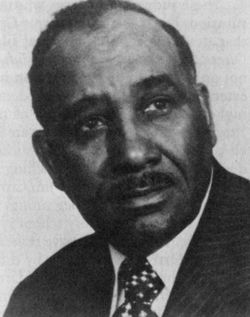
Clarence Mitchell
To a remarkable extent, this youthful vanguard was strongly religious and nonviolent. The influence of the church on the militant phase of the civil rights movement is one of the movement's salient characteristics.
This black awakening paralleled a growing realization among an increasing number of white Americans that the demands of the civil rights leaders were just and that the government should act. World War II had made many thoughtful Americans aware of the contradiction inherent in fighting fascism with segregated troops. In the postwar years, the cold war rivalry for the friendship and allegiance of the world's colored peoples, who were creating a multitude of new states, added a pragmatic reason for ensuring equal treatment and opportunity for black Americans. A further inducement, and a particularly forceful one, was the size of the northern black vote, which had become the key to victory in several electorally important states and had made the civil rights cause a practical political necessity for both major parties.
Independent federal agencies also began to attack racial discrimination. The Interstate Commerce Commission, with strong assistance from the courts, made a series of rulings that by 1961 had outlawed segregation in much interstate travel. The Federal Housing Authority, following the Supreme Court's abrogation of the state's power to enforce restrictive covenants in the sale of housing, began in the early 1950's to push toward a federal open-occupancy policy in public housing and all housing with federally guaranteed loans. The U.S. Commission on Civil Rights, an investigatory agency appointed by the President under the Civil Rights Act of 1957, examined complaints of voting discrimination and denials of equal protection under the law. Both Eisenhower and Kennedy dispatched federal officials to investigate and prosecute violations of voting rights in several states.
Despite the President's reluctance to lead in civil rights matters, major blame for the lack of substantial progress must be assigned to the third branch of government. The 1957 and 1960 civil rights laws, pallid harbingers of later powerful legislation in this field, demonstrated Congress's lukewarm commitment to civil rights reform that severely limited federal action. The reluctance of Congress to enact the reforms augured in the Brown decision convinced many Negroes that they would have to take further measures to gain their full constitutional rights. They had seen presidents and federal judges embrace principles long argued by civil rights organizations, but to little avail. Seven years after the Brown decision, Negroes were still disfranchised in large areas of the south, still endured segregated public transportation and places of public accommodation, and still encountered discrimination in employment and housing throughout the nation. Nor had favorable court decisions and federal attempts at enforcement reversed the ominous trend in black unemployment rates, which had been rising for a decade. Above all, court decisions could not spare Negroes the sense of humiliation that segregation produced. Segregation implied racial inferiority, a "constant corroding experience," as Clarence Mitchell once called it. It was segregation's seeming imperviousness to governmental action in the 1950's that caused the new generation of civil rights leaders to develop new civil rights techniques.
Their new methods forced the older leaders, temporarily at least, into eclipse. No longer could they convince their juniors of the efficacy of legal action, and the 1950's ended with the younger generation taking to the streets in the first spontaneous battles of their civil rights revolution. Under the direction of the Southern Christian Leadership Council and its charismatic founder, Martin Luther King, Jr., the strategy of massive civil disobedience, broached in 1948 by A. Philip Randolph, became a reality. Other organizations quickly joined the battle, including the Student Nonviolent Coordinating Committee (SNCC), also organized by Dr. King but soon destined to break away into more radical paths, and the Congress of Racial Equality (CORE), an older organization, now expanded and under its new director, James Farmer, rededicated to activism.
The stage was set for a climatic scene, and onto that stage walked the familiar figure of A. Philip Randolph, calling for a massive march on Washington to demand a redress of black grievances. This time, unlike the response to his 1940 appeal, the answer was a promise of support from both races. The churches joined in, many labor leaders, including Walter Reuther, enlisted in the demonstration, and even the President, at first opposed, gave his blessing to the national event. A quarter of a million people, about 20 percent of them white, marched to the Lincoln Memorial on 28 August 1963 to hear King appeal to the nation's conscience by reciting his dream of a just society. In the words of the Kerner Commission:
Limitations on Executive Order 9981
The decade of national civil rights activity that culminated symbolically at the Lincoln Memorial in 1963 was closely mirrored in the Department of Defense, where the services' definition of equal treatment and opportunity underwent a marked evolution. Here, a decade that had begun with the department's placing severe limitations on its defense of black servicemen's civil rights ended with the department's joining the vanguard of the civil rights movement.
This requirement could be rather brutal in practice and placed the services, the nation's leading equal opportunity employer, in questionable company. In 1953 a black pilot stationed at Craig Air Force Base, Alabama, refused to move to the rear of a public bus until the military police ordered him to comply with the state law. The Air Force officially reprimanded and eventually discharged the pilot. The position of the Air Force was made clear in the reprimand:
Tact and diplomacy were also the keynote when the services helped enforce the local segregation practices of the nation's allies. This became increasingly true even in Europe in the 1950's, although never with as much publicity as the events connected with the carrier Midway's visit to Capetown, South Africa, in 1955. Its captain, on the advice of the U.S. consul, agreed to conform with a local law that segregated sailors when they were ashore. This agreement became public knowledge while the ship was en route, but despite a rash of protests and congressional demands that the visit be canceled, the Midway arrived at Capetown. Later a White House spokesman tried to put a good face on the incident:
The President's heart bleeds when any Americans are victims of injustice, and he is doing everything he possibly can to rectify this situation in our country.
But as the record suggests, this promise to rectify the situation was never meant to extend beyond the gates of the military reservation. Thus, the countless incidents of blatant discrimination encountered by black GI's would continue largely unchallenged into the 1960's, masking the progress made by the Eisenhower administration in ordering the sometimes reluctant services to adopt reforms. This presidential resolution was particularly obvious in the integration of civilian facilities at Navy shipyards and installations and in schools for dependent children on military posts.
Integration of Navy Shipyards
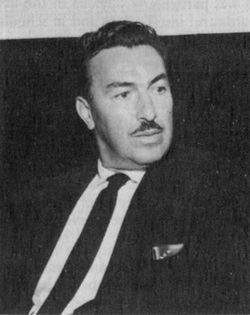
Congressman Powell
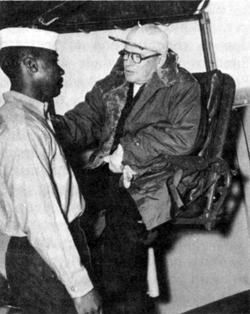
Secretary Anderson talks to a member of the fleet.
Anderson then proceeded to reverse his position. He began by ordering a survey of a group of southern installations to estimate the effect of integration on their civilian programs. He learned segregation could be virtually eliminated at these shipyards and stations within six months, although Under Secretary Charles S. Thomas, who prepared the report, agreed with the local commanders that an integration directive would be certain to cause trouble. But the formula chosen by the commanders for eliminating segregation, in which Thomas concurred, might well have given Anderson pause. They wanted to remove racial signs from drinking fountains and toilets, certain that the races would continue using separate facilities, and leave the problem of segregated cafeterias till later. It was the unanimous opinion of those involved, Thomas reported, that the situation should not be forced by "agitators," a category in which they all placed Powell.
Dependent Children and Integrated Schools
The Department of Defense's effort to integrate schools attended by servicemen's children proved infinitely more complex than integrating naval shipyards. In a period when national attention was focused on the constitutional implications of segregated education, the Eisenhower administration was thrust into a dispute over the intent of federal aid to education and eventually into a reappraisal of the federal role in public education. Confusing to the Department of Defense, the President's personal attitude remained somewhat ambiguous throughout the controversy. He had publicly committed himself to ending segregation in federally financed institutions, yet he had declared scruples against federal interference with state laws and customs that would prevent him from acting to keep such a pledge when all its ramifications were revealed.
In fact not one but four separate categories of educational institutions came under scrutiny. Only the first category, schools run by the U.S. Office of Education for the Department of Defense overseas and on military reservations in the United States, operated exclusively with federal funds. The next two categories, schools operated by local school districts on military reservations and schools on federal land usually adjacent to a military reservation, were supported by local and state funds with federal subsidies. The fourth and by far the largest group contained the many community schools attended by significant numbers of military dependents. These schools received considerable federal support through the impact aid program.
The matter was rescued from bureaucratic limbo when in answer to a question during his 19 March 1953 press conference President Eisenhower promised to investigate the school situation, adding:
The integration of schools operated by local school authorities on military posts was not so simple, and before the controversy died down the Department of Defense found itself assuming responsibility for a number of formerly state-operated institutions. As of April 1953, twenty-one of these sixty-three schools in the United States were operating on a segregated basis. (Table 12)
Table 12—Defense Installations With Segregated Public Schools
State Installation
Alabama (C)[1] Maxwell Air Force Base
Craig Air Force Base
Arkansas (S)[2] Pine Bluff Arsenal (Army)
Florida (C) MacDill Air Force Base
Eglin Air Force Base
Tyndall Air Force Base
Naval Air Station, Pensacola
Patrick Air Force Base
Maryland (S) Andrews Air Force Base
Naval Air Station, Patuxent
Naval Powder Factory, Indianhead
Oklahoma (C) Fort Sill (Army)
Texas (C) Fort Bliss (Army)
Fort Hood (Army)
Fort Sam Houston (Army)
Randolph Air Force Base
Reese Air Force Base
Shepherd Air Force Base
Lackland Air Force Base
Virginia (C) Fort Belvoir (Army)
Langley Air Force Base
Tablenote 1: (C) indicates segregation required by state constitution. Tablenote 2: (S) indicates segregation required by state statute.
The three services quickly responded to the order. By 18 February all had issued specific directives for enforcing it. The Secretary of the Navy, for example, declared that the "policy of non-segregation" would apply
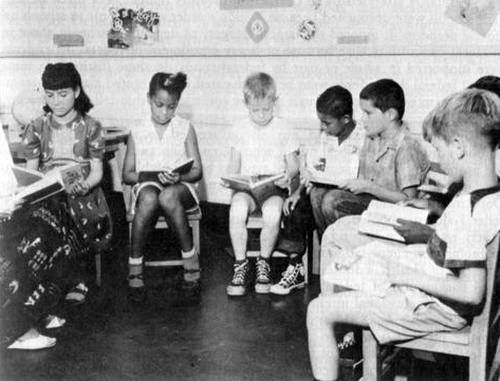
Reading Class in the Military Dependents School, Yokohama, Japan, 1955.