CHAPTER 16
Reading edition
Integration in the Air Force and the Navy
The racial reforms instituted by the four services between 1949 and 1954 demonstrated that integration was to a great extent concerned with effective utilization of military manpower. In the case of the Army and the Marine Corps the reforms would be delayed and would occur, finally, on the field of battle. The Navy and the Air Force, however, accepted the connection between military efficiency and integration even before the Fahy Committee began to preach the point. Despite their very dissimilar postwar racial practices, the Air Force and the Navy were facing the same problem. In a period of reduced manpower allocations and increased demand for technically trained men, these services came to realize that racial distinctions were imposing unacceptable administrative burdens and reducing fighting efficiency. Their response to the Fahy Committee was merely to expedite or revise integration policies already decided upon.
The Air Force, 1949-1951
The Air Force Commanders' Conference, assembled on 12 April 1949, heard Lt. Gen. Idwal Edwards, the Deputy Chief of Staff for Personnel, explain the genesis of the integration plan and outline its major provisions. He mentioned two major steps to be taken in the first phase of the program. First, the 332d Fighter Wing would be inactivated on or before 30 June, and all blacks would be removed from Lockbourne. The commander of the Continental Air Command would create a board of Lockbourne officers to screen those assigned to the all-black base, dividing them into three groups. The skilled and qualified officers and airmen would be reassigned worldwide to white units "just like any other officers or airmen of similar skills and qualifications." General Edwards assumed that the number of men in this category would not be large. Some 200 officers and 1,500 airmen, he estimated, would be found sufficiently qualified and proficient for such reassignment. He added parenthetically that Colonel Davis understood the "implications" of the new policy and intended to recommend only an individual "of such temperament, judgment, and common sense that he can get along smoothly as an individual in a white unit, and second, that his ability is such as to warrant respect of the personnel of the unit to which he is transferred."
The technically unqualified but still "usable" men would be reassigned to black service units. The staff recognized, General Edwards added, that some Negroes were unsuited for assignment to white units for "various reasons" and had specifically authorized the retention of "this type of Negro" in black units. Finally, those who were found neither qualified nor useful would be discharged under current regulations.
The second major action would be taken at the same time as the first. All commands would similarly screen their black troops with the object of reassigning the skilled and qualified to white units and eliminating the chronically unqualified. At the same time racial quotas for recruitment and school attendance would be abolished. Henceforth, blacks would enter the Air Force under the same standards as whites and would be classified, assigned, promoted, or eliminated in accordance with rules that would apply equally to all. "In other words," Edwards commented, "no one is either helped or hindered because of the color of his skin; how far or how fast each one goes depends upon his own ability." To assure equal treatment and opportunity, he would closely monitor the problem. Edwards admitted that the subject of integrated living quarters had caused discussion in the staff, but based on the Navy's years of good experience with integrated quarters and bolstered by the probability that the number of Negroes in any white unit would rarely exceed 1 percent, the staff saw no need for separate sleeping accommodations.
General Edwards reminded the assembled commanders that, while integration was new to the Air Force, the Navy had been following a similar policy for years, encountering no trouble, even in the Deep South where black troops as well as the nearby civilian communities understood that when men left the base they must conform to the laws and customs of the community. And as a parting shot he made the commanders aware of where the command responsibility lay:
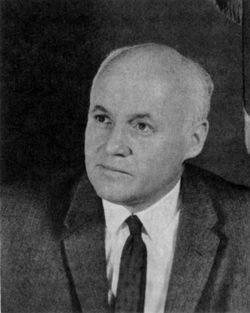
Assistant Secretary Zuckert
Concurrently with the Lockbourne processing, individual commanders established similar screening procedures wherever black airmen were then assigned. All these teams uncovered a substantial number of men and women considered eligible for further training or reassignment. (Table 4)
Table 4—Disposition of Black Personnel at Eight Air Force Bases, 1949
Percentages
Base Total Tested Asgmt to Instr Duty Asgmt to Tech School Asgmt to Present MOS Recom for Board Action
Lockbourne
Male 970 .32 12.08 64.64 22.98
Female 58 0.00 25.86 55.17 18.97
Lackland 247 1.62 20.65 67.61 10.12
Barksdale 158 0.00 20.25 65.82 13.93
Randolph 252 2.38 26.19 57.14 14.29
Waco 146 2.06 30.14 57.53 10.27
Mather 126 .79 27.78 40.48 30.95
Williams 144 8.33 21.53 39.58 30.56
Goodfellow 122 .82 36.89 40.89 21.31
Total 2,223 1.35 19.61 59.20 19.84
Source: President's Cmte on Equality of Treatment and Opportunity in the Armed Forces, "A First Report on the Racial Integration Program of the Air Force," 6 Feb 50, FC file.
The process of screening Lockbourne's troops was quickly completed, but the process of reassigning them was considerably more drawn-out. The reassignments were somewhat delayed in the first place by indecision, caused by budgetary uncertainties, on the future of Lockbourne itself. By 25 July, a full two months after the screening began, the Lockbourne board had recommended only 181 officers and 700 airmen to Air Force headquarters for new assignment. A short time later, however, Lockbourne was placed on inactive status and its remaining men and women, with the exception of a small caretaker detachment, were quickly reassigned throughout the Air Force.
Table 5—Racial Composition of Air Force Units
Month Black Units Integrated Units Negroes Assigned to Black Units Negroes Assigned to Integrated Units[1]
1949
June 106 167 Not available Not available
July 89 350 14,609 7,369
August 86 711 11,921 11,977
September 91 863 11,521 13,290
October 88 1,031 9,522 15,980
November 75 1,158 8,038 17,643
December 67 1,253 7,402 18,489
1950
January 59 1,301 6,773 18,929
February 36 1,399 5,511 20,654
March 26 1,476 5,023 20,938
April 24 1,515 4,728 20,793
May 24 1,506 4,675 21,033
Tablenote 1: Figures extracted from the Marr Report; see also monthly reports on AF integration, for example Memo, Dir, Pers Plng, for Osthagen (SecAF office), 10 Mar 50, sub: Distribution of Negro Personnel, SecAF files.
Despite the predictions of some analysts, the effect of integration on black recruitment proved to be negligible. In a service whose total strength remained about 415,000 men during the first year of integration, Negroes numbered as follows (Table 6):
Table 6—Black Strength in the Air Force
Date Officer Strength[1] Enlisted Strength[1] Percentage of Air Force Strength
December 1948 Not available Not available 6.5
June 1949 319 (47) 21,782 (2,196) 6.0
August 1949 330 (32) 23,568 (2,275) 6.5
December 1949 368 (18) 25,523 (3,072) 7.2
May 1950 341 (8) 25,367 (2,611) 7.1
Tablenote 1: Includes in parentheses the Special Category Army Personnel with Air Force (SCARWAF), those soldiers assigned for duty in the Air Force but still administratively under the segregated Army, leftovers from the Department of Defense reorganization of 1947. Figures extracted from Marr Report.
The Air staff explained that the slight surge in black recruits in the early months of integration was related less to the new policy than to the abnormal recruiting conditions of the period. In addition to the backlog of Negroes who for some time had been trying to enlist only to find the Air Force quota filled, there were many black volunteers who had turned to the quota-free Air Force when the Army, its quota of Negroes filled for some time, stopped recruiting Negroes.
Table 7—Racial Composition of the Training Command, December 1949
A. Flight Training White Black Percent Black
Officers 1,345 11 .8
Enlisted 3,063 22 1.0
Total 3,408 33 .9
B. Technical Training
Officers 1,897 37 1.9
Enlisted 25,838 1,819 6.5
Total 27,735 1,856 6.0
C. Indoctrination (Basic) Training
White 7,649
Black 1,007
Total 8,656
Percent black 11.6[a]
D. Officers Candidate Training (candidates graduating from 28 November through 26 December 1949)
White 225
Black 7
Total 232
Percent black 3.0
E. Course Representation
Base No. of Courses[b] No. of Courses with Blacks
Chanute 31 21
Warren 11 10
Keesler 16 7
Lowry 23 13
Scott 6 4
Sheppard 4 1
Tablenote a: In January 1950, probably as a result of a decline in backlog and the raising of enlistment standard to GCT 100, this percentage dropped to 8.8. Tablenote b: Negroes in 61 percent of the courses offered as of 26 Dec 1949.
Source: Kenworthy Report.
There were several reasons for the universal application of what was conceived as a limited program. First, the Air Force was in a sense the captive of its own publicity. While Secretary Symington had carefully delineated the limits of his departmental plan for the Personnel Policy Board in January 1949, he was carried considerably beyond these limits when he addressed President Truman in the open forum of the Fahy Committee's first formal meeting:
The more favorable the publicity garnered by the plan in succeeding months, the weaker the distinction became between the limited integration of black specialists and total integration. Reinforcing the favorable publicity were the monthly field reports that registered a steady drop in the number of black units and a corresponding rise in the number of integrated black airmen. This well-publicized progress provided another, almost irresistible reason for completing the task.
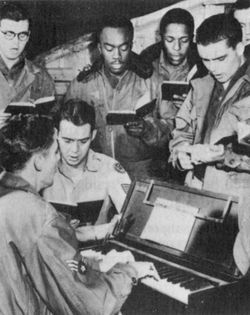
Music Makers of the U.S. Far East Air Force prepare to celebrate Christmas, Korea, 1950.
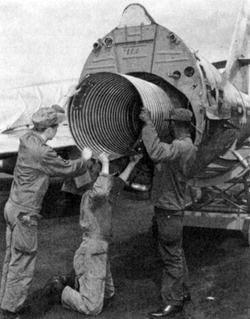
Maintenance Crew, 462d Strategic Fighter Squadron, disassembles aft section of an F-84 Thunderstreak.
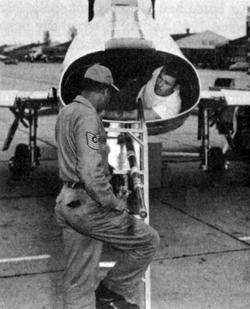
Jet Mechanics work on an F-100 Supersabre, Foster Air Force Base, Texas.
The Navy and Executive Order 9981
Despite these well-intentioned efforts, the Navy failed to increase significantly the number of black officers or sailors in the next decade (Table 8). The percentage of Negroes in the Navy increased so slowly that not until 1955, in the wake of the great manpower buildup during the Korean War, did it exceed the 1949 figure. Although the percentage of black enlistments increased significantly at times—approximately 12 percent of all enlistments in 1955 were black, for example—the proportion of Negroes in the Navy's enlisted ranks was only 0.4 percent higher in 1960 than in 1949. While the number of black officers increased more than sevenfold in the same decade, it was still considerably less than 1 percent of the total officer strength, well below Army and Air Force percentages.
Table 8—Black Manpower, U.S. Navy
A. Enlisted Strength
Year Total Strength Black Strength Percent Black
1949 363,622 17,051 4.5
1950 329,114 14,858 3.7
1951 656,371 17,604 2.7
1952 728,511 23,010 3.2
1953 698,367 24,734 3.5
1954 635,103 24,236 3.8
1955 574,157 30,623 5.3
1956 586,782 37,308 6.3
1957 593,022 38,222 6.4
1958 558,955 30,978 5.7
1959 547,236 30,098 5.5
1960 544,323 26,760 4.9
B. Percentage of Blacks Enlisted in Steward's and Other Branches
Year Steward's Branch Other Branches
1949 65.12 34.88
1950 57.07 42.93
1951 51.73 48.27
1952 54.95 45.05
1953 51.73 48.27
1954 53.43 48.57
1955 51.19 48.81
1956 25.38 74.62
1957 21.66 78.34
1958 23.35 76.65
C. Officer Strength (Selected Years)
Year Black Officers on Active Duty Total Officers
1949 19 45,464
1951 23 66,323
1953 53 78,095
1955 81 71,591
1960 149
Source: BuPers, Personnel Statistics Branch. See especially BuPers, "Memo on Discrimination of the Negro," 24 Jan 59, BAF2-014. BuPers Technical Library. All figures represent yearly averages.
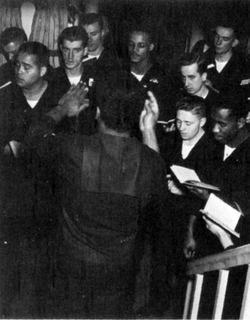
Christmas in Korea, 1950
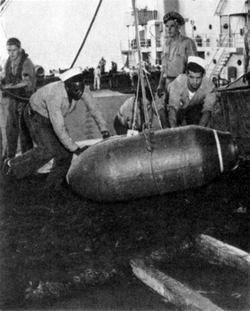
Rearming At Sea. Ordnancemen at work on the deck of the USS Philippine Sea, off Korea, October 1950.
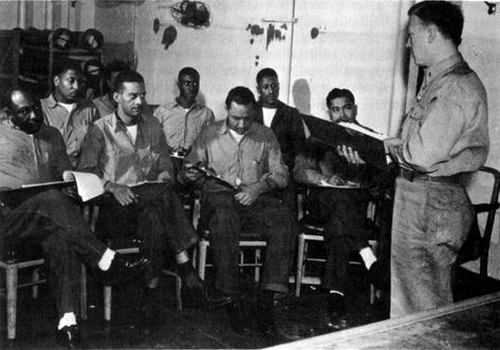
Broadening Skills. Stewards on the USS Valley Forge volunteer for classes leading to advancement in other fields, Korea, 1950.
The group acknowledged that the Steward's Branch was a "sore spot with the Negroes, and is our weakest position from the standpoint of Public Relations," and two of their recommendations were obviously aimed at immediate improvement of public relations. Combining the messmen and commissary specialists would of course create an integrated branch, which Granger estimated would be only 20 percent black, and would probably provide additional opportunities for promotions, but in the end it could not mask the fact that a high proportion of black sailors were employed in food service and valet positions. Nor was it clear how changing the familiar crescent insignia, symbolic of the steward's duties, would change the image of a separate group that still performed the most menial duties. Long-term reform, everyone agreed, demanded the presence of a significant number of whites in the branch, and there was strong evidence that the general service contained more than a few group IV white sailors. The group's proposal to abolish separate recruiting would probably increase the number of blacks in the general service and eliminate the possibility that unsuspecting black recruits would be dragooned into a messman's career; both were substantial reforms but did not guarantee that whites would be attracted or assigned to the branch.
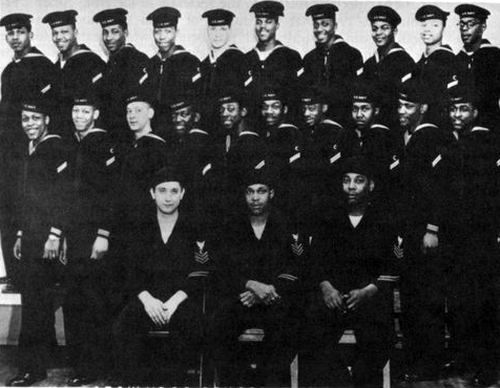
Integrated Stewards Class Graduates, Great Lakes, 1953
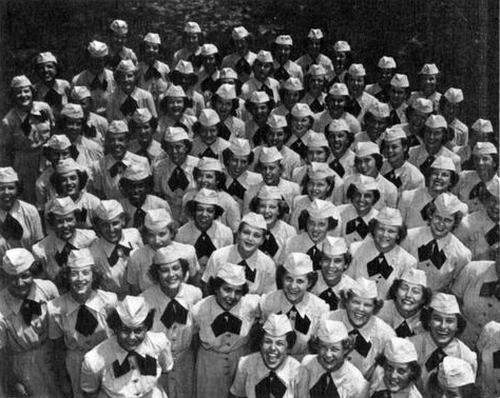
WAVE Recruits, Naval Training Center, Bainbridge, Maryland, 1953.
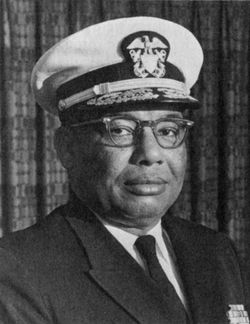
Admiral Gravely (1973 portrait).
In time integrated service became routine throughout the Navy, and instances of Negroes in command of integrated units increased. Bigots of both races inevitably remained, and the black community continued to resent the separate Steward's Branch, but the sincerity of the Navy's promise to integrate the service seemed no longer in doubt.