CHAPTER 13
Reading edition
Service Interests Versus Presidential Intent
Several months elapsed between the appointment of the President's Committee on Equality of Treatment and Opportunity in the Armed Services and its first meeting, a formal session with the President at the White House on 12 January 1949. Actually, certain advantages accrued from the delay, for postponing the meetings until after the President's reelection enabled the committee to face the services with assurance of continued support from the administration. Renewed presidential backing was probably necessary, considering the services' deliberations on race policy during this half-year hiatus. Their reactions to the order, logical outgrowths of postwar policies and practices, demonstrated how their perceived self-interests might subvert the President's intentions. The events of this six-month period also began to show the relative importance of the order and the parochial interests of the services as factors in the integration of the armed forces.
Public Reaction to Executive Order 9981
Considering the substantial changes it promised, the President's order provoked surprisingly little public opposition. Its publication coincided with the convening of the special session of a Congress smarting under Truman's "do-nothing" label. In this charged political atmosphere, the anti-administration majority in Congress quietly sidestepped the President's 27 July call for civil rights legislation. To do otherwise would only have added to the political profits already garnered by Truman in some important voting areas. For the same reason congressional opponents avoided all mention of Executive Order 9981, although the widely expected defeat of Truman and the consequent end to this executive sally into civil rights might have contributed to the silence. Besides, segregationists could do little in an immediate legislative way to counteract the presidential command. Congress had already passed the Selective Service Act and Defense Appropriations Act, the most suitable vehicles for amendments aimed at modifying the impact of the integration order. National elections and the advent of a new Congress precluded any other significant moves in this direction until later in the next year.
But such arguments were under attack by the very civil rights groups the President was trying to court. "Are we to understand that the President's promise to end discrimination," one critic asked,
The Army: Segregation on the Defensive
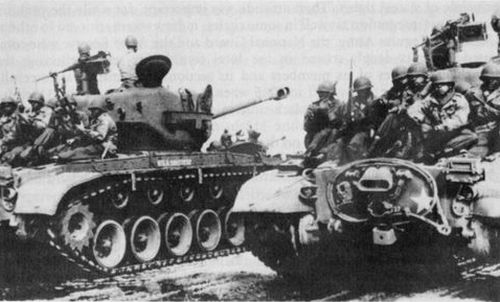
MP's Hitch a Ride on Army Tanks, Augsburg, Germany, 1949
Here was tacit recognition of federal supremacy over the National Guard. In supporting the right of the Secretary of the Army to dictate racial policy to state guards in 1948, the National Guard Committee adopted a position that would haunt it when the question of integrating the guard came up again in the early 1960's.
Secure in his belief that segregation was right and necessary, Royall confidently awaited the judgment of the recently appointed President's committee. He was convinced that any fair judge could draw but one conclusion: under the provisions of Circular 124, Negroes had already achieved equal treatment and opportunity in the Army. His job, therefore, was relatively simple. He had to defend Army policy against outside attack and make sure it was applied uniformly throughout the service. His stand marked one of the last attempts by a major federal official to support a racially separate but equal system before the principle was finally struck down by the Supreme Court in Brown v. Board of Education.
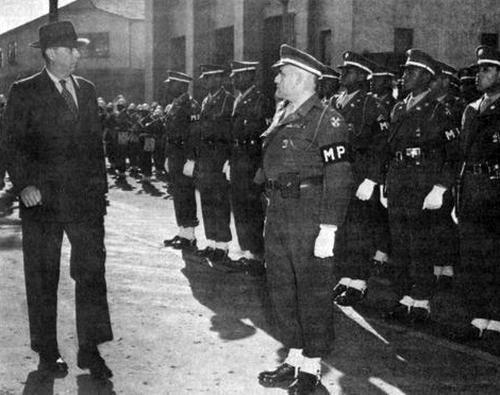
Secretary Royall Reviews Military Police, Yokohama, Japan, 1949.]
Even as Secretary Royall tried to defend the Army from the attacks of the press, the service's policy was challenged from another quarter. The blunt fact was that with the reinstitution of selective service in 1948 the Army was receiving more black recruits—especially those in the lower mental categories—than a segregated system could easily absorb. The high percentage of black soldiers so proudly publicized by Royall at the National Defense Conference was in fact a source of anxiety for Army planners. The staff particularly resented the different standards adopted by the other services to determine the acceptability of selectees. The Navy and Air Force, pleading their need for skilled workers and dependence on volunteer enlistments, imposed a higher minimum achievement score for admission than the Army, which, largely dependent upon the draft for its manpower, was required to accept men with lower scores. Thousands of Negroes, less skilled and with little education, were therefore eligible for service in the Army although they were excluded from the Navy and Air Force. Given such circumstances, it was probably inevitable that differences in racial policies would precipitate an interservice conflict. The Army claimed the difference in enlistment standards was discriminatory and contrary to the provisions of the draft law which required the Secretary of Defense to set enlistment standards. In April 1948 Secretary Royall demanded that Forrestal impose the same mental standards on all the services. He wanted inductees allocated to the services according to their physical and mental abilities and Negroes apportioned among them.
A Different Approach
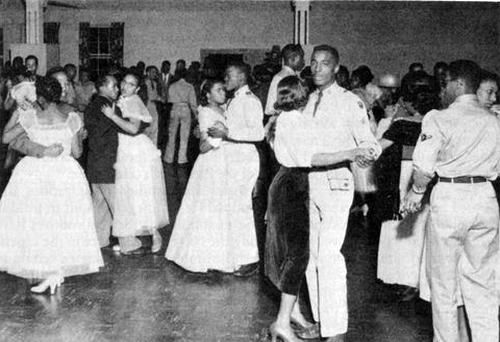
Spring Formal Dance, Fort George G. Meade, Maryland, 1952
The plan for a large-scale integrated unit progressed little beyond this point, but it was significant if only because it marked the first time since the Revolution that the Army had seriously considered using a large number of black soldiers in a totally integrated unit. The situation was not without its note of irony, for the purpose of the plan was not to abolish the racial discrimination that critics were constantly laying at the Army's doorstep. In fact, Army leaders, seriously dedicated to the separate but equal principle, were convinced the Gillem Board policy had already eliminated discrimination. Nor was the plan designed to carry out the President's order or prompted by the Secretary of Defense. Rather, it was pushed by Secretary Royall as a means of defending the Army against the anticipated demands of the President's committee.
Royall formally proposed a defense-wide experiment in integration to Forrestal on 2 December. He was not oblivious to the impression his vacillation on the subject had produced and went to some lengths to explain why he had opposed such experiments in the past. Although he had been thinking about such an experiment for some time, he told Forrestal, he had publicly rejected the idea at the National Defense Conference and during the Senate hearings on the draft law because of the tense international situation and the small size of the Army at that time. His interest in the experiment revived as the size of the Army increased and similar suggestions were made by both black leaders and southern politicians, but again he had hesitated, this time because of the national elections. He was now prepared to go ahead, but only if similar action were taken by the other services.
The other services had no intention of going forward with such an experiment. The Air Force objected, as Secretary Symington explained, because the experiment would be inconclusive; too many artificial features were involved, especially having units composed of volunteers. Arbitrary quotas violated the principle of equal opportunity, he charged, and the experiment would be unfair to Negroes because the proportion of Negroes able to compete with whites was less than 1 to 10. Symington also warned against the public relations aspect of the scheme, which was of "minimal military significance but of major significance in the current public controversy on purely racial issues." The Air Force could conduct the experiment without difficulty, he conceded, for there were enough trained black technicians to man 10 percent of the positions and give a creditable performance, but these men were representative neither of the general black population of the Air Force nor of Negroes coming into the service during wartime.
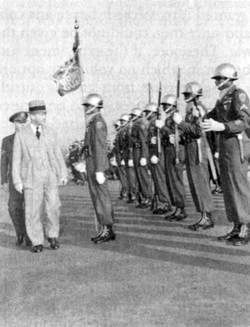
Secretary Forrestal, accompanied by General Huebner, inspects the 427th Army Band and the 7777th EUCOM Honor Guard, Heidelberg, Germany, November 1948.
The Navy: Business as Usual
Adjustments in the Marine Corps
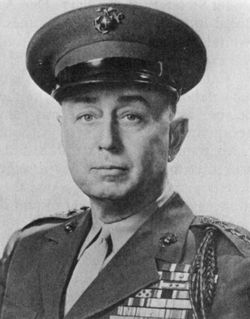
General Cates
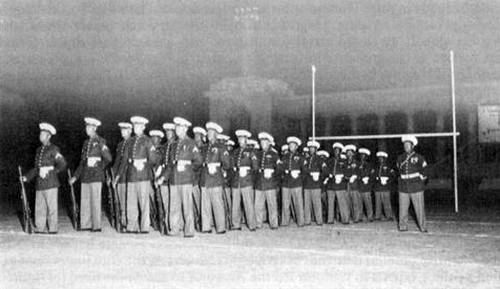
1st Marine Division Drill Team on Exhibition at San Diego's Balboa Stadium, 1949.
The Marine Corps, in short, had no intention of relaxing its policy of separating the races. The timing of the integration of recruit training and the breakup of some large black units perhaps suggested a general concession to the Truman order, but these administrative changes were actually made in response to the manpower restrictions of the Truman defense budget. In fact, the position of black marines in small black units became even more isolated in the months following the Truman order as the Division of Plans and Policies began devising racially separate assignments. Like the stewards before them, the security guards at closed naval installations and ammunition depots found themselves in assignments increasingly viewed as "colored" jobs. That the number of Negroes in the Marine Corps was so small aided and abetted these arrangements, which promised to continue despite the presidential order until some dramatic need for change arose.
The Air Force Plans for Limited Integration
Of all the services, the Air Force was in the best position to respond promptly to President Truman's call for equal treatment and opportunity. For some time a group of Air staff officers had been engaged in devising a new approach to the use of black manpower. Indeed their study, much of which antedated the Truman order, represented the solution of the Air Force's manpower experts to a pressing problem in military efficiency. More important than the executive order or demands of civil rights advocates, the criticism of segregation by these experts in uniform led the Air Force to accept the need for limited integration.
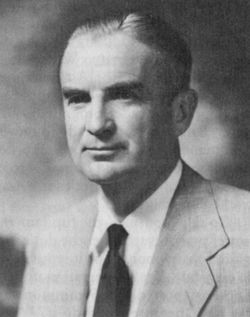
Secretary Symington
On the basis of evidence submitted by his long-standing study group, General Edwards concluded that current Air Force policy for the use of black manpower was "wasteful, deleterious to military effectiveness and lacking in wartime application." The policy of the Navy was superior, he told the Chief of Staff and the secretary, with respect to military effectiveness, economy, and morale, especially when the needs of full mobilization were considered. The Air Force would profit by adopting a policy similar to that of the Navy, and he proposed a program, to be "vigorously implemented and monitored," that would inactivate the all-black fighter wing and transfer qualified black servicemen from that wing as well as from all the major commands to white units. One exception would be that those black specialists, whose work was essential to the continued operation of their units, would stay in their black units. Some black units would be retained to provide for individuals ineligible for transfer to white units or for discharge.
The proposal forwarded to the Secretary of Defense in January 1949 committed the Air Force to a limited integration policy frankly imitative of the Navy's. A major improvement over the Air Force's current practices, the plan still fell considerably short of the long-range goals enunciated in the Gillem Board Report, to say nothing of the implications of the President's equal opportunity order. Although it is impossible to say exactly why Symington decided to settle for less than full integration, there are several explanations worth considering.
In the first place the program sent to Forrestal may well not have reflected the exact views of the Air Force secretary, nor conveyed all that his principal manpower assistant intended. Actually, the concern expressed by Air Force officials for military efficiency and by civil rights leaders for equal opportunity always centered specifically on the problems of the black tactical air unit and related specialist billets at Lockbourne Air Force Base. In fact, the need to solve the pressing administrative problems of Colonel Davis's command provoked the Air staff study that eventually evolved into the integration program. The program itself focused on this command and provided for the integrated assignment of its members throughout the Air Force. Other black enlisted men, certainly those serving as laborers in the F Squadrons, scattered worldwide, did not pose a comparable manpower problem. They were ignored on the theory that abolition of the quota, along with the application of more stringent recruitment procedures, would in time rid the services of its unskilled and unneeded men.
In the end it must be admitted that race relations possess an inner dynamic, and it is impossible to relate the integration of the Air Force to any isolated decision by a secretary or proposal by a group from his military staff. The decision to integrate was the result of several disparate forces—the political interests of the administration, the manpower needs of the Air Force, the aspirations of its black minority, and perhaps more than all the rest, the acceptance by its airmen of a different social system. Together, these factors would make successive steps to full integration impossible to resist. Integration, then, was an evolutionary process, and Symington's acceptance of a limited integration plan was only one step in a continuing process that stretched from the Air staff's study of black manpower in 1948 to the disappearance of the last black unit two years later.