CHAPTER 5
Reading edition
A Postwar Search
The nation's military leaders and the leaders of the civil rights movement were in rare accord at the end of World War II. They agreed that despite considerable wartime improvement the racial policies of the services had proved inadequate for the development of the full military potential of the country's largest minority as well as the efficient operation and management of the nation's armed forces. Dissatisfaction with the current policy of the armed forces was a spearpoint of the increasingly militant and powerful civil rights movement, and this dissatisfaction was echoed to a great extent by the services themselves. Intimate association with minority problems had convinced the Army's Advisory Committee on Negro Troop Policies and the Navy's Special Programs Unit that new policies had to be devised and new directions sought. Confronted with the incessant demands of the civil rights advocates and presented by their own staffs with evidence of trouble, civilian leaders of the services agreed to review the status of the Negro. As the postwar era opened, both the Army and the Navy were beginning the interminable investigations that augured a change in policy.
Unfortunately, the services and the civil rights leaders had somewhat different ends in mind. Concerned chiefly with military efficiency but also accustomed to racial segregation or exclusion, most military leaders insisted on a rigid appraisal of the performance of segregated units in the war and ignored the effects of segregation on that performance. Civil rights advocates, on the other hand, seeing an opportunity to use the military as a vehicle for the extension of social justice, stressed the baneful effects of segregation on the black serviceman's morale. They were inclined to ignore the performance of the large segregated units and took issue with the premise that desegregation of the armed forces in advance of the rest of American society would threaten the efficient execution of the services' military mission. Neither group seemed able to appreciate the other's real concerns, and their contradictory conclusions promised a renewal of the discord in their wartime relationship.
Black Demands
World War II marked the beginning of an important step in the evolution of the civil rights movement. Until then the struggle for racial equality had been sustained chiefly by the "talented tenth," the educated, middle-class black citizens who formed an economic and political alliance with white supporters. Together they fought to improve the racial situation with some success in the courts, but with little progress in the executive branch and still less in the legislative. The efforts of men like W. E. B. DuBois, Walter White, and Thurgood Marshall of the NAACP and Lester Granger of the National Urban League were in the mainstream of the American reform movement, which stressed an orderly petitioning of government for a redress of grievances.
But there was another facet to the American reform tradition, one that stressed mass action and civil disobedience, and the period between the March on Washington Movement in 1940 and the threat of a black boycott of the draft in 1948 witnessed the beginnings of a shift in the civil rights movement to this kind of reform tactic. The articulate leaders of the prewar struggle were still active, and in fact would make their greatest contribution in the fight that led to the Supreme Court's pronouncement on school segregation in 1954. But their quiet methods were already being challenged by A. Philip Randolph and others who launched a sustained demand for equal treatment and opportunity in the armed forces during the early postwar period. Randolph and leaders of his persuasion relied not so much on legal eloquence in their representations to the federal government as on an understanding of bloc voting in key districts and the implicit threat of civil disobedience. The civil rights campaign, at least in the effort to end segregation in the armed forces, had the appearance of a mass movement a full decade before a weary Rosa Parks boarded a Montgomery bus and set off the all-embracing crusade of Martin Luther King, Jr.
The growing political power of the Negro and the threat of mass action in the 1940's were important reasons for the breakthrough on the color front that began in the armed forces in the postwar period. For despite the measure of good will and political acumen that characterized his social programs, Harry S. Truman might never have made the effort to achieve racial equality in the services without the constant pressure of civil rights activists.
Though much of the increase in black employment was the result of temporarily expanded wartime industries, black workers gained valuable training and experience that enabled them to compete more effectively for postwar jobs. Employment in unionized industries strengthened their position in the postwar labor movement. The severity of inevitable postwar cuts in black employment was mitigated by continued prosperity and the sustained growth of American industry. Postwar industrial development created thousands of new upper-level jobs, allowing many black workers to continue their economic advance without replacing white workers and without the attendant development of racial tensions.
The armed forces played their part in this change. Along with better food, pay, and living conditions provided by the services, many Negroes were given new work experiences. Along with many of their white fellows, they acquired new skills and a new sophistication that prepared them for the different life of the postwar industrial world. Most important, military service in World War II divorced many Negroes from a society whose traditions had carefully defined their place, and exposed them for the first time to a community where racial equality, although imperfectly realized, was an ideal. Out of this experience many Negroes came to understand that their economic and political position could be changed. Ironically, the services themselves became an early target of this rising self-awareness. The integration of the armed forces, immediate and total, was a popular goal of the newly franchised voting group, which was turning away from leaders of both races who preached a philosophy of gradual change.
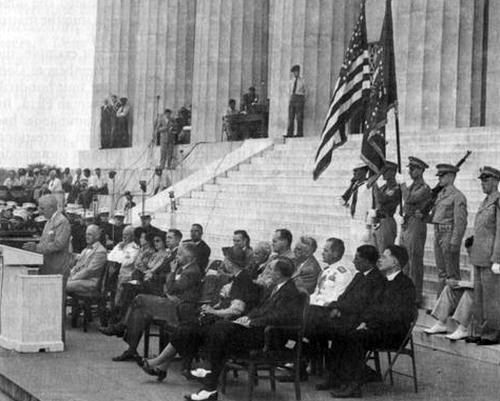
President Truman Addressing the NAACP Convention, Lincoln Memorial, Washington, D.C., June 1947. Seated at the President's left are Walter White, Eleanor Roosevelt, and Senator Wayne Morse; visible in the rear row are Admiral of the Fleet Chester W. Nimitz, Attorney General Tom C. Clark, and Chief Justice Fred M. Vinson.
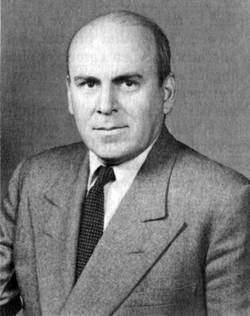
Assistant Secretary McCloy
The Army's Grand Review
In the midst of this intensifying sentiment for integration, in fact a full year before the war ended, the Army began to search for a new racial policy. The invasion of Normandy and the extraordinary advance to Paris during the summer of 1944 had led many to believe that the war in Europe would soon be over, perhaps by fall. As the Allied leaders at the Quebec Conference in September discussed arrangements to be imposed on a defeated Germany, American officials in Washington began to consider plans for the postwar period. Among them was Assistant Secretary of War McCloy. Dissatisfied with the manner in which the Army was using black troops, McCloy believed it was time to start planning how best to employ them in the postwar Army, which, according to current assumptions, would be small and professional and would depend upon a citizen reserve to augment it in an emergency.
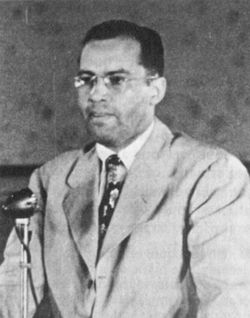
Truman Gibson
Not everyone agreed that the questionnaire was the best way to review the performance of Negroes in World War II. Truman Gibson, for one, doubted the value of soliciting information from senior commanders, feeling that these officers would offer much subjective material of little real assistance. Referring to the letter to the major senior commanders, he said:
Mere injunctions of objectivity do not work in the racial field where more often than not decisions are made on a basis of emotion, prejudice or pre-existing opinion.... Much of the difficulty in the Army has arisen from improper racial attitudes on both sides. Indeed, the Army's basic policy of segregation is said to be based principally on the individual attitudes and desires of the soldiers.
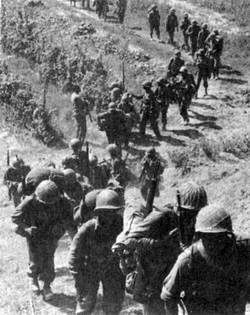
Company I, 370th Infantry, 92d Division, advances through Cascina, Italy.
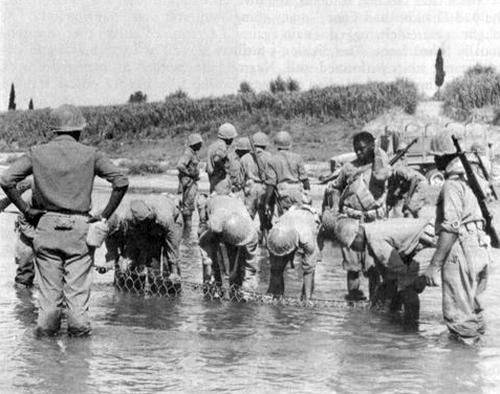
92d Division Engineers Prepare a Ford for Arno River Traffic
Actually, there was little doubt that the performance of the black divisions in World War II was generally unacceptable. Beyond that common conclusion, opinions diverged widely. Commanders tended to blame undisciplined troops and lack of initiative and control by black officers and noncommissioned officers as the primary cause of the difficulty. Others, particularly black observers, cited the white officers and their lack of racial sensitivity. In fact, as Ulysses Lee points out with careful documentation, all these factors were involved, but the underlying problem usually overlooked by observers was segregation. Large, all-black combat units submerged able soldiers in a sea of men with low aptitude and inadequate training. Segregation also created special psychological problems for junior black officers. Carefully assigned so that they never commanded white officers or men, they were often derided by white officers whose attitudes were quickly sensed by the men to the detriment of good discipline. Segregation was also a factor in the rapid transfer of men in and out of the divisions, thus negating the possible benefits of lengthy training. Furthermore, the divisions were natural repositories for many dissatisfied or inadequate white officers, who introduced a host of other problems.
Truman Gibson was quick to point out how segregation had intensified the problem of turning civilians into soldiers and groups into units. The "dissimilarity in the learning profiles" between black and white soldiers as reflected in their AGCT scores was, he explained to McCloy, primarily a result of inferior black schooling, yet its practical effect on the Army was to burden it with several large units of inferior combat ability (Table 2). In addition to the fact that large black units had a preponderance of slow learners, Gibson emphasized that nearly all black soldiers were trained near "exceedingly hostile" communities. This hostile atmosphere, he believed, had played a decisive role in their adjustment to Army life and adversely affected individual motivation. Gibson also charged the Army with promoting some black officers who lacked leadership qualifications and whose performance, consequently, was under par. He recommended a single measure of performance for officers and a single system for promotion, even if this system reduced promotions for black officers. Promotions on any basis other than merit, he concluded, deprived the Army of the best leadership and inflicted weak commanders on black units.
Table 2—AGCT Percentages in Selected World War II Divisions
Unit I II III IV V Total
(130 +) (110 - 120) (90 - 109) (60 - 89) (0 - 59)
11th Armored Division 3.0 23.8 33.8 33.1 6.3 100
35th Infantry Division 3.3 27.0 34.2 28.0 7.5 100
92d Infantry Division (Negro) 0.4 5.2 11.8 43.5 39.1 100
93d Infantry Division (Negro) 0.1 3.5 13.0 38.4 45.0 100
100th Infantry Division 3.6 27.1 34.1 29.1 6.1 100
Source: Tables submitted by The Adjutant General to the Gillem Board, 1945.
The Army Ground Forces, which trained black units for all major branches of the field forces, also wanted to retain black units, but its report concluded that these units could be of battalion size. The organization of black soldiers in division-size units, it claimed, only complicated the problem of training because of the difficulty in developing the qualified black technicians, noncommissioned officers, and field grade officers necessary for such large units and finding training locations as well as assignment areas with sufficient off-base recreational facilities for large groups of black soldiers. The Army Ground Forces considered the problem of finding and training field grade officers particularly acute since black units employing black officers, at least in the case of infantry, had proved ineffective. Yet white officers put in command of black troops felt they were being punished, and their presence added to the frustration of the blacks.
The Army Ground Forces was also particularly concerned with racial disturbances, which, it believed, stemmed from conflicting white and black concepts of the Negro's place in the social pattern. The Army Ground Forces saw no military solution for a problem that transcended the contemporary national emergency, and its conclusion—that the solution lay in society at large and not primarily in the armed forces—had the effect, whether or not so intended, of neatly exonerating the Army. In fact, the detailed conclusions and recommendations of the Army Ground Forces were remarkably similar to those of the Army Service Forces, but the Ground Forces study, more than any other, was shot full with blatant racism. The study quoted a 1925 War College study to the effect that the black officer was "still a Negro with all the faults and weaknesses of character inherent in the Negro race." It also discussed the "average Negro" and his "inherent characteristics" at great length, dwelling on his supposed inferior mentality and weakness of character, and raising other racial shibboleths. Burdened with these prejudices, the Army Ground Forces study concluded
The Army Air Forces, another large employer of black servicemen, reported a slightly different World War II experience. Conforming with departmental policies on utilizing black soldiers, it had selected Negroes for special training on the same basis as whites with the exception of aviation cadets. Negroes with a lower stanine (aptitude) had been accepted in order to secure enough candidates to meet the quota for pilots, navigators, and bombardiers in the black units. In its preliminary report to the War Department on the employment of Negroes, the Army Air Forces admitted that individuals of both races with similar aptitudes and test scores had the same success in technical schools, could be trained as pilots and technicians in the same period of time, and showed the same degree of mechanical proficiency. Black units, on the other hand, required considerably more time in training than white units, sometimes simply because they were understrength and their performance was less effective. At the same time the Air Forces admitted that even after discounting the usual factors, such as time in service and job assignment, whites advanced further than blacks. No explanation was offered. Nevertheless, the commanding general of the Air Forces reported very little racial disorder or conflict overseas. There had been a considerable amount in the United States, however; many Air Forces commanders ascribed this to the unwillingness of northern Negroes to accept southern laws or social customs, the insistence of black officers on integrated officers' clubs, and the feeling among black fliers that command had been made an exclusive prerogative of white officers rather than a matter depending on demonstrated qualification.
In contrast to the others, the Army Air Forces revealed a marked change in sentiment over the post-World War I studies of black troops. No more were there references to congenital inferiority or inherent weaknesses, but everywhere a willingness to admit that Negroes had been held back by the white majority.
Sommers had, in effect, adopted Gibson's gradualist approach to the problem, suggesting an inquiry to determine "the areas in which nonsegregation can be attempted first and the methods by which it can be introduced ... instead of merely generalizing, as in the past, on the disappointing and not very relevant experiences with large segregated units." He foresaw difficulties: a certain amount of social friction and perhaps a considerable amount of what he called "professional Negro agitation" because Negroes competing with whites would probably not achieve comparable ranks or positions immediately. But Sommers saw no cause for alarm. "We shall be on firm ground," he concluded, "and will be able to defend our actions by relying on the unassailable position that we are using men in accordance with their ability."
Even among officers troubled by the contradictory aspects of an issue clouded by morality, many felt impelled to give their prime allegiance to the Army as it was then constituted. The Army's impressive achievement during the war, they reasoned, argued for its continuation in conformance with current precepts, particularly in a world still full of hostilities. The stability of the Army came first; changes would have to be made slowly, without risking the menace of disruption. An attempt to mix the races in the Army seemed to most officers a dangerous move bordering on irresponsibility. Furthermore, the majority of Army officers, dedicated to the traditions of the service, saw the Army as a social as well as a military institution. It was a way of life that embraced families, wives and children. The old manners and practices were comfortable because they were well known and understood, had produced victory, and had represented a life that was somewhat isolated and insulated—particularly in the field—from the currents and pressures of national life. Why then should the old patterns be modified; why exchange comfort for possible chaos? Why should the Army admit large numbers of Negroes; what had Negroes contributed to winning World War II; what could they possibly contribute to the postwar Army?
Although opinion among Army officials on the future role of Negroes in the Army was diverse and frankly questioning in tone, opinion on the past performance of black units was not. Commanders tended to agree that with certain exceptions, particularly small service and combat support units, black units performed below the Army average during the war and considerably below the best white units. The commanders also generally agreed that black units should be made more efficient and usually recommended they be reduced in size and filled with better qualified men. Most civil rights spokesmen and their allies in the Army, on the other hand, viewed segregation as the underlying cause of poor performance. How, then, could the conflicting advice be channeled into construction of an acceptable postwar racial policy? The task was clearly beyond the powers of the War Department's Special Planning Division, and in September 1945 McCloy adopted the recommendation of Sommers and Gibson and urged the Secretary of War to turn over this crucial matter to a board of general officers. Out of this board's deliberations, influenced in great measure by opinions previously expressed, would emerge the long-awaited revision of the Army's policy for its black minority.
The Navy's Informal Inspection
In contrast to the elaborate investigation conducted by the Army, the Navy's search for a policy consisted mainly of an informal intradepartmental review and an inspection of its black units by a civilian representative of the Secretary of the Navy. In general this contrast may be explained by the difference in the services' postwar problems. The Army was planning for the enlistment of a large cross section of the population through some form of universal military training; the Navy was planning for a much smaller peacetime organization of technically trained volunteers. Moreover, the Army wanted to review the performance of its many black combat units, whereas the naval establishment, which had excluded most of its Negroes from combat, had little to gain from measuring their wartime performance.
Forrestal's wish for a racially democratic Navy did not noticeably conflict with the traditionalists' plan for a small, technically elite force, so while the Army launched a worldwide quest in anticipation of an orthodox policy review, the Navy started an informal investigation designed primarily to win support for the racial program conceived by the Secretary of the Navy.
The committee deliberated on all these points, and, after meeting several times, announced in May 1945 its findings and recommendations. It found that the Navy's current policies were sound and when properly executed produced good results. At the same time it saw a need for periodic reviews to insure uniform application of policy and better public relations. Such findings could be expected from a body headed by a senior official of the personnel bureau, but the committee then came up with the unexpected—a series of recommendations for sweeping change. Revealing the influence of the Special Programs Unit, the committee asked that Negroes be declared available for assignment to all types of ships and shore stations in all classifications, with selections made solely on merit. Since wholesale reassignments were impractical, the committee recommended well-planned, gradual assimilation—it avoided the word integration—as the best policy for ending the concentration of Negroes at shore activities. It also attacked the Steward's Branch as the conspicuous symbol of the Negroes' second-class status and called for the assignment of white stewards and allowing qualified stewards to transfer to general service.
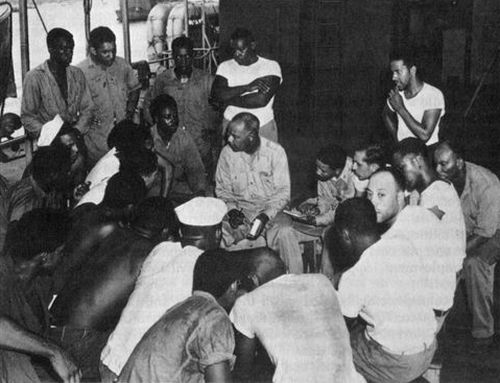
Granger Interviewing Sailors on inspection tour in the Pacific.
The committee's recommendations, submitted to Under Secretary Bard on 22 May 1945, were far more than an attempt to unify the racial practices of the various subdivisions of the Navy Department. For the first time, senior representatives of the department's often independent branches accepted the contention of the Special Programs Unit that segregation was militarily inefficient and a gradual but complete integration of the Navy's general service was the solution to racial problems.
Yet as a formula for equal treatment and opportunity in the Navy, the committee's recommendations had serious omissions. Besides overlooking the dearth of black officers and the Marine Corps' continued strict segregation, the committee had ignored Granger's key proposal that Negroes be guaranteed a place in the Regular Navy. Almost without exception, Negroes in the Navy's general service were reservists, products of wartime volunteer enlistment or the draft. All but a few of the black regulars were stewards. Without assurance that many of these general service reservists would be converted to regulars or that provision would be made for enlistment of black regulars, the committee's integration recommendations lacked substance. Secretary Forrestal must have been aware of these omissions, but he ignored them. Perhaps the problem of the Negro in the postwar Navy seemed remote during this last, climactic summer of the war.
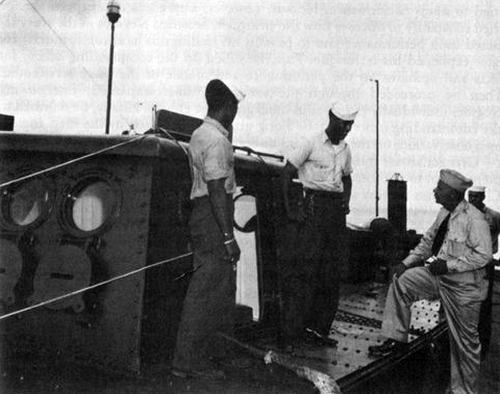
Granger With Crewmen of a Naval Yard Craft
Granger always related the performance of enlisted men to their morale. He pointed out to the commanders that poor morale was at the bottom of the Port Chicago mass mutiny and the Guam riot, and his report to the secretary confirmed the experiences of the Special Programs Unit: black performance was deeply affected by the extent to which Negroes felt victimized by racial discrimination or handicapped by segregation, especially in housing, messing, and military and civilian recreational facilities. Although no official policy on segregated living quarters existed, Granger found such segregation widely practiced at naval bases in the United States. Separate housing meant in most cases separate work crews, thereby encouraging voluntary segregation in mess halls. In some cases the Navy's separate housing was carried over into nearby civilian communities where no segregation existed before. In others shore patrols forced segregation on civilian places of entertainment, even when state laws forbade it. On southern bases, especially, many commanders willingly abandoned the Navy's ban against discrimination in favor of the racial practices of local communities. There enforced segregation was widespread, often made explicit with "colored" and "white" signs.
Yet Granger found encouraging exceptions which he passed along to local commanders elsewhere. At Camp Perry, Virginia, for example, there was a minimum of segregation, and the commanding officer had intervened to see that Virginia's segregated bus laws did not apply to Navy buses operating between the camp and Norfolk. This situation was unusual for the Navy although integrated busing had been standard practice in the Army since mid-1944. He found Camp Perry "a pleasant contrast" to other southern installations, and from his experiences there he concluded that the attitude of the commanding officer set the pace. "There is practically no limit," Granger said, "to the progressive changes in racial attitudes and relationships which can be made when sufficiently enlightened and intelligent officer leadership is in command." The development of hard and fast rules, he concluded, was unnecessary, but the Bureau of Naval Personnel must constantly see to it that commanders resisted the "influence of local conventions."
At Pearl Harbor Granger visited three of the more than two hundred auxiliary ships manned by mixed crews. On two the conditions were excellent. The commanding officer in each case had taken special pains to avoid racial differentiation in ratings, assignments, quarters, and messes; efficiency was superior, morale was high, and racial conflict was absent. On the third ship Negroes were separated; they were specifically assigned to a special bunk section in the general crew compartment and to one end of the chow table. Here there was dissatisfaction among Negroes and friction with whites.
At the naval air bases in Hawaii performance and morale were good because Negroes served in a variety of ratings that corresponded to their training and ability. The air station in Oahu, for example, had black radar operators, signalmen, yeomen, machinist mates, and others working amiably with whites; the only sign of racial separation visible was the existence of certain barracks, no different from the others, set aside for Negroes.
Morale was lowest in black base companies and construction battalions. In several instances able commanding officers had availed themselves of competent black leaders to improve race relations, but in most units the racial situation was generally poor. Granger regarded the organization of the units as "badly conceived from the racial standpoint." Since base companies were composed almost entirely of nonrated men, spaces for black petty officers were lacking. In such units the scaffold of subordinate leadership necessary to support and uphold the authority of the officers was absent, as were opportunities for individual advancement. Some units had been provisionally re-formed into logistic support companies, and newly authorized ratings were quickly filled. This partial remedy had corrected some deficiencies, but left unchanged a number of the black base companies in the Pacific area. Although construction battalions had workers of both races, Granger reported them to be essentially segregated because whites were assigned to headquarters or to supervisory posts. Some officers had carried this arbitrary segregation into off-duty areas, one commander contending that strict segregation was the civilian pattern and that everyone was accustomed to it.
The Marine Corps lagged far behind the rest of the naval establishment, and there was little pretense of conforming with the Navy's racial policy. Black marines remained rigidly segregated and none of the few black officer candidates, all apparently well qualified, had been commissioned. Furthermore, some black marines who wanted to enlist as regulars were waiting word whether they could be included in the postwar Marine Corps. Approximately 85 percent of the black marines in the Pacific area were in depot and ammunition companies and steward groups. In many cases their assignments failed to match their qualifications and previous training. Quite a few specialists complained of having been denied privileges ordinarily accorded white men of similar status—for example, opportunities to attend schools for first sergeants, musicians, and radar operators. Black technicians were frequently sent to segregated and hastily constructed schools or detached to Army installations for schooling rather than sent to Marine Corps schools. Conversely, some white enlisted men, assigned to black units for protracted periods as instructors, were often accorded the unusual privilege of living in officers' quarters and eating in the officers' mess in order to preserve racial segregation.
Most black servicemen, Granger found, resented the white fleet shore patrols in the Pacific area which they considered biased in handling disciplinary cases and reporting offenders. The commanding officer of the shore patrol in Honolulu defended the practice because he believed the use of Negroes in this duty would be highly dangerous. Granger disagreed, pointing to the successful employment of black shore patrols in such fleet liberty cities as San Diego and Miami. He singled out the situation in Guam, which was patrolled by an all-white Marine Corps guard regarded by black servicemen as racist in attitude. Frequently, racial clashes occurred, principally over the attentions of native women, but it was the concentration of Negroes in the naval barracks at Guam, Granger concluded, along with the lack of black shore patrols, that intensified racial isolation, induced a suspicion of racial policies, and aggravated resentment.
At every naval installation Granger heard vigorous complaints over the contrast between black and white ratings and promotions. Discrepancies could be explained partly by the fact that, since the general service had been opened to Negroes fairly late in the war, many white men had more than two years seniority over any black. But Granger found evidence that whites were transferred into units to receive promotions and ratings due eligible black members. In many cases, he found "indisputable racial discrimination" by commanding officers, with the result that training was wasted, trained men were prevented from acquiring essential experience and its rewards, and resentment smoldered.
Evidence of overt prejudice aside, Granger stressed again and again that the primary cause of the Navy's racial problems was segregation. Segregation was "impractical and inefficient," he pointed out, because racial isolation bred suspicion, which in turn inflamed resentment, and finally provoked insubordination. The best way to integrate Negroes, Granger felt, was to take the most natural course, that is, eliminate all special provisions, conditions, or cautions regarding their employment. "There should be no exceptional approach to problems involving Negroes," he counseled, "for the racial factor in naval service will disappear only when problems involving Negroes are accepted as part of the Navy's general program for insuring efficient performance and first-class discipline."
Despite his earlier insistence on a fair percentage of Negroes in the postwar Regular Navy, Granger conceded that the number and proportion would probably decrease during peacetime. It was hardly likely, he added, that black enlistment would exceed 5 percent of the total strength, a manageable proportion. He even saw some advantages in smaller numbers, since, as the educational standards for all enlistees rose, the integration of relatively few but better qualified Negroes would "undoubtedly make for greater racial harmony and improved naval performance."
Although different in approach and point of view, Granger's observations neatly complemented the findings and recommendations of the Committee on Negro Personnel. Both reinforced the secretary's postwar policy aims and both supported his gradualist approach to racial reform. Granger cited segregation, in particular the concentration of masses of black sailors, as the principal cause of racial unrest and poor morale among Negroes. The committee urged the gradual integration of the general service in the name of military efficiency. Granger and the committee also shared certain blind spots. Both were encouraged by the progress toward full-scale integration that occurred during the war, but this improvement was nominal at best, a token bow to changing conditions. Their assumption that integration would spread to all branches of the Navy neglected the widespread and deeply entrenched opposition to integration that would yield only to a strategy imposed by the Navy's civilian and military leaders. Finally, the hope that integration would spread ignored the fact that after the war few Negroes except stewards would be able to meet the enlistment requirements for the Regular Navy. In short, the postwar Navy, so far as Negroes were concerned, was likely to resemble the prewar Navy.
The search for a postwar racial policy led the Army and Navy down some of the same paths. The Army manpower planners decided that the best way to avoid the inefficient black divisions was to organize Negroes into smaller, and therefore, in their view, more efficient segregated units in all the arms and services. At the same time Secretary Forrestal's advisers decided that the best way to avoid the concentration of Negroes who could not be readily assimilated in the general service was to integrate the small remnant of black specialists and leave the majority of black sailors in the separate Steward's Branch. In both instances the experiences of World War II had successfully demonstrated to the traditionalists that large-scale segregated units were unacceptable, but neither service was yet ready to accept large-scale integration as an alternative.