CHAPTER 23
Reading edition
From Voluntary Compliance to Sanctions
The Defense Department's attitude toward off-base discrimination against servicemen underwent a significant change in the mid-1960's. At first Secretary McNamara relied on his commanders to win from the local communities a voluntary accommodation to his equal opportunity policy. Only after a lengthy interval, during which the accumulated evidence demonstrated that voluntary compliance would, in some cases, not be forthcoming, did he take up the cudgel of sanctions. His use of this powerful economic weapon proved to be circumscribed and of brief duration, but its application against a few carefully selected targets had a salubrious and widespread effect. At the same time developments in the civil rights movement, especially the passage of strong new legislation in 1964, permitted servicemen to depend with considerable assurance upon judicial processes for the redress of their grievances.
Development of Voluntary Action Programs

Fighter Pilots on the Line. Col. Daniel (Chappie) James, Jr., commander of an F-4 jet, and his pilot readying for takeoff from a field in Thailand.
The first inventory confirmed the widespread complaints of special discrimination encountered by black servicemen. It also uncovered interesting patterns in that discrimination. In matters of commercial transportation, local schools, and publicly owned facilities such as libraries and stadiums, the problem of discrimination against black servicemen was confined almost exclusively to areas around installations in the south. But segregated public accommodations such as motels, restaurants, and amusements, a particularly virulent form of discrimination for servicemen, who as transients had to rely on such businesses, existed in all parts of the country including areas as diverse as Iowa, Alaska, Arizona, and Illinois. Discrimination in these states was especially flagrant since all except Arizona had legislation prohibiting enforced segregation of public accommodations. Discrimination in the sale and rental of houses showed a similar pattern. Only thirty installations out of the 305 reporting were located in states with equal housing opportunity statutes. These were in northern states, stretching from Maine to California. At the same time, some of these installations reported discrimination in housing despite existing state legislation forbidding such practices. No differences were reported in the treatment of black and white servicemen with respect to civilian law enforcement except that in some communities black servicemen were segregated when taken into custody for criminal violations.
Generally, the practice of most forms of discrimination was more intense in the south, but the record of other sections of the country was no better than mixed, even where legislation forbade such separate and unequal treatment. Obviously there was much room for progress, and as indicated in the inventory much still could be done within the armed forces themselves. The reports revealed that almost one-third of the commands inventoried failed to form the command-community relations committees recommended by the Gesell Committee and ordered in the services' equal opportunity directives. Of the rest, only sixty-one commands had invited local black leaders to participate in what were supposed to be biracial groups.
Fitt's assessment was accurate, no doubt, but not exactly in keeping with the optimistic spirit of the Gesell Committee and Secretary McNamara's subsequent equal opportunity commitment to the President. Obviously more could be achieved through voluntary compliance if the threat of legal sanctions were available. In the summer of 1964, therefore, the Defense Department's manpower officials turned to new federal civil rights legislation for help.
Civil Rights, 1964-1966
He was peculiarly fitted for the task. A southerner in quest of national support, Johnson was determined for very practical reasons to carry out the civil rights program of his slain predecessor and to end the long rule of Jim Crow in many areas of the country. He let it be known that he would accept no watered-down law.
Certainly this pronouncement was no empty rhetoric, coming as it did from a consummate master of the legislative process who enjoyed old and close ties with congressional leaders.
In common with its predecessors, the 1964 Civil Rights Act had only touched lightly on the serious obstacles in the way of black voters. Although some 450,000 Negroes were added to the voting rolls in the southern states in the year following passage of the 1964 law, the civil rights advocates were calling for stronger legislation. With bipartisan support, the President introduced a measure aimed directly at states that discriminated against black voters, providing for the abolition of literacy tests, appointment of federal examiners to register voters for all elections, and assignment of federal supervisors for those elections. The Twenty-fourth Amendment, adopted in February 1964, had eliminated the poll tax in federal elections, and the President's new measure carried a strong condemnation of the use of the poll tax in state elections as well.
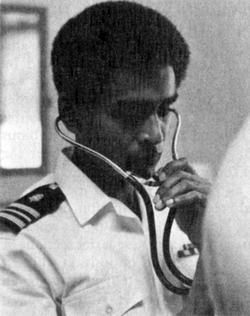
Medical Examination. Navy doctor on duty, Yokosuka, Japan.
Discrimination in housing was a major cause of black urban unrest, and housing was foremost among the areas of discrimination still untouched by federal legislation. The housing provision of the 1964 Civil Rights Act was severely limited, and Johnson rejected the idea of yet another executive order proposed by his Committee on Equal Opportunity in Housing. Like the order signed by Kennedy, it could cover only new housing and even that with dubious legality. Johnson, relying on the civil rights momentum developed over the previous years, decided instead to press for a comprehensive civil rights bill that would outlaw discrimination in the sale of all housing. The new measure was also designed to attack several other residual areas of discrimination, including jury selection and the physical protection of Negroes and civil rights workers. Although he enjoyed a measure of bipartisan support for these latter sections of the bill, the President failed to overcome the widespread opposition to open housing, and the 1966 civil rights bill died in the Senate, thereby postponing an effective law on open housing until after the assassination of Dr. King in 1968.
The Civil Rights Act and Voluntary Compliance
The Limits of Voluntary Compliance
If the Civil Rights Act strengthened the hands of the commander, it also quickly revealed the ultimate limits of voluntary compliance itself. The campaign against Titles II and III discrimination was only one facet of the Department of Defense's battle against off-base discrimination, which also included major attacks against discrimination in the National Guard, in the public schools, and, finally, in housing. It was in these areas that the limits of voluntary compliance were reached, and the technique was abandoned in favor of economic sanctions.
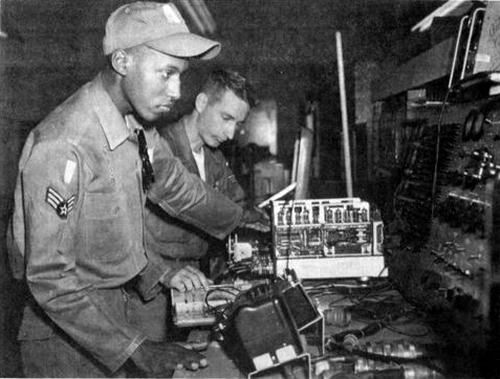
Auto Pilot Shop. Airmen check out equipment, Biggs Air Force Base, Texas.
Lack of equal opportunity in the National Guard might have been resented by civil rights groups, but black servicemen themselves suffered more generally and more deeply from discrimination visited on their children. Alfred Fitt summarized these feelings in 1964:
There was much to be said for the Defense Department's theory that an appeal for voluntary compliance would produce much integration in off-base schools attended by military dependents. That these children were the offspring of men serving in defense of their country was likely to have considerable impact in the south, especially, with its strong military traditions. That the children had in most cases already attended integrated schools, competing and learning with children of another race, was likely to make their integration more acceptable to educators.
The effort of the Department of Defense to secure education for its military dependents in integrated schools was, on the whole, unsuccessful. Integration, when it finally came to most of these institutions later in the 1960's, came principally through the efforts of the Department of Health, Education, and Welfare to enforce Title VI of the Civil Rights Act of 1964. Yet the role of local military commanders in the effort to secure integrated schools cannot be ignored, for with the development of a new policy toward off-base facilities in 1963 the commander became a permanent and significant partner in the administration's fight to desegregate the nation's schools. In contrast to earlier times when the Department of Defense depended on moral suasion to desegregate schools used by servicemen's children, its commanders now educated parents on their legal rights, collected data to support class action suits, and negotiated with school boards. If the primary impetus for this activity was the Civil Rights Act of 1964, the philosophy of the Gesell Committee and the Secretary of Defense's directive were also implicit.
Discrimination in the sale and lease of housing continued to be the most widespread and persistent form of racial injustice encountered by black servicemen, and a most difficult one to fight. The chronic shortage of on-base accommodations, the transient nature of a military assignment, and the general reluctance of men in uniform to protest publicly left the average serviceman at the mercy of local landlords and real estate interests. Nor did he have recourse in law. No significant federal legislation on the subject existed before 1969, and state laws (by 1967 over half the states had some form of prohibition against discrimination in public housing and twenty-one states had open housing laws) were rather limited, excluding owner-occupied dwellings, for example, from their provisions. Even President Kennedy's 1962 housing order was restricted to future building and to housing dependent on federal financing.
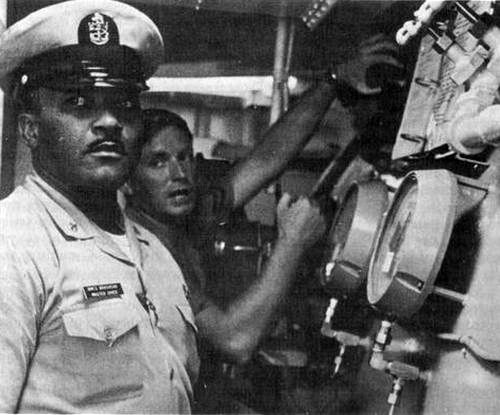
Submarine Tender Duty. A senior chief boatswain mate and master diver at his station on the USS Hunley.
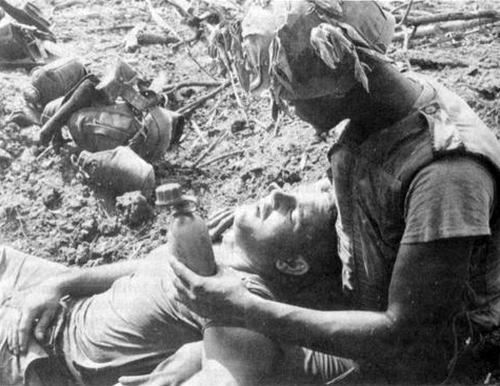
First Aid. Soldier of the 23d Infantry gives water to heat stroke victim during "Operation Wahiawa," Vietnam.
The campaign for open housing is the most noteworthy chapter in the fight for equality of treatment and opportunity for servicemen. The efforts of the Department of Defense against other forms of off-base discrimination were to a great extent successful because they coincided with court rulings and powerful civil rights legislation. The campaign for open housing, on the other hand, was launched in advance of court and congressional action and in the face of much popular feeling against integrated housing. McNamara's fight for open housing demonstrates, as nothing had before, his determination to use, if necessary, the department's economic powers in the civilian community to secure equal treatment and opportunity for servicemen. In the name of fair housing, McNamara invested not only his own prestige but also the Defense Department's manpower and financial resources. In effect, this willingness to use the extreme weapon of off-limits sanctions revitalized the idea of using the Department of Defense as an instrument of social change in American society.
McNamara's willingness to push the department beyond the national consensus on civil rights (as represented by the contemporary civil rights laws) also signified a change in his attitude. Unlike Yarmolinsky and Robert Kennedy, McNamara limited his attention to discrimination's effect on the individual serviceman and, ultimately, on the military efficiency of the armed forces. Despite his interest in the cause of civil rights, he had, until the open housing campaign, always circumscribed the department's equal opportunity program to fit a more traditional definition of military mission. Seen in this light, McNamara's attack against segregated housing represented not only the substitution of a new and more powerful technique—sanctions—for one that had been found wanting—voluntary compliance, but also a substantial evolution in his own social philosophy. He later implied as much.
But voluntary compliance had its limits. Its success depended in large measure on the ability and will of local commanders, who, for the most part, were unprepared by training or temperament to deal with the complex and explosive problems of off-base discrimination. Even if the commander could qualify as a civil rights reformer, he had little time or incentive for a duty that would go unrecognized in terms of his efficiency rating yet must compete for his attention with other necessary duties that were so recognized. Finally, the successful use of voluntary compliance techniques depended on the implied threat of legal or economic pressures, yet, for a considerable period following McNamara's 1963 directive, no legal strictures against some forms of discrimination existed, and the use of economic sanctions had been so carefully circumscribed by defense officials as to render the possibility of their use extremely remote.
The decision to circumscribe the use of economic sanctions against off-base discrimination made sense. Closing a base because of discrimination in nearby communities was practically if not politically impossible and might conceivably become a threat to national security. As to sanctions aimed at specific businesses, the secretary's civil rights assistants feared the possibility that the abrupt or authoritarian imposition of sanctions by an insensitive or unsympathetic commander might sabotage the department's whole equal opportunity program in the community. They were determined to leave the responsibility for sanctions in the hands of senior civilian officials. In the end it was the most senior of these officials who acted. When his attention turned to the problem of discrimination in off-base housing for black servicemen in 1967, Secretary McNamara quickly decided to use sanctions against a discriminatory practice widely accepted and still legal under federal law.