CHAPTER 15
Reading edition
The Role of the Secretary of Defense 1949-1951
The issue of civil rights, however, was still of vital interest to one of the President's major constituencies. Black voters, recognized as a decisive factor in the November 1948 election, pressed their demands on the victorious President; in particular some of their spokesmen called on the administration to implement fully the program put forth by the Fahy Committee. These demands were being echoed in Congress by a civil rights bloc—for bloc it had now become in the wake of the election that sent Harry Truman back to the White House. No longer the concern of a congressman or two, the cause of the black serviceman was now supported by a group of politicians who, joining with civil rights leaders, pressed the Department of Defense for rapid changes in its racial practices.
At most, Congress played only a minor role in the dramatic changes beginning in the armed forces. Champions of civil rights had little effect on service practices, although these congressmen channeled the complaints of black voters and kept the military traditionalists on the defensive. As for the congressional traditionalists, their support may have helped sustain those on the staff who resisted racial change within the Army, thus slowing down that service's integration. But the demands of congressional progressives and obstructionists tended to cancel each other out, and in the wake of the Fahy Committee's disbandment the services themselves reemerged as the preeminent factor in the armed forces racial program.
The services regained control by default. Logically, direction of racial reforms in the services should have fallen to the Secretary of Defense. In the first place, the secretary, other administration officials, and the public alike had begun to use the secretary's office as a clearinghouse for reconciling conflicting demands of the services, as an appellate court reviewing decisions of the service secretaries, and as the natural channel of communication between the services and the White House, Congress, and the public. Many racial problems had become interservice in nature, and only the Office of the Secretary of Defense possessed the administrative machinery to deal with such matters. The Personnel Policy Board or, later, the new Office of the Assistant Secretary of Defense for Manpower and Personnel might well have become the watchdog recommended by the Fahy Committee to oversee the services' progress toward integration, but neither did.
Certainly the Secretary of Defense had other matters pressing for his attention. Secretary Johnson had become the central character in the budgetary conflicts of Truman's second term, and both he and General George C. Marshall, who succeeded him as secretary on 20 September 1950, were suddenly thrust into leadership of the Korean War. In administrative matters, at least, Marshall had to concentrate on boosting the morale of a department torn by internecine budgetary arguments. Integration did not appear to have the same importance to national security as these weighty matters. More to the point, Johnson and Marshall were not social reformers. Whatever their personal attitudes, they were content to let the services set the pace of racial reform. With one notable exception neither man initiated any of the historic racial changes that took place in the armed forces during the early 1950's.
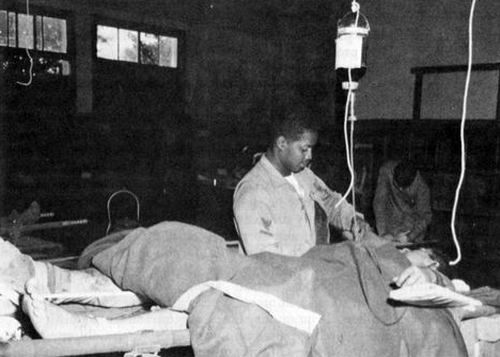
Navy Corpsman in Korea attends wounded from the 1st Marine Division, 1950.
Overseas Restrictions
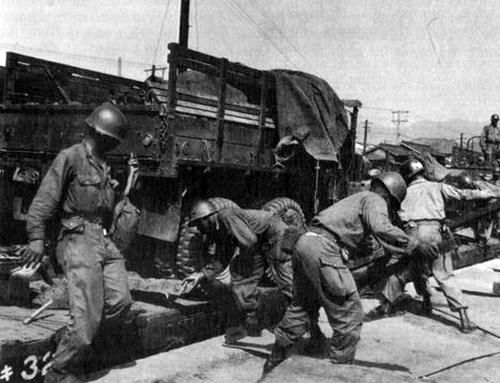
25th Division Troops Unload Trucks and Equipment at Sasebo Railway Station, Japan, for transport to Korea, 1950.
Congressional Concerns
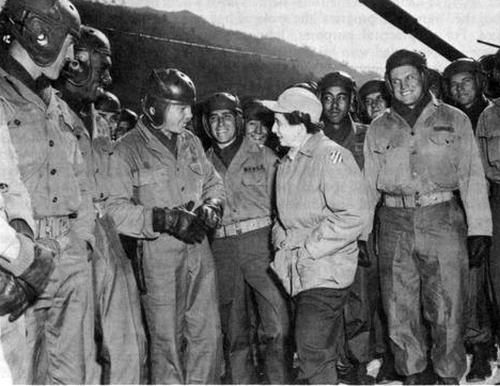
Assistant Secretary Rosenberg talks with men of the 140th Medium Tank Battalion during a Far East tour.
Still, to bring about effective integration of the services would take more than a positive attitude, and Rosenberg faced a delicate situation. She had to reassure integrationists that the new racial policy would be enforced by urging the sometimes reluctant services to take further steps toward eliminating discrimination. At the same time she had to promote integration and avoid provoking the segregationists in Congress to retaliate by blocking other defense legislation. The bill for universal military training was especially important to the department and to push for its passage was her primary assignment. It is not surprising, therefore, that she accomplished little in the way of specific racial reform during the first year of the Korean War.
Table 3—Percentage of Black Enlisted Men and Women
Service 1 July 1949 1 July 1954 1 July 1956
Army 12.4 13.7 12.8
Navy 4.7 3.6 6.3
Air Force 5.1 8.6 10.4
Marine Corps 2.1 6.5 6.5
Source: Memo for Rcd, ASD/M, 12 Sep 56, sub: Integration Percentages, ASD(M) 291.2.
Executive Order 9981 passed its third anniversary in July 1951 with little having happened in the Office of the Secretary of Defense to lift the hearts of the champions of integration. The race issues with which the Secretary of Defense concerned himself in these years—the definition of race, the status of black servicemen overseas, even the parity of enlistment standards—while no doubt important in the long run to the status of the Negro in the armed forces, had little to do with the immediate problem of segregation. Secretary Johnson had done nothing to enforce the executive order in the Army and his successor achieved little more. Willing to let the services set the pace of reform, neither secretary substantially changed the armed forces' racial practices. The integration process that began in those years was initiated, appropriately enough perhaps, by the services themselves.