The Woman to the Plow and The Man to the Hen Roost.
Reading edition
Or, a fine way to cure a Cot Quean—.
The Tune is, I have for all good Wives a Song.—
[7.]
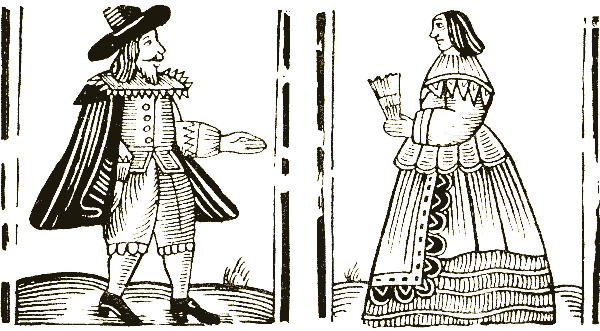
Both Men and Women listen well,
A merry Jest I will you tell,
Betwixt a Good man and his Wife,
Who fell the other day at strife:
He chid her for her Huswivery,
And she found fault as well as he,
With him for's work without the door,
Quoth he (we'l quarrel thus no more)
Sith you and I cannot agree,
Let's change the work. Content, quoth she,
My Wheel and Distaffe here take thow,
And I will drive the Cart and Plow.
This was concluded 'twixt them both,
To Cart and Plow the good-wife goeth,
The Good man he at home doth tarry,
To see that nothing doth miscarry.
An apron he before him put,
Judge, was not this a handsome slut.
He Brews and Bakes as well as he Can,
But not as it should be done, poor man:
As he did make his Cheese one day,
Two Pigs their Bellies broke with whey;
Nothing that he in hand did take,
Did come to good; once he did Bake,
And burnt the Bread as black as a stock,
Another time he went to Rock
The Cradle, and threw the child o' th' floor,
And broke his Nose, and hurt it sore.
He went to milk one Eventide
A Skittish Cow on the wrong side,
His pail was full of Milk, God wot,
She Kickt and spilt it every jot.
Besides she hit him a blost o' th' face
Which was scant well in six weeks space.
Thus was he served, and yet too well
And more mischances yet befell.
Before his apron he'd leave off,
Though all his neighbours did him scoff.
Now list and mark one pretty jest,
'Twill make you laugh above all the rest,
As he to churn his Butter went,
One Morning with a good intent,
For he had quite forgot the Cream,
He churn'd all Day with all his might,
And yet he could get no Butter at night.
'Twere strange indeed for me to utter
That without Creame he should make Butter.
Now having shew'd his huswivery,
Who did all things thus untowardly,
Unto the good-wife I'll turn my Rhime,
And tell you how she spent her time;
She us'd to drive the Cart and Plow,
But do't well she Knew not how,
She made so many banks i' th' ground,
He been better have given five pound
That she had never ta'ne in hand
So sorely did she spoil the Land.
As she did go to Sow likewise,
She made a Feast for Crows and Pies,
She threw away a hanful at a Place,
And left all bare another Space.
At the Harrow she could not rule the Mare
But hid one Land, and left two bare.
And shortly after, one a day,
As she came home with a Load of Hay
She overthrew it, nay, and worse
She broke the Cart, and Kill'd a Horse:
The good-man that time had ill luck,
He let in the Sow, and Kill'd a Duck,
And being grieved at his heart,
For loss on's Duck, his Horse and Cart,
The many hurts on both sides done,
His eyes did with salt water run;
Then now, quoth he, full well I see
The Wheel's for her, the Plow's for me,
I thee intreat, quoth he, good-wife,
To take thy Charge, and all my life
I'll never meddle with huswivery more,
Nor find such faults as I did before;
Give me the Cart Whip and the Frail,
Take thou the Churn and Milking pail.
The good-wife she was well content
And about her Huswivery she went;
He to Hedging and to Ditching,
Heaping, Mowing, Lading, Pitching,
But after that ne'r twatled more.
I wish all Wives that troubled be
With Hose and Doublet Huswivery,
To serve them as this Woman did,
Then may they work and ne'r be chid.
Though she i' th' intrim had some loss,
Thereby she was eased of a Cross;
Take heed of this you husband men,
Let Wives alone to grope the Hen,
And meddle you with Horse and Ox.
And keep your Lambs safe from the Fox,
So shall you live Contented lives,
And take sweet pleasure in your Wives.
FINIS.
[8.] The Marquess of Worcester, calling for a glass of Claret wine, it was told him by his Physician, that Claret wine was naught for his gout; What, said the Marquess, my old friend Claret? nay, give it me in spight of all Physicians and their books, it never shall be said that I forsook my friend for my enemy.
On a cowardly Souldier.
[5.]Strotzo doth weare no ring upon his hand, Although he be a man of great command; But gilded spurs do jingle at his heeles; Whose rowels are as big as some coach wheels, He grac'd them well, for in the Netherlands, His heels did him more service than his hands.
On a fly in a glasse.
[5.]A fly out of his glasse a guest did take, 'Ere with the liquor he his thirst would slake, When he had drunk his fill, again the fly Into the glasse he put, and said, though I Love not flyes in my drink yet others may, Whose humour I nor like, nor will gainsay.
Upon a Churle that was a great usurer.
[9.]A Chuffe that scarce hath teeth to chew his meate, Heares with deafe ears, and sees with glassy eies, Unto his grave his path doth daily beate, Or like a logg upon his pallett lies: Hath not a thought of God, nor of his grace, Speaks not a word but what intends to gaine, Can have no pitty on the poore Mans case, But will the hart-strings of the needy straine: Cries not till death, and then but gives a groane, To leave his silver, and his golden bags, Then gapes and dies, and with a little moane Is lapped up in a few rotten ragges: What will this Clunch fist leave upon his grave? Here lies the Carkasse of a wretched Knave.
[4.] An Arch Wag speaking of the late dreadful Fire of London, said Cannon Street roared, Wood Street was burnt to Ashes, Bread Street was burnt to a Coal, Pie Corner was over bak'd and Snow hill melted down.
[4.] A Highway man being to be hang'd in a Country Town, Order was sent to the Carpenter to make a Gallows; which he neglecting to do, the Execution was forc'd to be defer'd, for which the Judge was not a little angry, who sending for the Carpenter, asked him why he had not done it? Why Sir, said he, I have done two or three already, but was never paid for them; but had I known it had been for your Worship, I would have left all other business to have done it.
With his fa, la, lanctre down dille;
He fetcht his sword and he went to fight
With his fa, la, lanctre down dille;
As he went over hill and dale,
All cloathed in his coat of Male,
With his fa, la, lanctre down dille.
A huge great Dragon leapes out of his Den, With his &c. Which had kill'd the Lord knowes how many men, With his &c. But when he saw Sir Egly More, Good lack had you seen how this Dragon did roare With his &c.
This Dragon he had on a plaguy hide, With his &c. Which could both sword and speare abide, All the trees in the wood did shake, With his &c. Stars did tremble and man did quake, With his &c. But had you seen how the birds lay peeping, 'Twould have made a mans heart to a' fallen a weeping. With his &c.
But now it was too late to feare, With his &c. For now it was come to fight dog, fight beare, With his &c. And as a yawning he did fall, He thrust his sword in, hilts and all. With his &c.
With his &c.
He ow'd the Dragon a shrewd good turne;
With his &c.
In at his mouth his sword he bent,
The hilt appeared at his fundament.
With his &c.
Then the Dragon like a Coward began to fly, With his &c. Unto his Den that was hard by. With his &c. And there he laid him down and roar'd; The Knight was vexed for his sword, With his &c.
The Sword it was a right good blade, With his &c. As ever Turk or Spaniard made; With his &c. I for my part do forsake it, And he that will fetch it, let him take it. With his &c.
When all this was done to the Ale house he went, With his &c. And by and by his two pence he spent; With his &c. For he was so hot with tugging with the Dragon, That nothing could quench him but a whole Flagon. With his &c.
Now God preserve our King and Queen, With his &c. And eke in London may be seene, With his &c. As many Knights, and as many more, And all as good as Sir Eglemore. With his &c.
[1.] There was a Fryer in London, which did use to go often to the house of an old woman, but ever when he came to her house, she hid all the meat she had. On a time this Fryer came to her house (bringing certain Company with him) and demanded of the Wife if she had any meat. And she said, Nay. Well, quoth the Fryer, have you not a whetstone? Yea (qd. the Woman) Marry, qd. he, I would make meat thereof. Then she brought a whetstone. He asked her likewise if she had not a Frying-pan. Yea, said she, but what the devil will ye do therewith? Marry (said the Fryer) you shall see by and by what I will do with it; and when he had the pan, he set it on the fire, and put the whetstone therein. Cocks body, said the woman, you will burn the pan. No, no, qd. the Fryer, if you will give me some eggs, it will not burn at all. But she would have had the pan from him, when that she saw it was in danger; yet he would not let her, but still urged her to fetch him some eggs, which she did. Tush said the Fryer, here are not enow, go fetch ten or twelve. So the good Wife was constrayned to fetch more for feare lest the Pan should burn; And when he had them, he put them in the Pan. Now, qd he, if you have no butter the pan will burn, and the eggs too. So the good wife being very loth to have her pan burnt, and the eggs lost, she fetcht him a dish of butter, the which he put into the pan, and made good meat thereof, & brought to the table, saying, Much good may it do you my Masters, now may you say, you have eaten of a buttered Whetstone. Whereat all the Company laughed, but the woman was exceeding angry because the Fryer had subtilly beguiled her of her meat.
The Devill and the Fryar.
[5.]The Devill was once deceived by a fryar, Who though he sold his soul cheated the buyer. The devill was promist if he would supply, The Fryar with Coyn at his necessity, When all the debts he ow'd discharg'd were quite, The Devill should have his soul as his by right; The Devill defray'd all scores, payd all; at last Demanded for his due, his soul in haste: The Fryar return'd this answer, if I owe You any debts at all, then you must know I am indebted still, if nothing be Due unto you, why do you trouble me?
On Battus.
[5.]Battus doth bragge he hath a world of bookes His studies maw holds more than well it may, But seld' or never he upon them looks, And yet he looks upon them every day, He looks upon their out side, but within He never looks nor never will begin: Because it cleane against his nature goes To know mens secrets, so he keeps them Close.