A Caution for Scolds or A True Way of Taming a Shrew.
Reading edition
To the tune of Why are my eyes still flowing.
This may be printed R.P.
[30.]A Noble Man he Marry'd with a cruel Scold, Who in her humours would ne'r be controul'd, So that he was almost a weary of his Life, By the cross humours of his froward Wife: Although he shewed himself exceeding kind, Yet she was still of a turbulent mind; Husband and Servants her Fury must feel, For in their Ears she would ring them a Peal. When any Friend approach'd the presence of her Lord, By this vile Shrew they were strangely abhor'd; With cruel Frowns and Railings she would them salute Tho' they were Persons of worthy Repute; All was a case for she woud have her Will, And the whole House with Confusion she'd fill; So that for fear of the heat of her Fray They have been forc'd to run packing away. It was his chance to make a worthy noble feast, Inviting full forty Couple at least, Both Lords and Earls, with vertuous Ladies of high fame, Who in true Friendship accordingly came: All sorts of dainties he then did prepare, No cost nor charge in the least he did spare; But ere they could to their Banqueting fall, Sirs, you shall hear how she welcom'd them all.
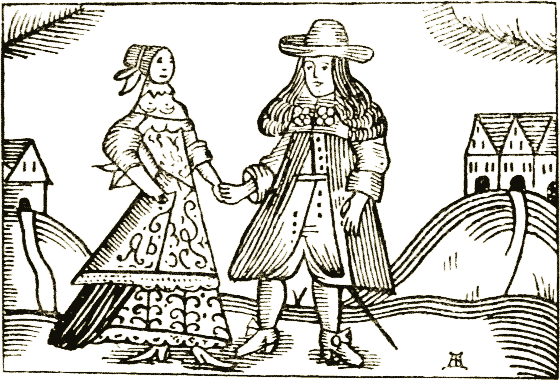
When she beheld the Costly Dishes of Rich Meat, This Shrew had not the Stomach to Eat, But did cry out, I shall be Ruined at this rate, This is enough to consume an Estate: Before she any more words did reply She made both Bottles and Dishes to flye; Both Friends and Husband she there did abuse, Asking him how he dare be so profuse? Like Thunder loud, her voice she straight began to raise, Which made the Guests to stand all in a maze, Who never saw the like in all their lives before, Dishes of Meat they lay strow'd on the floor; Thus in disorder they all went their way, Each one was glad they were out of the fray; Then said her Husband did ever Man know, Any poor Mortal so plagu'd with a Shrow. Now the next day he to a skilful Doctor went, Promising that he would give him content, If he could cure the cause of a Distracted Wife Which almost made him a weary of his Life; Yes, quoth the Doctor, i'le do it ne'r fear, Bring her, for now 'tis the Spring of the Year; I'le take the Lunacy out of her Brains, Or else I wont have a Groat for my pains. Then home he went and sent her thither out of hand, Now when the Shrow, she did well understand All their intent, she cal'd the Doctor sneaking knave; Now when he see she began for to Rave, Straightways the Doctor did bind her in Bed, Leting her Blood, likewise shaving her Head; Sirrah, said she, I would have you to know, That you shall suffer for serving me so. Madam, said he, I know you are beside your Wits, But I will soon bring you out of those Fits; I'le cut your Tongue, and when a Gallon you have bled, 'Twill cure that violent Noise in your Head; Pray Sir, said she, don't afflict me so sore, I'le ne'r offend my sweet Husband no more; Thus by sharp Usage and keeping her low, He had the fortune to Conquer the Shrow. After some time, he came to see his Wife at last, When she begg'd pardon for all that was past; Saying, her Fits for evermore she would refrain, If he'd be pleas'd to receive her again; My former Follies I pray now forgive, Ile ne'r offend you no more while I live: Then in much love they both homeward did go Thus has he made a sweet Wife of a Shrow.
FINIS.
[18.] One being set upon by Robbers at five a Clock in the Morning, Gentlemen, says he to 'em, you open Shop very early to day.
[12.]Mr Hill he did say H non est litera, But a note of aspiration still; Now I think on't better, If it be not a letter, With him it will go very ill.
On Galla going to the Bath.
[14.]When Galla for her health goes to the Bath, She carefully doth hide, as is most meet, With aprons of fine linnen or a sheet, Those parts that modesty concealed hath; Nor only those, but even the breast and neck, That might be seen or shown without all check; But yet one foul and unbeseeming place. She leaves uncovered still; what's that? her face.
[8.] There was one that died greatly in Debt, when it was reported in some company, where divers of his Creditors were, that he was dead; one began to say in good faith, then he hath Carried five hundred ducates of mine with him into the other world; and another of them said, and two hundred of mine; and some others spake of several sums of theirs: whereupon one that was amongst them said, Well, I see now, that though a man cannot carry any of his own with him, into the other world, yet he may carry other mens.
[5.]A Welshman and an Englishman disputed, Which of their Lands maintain'd the greatest state, The Englishman the Welshman quite confuted, Yet would the Welshman nought his brags abate: Ten Cooks, quoth he, in Wales one wedding sees; Truth quoth the other, each man tosts his cheese.
[12.]'Fore a Justice was brought One for a great fault; Y'are an errant Dog, Rogue, says he; Sir, I am no Dog, Nor so errant a Rogue. As your Worship —— takes me to be.
[17.] A Western Lady was very Hospitable to many Gentlemen, and it happened a Knight came thither; and being a great House-wife, early in the Morning she called to her maids, and ask'd whether the Pigs were served; which the Knight hearing, said before the Gentlewoman at dinner, Madam are the Pigs served? Sir, says she, I know not whether you have had your breakfast yea or no.
[5.]My love and I for kisses play'd She would keep stakes, I was content, And when I wonne, she would be payd; This made me aske her what she meant, Sayth she, since you are in this wrangling vaine, Take you your kisses, and give me mine againe.
On a farmer knighted.
[5.]In my conceit Sir John, you were to blame, To make a quiet good wife, a mad dame.
[26.] Some Gentlemen were sitting at a Coffee-house together, one was asking what News there was? T'other told him, There was forty thousand Men rose to day, which made them all stare about, and asked him to what end they rose, and what did they intend? Why faith, says he, only to go to bed at Night again.
Of Milo the Glutton.
[6.]Milo with haste to cram his greedy gut, One of his thumbs into the bone had cut. Then straight, it noysed was about by some, That he had lost his stomacke with his thumbe. To which one said. No worse hap fall unto him, But, if a poore man finde it, 'twill undo him.
[18.] A Person of Quality owed a Gentleman a Thousand Pounds. Meeting together in a fair Road, where both their Coaches went a good rate; the first looking out of the Coach called to the Gentleman, and begged a thousand Excuses. And I beg, said the Gentleman presently, a thousand Pounds.