A Pleasant new Ballad you here may behold, How the Devill, though subtle, was guld by a Scold.
Reading edition
To the Tune of The Seminary Priest.
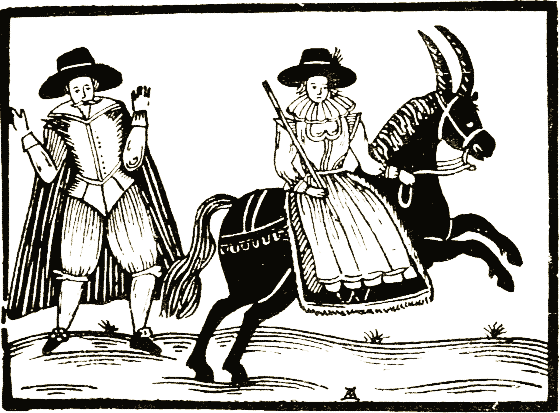
[31.]Give eare my loving Country-men that still desire newes, Nor passe not while you heare it sung, or else the song peruse: For ere you heare it, I must tell my newes, it is not common, But Ile unfold a trueth betwixt a Devill and a woman. Tom Thumb is not my subiect, whom Fairies oft did aide, Nor that mad spirit Robin that plagues both wife and maid Nor is my song satyricke like, invented against no man, But onely of a pranke betwixt a Devill and a woman. .... A woman well in yeares liv'd with a husband kinde Who had a great desire to live content in minde, But twas a thing impossible to compasse his desire For night and day with scolding she did her husband tire. With roughish, lowtish clowne, despight thee Ile be wilde, Doest thou think I marryed thee to use thee like a childe, And set thee on my lap, or humour what you speake? Before Ile be so fond, thy very heart Ile breake. Why, loving wife, quoth he, Ile never doe thee wrong, So thoul't be rul'd by me, and onely hold thy tongue. And when I come from worke, wilt please at board and bed; Doe this my loving wife and take all being dead. Marke well, quoth she, my words what ere you speak me to, By faire meanes or by foule, the contrary Ile doe. According to her speech, this man led such a life, That oft he wish't the Devill to come and fetch his wife. Had he bid her goe homely, why then she would goe brave, Had he cal'd her good wife, she cal'd him rogue and slave; Bade he, wife goe to Church, and take the fairest pew, Shee'd goe unto an Alehouse, and drinke, lye downe and spew. The Devill being merry with laughing at this mirth, Would needs from hell come trotting, to fetch her from the earth; And coming like a horse, did tell this man his minde, Saying, Set her but astride my backe, Ile hurry her through the winde. Kinde Devill quoth the man, if thou a while will wait, Ile bid her doe that thing shall make her backe thee straight And here Ile make a vow for all she is my wife, Ile never send for her againe whilest I have breath or life. Content, the Devill cry'd, then to his wife goes he Good wife, goe lead that horse so black and fair you see. Goe leade, sir Knave, quoth she and wherefore not goe ride? She took the Devill by the reines, and up she goes astride. The Devill neighed lowd, and threw his heeles i' th' ayre, Kick, in the Devill's name, quoth she, a shrew doth never fear. Away to hell he went, with this most wicked scold, But she did curbe him with the bit, and would not loose her hold. The more he cry'd, Give way, the more she kept him in, And kickt him so with both her heeles, that both his sides were thin. Alight, the Devill cry'd, and quick the bridle loose, No I will ride (quoth she) whiles thou hast breath or shooes. Again she kickt and prickt, and sate so stiffe and well, The Devill was not so plagu'd a hundred years in hell. For pitty light (quoth he) thou put'st me to much paine, I will not light, (quoth she) till I come home againe. The Devill shewed her all the paines within that place, And told her that they were ordain'd for Scolds so base. Being bereft of breath, for scolding tis my due, But whilest I live on earth Ile be reveng'd on you. Then did she draw her knife, and gave his eare a slit, The Devill never felt the like from mortall yet. So fearing further danger, he to his heeles did take, And faster than he came, he poast hast home did make. Here take her (quoth the Devill) to keep her here be bold, For hell would not be troubled with such an earthly scold. When I come home, I may to all my fellowes tell, I lost my labour and my bloud to bring a scold to hell. The man halfe dead did stand, away the Devill hyde, Then since the world, nor hell, can well a Scold abide: To make a saile of ships let husbands fall to worke, And give their free consents to send them to the Turke. Then honest wives and maides, and widdowes of each sort, Might live in peace and rest, and Silence keep her court, Nor would I have a scold, one penny here bestow, But honest men and wives buy these before you goe.
FINIS.
[32.]He went to the wood and caught it, He sate him down and sought it, Because he could not find it, Home with him he brought it.
Solution.
That is a thorn; for a man went to the wood and caught a thorn in his foot, and then he sate him down, and sought to have pull'd it out, and because he could not find it out he must needs bring it home.
[26.] A rich and covetous Councellor of this Kingdom, that had an only Child, which was a Daughter and worth £20,000. A young and handsome Gentleman of good Birth though of no great Fortune; yet had so far insinuated himself into the young Lady's Favour, that she promis'd him Marriage, if he could get her Father's Consent. Immediately he comes for London, and goes to her Father, and told him, That he would give him £10 for a Fee if he could assist him in a business which did much concern him: which was, That there was a rich young Heiress in town, which had promised him marriage if it could any way be made good by Law: Why, says he, let her hire a Horse, and invite you to take her away, and let her get up before, and you behind that it may not be said that you rode away with her, but she with you, and let her go to the Minister, and tell him, 'tis her desire to be married to you, and to get a Licence accordingly; and when you are married, then be sure to bed her, and I'll warrant you she's your own. And this, says the Gentleman, you'll avouch for Law? He told him, Yes. Well Sir, says he, if you will set your Hand to it, I'll give you Ten Pounds more; which he did. Immediately he goes into the Country, and shews the young Lady what was done, and how 'twas done; and she accordingly performed her promise, and suddenly married and bedded; and having so continued a week they both came to London, and came to her Father, and fell down upon their knees to him, and craved his Blessing; which made him at first fly into harsh Language; but the Gentleman said, We have done nothing but what you avoucht for Law, and have it under your hand. The Lawyer fearing his Reputation might be brought in question, and seeing him to be a handsome and well bred Gentleman, and of a good family, clape both their hands together, and bid God bless them; and then gave them a subsistence for the present, and made over all to them after his death.
[12.]Three had a contest
Which grain was the best;
The first said Wheat had the Quorum
The second stood for Rye
But the third did reply
On one in debt.
[14.]Don Pedro's out of debt; be bold to say it; For they are said to owe that mean to pay it.
[4.] A Gentleman that had never been used to Wounds, received a small scratch with a Sword in a Tavern Fray; at which he was sadly frighted, and sent immediately for a Chyrurgeon, who coming, and seeing the Wound but slight, and the Gentleman in a great fear: for sport's sake pretended great danger, and therefore sends his Man with great speed to fetch him such a Plaister: Why Sir, quoth the Gentleman, is the wound so dangerous? O Yes, replyed the Arch Chyrurgeon, for if he don't make great haste, it will heal of it self, before he comes.
Scylla toothlesse.
[24.]Scylla is toothlesse; yet when she was young, She had both tooth enough, and too much tongue: What should I now of toothlesse Scylla say? But that her tongue hath worne her teeth away.
The extravagances of male attire in Charles the First's time justly called down the wrath of the Satirists, particularly of the Puritan School. The Cavaliers, however, were only effeminate in their dress, their gallant conduct in the Civil war proving them to be men of mettle. The subjoined is so faithful in its representation of the then height of fashion as to be almost removed from caricature, still the letterpress evidently intends it to be a satire as bitter as could be made by the Roundhead who penned it, who naturally believed in "the Unlovelinesse of Love Lockes."