The London Ladies Vindication of Top-Knots: With the many Reasons that She shows for the Continuation of the same: As also proving Men to be as Proud as themselves.
Reading edition
To the Tune of, Here I love, There I love: Or, The two English Travellers.
Licensed according to Order.
[112.]Young Women and Damsels that love to go fine, Come listen a while to this Ditty of mine, In spight of all Poets, brave Girls, we will wear Our Towers and Top Knots, with Powdered Hair. I am a young Woman, 'tis very well known, And I am resolv'd to make use of my own, In spight of all Poets, brave Girls, we will wear A Tower and Top Knot, with Powdered Hair. They talk of a Calf which was seen in our dress, But let us take Courage, Girls, nevertheless. In spight of those Rumours, we'll constantly wear A Tower and Top Knot, and Powdered Hair. We are not such Fools to believe what they say, 'Tis fit that young Women should go fine and gay, In spight of their Bugbears, brave Girls, let us wear, Rich Towers and Top Knots, with Powdered Hair. Were we to be Ruled by some sort of Men, We should go like Women of Fourscore and Ten, In spight of those Cox combs, brave Girls, we will wear Rich Towers and Top Knots, with Powdered Hair. Like Beautiful Angels we strive to appear, The Hearts of our Husbands in order to cheer, Then what is the Reason that we may not wear Rich Towers and Top Knots, with Powdered Hair.
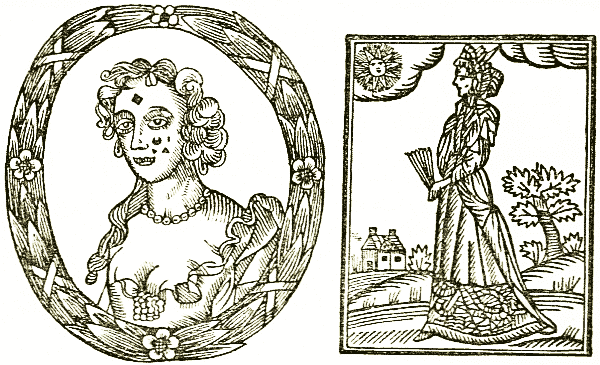
If we are the Pleasure and Joy of their Life, Pray when can they take more delight in a Wife, Then at the same time when rich Garments they wear, With Towers and Top Knots, and Powdered Hair. We see the young Misses and Jilts of the Town, Have six Stories high, as they walk up and down, Then pray tell me why should not honest Wives wear Rich Towers and Top Knots, with Powdered Hair. If we an't as Fine and as Gaudy as they, Who knows but our Husbands might soon run astray, Consider this, Women, and still let us wear Our Towers and Topknots, with Powdered Hair. It is but a Folly to tell us of Pride, While we have these Arguments still on our side; As long as we live we will flourishing wear Rich Towers and Top Knots, with Powdered Hair. Nay further I'le tell ye the case it is thus, That all is not sav'd which is put in the Purse; A Shopkeepers Lady she utters much Ware When drest in her Top Knots, with Powdered Hair. What Man would not have his Wife richly Array'd When as he well knows it enlarges his Trade; Come, come, I must tell ye, 'tis fit we should wear Rich Towers and Top Knots, with Powdered Hair. Sometimes when our Husbands are out of the way, Pray tell me what huffing young Gallants will stay, If that a fine Delicate Wife were not there? Then Hey for the Top Knots, and Powdered Hair. Some young-men may flout us, yet mark what I say, There's no Woman living, now Prowder than they; Observe but the many knick-knacks which they wear. More Costly than Top Knots, or Powdered Hair. Their Wigg, Watch, and Rapiers we daily behold, And Embroidered Wastcoats of Silver and Gold; Likewise, Turn up Stockings, they constantly wear More Costly than Topknots, or Powdered Hair. If Pride be a sin and a folly, why then Han't we a far better Example from Men? If Gaudy Apparel those Gallants do wear, We will have our Top Knots and Powdered Hair.
Printed for P. Brooksby, J. Deacon, J. Blare, J. Black.
[103.] A Gentleman in a Town in Hartfordshire, being much in Debt, was oblig'd to keep House close, a Bailiff who had been promised a great reward to take that Gentleman, having made several attempts in vain to snap him, at last resolv'd upon one that he thought could not fail, so pretending himself in dispair, came by the Gentlemans Parlor Window, (which was next the Street, and where he sat Writing every Day) and pulling out of his Pocket a Halter, made a Nooze, and seemed as if he intended to Hang himself therewith; a Grindstone was before the Door, upon which he got up, and threw the Rope over a good Bough of the Tree, and fastned it, and then put his Head in, concluding the Gentleman would whip out, and so he should arrest him; but as the Devil would have it, the Grindstone which stood firm like a Rock for him to get up, tumbled down as soon as ever the Halter was about his Neck, the Innocent, Unwary Gentleman seeing what past, sallied out, to Cut the Rope, and save the Man; but the Bailiff's Follower lying in Ambuscade, snap'd the Gentleman as soon as ever he peept out, and carried him off, and let his Master hang; who carried the Jest too far, and when the Gentleman told the Bailiff's Follower that his Master would soon be Dead if he did not cut him down—Let him be D—— said he, I have got my Prize, and I shall have the Reward, and my Masters place too.
[26.] A Man being very much diseas'd and weak, was bemoaning himself to his only Son, whom he lov'd very well. For, Jack, says he, if I stand, my Legs ake, if I kneel my Knees ake, if I go, my Feet ake, if I lie then my Back akes, if I sit my Hips ake, if I lean, my Elbows ake. Why truly, Father, says he, (like a good dutiful Child) I advise you, Father, to hang yourself an hour or two, and if that does not do, then come to me again.
[67.] A Scholer being at a Parson's house, stole a Pig; the Parson looking out at his window, spied him and said, Scholer, Scholer, I'le none of that. Noe more you shall, quoth ye Scholer, and ran away with it.
[82.] A Nobleman of France (as hee was riding) met with a yeoman of the Country, to whom he said, My friend, I should know thee, I doe remember I have often seene thee: My good Lord, said the Countryman, I am one of your Honors poore tenants, and my name is T. I. I remember thee better now (said my Lord) there were two brothers of you, but one is dead, I pray which of you doth remaine alive.
The aforesaid Nobleman having had a Harper that was blinde playing to him after supper, somewhat late, at last hee arose, and commanded one of his servants to light the Harper downe the staires: to whom the Serving man sayd, my Lord, the Harper is blind; thou ignorant knave, quoth my Lord, he hath the more need of light.
[105.] When that Scogin had taught his scholler that hee with helpe might be Sub deacon, he said to him, thou shalt goe to take orders, and I will go with thee. And if thou dost stand in any doubt, take heed to my booke, and give an eare to me, and I will helpe thee as much as I can. When all they that should take orders, were come to oppositions, Scogin did come forth with his scholler. And the Ordinary did oppose him with a verse of the Psalter; which was this, Moab, Agareni, Gebal, Amon & Amalek, cum habitantibus Tirum. Scogins scholler was blanke or amazed. Sir, said Scogin to the Ordinary, you shall understand that Moab, Agareni, Gebal, Amon & Amalek, cum habitantibus Tirum, were unhappy fellowes, for they did trouble the children of Israel, and if they trouble my scholler, it is no marvell: but now I doe tell thee, my scholler, be not afraid of Moab, Agareni, Gebal, Amon & Amalek, cum habitantibus Tirum, for I will stand beside to comfort thee, for Moab, Agareni &c can do thee no harm for they be dead. By reason that Scogin did so oft repeate these words, the scholler did reade this verse aforesaid: and through Scogins promise, the Ordinary was content that his scholler should take Orders, and be Sub deacon. After this when the orders were given againe, Scogin did speake to his schollers Father, to send in a letter three or foure peeces of gold. The Schollers Father was content so to doe; so that his son might be Deacon. Then said Scogin to his scholler, thou shalt deliver this letter to the Ordinary, when he doth sit in oppositions, and as soone as he feeleth the letter, he will perceive that I have sent him some money, and he will say to thee Quomodo valet magister tuus? that is to say, how doth thy Master? thou shalt say Bene: that is to say, well. Then will he say, Quid petis? What thing doest thou aske? Then thou shalt say, Diaconatum, to be a Deacon. Then the Ordinary will say, Es tu literatus? art thou learned? & thou shalt say Aliqualiter, somewhat. Now said Scogin, thou hast no more than three words to beare in mind in Latine, which is to say Bene, Diaconatum, and Aliqualiter. The father and the scholler were glad that by Scogins letters & the money he should be Deacon, & went to the oppositions, and delivered his letter with the money. The Ordinary perceiving money in the letter, said to the scholler. Quid petis? that is to say, what dost thou aske or desire? The scholler remembring Scogins words, that the first word was Bene, he said Bene, that is, well. When the Ordinary heard him say so, he said Quomodo valet Magister tuus? How doth thy Master? The scholler said, Diaconatum that is to say Deacon. The Ordinary did see he was a foole, & said, Tu es stultus, thou art a foole: the scholler said Aliqualiter, that is to say, somewhat. Nay, said the Ordinary not Aliqualiter, but Totaliter, a starke foole. Then the scholler was amazed, and said, sir, let me not goe home without mine Orders, and heere is another Angell of gold for you to drinke. Well, said the Ordinary, on that condition you will promise me to goe to your booke and learne, you shall bee Deacon at this time. Heere a man may see that money is better than learning.
[17.] In a wedding between a Gentleman of a great Family and no Wealth, and a Widdow of great Wealth; says one This is like a Black pudding; the one brought blood, and the other Suet and Oatmeal.
[110.] In the beginning of Queene Elizabeaths raigne, when the order of hanging out lanterne and Candlelight first of all was brought up; the bedell of the warde where Maister Hobson dwelt, in a darke evening crieing up and downe, hang out your lantornes; using no other words. Whereupon Maister Hobson tooke an empty lantorne, and according to the beadles call hung it out. This flout by the Lord Maior was taken in ill part, and for the same offence was sent to the counter; but being released, the next night following, the beadle thinking to amend his call, cried with a loud voice, hang out your lantorne and Candle. Maister Hobson hereupon hung out a lantorne and candle unlighted, as the beadle againe commanded, whereupon he was sent againe to the counter. But the next night the beadle being better advised, cryed, hang out your lantorne and candle light, hang out your lantorne and candle light, which maister Hobson at last did, to his great commendations, which cry of lanthorne and candle light is in right manner used to this day.
[94.] One observ'd it to be a good fashion that was worn now a days, because the Taylors had so contrivd it, that there was little or no Waste in a whole Suit.
The illustration to this satire on drunkenness (which is dated September 1652) is indebted for its point to the foxes, it being then a cant term when a man was drunk to say he was foxed; the geese denote the foolish behaviour of men when under the influence of drink.
BARNABIES SUMMONS: or, Paie your Groat in the Morning.
[113.] Intended for all Malaga Men, called Vintners, Sack drawers, White wine, Claret, Rhenish, Bastard Sherry, or Canary Blades, and Birds, together with all Ale Brewers, Beer Brewers (alias) Hogshead fillers, Barrellers, Tapsters, or Firkinners: As also for all Drawers, Tub Tapsters, Quaffers, Huffers, Puffers, Snuffers, Rufflers, Scufflers, and Shufflers, with Wine bibbers, Sack suckers, and Toast makers; not forgetting other depending Officers of a lower Rank, of our stumbling Fraternity, viz Bench whistlers, Lick-wimbles, Suck spigots, Hawkers, Spewterers, Maudliners, Fox catchers, including in the said Warrant as a Reserve, our true and trusty Friends for the speedier effecting our designe and purpose, All Vulcans, Crispins, Tinkers, Pedlars, and of late our endeared friends, the Society of Upstart Printers, and Newes Mongers; and excluding by special command, all Three peny Ordinary Sharks, as Bakers, Weavers, Tailors, Usurers, Snip Eared Scriveners, Presbyters, either English, Scotch, or Dutch, (but stay there a little) for though the last of these be good for nothing else, yet they are stout Drinkers and Drunkards; and therefore if they please to tiple as formerly they have done, and must doe now, they shall have the benefit of this our Warrant, provided they neither drink all, nor too much; our Warrant for the generall content of all Bonos Socios is set out in maner and forme following, that all whom it may concern (as it does too many) may, if they can stand, understand it.
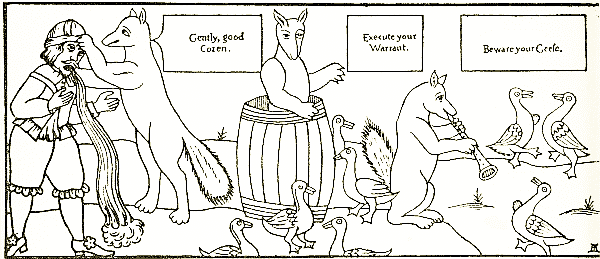
Gently, good Cozen. Execute your Warrant. Beware your Geese.
The WARRANT.
To all Constables, Head boroughs, and other petty Officers, and stout Drinkers, whom this specially concernes.
Given at our Mannour of Flushing in the Full Moone Tavern at Sun rising
Anno 155432.
Upon the last day of the first of March.
Ut Supra.
[26.] One told a Story (which he swore was of certain as you know all these things are,) For, says he, I was riding to Saint Albans, and riding through a Lane, that was of stiff Clay, as I was galloping, my Horses foot sticking in, pluckt off shoe and hooff too, and so I gallopt on for three or four Miles; and my horse never complained, that I never saw a horse gallop so well on three legs in my life; at length he began to limp, then I lighted to see what he ailed and found both shooe and hooff gone; so, fearing to pay for the horse, got presently up agen, and gallopt as fast as I could drive; and fortunately my Horse leg lighted agen in the same place, and pull'd up hooff, shoe and all, which was better fastened than when I came out; and so I performed my journy, and got that night as far as I rid.
[91.]One evening as Cold as Cold might be, With frost and haile, and pinching weather, Companions about three times three Lay close all in a pound together. Yet one after another they tooke a heate, And died that night all in a sweat.
Resolution. A pound of Candles.