SOME OF THE TUNES noted in this Book.
Reading edition
Sir Eglamore. See p. 9.
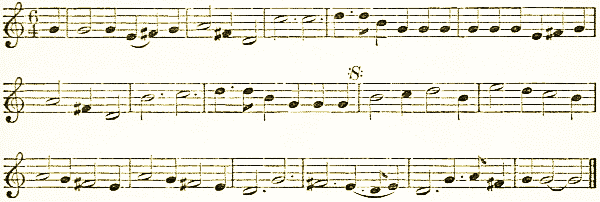
midi file .pdf file
Come Lasses and Lads. See p. 23.
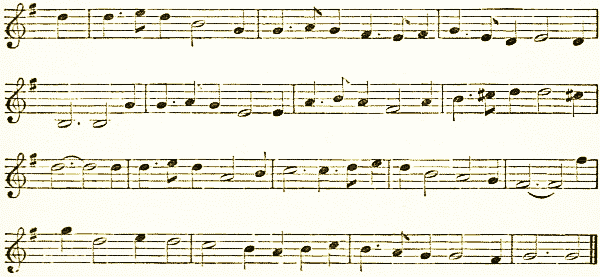
midi file .pdf file
Sellenger's Round. See p. 68.
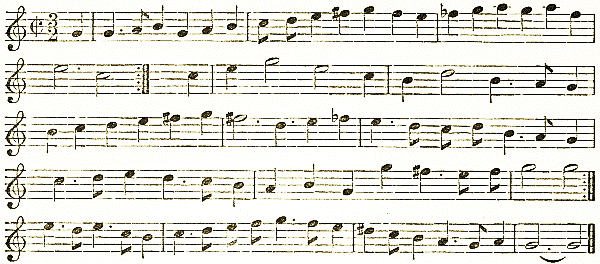
midi file .pdf file
Dumb, Dumb, Dumb. See p. 99.
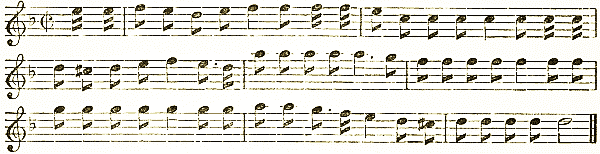
midi file .pdf file
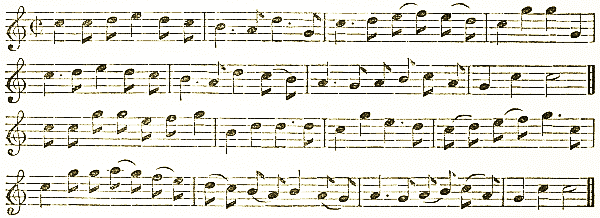
Sawney and Jockey. See p. 116.
midi file .pdf file
Stingo; or, the Oyle of Barley. See p. 124, p. 276.

midi file .pdf file
Pegge of Ramsay; or, Watton Town's End. See p. 142.

midi file .pdf file
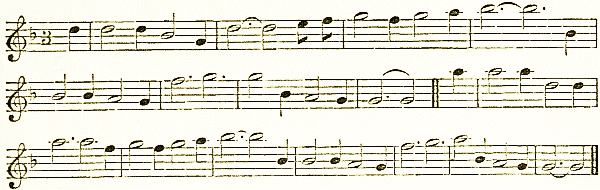
Upon a Summer's Day. See p. 159.
midi file .pdf file
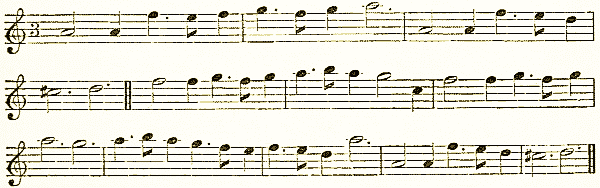
Shall I lye beyond thee? or, Lulle me beyond thee. See p. 207.
midi file .pdf file
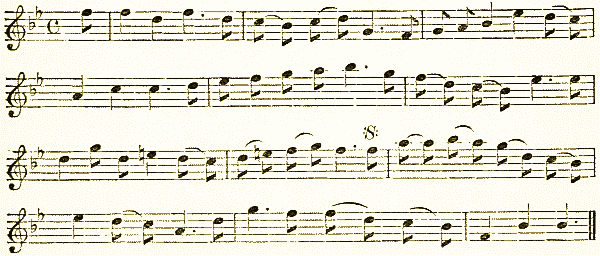
The Spinning Wheel. See p. 241.
midi file .pdf file
Cuckolds all a Row. See p. 255.
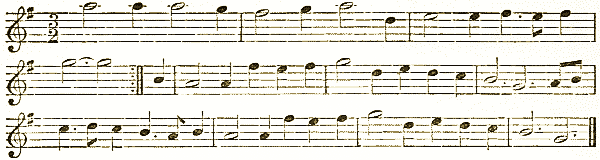
midi file .pdf file
The Leather Bottel. See p. 312, p. 343.
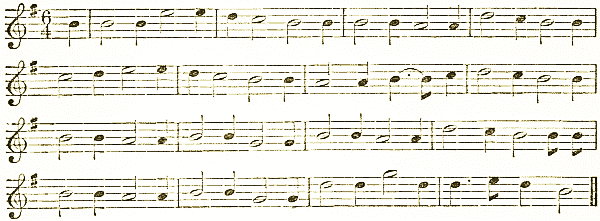
midi file .pdf file
Ragged and Torn. See p. 327.
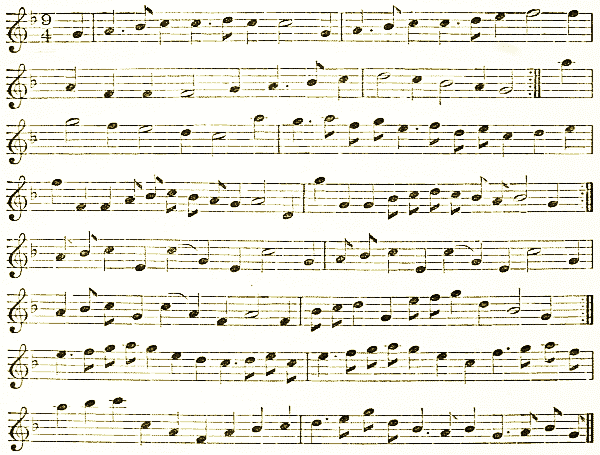
midi file .pdf file
There was a Jovial Beggar. See p. 386.
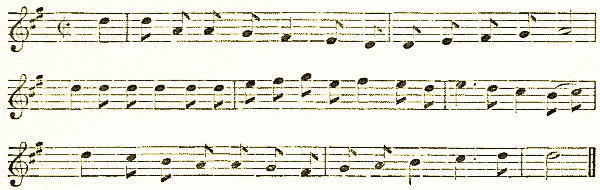
midi file .pdf file
Ioan's Ale is New. See p. 399.
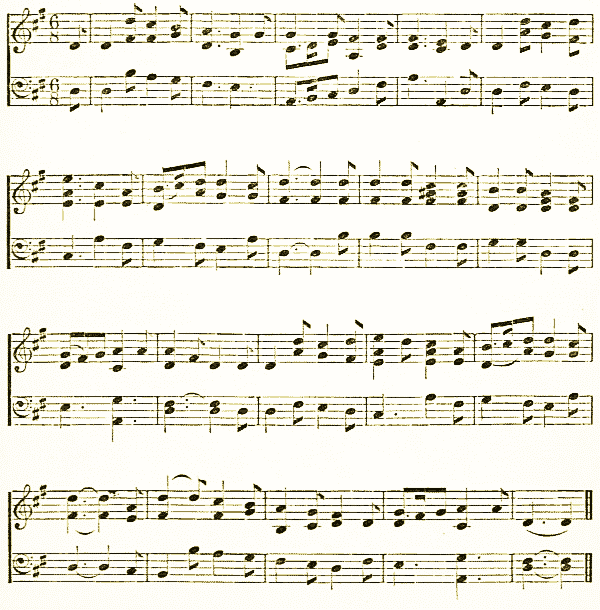
midi file .pdf file
Love will find out the way. See p. 417.
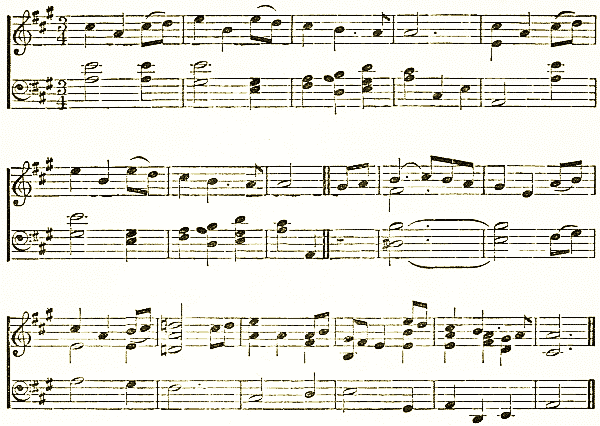
midi file .pdf file
The Joviall Crew; or, A Beggar, a Beggar, a Beggar I'll be. See p. 424.
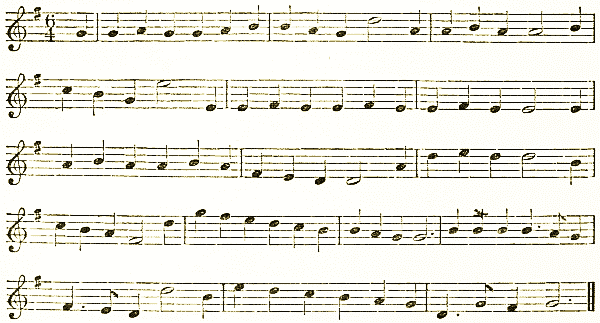
midi file .pdf file
Transcriber's Note:
Footnotes are numbered consecutively through the book, 1 to 288, and placed below the snippet/poem/article etc. to which they refer.
The other numbers in square brackets, e.g. [61.], are references to publications listed at the end of the book.
(Some numbers are used multiple times. Online readers could use the Back button, or Back arrow, to return from Endnotes. 'Return to p. ' numbers have been supplied as an aid for devices without Back buttons.)
Special Notes, (a. - u.), are specific to one poem. They are placed, as in the original, after each stanza.
Sidenotes are used for one poem, and are placed to the right of the text, in the margin.
Punctuation is somewhat irregular, and not always present. Opening quotes are not always closed, and sometimes the closing quote is many paragraphs after the opening quote. Punctuation has not been regularised. Some punctuation is older style, as : for . Some missing or damaged punctuation has been repaired.
The spelling is not necessarily consistent. A word or name can be spelt several ways in the same article. All logical variants have been retained.
'I' often means 'aye' (meaning 'yes'), even in the same sentence as 'I' the personal pronoun.
The spelling of this book is from the 17th Century, when modern spelling rules did not apply.
Apostrophes (of ownership) were usually absent.
Dashes frequently replace letters in censored words, leaving the astute reader able to guess the word, while not falling foul of officialdom.
Page 3: King Harry groates
Harry was King Henry; a groat was an old English silver coin, first coined by Henry III in 1249, and by Edward III in 1351. Originally worth one penny, it later rose to the value of fourpence. The groat was revived between 1836 and 1856, and withdrawn from circulation in 1887 (from Collins New Age Encyclopedia, 1963).
Page 104: Pr. Rob. Dog corrected to Pr. Rup. Dog (printer's error).
Page 147: 'I'l.' sic. "and therefore I'l. light."
Page 150: 'I, i and J, j were often interchangeable:
Puss my aple gainst thy mouse jle lay The gam's mine jf thast ne'r a trump to play
would perhaps today be written
Puss my apple 'gainst thy mouse I'll lay The game's mine if thou hast ne'er a trump to play
but this book is 17th century....
Page 182: 'of his freind'. "Freind" was a normal 17th century spelling of 'friend'.
Page 268: [94*.] is as printed. The reason for the asterisk is unclear.
Page 275: 60000l. l is short for 'libra' (Latin) = £ (pound/pounds); so, £60,000.
Page 318, Footnote 201: 'Whitlocke' and 'Whitelocke' both occur. Wikipedia favours 'Whitelocke', but both spellings have been retained.
Page 333: 'is' corrected to 'in'.
"the Hare went through a Muse211 in a Hedg where a Carpenter had hid his Axe,..."
Page 437 et seq.: Appendix. Traditional Printers had the luxury of being able to assign an absolute width to the pages of printed books. The text of online books is of variable width, depending on the computer size or the mobile medium chosen by the reader. Accordingly, entries containing British Museum reference numbers in the style of fractions may not wrap appropriately for some online or mobile devices. It is practically impossible to render these entries at a correct width to suit all reading devices. Shorter, but readable lines were deemed better than overlaps.
Page 438: 'woood' corrected to 'wood
"Being a Mock to the Crab of the Wood, and to that Tune:"
Page 440: Printed for R. Jackson 1643.263; Printed for I. Underwood 1643.263 This is not an error: the same footnote (263 This, as far as I can learn, is the only year of his publishing.) would appear to apply to both publishers.