The beggars CHORUS IN THE JOVIAL CREW.
Reading edition
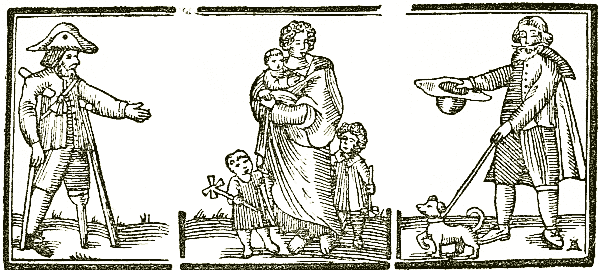
[119.]There was a jovial Beggar, he had a wooden Leg, Lame from his Cradle, and forced for to Beg; And a Begging we will go, we'll go, we'll go, And a Begging we will go. A Bag for my Oatmeal, another for my Salt, A little pair of Crutches, to see how I can halt; And a Begging, &c A Bag for my Bread, another for my Cheese, A little Dog to follow me, to gather what I leese. And a Begging &c A Bag for my Wheat, another for my Rye, A little Bottle by my side, to drink when I'm a dry. And a Begging we will go, we'll go, we'll go, And a Begging we will go. To Pimlico we'll go, where merry we shall be, With ev'ry Man, a Can in's hand, and a Wench upon his knee. And a Begging &c Seven years I served my old Master Wild, Seven years I begged whilst I was but a Child And a begging &c I had the pretty knack for to wheedle and to cry, By young and by old much pitied e'er was I. And a begging &c Fatherless and Motherless still was my Complaint, And none that ever saw me but took me for a Saint. And a begging &c I begg'd for my Master, and got him store of Pelf, But Jove now be praised, I now beg for myself. And a begging &c Within a hollow Tree I live, and pay no Rent, Providence provides for me, and I am well content. And a begging &c Of all occupations a Beggar lives the best, For when he is a weary, he'll lie him down and rest. And a begging &c I fear no Plots against me, but live in open Cell; Why who woud be a King when a Beggar lives so well? And a begging &c.
Printed for R. Brooksby at the Golden Ball in Pye-Corner.
[52.] One Dromo, a certaine Tiler, sitting upon a ridge of a House, laying on certaine roofe tiles, looking backe, and reaching somewhat too far for a little morter, that lay by him, fell backward and by good hap, fell upon a man that was sitting under the house, whom with his fall he bruised to death, but thereby saved his owne life. Not many dayes after, a sonne of the dead mans, caused this man to be apprehended for murther, and, having him before the Judge, cried unto the Judge for justice: who asking the prisoner what hee could say for himselfe, received this answer. Truly, Sir, I never thought the man any hurt, neither did I thinke to fall: but since it was my hap to hit upon him to save my life, if it please your Lordship, I am contented that he shall have justice; for my selfe, I had no malice to his father, though I see he hath a great deale to me: but let him doe his worst, I care not, I aske no favour: let him go up to the top of the house where I sate, and I will sit where his father sate; let him fall from the place as cunningly as hee can, and fall upon mee to save his life, I will bee contented. The Judge seeing the mans innocency, and how farre he was from intent of any evill to the man whom he had slaine, willed the complainant to take this course for his contentment: which he refusing, was dismissed the Court, and the Prisoner thus by his wity answer released.
[110.] There was a certaine farmer that lost forty pounds betwixt Cambridge and London, and being so great a summe, he made proclamation in all market Townes there abouts, that whosoever had found forty and five pounds, should have the five pounds for his labour for finding it, and therefore he put in the five pound more than was lost. It was Maister Hobsons fortune to find the same sum of forty pounds, and brought the same to the baylive of Ware & required the five pounds for his paines, as it was proclaymed. When the country farmer understood this, and that he must needs pay five pounds for the finding, he sayd that there was in the purse five and forty pounds, and so would hee have his owne mony and five pounds over. So long they strove, that the matter was brought before a Justice of the Peace, which was one Maister Fleetwood, who after was Recorder of London; but when Maister Fleetwood understood by the bayleife that the proclamation was made for a purse of five and forty pound, he demanded where it was. Here, quoth the baylie, and gave it him. Is it just forty pound? said Maister Fleetwood. Yes truly, (quoth the bayleife) Here maister Hobson, sayd Ma. Fleetwood, take you this mony for it is your owne, and if you chance to find a purse of five and forty pound, bring it to this honest farmer. That is mine, quoth the farmer, for I lost just forty pound. You speake too late (quoth Maister Fleetwood). Thus the farmer lost the mony, and maister Hobson had it according to justice.
[67.] Mr. French the King's Fisher, beeing a Widower, married a young woman, and shortly died, on whom one made this distich.
By fish hee liv'd, by fish hee thriv'd, He touched ye flesh, and so hee died.
[103.] An Alderman of Norwich, having a Maid servant Married from his House, went two or three Years after to see her, and ask'd (amongst other things) how many Children she had? Truly Sir, says she, none. O Lord, replys he, what should be the reason of that? I don't know, says the Woman. Alas! adds the Old Fellow, now I remember me, your Mother had none.
[17.] A poor Countrey Boy came up to London to be an Apprentice to a Cobler, and seeing the Lord Mayors show, and hearing that Sir Simon Eyre who formerly was Lord Mayor, had been apprentice to a Shoemaker; one said to him, Is not this a brave show: I, says the Boy, 'tis this we must all come to.
[4.] A silly old fellow meeting his God son, ask'd whither he was going? To School, said the Boy: That's well, said he, there's a Penny for you; Be a good Boy, and mind your Book, and I hope I shall live to hear thee Preach my Funeral Sermon.
[94.] It was said by one, that a Hangman had a contemplative Profession, because he was never at work, but he was put in minde of his own end.
[94.] Why do Ladies so affect slender wastes, said one? 'Tis (replied another) because their Expences may not be too great.
[67.] John Hall, beeing in a sheete (of printing, or writing) called, Knave, is said to have Carried it to ye Vice Ch.(ancellor) Dr Gouch to complaine, who beeing walking in his garden, and vexed that hee would trouble him wth such a frivolous matter, tare ye sheete & cast it abroad. John gathers up all ye pieces: ye Dr demanded why? Hee answered, I would bee loth to leave ye Knave in your worship's garden.
[94.] One commending a Taylor for his dexterity in his Profession; another standing by, ratified his opinion, saying, Taylors had their business at their fingers ends.