My Wife will be my Master: or, The Married-mans Complaint against his unruly Wife.
Reading edition
The Tune is, A Taylor is a Man.
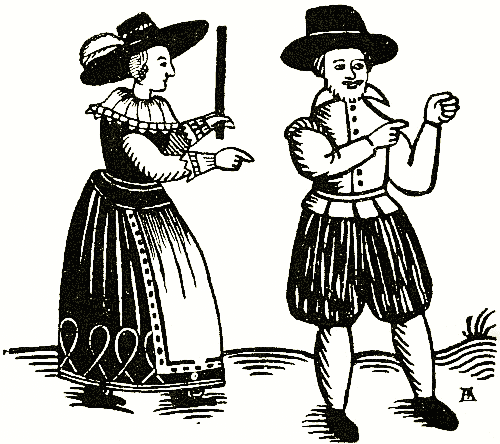
[108.]As I was walking forth of late, I heard a man complaining, With that I drew me near to him, to know the cause and meaning Of this his sorrow, pain and grief, which bred him such disaster; Alas, quoth he, what shall I do, my wife will be my master. But if ever I am a Widdower, and another wife do marry, I mean to keep her poor and bare, and the purse I mean to carry. If I should give her forty pound, within her apron folding, No longer then she's telling on't, her tongue would ne'r leave scolding, As Esops Dog barkt at the Moon thinking for to distast her, So doth my wife scold without cause and strives to be my master. But if ever &c Were I so strong as Hercules, or wiser than Apollo, Or had I Icarus wings to flye, my wife would after follow: Or should I live as many years as ever did King Nestor, Yet do I greatly stand in fear my wife would be my Master. But if ever &c I know no cause nor reason why, that she with me should jangle, I never gave her cause at all to make her with me wrangle; I please her still in what I may, and do no jot distast her, Yet she doth strive both night and day always to be my Master. But if ever &c I every morning make a fire, all which is done to ease her I get a Nutmeg, make a toast, in hope therewith to please her: Of a Cup of nappy ale and spice, of which she is first taster, And yet this cros-grain'd quean will scold and strive to be my Master. But if ever &c I wash the dishes, sweep the house, I dress her wholsome dyet, I humour her in every thing, because I would be quiet: Of every several dish of meat, she'l surely be first taster, And I am glad to pick the bones, She is so much my Master. But if ever &c Sometimes she'l sit while day gives light, in company with good fellows, In Taverns and in bowsing Kens, or in some pimping Ale house: And when she comes home drunk at night, though I do not distast her, She'l fling, she'l throw, she'l scratch and bite, and strive to be my Master. But if ever &c Her bed I make both soft and fine, and put on smock compleatly, Her shooes and stockings I pull off, and lay her down most neatly: I cover her, and keep her warm for fear I should distast her, I hug her kindly in my arms, Yet still She'l be my Master. But if ever &c And when I am with her in bed she doth not use me well sir, She'l wring my nose, and pull my ears, a pittiful case to tell sir; And when I am with her in bed, not meaning to molest her, She'l kick me out at the bed's feet, and so become my Master. But if ever &c And thus you hear how cruelly my wife doth still abuse me, At bed, at board, at noon and night she always did misuse me: But if I were a lusty Man and able for to baste her, Then would I surely use some means, that she should not be my Master. But if ever &c You Batchelors that sweet-hearts have, when as you are a Wooing, Be sure you look before you leap, for fear of your undoing: The after wit is not the best, and he that weds in hast sir, May like to me, bewail his case, if his wife do prove his Master. But if ever &c You Married Men that have good wives, I wish you deal well by them, For they more precious are than Gold, if once you come to try them: A good wife makes a husband glad, then let him not distast her, But a Scold will make a man run mad, if once she proves his Master. But if ever &c
[93.] There was some halfe dozen of Citizens, that had oftentimes beene solliciters to George (Peele), he being a Master of Art at the Universitie of Oxford, that hee would ride with them to the Commencement, it being at Midsomer. George, willing to pleasure the Gentlemen his friends, rode along with them. When they had rode the better part of the way, they baited at a village called Stoken, five miles from Wickham; good cheere was bespoken for dinner, and frolicke was the company, all but George, who could not be in that pleasant vaine that did ordinarilie possess him, by reason he was without mony: but he had not fetcht fortie turnes about the Chamber, before his noddle had entertained a conceit how to money himself with credit, and yet glean it from some one of the Company. There was among them one excellent Asse, a fellow that did nothing but friske up and down the Chamber, that his money might bee heard chide in his pocket: this fellow had George observed, and secretly convay'd his gilt Rapier and Dagger into another Chamber, and there closely hid it: that done, he called up the Tapster, and upon his cloake borrowes 5 shillings for an houre or so, till his man came, (as he could fashion it well enough:) so much money he had, and then who more merry than George! Meate was brought up, they set themselves to dinner, all full of mirth, especially my little foole, who dranke not of the conclusion of their feast: dinner ended, much prattle past, every man begins to buckle to his furniture: among whom this Hichcock missed his Rapier: at which all the Company were in a maze; he, besides his wits, for he had borrowed it of a speciall friend of his, and swore he had rather spend twenty Nobles. This is strange, quoth George, it should be gone in this fashion, none beeing heere but our selves, and the fellowes of the house, who were examined, but no Rapier could be heard of: but George in a pittifull chafe, swore it should cost him fortie shillings, but hee would know what was become of it, if Art could do it; and with that he caused the Oastler to saddle his Nag, for George would ride to a Scholler, a friend of his, that had skill in such matters. O, good M. Peele, quoth the fellow, want no money, heere is forty shillings, see what you can doe, and, if you please, I'le ride along with you. Not so, quoth George, taking his fortie shillings, I'le ride alone, and be you as merry as you can till my returne. So George left them, and rode directly to Oxford; there he acquaints a friend of his with all the circumstances, who presently tooke Horse, and rode along with him to laugh at the Jest. When they came backe, George tels them he has brought one of the rarest men in England: whom they with much complement bid welcome. He, after a distracted countenance, and strange words, takes this Bulfinch by the wrist, and carried him into the privy, and there willed him to put in his head, but while he had written his name and told forty: which he willingly did: that done, the Scholler asked him what he saw? By my faith, sir, I smelt a villainous sent, but I saw nothing. Then I have, quoth he, and with that directed him where his Rapier was: saying, it is just North East, inclosed in Wood, neere the earth: for which they all made diligent search, till George who had hid it under a settle, found it, to the comfort of the fellow, the joy of the Company, and the eternall credit of his friend, who was entertained with Wine and Sugar; and George redeemed his Cloake, rode merrily to Oxford, having Coine in his pocket, where this Loach spares not for any expence, for the good fortune he had in the happy finding of his Rapier.
[94.] One said the Midwifes Trade, of all Trades, was most commendable, because they lived not by the hurts of other men as Surgeons do; nor by the falling out of friends, as Lawyers do; but by the agreement betwixt party and party.
[105.] On a time Scogin did send Jacke to Oxford to market, to buy a penny worth of fresh herring. Scogin said, bring foure herrings for a penny, or else bring none. Jack could not get foure herrings but three for his penny; and when he came home, Scogin said, how many herrings hast thou brought? and Jacke said, three herrings, for I could not get foure for a penny. Scogin said he would none of them: Sir, said Jacke, then will I, and here is your penny againe. When dinner time was come then Jack did set bread and butter before his Master, and rosted his herrings, and sate downe at the lower end of the table and did eate the herrings. Scogin said, let mee have one of thy herrings, and thou shalt have another of mee another time. Jacke said, if you will have one herring, it shall cost you a penny. What, said Scogin, thou will not take it on thy Conscience: Jacke said, my conscience is such, that you get not a morsell here, except I have my penny again. Thus contending together, Jacke had made an end of his herrings: A Master of Arts of Oxford, one of Scogins fellowes, did come to see Scogin, and when Scogin had espied him, hee said to Jacke, set up the bones of the herrings before me: sir, said Jacke, they shall cost you a penny. Then said Scogin, what, wilt thou shame me? No, sir, said Jacke, give me my penny again, and you shal have up the bones, or else I will tell all. Scogin then cast down a penny to Jacke, and Jacke brought up to Scogin the herring bones: and by this time the Master of Arts did come in to Scogin, and Scogin bad him welcome, saying, if you had come sooner you should have had fresh herrings to dinner.
[26.] A confident bold Fellow at a Nisi prius in the Country, having a Trial then in Law, and fearing that the Trial would go against him, said to the Judge, My Lord, I do not desire your Sentence now, but only your Opinion at the present; and I will wait upon your Lordship for Judgment at some other time. Well, says the Judge, if you'd only have my Opinion now, why then my Opinion is, That if you had had Judgment to be hang'd seven years ago, the Country would have been more quiet than it is now. Well, my Lord, says he, if this be your Opinion, then your Judgement and mine doth not suit at all, so that I'le have nothing to do with you, but go to another Judge.