The Joviall Crew.244 or Beggars-Bush.
Reading edition
The Joviall Crew.244 or Beggars-Bush.
In which a Mad Maunder doth vapour and swagger With praiseing the Trade of a bonney bold Beggar.
To the tune of, From hunger and Cold.
[126.]A Beggar, a Beggar, A Beggar I'le be, There's none leads a Life so jocond as hee; A Beggar I was, And a Beggar I am, A Beggar I'le be, from a Beggar I came: If (as it begins) our Trading do fall, I fear (at the last) we shall be Beggars all. Our Tradesmen miscarry in all their affayrs And few men grow wealthy, but Courtiers and Players. A Craver my father, A Maunder my mother, A Filer my sister, a Filcher my brother, A Canter my Unckle, That cared not for Pelfe, A Lifter my aunt, a Beggar myselfe. In white wheaten straw, when their bellies were full, Then I was begot, between Tinker and Trul. And therefore a Beggar, a Beggar I'le be, For none hath a spirit so jocond as he.
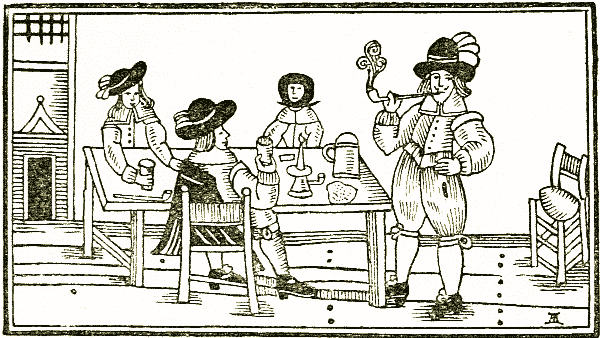
When Boyes do come to us, And that their intent is To follow our Calling, we nere bind them Prentice, Soon as they come too't, We teach them to doo't, And give them a Staff and a Wallet to boot. We teach them their Lingua, to Crave and to Cant, The devil is in them if then they can want. If any are here that Beggars will bee, We without Indentures will make them free. We begg for our bread, But sometimes it happens We feast with Pigg, Pullet, Conny and Capons For Churche's affairs We are no Man-slayers We have no religion, yet live by our prayers. But if when we begg, Men will not draw their purses, We charge and give fire, with a volley of curses, The Devil confound your good Worship we cry, And such a hold brazen fac'd Beggar am I.
London. Printed for W. Thackeray, T. Passenger, and W. Whitwood.
[82.] A Justice of the Peace committed a fellow to prison, and commanded him away three or foure times, but stil the fellow intreated him. Sirrah, (said the Justice) must I bid you bee gone so many times, and will you not goe? The fellow answered, Sir, if your worship had bidden mee to dinner or supper, I should in my poore manners not to have taken your offer under two or three biddings; therefore I pray you blame me not if I looke for foure biddings to prison.
[26.] King James being in his Progress at Woodstock in Oxfordshire, the King, finding it to rain so one morning that he could not ride a hunting, had got some Nobility and Gentry together, resolving to be merry. And one humour was, that the King having that morning a fine curvetting Horse given him, which kind of Horse he never lik'd in his life, told them that he that could tell the greatest lie should have that Horse. So one told one lie, and another, another: and several had told others, that there was great laughing; and just in the midst of this mirth in comes a Country Fellow, complaining to the King that some of his Servants had wrong'd him: Well, well, says the King, we'll hear you of that anon; come, come hither amongst us, and you must know that he that can tell the greatest lie shall have that horse. Truly Sir, says he, an't please your Grace, I never told a lie in all my life. With that says the King, Give him the Horse, give him the Horse, for I am sure that is the greatest lie that has been told to day.
[94.] A yong lascivious Gallant wanting money, could not with his credit sell anything; yet his father being but lately dead, at length was checkt by some of his friends for his loose and extravagant life, and withal told him he had base and beastly Associates that did draw him to ill houses. He, taking this opportunity, answered, Truly, Friends, your Counsel is very good, I will presently go sell my Coach and Horses.
[17.] One being desired to eat some Oysters, refused, saying they were ungodly meat, unchristianly meat, uncharitable meat, and unprofitable meat. And being demanded his reason why he said it, he answered, They were ungodly meat, because they were eaten without saying of Grace; unchristianly meat because the Creature was eaten alive; uncharitable meat, because they left no offal to the poor, and unprofitable meat, because most commonly there was more spent upon them than the Oysters cost.
[52.] A mad fellow newly married, had onely one young child by his wife, of some quarter old, whom he dearly and tenderly loved, but he was much given to good fellowship, and she altogether addicted to sparing, & good huswifery: still he used to come merry home from the taverne from his boone companions, to her great griefe, she being as sparing of her purse, as prodigall of her tongue, for she was little better than a Scold, would oft upbraid him with his expences of money, and time, and to be so often drunke was prejudiciall both to his estate and bodily health, and that it were far better to spend that at home in his house than in a Taverne; with such Matron like speeches, always concluding her exhortations with a vow that if ever he came home again in the like pickle she would (happen what would come) fling the Child into the Moat (for the house was moted round.) It happned shortly after, that he revelling till late in a cold frosty Winter evening, she having intelligence by her scouts where hee was, made no doubt hee would come home flustred. She commands the Infant to bee convaied to the farther part of the house, and to wrap the Cat in the blankets, put it in the Cradle, and there sit and rocke it. Presently comes her Husband, she fals to her old lesson of quarrelling with him, and hee with her, ill words begot worse, much lewd language past betwixt them. The woman suddenly steps to the Cradle (having spied her advantage;) I have long threatned thee a mischiefe, and that revenge I cannot worke on thee (come doggs, come devills) I will inflict on thy Brat in the Cradle; instantly snatched it up in her armes, and ran with it to the Moat side, and flings it into the middle of the water: the poore man much affrighted, leaves to pursue her, and leaps into the water, up in mud and water to the very chinne, crying, Save, oh save the child. Now waded he in the Moat in a very bitter cold frost, till he brought out the Mantle, and with much paine and danger comes to the shore, and still crying, Alas, my poore childe, opened the Cloathes: At length the frighted Cat cryed Mew, and being at liberty leapt from betwixt his armes, and ranne away. The husband both amazed and vexed, the woman heartily laughed at her revenge, and the poore man was glad to reconcile the difference before she would either give him fire or dry linnen.
[26.] A dear and Loving wife, that always bore a great respect to her Husband, both in Sickness and in Health, and now did make it appear to the very last. For when her dear Husband was, in Essex, condemned to die, for a small matter God knows, that is only for stealing four or five Horses, and breaking up as many Houses; so this sweet loving Soul his wife, hearing where he was, came and gave him a visit. Wife, says he, you see what I am come to now, prithee pray for me, and have a care to bring up our Children in the fear of God. Husband, says she, as soon as I heard of it, you see I came to you, and as you know I have always been loving to you, you shall now find it at the last. Pray Husband, tell me, are we to be at the charge of a Rope, or they, for I would have all things ready to do you a kindness; for here I have brought one forty Miles to do you a Courtesie, And so left the Rope with him. Well, wife, says he, I thank you heartily, and pray go home, and look after the Children. No, Husband, says she, I have not come so far, but a Grace a God I'll see you hang'd before I go.
[17.] A Countrey man passing by St Pauls Church, at such time as it was turn'd from a House of Prayer, to be a den of Thieves; I mean, an unsanctified Guard of Souldiers: He seeing what manner of Cattle inhabited it, asked a Shopkeeper hard by, If that place were Noah's Ark? Being asked the reason of his demand, Because, said he, I see so many unclean beasts therein.
[82.] In Queene Elizabeths dayes there was a fellow that wore a brooch in his hat, like a tooth drawer, with a Rose and Crowne and two letters: this fellow had a warrant from the Lord Chamberlaine at that time to travell with an exceeding brave Ape which hee had; whereby hee gat his living from time to time at markets and fayres: his Ape did alwayes ride upon a mastiffe dog, and a man with a drum to attend him. It happened that these foure travellers came to a towne called Looe in Cornwall, where the Inne being taken, the drum went about to signifie to the people that at such an Inne was an Ape of singular vertue and quality, if they pleased to bestow their time and money to see him. Now the townsmen, being honest labouring Fishers, and other painfull functions, had no leasure to waste either time or coyne in Ape tricks, so that no audience came to the Inne, to the great griefe of Jack an Apes his Master; who, collecting his wits together, resolved to adventure to put a tricke upon the towne, whatsoever came of it; whereupon hee took pen, inke, and paper and wrote a warrant to the Mayor of the towne as followeth.
These are to will and require you, and every of you, with your wives and families, that upon the sight hereof you make your personall appearance before the Queenes Ape, for it is an Ape of ranke and quality, who is to be practised throughout her Majesties dominions, that by his long experience amongst her loving subjects, hee may bee the better enabled to doe her Majesty service hereafter; and hereof faile you not, as you will answer the contrary. &c.
[26.] A Gentleman having drank very hard at the Kings Head Tavern, came Reeling out up Chancery Lane, and chanced to Reel within the Rails of the Pump, and kept his motion round so long that he was tired; whereupon, leaning on the Rail he askt one that passed by, where he was; he told him over against the Chancery. I thought so (says he) and thats the Reason I think I shall never get out of this place.
[94.] A Welchman that had one of his own Countrey men waiting upon him, went to see a Comedy, and drawing out a Purse of gold and silver at the door, was espied by a Cut purse and dog'd, who seated himself close by him, his servant having all this while a careful eye towards his Master, and jealous of the Cut purse, so that whilest his Master was minding his sport, the Cheater got all his gold and silver out of his pocket, and was about to be gone. The little Welchman's blood rising at it, presently drew out his knife, and cut off his ear, which made the fellow startle, and troubled with the smart thereof, ask't what he meant by it? To whom the Welchman replied, shewing him his ear in his hand, No great harm friend, onely give hur Master hur purse, and I will give hur hur ear.
[105.] Scogin waxing sicker and sicker, his friends advertised him to make his Testament, and to shew where he would lye after hee was dead: Friends, said Scogin, when I came into this World, I brought nothing with me, and when I shall depart out of this world, I shall take nothing away but a sheet; take you the sheet, and let mee have the beginning againe naked. And if you cannot doe this for me, I pray you that I may be buried at the East side of Westminster, under one of the spouts of the leads, for I have ever loved good drinke all the dayes of my life, and there was he buried.
When the extreame pangs of death came upon Scogin, the holy Candle was put in his hand to blesse himselfe. When Scogin had done so, in surrendring thankes to God, hee said, Now the proverbe is fulfilled, that he that worst may shall hold the Candle, for ever the weakest is thrust to the wall.