A Merry Dialogue between Thomas and John. in the praise and dispraise of Women and Wine.
Reading edition
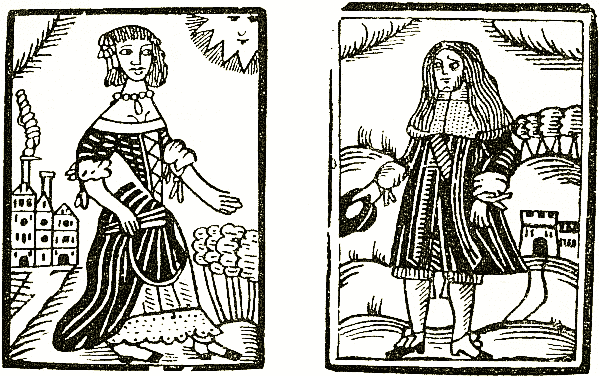
Thomas against the Women doth contend, But John most stoutly doth their cause defend; Young and old read these lines that ensue, You'l all confess that what I write is true, I know no reason but that without dispute This may as well be printed as sung to a Lute.
To a gallant delightful new Tune, well known among Musitioners, and in Play-houses: Called Women and Wine.
Thomas
[71.]Some Women are like to the Wine, like the Sea, and like the Rocks, But they that proves them soon may find 'em like the Wine and Weathercocks. But if you'l believe me, i'le tell you true What light Women are likeunto, Wine, Women and Wine, thus you may compare them too.
John
Women most Constant Men doth find, not like the Sea, but like the Rocks, They are evermore loving and kind, not like the Wine and Weather Cocks But if &c
Thomas
Women have hooks, and women have crooks, so hath the Wine, so hath the Wine, Which draws great Lawyers from their books more than the Wine, more than the Wine. But if &c
John
Women have beauty and fair looks, So hath the Wine, so hath the Wine, Far surpassing the Lawyers books more than the Wine, more than the Wine. But if you'l believe me i'le tell you true What good Women are like unto, Wine, Wine, Women and Wine, thus may you compare them too.
Thomas
Women are Witches when they may so is the Wine, so is the Wine, Which causeth men from their Wives to stray, so will the Wine, so will the Wine. But if you'l believe me i'le tell you true What light Women are like unto, Wine, Wine, Women and Wine, thus may you compare them too.
John
Women are witty when they may, so is not Wine, so is not Wine, And causeth Men at home to stay, so doth not Wine, so doth not Wine. But if &c
Thomas
Women have arms for to imbrace, more than the Wine, more than the Wine, Which brings brave Gallants to disgrace, so doth the Wine, so doth the Wine. But if &c
John
Women most sweetly do imbrace more than the Wine, more than the Wine, And save their Husbands from disgrace, so doth not Wine, so doth not Wine. But if &c
Thomas
Women's tongues are like sharp swords, so is the Wine, so is the Wine, Which urgeth men to swear damn'd Oaths, so doth the Wine, so doth the Wine. But if &c
John
Women's tongues do speak sweet Words, so doth not Wine, so doth not Wine; They can persuade from damned Oaths, so will not Wine, so will not Wine. But if &c
Thomas
Women they do use to change, so doth the Wine, so doth the Wine, And often times abroad will range when Sun doth shine, when Sun doth shine. But if &c
John
Good Women they will never change, so will the Wine, so will the Wine, For profit they abroad will range, Hail, Rain or Shine, Hail Rain or Shine. But if &c
Thomas
Women they will fight and brawl, fill'd with Wine, fill'd with Wine, Their Husbands they will Cuckolds call, inflam'd with Wine, inflam'd with Wine. But if &c
John
Good Women they will comfort all, like the best Wine, like the best Wine, Whatever Sorrow doth befall, so will good Wine, so will good Wine. But if you'l believe me, i'le tell you true, What good Women are like unto, Wine, Wine, Women and Wine, thus you may compare them to.
[17.] A Welch man in heat of blood, challenged an Englishman at Sword and Buckler; but the Englishman giving him a lusty blow on the leg which vext him, he threw down his Weapon, swearing Splut, was not her Buckler broad enough, but her must hit her on the leg?
Now you have heard the sound of the drumme, You may all depart like fooles as you come.
Whereupon the men falling to cursing and swearing, the women to scolding, scratching, and biting, were fame to depart like fooles indeed.
[12.]A Man being cold In's Boots, was so bold, To stand near the fire for remedy; You'l burn your Spurs, says Jane, My Boots sure you mean; No, Sir, they are burnt already.
[26.] A Scholar coming home from Cambridge to his Father, his Father askt him what he had learnt? Why Father, says he, I'll prove that this Capon is better than the blessing of God. How Zon, says he, come, let's hear it; Why thus, Father, says he, nothing you know is better than the blessing of God, and this Leg of the Capon is better than Nothing: Ergo.
[72.]
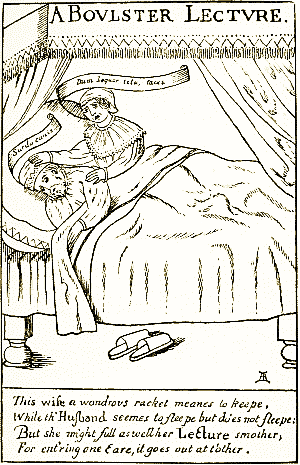
A Bovlster Lectvre.
"Dum Loquor icta taces."
"Surdu canis."
This wife a wondrous racket meanes to keepe, While th'Husband seemes to sleepe but do'es not sleepe: But she might full as well her Lecture smother, For ent'ring one Eare, it goes out at t'other.
[5.]A friend of Durus comming on a day
To visite him, finding the doores say nay;
Being lock'd fast up, first knocks, and then doth pause,
But missing it, he ask't a neighbour by
When the rich Durus' (doors) were lock'd and why?
He said it was a Custome growne of late
At diner time to lock your great man's gate,
Durus' his poor friend admir'd & thought the door
Was not for State lock'd up, but 'gainst the poore,
And thence departing empty of good cheere,
Said, Lord have mercy on us is not there.
[72.]A Man there was, who liv'd a merry life,
Till in the end he tooke him to a Wife;
One that no image was (for shee could speake)
So fierce she was and furious, as in summe,
She was an arrant Devill of her tongue.
This drove the poore man to a discontent,
And oft, and many times did he repent
That e're hee chang'd his former quiet state,
But 'las, repentance then did come too late.
No cure he finde to cure this maladie,
But makes a vertue of necessitie,
The common cure for care to every man,
"A potte of nappy Ale:" where he began
To fortifie his braine 'gainst all should come,
'Mongst which the clamour of his wives loud tongue
That when he was from Ale, an houre seem'd long,
So well hee lik'd th' profession: on a Time
Having staid long at pot (for rule nor line
Limits no drunkard) even from Morne to Night,
He hasted home apace, by the Moone-light:
Where as he went, what phantasies were bred,
I doe not know, in his distempered head,
But a strange Ghost appear'd, and forc'd him stay,
With which perplext, hee thus began to say:
"Good Spirit, if thou be, I need no charme,
For well I know, thou wilt not doe mee harme;
And if the Devill; sure mee thou shoulds't not hurt,
I wed't thy Sister, and am plagued for't."
The Spirit, well approving what he said,
Dissolv'd to ayre, and quickly vanished.
116 Head.
[17.] A Taylor sent his bill to a Lawyer for money; the Lawyer bid the Boy tell his Master, that he was not running away (being very busie at that time). The Boy comes again, and tells him he must needs have his money. Did'st tell him, I was not running away? Yes Sir, but he bid me tell you, that though you were not running away, yet he was.
[17.] A Schollar was lock'd out of Wadham Colledge, and about ten a Clock he came and knockt; the Porter came to the Gate, and told him the Warden had took up the keys with him: Pray, says he to the Porter, go to the Warden, and tell him I am here: Truly, Sir, says he, the Warden is angry with me already, I dare not do it: but if you'll go your self, it may be he'll give you the keys.
[5.]He's rich that hath great in-comes by the year; Then that great belly'd man is rich, Ile swear: For sure, his belly ne'r so big had bin, Had he not daily had great comings in.