THE POETS DREAM69 OR, The Great Out-cry and Lamentable Complaint of the Land against BAYLIFFS and their DOGS.
Reading edition
THE POETS DREAM69 OR, The Great Out-cry and Lamentable Complaint of the Land against BAYLIFFS and their DOGS.
Wherein is Expressed their Villanous Out-rages to poor Men; With a true Description of their Knavery and their Debauch'd Actions; Prescribed and Presented to the view of all People.
To the Tune of Sawny &c.
[53.]As I lay Slumbring in a Dream, methought the world most strangely went; The Bayliffs on High Seats was seen, which caus'd the Poor's great discontent. They pluckt true Justice from the Throne, erecting Laws made of their own, And burthen'd the Poor till they made them groan, And that's the cause that the Land Complains. Their Meeting house was an Ale-wives Bench, fix'd in a Street that is termed Old; Their Speaker was a Play-house-Wench both —— and Thief, and a Devilish Scold. Shee'd guzzel Brandy, Wine or Ale, and then she'd at her Neighbours Rail, And send for the Bayliffs to have them to Jayl, And that's the cause &c.
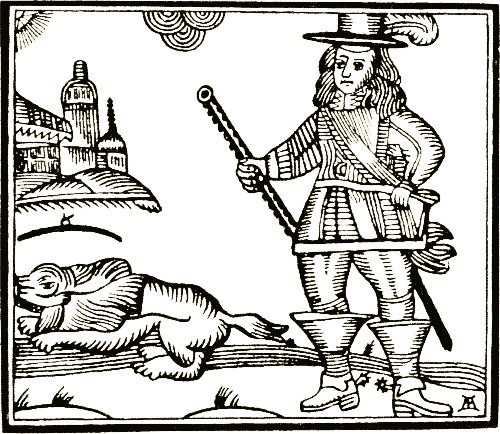
Methoughts a mighty hunting-match,
was made by Bayliffs and their Currs:
Poor men was the Deer they strove to catch,
The Suburbs-Round, it was their Park,
the Bayliffs yell, the Dogs did Bark,
The Poor kept as close as Noah in the Ark,
And that's the Cause &c.
Then Shephard and his Dog wheel'd up to th' right, and thunder'd by a Cursed Lane, And there the Villains wrought their Spight, for by them, once, was a poor Man slain. They Swear, before they'l ever lack, they'l go to Hell, a Pick-a Pack, And thus poor Debters they go to rack, And that's the Cause &c.
There's Cursing Will and Damme Jack, and Robbin Tanner's alive agen, And Paunchgut Tom, (a Hellish Pack), with perjur'd Dick, and bawdy Ben: Which formerly on Earth did Dwell, and now they are return'd from Hell, And doth against our Laws Rebell. And that's the Cause &c.
When I awaked from my Dream, methoughts the world turn'd upside down, And in great haste, I Writ this Theam, for the Bayliffs Doggs of our Town; Who for their Pray each hour doe wait, like Death at every poor Man's Gate, And brings the Realm to a Dismal fate. And that's the Cause &c.
When Poor men are out of Employ and have not a Farthing in the World, The while there Wives and Children cry, there's many are in a Prison hurl'd: Men are enticed by the Bumms, who swear they ne'r will pay their Summs, Thus Poor in Flocks to the Jaylor comes, And that's the Cause &c.
The Tallyman, Curmudgeon, keeps a Baylif and his Dog to Bite, If in their Books, men ever Creeps, they quickly swear they'l have their Right: So soon as e're they do Back-slide, the Torturing Jale they must abide Then Toby and Dog's employ'd; And that's the Cause &c.
When Rogues are at the Old Bayly Burn'd, and that their Pilfering Trades do fail; From Thieves to Bayliff's Dogs have turn'd, to plague and hurry the Poor to Jayl: How like Kid-nappers all the Day, in every Corner they Survey, And quaff whole Bowls when they get their way. And that's the Cause &c.
Ten Groat's the Fees, and a Crown the arrest and three Round OOO's for a Writ beside, Thus Laws are broken, and poor men opprest, such Racking torments they must abide. And while the Prisoner sends for Bail, they Tope the Brandy, Beer and Ale, And makes him pay, or they have him to Jail. And that's the Cause &c.
For Twenty Shillings, Ten or Five, they'l put a man to a Cursed Charge; Or run him to Jayl they'l soon contrive, where other Bills are exprest at Large: The Jayl Fees many are bound to Rue, the Garnish, Bed and Turnkey too, Expects an unexpected Due, And that's the Cause &c.
Tis seldom a Bayliff or his Dog is ever known for to go to Church; As soon as they here the Word of God they leave the Parson in the lurch: They swear they'l come to Church no more, they lay their sins to Adam's Score, And jaunt to Moorfields to a ——, And that's the Cause &c.
Thus I conclude and end my Song,
desiring that you wou'd be content;
There's Christian Peers that may right our wrong.
when Heaven yields up a Parliament:
I hope true Reason will plead our Cause,
while they'r erecting wholesome Laws
They'l keep us from the Crocodils paws,
Printed for P. Brooksby at the Golden Ball near the Bear Tavern in Pye Corner.
The dumbe wife recovered her speech.
[52.] A certaine Farmer had taken to wife a dumb woman, and hearing of a great Magician lately come into England, he tooke horse and rode to him, and demanded if there were no help for a woman that had lost her speech. The Magician answered, Yes, it is an easie matter, and told him hee must take an Aspen leafe, and lay it under her tongue, and it would instantly help her. The Farmer was joy'd with this tidings, and returned in haste homewards, suspecting in himselfe the vertue of his new receit, and therefore to make the matter more sure, he tooke three Aspen leaves, and laid them all three under his wifes tongue, who immediately began to talk and prate very nimbly, and in the end, upon a very small occasion to curse and raile downeright upon her husband, as if shee had beene mad. The Farmer was now in a peck of troubles, and posted in all hast to the Magician, certifying him of this unhappy accident. The Magician demanded if hee absolutely followed his counsell. The Farmer answered No, for (quoth he) instead of one leaf I have used three, hoping to make the matter surer. Marry then, God help thee, (quoth the Magician) for it is an easie matter to make a woman speak, but to make her hold her tongue is past my cunning. Nay, all the devills in Hell could never worke such a wonder. Whereat the Farmer much grieved, departed.
[32.] What is that the more ye lay on, the faster it wasteth?
Solution. That is a Whetstone, for the more ye whet the less is the Whetstone.
[51.]A Money Monger choyce of Sureties had;
A Countrey fellow plaine in Russet clad;
His doublet Mutton-taffety Sheep-skins,
His sleeves at hand button'd with two good pins;
Upon his head a filthy greasie Hat,
That had a hole eate thorou it by a Rat,
A Leather Pouch that with a Snap-hance shut,
One hundred Hobnailes in his Shooes were put:
The stockings that his Clownish legs did fit,
Were Kersie to the calfe, and t'other knit;
And at a word, th' apparell that he wore
Was not worth twelve pence, at Who gives more?
The other surety of another stuffe,
His neck inviron'd with a double Ruffe,
Made Lawne and Cambrick both such common ware,
His Doublet set had falling Band to spare;
His fashion new, with last Edition stood,
His Rapier Hilts imbru'd in golden blood:
And these same trappings made him seeme one sound,
To passe his credit for an hundred pound,
So was accepted; Russet coat deny'd,
But when time came the money should be pay'd,
And Monsieur Usurer did hunt him out,
Strange alteration struck his heart in doubt;
And Brokers had his painted cloaths to sell;
The Usurer then further understands,
The Clowne (refus'd) was rich and had good lands;
Ready (through rage) to hang himselfe, he swore
That Silken Knaves should cozen him no more.
[8.] A seaman coming before the Judges of the Admiralty for admittance into office in a ship bound for the Indies, was by one of the Judges much sleighted, as an insufficient person for that office which he sought for to acquire; till the Judge telling him that he believed that he could not say the points of his Compass; the Seaman answered, better than he could say his Pater Noster: The Judge replyed, that he would wager twenty shillings with him of that; so the Seaman taking him up, it came to trial, and the Seaman began and said all the points of his Compass very exactly; the Judge likewise said his Pater Noster, and when he had finished it, he required the wager according to the agreement, because the Seaman was to say his Compass better than he his Pater Noster, which he had not performed: nay hold, quoth the Sea man, the wager is not finished, for I have but half done; and so he immediately said his Compass backward very exactly, which the Judge failing of in his Pater Noster, the Seaman carried away the prize.
[12.]A Grave there was made For one Aylet, he said The Bell for him then did toul; But you lye like a Knave, It is not a Grave, But only an Aylet hole.
[17.] One having a very great Nose, and thin beard, was told the shadow of his Nose did hinder his Beard's growth.
[26.] An Apothecary in Oxford spoke to a Country man by way of Jeer to bring him some live Rats, and he would give him eighteen pence a piece for them; and a fortnight after he brought them; and then the Apothecary told him, That he was provided the day before. The Country Fellow seeing he was abused, was resolved to be quit with him, saying, I am unwilling (seeing I have brought them) to carry them back again; and told him he would take three pence out in Physick at some time or other; and so opened his Bag, and let them about the Shop, which did so whisk up and down the Shelves, that in a little space they broke him about forty Pots and Glasses, and could never get rid of them since. Probatum est.
A Courtier and a Scholler meeting.
[5.]A Courtier proud walking along the Street, Hap'ned by chance a Scholler for to meet, The Courtier said, (minding nought more than place) Unto the Scholler, meeting face to face, To take the wall, base men Ile not permit, The Scholler said, I will, and gave him it.
[4.] A Lady going to Mass to present her Tapers, fixed one to St. Michael, and another to the Devil that was at his Feet. The Clerk seeing her, told her she did not well to offer a Candle to the Devil. No matter, says the Lady, 'tis good to have Friends every where; for we know not where we shall go.
[8.] There was a gentleman fell very sick, and a friend of his said to him, Surely you are in danger, I pray you send for a Physician; but the sick man answered, It is no matter, for if I die I will die at leisure.
[51.]A wealthy Misers sonne, upon a day, Met a poore Youth, that did intreat and pray Something of Charitie in his distresse; Helpe Sir (quoth hee) one that is Fatherlesse, Sirrah (sayd hee) away, begone with speed, Ile helpe none such; thou art a Knave indeed: Dost thou complaine because thou wants a Father? Were it in my case I would rejoyce the rather; For if thy Father's death, cause thee repine, I would my Father had excused thine.