Good Ale for my Money171
Reading edition
Good Ale for my Money171
The Good-fellowes resolution of strong Ale, That cures his nose from looking pale.
To the Tune of The Countrey Lass.
[96.]Be merry my friends, and list a while unto a merry jest, It may from you produce a smile, when you heare it exprest: Of a young man lately married, which was a boone good fellow; This song in 's head he alwaies carried, when drinke had made him mellow. I cannot go home, nor I will not go home, it's 'long of the oyle of Barly, I'le tarry all night for my delight, and go home in the morning early.
No Tapster stout, or Vintner fine, quoth he shall ever get One groat out of this purse of mine to pay his masters debt: Why should I deal with sharking Rookes, that seeke poore guls to cozen, To give twelve pence for a quart of wine, of ale 'twill buy a dozen. 'Twill make me sing, I cannot go home &c
But never any wine could yet
my honour please to swell:
The Rhenish wine or Muscadine,
sweet Malmsie is too fulsome,
No, give me a cup of Barlie broth
for that is very wholesome.
'Twill make me sing &c—
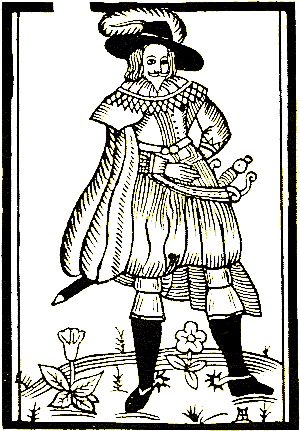
Hot Waters are to me as death, and soon the head oreturneth, And Nectar hath so strong a breath Canary when it burneth. It cures no paine but breakes the braine, and raps out oathes and curses, And makes men part with heavie heart, but light it makes their purses. I cannot go home &c
with Perry and sweet Sider,
'Twill bring the body out of frame,
and reach the belly wider:
Which to prevent I am content
with Ale that's good and nappie,
And when thereof I have enough,
I thinke myselfe most happy.
I cannot go home &c
All sorts of men when they do meet, both trade and occupation, With curtesie each other greet, and kinde humiliation: A good coale fire is their desire, whereby to sit and parly, They'le drinke their ale and tell a tale and go home in the morning early. I cannot go home &c
Your domineering swaggering blades, and Cavaliers that flashes, That throw the Jugs against the walls, and break in peeces glasses. When Bacchus round cannot be found, they will in merriment Drink ale and beere and cast of care, and sing with one consent. I cannot go home &c Lawrence Price.
Printed at London.
[52.] A notable yong Rogue, having plaid some notable knavish pranke, was for the offence to be whipt, and as hee was ready to be tied to the Cart, hee said to the Beadle that should whip him; Here is ten Shillings for thee, I pray thee use mee kindly, and deale not too cruelly with me: to whom the Beadle promised great curtesie; but being tied fast to the Cart, hee whipt him very severely. The fellow called unto him, and bad him remember his promise: What knave (quoth the Beadle) do'st prate and talke, and knowest not the Law. Afterward being released he bethought himselfe how he might be revenged on the Beadle, and seeing him stand in the Market, pickes a pocket, and puts the purse into the Beadles pocket, and goes to the fellow, from whom he had stolne the purse, saying, Friend, do you misse nothing? who presently cryed out, saying He had lost his purse. Yonder Beadle hath it (quoth hee) and you shall finde it in his pocket, I saw him take it. The man that had lost his purse goes unto the Beadle, and apprehended him, for his purse, who utterly denied he had it, neither knew of any such matter. But being found about him, he was condemned to die for it. The pick-pocket being imprisoned againe for some small fault desired he might be hangman that day, and it being granted: When the Beadle came to be hanged, Sirrah (quoth the pick pocket) do you remember how you whipt me the other day when I gave you ten shillings? I. (quoth the Beadle) I pray thee forgive me, I am now ready to dye. I. sirrah (quoth hee) thank me for it, for I pickt the purse and put it in your pocket. With that the Beadle began to cry aloud, saying, Hold, hold. What, knave, (quoth the pick pocket) do'st talke and prate, and knowest not the Law. And so he turned him beside the ladder.
[17.] A fat man riding upon a lean horse, was ask'd, Why he was so fat, and the horse so lean? said: Because I look to myself, and my man to my horse.
[4.] A Blind Minister coming to speak with a Gentleman, the Gentleman's man came running to him, and told him that the blind Minister was come to see him.
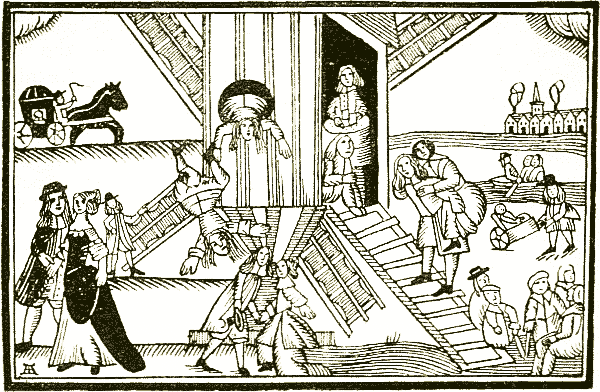
The very rare book from which the accompanying illustration is taken is not of interest to the general reader. It is a dialogue between the miller and those who bring their wives, etc., to be ground young again; but the woodcut itself is very curious as a caricature.
[97.]
[26.] Another Fellow said that he had heard all their stories, and did think at first that some of them had been untruths, but now, says he, I am better satisfied; and I will tell you what I know upon my own knowledge. I was once in some company where I heard one of them say that to his knowledge a Raven would live a hundred years: so the next day I went and bought me one purposely to make a Tryal, and put him into a Cage and taught him to sing; and I think in my Conscience no Bird but a Raven could sing like him. Well, says he, I kept this Bird above a hundred years; nay, if I should say two hundred, I should not lie, (and fed him all the time myself.) At last being very tame I turn'd him out of the Cage and put him into a Room, where I had only a Goose, but never a Gander for her: I know not how it happened, but the Raven and the Goose fell in league together (for you must know 'twas a Cock Raven,) and she brought ten young ones, all coloured half black, and half white; and those Five which were black towards the head cry'd just like a Raven, and those that were white towards the head, cry'd like Geese, and I eat one of the former, that was black towards the head; and, if you'll believe me, I have had ever since such a strange croaking in my Stomach, especially if I see any Carrion, that 'tis a great disturbance to me: Nay, one of my Neighbours upon some occasion call'd my Wife Carrion; and though I did not love her before; yet ever since I have had a great kindness for her. Then they told him that the strangness of this story made it true, and the Proverb makes it good, that is 'Tis not so strange as true.
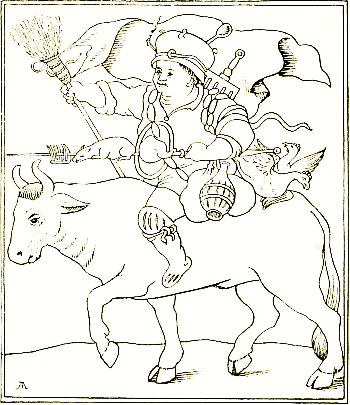
The following caricature of Shrovetide, which has more artistic merit than most similar productions, has a companion in Lent, which, however, not being able to procure the original, I do not give.
[98.]Fatte Shrovetyde mounted on a good fatt Oxe,
Armd Cap a pea from head unto the heele,
A Spit, his long sword, somewhat worse than steele,
(Sheathed in a fatt Pigge, and a Peece of Porke)
His bottles fil'd with Wine, well stopt with Corke.
The two plump Capons fluttering at his Crupper,
And's shoulders lac'd with Sawsages for Supper;
The Gridir'n (like a well strung Instrument)
Hung at his backe, and for the Turnament
His Helmet is a Brasse Pott, and his Flagge
A Cookes foule Apron, which the wind doth wagg,
Fixd to a Broome, thus bravely he did ride,
And boldly to his foe, he thus replyde.
What art thou, thou leane jawde Annatamie
All spirit (for I no flesh upon thee spie)
Thou bragging peece of ayre and smoake that prat'st,
And all good fellowship and friendship hat'st.
You'le turne our feasts to fasts, when, can you tell
Against your spight, we are provided well.
SHROVETYDE.
You that hate Fasting, Dearth, and starvling Leanes, Spitts bright hang'd up, and Teeth and Platters Cleanes
SHROVETYDE
Behold your Champion Shrovetyde in this fray Would murder Lent, and every fasting day
Thou sayst thou'lt ease the Cookes, the Cooks could wish Thee boyld, or broyld with all thy froathy fish, For one fish dinner takes more paines and cost Than three of flesh, bak'd, roast or boyld, almost. Youle take away our playes, our sports and pleasure, And give the Butchers time for ease and leasure. Alasse poor scabbe, how barren are thy hopes The Fencers, Beares, and Dauncers on the Ropes, Is manly sport, or lawlesse recreation Which all thy sev'n weeks time, are still in fashion, The truth is, thou aswagest few mens hunger, And hast no faithfull friend but the Fishmonger. There's little danger to attend on me, When men are drownd at Sea to furnish thee. Pease pottage, and dryde beanes, by proofe we find, Offends and fills men with unwholsome wind, And ere I'le be a slave and pinch my maw I'le breake all Proclamation, rule and Law, Wee'le fill our Tubs with powdred flesh, beside By licenc't Butchers we will be supplyde With fresh meat; so hungry Lent adieu, We are resolv'd to feed in spight of you.
FINIS
LONDON
Printed by M. S. for Thomas Jenner, and are to be sold at his Shop at the South Entrance of the Royal Exchange 1660.
[99.]
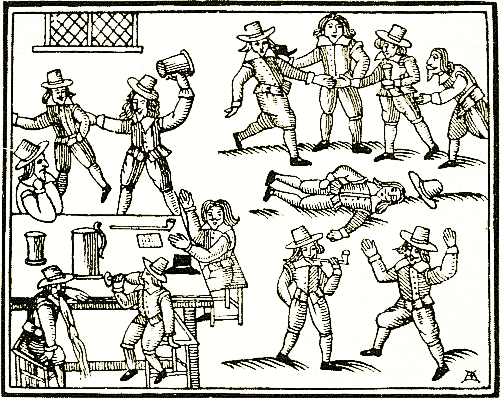
[94.] A drunken fellow returning home towards evening, found his wife hard at her spinning; she reproving him for his ill husbandry, and commending herself for her good huswifery, he told her that she had no great cause to chide, for as she had been spinning, he came home all the way reeling.
[91.]There was a man bespake a thing, Which when the owner home did bring, He that made it did refuse it, And he that bought it would not use it, And he that hath it doth not know, Whether he hath it, I, or no.
Resolution A Coffin bought by another for a dead man.