A Health to all Good-Fellowes: or The good Companions Arithmaticke.
Reading edition
To the Tune of, To drive the cold Winter away.
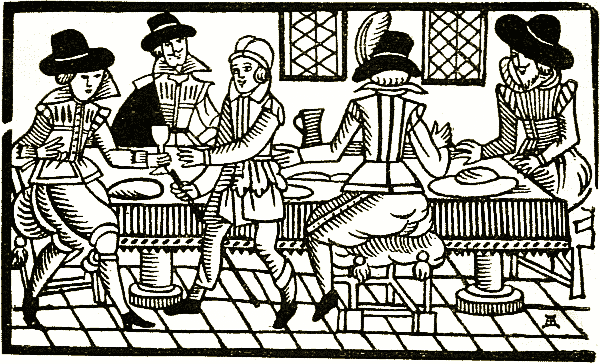
Be merry my hearts, and call for your quarts, and let no liquor be lacking, We have gold in store, we purpose to roare, untill we set care a packing. Then Hostis make haste, and let no time waste, let every man have his due, To save shooes and trouble, bring in the pots double, for he that made one made two. I'le drink up my drinke, and speak what I thinke, strong drinke will make us speake truely, We cannot be termed all drunkards confirmed, so long as we are not unruly. Wee'le drinke and be civill, intending no evill, if none be offended at me, As I did before, so I'le adde one more, and he that made two made three.
at home with browne bread and small beare,
To Coffer up wealth, he starveth himselfe,
scarce eats a good meale in a yeare.
But I'le not do so, how ere the world go
so long as I have money in store
I scorne for to faile, go fil us more Ale,
for he that made three made four.
Why sit you thus sadly, because I call madly, I meane not to leave in the lurch, My reckoning Ile pay ere I go away, else hang me as high as a Church. Perhaps you will say, this is not the way, they must pine that in this world will thrive, No matter for that, wee'le laugh and be fat, for he that made foure made five.
To those my good friends my love so extends, I cannot truely expresse it; When with you I meet, your words are so sweet, I am unwilling to misse it. I hate all base slaves that their money saves, and all those that use base tricks, For with joviall blades, I'm merry as the Maids, for he that made five made six.
Then drink about round till sorrow be dround, and let us sing hey downe a derry, I cannot endure, to sit thus demure, for hither I came to be merry. Then plucke up a good heart before we depart, with my Hostesse we will make it even, For I am set a madding, and still will be adding, for he that made six made seven.
Sad mellancholly will bring us to folly, and this is deaths principall magent, (sic) But this course I will take, it never shall make me looke otherwise than an agent. And in more content my time shall be spent, and I'le pay every man his right, Then hostesse go fill, and stand not so still, for he that made seven made eight.
At home I confesse, with my wife honest Besse, I practise good husbandry well, I follow my calling, to keep me from falling; my neighbours about me that dwell Wil praise me at large for maintaining my charge, but when I to drinking incline I scorne for to shrinke, go fetch us more drinke, for he that made eight made nine.
Then while we are here, wee'le drinke Ale & Beer, and freely our money wee'le spend, Let no man take care, for paying his share, if need be I'le pay for my friend. Then Hostesse make haste, and let no time waste, you're welcome all, kind Gentlemen, Never fear to Carowse, while there is beere in the house, for he that made nine made ten.
Then Hostesse be quicker, and bring us more liquor, and let no attendance be missing, I cannot content me, to see the pot empty, a full cup is well worth the kissing. Then Hostesse go fetch us some, for till you do come, we are of all joyes bereaven, You know what I mean, make haste, come again, for he that made ten, made eleven.
With merry solaces, quite voyd of all malice, with honest good fellowes thats here, No cursing nor swearing, no staring nor tearing, amongst us do seeme to appeare. When we have spent, all to labour we fall, for a living wee'le dig, or wee'le delve, Determin'd to be both bounteous and free, he that made eleven, made twelve.
Now I think it is fit and most requisit, to drinke a health to our wives, The which being done, wee'le pay and be gone, strong drinke all our wits now deprives. Then, Hostesse, let's know the summe that we owe, twelve pence there is for certain Then fill t'other pot, and here's money for't for he that made twelve made thirteene.
FINIS.
London, Printed for Henry Gossen.
[17.] A great Lord being in the Tower was visited by some other Lords; and being merry, one began the Kings health, which he refused to pledge. They told him 'twould be ill taken: Why truly, my Lords, saies he, I'll pray for the Kings health, but drink for my own.
[4.] A gentleman ordr'd a Crane for Supper; but his Cook, having a Sweetheart in a longing condition, cut off a Leg and sent her; so the one Legg'd Crane was set on the Table, which the Gentleman seeing, was enrag'd at his Cook; but he, being an arch Wag, readily told the Gentleman that Cranes had but one Leg, and avowed it with that Confidence, that he gain'd upon his wise Masters belief; but he, resolving to observe it as he was walking in the Fields one Frosty Morning, he saw a flock of Cranes, and, sending for his Cook, they held up one of their Legs under their Wings, as is the Custom of those birds in the cool weather. So, says his Cook, I hope your Worship is satisfied that they have but one Leg; but the Gentleman going pretty near to them, cries Cush, and frighted them up. Whereupon both Legs appear'd. Look, says the Gentleman, they have now two Legs. Oh, says the Cook, if you had cried Cush to that in the Dish, it wou'd have had two Legs too.
[26.] A Gentleman that had bred up a Young Colt, and had taught him many pretty pieces of Activity, but one among the rest, that of leaping so well, that no Ditch or Hedg, though never so broad or deep but he whipt over: nay, an ordinary House was nothing with him, or small Country Church also, but yet could never leap over the Steeple. It fortun'd that the Gentleman having occasion to ride abroad on him, came to a River that was about Twenty yards wide, which you'll say was very broad; yet this poor beast leapt with him to the very brink of the River on the other side, and there by chance lighted upon a stump of a Tree which ran into his Belly; which the Master seeing, alighted, and so left the poor Beast in that condition, yet would not kill him, and so went away. About six months after, this Gentleman was riding that way with his Man, and as they rode, says his Master, Don't you see something move yonder? Yes, says he, I think I see a Tree go; and coming near to it, they put aside all the Boughs, and there spied his late Horse, which he thought had died there: so they cut off all the Boughs, which were so many as to load almost three Carts, and then he took the poor Beast home, and cur'd him of all but the stump of the Tree which was in his Belly; and, indeed he need not do it, for he receiv'd a great advantage by it every year; that is, at least two or three load of Wood, which serv'd him to burn in his Chamber; for he would never burn any other than that, out of the love he bore to that poor beast of his. But some that heard him tell it, thought it savour'd too much of the Legend: Why, if you won't believe me, ask my Man, who knows it as well as I, and shall swear it too, if you please.
[18.]Here at last doth she lie in quiet, Who whilst she lived was ever unquiet. Her Husband prays, if by her Grave you walk, You'd gently tread, for if waked, she'll talk.