NEWES FROM MORE-LANE.
Reading edition
or
A mad, knavish, and uncivil Frolick of a Tapster dwelling there, who buying a fat Coult for Eighteen pence, the Mare being dead and he not knowing how to bring the Coult up by hand, killed it, and had it baked in a Pastie, and invited many of his Neighbours to the Feast and telling of them what it was: the Conceit thereof made them all Sick, as by the following ditty you shall hear.
The Tapster fil'd the Cup up to the brim, And all to make the little Coult to swim; But all that heares it sayes that for his gaine, He is no better than a Wagg in graine.
The Tune is, A Health to the best of Men.
[68.]There is a Tapster in More lane that did a Pasty make, All People doe of him complaine, now for his grosse mistake: Hee instead of Venson fine a good fat Coult did kill, And put in store of Clarret Wine, his humour to fullfill. A Peck of Flower at the least, with six pound of Butter, Hee made his Nighbours such a Feast and bid them all to supper: A curious fine fat Colt it was, and handled daintily: The Tapster prov'd himself an Asse, for this his knavery. Likewise there was a Baker too, that lived in that place, And he was a pertaker too, I speak in his disgrace: For he found Flower to make it, I speak not in his praise, And afterwards did bake it, his knavery for to raise.
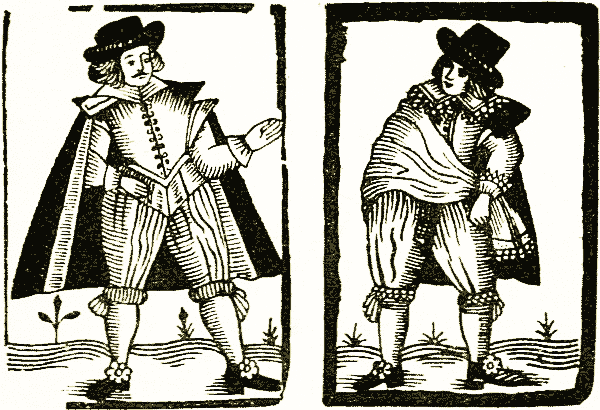
Likewise there was a Carman too and he found Butter for it, But when the Knavery Neighbours knew they could not but abhor it; And then there was a Cooke, Sir, at More gate doth he dwell, And he then under tooke, Sir, to make the Pasty well. Some say it eate as mellow then as any little chick, But I tell thee, good-fellow; then it made the Neighbours sick: The Tapster had his humour, but the Neighbours had the worst, Yet I doe hear they had good Beere and dainty Pastry crust. Then every joviall Blade, Sir, that lived in that place, Their Money freely paid, Sir, they scorned to be bace: They cal'd for Beere, likewise for Ale because the Coult should swim, And of the Cup they would not faile, but fil'd it to the brim. The Car-mans Wife cry'd out and said troath 'tis good Meat indeed, So likewise said the Chamber-maid, when she on it did feed. The Tapster bid them welcome then, and Wea-Hae did he cry You are all welcome, Gentlemen, you'r welcome hartily. The Glover's Wife was in a heat, and did both pout and mump, Because they would not let her eat the Buttock and the Rump. As for the merry Weaver's Wife, I will give her her due, She spent her Coyne to end the strife among that joviall Crew. This Colt was not so wholsome though as was a good fat Hogg, Yet one came in and told the crew it was a mangie Dogg! But he that told them was to blame, and was but a silly Dolt, The Tapster bid him peace for Shame for 'twas a good fat Colt. The Colt he cost me eighteen pence, the Tapster he did say, I hope good Folks 'ere you goe hence, you for your Meate will pay. Pox take you for a Rogue quoth one, another, he fel'd oaks, Another said he was undone! 'twas worse than Harty Choaks. The Porter he did give nine pence to have it in a Pye, The People ere they went from thence did feed most hartily: It was the joviall Baker, and knavish Tapster too, The Car-man was pertaker was not this a Joviall crew. The Potecary he was there, Farr and the Sexton too, The Tapster put them in great fear, he made them for to spue. Now was not this a knave ingrain, to use his Neighbours so, When knaves are scarce, hee'l go for twain, good People, what think you. The Tapster he came in at last, and gave the People vomits, I hope, (quoth he,) the worst is past, I have eased your foule Stomacks; Wea-hea cry'd the Tapster then, how doe you like my sport, The Women said, so did the Men, the Devill take you for't. At Brainford as I heard some say a mangie Dog was eate: This was not halfe so bad as that, and yet the fault was great: Men of good fashon then was there that went both fine and brave Now all do say, that this doth heare, the Tapster is a knave.
FINIS.
London, Printed for William Gammon, and to be sould in Smithfield.
[61.] There fell a great dispute betwixt Jockey a Scotchman, and Jenkin a Welch man, and the subject of it was about the fruitfullnesse of their Countries, and thus Jockey began. There was not a braver, fruitfuller Country in the world than Leith in Scotland: The Welch man answered him again, Picot, that was false, for there was no place so full of all sorts of fruite, as was in Wales. Jockey replyed again, that he knew a piece of ground in Scotland where the grass grew up so suddenly that if you throw a Staff in it over night, in that time the pasture would so over grow it, that you could not see it again the next morning. But Jenkin hearing this, with a great Scorne made him this answer, Py Saint Taffe that the throwing so small a thing as a Staff was nothing, for (quoth Shinkin) we have divers pieces of Cround in our Contry, that if you turn your Horse into them, you shall not see him next Morning.
[12.]Why do Men not agree With their Wives now we see Men now are more Learn'd, and do brawl; Tis false Concord we see For the Masculine to agree With the Feminine Gender at all.
[26.] Says a Fellow that had lost one of his Ears at Newcastle, for no goodness 'tis thought; when one told him a Story, 'Tis in at one ear and out at t'other. By my truth, says the other, then there's a great deal of wonder in the travel of these Tales, for thy two Ears be two hundred Miles asunder.
[52.] A Certaine Gentleman in Lincolneshire, being also a Justice of Peace, had an old servant many yeares called Adam Milford, who upon a time came unto his Master, and desired him, in regard that he had been his servant so many yeares, hee would now give him somthing to help him in his old age. Thou sayest true, quoth his Master, and I will tell thee what I will doe. Now shortly am I to ride up to London; if thou wilt pay my costs & charges by the way, I will give thee, ere long, such a thing as shall be worth to thee an hundred pounds. I am content, quoth Adam, and so payed for all their reckoning by the way. Being come to London, hee put his Master in mind of his former promise that he had made to him. What did I promise thee anything? Yes, quoth Adam, that you did; for you said you would give me that which should be worth to me an hundred pounds, for bearing your Charges to London. Let me see your writing, quoth his Master. I have none, quoth Adam. Then thou art like to have nothing, quoth his Master; And learne this of me, that when thou makest a bargain with any man, looke thou take a Writing, and beware how thou makest a Writing to any man. This hath availed me an hundred pounds in my dayes. When Adam saw there was no remedy, he was content; but when they should depart Adam stayed behind his Master to reckon with his Hostis, and on his Masters Scarlet cloake borrowed so much mony, as came to all their charges he had laid out by the way. His Master had not ridden past two miles, but it began to raine apace: wherefore he called for his cloake. His other men made answer that Adam was behinde, and had it with him. So they shrowded them under a tree, till Adam came. When he came, his Master said all angerly, Thou knave, come give me my cloak: hast thou not served me well, to let me be thus wet? Truely, Sir, (quoth Adam) I have laid it to pawne for all your charges by the way. Why, knave, quoth he, didst thou not promise me to beare my charges to London? Did I? quoth Adam; I, quoth his Master, that thou didst. Let's see, shew me your writing of it, quoth Adam. Whereupon, his Master perceiving he was over-reacht by his man, was fain to send for his cloak againe, and pay the money.
Chronogramma. Anno 1628. obiit GeorgIVs DVX BVCkInghaMIæ
[67.]Malignant characters that did portend
Duke-murthering Fate & his untimely end,
Constrain'd to die, that would have liv'd & fought
Xantippus like, but that fell Felton brought
Vaine are designes, where one doth of his freind
Vsurpe too much, him you doe countermine
In breife the world applaudes this last designe.
It was his death, but now hee's dead & gone
Ill having heard of many, felt but one.
The date 1628 can be easily made by adding the Roman numerals, which are represented by the capital letters.
105 Life.
[5.]All things have savour, though some very small, Nay, a box on the eare hath no smell at all.
[17.] One having a scoulding Wife, swore he would drown himself. She followed him desiring him to forbear, or at least to let her speak with him. Speak quickly then, says he: Pray Husband, if you will needs drown your self, take my counsel to goe into a deep place; for it would grieve my heart to see you long a dying; with that the Fellow came back again and went to the Indies.
[52.] Coomes of Stapforth hearing that his wife was drowned comming from market went with certaine of his friends to see if they could finde her in the River; he, contrary to all the rest, sought his wife against the streame: which, they perceiving, said, He lookt the wrong way. And why so? (quoth he) Because (quoth they) you should look down the streame, and not against it. Nay (quoth he) I shall never finde her that way: for she did all things so Contrary in her lifetime, that now she is dead, I am sure she will goe against the streame.
[12.]I've known many men Know each other now and then Yet never the knowledge could get Of any Man before Though known many a score, That ever knew himself yet.
[4.] Doctor Fuller overtook one Mr Woodcock upon the Road, falling into Discourse in a facetious manner, ask'd him what difference there was between a Woodcock and an Owl, (supposing Mr Woodcock had not known him). He wittily replyed, That an Owl was Fuller in the Head, Fuller in the Face, Fuller in the Eyes, Fuller in the Neck, and Fuller all over.
On Anne Angel marrying a Lawyer.
[67.]Anne is an Angel, but what if she bee. What is an Angel, but a Lawyer's fee.
[67.]A Welchman walking in ye darke for feare Some wall might hitte his face a box o' th' eare, Strecht out his armes, yt if such danger Came, His hands might from his face avert ye same. At last betwixt his armes there came a post, Which hitte his nose, and stroke him downe almost; Pluter of nayles, quoth he, I did not know My nose was longer than my armes till now.
The accompanying illustration is taken for its quaintness and as an example of caricature, the tract itself hardly repaying perusal.
[69.]No-Body—Why do'st thou father all thy Lies On Me? heaping Indignities On one that never injur'd thee? Some-Body—My Words and Acts hurt No-Body: No-Body—Som-Body hath belied me much, No-Body sure hath cause to grutch.
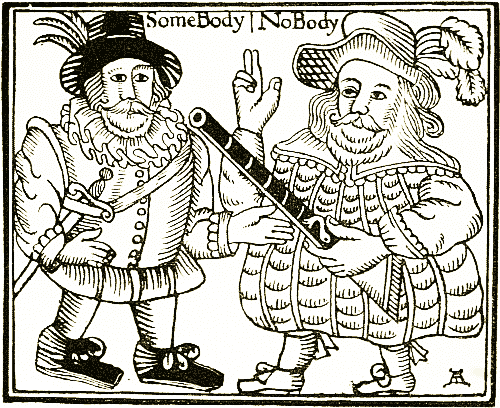
SomeBody NoBody
[52.] A certain rich Farmer having lain long sick in Norfolk, at last sent for a Physitian from the next Market Towne: who when he came, he felt his pulses, and viewed his water, & then told them, That he could by no means, nor physick escape, the disease had so much power in his body, and so went his way. Within a while after, by God's good help (who is the only giver of all health) the man escaped and was well againe, and walking abroad, being still very weak and feeble, he met with his Physitian, who, being very sore afraid to see him, asks him, if he were not such a Farmer; Yes, truely (quoth he) I am: Art thou alive or dead? (quoth he) Dead (quoth he) I am; and because I have experience of many things, God hath sent me to take up all Physitians I can get: which made the Physitian quiver and quake, and looke as pale as ashes for feare. Nay feare not quoth the Farmer, though I named all the Physitians, yet I meant thee for none: for I am sure a verier dunce lives not this day, than thou art: and then I should be a foole to take thee for one, that art more fit to give dogges physicke than men, and so he left him: but the Physitian never left quaking till he was out of his Patients Sight.
To my Booke-seller.
[70.]Thou that mak'st gaine thy end, and wisely well,
Call'st a booke good, or bad, as it doth sell,
Use mine so, too; I give thee leave. But crave
For the luck's sake, it this much favour have.
To lye upon thy stall, till it be sought;
Not offer'd, as it made sute to be bought;
Nor have my title-leafe on posts, or walls,
Or in cleft-sticks, advanced to make calls
Who scarse can spell th' hard names; whose knight lesse can.
If, without these vile arts, it will not sell,
[61.] Two gentlemen met upon the Road, betwixt Ware and London, the one was a wild young Gallant who had more means than Manners, the other a very grave discreet and temperate Citizen of London; who considering his own yeares, conceived that the younger man would give him the way, and by continuing his speed resolved to trye the young Gallants manners, until their Horses heads met. But the young fellow crost expectation, and uncivilly demanded his way of the elder; who replyed, Sir, since you will dispute it, I must tell you, according to the rules of Civility, the Elder in our Country have alwayes the way of their Younger: But the bold Upstart answered him again, that his Horse would not give way to a Foole. To which the old man replyed, But my Horse will, and so resigned the way to my gallant.
[12.]A Man in a Hall, His Dogg Cuckold did call; Says a Woman stood by, 'tis a shame To calle a Dogg so, For I'de have you to know 'Tis a Christian bodies name.
[17.] A Lady was bragging that she had overthrown her Enemy in Law: One of her Servants standing by, said, He took a wrong Sow by the ear, when he meddled with your Ladyship.
[5.]Who woes a wife, thinks wedded men do know The onely true content, I thinke not so; If Woe in wooers bee, that women court, As the word Woe in wooers doth import; And Woe in woemen too, that Courted be, As the word Woe in women we doe see.