SEPTEMBER.
Reading edition
The harvest-men ring Summer out With thankful song, and joyous shout; And, when September comes, they hail The Autumn with the flapping flail.
*
This besides being named “gerst-monat” by the Anglo-Saxons,[328] they also called haligemonath, or the “holy-month,” from an ancient festival held at this season of the year. A Saxon menology, or register of the months, (in Wanley’s addition to Hickes,) mentions it under that denomination, and gives its derivation in words which are thus literally translated “haligemonath—for that our forefathers, the while they heathens were, on this month celebrated their devil-gild.” To inquire concerning an exposition which appears so much at variance with this old name, is less requisite than to take a calm survey of the month itself.
I at my window sit, and see Autumn his russet fingers lay On every leaf of every tree; I call, but summer will not stay. She flies, the boasting goddess flies, And, pointing where espaliers shoot, Deserve my parting gift, she cries, I take the leaves, but not the fruit.
Still, at this season—
The rainbow comes and goes, The moon doth with delight Look round her when the heavens are bare; Waters on a starry night Are beautiful and fair; The sunshine is a glorious birth;— But yet we know, where’er we go, That there hath passed away a glory from the earth.
“I am sorry to mention it,” says the author of the Mirror of the Months, “but the truth must be told even in a matter of age. The year then is on the wane. It is ‘declining into the vale’ of months. It has reached ‘a certain age.’—It has reached the summit of the hill, and is not only looking, but descending, into the valley below. But, unlike that into which the life of man declines, this is not a vale of tears; still less does it, like that, lead to that inevitable bourne, the kingdom of the grave. For though it may be called (I hope without the semblance of profanation) ‘the valley of the shadow of death,’ yet of death itself it knows nothing. No—the year steps onward towards its temporary decay, if not so rejoicingly, even more majestically and gracefully, than it does towards its revivification. And if September is not so bright with promise, and so buoyant with hope, as May, it is even more embued with that spirit of serene repose, in which the only true, because the only continuous enjoyment consists. Spring ‘never is, but always to be blest;’ but September is the month of consummations—the fulfiller of all promises—the fruition of all hopes—the era of all completeness.
“The sunsets of September in this country are perhaps unrivalled, for their infinite variety, and their indescribable beauty. Those of more southern countries may, perhaps, match or even surpass them, for a certain glowing and unbroken intensity. But for gorgeous variety of form and colour, exquisite delicacy of tint and pencilling, and a certain placid sweetness and tenderness of general effect, which frequently arises out of a union of the two latter, there is nothing to be seen like what we can show in England at this season of the year. If a painter, who was capable of doing it to the utmost perfection, were to dare depict on canvas one out of twenty of the sunsets that we frequently have during this month, he would be laughed at for his pains. And the reason is, that people judge of pictures by pictures. They compare Hobbima with Ruysdael, and Ruysdael with Wynants, and Wynants with Wouvermans, and Wouvermans with Potter, and Potter with Cuyp; and then they think the affair can proceed no farther. And the chances are, that if you were to show one of the sunsets in question to a thorough-paced connoisseur in this department of fine art, he would reply, that it was very beautiful, to be sure, but that he must beg to doubt whether it was natural, for he had never seen one like it in any of the old masters!”
In the “Poetical Calendar” there is the following address “to Mr. Hayman,” probably Francis Hayman, the painter of Vauxhall-gardens, who is known to us all, through early editions of several of our good authors, “with copper-plates, designed by Mr. Hayman.”
An Autumnal Ode.
Yet once more, glorious God of day, While beams thine orb serene, O let me warbling court thy stay To gild the fading scene! Thy rays invigorate the spring, Bright summer to perfection bring, The cold inclemency of winter cheer, And make th’ autumnal months the mildest of the year. Ere yet the russet foliage fall I’ll climb the mountain’s brow, My friend, my Hayman, at thy call, To view the scene below: How sweetly pleasing to behold Forests of vegetable gold! How mix’d the many chequer’d shades between The tawny, mellowing hue, and the gay vivid green! How splendid all the sky! how still! How mild the dying gale! How soft the whispers of the rill, That winds along the vale! So tranquil nature’s works appear, It seems the sabbath of the year: As if, the summer’s labour past, she chose This season’s sober calm for blandishing repose. Such is of well-spent life the time, When busy days are past; Man, verging gradual from his prime, Meets sacred peace at last: His flowery spring of pleasures o’er, And summer’s full-bloom pride no more, He gains pacific autumn, mild and bland, And dauntless braves the stroke of winter’s palsied hand. For yet a while, a little while, Involv’d in wintry gloom, And lo! another spring shall smile, A spring eternal bloom: Then shall he shine, a glorious guest, In the bright mansions of the blest, Where due rewards on virtue are bestow’d, And reap’d the golden fruits of what his autumn sow’d.
It is remarked by the gentleman-usher of the year, that “the fruit garden is one scene of tempting profusion.
“Against the wall, the grapes have put on that transparent look which indicates their complete ripeness, and have dressed their cheeks in that delicate bloom which enables them to bear away the bell of beauty from all their rivals. The peaches and nectarines have become fragrant, and the whole wall where they hang is ‘musical with bees.’ Along the espaliers, the rosy-cheeked apples look out from among their leaves, like laughing children peeping at each other through screens of foliage; and the young standards bend their straggling boughs to the earth with the weight of their produce.
“Let us not forget to add, that there is one part of London which is never out of season, and is never more in season than now. Covent-garden market is still the garden of gardens; and as there is not a month in all the year in which it does not contrive to belie something or other that has been said in the foregoing pages, as to the particular season of certain flowers, fruits, &c., so now it offers the flowers and the fruits of every season united. How it becomes possessed of all these, I shall not pretend to say: but thus much I am bound to add by way of information,—that those ladies and gentlemen who have country-houses in the neighbourhood of Clapham-common or Camberwell-grove, may now have the pleasure of eating the best fruit out of their own gardens—provided they choose to pay the price of it in Covent-garden market.”[329]
The observer of nature, where nature can alone be fully enjoyed, will perceive, that, in this month, “among the birds, we have something like a renewal of the spring melodies. In particular, the thrush and blackbird, who have been silent for several weeks, recommence their songs,—bidding good bye to the summer, in the same subdued tone in which they hailed her approach—wood-owls hoot louder than ever; and the lambs bleat shrilly from the hill-side to their neglectful dams; and the thresher’s flail is heard from the unseen barn; and the plough-boy’s whistle comes through the silent air from the distant upland; and snakes leave their last year’s skins in the brakes—literally creeping out at their own mouths; and acorns drop in showers from the oaks, at every wind that blows; and hazel-nuts ask to be plucked, so invitingly do they look forth from their green dwellings; and, lastly, the evenings close in too quickly upon the walks to which their serene beauty invites us, and the mornings get chilly, misty, and damp.”
Finally, “another singular sight belonging to this period, is the occasional showers of gossamer that fall from the upper regions of the air, and cover every thing like a veil of woven silver. You may see them descending through the sunshine, and glittering and flickering in it, like rays of another kind of light. Or if you are in time to observe them before the sun has dried the dew from off them in the early morning, they look like robes of fairy tissue-work, gemmed with innumerable jewels.”[330]
September. An Ode.
Farewell the pomp of Flora! vivid scene! Welcome sage Autumn, to invert the year— Farewell to summer’s eye-delighted green! Her verdure fades—autumnal blasts are near. The silky wardrobe now is laid aside, With all the rich regalia of her pride. And must we bid sweet Philomel adieu? She that was wont to charm us in the grove? Must Nature’s livery wear a sadder hue, And a dark canopy be stretch’d above? Yes—for September mounts his ebon throne, And the smooth foliage of the plain is gone. Libra, to weigh the harvest’s pearly store, The golden balance poizes now on high, The calm serenity of Zephyr o’er, Sol’s glittering legions to th’ equator fly, At the same hour he shows his orient head, And, warn’d by Thetis, sinks in Ocean’s bed. Adieu! ye damask roses, which remind The maiden fair-one, how her charms decay; Ye rising blasts, oh! leave some mark behind, Some small memorial of the sweets of May; Ah! no—the ruthless season will not hear, Nor spare one glory of the ruddy year. No more the waste of music sung so late From every bush, green orchestre of love, For now their winds the birds of passage wait, And bid a last farewell to every grove; While those, whom shepherd-swains the sleepers call, Choose their recess in some sequester’d wall. Yet still shall sage September boast his pride, Some birds shall chant, some gayer flowers shall blow, Nor is the season wholly unallied To purple bloom; the haler fruits shall grow, The stronger plants, such as enjoy the cold, And wear a livelier grace by being old.
NATURALISTS’ CALENDAR.
Mean Temperature 63·69.
September 1.
Giles.
This popular patron of the London district, which furnishes the “Mornings at Bow-street” with a large portion of amusement, is spoken of in vol. i. col. 1149.
Until this day partridges are protected by act of parliament from those who are “privileged to kill.”
Application for a License.
In the shooting season of 1821, a fashionably dressed young man applied to sir Robert Baker for a license to kill—not game, but thieves. This curious application was made in the most serious and business-like manner imaginable. “Can I be permitted to speak a few words to you, sir?” said the applicant. “Certainly, sir,” replied sir Robert. “Then I wish to ask you, sir, whether, if I am attacked by thieves in the streets or roads, I should be justified in using fire-arms against them, and putting them to death?” Sir Robert Baker replied, that every man had a right to defend himself from robbers in the best manner he could; but at the same time he would not be justified in using fire-arms, except in cases of the utmost extremity. “Oh! I am very much obliged to you, sir; and I can be furnished at this office with a license to carry arms for that purpose?” The answer, of course, was given in the negative, though not without a good deal of surprise at such a question, and the inquirer bowed and withdrew.
The first of September.
Here the rude clamour of the sportsman’s joy, The gun fast-thundering, and the winded horn, Would tempt the muse to sing the rural game: How, in his mid-career, the spaniel struck, Stiff, by the tainted gale, with open nose, Out-stretched, and finely sensible, draws full, Fearful, and cautious, on the latent prey; As in the sun the circling covey bask Their varied plumes, and watchful every way Through the rough stubble turn the secret eye. Caught in the meshy snare, in vain they beat Their idle wings, entangled more and more: Nor on the surges of the boundless air, Though borne triumphant, are they safe; the gun, Glanc’d just, and sudden, from the fowler’s eye, O’ertakes their sounding pinions; and again, Immediate brings them from the towering wing, Dead to the ground: or drives them wide-dispers’d, Wounded, and wheeling various, down the wind. These are not subjects for the peaceful muse, Nor will she stain with such her spotless song; Then most delighted, when she social sees The whole mix’d animal creation round Alive, and happy. ’Tis not joy to her, This falsely-cheerful barbarous game of death This rage of pleasure, which the restless youth Awakes impatient, with the gleaming morn; When beasts of prey retire, that all night long, Urg’d by necessity, had rang’d the dark, As if their conscious ravage shunn’d the light, Asham’d. Not so the steady tyrant man, Who with the thoughtless insolence of power Inflam’d, beyond the most infuriate wrath Of the worst monster that e’er roam’d the waste, For sport alone pursues the cruel chase, Amid the beamings of the gentle days. Upbraid, ye ravening tribes, our wanton rage, For hunger kindles you, and lawless want; But lavish fed, in nature’s bounty roll’d, To joy at anguish, and delight in blood, Is what your horrid bosoms never knew.
So sings the muse of “The Seasons” on the one side; on the other, we have “the lay of the last minstrel” in praise of “Fowling,” the “rev. John Vincent, B. A. curate of Constantine, Cornwall,” whose “passion for rural sports, and the beauties of nature,” gave birth to “a poem where nature and sport were to be the only features of the picture,” and wherein he thus describes.
Full of th’ expected sport my heart beats high, And with impatient step I haste to reach The stubbles, where the scatter’d ears afford A sweet repast to the yet heedless game. How my brave dogs o’er the broad furrows bound, Quart’ring their ground exactly. Ah! that point Answers my eager hopes, and fills my breast With joy unspeakable. How close they lie! Whilst to the spot with steady pace I tend. Now from the ground with noisy wing they burst, And dart away. My victim singled out, In his aërial course falls short, nor skims Th’ adjoining hedge o’er which the rest unhurt Have pass’d. Now let us from that lofty hedge Survey with heedful eye the country round; That we may bend our course once more to meet The scatter’d covey: for no marker waits Upon my steps, though hill and valley here, With shrubby copse, and far extended brake Of high-grown furze, alternate rise around. Inviting is the view,—far to the right In rows of dusky green, potatoes stretch, With turnips mingled of a livelier hue. Towards the vale, fenc’d by the prickly furze That down the hill irregularly slopes, Upwards they seem’d to fly; nor is their flight Long at this early season. Let us beat, With diligence and speed restrain’d, the ground, Making each circuit good. Near yonder hedge-row where high grass and ferns The secret hollow shade, my pointers stand. How beautiful they look! with outstretch’d tails, With heads immovable and eyes fast fix’d, One fore-leg rais’d and bent, the other firm, Advancing forward, presses on the ground! Convolv’d and flutt’ring on the blood stain’d earth, The partridge lies:—thus one by one they fall, Save what with happier fate escape untouch’d, And o’er the open fields with rapid speed To the close shelt’ring covert wing their way. When to the hedge-rows thus the birds repair, Most certain is our sport; but oft in brakes So deep they lie, that far above our head The waving branches close, and vex’d we hear The startled covey one by one make off. Now may we visit some remoter ground; My eager wishes are insatiate yet, And end but with the sun. Yet happy he, Who ere the noontide beams inflame the skies, Has bagg’d the spoil; with lighter step he treads, Nor faints so fast beneath the scorching ray. The morning hours well spent, should mighty toil Require some respite, he content can seek Th’ o’er-arching shade, or to the friendly farm Betake him, where with hospitable hand His simple host brings forth the grateful draught Of honest home-brew’d beer, or cider cool. Such friendly treatment may each fowler find Who never violates the farmer’s rights, Nor with injurious violence, invades His fields of standing corn. Let us forbear Such cruel wrong, though on the very verge Of the high waving field our days should point.
The pen of a country gentleman communicates an account of a remarkable character created by “love of the gun.”
THE LOSCOE MISER.
For the Every-Day Book.
About sixty years ago, at Loscoe, a small village in Derbyshire, lived James Woolley, notorious for three things, the very good clocks he made, his eccentric system of farming, and the very great care he took of his money. He was, like Elwes and Dancer, an old bachelor, and for the same reason, it was a favourite maxim with him, and ever upon his lips, that “fine wives and fine gardens are mighty expensive things:” he consequently kept at a very respectful distance from both. He had, indeed, an unconquerable dread of any thing “fine,” or that approached in any way that awful and ghost-like term “expensive.”
It would seem that Woolley’s avaricious bias, was not, as is generally the case, his first ruling passion, though a phrenologist, might entertain a different opinion. “When young,” says Blackner in his History of Nottinghamshire, “he was partial to shooting; but being detected at his sport upon the estate of the depraved William Andrew Horne, Esq. of Butterly (who was executed on the 11th of December, 1759, at Nottingham, for the murder of a child) and compelled by him to pay the penalty, he made a vow never to cease from labour, except when nature compelled him, till he had obtained sufficient property to justify him in following his favourite sport, without dreading the frowns of his haughty neighbour. He accordingly fell to work, and continued at it till he was weary, when he rested, and “to it again,”—a plan which he pursued without any regard to night or day. He denied himself the use of an ordinary bed, and of every other comfort, as well as necessary, except of the meanest kind. But when he had acquired property to qualify him to carry a gun, he had lost all relish for the sport; and he continued to labour at clock-making, except when he found an opportunity of trafficking in land, till he had amassed a considerable fortune, which he bequeathed to one of his relations. I believe he died about 1770.”
It must have been a singular spectacle to any one except Woolley’s neighbours, who were the daily observers of his habits, to have seen a man worth upwards of 20,000l. up at five in the morning brushing away with his bare feet the dew as he fetched up his cows from the pasture, his shoes and stockings carefully held under his arm to prevent them from being injured by the wet; though, by the by, a glance at them would have satisfied any one they had but little to fear from the dew or any thing else. A penny loaf boiled in a small piece of linen, made him an excellent pudding; this with a halfpenny worth of small beer from the village alehouse was his more than ordinary dinner, and rarely sported unless on holydays, or when he had a friend or tenant to share the luxury.
Once in his life Woolley was convicted of liberality. He had at great labour and expense of time made, what he considered, a clock of considerable value, and, as it was probably too large for common purposes, he presented it to the corporation of Nottingham, for the exchange. In return he was made a freeman of the town. They could not have conferred on him a greater favour: the honour mattered not—but election-dinners were things which powerfully appealed through his stomach to his heart. The first he attended was productive of a ludicrous incident. His shabby and vagrant appearance nearly excluded him from the scene of good-eating, and even when the burgesses sat down to table, no one seemed disposed to accommodate the miserly old gentleman with a seat. The chairs were quickly filled: having no time to lose, he crept under the table and thrusting up his head forced himself violently into one, but not before he had received some heavy blows on the bare skull.
The most prominent incident in his history, was a ploughing scheme of his own invention. He had long lamented that he kept horses at a great expense for the purposes of husbandry. To have kept a saddle-horse would have been extravagant—and at last fancying he could do without them, they were sold, and the money carefully laid by. This was a triumph—a noble saving! The winter passed away, and his hay and corn-stacks stood undiminished; ploughing time however arrived, and his new plan must be carried into effect. The plough was drawn from its inglorious resting-place, and a score men were summoned from the village to supply the place of horses. At the breakfast-table he was not without fears of a famine—he could starve himself, but a score of brawny villagers, hungry, and anticipating a hard day’s work, would eat, and drink too, and must be satisfied. They soon proceeded to the field, where a long continued drought had made the ground almost impenetrable; the day became excessively hot, and the men tugged and puffed to little purpose; they again ate heartily, and drank more good ale than the old man had patience to think of; and difficult as it was, to force the share through the unyielding sward, it was still more difficult to refrain from laughing out at the grotesque figure their group presented. They made many wry faces, and more wry furrows, and spoiled with their feet what they had not ploughed amiss. But this was not all. Had a balloon been sent up from the field it could scarcely have drawn together more intruders; he tried, but in vain, to keep them off; they thronged upon him from all quarters; his gates were all set open or thrown off the hooks; and the fences broken down in every direction. Woolley perceived his error; the men, the rope traces, and the plough were sent home in a hurry, and with some blustering, and many oaths, the trespassers were got rid of. The fences were mended, and the gates replaced, and having to his heart’s content gratified his whim, he returned to the old-fashioned custom of ploughing with horses, until in his brains’ fertility he could discover something better and less “expensive!”
NATURALISTS’ CALENDAR.
Mean Temperature 60·40.
September 2.
London Burnt, 1666.
This notice in our almanacs was descriptively illustrated in vol. i. col. 1150-1165.
Bartholomew Fair, 1826.
Another year arrives, and spite of corporation “resolutions,” and references to “the committee,” and “reports,” and “recommendations,” to abolish the fair, it is held again. “Now,” says an agreeable observer, “Now arrives that Saturnalia of nondescript noise and nonconformity, ‘Bartlemy fair;’—when that prince of peace-officers, the lord mayor, changes his sword of state into a sixpenny trumpet, and becomes the lord of misrule and the patron of pickpockets; and lady Holland’s name leads an unlettered mob instead of a lettered one; when Mr. Richardson maintains, during three whole days and a half, a managerial supremacy that must be not a little enviable even in the eyes of Mr. Elliston himself; and Mr. Gyngell holds, during the same period, a scarcely less distinguished station as the Apollo of servant-maids; when ‘the incomparable (not to say eternal) young Master Saunders’ rides on horseback to the admiration of all beholders, in the person of his eldest son; and when all the giants in the land, and the dwarfs too, make a general muster, and each proves to be, according to the most correct measurement, at least a foot taller or shorter than any other in the fair, and in fact, the only one worth seeing,—‘all the rest being impostors!’ In short, when every booth in the fair combines in itself the attractions of all the rest, and so perplexes with its irresistible merit the rapt imagination of the half-holyday schoolboys who have got but sixpence to spend upon the whole, that they eye the outsides of each in a state of pleasing despair, till their leave of absence is expired twice over, and then return home filled with visions of giants and gingerbread-nuts, and dream all night long of what they have not seen.”[331]
The almanac day for Bartholomew fair, is on the third of the month, which this year fell on a Sunday, and it being prescribed that the fair shall be proclaimed “on or before the third,” proclamation was accordingly made, and the fair commenced on Saturday the second of September, 1826. Its appearance on that and subsequent days, proves that it is going out like the lottery, by force of public opinion; for the people no longer buy lottery tickets even in “the last lottery,” nor pay as they used to do at “Bartlemy fair.” There were this year only three shows at sixpence, and one at twopence; all the rest were “only a penny.”
The sixpenny shows were, Clarke, with riders and tumblers; Richardson, with his tragi-comical company, enacting “Paul Pry;” and wicked Wombwell, with his fellow brutes.
In the twopenny show were four lively little crocodiles about twelve inches long, hatched from the eggs at Peckham, by steam; two larger crocodiles; four cages of fierce rattle snakes; and a dwarf lady.
In the penny shows were a glass-blower, sitting at work in a glass wig, with rows of curls all over, making pretty little teacups at threepence each, and miniature tobacco pipes for a penny; he was assisted by a wretched looking female, who was a sword-swallower at the last figure, and figured in this by placing her feet on hot iron, and licking a poker nearly red hot with her tongue. In “Brown’s grand company from Paris,” there were juggling, tight-rope dancing, a learned horse, and playing on the salt-box with a rolling-pin, to a tune which is said to be peculiar to the pastime. The other penny shows were nearly as last year, and silver-haired ladies and dwarfs, more plentiful and less in demand than learned pigs, who, on that account, drew “good houses.”
In this year’s fair there was not one “up-and-down,” or “round-about.”
The west side of Giltspur-street was an attractive mart to certain “men of letters;” for the ground was covered with “relics of literature.” In the language of my informant, for I did not visit the fair myself, there was a “path of genius” from St. Sepulchre’s church to Cock-lane. He mentions that a person, apparently an agent of a religious society, was anxiously busy in the fair distributing a bill entitled—“Are you prepared to die?”
Roman Remains at Pentonville, and The White Conduit.
I am not learned in the history or the science of phrenology, but, unless I am mistaken, surely in the days of “craniology,” the organ of “inhabitiveness” was called the organ of “travelling.” Within the last minute I have felt my head in search of the development. I imagine it must be very palpable to the scientific, for I not only incline to wander but to locate. However that may be, I cannot find it myself—for want, I suppose, of a topographical view of the cranium, and I have not a copy of Mr. Cruikshank’s “Illustrations of Phrenology” to refer to.
At home, I always sit in the same place if I can make my way to it without disturbing the children; all of whom, by the by, (I speak of the younger ones,) are great sticklers for rights of sitting, and urge their claims on each other with a persistence which takes all my authority to abate. I have a habit, too, at a friend’s house of always preferring the seat I dropped into on my first visit; and the same elsewhere. The first time I went to the Chapter Coffee-house, some five-and-twenty years ago, I accidentally found myself alone with old Dr. Buchan, in the same box; it was by the fireplace on the left from Paternoster-row door: poor Robert Heron presently afterwards entered, and then a troop of the doctor’s familiars dropped in, one by one; and I sat in the corner, a stranger to all of them, and therefore a silent auditor of their pleasant disputations. At my next appearance I forbore from occupying the same seat, because it would have been an obtrusion on the literary community; but I got into the adjoining box, and that always, for the period of my then frequenting the house, was my coveted box. After an absence of twenty years, I returned to the “Chapter,” and involuntarily stepped to the old spot; it was pre-occupied; and in the doctor’s box were other faces, and talkers of other things. I strode away to a distant part of the room to an inviting vacancy, which, from that accident, and my propensity, became my desirable sitting place at every future visit. My strolls abroad are of the same character. I prefer walking where I walked when novelty was charming; where I can have the pleasure of recollecting that I formerly felt pleasure—of rising to the enjoyment of a spirit hovering over the remains it had animated.
One of my oldest, and therefore one of my still-admired walks is by the way of Islington. I am partial to it, because, when I was eleven years old, I went every evening from my father’s, near Red Lion-square, to a lodging in that village “for a consumption,” and returned the following morning. I thus became acquainted with Canonbury, and the Pied Bull, and Barnesbury-park, and White Conduit-house; and the intimacy has been kept up until presumptuous takings in, and enclosures, and new buildings, have nearly destroyed it. The old site seems like an old friend who has formed fashionable acquaintanceships, and lost his old heartwarming smiles in the constraint of a new face.
In my last Islington walk, I took a survey of the only remains of the Roman encampment, near Barnesbury-park. This is a quadrangle of about one hundred and thirty feet, surrounded by a fosse or ditch, about five-and-twenty feet wide, and twelve feet deep. It is close to the west side of the present end of the New Road, in a line with Penton-street; immediately opposite to it, on the east side of the road, is built a row of houses, at present uninhabited, called Minerva-place. This quadrangle is supposed to have been the prætorium or head quarters of Suetonius, when he engaged the British queen, Boadicea, about the year 60. The conflict was in the eastward valley below, at the back of Pentonville. Here Boadicea, with her two daughters before her in the same war-chariot, traversed the plain, haranguing her troops; telling them, as Tacitus records, “that it was usual to the Britons to war under the conduct of women,” and inciting them to “vengeance for the oppression of public liberty, for the stripes inflicted on her person, for the defilement of her virgin daughters;” declaring “that in that battle they must remain utterly victorious or utterly perish: such was the firm purpose of her who was a woman; the men, if they pleased, might still enjoy life and bondage.” The slaughter was terrible, eighty thousand of the Britons were left dead on the field; it terminated victoriously for the Romans, near Gray’s-inn-lane, at the place called “Battle Bridge,” in commemoration of the event.
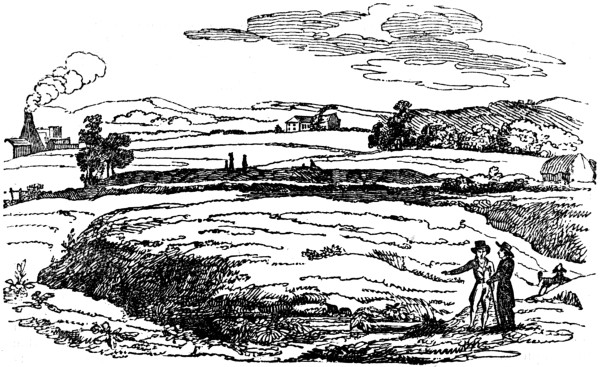
Pretorium of the Roman Camp near Pentonville.
The pencil of the artist has been employed to give a correct and picturesque representation as it now appears, in September, 1826, of the last vestige of the Roman power in this suburb. The view is taken from the north-east angle of the prætorium. Until within a few years the ground about it was unbroken; and, even now, the quadrangle itself is surprisingly complete, considering that nearly eighteen centuries have elapsed since it was formed by the Roman soldiery. In a short time the spirit of improvement will entirely efface it, and houses and gardens occupy its site. In the fosse of this station, which is overrun with sedge and brake, there is so pretty a “bit,” to use an artist’s word, that I have caused it to be sketched.
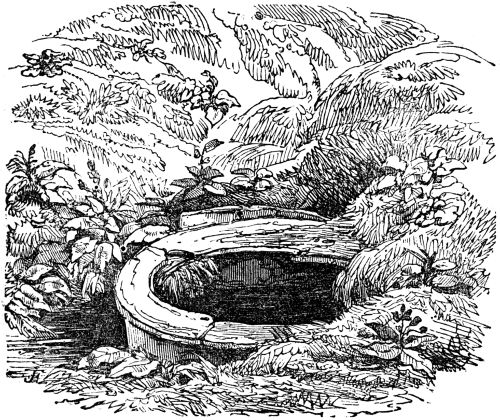
The Old Well in the Fosse.
This may be more pleasantly regarded when the ancient works themselves have vanished. Within a few yards of the western side of the fosse, and parallel with it, there is raised a mound or rampart of earth. It is in its original state and covered with verdure. In fine mornings a stray valitudinarian or two may be seen pacing its summit. Its western slope has long been the Sunday resort of Irishmen for the game of foot-ball.
Getting back into the New Road, its street which stands on fields I rambled in when a boy, leads to “White Conduit-house,” which derives its name from a building still preserved, I was going to say, but I prefer to say, still standing.
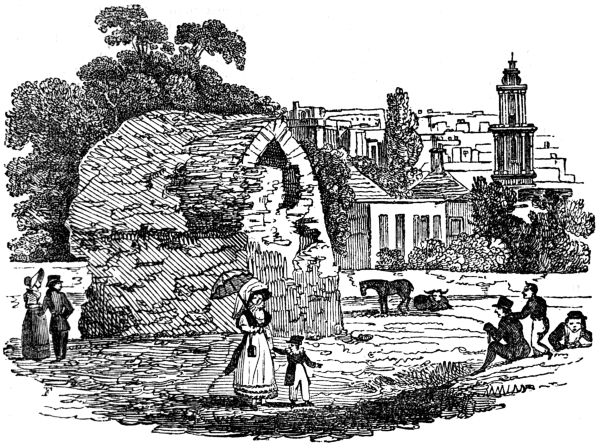
The White Conduit.
Mr. Joseph Fussell who resides within sight of this little edifice, and whose pencil took the Roman general’s station, and the well, also drew this Conduit; and his neighbour, Mr. Henry White, engraved the three, as they now present themselves to the reader’s eye.
The view of the “White Conduit” is from the north, or back part, looking towards Pentonville, with Pancras new church and other buildings in the distance. It was erected over a head of water that formerly supplied the Charter-house, and bore a stone in front inscribed “T. S.” the initials of Sutton, the founder, with his arms, and the date “1641.”[332]
About 1810, the late celebrated Wm. Huntington, S.S., of Providence chapel, who lived in a handsome house within sight, was at the expense of clearing the spring for the use of the inhabitants; but, because his pulpit opinions were obnoxious, some of the neighbouring vulgar threw loads of soil upon it in the night, which rendered the water impure, and obstructed its channel, and finally ceasing to flow, the public was deprived of the kindness he proposed. The building itself was in a very perfect state at that time, and ought to have been boarded up after the field it stood in was thrown open. As the new buildings proceeded it was injured and defaced by idle labourers and boys, from mere wantonness and reduced to a mere ruin. There was a kind of upper floor or hayloft in it, which was frequently a shelter to the houseless wanderer. A few years ago some poor creatures made it a comfortable hostel for the night, with a little hay. Early in the morning a passing workman perceived smoke issuing from the crevices, and as he approached heard loud cries from within. Some mischievous miscreants had set fire to the fodder beneath the sleepers, and afterwards fastened the door on the outside: the inmates were scorched by the fire, and probably they would all have been suffocated in a few minutes, if the place had not been broken open.
The “White Conduit” at this time merely stands to shame those who had the power, and neglected to preserve it. To the buildings grown up around, it might have been rendered a neat ornament, by planting a few trees and enclosing the whole with an iron railing, and have stood as a monument of departed worth. This vicinity was anciently full of springs and stone conduits; the erections have long since gone to decay, and from their many waters, only one has been preserved, which is notoriously deficient as a supply to the populous neighbourhood. During the heats of summer the inhabitants want this common element in the midst of plenty. The spring in a neighbouring street is frequently exhausted by three or four o’clock in the afternoon, the handle of the pump is then padlocked till the next morning, and the grateful and necessary refreshment of spring-water is not to be obtained without going miles in search of another pump. It would seem as if the parochial powers in this quarter were leagued with publicans and sinners, to compel the thirsty to buy deleterious beer and bowel-disturbing “pop,” or to swallow the New River water fresh with impurities from the thousands of people who daily cleanse their foul bodies in the stream, as it lags along for the use of our kitchens and tea-tables.
“White Conduit-house,” has ceased to be a recreation in the good sense of the word. Its present denomination is the “Minor Vauxhall,” and its chief attraction during the passing summer has been Mrs. Bland. She has still powers, and if their exercise here has been a stay and support to this sweet melodist, so far the establishment may be deemed respectable. It is a ground for balloon-flying and skittle-playing, and just maintains itself above the very lowest, so as to be one of the most doubtful places of public resort. Recollections of it some years ago are more in its favour. Its tea-gardens then in summer afternoons, were well accustomed by tradesmen and their families; they are now comparatively deserted, and instead, there is, at night, a starveling show of odd company and coloured lamps, a mock orchestra with mock singing, dancing in a room which decent persons would prefer to withdraw their young folks from if they entered, and fire-works “as usual,” which, to say the truth, are usually very good.
Such is the present state of a vicinage which, “in my time,” was the pleasantest near spot to the north of London. The meadow of the “White Conduit” commanded an extensive prospect of the Hampstead and Highgate hills, over beautiful pastures and hedge-rows which are now built on, or converted into brick clamps, for the material of irruption on the remaining glades. The pleasant views are wholly obstructed. In a few short years, London will distend its enormous bulk to the heights that overlook its proud city; and, like the locusts of old, devour every green field, and nothing will be left to me to admire, of all that I admired.
Elegy
Written in Bartlemy Fair, at Five o’clock in the morning, in 1810.
The clock-bell tolls the hour of early day, The lowing herd their Smithfield penance drie, The watchman homeward plods his weary way And leaves the fair—all solitude to me! Now the first beams of morning glad the sight, And all the air a solemn stillness holds; Save when the sheep-dog bays with hoarse affright, And brutal drovers pen the unwilling folds. Save that where sheltered, or from wind or shower, The lock’d-out ’prentice, or frail nymph complain, Of such as, wandering near their secret bower, Molest them, sensible in sleep, to pain. Beneath those ragged tents—that boarded shade, Which late display’d its stores in tempting heaps; There, children, dogs, cakes, oysters, all are laid, There, guardian of the whole, the master sleeps. The busy call of care-begetting morn, The well-slept passenger’s unheeding tread; The showman’s clarion, or the echoing horn, Too soon must rouse them from their lowly bed. Perhaps in this neglected booth is laid Some head volcanic, oft discharging fire! Hands—that the rod of magic lately sway’d; Toes—that so nimbly danc’d upon the wire. Some clown, or pantaloon—the gazers’ jest, Here, with his train in dirty pageant stood: Some tired-out posture-master here may rest, Some conjuring swordsman—guiltless of his blood! The applause of listening cockneys to command, The threats of city-marshal to despise; To give delight to all the grinning band, And read their merit in spectators’ eyes, Is still their boast;—nor, haply, theirs alone, Polito’s lions (though now dormant laid) And human monsters, shall acquire renown, The spotted Negro—and the armless maid! Peace to the youth, who, slumbering at the Bear, Forgets his present lot, his perils past: Soon will the crowd again be thronging there, To view the man on wild Sombrero cast. Careful their booths, from insult to protect, These furl their tapestry, late erected high; Nor longer with prodigious pictures deck’d, They tempt the passing youth’s astonish’d eye. But when the day calls forth the belles and beaux, The cunning showmen each device display, And many a clown the useful notice shows, To teach ascending strangers—where to pay. Sleep on, ye imps of merriment—sleep on! In this short respite to your labouring train; And when this time of annual mirth is gone, May ye enjoy, in peace, your hard-earned gain![333]
NATURALISTS’ CALENDAR.
Mean Temperature 60·40.
September 3.
Purton Fair, Wilts.
To the Editor of the Every-Day Book.
August 18, 1826.
Dear Sir,—Perhaps you, or some of your readers, may be acquainted with a small village in the north of Wiltshire, called Purton, very pleasantly situated, and dear to me, from a child; it being the place where I passed nearly all my boyish days. I went to school there, and there spent many a pleasant hour which I now think of with sincere delight; and perhaps you will not object to a few particulars concerning a fair held there on the first day of May and the third day of September in every year.
The spot whereon Purton fair is annually celebrated, is a very pleasant little green called the “close,” or play-ground, belonging to all the unmarried men in the village. They generally assemble there every evening after the toils of the day to recreate themselves with a few pleasant sports. Their favourite game is what they call backswording, in some places called singlestick. Some few of the village have the good fortune to be adepts in that noble art, and are held up as beings of transcendent genius among the rustic admirers of that noted science. They have one whom they call their umpire, to whom all disputes are referred, and he always, with the greatest possible impartiality, decides them.
About six years ago a neighbouring farmer, whose orchard joins the green, thought that his orchard might be greatly improved. He accordingly set to work, pulled down the original wall, and built a new one, not forgetting to take in several feet of the green. The villagers felt great indignity at the encroachment, and resolved to claim their rights. They waited till the new wall should be complete, and in the evening of the same day a party of about forty marched to the spot armed with great sticks, pickaxes, &c., and very deliberately commenced breaking down the wall. The owner on being apprised of what was passing, assembled all his domestics and proceeded to the spot, when a furious scuffle ensued, and several serious accidents happened. At last, however, the aggressor finding he could not succeed, proposed a settlement; he entirely removed the new wall on the following day, and returned it to the place where the old one stood.
On the morning of the fair, as soon as the day begins to dawn, all is bustle and confusion throughout the village. Gipsies are first seen with their donkies approaching the place of rendezvous; then the village rustics in their clean white Sunday smocks, and the lasses with their Sunday gowns, caps, and ribands, hasten to the green, and all is mirth and gaiety.
I cannot pass over a very curious character who used regularly to visit the fair, and I was told by an ancient inhabitant that he had done so for several years. He was an old gipsy who had attained to high favour with all the younkers of the place, from his jocular habits, curious dress, and the pleasant stories he used to relate. He called himself “Corey Dyne,” or “Old Corey,” and those are the only names by which he was known. He was accustomed to place a little hat on the ground, from the centre of which rose a stick about three feet high, whereon he put either halfpence or a small painted box, or something equally winning to the eye of his little customers. There he stood crying, “Now who throws with poor old Corey—come to Corey—come to Corey Dyne; only a halfpenny a throw, and only once a year!” A boy who had purchased the right to throw was placed about three feet from the hat, with a small piece of wood which he threw at the article on the stick, and if it fell in the hat, (which by the by it was almost invariably sure to do,) the thrower lost his money; but if out of the hat, on the ground, the article from the stick was claimed by the thrower. The good humour of “Old Corey” generally ensured him plenty of custom. I have oftentimes been a loser with him, but never a winner. I believe that no one in all Purton knows from whence he is, although every body is acquainted with him.
There was a large show on the place, at which the rustics were wont to gaze with surprise and admiration. The chief object of their wonder was our “punch.” They could not form the slightest idea how little wooden figures could talk and dance about; they supposed that there must be some life in them. I well remember that I once undertook to set them right, but was laughed at and derided me for my presumption and boast of superior knowledge.
There was also another very merry fellow who frequented the fair by the name of “Mr. Merryman.” He obtained great celebrity by giving various imitations of birds, &c., which he would very readily do after collecting a sufficient sum “to clear his pipe,” as he used to say. He then began with the nightingale, which he imitated very successfully, then followed the blackbird—linnet—goldfinch—robin—geese and ducks on a rainy morning—turkies, &c. &c. Then, perhaps, after collecting some more money “to clear his pipe,” he would imitate a jackass, or a cow. His excellent imitation of the crow of a cock strongly affected the risible muscles of his auditors.
The amusements last till near midnight, when the rustics, being exhilarated with the effects of good strong Wiltshire ale, generally part after a few glorious battles.
The next day several champions enter the field to contest the right to several prizes, which are laid out in the following order:—
1st. A new smock.
2nd. A new hat with a blue cockade.
3rd. An inferior hat with a white cockade.
4th. A still inferior hat without a cockade.
A stage is erected on the green, and at five o’clock the sport commences; and a very celebrated personage, whom they call their umpshire, (umpire,) stands high above the rest to award the prizes. The candidates are generally selected from the best players at singlestick, and on this occasion they use their utmost skill and ingenuity, and are highly applauded by the surrounding spectators. I must not forget to remark that on this grand, and to them, interesting day, the inhabitants of Purton do not combat against each other. No—believe me, sir, they are better acquainted with the laws of chivalry. Purton produces four candidates, and a small village adjoining, called Stretton, sends forth four more. These candidates are representatives of the villages to which they respectively belong, and they who lose have to pay all the expenses of the day; but it is to the credit of the sons of Purton I record, that for seven successive years their candidates have been returned the victors. The contest generally lasts two hours, and, after that, the ceremony of chairing the representatives takes place, which is thus performed:—Four chairs made with the boughs of trees are in waiting, and the conquerors are placed therein and carried through the village with every possible demonstration of joy, the inhabitants shouting “Purton for ever! huzza! my boys, huzza!” and waving boughs over their triumphant candidates. After the chairing they adjourn to the village public-house, and spend the remainder of the evening as before.
The third day is likewise a day of bustle and confusion. All repair to a small common, called the cricket ground, and a grand match takes place between the Purton club and the Stretton club; there are about twenty candidates of a side. The vanquished parties pay a shilling each to defray the expense of a cold collation, which is previously provided in a pleasant little copse adjoining the cricket-ground, and the remainder of the day is spent convivially.
I remember hearing the landlord of the public-house at Purton, (which is situated on one side of the green,) observe to a villager, that during the three days’ merriment he had sold six thousand gallons of strong beer and ale; the man of course doubted him, and afterwards very sarcastically remarked to me, “It’s just as asy, measter, for he to zay zix thousand gallons as dree thousand!” Does not this, good Mr. Editor, show a little genuine Purton wit?
I have now, my dear sir, finished, and have endeavoured to describe three pleasant days spent in an innocent and happy manner; and if I have succeeded in affording you any service, or your readers any amusement, I am amply rewarded. Allow me to add I feel such an affection for old Purton, that should I at any time in my life visit Wiltshire, I would travel twenty miles out of my road to ramble once more in the haunts of my boyhood.
Believe me, my dear Sir, Yours very sincerely, C. T.
August, 18, 1826.
P.S. Since writing the above I have received a letter from a very particular friend who went to Purton school five years, to whom I applied for a few extra particulars respecting the fair, &c., and he thus writes, “Dear C. You seem to think that with the name I still retain all the characteristics and predilections of a hodge; and therefore you seek to me for information respecting the backsword-playing, fair, &c. Know that as to the first, it is (and has been for the last two years) entirely done away with, as the principal ‘farmers’ in the place ‘done’ like it, and so don’t suffer it. As to the fair, where lads and lasses meet in their best gowns, and ribands, and clean smocks, you must know, most assuredly, more of it than I do, as I seldom troubled about it. You must bear in mind that this fair is exactly the same as that held in the month of May, but as no notice has been taken of it by Mr. Hone in either of his volumes, I suppose it very little matters whether your description is of the fair held in May or September.”
I have to lament, my dear sir, the discontinuance of the ancient custom of backswording at Purton village; but so long as they keep up their fairs, the other loss will not be so much felt. C. T.
August 30, 1826.
I forgot to mention in my particulars of Purton-fair, that Old Corey, and the other celebrated worthies, only come to the September fair, as the May fair is disregarded by them, it being a fair principally for the sale of cattle, &c. and the September fair is entirely devoted to pleasure. Perhaps you can introduce this small piece of intelligence, together with the following doggrel song written for the occasion. C. T.
TO THE WORTHY AND RESPECTABLE INHABITANTS OF PURTON, This SONG is most respectfully inscribed, By their ever true and devoted humble servant,
Charles Tomlinson.
SONG.
Purton Fair.
Come, neighbours, listen, I’ll sing you a song, Which, I assure you, will not keep you long; I’ll sing a good song about old Purton fair, For that is the place, lads, to drive away care. The damsels all meet full of mirth and of glee, And they are as happy as happy can be; Such worth, and such beauty, fairs seldom display, And sorrow is banished on this happy day. There’s the brave lads of Purton at backsword so clever, Who were ne’er known to flinch, but victorious ever; The poor boys of Stretton are basted away, For Purton’s fam’d youths ever carry the day. ’Tis “Old Corey Dyne,” who wisely declares, Stretton’s lads must be beaten at all Purton’s fairs; They can’t match our courage, then, huzza! my boys, To still conquering Purton let’s kick up a noise. “Old Corey’s” the merriest blade in the fair, What he tells us is true, so, prithee, don’t stare; “Remember poor Corey, come, pray have a throw, ’Tis but once a year, as you very well know.” But—here ends my song, so let’s haste to the green, ’Tis as pretty a spot as ever was seen; And if you are sad or surrounded with care, Haste quickly! haste quickly! to Old Purton Fair.
NATURALISTS’ CALENDAR.
Mean Temperature 61·07.
September 4.
How to keep Apples.
Gather them dry, and put them with clean straw, or clean chaff, into casks; cover them up close, and put them into a cool dry cellar. Fruit will keep perfectly good a twelvemonth in this manner.
How to mark your fruit.
Let the cultivator of choice fruit cut in paper the initial letters of his name, or any other mark he likes; and just before his peaches, nectarines, &c. begin to be coloured, stick such letters or mark with gum-water on that side of the fruit which is next the sun. That part of the rind which is under the paper will remain green, in the exact form of the mark, and and so the fruit be known wheresoever found, for the mark cannot be obliterated.
NATURALISTS’ CALENDAR.
Mean Temperature 59·92.
September 5.
Old Bartholomew.
This day has been so marked in our almanacs since the new style.
The Season.
We may expect very pleasant weather during this month. For whether the summer has been cold, warm, or showery, September, in all latitudes lying between 45 and 55 degrees north, produces, on an average, the finest and pleasantest weather of the year: as we get farther south the pleasantest temperature is found in October; more northward than 55 degrees the chills of autumn are already arrived, and we must look for temperature to August.[334]
The Gymnasium. For the Every-Day Book.
Hæc opera atque hæ sunt generosi Principis artes.
Juv. Sat. 8. L. 224.
Let cricket, tennis, fives, and ball, The active to amusement call; Let sportsmen through the fields at morn Discharge the gun and sound the horn,— Gymnastic sport shall fill my hours, Renew my strength and tone my powers. I learn to climb, to walk and run, I make defence, and dangers shun; Now quick, now slow, now poised on high, I stand in air and vault the sky; The sailor’s skill, the soldier’s part, I compass by Gymnastic art. All life’s concerns require that health Should be secured to gather wealth; That limb and muscle, nerve and vein, Should vigorous force and motion gain:— Seek the Gymnasium,—try the plan, And be the strong and graceful man. The Olympic games, of Grecian birth, Gave many a youth athletic worth; Hence Romans shone;—hence Britons fought, The Picts and Vandals influence caught; The lance, the spear, and arrow flew, And prove what deeds Gymnastics do. With ease the horseman learns to ride And keep his hobby in his pride; Bloodless the feats are here pursued, And vanquished contests are renewed. Hey for Gymnastics!—’tis the rage Both with the simple and the sage. Clias, and Voelker as the chief, Each makes his charge and gives relief; Each points his pupils to the goal, And, more than Parry, gains the pole:— Up and be trim!—the sport is fine,— Fling down the gauntlet,—mount the line. Caleidoscopes were once the taste,— Velocipedes were rode for haste,— Those fed the eye with pleasing views, These ran the streets and tithed their dues; Thrown to the shade like fashions past, Gymnastics reign, for they are last. Nature with art is like a tower, Strong in defence in every hour; Nature with art can nearly climb The Alp and Appenine of time; Make life more lasting, life more bold, By true Gymnastic skill controlled.
J. R. Prior.
Sept. 1826.
NATURALISTS’ CALENDAR.
Mean Temperature 60·35.
September 6.
Chronology.
On the 6th of September, 1734, died in France, the Sieur Michael Tourant, aged ninety-eight, of whom it is said he never eat salt, and had none of the infirmities of old age.[335]
A Total Eclipse in Caligraphy.
To the Editor of the Every-Day Book.
Sir,—As a subscriber to your highly entertaining work, I take the liberty of sending you the following.
In the first volume of the Every-Day Book, page 1086, I found an account of some small writing, executed by Peter Bales, which Mr. D’Israeli presumed to have been the whole bible written so small, that it might be put in an English walnut no bigger than a hen’s egg. “The nut holdeth the book; there are as many leaves in this little book as in the great bible, and as much written in one of the little leaves, as a great leaf of the bible.”—There is likewise an account in the same pages of the “Iliad” having been written so small that it might be put in a nut-shell; which is nothing near so much as the above.
I have lately seen written within the compass of a new penny piece, with the naked eye, and with a common clarified pen, the lord’s prayer, the creed, the ten commandments, the sixth, seventh, eighth, ninth, tenth, eleventh, twelfth, thirteenth, and fourteenth collects after Trinity, the grace of our Lord Jesus Christ, &c., the name of the writer, place of abode, nearest market town, county, day of the month and date of the year, all in words at length, and with the whole of the capital letters and stops belonging thereto, the commandments being all numbered. It was written by, and is in the possession of, Mr. John Parker of Wingerworth, near Chesterfield, Derbyshire: the writing bears date September 10, 1823. This piece of writing, I find, upon calculation, to be considerably smaller than either of the before-mentioned pieces. My calculation is as follows:—
A moderate sized egg will hold a book one inch and three quarters by one inch and three-eighths. Bibles have from about sixty to eighty lines in a column; I have not seen more. In this ingenious display of fine penmanship, there are eighty lines in one inch, and two half-eighths of an inch, which in one inch and three quarters, (the length of the bible,) is one hundred and six lines, which would contain one-third more matter than the bibles with eighty lines in a column; and one line of this writing, one inch and two-half eighths of an inch in length, (which is the sixteenth of an inch less in bread than the small bible,) is equal to two lines from one column of the great bible—for example.
Isaiah. Chap. XXIV.—Two lines of verse 20, the bible having seventy-nine lines in a column:—
“and the transgression thereof shall be heavy upon it, and it shall fall, and not rise again.”
Ezekiel, Chap. XXX.—Two lines of verse 12, the bible having sixty-three lines in a column:—
“and I will make the Land waste, and all that is therein, by the hand of strangers.”
One line of Mr. Parker’s writing being part of the seventh collect after Trinity:—
“good things; graft in our hearts the love of thy name, increase in us true religion, now”—
Another line being part of the ninth and tenth commandments:—
“false witness against thy neighbour. 10.—Thou shalt not covet thy neighbour’s house.”—
Mr. Parker very obligingly submits his writing to the inspection of the curious, and would execute one similar for a proper reward. If this account should be thought worthy of a place in your “Every-Day Book,” I shall feel much obliged by its insertion, and will endeavour to send you something amusing respecting the customs, pastimes, and amusements of this part of Derbyshire.
I am, Sir, Your well-wisher And obedient servant, John Francis Browne.
Lings, near Chesterfield, August, 30, 1826.
NATURALISTS’ CALENDAR.
Mean Temperature 59·17.
September 7.
Enurchus.
For this saint, in the church of England calendar, see vol. i. col. 1253.
Chronology.
On the 7th of September, 1772, a most astonishing rain fell at Inverary, in Scotland, by which the rivers rose to such a height, as to carry every thing along with the current that stood in the way. Even trees that had braved the floods for more than one hundred years, were torn up by the roots and carried down the stream. Numbers of bridges were swept away, and the military roads rendered impassable. All the duke of Argyle’s cascades, bridges, and bulwarks, were destroyed at his fine palace, in that neighbourhood.[336]
Baron Brown, the Durham Poet.
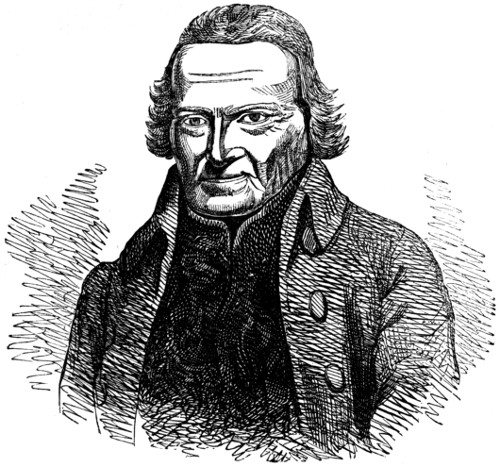
Baron Brown, the Durham Poet.
A Latin line beneath his name May lift along the laureate’s fame, As on a crutch, and make it go For half an age, for all to know That there was one, in our time, Who thought mere folly not a crime; And, though he scorn’d to be a scorner And offer Brown to Poets Corner, Imagined it a fit proceeding To give his life—let who will sneer at It—“Palmam qui meruit ferat.”
Mr. John Sykes, bookseller, Johnson’s-head, Newcastle, in the “Local Records, or Historical Register of Remarkable Events,” which, in 1824, he compiled into a very interesting octavo volume, inserts the death, with some account of the “life, character, and behaviour,” of the self-celebrated poet-laureate of Durham, whose portrait adorns this page. He has not been registered here under the day of his decease according to Mr. Syke’s obit, but it is not fitting as regards this work, that Brown should die for ever, and therefore, from a gentleman who knew him, the reader will please to accept the following
Memoir of James Brown.
For the Every-Day Book.
This curious personage was well known for a long series of years to the inhabitants of Northumberland and Durham, and we believe few men have figured on the stage of the world more remarkable for their peculiarities and eccentricities.
Of the early part of James Brown’s life little is known that can be depended upon, but the compiler of the present article has heard him assert that he was born at Berwick-on-Tweed; if this be the case it is probable he left that town at a very early age, as in his speech none of the provincialisms of the lower order of inhabitants of Berwick could be observed, and had he resided there for any length of time, he must have imperceptibly imbibed the vulgar dialect. Certain, however, it is, that when a young man he resided in that “fashionable” part of Newcastle-upon-Tyne called “the Side,” where he kept a rag-shop, and was in the habit of attending the fairs in the neighbourhood with clothes ready-made for sale. During his residence in Newcastle his first wife died; of this person he always spoke in terms of affection, and was known long after her death, to shed tears on her being alluded to. In all probability it was owing to his loss of her that his mind became disturbed, and from an industrious tradesman he became a fanatic. A few years after her decease he married a Miss Richardson, of Durham, a respectable though a very eccentric character, and who survived him a year. This lady being possessed of a theatre, and some other little property in Durham, he removed to that city to reside.
When Brown first devoted himself to the muses is uncertain, but about thirty-three years ago, he lived in Newcastle, styled himself the poet-laureate of that place, and published a poem explanatory of a chapter in the Apocalypse, which was “adorned” with a hideous engraving of a beast with ten horns. Of this plate he always spoke in terms of rapture. We have heard that it was designed by the bard; but as Mr. B., though a poet, never laid any claim to the character of an artist, it is our belief that he had no hand in its manufacture, but that it was the work of some of those waggish friends who deceived him by their tricks, and rendered his life a pleasure. Their ingenious fictions prevented his dwelling on scenes by which his existence might have been embittered, and it is but justice to his numerous hoaxers to assert, that without their pecuniary assistance he would have often been in want of common necessaries. Though credulous he was honest; though poor he was possessed of many virtues; and while they laughed at the fancies of the visionary, they respected the man. Brown once indulged a gentleman in Durham with a sight of the drawing above alluded to, and on a loud laugh at what the poet esteemed the very perfection of terrific sublimity, Brown told him “he was no christian, or he would not deride a scriptural drawing which the angel Gabriel had approved!”
Brown’s poesy was chiefly of a serious nature, (at least it was intended to be so,) levity and satire were not his forte. Like Dante, his imagination was gloomy—he delighted to describe the torments of hell—the rattling of the chains, and the screams of the damned; the mount of Sisyphus was his Parnassus, the Styx was his Helicon, and the pale forms that flit by Lethe’s billows, the muses that inspired his lay. His poems consisted chiefly of visions, prophecies, and rhapsodies, suggested by some part of the sacred volume of the contents of which he had an astonishing recollection. When he was at the advanced age of ninety-two it was almost impossible to quote any passage of scripture to him without his remembering the book, chapter, and frequently the verse from whence it was taken. Of his poetry (though in his favourite city he has left many imitators) we cannot say any thing in praise; it had “neither rhyme nor reason,” it was such as a madman would inscribe on the walls of his cell. His song, like that of the witches in Thalaba, was “an unintelligible song” to all but the writer, on whose mind in reading it, to use the words of one of the sweetest of our modern poets, “meaning flashed like strong inspiration.” The only two lines in his works that have any thing like meaning in them are—
“When men let Satan rule their heart They do act the devil’s part.”
Our author’s last, and as he esteemed it, his best work—his monumentum ære perennius, was a pamphlet published in Newcastle in 1820, by Preston and Heaton, at the reasonable price of one shilling; for, unlike his brother bards, Mr. Brown never published in an expensive form. He was convinced that merit would not lie hid though concealed in a pamphlet, but like Terence’s beauty, diu latere non potest, and that nonsense, though printed in quarto with the types of a Davison, would be still unnoticed and neglected. On his once being shown the quarto edition of the “White Doe,” and told that he ought to publish in a similar manner, his answer was that “none but the devil’s poets needed fine clothes!” The pamphlet above alluded to was entitled “Poems on Military Battles, Naval Victories, and other important subjects, the most extraordinary ever penned, a Thunderbolt shot from a Lion’s Bow at Satan’s Kingdom, the Kingdom of the Devil and the Kingdom of this World reserving themselves in darkness for the great and terrible Day of the Lord, as Jude, the servant of God, declareth: By James Brown, P. L.” This singular work was decorated with a whole length portrait of the author treading on the “devil’s books,” and blowing a trumpet to alarm sinners; it was, as we have heard him say, the work of a junior pupil of the ingenious Mr. Bewick.
During the contest for Durham, in 1820, a number of copies of an election squib, written by a humble individual connected with a northern newspaper, and entitled “A Sublime Epistle, Poetic and Politic, by James Brown, P. L.” was sent him for distribution; these, after printing an explanatory address on the back of the title, wherein he called himself S. S. L. D., the “Slayer of Seven Legions of Devils,” and disowned the authorship, he turned to his own emolument by selling at sixpence a copy.
In religious affairs Brown was extremely superstitious; he believed in every mad fanatic who broached opinions contrary to reason and sense. The wilder the theory, the more congenial to his mind. He was successively a believer in Wesley, Messrs. Buchan, Huntington, Imanuel Swedenburg, and Joanna Southcote; had he lived a little longer he would probably have been “a ranter.” He was a great reader, and what he read he remembered. The bible, of which he had a very old and curious pocket edition in black letter, was his favourite work; next to that he esteemed Alban Butler’s wonderful lives of the saints, to every relation of which he gave implicit credit, though, strange to tell, he was in his conversation always violent against the idolatries of the catholic church.
When Brown was a follower of Mr. Buchan, he used to relate that he fasted forty days and forty nights, and it is to this subject that veterinary doctor Marshall, of Durham, his legitimate successor, alludes in the following lines of an elegy he wrote on the death of his brother poet and friend:—
“He fasted forty days and nights When Mr. Buchan put to rights The wicked, for a wonder; And not so much, it has been thought, As weigh’d the button on his coat, He took to keep sin under.”
So said a Bion worthy of such an Adonis! but other accounts differ. If we may credit Mr. Sykes, the respectable author of “Local Records,” Marshall erred in supposing that the poet, camelion-like, lived on air for “forty days and forty nights.” Mr. Sykes relates that in answer to a question he put to him as to how he contrived for so long a time to sustain the cravings of nature, Brown replied, that “they (he and the rest of the party of fasters) only set on to the fire a great pot, in which they boiled water, and then stirred into it oatmeal, and supped that!”
Brown was very susceptible of flattery, and all his life long constantly received letters in rhyme, purporting to come from Walter Scott, Byron, Shelley, Southey, Wilson, and other great poets; with communications in prose from the king of England, the emperor of Morocco, the sultan of Persia, &c. All of these he believed to be genuine, and was in the habit of showing as curiosities to his friends, who were frequently the real authors, and laughed in their sleeves at his credulity.
In 1821, Brown received a large parchment, signed G. R., attested by Messrs. Canning and Peel, to which was suspended a large unmeaning seal, which he believed to be the great seal of Great Britain. This document purported to be a patent of nobility, creating him “baron Durham, of Durham, in the county palatine of Durham.” It recited that this title was conferred on him in consequence of a translation of his works having been the means of converting the Mogul empire! From that moment he assumed the name and style of “baron Brown,” and had a wooden box made for the preservation of his patent.
Of the poetic pieces which Brown was in the habit of receiving, many were close imitations of the authors whose names were affixed to them, and evinced that the writers were capable of better things. One “from Mr. Coleridge,” was a respectable burlesque of the “Ancient Mariner,” and began:—
It is a lion’s trumpeter, And he stoppeth one of three.
Another, “from Mr. Wilson,” commenced thus:—
Poetic dreams float round me now, My spirit where art thou? Oh! art thou watching the moonbeams smile On the groves of palm in an Indian isle; Or dost thou hang over the lovely main And list to the boatswain’s boisterous strain; Or dost thou sail on sylphid wings Through liquid fields of air, Or, riding on the clouds afar, Dost thou gaze on the beams of the evening star So beautiful and so fair. O no! O no! sweet spirit of mine Thou art entering a holy strain divine A strain which is so sweet, Oh, one might think ’twas a fairy thing, A thing of love and blessedness, Singing in holy tenderness, A lay of peaceful quietness, Within a fairy street! But ah! ’tis Brown, &c. &c.
A piece “from Walter Scott” opened with:—
The heath-cock shrill his clarion blew Among the heights of Benvenue, And fast the sportive echo flew, Adown Glenavin’s vale. But louder, louder was the knell, Of Brown’s Northumbrian penance-bell,[337] The noise was heard on Norham fell, And rung through Teviotdale.
These burlesques were chiefly produced by the law and medical students in Newcastle and Durham, and the young gentlemen of the Catholic College of Ushaw, near the latter place. As the writer of this sketch was once congratulating Mr. Brown on his numerous respectable correspondents, the old man said that he had an acquaintance far superior to any of his earthly ones, and no less a personage than the angel Gabriel, who, he stated, brought him letters from Joanna Southcote, and call to carry back his answers! This “Gabriel” was a young West Indian then residing in Durham, who used to dress himself in a sheet with goose wings on his shoulders and visit the poet at night, with letters purporting to be written to him in heaven by the far-famed prophetess. After “Gabriel” left Durham, Brown was frequently told of the deception which had been practised upon him, but he never could be induced to believe that his nocturnal visiter was any other than the angel himself. “Did I not,” he once said, “see him clearly fly out at the ceiling!” Brown used to correspond with some of Joanna’s followers in London, on the subject of these supposed revelations, and actually found (credite posteri) believers in the genuineness.
Amongst Brown’s strange ideas, one was that he was immortal, and should never die. Under this delusion when ill he refused all medical assistance, and it induced him at the age of 90 to sell the little property which he acquired by marriage, for a paltry guinea a week, to be paid during the life of himself and Mrs. Brown, and the life of the survivor. The property he parted from, in consideration of this weekly stipend, was a leasehold house in Sadler-street, (the theatre having been pulled down soon after the erection of the present one opposite to it,) and the house was conveyed to two Durham tradesmen, Robinson Emmerson and George Stonehouse, by whom the allowance was for some time regularly paid; but on the latter becoming embarrassed in his circumstances, the payment was discontinued, and poor Brown and his aged wife were thrown on the world without a farthing, at a time when bodily and mental infirmities had rendered them incapable of gaining a livelihood. Far be it from the writer of this to cast any aspersion on Messrs. Emmerson and Stonehouse, but it does certainly appear to him that their conduct to Brown was unkind to say the least of it. After this calamity Brown became for a few months an inhabitant of a poor-house, which he subsequently left for a lodging at an obscure inn, where, on the 11th of July, 1823, he died in a state of misery and penury at the advanced age of 92; his wife shortly afterwards died in the poorhouse. They are both interred in the churchyard of St. Oswald.
Such was James Brown the Durham poet, who with all his eccentricities was an honest, harmless and inoffensive old man. Of his personal appearance, the excellent portrait which accompanies this memoir from a drawing by Mr. Terry is an exact resemblance. All who knew him will bear testimony to its correctness. It is indeed the only one in existence that gives a correct idea of what he was. The other representations of him are nothing better than caricatures. D.
NATURALISTS’ CALENDAR.
Mean Temperature 58·45.
September 8.
Nativity B. V. M.
The legend of this festival retained in the church of England calendar, is related in vol. i. col. 1274.
Chronology.
Fatal Puppet Play.
Extract from the Parish Register of Burwell, in Cambridgeshire, “1727, September 8. N. B. About nine o’clock in the evening, a most dismal fire broke out in a barn in which a great number of persons were met together to see a puppet-show. In the barn there were a great many loads of new light straw; the barn was thatched with straw, which was very dry, and the inner roof of the barn was covered with old dry cobwebs; so that the fire, like lightning, flew round the barn in an instant, and there was but one small door belonging to the barn, which was close nailed up, and could not be easily broke open; and when it was opened, the passage was so narrow, and every body so impatient to escape, that the door was presently blocked up, and most of those that did escape, which were but very few, were forced to crawl over the heads and bodies of those that lay on a heap at the door, and the rest, in number seventy-six, perished instantly, and two more died of their wounds within two days. The fire was occasioned by the negligence of a servant, who set a candle and lantern to, or near, the heap of straw that was in the barn. The servant’s name was Richard Whitaker, of the parish of Hadstock, in Essex, near Linton, in Cambridgeshire, who was tried for the fact at the assizes held at Cambridge, March 27, 1728, but he was acquitted.”[338]
Staines Church, Middlesex. Exhumation.
In a small apartment under the staircase leading to the gallery at the west end of the church, is presented the singular and undesirable spectacle of two unburied coffins, containing human bodies. The coffins are covered with crimson velvet and are otherwise richly embellished. They are placed beside each other on trestles, and bear respectively the following inscriptions:—
“Jessie Aspasia.
The most excellent and truly beloved wife of F. W. Campbell, Esq. of Barbreck, N. B. and of Woodlands in Surrey. Died in her 28th year,
July 11th, 1812.”
“Henry E. A. Caulfield, Esq. Died Sept. 3, 1808. Aged 29 years.”
As it was necessarily supposed that coffins thus open to inspection would excite much curiosity, a card is preserved at the sexton’s house, which states, in addition to the intelligence conveyed by the above inscriptions, that the deceased lady was daughter of W. T. Caulfield, Esq. of Rahanduff in Ireland, by Jessie, daughter of James, third lord Ruthven; and that she bore, with tranquil and exemplary patience, a fatal disorder produced by grief on the death of her brother, who removed from a former place of sepulture, now lies beside her in unburied solemnity.
NATURALISTS’ CALENDAR.
Mean Temperature 57·87.
September 9.
The Season.
At this period of the year the fashionable people of unfashionable times were accustomed to close their sojournments on the coasts, and commence their inland retreats before they “came to town for good.” In this respect manners are altered. The salubrity of the ocean-breeze is now courted, and many families, in defiance of gales and storms, spend the greater part of the winter at the southern watering places. The increase of this remarkable deviation deserves to be noticed, as a growing accommodation to the purposes of life.
A literary gentleman on his arrival from viewing the world of waters, obliges the editor with some original flowings from his pen, so fresh and beautiful, that they are submitted immediately to the reader’s enjoyment.
Sonnet. Written in a Cottage by the Sea-side. Hastings.
Ye, who would flee from the world’s vanities From cities’ riot, and mankind’s annoy, Seek this lone cot, and here forget your sighs, For health and rest are here—guests but too coy. If the vast ocean, with its boundless space, Its power omnipotent, and eternal voice, Wean not thy thoughts from wearying folly’s choice, And mortal trifling, unto virtue’s grace, To high intent, pure purpose, and sweet peace, Leaving of former bitter pangs no trace;— If each unworthy wish it does not drown, And free thee from ennui’s unnerving thrall, Then art thou dead to nature’s warning call, And fit but for the maddening haunts of town.
August, 1826.
W. T. M.
Sonnet Stanzas. On the Sea.
I never gaze upon the mighty sea, And hear its many voices, but there steals A host of stirring fancies, vividly Over my mind; and memory reveals A thousand wild and wondrous deeds to me; Of venturous seamen, on their daring keels; And blood-stain’d pirates, sailing fearlessly; And lawless smugglers, which each cave conceals; In his canoe, the savage, roving free; And all I’ve read of rare and strange, that be On every shore, o’er which its far wave peals: With luxuries, in which Imagination reels, Of bread fruit, palm, banana, cocoa tree, And thoughts of high emprize, and boundless liberty! I ne’er upon the ocean gaze, but I Think of its fearless sons, whose sails, unfurl’d, So oft have led to Art’s best victory. Columbus upon unknown waters hurl’d, Pursuing his sole purpose, firm and high, The great discovery of another world; And daring Cook, whose memory’s bepearled With pity’s tears, from many a wild maid’s eye; Their Heiva dance, in fancy I espy, While still the dark chief’s lip in anger curled: O’er shipwreck’d Crusoe’s lonely fate I sigh, His self-form’d bark on whelming billows whirled; And oft, in thought, I hear the Tritons cry, And see the mermaid train light gliding by. I never gaze upon the boundless deep, But still I think upon the glorious brave, Nelson and Blake, who conquered but to save; I hear their thunders o’er the billows sweep, And think of those who perish’d on the wave, That Britain might a glorious harvest reap! High hearts and generous, Vain did foemen Peace to their souls, and sweetly may they sleep, Entomb’d within the ocean’s lonely cave! Still many a lovely eye for them shall weep, Tears, far more precious than the pearls, that keep Their casket there, or all the sea e’er gave, To the bold diver’s grasp, whose fearless leap With wealth enriches, or in death must sleep!
W. T. M.
NATURALISTS’ CALENDAR.
Mean Temperature 58·55.
September 10.
The Rainbow.
Behold yon bright, ethereal bow, With evanescent beauties glow; The spacious arch streams through the sky, Decked with each tint of nature’s dye: Refracted sunbeams, through the shower, A humid radiance from it pour; Whilst colour into colour fades, With blended lights and softening shades.
Lunar Rainbow.
On the 10th of September, 1802, a very beautiful lunar rainbow was observed at Matlock, in Derbyshire, between the hours of eight and nine in the evening: its effect was singularly pleasing. The colours of these phenomena are sometimes very well defined; but they have a more tranquil tone than those which originate in the solar beams. They are not unfrequent in the vicinity of Matlock, being mentioned by some writers among the natural curiosities of that delightful spot.
On Saturday evening, September 28, 1822, an extremely interesting iris of this description was distinctly observed by many persons in the neighbourhood of Boston, in Lincolnshire. It made its appearance nearly north, about half-past eight in the evening. This bow of the heavens was every way complete, the curvature entire, though its span was extensive, and the altitude of its apex seemed to be about 20 degrees. The darkness occasioned by some clouds pregnant with rain, in the back ground of this white arch of beauty, formed a striking contrast, while several stars in the constellation of Ursa Major, (the great bear,) which were for a time conspicuous, imparted additional grandeur to the scene.[339]
An observer of a nocturnal rainbow on the 17th of August 1788, relates its appearance particularly. “On Sunday evening, after two days, on both of which, particularly the former, there had been a great deal of rain, together with lightning and thunder, just as the clocks were striking nine, three and twenty hours after full moon, looking through my window, I was struck with the appearance of something in the sky which seemed like a rainbow. Having never seen a rainbow by night, I thought it a very extraordinary phenomenon, and hastened to a place where there were no buildings to obstruct my view of the hemisphere. The moon was truly ‘walking in brightness,’ brilliant as she could be, not a cloud was to be seen near her; and over-against her, toward the northwest, or perhaps rather more to the north, was a rainbow, a vast arch, perfect in all its parts, not interrupted or broken as rainbows frequently are, but unremittedly visible from one horizon to the other. In order to give some idea of its extent, it is necessary to say, that, as I stood toward the western extremity of the parish of Stoke Newington, it seemed to take its rise from the west of Hampstead, and to end, perhaps, in the river Lea, the eastern boundary of Tottenham; its colour was white, cloudy, or greyish, but a part of its western leg seemed to exhibit tints of a faint, sickly green. I continued viewing it for some time, till it began to rain; and at length the rain increasing, and the sky growing more hazy, I returned home about a quarter or twenty minutes past nine, and in ten minutes came out again, but by that time all was over, the moon was darkened by clouds, and the rainbow of course vanished.”[340]
Pump at Hammersmith.
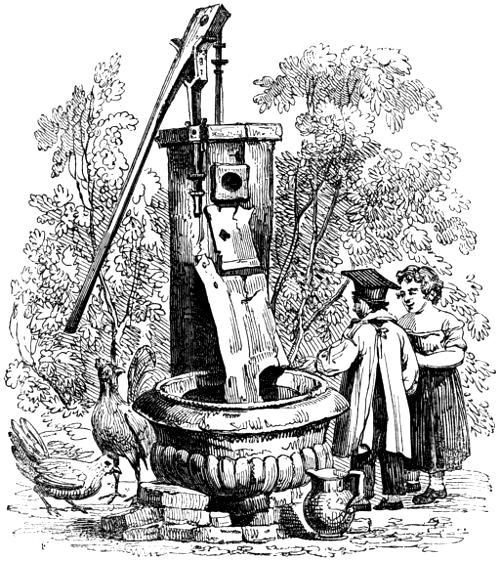
Pump at Hammersmith.
A “walking” man should not refrain To take a saunter up Webb’s-lane, Tow’rds Shepherd’s bush, and see a rude Old lumb’ring pump. It’s made of wood, And pours its water in a font So beautiful—that if he do’n’t Admire how such a combination Was form’d, in such a situation, He has no power of causation, Or taste, or feeling; but must live Painless, and pleasureless; and give Himself to doing what he can; And die a sort of sort-of-man.
Some persons walk the strait road from Dan to Beersheba, and finding it firm beneath the foot, have no regard to any thing else, and are satisfied when they get to their journey’s end. I do not advise these good kind of people to go to Hammersmith; but, here and there, an out-of-the-way man will be glad to bend his course thitherward, in search of the object represented. It is fair to say I have not seen it myself: it turned up the other day in an artist’s sketch-book. He had taken it as an object, could tell no more than that he liked it, and, as I seemed struck by its appearance, but could not then go to look at it and make inquiries, he volunteered his services, and wrote me as follows:—“I went to Hammersmith, and was some time before I could find the place again; however, I at length discovered it in Webb’s-lane, opposite the Thatched-house, (Mr. Gowland is the landlord.) There I took some refreshment, and gained what information I could, which was but little. The stone font with other things (old carved ornaments, &c., which were used in fitting up the upper rooms of some cottages that the pump belongs to) were purchased at a sale; and this was all I could obtain at the Thatched-house. Coming from thence I learned from a cobler at work that there was originally a leaden pump, but that it was doubled up, and rolled away, by some thieves, and they attempted to take the font, but found it too heavy. The Crispin could not inform me where the sale was, but he told me where his landlady lived and her name, which was Mrs. Springthorp, of Hammersmith, any one could tell me her house: so, being very tired, I took coach, and rode to town without inquiry. Please to send me word whether I shall do it for next week.”
To the latter inquiry my answer of course was “yes,” but I am as dark as my informant, as to the origin of what he calls the “font” which forms the sink of this pump. It does not appear to me to be a font, but a vase. I could have wished he had popped the question to “Mrs. Springthorp” respecting the place from whence it came, and concerning the “other things, old carved ornaments, &c.” I entreat some kind reader to diligently seek out and obligingly acquaint me with full particulars of these matters. In the mean time I console myself with having presented a picturesque object, and with the hope of being enabled to account for the agreeable union.
NATURALISTS’ CALENDAR.
Mean Temperature 58·07.
September 11.
Woodland Walks.
These are delightful at any time. At about this season of the year, 1817, the following poetical description appeared in a newspaper which no longer exists:—
LINES By Mr. J. H. Reynolds.
Whence is the secret charm of this lone wood, Which in the light of evening sweetly sleeps!— I tread with lingering feet the quiet steeps, Where thwarted oaks o’er their own old age brood;— And where the gentler trees, in summer weather, Spring up all greenly in their youth together; And the grass is dwelling in a silent mood, And the fir-like fern its under forest keeps In a strange stillness. My winged spirit sweeps Not as it hath been wont,—but stays with me Like some domestic thing that loves its home; It lies a-dreaming o’er the imagery Of other scenes,—which from afar do come, Matching them with this indolent solitude. Here,—I am walking in the days gone by,— And under trees which I have known before. My heart with feelings old is running o’er— And I am happy as the morning sky. The present seems a mockery of the past— And all my thoughts flow by me, like a stream, That hath no home, that sings beneath the beam Of the summer sun,—and wanders through sweet meads,— In which the joyous wildflower meekly feeds,— And strays,—and wastes away in woods at last. My thoughts o’er many things fleet silently,— But to this older forest creep, and cling fast. Imagination, ever wild and free, With heart as open as the naked sea, Can consecrate whate’er it looks upon:— And memory, that maiden never lone, Lights all the dream of life. While I can see This blue deep sky,—that sun so proudly setting In the haughty west,—this spring patiently wetting The shadowy dell,—these trees so tall and fair, That have no visiters but the birds and air:— And hear those leaves a gentle whispering keep, Light as young joy, and beautiful as sleep,— The melting of sweet waters in the dells,— The music of the loose flocks’ lulling bells, Which sinks into the heart like spirit’s spells. While these all softly o’er my senses sweep,— I need not doubt that I shall ever find Things, that will feed the cravings of my mind. My happiest hours were past with those I love On steeps;—in dells, with shadowy trees above; And therefore it may be my soul ne’er sleeps, When I am in a pastoral solitude:— And such may be the charm of this lone wood, That in the light of evening sweetly sleeps.
NATURALISTS’ CALENDAR.
Mean Temperature 58·40.
September 12.
Storm at Enghien.
On the 12th of September, 1817, the gentlemen forming a deputation of the “Caledonian Horticultural Society,” while inspecting Mr. Parmentier’s gardens at Enghien, were suddenly overtaken by a violent thunder storm, and compelled to flee for shelter to Mr. Parmentier’s house. “As this thunder storm was of a character different from what we are accustomed to in Scotland, and much more striking than what we had witnessed at Brussels, a short notice of it may be excused.—A dense, black cloud was seen advancing from the east; and as this cloud developed itself and increased in magnitude, one-half of the horizon became shrouded in darkness, enlivened only by occasional flashes of forked lightning, while the other half of the horizon remained clear, with the sun shining bright. As the black cloud approached, the sun’s rays tinged it of a dull copper colour, and the reflected light caused all the streets and houses to assume the same lurid and metallic hue. This had a very uncommon and impressive effect. Before we reached the mayor’s house, scarce a passenger was to be seen in the streets; but we remarked women at the doors, kneeling, and turning their rosaries as they invoked their saints. Meantime ‘thick and strong the sulphurous flame descended;’ the flashes and peals began to follow each other in almost instantaneous succession, and the tout-ensemble became awfully sublime. A sort of whirlwind, which even raised the small gravel from the streets, and dashed it against the windows, preceded the rain, which fell in heavy drops, but lasted only a short time. The sun now became obscured, and day seemed converted into night. Mr. Parmentier having ordered wine, his lady came to explain that she could not prevail on any of the servants to venture across the court to the cellar. The mayor, in spite of our remonstrances, immediately undertook the task himself; and when, upon his return, we apologised for putting him to so much trouble, he assured us that he would not on any account have lost the brilliant sight he had enjoyed, from the incessant explosions of the electric fluid, in the midst of such palpable darkness. Such a scene, he added, had not occurred at Enghien for many years; and we reckoned ourselves fortunate in having witnessed it. We had to remain housed for more than two hours; when the great cloud began to clear away, and to give promise of a serene and clear evening.”
Two days before, on the 10th, the same party had been surprised at Brussels by a similar tempest. They were on a visit to the garden of Mr. Gillet, and remarking on the construction of his forcing-house. “In this forcing-house, as is usual, the front of the roof extends over the sloping glass, till it reaches the perpendicular of the parapet. Mr. Gillet had no doubt, that the object of this sort of structure is to help to save the glass from the heavy falls of hail, which frequently accompany thunder storms. Just as he had made this observation, we perceived menacing thunder clouds approaching: the gardener hastened to secure his glazed frames; Mr. Gillet took his leave; and before we could get home, the whole horizon was overcast; lightning flashed incessantly; the streets seemed to have been suddenly swept of the inhabitants, the shop-doors were shut, and we could scarcely find a person of whom to inquire the way.”—The day had been altogether sultry; and at ten o’clock P. M. the mercury in the thermometer stood at seventy-two degrees Fahrenheit.[341]