Book Lotteries. (continued 2)
Reading edition
£ s. d.
A sixty-fourth 0 4 0
Thirty-second 0 7 6
Sixteenth 0 15 0
An eighth 1 10 0
A Fourth 3 0 0
A half 6 0 0
By which may be gained from upwards of one hundred and fifty to upwards of five thousand guineas, at her said office No. 30.
A Number twice sold.
The lottery of 1766 was unfortunate to a lottery-office keeper. The ticket No. 20,99 was purchased in the alley for Pagen Hale, esq. of Hertfordshire; and the same number was also divided into shares at a lottery-office near Charing-cross, and some of the shares actually sold. The number purchased in the alley was the real number, but that divided by the office-keeper was done by mistake, for which he paid a proportionable sum.
During the lottery of 1767, the stockbrokers fell among thieves. Mr. Hugnes, a stock-broker, had his pocket picked in Jonathan’s coffee-house of fifty lottery tickets, the value of which (at the price then sold) was 800l. The same evening three other brokers had their pockets picked of their purses, one containing sixty-two guineas, another seven, and the third five. One of the pick-pockets was afterwards apprehended, on whom thirty-five of the tickets were found, and recovered; the other fifteen he said were carried to Holland by his accomplices.
The preceding anecdotes are in the newspapers of the time, together with the following, which strongly marks the perversion of a weak mind. “A gentlewoman in Holborn, whose husband had presented her with a ticket, put up prayers in the church, the day before drawing, in the following manner: The prayers of the congregation are desired for the success of a person engaged in a new undertaking.”
A Fraudulent Insurer.
In January, 1768, an insurer of tickets was summoned before a magistrate, for refusing to pay thirty guineas to an adventurer, upon the coming up of a certain number a blank, for which he had paid a premium of three guineas. The insurer was ordered immediately to pay thirty guineas, which he was obliged to comply with to prevent worse consequences.[469] In other words, the magistrate was too weak to exert the power he was armed with, by law, against both the insurer and the insured.
Love Tickets.
Mr. Charles Holland, the actor, who died on the 7th of December, 1769, received many letters of passionate admiration from a lady who fell in love with him from his appearance on the stage; and she accompanied one of her declarations of attachment by four lottery tickets as a present.[470]
Good and ill Luck.
In the lottery of 1770, the holder of the ticket entitled to the capital prize or 20,000l. was captain Towry of Isleworth. A very remarkable circumstance put it in his possession: Mr. Barnes, a grocer in Cheapside, purchased four following numbers, one of which this was; but thinking the chance not so great in so many following ones, he carried this very ticket back to the office, and changed it for another.
A Little Go.
October 14, 1770, a case was determined at the general quarter session of the peace for the county of Wilts, held at Marlborough. A quack doctor had been convicted before Thomas Johnson, esq. of Bradford, in the penalty of 200l. for disposing of plate, &c. by means of a device or lottery; and by a second information convicted of the same offence before Joseph Mortimer, esq. of Trowbridge. To both these convictions he appealed to the justices at the general quarter session of the peace, when, after a trial of near ten hours, the bench unanimously confirmed the conviction on both informations, by which the appellant was subjected to the penalties of 200l. on each, and costs.[471]
Insurance Cause.
On the 1st of March, 1773, a cause of great public concern came on to be tried before lord Mansfield, at Guildhall, wherein the lord mayor was plaintiff, and Messrs. Barnes and Golightly were defendants, in order to determine the legality of insuring lottery tickets; but on account of an error in the declaration the plaintiff was nonsuited.
On the 17th of the same month, “Mr. Sheriff Lewes presented a petition from the city of London, against the frequent toleration of lotteries in the time of peace; but the petition was ordered to lie upon the table.—No government can long subsist, that is reduced to the necessity of supporting itself by fraudulent gaming.”[472]
Tricks of an Insurer.
June 26, 1775, a cause came on in the court of common pleas, Guildhall, between a gentleman, plaintiff, and a lottery-office keeper of this city, defendant; the cause of this action was as follows: the gentleman, passing by the lottery-office, observed a woman and boy crying, on which he asked the reason of their tears; they informed him, that they had insured a number in the lottery on the over night, and, upon inquiry at another office, found it to have been drawn five days before, and therefore wanted their money returned; the gentleman, taking their part, was assaulted and beat by the office-keeper, for which the jury gave a verdict in favour of the gentleman with five pounds damages.[473]
Proceedings respecting a Blue-coat Boy.
In 1775, some of the boys of Christ’s Hospital, appointed to draw numbers and chances from the wheel, were tampered with, for the purpose of inducing them to commit a fraud. These attempts were successful in one instance, and led to certain regulations, which will presently be stated.
On the 1st of June, a man was carried before the lord mayor for attempting to bribe the two blue-coat boys who drew the Museum Lottery at Guildhall to conceal a ticket, and to bring it to him, promising that he would next day return it to them. His intention was to insure it in all the offices, with a view to defraud the office-keepers. The boys were honest, gave notice of the intended fraud, and pointed out the delinquent, who, however, was discharged, as there existed no law to punish the offence.
On the 5th of December, one of the blue-coat boys who drew the numbers in the State Lottery at Guildhall was examined before sir Charles Asgill, relative to a number that had been drawn out the Friday before, on which an insurance had been made in almost every office in London. The boy confessed, that he was prevailed upon to conceal the ticket No. 21,481, by a man who gave him money for so doing; that the man copied the number; and that the next day he followed the man’s instructions, and put his hand into the wheel as usual, with the ticket in it, and then pretended to draw it out. The instigator of the offence had actually received 400l. of the insurance-office keepers; had all of them paid him, the whole sum would have amounted to 3000l. but some of them suspected a fraud had been committed, and caused the inquiry, which obtained the boy’s confession.
On the following day, the person who insured the ticket was examined. He was clerk to a hop-factor in Goodman’s-fields, but not being the person who seduced the boy to secrete the ticket, and no evidence appearing to prove his connection with the person who did, the prisoner was discharged, though it was ascertained that he had insured the number already mentioned ninety-one times in one day.[474]
In consequence of the circumstances discovered by this examination, the lords of the treasury inquired further, and deliberated on the means of preventing similar practices; the result of their conferences was the following “Orders,” which are extracted from the original minutes of the proceedings, and are now for the first time published.
COPY, No. I. Order of December 12, 1775.
A Discovery having been made, that William Tramplet, one of the boys employed in drawing the lottery, had, at the instigation of one Charles Lowndes, (since absconded,) at different times, in former rolls taken out of the number wheel three numbered tickets, which were at three several times returned by him into the said wheel, and drawn without his parting with them, so as to give them the appearance of being fairly drawn, to answer the purpose of defrauding by insurance:
It is therefore ordered, for preventing the like wicked practices in future, that every boy before he is suffered to put his hand into either wheel, be brought by the proclaimer to the managers on duty, for them to see that the bosoms and sleeves of his coat be closely buttoned, his pockets sewed up, and his hands examined; and that during the time of his being on duty, he shall keep his left hand in his girdle behind him, and his right hand open, with his fingers extended; and the proclaimer is not to suffer him at any time to leave the wheel without being first examined by the manager nearest him.
The observance of the foregoing order is recommended by the managers on this roll to those on the succeeding rolls, till the matter shall be more fully discussed at a general meeting.
COPY, No. II. Order at General Meeting.
A Plan of Rules and Regulations to be observed, in order to prevent the boys committing frauds, &c., in the drawing of the lottery, agreeable to directions received by Mr. Johnson, on Tuesday the 16th of January, 1776, from the LORDS OF THE TREASURY.
That ten managers be always on the roll at Guildhall, two of whom are to be conveniently placed opposite the two boys at the wheels, in order to observe that they strictly conform themselves to the rules and orders directed by the committee at Guildhall, on Tuesday, December 12, 1775.
That it be requested of the treasurer of Christ’s Hospital not to make known who are the twelve boys nominated for drawing the lottery till the morning the drawing begins; which said boys are all to attend every day, and the two who are to go on duty at the wheels are to be taken promiscuously from amongst the whole number by either of the secretaries, without observing any regular course or order; so that no boy shall know when it will be his turn to go to either wheel.
This method, though attended with considerable additional expense, by the extra attendance of two managers and six boys, will, it is presumed, effectually prevent any attempt being made to corrupt or bribe any of the boys to commit the fraud practised in the last lottery.
It is imagined, that to future inquirers concerning lotteries, with a view to its history, the publication of the preceding documents may be acceptable. So long a time has elapsed since the fraud they relate to was perpetrated, that any motive which existed for keeping them private has ceased. The blue-coat boy who secretly abstracted the tickets from the wheel, and afterwards appeared to draw them fairly and openly, will be regarded as having been pitiably exposed to seductions, which might have been prevented if these regulations had been adopted on the complaint of the lad who was tampered with in June. Perhaps it was prudent, though not “quite correct,” to conceal that three tickets had been improperly taken from the wheel: until now, it has not been publicly made known that there was more than one; and though, if the point had been tried, that one might have been sufficient to have vitiated the legality of the drawing of the lottery of 1775 altogether, it was not enough, in a popular view, to raise a hue-and-cry among the unfortunate holders against the disturbance of their chances. The concealment of three might have congregated the unsuccessful adventurers of the three kingdoms into an uproar, “one and indivisible,” which, with the law on their side, would have exceedingly puzzled the then lords of the treasury to subdue, without ordering the lottery to have been drawn over again, and raising a fresh clamour among the holders of tickets that had been declared prizes.
Lottery Suicide.
On the 10th of January, 1777, “a young man, clerk to a merchant in the city, was found in the river below bridge drowned: he had been dabbling in the lottery with his master’s money, and chose this way of settling his accounts.”[475]
A Blank made a Prize.
In January, 1777, Joseph Arones and Samuel Noah, two jews, were examined at Guildhall before the lord mayor, charged with counterfeiting the lottery ticket No. 25,590, a prize of 2000l., with intent to defraud Mr. Keyser, an office-keeper, knowing the same to have been false and counterfeit. Mr. Keyser had examined the ticket carefully, and had taken it into the Stock-exchange to sell, when Mr. Shewell came into the same box, and desired to look at the ticket, having, as he recollected, purchased one of the same number a day or two before. This fortunate discovery laid open the fraud, and the two jews were committed to take their trial for their ingenuity. It was so artfully altered from 23,590, that not the least erasure could be discerned. Arones was but just come to England, and Noah was thought to be a man of property.
In February following, Arones and Noah were tried at the Old Bailey for the forgery and fraud. Their defence was, that the prisoner Arones found it, and persons were brought to swear it; on which they were acquitted. The figure altered was so totally obliterated by a certain liquid, that not the least trace of it could be perceived.
At the same sessions, Daniel Denny was tried for forging, counterfeiting, and altering a lottery ticket, with intent to defraud; and, being found guilty, was condemned.[476]
Insuring.
In July, 1778, came on to be tried at Guildhall, before lord Mansfield, a cause, wherein a merchant was plaintiff and a lottery-office keeper defendant. The action was brought for suffering a young man, the plaintiff’s apprentice, to insure with the defendant during the drawing of the last lottery, contrary to the statute; whereby the youth lost a considerable sum, the property of the merchant. The jury without going out of court gave a verdict for the plaintiff, thereby subjecting the defendant to pay 500l. penalty, and to three months’ imprisonment.[477]
During the same year, parliament having discussed the evil of insuring, and the mischievous subdivision of the shares of tickets, passed an act “for the regulation of Lottery offices,” in which the principal clauses were as follows—
“To oblige every lottery-office keeper to take out a licence, at the expense of 50l., and give security not to infringe any part of the act.
“That no person shall dispose of any part of a ticket in any smaller share or proportion than a sixteenth, on 50l. penalty.
“That any person selling goods, wares, or other merchandise, or who shall offer any sum or sums of money, upon any chance or event whatsoever, relating to the drawing of any ticket, shall be liable to a penalty of 20l.
“To enable the commissioners of his majesty’s treasury to establish an office;—all shares to be stamped at that office;—the original tickets from which such shares are to be taken, to be kept at that office till a certain time after drawing;—books of entry to be regularly kept;—persons carrying shares to be stamped to pay a small sum specified in the act;—penalties for persons selling shares not stamped; and a clause for punishing persons who shall forge the stamp of any ticket.”
In 1779, the drawing of the lottery and the conduct of lottery-office keepers was further regulated by act of parliament.[478]
Evasions of the Insurers.
The provisions of parliament against the ruinous practice of insurance were evaded by the dexterity of the lottery-office keepers. In 1781, the following proposals were issued by the cunning, and greedily accepted by the credulous.
I.
November 7, 1781
Mode of Insurance,
Which continues the whole time of drawing the lottery, at Carrick’s State Lottery Office, King’s Arms, 72, Threadneedle-street. At one guinea each numbers are taken, to return three twenty pound prizes, value sixty pounds, for every given number that shall be drawn any prize whatever above twenty pounds during the whole drawing.
⁂ Numbers at half a guinea to receive half the above.
II.
J. Cook respectfully solicits the public will favour the following incomparably advantageous plan with attention, by which upwards of thirty-two thousand chances for obtaining a prize (out of the forty-eight thousand tickets) are given in one policy.
Policies of Five Guineas with three numbers, with the first number will gain
20000 if a prize of £20000
10000 £10000
5000 £5000
with the second number will gain
6000 guineas if 20000
3000 10000
1500 5000
with the third number will gain
3000 guineas if 20000
1500 10000
1200 5000
In the lottery act of 1782 there was a clause designed to prevent the insurance of tickets by any method. The lottery-office keepers persisted in their devices, and the magistrates enforced the law.
About the beginning of January 1785 several lottery-office keepers were convicted, before the lord mayor and aldermen, in penalties of fifty pounds each for insuring numbers contrary to law; and in Trinity term the following cause was tried at Westminster, before lord Loughborough.
A lottery-office keeper near Charing-cross was plaintiff, and the sheriff of Middlesex defendant. The action was to recover one thousand five hundred and sixty-six pounds, levied by the sheriff, about a year past, on the plaintiff’s goods, by virtue of three writs of fieri facias, issued from the court of King’s-bench. It seems that the above plaintiff was convicted in three penalties of five hundred pounds each, for insuring lottery tickets; but previous to the trial’s coming on, for some indulgence, he had, by himself or agents, consented not to bring any writ of error, and an order of nisi prius was drawn up, and served upon his attorney; notwithstanding which, three writs of error were sued out. The court of King’s-bench being then moved, made an order that the executions should be levied according to the original rule of court: the sheriff made the levy, and the money being paid and impounded in his hands, the above action was brought to get the same returned. The novelty of the action caused much laughter among the counsel, and, after a few minutes’ hearing, his lordship ordered the plaintiff to be nonsuited.[479]
Lottery Wood Cuts.
It is to be remarked, that at this period engravings on their printed addresses do not seem to have been resorted to by the lottery-schemers as they have been since, for the purpose of stimulating attention to their plans. No subject of the kind therefore can be given, to illustrate their proceedings at the time now under review; but on arriving, as we shall presently, at days nearer our own, they crowd upon us, and several will be given in the next sheet as specimens of their ingenuity and taste.
Charles Price, alias Patch, &c.
This man was a lottery-office keeper. His notoriety and his fate render him one of the most remarkable characters of the age wherein he lived; it is therefore proposed to give a brief outline of his life.
His father, Charles Price, was “by trade a tailor.” He came from South Wales, about the year 1702, and worked at several places in London, till in 1710 he got into Monmouth-street, as journeyman to a salesman there. By strict application he was, in a few years, enabled to set up as a master, and kept a saleshop the corner of Earl-street and West-street, Seven Dials. Some time previous to this he had married a woman who bore a very good character. He was very clever in his business, but illiterate; yet exceedingly artful, and the flower of Monmouth-street for oratory in the sale of his goods: at the same time, he was sincere in his friendships, despised downright knavery, and had a regard to reputation. His eldest son, Thomas, was bred to his father’s business. One Creed, a salesman in Rosemary-lane, used to send him with a cart loaded with goods round the country; and Creed dying, Thomas decamped with the produce of one journey, about 200l. For this, and for similar acts of knavery in his brother Charles, he left them only a shilling each, and bequeathed the rest of his property to his daughter. Thomas died young.
Charles, the hero of our history, when about six years of age, was sent to school, where he acquired the rudiments of the French language, and was so neglected in his own, that he was complete in neither. At about twelve years’ old he was taken home to assist his father, where he soon gave proofs of address similar to the following.
A sailor who had staggered to Monmouth-street to buy some clothes, was caught by Charles at the corner, and introduced by him into a room, where, in a summer’s noon, it was hardly possible to distinguish blue from black, or green from blue. The honest tar was shown a coat and waistcoat, the real value of which was about two guineas. Though they were considerably too little, Charles squeezed him up, and persuaded him they fitted exactly. The price being demanded, Charles declared upon his honour the lowest farthing he could take was five guineas. The sailor put his hand in his pocket, and laid down the money. Charles stepped down to his father’s journeyman, under pretence of getting something to put the clothes in, and told him the customer he met with, and that he might as well have had six guineas as five. “Do you,” said he, “follow me up stairs, inquire what I have done, pretend to be very angry, swear they cost you six guineas, give me two or three kicks or cuffs, and I dare swear we shall get more money out of him, and then, as my father is not at home, you shall go halves in all we get above the five guineas.” The scheme was readily acquiesced in by the journeyman. Charles slipped up stairs; the journeyman followed, inquiry, blame, and sham blows ensued; the journeyman declared the clothes cost him six guineas out of his pocket, and was going to beat Charles again, when the sailor cried, “Avast, master, don’t beat the boy, if he has made a mistake in a guinea, why here it is;” and laying it down, departed well pleased with his bargain, and that he had saved the lad a drubbing by the insignificant trifle of an additional guinea. Charles gave his father two guineas, the journeyman half a one, and kept three guineas and a half to himself.
The father soon experienced the effects of his son’s knavery, and put him apprentice to a hatter and hosier in St. James’s-street, with a considerable premium, hoping that his conduct would be quite different from what it had been at home; but his master had almost as much reason to complain of him as his father. Among his other frauds was the following: he robbed his father of an elegant suit of clothes, in which he dressed himself and went to his master, of whom he purchased about ten pounds’ worth of silk stockings, leaving his address, Benjamin Bolingbroke, esq., Hanover-square, and ordering them to be sent in an hour’s time, when he would pay the person who brought them. Incredible as it may appear, his master did not know him; to complete the cheat, he came back in half an hour, in his usual dress, and was ordered to take the goods home, which he actually pretended to do, and thus robbed his master. Having been detected in his villainies, he ran away; and his father, in detestation of his principles, disinherited him, soon afterwards died, and was buried at Lambeth. It may be remarked, that he was the first corpse carried over Westminster-bridge, which was on the first day it was free for carriages, when multitudes flocked to see the opening of the new structure.
Before his father’s death, Charles Price became a gentleman’s servant, and in that capacity lived some years, till he got into the service of sir Francis Blake Delaval, went with him the tour of Europe, returned to England, and through sir Francis, who was the companion of the celebrated Samuel Foote, became comedian. He acted a principal part in the scheme by which sir Francis obtained his lady, with a very large fortune. She went to consult a conjuror, and Foote performed the character to the satisfaction of his friend. Price afterwards contrived to conjure Foote out of 500l. in a sham scheme in a brewery, wherein that gentleman and Price were concerned. Price was made a bankrupt, and afterwards set up in a distillery, defrauded the revenue, was sent to the King’s-bench, released by an insolvent act, again turned brewer, and defrauded a gentleman out of 6000l. through one of his disguises. He then became a lottery-office keeper and stockbroker, gambled in the alley, was ruined, again set up lottery-office keeper, courted a Mrs. Pounteney, and ran away with her niece, who was the daughter of justice Wood, in the Borough. He practised innumerable frauds, became an adept in swindling, and had the effrontery to avow his depredations, and laugh at those he injured.
Price was intimate with a Mr. R——s, a grocer retired from business, with whom he had for a long time passed as a stockbroker. Price, who then lived at Knightsbridge, frequently used to request the favour of Mr. R. to take a bank-note or two into the city, and get them changed into small ones. In this he had a two-fold plot. He informed his friend that he was intimately acquainted with a very old gentleman, exceedingly rich, who had been an eminent broker in the alley, but had long retired; that his monies in the funds were immense; that the only relation he had in the world was one sister, to whom he intended to bequeath the best part of his property; and that his sister was near fifty years of age, had never been married, and determined never to marry; and that it was impossible the old gentleman could live long, as he was very old, very infirm, and almost incapable of going out of doors. This old gentleman, Price said, had often asked him to become his executor; and besought him to recommend another person, in whose fidelity, character, and integrity, he could repose an entire confidence, and that he would make it well worth their while, if they would undertake so friendly and solemn an office.—“Now,” said Price to Mr. R., “here is an opportunity for us to make a considerable sum in a short time, and, in all probability, a very capital fortune in a few years; for the sister being determined not to marry, and having no relations in the world, there is no doubt but she will leave us the whole of the estate; and, after his decease, she will become totally dependent upon us.—I shall see the old gentleman, Mr. Bond, to-day, and if you will join in the trust, the will shall be immediately made.”
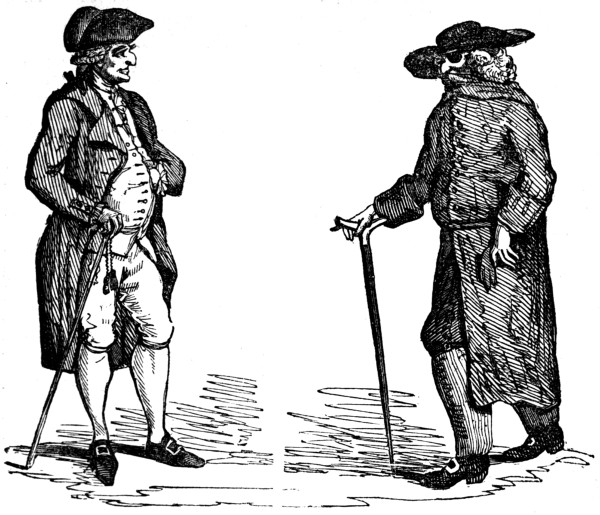
Charles Price, the Arch-Imposter, In his usual Dress—and in Disguise.
To this proposal Mr. R. consented. In the evening Price returned to Knightsbridge. He told Mr. R. that he had visited Mr. Bond, who expressed great happiness and easiness of mind on such a recommendation, and desired to see Mr. R. the next day. Price appointed to meet him at twelve o’clock at Mr. Bond’s. At the appointed hour, Mr. R. knocked at the door. He was shown up stairs by the aforementioned sister-lady, and introduced to Mr. Bond, seated in a great chair, his legs in another, and covered with a night-cap. The poor, infirm, weak, debilitated, old gentleman regretted the absence of his ever-dear friend Mr. Price, the most worthy man in the world, and rang a peal on his friendship, honour, honesty, integrity, &c., &c., accompanied with emaciated coughs—was obliged to go to the city coffee-house—a punctual man—never failed an appointment—it was the soul of business—and then he told Mr. R. that his dear friend desired to meet Mr. R. there exactly at one o’clock—he approved highly of Mr. Price’s recommendation, and was now happy in his mind—it wanted but a quarter to one, he believed, and he hoped Mr. R. would not fail, as his dear friend was very exact indeed. The usual compliments passed; the sister conducted Mr. R. to the door, who posted away to the city coffee-house, and left old Mr. Bond, the rich brother, who was in reality no other than Mr. Price, and the brother’s maiden sister, who was a Mrs. Pounteney, to laugh at Mr. R.’s credulity. Mr. R. had not been five minutes in the coffee-house before he was joined by his friend Price, to whom Mr. R. recapitulated what passed, and as soon as Price had despatched some pretended business, he proposed calling on Mr. Bond. This was readily acquiesced in by Mr. R. and away they drove to Leather-lane. When they came there, they were informed by the lady, that her brother was just gone out in a coach, on an airing, to Highgate. In short, Price carried on the scheme completely for several days, during which time Mr. R. had twice or thrice seen the old gentleman. The will was made, and, on the strength of the joint executorship and expectancy, Mr. R. was swindled out of very near a thousand pounds in cash, and bonds to the amount of two hundred pounds.
Another anecdote, though it does not exhibit him in his Proteus-like character, exemplifies his cunning and selfishness. He had formed a connection with Mr. W——, a brewer, a man of character. Price, who was then in the brewery, proposed a project, which was assented to, for purchasing hops to the amount of two thousand pounds, and he actually went into the country, contracted for hops to that amount with hop-growers in Kent, and then applied to Mr. W. for the two thousand pounds, alledging that there would be a sudden rise of hops, and they could not be delivered too soon; and that Mr. W. should have his share of the profit. From some undisclosed motive, Mr. W. refused to advance the money. An unexpected rise, however, did soon after take place, Price went into Kent to demand delivery, the growers were shy in delivering, especially as they found they had made a bad bargain, and he gained two hundred pounds for releasing them.
Price was servile to extreme meanness, where his servility could be recompensed by a shilling. He was master of consummate effrontery, when principle called upon him for that shilling, if it was unsupported by law. He never paid but with an eye to further plunder; and then he abounded in that species of flattery distinguished under the word palaver. He possessed an extensive knowledge of men and manners, and to superficial observers appeared a very sensible person. He knew something of most of the living languages; had travelled all over France and Holland, and been at most of the German courts. He was at Copenhagen during the crisis in the fate of the unhappy Matilda queen of Denmark, sister to George III.; and he wrote a pamphlet in her behalf, tending to prove that the true motive for the degrading attack on her character, was to effect a revolution in favour of the queen dowager’s son. It proved him to have an eye directed to the cabals of the court, and an understanding capable of developing its intrigues.
Price’s character about the ’Change in London was well-known—he was a keen, intriguing speculator, well versed in the mystery of the bulls and bears: his head enabled him to make the most accurate calculations, but his heart would not permit him to enjoy the fruit of even his honest labours; for he never would comply with the demands of a fortunate customer, unless terrified into it,—and to terrify him required no small portion of ingenuity and resolution. His dishonesty was the spring of all his misfortunes; it made him shift from place to place to avoid the abuse of the vulgar, and the clamorous calls of the few fortunate adventurers in the lottery. His last office was the corner of King-street, Covent-garden, from whence he was driven, by a run of ill-luck, into a private decampment.
From that period, Price lived in obscurity. Though a perfect sycophant abroad, at home he was an absolute tyrant; nor could a prudent, virtuous woman, endowed with every qualification to render the marriage state happy, soften his brutal disposition, when the ample fortune he obtained with her had been squandered. Having a family of eight children to support, he turned his thoughts to fatal devices, and commenced to forge on the bank of England. His first attack on the bank was about the year 1780, when one of his notes had been taken there, so complete in the engraving, the signature, the water-marks, and all its parts, that it passed through various hands unsuspected, and was not discovered till it came to a certain department, through which no forgery whatever can pass undiscovered. The appearance of this note occasioned a considerable alarm among the directors; and forgery upon forgery flowed in, about the lottery and Christmas times, without the least probability of discovering the first negociators. Various consultations were held, innumerable plans were laid for detection, and they were traced in every quarter to have proceeded from one man, always disguised, and always inaccessible.
Had Price permitted a partner in his proceedings—had he employed an engraver—had he procured paper to be made for him, with water-marks upon it, he must soon have been discovered—but he “was himself alone.” He engraved his own plates, made his own paper with the water-marks, and, as much as possible, he was his own negociator. He thereby confined a secret to himself, which he deemed not safe in the breast of another; even Mrs. Price had not the least knowledge or suspicion of his proceedings. Having practised engraving till he had made himself sufficient master of it, he then made his own ink to prove his own works. He next purchased implements, and manufactured the water-mark, and began to counterfeit hand-writings. Private attempts to discover him proved thoroughly abortive, and the bank came to the resolution of describing the offender by the following public advertisement, which was continued in all the newspapers for a considerable time to no purpose. It is a very curious document, from the minuteness with which his disguise is particularized.
Public-office, Bow-street, Dec. 5, 1780. A Forgery.
Whereas a person, answering the following description, stands charged with forging two notes, purporting to be bank-notes, one for forty pounds and the other for twenty pounds, whoever will apprehend him, or give such immediate notice at this office as may be the means of apprehending him, shall receive one hundred pounds’ reward on his commitment.
Or, if any person concerned in the above forgery, (except the person here-under described,) will surrender and discover his or her accomplices, he or she will be admitted an evidence for the crown, and, on conviction of any one offender therein, receive two hundred pounds’ reward.
And if any engraver, paper-maker, mould-maker or printer, can give information of the engraving any plate, making any mould or paper, or printing any note resembling bank-notes, shall receive two hundred pounds’ reward, on conviction of any of the offenders in the above forgery.
He appears about fifty years of age, about five feet six inches high, stout made, very sallow complexion, dark eyes and eye-brows, speaks in general very deliberately, with a foreign accent; has worn a black patch over his left eye, tied with a string round his head, sometimes wears a white wig, his hat flapped before, and nearly so at the sides, a brown camblet great coat, buttons of the same, with a large cape, which he always wears so as to cover the lower part of his face; appears to have very thick legs, which hang over his shoes, as if swelled, his shoes are very broad at the toes, and little narrow old-fashioned silver buckles, black stocking breeches, walks with a short crutch stick with an ivory head, stoops, or affects to stoop very much, and walks slow as if infirm; he has lately hired many hackney-coaches in different parts of the town, and been frequently set down in or near Portland-place, in which neighbourhood it is supposed he lodges.
He is connected with a woman who answers the following description:—She is rather tall, and genteel, thin face and person, about thirty years of age, light hair, rather a yellow cast on her face, and pitted with the small pox, a down-cast look, speaks very slow, sometimes wears a coloured linen jacket and petticoat, and sometimes a white one, a small black bonnet, and a black cloak, and assumes the character of a lady’s maid.
N. B. It is said, that about fifteen months since he lodged at Mrs. Parker’s, No. 40, in Great Titchfield-street, (who is since dead,) at which time he went by the name of Wigmore.
This advertisement drove Price to extremities:—it forced him to refrain from the circulation of his forgeries, and for some months put a total stop to them. It was posted on the walls, and printed as hand-bills, and delivered from house to house throughout the whole of the quarter where he was most suspected to reside; at the very house which he daily resorted to, and where all his implements were fixed; in the neighbourhood of Marybone, Portland-place, Oxford-street, and Tottenham-court-road. One of them was thrown down an area to the only person in whom he placed any confidence, a female whom the reader will be better acquainted with. By these means Price was informed of his immediate danger, and took his measures accordingly. Eagerness to secure banished the foresight and caution which are necessary in the pursuit of artful villany. The animal whose sagacity is a proverb, can never be secured in haste; he must be entrapped by superior patience and caution.
Though Price had no partner in any branch of the forgery of a bank-note, yet he had a confidante in his wife’s aunt, by the mother’s side, whom he had known previous to his marriage. Her name was Pounteney; and, unknown to Mrs. Price, he was daily with her. He divided his dinner-times equally between the two, and Mrs. Price had for ten years’ past, through the impositions of her husband, considered her aunt either as dead, or residing abroad. His wife had too little art, or understanding in the ways of the world, to be what is commonly called cunning. In short, her character was that of perfect simplicity. Price therefore thought her not fit to be trusted. Her aunt, on the contrary, was wily, crafty and capable of executing any plan Price would chalk out for her. She was a woman after his own heart; and having made choice of this woman as an assistant, and his apparatus being ready, he began his operations. He lived then at Paddington with his wife, whom he went to nightly; and at lodgings, near Portland-place, he daily visited her aunt, where the implements for his undertakings were concealed. His next and chief object was a negociator, and he procured one in the following manner.
Previous to the drawing of the lottery for the year 1780, Price put an advertisement into the “Daily Advertiser” for a servant who had been used to live with a single gentleman, and the direction was to “C. C. Marlborough-street coffee-house, Broad-street, Carnaby-market.” An honest young man, who at that time lived with a musical instrument-maker in the Strand, read this advertisement, and sent a letter to the specified address. At the end of a week, one evening, about dusk, a coachman inquired for the person who had answered the advertisement, saying there was a gentleman over the way, in a coach, wanted to speak with him. The young man went to the coach, was desired to step in, and there saw an apparently aged foreigner, gouty, wrapped up with five or six yards of flannel about his legs, a camblet surtout buttoned up over his chin, close to his mouth, a large patch over his left eye, and every part of his face concealed except his nose, right eye, and a small part of that cheek. This person was Price, who caused the young man to sit at his left side, on which eye the patch was; so that Price could take an askance look at him with his right eye, and discover only a small portion of his own face. Thus disguised, he seemed between sixty and seventy years of age, and afterwards, when the man saw him standing, he appeared nearly six feet high, owing to boots or shoes with heels little less than four inches high. To aid the deception, he was so buttoned up and straightened as to appear perfectly lank. Price’s real height was about five feet six inches; he was a compact, neat made man, rather square shouldered, and somewhat inclined to corpulency; his legs were firm and well set. His features assisted his design to look considerably older than he really was; his nose was aquiline, his eyes were small and grey, his mouth stood very much inwards, his lips were very thin, his chin was pointed and prominent, he had a pale complexion, and loss of teeth favoured his disguise of speech. His natural form was exceedingly upright; he was active and quick in his walk, and was what is usually described “a dapper made man.” To the young man, whose christian name was Samuel, Price affected great age, with a faint hectic cough, and so much bodily infirmity as almost to disable him from getting out of the coach. Price told him he was not wanted by himself, but as under servant to a young nobleman of fortune, under age, and then in Bedfordshire, to whom he was, and had been some years, guardian. He inquired into the particulars of Samuel’s life, and thinking him honest and ingenuous, and therefore unsuspicious, and suitable to his purpose, he talked to him about wages. Samuel inquired whether he was to be in livery or not: Price replied, that he could not really tell, for the young nobleman was a very whimsical character, but that was a circumstance which might be settled hereafter. To carry on the farce, he desired Samuel to call his master to the coach to give him a character, and his master came and gave him such an one as Price pretended to approve; he then hired Samuel at eighteen shillings per week, and gave him a direction to himself, as Mr. Brank, at No. 39, Titchfield-street, Oxford-street.
Pursuant to appointment, on the second or third evening afterwards, Samuel went to Titchfield-street, and there entered on the service of the minor nobleman, by waiting on Mr. Brank. Price resumed his discourse respecting his ward, the eccentricity and prodigality of his manners, and his own hard task in endeavouring to prevent him from squandering his money, especially in those deceitful allurances called lottery tickets. He said, although he was his guardian, he was still obliged to comply with some of those whims, in opposition to his own advice and remonstrance. Old Mr. Brank talked of the happy prospects for Samuel by serving such a master, and Samuel talked of his wages and clothes, and whether he was to be in livery or not. It was concluded, that for the present he should procure a drab coat, turned up with red, till the nobleman’s pleasure was known, or he came to town: he was ordered to get the clothes at his own charge, and make out his bill; which he did, but was never repaid. This circumstance corresponded with Price’s usual conduct: he never was known to part with a shilling from one hand, till he had more than double its value in the other. It should be observed, that Samuel was so placed on the left side of the pretended Mr. Brank, on which side the patch was, that during the whole of the conversation he could never see the right side of Price’s face.
Before Samuel took leave of the old gentleman, he was ordered to come again in the evening of the first day of the drawing of the lottery. Price pretended, that he seldom went to the nobleman’s town house of an evening, and therefore, to avoid giving him unnecessary trouble, he was to attend in Titchfield-street. On that evening he pulled out a variety of papers, letters, &c., and told Samuel he had received orders from the thoughtless young nobleman to purchase lottery tickets, as a venture against his coming to town, and for that purpose he meant to employ Samuel. He produced some seeming bank-notes, and gave Samuel two, one of twenty pounds, the other of forty pounds. He directed him to take their numbers and dates on a piece of paper, for fear of losing them, and to go to a lottery office in the Hay-market, and with the one of twenty pounds to purchase “an eight guinea chance:” from thence he was to go to the corner of Bridge-street, Westminster, to buy another out of the forty pound note, and wait at the door of the Parliament-street coffee-house till he came to him. With these notes Samuel bought each of the chances, and was on his way to the Parliament-street coffee-house when, from the opposite side of the way, he was hailed by Mr. Brank, who complimented him on his speed, and said he had been so quick, that he, Brank, had not had time to get to the coffee-house. He was then interrogated, if he had made the purchases, and, replying in the affirmative, was again commended for his diligence: Brank also inquired, if any mistake had happened; and all this with a deal of coughing, imbecility of speech, and feigned accent.
When Samuel received the notes, he received as many canvass bags as he was ordered to buy shares, and to put each distinct share, and the balance of each note, into a separate bag, for fear, as Brank said, the chance of one office might be confused with the chance of another, and Samuel be thereby puzzled to know where he had bought the different chances; and by such confusion, or forgetfulness, it might not be recollected where to apply in case of a fortunate number.
Mr. Brank having secured the chances and balances, ordered Samuel to go to Goodluck’s at Charing-cross, from thence to King-street, Covent-garden, and York-street, Covent-garden, and purchase some other small shares and chances, and then meet him at the city coffee-house, Cheapside. To these places the young man went, and having bought his numbers and changed his notes, as he was going along York-street, his master called to him from a coach, pretended he was fortunate in thus seeing him, made Samuel step in, got the produce of the forgery, and away they drove to the city.
In their way thither, Brank applauded his servant’s despatch; gave him more notes, to the amount of four hundred pounds, with instructions to purchase shares and chances, at offices about the Exchange; and directed him, as before, to put the chances and money received at each office in a separate bag. For this purpose Samuel was set down from the coach in Cheapside, and having executed his commissions returned, agreeable to his orders, to the city coffee-house, where he waited a few minutes and then Mr. Brank came hobbling up to him, and took him into a coach, that was waiting hard by. Brank resumed complaints of his health and infirmities, and observed, that the fatigues of business had kept him longer than he expected; but he warned Samuel to be always exceedingly punctual. His reason for urging punctuality was the dread of a discovery, and to prevent consultations, by which he might be detected. On their way to Long-acre, where the coachman was ordered to drive, Brank amused his servant with flattering promises for his attention and fidelity; and at parting put a guinea into his hand, and gave him orders to be in waiting, for a few days, at his old master’s in the Strand.
It afterwards appeared, that whenever Samuel went to an office a woman, unobserved by him, always walked in at the same time, and looked about her as if accompanying some one else in the shop; and as soon as Samuel had done his business she also walked away. This woman was Mrs. Pounteney, the aunt of Price’s wife, described in the advertisement and hand-bill issued by the bank. She constantly accompanied Price in a coach whenever he went out, watched Samuel at every office, as soon as he had safely got out stepped across the way to Price, who was in the coach, informed him of the success, and then Samuel was hailed, and Price secured the property while she kept out of sight; nor did Samuel ever see her during his servitude. During his residence at Titchfield-street, which was but a week, Price always appeared and went out as Brank, accompanied by Mrs. Pounteney. In case of any accidental discovery, she was ready to receive the disguise, so that Brank might be instantly shifted to Price, and Price to Brank, and Samuel thereby be rendered incapable of identifying the man that had employed him.
On the Sunday morning after Price’s last adventure, a coachman inquired for Samuel at his old master’s, by whom the coachman was informed, that though Sam worked he did not lodge there, and that he should not see him till the next morning. The coachman held a parcel in his hand, which he said was for Samuel, and which the master desired him to leave, and he should have it the next day; the coachman replied, he was ordered not to leave it, but to take it back in case he could not see the man, and accordingly went across the way with it; there the master saw the elderly gentleman, with whom he had conversed on Samuel’s character a few days before, to whom the coachman delivered the parcel. Samuel’s master saw this old gentleman get into a coach; but in a minute the coachman returned and left the parcel, which contained notes to the amount of three hundred pounds, with a letter directing Samuel to buy, on the next morning, a sixteenth, an eight guinea chance, and a whole ticket, to repeat his purchases as before, till the whole were changed, and to meet his master, Mr. Brank, at Mill’s coffee-house, Gerrard-street, Soho, at twelve o’clock the next day. Samuel duly executed these orders, but, on inquiry at the coffee-house, he found no such person as Mr. Brank had been there; in a few minutes, however, as he was standing at the coffee-house door, a coachman summoned him to Mr. Brank, who was waiting in a coach at the corner of Macclesfield-street. He desired Samuel to come in, and made him sit on the left hand, as before described, and having received the tickets, shares, and balances, ordered him to bid the coachman drive towards Hampstead. On the way, he gave Samuel three sixteenths as a reward for his diligence, and talked much of his ward, who, he said, would be in town in a day or two, when he would speak highly of Samuel’s industry. He discoursed on these subjects till they reached Mother Black-cap’s at Kentish-town, and then Samuel received orders to bid the coachman turn round; and, on their way back, Samuel had notes for five hundred pounds given to him, with directions to lay them out in the same manner about the ’Change, and meet his master at the same place in the evening, where he said he should dine; but, for reasons easily imagined, Samuel was ordered not to make his purchases at the offices he had been to before.
Samuel, having performed this task also, went to the coffee-house, where a porter accosted him, and conducted him to his master in a coach as usual. He was now blamed for his delay, and an appearance of anger assumed, with a declaration, that he would not do if not punctual, for that the nobleman was very particular in time, even to a minute. Samuel apologized, and Brank received the cash and shares, and ordered him to go to the New Inn Westminster-bridge and hire a post-chaise to carry them to Greenwich to meet the nobleman’s steward, who was also his banker, to whom he was going for money to purchase more tickets; observing, at the same time, on the imprudence and prodigality of his ward.
At Greenwich, Samuel was desired to go to the Ship and order a dinner, while Brank was engaged, as he pretended, in negociating his business; he instructed him not to wait longer than three o’clock, but go to dinner at that time, if he, Brank, did not return. It was not till half past four that Brank came hobbling, coughing, and seemingly quite out of breath with fatigue. They then drank tea together, and afterwards returned in the chaise to Lombard-street, where it was discharged. There Sam received more notes to the amount of 350l., which he got rid of in the usual way; and at the city coffee-house was again fortunate enough to meet his master before he got to the door. Brank ordered him to attend the next evening at his lodgings, which he accordingly did, and afterwards at three or four other times, in the course of which attendance he negociated 500l. more of the forged notes.
We now arrive at the close of Samuel’s services. In negociating the last sum he had received, he went to Brooksbank’s and Ruddle’s, where he was interrogated as to whom he lived with; Samuel said he was servant to a very rich nobleman’s guardian, that he was at board-wages, and gave his address to his old master, the musical instrument-maker. Having delivered Brank the cash, &c. in the usual way, he was told, that perhaps he might not be wanted again for a week, and that he might wait till sent for. Before the expiration of that time, however, Samuel was apprehended, and taken to Bow-street, where he was examined by the magistrates and gentlemen from the bank; and telling his artless tale, which was not believed, he was committed to Tothillfields-bridewell, on suspicion of forgery.
The surprise of the poor lad on his apprehension, his horror on being confined in a prison, and his dread of being executed as a forger of counterfeit bank-notes, were only equalled by the astonishment of the directors of the bank and the magistrates, at the sagacity of the manufacturer, who had hitherto evaded every possibility of detection. Nor did they appear at all persuaded of Sam’s innocence, though his story was, in part, confirmed by his former master, the musical instrument-maker. The forged note he had passed at Brooksbank’s and Ruddle’s, where he had been interrogated, was the means of his apprehension. In a day or two it was paid into the bank, traced back to Brooksbank’s and Ruddle’s office, and, immediate application being made to Bow-street, the lad was taken into custody.
Samuel’s examinations were frequent and long, and in the end the following scheme was laid to secure the fabricator. Samuel having been ordered by Brank to stay till he was sent for, an inferior officer of Bow-street was stationed at the musical instrument-maker’s in the Strand, where Samuel worked, in case Brank should call in the mean time. After the lapse of a few days, Price sent Samuel a message to meet him the next day at Mill’s coffee-house, exactly at eleven o’clock. This was communicated to Mr. Bond, a clerk at Bow-street office, who ordered Samuel to comply, but not to go till five minutes past the time. The above inferior officer attended at a distance, disguised as a porter, with a knot on his shoulder, and Bond, dressed as a “lady,” followed at a small distance. When Samuel arrived at the coffee-house he found that a real porter had that instant been there and inquired for him, and could have been hardly got out of the door. This information Samuel directly communicated to the “lady,” (Bond of Bow-street,) and Samuel was sent back to wait; but Brank, in a hackney-coach hard by, had discovered the momentary conversation between Samuel and the disguised officers, and took immediate flight. An instant rush was made at Titchfield-street, but in vain; Blank had not been there since Samuel and he had left it together, and the police were entirely at fault. The advertisements were again issued, and hand-bills were showered around to no purpose. Poor Samuel, however, having tolerably established his innocence, was, after suffering eleven months’ imprisonment, discharged with a present of twenty pounds.
In the ensuing lottery, Price played the same artful game with notes of higher value; those of 20l. and 40l. were grown too suspicious, another lad had been taken into custody, another rush made, and Price was missed again by a moment.
Price’s next scheme was an advertisement for a person in the linen drapery business; and with notes of from 50l. to 100l. two young men, his agents, purchased linen drapery at different shops. They were detected by having passed an 100l. note to Mr. Wollerton, a linen-draper in Oxford-street, who recovered the whole of his property through Bond the officer, by whom it was seized at No. 3, on the Terrace, in Tottenham-court-road.
To follow Price through all his proceedings would be impossible: in November 1782, Mr. Spilsbury of Soho-square, the proprietor of some medicinal “drops,” received a card bearing the name of Wilmott, which had been left by a person who had called at his house in his absence. The next evening the following note was delivered at Mr. Spilsbury’s.
“Mr. Wilmott’s complits to Mr. Spilsbur. wishes to converse with him 10 minutes. having an Order for His drops, at half past five o’clock this evening.
“No. 17, Gresse-street, Rathbone-place.”
At the time mentioned in the note Mr. Spilsbury went to Gresse-street, where he was shown into a parlour by a foot-boy, and waited until Mr. Wilmott made his appearance. He appeared to be a very infirm old man, in a great coat and a slouched hat, with a piece of red flannel round the lower part of his face, a large bush-wig on, and his legs wrapped over with flannel; he wore green spectacles, and a green silk shade hanging from his hat, but no patch on his eye: this was Price. He and Mr. Spilsbury had frequently met at Percy-street coffee-house, Rathbone-place, and often conversed together; but on this occasion Mr. Spilsbury had no idea or recollection of his old acquaintance. As soon as Price entered the parlour, he observed on his own dress; and said he had exceedingly suffered from the drawing of a tooth by an unskilful dentist, and wore the flannel on his face in order to avoid catching cold. He then familiarly conversed with Mr. Spilsbury, extolled the merits of his “drops,” recounted great cures which he knew they had performed, styled himself a dealer in diamonds, and dismissed Mr. Spilsbury with the promise of an order in a few days. It was evidently postponed to strengthen Mr. Spilsbury’s opinion of him, but at last it arrived in the following note:—
“Mr. Wilmott’s compliments to Mr. Spilsbur, desires he will put up twelve bottles of drops at 3s. 6d. against Friday three o’clock. the boy will call and pay for them. also, Mr. Spilsbur will send a copy or form of an Advertisement—and attestation, leaving a blank for the names. the case was—the man was violently broke out in legs, body and face, and he actually had no other physic than two of the bottles. and it is really astonishing how much He is recovered.—when Mr. Wilmott comes to town to-morrow week He will send the voucher authenticated by 6 people of consequence.
“Gresse-street, No. 17.”
The boy did not call on the Friday mentioned; but on the Friday week he brought a letter, in which Mr. Wilmott desired Mr. Spilsbury to send two guineas’ worth of the drops, and change for a 10l. bank-note, and to be particular in sending guineas of good weight. The bank-note appeared to be a new one, change was got in the neighbourhood, and the drops sent; and the next note Mr. Spilsbury received was from Sir Sampson Wright, desiring his attendance at Bow-street, where, to his astonishment, he was informed of the forgery. He related the preceding particulars to the magistrate, and produced the two letters. The officers paid an immediate visit to Gresse-street, but old Mr. Wilmott had previously departed.
Not long after this, Mr. Spilsbury met his acquaintance, Mr. Price, at the Percy-street coffee-house; and there, drinking his chocolate, and talking over the occurrences of the day, Mr. Spilsbury told the foregoing story to his coffee-house acquaintance, while Price every now and then called out “Lack a day! Good God! who could conceive such knavery could exist! What, and did the bank refuse payment, sir?” “O yes,” said Mr. Spilsbury, with some degree of acrimony; “though it is on the faith of the bank of England that I and a great many others have taken them, and they are so inimitably executed, that the nicest judges cannot detect them.” “Good God!” said Price, “he must have been an ingenious villain!—What a complete old scoundrel!”
It is related, that when the celebrated artist William Wynn Ryland was to be executed for forging an East-india bond, Price intreated the use of a dining-room window in Oxford-street, at the house of a gentleman whom he had defrauded in the same manner he had done Mr. Spilsbury; and Price was present when Ryland passed to Tyburn, and on that occasion pointed to Ryland, saying “There goes one of the most ingenious men in the world, but as wicked as he is ingenious—he is the identical man who has done all the mischief in the character of Patch: he deserves his fate, and he would confess the fact, if he was not in hopes of a respite; which he would have obtained, perhaps, had not the directors been certain that it was charity to the public to let him suffer.”
Mention has already been made of the fraud practised by Price on Mr. R. of Knightsbridge. One in a family was not enough for him, and Mr. R’s brother, who lived in Oxford-street, experienced the effect of Price’s ingenuity in crime. Price had been often there, and bought a variety of things, and was perfectly well known in his real person, and by his proper name. One day, however, a hackney-coach carried him thither disguised as an old man, and in that character he made some purchases. In a day or two he repeated his visit, and on a third day, when he knew Mr. R. was from home, he went again with his face so coloured that he seemed in a deep jaundice. The shopman, to whom he was full of complaints, told him that he had a receipt for that disorder, which had cured his father of it, and offered him the prescription. Price accepted it, and promised that if it succeeded he would liberally reward him. In a few days, he again appeared before the shopman perfectly freed from the complaint, and acknowledging his great obligations to him, said he had but a short time to live in the world, and having very few relations to leave any thing to, he begged his acceptance of a 50l. bank-note, at the same time, he said, he wanted cash for another. Mr. R. not being in the way, the grateful shopman stepped out, and got change for it. The next day Price having watched Mr. R’s going out, prevailed on the lad to take five other 50l. notes to his master’s banker, and there get them changed for smaller ones. Price’s notes soon got to the bank, and of course were stopped. They were traced to Mr. R’s. His lad was interrogated, and as Mr. R. positively refused to pay the 250l. to his bankers, they brought an action against him, which was tried in the court of common pleas, before Lord Loughborough, and the bankers obtained a verdict. The most extraordinary circumstances pending the suit were, that Mr. R. communicated the story to Price, who offered him all the assistance in his power, and became a principal agent in the defence. He was, of all others, the most active in procuring witnesses for Mr. R., and actually attended the trial, without the least suspicion, on the part of any individual concerned, that he was the perpetrator of the mischief.
It is an extraordinary and almost incredible fact, that during a period of six years, five of which had elapsed after the remarkable advertisement issued at the instance of the bank in December 1780, Price committed depredations of this nature on the public with impunity. The deceptions by which he circulated his forged notes through so long a period, were as varied as the nature of each new circumstance required. At last he turned another species of forgery, equally artful, and, for a time, equally successful. He went to the coffee-houses near the Royal Exchange in a new disguise, and there was accustomed to get a boy to take a sum of 10l. to the bank, with directions to receive from the teller the customary ticket to the cashier who pays; but the lad had his especial orders not to go to the cashier for the money, as the teller is accustomed to direct, but as soon as the boy was out of the teller’s sight he was to turn another way, and bring the ticket to Price at the coffee-house. There Price used to alter the teller’s tickets from 10l. to 100l. by adding an 0, or by placing a 1 before any other sum where the addition was easy, so as to make 50 into 150, &c., and then send the tickets by other hands to the cashiers, who paid the increased sums unsuspectedly.
This scheme was his last. One of the notes he had received at the bank, on a forged ticket, he had passed at Mr. Aldous’s, a pawn-broker in Berwick-street, where he was known by the name of Powel, and went two or three times a week to pledge things of value. An officer was placed at Mr. Aldous’s till his next call, which was the next day but one, when he was secured and carried to Bow-street. His behaviour there was exceedingly insolent. Mr. Bond, who, when Price kept a lottery-office in King-street, Covent-garden, was clerk at Bow-street, had visited him on account of some money due to Sir John Fielding’s maid servant, gained by insuring with Price, which he had refused to pay her; but when informed by Mr. Bond who her master was, he waited on Sir John, and satisfied her claim. He now taxed Mr. Bond, who had been made a magistrate, with prejudice against him on account of the insurance affair, and complained that he should not have justice done him. He also urged against Mr. Abraham Newland, esq., principal cashier of the bank, that he could expect nothing from him but every possible injury, on account of some former antipathy that gentleman had conceived towards him; and he imputed desire of revenge to every individual whose duty it was to render him amenable to justice.
When under examination, the chief magistrate, Sir Sampson Wright, suddenly called out “Sam;” the young man immediately answered, and at the same moment appeared before his old master, who started as at a ghost; but, recollecting himself, made a polite bow to his former servant, with a view either to awaken his sympathy, or to hint at what he might expect if he disclaimed him. Samuel, however, could only swear to his voice, for he had not the least idea of his person or features. Price was committed to Tothillfields-bridewell, where he turned his thoughts to the destruction of the implements. Well knowing that nothing could be extracted from Mrs. Price, or any of his family, to affect him, he had declared, when under examination, that he lived with them at a cheesemonger’s in the neighbourhood of Tottenham-court-road; and he was equally secure that nothing could be found there to afford the least suspicion of his being the forger described under the character of Patch. His next step was to obtain an interview with Mrs. Price and his eldest son, a youth about fifteen years of age. To his wife’s great surprise, he communicated to her the secret of his lodgings, and the circumstances respecting her aunt. He wrote a letter to Mrs. Pounteney, informing her of his situation, and desiring her instantly to destroy every atom of the apparatus, clothes, &c.; he tore up the inner sole of his son’s shoe, and putting the letter under, it passed safe.
When Mrs. Pounteney received the letter, she burnt every article of clothes in which Price had disguised himself, and sent for a carpenter, to whom he had never been visible, to take down the wood frame, presses, and other instruments with which Price had made his paper, and printed off his notes. While the maid was gone for the carpenter, her mistress put the copper-plates into the fire, and, rendering them pliable, reduced them to small pieces. These, with a large bundle of small wires, used in the manufacture of the paper and water-marks, she desired Price’s son to take to the adjacent fields, and there distribute them beneath the dust heaps; and the pieces lay there till, by a stratagem, they were discovered and brought to Bow-street. The carpenter took down the apparatus, and being paid and despatched, every thing was brought down and reduced to ashes.
Throughout Price’s examinations, his assurance was the most remarkable feature in his conduct; but the audacity by which he sought to baffle his accusers was so reckless, as to disclose a circumstance which largely added to the grounds for believing him to be the criminal who had so long eluded justice. From the extreme art he had adopted to effectually disguise his person, while committing his enormous frauds, there was no connected proof of his identity. Long before his apprehension, he had hazarded experiments to discover whether his disguises were effectual. He would go to the coffee-houses about the ’Change, where he was thoroughly well known as Mr. Price, and in his real character inquire for Mr. Norton, write a letter, and leave it at the bar. In ten minutes he would return as Mr. Norton, receive the letter, and drink his coffee. While in Tothillfields-bridewell, a boy who had more than once taken cash for him to the tellers at the bank, together with the boy’s mother, who had also seen him, were conveyed to the prison to view him. The boy could not at all identify him: the mother was more positive, but still the proof was deemed scarcely sufficient to convict him. He had pledged things of value several times, under the name of Powel, with Mr. Aldous. Mrs. Pounteney had done the same in the character of Mrs. Powel. They had talked of each other, and each of them had at different times pledged the same article; yet Price on his examination denied the least knowledge of her; impudently threatened to bring actions for false imprisonment; and ridiculing the officers for not finding a ten pound note in his fob, under his watch, when he was searched, he heedlessly produced it—this identical note was one of the notes delivered by the cashier upon a teller’s ticket which Price had forged!
Price had been brought up three times for the purpose of being viewed, and his sagacity perceived the impossibility of his escaping the hand of justice. He told the keeper he had been “betrayed,” but this was not the fact. Meditating to avoid a public execution, he informed his son that the people of the prison came into his room sooner than he wished; and that he had something secret to write, which they might get at by suddenly coming upon him, which he wished to prevent. On this pretence he gave his son money to purchase two gimblets and a sixpenny cord, pointing out to him how he would fasten the gimblets in the post, and tie the cord across the door, which opened inwards. The poor youth obtained the implements, and Price having fastened the gimblets under two hat screws, was discovered hanging in his room, without coat or shoes, on the 25th of January, 1786.
Under his waistcoat were found three papers. One was a petition to the king, praying protection for his wife and eight children; all of whom, he said, had never offended; and stating, that he had written a pamphlet with a view to prevent a war between the crowns of England and Denmark, and to rescue the character of queen Matilda from the aspersions of the queen dowager’s party. The second was a letter of thanks to Mr. Fenwick, the keeper of the prison, for his indulgence and favours. The third was a letter to his wife, wherein he begged her forgiveness for the injuries he had done her, and intreated her attention to their offspring. In these papers, written with his dying hand, the guilty man solemnly denied every thing laid to his charge!
Immediately upon Price’s self-destruction, his unhappy wife, who had been innocent of his iniquities, was urged to discover the woman with whom he had been connected. She was assured, that though the verdict of a coroner’s inquest must be formally complied with, yet, if she rendered this act of justice to the country, his remains might afterwards receive christian burial. Her son was present and added his intreaties that she would tell, or suffer him to tell, who and where the woman was; the feelings of the widow and the mother prevailed, and she communicated the residence of her depraved aunt, who, on being taken into custody, disclosed several of the circumstances attending the destruction and concealment of the presses and implements. What remained of them were destroyed by the police, and she was delivered out of custody to the punishment of her own thoughts. It was afterwards ascertained, on a second search, that she had not discovered all the machinery. The frame with which Price had made his paper was produced to her, and she was asked what it was: “It is an instrument,” she said, “I use for mangling.” An answer which may be taken as evidence, that notwithstanding the example of Price might have taught her the folly of wickedness, and though she herself had escaped by the sufferance of extreme mercy, her mind was still disposed to evil.
Price was buried in the cross-roads, but, in about a week, his body was privately removed by night.
These particulars of Price are more numerous, and the account of him is more diffuse, than might be expected in connection with the lottery; but as he was too remarkable to have been omitted among its incidents, so his criminal career was too flagitious and notorious to be lightly passed over when he was mentioned at all.
Price’s lottery-office, in King-street, Covent-garden, was the house now (in 1826) occupied by Mr. Setchell, the bookseller. On part of the wall where Mr. Setchell’s shutters are placed, there are remains of Price’s lottery-bills still visible.
Lottery Suicide and Heartbreaking.
The “Gentleman’s Magazine” of 1787 inserts what is called “a copy of a paper left by the unhappy young gentleman who lately shot himself with two pistols in Queen-street, Westminster,” wherein he execrates “the head that planned, and the heart that executed, the baneful, destructive plan of a Lottery.”
The same year, in a debate in the house of commons on a bill then passing to prevent insurance, Mr. Francis said his own family furnished a striking instance of the dreadful effects of a passion for this ruinous practice. He had given, at different times, to a female servant sums of money to the amount of two hundred pounds, to discharge tradesmen’s bills; and, to his great surprise, he found afterwards that, regardless of his character, or her own, she had risked the entire sum in insuring in the lottery, and had lost it. He would have been glad had the loss of money been the only one, for he would have taken it upon himself; but the poor woman lost her life within a week after this discovery had been made, dying broken-hearted and distracted.
Sharing a Prize.
In the Lottery of 1788 a guinea share of a ticket drawn a 20,000l. prize had been duly registered by Shergold and Co. who sold it, and acquainted the holder by letter that it entitled him to 1500l. This lucky man, who lived in the country, attended his club the same evening, and imparted the good news he had received. His joy, however, was considerably damped by a person present, who assured him that he never would be paid—that his prize was not worth a groat, and that he himself knew one who at the beginning of the lottery had a half guinea share a prize of 20,000l. and was entitled to 700l., but was glad to compromise it for 50l. After reciting a variety of circumstances to the same effect, and cunningly working up alarm to the highest pitch, he at length told the owner of the prize, that he knew some of the proprietors in Shergold’s house, and he believed he might be able to get some money where another could get none; he would therefore venture to give 100l. for the prize. This proposal being rejected, he advanced to 200l. from thence to 300l. and at last to 600l., which was accepted. He accordingly paid the money to the unfortunate fortunate adventurer, got possession of the prize, and immediately set off for London, and received the 1500l. without difficulty. Several eminent lawyers, on considering the misrepresentations used in this transaction, were of opinion, that it was what is termed a catching bargain, and advised the owner, who was cozened out of 900l., to apply to equity for relief.[480] He seems to have been afraid of the remedy; for, though he took counsel’s opinion, it does not appear that he followed it into chancery.
At the Haymarket theatre, in 1791, a comedy, called the “School for Arrogance,” was produced with a prologue spoken in the character of a news-hawker, with the Lottery as one of the topics of intelligence.
After sounding, and calling “Great News!” without; he enters with a postman’s horn, newspapers, cap and livery.
Great news! here’s money lent on bond, rare news! By honest, tender-hearted, christian jews! Here are promotions, dividends, rewards, A list of bankrupts, and of new made lords. Here the debates at length are, for the week; And here the deaf and dumb are taught to speak. Here Hazard, Goodluck, Shergold, and a band Of gen’rous gentlemen, whose hearts expand With honour, rectitude, and public spirit, Equal in high desert, with equal merit, Divide their tickets into shares and quarters; And here’s a servant-maid found hanging in her garters! Here! here’s the fifty thousand, sold at ev’ry shop! And here’s the “Newgate Calendar”—and drop. Rare news! strange news! extraordinary news! Who would not give three halfpence to peruse?
Shergolds seem to have persisted in a course of attempts to evade the law, by a peculiar mode of dividing and insuring tickets; but in Michaelmas term, 1791, the question was argued in the court of King’s-bench on a special verdict, whether the sellers of their receipts were liable to be apprehended and committed as vagrants under the Lottery act, and the court determined, that they were vagrants within the true intent of the act.
Insuring.
In February, 1793, the commissioners of the Lottery, in order to abate insuring, determined that no persons should be suffered to take down numbers, except the clerks of licensed offices known to the commissioners: no slips were to be sent out; but the numbers were to be taken down by one clerk in one book; Steel’s list of lottery numbers was to be abolished, and a recompence made for it; and the magistrates resolved to apprehend all suspicious persons who should be seen taking early numbers.[481]
Yet, in 1796, we find “a class of sharpers, who take Lottery Insurances,” and that this gambling, among the higher and middling ranks, was carried on to an extent exceeding all credibility, producing consequences to many private families, of great worth and respectability, of the most distressing nature.—Mr. Colquhoun represents them as “a class, in general, of very depraved or distressed characters, who keep unlicensed insurance offices, during the drawing of the English and Irish Lotteries;” many of whom, during the intervals of such lotteries, had recently invented and set up private lotteries, or wheels, called little goes, containing blanks and prizes, which were drawn for the purpose of establishing a ground for insurance, and producing incalculable mischiefs, inasmuch as the rage and mania were so rooted, from habit and a spirit of gaming, that no domestic pressure, and no consideration, connected either with the frauds that were practised, or the number of chances against them, would operate as a check upon the minds of the infatuated. The criminal agents felt no want of customers. The houses and offices were not only extremely numerous all over the metropolis, but in general high rented, exhibiting the appearance of considerable expense, and barricadoed in such a manner with iron doors and other contrivances as, in many instances, to defy the arm of the law. A considerable portion of their emoluments was traced to have been derived from menial servants in general; but particularly the male and female domestics in the houses of men of fashion and fortune, who were said, almost without a single exception, to be in the constant habit of insuring in the English and Irish Lotteries.
Such persons, with a spirit of gambling rendered more ardent than prevails in common life, from the example of their superiors, and from their idle and dissipated habits, entered keenly into the Lottery business; and when ill luck attended them were often led, step by step, to that point where they lost sight of moral principle, and were impelled, by desire of regaining what they had lost, to sell or pawn the property of their masters, whenever it could be pilfered so as to elude detection; and this species of peculation sometimes terminated in more atrocious crimes.
The insurance offices in the metropolis exceeded four hundred in number. To many of them persons were attached, called Morocco Men, who went from house to house among their customers, or attended in the back parlours of public-houses, where they were met by them to make insurances.
It was calculated, that at these offices (exclusive of what was done at the licensed offices) insurances were made to the extent of eight hundred thousand pounds, in premiums during the Irish Lottery, and above one million during the English; upon which it was calculated that they made from fifteen to twenty-five per cent. profit. This confederacy, during the English Lottery of the year 1796, supported about 2000 agents and clerks, and nearly 7500 Morocco men, including a considerable number of ruffians and bludgeon men, paid by a general association of the principal proprietors of the establishments, who regularly met in committee, in a well-known public-house in Oxford-market, twice or thrice a week, during the drawing of the lottery, for the purpose of concerting measures to defeat the exertions of the magistrates, by forcibly resisting or bribing the officers of justice.
The Lottery was declared to be inseparable from illegal insurances, by the parliamentary reports of 1807; and they further state, that “the Lottery is so radically vicious, that under no system of regulations which can be devised will it be possible for parliament to adopt it as an efficient source of revenue, and at the same time divest it of all the evils and calamities of which it has hitherto been so baneful a source.” Among these evils and calamities, the committees of parliament enumerate that “idleness, dissipation, and poverty, were increased,—the most sacred and confidential trusts were betrayed—domestic comfort was destroyed—madness was often created—suicide itself was produced—and crimes subjecting the perpetrators of them to death were committed.”
Little Goes.
These were little Lotteries on the same plan as the great State Lotteries, and drawn in the same manner. There were generally five or six “little goes” in the year, and they were actually set up and conducted by two or three of the licensed lottery-office keepers. The State Lottery was the parent of these “little goes.” Persons who had not patience to wait till another State Lottery gambled during the vacations in a “little go.” A “little go” was never heard of during the State Lotteries.[482]
The Great Go.
Sir Nathaniel Conant, who in 1816 was chief magistrate of the police establishment at Bow-street, stated in that year to a committee of the house of commons, that the Lottery was one of the predisposing causes by which the people of the metropolis were vitiated; that it led to theft, to supply losses and disappointments, occasioned by speculating on its chances; and that illegal insurances continued to be effected:—“there are,” he says, “people in the back ground who having got 40, or 50,000l. by that, employ people of the lowest order, and give them a commission for what they bring; there is a wheel within a wheel.” Another magistrate, giving evidence before the same committee, said, “it is a scandal to the government thus to excite people to practice the vice of gaming, for the purpose of drawing a revenue from their ruin: it is an anomalous proceeding by law to declare gambling infamous, to hunt out petty gamblers in their recesses, and cast them into prison, and by law also to set up the giant gambling of the State Lottery, and encourage persons to resort to it by the most captivating devices which ingenuity, uncontrolled by moral rectitude, can invent.”[483]
Conclusion.
Incredible efforts were made in the summer of 1826 to keep the “last lottery” on its legs. The price of tickets was arbitrarily raised, to induce a belief that they were in great demand at the very moment when their sale was notoriously at a stand; and the lagging attention of the public of the metropolis was endeavoured to be quickened, by all sorts of stratagems, to the 18th of July, as the very last chance that would occur in England of gaining “Six 30,000l. besides other Capitals,” which it was positively affirmed were “all to be drawn” on that fatal day. Besides the dispersion of innumerable bills, and the aspersions on government relative to the approaching extinction of the Lottery, the parties interested in its preservation caused London and its environs to be paraded by the following
Procession.
1. Three men in liveries, scarlet and gold.
2. Six men bearing boards at their backs and on their breasts, with inscriptions in blue and gold, “All Lotteries end Tuesday next, six 30,000l.”
3. Band of trumpets, clarionets, horns, &c.
4. A large purple silk banner carried by six men, inscribed in large gold letters “All Lotteries end for ever on Tuesday next, six 30,000l.”
5. A painted carriage, representing the Lottery wheel, drawn by two dappled grey horses, tandem fashion; the fore horse rode by a postillion in scarlet and gold, with a black velvet cap, and a boy seated in a dickey behind the machine, turning the handle and setting the wheel in motion.
6. Six men with other Lottery labels.
7. A square Lottery carriage, surmounted by a gilt imperial crown; the carriage covered by labels, with “All Lotteries end on Tuesday next;” drawn by two horses, tandem, and a postillion.
8. Six men with labels.
9. Twelve men in blue and gold, with boards or poles with “Lotteries end for ever on Tuesday next.”
10. A large purple silk flag, with “all Lotteries end on Tuesday next.”
This procession with its music drew the heads of the servant maids from the windows in every suburb of the metropolis, and was followed by troops of boys, till they tired on its frequency. It sometimes stopped, and a man with a bell cried “O yes!” and “God save the king!” and, between the two, proclaimed, in set words, the “death of the Lottery on Tuesday next!” The event was likewise announced as certain in all the newspapers, and by cart-loads of bills showered down areas, and thrust under knockers; when, behold, “the Lords of the Treasury were pleased to order” the final drawing to be postponed to Thursday the 18th of October; but all the good people so informed were wisely uninformed, that this “order” was obtained by the lottery-office folks, to give them a long day to get rid of their unsold tickets.
After this, the streets were cavalcaded by men, whose bodies were concealed between long boards on each side of their horses (as represented in the engraving on page 1407) to announce the next “last of the Lottery on the 18th of October” aforesaid; and men on foot walked with labels on their breasts and backs, with the same never-dying intelligence, according to the further figure in the engraving of the lottery wheel (on page 1439,) which cut, it may be here observed, represents one of the government wheels, and the sledge it was drawn upon from Somerset-house to Coopers’-hall, at the commencement of the drawing of every Lottery; on which occasion there were four horses to each wheel, and about a dozen horse-guards to protect the instruments of Miss-Fortune.
But the most pageant-like machine was an octagon frame work, covered by printed Lottery placards (as exhibited in the engraving on page 1405) with a single horse, and a driver, and a guard-like seat at the back. When drawn along the streets, as it was at a most funereal pace, it overtopped the sills of the first-floor windows. Its slow motion, and the route it chiefly took, evidenced the low hopes of the proprietors. St. Giles’s and the purlieus of that neighbourhood seem to have been selected as the favoured spots from whence favours were mostly to be expected. An opportunity offered to sketch it, while it was pelted with mud and stones, and torn and disfigured by the unappreciating offspring of the sons of fortune whose regards it courted. The artist’s letter describes the scene: “As I was walking up Holborn on Monday the 9th instant, I saw a strange vehicle moving slowly on, and when I came up to it, found a machine, perhaps from twenty to thirty feet high, of an octagon shape, covered all over with Lottery papers of various colours. It had a broad brass band round the bottom, and moved on a pivot; it had a very imposing effect. The driver and the horse seemed as dull as though they were attending a solemn funeral, whilst the different shopkeepers came to the doors and laughed; some of the people passing and repassing read the bills that were pasted on it, as if they had never read one before, others stationed themselves to look at it as long as it was in sight. It entered Monmouth-street, that den of filth and rags, where so great a number of young urchins gathered together in a few minutes as to be astonishing. There being an empty chair behind, one of them seated himself in it, and rode backwards; another said, “let’s have a stone through it,” and a third cried “let’s sludge it.” This was no sooner proposed than they threw stones, oyster shells, and dirt, and burst several of the sheets; this attack brought the driver from his seat, and he was obliged to walk by the side of his machine up this foul street, which his show canvassed, halting now and then to threaten the boys, who still followed and threw. I made a sketch, and left the scene. It was not an every-day occurrence, and I accompany it with these remarks.”
This was the fag-end of the last struggle of the speculators on public credulity for popularity to their “last, dying Lottery.”
At last, on Wednesday the 18th of October, 1826, the State Lottery expired, and its decease was announced in the newspapers of the next day by the following article:—
State Lottery.
Yesterday afternoon, at about half past six o’clock, that old servant of the state, the Lottery, breathed its last, having for a long period of years, ever since the days of queen Anne, contributed largely towards the public revenue of the country. This event took place at Coopers’-hall, Basinghall-street; and such was the anxiety on the part of the public to witness the last drawing of the Lottery, that great numbers of persons were attracted to the spot, independently of those who had an interest in the proceedings. The gallery of Coopers’-hall was crowded to excess long before the period fixed for the drawing, (five o’clock,) and the utmost anxiety was felt by those who had shares in the Lottery for the arrival of the appointed hour. The annihilation of Lotteries, it will be recollected, was determined on in the session of parliament before last; and thus a source of revenue bringing into the treasury the sums of 250,000l. and 300,000l. per annum will be dried up. This determination on the part of the legislature is hailed by far the greatest portion of the public with joy, as it will put an end to a system which many believe to have fostered and encouraged the late speculations, the effects of which have been and are still severely felt. A deficiency in the public revenue to the extent of 250,000l. annually, will, however, be the consequence of the annihilation of Lotteries, and it must remain for those who have strenuously supported the putting a stop to Lotteries to provide for the deficiency.
Although that which ended yesterday was the last, if we are informed correctly, the lottery-office keepers have been left with a great number of tickets remaining on their hands—a pretty strong proof that the public in general have now no relish for these schemes.
The concourse of persons in Basinghall-street was very great; indeed the street was almost impassable, and everybody seemed desirous of ascertaining the fortunate numbers. In the gallery the greatest interest was excited, as the various prizes were drawn from the wheel; and as soon as a number-ticket was drawn from the number-wheel every one looked with anxiety to his share, in order to ascertain if Fortune smiled on him. Only one instance occurred where a prize was drawn and a number held by any individual present. The fortunate person was a little man, who, no sooner had learned that his number was a grand prize, then he buttoned up his coat and coolly walked off without uttering a word. As the drawing proceeded, disappointment began to succeed the hopes indulged by those who were present. On their entrance to the hall every face wore a cheerful appearance; but on the termination of the drawing a strong contrast was exhibited, and the features of each were strongly marked with dissatisfaction.