JANUARY. (continued 2)
Reading edition
Man naturally requires excitement and relaxation; but it is essentially necessary that they should be adapted to his situation and circumstances. The feast week, however alluring it may appear in description, is in reality productive of greater evil than good. The excitement lasts too long, and the enjoyment, whatever it may be, is purchased at the sacrifice of too great expense. It is a well-known fact, that many of the poor who have exerted every effort to make this profuse, but short-lived display, have scarcely bread to eat for weeks after. But there is no alternative, if they expect to be received with the same spirit of hospitality by their friends. The alehouses, in the interim, are too often scenes of drunkenness and disorder; and the labouring man who has been idle and dissipated for a week, is little disposed for toil and temperance the next. Here, then, the illusion of rural simplicity ends! These things are managed much better where one fair day, as it is called, is set apart in each year, as is the case in many counties; the excitement, which is intense for ten or twelve hours, is fully sufficient for the purpose; all is noise and merriment, and one general and simultaneous burst and explosion, if it may be so expressed, takes place. You see groups of happy faces. Every one is willing “to laugh he knows not why, and cares not wherefore;” and one day’s gratification serves him for every day’s pleasing topic of reference for weeks to come.
S. P.
NATURALISTS’ CALENDAR.
Mean Temperature 35·62.
January 12.
Leeches unhurt by Frost.
Among the cold-blooded animals which resist the effects of a low temperature, we may reckon the common leech, which is otherwise interesting to the meteorologist, on account of its peculiar habits and movements under different states of the atmosphere. A group of these animals left accidentally in a closet without a fire, during the frost of 1816, not only survived, but appeared to suffer no injury from being locked up in a mass of ice for many days.[25]
SWEEPING RHETORIC.
Certain rewards allowed by act of parliament to firemen, turncocks, and others, who first appear with their engines and implements at premises sworn to be on fire, were claimed at the public office, Marlborough-street, in this month, 1826, and resisted on the ground that the chimney, which belonged to a brewery, and was more than eighty feet high, was not, and could not be on fire. A witness to that end, gave a lively specimen of familiar statement and illustration. He began by telling the magistrate, that he was a sweep-chimney by profession—a piece of information very unnecessary, for he was as black and sooty a sweep as ever mounted a chimney-top,—and then went on in this fashion—“This here man, (pointing to the patrol,) your wortship, has told a false affidavit. I knows that ere chimley from a hinfant, and she knows my foot as well as my own mother. The way as I goes up her is this—I goes in all round the boiler, then I twistes in the chimley like the smoke, and then up I goes with the wind, for, your wortship, there’s a wind in her that would blow you out like a feather, if you didn’t know her as well as I do, and that makes me always go to the top myself, because there isn’t a brick in her that doesn’t know my foot. So that you see, your wortship, no soot or blacks is ever in her: the wind won’t let ’em stop: and besides they knows that I go up her regular. So that she always keeps herself as clean as a new pin. I’ll be bound the sides of her is as clean this minute as I am (not saying much for the chimney); therefore, your wortship, that ere man as saw two yards of fire coming out of her, did not see no such thing, I say; and he has told your wortship, and these here gentlemen present, a false affidavit, I say. I was brought up in that chimley, your wortship, and I can’t abear to hear such things said—lies of her; and that’s all as I knows at present, please your wortship.”[26]
AMUSEMENTS.
The London Christmas evenings of 1826, appear to have been kept out of doors, for every place of entertainment was overflowing every night.
At this season, from six o’clock in the evening, a full tide of passengers sets in along every leading street to each of the theatres. Hackney coaches drawl, and cabriolets make their way, and jostle each other, and private carriages swiftly roll, and draw up to the box door with a vigorous sweep, which the horses of hired vehicles are too aged, or too low in condition to achieve. Within a hundred yards of either playhouse, hands are continually thrust into each coach window, with “a bill of the play,” and repeated cries of “only a penny!” The coachdoor being opened, down fall the steps with a sharp clackity-clack-click, and the companies alight, if they can, without the supernumerary aid of attendant pliers, who offer their over-ready arms to lean upon, and kindly entreat—“Take care, sir!—mind how you step ma’am—this way if you please—this way,” all against your will, and ending with “I hope you’ll please to remember a poor fellow!” the “poor fellow” having done nothing but interrupt you. When past the “pay place,” great coats, umbrellas, shawls or other useful accompaniments to and from “the house,” though real encumbrances within it, may be safely deposited with persons stationed for their reception, who attach tickets to them, and deliver corresponding numbers, which ensure the return of your property on your coming out; sixpence or a shilling being a gratuity for the accommodation. Then, when the whole is over, there is the strict blockade of coaches further than the eye can reach; servants looking out for the parties they came with, and getting up their masters’ carriages; and a full cry of hackney coachmen and their representatives, vociferating “Want a coach, sir? Here’s your coach, sir! Which is it, sir? Coach to the city, sir! West end, sir! Here! Coach to the city! Coach to Whitechapel! Coach to Portman-square! Coach to Pentonville! Coach to the Regent’s Park! This way! this way! Stand clear there! Chariot, or a coach, sir? No chariots, sir, and all the coaches are hired! There’s a coach here, sir—just below! Coachman, draw up!” and drawing up is impossible, and there is an incessant confusion of calls and complaints, and running against each other, arising out of the immediate wants of every body, which can only be successively gratified. Pedestrians make their way home, or to the inns, as fast as possible, or turn in to sup at the fish-shops, which, in five minutes, are more lively than their oysters were at any time. “Waiter! Waiter! Yes, sir! Attend to you directly, sir! Yours is gone for, sir! Why, I’ve ordered nothing! It’s coming directly, sir! Ginger-beer—why this is poison! Spruce—why this is ginger-beer! Porter, sir! I told you brandy and water! Stewed oysters! I ordered scolloped! When am I to have my supper? You’ve had it, sir—I beg your pardon, sir, the gentleman that sat here is gone, sir! Waiter! waiter!” and so on; and he who has patience, is sure to be indulged with an opportunity of retaining it, amidst loud talking and laughter; varied views of the new pantomime; conflicting testimony as to the merits of the clown and the harlequin; the “new scenery, dresses, and machinery;” likings and dislikings of certain actresses; “the lovely” Miss So-and-so, or “that detestable” woman, Mrs. Such-an-one, that clever fellow, “Thing-a-merry,” or that stupid dog, “What-d’ye-call-um.” These topics failing, and the oysters discussed, then are stated and considered the advantages of taking something “to keep’em down;” the comparative merits of Burton, Windsor, or Edinburgh ale; the qualities of porter; the wholesomeness of smoking; the difference between a pipe and a segar, and the preference of one to the other; whether brandy or rum, or the clear spirit of juniper, is the best preservative of health; which of the company or their friends can drink most; whether the last fight was “a cross,” and who of all the men in the fancy is most “game;” whether the magistrates dare to interfere with “the ring;” whether if fighting should be “put an end to” Englishmen will have half the courage they had three hundred years ago, before prize fighting existed; whether Thurtell was not “a good one” to the last, and whether there’s a better “trump” in the room. On these points, or to points like these, the conversation of an oyster room is turned by sitters after the play, till they adjourn to “spend the evening” at the “flash-and-foolish” houses which “keep it up” all night in the peculiar neighbourhood of the public office, Bow-street. This is more than mere animal gratification, as the police reports exemplify.
Seasonable Refreshment.
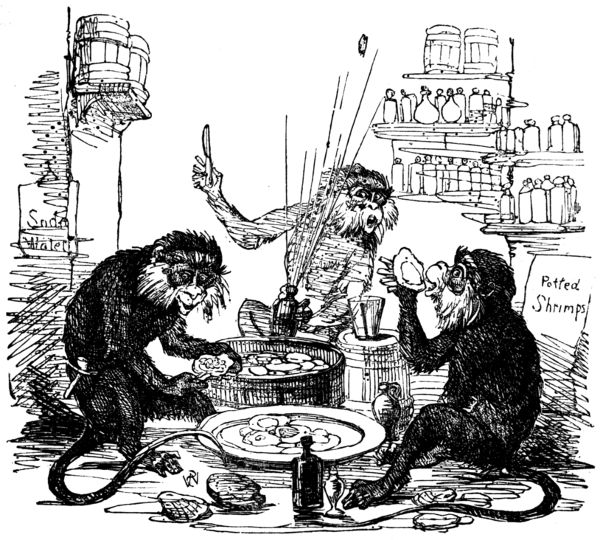
Seasonable Refreshment.
Capital oysters, I declare! Excellent spruce, and ginger beer! Don’t you take vinegar? there’s the bread— We’ll just have a pipe—and then to bed.
*
Why should not this be deemed a real scene, and as respectable as that just described. It is quite as lively and as intellectual. The monkey eats, and according to many accounts can catch fish as well as man. It is told of this animal, that from love of the crab and experience of his claws, he gently shakes his tail before the hole of the crab, who, as soon as he begins to “pull him by his long tail,” is drawn out by that dependancy and falls a prey to his decoyer. It is related that a party of officers belonging to the 25th regiment of infantry, on service at Gibraltar, amused themselves with whiting fishing at the back of the rock till they were obliged to shift their ground from being pelted from above, they did not know by whom. At their new station they caught plenty of fish, but the drum having unexpectedly beat to arms, they rowed hastily ashore, and drew their boat high and dry upon the beach. On their return they were greatly surprised to find it in a different position ashore, and some hooks baited which they had left bare. In the end it was ascertained that their pelters while they were fishing were a party of young monkeys. They were driven off by two or three old ones who remained secretly observing the whiting fishing of the officers till they had retired. The old monkeys then launched the boat, put to sea, baited their hooks, and proceeded to work. The few fish they caught, they hauled up with infinite gratification, and when tired they landed, placed the boat as nearly as they could in its old position, and went up the rock with their prey. General Elliot, while commander at Gibraltar, never suffered the monkeys with which the rock abounds to be molested or taken.
The faculty of imitation in monkeys is limited, but not so in man; a remarkable instance of this is lately adduced in a pleasant little story of perhaps the greatest performer on our stage.
Garrick.
At a splendid dinner-party at lord ——’s they suddenly missed Garrick, and could not imagine what was become of him, till they were drawn to the window by the convulsive screams and peals of laughter of a young negro boy, who was rolling on the ground in an ecstasy of delight to see Garrick mimicking a turkey-cock in the court yard, with his coat-tail stuck out behind, and in a seeming flutter of feathered rage and pride. Of our party only two persons present had seen the British Roscius; and they seemed as willing as the rest to renew their acquaintance with their old favourite. This anecdote is new: it is related by the able writer of a paper concerning “Persons one would wish to have seen,”[27] as an instance of Garrick’s singleness of purpose when he was fully possessed by an idea.
NATURALISTS’ CALENDAR.
Mean Temperature 34·45.
January 13.
1826. Hilary Cambridge Term begins.
St. Veronica.
Some curious circumstances are connected with the name of this saint, who appears to have been a poor ignorant girl, born near Milan, where she worked in the fields for her living. Conceiving a desire to become a nun, she sat up at night to learn to read and write, which, her biographer says, for want of an instructor, was a great fatigue to her. He proceeds to tell us, that she was relieved from labour of that kind in the following manner:—“One day, being in great anxiety about her learning, the mother of God, in a comfortable vision, bade her banish that anxiety, for it was enough if she knew three letters.” So Veronica became a nun, seeking “the greatest drudgery,” desiring “to live always on bread and water,” and dying “at the hour which she had foretold, in the year 1497, and the fifty-second of her age. Her sanctity was confirmed by miracles.” We gather this from Alban Butler, who subjoins, by way of note, thus:—
“The print of the holy face of our Saviour on a linen cloth is kept in St. Peter’s church at Rome, with singular veneration.—Some private writers and churches have given the name of St. Veronica to the devout woman who is said to have presented this linen to our divine Redeemer, but without sufficient warrant.”
Before saying any thing concerning the earlier St. Veronica, or “this linen” whereon Romish writers allege Christ impressed his own portrait by wiping his face with it, mention may be made of another portrait of him which Romish writers affirm he miraculously executed in the same manner, and sent to Abgarus, king of Edessa, in the way hereafter related. They have further been so careful as to publish a print of this pretended portrait, with representations around illustrating the history they tell of it. An engraving from it immediately follows. The Latin inscription beneath their print is placed beneath the present engraving.
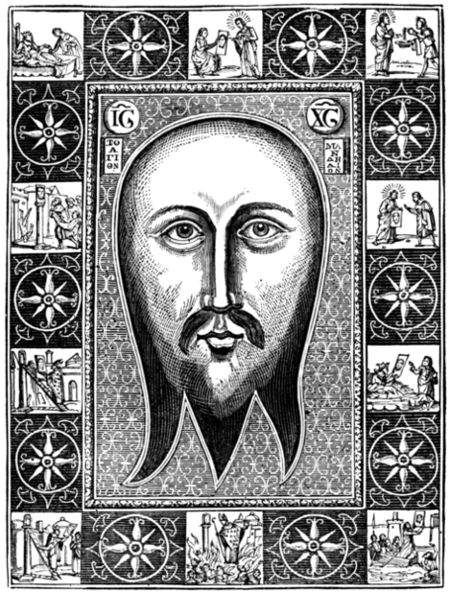
Effigies Christi Domini.
Ex ipsomet Divino Exemplari ad Abgarum missa Genuæ in Ecclesia Sti. Bartolomæi Clericorum Reg. Sti. Pauli Summa Veneratione asservato Accuratissime Expressa.
Enlarged illustration (380 kB).
No circumstance is more remarkable than the existence of this pretended resemblance, as an object of veneration in the Romish church. Being one of the greatest curiosities in its numerous cabinets of relics, it has a place in this work, which, while it records manners and customs, endeavours to point out their origin, and the means by which they have been continued. Nor let it be imagined that these representations have not influenced our own country; there is evidence to the contrary already, and more can be adduced if need require, which will incontestably prove that many of our present popular customs are derived from such sources.
NATURALISTS’ CALENDAR.
Mean Temperature 35·27.
January 14.
1826. Oxford Hilary Term begins.
Sailors.
Mariners form a distinct community, with peculiar manners, little known to their inland fellow countrymen, except through books. In this way Smollett has done much, and from Mr. Leigh Hunt’s “Indicator,” which may not be in every one’s hands, though it ought to be, is extracted the following excellent description:
Seamen on Shore.
And first of the common sailor.—The moment the common sailor lands, he goes to see the watchmaker, or the old boy at the Ship. His first object is to spend his money: but his first sensation is the strange firmness of the earth, which he goes treading in a sort of heavy light way, half waggoner and half dancing master, his shoulders rolling, and his feet touching and going; the same way, in short, in which he keeps himself prepared for all the rolling chances of the vessel, when on deck. There is always, to us, this appearance of lightness of foot and heavy strength of upper works, in a sailor. And he feels it himself. He lets his jacket fly open, and his shoulders slouch, and his hair grow long to be gathered into a heavy pigtail; but when full dressed, he prides himself on a certain gentility of toe; on a white stocking and a natty shoe, issuing lightly out of the flowing blue trowser. His arms are neutral, hanging and swinging in a curve aloof; his hands, half open, look as if they had just been handling ropes, and had no object in life but to handle them again. He is proud of appearing in a new hat and slops, with a belcher handkerchief flowing loosely round his neck, and the corner of another out of his pocket. Thus equipped, with pinchbeck buckles in his shoes (which he bought for gold) he puts some tobacco in his mouth, not as if he were going to use it directly, but as if he stuffed it in a pouch on one side, as a pelican does fish, to employ it hereafter: and so, with Bet Monson at his side, and perhaps a cane or whanghee twisted under his other arm, sallies forth to take possession of all Lubberland. He buys every thing that he comes athwart,—nuts, gingerbread, apples, shoe-strings, beer, brandy, gin, buckles, knives, a watch, (two, if he has money enough,) gowns and handkerchiefs for Bet, and his mother and sisters, dozens of “superfine best men’s cotton stockings,” dozens of “superfine best women’s cotton ditto,” best good check for shirts (though he has too much already), infinite needles and thread (to sew his trowsers with some day), a footman’s laced hat, bear’s grease to make his hair grow (by way of joke), several sticks, all sorts of jew articles, a flute (which he can’t play and never intends), a leg of mutton which he carries somewhere to roast, and for a piece of which the landlord of the Ship makes him pay twice what he gave for the whole;—in short, all that money can be spent upon, which is every thing but medicine gratis; and this he would insist on paying for. He would buy all the painted parrots on an Italian’s head, on purpose to break them, rather than not spend his money. He has fiddles and a dance at the Ship, with oceans of flip and grog; and gives the blind fiddler tobacco for sweetmeats, and half a crown for treading on his toe. He asks the landlady with a sigh, after her daughter Nance who first fired his heart with her silk stockings; and finding that she is married and in trouble, leaves five crowns for her; which the old lady appropriates as part payment for a shilling in advance. He goes to the port playhouse with Bet Monson, and a great red handkerchief full of apples, gingerbread nuts, and fresh beef; calls out for the fiddlers and Rule Britannia; pelts Tom Sikes in the pit; and compares Othello to the black ship’s cook in his white night-cap. When he comes to London, he and some messmates take a hackney-coach, full of Bet Monsons and tobacco pipes, and go through the streets smoking and lolling out of window. He has ever been cautious of venturing on horseback; and among his other sights in foreign parts, relates with unfeigned astonishment how he has seen the Turks ride,—“Only,” says he, guarding against the hearer’s incredulity, “they have saddle-boxes to hold ’em in, fore and aft; and shovels like for stirrups.” He will tell you how the Chinese drink, and the Negurs dance, and the monkies pelt you with cocoa-nuts; and how king Domy would have built him a mud hut and made him a peer of the realm, if he would have stopped with him and taught him to make trowsers. He has a sister at a “school for young ladies,” who blushes with a mixture of pleasure and shame at his appearance; and whose confusion he completes, by slipping fourpence into her hand, and saying out loud that he has “no more copper” about him. His mother and elder sisters at home doat on all he says and does, telling him however that he is a great sea-fellow, and was always wild ever since he was a hop-o’-my-thumb no higher than the window-locker. He tells his mother she would be a duchess in Paranaboo; at which the good old portly dame laughs and looks proud. When his sisters complain of his romping, he says that they are only sorry it is not the baker. He frightens them with a mask made after the New Zealand fashion, and is forgiven for his learning. Their mantle-piece is filled by him with shells and shark’s teeth; and when he goes to sea again, there is no end of tears, and God-bless you, and home-made gingerbread.
His officer on shore does much of all this, only, generally speaking, in a higher taste. The moment he lands he buys quantities of jewellery and other valuables, for all the females of his acquaintance; and is taken in for every article. He sends in a cart load of fresh meat to the ship, though he is going to town next day; and calling in at a chandler’s for some candles, is persuaded to buy a dozen of green wax, with which he lights up the ship at evening; regretting that the fine moonlight hinders the effect of the colour. A man, with a bundle beneath his arm, accosts him in an undertone; and, with a look in which respect for his knowledge is mixed with an avowed zeal for his own interest, asks if his honour will just step under the gangway here, and inspect some real India shawls. The gallant lieutenant says to himself, “this fellow knows what’s what by his face;” and so he proves it by being taken in on the spot. When he brings the shawls home, he says to his sister with an air of triumph, “there Poll, there’s something for you; only cost me twelve, and is worth twenty, if it’s worth a dollar.” She turns pale—“Twenty what, my dear George? Why, you haven’t given twelve dollars for it, I hope?” “Not I, by the Lord.”—“That’s lucky; because you see, my dear George, that all together is not worth more than fourteen or fifteen shillings.” “Fourteen or fifteen what! Why, it’s real India, en’t it? Why the fellow told me so; or I’m sure I’d as soon”—(here he tries to hide his blushes with a bluster) “I’d as soon have given him twelve douses on the chaps as twelve guineas.” “Twelve GUINEAS,” exclaims the sister; and then drawling forth “Why—my—DEAR—George,” is proceeding to show him what the articles would have cost him at Condell’s, when he interrupts her by requesting her to go and choose for herself a tea-table service. He then makes his escape to some messmates at a coffee-house, and drowns his recollection of the shawls in the best wine, and a discussion on the comparative merits of the English and West Indian beauties and tables. At the theatre afterwards, where he has never been before, he takes a lady at the back of one of the boxes for a woman of quality: and when after returning his long respectful gaze with a smile, she turns aside and puts her handkerchief to her mouth, he thinks it is in derision, till his friend undeceives him. He is introduced to the lady; and ever afterwards, at first sight of a woman of quality (without any disparagement either to those charming personages), expects her to give him a smile. He thinks the other ladies much better creatures than they are taken for; and for their parts, they tell him, that if all men were like himself, they would trust the sex again:—which, for aught we know, is the truth. He has, indeed, what he thinks a very liberal opinion of ladies in general; judging them all, in a manner, with the eye of a seaman’s experience. Yet he will believe nevertheless in the “true-love” of any given damsel whom he seeks in the way of marriage, let him roam as much, or remain as long at a distance as he pleases. It is not that he wants feeling; but that he has read of it, time out of mind, in songs; and he looks upon constancy as a sort of exploit, answering to those which he performs at sea. He is nice in his watches and linen. He makes you presents of cornelians, antique seals, cocoa-nuts set in silver, and other valuables. When he shakes hands with you, it is like being caught in a windlass. He would not swagger about the streets in his uniform, for the world. He is generally modest in company, though liable to be irritated by what he thinks ungentlemanly behaviour. He is also liable to be rendered irritable by sickness; partly because he has been used to command others, and to be served with all possible deference and alacrity; and partly, because the idea of suffering pain, without any honour or profit to get by it, is unprofessional, and he is not accustomed to it. He treats talents unlike his own with great respect. He often perceives his own so little felt that it teaches him this feeling for that of others. Besides, he admires the quantity of information which people can get, without travelling like himself; especially when he sees how interesting his own becomes, to them as well as to every body else. When he tells a story, particularly if full of wonders, he takes care to maintain his character for truth and simplicity, by qualifying it with all possible reservations, concessions, and anticipations of objection; such as “in case, at such times as, so to speak, as it were, at least, at any rate.” He seldom uses sea-terms but when jocosely provoked by something contrary to his habits of life; as for instance, if he is always meeting you on horseback, he asks if you never mean to walk the deck again; or if he finds you studying day after day, he says you are always overhauling your log-book. He makes more new acquaintances, and forgets his old ones less, than any other man in the busy world; for he is so compelled to make his home every where, remembers his native one as such a place of enjoyment, has all his friendly recollections so fixed upon his mind at sea, and has so much to tell and to hear when he returns, that change and separation lose with him the most heartless part of their nature. He also sees such a variety of customs and manners, that he becomes charitable in his opinions altogether; and charity, while it diffuses the affections, cannot let the old ones go. Half the secret of human intercourse is to make allowance for each other.
When the officer is superannuated or retires, he becomes, if intelligent and inquiring, one of the most agreeable old men in the world, equally welcome to the silent for his card-playing, and to the conversational for his recollections. He is fond of astronomy and books of voyages; and is immortal with all who know him, for having been round the world, or seen the Transit of Venus, or had one of his fingers carried off by a New Zealand hatchet, or a present of feathers from an Otaheitean beauty. If not elevated by his acquirements above some of his humbler tastes, he delights in a corner-cupboard holding his cocoa-nuts and punch-bowl; has his summer-house castellated and planted with wooden cannon; and sets up the figure of his old ship, the Britannia or the Lovely Nancy, for a statue in the garden; where it stares eternally with red cheeks and round black eyes, as if in astonishment at its situation.
NATURALISTS’ CALENDAR.
Mean Temperature 36·20.
January 15.
Changes of Climate.
An opinion has been long entertained, that there are vicissitudes in the climate and temperature of the air unknown to former times, and that such variations exist in America as well as in Europe. It is said that the transatlantic changes have been more frequent, and the heat of the sun not so early or so strongly experienced as formerly. In America, these alterations are attributed to a more obvious cause than uncertain hypothesis, and at not many degrees distance. For instance, the ice in the great river St. Lawrence, at Quebec, did not break up till the first week in May, 1817, when it floated down the stream in huge masses, and in vast quantities; these, with other masses from the coast of Labrador, &c. spread a general coldness many degrees to the southward. But a few weeks before the snow fell in some parts of New England, and New York, to a considerable depth, and there were severe frosts. The vessels from England and Ireland, which arrived at Quebec, all concurred in their accounts of the dangers which they encountered, and the cold which they suffered. In fine, it would appear that the ice in those regions had accumulated to so alarming a degree, as to threaten a material change in all the adjacent countries, and to verify the theory of some who imagined that the extreme cold of the north was gradually making encroachments upon the extreme heat of the south. They have remarked, in confirmation of their opinions, that the accounts of travellers and navigators, furnish strong reasons for supposing that the islands of ice in the higher northern latitudes, as well as the glaciers on the Alps, continue perpetually to increase in bulk. At certain times, in the ice mountains of Switzerland, there occur fissures, which show the immense thickness of the frozen matter; some of these cracks have measured three or four hundred ells deep. The great islands of ice, in the northern seas bordering upon Hudson’s Bay, have been observed to be immersed one hundred fathoms beneath the surface of the sea, and to have risen a fifth or sixth part above the surface, measuring, at the same time, about a mile and a half in diameter. It has been shown by Dr. Lyster, that the marine ice contains some salt, and less air, than common ice, and that it therefore is more difficult of solution. From these premises, he endeavours to account for the perpetual augmentation of those floating islands. By a celebrated experiment of Mr. Boyle, it has been demonstrated that ice evaporates very fast, in severe frosty weather, when the wind blows upon it; and as ice, in a thawing state, is known to contain six times more cold than water, at the same degree of sensible coldness, it is easy to conceive that winds sweeping over islands and continents of ice, perhaps much below northing on Fahrenheit’s scale, and rushing thence into our latitudes, must bring most intense degrees of cold along with them. If to this be added the quantity of cold produced by the evaporation of the water, as well as by the solution of ice, it can scarcely be doubted but that the arctic seas are the principal source of the cold of our winters, and that it is brought hither by the regions of the air blowing from the north, and which take an apparently easterly direction, by their coming to a part of the surface of the earth, which moves faster than the latitude from which they originate. Hence, the increase of the ice in the polar regions, by increasing the cold of our climate, adds, at the same time, to the bulk of the glaciers of Italy and Switzerland.
Reasonings of this kind are supported by the greatest names, and countenanced by the authentic reports of the best informed travellers. Mr. Bradley attributes the cold winds and wet weather, which sometimes happen in May and June, to the solution of ice islands accidentally detached and floating from the north. Mr. Barham, about the year 1718, in his voyage from Jamaica to England, in the beginning of June, met with some of those islands, which were involved in such a fog that the ship was in danger of striking against them. One of them measured sixty miles in length.
On the 22d of December, 1789, there was an instance of ice islands having been wafted from the southern polar regions. It was on these islands that the Guardian struck, at the commencement of her passage from the Cape of Good Hope towards Botany Bay. These islands were wrapt in darkness, about one hundred and fifty fathoms long, and above fifty fathoms above the surface of the waves. In the process of solution, a fragment from the summit of one of them broke off, and plunging into the sea, caused a tremendous commotion in the water, and dense smoke all around it.
These facts were strongly urged upon public attention in the autumn of 1817,[28] as grounds of not only curious and interesting, but likewise of highly important speculation. A supposed change in the temper, and the very character of our seasons, was deemed to have fallen within the observation of even young men, or at least middle-aged men; and upon this supposition, it was not deemed extravagant to anticipate the combined force of the naval world employed in navigating the immense masses of ice into the more southern oceans; while to render the notion more agreeable, and to enliven the minds of such as might think such matters of speculation dull or uninteresting, the project was laid before them in a versified garb, characterising the arctic regions.
There in her azure coif, and starry stole, Grey Twilight sits, and rules the slumbering pole; Bends the pale moon-beams round the sparkling coast, And strews, with livid hands, eternal frost! There, Nymphs! alight, array your dazzling powers, With sudden march alarm the torpid hours; On ice-built isles expand a thousand sails, Hinge the strong helm, and catch the frozen gales; The winged rocks to feverish climates guide, Where fainting zephyrs pant upon the tide; Pass where to Ceuta Calpe’s thunder roars, And answering echoes shake the kindred shores; Pass where with palmy plumes Canary smiles, And in her silver girdle binds her isles; Onward, where Niger’s dusky Naiad laves A thousand kingdoms with prolific waves, Or leads o’er golden sands her threefold train In steamy channels to the fervid main, While swarthy nations crowd the sultry coast, Drink the fresh breeze, and hail the floating frost; Nymphs! veil’d in mist, the melting treasures steer, And cool with arctic snows the tropic year. So from the burning line, by monsoons driv’n, Clouds sail in squadrons o’er the darken’d heav’n, Wide wastes of sand the gelid gales pervade, And ocean cools beneath the moving shade.
Darwin.
NATURALISTS’ CALENDAR.
Mean Temperature 35·05.
January 16.
HOGMANY.
Mr. Reddock’s paper on this subject, at page 13. has elicited the following letter from a literary gentleman, concerning a dramatic representation in England similar to that which Mr. Reddock instances at Falkirk, and other parts of North Britain. Such communications are particularly acceptable; because they show to what extent usages prevail, and wherein they differ in different parts of the country. It will be gratifying to every one who peruses this work, and highly so to the editor, if he is obliged by letters from readers acquainted with customs in their own vicinity, similar to those that they are informed of in other counties, and particularly if they will take the trouble to describe them in every particular. By this means, the Every-Day Book will become what it is designed to be made,—a storehouse of past and present manners and customs. Any customs of any place or season that have not already appeared in the work, are earnestly solicited from those who have the means of furnishing the information. The only condition stipulated for, as absolutely indispensable to the insertion of a letter respecting facts of this nature, is, that the name and address of the writer be communicated to the editor, who will subjoin such signature as the writer may choose his letter should bear to the eye of the public. The various valuable articles of this kind which have hitherto appeared in the work, however signed by initials or otherwise, have been so authenticated to the editor’s private satisfaction, and he is thus enabled to vouch for the genuineness of such contributions.
To the Editor of the Every-Day Book.
Sir,
In your last number appeared a very amusing article touching some usages and customs in Scotland, and communicated from Falkirk. In the description of the boys’ play, ingeniously suggested as typical of the Roman invasion under Agricola, we, however, read but a varied edition of what is enacted in other parts besides Scotland, and more particularly in the western counties, by those troops of old Father Christmas boys, which are indeed brief chronicles of the times. I mean, those paper-decorated, brick-dust-daubed urchins, ’yclept Mummers.
To be sure they do not begin,
“Here comes in the king of Macedon;”
but we have instead,
“Here comes old Father Christmas, Christmas or Christmas not, I hope old Father Christmas never will be forgot.”
And then for the Scottish leader Galgacus, we find,
“Here comes in St. George, St. George That man of mighty name, With sword and buckler by my side I hope to win the game.”
These “western kernes” have it, you see, Mr. Editor, “down along,” to use their own dialect, with those of the thistle. Then, too, we have a fight. Oh! how beautiful to my boyish eyes were their wooden swords and their bullying gait!—then we have a fight, for lo
“Here’s come I, the Turkish knight, Come from the Soldan’s land to fight, And be the foe’s blood hot and bold With my sword I’ll make it cold.”
A vile Saracenic pun in the very minute of deadly strife. But they fight—the cross is victorious, the crescent o’erthrown, and, as a matter of course, even in our pieces of mock valour, duels we have therein—the doctor is sent for; and he is addressed, paralleling again our players of “Scotia’s wild domain,” with
“Doctor, doctor, can you tell What will make a sick man well?”
and thereupon he enumerates cures which would have puzzled Galen, and put Hippocrates to a “non-plus;” and he finally agrees, as in the more classical drama of your correspondent, to cure our unbeliever for a certain sum.
The “last scene of all that ends this strange eventful history” consists in the entrance of the most diminutive of these Thespians, bearing, as did Æneas of old, his parent upon his shoulders, and reciting this bit of good truth and joculation (permitting the word) by way of epilogue:
“Here comes I, little Johnny Jack, With my wife and family at my back, Yet, though my body is but small, I’m the greatest rogue amongst ye all; This is my scrip—so for Christmas cheer If you’ve any thing to give throw it in here.”
This may be but an uninteresting tail-piece to your correspondent’s clever communication, but still it is one, and makes the picture he so well began of certain usages more full of point.
I doat upon old customs, and I love hearty commemorations, and hence those mimics of whom I have written—I mean the mummers—are my delight, and in the laughter and merriment they create I forget to be a critic, and cannot choose but laugh in the fashion of a Democritus, rather than weep worlds away in the style of a Diogenes.
I am, &c. &c. J. S. jun.
Little Chelsea, Jan. 4, 1826.
In the preface to Mr. Davies Gilbert’s work on “Ancient Christmas Carols,” there is an account of Cornish sports, with a description of a “metrical play,” which seems to be the same with which is the subject of the preceding letter.
Being on the popular drama, and as the topic arose in Mr. Reddock’s communication from Scotland, a whimsical dramatic anecdote, with another of like kin from that part of the kingdom, is here subjoined from a Scottish journal of this month in the year 1823.
New Readings of Burns.
We were lately favoured with the perusal of a Perth play-bill, in which Tam O’Shanter, dramatized, is announced for performance as the afterpiece. A ludicrous mistake has occurred, however, in the classification of the Dramatis Personæ. The sapient playwright, it would appear, in reading the lines
“Tam had got planted unco richt, Fast by an ingle bleezin’ finely, Wi’ reaman’ swats that drank divinely,”
very naturally conceiving ream an’ swats, from the delectable style of their carousing, to be a brace of Tam’s pot companions, actually introduced them as such, as we find in the bill that the characters of “Ream” and “Swats” are to be personated by two of the performers!
This reminds us of an anecdote, connected with the same subject, which had its origin nearer home. Some time ago we chanced to be in the shop of an elderly bookseller, when the conversation turned upon the identity of the characters introduced by Burns in his Tam O’Shanter. The bibliopole, who had spent the early part of his life in this neighbourhood, assured us that, “exceptin’ Kerr, he kent every body to leuk at that was mentioned, frae Tam himsel’ doun to his mare Maggie.” This being the first time we had ever heard Mr. Kerr’s cognomen alluded to, in connection with Tam O’Shanter, we expressed considerable surprise, and stated that he undoubtedly must have made a mistake in the name. “It may be sae, but its a point easily sattled,” said he, raxing down a copy of Burns from the shelf. With “spectacles on nose,” he turned up the poem in question. “Ay, ay,” said he, in an exulting tone, “I thocht I was na that far wrang—
“Care mad to see a man sae happy, E’n drowned himself amang the happy.”
Now, I kent twa or three o’ the Kerr’s that leev’t in the town-head, but I never could fin’ out whilk o’ them Burns had in his e’e when he wrote the poem.”[29]
To Thespian ingenuity we are under an obligation for an invention of great simplicity, which may be useful on many occasions, particularly to literary persons who are too far removed from the press to avail themselves of its advantages in printing short articles for limited distribution.
A Dramatic Printing Apparatus.
Itinerant companies of comedians frequently print their play-bills by the following contrivance: The form of letter is placed on a flat support, having ledges at each side, that rise within about a thirteenth of an inch of the inked surface of the letter. The damped paper is laid upon the letter so disposed, and previously inked, and a roller, covered with woollen cloth, is passed along the ledges over its surface; the use of the ledges is to prevent the roller from rising in too obtuse an angle against the first letters, or going off too abruptly from the last, which would cause the paper to be cut, and the impression to be injured at the beginning and end of the sheet. The roller must be passed across the page, for if it moves in the order of the lines, the paper will bag a little between each, and the impression will be less neat.[30]
NATURALISTS’ CALENDAR.
Mean Temperature 35·65.
January 17.
Snow, &c.
On the 16th and 17th of January, 1809, Mr. Howard observed, that the snow exhibited the beautiful blue and pink shades at sunset which are sometimes observable, and that there was a strong evaporation from its surface. A circular area, of five inches diameter, lost 150 grains troy, from sunset on the 15th to sunrise next morning, and about 50 grains more by the following sunset; the gauge being exposed to a smart breeze on the house top. The curious reader may hence compute for himself, the enormous quantity raised in those 24 hours, without any visible liquefaction, from an acre of snow: the effects of the load thus given to the air were soon perceptible. On the 17th, a small brilliant meteor descended on the S. E. horizon about 6 p. m. On the 18th, though the moon was still conspicuous, the horns of the crescent were obtuse. On the 19th appeared the Cirrus cloud, followed by the Cirrostratus. In the afternoon a freezing shower from the eastward glazed the windows, encrusted the walls, and encased the trees, the garments of passengers, and the very plumage of the birds with ice. Birds thus disabled were seen lying on the ground in great numbers in different parts of the country. Nineteen rooks were taken up alive by one person at Castle Eaton Meadow, Wilts. The composition of this frozen shower, examined on a sheet of paper, was no less curious than these effects. It consisted of hollow spherules of ice, filled with water; of transparent globules of hail; and of drops of water at the point of freezing, which became solid on touching the bodies they fell on. The thermometer exposed from the window indicated 30,5°. This was at Plaistow. The shower was followed by a moderate fall of snow. From this time to the 24th, there were variable winds and frequent falls of snow, which came down on the 22d in flakes as large as dollars, with sleet at intervals. On the 24th a steady rain from W. decided for a thaw. This and the following night proved stormy: the melted snow and rain, making about two inches depth of water on the level, descended suddenly by the rivers, and the country was inundated to a greater extent than in the year 1795. The River Lea continued rising the whole of the 26th, remained stationary during the 27th, and returned into its bed in the course of the two following days. The various channels by which it intersects this part of the country were united in one current, above a mile in width, which flowed with great impetuosity, and did much damage. From breaches in the banks and mounds, the different levels, as they are termed, of embanked pasture land, were filled to the depth of eight or nine feet. The cattle, by great exertions, were preserved, being mostly in the stall; and the inhabitants, driven to their upper rooms, were relieved by boats plying under the windows. The Thames was so full during this time, that no tide was perceptible; happily, however, its bank suffered no injury; and the recession of the water from the levels proceeded with little interruption till the 23d of February, when it nearly all subsided. No lives were lost in these parts; but several circumstances concurred to render this inundation less mischievous than it might have been, from the great depth of snow on the country. It was the time of neap tide; the wind blew strongly from the westward, urging the water down the Thames; while moonlight nights, and a temperate atmosphere, were favourable to the poor, whose habitations were filled with water. On the 28th appeared a lunar halo of the largest diameter. On the 29th, after a fine morning, the wind began to blow hard from the south, and during the whole night of the 30th it raged with excessive violence from the west, doing considerable damage. The barometer rose, during this hurricane, one-tenth of an inch per hour. The remainder of the noon was stormy and wet, and it closed with squally weather; which, with the frequent appearance of the rainbow, indicated the approach of a drier atmosphere, a change on few occasions within Mr. Howard’s recollection more desirable.
Numerous inundations, consequent on the thaw of the 24th, appear to have prevailed in low and level districts all along the east side of the island: but in no part with more serious destruction of property, public works, and the hopes of the husbandman, than in the fens of Cambridgeshire: where, by some accounts, 60,000, by others above 150,000 acres of land, were laid under deep water, through an extent of 15 miles. It is a fact worth preserving, that about 500 sacks filled with earth, and laid on the banks of the Old Bedford river, at various places, where the waters were then flowing over, proved effectual in saving that part of the country from a general deluge.
Swearing on the Horns at Highgate.
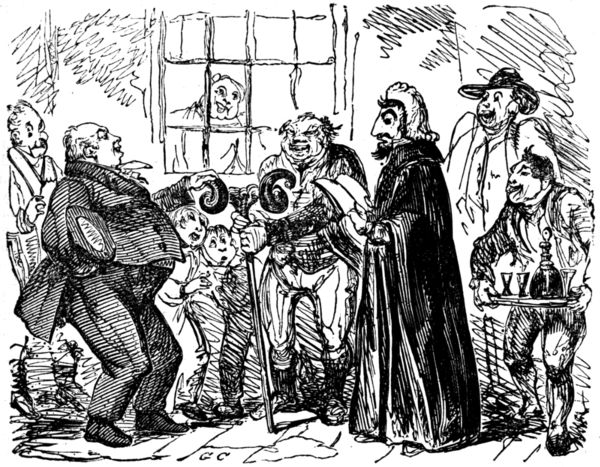
Swearing on the Horns at Highgate.
It’s a custom at Highgate, that all who go through, Must be sworn on the horns, sir!—and so, sir, must you! Bring the horns! shut the door!—now, sir, take off your hat!— When you come here again, don’t forget to mind that!
*
“Have you been sworn at Highgate?” is a question frequently asked in every part of the kingdom; for, that such a custom exists in this village is known far and near, though many who inquire, and are asked, remain ignorant of the ceremony. As the practice is declining, diligence has been exercised to procure information on the spot, and from every probable source, concerning this remarkable usage.
The village of Highgate takes its name from the gate across the public road into London, opposite the chapel, which is sometimes erroneously called the church, for it is, in fact, only a chapel of ease to Hornsey church. This road runs through land belonging to the bishopric of London, and was made, by permission of the bishop in former times, probably when the whole of this spot, and the circumjacent country, was covered with wood, and part of the great forest of Middlesex, which, according to Matthew Paris, was infested by wolves, stags, boars, and other wild beasts, besides robbers. This gate, from being on the great northern eminence towards London, was called the high-gate; as the land became cleared of wood, houses arose near the spot, and hence the village now called Highgate. It seems probable, that the first dwelling erected here was the gate-house. The occupier of the inn of that name holds it under a lease from the bishop, under which lease he also farms the bishop’s toll. In the year 1769 the old gate-house, which extended over the road, was taken down, and the present common turnpike-gate put up. So much, then, concerning Highgate, as introductory to the custom about to be related.
“Swearing on the horns,” which now is “a custom more honour’d in the breach than in the observance,” prevailed at Highgate as a continual popular amusement and private annoyance. An old and respectable inhabitant of the village says, that sixty years ago upwards of eighty stages stopped every day at the Red Lion, and that out of every five passengers three were sworn. It is a jocular usage of the place, from beyond the memory of man, especially encouraged by certain of the villagers, to the private advantage of public landlords. On the drawing up of coaches at the inn-doors, particular invitations were given to the company to alight, and after as many as could be collected were got into a room for purposes of refreshment, the subject of being “sworn at Highgate” was introduced, and while a little artifice easily detected who had not taken the oath, some perhaps expressed a wish to submit to the ceremony. It often happened however, that before these facts could be ascertained “the horns” were brought in by the landlord, and as soon as they appeared, enough were usually present to enforce compliance. “The horns,” fixed on a pole of about five feet in height, were erected, by placing the pole upright on the ground, near the person to be sworn, who was required to take off his hat, and all present having done the same, the landlord then, in a loud voice, swore in the “party proponent.” What is called the oath is traditional, and varies verbally in a small degree. It has been taken down in writing from the lips of different persons who administer it, and after a careful collation of the different versions the following may be depended on as correct.—The landlord, or the person appointed by him to “swear in,” proclaims aloud—
“Upstanding and uncovered! Silence!” Then he addresses himself to the person he swears in, thus:—
“Take Notice what I now say unto you, for that is the first word of your oath—mind that! You must acknowledge me to be your adopted Father, I must acknowledge you to be my adopted son (or daughter.) If you do not call me father you forfeit a bottle of wine, if I do not call you son, I forfeit the same. And now, my good son, if you are travelling through this village of Highgate, and you have no money in your pocket, go call for a bottle of wine at any house you think proper to go into, and book it to your father’s score. If you have any friends with you, you may treat them as well, but if you have money of your own, you must pay for it yourself. For you must not say you have no money when you have, neither must you convey the money out of your own pocket into your friends’ pockets, for I shall search you as well as them, and if it is found that you or they have money, you forfeit a bottle of wine for trying to cozen and cheat your poor old ancient father. You must not eat brown bread while you can get white, except you like the brown the best; you must not drink small beer while you can get strong, except you like the small the best. You must not kiss the maid while you can kiss the mistress, except you like the maid the best, but sooner than lose a good chance you may kiss them both. And now, my good son, for a word or two of advice. Keep from all houses of ill repute, and every place of public resort for bad company. Beware of false friends, for they will turn to be your foes, and inveigle you into houses where you may lose your money and get no redress. Keep from thieves of every denomination. And now, my good son, I wish you a safe journey through Highgate and this life. I charge you, my good son, that if you know any in this company who have not taken this oath, you must cause them to take it, or make each of them forfeit a bottle of wine, for if you fail to do so you will forfeit a bottle of wine yourself. So now, my son, God bless you! Kiss the horns or a pretty girl if you see one here, which you like best, and so be free of Highgate!”
If a female be in the room she is usually saluted, if not, the horns must be kissed: the option was not allowed formerly. As soon as the salutation is over the swearer-in commands “silence!” and then addressing himself to his new-made “son,” he says, “I have now to acquaint you with your privilege as a freeman of this place. If at any time you are going through Highgate and want to rest yourself, and you see a pig lying in a ditch you have liberty to kick her out and take her place; but if you see three lying together you must only kick out the middle one and lie between the other two! God save the king!” This important privilege of the freemen of Highgate was first discovered by one Joyce a blacksmith, who a few years ago kept the Coach and Horses, and subjoined the agreeable information to those whom “he swore in.”
When the situation of things and persons seems to require it, the “bottle of wine” is sometimes compounded for by a modus of sundry glasses of “grog,” and in many cases a pot of porter.
There is one circumstance essential for a freeman of Highgate to remember, and “that is the first word of his oath,—mind that!” If he fail to recollect that, he is subject to be resworn from time to time, and so often, until he remember that. He is therefore never to forget the injunction before he swears, to take notice what is said, “for that is the first word of your oath—mind that!” Failure of memory is deemed want of comprehension, which is no plea in the high court of Highgate—“mind that!” That is, that that “that,” is “that.”
There is no other formality in the administration or taking of this oath, than what is already described; and the only other requisite for “a stranger in Highgate” to be told, is, that now in the year 1826, there are nineteen licensed houses in this village, and that at each of these houses the “horns” are kept, and the oath administered by the landlord or his deputy.
To note the capabilities of each house, their signs are here enumerated, with the quality of horns possessed by each.
1. The Gate-house is taken first in order, as being best entitled to priority, because it has the most respectable accommodation in Highgate. Besides the usual conveniences of stabling and beds, it has a coffee-room, and private rooms for parties, and a good assembly-room. The horns there are Stag’s.
2. Mitre, has Stag’s horns.
3. Green Dragon, Stag’s horns.
4. Red Lion and Sun, Bullock’s horns.
The late husband of Mrs. Southo, the present intelligent landlady of this house, still lives in the recollection of many inhabitants, as having been a most facetious swearer in.
5. Bell, Stag’s horns. This house now only known as the sign of the “Bell,” was formerly called the “Bell and Horns.” About fifty years ago, it was kept by one Anderson, who had his “horns” over his door, to denote that persons were sworn there as well as at the Gate-house. Wright, the then landlord of the “Red Lion and Sun,” determined not to be outrivalled, and hung out a pair of bullock’s horns so enormous in size, and otherwise so conspicuous, as to eclipse the “Bell and Horns;” at last, all the public houses in the village got “horns,” and swore in. It is within recollection that every house in Highgate had “the horns” at the door as a permanent sign.
6. Coach and Horses, Ram’s horns.
7. Castle, Ram’s horns.
8. Red Lion, Ram’s horns.
9. Wrestler’s, Stag’s horns.
10. Bull, Stag’s horns.
11. Lord Nelson, Stag’s horns.
12. Duke of Wellington, Stag’s horns.
This house is at the bottom of Highgate Hill, towards Finchley, in the angle formed by the intersection of the old road over the hill, and the road through the archway to Holloway. It therefore commands the Highgate entrance into London, and the landlord avails himself of his “eminence” at the foot of the hill, by proffering his “horns” to all who desire to be free of Highgate.
13. Crown, Stag’s horns. This is the first public house in Highgate coming from Holloway.
14. Duke’s Head, Stag’s horns.
15. Cooper’s Arms, Ram’s horns.
16. Rose and Crown, Stag’s horns.
17. Angel, Stag’s horns.
18. Flask, Ram’s horns.
This old house is now shut up. It is at the top of Highgate Hill, close by the pond, which was formed there by a hermit, who caused gravel to be excavated for the making of the road from Highgate to Islington, through Holloway. Of this labour old Fuller speaks, he calls it a “two-handed charity, providing water on the hill where it was wanting, and cleanliness in the valley which before, especially in winter, was passed with difficulty.”
19. Fox and Crown, Ram’s Horns.
This house, commonly called the “Fox” and the “Fox under the Hill,” is nearly at the top of the road from Kentish Town to Highgate, and though not the most remarked perhaps, is certainly the most remarkable house for “swearing on the horns.” Guiver, the present landlord, (January 1826) came to the house about Michaelmas 1824, and many called upon him to be sworn in; not having practised he was unqualified to indulge the requisitionists, and very soon finding, that much of the custom of his house depended on the “custom of Highgate,” and imagining that he had lost something by his indifference to the usage, he boldly determined to obtain “indemnity for the past, and security for the future.” Thereupon he procured habiliments, and an assistant, and he is now an office-bearer as regards the aforesaid “manner” of Highgate, and exercises his faculties so as to dignify the custom. Robed in a domino with a wig and mask, and a book wherein is written the oath, he recites it in this costume as he reads it through a pair of spectacles. The staff with “the horns” is held by an old villager who acts as clerk, and at every full stop, calls aloud, “Amen!” This performance furnishes the representation of the present engraving from a sketch by Mr. George Cruikshank. He has waggishly misrepresented one of the figures, which not being the landlord, who is the most important character, no way affects the general fidelity of the scenes sometimes exhibited in the parlour of the Fox and Crown.
It is not uncommon for females to be “sworn at Highgate.” On such occasions the word “daughter” is substituted for “son,” and other suitable alterations are made in the formality. Anciently there was a register kept at the gate-house, wherein persons enrolled their names when sworn there, but the book unaccountably disappeared many years ago.—Query. Is it in Mr. Upcott’s collection of autographs?
There seems to be little doubt, that the usage first obtained at the Gate-house; where, as well as in other public houses, though not in all, at this time, deputies are employed to swear in. An old inhabitant, who formerly kept a licensed house, says, “In my time nobody came to Highgate in any thing of a carriage, without being called upon to be sworn in. There was so much doing in this way at one period, that I was obliged to hire a man as a ‘swearer-in:’ I have sworn in from a hundred to a hundred and twenty in a day. Bodies of tailors used to come up here from town, bringing five or six new shopmates with them to be sworn; and I have repeatedly had parties of ladies and gentlemen in private carriages come up purposely to be made free of Highgate in the same way.”
Officers of the guards and other regiments repeatedly came to the Gate-house and called for “the horns.” Dinner parties were formed there for the purpose of initiating strangers, and as pre-requisite for admission to sundry convivial societies, now no more, the freedom of Highgate was indispensable.
Concerning the origin of this custom, there are two or three stories. One is, that it was devised by a landlord, who had lost his licence, as a means of covering the sale of his liquors; to this there seems no ground of credit.
Another, and a probable account, is, to this effect—That Highgate being the place nearest to London where cattle rested on their way from the north for sale in Smithfield, certain graziers were accustomed to put up at the Gate-house for the night, but as they could not wholly exclude strangers, who like themselves were travelling on their business, they brought an ox to the door, and those who did not choose to kiss its horns, after going through the ceremony described, were not deemed fit members of their society.
It is imagined by some, because it is so stated in a modern book or two as likely, that the horns were adopted to swear this whimsical oath upon, because it was tendered at the parish of Horns-ey, wherein Highgate is situated.
The reader may choose either of these origins; he has before him all that can be known upon the subject.
An anecdote related by Mrs. Southo of the Red Lion and Sun, may, or may not, be illustrative of this custom. She is a native of Hoddesdon in Hertfordshire, where her father kept the Griffin, and she says, that when any fresh waggoner came to that house with his team, a drinking horn, holding about a pint, fixed on a stand made of four rams’ horns, was brought out of the house, and elevated above his head, and he was compelled to pay a gallon of beer, and to drink out of the horn. She never heard how the usage originated; it had been observed, and the stand of rams’ horns had been in the house, from time immemorial.
NATURALISTS’ CALENDAR.
Mean Temperature 35·52.
January 18.
St. Priscian.
In the church of England calendar.
Old Twelfth Day.
This is still observed in some parts of England.
Don Sebastian.
In default of holiday making by the editor, who during the Christmas season has been employed in finishing the indexes, which will be in the readers’ hands in few days to enable them to complete the first volume of this work, he has now and then turned to his collections to relieve the wearisomeness of his occupation, and finding the following anecdote in “The Times” of Dec. 1825, he subjoins from his stores an illustration of the curious fact it relates to. “It may be mentioned,” The Times says, “as a singular species of infatuation, that many Portuguese residing in Brazil as well as Portugal, still believe in the coming of Sebastian, the romantic king, who was killed in Africa about the year 1578, in a pitched battle with the emperor Muley Moluc. Some of these old visionaries will go out, wrapped in their large cloaks, on a windy night, to watch the movements of the heavens, and frequently, if an exhalation is seen flitting in the air, resembling a falling star, they will cry out, “there he comes!” Sales of horses and other things are sometimes effected, payable at the coming of king Sebastian. It was this fact that induced Junot, when asked what he would be able to do with the Portuguese, to answer, what can I do with a people who are still waiting for the coming of the Messiah and king Sebastian?”
This superstitious belief is mentioned in a MS. Journal of a Residence at Lisbon in 1814, written by an individual personally known to the editor, who extracts from the narrative as follows:—
It is the daily practice at Lisbon for the master of the family to cater for the wants of his table himself. According to ancient usage, he must either employ and pay a porter to carry home his purchases at market, or send a servant for them. A certain doctor, well known to be a lover of fish, and an enthusiastic expectant of Don Sebastian, was watched several days in the fish market by some knavish youths, who contrived a trick upon him. One morning, they observed him very intent upon a fine large fish, yet disagreeing with the fishmonger as to its price. One of these knaves managed to inform the man, if he would let the doctor have the fish at his own price he would pay the difference, and the fishmonger soon concluded the bargain with the doctor. As soon as he was gone, one of the party, without the fishmonger’s knowledge, insinuated down the fish’s throat a scroll of parchment curiously packed, and shortly afterwards, the doctor’s servant arrived for his master’s purchase. On opening the fish, in order to its being cooked, the parchment deposit was found, and the credulous man, to his astonishment and delight, read as follows:—
“Worthy and well-beloved Signor: —— ——, respected by the saints and now revered by men. From our long observation of thine heart’s integrity, and in full knowledge of thy faith and firm belief, thou art selected as the happy instrument of our return; but know, most worthy Signor, the idea of a white horse in clouds of air, is a mere fable invented by weak men. It will be far otherwise, but be thou circumspect and secret, and to thee these things will be explained hereafter. Know, that by the element of water, by which we make this known, we shall return. Not far from Fort St. Juliana is a spot thou knowest well, a smooth declivity towards the sea; it is there we first shall touch the shore of our loved Portugal to-morrow’s night at twelve. Be thou there alone, and softly gliding on the water’s surface a small boat shall appear. Be silent and remain quiet on our appearance, for until we can join our prayers with thine thou must not speak; load not thyself with coin, for soon as dawn appears a troop of goodly horse from Cintra’s Road will rise upon thy view. But be not destitute of wherewith to bear thine expense. All thy future life shall be thy prince’s care.
“Sebastian.”
The trick succeeded; for the next day the doctor left Lisbon as privately as possible, while his trepanners who had watched him quickly followed, two in a boat hired for the purpose, and two on shore, to make a signal. The boat arrived at the appointed hour, and the doctor expected nothing less than the landing of the long expected and well-beloved Sebastian. It reached the shore, and by those who stepped out and their confederates concealed on the beach, the doctor was eased of some doubloons he had with him, received a cool dip in the water, and was left on the beach to bewail his folly. The story soon got wind, and now (in 1814) there are wags who, when they observe the doctor coming, affect to see something in the sky; this hint concerning Don Sebastian’s appearance is usually intimated beyond the reach of the doctor’s cane.
NATURALISTS’ CALENDAR.
Mean Temperature 36·12.
January 19.
Feast of Lanthorns.
This is a festival with the Chinese on the fifteenth day of the first month of their year. It is so called from the great number of lanthorns hung out of the houses, and in the streets; insomuch that it rather appears a season of madness, than of feasting. On this day are exposed lanthorns of all prices, whereof some are said to cost two thousand crowns. Some of their grandees retrench somewhat every day out of their table, their dress, their equipage, &c. to appear the more magnificent in lanthorns. They are adorned with gilding, sculpture, painting, japanning, &c. and as to their size, it is extravagant; some are from twenty-five to thirty feet diameter; they represent halls and chambers. Two or three such machines together would make handsome houses. In lanthorns of these dimensions the Chinese are able to eat, lodge, receive visits, have balls, and act plays. The great multitude of smaller lanthorns usually consist of six faces or lights, each about four feet high, and one and a half broad, framed in wood finely gilt and adorned; over these are stretched a fine transparent silk, curiously painted with flowers, trees, and sometimes human figures. The colours are extremely bright; and when the torches are lighted, they appear highly beautiful and surprising.
French Lark Shooting.
To the gentleman whose letter from Abbeville, descriptive of “Wild fowl shooting in France,” is on p. 1575 of vol. I., the editor is indebted for another on “Lark shooting,” which is successfully practised there by a singular device unknown to sportsmen in this country.[31]
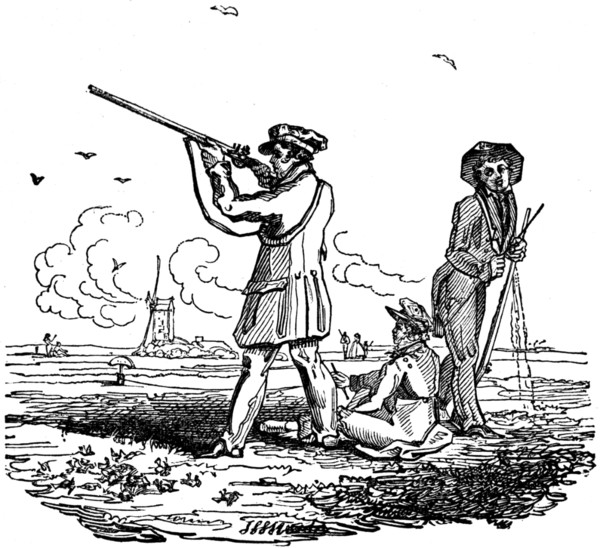
Lark Shooting in France.
———————— As far-off islanders, Innocent of trade, unskilled in commerce, To whom a glass or toy unknown before Is wonderful, give freely, flocks and fruits To gain mere baubles; so, these silly birds Attracted by the glisten of the twirler, Hover above the passing strange decoy, Intent to gaze, and fall the gunner’s prey.
*
Abbeville.
Dear Sir,
If I do not send you your wished for wood cuts I at least keep my promise of letting you hear from me. I told you in my last you should have something about our lark-shooting, and so you shall, and at this time too; though I assure you writing flying as I almost do, is by no means so agreeable to me as shooting flying, which is the finest sport imaginable. When I come home I will tell you all about it, for the present I can only acquaint you with enough to let you into the secret of the enjoyment that I should always find in France, if I had no other attraction to the country. I must “level” at once, for I have no time to spare, and so “here goes,” as the boy says.
Partridge and quail shooting cease in this delightful part of the world about the middle of October, for by that time the partridges are so very wild and wary that there is no getting near them. The reason of this is, that our fields here are all open without either hedge or ditch, and when the corn and hemp are off, the stubble is pulled up so close by the poor people for fuel, that there is no cover for partridges; as to the quails, they are all either “killed off,” or take their departure for a wilder climate; and then there is nothing left for the French gentry to amuse themselves with but lark-shooting. These birds are attracted to any given spot in great numbers by a singular contrivance, called a miroir. This is a small machine, made of a piece of mahogany, shaped like a chapeau bras, and highly polished; or else it is made of common wood, inlaid with small bits of looking glass, so as to reflect the suns rays upwards. It is fixed on the top of a thin iron rod, or upright spindle, dropped through an iron loop or ring attached to a piece of wood, to drive into the ground as here represented.
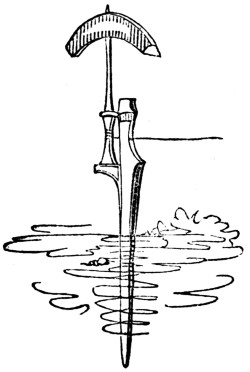
By pulling a string fastened to the spindle, the miroir twirls, and the reflected light unaccountably attracts the larks, who hover over it, and become a mark for the sportsman. In this way I have had capital sport. A friend of mine actually shot six dozen before breakfast. While he sat on the ground he pulled the twirler himself, and his dogs fetched the birds as they dropped. However, I go on in the common way, and employ a boy to work the twirler. Ladies often partake in the amusement on a cold dry morning, not by shooting but by watching the sport. So many as ten or a dozen parties are sometimes out together, firing at a distance of about five hundred yards apart, and in this way the larks are constantly kept on the wing. The most favourable mornings are when there is a gentle light frost, with little or no wind, and a clear sky—for when there are clouds the larks will not approach. One would think the birds themselves enjoyed their destruction, for the fascination of the twirler is so strong, as to rob them of the usual “fruits of experience.” After being fired at several times they return to the twirler, and form again into groupes above it. Some of them even fly down and settle on the ground, within a yard or two of the astonishing instrument, looking at it “this way and that way, and all ways together,” as if nothing had happened.
Larks in France fetch from three to four sous a piece. In winter, however, when they are plentiful, they are seldom eaten, because here they are always dressed with the trail, like snipes and woodcocks; but for this mode of cooking they are not fitted when the snow is on the ground, because they are then driven to eat turnip-tops, and other watery herbs, which communicate an unpleasant flavour to the trail. Were you here at the season, to eat larks in their perfection, and dressed as we dress them, I think your praise of the cooking would give me the laugh against you, if you ever afterwards ventured to declaim against the use of the gun, which, next to my pencil, is my greatest hobby. I send you a sketch of the sport, with the boy at the twirler—do what you like with it.
I rather think I did not tell you in my last, that the decoy ducks, used in wild-fowl shooting, are made of wood—any stump near at hand is hacked out any how for the body, while a small limb of any tree is thrust into the stump for the duck’s neck, and one of the side branches left short makes his head. These ducks answer the purpose with their living prototypes, who fly by moonlight, and have not a perfect view, and don’t stay for distinctions, like philosophers.
It will not be long before I’m off for England, and then, &c.
I am, &c. J. H. H.
NATURALISTS’ CALENDAR.
Mean Temperature 37·02.
January 20.
Fabian.
In the church of England calendar.[32]
DEDICATION.
The dedication of each day in the year, by the Romish church, in honour of a saint, which converts every day into a festival, is a fact pretty well known to the readers of the Every-Day Book. It is also generally known, that in certain almanacs every part of the human body is distributed among the days throughout the year, as subjects of diurnal influence; but it is not perhaps so well known, that every joint of each finger on each hand was appropriated to some saint. The proof of this is supplied by two very old prints, from engravings on wood, at the British Museum. They are among a collection of ancient wood cuts pasted in a folio volume. It would occupy too much room to give copies of these representations in fac-simile: the curiously inclined, who have access to the Museum print-room, may consult the originals; general readers may be satisfied with the following description:—
Right Hand.
The top joint of the thumb is dedicated to God; the second joint to the Virgin; the top joint of the fore finger to Barnabas, the second joint to John, the third to Paul; the top joint of the second finger to Simeon Cleophas, the second joint to Tathideo, the third to Joseph; the top joint of the third finger to Zaccheus, the second to Stephen, the third to Luke; the top joint of the little finger to Leatus, the second to Mark, the third joint to Nicodemus.
Left Hand.
The top joint of the thumb is dedicated to Christ, the second joint to the Virgin; the top joint of the fore finger to St. James, the second to St. John the evangelist, the third to St. Peter; the first joint of the second finger to St. Simon, the second joint to St. Matthew, the third to St. James the great; the top joint of the third finger to St. Jude, the second joint to St. Bartholomew, the third to St. Andrew; the top joint of the little finger to St. Matthias, the second joint to St. Thomas, the third joint to St. Philip.
NATURALISTS’ CALENDAR.
Mean Temperature 36·92.
January 21.
St. Agnes.
In the church of England calendar.[33]
How to sleep well in cold weather.
Obtain a free circulation of the blood by walking, or other wholesome exercise, so as to procure a gentle glow over the entire surface of the body. Hasten to your chamber, undress yourself quickly, and jump into bed without suffering its temperature to be heightened by the machine called a warming-pan. Your bed will be warmed by your own heat, and if you have not eaten a meat supper, or drank spirits, you will sleep well and warm all night. Calico sheets are adapted to this season—blankets perhaps are better; but as they absorb perspiration they should be washed before they come into use with sheets in summer time.
Extraordinary sleeper.
Samuel Clinton, of Timbury, near Bath, a labouring man, about twenty-five years of age, had frequently slept, without intermission, for several weeks. On the 13th of May, 1694, he fell into a profound sleep, out of which he could by no means be roused by those about him; but after a month’s time, he rose of himself, put on his clothes, and went about his business as usual. From that time to the 9th of April following he remained free from any extraordinary drowsiness, but then fell into another protracted sleep. His friends were prevailed on to try what remedies might effect, and accordingly he was bled, blistered, cupped, and scarified, but to no purpose. In this manner he lay till the 7th of August, when he awaked, and went into the fields, where he found people busy in getting in the harvest, and remembered that when he fell asleep they were sowing their oats and barley. From that time he remained well till the 17th of August, 1697, when he complained of a shivering, and, after some disorder of the stomach, the same day fell fast asleep again. Dr. Oliver went to see him; he was then in an agreeable warmth, but without the least sign of his being sensible; the doctor then held a phial of sal-ammoniac under his nose, and injected about half an ounce up one of his nostrils, but it only made his nose run and his eyelids shiver a little. The doctor then filled his nostrils with powder of white hellebore, but the man did not discover the least uneasiness. About ten days after, the apothecary took fourteen ounces of blood from his arm without his making the least motion during the operation. The latter end of September Dr. Oliver again visited him, and a gentleman present ran a large pin into his arm to the bone, but he gave not the least sign of feeling. In this manner he lay till the 19th of November, when his mother hearing him make a noise ran immediately to him, and asked him how he did, and what he would have to eat? to which he replied, “very well, I thank you; I’ll take some bread and cheese.” His mother, overjoyed, ran to acquaint his brother that he was awake, but on their going up stairs they found him as fast asleep as ever. Thus he continued till the end of January, at which time he awoke perfectly well and very little altered in his flesh, and went about his business as usual.[34]
NATURALISTS’ CALENDAR.
Mean Temperature 37·35.
January 22.
St. Vincent.
In the church of England calendar.[35]
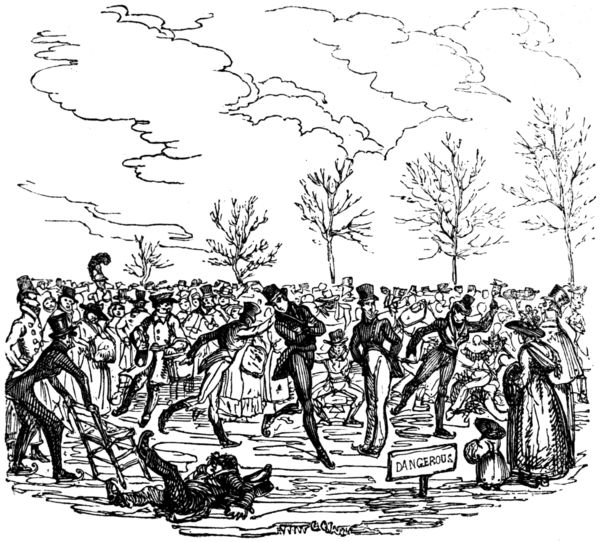
Skating on the Serpentine.
Skating on the Serpentine.
The Hyde-park river—which no river is, The Serpentine—which is not serpentine When frozen, every skater claims as his, In right of common, there to intertwine With countless crowds, and glide upon the ice. Lining the banks, the timid and unwilling Stand and look on, while some the fair entice By telling, “yonder skaters are quadrilling”— And here the skateless hire the “best skates” for a shilling.
*
A hard frost is a season of holidays in London. The scenes exhibited are too agreeable and ludicrous for the pen to describe. They are for the pencil; and Mr. Cruikshank’s is the only one equal to the series. In a work like this there is no room for their display, yet he has hastily essayed the preceding sketch in a short hour. It is proper to say, that however gratifying the representation may be to the reader, the friendship that extorted it is not ignorant that scarcely a tithe of either the time or space requisite has been afforded Mr. Cruikshank for the subject. It conveys some notion however of part of the doings on “the Serpentine in Hyde-park” when the thermometer is below “freezing,” and every drop of water depending from trees and eaves becomes solid, and hangs
“like a diamond in the sky.”
The ice-bound Serpentine is the resort of every one who knows how or is learning to skate, and on a Sunday its broad surface is covered with gazers who have “as much right” to be on it as skaters, and therefore “stand” upon the right to interrupt the recreation they came to see. This is especially the case on a Sunday. The entire of this canal from the wall of Kensington-gardens to the extremity at the Knightsbridge end was, on Sunday the 15th of January, 1826, literally a mob of skaters and gazers. At one period it was calculated that there were not less than a hundred thousand persons upon this single sheet of ice.
The coachmen on the several roads, particularly on the western and northern roads, never remembered a severer frost than they experienced on the Sunday night just mentioned. Those who recollected that of 1814, when the Thames was frozen over, and booths raised on the ice, declared that they did not feel it so severely, as it did not come on so suddenly. The houses and trees in the country had a singular appearance on the Monday, owing to the combination of frost and fog; the trees, and fronts of houses, and even the glass was covered with thick white frost, and was no more transparent than ground-glass.
Butchers, in the suburbs, where the frost was felt more keenly than in the metropolis, were obliged to keep their shops shut in order to keep out the frost; many of them carried the meat into their parlours, and kept it folded up in cloths round the fires, and unfolded it as their customers came in and required it. The market gardeners also felt the severity of the weather—it stopped their labours, and some of the men, attended by their wives, went about in parties, and with frosted greens fixed at the tops of rakes and hoes, uttered the ancient cry of “Pray remember the gardeners! Remember the poor frozen out gardeners!”[36]
The Apparition.
’Twas silence all, the rising moon With clouds had veil’d her light, The clock struck twelve, when, lo! I saw A very chilling sight. Pale as a snow-ball was its face, Like icicles its hair; For mantle, it appeared to me A sheet of ice to wear. Tho’ seldom given to alarm, I’ faith, I’ll not dissemble, My teeth all chatter’d in my head, And every joint did tremble. At last, I cried, “Pray who are you, And whither do you go?” Methought the phantom thus replied, “My name is Sally Snow; “My father is the Northern Wind, My mother’s name was Water; Old parson Winter married them, And I’m their hopeful Daughter. “I have a lover—Jackey Frost, My dad the match condemns; I’ve run from home to-night to meet My love upon the Thames.” I stopp’d Miss Snow in her discourse, This answer just to cast in, “I hope, if John and you unite, Your union wo’n’t be lasting! “Besides, if you should marry him, But ill you’d do, that I know; For surely Jackey Frost must be A very slippery fellow.” She sat her down before the fire, My wonder now increases; For she I took to be a maid, Then tumbled into pieces! For air, thin air, did Hamlet’s ghost, His foremost cock-crow barter; But what I saw, and now describe, Resolv’d itself to water.
Great Frost, 1814.
The severest and most remarkable frost in England of late years, commenced in December, 1813, and generally called “the Great Frost in 1814,” was preceded by a great fog, which came on with the evening of the 27th of December, 1813. It is described as a darkness that might be felt. Cabinet business of great importance had been transacted, and lord Castlereagh left London about two hours before, to embark for the continent. The prince regent, (since George IV.) proceeding towards Hatfield on a visit to the marquis of Salisbury, was obliged to return to Carlton-house, after being absent several hours, during which period the carriages had not reached beyond Kentish-town, and one of the outriders fell into a ditch. Mr. Croker, secretary of the admiralty, on a visit northward, wandered likewise several hours in making a progress not more than three or four miles, and was likewise compelled to put back. It was “darkness that might be felt.”
On most of the roads, excepting the high North-road, travelling was performed with the utmost danger, and the mails were greatly impeded.
On the 28th, the Maidenhead coach coming to London, missed the road near Hartford bridge and was overturned. Lord Hawarden was among the passengers, and severely injured.
On the 29th, the Birmingham mail was nearly seven hours in going from the Post-office to a mile or two below Uxbridge, a distance of twenty miles only: and on this, and other evenings, the short stages in the neighbourhood of London had two persons with links, running by the horses’ heads. Pedestrians carried links or lanterns, and many, who were not so provided, lost themselves in the most frequented, and at other times well-known streets. Hackney-coachmen mistook the pathway for the road, and the greatest confusion prevailed.
On the 31st, the increased fog in the metropolis was, at night, truly alarming. It required great attention and thorough knowledge of the public streets to proceed any distance, and persons who had material business to transact were unavoidably compelled to carry torches. The lamps appeared through the haze like small candles. Careful hackney-coachmen got off the box and led their horses, while others drove only at a walking pace. There were frequent meetings of carriages, and great mischief ensued. Foot passengers, alarmed at the idea of being run down, exclaimed, “Who is coming?”—“Mind!”—“Take care!” &c. Females who ventured abroad were in great peril; and innumerable people lost their way.
After the fogs, there were heavier falls of snow than had been within the memory of man. With only short intervals, it snowed incessantly for forty-eight hours, and this after the ground was covered with ice, the result of nearly four weeks continued frost. During this long period, the wind blew almost continually from the north and north-east, and the cold was intense. A short thaw of about one day, rendered the streets almost impassable. The mass of snow and water was so thick, that hackney-coaches with an additional horse, and other vehicles, could scarcely plough their way through. Trade and calling of all kinds in the streets were nearly stopped, and considerably increased the distresses of the industrious. Few carriages, even stages, could travel the roads, and those in the neighbourhood of London seemed deserted. From many buildings, icicles, a yard and a half long, were seen suspended. The water-pipes to the houses were all frozen, and it became necessary to have plugs in the streets for the supply of all ranks of inhabitants. The Thames, from London Bridge to Blackfriars, was completely blocked up at ebb-tide for nearly a fortnight. Every pond and river near the metropolis was completely frozen.
Skating was pursued with great avidity on the Canal in St. James’s, and the Serpentine in Hyde-park. On Monday the 10th of January, the Canal and the Basin in the Green-park were conspicuous for the number of skaters, who administered to the pleasure of the throngs on the banks; some by the agility and grace of their evolutions, and others by tumbles and whimsical accidents from clumsy attempts. A motley collection of all orders seemed eager candidates for applause. The sweep, the dustman, the drummer, the beau, gave evidence of his own good opinion, and claimed that of the belles who viewed his movements. In Hyde-park, a more distinguished order of visitors crowded the banks of the Serpentine. Ladies, in robes of the richest fur, bid defiance to the wintry winds, and ventured on the frail surface. Skaters, in great numbers, of first-rate notoriety, executed some of the most difficult movements of the art, to universal admiration. A lady and two officers, who performed a reel with a precision scarcely conceivable, received applause so boisterous as to terrify the fair cause of the general expression, and occasion her to forego the pleasure she received from the amusement. Two accidents occurred: a skating lady dislocated the patella or kneepan, and five gentlemen and a lady were submerged in the frosty fluid, but with no other injury than from the natural effect of so cold an embrace.
On the 20th, in consequence of the great accumulation of snow in London, it became necessary to relieve the roofs of the houses by throwing off the load collected upon them. By this means the carriage-ways in the middle of the streets were rendered scarcely passable; and the streams constantly flowing from the open plugs, added to the general mass of ice.
Many coach proprietors, on the northern and western roads, discontinued to run their coaches. In places where the roads were low, the snow had drifted above carriage height. On Finchley-common, by the fall of one night, it lay to a depth of sixteen feet, and the road was impassable even to oxen. On Bagshot-heath and about Esher and Cobham the road was completely choked up. Except the Kent and Essex roads, no others were passable beyond a few miles from London. The coaches of the western road remained stationary at different parts. The Windsor coach was worked through the snow at Colnbrook, which was there sixteen feet deep, by employing about fifty labourers. At Maidenhead-lane, the snow was still deeper; and between Twyford and Reading it assumed a mountainous appearance. Accounts say that, on parts of Bagshot-heath, description would fail to convey an adequate idea of its situation. The Newcastle coach went off the road into a pit upwards of eight feet deep, but without mischief to either man or horse. The middle North-road was impassable at Highgate-hill.
On the 22d of January, and for some time afterwards, the ice on the Serpentine in Hyde-park bore a singular appearance, from mountains of snow which sweepers had collected together in different situations. The spaces allotted for the skaters were in circles, squares, and oblongs. Next to the carriage ride on the north side, many astonishing evolutions were performed by the skaters. Skipping on skates, and the Turk-cap backwards, were among the most conspicuous. The ice, injured by a partial thaw in some places, was much cut up, yet elegantly dressed females dashed between the hillocks of snow, with great bravery.
At this time the appearance of the river Thames was most remarkable. Vast pieces of floating ice, laden generally with heaps of snow, were slowly carried up and down by the tide, or collected where the projecting banks or the bridges resisted the flow. These accumulations sometimes formed a chain of glaciers, which, uniting at one moment, were at another cracking and bounding against each other in a singular and awful manner with loud noise. Sometimes these ice islands rose one over another, covered with angry foam, and were violently impelled by the winds and waves through the arches of the bridges, with tremendous crashes. Near the bridges, the floating pieces collected about mid-water, or while the tide was less forcible, and ranged themselves on each other; the stream formed them into order by its force as it passed, till the narrowness of the channel increased the power of the flood, when a sudden disruption taking place, the masses burst away, and floated off. The river was frozen over for the space of a week, and a complete Frost Fair held upon it, as will be mentioned presently.
Since the establishment of mail-coaches correspondence had not been so interrupted as on this occasion. Internal communication was completely at a stand till the roads could be in some degree cleared. The entire face of the country was one uniform sheet of snow; no trace of road was discoverable.