JANUARY. (continued 4)
Reading edition
Mr. Watson states other objections to this service. “In the hymn used instead of Venite exultemus, it is said, They fought against him without a cause: the contrary of which, when it is applied to king Charles, I think has been owned by every historian. The parliament of England were always more wise and good, than to raise armies against the kings who gave them no occasion to do so; and I cannot but entertain this favourable opinion of that which began to sit in the year 1640. There is nothing more true than that the king wanted to govern by an arbitrary power. His whole actions showed it, and he could never be brought to depart from this. Either, therefore, his people must have submitted to the slavery, or they must have vindicated their freedom openly; there was no middle way. But should they have tamely received the yoke? No, surely; for had they done so, they had deserved the worst of evils; and the bitter effects thereof, in all probability, had not only been derived to us, but our posterity. Happy Britons, that such a just and noble stand was made! May the memories of those great patriots that were concerned in it be ever dear to Englishmen; and to all true Englishmen they will!
“In the same hymn it is likewise affirmed that False witnesses rose up against him, and laid to his charge things that he knew not. Which on this occasion cannot be truly said, because as the chief fact to be proved was the king’s being in arms, it cannot be supposed that out of more than 200,000 men who had engaged with him, a sufficient number of true witnesses could be wanting. What, therefore, Mr. Wheatly could think when he said that his hymn is as solemn a composure, and as pertinent to the occasion as can be imagined or contrived, I cannot tell. I am sure a broad hint is given therein, that the clergy in king Charles’s time were a set of wicked people, and that it was through their unrighteousness, as well as that of the laity, that the king lost his life. The words are these, ‘For the sins of the people, and the iniquities of the priests, they shed the blood of the just in the midst of Jerusalem.’ Let those defend this passage who are able, for I own myself incapable of doing it consistently.”
Mr. Watson says, “I am not by myself in thinking that this service for the 30th of January needs a review; many sensible, worthy men think further—that it is time to drop it; for they see that it is unseasonable now, and serves no other end than as a bone of contention in numberless parishes, preventing friendship, and good will being shown towards such of the clergy as cannot in all points approve of it; excepting that (as I have found by experience) it tends to make bad subjects. A sufficient argument this, was there no other, why it should either be altered, or taken away; but I presume not to dictate; and, therefore, I urge this no further: had I not a sincere regard for the church of England, I should have said less; but notwithstanding any reports to the contrary, I declare myself to be a hearty well-wisher to her prosperity. Did I not prefer her communion to that of any other, I would instantly leave her, for I am not so abandoned as to play the hypocrite that I detest, and have often detested it to my great loss. But I am not of that opinion, that it is for the interest of the church to conceal her defects; on the contrary, I think I do her the greatest service possible by pointing them out, so that they may be remedied to the satisfaction of all good men. She ought not to be ashamed of the truth, and falsehood will never hurt her.”
It appears that Mr. Watson’s conduct obtained much notice; for he preached another sermon at Halifax, entitled “Moderation; or a candid disposition towards those that differ from us, recommended and enforced.” This he also printed, with the avowed view of “promoting of that moderation towards all men which becometh us as Christians, is the ornament of our profession, and which we should therefore labour to maintain, as we desire to walk worthy of the vocation wherewith we are called, with all lowliness and meekness, with long suffering, forbearing one another in love, endeavouring to keep the unity of the spirit in the bond of peace.” He proceeds to observe in this discourse, that “whoever reflects upon the nature of human constitutions, will readily allow the impossibility of perfection in any of them; and whoever considers the mutability of human things, will grant that nothing can be so well devised, or so sure established, which, in continuance of time, will not be corrupted. A change of circumstances, to which the best constituted state is liable, will require such alterations as once would have been needless: and improvement of observation will demand such regulations as nothing else could have discovered to have been right. Of this the wise founders of the established church of England were very sensible; they prudently required no subscription to perfection in the church, well knowing that they but laid the foundation stone of a much greater building than they could live to see completed. The Common Prayer, since it was first properly compiled, in the year 1545, has undergone sixteen alterations, as defects became visible, and offence was thereby given to the promoting of separations and divisions: noble examples these—fit for the present age to imitate! for, as ninety years have elapsed since the last review, this experienced age has justly discovered that the amendments, at that time made, were not sufficient. I could produce you many instances; but I forbear; for I am very sensible how tender a point I am discussing. However, I cannot but observe, that for my own part, upon the maturest and most sober consideration, I take him to be a greater friend to Christianity in general, and to this church in particular, who studies to unite as many dissenters as may be to us, by a reasonable comprehension, than he who is against it.”
It is urged by Mr. Watson, that the church of England herself does not claim a perfection which is insisted upon as her distinguishing quality by some of her over zealous advocates. He says, “The first reformers were wise and good men, but the Common Prayer they published was little better than popery itself; many indeed have been the alterations in it made since then; but as, through the unripeness of the times, it never had any but imperfect emendations, we may reasonably suppose it capable of still further improvements.” Deeming the service appointed for this day as inappropriate, and referring to suggestions that were in his time urged upon public attention for a review of the liturgy, he proceeds to say, “There may be men at work that misrepresent this good design; that proclaim, as formerly, the church’s danger; but let no arts like these deceive you; they must be enemies in disguise that do it, or such who have not examined what they object to with sufficient accuracy. What is wished for, your own great Tillotson himself attempted: this truly valuable man, with some others but little inferior to himself, being sensible that the want of a sufficient review drew many members from the church, would have compromised the difference in a way detrimental to no one, beneficial to all; and had he not been opposed by some revengeful zealots, had certainly completed what all good men have wished for.”
The Editor of the Every-Day Book has Mr. Watson’s private copies of these printed tracts, with manuscript additions and remarks on them by Mr. Watson himself. It should seem from one of these notes, in his own hand-writing, that his opinions were not wholly contemned. Regarding his latter discourse, he observes that “the late Dr. Sharp, archdeacon of Northumberland, in a pamphlet, called ‘A Serious Inquiry into the Use and Importance of External Religion;’ quotes this sentence, “Where unity and peace are disregarded, devotion must be so too, as it were by natural consequences. I have borrowed these words from a sermon preached at Halifax, by John Watson, A. M., which, if any man, who has sixpence to spare, will purchase, peruse, and lay to heart, he will lay out his time and his money very well.” Archdeacon Sharp was father of the late Granville Sharp, the distinguished philanthropist and hebraist.
Mr. Watson was born at Presburg, in Cheshire, and educated at Brazen Nose college, Oxford, where he obtained a fellowship. He wrote a History of Halifax, in 2 vols. 4to., 1775; and a History of the Warren Family, by one of whom he was presented to the rectory of Stockport, where he died, aged 59 years. He also wrote a review of the large Moravian hymn book, and several miscellaneous pieces. There is a portrait of him by Basire.
By those who believe that Charles was “guiltless of his country’s blood,” and that the guilt “of his blood” is an entail upon the country not yet cut off, it may be remarked as a curious fact, that at about that season, eighty years after the king “bowed his head” on the scaffold at Whitehall, it was “a very sickly time.” It is recorded, that in 1733 “people were afflicted this month with a head-ach and fever which very few escaped, and many died of; particularly between Tuesday, the twenty-third, and Tuesday, the thirtieth of January, there died upwards of fifteen hundred in London and Westminster.”[46] On the twenty-third of January, 1649, the king having peremptorily denied the jurisdiction of the court, the president, Bradshaw, “ordered his contempt to be recorded: on the thirtieth of January he was beheaded.” During these days, and the intervening ones, the fatal London head-ach prevailed in 1733.
On the second of March, 1772 Mr. Montague moved in the house of commons to have so much of the act of 12th C. II. c. 30, as relates to the ordering the thirtieth of January to be kept as a day of fasting and humiliation, to be repealed. His motive he declared to be, to abolish, as much as he could, any absurdity from church as well as state. He said that he saw great and solid reasons for abolishing the observation of that day, and hoped that it was not too harsh a name to be given to the service for the observation of that day, if he should brand it with the name of impiety, particularly in those parts where Charles I. is likened to our Saviour. On a division, there being for the motion 97, and against it 125, it was lost by a majority of 27.
The Calves-head Club.
On the 30th of January, 1735, certain young noblemen and gentlemen met at a French tavern in Suffolk-street, (Charing Cross,) under the denomination of the “Calves-head Club.” They had an entertainment of calves’ heads, some of which they showed to the mob outside, whom they treated with strong beer. In the evening, they caused a bonfire to be made before the door, and threw into it with loud huzzas a calf’s-head dressed up in a napkin. They also dipped their napkins in red wine, and waved them from the windows, at the same time drinking toasts publicly. The mob huzzaed as well as “their betters,”—but at length broke the windows, and became so mischievous that the guards were called in to prevent further outrage.[47]
These proceedings occasioned some verses in the “Grub-street Journal,” wherein are the following lines:—
Strange times! when noble peers secure from riot Cann’t keep Noll’s annual festival in quiet. Through sashes broke, dirt, stones and brands thrown at em, Which, if not scand was brand-alum-magnatum— Forced to run down to vaults for safer quarters, And in cole-holes, their ribbons hide and garters. They thought, their feast in dismal fray thus ending, Themselves to shades of death and hell descending: This might have been, had stout Clare-market mobsters With cleavers arm’d, outmarch’d St. James’s lobsters; Numsculls they’d split, to furnish other revels, And make a calves-head feast for worms and devils.
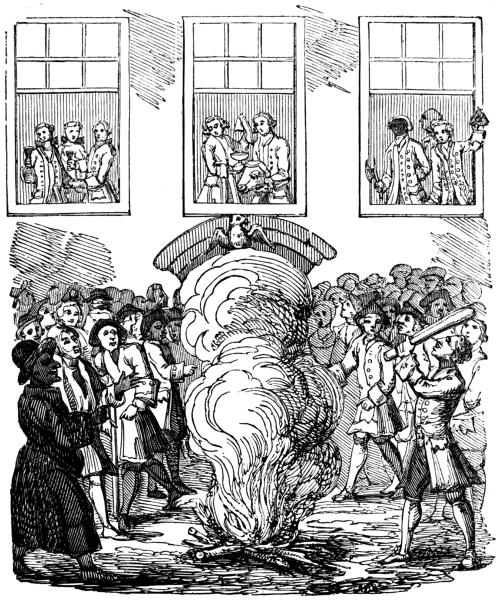
The Calves-head Club in Suffolk Street, 1734.
There is a print entitled “The true Effigies of the Members of the Calves-head Club, held on the 30th of January, 1734, in Suffolk Street, in the County of Middlesex.” This date is the year before that of the disturbance related, and as regards the company, the health drinking, huzzaing, a calf’s head in a napkin, a bonfire, and the mob, the scene is the same; with this addition, that there is a person in a mask with an axe in his hand. The engraving above is from this print.
On a work entitled the “History of the Calves-head Club,” little reliance is to be placed for authenticity. It appears, however, that their toasts were of this description: “The pious memory of Oliver Cromwell.” “Damn——n to the race of the Stuarts.” “The glorious year 1648.” “The man in the mask, &c.” It will be remembered that the executioner of Charles I. wore a mask.
Oranges and Bells.
A literary hand at Newark is so obliging as to send the communication annexed, for which, in behalf of the reader, the editor offers his sincere thanks.
To the Editor of the Every-Day Book.
Sir, Newark, Dec. 10, 1825.
On the 30th of January, the anniversary of king Charles’s martyrdom, and on Shrove Tuesday, we have a custom here, which I believe to be singular, having never heard of it elsewhere. On those days, there are several stalls placed in the market-place, (as if for a regular market,) having nothing but oranges: you may purchase them, but it is rarely the case; but you “raffle” for them, at least that is their expression. You give the owner a halfpenny, which entitles you to one share; if a penny, to two, and so on; and when there is a sufficient sum, you begin the raffle. A ball nearly round, (about the size of a hen’s egg,) yet having twenty-six square sides, each having a number, being one to twenty-six, is given you: (some balls may not have so many, others more, but I never saw them.) You throw the ball down, what I may term, the chimney, (which is so made as to keep turning the ball as it descends,) and it falls on a flat board with a ledge, to keep it from falling off, and when it stops you look at the number. Suppose it was twelve, the owner of the stall uses this expression, “Twelve is the highest, and one gone.” Then another throws; if his is a lesser number, they say, “Twelve is the highest, and two gone;” if a higher number, they call accordingly. The highest number takes oranges to the amount of all the money on the board. When they first begin, a halfpenny is put down, then they call “One, and who makes two?” when another is put down, it is “Two, and who makes three?” and so on. At night the practice is kept up at their own houses till late hours; and others go to the inns and public-houses to see what they can do there.
Also every day, at six in the morning, and night, at eight o’clock, we have a bell rung for about a quarter of an hour: it is termed six o’clock and eight o’clock bell. On saint days, Saturdays, and Sundays, the time is altered to seven o’clock in the morning, and to seven o’clock at night, with an additional ringing at one o’clock at noon. Again, at eight o’clock on Sunday morning, all the bells are tolled round for a quarter of an hour.
I have mentioned the above, that, if they come within the notice of the Every-Day Book, you would give them insertion, and, if possible, account for their origin.
Whilst on the subject of “bells,” perhaps you can mention how “hand bells came into the church, and for what purpose.” We have a set in this church.
I am, &c. H. H. N. N.
The editor will be glad to receive elucidations of either of these usages.
Accounts of local customs are particularly solicited from readers of the Every-Day Book in every part of the country.
To the notice of this day in the Perennial Calendar, the following stanzas are subjoined by Dr. Forster. They are evident “developments” of phrenological thought.
VERSES ON A SKULL In a church-yard.
O empty vault of former glory! Whate’er thou wert in time of old, Thy surface tells thy living story, Tho’ now so hollow, dead, and cold, For in thy form is yet descried The traces left of young desire; The Painter’s art, the Statesman’s pride, The Muse’s song, the Poet’s fire; But these, forsooth, now seem to be Mere lumps on thy periphery. Dear Nature, constant in her laws, Hath mark’d each mental operation, She ev’ry feeling’s limit draws On all the heads throughout the nation, That there might no deception be; And he who kens her tokens well, Hears tongues which every where agree In language that no lies can tell— Courage—Deceit—Destruction—Theft— Have traces on the skullcap left. But through all Nature’s constancy An awful change of form is seen, Two forms are not which quite agree, None is replaced that once hath been; Endless variety in all, From Fly to Man, Creation’s pride, Each shows his proper form—to fall Eftsoons in time’s o’erwhelming tide, And mutability goes on With ceaseless combination. ’Tis thine to teach with magic power Those who still bend life’s fragile stem, To suck the sweets of every flower, Before the sun shall set to them; Calm the contending passions dire, Which on thy surface I descry, Like water struggling with the fire In combat, which of them shall die; Thus is the soul in Fury’s car, A type of Hell’s intestine war. Old wall of man’s most noble par, While now I trace with trembling hand Thy sentiments, how oft I start, Dismay’d at such a jarring band! Man, with discordant frenzy fraught, Seems either madman, fool, or knave; To try to live is all he’s taught— To ’scape her foot who nought doth save In life’s proud race;—(unknown our goal) To strive against a kindred soul. These various organs show the place Where Friendship lov’d, where Passion glow’d, Where Veneration grew in grace, Where justice swayed, where man was proud— Whence Wit its slippery sallies threw On Vanity, thereby defeated; Where Hope’s imaginary view Of things to come (fond fool) is seated; Where Circumspection made us fear, Mid gleams of joy some danger near. Here fair Benevolence doth grow In forehead high—here Imitation Adorns the stage, where on the Brow Are Sound, and Color’s legislation. Here doth Appropriation try, By help of Secrecy, to gain A store of wealth, against we die, For heirs to dissipate again. Cause and Comparison here show, The use of every thing we know. But here that fiend of fiends doth dwell, While Ideality unshaken By facts or theory, whose spell Maddens the soul and fires our beacon. Whom memory tortures, love deludes, Whom circumspection fills with dread, On every organ he obtrudes, Until Destruction o’er his head Impends; then mad with luckless strife, He volunteers the loss of life. And canst thou teach to future man The way his evils to repair— Say, O momento,—of the span Of mortal life? For if the care Of truth to science be not given, (From whom no treachery it can sever,) There’s no dependance under heaven That error may not reign for ever. May future heads more learning cull From thee, when my own head’s a skull.
There is a parish game in Scotland, at this season of the year, when the waters are frozen and can bear practitioners in the diversion. It prevails, likewise, in Northumberland, and other northern parts of south Britain; yet, nowhere, perhaps, is it so federalized as among the descendants of those who “ha’ wi’ Wallace bled.” This sport, called curling, is described by the georgical poet, and will be better apprehended by being related in his numbers: it being premised that the time agreed on, or the appointment for playing it, is called the tryst; the match is called the bonspiel; the boundary marks for the play are called the tees; and the stones used are called coits, or quoits, or coiting, or quoiting-stones.
Now rival parishes, and shrievedoms, keep, On upland lochs, the long-expected tryst To play their yearly bonspiel. Aged men, Smit with the eagerness of youth, are there, While love of conquest lights their beamless eyes, New-nerves their arms, and makes them young once more. The sides when ranged, the distance meted out, And duly traced the tees, some younger hand Begins, with throbbing heart, and far o’ershoots, Or sideward leaves, the mark: in vain he bends His waist, and winds his hand, as if it still Retained the power to guide the devious stone, Which, onward hurling, makes the circling groupe Quick start aside, to shun its reckless force. But more and still more skilful arms succeed, And near and nearer still around the tee, This side, now that, approaches; till at last, Two, seeming equidistant, straws, or twigs, Decide as umpires ’tween contending coits. Keen, keener still, as life itself were staked, Kindles the friendly strife: one points the line To him who, poising, aims and aims again; Another runs and sweeps where nothing lies. Success alternately, from side to side, Changes; and quick the hours un-noted fly, Till light begins to fail, and deep below, The player, as he stoops to lift his coit, Sees, half incredulous, the rising moon. But now the final, the decisive spell Begins; near and more near the sounding stones, Some winding in, some bearing straight along, Crowd justling all around the mark, while one, Just slightly touching, victory depends Upon the final aim: long swings the stone. Then with full force, careering furious on, Rattling it strikes aside both friend and foe, Maintains its course, and takes the victor’s place. The social meal succeeds, and social glass; In words the fight renewed is fought again, While festive mirth forgets the winged hours.— Some quit betimes the scene, and find that home Is still the place where genuine pleasure dwells.
Grahame.
NATURALISTS’ CALENDAR.
Mean Temperature 36·85.
January 31.
King George IV. proclaimed.—Holiday at the Exchequer.
Wakes.
A newspaper of this day,[48] in the year 1821, relates the following anecdote:—
All through Ireland the ceremonial of wakes and funerals is most punctually attended to, and it requires some sçavoir faire to carry through the arrangement in a masterly manner. A great adept at the business, who had been the prime manager at all the wakes in the neighbourhood for many years, was at last called away from the death-beds of his friends to his own. Shortly before he died he gave minute directions to his people as to the mode of waking him in proper style. “Recollect,” says he, “to put three candles at the head of the bed, after you lay me out, and two at the foot, and one at each side. Mind now, and put a plate with the salt on it just a top of my breast. And, do you hear? have plenty of tobacco and pipes enough; and remember to make the punch strong. And—but what the devil is the use of talking to you? sure I know you’ll be sure to botch it, as I won’t be there myself.”
Mr. John Bull, an artist, with poetical powers exemplified in the first volume[49] by a citation from his poem entitled “The Museum,” which deserves to be better known, favours the Every-Day Book with the following original lines. The conflict between the cross and the crescent, renders the communication peculiarly interesting to those who indulge a hope that the struggle will terminate in the liberation of Greece from “worse than Egyptian bondage.”
THE RAINBOW IN GREECE. By Mr. John Bull.
Arch of peace! the firmament Hath not a form more fair Than thine, thus beautifully bent Upon the lighten’d air. Well might the wondrous bards of yore Of thee so sweetly sing; Thy fair foot on their lovely shore Returning with the spring! An angel’s form to thee they gave, Celestial feign’d thy birth, Saw thee now span the light green wave, And now the greener earth. Yet then, where’er thy smile was seen On land, or billowy main, Thou seem’d to watch, with look serene, O’er Freedom’s glorious reign. Thy brilliant arch, around the sky, The nurse of hope appear’d, Sweet as the light of liberty, Wherewith their souls were cheer’d! But ah! if thou, when Greece was young, Didst visit realms above; Go and return, as minstrels sung A messenger of love: What tale, in heaven, hast thou to tell, Of tyrants and their slaves— Despots, and soul-bound men that dwell Without their fathers’ graves! Oh! when they see thy beauteous bow, Surround their ancient skies, Do not the Grecian warriors know, ’Tis then their hour to rise? Let them unsheath the daring sword, And, pointing up to thee, Speak to their men one fiery word, And march to set them free Upon thine arch of hope they’d glance, And say, “The storm is o’er! “The clouds are breaking off—advance, “We will be slaves no more!”
The “Mirror of the Months” represents of the coming month, that—
Now the Christmas holidays are over, and all the snow in Russia could not make the first Monday in this month look any other than black, in the home-loving eyes of little schoolboys; and the streets of London are once more evacuated of happy wondering faces, that look any way but straight before them; and sobs are heard, and sorrowful faces seen to issue from sundry post-chaises that carry sixteen inside, exclusive of cakes and boxes; and theatres are no longer conscious or unconscious éclats de rire, but the whole audience is like Mr. Wordsworth’s cloud, “which moveth altogether, if it move at all.”
In the gardens of our habitations, and the immense tracts that provide great cities with the products of the earth, the cultivator seizes the first opportunity to prepare and dress the bosom of our common mother. “Hard frosts, if they come at all, are followed by sudden thaws; and now, therefore, if ever, the mysterious old song of our school days stands a chance of being verified, which sings of
‘Three children sliding on the ice, All on a summer’s day!’
Now the labour of the husbandman recommences; and it is pleasant to watch (from your library-window) the plough-team moving almost imperceptibly along, upon the distant upland that the bare trees have disclosed to you.—Nature is as busy as ever, if not openly and obviously, secretly, and in the hearts of her sweet subjects the flowers; stirring them up to that rich rivalry of beauty which is to greet the first footsteps of spring, and teaching them to prepare themselves for her advent, as young maidens prepare, months beforehand, for the marriage festival of some dear friend.—If the flowers think and feel (and he who dares to say that they do not is either a fool or a philosopher—let him choose between the imputations!)—if the flowers think and feel, what a commotion must be working within their silent hearts, when the pinions of winter begin to grow, and indicate that he is at least meditating his flight. Then do they, too, begin to meditate on May-day, and think on the delight with which they shall once more breathe the fresh air, when they have leave to escape from their subterranean prisons; for now, towards the latter end of this month, they are all of them at least awake from their winter slumbers, and most are busily working at their gay toilets, and weaving their fantastic robes, and shaping their trim forms, and distilling their rich essences, and, in short, getting ready in all things, that they may be duly prepared to join the bright procession of beauty that is to greet and glorify the annual coming on of their sovereign lady, the spring. It is true none of all this can be seen. But what a race should we be, if we knew and cared to know of nothing, but what we can see and prove!”[50]
NATURALISTS’ CALENDAR.
Mean Temperature 39·35.