JUNE. (continued 2)
Reading edition
Nottingham.
W. H.
Now, as the sun declines, may be seen, emerging from the surface of shallow streams, and lying there for a while till its wings are dried for flight, the (misnamed) May-fly. Escaping, after a protracted struggle of half a minute, from its watery birth place, it flutters restlessly up and down, up and down, over the same spot, during its whole era of a summer evening; and at last dies, as the last dying streaks of day are leaving the western horizon. And yet, who shall say that in that space of time it has not undergone all the vicissitudes of a long and eventful life? That it has not felt all the freshness of youth, all the vigour of maturity, all the weakness and satiety of old age, and all the pangs of death itself? In short, who shall satisfy us that any essential difference exists between its four hours and our fourscore years[206]?
To the May Fly.
Thou art a frail and lovely thing, Engender’d by the sun: A moment only on the wing, And thy career is done. Thou sportest in the evening beam An hour—an age to thee— In gaiety above the stream, Which soon thy grave must be. Although thy life is like to thee An atom—art thou not Far happier than thou e’er couldst be If long life were thy lot? For then deep pangs might wound thy breast And make thee wish for death; But as it is thou’rt soon at rest Thou creature of a breath! And man’s life passeth thus away, A thing of joy and sorrow— The earth he treads upon to-day Shall cover him to-morrow.
Barton Wilford.
NATURALISTS’ CALENDAR.
Mean Temperature 57·45.
June 7.
Chabert. The Human Salamander.
This exhibitor’s public performances in London, seem to have excited great curiosity in a multitude of persons unacquainted with the natural quality of the human body to endure extraordinary heat. The journals teem with astonishing accounts—people wonder as they read—and, by and by, they will “wonder at their own wonder.” Perhaps the most interesting account of his first appearance is the following:—
Hot! hot!—all hot!
Monsieur Chabert (the celebrated continental salamander) exhibited his power in withstanding the operation of the fiery element, at White Conduit Gardens, yesterday evening (June 7, 1826). In the first instance, he refreshed himself with a hearty meal of phosphorus, which was, at his own request, supplied to him very liberally, by several of his visiters, who were previously unacquainted with him. He washed down this infernal fare with solutions of arsenic and oxalic acid, thus throwing into the background the long-established fame of Mithridates. He next swallowed with great goût several spoonsful of boiling oil, and, as a dessert to this delicate repast, helped himself with his naked hand to a considerable quantity of molten lead. There are, we know, preparations which so indurate the cuticle as to render it insensible to the heat either of boiling oil or melting lead, and the fatal qualities of certain poisons may be destroyed, if the medium through which they are imbibed, as we suppose to be the case here, is a strong alkali. We cannot, however, guess in what manner Monsieur Chabert effected this neutralization; and it is but fair to state, that the exhibitor offered to swallow Prussic acid, perhaps the most powerful of known poisons, the effect of which is instantaneous, if any good-natured person could furnish him with a quantity of it. During the period when this part of the entertainment (if entertainment it can be called) was going on, an oven, about six feet by seven, was heated. For an hour and a quarter, large quantities of faggots were burnt in it, until at length it was hot enough for the bed-chamber of his Satanic Majesty. “O for a muse of fire!” to describe what followed. Monsieur Chabert, who seems to be a piece of living asbestos, entered this stove, accompanied by a rump-steak and a leg of lamb, when the heat was at about 220. He remained there, in the first instance, for ten minutes, till the steak was properly done, conversing all the time with the company through a tin tube, placed in an orifice formed in the sheet-iron door of the oven. Having swallowed a cup of tea, and having seen that the company had done justice to the meat he had already cooked, he returned to his fiery den, and continued there until the lamb was properly done. This joint was devoured with such avidity by the spectators, as leads us to believe, that had Monsieur Chabert himself been sufficiently baked, they would have proceeded to a Caribbean banquet. Many experiments, as to the extent to which the human frame could bear heat, without the destruction of the vital powers, have been tried from time to time; but so far as we recollect, Monsieur Chabert’s fire-resisting qualities are greater than those professed by the individuals who, before him, have undergone this species of ordeal. It was announced some time ago, in one of the French journals, that experiments had been tried with a female, whose fire-standing qualities had excited great astonishment. She, it appears, was placed in a heated oven, into which, live dogs, cats, and rabbits, were conveyed. The poor animals died, in a state of convulsion, almost immediately, while the fire queen bore the heat without complaining. In that instance, however, the heat of the oven was not so great as that which Monsieur Chabert encountered. If Monsieur Chabert will attach himself to any of the insurance companies, he will, we have no doubt, “save more goods out of the fire” than ever Nimming Ned did.[207]
As regards the taking of poisons by this person, the “Morning Chronicle” account says, “Monsieur Chabert’s first performance was the swallowing a quantity of phosphorus, which, we need not inform our readers, is one of the most violent poisons. Happening to stand near the exhibitor’s table, he invited us to weigh out the phosphorus, and taste the pure water with which he washed down the aconite. We accordingly administered to the gentleman a dose of sixty-four grains, enough, we imagine, to have proved a quietus to even Chuny himself. We observed, however, that the pure water was strongly impregnated with an alkali (soda), and we need scarcely observe, that any of the fixed alkalies would have the effect of neutralizing the phosphorus, and destroying its pernicious effects in the stomach. There was a similar exhibition of swallowing a quantity of arsenic, some of which was fused over charcoal, to convince the bystanders, by the smell, that it was the real poison. To us, however, it appeared that it was merely metallic arsenic, the swallowing of which might be done with impunity—at least, to the extent to which Monsieur Chabert received it into his stomach. We thought this part of the exhibition rather offensive and silly, for it was obvious that the quality of the drugs, professed to be poison, was submitted to no fair test; and there were several links deficient in the chain of reasoning necessary to convince an intelligent person that the professed feat was really performed.” Supposing this statement correct, there is nothing surprising in Monsieur Chabert’s trick.
“But,” the same writer adds, “it was different with the pyrotechnic exhibition.—Monsieur Chabert first poured nitric acid upon metallic filings, mixed (we suppose) with sulphur, to form pyrites; these he suffered fairly to ignite in the palm of his hand, and retained the burning mass some time, although a small quantity ignited in our hand quickly made us glad to plunge it into water. Monsieur Chabert then deliberately rubbed a hot shovel over his skin, through his hair, and finally upon the tongue. This was very fairly done. The next feat was that of swallowing boiling oil. We tried the thermometer in the oil, and found it rose to 340 degrees. Monsieur Chabert swallowed a few table spoonsful of this burning liquid, which perhaps might have cooled to about 320 degrees, between the taking the oil from the saucepan and the putting it into his mouth. A gentleman in the company came forward, and dropping lighted sealing-wax upon Monsieur Chabert’s tongue, took the impression of his seal. This we suppose is what is called sealing a man’s mouth.”
There is nothing more astonishing in this than in the trick with the poisons. The little black-letter “Booke of Secretes of Albertus Magnus, imprinted at London by H. Iackson,” which discovers many “merveyls of the world,” happens to be at hand, and two of them may throw some light on the kind of means by which Monsieur Chabert performed his pyrotechnic exhibition; viz.
1. When thou wilt that thou seeme a inflamed, or set on fyre from thy head unto thy fete and not be hurt.
Take white great malowes or holy-hocke, myxe them with the white of egges; after anoynte thy body with it, and let it be untill it be dryed up; and, after, anoynte the with alume, and afterwards caste on it smal brymstone beaten unto poulder, for the fyre is inflamed on it, and hurteth not; and if thou make upon the palme of thy hand thou shalt bee able to hold the fyre without hurt.
2. A merveylous experience, which maketh menne to go into the fyre without hurte, or to bere fyre, or red hott yron in their hand, withoute hurte.
Take the juyce of Bismalua, and the whyte of an egge, and the sede of an hearbe called Psillium, also Pulicarius herba, and breake it unto powder, and make a confection, and mixe the juyce of Radysh with the whyte of an egge.
Anoynt thy body or hande with this confection, and let it be dryed and after anoynte it againe; after that, thou mayest suffer boldely the fyre without hurt.
This, without multiplying authorities, may suffice to show, that a man may continue to work great marvels in the eyes of persons who are uninformed, by simple processes well known centuries ago. The editor of the Every-Day Book was once called on by a lady making tea, to hand the boiling water in his “best manner:” he took the kettle from the fire, and placing its bottom on his right hand, bore it with extended arm across the room to his fair requisionist, who very nearly went into fits, and some of the female part of the company fainted: they expected his hand to be thoroughly burned; when, in fact, no other inconvenience will result to any one who chooses to present a tea-kettle in that way than the necessity of wiping the soil from the hand by a damp cloth. Some of the most common things are wonderful to those who have never seen them.
As to M. Chabert, the “Morning Chronicle” account says, “But now came the grand and terrific exhibition—the entering the oven—for which expectation was excited to the highest pitch. We had the curiosity to apply the unerring test of the thermometer to the inside of the oven, and found the maximum of heat to be 220 deg. M. Chabert, being dressed in a loose black linen robe, rendered, he assured us, as fireproof as asbestos, by a chemical solution, entered the oven amidst the applause of the spectators. He continued like a modern Shadrach in the fiery furnace, and after a suspense of about 12 minutes, again appeared to the anxious spectators, triumphantly bearing the beef-steak fully dressed, which he had taken into the oven with him raw. M. Chabert also exhibited to us the thermometer, which he had taken into the oven with him at 60 deg., and which was now up to 590 deg. We need not say that the bulb had been kept in the burning embers, of which it bore palpable signs. This was a mere trick, unworthy of the exhibition, for Mons. Chabert really bore the oven heated to 220 deg. for full twenty minutes. Whether we were emulous of Paul Pry, and peeped under the iron door of the oven, and beheld the beef-steak and leg of mutton cooking upon a heap of charcoal and embers concealed in the corner of the oven, we must not say, ‘it were too curious to consider matters after that manner.’ We are only doing justice to Monsieur Chabert in saying, that he is the best of all fire-eaters we have yet seen, and that his performance is truly wonderful, and highly worthy of the public patronage. A man so impervious to fire, may ‘make assurance doubly sure, and take a bond of fate.’”
Stay, stay! Not quite so fast. M. Chabert is a man of tricks, but his only real trick failed to deceive; this was placing the bulb of the thermometer in burning embers, to get the mercury up to 590, while, in fact, the heat he really bore in the oven was only 220; which, as he bore that heat for “full twenty minutes,” the writer quoted deems “really wonderful.” That it was not wonderful for such an exhibitor to endure such a heat, will appear from the following statements.
About the middle of January, 1774, Dr. Charles Blagden, F.R.S., received an invitation from Dr. George Fordyce, to observe the effects of air heated to a much higher degree than it was formerly thought any living creature could bear. Dr. Fordyce had himself proved the mistake of Dr. Boerhaave and most other authors, by supporting many times very high degrees of heat, in the course of a long train of important experiments. Dr. Cullen had long before suggested many arguments to show, that life itself had a power of generating heat, independent of any common chemical or mechanical means. Governor Ellis in the year 1758 had observed, that a man could live in air of a greater heat than that of his body; and that the body, in this situation, continues its own cold; and the abbé Chappe d’Auteroche had written that the Russians used their baths heated to 60 deg. of Reaumur’s thermometer, about 160 of Fahrenheit’s. With a view to add further evidence to these extraordinary facts, and to ascertain the real effects of such great degrees of heat on the human body, Dr. Fordyce tried various experiments in heated chambers without chimneys, and from whence the external air was excluded. One of these experiments is thus related.
Dr. Blagden’s Narrative.
The honourable captain Phipps, Mr. (afterwards sir Joseph) Banks, Dr. Solander, and myself, attended Dr. Fordyce to the heated chamber, which had served for many of his experiments with dry air. We went in without taking off any of our clothes. It was an oblong square room, fourteen feet by twelve is length and width, and eleven in height, heated by a round stove, or cockle, of cast iron, which stood in the middle, with a tube for the smoke carried from it through one of the side walls. When we first entered the room, about two o’clock in the afternoon, the quicksilver in a thermometer, which had been suspended there stood above the 150th degree. By placing several thermometers in different parts of the room we afterwards found, that the heat was a little greater in some places than in others; but that the whole difference never exceeded 20 deg. We continued in the room above 20 minutes, in which time the heat had risen about 12 deg., chiefly during the first part of our stay. Within an hour afterwards we went into this room again, without seeing any material difference, though the heat was considerably increased. Upon entering the room a third time, between five and six o’clock after dinner, we observed the quicksilver in our only remaining thermometer at 198 deg.; this great heat had so warped the ivory frames of our other thermometers, that every one of them was broken. We now staid in the room, all together, about 10 minutes; but finding that the thermometer sunk very fast, it was agreed, that for the future only one person should go in at a time, and orders were given to raise the fire as much as possible. Soon afterwards Dr. Solander entered the room alone, and saw the thermometer at 210 deg., but, during three minutes that he staid there, it sunk to 196 deg. Another time, he found it almost five minutes before the heat was lessened from 210 deg., to 196 deg. Mr. Banks closed the whole, by going in when the thermometer stood above 211 deg.; he remained seven minutes, in which time the quicksilver had sunk to 198 deg.; but cold air had been let into the room by a person who went in and came out again during Mr. Banks’s stay. The air heated to these high degrees felt unpleasantly hot, but was very bearable. Our most uneasy feeling was a sense of scorching on the face and legs: our legs, particularly, suffered very much, by being exposed more fully than any other part to the body of the stove, heated red-hot by the fire within. Our respiration was not at all affected; it became neither quick nor laborious; the only difference was a want of that refreshing sensation which accompanies a full inspiration of cool air. Our time was so taken up with other observations, that we did not count our pulses by the watch: mine, to the best of my judgment by feeling it, beat at the rate of 100 pulsations in a minute, near the end of the first experiment; and Dr. Solander’s made 92 pulsations in a minute, soon after we had gone out of the heated room. Mr. Banks sweated profusely, but no one else: my shirt was only damp at the end of the experiment. But the most striking effects proceeded from our power of preserving our natural temperature. Being now in a situation in which our bodies bore a very different relation to the surrounding atmosphere from that to which we had been accustomed, every moment presented a new phenomenon. Whenever we breathed on a thermometer, the quicksilver sunk several degrees. Every expiration, particularly if made with any degree of violence, gave a very pleasant impression of coolness to our nostrils, scorched just before by the hot air rushing against them when we inspired. In the same manner our now cold breath agreeably cooled our fingers, whenever it reached them. Upon touching my side, it felt cold like a corpse; and yet the actual heat of my body, tried under my tongue, and by applying closely the thermometer to my skin, was 98 deg., about a degree higher than its ordinary temperature. When the heat of the air began to approach the highest degree which the apparatus was capable of producing, our bodies in the room prevented it from rising any higher; and, when it had been previously raised above that point, inevitably sunk it. Every experiment furnished proofs of this: towards the end of the first, the thermometer was stationary: in the second, it sunk a little during the short time we staid in the room: in the third, it sunk so fast as to oblige us to determine that only one person should go in at a time; and Mr. Banks and Dr. Solander each found, that his single body was sufficient to sink the quicksilver very fast, when the room was brought nearly to its maximum of heat.
These experiments, therefore, prove in the clearest manner, that the body has a power of destroying heat. To speak justly on this subject, we must call it a power of destroying a certain degree of heat communicated with certain quickness. Therefore, in estimating the heat which we are capable of resisting, it is necessary to take into consideration not only what degree of heat would be communicated to our bodies, if they possessed no resisting power, by the heated body, before the equilibrium of heat was effected; but also what time that heat would take in passing from the heated body into our bodies. In consequence of this compound limitation of our resisting power, we bear very different degrees of heat in different mediums. The same person who felt no inconvenience from air heated to 211 deg. could not bear quicksilver at 120 deg. and could just bear rectified spirit of wine at 130 deg. that is, quicksilver heated to 120 deg. furnished, in a given time, more heat for the living powers to destroy, than spirits heated to 130 deg. or air to 211 deg. And we had, in the heated room where our experiments were made, a striking, though familiar instance of the same. All the pieces of metal there, even our watch-chains, felt so hot that we could scarcely bear to touch them for a moment, whilst the air, from which the metal had derived all its heat, was only unpleasant. The slowness with which air communicates its heat was further shown, in a remarkable manner, by the thermometers we brought with us into the room; none of which, at the end of twenty minutes, in the first experiment, had acquired the real heat of the air by several degrees. It might be supposed, that by an action so very different from that to which we are accustomed, as destroying a large quantity of heat, instead of generating it, we must have been greatly disordered. And indeed we experienced some inconvenience; our hands shook very much, and we felt a considerable degree of languor and debility; I had also a noise and giddiness in my head. But it was only a small part of our bodies that excited the power of destroying heat with such a violent effort as seems necessary at first sight. Our clothes, contrived to guard us from cold, guarded us from the heat on the same principles. Underneath we were surrounded with an atmosphere of air, cooled on one side to 98 deg. by being in contact with our bodies, and on the other side heated very slowly, because woollen is such a bad conductor of heat. Accordingly I found, toward the end of the first experiment, that a thermometer put under my clothes, but not in contact with my skin, sunk down to 110 deg. On this principle it was that the animals, subjected by M. Tillet to the interesting experiments related in the “Memoirs of the Academy of Sciences” for the year 1764, bore the oven so much better when they were clothed, than when they were put in bare: the heat actually applied to the greatest part of their bodies was considerably less in the first case than in the last. As animals can destroy only a certain quantity of heat in a given time, so the time they can continue the full exertion of this destroying power seems to be also limited; which may be one reason why we can bear for a certain time, and much longer than can be necessary to fully heat the cuticle, a degree of heat which will at length prove intolerable. Probably both the power of destroying heat, and the time for which it can be exerted, may be increased, like most other faculties of the body, by frequent exercise. It might be partly on this principle, that, in M. Tillet’s experiments, the girls, who had been used to attend the oven, bore, for ten minutes, an heat which would raise Fahrenheit’s thermometer to 280 deg. In our experiments, however, not one of us thought he suffered the greatest degree of heat that he was able to support.[208]
We find then, that Dr. Fordyce, Dr. Blagden, Dr. Solander, the honourable captain Phipps, sir Joseph Banks, together, bore the heat at 198 deg.; that Dr. Solander went into the room at 210, sir Joseph Banks at 211; and that M. Tillet’s oven-girls bore a heat for ten minutes which would raise the thermometer to 280 deg., being 60 deg. higher than M. Chabert bore for ten minutes at White Conduit-house. Recent experiments in England fully corroborate the experiments referred to; and, in short, an extension of our knowledge in philosophical works will outjuggle jugglers of every description.
NATURALISTS’ CALENDAR.
Mean Temperature 58·70.
June 8.
Figg, the Prize Fighter.
A printed advertisement from this “early master” in the “noble art of self-defence,” in answer to a challenge from the anciently-noted Sutton, with the challenge itself, being before the editor in the shape of a small hand-bill, printed at the time wherein they “flourished,” it is submitted verbatim, as the first specimen in these pages of the manner wherein these self-styled heroes announced their exhibitions “for the benefit of the public.”
G. R.
At Mr. FIGG’s New Amphitheatre.
Joyning to his House, the Sign of the City of Oxford, in Oxford Road, Marybone Fields, on Wednesday next, being the 8th of June, 1726. Will be Perform’d a Tryal of Skill by the following Masters.
VVhereas I EDWARD SUTTON, Pipemaker from Gravesend, and Kentish Professor of the Noble Science of Defence, having, under a Sleeveless Pretence been deny’d a Combat by and with the Extoll’d Mr. FIGG; which I take to be occasioned through fear of his having that Glory Eclipsed by me, wherewith the Eyes of all Spectators have been so much dazzled: Therefore, to make appear, that the great Applause which has so much puff’d up this Hero, has proceeded only from his Foyling such who are not worthy the name of Swordsmen, as also that he may be without any farther Excuse; I do hereby dare the said Mr. FIGG to meet as above, and dispute with me the Superiority of Judgment in the Sword, (which will best appear by Cuts, &c.) at all the Weapons he is or shall be then Capable of Performing on the Stage.
I JAMES FIGG, Oxonian Professor of the said Science, will not fail giving this daring Kentish Champion an Opportunity to make good his Allegations; when, it is to be hop’d, if he finds himself Foyl’d he will then change his Tone, and not think himself one of the Number who are not worthy the Name of Swordsmen, as he is pleased to signifie by his Expression: However, as the most significant Way of deciding these Controversies is by Action, I shall defer what I have farther to Act till the Time above specified; when I shall take care not to deviate from my usual Custom, in making all such Bravadoes sensible of their Error, as also in giving all Spectators intire Satisfaction.
N.B. The Doors will be open’d at Four, and the Masters mount between Six, and Seven exactly. VIVAT REX.
NATURALISTS’ CALENDAR.
Mean Temperature 59·52.
June 9.
The Season, in London.
Now, during the first fortnight, Kensington Gardens is a place not to be paralleled: for the unfashionable portion of my readers are to know, that this delightful spot, which has been utterly deserted during the last age (of seven years), and could not be named during all that period without incurring the odious imputation of having a taste for trees and turf, has now suddenly started into vogue once more, and you may walk there, even during the “morning” part of a Sunday afternoon, with perfect impunity, always provided you pay a due deference to the decreed hours, and never make your appearance there earlier than twenty minutes before five, or later than half-past six; which is allowing you exactly two hours after breakfast to dress for the Promenade, and an hour after you get home to do the same for dinner: little enough, it must be confessed; but quite as much as the unremitting labour of a life of idleness can afford! Between the above-named hours, on the three first Sundays of this month, and the two last of the preceding, you may (weather willing) gladden your gaze with such a galaxy of beauty and fashion (I beg to be pardoned for the repetition, for fashion is beauty) as no other period or place, Almack’s itself not excepted, can boast: for there is no denying that the fair rulers over this last-named rendezvous of the regular troops of bon ton are somewhat too recherchée in their requirements. The truth is, that though the said rulers will not for a moment hesitate to patronise the above proposition under its simple form, they entirely object to that subtle interpretation of it which their sons and nephews would introduce, and on which interpretation the sole essential difference between the two assemblies depends. In fact, at Almack’s fashion is beauty; but at Kensington Gardens beauty and fashion are one. At any rate, those who have not been present at the latter place during the period above referred to, have not seen the finest sight (with one exception) that England has to offer.
Vauxhall Gardens, which open the first week in this month, are somewhat different from the above, it must be confessed. But they are unique in their way nevertheless. Seen in the darkness of noonday, as one passes by them on the top of the Portsmouth coach, they cut a sorry figure enough. But beneath the full meridian of midnight, what is like them, except some parts of the Arabian Nights’ Entertainments? Now, after the first few nights, they begin to be in their glory, and are, on every successive gala, illuminated with “ten thousand additional lamps,” and include all the particular attractions of every preceding gala since the beginning of time!
Now, on fine evenings, the sunshine finds (or rather loses) its way into the galleries of Summer theatres at whole price, and wonders where it has got to.
Now, boarding-school boys, in the purlieus of Paddington and Mile End, employ the whole of the first week in writing home to their distant friends in London a letter of not less than eight lines, announcing that the “ensuing vacation will commence on the —— instant;” and occupy the remaining fortnight in trying to find out the unknown numerals with which the blank has been filled up.
Finally, now, during the first few days, you cannot walk the streets without waiting, at every crossing, for the passage of whole regiments of little boys in leather breeches, and little girls in white aprons, going to church to practise their annual anthem-singing, preparatory to that particular Thursday in this month, which is known all over the world of charity-schools by the name of “walking day;” when their little voices, ten thousand strong, are to utter forth sounds that shall dwell for ever in the hearts of their hearers. Those who have seen this sight, of all the charity children within the bills of mortality assembled beneath the dome of Saint Paul’s, and heard the sounds of thanksgiving and adoration which they utter there, have seen and heard what is perhaps better calculated than anything human ever was, to convey to the imagination a faint notion of what we expect to witness hereafter, when the hosts of heaven shall utter with one voice, hymns of adoration before the footstool of the Most High[209].
Twilight.
How fine to view the Sun’s departing ray Fling back a lingering lovely after-day; The moon of summer glides serenely by, And sheds a light enchantment o’er the sky. These, sweetly mingling, pour upon the sight A pencilled shadowing, and a dewy light— A softened day, a half unconscious night. Alas! too finely pure on earth to stay, It faintly spots the hill, and dies away.
Thatcham.
J. W.
The Water Fountain.
It seems seasonable to introduce an engraving of a very appropriate ornament of a shop window, which will not surprise any one so much as the proprietor, who, whatever may be thought to the contrary, is wholly unknown to the editor of this work.
As a summer decoration, there is scarcely any thing prettier than this little fountain. Gilt fish on the edge of the lower basin spout jets of water into the upper one, which constantly overflows, and, washing the moss on its stand, falls into its first receiver. These vessels are of glass, and contain live fish; and on the surface of the larger, white waxen swans continue in gentle motion. Vases of flowers and other elegancies are its surrounding accompaniments.
This representation exemplifies the rivalry of London tradesmen to attract attention. Their endeavours have not attained the height they are capable of reaching, but the beautiful forms and graceful displays continually submitted to the sight of passengers, evince a disposition which renders our shops the most elegant in Europe.
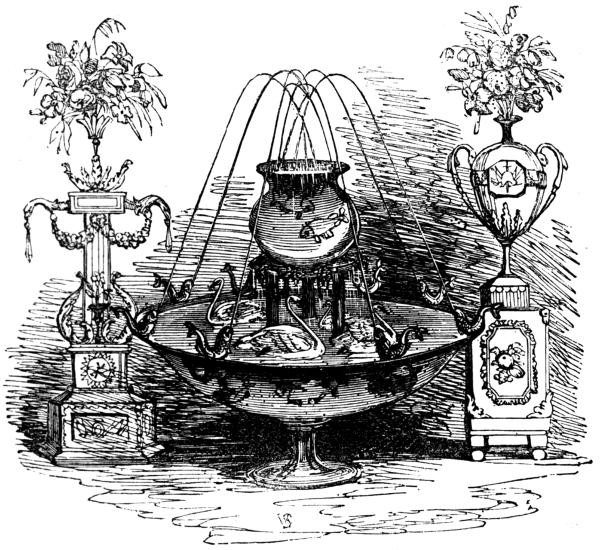
A Fountain in June, 1826. In the window of Mr. Farrel, Pastrycook, Lambs-Conduit-Street, London.
NATURALISTS’ CALENDAR.
Mean Temperature 59·15.
June 10.
House of God, Newcastle.
On the 10th of June, 1412, King Henry IV. granted his royal license to an hospital called the Maison de Dieu, or “House of God,” erected by Roger Thornton, on the Sandhill, Newcastle, for the purpose of providing certain persons with food and clothing. The building seems to have been completed in that year. Before it was pulled down in 1823, the “Merchant’s Court” was established over it, and at this time a new building for the company of Free Merchants, &c., is erected on its site.
The son of the founder of the old hospital granted the use of its hall and kitchen “for a young couple when they were married to make their wedding dinner in, and receive the offerings and gifts of their friends, for at that time houses were not large.” Mr. Sykes, in his interesting volume of “Local Records,” remarks, that “this appears an ancient custom for the encouragement of matrimony.”
NATURALISTS’ CALENDAR.
Mean Temperature 59·37.
June 11.
Blessings of Instruction.
Hast thou e’er seen a garden clad In all the robes that Eden had; Or vale o’erspread with streams and trees, A paradise of mysteries; Plains with green hills adorning them, Like jewels in a diadem? These gardens, vales, and plains, and hills, Which beauty gilds and music fills, Were once but deserts. Culture’s hand Has scattered verdure o’er the land, And smiles and fragrance rule serene, Where barren wild usurped the scene. And such is man—A soil which breeds Or sweetest flowers, or vilest weeds; Flowers lovely as the morning’s light, Weeds deadly as an aconite; Just as his heart is trained to bear The poisonous weed, or flow’ret fair.
Bowring.
NATURALISTS’ CALENDAR.
Mean Temperature 58·75.
June 12.
The Season, in the Country.
Sheep-Shearing.
Sheep-shearing, one of the great rural labours of this delightful month, if not so full of variety as the hay-harvest, and so creative of matter for those “in search of the picturesque” (though it is scarcely less so), is still more lively, animated, and spirit-stirring; and it besides retains something of the character of a rural holiday, which rural matters need, in this age and in this country, more than ever they did, since it became a civilized and happy one. The sheep-shearings are the only stated periods of the year at which we hear of festivities, and gatherings together of the lovers and practisers of English husbandry; for even the harvest-home itself is fast sinking into disuse, as a scene of mirth and revelry, from the want of being duly encouraged and partaken in by the great ones of the earth; without whose countenance and example it is questionable whether eating, drinking, and sleeping, would not soon become vulgar practices, and be discontinued accordingly! In a state of things like this, the Holkham and Woburn sheep-shearings do more honour to their promoters than all their wealth can purchase and all their titles convey. But we are getting beyond our soundings: honours, titles, and “states of things,” are what we do not pretend to meddle with, especially when the pretty sights and sounds preparatory to and attendant on sheep-shearing, as a mere rural employment, are waiting to be noticed.
Now, then, on the first really summer’s day, the whole flock being collected on the higher bank of the pool formed at the abrupt winding of the nameless mill-stream, at the point, perhaps, where the little wooden bridge runs slantwise across it, and the attendants being stationed waist-deep in the midwater, the sheep are, after a silent but obstinate struggle or two, plunged headlong, one by one, from the precipitous bank; when, after a moment of confused splashing, their heavy fleeces float them along, and their feet, moving by an instinctive art which every creature but man possesses, guide them towards the opposite shallows, that steam and glitter in the sunshine. Midway, however, they are fain to submit to the rude grasp of the relentless washer, which they undergo with as ill a grace as preparatory schoolboys do the same operation. Then, gaining the opposite shore heavily, they stand for a moment till the weight of water leaves them, and, shaking their streaming sides, go bleating away towards their fellows on the adjacent green, wondering within themselves what has happened.
The shearing is no less lively and picturesque, and no less attended by all the idlers of the village as spectators. The shearers, seated in rows beside the crowded pens, with the seemingly inanimate load of fleece in their laps, and bending intently over their work; the occasional whetting and clapping of the shears; the neatly-attired housewives, waiting to receive the fleeces; the smoke from the tar-kettle, ascending through the clear air; the shorn sheep escaping, one by one, from their temporary bondage, and trotting away towards their distant brethren, bleating all the while for their lambs, that do not know them; all this, with its ground of universal green, and finished every-where by its leafy distances, except where the village spire intervenes, forms together a living picture, pleasanter to look upon than words can speak, but still pleasanter to think of, when that is the nearest approach you can make to it.[210]
Chronology.
On this day, in the year 1734, the duke of Berwick, while visiting the trenches at the siege of Philipsburgh, near Spire, in Germany, was killed, standing between his two sons by a cannon-ball. He was the illegitimate son of the duke of York, afterwards James II., whom he accompanied in his flight from England, in 1688. His mother was Arabella Churchill, maid of honour to the duchess of York, and sister to the renowned Marlborough.
The duke of Berwick on quitting the country, entered into the service of France, and was engaged in several battles against the English or their allies in Ireland, the Netherlands, Portugal, and Spain. At his death he was in the sixty-fourth year of his age. No general of his time excelled him in the art of war except his uncle, the duke of Marlborough.[211]
NATURALISTS’ CALENDAR.
Mean Temperature 58·40.
June 13.
Signs “Of the Times,” NEW AND OLD.
To the Editor of the Every-Day Book.
Liverpool, 6th June, 1826.
Sir,—The pages of The Every-Day Book, notwithstanding a few exceptions, have afforded me unqualified pleasure, and having observed your frequent and reiterated requests for communications, I have been induced to send you the following doggrels.
I ought to promise that they formed part of the sign of an alehouse, formerly standing in Chapel-street, near St. Nicholas church in this town, but which is now taken down to make room for a costly pile of warehouses since erected on the site.
The sign represented (elegantly, of course) a man standing in a cart laden with fish, and holding in his right hand what the artist intended to represent a salmon. The lines are to be supposed to be spoken by the driver:—
This salmon has got a tail It’s very like a whale, It’s a fish that’s very merry, They say it’s catch’d at Derry; It’s a fish that’s got a heart, It’s catch’d and put in Dugdale’s cart.
This truly classic production of the muse of Mersey continued for several years to adorn the host’s door, until a change in the occupant of the house induced a corresponding change of the sign, and the following lines graced the sign of “The Fishing Smack:”—
The cart and salmon has stray’d away, And left the fishing-boat to stay. When boisterous winds do drive you back, Come in and drink at the Fishing Smack.
Whilst I am upon the subject of “signs,” I cannot omit mentioning a punning one in the adjoining county (Chester) on the opposite side of the Mersey, by the highway-side, leading from Liscard to Wallasea. The house is kept by a son of Crispin, and he, zealous of his trade, exhibits the representation of a last, and under it this couplet:—
All day long I have sought good beer, And at the last I have found it here.
I do not know, sir, whether the preceding nonsense may be deemed worthy of a niche in your miscellany; but I have sent it at a venture, knowing that originals, however trifling, are sometimes valuable to a pains-taking (and, perhaps, wearied) collector.
I am, Sir, your obliged, Lector.
By publishing the letter of my obliging correspondent “Lector,” who transmits his real name, I am enabling England to say—he has done his duty.
Really if each of my readers would do like him I should be very grateful. While printing his belief that I am a “pains-taking” collector, I would interpose by observing that I am far, very far, from a “wearied” one: and I would fain direct the attention of every one who peruses these sheets to their collections, whether great or small, and express an earnest desire to be favoured with something from their stores; in truth, the best evidence of their receiving my sheets favourably will be their contributions towards them. While I am getting together and arranging materials for articles that will interest the public quite as much as any I have laid before them, I hope for the friendly aid of well-wishers to the work, and urgently solicit their communications.
NATURALISTS’ CALENDAR.
Mean Temperature 59·75.
June 14.
1826. Trinity Term ends.
Cheap Travelling.
To the Editor of the Every-Day Book.
Newark, May 17, 1826.
Sir,—The following singular circumstance may be relied on as a fact. The individual it relates to was well known upon the turf. I recollect him myself, and once saw the present venerable Earl of Fitzwilliam, on Stamford race-course, humorously inquire of him how he got his conveyance, in allusion to the undermentioned circumstance, and present him with a guinea.—I am, &c.
Benj. Johnson.
John Kilburn, a person well known on the turf as a list seller, &c., was at a town in Bedfordshire, and, as the turf phrase is, “quite broke down.” It was during harvest, and the week before Richmond races (Yorkshire), whither he was travelling, and near which place he was born: to arrive there in time he hit on the following expedient.—He applied to an acquaintance of his, a blacksmith, to stamp on a padlock the words ‘Richmond Gaol,’ with which, and a chain fixed to one of his legs, he composedly went into a corn-field to sleep. As he expected, he was soon apprehended and taken before a magistrate, who, after some deliberation, ordered two constables to guard him in a carriage to Richmond. No time was to be lost, for Kilburn said he had not been tried, and hoped they would not let him lay till another assize. The constables, on their arrival at the gaol, accosted the keeper with “Sir, do you know this man?” “Yes, very well, it is Kilburn; I have known him many years.” “We suppose he has broken out of your gaol, as he has a chain and padlock on with your mark. Is not he a prisoner?” “I never heard any harm of him in my life.” “Nor,” says Kilburn, “have these gentlemen: Sir, they have been so good as to bring me out of Bedfordshire, and I will not put them to further inconvenience. I have got the key of the padlock, and I will not trouble them to unlock it. I am obliged to them for their kind behaviour.” He travelled in this way about one hundred and seventy miles.
This anecdote has been seen before, perhaps, but it is now given on authority.
NATURALISTS’ CALENDAR.
Mean Temperature 59·67.
June 15.
Summer Merriment.
To the Editor of the Every-day Book.
Sir,—You have inserted in vol. i. p. 559, an interesting account of the Morris Dance in the “olden times,” and I was rather disappointed on a perusal of your extensive Index, by not finding a “few more words” respecting the Morris Dancers of our day and generation. I think this custom is of Moorish origin, and might have been introduced into this country in the middle ages. Bailey says, “the Morris Dance is an antic dance performed by five men and a boy, dressed in girl’s clothes.” The girlish part of it is, however, more honoured in “the breach than the observance.”
In June, 1826, I observed a company of these “bold peasantry, the country’s pride,” in Rosoman-street, Clerkenwell. They consisted of eight young men, six of whom were dancers; the seventh played the pipe and tabor; and the eighth, the head of them, collected the pence in his hat, and put the precious metal into the slit of a tin painted box, under lock and key, suspended before him. The tune the little rural-noted pipe played to the gentle pulsations of the tabor, is called
“Moll in the wad and I fell out, And what d’ye think it was about”
This may be remembered as one of the once popular street songs of the late Charles Dibdin’s composition. The dancers wore party-coloured ribands round their hats, arms, and knees, to which a row of small latten bells were appended, somewhat like those which are given to amuse infants in teeth-cutting, that tinkled with the motion of the wearers. These rustic adventurers “upon the many-headed town,” came from a village in Hertfordshire. Truly natural and simple in appearance, their features, complexion, dress, and attitude, perfectly corresponded. Here was no disguise, no blandishment, no superhuman effort. Their shape was not compressed by fashion, nor did their hearts flutter in an artificial prison. Nature represented them about twenty-five years of age, as her seasoned sons, handing down to posterity, by their exercises before the present race, the enjoyment of their forefathers, and the tradition of happy tenantry “ere power grew high, and times grew bad.” The “set-to,” as they termed it, expressed a vis-à-vis address; they then turned, returned, clapped their hands before and behind, and made a jerk with the knee and foot alternately,
“Till toe and heel no longer moved.”
Though the streets were dirty and the rain fell reluctantly, yet they heeded not the elemental warfare, but
“Danced and smiled, and danced and smiled again:”
hence their ornaments, like themselves, looked weather-beaten. Crowds collected round them. At 12 o’clock at noon, this was a rare opportunity for the schoolboys let out of their seats of learning and confinement. The occasional huzza, like Handel’s “Occasional Overture,” so pleasing to the ear of liberty, almost drowned the “Morris.” But at intervals the little pretty pipe drew the fancy, as it were, piping to a flock in the valley by the shade of sweet trees and the bosom of the silver brook. O! methought, what difference is here by comparison with the agile-limbed aërials of St. James’s and these untutored clowns! Yet something delightful comes home to the breast, and speaks to the memory of a rural-born creature, and recals a thousand dear recollections of hours gone down the voyage of life into eternity! To a Londoner, too, the novelty does not weary by its voluntary offering to their taste, and apposition to the season.
Lubin Brown, the piper, was an arch dark-featured person; his ear was alive to Doric melody; and he merrily played and tickled the time to his note. When he stopped to take breath, his provincial dialect scattered his wit among the gapers, and his companions were well pleased with their sprightly leader. Spagnioletti, nor Cramer, could do no more by sound nor Liston, nor Yates, by grimace. I observed his eye ever alert to the movement and weariness of his six choice youths. He was a chivalrous fellow: he had won the prize for “grinning through a horse collar” at the revel, thrown his antagonist in the “wrestling ring,” and “jumped twenty yards in a sack” to the mortification of his rivals, who lay vanquished on the green. The box-keeper, though less dignified than Mr. Spring, of Drury-lane, informed me that “he and his companions in sport” had charmed the village lasses round the maypole, and they intended sojourning in town a week or two, after which the box would be opened, and an equitable division take place, previously to the commencement of mowing and hay-harvest. He said it was the third year of their pilgrimage; that they had never disputed on the road, and were welcomed home by their sweethearts and friends, to whom they never omit the carrying a seasonable gift in a very humble “Forget me not!” or “Friendship’s Offering.”
Mr. Editor, I subscribe myself, Yours, very sincerely. J. R. P.
NATURALISTS’ CALENDAR.
Mean Temperature 58·55.
June 16.
Chronology.
June 16, 1722, the great duke of Marlborough died. (See vol. i., p. 798.) Among the “Original Papers,” published by Macpherson, is a letter of the duke’s to king James II., whom he “deserted in his utmost need” for the service of king William, wherein he betrays to his old master the design of his new one against Brest in 1694. This communication, if intercepted, might have terminated the duke’s career, and we should have heard nothing of his “wars in Flanders.” It appears, further, that the duke’s intrigues were suspected by king William, and were the real grounds of his imprisonment in the Tower two years before.
NATURALISTS’ CALENDAR.
Mean Temperature 59·12.
June 17.
St. Botolph.
This English saint, whose festival is on this day, with his brother Adulph, another saint, travelled into Belgic Gaul, where Adulph became bishop of Maestricht, and Botolph returned home with news of the religious houses he had seen abroad, and recommendations from the two sisters of Ethelmund, king of the south Saxons, who resided in France, to their brother in England. Ethelmund gave him a piece of land near Lincoln, called Icanhoe, “a forsaken uninhabited desert, where nothing but devills and goblins were thought to dwell: but St. Botolphe, with the virtue and sygne of the holy crosse, freed it from the possession of those hellish inhabitants, and by the means and help of Ethelmund, built a monasterie therein.” Of this establishment of the order of St. Benedict, St. Botolph became abbot. He died on this day in June, 680, and was buried in his monastery, which is presumed by some to have been at Botolph’s bridge, now called Bottle-bridge, in Huntingdonshire; by others, at Botolph’s town, now corruptly called Boston in Lincolnshire; and again, its situation is said to have been towards Sussex. Boston seems, most probably, to have been the site of his edifice.
St. Botolph’s monastery having been destroyed by the Danes, his relics were in part carried to the monastery of Ely, and part to that of Thorney. Alban Butler, who affirms this, afterwards observes that Thorney Abbey, situated in Cambridgeshire, founded in 972, in honour of St. Mary and St. Botolph, was one of those whose abbots sat in parliament, that St. Botolph was interred there, and that Thorney was anciently called Ancarig, that is, the Isle of Anchorets. It may here be remarked, however, that Westminster was anciently called Thorney, from its having been covered by briars; and that the last-written “History of Boston” refers to Capgrave, as saying, “that in the book of the church of St. Botolph, near Aldersgate, London, there is mention how a part of the body of St. Botolph was, by king Edward of happy memory, conferred on the church of St. Peter in Westminster.” Father Porter, in his “Flowers of the Saincts,” says, “it hath been found written in the booke of St. Botolphe’s church, near Aldersgate, in London, that part of his holy bodie was by king Edward given to the abbey of Winchester.” The editor of the Every-Day Book possessed “the register book of the church of St. Botolph, near Aldersgate,” when he wrote on “Ancient Mysteries,” in which work the manuscript is described: it wanted some leaves, and neither contained the entry mentioned by Capgrave, nor mentioned the disposition of the relics of St. Botolph. Besides the places already noticed, various others throughout the country are named after St. Botolph, and particularly four parishes of the city of London, namely, in Aldersgate before mentioned, Aldgate, Billingsgate, and Bishopsgate. Butler says nothing of his miracles, but Father Porter mentions him as having been “famous for miracles both in this life and after his death.”
Lady’s Dress in 1550.
The gentleman whose museum furnished the Biddenden cake, obligingly transmits an extract from some papers in his collection, relative to a wedding on this day.
To the Editor of the Every-Day Book.
Sir,—Perhaps the following account of the dresses of a lady in olden time may be interesting to your readers:—
The wedding-clothes of Miss Eliz. Draper, 1550, a present from her husband, John Bowyer, Esq. of Lincoln’s-inn:—
“Wedyn-apparrell bought for my wyffe, Elizabeth Draper, the younger, of Camberwell, against 17o die Junii, anno Domini, 1550, with dispensalls.
s. d.
First, 4 ells of tawney taffeta, at 11s. 6d. the ell, for the Venyce gowne 46 0
Item, 4 yardes of silk Chamlett crymson, at 7s. 6d. the yard, for a kyrtle 52 6
Item, one yard and a half of tawney velvet, to gard the Venyce gowne, at 15s. the yard 22 6
Item, half a yard of crymsyn satin, for the fore-slyves 6 8
Item, 8 yards of russel’s black, at 4s. 6d. the yard, for a Dutch gowne 35 0
Item, half a yard of tawney sattyn 5 0
Item, a yard and a quarter of velvet black, to guard the Dutch gowne 17 8
Item, 6 yards of tawney damaske, at 11s. the yard 66 0
Item, one yard and half a quarter of skarlett, for a pety cote with plites 20 0
Amounting to 271 4 ”
The wedding-ring is described as weighing “two angels and a duckett,” graven with these words, “Deus nos junxit, J.E.B.Y.R.” The date of the marriage is inserted by Mr. B. with great minuteness (at the hour of eight, the dominical letter F. the moon being in Leo), with due regard to the aspects of the heavens, which at that time regulated every affair of importance.
I am, &c. J. I. A. F.
June 5, 1826.
NATURALISTS’ CALENDAR.
Mean Temperature 59·55.
June 18.
Chronology.
On the 18th of June, 1805, died Arthur Murphy, Esq., barrister at law, and bencher of Lincoln’s-inn; a dramatic and miscellaneous writer of considerable celebrity. He was born at Cork, in 1727, and educated in the college of St. Omers, till his 18th year, and was at the head of the Latin class when he quitted the school. He was likewise well acquainted with the Greek language. On his return to Ireland he was sent to London, and placed under the protection of a mercantile relation; but literature and the stage soon drew his attention, and wholly absorbed his mind. The success of his first tragedy, “The Orphan of China,” enabled him to discharge some pecuniary obligations he had incurred, and he made several attempts to acquire reputation as an actor; but, though he displayed judgment, he wanted powers, and was brutally attacked by Churchill, from motives of party prejudice. Mr. Murphy in a very humorous ode to the naiads of Fleet-ditch, intituled “Expostulation,” vindicated his literary character. He withdrew from the stage, studied the law, made two attempts to become a member of the Temple and of Gray’s-inn, and was rejected, on the illiberal plea that he had been upon the stage. More elevated sentiments in the members of Lincoln’s-inn admitted him to the bar, but the dramatic muse so much engaged his attention, that the law was a secondary consideration. He wrote twenty-two pieces for the stage, most of which were successful, and several are stock pieces. He first started into the literary world with a series of essays, intituled “The Gray’s-inn Journal.” At one period he was a political writer, though without putting his name to his productions. He produced a Latin version of “The Temple of Fame,” and of Gray’s “Elegy,” and a well-known translation of the works of Tacitus. He was the intimate of Foote and Garrick, whose life he wrote. He had many squabbles with contemporary wits, particularly the late George Steevens, Esq.; but, though he never quietly received a blow, he was never the first to give one. Steevens’s attack he returned with abundant interest. His friend Mr. Jesse Foot, whom he appointed his executor, and to whom he entrusted all his manuscripts, says, “He lived in the closest friendship with the most polished authors and greatest lawyers of his time; his knowledge of the classics was profound; his translations of the Roman historians enlarged his fame; his dramatic productions were inferior to none of the time in which he flourished. The pen of the poet was particularly adorned by the refined taste of the critic. He was author of ‘The Orphan of China,’ ‘The Grecian Daughter,’ ‘All in the Wrong,’ ‘The Way to keep Him,’ ‘Know your own Mind,’ ‘Three Weeks after Marriage,’ ‘The Apprentice,’ ‘The Citizen,’ and many other esteemed dramatic productions.” He had a pension of 200l. a year from government during the last three years of his life; and was a commissioner of bankrupts. His manners were urbane, and if he sometimes showed warmth of temper, his heart was equally warm towards his friends.
NATURALISTS’ CALENDAR.
Mean Temperature 60·17.
June 19.
1826.—General Election.
The united kingdom may be said to be in uproar, wherever the electors are solicited for their “sweet voices.” One place latterly seems to be without a candidate; viz. “the ancient and honorable borough of Garrett,” situate near the Leather Bottle in Garrett Lane, in the parish of Wandsworth, in the county of Surrey. Information to the Editor respecting former elections for Garrett, and especially any of the printed addresses, advertisements, or hand bills, if communicated to the Editor of the Every-Day Book immediately, will enable him to complete a curious article in the next sheet. Particulars respecting Sir Jeffery Dunstan, Sir Harry Dimsdale, Sir George Cook, Sir John Horn Conch, baronets, or other “public characters” who at any time had the honour to represent Garrett, will be very acceptable, but every thing of the sort should be forwarded without an hour’s delay.
NATURALISTS’ CALENDAR.
Mean Temperature 59·77.
June 20.
Custom at Dunmow, in Essex.
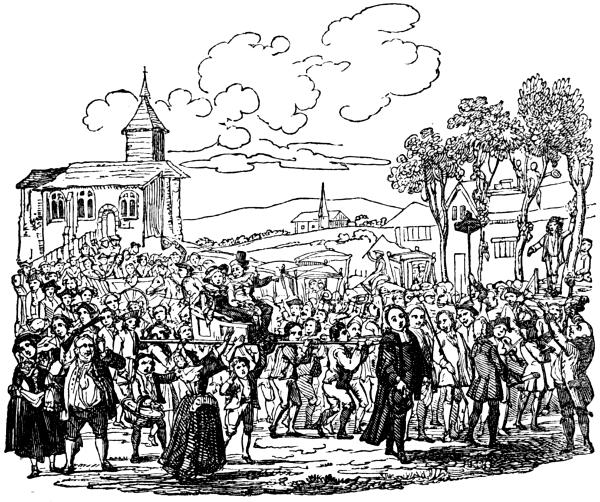
Custom at Dunmow, in Essex.
On this day, in the year 1751, a flitch of bacon was claimed at Dunmow, in Essex, by a man and his wife, who had the same delivered to them as of right, according to ancient custom, on the ground that they had not quarrelled, nor had either repented, nor had one offended the other, from the day of their marriage.—The above Engraving is after a large print by C. Mosley, “from an original painting taken on the spot by David Ogborne,” which print represents the procession of the last-mentioned claimants on their return from Dunmow church with the flitch.
Ogborne’s print, from whence the preceding engraving is taken, bears this inscription:—
“An exact Perspective View of Dunmow, late the Priory in the county of Essex, with a Representation of the Ceremony & Procession in that Mannor, on Thursday the 20 of June 1751 when Thomas Shakeshaft of the Parish of Weathersfield in the county aforesaid, Weaver, & Ann his Wife came to demand and did actually receive a Gammon of Bacon, having first kneelt down upon two bare stones within the Church door, and taken the said Oath pursuant to the ancient custom in manner & form prescribed as aforesaid.” A short account of this custom precedes the above inscription.
Mr. Brand speaks of his possessing Ogborne’s print, and of its having become “exceedingly rare;” he further cites it as being inscribed “Taken on the spot and engraved by David Ogborne.” Herein he mistakes; for, as regards Ogborne, both old and modern impressions are inscribed as already quoted in the preceding column: in the old impression “C. Mosley sculpt.” stands below “the oath” in verse, at the right hand corner of the plate; and in the modern one it is erased from that part and placed at the same corner above “the oath,” and immediately under the engraving; the space it occupied is supplied by the words “Republish’d Octr 28th. 1826 by R. Cribb, 288 Holborn”: its original note of publication remains, viz. “Publish’d according to Act of Parliament Janry. 1752.” The print is now common.
Mr. Brand, or his printer, further mistakes the name of the claimant on the print, for, in the “Popular Antiquities” he quotes it “Shapeshaft” instead of “Shakeshaft;” and he omits to mention a larger print, of greater rarity in his time, “sold by John Bowles Map & Printseller in Cornhill,” entitled “The Manner of claiming the Gamon of Bacon &c. by Thos. Shakeshaft, and Anne his wife” which it thus represents:—
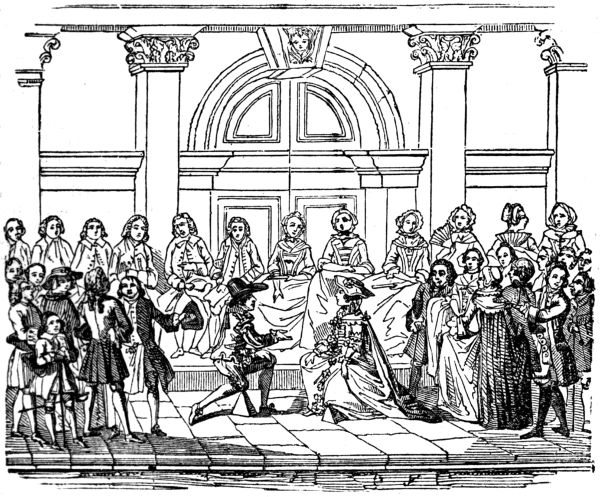
The last taking of the Oath at Dunmow, FOR THE GAMMON OF BACON.
FORM OF THE OATH.
You shall swear by Custom of Confession, If ever you made nuptial trangression: Be you either married man or wife, By household brawles or contentious strife, Or otherwise in bed, or at boord, Offend each other in deed, or word; Or since the parish Clerk said Amen, You wish’t yourselves unmarried agen: Or in a twelve moneths time and a day Repented not in thought any way: But continued true and just in desire As when you joyned hands in the holy quire If to these conditions without all feare, Of your own accord you will freely sweare, A whole Gammon of Bacon you shall receive, And bear it henceforth with love and good leave. For this is our Custome at Dunmow well known, Though the pleasure be ours, the Bacon’s your own.
On the taking of this oath, which is cited by an old county historian,[212] and somewhat varies from the verses beneath the before-mentioned prints, the swearers were entitled to the flitch, or gammon.
The “Gentleman’s Magazine,” of 1751, mentions that on this day “John Shakeshanks, woolcomber, and Anne his wife, of the parish of Weathersfield, in Essex, appeared at the customary court at Dunmow-parva, and claim’d the bacon according to the custom of that manor.” This is all the notice of the last claim in that miscellany, but the old “London Magazine,” of the same year, adds, that “the bacon was delivered to them with the usual formalities.” It is remarkable that in both these magazines the parties are named “Shakeshanks.” On reference to the court-roll, the real name appears to be Shakeshaft.
Ogborne’s print affirms that this custom was instituted in or about the year 1111, by Robert, son of Richard Fitz Gilbert, Earl of Clare: but as regards the date, which is in the time of Henry I., the statement is inaccurate; for if it originated with Robert Fitzwalter, as hereafter related, he did not live till the time of “King Henry, son of King John,” who commenced his reign in 1199, and was Henry III.
Concerning the ceremony, the print goes on to describe, that after delivering the bacon, “the happy pair are taken upon men’s shoulders, in a chair kept for that purpose, and carried round the scite of the priory, from the church to the house, with drums, minstrells, and other musick playing, and the gammon of bacon borne on a high pole before them, attended by the steward, gentlemen, and officers of the manor, with the several inferior tenants, carrying wands, &c., and a jury of bachelors and maidens (being six of each sex) walking two and two, with a great multitude of other people, young and old, from all the neighbouring towns and villages thereabouts, and several more that came from very great distances (to the amount of many thousands in the whole), with shouts and acclamations, following.”[213]
The chair in which the successful candidates for “the bacon” were seated, after obtaining the honourable testimony of their connubial happiness, is made of oak, and though large, seems hardly big enough for any pair, but such as had given proofs of their mutual good-nature and affection. It is still preserved in Dunmow Church, and makes part of the admiranda of that place. It is undoubtedly of great antiquity, probably the official chair of the prior, or that of the lord of the manor, in which he held the usual courts, and received the suit and service of his tenants. There is an engraving of the chair in the “Antiquarian Repertory,” from whence this notice of it is extracted: it in no way differs from the chief chairs of ancient halls.
Of “the bacon,” it is stated, on Ogborne’s print, that “before the dissolution of monasteries, it does not appear, by searching the most ancient records, to have been demanded above three times, and, including this (demand of Shakeshaft’s) just as often since.” These demands are particularized by Dugdale, from a manuscript in the College of Arms,[214] to the following effect:—
“Robt. Fitzwalter, living long beloved of king Henry, son of king John, as also of all the realme, betook himself in his latter dayes to prayer and deeds of charity, gave great and bountifull alms to the poor, kept great hospitality, and re-edified the decayed prison (priory) of Dunmow, which one Juga (Baynard), a most devout and religious woman, being in her kinde his ancestor, had builded; in which prison (priory) arose a custome, begun and instituted, eyther by him, or some other of his successours, which is verified by a common proverb or saying, viz.—That he which repents him not of his marriage, either sleeping or waking, in a year and a day, may lawfully go to Dunmow and fetch a gammon of bacon. It is most assured that such a custome there was, and that this bacon was delivered with such solemnity and triumphs as they of the priory and the townsmen could make. I have enquired of the manner of it, and can learne no more but that it continued untill the dissolution of that house, as also the abbies. And that the party or pilgrim for bacon was to take his oath before prior and convent, and the whole town, humbly kneeling in the church-yard upon two hard pointed stones, which stones, some say, are there yet to be seen in the prior’s church-yard; his oath was ministered with such long process, and such solemne singing over him, that doubtless must make his pilgrimage (as I may term it) painfull: after, he was taken up upon men’s shoulders, and carried, first about the priory church-yard, and after, through the town with all the fryers and brethren, and all the town’s-folke, young and old, following him with shouts and acclamations, with his bacon borne before him, and in such manner (as I have heard) was sent home with his bacon; of which I find that some had a gammon, and others a flecke, or a flitch; for proof whereof I have, from the records of the house, found the names of three several persons that at several times had it.”
Anno 23. Henry VI. 1445, one Richard Wright of Badbury, near the city of Norwich in the county of Norfolk, labourer (Plebeius) came to Dunmow and required the bacon, to wit, on the 27th of April, in the 23d year of the reign of King Henry VI. and according to the form of the charter was sworn before John Cannon, prior of the place and the convent, and very many other neighbours, and there was delivered to him, the said Richard a side or flitch of bacon.
Anno 7 Edw. IV. 1467, one Stephen Samuel of Ayston-Parva, in the county of Essex, husbandman, on the day of the Blessed Virgin in Lent (25th March) in the 7th year of king Edward IV. came to the priory of Dunmow, and required a gammon of bacon; and he was sworn before Roger Bulcott, then prior of the place and the convent, and also before a multitude of other neighbours, and there was delivered to him a gammon of bacon.
Anno 2 Hen. VIII. 1510, Thomas le Fuller of Cogshall, in the county of Essex, came to the priory of Dunmow, and on the 8th day of September, being Sunday, in the 2d year of king Henry VIII. according to the form of the charter, was sworn before John Tils, then Prior of the house and the convent, and also before a multitude of neighbours, and there was delivered to him, the said Thomas, a gammon of bacon.
“Hereby it appeareth,” Dugdale says, “that it was according to a charter, or donation, given by some conceited benefactor to the house; and it is not to be doubted, but that at such a time, the bordering towns and villages resorted, and were partakers of their pastimes, and laughed to scorne the poore man’s pains[215].”
In a letter from F. D. to “Mr. Urban,” Shakeshaft, alias Shakeshank, is called the ancient woolcomber of Weathersfield, and a copy of the register of the form and ceremony, observed fifty years before, is communicated as follows:—
Extract from the Court Roll.
“Dunmow, Nuper Priorat.
At a court baron of the right worshipful Sir Thomas May, knt. there holden upon Friday the 7th day of June, in the 13th year of the reign of our sovereign lord William III. by the grace of God, &c. and in the year of our lord 1701, before Thomas Wheeler, gent. steward of the said manor, it is thus enrolled:
Homage. { Elizabeth Beaumont, Spinster } Jurat.
Henrietta Beaumont, Spinster
Annabella Beaumont, Spinster
Jane Beaumont, Spinster
Mary Wheeler, Spinster
“Be it remember’d, that at this court, in full and open court, it is found, and presented by the homage aforesaid, that William Parsley, of Much Easton in the county of Essex, butcher, and Jane his wife, have been married for the space of three years last past, and upward; and it is likewise found, presented, and adjudged, by the homage aforesaid, that the said William Parsley, and Jane his wife, by means of their quiet, peaceable, tender, and loving cohabitation, for the space of time aforesaid, (as appears by the said homage) are fit and qualify’d persons to be admitted by the court to receive the antient and accustom’d oath, whereby to entitle themselves to have the bacon of Dunmow delivered unto them, according to the custom of the manor.
“Whereupon, at this court, in full and open court, came the said William Parsley, and Jane his wife, in their proper persons, and humbly prayed, they might be admitted to take the oath aforesaid; whereupon the said steward, with the jury, suitors, and other officers of the court, proceeded, with the usual solemnity, to the antient and accustomed place for the administration of the oath, and receiving the gammon aforesaid, (that is to say) the two great stones lying near the church door, within the said manor, where the said William Parsley, and Jane his wife, kneeling down on the said two stones, and the said steward did administer unto them the above-mentioned oath in these words, or to this effect following, viz.
You do swear by custom of confession, That you ne’er made nuptial transgression, Nor since you were married man and wife, By houshold brawls, or contentious strife, Or otherwise, in bed or at board, Offended each other in deed or in word; Or in a twelvemonth’s time and a day, Repented not in thought any way; Or since the church clerk said Amen, Wished yourselves unmarried again, But continued true, and in desire As when you joyned hands in holy quire.
“And immediately thereupon, the said William Parsley, and Jane his wife, claiming the said gammon of bacon, the court pronounced the sentence for the same, in these words, or to the effect following—
Since to these conditions, without any fear, Of your own accord you do freely swear, A whole gammon of bacon you do receive, And bear it away with love and good leave, For this is the custom of Dunmow well known; Tho’ the pleasure be ours, the bacon’s your own.
“And accordingly a gammon of bacon was delivered unto the said William Parsley, and Jane his wife, with the usual solemnity.
“Examined per Thomas Wheeler, steward.”
The same day a gammon was delivered to Mr. Reynolds, steward to Sir Charles Barrington, of Hatfield Broad Oak.
The custom of this manor is commemorated “in this old distich” viz.
He that repents him not of his Marriage in a year and a day either sleeping or waking May lawfully goe to Dunmow and fetch a gammon of Bacon.
It is further mentioned in “Piers Plowman’s Vision,” and Chaucer refers to it in the following words:
The bacon was not set for hem I trowe, That some men haue in Essex at Donmowe
Wife of Bath’s Prologue.
Custom of Whichnovre, Stapfords. Bacon and Corn.
There is a similar usage, in the “Honor of Tutbury,” the whole whereof is here set forth in Dr. Plot’s words, viz.:
“I find that Sr. Philip de Somervile 10 of Edw. 3. held the Manors of Whichnovre, Scirescot, Ridware Netherton, and Cowlee, all in Com. Stafford of the Earles of Lancaster Lords of the Honor of Tutbury, by these memorable Services, viz. By two small fees, that is to say,
“When other Tenants pay for Reliefe one whole Knight’s fee, One hundred Shillings, he the said Sir Philip shall pay but Fifty shillings: and when Escuage is assessed throgheowtt the land; or to Ayde for to make th’ eldest sonne of the Lord, Knyght; or for to marry the eldest daughter of the Lord, the said Sir Philip shall pay bott the moitye of it that other shall paye. Nevertheless, the said Sir Philip shall fynde, meyntienge, and susteingne one Bacon flyke, hanging in his Hall at Whichenovre, redy arrayede all times of the yere, bott (except) in Lent; to be given to everyche mane, or woman married, after the day and the yere of their marriage be passed: and to be gyven to everyche mane of Religion, Archbishop, Bishop, Prior, or other Religious; and to everyche Preest, after the year and day of their profession finished, or of their dignity reseyved, in forme followyng. Whensoever that ony suche byforenamed, wylle come for to enquire for the Baconne, in there own persone; or by any other for them, they shall come to the Baillyfe, or to the Porter of the Lordship of Whichenovre, and shall say to them, in the manere as ensewethe;
“Bayliffe, or Porter, I doo you to knowe; that I am come for my self (or, if he be come for any other, shewing for whome) to demaunde one Bacon flyke, hanging in the Halle, of the Lord of Whichenovre, after the forme thereunto belongyng.
After which relacioun, the Baillyffe or Porter shall assign a day to him, upon promyse, by his feythe to retourne; and with him to bryng tweyne of his neighbours.
“And, in the meyn tyme, the said Bailliffe shall take with him tweyne of the Freeholders of the Lordship of Whichenovre; and they three, shall go to the Manoir of Rudlowe, belongynge to Robert Knyghtleye, and there shall somon the forseid Knyghteley or his Baillyffe; commanding him, to be redy at Whichenovre, the day appoynted, at pryme of the day, withe his Caryage; that is to say, a Horse and a Sadylle, a Sakke, and a Pryke, for to convey and carye the said Baconne, and Corne, a journey owtt of the Countee of Stafford, at hys costages. And then the sayd Baillyffe, shall, with the sayd Freeholders, somone all the Tenaunts of the said Manoir, to be ready at the day appoynted, at Whichenovre, for to doo and perform the services which they owe to the Baconne. And, at the day assign’d, all such as owe services to the Baconne, shall be ready at the Gatte of the Manoir off Whichenovre, frome the Sonnerysing to None, attendying and awatyn for the comyng for hym, that fetcheth the Baconne. And, when he is comyn, there shall be delivered to hym and hys felowys, Chapeletts; and to all those whiche shall be there; to do their services deue to the Baconne: And they shall lede the seid Demandant wythe Trompes and Sabours, and other maner of Mynstralseye, to the Halle-dore, where he shall fynde the Lord of Whichenovre, or his Steward, redy to deliver the Baconne, in this manere:—
“He shall enquere of hym, whiche demandeth the Baconne, yf he have brought tweyn of hys Neghbors with hym. Whiche must answere; They be here ready. And then the Steward shall cause thies two Neighbours to swere, yf the seyd Demandaunt be a weddyt man; or have be a man weddyt: and yf sythe his Marriage, one yere and a day be passed: and, yf he be a freeman, or a villeyn. And yf hys seid neghbours make Othe, that he hath for hym all thies three poynts rehersed; then shall the Baconne be take downe, and broghte to the Hall-dore; and shall there be layd upon one halfe a Quarter of Wheatte; & upon one other of Rye. And he that demandeth the Baconne shall kneel upon his knee; and shall hold his right hand upon a booke; which booke shall be layde above the Baconne, and the Corne; and shall make Othe, in this manere.
“Here ye, Sir Philippe de Somervile, Lord of Whichenovre, mayntener and gyver of this Baconne; That I A. sithe I Wedded B. my wife, and sythe I hadd hyr in my kepyng, and at my wylle, by a yere and a day, after our Mariage; I wold not have chaunged for none other; farer, ne fowler; rycher ne pourer; ne for none other descended of greater lynage; slepyng, ne waking, at noo tyme. And yf the seyd B. were sole, and I sole, I would take her to be my Wyfe, before alle the wymen of the worlde; of what condiciones soever they be; good or evylle, as helpe me God ond hys Seyntys; and this fleshe, and all fleshes.
“And hys neighbors shall make Othe, that they trust veraly he hath said truly. And, yff it be founde by his neighbours, before-named, that he be a Free-man; there shall be delyvered to him half a Quarter of Wheate, and a Cheese. And yf he be a villeyn, he shall have half a Quarter of Rye, wythoutte Cheese. And then shall Knyghtleye, the Lord of Rudlowe, be called for, to carrye all thies thynges, tofore rehersed: And the said Corne shall be layd upon one horse, and the Baconne above ytt: and he too whom the Baconne apperteigneth, shall ascend upon his Horse; and shall take the Cheese before hym, yf he have a Horse: And, yf he have none, the Lord of Whichenovre shall cause him have one Horse and Sadyll, to such time as he be passed hys Lordshippe: and so shalle they departe the Manoir of Whichenovre, with the Corne and the Baconne, tofore hym that hath wonne itt, with Trompets, Tabouretts, and other maner of Mynstralce. And, all the Free-Tenants of Whichenovre shall conduct hym, to be passed the Lordship of Whichenovre. And then shall all they retorne; except hym, to whom apperteigneth to make the carryage and journey, wythowtt the Countye of Stafford, at the Costys of hys Lord of Whichenovre. And, yff the sayd Robert Knightley, do not cause the Baconn and Corne, to be conveyed, as is rehersed; the Lord of Whichenovre shall do it be carryed, and shall dystreigne the seyd Robert Knyghtley for his defaulte, for one hundred shyilings, in his Manoir of Rudlowe; and shalle kepe the distres, so takyn, irreplevisable.
“Moreover, the said Sir Philippe holdeth of his Lorde, th’ Erle, the Manoir of Briddleshalle, by thies services; that, att such tyme, that hys sayd Lorde holdeth hys Chrystemes at Tutbury, the seyd Sir Phelippe shall come to Tutbury, upon Chrystemasse Evyn; and shall be lodged yn the Town of Tutbury, by the Marshall of the Erlys house: and upon Chrystymesse-day, he himself, or some othyr Knyght (his Deputye) shall go to the Dressour; and shall serve to his Lordys meese: and then shall he kerve the same meet to hys sayd Lord: And thys service shall he doo aswell at Souper, as at Dynner: and when hys Lord hath etyn; the said Sir Philippe shall sit downe, in the same place, wheir hys Lord satt: and shalle be served att hys Table, by the Steward of th’ Erlys house. And, upon Seynt Stevyn-day, when he haith dyned, he shall take leve of hys Lorde, and shall kysse hym: and, for hys service he shall nothing take, ne nothing shall gyve. And all thyes services, tofore-rehersed, the seyd Sir Philippe hath doo, by the space of xlviii. yeres; and hys ancestors byfore hym, to hys Lordys, Erlys of Lancastre.
“Item, the said Sir Philippe holdeth of his seid Lord, th’Erle, his Manoirs of Tatenhull and Drycotte, en percenerye, by thies services; that the seid Sir Phelippe, or his Atturney for hym, shall come to the Castell of Tutburye, upon Seynt Petyr day, in August, which is called Lammesse; and shall shew the Steward, or Receiver, that he is come thither to hunt, and catch his Lord’s Greese, at the costages of hys Lorde. Whereupon the Steward or the Receiver shall cause a Horse and Sadylle to be deliveryd to the sayd Sir Phelippe, the price Fifty shillings; or Fifty shillings in money, and one Hound; and shall pay to the said Sir Phelippe, everyche day, fro the said day of Seynt Peter, to Holy Roode-day, for hymself Two shillings six pence a day; and everyche day for his servant, and his Bercelett, during the sayd time twelve pence. And all the Wood-masters of the Forest of Nedewode and Duffelde, withe alle the Parkers and Foresters, shall be commandyd to awatte, and attend upon the sayd Sir Phelippe, while theyre Lord’s Greese be takyn, in all places of the seyde Forestys, as upon their Master, during the said tyme. And the said Sir Phelippe, or his Attorny, shall deliver to the said Parkers, or Foresters, that shall belonge to their Lordys Lardere; commandyng them to convey itt to the Erlys Lardyner, abyding at Tutbury: and with the remenant, the seyd Sir Phelippe shall do hys plesoure. And, upon Holy-Rood-day the sayd Sir Phelippe shall returne to the Castell of Tutbury, upon the said Horse, with his Bercelet; and shall dyne with the Steward or Receyver: and after Dynner he shall delyver the Horse, Sadylle, and Bercelett to the Steward or Receyvour; and shall kysse the Porter and depart.”
Having here set forth these singular usages in the “Pea season,” it may not be amiss to add the following—
Receipt to make Somersetshire Bacon.
The best time is between September and Christmas. Procure a large wooden trough; lay the sides of the hog in the trough, and sprinkle them heavily with bay-salt; leave them twenty-four hours to drain away the blood, and other over-abounding juices. Then take them out, wipe them dry, and throw away the drainings. Take some fresh bay-salt, and heating it well in an iron frying-pan, (beware not to use copper or brass though ever so well tinned,) rub the meat till you are tired; do this four days successively, turning the meat every other day. If the hog is large, keep the sides in the brine (turning them ten times) for three weeks; then take them out, and dry them thoroughly in the usual manner.[216]
Finally, remembering that the customs before stated relate to marriage, it occurs that there is the following
Receipt for a Good Match.
To make a good match you have brimstone and wood, Take a scold and a blockhead—the match must be good.
NATURALISTS’ CALENDAR.
Mean Temperature 60·47.
June 21.
The Longest Day.
This day the sun enters the sign Cancer, and is then at his extreme distance north of the Equator, passing in the zenith over the heads of all the inhabitants situated on the tropical line; while to us, who reside in London, he appears at his greatest altitude, and hence arises the increased heat we experience from his rays.
To individuals within the Arctic circle the sun at this time does not set.
Cancer is the first of the summer signs, and when the sun enters it we have our longest day. According to Sir William Jones, “the Hindu Asbrono mer Varaha lived when the solstices were in the first degrees of Cancer and Capricorn.” It is now above 2000 years since the solstices thus coincided, and, at present, the sign Cancer begins near the two stars which form the upper foot in the constellation Gemini, and terminates about the fourth degree within the eastern boundary of the constellation Cancer. In the Zodiac of Dendera this sign is represented by a scarabæus or beetle.
Fruits.
To the eye and palate of the imagination, this month and the next are richer than those which follow them; for now you can “have your fruit and eat it too;” which you cannot do then. In short, now the fruit blossoms are all gone, and the fruit is so fully set that nothing can hurt it; and what is better still, it is not yet stealable, either by boys, birds, or bees; so that you are as sure of it as one can be of any thing, the enjoyment of which is not actually past. Enjoy it now, then, while you may; in order that, when in the autumn it disappears, on the eve of the very day you had destined for the gathering of it (as every body’s fruit does), you alone may feel that you can afford to lose it. Every heir who is worthy to enjoy the estate that is left to him in reversion, does enjoy it whether it ever comes to him or not.
On looking more closely at the Fruit, we shall find that the Strawberries, which lately (like bold and beautiful children) held out their blossoms into the open sunshine, that all the world might see them, now, that their fruit is about to reach maturity, hide it carefully beneath their low-lying leaves, as conscious virgins do their maturing beauties;—that the Gooseberries and Currants have attained their full growth, and the latter are turning ripe;—that the Wall-fruit is just getting large enough to be seen among the leaves without looking for;—that the Cherries are peeping out in white or “cherry-cheeked” clusters all along their straight branches;—and that the other standards, the Apples, Pears, and Plums, are more or less forward, according to their kinds.[217]
NATURALISTS’ CALENDAR.
Mean Temperature 59·49.
The Longest Day. For the Every-Day Book.
Cradled in glory’s ether-space, By Venus nursed till morn,— The light unrolls thy golden life And thou art sweetly born. O lovely Day of bloom and shine, Of heat, and air, and strain! Millions rejoice and millions die Within thy halcyon reign. Hopes, fears, and doubts, the passions move; ’Twas yesterday the same:— To-morrow! thou wilt join the dead, And only live by name— Jupiter guides thee through the skies To Hope’s eternal shore: The sun departs—Thou, Longest Day— Thou wilt be seen no more! Methuselah of England’s year! Thou Parr of Time—Farewell! St. Thomas, shortest of thy race, Shall ring thine annual knell.
J. R. Prior.
Young Birds.
The following letter is to be considered as addressed to the reader, rather than the editor, who, as yet, is not even a tyro in the art wherein his respected correspondent has evidently attained proficiency. Indeed the communication ought to have been inserted in May. If its agreeable writer, and his good-natured readers, can excuse the omission, the birds and the editor will be equally obliged.
The Rearing and Treatment of Young Birds.
To the Editor of the Every-Day Book.
Now, thro’ the furrows where the skylarks build, Or by the hedge-rows green, the fowler strays, Seeking the infant bird.
Sir,—As the time has arrived for taking the young from the feathered tribe, it may not be amiss to say a few words by way of advice to the uninitiated, concerning the rearing, and training of these amusing creatures, who repay our cares with their rich melody.
We may now get Chaffinches, Goldfinches, Linnets, Larks, &c. in the streets, or at the different shops at a very small expense, either singly, or by the nest, according to their ages, but I should recommend all who wish to purchase young birds to go to a regular dealer, who sell them quite as cheap, and warrant them cocks. Buy them when they begin to feed themselves—or, if younger, when you have them home, put them in a cage, rather roomy:—then for Linnets, Goldfinches, or Chaffinches, mix rape-seed, bruised, and bread, steeped in boiling water—with which, when cooled, you may feed them, putting it into their mouths from the end of a stick, about every two hours; water they will not require, the food being sufficiently moist for them. When you find them peck at the stick, and take their food eagerly from it, which they will do at about a fortnight old, place some food about the cage with clean dry gravel, scattering among it some dry seed bruised; they will pick it up, and so be weaned off the moist food, which is no longer proper for them—also place water in the pot. This, as regards their feeding, is all you have to do, while they remain healthy—if sick, you must treat them according to the nature of their complaint. I think their sickness at this early stage of their existence is either caused by cold, or by the oily nature of their food, it being too strong for their stomachs; to remedy this, mix a little of the fine gravel with it, this will help their digestion. Sometimes the seed will scour them, in that case, boiled milk, or rust of iron put into their water is a remedy. So much as concerns the hard-billed tribe.
If your fancy runs on soft-billed birds, such as the skylark, woodlark, nightingale, or robin, you must feed them with egg, and bread moistened with water; or beef, raw or cooked; changing it as they grow and begin to feed themselves, to dry egg chopped small, and crumbled bread; throwing in with it German paste, until you find them contented with the latter. All these birds will live healthy, and sing stout, on this food, except the nightingale; he must have beef and egg. The remedy for sickness and scouring is as before; if the paste binds them, give them raw beef, or chopped fig; the latter is good for all birds, keeping them in beautiful feather, and cool in body. When a month old, cage them off in their proper cages.
Give your captives good food, and clear water; keep their dwellings free from vermin, which you may always do by having a spare cage to turn them into once a week, while you search the other, and destroy the devouring race of red lice that breed in their crevices and corners.
Squirt a mouthful of water over your birds now and then, it will do them good; this will much assist them in their moulting, and make them throw their feathers faster, particularly larks, nightingales, and robins. The latter may have their water-pans to fix inside the cage, so that they can dabble in them, when they like; this will save the trouble of taking them out to clean their feet. Larks must be taken out once a week, or their claws will become clogged with dirt, and rot off. The cleaning their feet is but very little trouble; dip them in warm water, and rub the dirt gently off with your thumb and finger. As these innocent creatures delight you with the beauty of their feathers, and sweetness of their song, too much cannot be done for their comfort.
Hoping this little dissertation (if I may so call it) will be useful,
I am, &c. S.R.J.
I conclude with the following
Sonnet On hearing a Thrush singing in the rain.
How sweet the song of the awakened thrush— Mellow’d by distance, comes upon the ear, Tho’ gather’d clouds have made the heavens drear, And the rain hisses in the hazel bush, Wherein he warbles with a voice as clear As if blue skies were over, and he near The one that lov’d him—sweet, yet sad to hear! For it remindeth me of one I’ve heard, Singing to other ears, herself unseen, In her own bower, like that delightful bird, While yet her bosom’s hopes were fresh and green, One, whom I heard again in after years, When sorrow smote her,—singing midst her tears.
S. R. J.
May, 1826.
The editor has often wished, for the sake of feathered posterity, that he could ensure their liberty; but he can no more do that, than persuade those who think they have “vested rights” in the bodies of certain of the airy race, to open their cages and “set the prisoners free.” It is in his power, however, to assist a little in ameliorating their condition, by urging re-perusal and strict attention to the preceding letter. He is himself particularly struck with the direction, “squirt a mouthful of water over your birds now and then—it will do them good.” He ventures with becoming diffidence to suggest, whether to syringe a little may not be as beneficial as to “squirt a mouthful.” This is the only exception he dares to hint, and it is to be marked as a qualified one, and, under a sense of inexperience, made “at a hazard.” But he agrees that “a nightingale,”—a caged nightingale, alas!—“must have beef and egg;” and “that larks must be taken out once a week”; and—he may be wrong—if they fly away, so much the better. He is strongly of opinion that birds are like himself—they cannot “bear confinement,” and be happy.
June 22.
1826. General Election.
Parliament having existed to its utmost legal duration, the electors exercised, or withheld the exercise of their franchise, according to their individual wishes or hopes, desires or fears, intelligence or ignorance; or as feelings of independence directed, or influence over weakness misdirected. Contests were as numerous and fierce as usual; and, as might have been expected, in some places, the numerical state of the poll-books intimated more of intellectual enlargement than the final results. No new arguments or means were resorted to. The following paragraph is only inserted as an instance, that to buy as cheap, and sell as dear as possible, as a principle of trade, was not thoroughly lost sight of by dealers.
Price of Provisions during Elections.
During the election at Sudbury, four cabbages sold for 10l., and a plate of gooseberries fetched 25l.; the sellers, where these articles were so dear, being voters. At Great Marlow, on the contrary, things were cheap, and an elector during the election bought a sow and nine young pigs for a penny.[218]
Election for Garrett.
The “County History” says, that the Hamlet of Garrett is in the road from Wandsworth to Tooting. About two centuries ago it appears to have been a single house called the Garvett. In it was the mansion-house of the Brodrick family, pulled down about fifty years ago; the ground is let to a market gardener; part of the garden wall remains. Garrett now contains about fifty houses, amongst which are some considerable manufactures. This used to be for many years the scene of a mock election, and much indecency on the meeting of every new parliament, when several characters in low life appeared as candidates, being furnished with fine clothes and gay equipages by the publicans, who made a good harvest. The last of these, known by the name of Sir Harry Dimsdale, was a deformed dwarf, little better than an idiot, who used to cry muffins in the streets about St. Ann’s, Soho, and died about 1809. It has been dropped at the two last general elections; but the memory of it will be preserved by Foote’s diverting farce of “The Mayor of Garrett.”—There are three prints displaying the proceedings on occasion of this election.[219]