SEPTEMBER. (continued 2)
Reading edition
NATURALISTS’ CALENDAR.
Mean Temperature 56·42.
September 13.
NATURALISTS’ CALENDAR.
Mean Temperature 56·90.
September 14.
Holy Cross.
The origin of the festival of “Holy Cross,” standing in the church of England calendar and almanacs, is related in vol. i. col. 1291, with some account of the rood and the rood-loft in churches.
NATURALISTS’ CALENDAR.
Mean Temperature 58·20.
September 15.
“The Devil looking over Lincoln.”
On the 15th of September, 1731, “the famous devil that used to overlook Lincoln college in Oxford, was taken down, having, about two years since, lost his head, in a storm.”
On the same day in the same year “a crown, fixed on the top of Whitehall gate in the reign of king Charles II., fell down suddenly.”[342]
The origin of the statue of the devil at Oxford is not so certain as that the effigy was popular, and gave rise to the saying of “the devil looking over Lincoln.”
Satanic Superstitions.
That the devil has a “cloven foot,” which he cannot hide if it be looked for is a common belief with the vulgar. “The ground of this opinion at first,” says sir Thomas Browne, “might be his frequent appearing in the shape of a goat,” (this accounts also for his horns and tail,) “which answers this description. This was the opinion of the ancient christians, concerning the apparition of panites, fauns, and satyrs; and of this form we read of one that appeared to Anthony in the wilderness.” Mr. Brand collects, respecting this appearance, that Othello says, in the “Moor of Venice,”
“I look down towards his feet; but that’s a fable; If that thou be’st a devil, I cannot kill thee;”
which Dr. Johnson explains: “I look towards his feet, to see, if, according to the common opinion, his feet be cloven.” There is a popular superstition both in England and Scotland relative to goats: that they are never to be seen for twenty-four hours together; and that once in that space, they pay a visit to the devil in order to have their beards combed.
Baxter, in his “World of Spirits,” mentions an anecdote from whence Mr. Brand imagines, that “this infernal visitant was in no instance treated with more sang froid on his appearing, or rather, perhaps, his imagined appearance, than by one Mr. White of Dorchester.” That gentleman was assessor to the Westminster Assembly at Lambeth, and “the devil, in a light night, stood by his bed-side: he looked awhile whether he would say or do any thing, and then said, ‘If thou hast nothing else to do, I have;’ and so turned himself to sleep.”
King James I. told his parliament in a speech on a certain occasion, that “the devil is a busy bishop.” It has been objected to this saying of “His Most Dread Majesty,” that it would have sounded well enough from a professed enemy to the bench, “but came very improperly from a king who flattered them more, and was more flattered by them, than any prince till his time.”[343]
Printers’ Devils.
As I was going the other day into Lincoln’s-inn, (says a writer in the “Grub-street Journal” of October 26, 1732,) under a great gateway, I met several lads loaded with great bundles of newspapers, which they brought from the stamp-office. They were all exceeding black and dirty; from whence I inferred they were “printers’ devils,” carrying from thence the returns of unsold newspapers, after the stamps had been cut off. They stopt under the gateway, and there laid down their loads; when one of them made the following harangue: “Devils, gentlemen, and brethren:—though I think we have no reason to be ashamed on account of the vulgar opinion concerning the origin of our name, yet we ought to acknowledge ourselves obliged to the learned herald, who, upon the death of any person of title, constantly gives an exact account of his ancient family in my London Evening Post. He says, there was one monsieur Devile, or De Ville, who came over with William the Conqueror, in company with De Laune, De Vice, De Val, D’Ashwood, D’Urfie, D’Umpling, &c. One of the sons of a descendant of this monsieur De Ville, was taken in by the famous Caxton in 1471, as an errand boy; was afterwards his apprentice, and in time an eminent printer, from whom our order took their name; but suppose they took it from infernal devils, it was not because they were messengers frequently sent in darkness, and appeared very black, but upon a reputable account, viz., John Fust, or Faustus, of Mentz, in Germany, was the inventor of printing, for which he was called a conjurer, and his art the black art. As he kept a constant succession of boys to run on errands, who were always very black, these they called devils; some of whom being raised to be his apprentices, he was said to have raised many a devil. As to the inferior order among us, called flies, employed in taking newspapers off the press, they are of later extraction, being no older than newspapers themselves. Mr. Bailey thinks, their original name was lies, taken from the papers they so took off, and the alteration occasioned thus. To hasten these boys, the pressmen used to cry flie, lie, which naturally fell into one single word lie. This conjecture is confirmed by a little corruption in the true title of the fLying Post; since, therefore, we are both comprehended under the title of devils, let us discharge our office with diligence; so may we attain, as many of our predecessors have done, to the dignity of printers, and to have an opportunity of using others as much like poor devils, as we have been used by them, or as they and authors are used by booksellers. These are an upstart profession, who have engrossed the business of bookselling, which originally belonged solely to our masters. But let them remember, that if we worship Belial and Beelzebub, the God of flies, all the world agrees, that their God is mammon.”
The preceding is from the “Gentleman’s Magazine” for October, 1732; and it is mentioned, that “at the head of the article is a picture emblematically displaying the art and mystery of printing; in which are represented a compositor, with an ass’s head; two pressmen, one with the head of a hog, the other of a horse, being names which they fix upon one another; a flie taking off the sheets, and a devil hanging them up; a messenger with a greyhound’s face kicking out the “Craftsman;” a figure with two faces, for the master, to show he prints on both sides; but the reader is cautioned against applying it to any particular person, who is, or ever was a printer; for that all the figures were intended to represent characters and not persons.”
It is a proverbial expression, not confined to our country, that “the devil is not so black as he is painted.” The French, in their usual forms of speech, mention him with great honour and respect. Thus, when they would commend any thing, they break out into this pious exclamation, “Diable! que cela est bon!” When they would represent a man honest, sincere, and sociable, they call him “un bon Diable.” Some of our own countrymen will say, a thing is “devilish good;” a lady is “devilish pretty.” In a mixture of surprise and approbation, they say, “the devil’s in this fellow, or he is a comical devil.” Others speak of the apostate angel with abhorrence, and nothing is more common than to say, “such a one is a sad devil.” I remember when I was at St. Germains, a story of a gentleman, who being in waiting at the court of king James II., and the discourse running upon demons and apparitions, the king asked him whether ever he had seen any thing of that sort. “Yes,” replied he, “last night.” His majesty asked him what he had seen. He answered, “the devil.” Being asked in what shape,—“O sir,” said he, with a sigh, “in his usual and natural shape, that of an empty bottle.”[344]
NATURALISTS’ CALENDAR.
Mean Temperature 59·32.
September 16.
Fraudulent Debtor.
On the 16th of September, 1735, Mr. Yardley died in the Fleet prison, where he had been confined nearly ten years in execution for a debt of a hundred pounds. He was possessed of nearly seven hundred a year, and securities and other effects to the value of five thousand pounds were found in his room.[345]
NATURALISTS’ CALENDAR.
Mean Temperature 59·04.
September 17.
Lambert.
There is an account of this saint of the church of England calendar, in vol. i. col. 1295.
Remarkable Thief.
On the 17th of September, 1737, the secret was discovered of some mysterious robberies committed in Gray’s-inn, while the inhabitants had been in the country.
About a month before, there died at a madhouse near Red Lion-square, one Mr. Rudkins, who had chambers up three pair of stairs, at No. 14, in Holborn-court, Gray’s-inn. His sister-in law and executrix, who lived in Staffordshire, wrote to Mr. Cotton, a broker, to take care of the effects in her behalf; and he having read a Mr. Warren’s advertisement of his chambers having been robbed, found several of his writings there; several things of a Mr. Ellis, who had been robbed about two years before of above three hundred pounds, of a Mr. Lawson’s of the Temple, and of captain Haughton’s, whose chambers were broken open some years previously, and two hundred pounds’ reward offered for his writings, which were a part found here. There were also found books to one hundred pounds’ value, belonging to Mr. Osborne the bookseller in Gray’s-inn.
It is remarkable, that when Mr. Rudkins had any thing in view in this way, he would padlock up his own door, and take horse at noonday, giving out to his laundress that he was going into the country. His chambers consisted of five rooms, two of which not even his laundress was ever admitted into, and in these was found the booty, with all his working tools, picklocks, &c. He had formerly been a tradesman in King-street, near Guildhall. It is further remarkable of this private house-breaker, that he always went to Abingdon’s coffee-house, in Holborn, on an execution-day, to see from thence the poor wretches pass by to their dismal end; and at no other time did he frequent that coffee-house.
NATURALISTS’ CALENDAR.
Mean Temperature 58·95.
September 18.
George I. and II. Landed.
The “coming over” of these two kings of the house of Brunswick, is marked in the almanacs on this day, which is kept as a holiday at all the public offices, except the excise, stamps, and customs.
NATURALISTS’ CALENDAR.
Mean Temperature 58·97.
September 19.
University of Gottingen.
In September, 1737, a new university founded at Gottingen, by his Britannic majesty, which has since attained to great eminence, was “opened with a very solemn inauguration.” In 1788, the black board, on the walls of its council-house, bore three edicts for the expulsion of three students named Westfield, Planch, and Bauer. These papers were drawn up in Latin by the celebrated professor Heyne, and are printed in the “Gentleman’s Magazine” for June, 1789. King George IV., when prince regent in 1814, sent a copy of every important work published in England during the ten preceding years, as a present to the library of the university, agreeable to a promise he had made to that purport.
NATURALISTS’ CALENDAR.
Mean Temperature 57·87.
September 20.
Health—Cholera Morbus.
This is, of all times of the year, the most productive of epidemical disorders of the bowels, which are erroneously ascribed to fruits, but which, in reality, the autumnal fruits seem best calculated to mollify. If the diarrhea be very violent, or accompanied with incessant vomiting, as in cholera morbus, the best practice is, after the intestinal canal has been suffered copiously to evacuate itself, to take small doses of chalk, or of some other substance known to check the disorder, with which chemists are always prepared. But in ordinary cases, it is a safer plan to let the disease spend itself, as there is a great deal of irritation of the intestines, which the flux carries off. We should avoid eating animal food, but take tea, broths, gruel, and other diluents, and the disorder will usually soon subside of itself. After it has so subsided we should guard against its return, by taking great care to keep the bowels regular, by eating light and vegetable food and fruits, or now and then taking a gentle dose of aloes, gr. iiii. The pills which commonly go by the name of Hunt’s pills, if genuine, are very good medicines to regulate the bowels. When low spirits and want of bile indicate the liver to partake much of the disease, two grains of the pil. hydrarg., commonly called blue pill, may be used now and then with advantage.[346]
NATURALISTS’ CALENDAR.
Mean Temperature 58·45.
September 21.
The Season.
Swallows and martins are still very numerous, the general migration not having begun. They roost in immense numbers on buildings, round about which martins fly some times in such quantities as almost to darken the air with their plumes. Sparrows, linnets, various finches, and also plovers, are now seen about in flocks, according to an annual habit, prevalent among many kinds of birds, of assembling together in autumn.[347]
The accompanying stanzas applicable to the season, are extracted from an original poem, entitled “The Libertine of the Emerald Isle,” which will, probably, be published early in the next year.
Autumn. For the Every-Day Book.
The leaves are falling, and the hollow breeze At ev’ning tide sweeps mournfully along, Making sad music, such as minor keys Develope in a melancholy song: The meadows, too, are losing by degrees Their green habiliments—and now among The various works of nature there appears A gen’ral gloom, prophetic of the year’s Approaching dissolution:—but to me These sombre traits are pregnant with delight, And yield my soul more true felicity Than words can justly picture:—they invite My mind to contemplation—they agree With my heart’s bias, and at once excite Those feelings, both of love and admiration, Which make this world a glorious revelation! Hence—not unfrequently when all is still, And Cynthia walks serenely through the sky, Silv’ring the groves and ev’ry neighb’ring hill, I sit and ponder on the years gone by: This is the time when reason has her fill Of this world’s good and evil, when the eye Of contemplation takes a boundless range Of spheres that never vacillate or change! Sweet Autumn! thou’rt surrounded with the charms Of reason, and philosophy, and truth, And ev’ry “sound reflection” that disarms This life of half its terrors:—in our youth We feel no sense of danger, and the qualms Of conscience seldom trouble us forsooth, Because the splendour of its reign destroys Whatever checks our sublunary joys? But thou art far too rigid and severe To let these errors triumph for a day, Or suffer folly, in her mad career, To sweep our reas’ning faculties away! Thou pointest out the fun’ral of the year, The summer’s wreck and palpable decay, Stamping a “moral lesson” on the mind, To awe, restrain, and meliorate mankind! But men are callous to thy warning voice, And pass thee by, regardless of thy worth, Making a false and perishable choice Of all the fleeting pleasures of the earth: They love gross riot, turbulence, and noise, The Bacchanalian’s ebriating mirth, And when the autumn of their lives creeps on, Their wit has vanish’d, and their strength is gone! But had they been observant of thy pow’rs, And ponder’d o’er thy ruin and decay, They might have well applied them to those hours Which nothing, for an instant, can delay; But whilst health, strength, and competence are our’s, And youth is basking in the summer’s ray, Life’s autumn scenes reluctantly are view’d, And folly’s visions joyously pursued!
B. W. R.
NATURALISTS’ CALENDAR.
Mean Temperature 58·02.
September 22.
St. Maurice.
This saint, to whom and his companions a festival is celebrated by the Romish church on this day, received a similar honour in England. They are said to have been officers in the Theban legion, which refused to sacrifice to the gods on their march into Gaul, and were, therefore, ordered to be decimated by Maximian. Every tenth man was accordingly put to death, and on their continued resistance, a second decimation ordered, and Maurice and his companions encouraged them, and the whole legion consisting of six thousand six hundred men, well armed, being no way intimidated to idolatry by cruelty, were slaughtered by the rest of the army, and relics of their bodies were gathered and preserved, and worked miracles.[348]
Battle of Threekingham.
For the Every-Day Book.
The village of Threekingham, in the county of Lincoln, was known by the name of Laundon, previous to this day, A. D. 870, when a battle was fought between the English and Danes, of which Ingulphus, a monk of Crowland abbey, has left the following account.
The Danes entered England in the year 879, and wintered at York; and in the year 880 proceeded to the parts of Lindsey, in Lincolnshire, where they commenced their destructive depredations by laying waste the abbey of Bardney. In the month of September in the latter year, earl Algar, with two of his seneschals, (Wibert, owner of Wiberton, and Leofric, owner of Leverton,) attended by the men of Holland (Lincolnshire), Toly, a monk (formerly a soldier), with two hundred men belonging to Crowland abbey, and three hundred from Deeping, Langtoft, and Boston, Morcar, lord of Bourn, with his powerful family, and Osgot, sheriff of Lincolnshire, with the forces of the county, being five hundred more, mustered in Kesteven, on the day of St. Maurice, and fought with the Danes, over whom they obtained considerable advantage, killing three of their kings and many of their private soldiers, and pursued the rest to their very camp, until night obliged them to separate. In the same night several princes and earls of the Danes, with their followers, who had been out in search of plunder, came to the assistance of their countrymen; by the report of which many of the English were so dismayed that they took to flight. Those, however, who had resolution to face the enemy in the morning, went to prayers, and were marshalled for battle. Among the latter was Toly with his five hundred men in the right wing, with Morcar and his followers to support them; and Osgot the sheriff, with his five hundred men, and with the stout knight, Harding de Riehall, and the men of Stamford. The Danes, after having buried the three kings whom they had lost the day before, at a place there called Laundon, but since, from that circumstance, called Three-king-ham, marched out into the field. The battle began, and the English, though much inferior in numbers, kept their ground the greater part of the day with steadiness and resolution, until the Danes feigning a flight, were rashly pursued without attention to order. The Danes then took advantage of the confusion of the English, returned to the charge, and made their opponents pay dearly for their temerity; in fine, the Danes were completely victorious. In this battle, earl Algar, the monk Toly, and many other valiant men, were slain on the part of the English; after which the Danes proceeded to the destruction of the abbeys of Crowland, Thorney, Ramsey and Hamstede (Peterborough) and many other places in the neighbourhood.—Thus far is from Ingulphus the monk.
A fair, said to have arisen from the above circumstance, is annually held at Three-king-ham, on a remarkable piece of ground, called Stow Green Hill, reported to be the spot whereon the battle was principally contested, and Domesday-book in some degree corroborates the statement; for in the Conqueror’s time, A. D. 1080, when that survey was taken, we find that there was then a fair held here, which yielded forty shillings, accounted for to Gilbert de Gand, lord of Foldingham. This fair, however, is not held now in the month of September, but commences on the 15th of June, and continues till the fourth of July, and was very probably changed in the fifty-second year of the reign of king Henry III., who according to Tanner’s “Notitia Monastica,” granted a charter for a fair at this place to the monastery of Sempringham.
Sleafordensis.
September 8, 1826.
NATURALISTS’ CALENDAR.
Mean Temperature 57·70.
September 23.
Opening of the Winter Theatres.
For the Every-Day Book.
To cultivate pleasant associations, may well be deemed a part and parcel of the philosophy of life. Now that spring, that sweet season redolent of flowers and buds hath passed away, and summer mellowing into autumn, has well nigh fallen into the “sere the yellow leaf,” we in “populous city pent,” gladly revert to those social enjoyments peculiar to a great metropolis, and among which stand conspicuous, the amusements of the acted drama.
The opening of the winter theatres may be reckoned as one of the principal fasti of cockney land, an epoch which distinctly marks the commencement of a winter in London. How changed from the auspicious season, when the bright sun glancing into our gloomy retreats, tantalizes us with visions of the breathing sweets of nature, and when we in our very dreams “babbled of green fields,”—to the period when even the thronged and dirty streets are endurable, as we wend our way perchance through a fog, (a London particular,) towards the crowded and gaily lighted theatre, by contrast made more brilliant.
“My first play” forms an era to most young persons, and is generally cherished among our more agreeable juvenile reminiscences: but the subject has been recently expatiated upon so delightfully and in so genial a spirit by Elia, as almost to make further comment “a wasteful and ridiculous excess.” I well remember the vast and splendid area of old Drury-lane theatre, where the mysterious green curtain portico, to that curious microcosm the stage, first met my youthful gaze. The performances were, the “Stranger” and “Blue Beard,” both then in the very bloom of their popularity: and whatever difference of opinion may exist as to the moral tendency of the first, all must allow that never piece was more effective in the representation, when aided by the unrivalled talents of Kemble, and Mrs. Siddons, at that time in the zenith of their powers. I confess, that to my unsophisticated boyish feelings, subdued by the cunning of the scene, it seemed quite natural, that the sufferings of bitter remorse and repentance should suffice to ensure the pity and forgiveness of outraged society.—Happy age, when the generous impulses of our nature are not yet blunted by the stern experience of after life!
This brings me to record a remarkable and disastrous event in theatrical annals, and one which in a great measure suggested the present communication. It was my fortune to be present at the last performances ever given on the boards of Old Drury—and which took place on Thursday evening the 23rd of February, 1809—when was acted for the first, and as it proved, the last time, a new opera composed by Bishop, called the “Circassian Bride.” The next night this magnificent theatre was a pile of burning ruins. The awful grandeur of the conflagration defies description, but to enlarge upon a circumstance so comparatively recent would be purely gratuitous; it was, however, an event which might be truly said, “to eclipse the harmless gaiety of nations,”—for the metropolis then presented the unprecedented spectacle of the national drama without a home,—the two sister theatres both prostrate in the dust!
Annexed is a copy of the play-bill, which at this distance of time, may perhaps be valued as an interesting relic, illustrative of dramatic history. J. H.
NEVER ACTED. Theatre Royal, Drury-lane.
This present Thursday, February 23, 1809.
Their Majesties Servants will perform a New Opera, in Three Acts, called the
CIRCASSIAN BRIDE.
With New Scenery, Dresses, and Decorations.
The Overture and Music entirely new, composed by Mr. Bishop.
CIRCASSIANS. Alexis, Mr. Braham, Rhindax, Mr. De Camp, Demetrio, Mr. Marshall, Basil, Mr. Ray, Officers, Mr. Gibbon, Mr. Miller, Chief Priest, Mr. Maddocks, Erminia, Miss Lyon.
ENGLISH. Ben Blunt, Mr. Bannister, Tom Taffrel, Mr. Smith, Rachael, Mrs. Mountain.
TARTARS. Usberg, (the Khan,) Mr. J. Smith, Barak, Mr. Mathews, Kerim, Mr. Fisher, Hassan, Mr. Cooke, Slaves, Messrs. Webb, Evans, Chatterley, Anna, Mrs. Bland.
The DANCE by Mesds. Green, Twamley, Davis, H. and F. Dennet.
Chorus of Circassians, Tartars, &c. By Messrs. Danby, Cook, Evans, Caulfield, Bond, Dibble, Jones, Mesds. Stokes, Chatterley, Menage, Maddocks, Wells, Butler. The New Scenes designed by Mr. Greenwood, And executed by him, Mr. Banks, and Assistants. The Dresses and Decorations, by Mr. Johnston, and executed by him, Mr. Banks and Mr. Underwood. The Female Dresses designed and executed by Miss Rein. Books of the Songs to be had in the Theatre.
To which will be added the Farce of
FORTUNE’S FROLIC.
Robin Roughhead, Mr. Mathews, Rattle, Mr. Palmer, Nancy Miss Lacy Margery, Mrs. Sparks, Dolly, Mrs. Harlowe.
Places for the Boxes to be taken of Mr. Spring, at the Box-Office, Russel-street.
No money to be returned.
Vivant Rex et Regina! (Lowndes and Hobbs, Printers, Marquis-court, Drury-lane.)
“Elia.”-Why should J. H. pop on me with his mention of Elia, just as I was about to write “an article?” Write!—it’s impossible. I have turned to “My First Play”—I cannot get it out my head: the reader must take the consequence of my inability, and of the fault of J. H., and read what I shall never approach to, in writing, were I to “grind my quill these hundred years”——
MY FIRST PLAY By Elia.
At the north end of Cross-court there yet stands a portal, of some architectural pretensions, though reduced to humble use, serving at present for an entrance to a printing-office. This old door-way, if you are young, reader, you may not know was the identical pit entrance to Old Drury—Garrick’s Drury—all of it that is left. I never pass it without shaking some forty years from off my shoulders, recurring to the evening when I passed through it to see my first play. The afternoon had been wet, and the condition of our going (the elder folks and myself) was, that the rain should cease. With what a beating heart did I watch from the window the puddles, from the stillness of which I was taught to prognosticate the desired cessation! I seem to remember the last spurt, and the glee with which I ran to announce it.
We went with orders, which my godfather F. had sent us. He kept the oil shop (now Davies’s) at the corner of Featherstone-building, in Holborn. F. was a tall grave person, lofty in speech, and had pretensions above his rank. He associated in those days with John Palmer, the comedian, whose gait and bearing he seemed to copy; if John (which is quite as likely) did not rather borrow somewhat of his manner from my godfather. He was also known to, and visited by, Sheridan. It was to his house in Holborn, that young Brinsley brought his first wife on her elopement with him from a boarding school at Bath—the beautiful Maria Linley. My parents were present (over a quadrille table) when he arrived in the evening with his harmonious charge.—From either of these connections, it may be inferred that my godfather could command an order for the then Drury-lane theatre at pleasure—and, indeed, a pretty liberal issue of those cheap billets, in Brinsley’s easy autograph, I have heard him say was the sole remuneration which he had received for many years’ nightly illumination of the orchestra, and various avenues of that theatre—and he was content that it should be so. The honour of Sheridan’s familiarity—or supposed familiarity—was better to my godfather than money.
F. was the most gentlemanly of oilmen; grandiloquent, yet courteous. His delivery of the commonest matters of fact was Ciceronian. He had two Latin words almost constantly in his mouth, (how odd sounds Latin from an oilman’s lips!) which my better knowledge since, has enabled me to correct. In strict pronunciation they should have been sounded vice versâ—but in those young years they impressed me with more awe than they would now do, read aright from Seneca or Varro—in his own peculiar pronunciation, monosyllabically elaborated, or anglicized, into something like verse verse. By an imposing manner, and the help of these distorted syllables, he climbed (but that was little) to the highest parochial honours which St. Andrew’s has to bestow.
He is dead, and thus much I thought due to his memory, both for my first orders (little wondrous talismans!—slight keys, and insignificant to outward sight, but opening to me more than Arabian paradises!) and moreover, that by his testamentary beneficence I came into possession of the only landed property which I could ever call my own—situate near the road-way village of pleasant Puckeridge, in Hertfordshire. When I journied down to take possession, and planted foot on my own ground, the stately habits of the donor descended upon me, and I strode (shall I confess the vanity?) with larger paces over my allotment of three quarters of an acre, with its commodious mansion in the midst with the feeling of an English freeholder, that all betwixt sky and centre was my own. The estate has passed into more prudent hands, and nothing but an agrarian can restore it.
In those days were pit orders. Beshrew the uncomfortable manager who abolished them!—with one of these we went. I remember the waiting at the door—not that which is left—but between that and an inner door in shelter—O when shall I be such an expectant again;—with the cry of nonpareils, an indispensable playhouse accompaniment in those days. As near as I can recollect, the fashionable pronunciation of the theatrical fruiteresses then was, “Chase some oranges, chase some numparels, chase a bill of the play;”—chase pro chuse. But when we got in, and I beheld the green curtain that veiled a heaven to my imagination, which was soon to be disclosed—the breathless anticipations I endured! I had seen something like it in the plate prefixed to “Troilus and Cressida,” in Rowe’s “Shakspeare”—the tent scene with Diomede—and a sight of that plate can always bring back in a measure the feeling of that evening.—The boxes at that time, full of well-dressed women of quality, projected over the pit; and the pilasters reaching down were adorned with a glistering substance (I know not what) under glass (as it seemed) resembling—a homely fancy—but I judged it to be sugar-candy—yet, to my raised imagination, divested of its homelier qualities, it appeared a glorified candy!—The orchestra lights at length arose, those “fair Auroras!” Once the bell sounded. It was to ring out yet once again—and, incapable of the anticipation, I reposed my shut eyes in a sort of resignation upon the maternal lap. It rang the second time. The curtain drew up—I was not past six years old—and the play was Artaxerxes!
I had dabbled a little in the Universal History—the ancient part of it—and here was the court of Persia. It was being admitted to a sight of the past. I took no proper interest in the action going on, for I understood not its import—but I heard the word Darius, and I was in the midst of Daniel. All feeling was absorbed in vision. Gorgeous vests, gardens, palaces, princesses, passed before me. I knew not players. I was in Persepolis for the time; and the burning idol of their devotion almost converted me into a worshipper. I was awe-struck, and believed those significations to be something more than elemental fires. It was all enchantment and a dream. No such pleasure has since visited me but in dreams.—Harlequin’s Invasion followed; where, I remember, the transformation of the magistrates into reverend beldams seemed to me a piece of grave historic justice, and the tailor carrying his own head to be as sober a verity as the legend of St. Denys.
The next play to which I was taken was the “Lady of the Manor,” of which, with the exception of some scenery, very faint traces are left in my memory. It was followed by a pantomime, called “Lun’s Ghost”—a satiric touch, I apprehend, upon Rich, not long since dead—but to my apprehension (too sincere for satire) “Lun” was as remote a piece of antiquity as “Lud”—the father of a line of Harlequins—transmitting his dagger of lath (the wooden sceptre) through countless ages. I saw the primeval Motley come from his silent tomb in a ghastly vest of white patch-work, like the apparition of a dead rainbow. So harlequins (thought I) look when they are dead.
My third play followed in quick succession. It was the “Way of the World.” I think I must have sat at it as grave as a judge; for, I remember, the hysteric affectations of good lady Wishfort affected me like some solemn tragic passion. “Robinson Crusoe” followed; in which Crusoe, man Friday, and the parrot, were as good and authentic as in the story.—The clownery and pantaloonery of these pantomimes have clean passed out of my head. I believe, I no more laughed at them, than at the same age I should have been disposed to laugh at the grotesque Gothic heads (seeming to me then replete with devout meaning) that gape, and grin, in stone around the inside of the old round church (my church) of the Templars.
I saw these plays in the season 1781-2, when I was from six to seven years old. After the intervention of six or seven other years (for at school all play-going was inhibited) I again entered the doors of a theatre. That old Artaxerxes evening had never done ringing in my fancy. I expected the same feelings to come again with the same occasion. But we differ from ourselves less at sixty and sixteen, than the latter does from six. In that interval what had I not lost! At the first period I knew nothing, understood nothing, discriminated nothing. I felt all, loved all, wondered all—
Was nourished, I could not tell how.—
I had left the temple a devotee, and was returned a rationalist. The same things were there materially; but the emblem, the reference, was gone!—The green curtain was no longer a veil, drawn between two worlds, the unfolding of which was to bring back past ages, to present “a royal ghost,”—but a certain quantity of green baize, which was to separate the audience for a given time from certain of their fellow-men who were to come forward and pretend those parts. The lights—the orchestra lights—came up a clumsy machinery. The first ring, and the second ring, was now but a trick of the prompter’s bell—which had been, like the note of the cuckoo, a phantom of a voice, no hand seen or guessed at which ministered to its warning. The actors were men and women painted. I thought the fault was in them; but it was in myself, and the alteration which those many centuries—of six short twelvemonths—had wrought in me. Perhaps it was fortunate for me that the play of the evening was but an indifferent comedy, as it gave me time to crop some unreasonable expectations, which might have interfered with the genuine emotions with which I was soon after enabled to enter upon the first appearance to me of Mrs. Siddons in “Isabella.” Comparison and retrospection soon yielded to the present attraction of the scene; and the theatre became to me, upon a new stock, the most delightful of recreations.
After this robbery of “Elia,” my conscience forces me to declare that I wish every reader would save me from the shame of further temptation to transgress, by ordering “Elia” into his collection. There is no volume in our language so full of beauty, truth, and feeling, as the volume of “Elia.” I am convinced that every person who has not seen it, and may take the hint, will thank me for acquainting him with a work which he cannot look into without pleasure, nor lay down without regret. It is a delicious book.
Sherborne Bells.
On this day it is a custom to exercise the largest bell of one of our country churches, in the manner described in the following communication.
Tolling Day.
For the Every-Day Book.
The 23d of September has obtained in Sherborne, Dorset, the name of “tolling-day,” in commemoration of the death of John Lord Digby, baron Digby of Sherborne, and earl of Bristol, in the year MDCXCVIII. and in conformity with the following wish expressed in a codicil annexed to his lordship’s will.
“Item, I give and bequeath out of my said estate to the parish church, the yearly sum of ten pounds, to be paid by my successors, lords of the said manor for the time being, at and upon, or within forty days after, the feast days of St. Michael the archangel, and of the annunciation of our blessed lady St. Mary the virgin, by equal portions yearly and for ever, and to be employed and bestowed by the churchwardens of the said parish for the time being, with the consent of the lord of the said manor for the time being, in keeping in good repair the chancel, and towards the reparations of the rest of the said church, yearly and for ever; provided that my successors, the lord or lords of the said manor for the time being, shall have and enjoy a convenient pew, or seat, in the said chancel for himself and family for ever; and provided that the said churchwardens for the time being, shall cause the largest bell in the tower of the said church, to be tolled six full hours, that is to say, from five to nine of the clock in the forenoon, and from twelve o’clock till two in the afternoon, on that day of the said month whereon it shall be my lot to depart this life, every year and for ever; otherwise this gift of ten pounds per annum shall determine and be void.”
This custom is annually observed, but not to the extent above intended, the tolling of the bell being limited to two hours instead of six. It begins to toll at six o’clock and continues till seven in the morning, when six men, who toll the bell for church service, repair to the mansion of the present earl Digby, with two large stone jars, which are there filled with some of his lordship’s strong beer, and, with a quantity of bread and cheese, taken to the church by the tollers and equally divided amongst them, together with a small remuneration in money paid by the churchwardens as a compensation for their labour. At twelve o’clock the bell is again tolled till one, and in the evening divine service is performed at the church, and a lecture suited to the occasion delivered from the pulpit; for which lecture or sermon the vicar is paid thirty pounds, provided by the will of the above donor.
R. T.
Bow Bells.
Who has not heard of “Bow Bells?” Who that has heard them does not feel an interest in their sounds, or in the recollection of them? The editor is preparing an article on “Bow Bells,” and for that purpose particularly desires communications. Accounts relative to their present or former state, or any facts or anecdotes respecting them at any time, are earnestly solicited from every reader as soon as possible.
NATURALISTS’ CALENDAR.
Mean Temperature 56·02.
September 24.
A Good Tenant.
In the “Gentleman’s Magazine,” for September, 1775, Mr. Clayton, a wealthy farmer of Berkshire, is related to have died at the extraordinary age of a hundred and fifteen years, and retained his faculties to the last; he is further remarkable, for having rented one farm ninety years. An occupancy of so great duration, by one individual, is perhaps unequalled in the history of landlord and tenant.
NATURALISTS’ CALENDAR.
Mean Temperature 55·40.
September 25.
Sea Side Sports.
There is an exhilarating effect in the sea-air and coast scenery, which inland views or atmosphere, however fine, fail to communicate.
On the 25th of September, 1825, a gentleman and lady came out of one of the hotels near the Steyne, and after taking a fair start, set off running round the Steyne. They both ran very swiftly, but the young lady bounded forward with the agility of the chamois and the fleetness of the deer, and returned to the spot from whence they started a considerable distance before the gentleman. She appeared much pleased with her victory. There were but few persons on the Steyne at the time, but those who were there, expressed their admiration at the swiftness of this second Atalanta.[349]
Brighton.
In Mr. Hazlitt’s “Notes of a Journey through France and Italy,” he mentions the place from whence he sailed for the continent:—
“Brighton stands facing the sea, on the bare cliffs, with glazed windows to reflect the glaring sun, and black pitchy bricks shining like the scales of fishes. The town is however gay with the influx of London visiters—happy as the conscious abode of its sovereign! Every thing here appears in motion—coming or going. People at a watering-place may be compared to the flies of a summer; or to fashionable dresses, or suits of clothes, walking about the streets. The only idea you gain is, of finery and motion. The road between London and Brighton, presents some very charming scenery; Reigate is a prettier English country-town than is to be found anywhere—out of England! As we entered Brighton in the evening, a Frenchman was playing and singing to a guitar.—The genius of the south had come out to meet us.”
When Mr. Hazlitt arrived at Brighton, it was in the full season. He says, “A lad offered to conduct us to an inn. ‘Did he think there was room?’ He was sure of it. ‘Did he belong to the inn?’ ‘No,’ he was from London. In fact, he was a young gentleman from town, who had been stopping some time at the White-horse hotel, and who wished to employ his spare time (when he was not riding out on a blood-horse) in serving the house, and relieving the perplexities of his fellow-travellers. No one but a Londoner would volunteer his assistance in this way. Amiable land of Cockayne, happy in itself, and in making others happy! Blest exuberance of self-satisfaction, that overflows upon others! Delightful impertinence, that is forward to oblige them!”
It is here both in place and season, to quote a passage of remarkably fine thought:—
“There is something in being near the sea, like the confines of eternity. It is a new element, a pure abstraction. The mind loves to hover on that which is endless, and for ever the same. People wonder at a steam-boat, the invention of man, managed by man, that makes its liquid path like an iron railway through the sea—I wonder at the sea itself, that vast Leviathan, rolled round the earth, smiling in its sleep, waked into fury, fathomless, boundless, a huge world of water-drops.—Whence is it, whither goes it, is it of eternity or of nothing? Strange ponderous riddle, that we can neither penetrate nor grasp in our comprehension, ebbing and flowing like human life, and swallowing it up in thy remorseless womb,—what art thou? What is there in common between thy life and ours, who gaze at thee? Blind, deaf and old, thou seest not, hearest not, understandest not; neither do we understand, who behold and listen to thee! Great as thou art, unconscious of thy greatness, unwieldy, enormous, preposterous twin-birth of matter, rest in thy dark, unfathomed cave of mystery, mocking human pride and weakness. Still is it given to the mind of man to wonder at thee, to confess its ignorance, and to stand in awe of thy stupendous might and majesty, and of its own being, that can question thine!”[350]
In Mr. Hazlitt’s “Journey through France and Italy,” there are “thoughts that breathe and words that burn.” His conceptions of beauty and grandeur, are at all times simple and vast. His works are pervaded by the results of profound thinking. His sentences have the power of elevating things that are deemed little remarkable, and of lowering those which successive submissions to over praise, have preposterously magnified. Many of the remarks on works of art, in his “Notes of a Journey through France and Italy,” will be wholly new to persons who never reflected on the subjects of his criticism, and will not be openly assented to by others thinking as he does, who, for the first time, has ventured to publicly dissent from received notions. If any of his opinions be deemed incorrect, the difference can easily be arbitrated. Taking the originals, whether corporeal or imaginary existences, as the standard, our pure sight and feeling may be relied on as unerring judges of the imitations.
NATURALISTS’ CALENDAR.
Mean Temperature 54·27.
September 26.
St. Cyprian. Old Holy Rood.
For these remembrances in the church of England calendar and almanacs, see vol. i. p. 1324.
Communications of local customs are always received and inserted with satisfaction. It is with peculiar pleasure that the editor submits the following, from a gentleman with respect to whom he has nothing to regret, but that he is not permitted to honour the work, by annexing the name of the respectable writer to the letter.
Paisley Hallow-Eve Fires. Sheffield Scotland Feast.
Paisley, September 21, 1826.
To the Editor of the Every-Day Book.
Sir,—Having been a subscriber to your Every-Day Book from its first appearance in this town, up to the present time, I reproach myself with neglect, in not having sent you before now, an account of a rather singular custom prevalent here, and, as it should seem, of ancient date.
The river White Cart, on which Paisley stands, although affected by the tide, and navigable to the town for vessels not exceeding fifty tons’ burden, is often remarkably shallow at low water. This is especially the case between the highest and the lowest of three stone bridges, by which the old town or burgh is connected with the new town. In this shallow part of the stream, parties of boys construct, on Hallow-eve,—the night when varied superstitions engross most of old Scotia’s peasantry,—circular raised hearths, if I may so term them, of earth or clay; bordered by a low round wall composed of loose stones, sods, &c. Within these enclosures, the boys kindle on their hearths, bonfires, often of considerable size. From the bridges, the appearance of these bonfires, after nightfall, is singular; and attracts, as spectators, many of the grown-up inhabitants of the place. The number and glare of the fires, their tremulous reflection in the surrounding water, the dark moving figures of the boys that group around them, and the shouts and screams set up by the youthful urchins in testimony of enjoyment, might almost make one fancy that the rites and incantations of magic, or of wizardry, were taking place before one’s very eyes. What is the origin of this custom, or how long it has prevailed, I do not know.
Ere I relinquish my pen, allow me to describe to you another singular custom, which obtains in the largest town of England, north of the Trent.[351] No one is better acquainted than, Mr. Hone, are you, with the existence of the wake or feast, still held annually in some of the towns, and nearly all the parochial villages of the midland and northern counties. In many of the larger towns, the traces of the ancient wake are, indeed, nearly worn out, and this is pretty much the case with that particular town, to which reference has just been made, namely, Sheffield; our great national emporium for cutlery, files, edge-tools, and the better kinds of plated goods. Only in a few ancient and primitive families, do roast beef, plum-pudding, and an extra allowance of Yorkshire stingo, gracing, on Trinity Sunday, a large table, begirt with some dozen of happy, and happy-faced town and country cousins, show, that the venerable head of the family, and his antique dame, have not forgotten Sheffield feast-day. But if the observance of Sheffield feast itself be thus partial, and verging towards disuse, amends is made for the circumstance, in the establishment, and pretty vigorous keeping up of sundry local feasts, held on different days, within the town, or in its suburbs. Besides those of the Wicker and little Sheffield, which are suburban, Broad-lane and Scotland-street, in the town itself, have their respective feasts too. At Little Sheffield and in Broad-lane, the zest of the annual festivity is often heightened by ass-races; foot-races, masculine, for a hat; foot-races, feminine, for a chemise; grinning-matches; and, though less frequently, the humours and rattle of a mountebank and his merry andrew. Occasionally too changes, in imitation of those on the church bells, are rung, by striking with a hammer, or a short piece of steel, on six, eight, or ten long bars each suspended by twine from the roof of a workshop, and the entire set chosen so as to resemble pretty nearly, a ring of bells, both in diversity and in sequence of tone.[352]
Scotland feast, however, in point of interest, bears away the bell from all the other district revels of Sheffield. It is so called from Scotland-street, already mentioned; a long, hilly, and very populous one, situated in the northern part of the town. On the eve of the feast, which is yearly held on the 29th of May, the anniversary of the restoration of our second Charles, parties of the inhabitants repair into the neighbouring country; whence, chiefly however from Walkley-bank, celebrated as Sheffield schoolboys too well know for birch trees, they bring home, at dead of night, or morning’s earliest dawn, from sixteen to twenty well-sized trees, besides a profusion of branches. The trees they instantly plant in two rows; one on each side of the street, just without the kirbstone of the flagged pavement. With the branches, they decorate the doors and windows of houses, the sign-boards of drinking-shops, and so on. By five or six in the morning Scotland-street, which is not very wide, has the appearance of a grove. And soon, from ropes stretched across it, three, four, or five, superb garlands delight the eyes, and dance over the heads of the feast-folk. These garlands are composed of hoops, wreathed round with foliage and flowers, fluttering with variously coloured ribands, rustling with asidew,[353] and gay with silver tankards, pints, watches, &c. Before the door of the principal alehouse, the largest tree is always planted. The sign of this house is, if memory do not deceive me, the royal oak.[354] But be this as it may, certain it is, that duly ensconced among the branches of the said tree, may always be seen the effigy, in small, of king Charles the Second: to commemorate indeed the happy concealment and remarkable escape of the merry monarch, at Boscobel, should seem to be the object of creating a sylvan scene at “Scotland feast;” while that of holding the feast itself on the anniversary of his restoration is, there can be little doubt, to celebrate with honour the principal event in the life of him, after whose ancient and peculiar kingdom the street itself is named. To the particulars already given, it needs scarcely be added, that dancing, drinking, and other merry-making are, as a Scotsman would say, rife,[355] at the annual commemoration thus briefly described.
Thanking you for much instruction, as well as entertainment, already derived from your book, and wishing you success from its publication, I remain, Sir,
Your obedient servant, Gulielmus.
Asidew.
In vol. i. col. 1213, arsedine is noticed as having been in use at Bartholomew fair, and Mr. Archdeacon Nares’s supposition is mentioned, that arsedine, arsadine, or orsden, as it was variously called, was a corruption of arsenic, or orpiment. The editor then ventured to hazard a different suggestion, and show that the word might be saxon, and expressive of “pigments obtained from minerals and metals.” Since then, a note in Mr. Sharp’s remarkably interesting “Dissertation on the Country Mysteries,” seems to favour the notion.
Mr. Sharp says, “At the end of Gent’s ‘History of York, 1730,’ is an advertisement of numerous articles, sold by Hammond, a bookseller of that city, and amongst the rest occurs ‘Assidue or horse-gold,’ the very next article to which, is ‘hobby-horse-bells.’—A dealer in Dutch metal, Michael Oppenheim, 27, Mansell-street, Goodman’s-fields, thus described himself in 1816—‘Importer of bronze powder, Dutch metal, and Or-sedew,’ and upon inquiry respecting the last article, it proved to be that thin yellow metal, generally known by the name of tinsel, much used for ornamenting children’s dolls, hobby-horses, and some toys, as well as manufactured into various showy articles of dress. The word orsedew is evidently a corruption of oripeau i. e. leaf (or skin) gold, afterwards brass. The Spaniards call it oropoel, gold-skin, and the Germans flitter-gold.”[356]
Through Mr. Sharp we have, at length, attained to a knowledge of this substance as the true arsedine of our forefathers, and the asidew of the Sheffield merry-makers at present.
NATURALISTS’ CALENDAR.
Mean Temperature 55·57.
September 27.
Chronology.
On the 27th of September, 1772, died at Turnhurst, in Staffordshire, James Brindley, a man celebrated for extraordinary mechanical genius and skilful labours in inland navigation. He was born at Tunsted, in the parish of Wormhill, Derbyshire, in 1716, where he contributed to support his parents’ family till he was nearly seventeen years of age, when he bound himself apprentice to a wheelwright named Bennet, near Macclesfield, in Cheshire. In the early period of his apprenticeship, he performed several parts of the business without instruction, and so satisfied the millers, that he was always consulted in preference to his master, and before the expiration of his servitude, when Mr. Bennet, by his age and infirmities, became unable to work, he carried on the business, and provided a comfortable subsistence for the old man and his family.
About this time Bennet was employed in constructing an engine paper-mill, the first of the kind that had been attempted in these parts; but, as he was likely to fail in the execution of it, Mr. Brindley, without communicating his design, set out on Saturday evening after the business of the day was finished, and having inspected the work, returned home on Monday morning, after a journey of fifty miles, informed his master of its defects, and completed the engine to the entire satisfaction of the proprietors. He afterwards engaged in the mill-wright business on his own account. The fame of his inventions in a little while spread far beyond his own neighbourhood. In 1752, he was employed to erect a curious water-engine at Clifton, in Lancashire, for the purpose of draining coal-mines, which had before been performed at an enormous expense. The water for the use of this engine was conveyed from the river Irwell by a subterraneous channel, nearly six hundred yards long, which passed through a rock; and the wheel was fixed thirty feet below the surface of the ground.
In 1755, he constructed a new silk-mill at Congleton, in Cheshire, according to the plan proposed by the proprietors, after the execution of it by the original undertaker had failed; and in the completion of it he added many new and useful improvements. He introduced one contrivance for winding the silk upon the bobbins equally, and not in wreaths; and another for stopping, in an instant, not only the whole of this extensive system, in all its various movements, but any individual part of it at pleasure. He likewise invented machines for cutting the tooth and pinion wheels of the different engines, in a manner that produced a great saving of time, labour, and expense. He also introduced into the mills, used at the potteries in Staffordshire for grinding flintstones, several valuable additions, which greatly facilitated the operation.
In 1756, he constructed a steam-engine at Newcastle-under-Line, upon a new plan. The boiler was made with brick and stone, instead of iron plates, and the water was heated by fire-places, so constructed as to save the consumption of fuel. He also introduced cylinders of wood instead of those of iron, and substituted wood for iron in the chains which worked at the end of the beam. But from these and similar contrivances for the improvement of this useful engine, his attention was diverted by the great national object of “inland navigation.” In planning and executing canals his mechanical genius found ample scope for exercise, and formed a sort of distinguishing era in the history of our country.
Envy and prejudice raised a variety of obstacles to the accomplishment of his designs and undertakings; and if he had not been liberally and powerfully protected by the duke of Bridgwater, his triumph over the opposition with which he encountered must have been considerably obstructed. The duke possessed an estate at Worsley, about seven miles from Manchester, rich in mines of coal, from which he derived little or no advantage, on account of the expense attending the conveyance by land carriage to a suitable market. A canal from Worsley to Manchester, Mr. Brindley declared to be practicable. His grace obtained an act for that purpose; and Brindley was employed in the conduct and execution of this, the first undertaking of the kind ever attempted in England, with navigable subterraneous tunnels and elevated aqueducts. At the commencement of the business it was determined, that the level of the water should be preserved without the usual obstruction of locks, and to carry the canal over rivers and deep vallies. It was not easy to obtain a sufficient supply of water for completing the navigation, but Brindley, furnished with ample resources, persevered, and conquered all the embarrassments, occasioned by the nature of the undertaking, and by the passions and prejudices of individuals. Having completed the canal as far as Barton, where the river Irwell is navigable for large vessels, he proposed to carry it over that river by an aqueduct thirty-nine feet above the surface of the water. This was considered as a chimerical and extravagant project; and an eminent engineer said, “I have often heard of castles in the air, but never before was shown where any of them were to be erected.” The duke of Bridgwater, confiding in the judgment of Brindley, empowered him to prosecute the work; and in about ten months the aqueduct was completed. This astonishing work commenced in September, 1760, and the first boat sailed over it the 17th of July, 1761. The canal was then extended to Manchester, where Mr. Brindley’s ingenuity in diminishing labour by mechanical contrivances, was exhibited in a machine for landing coals upon the top of a hill.
The duke of Bridgwater extended his views to Liverpool; and obtained, in 1762, an act of parliament for branching his canal to the tide-way in the Mersey. This part is carried over the river Mersey and Bollan, and over many wide and deep vallies. Over the vallies it is conducted without a single lock; and across the valley at Stretford, through which the Mersey runs, a mound of earth, raised for preserving the water, extends for nearly a mile. In the execution of every part of the navigation, Mr. Brindley displayed singular skill and ingenuity; and in order to facilitate his purpose, he produced many valuable machines. His economy and forecast are peculiarly discernible in the stops, or flood-gates, fixed in the canal, where it is above the level of the land. They are so constructed, that if any of the banks should give way and occasion a current, the adjoining gates will rise merely by that motion, and prevent any other part of the water from escaping than that which is near the breach between the two gates.
Encouraged by the success of the duke of Bridgwater’s undertakings, a subscription was entered into by a number of gentlemen and manufacturers in Staffordshire, for constructing a canal through that county. In 1766, this canal, “The Grand Trunk Navigation,” was begun; and it was conducted with spirit and success, under the direction of Brindley, as long as he lived.
After this, Brindley constructed a canal from the Grand Trunk, near Haywood, in Staffordshire, to the river Severn near Bewdley, connecting Bristol with Liverpool and Hull. This canal, about forty-six miles in length, was completed in 1772. His next undertaking was a canal from Birmingham, which should unite with the Staffordshire and Worcestershire canal near Wolverhampton. It is twenty six miles in length, and was finished in about three years. To avoid the inconvenience of locks, and for the more effectual supply of the canal with water, he advised a tunnel at Smethwick; his advice was disregarded; and the managers were afterwards under the necessity of erecting two steam engines. He executed the canal from Droitwich to the Severn, for the conveyance of salt and coals; and planned the Coventry navigation, which was for some time under his direction; but a dispute arising, he resigned his office. Some short time before his death, he began the Oxfordshire canal, which, uniting with the Coventry canal, serves as a continuation of the Grand Trunk navigation to Oxford, and thence by the Thames to London.
Mr. Brindley’s last undertaking was the canal from Chesterfield to the river Trent at Stockwith. He surveyed and planned the whole, and executed some miles of the navigation, which was finished five years after his death by his brother-in-law, Mr. Henshall, in 1777. Such was Mr. Brindley’s established reputation, that few works of this kind were undertaken without his advice. They are too numerous to be particularized, but it may be added that he gave the corporation of Liverpool a plan for clearing their docks of mud, which has been practised with success; and proposed a method, which has also succeeded, of building walls against the sea without mortar. The last of his inventions was an improved machine for drawing water out of mines, by a losing and gaining bucket, which he afterwards employed with advantage in raising coals.
When difficulties occurred in the execution of any of Mr. Brindley’s works, he had no recourse to books, or to the labours of other persons. All his resources were in his own inventive mind. He generally retired to bed, and lay there one, two, or three days, till he had devised the expedients which he needed for the accomplishment of his objects; he then got up, and executed his design without any drawing or model, which he never used, except for the satisfaction of his employers. His memory was so tenacious, that he could remember and execute all the parts of the most complex machine, provided he had time, in his previous survey, to settle, in his mind, the several departments, and their relations to each other. In his calculations of the powers of any machine, he performed the requisite operation by a mental process, in a manner which none knew but himself, and which, perhaps, he was not able to communicate to others. After certain intervals of consideration, he noted down the result in figures; and then proceeded to operate upon that result, until at length the complete solution was obtained, which was generally right. His want of literature, indeed, compelled him to cultivate, in an extraordinary degree, the art of memory; and in order to facilitate the revival, in his mind, of those visible objects and their properties, to which his attention was chiefly directed, he secluded himself from the external impressions of other objects, in the solitude of his bed.
Incessant attention to important and interesting objects, precluded Mr. Brindley from any of the ordinary amusements of life, and indeed, prevented his deriving from them any pleasure. He was once prevailed upon by his friends in London to see a play, but he found his ideas so much disturbed, and his mind rendered so unfit for business, as to induce him to declare, that he would not on any account go to another. It is not improbable, however, that by indulging an occasional relaxation, remitting his application, and varying his pursuits, his life might have been prolonged. The multiplicity of his engagements, and the constant attention which he bestowed on them, brought on a hectic fever, which continued, with little or no intermission, for some years, and at last terminated his useful and honourable career, in the 56th year of age. He was buried at New Chapel, in the same county.
Such was the enthusiasm with which this extraordinary man engaged in all schemes of inland navigation, that he seemed to regard all rivers with contempt, when compared with canals. It is said, that in an examination before the house of commons, when he was asked for what purpose he apprehended rivers were created, he replied, after some deliberation, “to feed navigable canals.” Those who knew him well, highly respected him “for the uniform and unshaken integrity of his conduct; for his steady attachment to the interest of the community; for the vast compass of his understanding, which seemed to have a natural affinity with all grand objects; and, likewise, for many noble and beneficial designs, constantly generating in his mind, and which the multiplicity of his engagements, and the shortness of his life, prevented him from bringing to maturity.”[357]
NATURALISTS’ CALENDAR.
Mean Temperature 55·50.
September 28.
Madame Geneva lying in State.
On the 28th of September, 1736, when the “Gin Act,” which was passed to prevent the retailing of spirituous liquors in small quantities was about to be enforced, it was deemed necessary to send a detachment of sixty soldiers from Kensington to protect the house of sir Joseph Jekyl, the master of the rolls in Chancery-lane, from the violence threatened by the populace against that eminent lawyer for his endeavours in procuring the obnoxious statute.
The keepers of the gin-shops testified their feelings by a parade of mock ceremonies for “Madame Geneva lying-in-state,” which created a mob about their shops, and the justices thought proper to commit some of the chief mourners to prison. On this occasion, the signs of the punch-houses were put in mourning; and lest others should express the bitterness of their hearts by committing violences, the horse and foot-guards and trained bands were ordered to be properly stationed. Many of the distillers, instead of spending their time in empty lamentations, betook themselves to other branches of industry. Some to the brewing trade, which raised the price of barley and hops; some took taverns in the universities, which nobody could do before the “Gin Act,” without leave of the vice-chancellor; others set up apothecaries’ shops. The only persons who took out fifty pound licenses were one Gordon, Mr. Ashley of the London punch-house, and one more. Gordon, a punch-seller in the Strand, devised a new punch made of strong Madeira wine, and called Sangre.[358]
County Customs.
It may be hoped that our readers who live in the apple districts will communicate the usages of their neighbourhoods to the Every-Day Book. For the present we must thank “an old correspondent.”
Griggling.
To the Editor of the Every-Day Book.
Dear Sir,—The more I read of your Every-Day Book, the stronger my recollection returns to my boyhood days. There is not a season wherein I felt greater delight than during the gathering in of the orchards’ produce. The cider barrels cleaned and aired from the cellar—the cider-mill ready—the baskets and press, the vats, the horse-hair cloths, and the loft, fitted for the process and completion of making cider—the busy people according to Philips, seek—
The pippin, burnish’d o’er with gold, Of sweetest honey’d taste, the fair permain, Temper’d like comeliest nymph, with white and red. ***** Let every tree in every garden own, The redstreak as supreme, whose pulpous fruit, With gold irradiate, and vermillion shines. Hail Herefordian plant! that dost disdain All other fields.
The Herefordshire cider is so exquisite, that when the earl of Manchester was ambassador in France, he is said frequently to have passed this beverage on their nobility for a delicious wine.
Leasing in the corn-fields after the sheaves are borne to the garner, is performed by villagers of all ages, that are justly entitled to glean, like ants, the little store against a rainy day. But after the orchard is cleared, (and how delightful a shower—the shaking the Newton instructing apples down,) the village (not chimney-sweepers) climbing boys collect in a possé, and with poles and bags, go into the orchard and commence griggling.
The small apples are called griggles. These, the farmers leave pretty abundantly on the trees, with an understanding that the urchins will have mercy on the boughs, which, if left entirely bare, would suffer. Suspended like monkeys, the best climbers are the ring-leaders; and less boys pick up and point out where an apple still remains. After the trees are cleared, a loud huzza crowns the exertion; and though a little bickering as to the quality and quantity ensues, they separate with their portion, praising or blaming the owner, proportionate to their success. If he requests it, which is often the case before they depart, the head boy stands before the house, and uncovered, he recites the well-known fable in the “Universal Spelling Book”—“A rude boy stealing apples.”—Then the hostess, or her daughter, brings a large jug of cider and a slice of bread and cheese, or twopence, to the great pleasure of the laughing recipients of such generous bounty.
Down to the present month the custom of griggling is continued with variation in the western hamlets, though innovation, which is the abuse of privilege, has prevented many orchard-owners allowing the boys their griggling perambulations.
With much respect, I am, &c.
P.—— T.—— *, *, P.
September 20, 1826.
NATURALISTS’ CALENDAR.
Mean Temperature 53·37.
September 29.
St. Michael.
In the former volume, there are particulars of St. Michael, at col. 500, 629, and 1325. To the latter article, there is a print of this archangel, with six others of his order: on the present page he appears with other characteristics.
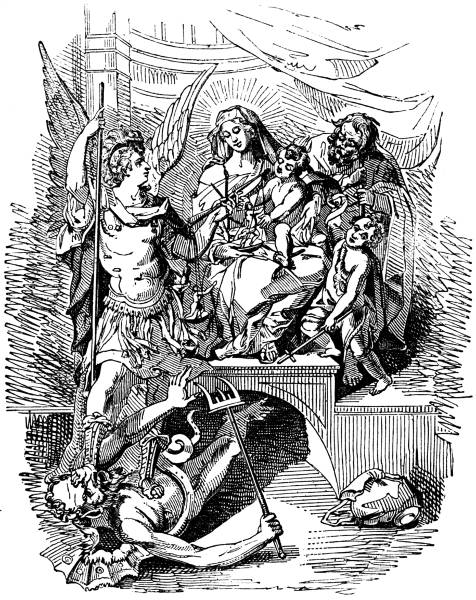
St Michael.
This print from a large engraving on copper, by one of the Caracci family in 1582, after a picture by Lorenzo Sabbatini of Bologna, represents the holy family, and St. John, and St. Michael standing on the devil, and presenting souls to the infant Jesus from a pair of scales. The artist has adopted this mode to convey a notion of the archangel, in quality of his office, as chief of the guardian angels, and judge of the claims of departed spirits. In vol. i. p. 630, there are notices relative to St. Michael in this capacity.
The church of Notre Dame, at Paris, rebuilt by “devout king Robert,” was conspicuously honoured by a statue of the chief of the angelic hierarchy, with his scales. “On the top, and pinnacle before the said church,” says Favine, “is yet to be seene the image of the arch-angell St. Michael, the tutelaric angell, and guardian of the most christian monarchie of France, ensculptured after the antique forme, holding a ballance in the one hand, and a crosse in the other; on his head, and toppe of his wings, are fixed and cramponned strong pikes of iron to keepe the birds from pearching thereon.”
Favine proceeds to mention a popular error concerning these “pikes of iron,” to defend the statue from the birds. “The ignorant vulgar conceived that this was a crowne of eares of corne, and thought it to be the idole of the goddesse Ceres.” He says this is “a matter wherein they are much deceived; for Isis and Ceres being but one and the same, her temple was at S. Ceour and S. Germain des Prez.”[359]
Louis XI. instituted an order in honour of St. Michael, the arch-angel, on occasion of an alleged apparition of the saint on the bridge at Orleans, when that city was besieged by the English in 1428.
St. George.
It has been intimated in vol. i., col. 500, that there are grounds to imagine “that St. George and the dragon are neither more nor less than St. Michael contending with the devil.” The reader who desires further light on this head, will derive it from a dissertation by Dr. Pettingall, expressly on the point. It may here, perhaps, be opportune to introduce the usual representation of St. George and the dragon, by an impression from an original wood-block, obligingly presented to this work by Mr. Horace Rodd.

St. George and the Dragon.
To-morrow morning we shall have you look, For all your great words, like St. George at Kingston, Running a footback from the furious dragon, That with her angrie tail belabours him For being lazie.
Woman’s Prize.
So say Beaumont and Fletcher, from whence we learn that the prowess of “St. George for England,” was ludicrously travestied.
NATURALISTS’ CALENDAR.
Mean Temperature 55·27.
September 30.
The Season.
It is noted under the present day in the “Perennial Calendar,” that at this time the heat of the middle of the days is still sufficient to warm the earth, and cause a large ascent of vapour: that the chilling frosty nights, which are also generally very calm, condense into mists; differing from clouds only in remaining on the surface of the ground.
Now by the cool declining year condensed, Descend the copious exhalations, check’d As up the middle sky unseen they stole, And roll the doubling fogs around the hill. . . . . . . Thence expanding far, The huge dusk gradual swallows up the plain Vanish the woods; the dimseen river seems Sullen and slow to roll the misty wave. Even in the height of noon oppressed, the sun Sheds weak and blunt his wide refracted ray; Whence glaring oft, with many a broadened orb, He frights the nations. Indistinct on earth, Seen through the turbid air, beyond the life Objects appear, and wildered o’er the waste, The shepherd stalks gigantic.
“Extraordinary News!”
To the Editor of the Every-Day Book.
Sir,—The character and manners of a people may be often correctly ascertained by an attentive examination of their familiar customs and sayings. The investigation of these peculiarities, as they tend to enlarge the knowledge of human nature, and illustrate national history, as well as to mark the fluctuation of language, and to explain the usages of antiquity, is, therefore, deserving of high commendation; and, though occasionally, in the course of those inquiries, some whimsical stories are related, and some very homely phrases and authorities cited, they are the occurrences of every day, and no way seem to disqualify the position in which several amusing and popular customs are brought forward to general view. Under this impression, it will not be derogatory to the Every-Day Book, to observe that by such communications, it will become an assemblage of anecdotes, fragments, remarks, and vestiges, collected and recollected:—
—————Various,—that the mind Of desultory man, studious of change, And pleas’d with novelty, may be indulged.
Cowper.
Should the following extract, from a volume of Miscellaneous Poems, edited by Elijah Fenton, and printed by Bernard Lintot, without date, but anterior to 1720, in octavo, be deemed by you, from the foregoing observations, deserving of notice, it is at your service.
Old Bennet was an eccentric person, at the early part of the last century, who appears to have excited much noise in London.
On the Death of Old Bennet, the News Cryer.
“One evening, when the sun was just gone down, As I was walking thro’ the noisy town, A sudden silence through each street was spread, As if the soul of London had been fled. Much I inquired the cause, but could not hear, Till fame, so frightened, that she did not dare To raise her voice, thus whisper’d in my ear: } Bennet, the prince of hawkers, is no more, Bennet, my Herald on the British shore; Bennet, by whom, I own myself outdone, Tho’ I a hundred mouths, he had but one. He, when the list’ning town he would amuse, Made echo tremble with his ‘bloody news.’ No more shall Echo, now his voice return, Echo for ever must in silence mourn.— Lament, ye heroes, who frequent the wars, The great proclaimer of your dreadful scars. Thus wept the conqueror, who the world o’ercame, Homer was wanting to enlarge his fame Homer, the first of hawkers that is known, Great news from Troy, cried up and down the town. None like him has there been for ages past, Till our stentorian Bennet came at last. Homer and Bennet were in this agreed, Homer was blind, and Bennet could not read.”
“Bloody News!” “Great Victory!” or more frequently “Extraordinary Gazette!” were, till recently, the usual loud bellowings of fellows, with stentorian lungs, accompanied by a loud blast of a long tin-horn, which announced to the delighted populace of London, the martial achievements of the modern Marlborough. These itinerants, for the most part, were the link-men at the entrances to the theatres; and costermongers, or porters, assisting in various menial offices during the day. A copy of the “Gazette,” or newspaper they were crying, was generally affixed under the hatband, in front, and their demand for a newspaper generally one shilling.
Those newscriers are spoken of in the past sense, as the further use of the horn is prohibited by the magistracy, subject to a penalty of ten shillings for a first offence, and twenty shillings on the conviction of repeating so heinous a crime. “Oh, dear!” as Crockery says, I think in these times of “modern improvement,” every thing is changing, and in many instances, much for the worse.
I suspect that you, Mr. Editor, possess a fellow-feeling on the subject, and shall no further trespass on your time, or on the reader’s patience, than by expressing a wish that many alterations were actuated by manly and humane intentions, and that less of over-legislation and selfishness were evinced in these pretended endeavours to promote the good of society.
I am, &c. J. H. B.
The present month can scarcely be better closed than with some exquisite stanzas from the delightful introduction to the “Forest Minstrel and other Poems, by William and Mary Howitt.” Mr. Howitt speaks of his “lightly caroll’d lays,” as—
——— never, surely, otherwise esteem’d Than a bird’s song, that, fill’d with sweet amaze At the bright opening of the young, green spring, Pours out its simple joy in instant warbling. For never yet was mine the proud intent To give the olden harp a thrilling sound, Like those great spirits who of late have sent Their wizard tones abroad, and all around This wond’rous world have wander’d; and have spent, In court and camp, on bann’d and holy ground, Their gleaning glances; and, in hall and bower, Have learn’d of mortal life the passions and the power: Eyeing the masters of this busy earth, In all the changes of ambition’s toil, From the first struggles of their glory’s birth, Till robed in power—till wearied with the spoil Of slaughter’d realms, and dealing woe and dearth To miserable men—and then the foil To this great scene, the vengeance, and the frown With which some mightier hand has pull’d those troublers down: Eyeing the passages of gentler life, And different persons, of far different scenes; The boy, the beau—the damsel, and the wife— Life’s lowly loves—the loves of kings and queens; Each thing that binds us, and each thing that weans Us from this state, with pains and pleasures rife; The wooings, winnings, weddings, and disdainings Of changeful men, their fondness and their feignings: And then have brought us home strange sights and sounds From distant lands, of dark and awful deeds; And fair and dreadful spirits; and gay rounds Of mirth and music; and then mourning weeds; And tale of hapless love that sweetly wounds The gentle heart, and its deep fondness feeds; Lapping it up in dreams of sad delight From its own weary thoughts, in visions wild and bright:— Oh! never yet to me the power or will To match these mighty sorcerers of the soul Was given; but on the bosom, lone and still, Of nature cast, I early wont to stroll Through wood and wild, o’er forest, rock, and hill, Companionless; without a wish or goal, Save to discover every shape and voice Of living thing that there did fearlessly rejoice. And every day that boyish fancy grew; And every day those lonely scenes became Dearer and dearer, and with objects new, All sweet and peaceful, fed the young spirit’s flame Then rose each silent woodland to the view, A glorious theatre of joy! then came Each sound a burst of music on the air, That sank into the soul to live for ever there! Oh, days of glory! when the young soul drank Delicious wonderment through every sense! And every tone and tint of beauty sank Into a heart that ask’d not how, or whence Came the dear influence; from the dreary blank Of nothingness sprang forth to an existence Thrilling and wond’rous; to enjoy—enjoy The new and glorious blessing—was its sole employ. To roam abroad amidst the mists, and dews, And brightness of the early morning sky, When rose and hawthorn leaves wore tenderest hues: To watch the mother linnet’s stedfast eye, Seated upon her nest; or wondering muse On her eggs’s spots, and bright and delicate dye; To peep into the magpie’s thorny hall, Or wren’s green cone in some hoar mossy wall; To hear of pealing bells the distant charm, As slow I wended down some lonely dale, Past many a bleating flock, and many a farm And solitary hall; and in the vale To meet of eager hinds a hurrying swarm, With staves and terriers hastening to assail Polecat, or badger, in their secret dens, Or otter lurking in the deep and reedy fens To pass through villages, and catch the hum Forth bursting from some antiquated school, Endow’d long since by some old knight, whose tomb Stood in the church just by; to mark the dool Of light-hair’d lads that inly rued their doom, Prison’d in that old place, that with the tool, Stick-knife or nail, of many a sly offender, Was carved and figured over, wall, and desk, and window; To meet in green lanes happy infant bands, Full of health’s luxury, sauntering and singing, A childish, wordless melody; with hands Cowslips, and wind-flowers, and green brook-lime bringing; Or weaving caps of rushes; or with wands Guiding their mimic teams; or gaily swinging On some low sweeping bough, and clinging all One to the other fast, till, laughing, down they fall; To sit down by some solitary man, Hoary with years, and with a sage’s look, In some wild dell where purest waters ran, And see him draw forth his black-letter book, Wond’ring, and wond’ring more, as he began, On it, and then on many an herb to look, That he had wander’d wearily and wide, To pluck from jutting rocks, and woods, and mountain side; And then, as he would wash his healing roots In the clear stream, that ever went singing on, Through banks o’erhung with herbs and flowery shoots, Leaning as if they loved its gentle tune, To hear him tell of many a plant that suits Fresh wound, or fever’d frame; and of the moon Shedding o’er weed and wort her healing power, For gifted wights to cull in her ascendant hour; To lie abroad on nature’s lonely breast, Amidst the music of a summer’s sky, Where tall, dark pines the northern bank invest Of a still lake; and see the long pikes lie Basking upon the shallows; with dark crest, And threat’ning pomp, the swan go sailing by; And many a wild fowl on its breast that shone, Flickering like liquid silver, in the joyous sun: The duck, deep poring with his downward head, Like a buoy floating on the ocean wave; The Spanish goose, like drops of crystal, shed The water o’er him, his rich plumes to lave; The beautiful widgeon, springing upward, spread His clapping wings; the heron, stalking grave, Into the stream; the coot and water-hen Vanish into the flood, then, far off, rise again; And when warm summer’s holiday was o’er, And the bright acorns patter’d from the trees When fires were made, and closed was every door, And winds were loud, or else a chilling breeze Came comfortless, driving cold fogs before: On dismal, shivering evenings, such as these, To pass by cottage windows, and to see, Round a bright hearth, sweet faces shining happily; These were the days of boyhood! Oh! such days Shall never, never more return again— When the fresh heart, all witless of the ways, The sickening, sordid, selfish ways of men, Danced in creation’s pure and placid blaze, Making an Eden of the loneliest glen! Darkness has follow’d fast, and few have been The rays of sunlight cast upon life’s dreary scene. For years of lonely thought, in morning-tide Of life, will make a spirit all unfit To brook of men the waywardness and pride; Too proud itself to woo, or to submit; Scorning, as vile, what all adore beside, And deeming only glorious the soul lit With the pure flame of knowledge, and the eye Filled with the gentle love of the bright earth and sky. Fancy’s spoil’d child will ever surely be A thing of nothing in the worldly throng: Wrapp’d up in dreams that they can never see; Listening to fairy harp, or spirit’s song, Where all to them is stillest vacancy: For ever seeking, as he glides along, Some kindred heart, that feels as he has felt, And can read each thought that with him long has dwelt. But place him midst creation!—let him stand Where wave and mountain revel in his sight, Then shall his soul triumphantly expand, With gathering power, and majesty, and light! The world beneath him is the temple plann’d For him to worship in; and, pure and bright, Heaven’s vault above, the proud eternal dome Of his Almighty Sire, and his own future home! With such inspiring fancies, mortal pride Shrinks into nothing; and all mortal things He casts, as weeds cast by the ocean tide, From its embraces; the world’s scorn he flings Back on itself, disdaining to divide, With its low cares, that sensitive spirit that brings Home to his breast all nature’s light and glee, Holding with sunshine, clouds, and gales, unearthly revelry.
NATURALISTS’ CALENDAR.
Mean Temperature 54·17.