MARCH. (continued 3)
Reading edition
Curious Narrative.
To the Editor of the Every-Day Book.
Sir,
The interment of the late duchess of Rutland, at Bottesford, the family burialplace, has had a more than usual number of persons to visit its many sepulchral monuments. One of them to the memory of Francis Manners, earl of Rutland, who lies buried here, is very splendid. It represents him with his countess in a kneeling posture, and two children who are supposed to have been bewitch’d to death. The inscription to that effect I read, and procured a copy of the particulars from an old book which is always read to visiters by the sexton; and which, as to the execution of the alleged criminals at Lincoln, on the 12th of March, 1618, I find to be correct, and send it for your use.
I am, Sir, &c. B. Johnson.
Newark, Feb. 22, 1826.
The only alteration in the transcript is a variation from inaccurate spelling.
Extract From the Church Book of Bottesford.
When the Right Hon. Sir Francis Manners succeeded his Brother Roger in the Earldom of Rutland, and took possession of Belvoir Castle, and of the Estates belonging to the Earldom, He took such Honourable measures in the Courses of his Life, that He neither displaced Tenants, discharged Servants, nor denied the access of the poor; but, making Strangers welcome, did all the good offices of a Noble Lord, by which he got the Love and good-will of the Country, his Noble Countess being of the same disposition: So that Belvoir Castle was a continual Place of Entertainment, Especially to Neighbours, where Joan Flower and her Daughter were not only relieved at the first, but Joan was also admitted Chairwoman and her daughter Margarett as a Continual Dweller in the Castle, looking to the Poultry abroad, and the washhouse at Home; and thus they Continued till found guilty of some misdemeanor which was discovered to the Lady. The first complaint against Joan Flower the Mother was that she was a Monstrous malicious Woman, full of Oaths, Curses, and irreligious Imprecations, and, as far as appeared, a plain Atheist. As for Margarett, her Daughter, she was frequently accused of going from the Castle, and carrying Provisions away in unreasonable Quantities, and returning in such unseasonable Hours that they could not but Conjecture at some mischief amongst them; and that their extraordinary Expences tended both to rob the Lady and served also to maintain some debauched and Idle Company which frequented Joan Flower’s House. In some time the Countess misliking her (Joan’s) Daughter Margarett, and discovering some Indecencies in her Life, and the Neglect of her Business, discharged her from lying any more in the Castle, yet gave her forty Shillings, a Bolster, and a Mattress of wool, commanding her to go Home. But at last these Wicked Women became so malicious and revengeful, that the Earl’s Family were sensible of their wicked Dispositions; for, first, his Eldest Son Henry Lord Ross was taken sick after a strange Manner, and in a little time Died; and, after, Francis Lord Ross was Severely tortured and tormented by them, with a Strange sickness, which caused his Death. Also, and presently after, the Lady Catherine was set upon by their Devilish Practices, and very frequently in Danger of her Life, in strange and unusual Fits; and, as they confessed, both the Earl and his Countess were so Bewitched that they should have no more Children. In a little time after they were Apprehended and carried to Lincoln Jail, after due Examination before sufficient Justices and discreet Magistrates.
Joan Flower before her Conviction called for bread and butter, and wished it might never go through her if she were guilty of the Matter she was Accused of; and upon mumbling of it in her Mouth she never spoke more, but fell down and Died, as she was carried to Lincoln Jail, being extremely tormented both in Soul and Body, and was Buried at Ancaster.
The Examination of Margarett Flower the 22nd of January, 1618.
She confessed that, about four years since, her Mother sent her for the right Hand glove of Henry Lord Ross, and afterwards her Mother bid her go again to the Castle of Belvoir, and bring down the glove, or some other thing, of Henry Lord Ross’s; and when she asked for what, her Mother answered to hurt My Lord Ross; upon which she brought down a glove, and gave it to her Mother, who stroked Rutterkin her cat (the Imp) with it, after it was dipped in hot water, and, so, pricked it often after; which Henry Lord Ross fell sick, and soon after Died. She further said that finding a glove, about two or three years since of Francis Lord Ross’s, she gave it to her mother, who put it into hot water, and afterwards took it out, and rubbed it on Rutterkin (the Imp,) and bid him go upwards, and afterwards buried it in the yard, and said “a mischief light on him but he will mend again.” She further confessed that her Mother and her and her sister agreed together to bewitch the Earl and his Lady, that they might have no more children; and being asked the cause of this their malice and ill-will, she said that, about four years since, the Countess, taking a dislike to her, gave her forty shillings, a Bolster, and a mattress, and bid her be at Home, and come no more to dwell at the Castle; which she not only took ill, but grudged it in her heart very much, swearing to be revenged upon her, on which her Mother took wool out of the Mattress, and a pair of gloves which were given her by Mr. Vovason, and put them into warm water, mingling them with some blood, and stirring it together; then she took them out of the water, and rubbed them on the belly of Rutterkin, saying, “the Lord and the Lady would have Children but it would be long first.” She further confessed that, by her Mother’s command, she brought to her a piece of a handkerchief of the Lady Catherine, the Earl’s Daughter, and her Mother put it into hot water, and then, taking it out, rubbed it upon Rutterkin, bidding him “fly and go,” whereupon Rutterkin whined and cryed “Mew,” upon which the said Rutterkin had no more power of the Lady Catherine to hurt her.
Margarett Flower and Phillis Flower, the Daughters of Joan Flower, were executed at Lincoln for Witchcraft, March 12, 1618.
Whoever reads this history should consider the ignorance and dark superstition of those times; but certainly these women were vile abandoned wretches to pretend to do such wicked things.
“Seek not unto them that have familiar spirits, nor wizards, nor unto witches that peep and that mutter: should not a people seek unto their God.” Isaiah xix.
This entry in the church book of Bottesford is certainly very curious. Its being read at this time, to the visitors of the monuments, must spread the “wonderful story” far and near among the country people, and tend to the increase of the sexton’s perquisites; but surely if that officer be allowed to disseminate the tale, he ought to be furnished with a few sensible strictures which he might be required to read at the same time. In all probability, the greater number of visitants are attracted thither by the surprising narrative, and there is at least one hand from whom might be solicited such remarks as would tend to obviate undue impressions. Instances are already recorded in this work of the dreadful influence which superstitious notions produce on the illiterate.
NATURALISTS’ CALENDAR.
Mean Temperature 40·72.
March 13.
Chronology.
On the 13th of March, 1614, in the reign of king James I., Bartholomew Legat, an Arian, was burnt in Smithfield for that heresy.
1722, March 13, there were bonfires, illuminations, ringing of bells, and other demonstrations of joy, in the cities of London and Westminster, upon the dissolution of the septennial parliament.[80]
NATURALISTS’ CALENDAR.
Mean Temperature 40·47.
March 14.
Football.
To the Editor of the Every-Day Book.
Sir,—Perhaps you are not aware that, during fine weather, football is played every Sunday afternoon, in the fields, between Oldfield’s dairy and Copenhagen-house, near Islington, by Irishmen. It generally commences at three o’clock, and is continued till dusk. The boundaries are fixed and the parties chosen. I believe, as is usual in the sister kingdom, county-men play against other county-men. Some fine specimens of wrestling are occasionally exhibited, in order to delay the two men who are rivals in the pursuit of the ball; meantime the parties’ friends have time to pursue the combat, and the quick arrival of the ball to the goal is generally the consequence, and a lusty shout is given by the victors.
When a boy, football was commonly played on a Sunday morning, before church time, in a village in the west of England, and the church-piece was the ground chosen for it.
I am, &c. J. R. P.
Islington.
Royal Bridal.
On the 14th of March, 1734, his serene highness the prince of Orange was married at St. James’s, to the princess-royal.
At eleven o’clock at night, the royal family supped in public in the great state ball-room.
About one, the bride and bridegroom retired, and afterwards sat up in their bed-chamber, in rich undresses, to be seen by the nobility, and other company at court.
On the following day there was a more splendid appearance of persons of quality to pay their compliments to the royal pair than was ever seen at this court; and in the evening there was a ball equally magnificent, and the prince of Orange danced several minuets.
A few days before the nuptials, the Irish peers resident in London, not having received summonses to attend the royal procession, met to consider their claims to be present, and unanimously resolved that neither themselves nor the peeresses would attend the wedding as spectators, and that they would not send to the lord chamberlain’s office for their tickets.[81]
The “Papeguay.”
To the Editor of the Every-Day Book.
Kennington, March 7, 1826.
Sir,—The following brief observations on the sport mentioned at p. 289, may not be considered unacceptable; strange to say, it is not mentioned by either Strutt or Fosbroke in their valuable works.
This sport obtained over the principal parts of Europe. The celebrated composer, C. M. Von Weber, opens his opera of horrors, “Der Freischütz,” with a scene of shooting for the popingay. This is a proof that it is common in Germany, where the successful candidate is elected a petty sovereign for the day. The necessity and use of such a custom in a country formed for the chase, is obvious.
The author of the “Waverley” novels, in his excellent tale of “Old Mortality,” introduces a scene of shooting for the popingay, as he terms it. It was usual for the sheriff to call out the feudal array of the county, annually, to what was called the wappen-schaws. The author says, “The sheriff of the county of Lanark was holding the wappen-schaw of a wild district, called the Upper Ward of Clydesdale, on a traugh or level plain, near to a royal borough, the name of which is in no way essential to my story, upon the morning of the 5th of May, 1679, when our narrative commences. When the musters had been made, and duly reported, the young men, as was usual, were to mix in various parts, of which the chief was to shoot at the popingay, an ancient game formerly practised with archery, and then with firearms. This was the figure of a bird, decked with party-coloured feathers, so as to resemble a popingay or parrot. It was suspended to a pole, and served for a mark, at which the competitors discharged their fusees and carbines in rotation, at the distance of sixty or seventy paces. He whose ball brought down the mark, held the proud title of captain of the popingay for the remainder of the day, and was usually escorted in triumph to the most reputable charge-house in the neighbourhood, where the evening was closed with conviviality, conducted under his auspices.” From the accuracy and research of the author, I am inclined to take it for granted, that this sport was common in Scotland.
A friend informs me it is common in Switzerland, and I have no doubt obtained pretty generally over Europe. In conclusion, allow me to remark that in my opinion the man on horseback, with the popingay on the pole, is returning as victor from the sport; the pole in the distance evidently had the honour of supporting the popingay, until it was carried away by the aim of the marksman.
I am, sir, &c.
T. A.
The editor is obliged by the conjecture at the close of the preceding letter, and concurs in thinking that he was himself mistaken, in presuming that the French print from whence the engraving was taken, represented the going out to the shooting. He will be happy to be informed of any other misconception or inaccuracy, because it will assist him in his endeavours to render the work a faithful record of manners and customs. To that end he will always cheerfully correct any error of opinion or statement.
NATURALISTS’ CALENDAR.
Mean Temperature 40·90.
March 15.
The Highgate Custom.
With much pleasure insertion is given to the following letter and its accompanying song.
To the Editor of the Every-Day Book.
Seymour-street, Feb. 18, 1826.
Sir,—In illustration of the custom of “Swearing on the horns at Highgate,” described at p. 79, in the Every-Day Book of the present year, I enclose you a song, which was introduced in the pantomime of Harlequin Teague, performed at the Haymarket theatre, in August, 1742. If you think it worthy the columns of your valuable work, it is at your service.
I am, &c. Pasche.
Song by the Landlord of the Horns
Silence! take notice, you are my son, Full on your father look, sir; This is an oath you may take as you run, So lay your hand on the Hornbook, sir. Hornaby, hornaby, Highgate and horns, And money by hook or by crook, sir. Hornaby, &c. Spend not with cheaters, nor cozeners, your life, Nor waste it on profligate beauty; And when you are married, be kind to your wife, And true to all petticoat duty. Dutiful, beautiful, kind to your wife, And true from the cap to the shoetie. Dutiful, &c. To drink to a man when a woman is near, You never should hold to be right, sir; Nor unless ’tis your taste, to drink small for strong beer, Or eat brown bread when you can get white, sir. Manniken, canniken, good meat and drink Are pleasant at morn, noon, and night, sir Manniken, &c. To kiss with the maid when the mistress is kind, A gentleman ought to be loth, sir: But if the maid’s fairest, your oath does not bind, Or you may, if you like it, kiss both, sir. Kiss away, both you may, sweetly smack night and day, If you like it—you’re bound by your oath, sir. Kiss away, &c. When you travel to Highgate, take this oath again, And again, like a sound man, and true, sir, And if you have with you some more merry men, Be sure you make them take it too, sir. Bless you, son, get you gone, frolic and fun, Old England, and honest true blue, sir. Bless you, &c.
NATURALISTS’ CALENDAR.
Mean Temperature 40· 8.
March 16.
Cornish Sports, AND THE Origin of Piccadilly.
From several valuable communications, a letter is selected for insertion this day, because it happens to be an open one, and therefore free for pleasant intelligence on any subject connected with the purpose of this publication. It is an advantage resulting from the volume already before the public, that it acquaints its readers with the kind of information desired to be conveyed, more readily than the prospectus proposed to their consideration. If each reader will only contribute something to the instruction and amusement of the rest, the editor has no doubt that he will be able to present a larger series of interesting notices and agreeable illustrations, than any work he is at present acquainted with.
To the Editor of the Every-Day Book.
February 6, 1826.
Sir,—I send you the account of two more games, or in-doors sports, in vogue among the country people in Cornwall. Of the latter, Mr. D. Gilbert has made slight mention in the introduction to his carols, second edition; but he states that these games, together with carol-singing, may be considered as obsolete, which is by no means the case: even yet in most of the western parishes, (and of these I can speak from personal observation,) the carol-singers, not only sing their “auntient chaunts” in the churches, but go about from house to house in parties. I am told the practice is the same in many other parts of the county, as it is also in various places throughout the kingdom. I have added a slight notice respecting Piccadilly, which (if worth inserting) may be new to some of your readers; but, now for our Cornish sports: I state them as I found them, and they are considered provincial.
First, then, the Tinkeler’s (tinker’s) shop.—In the middle of the room is placed a large iron pot, filled with a mixture of soot and water. One of the most humourous of the set is chosen for the master of the shop, who takes a small mop in his left hand, and a short stick in his right; his comrades each have a small stick in his right hand; the master gives each a separate name, as Old Vulcan, Save-all, Tear’em, All-my-men, Mend-all, &c. After these preliminaries, all kneel down, encircling the iron vessel. The master cries out, “Every one (that is, all together, or ‘one and all,’ as the Cornish say,) and I;” all then hammer away with their sticks as fast as they can, some of them with absurd grimaces. Suddenly the master will, perhaps, cry out, “All-my-men and I;” upon this, all are to cease working, except the individual called All-my-men; and if any unfortunate delinquent fails, he is treated with a salute from the mop well dipped in the black liquid: this never fails to afford great entertainment to the spectators, and if the master is “well up to the sport,” he contrives that none of his comrades shall escape unmarked; for he changes rapidly from All-my-men and I, to Old Vulcan and I, and so on, and sometimes names two or three together, that little chance of escaping with a clean face is left.
The Corn-market.—Here, as before, an experienced reveller is chosen to be the master, who has an assistant, called Spy-the-market. Another character is Old Penglaze, who is dressed up in some ridiculous way, with a blackened face, and a staff in his hand; he, together with part of a horse’s hide girt round him, for the hobby-horse, are placed towards the back of the market. The rest of the players sit round the room, and have each some even price affixed to them as names; for instance, Two-pence, Four-pence, Six-pence, Twelve-pence, &c. The master then says “Spy-the-market,” to which the man responds, “Spy-the-market;” the master repeats, “Spy-the-market;” the man says, “Aye, sirrah.” The master then asks the price of corn, to which Spy-the-market, may reply any price he chooses, of those given to his comrades, for instance, “Twelve-pence.” The master then says, “Twelve-pence,” when the man hearing that price answers “Twelve-pence,” and a similar conversation ensues, as with Spy-the-market before, and Twelve-pence names his price, and so the game proceeds; but if, as frequently happens, any of the prices forget their names, or any other mistakes occur in the game, the offender is to be sealed, a ceremony in which the principal amusement of the game consists; it is done as follows,—the master goes to the person who has forfeited, and takes up his foot, saying, “Here is my seal, where is old Penglaze’s seal?” and then gives him a blow on the sole of the foot. Old Penglaze then comes in on his horse, with his feet tripping on the floor, saying, “Here I comes, neither riding nor a foot;” the horse winces and capers, so that the old gentleman can scarcely keep his seat. When he arrives at the market, he cries out, “What work is there for me to do?” The master holds up the foot of the culprit and says, “Here, Penglaze, is a fine shoeing match for you.” Penglaze dismounts; “I think it’s a fine colt indeed.” He then begins to work by pulling the shoe off the unfortunate colt, saying “My reward is a full gallon of moonlight, besides all other customs for shoeing in this market;” he then gives one or two hard blows on the shoe-less foot, which make its proprietor tingle, and remounts his horse, whose duty it is now to get very restive, and poor Penglaze is so tossed up and down, that he has much difficulty to get to his old place without a tumble. The play is resumed until Penglaze’s seal is again required, and at the conclusion of the whole there is a set dance.
Piccadilly.—The pickadil was the round hem, or the piece set about the edge or skirt of a garment, whether at top or bottom; also a kind of stiff collar, made in fashion of a band, that went about the neck and round about the shoulders; hence the term “wooden peccadilloes,” (meaning the pillory) in “Hudibras,” and see Nares’s “Glossary,” and Blount’s “Glossographia.” At the time that ruffs, and consequently pickadils, were much in fashion, there was a celebrated ordinary near St. James’s, called Pickadilly, because, as some say, it was the outmost, or skirt-house, situate at the hem of the town; but it more probably took its name from one Higgins, a tailor, who made a fortune by pickadils, and built this with a few adjoining houses. The name has by a few been derived from a much frequented shop for sale of these articles; this probably took its rise from the circumstance of Higgins having built houses there, which, however, were not for selling ruffs; and indeed, with the exception of his buildings, the site of the present Piccadilly was at that time open country, and quite out of the way of trade. At a later period, when Burlington-house was built, its noble owner chose the situation, then at some distance from the extremity of the town, that none might build beyond him. The ruffs formerly worn by gentlemen were frequently double-wired, and stiffened with yellow starch; and the practice was at one time carried to such an excess that they were limited by queen Elizabeth “to a nayle of a yeard in depth.” In the time of James I. they still continued of a preposterous size, so that previous to the visit made by that monarch to Cambridge in 1615, the vice-chancellor of the university thought fit to issue an order, prohibiting “the fearful enormity and excess of apparel seen in all degrees, as, namely, strange peccadilloes, vast bands, huge cuffs, shoe-roses, tufts, locks, and tops of hair, unbeseeming that modesty and carriage of students in so renowned an university.” It is scarcely to be supposed that the ladies were deficient in the size of their ruffs; on the contrary, according to Andrews, (Continuation of Henry’s History of England, vol. ii. 307,) they wore them immoderately large, made of lawn and cambric, and stiffened with yellow starch, for the art of using which, in the proper method, they paid as much as four or five pounds, as also twenty shillings for learning “to seethe starche,” to a Mrs. Dingen Van Plesse, who introduced it, as well as the use of lawn, which was so fine that it was a byword, “that shortly they would wear ruffes of a spider’s web.” The poking of these ruffs gracefully was an important attainment. Some satirical Puritans enjoyed the effects of a shower of rain on the ruff-wearers; for “then theyre great ruffes stryke sayle, and downe they falle, as dish-clouts fluttering in the winde.” Mrs. Turner, who was one of the persons implicated in the death of sir Thomas Overbury, is said to have gone to the place of execution in a fashionable ruff, after which their credit was very much diminished.
I am, sir, Your obedient servant, W. S.
P. S.—It is perhaps scarcely worth observing, that the Monday preceding Ash-Wednesday is, in the west, called Shrove-Monday; and that peas and pork is as standard a dish on that day as pancakes on Shrove-Tuesday, or salt fish on Ash-Wednesday.
Having thus performed a duty to a valued correspondent without waiting till Christmas, the editor takes the liberty of referring to the observations by which the preceding letter was introduced, and respectfully expresses an earnest hope to be favoured with such communications as, from the past conduct of the Every-Day Book, may appear suitable to its columns. For the first time, he believes, he ventures to allude to any inconvenience he has felt while conducting it; nor does he hint at difficulty now from lack of materials, for he has abundance; but it is a truth, which he is persuaded many of his readers will be happy to mitigate, that at the present moment he is himself so very unwell, and has so much indisposition in his family to distract his mind, that he cannot arrange his collections; services, therefore, under such circumstances, will be peculiarly acceptable. If one or two of his correspondents should refer him to communications which their kindness have already placed in his hands, he answers, that he is really too ill to seek them amongst his papers. From this it will be seen how very much he really needs, and how much he covets, assistance. He ventures to think that he shall not have made this public appeal in vain, and he again calls on the friends and readers of his labours to send him their aid.
NATURALISTS’ CALENDAR.
Mean Temperature 40·51.
March 17.
1826, Cambridge Term ends.
St. Patrick’s Day—a Pattern.
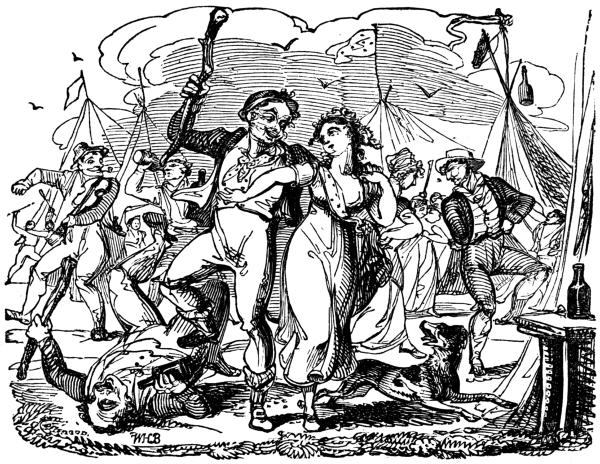
St. Patrick’s Day—a Pattern.
“An Irishman all in his glory was there, With a sprig of shillelagh and shamrock so green.”
It happens that several fairs, similar to those in the country parts of England as to tents and booths, are held in Ireland on Saint Patrick’s day, and then its hilarity is heightened by the publicity of the celebration.
The usual fair day or “patron,” or, as it is usually pronounced, pattern or patten, is a festive meeting to commemorate the virtues of a patron saint. It is a kind of rural fete with drinking and dancing, whereto (in Ireland) is added fighting, “unless the neighbouring magistrates personally interfere, or the spirits of the people are repressed by a conscious participation in plots and conspiracies.” This is the character of these festivals by an Irish writer, who relates an anecdote resulting from one of these festivals: “We were waiting (he says,) in the vain hope that the weather would clear up, and allow us a fine evening for return, when a poor stranger from Joyce country came before ‘his honour’ as a magistrate. His black eye, swelled face, and head and shoulders covered with clotted blood, too plainly told the history of his sufferings; and his woeful countenance formed a strange and ludicrous contrast with his account of the pleasures of the preceding evening.” He had obtained these features at a patron. “The poor fellow had travelled many a weary mile across the mountains to share its rustic mirth and revelry: but, ‘plaze your honour, there was a little bit of fighting in it,’ and as no true follower of St. Macdarragh could refuse to take a part in such a peaceful contest, he had received, and no doubt given, many a friendly blow; but his meditations on a broken head during the night, had both cooled his courage and revived his prudence, and he came to swear before ‘his honour’ a charge of assault and battery against those who had thus woefully demolished his upper works.”[82]
The constant use of the “shillelagh” by Irishmen at a “patron,” is a puzzling fact to Englishmen, who, on their own holidays, regard a “shillelagh” as a malicious weapon. In the hand of an Irishman, in his own country, at such a season, it is divested of that character; this singular fact will be accounted for, when the origin of the custom comes to be considered. At present, nothing more is requisite than to add, that the “shillelagh” is seldom absent on St. Patrick’s day, celebrated as a patron.
Some account of the commemoration of this festival, and of the tutelar saint of Ireland and his miracles, is already given in vol. i. p. 363. To this may be added the annexed notices relative to the day, obtained from an Irish gentleman.
It is a tradition that St. Patrick first landed at Croagh Patrick, a high and beautiful mountain in the county of Mayo, from which place he banished all venomous animals into the sea, and to this day, multitudes of the natives who are catholics, make pilgrimages to Croagh Patrick, under the persuasion of efficacy in these journies to atone for misdeeds, or mitigate the penalties attached to sin.
It is a very popular tradition that when St. Patrick was dying, he requested his weeping and lamenting friends to forego their grief, and rather rejoice at his comfortable exit, for the better furtherance of which, he advised each one to take “a drop of something to drink;” and that this last injunction of the saint in reverence to his character was complied with. However this may be, it is a custom on his anniversary to observe the practice to supererogation; for the greater number of his present followers, who take a little “crathur” for the purpose of dissipating woeful reminiscencies, continue to imbibe it till they “lisp and wink.”
Some years ago, “Patrick’s day” was welcomed, in the smaller country towns or hamlets, by every possible manifestation of gladness and delight. The inn, if there was one, was thrown open to all comers, who received a certain allowance of oaten bread and fish. This was a benevolence from the host, and to it was added a “Patrick’s pot,” or quantum of beer; but, of late years, whiskey is the beverage most esteemed. The majority of those who sought entertainment at the village inn, were young men who had no families, whilst those who had children, and especially whose families were large, made themselves as snug as possible by the turf fire in their own cabins.
Where the village or hamlet could not boast of an inn, the largest cabin was sought out, and poles were extended horizontally from one end of the apartment to the other; on these poles, doors purposely unhinged, and brought from the surrounding cabins were placed, so that a table of considerable dimensions was formed, round which all seated themselves, each one providing his own oaten bread and fish. At the conclusion of the repast, they sat for the remainder of the evening over a “Patrick’s pot,” and finally separated quietly, and it is to be hoped in perfect harmony.
In the city of Dublin, “Patrick’s day” is still regarded as a festival from the highest to the lowest ranks of society. There is an annual ball and supper at the lord lieutenant’s residence in the castle, and there are private convivial assemblies of the most joyous character. On this day every Irishman who is alive to its importance, adorns his hat with bunches of shamrock, which is the common trefoil or clover, wherewith, according to tradition, St. Patrick converted the Irish nation to belief in the doctrine of the trinity in unity. In the humbler ranks, it is the universal practice to get a morning dram as a preparation for the duties of the festival. They then attend chapel and hear high mass. After the ceremonies and observances peculiar to the Romish worship, they again resort to the whiskey shop, and spend the remainder of the day in devotions to Bacchus, which are mostly concluded, with what in England would be called, by persons of this class, “a row.”
On Patrick’s day, while the bells of churches and chapels are tuned to joyous notes, the piper and harper play up “Patrick’s day in the morning;” old women, with plenteous supplies of trefoil, are heard in every direction, crying “Buy my shamrocks, green shamrocks,” and children have “Patrick’s crosses” pinned to their sleeves. These are small prints of various kinds; some of them merely represent a cross, others are representations of Saint Patrick, trampling the reptiles under his feet.
It appears from this account, and from general narrations, that St. Patrick is honoured on his festival by every mode which mirth can devise for praise of his memory. The following whimsical song is a particular favourite, and sung to “his holiness” by all ranks in the height of convivial excitement:—
St. Patrick was a Gentleman.
St. Patrick was a gentleman, and he came from decent people: In Dublin town he built a church and on it put a steeple; His father was a Wollaghan, his mother an O’Grady, His aunt she was a Kinaghan, and his wife a widow Brady. Tooralloo tooralloo, what a glorious man our saint was, Tooralloo, tooralloo, O whack fal de lal, de lal, &c. Och! Antrim hills are mighty high and so’s the hill of Howth too; But we all do know a mountain that is higher than them both too; ’Twas on the top of that high mount St. Patrick preach’d a sermon, He drove the frogs into the bogs, and banished all the vermin. Tooralloo, &c. No wonder that we Irish lads, then, are so blythe and frisky; St. Patrick was the very man that taught us to drink whiskey; Och! to be sure, he had the knack and understood distilling, For his mother kept a sheebeen shop, near the town of Enniskillen. Tooralloo, &c.
The day after St. Patrick’s day is “Sheelah’s day,” or the festival in honour of Sheelah. Its observers are not so anxious to determine who “Sheelah” was, as they are earnest in her celebration. Some say she was “Patrick’s wife,” others that she was “Patrick’s mother,” while all agree that her “immortal memory” is to be maintained by potations of whiskey. The shamrock worn on St. Patrick’s day should be worn also on Sheelah’s day, and, on the latter night, be drowned in the last glass. Yet it frequently happens that the shamrock is flooded in the last glass of St. Patrick’s day, and another last glass or two, or more, on the same night, deluges the over-soddened trefoil. This is not “quite correct,” but it is endeavoured to be remedied the next morning by the display of a fresh shamrock, which is steeped at night in honour of “Sheelah” with equal devotedness.
That Saint Patrick was not married is clear from the rules of the Roman catholic church, which impose celibacy on its clergy. A correspondent suggests that the idea of his matrimonial connection, arose out of a burlesque, or, perhaps, ironical remark, by females of the poorer class in Ireland, to retaliate on their husbands for their excesses on the 17th of March; or, perhaps, from the opportunity the effects of such indulgence afforded them, these fair helpmates are as convivial on the following morning, as their “worser halves” were the preceding day. “Sheelah” is an Irish term, generally applied to a slovenly or muddling woman, more particularly if she be elderly. In this way, probably, the day after St. Patrick’s obtained the name of “Sheelah’s day,” speciale gratia, without any reference to the calendar of saints. The saint himself, if we determine from the sacrifices to his memory, is deemed a kind of christian Bacchus; and, on like home-made authority, “Sheelah” is regarded as his consort.
The editor of this work especially regrets that few of the peculiarities regarding this festival which are familiar to Irishmen have been communicated to him. He has received letters expressing surprise that so little has been observed concerning their country. Such complaints have been made under initials, and therefore he could not answer them: the complainants he has no doubt could have contributed largely themselves, and from them he would have required information. As many Irish usages are fast dying away, he hopes and earnestly solicits to be favoured with particulars, which he is persuaded the collections or recollections of his Irish readers can readily furnish, and which he will be most happy in having intrusted to him for publication. Any illustrations of Irish character and manners, especially if drawn up by natives of Ireland, will be highly valued.
On St. Patrick’s day, 1740, the butchers in Clare-market, London, hung up a grotesque figure of an Irishman. A great number of Irishmen came to pull it down, when a fierce battle ensued, much mischief was done, and several persons were dangerously wounded; but a file of musqueteers having been fetched from St. James’s, some of the rioters were taken into custody, and three of them were committed by col. De Veil to Newgate.[83]
A correspondent who signs, “Ikey Pingle,” communicates a copy of a singular monumental inscription in the churchyard of Grimmingham, in Norfolk. It is subjoined on this day, because the public performer to whom it refers is stated to have quitted this stage of life on this day, in the year 1798.
Epitaph.
SACRED To the memory of Thomas Jackson, Comedian,
who was engaged, 21st of Dec. 1741, to play a comic cast of characters, in this great theatre—the World: for many of which he was prompted by nature to excel.
The season being ended, his benefit over, the charges all paid, and his account closed, he made his exit in the tragedy of Death, on the 17th of March, 1798, in full assurance of being called once more to rehearsal; where he hopes to find his forfeits all cleared, his cast of parts bettered, and his situation made agreeable, by him who paid the great stock-debt, for the love he bore to performers in general.
NATURALISTS’ CALENDAR.
Mean Temperature 41·27.
March 18.
Edward, king of the West Saxons.
On this anniversary, which is a holiday in the church of England calendar, and kept at the Exchequer, Rapin says, “I do not know upon what foundation Edward was made both a saint and a martyr, unless it was pretended he was murdered out of revenge for his great affection to Dunstan and the monks.” See farther concerning him in vol. i. p. 372.
NATURALISTS’ CALENDAR.
Mean Temperature 41·75.
March 19.
1826. Oxford Term ends.
Palm Sunday.
This is the first of Passion Week. To accounts of remarkable ceremonies peculiar to the day, and its present observance, it is proper to add the mode wherein it is celebrated by the papal pontiff at Rome. An eye-witness to the pageant relates as follows:—
About half-past nine in the morning, the pope entered the Sistine chapel, attired in a robe of scarlet and gold, which he wore over his ordinary dress, and took his throne. The cardinals, who were at first dressed in under-robes of a violet colour (the mourning for cardinals), with their rich antique lace, scarlet trains, and mantles of ermine, suddenly put off these accoutrements, and arrayed themselves in most splendid vestments, which had the appearance of being made of carved gold. The tedious ceremony of each separately kissing the pope’s hand, and making their three little bows, being gone through, and some little chaunting and fidgetting about the altar being got over, two palm branches, of seven or eight feet in length, were brought to the pope, who, after raising over them a cloud of incense, bestowed his benediction upon them: then a great number of smaller palms were brought, and a cardinal, who acted as the pope’s aid-de-camp on this occasion, presented one of these to every cardinal as he ascended the steps of the throne, who again kissed the pope’s hand and the palm, and retired. Then came the archbishops, who kissed both the pope’s hand and toe, followed by the inferior orders of clergy, in regular gradations, who only kissed the toe, as they carried off their palms.
The higher dignitaries being at last provided with palms, the deacons, canons, choristers, cardinals, train-bearers, &c. had each to receive branches of olive, to which, as well as to the palms, a small cross was suspended. At last, all were ready to act their parts, and the procession began to move: it began with the lowest in clerical rank, who moved off two by two, rising gradually in dignity, till they came to prelates, bishops, archbishops, and cardinals, and terminated by the pope, borne in his chair of state (sedia gestatoria) on men’s shoulders, with a crimson canopy over his head. By far the most striking figures in the procession were the bishops and patriarchs of the Armenian church. One of them wore a white crown, and another a crimson crown glittering with jewels. The mitres of the bishops were also set with precious stones; and their splendid dresses, and long wavy beards of silver whiteness, gave them a most venerable and imposing appearance.
The procession issued forth into the Sala Borgia (the hall behind the Sistine chapel), and marched round it, forming nearly a circle; for by the time the pope had gone out, the leaders of the procession had nearly come back again; but they found the gates of the chapel closed against them, and, on admittance being demanded, a voice was heard from within, in deep recitative, seemingly inquiring into their business, or claims for entrance there. This was answered by the choristers from the procession in the hall; and after a chaunted parley of a few minutes, the gates were again opened, and the pope, cardinals, and priests, returned to their seats. Then the passion was chaunted; and then a most tiresome long service commenced, in which the usual genuflections, and tinkling of little bells, and dressings and undressings, and walking up and coming down the steps of the altar, and bustling about, went on; and which at last terminated in the cardinals all embracing and kissing each other, which is considered the kiss of peace.
The palms are artificial, plaited of straw, or the leaves of dried reeds, so as to resemble the real branches of the palm-tree when their leaves are plaited, which are used in this manner for this ceremony in the catholic colonies of tropical climates. These artificial palms, however, are topped with some of the real leaves of the palm-tree, brought from the shores of the gulf of Genoa.[84]
Palm Sunday in Spain.
The following is a description of the celebration of this day in the cathedral of Seville:—
Early in the morning, the melancholy sound of the passion-bell announces the beginning of the solemnities for which the fast of Lent is a preparation. This bell, the largest of several which are made to revolve upon pivots, is moved by means of two long ropes, which by swinging the bell into a circular motion, are twined, gently at first, round the massive arms of a cross, of which the bell forms the foot, and the head its counterpoise. Six men then draw back the ropes, till the enormous machine receives a sufficient impetus to coil them in an opposite direction; and thus alternately, as long as ringing is required. To give this bell a tone appropriate to the sombre character of the season, it has been cast with several large holes disposed in a circle round the top—a contrivance which without diminishing the vibration of the metal, prevents the distinct formation of any musical note, and converts the sound into a dismal clangour.
The chapter, consisting of about eighty resident members, in choral robes of black silk with long trains and hoods, preceded by the inferior ministers, by thirty clergymen, in surplices, whose deep bass voices perform the plain or Ambrosian chaunt, and by the band of wind-instruments and singers, who execute the more artificial strains of modern or counterpoint music, move in a long procession round the farthest aisles, each holding a branch of the oriental, or date palm, which overtopping the heads of the assembled multitude, nod gracefully, and bend into elegant curves at every step of the bearers. For this purpose a number of palm-trees are kept with their branches tied up together, that, by the want of light, the more tender shoots may preserve a delicate yellow tinge. The ceremony of blessing these branches is solemnly performed by the officiating priest, previously to the procession, after which they are sent by the clergy to their friends, who tie them to the iron bars of the balconies, to be, as they believe, a protection against lightning.
In the long church-service for this day, the organ is silent, the voices being supported by hautboys and bassoons. All the altars are covered with purple or grey curtains. The holy vestments, during this week, are of the first-mentioned colour, except on Friday, when it is changed for black. The four accounts of our saviour’s passion, appointed as gospels for this day, Wednesday, Thursday, and Friday, are dramatized in the following manner:—Outside of the gilt-iron railing which encloses the presbytery, are two large pulpits of the same materials, from one of which, at the daily high mass, the sub-deacon chaunts the epistle, as the deacon does the gospel from the other. A movable platform with a desk, is placed between the pulpits on the passion-days; and three priests or deacons, in albes—the white vestment, over which the dalmatic is worn by the latter, and the casulla by the former—appear on these elevated posts, at the time when the gospel should be said. These officiating ministers are chosen among the singers in holy orders, one a bass, another a tenor, and the third a counter-tenor. The tenor chaunts the narrative without changing from the keynote, and makes a pause whenever he comes to the words of the interlocutors mentioned by the evangelist. In those passages the words of our saviour are sung by the bass in a solemn strain. The counter-tenor, in a more florid style, personates the inferior characters, such as Peter, the maid, and Pontius Pilate. The cries of the priests and the multitude are represented by the band of musicians within the choir.[85]
Palm Sunday Custom in Lincolnshire.
The following letter is from a correspondent on the spot where the custom is still preserved.
To the Editor of the Every-Day Book.
Sir,—There is a singular ceremony at Caistor church, Lincolnshire, every Palm Sunday, which you may think worth describing from this account of it.
A deputy from Broughton brings a very large ox-whip, called here a gad-whip. Gad is an old Lincolnshire measure of ten feet; the stock of the gad-whip is, perhaps, of the same length. The whip itself is constructed as follows. A large piece of ash, or any other wood, tapered towards the top, forms the stock; it is wrapt with white leather half way down, and some small pieces of mountain ash are enclosed. The thong is very large, and made of strong white leather. The man comes to the north porch, about the commencement of the first lesson, and cracks his whip in front of the porch door three times; he then, with much ceremony, wraps the thong round the stock of the whip, puts some rods of mountain ash lengthwise upon it, and binds the whole together with whip-cord. He next ties to the top of the whip-stock a purse containing two shillings, (formerly this sum was in twenty-four silver pennies,) then taking the whole upon his shoulder, he marches into the church, where he stands in front of the reading desk till the commencement of the second lesson: he then goes up nearer, waves the purse over the head of the clergyman, kneels down on a cushion, and continues in that position, with the purse suspended over the clergyman’s head, till the lesson is ended. After the service is concluded, he carries the whip, &c. to the manor-house of Undon, a hamlet adjoining, where he leaves it. There is a new whip made every year; it is made at Broughton, and left at Undon.
Certain lands in the parish of Broughton are held by the tenure of this annual custom, which is maintained to the present time.
I am, Sir, &c. G. P. J.
On the 19th of March, 1755, three women in the village of Bergemoletto, near Piedmont, were buried for thirty-seven days in the ruins of a stable, by a heavy fall of snow. They survived their confinement, and the facts relating to it were published by Ignazio Somis, professor in the university of Turin. With the case of these poor creatures, that, related at p. 176, of our Elizabeth Woodcock, who remained so imprisoned eight days, is scarcely to be compared. Her sufferings highly interest the feelings; a narration of theirs would too deeply wound them.
NATURALISTS’ CALENDAR.
Mean Temperature 41·25
March 20.
Lamb Season. An Anecdote.
It is related in the Scottish newspapers that about the year 1770, a Selkirkshire farmer, a great original in his way, and remarkable for his fondness of a “big price” for every thing, attended at Langholm fair, and, notwithstanding his parsimonious habits, actually sold his lambs to a perfect stranger upon his simply promising to pay him punctually at the next market. On his return home, the farmer’s servants, who regularly messed at the same table, and seldom honoured him with the name of master, inquired “Weel, Sandy, hae ye sell’t the lambs?” “Atweel hae I, and I gat saxpence mair a-head for them than ony body in the market.” “And a’ weel paid siller?” “Na, the siller’s no paid yet, but its sure eneuch.” “Wha’s your merchant, and, and what’s your security?” “Troth I never spiered, but he’s a decent lookin’ man wi tap boots, and a bottle-green coat.” The servants, at this, laughed outright, and tauntingly told him he would never get a farthing. Sandy, however, thought differently, and having accidentally hurt his leg so as to prevent him from travelling, he sent a shepherd to Langholm, with instructions to look for a man with a bottle-green coat, whom he was sure he said, to find standing near a certain sign. The shepherd did as he was bid, and, strange to say, discovered a person standing at the identical spot, who, on learning his errand, inquired kindly for his master, and paid the money to the uttermost farthing. Sandy, who piqued himself on his skill in physiognomy, heard the news without emotion, and merely said, “I wad at any time trust mair to looks than words, and whan I saw Colly smeiling about hun sae kindly, I ken’t weel eneuch he couldna be a scoundrel.” This result differs from one which might have been expected. Sandy believed in a “second sight,” which, in these times, a knowledge of the arts of life disqualify most persons for indulging on such an occasion.
In an early edition of vol. i. p. 374, the death of sir Isaac Newton is stated to have happened on this day in the year 1727; and it is added, that he was born on the 25th of December 1742, instead of the proper year 1642.
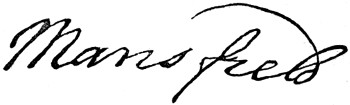
On the same page the death of the celebrated earl Mansfield, is mentioned to have taken place on the same day in the year 1793. He was aged eighty-nine, and his autograph is now added for the gratification of those who desire to be acquainted with the hand-writing of distinguished persons.
NATURALISTS’ CALENDAR.
Mean Temperature 42·81.
March 21.
Benedict.
Concerning this saint in our almanacs, see vol. i. p. 380.
A Surprising Calculation.
For the Every-Day Book.
In the summer of 1825, a meeting was held at Tunbridge in Kent, by some gentlemen interested in the formation of a rail road, in that neighbourhood; at which was a present a young gentleman well known for astonishing celerity in resolving difficult calculations by the aid of memory alone. One of the company, a great snuff-taker, and good mathematician, proposed the following, (as he thought,) puzzling question;
“If I take so many (a given quantity) of pinches of snuff every quarter of an hour, how many pinches shall I have taken in fifteen years?”
The young gentleman in little more than a minute gave his answer.
The snuff-taker called for pen, ink, and paper, to examine the answer, when after a considerable time he declared it erroneous; upon hearing which, the calculator asked the snuff-taker if he had allowed for the leap-years? being answered in the negative, the snuff-taker was requested to add them, when the calculator’s answer was found to be correct to a single pinch, to the no small astonishment and delight of the assembled party.
A. S.
The preceding anecdote is wholly new, and, after a “pinch of snuff,” the editor introduces a topic somewhat corresponding.
“Tobacco.” “Ex fumo dare lucem.”
To the Editor of the Every-Day Book.
Sir,
The use of tobacco, “that stinking weed so much abused to God’s dishonour,” as Stow expresses himself, having become so common, as to be almost “naturalized on English ground;” perhaps a short article on the subject at this seasonable period, may not be unacceptable to the numerous readers of the Every-Day Book. Let me however be understood in the outset.
I do not mean to write a historical—nor yet critical—nor yet a poetical essay on my subject—no! I merely wish to “cull a few leaves” from the “fragrant herb,” and leave them for you to burn, or your readers to cut up, or smoke, at their good pleasure. Dropping all metaphor, the subject is worth attention, and treated with judgment, might be rendered highly interesting. Resigning all pretension however to that quality, I have merely collected a few “passages,” which, I hope, will be considered worthy of a place in your interesting miscellany.
“Commencing our commencement,” says the old French proverb, my medical dictionary, (Hooper’s) has the following under this head:—
“Tobacco. See Nicotiana.”
“Nicotiana. (From M. Nicot, who first brought it into Europe.) Tobacco.”
“1st. The name of a genus of plants in the Linnean system. Class Pentandria; order, Monogynia.”
“2nd. The former pharmacopæial name of the officinal tobacco,” &c. &c.
Hooper’s Medical Dictionary, 4th edit. p. 594.
In that elegant work, “Flora Domestica,” the botanical summary says, “This genus is named from Jean Nicot of Nismes, agent from the king of France to Portugal, who procured the seeds from a Dutchman, and sent them to France. Tobacco, from the island Tobago. The French have many names for it; as, le tabac: Nicotiane from its first introducer; petum [the original Indian appellation;] herbe du grand prieur; herbe à la Reine; herbe sacrìe; herbe propre à tous maux; herbe de St. Croix; &c. &c. Italian, tabacco; terna bona.”
Flora Domestica, 1823. p. 365.
Of these names, the Italian one of “terna bona,” is very singular, and as arbitrary as need be, for example, what connection can there be between tobacco, and the “grand prior,” the “queen’s,” or the “holy cross?” “Propre à tous maux,” is rather too comprehensive an appellation; I have copied but few of these names, many as there may appear to be.
Of all the subjects which have employed the pens of writers, perhaps no one has called forth so great a diversity of opinion as this; and we may perhaps go further, and say, that no other (save only, love and war) has attracted so much notice since its introduction. Popes, poets, historians, kings, and physicians, have dwelt upon its use and abuse, and even historians have condescended to mention it. But to proceed.
With regard to its first introduction into England, Hume says, “chap. xli. Eliz. 1558, 1603,” at the close of the narration of Drake’s attack on the Spanish provinces in the West Indies. “It is thought that Drake’s fleet first introduced the use of tobacco into England.”
In an after part of his work “Appendix, James I. 1603-1625,” he adds,
“After supplying themselves with provisions more immediately necessary for the support of life, the new planters began the cultivating of tobacco; and James notwithstanding his antipathy to that drug, which he affirmed to be pernicious to men’s morals as well as health, gave them permission to enter it in England; and he inhibited by proclamation all importation of it from Spain.”
At this period originated the story of the wetting poor sir Walter Raleigh, received from the hands (and bucket) of his servant; this, however, is too common to deserve transferring to your pages. The following facts, however, are not so generally known. “On the first introduction of tobacco, our ancestors carried its use to an enormous excess, smoking even in the churches, which made pope Urban VIII. in 1624, publish a decree of excommunication against those who used such an unseemly practice; and Innocent XII. A. D. 1690, solemnly excommunicated all those who should take snuff or tobacco, in St. Peter’s church at Rome.” Flora Domestica, p. 367.
This excess is perhaps only equalled by the case of William Breedon, vicar of Thornton, Bucks, “a profound divine, but absolutely the most polite person for nativities in that age;” of whom William Lilly, “student in astrology,” says, “when he had no tobacco, (and I suppose too much drink,) he would cut the bell ropes and smoke them.”—History of Lilly’s Life and Times, p. 44.[86]
To the eulogist of tobacco, who, on column 195 of your present volume, defies “all daintie meats,” and
——“keeps his kitchen in a box, And roast meat in a pipe,”
take as an antidote the following from Peter Hausted’s Raphael Thorius: London, 1551.
Let it be damn’d to Hell, and call’d from thence, Proserpine’s wine, the Furies’ frankincense, The Devil’s addle eggs.
Hawkins Brown, esq., parodying Ambrose Philips, writes thus prettily to his pipe:—
Little tube of mighty power, Charmer of an idle hour, Object of my warm desire; Lip of wax, and eye of fire; And thy snowy taper waist, With my finger gently brac’d; &c.
In our own times the following have appeared.
“La Pipe de Tabac,” a French song to music, by Geweaux, contains the following humorous stanzas:—
“Le soldat baille sous la tente, Le matelot sur le tillac, Bientôt ils ont l’âme contente, Avec la pipe de tabac; Si pourtant survient une belle, A l’instant le cœur fait tìc tac, Et l’Amant oublie auprès d’elle, Jusqu’à la pipe de tabac. “Je tiens cette maxime utile, De ce fameux Monsieur de Crac, En campagne comme à la ville, Font tous l’amour et le tabac, Quand ce grand homme allait en guerre Il portait dans son petit sac, Le doux portrait de sa bergère, Avec la pipe de tabac.”
In the accompanying English version, they are thus imitated:—
See, content, the soldier smiling Round the vet’ran smoking crew And the tar, the time beguiling, Sighs and whiffs, and thinks of Sue. Calm the bosom; naught distresses;— Labour’s harvest’s nearly ripe;— ‘Susan’s health;’—the brim he presses,— Here alone he quits his pipe. Faithful still to every duty Ne’er his faithful heart will roam; Mines of wealth, and worlds of beauty, Tempt him not from Susan’s home. From his breast—wherever steering, Oft a sudden tear to wipe, Susan’s portrait,—sorrow cheering, First he draws—and then his pipe!
Our immortal Byron, in his poem of “The Island,” sings thus the praises of “the Indian weed:”—
Sublime tobacco!—which from east to west Cheers the tar’s labours, or the Turkman’s rest; Which on the Moslem’s ottoman divides His hours,—and rivals opium and his brides; Magnificent in Stamboul, but less grand, Though not less loved, in Wapping or the Strand; Divine in hookas, glorious in a pipe When tipped with amber, mellow, rich, and ripe; Like other charmers, wooing the caress More dazzlingly when daring in full dress; Yet thy true lovers more admire by far, Thy naked beauties—— Give me a cigar!
If, Sir, you should deem this communication worthy of your notice, I shall feel inclined to pursue my researches farther; and, whatever the result, allow me in the mean time to subscribe myself,
Your well-wisher, Fumo.
P. S. Should you, Sir, burn this, the Roman adage, which I have used as my motto, will be once more verified.
NATURALISTS’ CALENDAR.
Mean Temperature 43·44.
March 22.
Passion Wednesday.
In 1826, this being the Wednesday before Easter, called Passion Wednesday, is celebrated with great solemnity in catholic countries. At Seville a white veil conceals the officiating priest and ministers, during mass, until the words in the service “the veil of the temple was rent in twain” are chaunted. At this moment the veil disappears, as if by enchantment, and the ears of the congregation are stunned with the noise of concealed fireworks, which are meant to imitate an earthquake.
The evening service, named Tinieblas, (darkness) is performed this day after sunset. The cathedral, on this occasion, exhibits the most solemn and impressive aspect. The high altar, concealed behind dark grey curtains which fall from the height of the cornices, is dimly lighted by six yellow wax candles, while the gloom of the whole temple is broken in large masses by wax torches, fixed one on each pillar of the centre aisle, about one-third of its length from the ground. An elegant candlestick of brass, from fifteen to twenty feet high, is placed, on this and the following evening, between the choir and the altar, holding thirteen candles, twelve of yellow, and one of bleached wax, distributed on the two sides of the triangle which terminates the machine. Each candle stands by a brass figure of one of the apostles. The white candle occupying the apex is allotted to the virgin Mary. At the conclusion of each of the twelve psalms appointed for the service, one of the yellow candles is extinguished, till, the white taper burning alone, it is taken down and concealed behind the altar. Immediately after the ceremony, the Miserere, (Psalm 50.) set, every other year, to a new strain of music, is sung in a grand style. This performance lasts exactly an hour. At the conclusion of the last verse the clergy break up abruptly without the usual blessing, making a thundering noise by clapping their movable seats against the frame of the stalls, or knocking their ponderous breviaries against the boards, as the rubric directs.[87]
Chronology.
On the 22d of March, 1687, Jean Baptiste Lully, the eminent musical composer, died at Paris. He was born of obscure parents at Florence, in 1634, and evincing a taste for music, a benevolent cordelier, influenced by no other consideration than the hope of his becoming eminent in the science, undertook to teach him the guitar. While under his tuition, a French gentleman, the chevalier Guise, arrived at Florence, commissioned by Mlle. de Montpensier, niece to Louis XIV., to bring her some pretty little Italian boy as a page. The countenance of Lully did not answer to the instructions, but his vivacity, wit, and skill on an instrument, as much the favourite of the French as of the Italians, determined the chevalier to send him to Paris. On his arrival, he was presented to the lady; but his figure obtained for him so cool a reception, that she commanded him to be entered in her household books as an under-scullion. Lully was at this time ten years old. In the moments of his leisure from the kitchen, he used to scrape upon a wretched fiddle. He was overheard by a person about the court, who informed the princess he had an excellent taste for music, and a master was employed to teach him the violin, under whom in the course of a few months, he became so great a proficient, that he was elevated to the rank of court-musician. In consequence of an unlucky accident he was dismissed from this situation; but, obtaining admission into the king’s band of violins, he applied himself so closely to study, that in a little time he began to compose. His airs were noticed by the king, Lully was sent for, and his performance of them was thought so excellent, that a new band was formed, called les petits violons, and under his direction it surpassed the band of twenty-four, till that time celebrated throughout Europe. This was about the year 1660, when the favourite entertainments at the French court were dramatic representations, consisting of dancing intermixed with singing and speaking in recitative; they were called ballets, and to many of them Lully was employed in composing the music.
In 1669, an opera in the French language, on the model of that at Venice, being established at Paris, Lully obtained the situation of composer and joint director, left his former band, instituted one of his own, and formed the design of building a new theatre near the Luxemburg palace, which he accomplished, and opened in November, 1670.
Previous to this, Lully, having been appointed surperintendent to the king’s private music, had neglected the practice of the violin; yet, whenever he could be prevailed with to play, his excellence astonished all who heard him.
In 1686, the king recovering from an indisposition that threatened his life, Lully composed a “Te Deum,” which was not more remarkable for its excellence, than the unhappy accident with which its performance was attended. In the preparations for the execution of it, and the more to demonstrate his zeal, he himself beat the time. With the cane that he used for this purpose, he struck his foot, which caused so much inflammation, that his physician advised him to have his little toe taken off; and, after a delay of some days, his foot; and at length the whole limb. At this juncture, an empiric offered to perform a cure without amputation. Two thousand pistoles were promised him if he should accomplish it, but his efforts were vain; and Lully died.
Lully’s confessor in his last illness required as a testimony of his sincere repentance, and as the condition of his absolution, that he should throw the last of his operas into the fire. After some excuses, Lully acquiesced, and pointing to a drawer in which the rough draft of “Achilles and Polixenes” was deposited, it was taken out and burnt, and the confessor went away satisfied. Lully grew better and was thought out of danger, when one of the young princes came to visit him: “What, Baptiste,” says he to him, “have you thrown your opera into the fire? You were a fool for thus giving credit to a gloomy Jansenist, and burning good music.” “Hush! hush! my lord,” answered Lully, in a whisper, “I knew very well what I was about, I have another copy of it!” This pleasantry was followed by a relapse; and the prospect of inevitable death threw him into such pangs of remorse, that he submitted to be laid on ashes with a cord round his neck; and, in this situation, he chaunted a deep sense of his late trangression.
Lully contributed greatly to the improvement of French music. In his overtures he introduced fugues, and was the first who, in the choruses, made use of the side and kettle drums. It is difficult to characterize his style, which seems to have been derived from no other source than his own invention.
His compositions were chiefly operas and other dramatic entertainments, adapted to the desires of Louis XIV., who was fond of dancing, and had not taste for any music but airs, in the composition of which a stated number of bars was the chief rule to be observed. Of harmony or fine melody, or of the relation between poetry and music, he seems to have had no conception; and these were restraints upon Lully’s talents.
He is said to have been the inventor of that species of composition, the overture; for, though the symphonies or preludes of Carissimi, Colonna, and others, are, in effect, overtures, yet they were compositions of a mild and placid kind, while Lully’s are animated and full of energy.[88]
Notwithstanding the character of Lully’s compositions, when unrestricted by the royal command and the bad taste of the court, he was one day reproached with having set nothing to music but languid verses. He flew to his harpsichord, and wildly running over the keys, sung, with great violence of gesture, the following terrific lines from Racine’s tragedy of “Iphigenie:”
“Un prêtre environne d’une foule cruelle Portera sur ma fille, une maine criminelle Dechirera son sein, et d’un œil curieux Dans son cœur palpitant consultera les Dieux.”
When cardinal d’Estrees was at Rome, he highly praised Corelli’s sonatas to that eminent composer. “Sir,” replied Corelli, “if they have any merit it is because I have studied Lully.” Handel has imitated Lully in many of his overtures.[89]
NATURALISTS’ CALENDAR.
Mean Temperature 42·79.
March 23.
MAUNDY THURSDAY. Shere Thursday.
These denominations have been sufficiently explained in vol. i. p. 400, with an account of the Maundy at the chapel royal St. James’s. The Romish church this day institutes certain ceremonies to commemorate the washing of the disciples’ feet.
Celebration of the day at Seville.
The particulars of these solemnities are recorded by the rev. Blanco White.
The ceremonies of the high mass, are especially intended as a remembrance of the last supper, and the service, as it proceeds, rapidly assumes the deepest hues of melancholy. The bells, in every steeple, from one loud and joyous peal, cease at once, and leave a peculiar heavy stillness, which none can conceive but those who have lived in a populous Spanish town long enough to lose the sense of that perpetual tinkling which agitates the ear during the day and great part of the night.
In every church a “host,” consecrated at the mass, is carried with great solemnity to a temporary structure, called the monument, which is erected with more or less splendour, according to the wealth of the establishment. It is there deposited in a silver urn, generally shaped like a sepulchre, the key of which, hanging from a gold chain, is committed by the priest to the care of a chief inhabitant of the parish, who wears it round his neck as a badge of honour, till the next morning. The key of the cathedral monument is intrusted to the archbishop, if present, or to the dean in his absence.
The striking effect of the last-mentioned structure, the “monument” in the cathedral, is not easily conceived. It fills up the space between four arches of the nave, rising in five bodies to the roof of the temple. The columns of the two lower tiers, which, like the rest of the monument, imitate white marble filletted with gold, are hollow, allowing the numerous attendants who take care of the lights that cover it from the ground to the very top, to do their duty during four-and-twenty hours, without any disturbance or unseemly bustle. More than three thousand pounds of wax, besides one hundred and sixty silver lamps, are employed in the illumination.
The gold casket set with jewels, which contains the host, lies deposited in an elegant temple of massive silver, weighing five hundred and ten marks, which is seen through a blaze of light on the pediment of the monument. Two members of the chapter in their choral robes, and six inferior priests in surplices, attend on their knees before the shrine, till they are relieved by an equal number of the same classes at the end of every hour. This adoration is performed without interruption from the moment of depositing the host in the casket till that of taking it out the next morning. The cathedral, as well as many others of the wealthiest churches, are kept open and illuminated the whole night.
One of the public sights of the town, on this day, is the splendid cold dinner which the archbishop gives to twelve paupers, in commemoration of the apostles. The dinner is to be seen laid out on tables filling up two large rooms in the palace. The twelve guests are completely clothed at the expense of their host; and having partaken of a more homely dinner in the kitchen, they are furnished with large baskets to take away the splendid commons allotted to each in separate dishes, which they sell to the gourmands of the town. Each, besides, is allowed to dispose of his napkin, curiously made up into the figure of some bird or quadruped, which people buy as ornaments to their china cupboards, and as specimens of the perfection to which some of the poorer nuns have carried the art of plaiting.
At two in the afternoon, the archbishop, attended by his chapter, repairs to the cathedral, where he performs the ceremony, which, from the notion of its being literally enjoined by our saviour, is called the mandatum. The twelve paupers are seated on a platform erected before the high altar, and the prelate, stripped of his silk robes, and kneeling successively before each, washes their feet in a large silver bason.
About this time the processions, known by the name of cofradías, (confraternities) begin to move out of the different churches to which they are attached. The head of the police appoints the hour when each of these pageants is to appear in the square of the town hall, and the audiencia or court of justice. From thence their route to the cathedral, and out of it, to a certain point, is the same for all. These streets are lined by two rows of spectators of the lower classes, the windows being occupied by those of a higher rank. An order is previously published by the town-crier, directing the inhabitants to decorate their windows, which they do by hanging out the showy silk and chintz counterpanes of their beds. As to the processions themselves, except one which has the privilege of parading the town in the dead of night, they have little to attract the eye or affect the imagination. Their chief object is to convey groups of figures, as large as life, representing different scenes of our saviour’s passion.
There is something remarkable in the established and characteristic marks of some figures. The Jews are distinguished by long aquiline noses. Saint Peter is completely bald. The dress of the apostle John is green, and that of Judas Iscariot yellow; and so intimately associated is this circumstance with the idea of the traitor, that it has brought that colour into universal discredit. It is probably from this circumstance, (though yellow may have been allotted to Judas from some more ancient prejudice,) that the inquisition has adopted it for the sanbenito, or coat of infamy, which persons convicted of heresy are compelled to wear. The red hair of Judas, like Peter’s baldness, seems to be agreed upon by all the painters and sculptors in Europe. Judas’ hair is a usual name in Spain; and a similar application, it should seem, was used in England in Shakspeare’s time. “His hair,” says Rosalind, in As you like it, “is of the dissembling colour:” to which Celia answers—“Something browner than Judas’s.”
The midnight procession derives considerable effect from the stillness of the hour, and the dress of the attendants on the sacred image. None are admitted to this religious act but the members of that fraternity; generally young men of fashion. They all appear in a black tunic, with a broad belt so contrived as to give the idea of a long rope tied tight round the body; a method of penance commonly practised in former times. The face is covered with a long black veil, falling from a sugar-loaf cap three feet high. Thus arrayed, the nominal penitents advance, with silent and measured steps, in two lines, dragging a train six feet long, and holding aloft a wax-candle of twelve pounds, which they rest upon the hip-bone, holding it obliquely towards the vacant space between them. The veils, being of the same stuff with the cap and tunic, would absolutely impede the sight but for two small holes through which the eyes are seen to gleam, adding no small effect to the dismal appearance of such strange figures. The pleasure of appearing in a disguise, in a country where masquerades are not tolerated by the government, is a great inducement, to the young men for subscribing to this religious association. The disguise, it is true, does not in the least relax the rules of strict decorum which the ceremony requires; yet the mock penitents think themselves repaid for the fatigue and trouble of the night by the fresh impression which they expect to make on the already won hearts of their mistresses, who, by preconcerted signals, are enabled to distinguish their lovers, in spite of the veils and the uniformity of the dresses.
It is scarcely forty years since the disgusting exhibition of people streaming in their own blood, was discontinued by an order of the government. These penitents were generally from among the most debauched and abandoned of the lower classes. They appeared in white linen petticoats, pointed white caps and veils, and a jacket of the same colour, which exposed their naked shoulders to view. Having, previous to their joining the procession, been scarified on the back, they beat themselves with a cat-o’nine-tails, making the blood run down to the skirts of their garment. It may be easily conceived that religion had no share in these voluntary inflictions. There was a notion afloat, that this act of penance had an excellent effect on the constitution.[90]
The pope commemorates the washing of the disciples’ feet by officiating in person. A modern traveller who was present at the ceremony says,—“There were thirteen instead of twelve; the one being the representative of the angel that once came to the table of twelve that St. Gregory was serving. The twelve were old priests, but the one who performed the part of the angel was very young. They were all dressed in loose white gowns, and white caps on their heads, and clean woollen stockings, and were seated in a row along the wall, under a canopy. When the pope entered and took his seat at the top of the room, the whole company of them knelt in their places, turning towards him; and on his hand being extended in benediction, they all rose again and reseated themselves. The splendid garments of the pope were then taken off; and clad in a white linen robe which he had on under the others, and wearing the bishop’s mitre instead of the tiara, he approached the pilgrims, took from an attendant cardinal a silver bucket of water, knelt before the first of them, immersed one foot in the water, put water over it with his hand, and touched it with a square fringed cloth; kissed the leg, and gave the cloth, and a sort of white flower or feather, to the man; then went on to the next. The whole ceremony was over, I think, in less than two minutes, so rapidly was this act of humility gone through. From thence the pope returned to his throne, put on his robes of white and silver again, and proceeded to the Sala di Tavola: the thirteen priests were seated in a row at the table, which was spread with a variety of dishes, and adorned with a profusion of flowers. The pope gave the blessing, and walking along the side of the table opposite to them, handed each of them bread, then plates, and lastly, cups of wine. They regularly all rose up to receive what he presented; and the pope having gone through the forms of service, and given them his parting benediction, left them to finish their dinner in peace. They carry away what they cannot eat, and receive a small present in money besides.”[91]
NATURALISTS’ CALENDAR.
Mean Temperature 43·15
March 24.
Good Friday.
This annual commemoration is the only one observed in England, with the exception of Christmas, by the suspension of all business, and the closing of shops. The late bishop Porteus having particularly insisted on this method of keeping Good Friday, the reverend Robert Robinson of Cambridge wrote a remarkable pamphlet, entitled, “The History and Mystery of Good Friday,” wherein he urges various statements and arguments against the usage. This tract has been published from time to time by Mr. Benjamin Flower. The controversy is referred to, because the writings of the bishop and his opponent state the grounds on both sides. It is to be remarked likewise, that several dissenters openly engage in their usual avocations, contrary to the general practice, which does not appear to be enforced by the church of England, farther than by notices through the parochial beadle and other officers.
Hot-cross Buns.
On the popular cry of “hot-cross buns,” and the custom of eating them to-day, there are particulars in vol. i. p. 402; and in the illustration of the ancient name and use of the bun, a few interesting passages are added. “The offerings which people in ancient times used to present to the gods, were generally purchased at the entrance of the temple; especially every species of consecrated bread, which was denominated accordingly. One species of sacred bread which used to be offered to the gods, was of great antiquity, and called boun. The Greeks, who changed the nu final into a sigma, expressed it in the nominative Βους, but in the accusative more truly boun, Βουν. Hesychius speaks of the boun, and describes it a kind of cake with a representation of two horns. Julius Pollux mentions it after the same manner, a sort of cake with horns. Diogenes Laertius, speaking of the same offering being made by Emperocles, describes the chief ingredients of which it was composed:—‘he offered up one of the sacred libra, called a boun, which was made of fine flour and honey.’ It is said of Cecrops, he first offered up this sort of sweet bread. Hence we may judge of the antiquity of the custom, from the times to which Cecrops is referred. The prophet Jeremiah takes notice of this kind of offering when he is speaking of the Jewish women at Pathros, in Egypt, and of their base idolatry; in all which their husbands had encouraged them: the women, in their expostulation upon his rebuke, tell him, ‘Did we make her cakes to worship her?’ &c. Jer. xliv. 18, 19. Ib. vii. 18.[92]”
Irish Custom.
In the midland districts of Ireland, viz. the province of Connaught, on Good Friday, it is a common practice with the lower orders of Irish catholics to prevent their young from having any sustenance, even to those at the breast, from twelve on the previous night to twelve on Friday night, and the fathers and mothers will only take a small piece of dry bread and a draught of water during the day. It is a common sight to see along the roads between the different market towns, numbers of women with their hair dishevelled, barefooted, and in their worst garments; all this is in imitation of Christ’s passion.[93]
In Ireland, as a catholic country, excessive attention prevails to the remarkable instances in the passion of Christ, which terminated in the crucifixion; and a revelation from Christ himself, to three nuns canonized by the Romish church, has been devised to heighten the fervour of the ignorant. The Irish journals of 1770, contain the copy of a singular paper said to have been sold to devotees at a high price, viz.
“This revelation was made by the mouth of our Lord Jesus Christ, to those three saints, viz. St. Elizabeth, St. Clare, and St. Bridget, they being desirous to know something in particular of the blessed passion of our Lord and Saviour Jesus Christ.
“First, I received 30 cuffs; 2dly, when I was apprehended in the garden, I received 40 blows: 3dly, I journeying to Annas’s house, got 7 falls: 4thly, they gave me 444 blows of whips upon my shoulders: 5thly, they raised me up from the ground, by the hair of the head, 330 times: 6thly, they gave me 30 blows against my teeth: 7thly, I have breathed 8888 sighs: 8thly, they drew me by my beard 35 times: 9thly, I received one mortal wound at the foot of the cross: 10th, 666 blows they gave me when I was bound to the pillar of stone: 11th, they set a crown of thorns upon my head: 12th, they have spitted at me 63 times: 13th, the soldiers gave me 88 blows of whips: 14th, they gave me gall and vinegar to drink: 15th, when I hanged on the cross I received five mortal wounds.
“All men or women that will say seven paters, seven aves, and a creed daily, in honour of the blessed passion of our Lord and Saviour Jesus Christ, for the space of 15 years, they shall obtain five graces: first, they shall receive plenary indulgence and remission of their sins; 2dly, they will not suffer the pains of purgatory; 3dly, if it happen that they die before 15 years be ended, they shall obtain grace as well as if they had suffered martyrdom; 4thly, in point of death, I will not come myself alone, to receive his own soul, but also his parents, if they be in purgatory; finally, I will convert them into everlasting bliss.
“This revelation hath those virtues, that whosoever shall carry it about him, shall be free from his enemies, neither will he die of any sudden death; and if there be any woman with child, that carry this revelation about her, she shall feel no pain in child-birth; and in whatsoever part of the house this revelation shall lye, it shall not be infected with any contagious diseases, or any other evil: and whosoever shall carry it about him, the glorious virgin Mary will show herself to him 46 days before his death.”

Sermon at St. Paul’s Cross on Good Friday.
The custom of preaching at St. Paul’s cross on Good Friday and other holidays, and some account of the cross itself is communicated in the following letter of a correspondent, who will be recognised by his initials to have been a contributor of former interesting articles.
To the Editor of the Every-Day Book.
Kennington, March 10, 1826.
Sir,—The following account of a sermon, annually preached on Good Friday at St. Paul’s cross, with a brief notice of that structure, will I hope be considered worthy preservation in your valuable miscellany.
It was, for a considerable period, a custom on Good Friday in the afternoon, for some learned man, by appointment of the bishop, to preach a sermon at Paul’s cross, which was situated in the midst of the churchyard on the north side towards the east end. The sermon generally treated of Christ’s passion; and upon the ensuing Monday, Tuesday, and Wednesday in Easter week, other learned men used to preach in a similar pulpit, at the Spital, now the Old Artillery Ground, Spitalfields; the subject of their discourse was the articles of Christ’s resurrection. Then, on Low Sunday, another divine was at Paul’s cross, to make a rehearsal of the four former sermons, either commending or disproving them as in his judgment he thought fit; all this done, (which by the by was no easy task,) he was to make a sermon himself, which in all were five sermons in one. At these sermons, so severally preached, the mayor, with his brethren the aldermen, were accustomed to be present in their “violets,” at St. Paul’s on Good Friday, and in their “scarlets,” both they and their ladies, at the Spital, in the holidays, except Wednesday in violet; and the mayor, with his brethren, on Low Sunday, in scarlet, at Paul’s cross. Since the Restoration these sermons were continued, by the name of the Spital sermons, at St. Bride’s, with the like solemnity, on Easter Monday, Tuesday, and Wednesday, every year.
Respecting the antiquity of this custom, I learn from Maitland, that, in the year 1398, king Richard having procured from Rome confirmation of such statutes and ordinances as were made in the parliament begun at Westminster and ended at Shrewsbury, he caused the same confirmation to be read and pronounced at Paul’s cross, and at St. Mary, Spital, in the sermons before all the people. Philip Malpas, one of the sheriffs, in the year 1439, the eighteenth of Henry VII., gave twenty shillings a year to the three preachers at the Spital. Stephen Foster, mayor, in the year 1454, gave forty shillings to the preachers of Paul’s cross and Spital. Opposite the pulpit at the Spital, was a handsome house of two stories high, for the mayor, aldermen, sheriffs, and other persons of distinction, to sit in, to hear the sermons preached in the Easter holidays; in the part above, stood the bishop of London and other prelates.
In foul and rainy weather, these solemn sermons were preached in a place called the shrowds, which was by the side of the cathedral church under covering, but open in front.—Ellis’s St. Paul’s Cathedral, p. 52.
For the maintenance of these St. Paul’s cross sermons, many of the citizens were liberal benefactors; as Aylmer, bishop of London, the countess dowager of Shrewsbury, Thomas Russell, George Bishop, who gave ten pounds a year, &c.; and for further encouragement of those preachers, in the year 1607, the lord mayor and court of aldermen then ordered, “that every one that should preach there, considering the journies some of them might take from the universities, or elsewhere, should at his pleasure be freely entertained, for five days space, with sweet and convenient lodging, fire, candle, and all other necessaries, viz. from Thursday before their day of preaching, to Thursday morning following.” This provision had a good effect, and the custom continued for some time, added to which the bishop of London, or his chaplain, when he sent to any one to preach, signified the place whither he might sojourn at his coming up, and be entertained freely. Towards this charge of the city, George Palin, a merchant of London, gave two hundred pounds to defray expenses.
At some future time a few observations on crosses will be introduced; at present I shall confine myself to the history of St. Paul’s cross, which was used, not only for the instruction of mankind by the doctrine of the preacher, but for every purpose, political or ecclesiastical; for giving force to oaths; for promulgating laws; or rather, the royal pleasure; for the emission of papal bulls; for anathematizing sinners; for benedictions; for exposing penitents under censure of the church; for recantations; for the private ends of the ambitious; and for defaming those who had incurred the displeasure of the crown. Pennant, 4to. 394.
To enter minutely into all the events connected with the history of this cross would be a work of considerable labour and difficulty, added to which, space could not be well spared in a work of the present nature. I shall therefore only notice some of the most remarkable that occur in history.
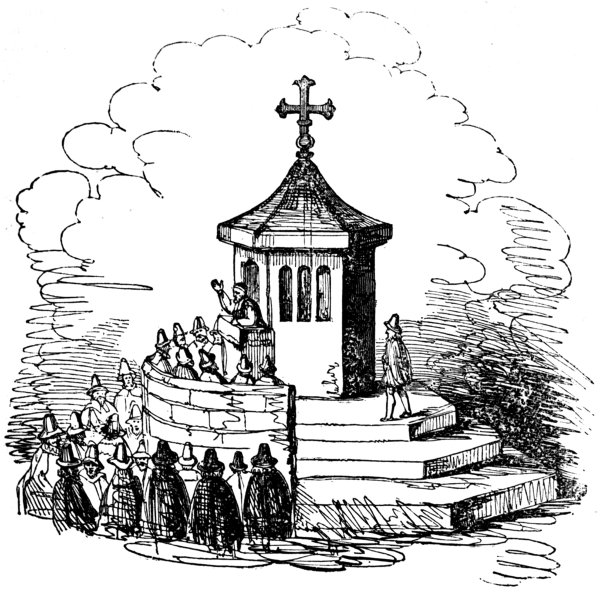
Sermon at St. Paul’s Cross on Good Friday.
This cross was strongly built of timber, mounted upon steps of stone, and covered with lead. The earliest mention of it occurs in the year 1259, when king Henry III. commanded a general assembly to be made at the cross, where he in person commanded the mayor that on the morrow he should cause to be sworn before the alderman, every youth of twelve years of age or upward, to be true to the king and his heirs kings of England. In the same year Henry III. caused to be read at this cross a bull obtained from pope Urban IV. as an absolution for him and for all that were sworn to maintain the articles made in the parliament at Oxford. In the year 1299, the dean of St. Paul’s cursed at the cross all those which had searched in the church of St. Martin in the Fields for a hoard of gold, &c.
This pulpit cross was by tempest of lightning and thunder, much defaced Thomas Kempe, bishop of London, from 28 Hen. VI. to 5 Hen. VII., new built the pulpit and cross.
The following is curious:—
“On the 8th day of March, 1555, while a doctor preached at the cross, a man did penance for transgressing Lent, holding two pigs ready drest, whereof one was upon his head, having brought them to sell.”—[Strype’s Ecclesiastical Memorials.]
Before this cross, in 1483, was brought, divested of all her splendour, Jane Shore, the charitable, the merry concubine of Edward IV., and after his death, of his favourite the unfortunate lord Hastings. After the loss of her protectors, she fell a victim to the malice of the crook-backed tyrant Richard III. He was disappointed (by her excellent defence) of convicting her of witchcraft, and confederating with her lover to destroy him. He then attacked her on the side of frailty. This was undeniable. He consigned her to the severity of the church: she was carried to the bishop’s palace, clothed in a white sheet, with a taper in her hand, and from thence conducted to the cathedral, and the cross, before which she made a confession of her only fault. “In her penance she went,” says Holinshed, “in countenance and pase demure, so womanlie, that albeit she were out of all araie, save her kirtle onlie, yet went she so faire and lovelie, namelie, while the woondering of the people cast a comelie rud in hir cheeks (of whiche she before had most misse), that hir great shame was hir much praise among those that were more amorous of hir bodie than curious of hir soule. And manie good folkes that hated hir living (and glad were to see sin corrected), yet pitied they more hir penance than rejoised therin, when they considered that the Protector procured it more of a corrupt intent, than anie virtuous affection.”—[Hardyng’s Chron. 4to. Lond. 1812. p. 499.] She lived to a great age, but in great distress and poverty; deserted even by those to whom she had, during prosperity, done the most essential services.
In 1538, “The 24th of February being Sunday, the Rood of Boxeley, in Kent, called the ‘Rood of Grace,’ made with divers vices, to move the eyes and lips, was shewed at Pawle’s Cross by the preacher, which was the bishop of Rochester, and there it was broken and plucked to pieces.”—[Stow’s Annals, p. 575.]
“On the 17th of November, 1595, a day of great triumph for the long and prosperous raigne of her majestie (queen Elizabeth) at London, the pulpit crosse in Pawle’s churchyard was new repayred, painted, and partly inclosed with a wal of bricke: Doctour Fletcher, bishop of London, preached there in prayse of the queene, and prayer for her majestie, before the lord mayor, aldermen, and citizens, in their best liveries. Which sermon being ended, upon the church leades the trumpets sounded, the cornets winded, and the quiristers sung an antheme. On the steeple many lights were burned: the Tower shot off her ordinance, the bels were rung, bonefires made,” &c.—[Stow’s Annals, p. 770.]