Book Lotteries. (continued 4)
Reading edition
Mr. Bowyer was buried, agreeably to his own direction, at Low-Layton, in Essex, and a monument erected, at the expense of his friend, Mr. Nichols, to his father’s memory and his own, with a Latin inscription written by himself. There is a bust of him in Stationers’-hall, with an English inscription annexed, in his own words: and beside it are a portrait of his father, and another of his patron, Mr. Nelson, all presented to the Company by Mr. Nichols, who was his apprentice, partner, and successor; and who has done ample justice to his eminent predecessor’s memory, by an invaluable series of “Anecdotes” of Mr. Bowyer, and many celebrated literary characters of the last and present century, whose persons or writings Mr. Nichols’s professional labours and varied erudition had acquainted him with.
NATURALISTS’ CALENDAR.
Mean Temperature 40·82.
November 19.
Chronology.
On this day in 1703 died, in the Bastille at Paris, an unknown prisoner, celebrated throughout Europe under the appellation of the Man with the Iron Mask; he had been confined, for state reasons, from the year 1661. There have been various disquisitions and controversies respecting his identity, but a recent work seems to have rendered it probable, that he was an Italian diplomatist who counteracted certain projects of Louis XIV., and was therefore condemned, by that monarch’s despotism, to perpetual imprisonment, in an iron mask, for the concealment of his features.
Pleasant Illustrations—and Additional Notices.
A correspondent is pleased to communicate a series of reminiscences occasioned by accounts in the first volume. They form two interesting articles, viz.
Memoranda I. On Vol. I. of the Every-Day Book.
“Pages attend on books as well as lords.”
J. R. P.
Sir,—It is obvious, that he who reads the Every-Day Book will think of things connected with the contents stated, and wish to append them as memoranda, for the perusal of those interested in the resuscitations of old customs and matters of fact. With this impression, I have collected my stray knowledge, and condensed it in the following compass. The pages quoted, refer to the first volume. Ex. g.
122. “Powerful Optical Illusion.” Approaching a lamp in the high road near town, an object crossed my path; it appeared like a large crab, and, as I drew nearer, ran up the side of a house in the road-way with great velocity. When I reached the lamp, to my satisfaction, I proved this appearance to have been caused by a full-sized spider, which had passed the light, and made upwards to its web. Had I not accounted for this natural circumstance, I should certainly have considered it as a phenomenon worthy of anxiety.
123. “The Spectre.” A young lady in Bedfordshire, on coming of age, was promised by her father a present of any thing she chose to accept at his hand. She said, A skeleton! Her choice was gratified—a skeleton was sent for from London, and placed in a case in a room accessible to her. The room has ever since gone by the name of the “Stranger’s Room.” “Have you seen? or will you see, the stranger?” is the question put to all visitors. The daughter of Herodias seems to have scarcely exceeded the eccentric taste of this young lady.
136. “St. Agnes’ Eve.” After fasting the whole of the day, upon going to bed an egg must be filled with salt, and eaten, which occasions a great thirst. The vessel the female dreams of drinking from, according to situation and circumstances, denotes who will be her husband.
This charm for the ague, on “St. Agnes’ Eve,” is customary to be said up the chimney, by the eldest female in the family—
“Tremble and go! First day shiver and burn: Tremble and quake! Second day shiver and learn: Tremble and die! Third day never return.”
179. “Bears” are seen on the Stock Exchange in human shape, natural ones are kept by friseurs to supply grease for the hair. The Black Bear in Piccadilly, Taylor’s Bear in Whitechapel, the White Bear, and the Bear and Ragged Staff, as a punster would say, are bear-able enough; but, I reprehend the “Dancing Bears” being led through the streets to perform antics for money. Two have appeared this month. Each with two monkeys, a camel, dromedary, and organ. Travellers have told of their sagacity; we believe them: but, that bears are made to stand upon hot iron, and undergo the severest discipline before they are fit for public exhibition, is a truth which harrows the feeling, and makes me wish the dancing bears unmuzzled, and let loose upon those who have the guidance of their education. The ursa major of the literary hemisphere, Dr. Johnson, might have been a match for them.
207. “St. Blase.” He seems to have neglected the protecting the “Woolcombers.” Since the introduction of machinery, by Arkwright and others, very little cloth is manufactured by hand. The woolcomber’s greasy and oily wooden horse, the hobby of his livelihood, with the long teeth and pair of cards, are rarely seen. When scribblers, carders, billies, and spinning jennies, came into use, the wheel no longer turned at the cottage door, but a revolution among the working classes gave occasion for soldiers to protect the mills—time, however, has ended this strife with wool, and begun another with cotton.
246. “Pancake Day.” It is a sine qua non at “Tedbury Mop,” before a maid servant is wholly qualified for the farmer’s kitchen, that she make apple fritters, and toss them without soot, or spoiling the batter.
348. “Sadler’s Wells.” It closed this season (1826) with a real benefit for Mrs. Fitzwilliam, October 2d. The new feature has been the horse-racing, in the open air, represented as at Newmarket. Boards were erected on every side, to conceal the race from the public in general, and ensure novelty to the play-going folks in particular. To give publicity to this amusement, the high-mettled racers, with riders, flags and bugles, in proper costume, paraded the environs daily, and distributed bills descriptive of cups, plate, bets, and other taking articles of jockeyship, which took place at evening. The thing did not take so much money as wished.
364. “St. Patrick’s Day” being my natal day, though not of Erin’s clime, I never fail dedicating a large plum pudding to his saintship; round my table the “olive branches” spread, and I make this record to encourage all persons to do the same, in remembrance of their parent’s solicitude, and the prospective harmony of the young.
402. “Good Friday.” The bun so fashionable, called the Sally Lunn, originated with a young woman of that name in Bath, about thirty years ago. She first cried them, in a basket with a white cloth over it, morning and evening. Dalmer, a respectable baker and musician, noticed her, bought her business, and made a song, and set it to music in behalf of “Sally Lunn.” This composition became the street favourite, barrows were made to distribute the nice cakes, Dalmer profited thereby, and retired; and, to this day, the Sally Lunn cake, not unlike the hotcross bun in flavour, claims preeminence in all the cities in England.
422. “Lifting” is a custom practised with hurdles among shepherds, in the South Downs, at their marriages. The bride and bridegroom are carried round a flock of sheep; a fleece is put for their seat, and may-horns, made of the rind of the sycamore tree, are played by boys and girls. There is another sort of “lifting,” however; I have seen a tale-bearer in the village tossed in a blanket by the maids, as it is represented in “Don Giovanni in London,” a scene in the King’s Bench.
I am, Sir, Your’s sincerely, Jehoiada.
Memoranda II. On Vol. I. of the Every-Day Book.
Franklin says, ‘farthings will amount to pounds:— So memorandums saved, will books produce.
J. R. P.
Videlicit.
507. “The Martin.” It is considered a presage of good, for this bird to build its nest in the corner of the bedroom-window; and particularly so, should the first inhabitants return in the season. I know it to be true, that a pair of martins built their nest in the curtains of a bed belonging to Mrs. Overton, of Loverrall, Yorkshire. The nest was suffered to remain unmolested, and access given to it from the air. Six successive seasons the old birds revisited their chosen spot, brought forth their young, and enjoyed their peace, till the death of their most kind benefactress; when a distribution of the furniture taking place, it dislodged the tenants of the wing, which to each of them was not all Mihi Beati Martini—“My eye, Betty Martin.”
570. “Milkmaids’ garland.” After I had sailed up the river Wye, and arrived at Chepstow-castle, my attention was arrested by one of the prettiest processions I remember to have enjoyed. It consisted of milkmaids dancing and serenading round an old man, whose few gray hairs were crowned by a wreath of wild flowers; he held a blossomy hawthorn in his right hand, and bore a staff, with cowslips and bluebells, in his left. A cow’s horn hung across his shoulders, which he blew on arriving at a house. The youths and lasses were more than thirty in number. Their arms, and heads and necks, were surrounded by clusters of lilies of the valley, and wild roses. Then came an apple-cheeked dame with a low-crowned, broad-brim hat; she wore spectacles, mittens were drawn up to her elbows, her waist trim, a woollen apron bound it, her petticoat short, blue worsted stockings, a high-heeled pair of shoes with silver buckles, and a broad tongue reposing on each instep. In one hand she held a brass kettle, newly scoured, it was full of cream; in the other, a basket of wood strawberries. To whoever came up to her with a saucer or basin, she gave a portion of her cream and fruit, with the trimmest curtsey I ever saw made by a dainty milkwoman betwixt earth and sky. She was “Aunt Nelly,” and her “Bough Bearer,” called “Uncle Ambrose,” was known for singing a song, “’Twas on one moonshiny night,” which his defective pronunciation lisped “meaun sheeiney.” Ambrose strummed an instrument in his turn, partly harp, and partly hirdy-girdy. Six goats, harnessed in flowers, carried utensils in milking and butter making; and the farmer of the party rode on a bull, also tastily dressed with the produce of the fields and hedges. A cheese and a hatchet were suspended behind him, and he looked proudly as he guided the docile animal to the public-house, into which the milkmaids and their sweethearts went, quickened in their motions by the cat-gut, which made stirring sounds up stairs. The flowery flag was thrust upwardly into the street, facing the iron bridge; and, getting again into the fisherman’s boat, I sailed and loitered down the banks of the river, charmed with what I had seen, felt, and understood. Of the milkmaids, Miss Thomas of Landcote was the darkest, the neatest, and the tallest—she stood only five feet, ten inches high.
692. “Kiss in the ring.” The ‘kissing crust’ is that part of the loaf which is slightly burnt, and parted from the next loaf: hungry children who go home from the baker’s, know best what it is, by the sly bits they filch from that part denominated the ‘kissing crust.’
807. “Buy a Broom!” Since Bishop harmonised this popular cry, the Flemish girls cry ‘Buy a brush?’ but a greater novelty has arisen in some of them singing glees, quartets, and quintets in the streets. The tune is unconcordant, slow, and grave; these warblers walk in a line down the centre, with their hands crossed before their stomachs. Their simple attitude, together with their sunny cast, and artless glance, render them objects of pity; but the pence fall not so plentily to them as to the real John Bull, straightforward songs of the young weavers that go about with the model of a loom in work, fixed to the top of a rod five feet high.
839. “French pulpit.” The pulpit at Union Chapel, Islington, is made of beautiful grained “Honduras mahogany;” and that of St. Pancras, New-road, of the farfamed “Fairlop oak.”—Wesley and Whitefield were contented to emerge in their first career from the hogsheads of a grocer in Moorfields.
858. “Copenhagen-house.” This year, the Spanish and Italian refugees have resorted to this house in great numbers, and played many famous matches at ball. Nothing can be more retired than the garden formed into bowers for visiters—if the building mania should not recover, age will give the young plantations beauty, pleasure, and effect. Two new roads are made near Copenhagen-house; the one, leading from Kentish-town to Holloway, the other, from the latter to Pentonville. At “the Belvidere” racket is much played, and archery practised at “White Conduit-house.” It is gratifying that the labours of the Every-Day Book are not in vain—the “Conduit” spoken of in vol. ii. col. 1203 has undergone repair; it is hoped, it will be enclosed by the proprietors as one of the new relics of venerable antiquity.
1435. “Beadles.” The beadle of Camberwell is a lineal descendant of Earl Withrington, of the same name so celebrated in the battle of Chevy Chase.
Jehoiada.
NATURALISTS’ CALENDAR.
Mean Temperature 40·25.
November 20.
Edmund. King and Martyr.[503]
Offensive Barbers.
On the 20th of November, 1746, fifty-one barbers were convicted before the commissioners of excise, and fined in the penalty of twenty pounds each, for having in their custody hair-powder not made of starch, contrary to act of parliament; and, on the 27th of the same month, forty-nine other barbers were convicted of the like offence, and fined in the same penalty.[504]
Roman Stations at Pancras and Pentonville.
To the Editor of the Every-Day Book.
Sir,—The following observations have been the result of a visit to the site of the undoubted Roman camp at Pentonville, and the conjectural remains at St. Pancras. Respecting the former, I have been able to ascertain, that in the course of the year 1825 a labourer, who was occupied in digging in the prætorium, turned up a considerable quantity of arrow heads; and shortly afterwards, another labourer, digging a few yards to the south of the same spot, for materials to mend a road, uncovered a pavement of red tiles, about sixteen feet square, each tile being about an inch and a half thick, and about six inches square; they were mostly figured, and some had “strange characters upon them:” unfortunately, the discoverer had neither taste nor curiosity, and they were consigned to the bottom of a deep road.[505] Respecting the “Brill” (at Pancras) I have examined the ground, and find that S. G. (p. 1347,) is incorrect in stating the prætorium was perfect, half of it having been converted into bricks some months ago; and the brickmakers inform me, that nothing was found, not even a tile or brass coin. I will extract a little respecting this camp from a work of some authority, viz. The Environs of London.
Mr. Lysons, in that work, treats the idea of a camp having been made near this spot as quite conjectural,[506] and remarks, that Dr. Stukely’s imagination, in the pursuit of a favourite hypothesis, would sometimes enable him to see more than other antiquaries; leaving the language of conjecture, the Dr. points out the disposition of the troops, and the station of each general’s tent, with as much confidence as if he had himself been in the camp. Here was Cæsar’s prætorium; here was stationed Mandubrace, king of London;[507] here were the quarters of M. Crassus, the quæstor; here was Cominus; there the Gaulish princes, &c. &c. It is but justice to Dr. Stukely’s memory to mention, that this account of Cæsar’s camp was not printed in his life-time. As he withheld it from the public, it is probable he was convinced that his imagination had carried him too far, on this subject. Dr. S. remarks, that the vallum thrown up in the civil war was in the fields next the duke of Bedford’s: he adds, that it was levelled after the Restoration, and that scarcely a trace of it was (when he wrote) visible, notwithstanding Cæsar’s camp remained in so perfect a state after an interval of 1800 years. Mr. Lysons does not suppose, that the entrenchment at the Brill was thrown up by the Londoners in 1642, since the name denotes something more ancient;[508] but it certainly appears, by the diurnals published at the time, that entrenchments and ramparts were thrown up in the fields near Pancras-church, during the civil war. He thinks it not improbable, that the moated areas, above-mentioned, near the church, were the sites of the vicarage and rectory-house, which are mentioned in a survey of the parish of Pancras circa 1251.[509] This is certainly the most probable conclusion, and far superior to the wild chimeras of the learned doctor.
I will conclude this slight, and, I am aware, imperfect view of the various opinions, for and against, by observing, that I resided in Somers-town and its neighbourhood for a considerable period; I carefully watched every excavation made for sewers, foundations for houses, chapels, &c., but I never heard of any discoveries having been made. The place lies too low to have even been frequented by the Romans, more especially when the violence of the river of Wells is considered, which must have descended from the hills like a torrent, and have flooded the whole of the neighbourhood of Somers-town, Battle-bridge, &c.
I am, Sir, yours, &c. T. A.
Oct. 24, 1826.
NATURALISTS’ CALENDAR.
Mean Temperature 41·12.
November 21.
Ærostation.
Messieurs Montgolfier, two brothers, paper-makers at Annonay in the department of Ardeche, in 1782 discovered the use of rarefied air in floating balloons; and on the 21st of November, 1783, the marquis d’Arlandes and M. Pilatre Rosier made the first unconfined aërial voyage in a machine called a “Montgolfier,” in honour of the inventors, to distinguish it from balloons made with inflammable air.[510]
NATURALISTS’ CALENDAR.
Mean Temperature 40·27.
November 22.
Cecilia.[511]
Towards the latter end of the seventeenth century, an entertainment was instituted, on the 22d of November, in commemoration of her, by many of the first rank in the kingdom; which was continued annually for a considerable time. A splendid entertainment was provided at Stationers’-hall, which was constantly preceded by a performance of vocal and instrumental music, by the most capital performers. This feast is represented by Mr. Motteux, in 1691, as “one of the genteelest in the world; there are no formalities nor gatherings like as at others, and the appearance there is splendid.” The words, which were always an encomium on their patroness, were set by Purcell, Blow, and others of the greatest eminence; and it became the fashion for writers of all ranks to celebrate saint Cecilia. Besides the odes to her by Dryden, and Pope, Addison, and Yalden, employed their talents on this subject. We have also odes to saint Cecilia by Shadwell, D’Urfey, and some still more indifferent poets. It appears by Mr. Motteux, that there were in 1691 “admirable concerts in Charles-street and York-buildings.”
On the anniversary of St. Cecilia, in 1697, a sermon was preached at St. Bride’s church by Dr. Brady, which he published under the title of “Church Music Vindicated.” The last account discovered by Mr. Nichols, of any entertainment to her memory at Stationers’-hall, is in Mr. Hughes’s ode in 1703. The festivity appears to have been also celebrated at Oxford, and to have been continued there longer. There are two odes to St. Cecilia; one, in 1707, composed by Mr. Purcell, the other, in 1708, by Dr. Blow, “both performed at St. Mary-hall, in Oxon, by Mr. Saunders and Mr. Court, assisted by the best voices and bands.” Mr. Addison’s ode was performed there in 1699; and he has “a song,” without date, on the same occasion.[512]
Cecilian Society.
To the Editor of the Every-Day Book.
The “Cecilian Society,” established in 1785 by a few individuals, has continued, to the present day, to meet once a week for rehearsal, and once a fortnight for the public performance of vocal and instrumental music, chiefly sacred, by Handel, occasionally relieved by popular modern composition.
This society has been the school of eminent composers and performers: such as Barthelomon, Everett, Purkis, Banner, Busby, Griffin, Russel, Miss Bolton, Jacobs, Miss Gray, and many others; among whom are the brothers, the Mr. Nightingales, so highly esteemed in the musical world for their professional talent, and irreproachable demeanour.
The venerable president, Mr. Z. Vincent, is one of the old school of harmonists, and a man of letters. His heart and soul are identified in Handel’s oratorios, and his judgment continues unimpaired. A Mr. Edwards is another instance of attachment to the society, he having been a member upwards of twenty years. The great “unity” that has prevailed, and still prevails, in this society, is an example worthy of a niche in the Every-Day Book. Their present performances are held at the “Albion Hall,” Moorfields, and well attended by the issue of “tickets.” In honour of this day, a grand miscellaneous concert is annually performed; many celebrated professionals attend, and the lovers of harmony never fail of having a high treat.
Astronomical.
On the 22nd of November the sun enters Sagittarius.
According to an old magical MS. of the fourteenth century, an aspect of “Sagittary” seems to have dominion over dogs. “When you wish to enter where there are dogs; that they may not hinder you, make a tin image of a dog, whose head is erected towards his tail, under the first face of Sagittary, and say over it, ‘I bind all dogs by this image, that they do not raise their heads or bark;’ and enter where you please.”[513]
“Ben”—“the Old General”—of Nottingham.
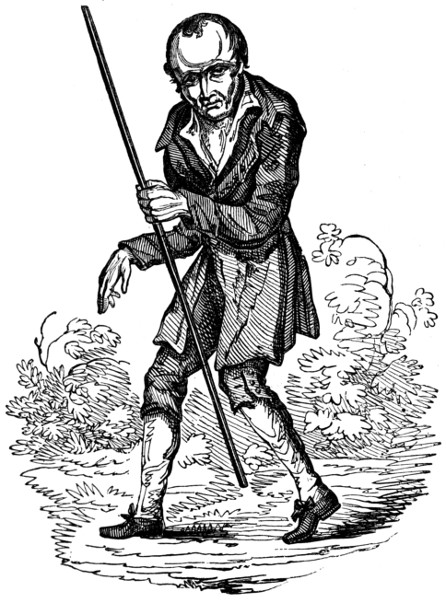
“Ben”—“the Old General”—of Nottingham.
Commander of some forces there, And intimate with Mr. Mayor.
*
Benjamin Mayo is believed to be the proper name of the “General,” his other appellations he derived from having been the ringleader of the boys, from his youth to the present time, on all occasions for which they assemble together in the town of Nottingham.
In order “to secure the boundaries of the town, a certain number of respectable characters, annually appointed, form what is called the Middleton, Mickleton, or Leet Jury, and circumambulate them twice a year, with the coroner at their head; it is also the duty of this jury to break down all obstructions in old roads, to fine those persons who may have made such encroachments as do not immediately obstruct a public road, and to present all nuisances at the quarter sessions.”[514] At the Easter and Michaelmas quarter sessions, the day for these duties is always appointed to be the Monday se’nnight following; and hence it is called Middleton Monday. The name of “Middleton is said to be retained from lord Middleton,” who is steward of the Peveril Court, which has now no jurisdiction in Nottingham, it being a town-county. The origin of these matters, however, is of little consequence in an account of the “General;” they are only referred to as preparatory to the observation, that he is a conspicuous personage in the ceremonial of the day.
On “Middleton Monday” all the school-boys in the town expect a holyday; it is the juvenile Saturnalia; and though the “General” is great on all occasions, he is especially so on “Middleton Monday;” for compared with him, the mayor, the coroner, and other municipal authorities, are subordinate officers in the estimation of the youthful tribes.
Previous to the jury commencing their survey, away trots “General,” with several hundreds of boys at his heels, to secure the sacred and inviolable right of a holyday. Two or three urchins, with shining, morning faces, lead the way to their own schoolmaster’s, who, in violation of the “orders of the day,” is seated amidst the few children whose parents have refused to grant a holyday, and therefore dare not “play travant.” Some “devoted Decius” in miniature, ventures in, on the forlorn hope of procuring liberty for the rest. Down drop books, pens, pencils, to the increasing cry of “Out, out, out.” The commander-in-chief arrives, amidst the cheers of his enthusiastic and devoted troops, takes up his position opposite to the door, and commands the onset. The advanced guard assail the portal with redoubled blows of their pocket-handkerchiefs, and old rope-ends, knotted into tommies, and the main body throw the missile mud. Ere long, a random stone breaks some window; this is speedily followed by a second and third crash; out sallies the master to seize the culprit, his sentinels are overpowered, the invaders rush in, the besieged are unmercifully belaboured till the capitulation is completed, but no sooner do they join the “liberating army,” than a shout of triumph is raised, and the place is abandoned. The aide-de-camps having reported to “the General,” what other fortresses hold out, the nearest is attacked in the same way. It often happens, however, that a parley is demanded, and “the General” shamelessly receives a bribe to desist. Alas! that one so devoted to the cause of liberty should be so easily corrupted—twopence will induce the commander-in-chief to withdraw, with his faithful followers, of fickle principle, and leave the anxious garrison to the uncontrolled power of its wily governor.
Upwards of twenty years ago, opposition to “the General” was rare, but about that period schoolmasters began to learn their strength. One individual successfully resisted during a three hours’ siege; the house for years bore marks of the mud with which it was pelted; but ever after he was triumphant, though frequently at the expense of an oaken staff, or an ash sapling, broken in repulsing the invaders. After repeated assaults, “the General” deemed this “hold” impregnable, and desisted from his attacks.
So many of the disciples of learning being emancipated, or prisoners, as “the General” can liberate or capture, he sets forward with the “surveying council,” escorted by his army, to commence the perambulation of the town. If a projecting scraper endanger the shins of the burgesses, it is recorded, and the Middleton jury pass on; but the juvenile admirers of summary and instantaneous justice are for the immediate removal of the offender. Perhaps the good old dame of the house “likes not these new regulations,” and takes up a strong position in its defence, armed with a mop and bucket of water. After a momentous pause, a hardy champion rushes forward to seize the offensive iron, and wrench it from its seat; he retires, overwhelmed and half drowned; hero after hero presses on, and is defeated; till some modern Ajax grapples with the mop, and making a diversion in favour of the assailants, the luckless scraper is borne off in triumph.
View “the General” at eleven o’clock, with his forces drawn up in front of the Castle lodge, demanding admittance into the Castle yard—a summons always evaded by the distribution of a quantity of cakes and gingerbread. On “the General’s” word of command the precious sweets are thrown, one by one, over the gate, and the confusion of a universal scramble ensues. After the whole is distributed, the popularity of “the General” rapidly wanes; hundreds are reduced to scores, and scores to ones—at noon he is
Deserted in his utmost need By those his former bounty fed.
In memory, however, of his departed greatness, he never deigns to work for the rest of the day.
Before the approach of “Middleton Monday,” fifty times a day the important question is put to the General, “When will be Middleton Monday?” Once he said, “I don’t know yet, the mayor ha’n’t ax’d me what day’ll suit me.” On the following Saturday he answered, “The mayor sent his respects to know if I’d let it be Middleton Monday next week; and I sent my respects, and I’d come.”
Ben Mayo has ever been “null, void, and of no effect,” except in his character of “General.” He is a harmless idiot, who, during most of his life, has been an inmate of St. Peter’s workhouse. He is now nearly fifty years of age. If erect, he would be under the middle size; his stature not being more than four feet nine inches. He is very round-shouldered. His eyes are dark grey, and rather lively; the lower part of his face is no way remarkable, but his forehead is very high, and singularly prominent in the middle; his head, which is thinly covered with hair cut very short, always projected before him in his shuffling gait, which is rather a run than a walk. His vestment generally consists of the “hodden grey” uniform of the parish; his shirt collar, like that of some other public characters, is usually unbuttoned, and displays his copper-coloured bosom. Grey stockings and quarter boots complete his equipment, for he never wears a hat. Though coarse, his dress is generally clean and tidy.
“The General” is constant in his attendance at church, where his behaviour is serious; and he would on no account be seen about in the streets on the Sabbath, for, being one of the public characters of the town, it would be setting a bad example. In politics, he is a staunch supporter of the powers that be; on such occasions as the king’s birth-day, and the coronation, Ben is sure to be seen with a bunch of blue riband to his coat, while at an election, to display his loyalty, he is dusted with power-blue from the crown of his head to the skirts. He has, however, no objection to aid “the Jacobin corporation,” as far as in him lies; and, according to his own account, he is particularly intimate with the mayor for the time being, whom he allows to be the first man in the town—himself being second. He is remarkably fond of peace and with his wand in hand will “charge” it, where there is no fear of its being broken.
Like other military men, “General” is a favourite with the ladies, inasmuch as he is known equally to high and low, and makes promises to all indiscriminately (who please him) that he will marry them “next Sunday morning;” at the same time, he cautions the favoured fair not to be later than half past seven, “for fear somebody else should get him.”
The “General’s” usual occupation is to sell the cheap commodities of the walking stationers, such as dreadful shipwrecks, horrid murders, calendars of the prisoners, last dying speeches and behaviours, or lists of the race horses. Sometimes, when the titles of these occur closely, he makes curious “varieties of literature.” Not long since, he was calling “A right and true calendar of all the running horses confined in his majesty’s gole, owners’ names, horses’ names, and colours of the riders, tried, cast, ’quit, and condemned before my lord judge this ’sizes, and how they came in every heat of the three days, with the sentences of the prisoners.”
About four years ago, at Lenton fair and wakes, which are always at Whitsuntide, and numerously attended from Nottingham, being only a mile distant, some wag set “General” to proclaim the Lenton fair. On this occasion he mounted an enormous cocked hat of straw, and had his wand in his hand. He jumbled together pigs, gingerbread, baa-lambs, cows, dolls, horses, ale, fiddling, sheep, &c. in a confused mass; whilst the latter part of the proclamation, though perfectly true, was very far from being “quite correct.”
Of the many anecdotes current of “General,” one or two authentic ones will display the union of shrewdness and simplicity common to persons of his order of intelligence. On a certain occasion, when public attention was directed towards the commander-in-chief, one evening in the twilight Ben began, “Here’s the grand and noble speech as the duke of York made yesterday.” A person, who had heard nothing of such a speech, immediately purchased one, and on approaching a window found himself possessed of a piece of blank paper. “General,” said he, “here’s nothing on it.” “No, sir, the duke of York said nowt.” Being set, at the workhouse, to turn a wheel, he did so properly enough for about half an hour, but becoming tired, he immediately began to turn backwards, nor could he be persuaded to the contrary. A blockhead once tried to make him quarrel with an idiot lad, as they were employed in sweeping the street together; “Oh,” said he, “he is a poor soft lad, and beneath my notice.” There is another instance of his dislike of work: having been set to weed part of the garden, he performed the task by pulling up all the flowers and herbs, and leaving the weeds growing. He once found a sixpence, and ran up the street shouting, “Who’s lost sixpence, who’s lost sixpence?” “It’s mine, General,” said one. “But had your’s a hole in it?” “Yes,” said he—“But this hasn’t,” rejoined General, and away he ran. His mode of running is remarkable, inasmuch as one leg is considerably shorter than the other, which gives his body an up-and-down motion. One peculiarity is, that when he has any fresh papers to sell he will never stop to take money till quite out of breath, and arrived at the extremity of the town.
David Love, of whom there is an account in the present volume of the Every-Day Book, p. 226, is still in Nottingham. In May he visited Hull, but while carolling his wild lays in a place where he was not known, he was apprehended as a vagrant, and consigned to the tread-mill for a fortnight.
“Oft from apparent ills our blessings flow.”
David, on his return to Nottingham, favoured us with “three varra couras poems of David Love’s composing, all about the trad wheel, where he warked for a fortnight—only a penny.” His numerous admirers purchased considerably.
Besides the “General” and the “bard” now living, Nottingham has been the residence of several equally noted personages deceased; such as Tommy Rippon, Piping Charley, the ventriloquist, &c.; and we have yet amongst us Jacky Peet, and other memorable characters, whose fame, it is feared, may not find an honest chronicler.
Nottingham, Oct. 23, 1826.
G.
NATURALISTS’ CALENDAR.
Mean Temperature 39·65.
November 23.
St. Clement.[515]
To the Editor of the Every-Day Book.
Sir,—In your last year’s volume I see you have taken great notice of St. Clement, and the customs observed on his day; but I do not see any mention of a custom which was common in Worcestershire, where I was born. I am entirely ignorant of its origin; yet in my youth I have often been at its celebration. The custom was as follows:—
On the afternoon of St. Clement’s day, a number of boys collected together in a body, and went from house to house; and at the door of each house, one, or sometimes more, would recite, or chaunt, the following lines—
Catherine and Clement, be here, be here; Some of your apples, and some of your beer Some for Peter, and some for Paul, And some for him that made us all. Clement was a good old man, For his sake give us some; Not of the worst, but some of the best, And God will send your soul to rest.
Some would say,
And God will send you a good night’s rest
Sometimes grown men would go in like manner, and, to such, the people of the house would give ale or cider; but to the boys they gave apples, or, if they had none to spare, a few halfpence. Having collected a good store of apples, which they seldom failed to do, the boys repaired to some one of their houses, where they roasted and ate the apples; and frequently the old would join the young, and large vessels of ale or cider would be brought in, and some of the roasted apples thrown hot into it, and the evening would then be spent with much mirth and innocent amusement; such as, I sorrow to think, have departed never to return.
Such, sir, was one of the usages “in my youthful days,” in that part of the country of which I have spoken. I have had but little intercourse with it of late years, but I fear these improved times have left but little spirit or opportunity for the observance of such ways, or the enjoyment of such felicity. Much has been said of improvement, and the happy state of the present over times past; but, on striking the balance, it may be found that the poor have lost much of their solid comfort, for the little improvement they have obtained.
You, Mr. Editor, have exposed with a masterly hand the superstitions and monkery of the olden time, for which you have my best thanks, in common, I believe, with those of nine out of every ten in the nation; but should a Mr. Hone arise two hundred years hence, I think he would have something to say upon these our times. I fear, however, I am going beyond my object, which is not to find fault, but to acquaint you with a practice which, if worthy a place in your pleasant, instructive, and highly useful work, I shall be glad to see there memorialed.
I am, &c.
Selits.
NATURALISTS’ CALENDAR.
Mean Temperature 40·02.
November 24.
Spectres and Apparitions.
In a popular “calendar” there are some observations on this day, which, as the time for telling “Ghost stories” is come in, seem appropriate. They are to the effect, that there is an essential difference between “Ocular Spectres” and “Spectral Illusions.”
Ocular Spectres move with the motion of the eye, whatever may be the forms of the spectrum on the retina; hence, they are spectra in the eye.
Spectral Illusions, or Ghosts, seem to move with their own proper motion, like real persons, and the objects in dreams; hence they are not in the eye itself or retina, but may arise in the brain.
We know nothing of the particular laws whereby these forms are regulated, as they occur without the conscious precurrence of the usual chains of thought, and often represent forms, and combinations of forms, almost entirely new to us. Some persons only see these spectres once or twice in their lives, and that only during diseases: others are continually harassed by them, and often mistake some one consistent spectre, which frequently comes and converses with them, for their guardian angel. In proportion, however, as the phantom gains on the credulity of the patient who beholds it, the latter approximates towards insanity. According to the disturbance of the brain of the individuals, the spectres are either horrifying or delightful, and partake of the character of the patient’s mind, as it is influenced variously by desire, fear, hope, and so on. We have known instances where the antiphlogistic measures resorted to with success, have been viewed by the patient, when recovered, as positive evils, having forcibly torn from him some perpetual and pleasing illusion.
The late Mr. John Wheeler, prebendary of Westminster, used to relate a remarkable story of the Abbé Pilori at Florence, who incurred a tremendous spectral disorder in consequence of a surfeit of mushrooms he one day ate. These fungi, not digesting, disturbed his brain, and he saw the frightful and appalling forms of scorpions continually before his eyes for a length of time.
This brings to our minds yet another observation with regard to spectra. Persons who are somewhat delirious from fever are apt to give to half-distinguished forms, in a darkish chamber, the most frightful imaginary shapes. This is a disorder distinct from that of seeing phantoms. A. Y. R. a child, being ill of fever, saw some bulbous roots laying on a table in the room, and conceived them immediately to be scorpions; nor could any thing convince her of the contrary, and they consequently were removed out of the room to relieve her terrors.
A familiar instance of deception is exemplified in the false voices which some persons imagine they hear calling them, faintly in common, but so as to deceive for a moment. When this false perception of sound concurs with images of spectral illusion, a formidable imitation of reality is maintained.[516]
A poetical friend, whose signature will be recollected as having been attached to “Sea Sonnets,” obligingly communicates a seasonable effusion of the like order of composition, prefaced by the following passage from Dr. Buchan:—
“If the power of volition be suspended, persons may dream while they are awake. Such is the case when, in an evening, looking into the fire, we let slip the reins of the imagination, and, yielding implicitly to external objects, a succession of splendid or terrific imagery is produced by the embers in the grate.”
FIRE-SIDE SONNET.
For the Every-Day Book.
For very want of thought and occupation Upon my fire, as broad and high it blaz’d, In idle and unweeting mood I gaz’d, And, in that mass of bright and glowing things Fancy, which in such moments readiest springs, Soon found materials for imagination: Within the fire, all listless as I maz’d, There saw I trees and towers, and hills and plains, Faces with warm smiles glowing, flocks and swains. And antic shapes of laughable creation: And thus the poet’s soul of fire contains A store of all things bright and glorious! rais’d By fancy, that daft artizan, to shape Into fair scenes and forms, that nature’s best may ape.
W. T. M.
NATURALISTS’ CALENDAR.
Mean Temperature 39·80.
November 25.
St. Catherine.
For an account of this Saint, see vol. i. col. 1504.
Bubbles.
In the “Morning Advertiser” of this day, 1807, which year was almost as much distinguished by joint-stock impositions as the present, there are two advertisements, which, from their station in the advertising columns of that paper, have a more remarkable, than if they had been displayed in its columns of entertainment, viz:
FINAL MEETING of the PUBLIC BLACKING SUBSCRIPTION COMPANY, held at the Boot in Leather-lane,
ANTHONY VARNISH, Esq. in the Chair, Sir John Blackwell, Knight, being indisposed.
The Chairman reported that Mr. Timothy Lightfoot, the Treasurer, had brushed off with the old fund, and that the deputation who had waited on Mr. Fawcett, the Proprietor of the Brilliant Fluid Blacking, at No. 76, Houndsditch, could not prevail on him to dispose of his right thereto in favour of this Company, although they had made him the most liberal offers.
Resolved, That this Meeting being fully sensible that any attempt to establish a rival Blacking would totally fail of success, from the high estimation in which the above popular article is held, and the mishap of the Treasurer having damped the ardour of the undertaking, that this design be altogether abandoned.
Resolved, That the character of the Promoters of this Company ought not to be blackened in public esteem, as there is no direct proof of their having shared the spoils with the Treasurer.
Signed, by Order of the Meeting, JACOB BRUSHWELL, Sec.
THE LONDON COMPANY for GENUINE MATCHES.—It having been suggested to Mr. Parr, Proprietor of the Equitable Office, Holborn-hill, that a complaint prevails among Servants, owing to the adulteration of Brimstone, and the badness of Wood, in consequence of which, they cannot get their Fires lighted in proper time, which obliges many of their Masters to go to business without their breakfast.
Such imposition having proved very injurious to a number of servants, by being discharged for neglect of duty, has induced Mr. Parr, in conjunction with six eminent Timber Merchants, to purchase those extensive Premises in Gunpowder-alley, near Shoe-lane, formerly occupied by the Saltpetre Company, for the sole purpose of a Genuine Match Manufactory.
The Public may be assured that this laudable undertaking is countenanced by some of the first characters in the United Kingdoms.
The Managers pledge themselves to employ the best work-people, both men, women, and children, that can be procured, which will amount to 1500 persons and upwards, as they conclude, by the large orders already received, that a less number will procrastinate the business.
Each Subscriber to have the privilege of recommending two, who are to bring certificates from the Minister of the Parish where they reside, of their being sober, honest, and industrious persons.
The Managers further engage to make oath before the Lord Mayor every three months, that the matches are made of the most prime new yellow Deal, and also that the Brimstone is without the least adulteration.
Not less than 12 penny bunches can be had.
Any order amounting to 1l. will be sent free of expense, to any part of the town, not exceeding two miles from the Manufactory.
The Capital first intended to be raised is Two Millions, in 50l. Shares, 2l. per Share to be paid at the time of subscribing, 3l. that day month, 4l. in six weeks, 5l. in two months, and so on regularly until the whole is subscribed.
Holders of five shares to be on Committees, and holders of ten will qualify them for Directors.
Although this plan has not been set on foot more than a week, it is presumed the call for Shares has been equal to a month’s demand for Shares in any of the late Institutions.
Schemes at large may be had, and Subscriptions received by Mr. Tinder, Secretary, at the Counting-house, from ten till two; also at his Residence, near the Turpentine Manufactory, St. John-street-road, from four to six; likewise by Messrs. Sawyer, Memel, and Tieup, Solicitors, Knave’s-acre, Westminster.
NATURALISTS’ CALENDAR.
Mean Temperature 41·27.
November 26.
The Season.
Autumnal appearances are increasing, and occasional gales of wind and interchanges of nipping frost hasten the approaching winter. The following passage seems to allude to the wintry garb of nature:—“The earth mourneth and languisheth; Lebanon is ashamed and withereth away; Sharon is like a wilderness; and Bashan and Carmel shake off their fruits.”—Isaiah, xxiii. 9.
Soon shall we be compelled to exclaim with the poet, in reference to this, generally speaking, gloomy season,
That time of year thou mayest in me behold, When yellow leaves, or none, or few do hang On those wild boughs which shake against the cold, Bare ruined quires, where late the sweet birds sang.
November, however, has its bright as well as its dark side. “It is now,” observes a pleasing writer, “that the labourer is about to enjoy a temporary mitigation of the season’s toil. His little store of winter provision having been hardly earned and safely lodged, his countenance brightens, and his heart warms, with the anticipation of winter comforts. As the day shortens and the hours of darkness increase, the domestic affections are awakened anew by a closer and more lengthened converse; the father is now once more in the midst of his family; the child is now once more on the knee of its parent; and she, in whose comfort his heart is principally interested, is again permitted, by the privileges of the season, to increase and to participate his happiness. It is now that the husbandman is repaid for his former risk and anxiety—that, having waited patiently for the coming harvest, he builds up his sheaves, loads his waggons, and replenishes his barns.” It is now that men of study and literary pursuit are admonished of the best season suited for the pursuits of literature; and the snug fireside in an armed chair, during a long winter’s evening, with an entertaining book, is a pleasure by no means to be despised. There is something, too, very pleasing in the festivals which are now approaching, and which preserve the recollection of olden time.[517]
NATURALISTS’ CALENDAR.
Mean Temperature 41·52.
November 27.
A National Death Day.
The chapter of an old, black-letter book of wonderful things concludes with the following amusing paragraph:—
“Here may we also speak of the people, Lucumoria, dwelling among the hilles, beyond the river Olbis. These men die every year the 27 of November, which day at Rutheas was dedicated to Saint Gregorie; and in the next spring following, most commonly at the four and twentieth day of April, they rise again like frogs.”[518]
NATURALISTS’ CALENDAR.
Mean Temperature 40·00.
November 28.
NATURALISTS’ CALENDAR.
Mean Temperature 39·65.
November 29.
NATURALISTS’ CALENDAR.
Mean Temperature 39·90.
November 30.
St. Andrew.
Respecting this Saint, the patron of Scotland, there is a notice in vol. i. 1537.
The Model Lottery.
For the Every-Day Book.
A Model Lottery is drawn on the 30th of November, at Mr. Oldershaw’s office, Lower-street, Islington. Several capital prizes are made, the principal of which is Fonthill Abbey, valued at 5l. There are others less valuable, Islington church, Cannonbury Tower, the Queen’s Head, Sir William Curtis’s villa, at Southgate,—the house in which Garrick was born,—many Italian buildings, and a variety to the number of 500. Each adventurer, by paying three shillings, draws a share which is equal, in the worst chance, to the deposit. The scheme is contrived by an ingenious artist and his wife, whose names are Golding. Previously to the drawing-day, three days are allowed for friendly inspection. It is laudable to see this Model Lottery patronised by the most respectable ladies and gentlemen in the vicinity where it takes place. This is the second year of its existence.
P.S. For Bradenstock, p. 1371, read Bradenstoke; and for Brinkworth, p. 1373, read Bremhill. Dr. Allsop, of Calne, was the gentleman who cut out the “White Horse at Cheverill,” at which place and time a revel was most merrily kept. J. R. P.
Corrections and Illustrations,
For the Every-Day Book.
Your correspondent in his account of “Clack Fall Fair,” p. 1371, has fallen into a few mistakes.
Bradenstoke was not an abbey, but a priory.
He might have inquired some further particulars of the Golden Image, said to have been found. In whose possession it now is? It is believed the circumstance, if true, is not generally known in the neighbourhood. Query, the name of the Carpenter?
The idea of a subterraneous passage from Bradenstoke Priory to Malmsbury Abbey, a distance of eight or ten miles, intersected by a deep valley, through which the Avon meanders, is absurd, and can only be conceived as one of the wild traditions derived from monkish times.
Can your correspondent furnish further particulars of the horrible story of the boy murdered by his schoolmaster, when and whom?
His account of “Joe Ody’s” exploits may be very correct. He is well remembered by the elder peasantry.
It is presumed, your correspondent meant to say, that the song was attributed to Bowles of Bremhill, not Brinkworth. The Rev. W. L. Bowles is rector, or vicar, of Bremhill, about five or six miles from Clack Brinkworth, about the same distance in the opposite direction.
Your correspondent might have noticed the mound called Clack Mount. Perhaps he will favour you with further recollections of the localities of Clack, and its vicinity.
The remains of a may-pole are visible at Clack; but the pole itself is believed not to be remembered by any person now living, or, if remembered, by very old persons only.
A Reader.