MARCH. (continued 5)
Reading edition
Minerva.
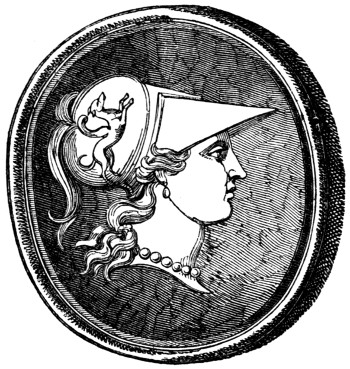
Minerva. From a Chrysolite possessed by Lord Montague.
The Minervalia was a Roman festival in March, commencing on the 19th of the month, and lasting for five days. The first day was spent in devotions to the goddess; the rest in offering sacrifices, seeing the gladiators fight, acting tragedies, and reciting witticisms for prizes. It conferred a vacation on scholars who now, carried schooling money, or presents, called Minerval, to their masters.
According to Cicero there were five Minervas.
1. Minerva, the mother of Apollo.
2. Minerva, the offspring of the Nile, of whom there was a statue with this inscription:—“I am all that was, is, and is to come; and my veil no mortal hath yet removed.”
3. Minerva, who sprung armed from Jupiter’s brain.
4. Minerva, the daughter of Jupiter and Corypha, whose father Oceanus invented four-wheeled chariots.
5. Minerva, the daughter of Pallantis, who fled from her father, and is, therefore, represented with wings on her feet, in the same manner as Mercury.
The second Minerva, of Egypt, is imagined to have been the most ancient. The Phœnicians also had a Minerva, the daughter of Saturn, and the inventress of arts and arms. From one of these two, the Greeks derived their Minerva.
Minerva was worshipped by the Athenians before the age of Cecrops, in whose time Athens was founded, and its name taken from Minerva, whom the Greek called Ἁθηνη. It was proposed to call the city either by her name or that of Neptune, and as each had partizans, and the women had votes equal to the men, Cecrops called all the citizens together both men and women; the suffrages were collected; and it was found that all the women had voted for Minerva, and all the men for Neptune; but the women exceeding the men by one voice, Athens was called after Minerva. A temple was dedicated to her in the city, with her statue in gold and ivory, thirty-nine feet high, executed by Phydias.
Mr. Matthews at Home, 1826.
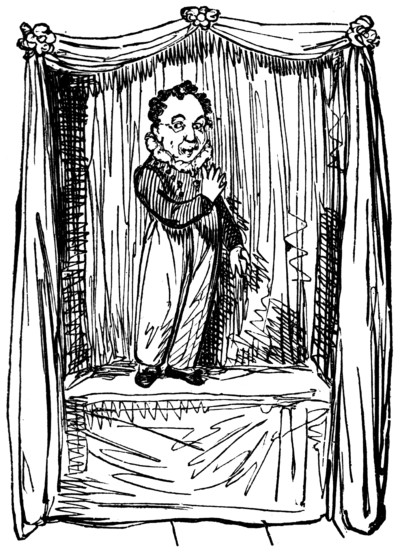
“Life is darken’d o’er with woe.”—Der Freischütz. Mr. Matthews at Home, 1826.
It would be as difficult for most persons, who think Mr. Matthews acts easily, to act as he does, as it would be difficult to make such persons comprehend, that his ease is the result of labour, and that his present performance is the result of greater labour than his exhibitions of former years. An examination of the process by which he has attained the extraordinary ability to “command success,” would be a fatiguing inquiry to most readers, though a very curious one to some. He has been called a “mimic;” this is derogation from his real powers, which not only can represent the face, but penetrate the intellect. An expert swimmer is not always a successful diver: Mr. Matthews is both. His faculty of observation “surpasses show.” He leaves the features he contemplates, enters into the mind, becomes joint tenant of its hereditaments and appurtenances with the owner, and describes its secret chambers and closets. This faculty obtained lord Chesterfield his fame, and enabled him to persuade the judgment; but he never succeeded by his voice or pen in raising the passions, like Mr. Matthews, who, in that respect, is above the nobleman. The cause of this superiority is, that Mr. Matthews is the creature of feeling—of excitation and depression. This assertion is made without the slightest personal knowledge or even sight of him off the stage; it is grounded on a generalized view of some points in human nature. If Mr. Matthews were not the slave of temperament, he never could have pictured the Frenchman at the Post Office, nor the gaming Yorkshireman. These are prominences seized by his whole audience, on whom, however, his most delicate touches of character are lost. His high finish of the Irish beggar woman with her “poor child,” was never detected by the laughers at their trading duett of “Sweet Home!” The exquisite pathos of the crathur’s story was lost. To please a large assemblage the points must be broad. Mr. Matthews’s countenance of his host drawing the cork is an excellence that discovers itself, and the entire affair of the dinner is “pleasure made easy” to the meanest capacity. The spouting child who sings the “Bacchanal Song” in “Der Freischütz” from whence the engraving is taken, is another “palpable hit,” but amazingly increased in force to some of the many who heard it sung by Phillips. The “tipsy toss” of that actor’s head, his rollocking look, his stamps in its chorus, and the altogetherness of his style in that single song, were worth the entirety of the drama—yet he was seldom encored. To conclude with Mr. Matthews, it is merely requisite to affirm that his “At Home” in the year 1826, evinces rarer talent than the merit of a higher order which he unquestionably possesses. He is an adept at adaptation beyond compeer.
Coleshill Custom.
They have an ancient custom at Coleshill, in the county of Warwick, that if the young men of the town can catch a hare, and bring it to the parson of the parish before ten o’clock on Easter Monday, the parson is bound to give them a calve’s head, and a hundred eggs for their breakfast, and a groat in money.[112]
Riding the Black Lad.
An account of an ancient usage still maintained under this name at Ashton-under-Lyne, will be found in the annexed letter.
To the Editor of the Every-Day Book.
Ashton-under-Lyne, March, 1826.
Sir,
A singular custom prevails at this town on Easter Monday. Every year on that day a rude figure of a man made of an old suit of clothes stuffed with rags, hay, &c. is carried on a horse through all the streets. The people who attend it call at every public-house, for the purpose of begging liquor for its thirsty attendants, who are always numerous. During its progress the figure is shot at from all parts. When the journey is finished, it is tied to the market cross, and the shooting is continued till it is set on fire, and falls to the ground. The populace then commence tearing the effigy in pieces, trampling it in mud and water, and throwing it in every direction. This riot and confusion are increased by help of a reservoir of water being let off, which runs down the streets, and not unfrequently persons obtain large quantities of hay, rags, &c. independent of that which falls from the effigy. The greatest heroes at this time are of the coarsest nature.
The origin of this custom is of so ancient a nature that it admits of no real explanation: some assert that it is intended as a mark of respect to an ancient family—others deem it a disrespect. Dr. Hibbert considers it to have the same meaning as the gool-riding in Scotland, established for the purpose of exterminating weed from corn, on pain of forfeiting a wether sheep for every stock of gool found growing in a farmer’s corn. Gool is the yellow flower called the corn Marygold.
It is further supposed, that this custom originated with one of the Assheton’s, who possessed a considerable landed property in this part of Lancashire. He was vice-chancellor to Henry VI., who exercised great severity on his own lands, and established the gool or guld riding. He is said to have made his appearance on Easter Monday, clad in black armour, and on horseback, followed by a numerous train for the purpose of claiming the penalties arising from the neglect of farmers clearing their corn of the “carr gulds.” The tenants looked upon this visit with horror, and tradition has still perpetuated the prayer that was offered for a deliverance from his power:—
“Sweet Jesu, for thy mercy’s sake, And for thy bitter passion; Save us from the axe of the Tower, And from Sir Ralph of Assheton.”
It is alleged that, on one of his visits on Easter Monday, he was shot as he was riding down the principal street, and that the tenants took no trouble to find out the murderer, but entered into a subscription, the interest of which was to make an effigy of disgrace to his memory. At the present day, however, the origin is never thought of. The money is now derived from publicans whose interest it is to keep up the custom. An old steel helmet was used some years ago, but it is now no more; a tin one is used instead.
This custom is applied to another purpose. The occupation of the last couple married in the old year are represented on the effigy. If a tailor, the shears hang dangling by his side; if a draper, the cloth yard, and so on. The effigy then at the usual time visits the happy couple’s door, and unless the bearers are fed in a handsome manner, the dividing gentlemen are not easily got rid of. Some authors state that it is the first couple in the new year; but this is incorrect, as there is always great pressing for marrying on new year’s day, in order to be sufficiently early in the year.
Such is the custom of Blake Lad Monday—or Riding the Black Lad, a custom which thousands annually witness, and numbers come from great distances to see. It is the most thronged, and the most foolish, day the Ashtonians can boast of.
C. C.——g. M. R. C. S. E.
It is observed by the historian of “Manchester and Salford,” that the most prevalent of several traditions, as to the origin of this custom, is, that it is kept up to perpetuate the disgraceful actions of sir Ralph Ashton, who in the year 1483, as vice-constable of the kingdom, exercised great severity in this part of the country. From a sum issued out of the court to defray the expense of the effigy, and from a suit of armour, which till of late it usually rode in, together with other traditional particulars, there is another account of the custom. According to this, in the reign of Edward III., at the battle of Neville’s Cross, near Durham, his queen, with the earl of Northumberland as general, gained a complete victory over the Scots, under David, king of Scotland, and in this battle one Thomas Ashton of Ashton-under-Lyne, of whom no other particulars are known, served in the queen’s army, rode through the ranks of the enemy, and bore away the royal standard from the Scottish king’s tent. For this act of heroism, Edward III. knighted him; he became sir Thomas Ashton, of Ashton-under-Lyne; and to commemorate his valour, he instituted the custom above described, and left ten shillings yearly (since reduced to five) to support it, with his own suit of black velvet, and a coat of mail, the helmet of which yet remains.”[113] It will be observed in our correspondent’s account, that the helmet has at last disappeared.
“Old Vinegar,” and “Hard Metal Spoons.”
William Conway, who cried “hard metal spoons to sell or change,” is mentioned by Mr. J. T. Smith, as “a man whose cry is well-known to the inhabitants of London and its environs;” but since Mr. Smith wrote, the “cry” of Conway has ceased from the metropolis, and from the remembrance of all, save a few surviving observers of the manners in humble life that give character to the times. He is noticed here because he introduces another individual connected with the history of the season. Adopting Mr. Smith’s language, we must speak of Conway as though his “cry” were still with us. “This industrious man, who has eleven walks in and about London, never had a day’s illness, nor has once slept out of his own bed; and let the weather be what it may, he trudges on, and only takes his rest on Sundays. He walks, on an average, twenty-five miles a day; and this he has done for nearly forty-four years. His shoes are made from old boots, and a pair will last him about six weeks. In his walks he has frequently found small pieces of money, but never more than a one pound note. He recollects a windmill standing near Moorfields, and well remembers Old Vinegar.”[114] Without this notice of Conway, we should not have known “Old Vinegar,” who made the rings for the boxers in Moorfields, beating the shins of the spectators, and who, after he had arranged the circle, would cry out “mind your pockets all round.” He provided sticks for the cudgel players, whose sports commenced on Easter Monday. At that time the “Bridewell boys” joined in the pastime, and enlivened the day by their skill in athletic exercises.
Wetting the Block.
For the Every-Day Book.
The first Monday in March being the time when shoemakers in the country cease from working by candlelight, it used to be customary for them to meet together in the evening for the purpose of wetting the block. On these occasions the master either provided a supper for his men, or made them a present of money or drink; the rest of the expense was defrayed by subscriptions among themselves, and sometimes by donations from customers. After the supper was ended, the block candlestick was placed in the midst, the shop candle was lighted, and all the glasses being filled, the oldest hand in the shop poured the contents of his glass over the candle to extinguish it: the rest then drank the contents of theirs standing, and gave three cheers. The meeting was usually kept to a late hour.
This account of the custom is from personal observation, made many years ago, in various parts of Hampshire, Berkshire, and the adjoining counties. It is now growing into disuse, which I think is not to be regretted; for, as it is mostly a very drunken usage, the sooner it is sobered, or becomes altogether obsolete the better.
A Shoemaker.
N.B. In some places this custom took place on Easter Monday.
NATURALISTS’ CALENDAR.
Mean Temperature 45·32.
March 28.
Easter Tuesday.
Formerly, “in the Easter holidays, was the Clarke’s-ale for his private benefit, and the solace of the neighbourhood.”[115] Our ancestors were abundant drinkers; they had their “bride-ales,” “church-ales,” and other sort of ales, and their feats of potation were so great as to be surprising to their posterity; the remainder of whom, in good time, shall be more generally informed of these regular drinking bouts. “Easter-ale” was not always over with Easter week. Excessive fasting begat excessive feasting, and there was no feast in old times without excessive drinking. A morning head-ache from the contents of the tankard was cured by “a hair of the same dog,”—a phrase well understood by hard-drinkers, signifying that madness from drinking was to be cured by the madness of drinking again. It is in common use with drinkers of punch.
Some of the days in this month seem
“For talking age and youthful lovers made.”
The genial breezes animate declining life, and waft “visions of glory” to those who are about to travel the journey of existence on their own account. In the following lines, which, from the “Lady’s Scrap Book,” whence they were extracted, appear to have been communicated to her on this day, by a worthy old gentleman “of the old school,” there is a touch of satirical good humour, that may heighten cheerfulness.
No Flattery
From J. M—— Esq. To Miss H—— W——. March 28, 1825.
I never said thy face was fair, Thy cheeks with beauty glowing; Nor whispered that thy woodland air With grace was overflowing. I never said thy teeth were white, In hue were snow excelling; Nor called thine eye, so blue, so bright, Young Love’s celestial dwelling. I never said thy voice so soft, Soft heart but ill concealing; Nor praised thy sparkling glances oft, So well thy thoughts revealing. I never said thy taper form Was, Hannah, more than handsome; Nor said thy heart, so young, so warm, Was worth a monarch’s ransom. I never said to young or old I felt no joy without thee: No, Hannah, no, I never told A single lie about thee.
NATURALISTS’ CALENDAR.
Mean Temperature 45·70.
March 29.
March Mornings.
For the Every-Day Book.
There are frequently mornings in March, when a lover of nature may enjoy, in a stroll, sensations not to be exceeded, or, perhaps, equalled by any thing which the full glory of summer can awaken:—mornings, which tempt us to cast the memory of winter, or the fear of its recurrence out of our thoughts. The air is mild and balmy, with, now and then, a cool gush by no means unpleasant, but, on the contrary, contributing towards that cheering and peculiar feeling which we experience only in spring. The sky is clear, the sun flings abroad not only a gladdening splendour, but an almost summer glow. The world seems suddenly aroused to hope and enjoyment. The fields are assuming a vernal greenness,—the buds are swelling in the hedges,—the banks are displaying amidst the brown remains of last year’s vegetation, the luxuriant weeds of this. There are arums, ground-ivy, chervil, the glaucous leaves, and burnished flowers of the pilewort,
“The first gilt thing, Which wears the trembling pearls of spring;”
and many another fresh and early burst of greenery. All unexpectedly too, in some embowered lane, you are arrested by the delicious odour of violets—those sweetest of Flora’s children, which have furnished so many pretty allusions to the poets, and which are not yet exhausted; they are like true friends, we do not know half their sweetness till they have felt the sunshine of our kindness; and again, they are like the pleasures of our childhood, the earliest and the most beautiful. Now, however, they are to be seen in all their glory—blue and white—modestly peering through their thickly clustering leaves. The lark is carolling in the blue fields of air; the blackbird and thrush are again shouting and replying to each other from the tops of the highest trees. As you pass cottages, they have caught the happy infection. There are windows thrown open, and doors standing a-jar. The inhabitants are in their gardens, some cleaning away rubbish, some turning up the light and fresh-smelling soil amongst the tufts of snowdrops and rows of glowing yellow crocuses, which every where abound; and the children, ten to one, are busy peeping into the first bird’s-nest of the season—the hedge-sparrow’s, with its four blue eggs, snugly, but unwisely, built in the pile of old pea-rods.
In the fields the labourers are plashing and trimming the hedges, and in all directions are teams at plough. You smell the wholesome, and we may truly say, aromatic soil, as it is turned up to the sun, brown and rich, the whole country over. It is delightful as you pass along deep hollow lanes, or are hidden in copses, to hear the tinkling gears of the horses, and the clear voices of the lads calling to them. It is not less pleasant to catch the busy caw of the rookery, and the first meek cry of the young lambs. The hares are hopping about the fields, the excitement of the season overcoming their habitual timidity. The bees are revelling in the yellow catkins of the sallow. The woods, though yet unadorned with their leafy garniture, are beautiful to look on. They seem flushed with life. Their boughs are of a clear and glossy lead colour, and the tree-tops are rich with the vigorous hues of brown, red, and purple; and if you plunge into their solitudes, there are symptoms of revivification under your feet, the springing mercury, and green blades of the blue-bells—and perhaps, above you, the early nest of the missel-thrush perched between the boughs of a young oak, to tinge your thoughts with the anticipation of summer.
These are mornings not to be neglected by the lover of nature; and if not neglected, then, not to be forgotten, for they will stir the springs of memory, and make us live over again times and seasons, in which we cannot, for the pleasure and the purity of our spirits, live too much.
Nottingham.
W. H.
NATURALISTS’ CALENDAR.
Mean Temperature 45·12.
March 30.
Kitty Fisher.
On the 30th of March, 1759, this celebrated female issued a singular advertisement through the “Public Advertiser,” which shows her sensitiveness to public opinion. She afterwards became duchess of Bolton.
TO ERR is a blemish entailed upon mortality, and indiscretion seldom or never escapes without censure, the more heavy, as the character is more remarkable; and doubled, nay trebled, by the world, if that character is marked by success: then malice shoots against it all her stings, and the snakes of envy are let loose. To the humane and generous heart then must the injured appeal, and certain relief will be found in impartial honour. Miss Fisher is forced to sue to that jurisdiction to protect her from the baseness of little scribblers, and scurvy malevolence. She has been abused in public papers, exposed in print shops, and, to wind up the whole, some wretches, mean, ignorant, and venal, would impose upon the public by daring to publish her memoirs. She hopes to prevent the success of their endeavours, by declaring that nothing of that sort has the slightest foundation in truth.
C. Fisher.
NATURALISTS’ CALENDAR.
Mean Temperature 44·67.
March 31.
John Hampden.
This celebrated man wrote a letter to sir John Elliott, on this day, in the year 1631, which is deposited in the British Museum.[116] At its date, which was long before “the troubles of England,” wherein he bore a distinguished part, it appears that he was absorbed by constant avocation, and attention to the business of others. The letter has been obligingly transcribed and communicated by our kind correspondent, T. A. It is curious from its style and sentiments, and is here printed, because it has not before been published. The commencing and concluding words are given fac-simile, from the original. It is addressed thus,
To my honoured and deare friend Sr. John Elliott at his lodging in the Tower.
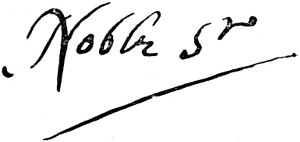
Tis well for mee that letters cannot blush, else you would easily reade mee guilty. I am ashamed of so long a silence and know not how to excuse it, for as nothing but businesse can speake for mee, of wch kinde I have many advocates, so can I not tell how to call any businesse greater than holding an affectionate correspondence with so excellent a friend. My only confidence is I pleade at a barr of loue, where absolutions are much more frequent then censures. Sure I ame that conscience of neglect doth not accuse mee; though euidence of fact doth. I would add more but ye entertainment of a straunger friend calls upon mee, and one other unsuitable occasion hold mee excused: therefore, deare friend, and if you vouchsafe mee a letter, lett mee begg of you to teach mee some thrift of time; that I may imploy more in yor service who will ever bee
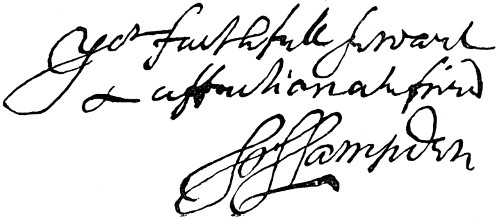
Hampd. March 31, 1631.
Command my service to ye souldier if not gone to his colours.
The Sun in March.
We may now see the great luminary at half-past five in the morning if “we shake off dull sloth,” and set our faces to be greeted by his, at his rising, in the open air. Lying a bed is a sad destroyer of health, and getting up early a vast improver of time. It is an old and a true saying, that “an hour in the morning before breakfast, is worth two all the rest of the day.”
In “The Examiner” of the 31st of March, 1822, there is the following pleasant little story.
The Wonderful Physician.
One morning at daybreak a father came into his son’s bedchamber, and told him that a wonderful stranger was to be seen. “You are sick,” said he, “and fond of great shows. Here are no quack-doctors now, nor keeping of beds. A remarkable being is announced all over the town, who not only heals the sick, but makes the very grass grow; and what is more, he is to rise out of the sea.” The boy, though he was of a lazy habit, and did not like to be waked, jumped up at hearing of such an extraordinary exhibition, and hastened with his father to the door of the house, which stood upon the sea-shore. “There,” said the father, pointing to the sun, which at that moment sprung out of the ocean like a golden world, “there, foolish boy, you who get me so many expenses with your lazy diseases, and yourself into so many troubles, behold at last a remedy, cheap, certain, and delightful. Behold at last a physician, who has only to look in your face every morning at this same hour, and you will be surely well.”
Provincial Medical Practice.
Country people who are unusually plain in notion, and straight forward in conduct, frequently commit the care of their health to very odd sort of practitioners.
A late celebrated empiric, in Yorkshire, called the Whitworth Doctor, was of so great fame as to have the honour of attending the brother of lord Thurlow. The name of this doctor was Taylor: he and his brother were farriers by profession, and to the last, if both a two-legged and a four-legged patient were presented at the same time, the doctor always preferred the four-legged one. Their practice was immense, as may be well imagined from the orders they gave the druggist; they dealt principally with Ewbank and Wallis, of York, and a ton of Glauber’s salt, with other articles in proportion, was their usual order. On a Sunday morning the doctors used to bleed gratis. The patients, often to the number of an hundred, were seated on benches round a room, where troughs were placed to receive the blood. One of the doctors then went and tied up the arm of each patient, and was immediately followed by the other who opened the vein. Such a scene is easier conceived than described. From their medical practice, the nice formality of scales and weights was banished; all was “rule of thumb.” An example of their practice may elucidate their claim to celebrity: being sent for to a patient who was in the last stage of a consumption, the learned doctor prescribed a leg of mutton to be boiled secundum artem, into very strong broth, a quart of which was to be taken at proper intervals: what might have been its success is not to be related, as the patient died before the first dose was got down. As bone-setters they were remarkably skilful, and, perhaps, to their real merit in this, and the cheapness of their medicines, they were indebted for their great local fame.
The “Public Ledger” of the 31st of March, 1825, contains
A crooked Coincidence.
A pamphlet published in the year 1703, has the following strange title:—“The deformity of sin cured, a sermon, preached at St. Michael’s, Crooked Lane, before the Prince of Orange; by the Rev. James Crookshanks. Sold by Matthew Dowton, at the Crooked Billet, near Cripplegate, and by all other Booksellers.” The words of the text are, “Every crooked path shall be made straight.” The Prince before whom it was preached was deformed in his person.
A Seasonable Epitaph on the late J. C. March, Esq.
Death seemed so envious of my clay, He bade me march and marched away; Now underneath the vaulted arch, My corpse must change to dust and March.
J. R. P.
NATURALISTS’ CALENDAR.
Mean Temperature 44·22.