FEBRUARY. (continued 2)
Reading edition
While some may deem this narrative of Rowland Taylor’s conduct too circumstantial, others perhaps may not so deem. It is to be considered as exemplifying the manners of the period wherein the event occurred, and may at least be acceptable to many. It will assuredly be approved by a few who regard inflexible adherence to principle, at the hazard of death itself, as preferable to a conscience-consuming subserviency, which, while it truckles to what the mind judges to be false, depraves the heart, and saps the foundations of public virtue.
NATURALISTS’ CALENDAR.
Mean Temperature 39·05.
February 10.
Biographical Notice.
1818. On this day died in London, captain Thomas Morris, aged 74, a man of highly cultivated mind, who was born in its environs, and for whom when young a maternal uncle, of high military rank, procured an ensigncy. He beat for recruits at Bridgewater, and enlisted the affections of a Miss Chubb of that town, whom he married. He was ordered with his regiment to America, where he fought by the side of general Montgomery.
Captain Morris at one time was taken by the Indians, and condemned to the stake; at the instant the women and children were preparing to inflict its tortures, he was recognised by an old sachem, whose life he had formerly saved, and who in grateful return pleaded so powerfully in his behalf, that he was unbound and permitted to return to his friends, who had given him up for lost. He published an affecting narrative of his captivity and sufferings; yet he was so attached to the Indian mode of life, that he used to declare they were the only human beings worthy of the name of MEN. On his return from America to England, he quitted the army and gave himself to literary studies, and the conversation of a few enlightened friends. In the midst of “the feast of reason, and the flow of soul,” he often sighed for the grand imagery of nature, the dashing cataracts of Columbia, the wild murmurs of rivers rolling through mountains, woods, and deserts. Having met with some disappointments which baffled his philosophy, he sought a spot for retirement, and found it in a nursery garden, at Paddington. Here in a small cottage, he compared Pope’s translation of Homer with the original, in which he was assisted by Mr. George Dyer, a gentleman well qualified for so pleasing a task. In this pursuit he passed some years, which he declared were the happiest of his life.
With partiality for the dead languages, he was sensible to the vigour and copiousness of his own: he translated Juvenal into English, and enriched it with many notes, but it was never printed. He published a little poem, entitled “Quashy, or the Coal-black Maid,” a pathetic West India story. He lived in the style of a gentleman, and left a handsome sum to his children.
NATURALISTS’ CALENDAR.
Mean Temperature 39·92.
February 11.
CHRONOLOGY.
1763. William Shenstone, the poet, died at his celebrated residence the Leasowes, near Hagley, in Worcestershire. He was born at Hales Owen, Shropshire, in 1714.
NATURALISTS’ CALENDAR.
Mean Temperature 40·00.
February 12.
1826.—First Sunday in Lent.
The communion service of the church of England for the Sundays in Lent, was extracted from the offices appointed for these Sundays by the missal of Sarum, excepting the collect for the first Sunday, which was composed by the compilers of the liturgy, and also excepting the gospel for the second Sunday.
NATURALISTS’ CALENDAR.
Mean Temperature 38·37.
February 13.
Valentine’s Eve.
1826. Hilary term ends. Cambridge term begins.
VALENTINE’S EVE AT SWAFFHAM.
For the Every-Day Book.
At Swaffham in Norfolk it is customary to send valentines on this evening. Watching for a convenient opportunity, the door is slyly opened, and the valentine, attached to an apple or an orange, is thrown in; a loud rap at the door immediately follows, and the offender, taking to his heels, is off instantly. Those in the house, generally knowing for what purpose the announcing rap was made, commence a search for the juvenile billet doux: in this manner, numbers are disposed of by each youth. By way of teasing the person who attends the door, a white oblong square, the size of a letter, is usually chalked on the step of the door, and, should an attempt be made to pick it up, great amusement is thus afforded to some of the urchins, who are generally watching.
K.
NATURALISTS’ CALENDAR.
Mean Temperature 38·10.
February 14.
OLD CANDLEMAS DAY.
Valentine.
Referring to vol. i. from p. 215 to 230, for information concerning the origin of this festival of lovers, and the manner wherein it is celebrated, a communication is subjoined concerning a custom now observed in Norfolk.
VALENTINE’S DAY AT LYNN.
For the Every-Day Book.
Independent of the homage paid to St. Valentine on this day at Lynn, (Norfolk,) it is in other respects a red-letter day amongst all classes of its inhabitants, being the commencement of its great annual mart. This mart was granted by a charter of Henry VIII., in the twenty-seventh year of his reign, “to begin on the day next after the feast of the purification of the blessed virgin Mary, and to continue six days next following,” (though now it is generally prolonged to a fortnight.) Since the alteration of the style, in 1752, it has been proclaimed on Valentine’s day. About noon, the mayor and corporation, preceded by a band of music, and attended by twelve decrepit old men, called from their dress “Red coats,” walk in procession to proclaim the mart, concluding by opening the antiquated, and almost obsolete court of “Piepowder.” Like most establishments of this nature, it is no longer attended for the purpose it was first granted, business having yielded to pleasure and amusement. Formerly Lynn mart and Stourbridge (Stirbitch) fair,[61] were the only places where small traders in this and the adjoining counties, supplied themselves with their respective goods. No transactions of this nature now take place, and the only remains to be perceived, are the “mart prices,” still issued by the grocers. Here the thrifty housewives, for twenty miles round, laid in their annual store of soap, starch, &c., and the booth of “Green” from Limehouse, was for three generations the emporium of such articles; but these no longer attend. A great deal of money is however spent, as immense numbers of persons assemble from all parts. Neither is their any lack of incitements to unburthen the pockets: animals of every description, tame and wild, giants and dwarfs, tumblers, jugglers, peep-shows, &c., all unite their attractive powers, in sounds more discordant than those which annoyed the ears of Hogarth’s “enraged musician.”
The year 1796 proved particularly unfortunate to some of the inhabitants of Marshland who visited the mart. On the evening of February 23, eleven persons, returning from the day’s visit, were drowned by the upsetting of a ferryboat; and on the preceding day a man from Tilney, going to see the wild beasts, and putting his hand to the lion’s mouth, had his arm greatly lacerated, and narrowly escaped being torn to pieces.
In the early part of the last century, an old building, which, before the reformation, had been a hall belonging to the guild of St. George, after being applied to various uses, was fitted up as a theatre, (and by a curious coincidence, where formerly had doubtless been exhibited, as was customary at the guild feasts, religious mysteries and pageants of the catholic age, again was exhibited the mysteries and pageants of the protestant age,) during the mart and a few weeks afterwards; but with no great success, as appears by an anecdote related of the celebrated George Alexander Stevens. Having in his youthful days performed here with a strolling company, who shared amongst them the receipts of the house, after several nights’ performance to nearly empty benches, while performing the part of Lorenzo, in Shakspeare’s “Merchant of Venice,” he thus facetiously parodied the speech of Lorenzo to Jessica, in the fifth act, as applicable to his distressed circumstances:
“Oh Jessica! in such a night as this we came to town, And since that night we’ve shar’d but half a crown; Let you and I then bid these folks good night, For if we longer stay, they’ll starve us quite.”
This neglect of the drama is not, however, to be attributed to the visitors or the inhabitants at the present day, a very elegant and commodious theatre having been erected in 1814, at a considerable expense, in another part of the town. But even here, a fatality attends our catholic ancestors, indicative of the instability of all sublunary affairs. The theatre has been erected on the site of the cloisters and cemetery of the grey friars’ monastery, the tall, slender tower of which is still standing near, and is the only one remaining out of ten monasteries found in Lynn at the dissolution; where, but for the lustful rapacity of that tyrannical “defender of the faith,” Henry VIII., this sacred asylum of our departed ancestors would not have been profaned, nor their mouldering particles disturbed, by a building as opposite to the one originally erected, as darkness is to light. Thus time, instead of consecrating, so entirely obliterates our veneration for the things of yesterday, that the reflecting mind cannot forbear to exclaim with the moralist of old,—“Sic transit gloria mundi.”
K.
David Love, of Nottingham, Aged 74, A. D. 1824.
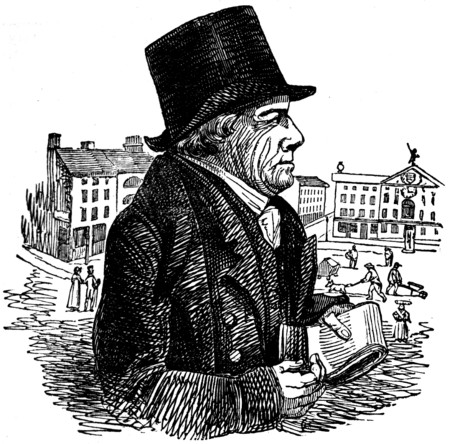
David Love, of Nottingham, Aged 74, A. D. 1824.
“Here’s David’s likeness for his book, All those who buy may at it look, As he is in his present state, Now printed from a copper-plate.”
These lines are beneath the portrait from whence the above engraving is taken. It is a very faithful likeness of David Love, only a little too erect:—not quite enough of the stoop of the old man of 76 in it,—but it is a face and a figure which will be recognised by thousands in Nottingham and Nottinghamshire. The race of the old minstrels has been long extinct;—that of the ballad-singers is fast following it—yet David is both one and the other. He is a bard and a caroller,—a wight who has wandered over as many hills and dales as any of the minstrels and troubadours of old;—a man who has sung, when he had cause enough for crying—who has seen many ups and downs, and has seldom failed to put his trials and hardships into rhyme. He is the poet of poverty and patience—teaching experience. He has seen the
“huts where poor men lie”
all his life; yet he has never ceased to chant as he proceeded on his painful pilgrimage, like the “nightingale with a thorn in her breast.” It is true, he does not carry his harp to accompany his strains, but he carries his life, “The Life, Adventures, and Experience of David Love, written by Himself. Fifth edition:” and well doth it deserve both its title and sale. A curious, eventful story of a poor man’s it is. First he is a poor parent-deserted lad; then he has wormed himself into good service, and afterwards into a coal-pit, where he breaks his bones and almost crushes out life; then he is a traveller, a shopkeeper, a soldier fighting against the Highland rebels; he falls in love, gets into wedlock and a workhouse, is never in despair, and never out of trouble; with a heart so buoyant, that, like a cork on a boisterous flood, however he might be plunged into the depths, he is sure to rise again to the surface, and in all places and cases still pours out his rhymes—pictures of scenes around him, strange cabins and strange groups, love verses, acrostics, hymns, &c.
“I have composed many rhymes, On various subjects, and the times, And call’d the trials of prisoners’ crimes The cash to bring; When old I grew, composed hymns, And them did sing.”
So David sped, and so he speeds now in his 77th year, only that his travels have left him finally fixed at Nottingham. His wars and his loves have vanished; his circle of action has annually become more and more contracted; till, at length, the town includes the whole field of his perambulations, and even that is almost more than his tottering frame can traverse. Yet there he is! and the stranger who visits Nottingham will be almost sure to see him, as represented in the print, crossing the market-place, with a parcel of loose papers in his hand;—a rhyming account of the last Goose Fair, a flood, an execution, or one of David’s own marriages,—for be it known to thee, gentle reader, that David Love has been a true son of the family of the Loves. He has not sung his amatory lays for naught; he has captivated the hearts of no less than three damsels, and he has various and memorable experience in wives.
David, like many of our modern geniuses, is a Scotchman. He tells us that he was born near Edinburgh, but the precise place he affects not to know. The fact is, he is not very strong in his faith that, as he has tasted the sweets of a parish, he cannot be removed, and thinks it best to keep his birth-place secret: but the spot is Torriburn, on the Forth, the Scotch Highgate. David “has been to mair toons na Torriburn,” as the Scotch say, when they intimate that they are not to be gulled.
After sustaining many characters in the drama of life whilst yet very young, a schoolmaster among the rest, he fairly flung himself and his genius upon the world, and rambled from place to place in Scotland, calling around him all the young ears and love-darting eyes by his original ballads. It was a dangerous life, and David did not escape scatheless.
“At length so very bold I grew, My songs exposed to public view, And crowds of people round me drew, I was so funny; From side to side I nimbly flew To catch the money.”
And he caught not only money, but matrimony,—and such a wife! alas! for poor David!
“As she always will rule the roast, I’d better be tied to a post, And whipped to death, Than with her tongue to be so tossed, And bear her wrath. She called me both rogue and fool, And over me she strove to rule; I sat on the repenting stool— There tears I shed; Sad my complaint, I said, O dool! That e’er I wed.”
The next step evidently enough was enlisting, which he did into the duke of Buccleugh’s regiment; where, he says, he distinguished himself by writing a song in compliment of the regiment and its noble commander, concluding with,
“Now, at the last, what do you think Of the author, David Love?”
And whenever the duke and the officers saw him, they were sure to point, and say, “What do you think of the author, David Love?” These seem to have been David’s golden days. Not only—
“One hand the pen, and one the sword did wield,”
but he was also an actor of plays for the amusement of the officers. However, his discharge came, and adventures crowded thickly upon him. He traversed England in all directions, married a second and a third time, figured away in London and Edinburgh, and finally in Nottingham, with ballads and rhymes of his own composing; saw the inside of a prison, was all but hanged for his suspicious and nomadic poverty, and after all, by his own showing, is now to be classed with the most favoured of mortals:—
“I am now 76 years of age, and I both see and hear as well as I did thirty years ago. My wife is aged about fifty, and has been the space of a year in tolerable health. She works hard at her silk-wheel, to assist me; is an excellent housewife; gossips none: cleanly in cooking, famous at washing, good at sewing, marking, and mending her own and children’s clothes. For making markets none can equal her. Consults me in every thing, to find if I think it right, before she proceeds to buy provisions, or clothes; strives to please me in every thing; and always studies my welfare, rejoicing when I am in health, grieved when I am pained or uneasy. She is my tender nurse to nourish me, my skilful doctress to administer relief when I am in sickness or in pain; in short, a better wife a poor man never had.”
Truly, David, I think so too! A happy man art thou to be possessed of such an incomparable helpmate; and still happier that, unlike many a prouder bard, thou art sensible of thy blessings.
To show that although our minstrel often invokes the muse to paltry subjects for paltry gains, yet he can sometimes soar into a higher region, I give the following:—
THE CHILD’S DREAM. The substance thereof being founded on fact
I’ll tell you who I saw last night, As I lay sleeping on my bed; A shining creature all in light, To me she seemed a heavenly maid. I meet her tripping o’er the dew, Fine as a queen of May, mamma; She saw, she smiled, she to me flew, And bade me come away, mamma. I looked, I loved, I blushed awhile, Oh! how could I say no, mamma? She spoke so sweet, so sweet did smile, I was obliged to go, mamma. For love my tender heart beguiled, I felt unusual flames, mamma; My inward fancy turned so wild, So very strange my dream, mamma. Indeed I was, I know not how, Oh had you only been with me; Such wonders opened to my view, As few but holy angels see. Methought we wandered in a grove, All green with pleasant fields, mamma; In joyful measures on we move, As music rapture yields, mamma. She took me in her snow-white hand, Then led me through the air, mamma. Far higher above sea and land, Than ever eagles were, mamma. The sea and land, with all their store, Of rivers, woods, and lofty hills, Indeed they did appear no more Than little streams or purling rills. I sought my dear papa’s estate, But found it not at all, mamma; The world in whole seemed not so great As half a cannon-ball, mamma. We saw the sun but like a star, The moon was like a mustard seed; Like Elias in his fiery car, All glorious winged with light’ning speed. Swift as our thoughts, oh joyful day. We glanced through all the boundless spheres; Their music sounding all the way, Heaven sweetly rushing in our ears, Now opens, and all we saw before Were lost entirely to our view; The former things are now no more, To us all things appeared new. No death is there, nor sorrow there, E’er to disturb the heavenly bliss, For death, sin, hell, and sorrow are, Entirely lost in the abyss. With wintry storms the ground ne’er pines Clothed in eternal bloom, mamma; For there the sun of glory shines, And all the just with him, mamma. I saw my sister Anna there, A virgin in her youthful prime; More than on earth her features fair, And like the holy angels’ fine. Her robe was all a flowing stream Of silver dipt in light, mamma, But ah! it ’woke me from my dream, It shone so strong and bright, mamma.
With this specimen of David’s poetical faculties, I leave him to the kind consideration of the well disposed.
January, 1826.
M. T.
NATURALISTS’ CALENDAR.
Mean Temperature 37·42.
February 15.
1826. Ember Week.
Ember weeks are those in which the Ember days fall. A variety of explanations have been given of the word Ember, but Nelson prefers Dr. Marechal’s, “who derives it from the Saxon word importing, a circuit or course; so that these fasts being not occasional, but returning every year in certain courses, may properly be said to be Ember days, because fasts in course.” The Ember days are the Wednesday, Friday, and Saturday after the first Sunday in Lent, and after the 13th of December. It is enjoined by the xxxi. canon of the church, “that deacons and ministers be ordained, or made, but only on the Sundays immediately following these Ember feasts.”[62]
1731. Their majesties king George II. and the queen, being desirous of seeing “the noble art of printing,” a printing press and cases were put up at St. James’s palace on the 15th of February, and the duke (of York) wrought at one of the cases, to compose for the press a little book of his own writing, called “The Laws of Dodge-Hare.” The two youngest princes, likewise, composed their names, &c., under the direction of Mr. S. Palmer, a printer, and author of the “History of Printing,” which preceded Mr. Ames’s more able work.[63]
NATURALISTS’ CALENDAR.
Mean Temperature 39·22.
February 16.
CHRONOLOGY.
A question was carried in the house of commons for building a bridge over the Thames, from Palace-yard to the Surrey side. During the debate, that river overflowed its banks by reason of a strong spring tide; the water was higher than ever known before, and rose above two feet in Westminster-hall, where the courts being sitting, the judges, &c. were obliged to be carried out. The water came into all the cellars and ground rooms near the river on both sides, and flowed through the streets of Wapping and Southwark, as its proper channel; a general inundation covered all the marshes and lowlands in Kent, Essex, Suffolk, Norfolk, and Lincolnshire, and some thousands of cattle were destroyed, with several of their owners in endeavouring to save them. The tide being brought in by a strong wind at N. W. was the highest in Lincolnshire of any for 135 years past. Seventeen breaches were made, about sunrise, in the banks of the river between Spalding and Wisbech, with several between Wisbech and Lynn, and irreparable damage done; some graziers having lost all their cattle. At Clay, in Norfolk, waters came over the great beach, almost demolished the town, and left nine feet of water in the marshes. At Gold Ongar, Essex, Mr. Cooper, and four of his servants, were drowned in endeavouring to save some sheep, the sea wall giving way of a sudden. The little isles of Candy and Foulness, on the coast of Essex, were quite under water; not a hoof was saved thereon, and the inhabitants were taken from the upper part of their houses into boats. The particular damages may be better conceived than related.[64]
NATURALISTS’ CALENDAR.
Mean Temperature 38·90.
February 17.
Sittings after Term.
On the day after the expiration of every term, the courts of law continue to sit at Westminster, and try causes; and some judges come into London at the same time, for the same purpose. These sittings are called the “sittings after term,” and during these periods, suits, arising out of clashing claims of important interests, are usually decided by the verdicts of special juries, and other litigations are disposed of.
The origin and progress of every possible action, in a court of law, are succinctly portrayed by “the Tree of Common Law”—an engraving in vol. i. p. 234. It stands there for “ornament and use;”—there are plenty of books to explain technical terms, and show the practice of the courts; any uninformed person, therefore, may easily obtain further information as to the modes; and any respectable attorney will advise an inquirer, who states all the particulars of his case, concerning the costs of attempting to sue or defend, and the chances of success. After proceeding so far, it will be requisite to pause, and then, as paramount to the legal advice, common sense should weigh consequences well, before giving “instructions to sue,” or “defend,” in
———— that wide and pathless maze Where law and custom, truth and fiction, Craft, justice, strife, and contradiction, With every blessing of confusion, Quirk, error, quibble, and delusion, Are all, if rightly understood, Like jarring ministers of state, ’Mid anger, jealousy, and hate, In friendly coalition joined, To harmonize and bless mankind.
To some “whimsical miscellanies,” subjoined at the place aforesaid, can be added or annexed, more or many others, of the same or the like kind. The realities of law may be relieved by the pleasures of imagination, and the heaviness of the “present sittings” be enlivened by a reported case, in the words of the reporter, (Stevens’s Lect.) premising, however, that he first publicly stated, with his head in his wig, and with a nosegay in his hand,
“Law is—law,—law is law, and as, in such and so forth, and hereby, and aforesaid, provided always, nevertheless, notwithstanding. Law is like a country dance, people are led up and down in it till they are tired. Law is like a book of surgery, there are a great many terrible cases in it. It is also like physic, they that take least of it are best off. Law is like a homely gentlewoman, very well to follow. Law is also like a scolding wife, very bad when it follows us. Law is like a new fashion, people are bewitched to get into it; it is also like bad weather, most people are glad when they get out of it.” The same learned authority observes, that the case before referred to, and hereafter immediately stated, came before him, that is to say,
Bullum v. Boatum. Boatum v. Bullum.
There were two farmers, farmer A and farmer B. Farmer A was seized or possessed of a bull; farmer B was seized or possessed of a ferry-boat. Now the owner of the ferry-boat, having made his boat fast to a post on shore, with a piece of hay, twisted rope fashion, or as we say, vulgo vocato, a hay-band. After he had made his boat fast to a post on shore, as it was very natural for a hungry man to do, he went up town to dinner; farmer A’s bull, as it was very natural for a hungry bull to do, came down town to look for a dinner; and the bull observing, discovering, seeing, and spying out, some turnips in the bottom of the ferry-boat the bull scrambled into the ferry-boat—he eat up the turnips, and to make an end of his meal, he fell to work upon the hay-band. The boat being eaten from its moorings, floated down the river, with the bull in it: it struck against a rock—beat a hole in the bottom of the boat, and tossed the bull overboard. Thereupon the owner of the bull brought his action against the boat, for running away with the bull, and the owner of the boat brought his action against the bull for running away with the boat.
At trial of these causes, Bullum v. Boatum, Boatum v. Bullum, the counsel for the bull began with saying,
“My lord, and you, gentlemen of the jury,
“We are counsel in this cause for the bull. We are indicted for running away with the boat. Now, my lord, we have heard of running horses, but never of running bulls before. Now, my lord, the bull could no more run away with the boat than a man in a coach may be said to run away with the horses; therefore, my lord, how can we punish what is not punishable? How can we eat what is not eatable? Or how can we drink what is not drinkable? Or, as the law says, how can we think on what is not thinkable? Therefore, my lord, as we are counsel in this cause for the bull, if the jury should bring the bull in guilty, the jury would be guilty of a bull.”
The counsel for the boat affirmed, that the bull should be nonsuited, because the declaration did not specify of what colour he was; for thus wisely, and thus learnedly spoke the counsel: “My lord, if the bull was of no colour, he must be of some colour; and if he was not of any colour, of what colour could the bull be?” I overruled this objection myself (says the reporter) by observing the bull was a white bull, and that white is no colour: besides, as I told my brethren, they should not trouble their heads to talk of colour in the law, for the law can colour any thing. The causes went to reference, and by the award, both bull and boat were acquitted, it being proved that the tide of the river carried them both away. According to the legal maxim, there cannot be a wrong without a remedy; I therefore advised a fresh case to be laid before me, and was of opinion, that as the tide of the river carried both bull and boat away, both bull and boat had a right of action against the water-bailiff.
Upon this opinion an action was commenced, and this point of law arose, how, whether, when, and whereby, or by whom, the facts could be proved on oath, as the boat was not compos mentis. The evidence point was settled by Boatum’s attorney, who declared that for his client he would swear any thing.
At the trial, the water-bailiff’s charter was read, from the original record in true law Latin, to support an averment in the declaration that the plaintiffs were carried away either by the tide of flood, or the tide of ebb. The water-bailiffs charter stated of him and of the river, whereof or wherein he thereby claimed jurisdiction, as follows:—Aquæ bailiffi est magistratus in choisi, sapor omnibus, fishibus, qui habuerunt finnos et scalos, claws, shells, et talos, qui swimmare in freshibus, vel saltibus, riveris, lakos, pondis, canalibus et well boats, sive oysteri, prawni, whitini, shrimpi, turbutus solus; that is, not turbots alone, but turbots and soals both together. Hereupon arose a nicety of law; for the law is as nice as a new-laid egg, and not to be understood by addle-headed people. Bullum and Boatum mentioned both ebb and flood, to avoid quibbling; but it being proved, that they were carried away neither by the tide of flood, nor by the tide of ebb, but exactly upon the top of high water, they were nonsuited; and thereupon, upon their paying all costs, they were allowed, by the court, to begin again, de novo.
NATURALISTS’ CALENDAR.
Mean Temperature 37·82.
February 18.
Revivification of Trees.
Mr. Arthur Aikin, in his “Natural History of the Year,” narrates the first vital function in trees on the conclusion of winter. This is the ascent of the sap after the frost is moderated, and the earth sufficiently thawed. The absorbent vessels composing the inner bark reach to the extremity of the fibres of the roots, and thus, through the roots, imbibe water, which, mixing there with a quantity of saccharine matter, forms sap, and is from thence abundantly distributed through the trunk and branches to every individual bud. The birch tree in spring, on being tapped, yields its sap, which is fermented into wine. The palm tree in the tropics of the same season yields its sap by the same method, which is made into palm wine, and the sap of the sugar maple in North America being boiled, yields the maple sugar.
“This great accession of nourishment (the sap) causes the bud to swell, to break through its covering, and to spread into blossoms, or lengthen into a shoot bearing leaves. This is the first process, and, properly speaking, is all that belongs to the springing or elongation of trees; and in many plants, that is, all those which are annual or deciduous, there is no other process; the plant absorbs juices from the earth, and in proportion to the quantity of these juices increases in size: it expands its blossoms, perfects its fruit, and when the ground is incapable by drought or frost of yielding any more moisture, or when the vessels of the plant are not able to draw it up, the plant perishes. But in trees, though the beginning and end of the first process is exactly similar to what takes places in vegetables, yet there is a second process, which at the same time that it adds to their bulk, enables them to endure and go on increasing through a long series of years.
“The second process begins soon after the first, in this way. At the base of the footstalk of each leaf a small bud is gradually formed; but the absorbent vessels of the leaf having exhausted themselves in the formation of the bud, are unable to bring it nearer to maturity: in this state it exactly resembles a seed, containing within it the rudiments of vegetation, but destitute of absorbent vessels to nourish and evolve the embryo. Being surrounded, however, by sap, like a seed in moist earth, it is in a proper situation for growing; the influence of the sun sets in motion the juices of the bud and of the seed, and the first operation in both of them is to send down roots a certain depth into the ground for the purpose of obtaining the necessary moisture. The bud accordingly shoots down its roots upon the inner bark of the tree, till they reach the part covered by the earth. Winter now arriving, the cold and defect of moisture, owing to the clogged condition of the absorbent vessels, cause the fruit and leaves to fall, so that, except the provision of buds with roots, the remainder of the tree, like an annual plant, is entirely dead: the leaves, the flowers, and fruit are gone, and what was the inner bark, is no longer organized, while the roots of the buds form a new inner bark; and thus the buds with their roots contain all that remains alive of the whole tree. It is owing to this annual renovation of the inner bark, that the tree increases in bulk; and a new coating being added every year, we are hence furnished with an easy and exact method of ascertaining the age of a tree by counting the number of concentric circles of which the trunk is composed. A tree, therefore, properly speaking, is rather a congeries of a multitude of annual plants, than a perennial individual.
“The sap in trees always rises as soon as the frost is abated, that when the stimulus of the warm weather in the early spring acts upon the bud, there should be at hand a supply of food for its nourishment; and if by any means the sap is prevented from ascending at the proper time, the tree infallibly perishes. Of this a remarkable instance occurred in London, during the spring succeeding the hard winter of the year 1794. The snow and ice collecting in the streets so as to become very inconvenient, they were cleared, and many cartloads were placed in the vacant quarters of Moorfields; several of these heaps of snow and frozen rubbish were piled round some of the elm-trees that grow there. At the return of spring, those of the trees that were not surrounded with the snow expanded their leaves as usual, while the others, being still girt with a large frozen mass, continued quite bare; for the fact was, the absorbents in the lower part of the stem, and the earth in which the trees stood, were still exposed to a freezing cold. In some weeks, however, the snow was thawed, but the greater number of the trees were dead, and those few that did produce any leaves were very sickly, and continued in a languishing state all summer, and then died.”
NATURALISTS’ CALENDAR.
Mean Temperature 37·92.
February 19.
1826.—Second Sunday in Lent.
The First Bird’s Nest in Spring.
Of all our native birds, none begins to build so soon as the raven: by the latter end of this month it has generally laid its eggs and begun to sit. The following anecdote, illustrative of its attachment to its nest, is related by Mr. White in his “Natural History of Selborne.” “In the centre of this grove there stood an oak, which, though shapely and tall on the whole, bulged out into a large excrescence about the middle of the stem. On this a pair of ravens had fixed their residence for such a series of years, that the oak was distinguished by the name of the raven-tree. Many were the attempts of the neighbouring youths to get at this eyry; the difficulty whetted their inclinations, and each was ambitious of surmounting the arduous task. But when they arrived at the swelling, it jutted out so much in their way, and was so far beyond their grasp, that the most daring lads were awed, and acknowledged the undertaking to be too hazardous. So the ravens built on, nest upon nest, in perfect security, till the fatal day arrived in which the wood was to be levelled. It was in the month of February, when those birds usually sit. The saw was applied to the butt, the wedges were inserted into the opening, the woods echoed to the heavy blows of the beetle and mallet, the tree nodded to its fall, but still the dam sat on. At last, when it gave way, the bird was flung from her nest; and though her parental affection deserved a better fate, was whipped down by the twigs, which brought her dead to the ground.”[65]
NATURALISTS’ CALENDAR.
Mean Temperature 38·37.
February 20.
The ways of the Season.
The roads now are usually heavy, that is, the thaws have so entirely liberated the water in the earth, that the subsoil, which had been expanded by the action of the frost, becomes loosened, and, yielding mud to the surface, increases the draught of carriages. Now, therefore, the commissioners and agents who execute their duty have full employment, and the highways afford employment to a large number of persons who are destitute of their customary labour, or unfit for other work.
Travelling in Ireland.
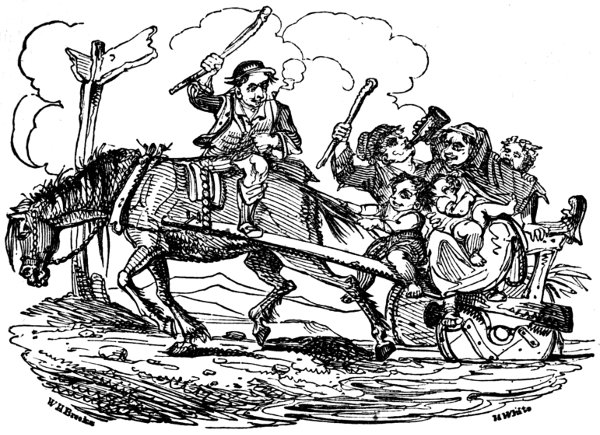
Travelling in Ireland.
And is it you’d be riding, by Blackwater to Fermoy? You’ll be accommodated, to your heart’s content and joy, There’s not a beast, nor car, but what’s beautiful and easy; And then the pleasant road—bad’s the luck but it’ll please ye!
MS. Ballad.
Mr. Crofton Croker’s “Researches in the South of Ireland,” besides accounts of scenery and architectural remains, and illustrations of popular manners and superstition, conveys a very good idea of the roads and the methods of travelling in that part of the sister kingdom. The usual conveyance is called a car; its wheels are either a solid block rounded to the desired size, or they are formed of three pieces of wood clamped together. The wheels are fixed to a massive wooden axletree; this supports the shafts, which are as commonly constructed on the outside as on the inside of the wheels. In one of these machines Mr. Croker, with a lady and gentleman who accompanied him on his tour, took their seats. The car and horse were precisely of that description and condition in the engraving. Mr. W. H. Brooke painted a picture of this gentleman’s party, from whence he has obligingly made the drawing for the present purpose; the only alteration is in the travellers, for whom he has substituted a family on their removal from one cabin to another.
This, which is the common Irish car, is used throughout the province of Leinster, the midland counties, and some parts of the north. The country, or farmer’s car always has the wheels on the outside of the shafts, with a balustrade or upright railing fixed from the shaft to the side bars, which rise diagonally from them; this sort of enclosure is also at the back. This car is open at top for the convenience of carrying hay, corn, vegetables, tubs, packages, and turf, which is generally placed in wicker baskets, called a “kish;” two or four of these placed side by side occupy the entire body. The car, with the wheels between the shafts, is used for like purposes, but has the additional honour of being rendered a family conveyance, by cart ropes intertwisted or crossing each other from the top bars, whereon a ticking, stuffed with straw, and a quilt or coverlid, form a cushion for the comfort of the travellers. The car is the common, and indeed the only, mode of carrying coals in the city of Dublin to the houses of the consumers: from six to nine sacks, making about half a ton, lie very snugly across the bars. Of course, as a family conveyance, it is only in use among the poorest class in the country.
The common car somewhat varies in shape, as will appear from the following figure, also drawn by Mr. Brooke.
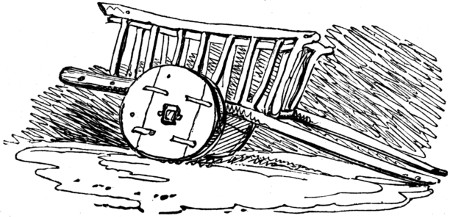
It must be added, that though these cars maintain their ground in uncultivated districts, they are quickly disappearing, in the improved parts of Ireland, before the Scotch carts introduced by the agricultural societies.
The Irish “jaunting-car,” the “jingle,” the “noddy,” and a variety of other carriages, which ply for hire in Dublin, are wholly distinct and superior vehicles.
The following interesting narrative, in the words of its author, illustrates the nature of the car, the state of the roads, and the “manners” of the people.
A JAUNT IN A COUNTRY CAR From Lismore to Fermoy By T. Crofton Croker, Esq.
Having hired a car at Lismore to take us to Fermoy, and wishing to walk part of the way along the banks of the Blackwater, we desired the driver to meet us at a given point. On arriving there, the man pretended not to have understood we were three in party, and demanded, in consequence, an exorbitant addition to the sum agreed on. Although we were without any other means of conveyance for eight Irish miles, it was resolved not to submit to this imposition, and we accordingly withdrew our luggage and dismissed the car, intending to seek another amongst a few cabins that appeared at a little distance from the road side. A high dispute ensued with the driver, who, of course, was incensed at this proceeding, and endeavoured to enlist in his cause the few straggling peasants that had collected around us; but having taken refuge and placed our trunks in the nearest cabin, ourselves and property became sacred, and the disposition to hostility, which had been at first partially expressed, gradually died away. When we began to make inquiries for a horse and car of any kind to take us into Fermoy, our endeavours were for some time fruitless. One person had a car, but no horse. Another had a car building, which, if Dermot Leary were as good as his word, would be finished next week some time, “God willing.” At length we gained intelligence of a horse that was “only two miles off, drawing turf: sure he could be fetched in less than no time.” But then again, “that big car of Thaddy Connor’s was too great a load for him entirely. Sure the baste would never draw the car into Fermoy, let alone their honours and the trunks.” After some further consultation, a car was discovered more adapted to the capabilities of the miserable animal thus called upon to “leave work and carry wood,” and though of the commonest kind we were glad to secure it. By means of our trunks and some straw we formed a kind of lodgment on the car, which, being without springs and on the worst possible of roads, was not exactly a bed of down. The severe contusions we received on precipitating into the numerous cavities, though no joke, caused some laughter; on which the driver turned round with a most facetious expression of countenance, suggesting that “May be the motion did not just agree with the lady, but never fear, she would soon get used to it, and be asleep before we got half way to Fermoy.” This prediction, it will readily be supposed, was not fulfilled; and I believe it was three days before we recovered from the bruises of that journey. It is difficulty to say whether our situation will excite mirth or sympathy in the minds of our readers, but a sketch may do no injury to the description. [In Mr. Croker’s volume an engraving on wood is inserted.]
Many Irish villages boast a post-chaise, the horses for which are not unfrequently taken from the plough, and the chaise itself submitted to a temporary repair before starting, to render it, if the parody of a nautical phrase may be allowed, “road-worthy;” but the defects are never thought of one moment before the chaise is required; and the miseries of posting in Ireland have, with justice, afforded subject for the caricaturist. Tired horses or a break-down are treated by a driver, whose appearance is the very reverse of the smart jockey-like costume of an English postilion, with the utmost resignation, as matters of unavoidable necessity. With a slouched hat—slovenly shoes and stockings—and a long, loose great coat wrapped round him, he sits upon a bar in front of the carriage and urges on his horses by repeated applications of the whip, accompanied with the most singular speeches, and varied by an involuntary burst of his musical talent, whistling a tune adapted to the melancholy pace of the fatigued animals, as he walks slowly beside them up the ascent of every hill.
“Did you give the horses a feed of oats at the village where we stopped to sketch?” inquired one of my fellow-travellers of the driver, who for the last three or four miles had with much exertion urged on the jaded hacks.
“I did not, your honour,” was the reply, “but sure, and they know I promised them a good one at Limerick.”
Nor is this instance of pretended understanding between man and horse singular. Riding once in company with a poor farmer from Cork to Mallow, I advised him to quicken the pace of his steed as the evening was closing in, and the lurid appearance of the sky foreboded a storm.
“Sure then that I would with the greatest pleasure in life for the honour I have out of your company, sir; but I promised the baste to let him walk, and I never belie myself to any one, much less to a poor creature that carries me—for, says the baste to me, I’m tired, as good right I have, and I’ll not go a step faster—and you won’t make me—I scorn it says I, so take your own way.”
A verbatim dialogue on an Irish break-down happily characterises that accident: the scene, a bleak mountain, and the time, the return of the driver with another chaise from the nearest station which afforded one—seven miles distant.
“Is the carriage you have brought us safe?”
(One of the travellers attempts to get in.)
“Oh never fear, sir; wait till I just bail out the water and put a little sop of hay in the bottom—and sure now and ’tis a queer thing that the ould black chaise should play such a trick, and it has gone this road eleven years and never broke down afore. But no wonder poor cratur, the turnpike people get money enough for mending the roads, and bad luck to the bit of it they mend, but put it all in their pockets.”
“What, the road?”
“Noe, your honour, the money.”
To such as can bear with composure and indifference lesser and temporary misfortunes, those attendant on an Irish tour become objects of merriment; the very essence of the innate ingenuity and wit of the people is called out by such evils; and the customary benediction muttered by the peasant on the meeting a traveller, is changed into the whimsical remark or shrewd reply that mock anticipation.
Of late, jingles, as they are termed, have been established between the principal towns. These are carriages on easy springs, calculated to contain six or eight persons. The roof is supported by a slight iron frame capable of being unfixed in fine weather, and the curtains, which may be opened and closed at will, afford complete protection from sun and rain; their rate of travelling is nearly the same as that of the stage-coach, and they are both a cheaper and more agreeable conveyance.
On our way from Cork to Youghall in one of these machines, we were followed by a poor wretch ejaculating the most dreadful oaths and imprecations in Irish. His head was of an uncommonly large and stupid shape, and his idiotic countenance was rendered fierce and wild by a long and bushy red beard. On our driver giving him a piece of bread, for which he had run beside the jingle at least half a mile, he uttered three or four terrific screams, accompanied by some antic and spiteful gestures. I should not remark this circumstance here were it one of less frequent occurrence; but on most of the public roads in the south of Ireland, fools and idiots (melancholy spectacles of humanity!) are permitted to wander at large, and in consequence of this freedom have acquired vicious habits, to the annoyance of every passenger: throwing stones, which they do with great dexterity, is amongst the most dangerous of their practices, and a case is known to me where the wife of a respectable farmer, having been struck on the temple by a stone thrown at her by an idiot, died a few days after. Within my recollection, Cove-lane, one of the most frequented parts of Cork, as leading to the Cove-passage, Carrigaline and Monkstown roads, was the station of one of these idiots, who seldom allowed an unprotected woman to pass without following her, and inflicting the most severe pinches on her back and arms; yet this unfortunate and mischievous being for many years was suffered by the civil power to remain the terror of every female, and that too within view of a public asylum for the reception of such. But to return from this digression.
The charges at inferior towns and villages are extravagant in an inverse proportion to the indifference of their accommodation, and generally exceed those of the first hotels in the metropolis. Our bill at Kilmallock was any thing but moderate, and yet the house, though the best the town afforded, appeared to be one where carmen were oftener lodged than gentry. The landlady stood at the door, and with a low curtsey and a good-humoured smile welcomed us to “the ancient city of Kilmallock;” in the same breath informed us, that she was a gentlewoman born and bred, and that she had a son, “as fine an officer as ever you could set eyes on in a day’s walk, who was a patriarch (a patriot) in South America;” then leading us up a dark and narrow staircase to the apartment we were to occupy, wished to know our names and business, whence we came and where we were going; but left the room on our inquiring, in the first place, what we could have to eat. After waiting a reasonable time our demands were attended to by a barefooted female, who to our anxiety respecting what we could have for supper, replied with perfect confidence, “Just any thing you like, sure!”
“Have you any thing in the house?”
“Indeed and we have not; but it’s likely I might be able to get an egg for ye.”
An examination of the bedrooms will not prove more satisfactory; a glass or soap are luxuries seldom found. Sometimes one coarse and very small towel is provided; at Kilmallock, the measurement of mine was half a yard in length and a quarter in breadth; its complexion, too, evinced that it had assisted in the partial ablutions of many unfastidious persons. Mr. Arthur Young’s constant ejaculation, when he lighted on such quarters in Ireland, usually occurred to my mind, “Preserve me, Fate, from such another!” and I have no doubt he would agree with me, that two very essential requisites in an Irish tour are a stock of linen, and a tolerable partiality for bacon. But travellers, any more than beggars, cannot always be choosers, and those who will not submit with patience to the accidents and inconveniences of a journey, must sit at home and read the road that others travel.
“Who alwaies walkes, on carpet soft and gay, Knowes not hard hills, nor likes the mountaine way.”[66]
NATURALISTS’ CALENDAR.
Mean Temperature 39·17.
February 21.
Seasonable Rules.
On p. 187 there is a “Letter,” delivered to a favourite servant at parting, which deserves to be printed in letters of gold, or, what is better, because it is easier and more useful, it should be imprinted on the memory of every person who reads it. There are sentiments in it as useful to masters and mistresses as their domestics. The following “Rules” may likewise be perused with advantage by both; they are deemed “seasonable,” because, as good-livers say, good things are never out of season.
Rules for Servants.
I. A good character is valuable to every one, but especially to servants; for it is their bread, and without it they cannot be admitted into any creditable family; and happy it is that the best of characters is in every one’s power to deserve.
II. Engage yourself cautiously, but stay long in your place, for long service shows worth—as quitting a good place through passion, is a folly which is always lamented of too late.
III. Never undertake any place you are not qualified for; for pretending to what you do not understand, exposes yourself, and, what is still worse, deceives them whom you serve.
IV. Preserve your fidelity; for a faithful servant is a jewel, for whom no encouragement can be too great.
V. Adhere to truth; for falsehood is detestable, and he that tells one lie, must tell twenty more to conceal it.
VI. Be strictly honest; for it is shameful to be thought unworthy of trust.
VII. Be modest in your behaviour; it becomes your station, and is pleasing to your superiors.
VIII. Avoid pert answers; for civil language is cheap, and impertinence provoking.
IX. Be clean in your business; for those who are slovens and sluts, are disrespectful servants.
X. Never tell the affairs of the family you belong to; for that is a sort of treachery, and often makes mischief; but keep their secrets, and have none of your own.
XI. Live friendly with your fellow-servants; for the contrary destroys the peace of the house.
XII. Above all things avoid drunkenness; for that is an inlet to vice, the ruin of your character, and the destruction of your constitution.
XIII. Prefer a peaceable life, with moderate gains, to great advantage and irregularity.
XIV. Save your money; for that will be a friend to you in old age. Be not expensive in dress, nor marry too soon.
XV. Be careful of your master’s property; for wastefulness is a sin.
XVI. Never swear; for that is a crime without excuse, as there is no pleasure in it.
XVII. Be always ready to assist a fellow-servant; for good nature gains the love of every one.
XVIII. Never stay when sent on a message; for waiting long is painful to your master, and a quick return shows diligence.
XIX. Rise early; for it is difficult to recover lost time.
XX. The servant that often changes his place, works only to be poor; for “the rolling-stone gathers no moss.”
XXI. Be not fond of increasing your acquaintances; for visiting leads you out of your business, robs your master of your time, and often puts you to an expense you cannot afford. And above all things, take care with whom you are acquainted; for persons are generally the better or the worse for the company they keep.
XXII. When out of place, be careful where you lodge; for living in a disreputable house, puts you upon a footing with those that keep it, however innocent you are yourself.
XXIII. Never go out on your own business, without the knowledge of the family, lest in your absence you should be wanted; for “Leave is light,” and returning punctually at the time you promise, shows obedience, and is a proof of sobriety.
XXIV. If you are dissatisfied with your place, mention your objections modestly to your master or mistress, and give a fair warning, and do not neglect your business nor behave ill, in order to provoke them to turn you away; for this will be a blemish in your character, which you must always have from the last place you served in.
⁂ All who pay a due regard to the above precepts, will be happy in themselves, will never want friends, and will always meet with the assistance, protection, and encouragement of the wealthy, the worthy, and the wise.
The preceding sentences are contained in a paper which a young person committed to heart on first getting a place, and, having steadily observed, obtained a character for integrity and worth incapable of being shaken. By constantly keeping in view that “Honesty is the best policy,” it led to prosperity, and the faithful servant became an opulent employer of servants.
NATURALISTS’ CALENDAR.
Mean Temperature 41·70.
February 22.
GENERAL ELECTION.
1826. This year may be deemed remarkable in the history of modern times, for its being the period wherein, for the first time within the memory of man, a parliament expired by efflux of time. Most of the preceding parliaments were dissolved, but this attained to its full duration of seven years.
THE FREEMAN’S WELL AT ALNWICK.
To the Editor of the Every-Day Book.
Sir,
Kensington, Feb. 1826.
I hope the following description of an extraordinary custom which has obtained at Alnwick, in Northumberland, may be considered worthy preservation in The Every-Day Book.
About four miles from the above town there is a pond, known by the name of the Freeman’s well; through which it has been customary for the freemen to pass from time immemorial before they can obtain their freedom. This is considered so indispensable, that no exemption is permitted, and without passing this ordeal the freedom would not be conferred. The pond is prepared by proper officers in such a manner, as to give the greatest possible annoyance to the persons who are to pass through it. Great dikes, or mounds, are erected in different parts, so that the candidate for his freedom is at one moment seen at the top of one of them only up to his knees, and the next instant is precipitated into a gulf below, in which he frequently plunges completely over head. The water is purposely rendered so muddy, that it is impossible to see where these dikes are situated, or by any precaution to avoid them. Those aspiring to the honour of the freedom of Alnwick, are dressed in white stockings, white pantaloons, and white caps. After they have “reached the point proposed,” they are suffered to put on their usual clothes, and obliged to join in a procession, and ride for several miles round the boundaries of the freemen’s property—a measure which is not a mere formality for parade, but absolutely indispensable; since, if they omit visiting any part of their property, it is claimed by his grace the duke of Northumberland, whose steward follows the procession, to note if any such omission occurs. The origin of the practice of travelling through the pond is not known. A tradition is current, that king John was once nearly drowned upon the spot where this pond is situated, and saved his life by clinging to a holly tree; and that he determined, in consequence, thenceforth, that before any candidate could obtain the freedom of Alnwick, he should not only wade through this pond, but plant a holly tree at the door of his house on the same day; and this custom is still scrupulously observed. In the month of February, 1824, no less than thirteen individuals went through the above formalities.
I am, &c.
T. A.
NATURALISTS’ CALENDAR.
Mean Temperature 42·61.
February 23.
CHRONOLOGY.
1821. John Keats, the poet, died. Virulent and unmerited attacks upon his literary ability, by an unprincipled and malignant reviewer, injured his rising reputation, overwhelmed his spirits, and he sunk into consumption. In that state he fled for refuge to the climate of Italy, caught cold on the voyage, and perished in Rome, at the early age of 25. Specimens of his talents are in the former volume of this work. One of his last poems was in prospect of departure from his native shores. It is an
Ode to a Nightingale.
1. My heart aches, and a drowsy numbness pains My sense, as though of hemlock I had drunk, Or emptied some dull opiate to the drains One minute past, and Lethe-wards had sunk: ’Tis not through envy of thy happy lot, But being too happy in thine happiness,— That thou, light-winged Dryad of the trees, In some melodious plot Of beechen green, and shadows numberless, Singest of summer in full-throated ease. 2. O, for a draught of vintage! that hath been Cool’d a long age in the deep-delved earth, Tasting of Flora and the country green, Dance, and Provençal song, and sunburnt mirth! O for a beaker full of the warm South, Full of the true, the blushful Hippocrene, With beaded bubbles winking at the brim, And purple-stained mouth; That I might drink, and leave the world unseen, And with thee fade away into the forest dim: 3. Fade far away, dissolve, and quite forget What thou among the leaves hast never known, The weariness, the fever, and the fret Here, where men sit and hear each other groan; Where palsy shakes a few, sad, last grey hairs, Where youth grows pale, and spectre-thin, and dies; Where but to think is to be full of sorrow And leaden-eyed despairs, Where Beauty cannot keep her lustrous eyes, Or new Love pine at them beyond to-morrow. 4. Away! away! for I will fly to thee, Not charioted by Bacchus and his pards, But on the viewless wings of Poesy, Though the dull brain perplexes and retards: Already with thee! tender is the night, And haply the Queen-Moon is on her throne, Cluster’d around by all her starry Fays; But here there is no light, Save what from heaven is with the breezes blown Through verdurous glooms and winding mossy ways. 5. I cannot see what flowers are at my feet, Nor what soft incense hangs upon the boughs, But, in embalmed darkness, guess each sweet Wherewith the seasonable month endows The grass, the thicket, and the fruit-tree wild; White-hawthorn, and the pastoral eglantine; Fast fading violets cover’d up in leaves; And mid-May’s eldest child, The coming musk-rose, full of dewy wine, The murmurous haunt of flies on summer eves. 6. Darkling I listen; and, for many a time I have been half in love with easeful Death, Call’d him soft names in many a mused rhyme, To take into the air my quiet breath; Now more than ever seems it rich to die, To cease upon the midnight with no pain, While thou art pouring forth thy soul abroad In such an ecstasy! Still wouldst thou sing, and I have ears in vain— To thy high requiem become a sod. 7. Thou wast not born for death, immortal Bird! No hungry generations tread thee down; The voice I hear this passing night was heard In ancient days by emperor and clown: Perhaps the self-same song that found a path Through the sad heart of Ruth, when, sick for home, She stood in tears amid the alien corn; The same that oft-times hath Charmed magic casements, opening on the foam Of perilous seas, in faery lands forlorn. 8. Forlorn! the very word is like a bell To toll me back from thee to my sole self! Adieu! the fancy cannot cheat so well As she is famed to do, deceiving elf. Adieu! adieu! thy plaintive anthem fades Past the near meadows, over the still stream, Up the hill-side; and now ’tis buried deep In the next valley-glades: Was it a vision, or a waking dream? Fled is that music:—Do I wake or sleep?
This ode was included with “Lamia, Isabella, the Eve of St. Agnes, and other Poems,” by John Keats, published by Messrs. Taylor and Hessey, who, in an advertisement at the beginning of the book, allude to the critical ferocity which hastened the poet’s death.
NATURALISTS’ CALENDAR.
Mean Temperature 41·57.
February 24.
St. Matthias.—Holiday at the Public Offices.
After the crucifixion, and the death of the traitor Judas, Peter, in the midst of the disciples, they being in number about a hundred and twenty, proposed the election of an apostle in his stead, “and they appointed two, Joseph, called Barsabas, who was surnamed Justus, and Matthias: and they prayed” to be directed in their choice, “and they gave forth their lots; and the lot fell upon Matthias, and he was numbered with the eleven apostles.” (Acts i. 23-26.) Writers disagree as to the particular places of his mission, and the year and manner of his death, though all concur in saying he was martyred. Dr. Cave affirms, that he suffered by the cross. He is presumed to have died A. D. 61 or 64.
NATURALISTS’ CALENDAR.
Mean Temperature 42·22.
February 25.
1826.—Third Sunday in Lent.
STORM SUPERSTITIONS.
The stilling of the waves by oil is briefly noticed at p. 192, and another instance is subjoined.
Oil for a fair Wind.
C. W., in Dr. Aikin’s Athenæum, says: “About twelve years ago, during my stay at Malta, I was introduced to the bey of Bengazi, in Africa, who was going with his family and a large retinue of servants to Mecca. He very politely offered me and my companion a passage to Egypt. We embarked on board a French brig which the bey had freighted, and very unfortunately were captured by an English letter of marque within a few leagues of Alexandria. The captain, however, was kind enough to allow us to proceed, and as we lay becalmed for two days, the bey ordered three or four Turkish flags to be hoisted, and a flask of oil to be thrown overboard. On inquiring into the purport of the ceremony, we were informed that the flask would float to Mecca (a pretty long circumnavigation) and bring us a fair wind! As we cast anchor in the port soon after, of course the ceremony had been propitious; nor did we seek to disturb the credulity of a man who had treated us so kindly.”
We know, however, that there is “credulity “on board English as well as Turkish vessels; and that if our sailors do not send an oil flask to Mecca, they whistle for a wind in a perfect calm, and many seem as certainly to expect its appearance, as a boatswain calculates on the appearance of his crew when he pipes all hands.
Navigation in the Clouds.
Agobard, archbishop of Lyons, in the reign of Charlemagne, and his son, has the following passage in his book, “De Grandine.” “In these districts, almost all persons, noble and plebeian, townsmen and rustics, old and young, believe that hail and thunder may be produced at the will of man, that is, by the incantations of certain men who are called Tempestarii.” He proceeds: “We have seen and heard many who are sunk in such folly and stupidity, as to believe and assert, that there is a certain country, which they call Magonia, whence ships come in the clouds, for the purpose of carrying back the corn which is beaten off by the hail and storms, and which those aërial sailors purchase of the said Tempestarii.” Agobard afterwards affirms, that he himself saw in a certain assembly four persons, three men and a woman, exhibited bound, as if they had fallen from these ships, who had been kept for some days in confinement, and were now brought out to be stoned in his presence; but that he rescued them from the popular fury. He further says, that there were persons who pretended to be able to protect the inhabitants of a district from tempests, and that for this service they received a payment in corn from the credulous countrymen, which payment was called canonicum.[67]
A Shrovetide Custom.
It will appear on reading, that the annexed letter came too late for insertion under Shrove Tuesday.
LUDLOW ROPE PULLING.
To the Editor of the Every-Day Book
Ludlow, Shrove Tuesday, Feb. 7, 1826.
Sir,
Among the customs peculiar to this town, that of pulling a rope is not the least extraordinary. On Shrove Tuesday the corporation provide a rope three inches in thickness, and in length thirty-six yards, which is given out by a few of the members at one of the windows of the Market-hall at four o’clock; when a large body of the inhabitants, divided into two parties, (the one contending for Castle-street and Broad-street Wards, and the other for Old-street and Corve-street Wards,) commence an arduous struggle; and as soon as either party gains the victory by pulling the rope beyond the prescribed limits, the pulling ceases; which is, however, always renewed by a second, and sometimes by a third contest; the rope being purchased by subscription from the victorious party, and given out again. In the end the rope is sold by the victors, and the money, which generally amounts to two pounds, or guineas, is expended in liquor. I have this day been an eye-witness to this scene of confusion; the rope was first gained by Old-street and Corve-street Wards, and secondly by Castle-street and Broad-street Wards. It is supposed, that nearly 2000 persons were actively employed on this occasion.
Without doubt this singular custom is symbolical of some remarkable event, and a remnant of that ancient language of visible signs, which, says a celebrated writer, “imperfectly supplies the want of letters, to perpetuate the remembrance of public or private transactions.” The sign, in this instance, has survived the remembrance of the occurrence it was designed to represent, and remains a profound mystery. It has been insinuated, that the real occasion of this custom is known to the corporation, but that for some reason or other, they are tenacious of the secret. An obscure tradition attributes this custom to circumstances arising out of the siege of Ludlow by Henry VI, when two parties arose within the town, one supporting the pretensions of the duke of York, and the other wishing to give admittance to the king; one of the bailiffs is said to have headed the latter party. History relates, that in this contest many lives were lost, and that the bailiff, heading his party in an attempt to open Dinham gate, fell a victim there.
R. J.
NATURALISTS’ CALENDAR.
Mean Temperature 41·16.
February 26.
1826.—Third Sunday in Lent.
Penderill Family.
1732, February 26. The title to an estate of 100l. per annum, which had been settled on the Penderill family “for preserving king Charles II. in the oak,” was sued for on behalf of an infant claiming to be heir-at-law, and the issue was this day tried in the court of king’s bench. It was proved that Mr. Penderill, after marrying the mother of the claimant, retired into Staffordshire two years before he died; that during that time he had no intercourse with his wife, and that the infant was born about the time of her husband’s death. In consequence of this evidence a verdict was found for the defendant, and thereby the child was declared to be illegitimate.[68]
Mayoralty Seal of the City of London.
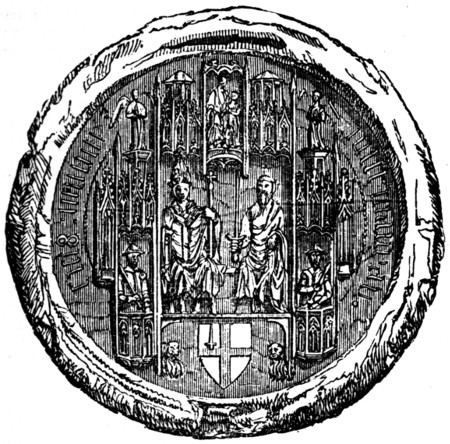
Mayoralty Seal of the City of London.
A respected correspondent, S. G., not remembering to have met with a representation of this remarkable seal in any work, and conceiving its appearance in the Every-Day Book may gratify many readers, obligingly transmits a fine impression, taken in February, 1826, from whence the present engraving has been made with at least as much fidelity as the antiquity of the original permitted. “This seal,” he says, “is quite distinct from the city seal. It is kept at the Mansion-house, in the custody of the gate-porter, and is now used for the purpose of authenticating documents forwarded to foreign countries upon affidavit sworn before the lord mayor: it is also used for sealing the precepts which are issued preparatory to St. Thomas’s-day for the election of common councilmen and ward officers.” The following is the inscription round the seal, “Sigillum Officii Majoratus Civitatis Londini:” this legend is indistinct from wear.
The history of this seal is especially remarkable, because it is connected with the origin of the “dagger” in the city arms. On this subject Maitland and other historians have taken so much only from Stow as seemed to them to suit their purpose; what that author relates, therefore, is here extracted verbatim. He introduces it by saying, “In the year 1381, William Walworth, then maior, a most provident, valiant, and learned citizen, did by his arrest of Wat Tyler, (a presumptuous rebell upon whom no man durst lay hands,) deliver the king and kingdome from the danger of most wicked traitors, and was for his service knighted in the field as before hath been related.” In opposition to a notion which prevailed in his time, and prevails at present, that the “dagger” in the civic shield was an augmentation of the city arms upon occasion of Walworth’s prowess in Smithfield, Stow says, “It hath also been, and is now growne to a common opinion, that in reward of this service done by the said William Walworth against the rebell, that king Richard added to the armes of this city (which was argent, a plaine crosse gules) a sword, or dagger, (for so they terme it,) whereof I have read no such record, but to the contrary. I finde that in the fourth yeere of king Richard the second, in a full assembly made in the upper chamber of the Guildhall, summoned by this William Walworth, then maior, as well of aldermen as of the common councell in every ward, for certain affaires concerning the king, it was there by common consent agreed and ordained, that the old seale of the office of the maioralty of the city being very small, old, unapt, and uncomely for the honour of the city, should be broken, and one other new seale bee had; which the said maior commanded to be made artificially, and honourably, for the exercise of the said office therafter, in place of the other. In which new seale, besides the images of Peter and Paul, which of old were rudely engraven, there should be under the feet of the said images a shield of the arms of the said city, perfectly graven, with two lyons supporting the same, and two sergeants of arms: in the other part, one, and two tabernacles, in which, above, should stand two angels, between whom (above the said images of Peter and Paul) should be set the glorious Virgin. This being done, the old seale of the office was delivered to Richard Odiham, chamberlain, who brake it, and in place thereof was delivered the new seale to the said maior, to use in his office of maioralty as occasion should require. This new seale seemeth to be made before William Walworth was knighted, for he is not there intituled Sir, as afterwards he was: and certain it is, that the same new seale then made, is now in use, and none other in that office of the maioralty; which may suffice to answer the former fable, without showing of any evidence sealed with the old seale, which was the crosse, and sword of Saint Paul, and not the dagger of William Walworth.”
On a partial citation of the preceding extract, in Maitland, it is observed by S. G., that “the seal at present in use was made in pursuance of the order above cited, may be deduced from the seal itself. In the centre, within a large and square compartment, are the effigies of Peter and Paul. The former has a mitre or tiara on his head, and is attired in the pall as bishop of the catholic church, and holds a crosier in his left hand. The latter saint is known by his usual attribute, the sword, which he sustains in his right hand: above each of these saints is a rich canopy. Beneath the compartment just described is a shield, bearing the present arms of the city, a cross, with a dagger in the dexter quarter, supported by two lions. It appears to have been surmounted with a low pointed arch. The centre compartment is flanked by two niches, with rich canopies and plinths; in each is a demi-figure bearing a mace, and having on its head a triangular cap; these figures, according to the above description, are intended to represent two sergeants at arms. The canopies to these niches terminate in angular pedestals, sustaining kneeling statues in the act of paying adoration to the Virgin Mary, whose effigy, though much effaced, appears in the centre niche at the top of the seal. From these representations on the seal before us, little doubt can remain that it is the same which has been in use from the time of sir William Walworth to the present day. The canopies and stall work are of the period in which it is supposed to have been made, and are of similar design with those fine specimens which ornamented the late front of Westminster-hall, and the screen to the chapel of Saint Edward the Confessor in the abbey, and which are still to be seen in the restored portion of Westminster-hall, as well as the plaster altar-screen lately set up in the abbey church.”
As Wat Tyler’s insurrection was in 1381, the fourth year of Richard II., and as that was the year wherein the old mayoralty seal was destroyed, and the present seal made, our obliging correspondent, S. G., deems it “a very reasonable opinion, which many authors have entertained on the subject, that the dagger in the city arms was really granted at that period, in commemoration of Walworth having given Tyler the blow with that instrument, which was the prelude to his death.” He says it is also further confirmed by the act of the assembly [the common council], which Maitland quotes [after Stow], inasmuch as one reason which appears to have been urged by them for destroying the old seal was on account of the same, at that time, being unbecoming the honour of the city, which, no doubt, referred to the addition of the dagger, which had then lately been made to the arms: and it likewise goes on further to state, in reference thereto, “that beside the images of Saint Peter and Paul, was placed the shield of the arms of the said city well engraved.”
Our correspondent, S. G., will not conceive offence at a notion which varies from his own opinion; and probably, on reperusing the quotation from Stow and the following remarks, he may see some reason to abate his present persuasion.
As a reason for the old seal, in the fourth year of Richard II., having been ordered by the common council to be broken, Stow says it was “very small, old, unapt, and uncomely for the honour of the city.” His description seems to set forth its diminutive size and age, its “being very small, old,” and “unapt,” as the ground whereon they deemed it “uncomely for the honour of the city,” and therefore caused the old seal to be destroyed, and a new one to be made. So far this appears to have been Stow’s view of the matter; and should his authority be regarded, our friend S. G. may appear to have too hastily assumed that the common council order for the destruction of the old seal, as “unbecoming the honour of the city, no doubt referred to the addition of the dagger which had then lately been made to their arms.” Unless Stow’s testimony be disputed, it may not only be doubted, but positively denied, that the dagger “had then lately been added to the city arms.” Stow speaks of it as a “common opinion,” when he wrote, that upon Walworth’s striking Wat Tyler with his dagger Richard II. therefore “added a sword, or dagger, for so they terme it,” he says, to the city arms; “whereof,” he adds, “I have read no such record, but to the contrary.” Then he takes pains to relate why the ancient seal was destroyed, and having stated the reasons already cited, he says, “this new seale,” the seal now before us, “seemeth to be made before William Walworth was knighted, for he is not there intituled Sir, as he afterwards was.” Afterwards comes Stow’s conclusion upon the whole matter: “Certaine it is,” he says, “that the same new seale then made, is now in use, and none other in that office of the maioralty: which,” mark his words, “which may suffice to answer the former fable, without shewing of any evidence sealed with the old seale, which was the crosse, and sword of St. Paul, and not the dagger of William Walworth.” What Stow here calls the “former fable,” was the “common opinion” stated by himself, “that king Richard added to the arms of this city (which [in the notion of those who entertained the opinion] was argent, a plain cross gules) a sword, or dagger.” That the city arms before the time of Richard II. was merely “argent a plain cross gules,” Stow clearly treats as a vulgar assumption, “whereof,” he says, “I have read no such record, but” and these following words are most notable, “BUT to the contrary.” This, his declaration “to the contrary” being followed by his particulars, just laid before the reader, concerning the present seal, Stow says, “may suffice to answer the former fable, without showing of any evidence sealed with the old seale:” that is, without showing or producing any document or writing “sealed with the old seale, which,” to clench the matter, he positively affirms, “was the crosse, and sword of St. Paul, and not the dagger of William Walworth.”
The cathedral church of the city of London is dedicated to St. Paul, who suffered martyrdom by the sword, and “the old seale,” related by Stow to have been destroyed, he says, “was the crosse, and sword of St. Paul.” It therefore represented the present shield of the city arms, which, on Stow’s showing, existed before the time of Wat Tyler’s insurrection, and are therefore “the crosse, and sword of St. Paul, and not the dagger of William Walworth.”
To the communication with which the liberty of differing has been taken, in furtherance of its object to elucidate the arms of the metropolis, our respected correspondent S. G. adds, “The origin of the seal may no doubt be traced to the source from whence sir Henry Englefield, in his walk through Southampton, derives the seal of the city of Winchester; in speaking of which his opinion appears to be, that it was first used in consequence of an act passed for the benefit of merchants, in the reign of Edward I., which was afterwards greatly extended by the statute of Staples, passed in the 27th year of the reign of Edward III., whereby it was enacted that the commerce of wool, leather, and lead should be carried on at certain towns, called Staple towns, of which several are not seaports—but to each of these inland Staples a port is assigned for entries. It was also further enacted, that in each Staple there should be a seal kept by the mayor of the Staple.”
In relation to this seal, Maitland sadly blunders. He says, “The ancient seal of this city having been laid aside in the fourth of Richard II., the present, whereof the annexed is a representation, was made in the same year, 1381.” Then he annexes his “representation,” purporting to be of this seal, which Stow so accurately describes, but, strange to say, he substitutes the “representation” of a seal wholly different. (See his History of London, edit 1772, vol. ii. p. 1193.) It is astonishing that Maitland should have so erred, for (in vol. i. p. 138.) he describes the seal almost in Stow’s words, and sufficiently at length to have saved him from the palpable mistake.
Sealing-Wax.
Our present common sealing-wax for letters was not invented till the sixteenth century. The earliest letter in Europe known to have been sealed with it, was written from London, August 3, 1554, to the rheingrave Philip Francis von Daun, by his agent in England, Gerrard Herman. The wax is of a dark red, very shining, and the impression bears the initials of the writer’s name, G. H. The next seal known in the order of time is on a letter written in 1561 to the council of Gorlitz at Breslau: it is sealed in three places with beautiful red wax. There are two letters in 1563 from count Louis of Nassau to the landgrave William IV.; one dated March 3, is sealed with red wax, the other, dated November 7, is sealed with black wax. In 1566 are two letters to the rheingrave Frederick von Daun, from his steward Charles de Pousol, in Picardy, dated respectively September the 2d, and September the 7th; another from Pousol to the rheingrave, dated Paris, January 22, 1567, is sealed with red wax of a higher colour and apparently of a coarser quality. On the 15th of May, 1571, Vulcob, a French nobleman, who the year before had been ambassador from the king of France to the court of Weymar, wrote a letter to that court sealed with red wax; he sealed nine letters of a prior date with common wax. From an old expense book of 1616, in the records of Plessingburg, “Spanish wax,” and other writing materials, were ordered from a manufacturer of sealing-wax at Nuremburg, for the personal use of Christian, margrave of Brandenburg.
It has been conjectured that, as the oldest seals came from England and France, and as the invention is called “Spanish wax,” it originated with the Spaniards; but this is doubted. The first notice of sealing-wax occurs in a work by Garcia ab Orto, or Horto, entitled “Aromatum et simplicium aliquot historia, &c.” first printed in 1563, and afterwards at Antwerp in 1574, 8vo., in which latter edition it is mentioned at p. 33. The oldest printed receipt for sealing-wax is in a work entitled “Neu Titularbuch, &c., Durch Samuelen Zimmerman, burger zu Augspurg 1579,” 4to. p. 112. The following is a
Translation.
“To make hard sealing-wax, called Spanish wax, with which if letters be sealed they cannot be opened without breaking the seal.—Take beautiful clear resin, the whitest you can procure, and melt it over a slow charcoal fire. When it is properly melted, take it from the fire, and for every pound of resin add two ounces of cinnabar pounded very fine, stirring it about. Then let the whole cool, or pour it into cold water. Thus you will have beautiful red wax.
“If you are desirous of having black wax, add lamp black to it. With smalt, or azure, you may make it blue; with white lead, white; and with orpiment, yellow.
“If instead of resin you melt purified turpentine, in a glass vessel, and give it any colour you choose, you will have a harder kind of sealing-wax, and not so brittle as the former.”
In these receipts there is no mention of gum lac, which is at present the principal ingredient in sealing-wax of the best quality. The name “Spanish wax,” probably imports no more than “Spanish flies,” “Spanish gum,” and several other “Spanish” commodities; for it was formerly the custom to give all new things, particularly those which excited wonder, or excelled in quality, the appellation of “Spanish.”[69]
Dutch sealing-wax, or wax with “brand well en vast houd,” burn well and hold fast, impressed on each stick, was formerly in great repute; but the legend having been constantly forged was no security against imposition. The “best Dutch sealing-wax” usually sold in the shops of London, is often worse than that which inferior manufacturers stamp with the names of many stationers, who prefer a large profit to a good reputation. It is not an easy matter, in 1826, to get a stick of sealing-wax that will “burn well and hold fast.”
Wafers.
The oldest letter yet found with a red wafer was written in 1624, from D. Krapf, at Spires, to the government at Bayreuth. Wafers are ascribed, by Labat, to Genoese economy. In the whole of the seventeenth century they were only used by private persons; on public seals they commence only in the eighteenth century.[70]
Writing Ink.
The ancient writing ink was a viscid mass like painter’s colours, and therefore letters in ancient manuscript frequently appear in relief.[71] Pliny’s writing ink is mentioned by Dr. Bancroft, according to whom it consisted of the simple ingredients in the following receipt. “Any person who will take the trouble of mixing pure lamp black with water, thickened a little by gum, may obtain an ink of no despicable quality in other respects, and with the advantage of being much less liable to decay by age, than the ink now in common use.” It should be observed, however, that every black pigment mixed with gum or size can be soon and easily washed out again with water.
It is not purposed to make this a “Receipt Book,” yet, as connected with this subject, two or three really good receipts may be of essential service, at some time or other, to many readers. For instance, artists, and other individuals who require it, may easily manufacture a black pigment in the following manner, with a certainty of its being genuine, which can scarcely be placed in the article sold at most shops.
A pure Lamp Black.
Suspend over a lamp a funnel of tin plate, having above it a pipe to convey from the apartment the smoke which escapes from the lamp. Large mushrooms of a very black carbonaceous matter, and exceedingly light, will be formed at the summit of the cone. This carbonaceous part is carried to such a state of division as cannot be given to any other matter by grinding it on a piece of porphyry. This black goes a great way in every kind of painting. It may be rendered drier by calcination in close vessels; and it should be observed that the funnel ought to be united to the pipe, which conveys off the smoke, by means of wire, because solder would be melted by the flame of the lamp.[72]
Receipts for Ink.
Chaptal the eminent chemist, after numerous experiments regarding writing ink, concludes, that the best ingredients and proportions are the following, viz: two parts of galls, in sorts, bruised, and one part of logwood chipped; these are to be boiled in twenty-five times their weight of water for the space of two hours, adding a little water from time to time, according to the evaporation. The decoction so made, he says, will commonly mark from 3 to 31⁄2 degrees upon the hydrometer of Beaumé, equal to about 1022 of the common standard. At the same time a solution of gum arabic is to be made with warm water, until the latter will dissolve no more of the former. This solution will mark 14 or 15 degrees, equal to about 110. A solution of calcined sulphate of iron is also to be made, and concentrated so that it will mark 10 degrees, equal to about 1071. And to this as much sulphate of copper is to be added as will be equal to one-twelfth part of the galls employed to make the decoction. The several matters being so prepared, six measures of the decoction are to be mixed with four measures of the solution of gum; and to this mixture from three to four measures of the metallic solution are to be added, by a little at a time, mixing the several matters each time by shaking. Ink so made, will, he says, form no sediment: and he estimates the proportions of solid matters contained in it to be five hundred parts of gums, four hundred and sixty-two parts of the extract of galls and logwood, and four hundred and eighty-one parts of metallic oxides.
Dr. Bancroft, who gives these particulars from Chaptal, proposes the following, as being generally the most suitable proportions for composing the best and most lasting writing ink, viz:
Take of good Aleppo galls, in sorts, coarsely powdered, twelve ounces, and of chipped logwood six ounces; boil these in five quarts of soft water two hours, and strain off the decoction whilst hot; then put to the residuum as much boiling water as, when properly stirred, strained, and added to the former, will suffice to make the whole of the decoction equal to one gallon; add to this five ounces of sulphate of iron, with the same quantity of gum arabic, and two ounces of good dry muscovado sugar; let these be all dissolved, and well mixed by stirring.
A calcination of the sulphate of iron, which Chaptal, Proust, and some others have recommended, Dr. Bancroft does not regard as of much importance; for, he says, though the ink may be thereby made to attain its utmost degree of darkness, almost immediately, yet the strong disposition which ink has to absorb oxygen from the atmosphere until saturated therewith, will enable it, without such calcination, to attain an equal degree of blackness, in a day or two, according to the temperature of the air, if the latter be allowed free access to it. For reasons which he also states, he omits the sulphate of copper; though he observes that, if any portion of that metal were deemed beneficial, he should prefer verdigrise to the sulphate, the latter containing a much larger proportion of acid than even the sulphate of iron, and being, therefore, more likely to render the ink corrosive. He regards gum as highly useful to retard the separation and subsidence of its black part, or compound of colouring matter and iron, previous to its application to paper, as well as to hinder it, when used, from spreading and penetrating too far.
Indelible Writing Ink.
M. Chaptal remarks, that, since the oxygenated muriatic acid had been found capable of discharging the colour of common writing ink, both from parchment and paper, without injuring their texture, it had been fraudulently employed to efface particular parts or words of deeds, contracts, or other writings, for which others had been substituted, leaving the signatures untouched. In consequence of these frauds, the commercial parts of society, as well as governments, were solicitous for the discovery of some composition, which might be employed instead of common writing ink, without its defects; therefore Chaptal, (being then minister of the interior of France, and possessed of great chemical science,) as might be expected, occupied himself particularly with that subject; and he states, that up to the then present time, the composition which had been found most useful for this purpose, consisted of a solution of glue in water, with which a sufficient portion of lamp black and a little sea salt were intimately mixed, by rubbing them together on marble. This composition was made sufficiently thin by water, to flow readily from the pen; and he describes it as being capable of resisting the action, not merely of cold, but of boiling water, and also of acids, alkalies, and spirit of wine; and attended with no inconvenience but that of abrasion by being rubbed.