DECEMBER. (continued 2)
Reading edition
Some of his biographers have noticed him as earl of Huntingdon, but they are not borne out in this by any of the old ballads, this epitaph alone calling him by that title. All the learned antiquarians agree in giving no credence to the genuineness of the above composition, alleging, among other causes, the quaintness of the spelling, and the pace of the metre, as affording them strong grounds for suspicion.
However strongly the name and exploits of Robin Hood may have been impressed on our memories from the “oft told” nursery tales, yet we have lately had it in our power to become more intimately, and, as it were, personally acquainted with this great chieftain of outlaws, through the medium of the author of “Waverley,” who has introduced “friend Locksley” to the readers of his “Ivanhoe,” in such natural and glowing colours, as to render the forgetting him utterly impossible.
Henry Brandon.
Leadenhall-street.
Christmas-eve. Bellman’s Verses Upon Christmas-eve.
This night (you may my Almanack believe) Is the return of famous Christmas-eve: Ye virgins then your cleanly rooms prepare, And let the windows bays and laurel wear; Your Rosemary preserve to dress your Beef, Nor forget me, which I advise in chief.
Another on the same.
Now, Mrs. Betty, pray get up and rise, If you intend to make your Christmas pies: Scow’ring the pewter falls to Cisley’s share; And Margery must to clean the house take care: And let Doll’s ingenuity be seen, In decking all the windows up with green.[546]
It is scarcely necessary to remind the reader, that several notices of this day have been already presented; yet, many as they are, there are others from whence a few may be gleaned, with the probability of their still being acceptable.
With Mr. Leigh Hunt, who is foremost among modern admirers of the old festivals of the season, Christmas is, as it ought to be, the chief. His papers, in 1817, which occasioned the following letter, are not at hand to cite; and, perhaps if they were, the excellent feelings of his “fair correspondent” might be preferred to some of even his descriptions.
To the Editor of the Examiner.
Sir,—I am of the number of your readers who recollect, with pleasure and gratitude, your papers last year on keeping Christmas, and I looked forward with a hope, which has not been disappointed, that you would take some notice again of its return. I feel unwilling to intrude on your valuable time, yet I cannot refrain from thanking you for your cheering attempts to enforce a due observance of this delightful season. I thank you in my own name, and I thank you in the name of those to whom the spring of life is opening in all its natural and heartfelt enjoyments. I thank you in the name of the more juvenile part of the holyday circle, who, released from the thraldom of school discipline, are come home, (that expressive word,) to bask awhile in the eyes and the smiles of their fond parents; and, lastly, I thank you on behalf of those who have none to plead for them, and to whom pleasure is but a name—the sick at heart and sick in body, the friendless and the fatherless, the naked and the hungry. To all of these I hope to extend a portion of happiness and of help, with a heart full of gratitude to Him who has “cast my lot in a goodly heritage.” I have, under this feeling, been for some days past busily employed in preparing for passing Christmas worthily. My beef and mince-meat are ready, (of which, with some warm garments, my poor neighbours will partake,) and my holly and mistletoe gathered; for I heartily approve of your article, and am of opinion that to the false refinement of modern times may be traced the loss of that primitive and pure simplicity which characterised “other times.” To your list of “authorities” I beg leave to add that learned and truly Christian prelate, Bishop Hall, who, in his “Contemplation on the Marriage of Cana,” so strongly enforces the doctrine, that the Creator is best honoured in a wise and rational enjoyment of the creature.
Cordially wishing you the chief of sublunary blessings, i. e. health of body and health of mind, I remain, Sir, your obliged and constant reader,
A Wife, a Mother, and An Englishwoman.
South Lambeth, Dec. 21, 1818.
In Mr. Nichols’s Collection of Poems there are some pleasant verses, which seem to have proceeded from his own pen:—
To H——y M——n, Esq.
On his refusing a Christmas Dinner with a Friend, on pretence of gallanting some Ladies to Leicester.
When you talk about Leicester I hope you’re a jester. Why desert an old friend, For no purpose or end? But to play the gallant, With belles who will flaunt, And who, cruel as vain, Will rejoice in your pain! No—Come to our pudding We’ll put all things good in Give you beef, the sirloin, If with us you will dine; Perhaps too a capon, With greens and with bacon: Give you port and good sherry, To make your heart merry, Then sit down to a pool, ’Stead of playing the fool; Or a rubber at whist, But for this as you list. Next, give muffins and tea, As you sometimes give me. As for supper, you know, A potato, or so; Or a bit of cold ham, As at night we ne’er cram; Or a tart, if you please, With a slice of mild cheese. Then we’ll sing—sing, did I say? Yes: “The Vicar of Bray;”[547] And, what I know you don’t hate “My fond shepherds of late:”[548] Nor think me a joker, If I add “Ally Croaker.”[549] In fine, we’ll sing and delight ye, Till you say, “Friends, good night t’ ye.”
1780.
N. J.
Whether these verses were written by Mr. Nichols or not, the mention of his name occasions it to be observed, that about a week before the present date he died, at the age of eighty-five.
The editor of this humble work, who has derived much assistance in its progress from the “Gentleman’s Magazine,” which Mr. Nichols edited for nearly half a century, would omit to do rightly if he were not thus to acknowledge the obligation. Nor can he recollect without feelings of respectful gratitude, that his name appeared a few years ago in the “Domestic Occurrences” of the “Gentleman’s Magazine” with fidelity to its readers, unaccompanied by remarks which some of its admirers might, perhaps, at that time have admired. Its critical pages subsequently distinguished the volume on “Ancient Mysteries” by approval; and since then they have been pleased to favour, and even praise, the publication of which this is the last sheet. There was no personal intimacy to incline such good-will, and therefore it may be fairly inferred to have resulted from pure feelings and principles of equity. Mr. Nichols’s rank as a literary antiquary is manifested by many able and elaborate works. As he declined in life, his active duties gradually and naturally devolved on his successor: may that gentleman live as long in health and wealth, and be remembered with as high honour, as his revered father.
Dec. 23, 1826.
W. H.
Glastonbury Thorn.
On Christmas-eve, (new style,) 1753, a vast concourse of people attended the noted thorn, but to their great disappointment there was no appearance of its blowing, which made them watch it narrowly the 5th of January, the Christmas-day, (old style,) when it blowed as usual.—London Evening Post.
On the same evening, at Quainton, in Buckinghamshire, above two thousand people went, with lanterns and candles, to view a blackthorn in that neighbourhood, and which was remembered to be a slip from the famous Glastonbury thorn, and that it always budded on the 24th, was full blown the next day, and went all off at night. The people finding no appearance of a bud, it was agreed by all, that December 25 (new style) could not be the right Christmas-day, and accordingly refused going to church, and treating their friends on that day as usual: at length the affair became so serious, that the ministers of the neighbouring villages, in order to appease them, thought it prudent to give notice, that the Old Christmas-day should be kept holy as before.[550]
This famous hawthorn, which grew on a hill in the church-yard of Glastonbury-abbey, it has been said, sprung from the staff of St. Joseph of Arimathea, who having fixed it in the ground with his own hand on Christmas-day, the staff took root immediately, put forth leaves, and the next day was covered with milk-white blossoms. It has been added, that this thorn continued to blow every Christmas-day during a long series of years, and that slips from the original plant are still preserved, and continue to blow every Christmas-day to the present time.
There certainly was in the abbey church-yard a hawthorn-tree, which blossomed in winter, and was cut down in the time of the civil wars: but that it always blossomed on Christmas-day was a mere tale of the monks, calculated to inspire the vulgar with notions of the sanctity of the place. There are several of this species of thorn in England, raised from haws sent from the east, where it is common. One of our countrymen, the ingenious Mr. Millar, raised many plants from haws brought from Aleppo, and all proved to be what are called Glastonbury thorns. This exotic, or eastern thorn, differs from our common hawthorn in putting out its leaves very early in spring, and flowering twice a year; for in mild seasons it often flowers in November or December, and again at the usual time of the common sort; but the stories that are told of its budding, blossoming, and fading on Christmas-day are ridiculous, and only monkish legends.[551]
“Hodening” in Kent.
At Ramsgate, in Kent, they begin the festivities of Christmas by a curious musical procession. A party of young people procure the head of a dead horse, which is affixed to a pole about four feet in length, a string is tied to the lower jaw, a horse cloth is then attached to the whole, under which one of the party gets, and by frequently pulling the string keeps up a loud snapping noise, and is accompanied by the rest of the party grotesquely habited and ringing hand-bells. They thus proceed from house to house, sounding their bells and singing carols and songs. They are commonly gratified with beer and cake, or perhaps with money. This is provincially called a hodening; and the figure above described a “hoden,” or wooden horse.
This curious ceremony is also observed in the Isle of Thanet on Christmas-eve, and is supposed to be an ancient relic of a festival ordained to commemorate our Saxon ancestors’ landing in that island.[552]
Christmas Pottage.
Amongst the customs observed on Christmas-eve, the Venetians eat a kind of pottage, which they call torta de lasagne, composed of oil, onions, paste, parsley, pine nuts, raisins, currants, and candied orange peel.
Marseilles’ Festival.
Many festivals, abrogated in France by the revolution, were revived under Buonaparte. Accordingly, at Marseilles on Christmas-eve all the members of any family resident in the same town were invited to supper at the house of the senior of the family, the supper being entirely au maigre, that is, without meat,—after which they all went together to a solemn mass, which was performed in all the churches at midnight: this ceremony was called in Provence faire calène. After mass the party dispersed and retired to their respective houses; and the next day, after attending high mass in the morning, they assembled at dinner at the same house where they had supped the night before, a turkey being, as in England, an established part of the dinner. The evening was concluded with cards, dancing, or any other amusement usual on holydays. Formerly there had been the midnight mass, which was often irregularly conducted, and therefore on the revival of the old custom it was omitted.[553]
Christmas.
With footstep slow, in furry pall yclad, His brows enwreathed with holly never sere Old Christmas comes, to close the wained year; And aye the shepherd’s heart to make right glad; Who, when his teeming flocks are homeward had, To blazing hearth repairs, and nutbrown beer, And views well pleased the ruddy prattlers dear Hug the grey mungrel; meanwhile maid and lad Squabble for roasted crabs. Thee, Sire, we hail, Whether thine aged limbs thou dost enshroud In vest of snowy white and hoary veil, Or wrap’st thy visage in a sable cloud; Thee we proclaim with mirth and cheer, nor fail To greet thee well with many a carol loud.
Bamfylde.
Carols.
The practice of singing canticles or carols in the vulgar tongue on Christmas-eve, and thence called noels in the country churches of France, had its origin about the time that the common people ceased to understand Latin. The word noel is derived from natalis, and signified originally a cry of joy at Christmas.[554]
NATURALISTS’ CALENDAR.
Mean Temperature 37·87.
December 25.
CHRISTMAS-DAY.
Bellman’s Verses, 1707, Upon Christmas Day. To the Shepherds.
Go, happy shepherds, leave your flocks and hie To Bethlem, where your infant Lord doth lie: And when you’ve view’d his Sacred Person well, Spare not aloud what you have seen to tell. Write volumes of these things, and let them bear The title of the Shepherd’s Calendar: This I assure you never shepherds knew With all their studies half so much as you.[555]
Whitehaven Customs.
To the Editor of the Every-Day Book.
Whitehaven, 4th Sept. 1826.
Sir,—You furnished your readers last Christmas with a dish, greatly up-heaped, of information regarding the manner in which it was kept in various parts of the kingdom. I enclose herein a printed copy of the play, which is said, or rather sung, at and about that time, by numbers of boys in this town. The comedians, of which there are many companies, parade the streets, and ask at almost every door if the mummers are wanted. They are dressed in the most grotesque fashion; their heads adorned with high paper caps, gilt and spangled, and their bodies with ribbons of various colours, while St. George and the prince are armed with ten swords. The “mysterie” (query?) ends with a song, and afterwards a collection is made. This is the only relic of ancient times which exists in this town, excepting, indeed, it be the Waites—a few persons who parade the streets for a fortnight or three weeks before Christmas, and play upon violins one or two lively jig tunes, and afterwards call upon the inhabitants for a few pence each. The same persons, when they hear of a marriage, or of the arrival from abroad of a sea-faring man, regularly attend and fiddle away till they raise the person or persons; and for this they expect a trifling remuneration.
I am satisfied you will join me, in surprise, that for so great a number of years, such a mass of indecent vulgarity as “Alexander and the king of Egypt,” should been used without alteration.
Upon the death of any individual, poor or rich, in this town, and the day before the funeral, the parish clerk, or the clerk of the church in whose church-yard the corpse is to be interred, goes round the town, with or without mourning as the case may be, and rings a bell, like a bellman, and thus announces his purpose: “All friends and neighbours are desired to attend the corpse of A. B. from Queen-street to St. James’s church to-morrow afternoon at four o’clock.”
Some of these hints may be of use to you—if so I shall rejoice; for a kinder-hearted publication than yours I never perused.
For the present I am, Mr. Hone, Yours, most respectfully, An Admirer of your Every-Day Book.
The tract accompanying the preceding communication is entitled “Alexander and the King of Egypt; a mock Play, as it is acted by the Mummers every Christmas. Whitehaven. Printed by T. Wilson, King-street.” Eight pages, 8vo. An opportunity is thus obligingly afforded of making the following extracts:
Act I. Scene I. Enter Alexander Alexander speaks
Silence, brave gentlemen, if you will give an eye, Alexander is my name, I’ll sing a tragedy; A ramble here I took the country for to see, Three actors I have brought, so far from Italy. The first I do present, he is a noble king, He’st just come from the wars, good tidings he doth bring; The next that doth come in he is a doctor good, Had it not been for him I’d surely lost my blood. Old Dives is the next, a miser you may see, Who, by lending of his gold, is come to poverty; So, gentlemen, you see, our actors will go round, Stand off a little while more pastime will be found.
Act I. Scene II. Enter Actors
Room, room, brave gallants, give us room to sport, For in this room we wish for to resort, Resort and to repeat to you our merry rhyme, For remember, good sirs, this is Christmas time. The time to cut up goose-pies now doth appear, So we are come to act our merry Christmas here, At the sound of the trumpet and beat of the drum Make room, brave gentlemen, and let our actors come. We are the merry actors that traverse the street; We are the merry actors that fight for our meat; We are the merry actors that show pleasant play, Step in thou King of Egypt, and clear the way. K. of Egypt. I am the King of Egypt as plainly doth appear, And Prince George he is my only son and heir, Step in therefore, my son, and act thy part with me, And show forth thy fame before the company. P. George. I am Prince George, a champion brave and bold, For with my spear I’ve won three crowns of gold, ’Twas I that brought the dragon to the slaughter, And I that gain’d the Egyptian monarch’s daughter. In Egypt’s fields I prisoner long was kept, But by my valour I from them escap’d; I sounded loud at the gate of a divine, And out came a giant of no good design, He gave me a blow which almost struck me dead, But I up with my sword and cut off his head. Alex. Hold, Slacker, hold, pray do not be so hot, For in this spot thou know’st not who thou’st got, ’Tis I that’s to hash thee and smash thee as small as flies, And send thee to Satan to make mince pies. Mince pies hot, mince pies cold, I’ll send thee to Satan ’ere thou’rt three days old; But hold, Prince George, before you go away, Either you or I must die this bloody day, Some mortal wounds thou shalt receive by me, So let us fight it out most manfully.
Act II. Scene I. Alexander and Prince George fight, the latter is wounded and falls. King of Egypt speaks.
Curs’d Christian, what is this thou hast done? Thou hast ruin’d me by killing my best son. Alex. He gave me a challenge, why should I him deny? How high he was, but see, how low he lies. K. of Egypt. O Sambo, Sambo, help me now, For I was never more in need, For thee to stand with sword in hand, And to fight at my command. Doctor. Yes, my liege, I will thee obey, And by my sword I hope to win the day; Yonder stands he who has kill’d my master’s son, And has his ruin thoughtlessly begun, I’ll try if he be sprung from royal blood, And through his body make an ocean flood, Gentlemen, you see my sword’s point is broke, Or else I’d run it through that villain’s throat. K. of Egypt. Is there never a doctor to be found, That can cure my son of his deadly wound? Doctor. Yes there is a doctor to be found, That can cure your son of his deadly wound. K. of Egypt. What diseases can he cure?
[The doctor relates in ribald lines his various remedies, and the scene ends.]
Act II. Scene II. Prince George arises. Prince George speaks.
O horrible! terrible! the like was never seen, A man drove out of seven senses into fifteen, And out of fifteen into four score, O horrible! terrible! the like was ne’er before. Alex. Thou silly ass, that liv’st on grass, dost thou abuse a stranger? I live in hopes to buy new ropes, and tie thy nose to a manger. P. George. Sir, unto you I bend. Alex. Stand off thou slave, I think thee not my friend. P. George. A slave! Sir, that’s for me by far too base a name, That word deserves to stab thine honour’s fame! Alex. To be stabb’d, sir, is least of all my care, Appoint your time and place, I’ll meet you there. P. George. I’ll cross the water at the hour of five. Alex. I’ll meet you there, sir, if I be alive. P. George. But stop, sir, I’ll wish you a wife both lusty and young, Can talk Dutch, French, and the Italian tongue. Alex. I’ll have none such. P. George. Why don’t you love your learning? Alex. Yes, I love my learning as I love my life, I love a learned scholar, but not a learned wife; Stand off, &c. K. of Egypt. Sir, to express thy beauty I’m not able, For thy face shines like the very kitchen table, Thy teeth are no whiter than the charcoal, &c. Alex. Stand off thou dirty dog, or by my sword thou’lt die, I’ll make thy body full of holes, and cause thy buttons to fly.
Act II. Scene III. King of Egypt fights, and is killed. Enter Prince George.
Oh! what is here? oh! what is to be done? Our king is slain, the crown is likewise gone; Take up his body, bear it hence away, For in this place no longer shall it stay.
The Conclusion.
Bouncer Buckler, velvet’s dear, And Christmas comes but once a year, Though when it comes it brings good cheer, But farewell Christmas once a year. Farewell, farewell, adieu! friendship and unity, I hope we have made sport, and pleas’d the company; But, gentlemen, you see we’re but actors four, We’ve done our best, and the best can do no more.
Hornchurch.
For the Every-Day Book.
On Christmas-day, the following custom has been observed at Hornchurch, in Essex, from time immemorial. The lessee of the tithes, which belong to New College, Oxford, supplies a boar’s head dressed, and garnished with bay-leaves, &c. In the afternoon, it is carried in procession into the Mill Field, adjoining the church-yard, where it is wrestled for; and it is afterwards feasted upon, at one of the public-houses, by the rustic conqueror and his friends, with all the merriment peculiar to the season. And here it may be observed, that there is another custom, at this place, of having a model of an ox’s head, with horns, affixed on the top of the eastern end of the chancel of the church. A few years ago it had been suffered to fall into decay; but in the year 1824 it was renewed by the present vicar. This church formerly belonged to the convent on Mount St. Bernard in Savoy; and it has been suggested, that the ox’s head, with the horns, may perhaps be the arms or crest of the convent, and that the custom, as well as the name of the place, originated from that circumstance. I shall be happy to be informed whether this suggestion be founded on matter of fact; and if not, to what other cause the custom can be assigned.
Ignotus.
Of the ancient doings of Christmas, there is a bountiful imagining, by a modern writer, in the subjoined verses:—
The great King Arthur made a sumptuous feast, And held his Royal Christmas at Carlisle, And thither came the vassals, most and least, From every corner of this British Isle; And all were entertained, both man and beast, According to their rank, in proper style; The steeds were fed and littered in the stable The ladies and the knights sat down to table. The bill of fare (as you may well suppose) Was suited to those plentiful old times, Before our modern luxuries arose, With truffles and ragouts, and various crimes; And therefore, from the original in prose I shall arrange the catalogue in rhymes: They served up salmon, venison, and wild boars By hundreds, and by dozens, and by scores. Hogsheads of honey, kilderkins of mustard, Muttons, and fatted beeves, and bacon swine; Herons and bitterns, peacocks, swan, and bustard, Teal, mallard, pigeons, widgeons, and in fine Plum-puddings, pancakes, apple-pies, and custard And therewithal they drank good Gascon wine, With mead, and ale, and cider of our own; For porter, punch, and negus, were not known. All sorts of people there were seen together, All sorts of characters, all sorts of dresses; The fool with fox’s tail and peacock’s feather, Pilgrims, and penitents, and grave burgesses; The country people with their coats of leather, Vintners and victuallers with cans and messes; Grooms, archers, varlets, falconers, and yeomen, Damsels and waiting-maids, and waiting-women.
Whistlecraft.
Subterranean Christmas Bells.
To the Editor of the Every-Day Book.
Dear Sir,—Near Raleigh, in Nottinghamshire, there is a valley, said to have been caused by an earthquake several hundred years ago, which swallowed up a whole village, together with the church.
Formerly, it was a custom for people to assemble in this valley, on Christmas-day morning, to listen to the ringing of the bells of the church beneath them! This it was positively asserted might be heard by putting the ear to the ground, and harkening attentively. Even now, it is usual on Christmas morning for old men and women to tell their children and young friends to go to the valley, stoop down, and hear the bells ring merrily.
I am, &c. C. T.
Christmas at Christ’s Hospital.
In an Essay on Christ’s Hospital, “Let me have leave to remember,” says Mr. Lamb, “the festivities at Christmas, when the richest of us would club our stock to have a gaudy day, sitting round the fire, replenished to the height with logs; and the pennyless, and he that could contribute nothing, partook in all the mirth, and in some of the substantialities of the feasting; the carol sung by night at that time of the year, which, when a young boy, I have so often laid awake from seven (the hour of going to bed) till ten, when it was sung by the older boys and monitors, and have listened to it in their rude chanting, till I have been transported to the fields of Bethlehem, and the song which was sung at that season by the Angels’ voices to the shepherds.”
NATURALISTS’ CALENDAR.
Mean Temperature 37·57.
December 26.
St. Stephen.
For some remarkable observances on this festival, see vol. i. 1643.
George Barnwell.
The representation of this tragedy was omitted in the Christmas holidays of 1819, at both the Theatres, for the first time.
When Mr. Ross performed the character of George Barnwell, in 1752, the son of an eminent merchant was so struck with certain resemblances to his own perilous situation, (arising from the arts of a real Millwood,) that his agitation brought on a dangerous illness, in the course of which he confessed his error, was forgiven by his father, and was furnished with the means of repairing the pecuniary wrongs he had privately done his employer. Mr. Ross says, “Though I never knew his name, or saw him to my knowledge, I had for nine or ten years, at my benefit, a note sealed up with ten guineas, and these words—“A tribute of gratitude from one who was highly obliged, and saved from ruin, by witnessing Mr. Ross’s performance of George Barnwell.””
This year, 1742, celebrated in dramatic annals as the year wherein Mr. Garrick first appeared on the stage, the theatrical season at Goodman’s-fields was 169 nights; Garrick played 159 nights; and, it is remarkable that the theatre was open on Christmas-day. The play was the “Fop’s Fortune,” and Garrick performed Clodio.
NATURALISTS’ CALENDAR.
Mean Temperature 38·40.
December 27.
St. John.
For wine manchets on this festival to preserve the eaters from poison annually, see vol. i. 1647.
The Clayen Cup.
To the Editor of the Every-Day Book.
January 12, 1825.
Sir,—In your account of the ceremonies now practised in Devon at Christmas, regarding the apple-trees,[556] you are wrong in calling it a “clayen cup,” it should be a clome or clomen cup: thus all earthenware shops and china shops are called by the middling class and peasantry clome or clomen shops, and the same in markets where earthenware is displayed in Devon, are called clome-standings. I feel assured you will place this note to the right account, a desire that so useful and interesting a work should be as perfect as possible.
Perhaps the spirit of Christmas is kept up more in Devon, even now, than in any other part of England.
I am, &c. An Exonian.
NATURALISTS’ CALENDAR.
Mean Temperature 36·75.
December 28.
Innocents.
How children were annually whipped on this festival, and of its reputed luck as a day, see vol. i. 1648.
NATURALISTS’ CALENDAR.
Mean Temperature 36·10.
December 29.
“Christmas Gambols.”
A play, with this title, appears to have once existed in MS. It is noticed in an early quarto auction catalogue, printed before 1700, though unfortunately without a title, penes me; the catalogue contains a rich sprinkling of English poetry, and this play, with others, occurs in Lot 40, amid a rare, though not very copious collection of old plays and miscellaneous tracts.
J. H. B.
NATURALISTS’ CALENDAR.
Mean Temperature 38·35.
December 30.
The following communication, though relating to an earlier period of the year, is now inserted, in order to include it, as its subject requires, in the present work.
Avingham Fair and Sports.
To the Editor of the Every-Day Book.
Sir,—As I have frequently derived much pleasure from the amusing descriptions of local customs in your Every-Day Book, I take the liberty of forwarding some reminiscences of customs which existed when I first drew halfpence from my breeches pockets, and which still remain in the north of England; I allude to a fair held at Avingham, a small hamlet situated on the banks of the Tyne, about twelve miles west of Newcastle.
Avingham fair is on the 26th of April and 26th of October. Formerly, an agricultural society awarded prizes to the successful candidates for the breed of horses, cows, sheep, &c. The April cattle show was entirely of the male kind, and in every respect calculated to afford pleasure and instruction to the naturalist, being replete with variety, form, colour, and as much beauty as could be found in that part of the animal creation; so much so, that in turning from the scene with reluctance, you might exclaim, “Accuse not nature, she hath done her part; man, do thou but thine.” Morland, Potter, Cooper, and Bewick[557] might all have found variety for the exercise of their several powers; and, indeed, the latter has given portraits of many of the specimens there exhibited, in his “History of Quadrupeds.” The October show was of the female kind, and inferior to the former. At this meeting, two additional prizes were given; one to the grower of the finest crop of turnips, which was decided by taking so many rows of a given number of yards in length, and weighing them; the other was the sum of ten pounds, to the person who could prove that he had reared the largest family without assistance from the parish. The privilege of contest was confined to hinds (husbandmen.)
The fair is principally for the sale of cattle, and the show is not greater than that of Smithfield on market-day, excepting pigs, which here and at Stainshaw (Stagshaw) bank fairs supply the principal stock to the Cumberland and Westmoreland pig feeders. In the morning a procession moves from the principal alehouse for the purpose of riding the fair, as they call it, headed by the two Northumberland pipers, called the duke of Northumberland’s pipers, in a light blue dress, a large cloak of the same colour with white cape, a silver half-moon on one arm as a cognizance, and white band and binding to the hat. Each is mounted on a rosinante, borrowed, without consent, by the busy hostler from some whiskey smuggler or cadger, reconciled to the liberty by long custom. Those who have noticed the miller and his horse in Stothard’s picture of the “Pilgrimage to Canterbury,” may form a tolerable notion of the manner in which this “Jemmy Allen” and son are mounted; the accompanying sketch, from recollection, may more conveniently illustrate my description:
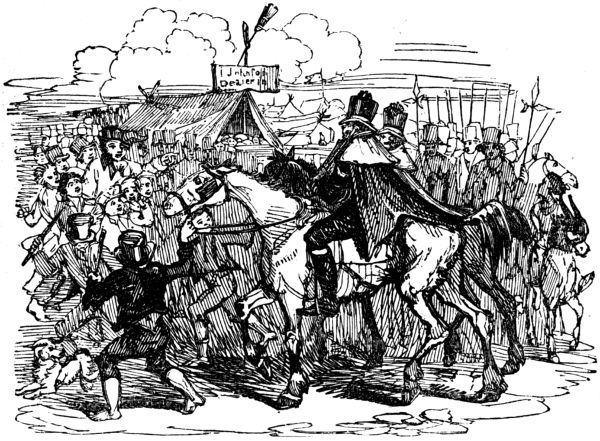
“Riding the Fair”—at Avingham.
And what have those troopers to do here to-day? The duke of Northumberland’s pipers are they.
The pipers, followed by the duke’s agent, bailiff, constable, and a numerous body of farmers, principally the duke’s tenantry, proceed first through the fair, where the proclamation is read, that the fair shall last nine days, &c.;[558] and then, the duke being lord of the manor, they walk the boundary of all that is or has been common or waste land. That task completed, they return to the alehouse with the pipers playing before them, where they partake freely of store of punch at the duke’s expense. The farmers are so proud of being able to express their attachment to his grace “in public,” as they term it, that they mount their sons on cuddies, (asses,) rather than they should not join the procession, to drink with them “the health o’ his grace, and lang may he leeve ta pratect and study the interests o’ his tanentry.” Then there’s “Here’s te ye Tam, thank’s te ye Joke,” and so they separate for the fair, there to “settle how mickle per heed they con git for their nowte an swine.”
Avingham fair, like others, is attended by many a “gaberlunzie,” with different kinds of amusement for children, such as the “E and O, black-cock and grey;” and, above all, for the amusement of the pig drivers and “gadsmen,” Punch and Toby, (so called by them,) and a number of those gentlemen who vomit fire, as if they had swallowed the wicks of all the candles they had snuffed for Richardson. Many of those worthies I recollect having attended ever since I was able to see above the level of their stalls. At my last visit, I was much amused with one who seemed to have been just arrived from the sister kingdom; he was surrounded by ploughboys and their doxeys, their cheeks as red as their topknots. He had a large pan suspended from his neck, and, as the girls observed, a “skimmering” white apron and bib, and he bellowed as loud as he could, “Hearse a’ yer rale dandy candy, made ap wa’ sugar an brandy, an tha rale hoile a mint; it’s cood far young ar hold, cough or cold, a shortness a’ breath, ar a pain at tha stamach, it’s cood far hany camplaint whatsamever; A, fate! an yil try it:—noo leddies, hif ye try it, an yer sure ta buy it.” And sure enough this was the case, for whatever might be its qualities, it pleased the “leddies,” who purchased in such abundance, that they besmeared their faces so as to destroy that rosy red, love’s proper hue, which dwells upon the cheeks of our northern rustic beauties.
I must not forget to mention that the October fair is more numerously attended by those who go for pleasure. Unlike the southern holyday folks, they prefer autumn for this reason, that “hearst” is just ended, and they have then most money, which, with the “leddies,” is generally expended in dress suitable to this and similar occasions. After baking a sufficient number of barley bannocks for the following day, and the milk set up, they throw off their “linsey-woolsey petticoats,” and “hale made bed-goons” for a gown, a good specimen of their taste, in the two warmest colours, a red flower or stripe upon a yellow ground, and as much of a third colour round the waste, as would make them vie with Iris. In this butterfly state they hasten to the scene of mirth, and most of them dance till they have reason to suppose it is time to “gang hame, an git a’ ready be’ crowdie time.” The style of dancing is the same as in Scotland, country dances, reels, jigs, and hornpipes; the last mentioned is much admired. No merry-making is allowed to pass over without some rural “admirable Crichton” having shown his agility in this step. The hornpipe is introduced between each country dance, while “Love blinks, wit sleeps, an’ social mirth forgets their’s care upon the earth.” The following day is called by the inhabitants “gwonny Jokesane’s” day; why so is not known; all they know is, that it is and has been so called since the recollection of the oldest alive; and that is sufficient to induce them to continue a custom, which is peculiar to it, as follows. When a sufficient number have assembled, they elect what they are pleased to call a mayor, who they mount upon a platform, which is borne along by four men, headed by the musician that attended the preceding evening, and followed by a number of bailiffs with white “wans,” and all the men, wives, maids, and white-headed urchins in the village. Thus, all in arms, they proceed first to the minister’s house, and strike up a dance in front. His worship, “the mayor,” as a privileged person, sometimes evinces a little impatience, and if the minister has not made his appearance, demands to speak to him. On his advancing, “his worship” begins thus, “A yes! twa times a yes! an’ three times a yes! If ony man, or ony man’s man, lairds, loons, lubburdoons, dogs, skelpers, gabbrigate swingers, shall commit a parliament as a twarliament, we, in the township o’ Avingham, shall hea his legs, an heed, tied ta tha cagwheel, till he say yence, twice, thrice, prosper the fair o’ Avingham, an’ gwonny Jokesane’s day.” This harangue, however ridiculous, is always followed with cheering, in which their good-tempered pastor freely joins, with his hat above his head, and stepping forward, shakes “his worship” by the hand, giving him a cordial welcome, trusting he will not leave the manse till he takes a “drap a yel, a’ his ain brewin.” This is of course acceded to. The ale being handed round in plenty, and being found to be good, “an’ what is na guid that the minister hes,” they engage themselves for some time, “while news much older than their ale goes round.” The musicians meanwhile play such airs as “The Reel Rawe,” “The Bonny Bit,” “Laddie Wylam away,” &c. The dance goes round, “the young contending as the old survey,” until silence is called, when “his worship” gives as a toast, “Health, wealth, milk, and meal, the de’al tak ye a’ thot disent wish him (the minister) weal—hip! hip! huzza!” Raising “his worship” shoulder height again, they proceed round the village, repeating their gambols in front of every respectable house where they meet with a similar reception.
After this, foot-racing commences, for hats, handkerchiefs, and (as Mathews calls them) she-shirts. The several races run and prizes distributed, they return to the last and gayest of their mirthful scenes, not without bestowing some little pains in selecting colours calculated to give the finishing touches to the picture.
“Wi’ merry sangs, an’ friendly cracks, I wat they did na weary; An’ unco tales, an’ funny jokes, Their sports were cheap an’ cheary. **** Syne, wi’ a social glass o’ strunt, They parted aff careerin, Fu’ blythe that night.”
So ends the fair of Avingham and its sports, which was to me, “in my youthful days,” a source of great amusement, but whether it is in comparing the present with the past, from a consciousness of having
“Dealt with life, as children with their play, Who first misuse, then cast their toys away,”
that we do not derive the same pleasure from what passes before us in maturer age; or whether, in boyhood, the impressions of such trifles as I have related are deeper rooted in the memory; yet, certain it is, whatever be our situation in life, we all come to the conclusion, that our early days were our happiest.
I am, &c. J—n J—k—n.
Bath Anecdotes.
A Member for the City, 1645.
In December 1645, the following letter was sent by the mayor and first alderman of Bath, to sir John Harrington, announcing their design of electing him one of their representatives, entreating him to accept the trouble thereof. The bold eagerness with which a seat in parliament is solicited now, and the modest coyness that marked the conduct of those who were called to that honour in the early part of the seventeenth century, strikingly contrast. The person chosen at that period to represent a county or city, was generally allowed a gratuity by his constituents in consideration of his trouble.
Copy.
To our muche honoured and worthie Friend, John Harrington, Esq. at his house at Kelstone, near Bathe.
Worthie Sir,
Out of the long experience we have had of your approved worth and sincerity, our citie of Bathe have determined and settled their resolutions to elect you for a burgess for the House of Commons in this present parliament, for our said citie, and do hope you will accept the trouble thereof; which if you do, our desire is, you will not fail to be with us at Bathe on Monday next, the eighth of this instant, by eight of the morning, at the furthest, for then we proceed to our election: and of your determination we entreat you to certify us by a word or two in writing, and send it by the bearer to
Your assured loving friends, John Bigg, the maior, William Chapman.
Bathe, Dec. 6, 1645.
Sir John’s Account of his Proceedings.
A Note of my Bathe businesse aboute the Parliament.
Saturday, Dec. 26th 1646 went to Bathe, and dined with the maior and citizens, conferred about my election to serve in parliament, as my father was helpless, and ill able to go any more; went to the George inn at night, met the bailiffs, and desired to be dismissed from serving, drank strong beer and metheglin, expended about iijs, went home late, but could not get excused, as they entertained a good opinion of my father.
Monday, Dec. 28th went to Bathe, met sir John Horner, we were chosen by the citizens to serve for the city. The maior and citizens conferred about parliament busines. The maior promised sir John Horner and myself a horse apiece, when we went to London to the parliament, which we accepted of, and we talked about the synod and ecclesiastical dismissions. I am to go again on Thursday, and meet the citizens about all such matters, and take advice therein.
Thursday 31st, went to Bathe, Mr. Ashe preached. Dined at the George inn with the maior and four citizens, spent at dinner vjs in wine.
Laid out in victuals at the George inn xjs 4d.
Laid out in drinking vijs ijd.
Laid out in tobacco and drinking vessels, iiijs 4d.
Jan. 1st, My father gave me £4 to pay my expenses at Bathe.
Mr. Chapman the maior came to Kelston, and returned thanks for my being chosen to serve in parliament, to my father, in name of all the citizens. My father gave me good advice, touching my speaking in parliament as the city should direct me. Came home late at night from Bathe, much troubled hereat, concerning my proceeding truly, for men’s good report and mine own safety.
Note. I gave the city messengers ijs for bearing the maior’s letters to me. Laid out in all £3 vijs for victuals, drink and horse hire, together with divers gifts.
Suffering a Recovery.
In December, 1822, a poor man made application to the Bath forum magistrates, and stated that six months prior, he had bought the goods and chattels of a neighbour, together with his wife, for the sum of four pounds ten shillings, for which he produced a regular stamped receipt.
The man had spent all the money and wanted to have his wife back again, but he refused to part with her. The magistrates told him he had no claim to her, and advised him to deliver her up to her husband, which he at last reluctantly did. The following is a true copy of the stamped receipt.
“Received of Edward Gale, the sum of four pounds ten shillings, for good and chattels; and also the black mare and Mrs. Naish, as parting man and wife. As agreed before witnesses this 8th December, 1822.
“Witness, the mark of Edward Pulling X Mary Gale, George Lansdowne, and Edward Gale.
“Settled the whole concern, By me John Naish.”
Nine Men’s Morris.
To the Editor of the Every-Day Book.
Ludgate-hill, 10th Nov. 1826.
Dear Sir,—I was much pleased on reading and being reminded of an ancient game in your book, called Ninepenny-marl; a game I had scarcely heard of during the last twenty years, although perfectly familiar to me in my boyish days, and played exactly the same as described by your correspondent P.[559]
I have since visited my native county, Norfolk, and find the game is still played by the rustics, and called, as it always has been there, “the game of Morris,” or “Nine Men’s Morris.” The scheme is frequently chalked on the ground or barn floors, and the game played with different coloured stones or beans. I think the name is more appropriate than “Ninepenny-marl;” and moreover, we of Norfolk have the authority of our immortal bard in his “Midsummer Night’s Dream,” where the queen of the fairies, speaking to Oberon, says, “The Nine Men’s Morris is filled up with mud.”
There are some men who are not a little proud at being proficients at this game. I heard an anecdote at North Walsham of a man named Mayes, still living in that neighbourhood, who is so great a lover of the pastime, that a wager was laid by some wags, that they would prevent his going to church, by tempting him to play; and, in order to accomplish their purpose, they got into a house, building by the road side, where Mayes was sure to pass. Being a great psalm-singer, he had a large book under his arm; they called him in to settle some disputed point about the game, and he was very soon tempted to play, and continued to do so till church time was over, and got a good scolding from his wife for being too late for dinner.
I have been led to make these remarks from the pleasure I have derived from your publication; and you may excuse me, perhaps, if I add, with a smile, that I have found some amusement in the game of Morris, by playing it with my chess men: it requires more art to play it well, than you would imagine at first sight.
I am, dear sir, Yours sincerely, T. B.
With almost the same pleasure that room has been made for this letter, from a well-remembered kind neighbour, will his communication be read in Norfolk by his fellow-countrymen.
He graces it from charmed metre, but I (spoil’d of Shakspeare’s line) take prose from Strutt.
The erudite historian of the “Sports and Pastimes of the People of England,” says, that “Merelles, or, as it was formerly called in England, Nine Men’s Morris, and also Fivepenny Morris, is a game of some antiquity.” He gives a figure of the “Merelle-table,” as it appeared in the fourteenth century, the lines of which are similar to those in the scheme of “Ninepenny Marl,” engraved with the account of the game communicated by *, *, P., with only this difference, that at each corner, formed by the angles and intersections, are black spots.
The game is played in France with pawns or men, made on purpose, termed merelles: hence the pastime derived that denomination. The manner of playing is briefly thus: two persons, each having nine men, different in colour and form, for distinction sake, place them alternately one by one upon the spots; and the business of either party is to prevent his antagonist from placing three of his pieces so as to form a row of three, without the intervention of an opponent piece. If he forms a row he takes one of his antagonist’s pieces from any part, except from a row, which must not be touched if he have another piece on the board. When all the pieces are laid down, they are played backwards and forwards in any direction that the lines run, but they can only move from one spot to another at one time. He that takes all his opponent’s pieces is the conqueror.
The rustic players of “Nine Men’s Morris,” in England, who draw their lines on the ground, make a small hole for every dot, and play in them with stones of different forms or colours. The pastime is supposed to have derived the appellation of “Nine Men’s Morris,” from the different coloured men being moved backwards or forwards as though they were dancing a morris.[560]
NATURALISTS’ CALENDAR.
Mean Temperature 38·70.
December 31.
To December.
The passing year, all grey with hours, Ends, dull month, with thee; Chilled his summer, dead his flowers, Soon will his funeral be; Frost shall drink up his latest breath, And tempests rock him into death. How he shivers! from his age All his leaves have faded, And his weary pilgrimage Ends at last unaided By his own sun that dims its ray, To leave him dark in his decay. Hark! through the air the wild storm bears In hollow sounds his doom, While scarce a star its pale course steers Athwart the sullen gloom; And Nature leaves him to his fate, To his grey hairs a cold ingrate. She goes to hail the coming year, Whose spring-flowers soon shall rise— Fool, thus to shun an old friend’s bier, Nor wisely moralize On her own brow, where age is stealing Many a scar of time revealing:— Quench’d volcanoes, rifted mountains, Oceans driven from land, Isles submerged, and dried up fountains, Empires whelm’d in sand— What though her doom be yet untold— Nature, like Time, is waxing old!
New Monthly Magazine.
NATURALISTS’ CALENDAR.
Mean Temperature 37·50.
The Indexes to the Volume will end the Every-Day Book.
On taking leave, as Editor of this work, I desire to express my thanks for its favourable acceptation. It seems to have been regarded as I wished—a miscellany to be taken up by any body at any time. I have the pleasure to know that it is possessed by thousands of families of all ranks: is presented by fathers to their sons at school; finds favour with mothers, as suited to the perusal of their daughters; and is so deemed of, as to be placed in public and private libraries enriched with standard literature. Ascribing these general marks of distinction to its general tendency, that tendency will be maintained in my next publication,
The Table Book.
This publication will appear, with cuts, every Saturday, and in monthly parts, at the same price as the Every-Day Book, and will contain several original articles from valued correspondents, for which room could not be here made.
The first number and the present year will be “out” together. I gratefully remember the attachment of my friends to the present sheets, and I indulge a hope that they will as kindly remember me, and my new work.
The Table Book.
Cuttings with Cuts, facts, fancies, recollections, Heads, autographs, views, prose and verse selections, Notes of my musings in a lonely walk, My friends’ communications, table-talk, Notions of books, and things I read or see, Events that are, or were, or are to be, Fall in my Table Book—and thence arise To please the young, and help divert the wise.
December 23, 1826.
W. Hone.