OCTOBER.
Reading edition
Then, for “October Month,” they put A rude illuminated cut— Reaching ripe grapes from off the vine, Or pressing them, or tunning wine; Or, something to denote that there Was vintage at this time of year.
We have “hopes and fears” for the year at all seasons, as we have for ourselves “in infancy” and throughout life. After the joyousness of summer comes the season of foreboding, for “the year has reached its grand climacteric, and is fast falling ‘into the sere, the yellow leaf.’ Every day a flower drops from out the wreath that binds its brow—not to be renewed. Every hour the sun looks more and more askance upon it, and the winds, those summer flatterers, come to it less fawningly. Every breath shakes down showers of its leafy attire, leaving it gradually barer and barer, for the blasts of winter to blow through it. Every morning and evening takes away from it a portion of that light which gives beauty to its life, and chills it more and more into that torpor which at length constitutes its temporary death. And yet October is beautiful still, no less ‘for what it gives than what it takes away;’ and even for what it gives during the very act of taking away.—The whole year cannot produce a sight fraught with more rich and harmonious beauty than that which the woods and groves present during this month, notwithstanding, or rather in consequence of, the daily decay of their summer attire; and at no other season can any given spot of landscape be seen to much advantage as a mere picture.—An extensive plantation of forest trees presents a variety of colours and of tints that would scarcely be considered as natural in a picture, any more than many of the sunsets of September would. Among those trees which retain their green hues, the fir tribe are the principal; and these, spiring up among the deciduous ones, now differ from them no less in colour than they do in form. The alders, too, and the poplars, limes, and horse-chestnuts, are still green,—the hues of their leaves not undergoing much change as long as they remain on the branches. Most of the other forest trees have put on each its peculiar livery; the planes and sycamores presenting every variety of tinge, from bright yellow to brilliant red; the elms being, for the most part, of a rich sunny umber, varying according to the age of the tree and the circumstances of its soil, &c.; the beeches having deepened into a warm glowing brown, which the young ones will retain all the winter, and till the new spring leaves push the present ones off; the oaks varying from a dull dusky green to a deep russet, according to their ages; and the Spanish chestnuts, with their noble embowering heads, glowing like clouds of gold.—As for the hedge-rows, though they have lost nearly all their flowers, the various fruits that are spread out upon them for the winter food of the birds, make them little less gay than they were in spring and summer. The most conspicuous of these are the red hips of the wild rose; the dark purple bunches of the luxuriant blackberry; the brilliant scarlet and green berries of the nightshade; the wintry-looking fruit of the hawthorn; the blue sloes, covered with their soft tempting-looking bloom; the dull bunches of the woodbine; and the sparkling holly-berries.—We may also still, by seeking for them, find a few flowers scattered about beneath the hedge-rows, and the dry banks that skirt the woods, and even in the woods themselves, peeping up meekly from among the crowds of newly fallen leaves. The prettiest of these is the primrose, which now blows a second time. But two or three of the persicaria tribe are still in flower, and also some of the goosefoots. And even the elegant and fragile heathbell, or harebell, has not yet quite disappeared; while some of the ground flowers that have passed away have left in their place strange evidences of their late presence; in particular, the singular flower (if it can be called one) of the arums, or lords and ladies, has changed into an upright bunch, or long cluster, of red berries, starting up from out the ground on a single stiff stem, and looking almost like the flower of a hyacinth.—The open fields during this month, though they are bereaved of much of their actual beauty and variety, present sights that are as agreeable to the eye, and even more stirring to the imagination, than those which have passed away. The husbandman is now ploughing up the arable land, and putting into it the seeds that are to produce the next year’s crops; and there are not, among rural occupations, two more pleasant to look upon than these: the latter, in particular, is one that, while it gives perfect satisfaction to the eye as a mere picture, awakens and fills the imagination with the prospective views which it opens.—It is not till this month that we usually experience the equinoxial gales, those fatal visitations which may now be looked upon as the immediate heralds of the coming on of winter; as in the spring they were the sure signs of its having passed away. Bitter-sweet is it, now, to lie awake at night, and listen wilfully (as if we would not let them escape us) to the fierce howlings of the winds, each accession of which gives new vividness to the vision of some tall ship, illumined by every flash of lightning—illumined, but not rendered visible—for there are no eyes within a hundred leagues to look upon it; and crowded with human beings—(not ‘souls’ only, as the sea-phrase is, for then it were pastime—but bodies) every one of which sees, in imagination, its own grave a thousand fathom deep beneath the dark waters that roar around, and feels itself beforehand.”[360]
The Wind.
The wind has a language, I would I could learn! Sometimes ’tis soothing, and sometimes ’tis stern, —Sometimes it comes like a low sweet song, And all things grow calm, as the sound floats along, And the forest is lulled by the dreamy strain, And slumber sinks down on the wandering main, And its crystal arms are folded in rest, And the tall ship sleeps on its heaving breast. Sometimes when autumn grows yellow and sere, And the sad clouds weep for the dying year, It comes like a wizard, and mutters its spell, —I would that the magical tones I might tell— And it beckons the leaves with its viewless hand, And they leap from their branches at its command, And follow its footsteps with wheeling feet, Like fairies that dance in the moonlight sweet. Sometimes it comes in the wintry night, And I hear the flap of its pinions of might, And I see the flash of its withering eye, As it looks from the thunder-cloud sailing on high, And pauses to gather its fearful breath, And lifts up its voice like the angel of death— And the billows leap up when the summons they hear And the ship flies away, as if winged with fear, And the uncouth creatures that dwell in the deep, Start up at the sound from their floating sleep, And career through the water, like clouds through the night, To share in the tumult their joy and delight, And when the moon rises, the ship is no more, Its joys and its sorrows are vanish’d and o’er, And the fierce storm that slew it has faded away, Like the dark dream that flies from the light of the day.
The Improvisatrice.
October 1.
Lawless Court.
This is the season of holding a remarkable court, which we are pleasantly introduced to by the relation of a good old writer.[361]
“Ryding from Ralegh towards Rochford, I happened to haue the good companie of a gentleman of this countrey, who, by the way, shewed me a little hill, which he called the Kings Hill; and told me of a strange customarie court, and of long continuance, there yearely kept, the next Wednesday after Michaelmas day in the night, upon the first cock crowing without any kinde of light, saue such as the heavens will affoard: The steward of the court writes onely with coales, and calleth all such as are bound to appeare, with as low a voice as possiblie he may, giuing no notice when he goeth to execute his office. Howsoever, he that gives not answer is deeply amerced; which servile attendance (saith he) was imposed at the first vpon certaine tenants of divers mannors hereabouts, for conspiring in this place, at such an vnseasonable time, to raise a commotion. The title of the entrie of the court hee had in memory, and writ it downe for me when we came to Rochford.” Fuller speaks of its running “in obscure barbarous rimes,” which he inserts nearly in the words of the legal authorities who give the following account:—
“Lawless Court. On Kingshill at Rochford in Essex, on Wednesday morning next, after Michaelmas day, at Cocks-crowing, Is held a Court, vulgarly called ‘The Lawless Court.’ They whisper and have no Candle, nor any Pen and Ink but a Coal; and he that ows Suit or Service, and appears not, forfeits double his rent every hour he is missing. This Court belongs to the Honor of Ralegh, and to the Earl of Warwick; and is called ‘Lawless,’ because held at an unlawful or lawless hour, or Quia dicta sine lege. The Title of it in the Court Rolls, runs thus,—
Kingshi in Rochford.
} ss. C
Vria de Domino Rege, Dicta sine Lege.
Kingshi in Rochford. } ss. CVria de Domino Rege, Dicta sine Lege.
Tenta est ibidem
Per ejusdem consuetudinem,
Ante ortum solis,
Luceat nisi polus,
Senescallus solus
Nil scribit nisi colis,
Toties voluerit,
Gallus ut cantaverit,
Per cujus soli sonitus,
Curia est summonita,
Clamat clam pro Rege,
In Curia sine Lege,
Et nisi cito venerint,
Citiùs pænituerint,
Et nisi clam accedant,
Curia non attendat,
Qui venerit cum lumine,
Errat in regimine:
Et dum sunt sine lumine,
Capti sunt in crimine:
Curia sine cura,
Jurati de injuria,
Tenta ibidem die Mercurii (ante Diem) proximi post Festum Sancti Michaelis Arch-angeli, Anno regni Regis,” &c.
This Court is mentioned in Cam. Britan, though imperfectly; who says this servile attendance was imposed on the Tenants, for conspiring at the like unseasonable time to raise a Commotion.[362]
Order of Fools.
We are already acquainted with so many whimsies of our forefathers, that any thing related of their doings ceases to surprise; we might otherwise be astonished by the fact, that Folly had an order of merit, and held its great court every year on the first Sunday after Michaelmas-day.
An inquiring antiquary gives some particulars of this institution, with a translation of the document for its foundation, which is preserved in Von Buggenhagen’s “Account of the Roman and National Antiquities” discovered at Cleves. He relates of it as follows:—
To this document are affixed thirty-six seals, all imprinted on green wax, with the exception of that of the founder, which is on red wax, and in the centre of the rest; having on its right the seal of the count de Meurs, and on its left that of Diedrich van Eyl. The insignium borne by the knights of this order on the left side of their mantles consisted of a fool embroidered in a red and silver vest, with a cap on his head, intersected harlequin-wise with red and yellow divisions, and gold bells attached, with yellow stockings and black shoes; in his right hand was a cup filled with fruits, and in his left a gold key, symbolic of the affection subsisting between the different members.
It is uncertain when this order ceased, although it appears to have been in existence at the commencement of the sixteenth century, when, however, its pristine spirit had become totally extinct. The latest mention that has hitherto been found of it occurs in some verses prefixed by Onofrius Brand to the German translation of his father Sebastian Brand’s celebrated “Navis Stultifera Mortalium,” by the learned Dr. Geiler von Kaisersberg, which was published at Strasburg in the year 1520.
Two-fold was the purpose of the noble founders of this order; to relieve the wants and alleviate the miseries of their suffering fellow-creatures; and to banish ennui during the numerous festivals observed in those ages, when the unceasing routine of disports and recreations, which modern refinement has invented in the present, were unknown. During the period of its meeting, which took place annually, and lasted seven days, all distinctions of rank were laid aside, and the most cordial equality reigned throughout. Each had his particular part allotted to him on those occasions, and those who supported their characters in the ablest manner, contributed most to the conviviality and gaiety of the meeting. Indeed we cannot but be strongly prepossessed in its favour, when we recur to the excellent regulations which accompanied its institution, and were admirably calculated to preserve it, at least for a great length of time, from degenerating into absurdity and extravagance.
We must not confound this laudable establishment with the vulgar and absurd practices which, till of late years, existed in many places under the names of feasts of fools and of the ass, &c. These were only national festivals, intended for the occasional diversion, or, as in those days they were termed, rites to promote the pious edification of the lower classes, which, “not unfrequently introduced by a superstition of the lowest and most illiberal species,” soon became objects of depravity and unbridled licentiousness. Of a totally different nature also, and analagous only in quaintness of appellation, were the societies established by men of letters in various parts of Italy, such as the society of the “Insensáte,” at Perugia, of the “Stravaganti,” at Pisa, and the “Eteróclyti,” at Pesaro. Nor can I allow myself to pass over in silence on the present occasion the order or society of Fools, otherwise denominated “Respublica Binepsis,” which was founded towards the middle of the fourteenth century by some Polish noblemen, and took its name from the estate of one Psomka, the principal instigator, near Leublin. Its form was modelled after that of the constitution of Poland; like this, too, it had its king, its council, its chamberlain, its master of the hunt, and various other offices. Whoever made himself ridiculous by any singular and foolish propensity, on him was conferred an appointment befitting it. Thus he, who carried his partiality to the canine species to a ridiculous extreme, was created master of the hunt; whilst another, who constantly boasted of his valorous achievements, was raised to the dignity of field marshal. No one dared to refuse the acceptance of such a vocation, unless he wished to become a still greater object of ridicule and animadversion than before. This order soon experienced so rapid an increase of numbers that there were few at court who were not members of it. At the same time it was expressly forbidden that any lampooner should be introduced amongst them. The avowed object of this institution was to prevent the rising generation from the adoption of bad habits and licentious manners; and ridiculous as was its outward form, is not its design at least entitled to our esteem and veneration?
Patent of Creation of the Order of Fools.
“We all, who have hereunto affixed our seals, make known unto all men, and declare, that after full and mature consideration, both on our own behalf and on account of the singular goodwill and friendship which we all bear, and will continue to bear towards one another, we have instituted a society of fools, according to the form and manner hereunto subjoined:—
“Be it therefore known, that each member shall wear a fool, either made of silver, or embroidered, on his coat. And such member as shall not daily wear this fool, him shall and may any one of us, as often as he shall see it, punish with a mulct of three old great tournois, (livres tournois, about four-pence halfpenny,) which three tournois shall be appropriated to the relief of the poor in the Lord!
“Further, will we fools yearly meet, and hold a conventicle and court, and assemble ourselves, to wit at Cleves, every year on the Sunday after Michaelmas-day; and no one of us shall depart out of the city, nor mount his horse to quit the place where we may be met together, without previous notice, and his having defrayed that part of the expenses of the court which he is bound to bear. And none of us shall remain away on any pretence or for any other reason whatsoever than this, namely, that he is labouring under very great infirmity; excepting moreover those only who may be in a foreign country, and at six days’ journey from their customary place of residence. If it should happen that any one of the society is at enmity with another, then must the whole society use their utmost endeavours to adjust their differences and reconcile them; and such members and all their abettors shall be excluded from appearing at the court on the Friday morning when it commences its sitting at sun-rise, until it breaks up on the same Friday at sun-set.
“And, we will further, at the royal court yearly elect one of the members to be king of our society, and six to be counsellors; which king with his six counsellors shall regulate and settle all the concerns of the society, and in particular appoint and fix the court of the ensuing year; they shall also procure, and cause to be procured, all things necessary for the said court, of which they shall keep an exact account. These expenses shall be alike both to knights and squires, and a third part more shall fall upon the lords than upon the knights and squires; but the counts shall be subject to a third part more than the lords.
“And early on the Tuesday morning (during the period of the court’s sitting) all of us members shall go to the church of the Holy Virgin at Cleves, to pray for the repose of all those of the society who may have died; and there shall each bring his separate offering.
“And each of us has mutually pledged his good faith, and solemnly engaged to fulfil faithfully, undeviatingly, and inviolably, all things which are above enumerated, &c.
“Done at Cleves, 1381, on the day of St. Cunibert.”
H. W. S.[363]
Stage Accident.
On the evening of Friday the 1st of October, 1736, during the performance of an entertainment called Dr. Faustus, at Covent-garden theatre, one James Todd who represented the miller’s man, fell from the upper stage, in a flying machine, by the breaking of the wires. He fractured his scull, and died miserably; three others were much hurt, but recovered. Some of the audience swooned, and the whole were in great confusion upon this sad accident.[364]
Mountebanks and Mr. Merriman.
For the Every-Day Book.
Little inferior to Mr. Punch, Mr. Merriman has stood eminently high at fairs, figured in market-places, and scarcely a village green in England, that has not felt the force of his irresistible appeals. He does not often approach the over-grown metropolis; his success here is less certain, and the few patrons that remain, love to feast their eyes and risible faculties without sparing a modicum from their pockets: the droll simpleton might crack his jokes without finding the kernel—cash.
A company of mountebanks, however, appeared on a green, north of White Conduit-house, several evenings last week. On Saturday the performance commenced at five o’clock in the afternoon. The performers consisted of the master, a short, middle aged person, with a florid complexion, dressed in decent half mourning. He possessed a sound pair of lungs, fair eloquence, and a good portion of colloquial ability. By the assistance of a little whip he kept in order a large ring, formed of boys, girls, and grown persons of both sexes. His eye, gray as a falcon’s, watched the reception he received, and seemed to communicate with his “mind’s eye,” as to his subscribers. The rosy-faced maid servants, glad of the opportunity of gazing at the exhibitors, were rejoiced by the pretence of holding the “nursery treasures” to see all that could be seen. Here the calculator looked for patronage and encouragement. “Mr. Merriman,” a young man with his face and clothes duly coloured, à la Grimaldi, raised laughter by his quaint retorts, by attempts at tumbling to prove he could tumble well, and by drilling with a bugle-horn a dozen volunteer boys in many whimsical exercises, truly marvellous to simpering misses and their companions. The next performer was a short man with sharp features, sunburnt face, and shrill goat-like voice:—he tumbled in a clever, but, I think, dangerous manner. Then Mr. Merriman’s “imitations” followed; not to say any thing of those inimitable imitators, Mathews, Reeve, and Yates, he suited his audience to the very echo of the surrounding skeletons in brick and mortar. The tumbler then reposed by putting a loose coat over his party-coloured habit, and playing a pandean-pipe while “Mr. Merriman” sat on a piece of carpet spread on the ground, and tossed four gilt balls in the air at the same time, to the variations of the music. A drum was beat by a woman about forty, with a tiara on her head, who afterwards left the beating art and mounting the slack-wire, which was supported by three sticks, coned at each end to a triangle; she danced and vaulted à la Gouffe. A table was put on the wire, which she balanced, and bore a glass full of liquor on the rim as she twirled it on her finger. This was the acmè of the display. Tickets at one shilling each were now handed round with earnestness and much promise, for a lottery of prizes, consisting of teapots, waiters, printed calico, and two sovereigns thrown on the grass instead of a sheep. These temptations held out to many a Saturday night labourer the hope of increasing his week’s wages. The “conductor” of his company no doubt profited by the experience of which he was possessed. Many tickets were sold; expectation breathed—fancy pictured a teapot—or some token of fortune’s performance. The decision made, the die cast, now the laughing winner walked hurriedly away, hugging his prize, while the losers hid their chagrin, and were quietly dispersed by the “blank” influence, with secret wishes that their money was in their pockets again.
When I reflect upon this kind of amusement for the labouring classes, I see nothing to prevent its occasional appearance. The wit scattered about, though in a blundering way, is often smart.
In spite of decorum, of my better instruction in gentility, and Chesterfield’s axioms, I love to stand and shake my human system, if it be only to remind me of past observation, and to see the children so happy, who ring out music, in every responsive applause of the tricks so plausibly represented to their view. While “Mr. Merriman” does not invade the peace of society, I hope he will be allowed his precarious reign, as he promised “that he would forfeit fifty guineas if he came into the parish again at least for a twelvemonth.”
It is within my remembrance when former mountebanks distributed packets instead of blanks, containing nostrums against toothache, corns, bunions, warts, witchcraft and the ague. Doctor Bolus strutted and fretted his hour upon the stage, and gave as much wit for sixpence as kept the village alehouse in a roar for many weeks. But, I suppose, the mountebank profession, like every other, feels the changes of the times, and retrenchment cries,—
“Ubi vos requiram, cum dies advenerit?”
*, *, P.
September 29, 1826.
Please to make the following correction, page 1270; for “he shaking,” read “the shaking.”
NATURALISTS’ CALENDAR.
Mean Temperature 52·85.
October 2.
Extraordinary Walking.
October 2, 1751, a man, for a wager of twenty guineas, walked from Shoreditch church, to the twenty mile stone near Ware, and back again, in seven hours![365]
Extraordinary Riding.
In October, 1754, lord Powerscourt having laid a wager with the duke of Orleans, that he would ride on his own horses from Fountainbleau to Paris, which is forty-two English miles, in two hours, for one thousand louis d’ors, the king’s guards cleared the way, which was lined with crowds of Parisians. He was to mount only three horses, but he performed the task on two, in one hour, thirty-seven minutes, and twenty-two seconds. The horses through whom the wager was won, were both killed by the severity of the feat.[366]
NATURALISTS’ CALENDAR.
Mean Temperature 53·75.
October 3.
Extraordinary Horse.
On the 3d of October, 1737, a cart-gelding belonging to Mr. Richard Fendall, of the Grange, Southwark, died by an accidental cut in his knee with a garden-mellon bell-glass; which is taken notice of, because this gelding was forty-four years in his possession. It was bought Michaelmas, 1693, at Uxbridge, was never sick nor lame all the time, and within the fifteen years preceding, drew his owner and another in a chaise, fifty miles in one day.[367]
Birds and Mists.
It is observed that—“Among the miscellaneous events of October, one of the most striking and curious is the interchange which seems to take place between our country, and the more northern as well as the more southern ones, in regard to the birds. The swallow tribe now all quit us: the swift disappeared wholly, more than a month ago; and now the house swallow, house martin, and bank or sand martin, after congregating for awhile in vast flocks about the banks of rivers and other waters, are seen no more as general frequenters of the air. If one or two are seen during the warm days that sometimes occur for the next two or three weeks, they are to be looked upon as strangers and wanderers; and the sight of them, which has hitherto been so pleasant, becomes altogether different in its effect: it gives one a feeling of desolateness, such as we experience on meeting a poor shivering lascar in our winter streets.—In exchange for this tribe of truly summer visiters, we have now great flocks of the fieldfares and redwings come back to us; and also wood pigeons, snipes, woodcocks, and several of the numerous tribe of water-fowl.
“Now, occasionally, we may observe the singular effects of a mist, coming gradually on, and wrapping in its dusky cloak a whole landscape that was, the moment before, clear and bright as in a spring morning. The vapour rises visibly (from the face of a distant river perhaps) like steam from a boiling caldron; and climbing up into the blue air as it advances, rolls wreath over wreath till it reaches the spot on which you are standing; and then, seeming to hurry past you, its edges, which have hitherto been distinctly defined, become no longer visible, and the whole scene of beauty, which a few moments before surrounded you, is as it were wrapt from your sight like an unreal vision of the air, and you seem (and in fact are) transferred into the bosom of a cloud.”[368]
Swallows.
A provincial paper[369] says, “It is a fact, which has not been satisfactorily accounted for by ornithologists, that the number of swallows which visit this island are not near so numerous as they formerly were; and this is the case, not only in this neighbourhood, but throughout the country. The little that is satisfactorily known concerning the parts to which they emigrate, and the many statements respecting their annual migration, not only serves to show that something remains to be discovered respecting these interesting visiters, but perhaps prevents us from ascertaining the causes of the decrease in their numbers. In the month of September, 1815, great numbers of these birds congregated near Rotherham, previous to their departure for a more genial climate. Their appearance was very extraordinary, and attracted much attention. We extract some account of this vast assemblage of the feathered race, from an elegantly written little work, published on the occasion, by the rev. Thomas Blackley, vicar of Rotherham, containing ‘Observations and Reflections’ on this circumstance:—
“‘Early in the month of September, 1815, that beautiful and social tribe of the feathered race began to assemble in the neighbourhood of Rotherham, at the Willow-ground, near the Glass-house, preparatory to their migration to a a warmer climate; and their numbers were daily augmented, until they became a vast flock which no man could easily number—thousands upon thousands, tens of thousands, and myriads—so great, indeed, that the spectator would almost have concluded that the whole of the swallow race were there collected in one huge host. It was their manner, while there, to rise from the willows in the morning, a little before six o’clock, when their thick columns literally darkened the sky. Their divisions were formed into four, five, and sometimes six grand wings, each of these filing off and taking a different route—one east, another west, another south, and so on; as if not only to be equally dispersed throughout the country, to provide food for their numerous troops; but also to collect with them whatever of their fellows, or straggling parties, might be still left behind. Just before the respective columns arose, a few birds might be observed first in motion at different points, darting through their massy ranks—these appeared like officers giving the word of command. In the evening, about five o’clock, they began to return to their station, and continued coming in, from all quarters, until nearly dark. It was here that you might see them go through their various aerial evolutions, in many a sportive ring and airy gambol—strengthening their pinions in these playful feats for their long etherial journey; while contentment and cheerfulness reigned in every breast, and was expressed in their evening song by a thousand pleasing twitters from their little throats, as they cut the air and frolicked in the last beams of the setting sun, or lightly skimmed the surface of the glassy pool. The notes of those that had already gained the willows sounded like the murmur of a distant waterfall, or the dying roar of the retreating billow on the sea beach.
“‘The verdant enamel of summer had already given place to the warm and mellow tints of autumn, and the leaves were now fast falling from their branches, while the naked tops of many of the trees appeared—the golden sheaves were safely lodged in the barns, and the reapers had, for this year, shouted their harvest home—frosty and misty mornings now succeeded, the certain presages of the approach of winter. These omens were understood by the swallows as the route for their march; accordingly, on the morning of the 7th of October, their mighty army broke up their encampment debouched from their retreat, and, rising, covered the heavens with their legions; thence, directed by an unerring guide, they took their trackless way. On the morning of their going, when they ascended from their temporary abode, they did not, as they had been wont to do, divide into different columns, and take each a different route, but went off in one vast body, bearing to the south. It is said that they would have gone sooner, but for a contrary wind which had some time prevailed; that on the day before they took their departure, the wind got round, and the favourable breeze was immediately embraced by them. On the day of their flight, they left behind them about a hundred of their companions; whether they were slumberers in the camp, and so had missed the going of their troops, or whether they were left as the rear-guard, it is not easy to ascertain; they remained, however, till the next morning, when the greater part of them mounted on their pinions, to follow, as it should seem, the celestial route of their departed legions. After these a few stragglers only remained; these might be too sick or too young to attempt so great an expedition; whether this was the fact or not, they did not remain after the next day. If they did not follow their army, yet the dreary appearance of their depopulated camp and their affection for their kindred, might influence them to attempt it, or to explore a warmer and safer retreat.’”
NATURALISTS’ CALENDAR.
Mean Temperature 50·00.
October 4.
Chronology.
On the 4th of October, 1749,[370] died at Paris, John Baptist Du Halde, a jesuit, who was secretary to father Le Tellier, confessor to Louis XIV. Du Halde is celebrated for having compiled an elaborate history and geography of China from the accounts of the Romish missionaries in that empire; he was likewise editor of the “Lettres edifiantes et curieuses,” from the ninth to the twenty-sixth collection, and the author of several Latin poems and miscellaneous pieces. He was born in the city wherein he died, in 1674, remarkable for piety, mildness, and patient industry.[371]
NATURALISTS’ CALENDAR.
Mean Temperature 54·92.
October 5.
NATURALISTS’ CALENDAR.
Mean Temperature 55·12.
October 6.
St. Faith.
Of this saint in the church of England calendar, there is an account in vol. i. col. 1362.
Somnambulism.
On Sunday evening, the 6th of October, 1823, a lad named George Davis, sixteen and a half years of age, in the service of Mr. Hewson, butcher, of Bridge-road, Lambeth, at about twenty minutes after nine o’clock, bent forward in his chair, and rested his forehead on his hands. In ten minutes he started up, fetched his whip, put on his one spur, and went thence to the stable; not finding his own saddle in the proper place, he returned to the house, and asked for it. Being asked what he wanted with it, he replied, to go his rounds. He returned to the stable, got on the horse without the saddle, and was proceeding to leave the stable; it was with much difficulty and force that Mr. Hewson junior, assisted by the other lad, could remove him from the horse; his strength was great, and it was with difficulty he was brought in doors. Mr. Hewson senior, coming home at this time, sent for Mr. Benjamin Ridge, an eminent practitioner, in Bridge-road, who stood by him for a quarter of an hour, during which time the lad considered himself stopped at the turnpike gate, and took sixpence out of his pocket to be changed; and holding out his hand for the change, the sixpence was returned to him. He immediately observed, “None of your nonsense—that is the sixpence again, give me my change.” When threepence halfpenny was given to him, he counted it over, and said, “None of your gammon; that is not right, I want a penny more;” making the fourpence halfpenny, which was his proper change. He then said, “give me my castor,” (meaning his hat,) which slang terms he had been in the habit of using, and then began to whip and spur to get his horse on; his pulse at this time was one hundred and thirty-six, full and hard; no change of countenance could be observed, nor any spasmodic affection of the muscles, the eyes remaining close the whole of the time. His coat was taken off his arm, his shirt sleeve stripped up, and Mr. Ridge bled him to thirty-two ounces; no alteration had taken place in him during the first part of the time the blood was flowing; at about twenty-four ounces, the pulse began to decrease; and when the full quantity named above had been taken, it was at eighty, with a slight perspiration on the forehead. During the time of bleeding Mr. Hewson related the circumstance of a Mr. Harris, optician in Holborn, whose son some years before walked out on the parapet of the house in his sleep. The boy joined the conversation, and observed he lived at the corner of Brownlow-street. After the arm was tied up, he unlaced one boot, and said he would go to bed. In three minutes from this time he awoke, got up, and asked what was the matter, (having then been one hour in the trance,) not having the slightest recollection of any thing that had passed, and wondered at his arm being tied up, and at the blood, &c. A strong aperient medicine was then administered, he went to bed, slept sound, and the next day appeared perfectly well, excepting debility from the bleeding and operation of the medicine, and had no recollection whatever of what had taken place. None of his family or himself were ever affected in this way before.[372]
Remarkable Storm.
The following remarkable letter in the “Gentleman’s Magazine,” relates to the present day seventy years ago.
Mr. Urban, Wigton, Oct. 23, 1756.
On the 6th inst. at night, happened a most violent hurricane; such a one perhaps as has not happened in these parts, in the memory of man. It lasted full 4 hours from about 11 till 3. The damage it has done over the whole county is very deplorable. The corn has suffered prodigiously.—Houses were not only unroofed, but in several places overturned by its fury.—Stacks of hay and corn were entirely swept away.—Trees without number torn up by the roots. Others, snapt off in the middle, and scattered in fragments over the neighbouring fields. Some were twisted almost round; bent, or split to the roots, and left in so shattered a condition as cannot be described.
The change in the herbage was also very surprising; its leaves withered shrivelled up, and turned black. The leaves upon the trees, especially on the weather side, fared in the same manner. The Evergreens alone seem to have escaped, and the grass recovered in a day or two.
I agreed, at first, with the general opinion, that this mischief was the effect of Lightning; but, when I recollected that, in some places, very little had been taken notice of; in others none at all; and that the effect was general, I begun to think of accounting for it from some other cause. I immediately examined the dew or rain which had been left on the grass, windows, &c. in hopes of being enabled, by its taste, to form some better judgment of the particles with which the air had been impregnated, and I found it as salt as any sea water I had ever tasted. The several vegetables also were all saltish more or less, and continued so for 5 or 6 days, the saline particles not being then washed off; and when the moisture was exhaled from the windows, the saline chrystal sparkled on the outside, when the sun shined, and appeared very brilliant.
This salt water, I conceive, has done the principal damage, for I find upon experiment, that common salt dissolved in fresh water affected some fresh vegetables, when sprinkled upon them, in the very same manner, except that it did not turn them quite so black,—but particles of a sulphurous, or other quality,[373] may have been mixed with it.
I should be glad to see the opinions of some of your ingenious correspondents on this wonderful phenomenon;—whether they think this salt water was brought from the sea,[374] and in what manner.
Yours, A. B.
NATURALISTS’ CALENDAR.
Mean Temperature 54·55.
October 7.
Conjugal Indifference.
On the 7 of of October, 1736, a man and his wife, at Rushal, in Norfolk, “having some words,” the man went out and hanged himself. The coroner’s inquest found it “self-murder,” and ordered him to be buried in the cross-ways; but his wife sent for a surgeon, and sold the body for half a guinea. The surgeon feeling about the body, the wife said, “He is fit for your purpose, he is as fat as butter.” The deceased was thereupon put into a sack with his legs hanging out, and being thrown upon a cart, conveyed to the surgeon’s.[375]
Old Times and New Times.
In a journal of 1826,[376] we have the following pleasant account of a similar publication ninety years ago.
A curious document, for we may well term it so, has come to our hands—a copy of a London newspaper, dated Thursday, March 24, 1736-7. Its title is, “The Old Whig, or the Consistent Protestant.” It seems to have been a weekly paper, and, at the above date, to have been in existence for about two years. How long it lived after, we have not, at present, any means of ascertaining. The paper is similar in size to the French journals of the present day, and consists of four pages and three columns in each. The show of advertisements is very fair. They fill the whole of the back page, and nearly a column of the third. They are all book advertisements. One of these is a comedy called “The Universal Passion,” by the author of “The Man of Taste,” no doubt, at that time, an amply sufficient description of the ingenious playwright. The “Old Whig” was published by “J. Roberts, at the Oxford Arms, in Warwick-lane,” as likewise by “H. Whitridge, bookseller, the corner of Castle-alley, near the Royal-exchange, in Cornhill, price two-pence!” It has a leading article in its way, in the shape of a discourse on the liberty of the press, which it lustily defends, from what, we believe, it was as little exposed to, in 1786-7, as it is in 1826—a censorship. The editor apologises for omitting the news in his last, on account of “Mr. Foster’s reply to Dr. Stebbing!” What would be said of a similar excuse now-a-days?
The following epigram is somewhat hacknied, but there is a pleasure in extracting it from the print, where it probably first appeared:—
“As we were obliged to omit the News in last week’s paper, by inserting Mr. Foster’s answer to the Rev. Dr. Stebbing, we shall in this give the few articles that are any way material.”
“Cries Celia to a reverend dean, What reason can be given, Since marriage is a holy thing, That there is none in Heaven?” “There are no Women,” he replied; She quick returns the jest; “Women there are, but I’m afraid, They cannot find a priest!”
The miscellaneous part is of nearly the same character as at present, but disposed in rather a less regular form. We have houses on fire, and people burnt in them, exactly as we had last week; but what is wonderful, as it shows the great improvement in these worthy gentlemen in the course of a century, the “Old Whig” adds to its account—“The watch, it seems, though at a small distance, knew nothing of the matter!”
There is a considerable number of deaths, for people died even in those good old times, and one drowning; whether intentional or not we cannot inform our readers, as the “Old Whig” went to press before the inquest was holden before Mr. Coroner and a most respectable jury.
We still tipple a little after dinner, but our fathers were prudent men; they took time by the forelock, and began their convivialities with their dejeune. The following is a short notice of the exploits of a few of these true men. It is with a deep feeling of the transitory nature of all sublunary things, that we introduce this notice, by announcing to our readers at a distance, that the merry Boar’s Head is merry no more, and that he who goes thither in the hope of quaffing port, where plump Jack quaffed sack and sugar, will return disappointed. The sign remains, but the hostel is gone.
“On Saturday last, the right hon. the Lord Mayor held a wardmote at St. Mary Abchurch, for the election of a common councilman, in the room of Mr. Deputy Davis. His lordship went sooner than was expected by Mr. Clay’s friends, and arriving at the church, ordered proclamation to be made, when Mr. Edward Yeates was put up by every person present; then the question being asked, whether any other was offered to the ward, and there being no person named, his lordship declared Mr. Yeates duly elected, and ordered him to be sworn in, which was accordingly done; and just at the words ‘So help you God,’ Mr. Clay’s friends (who were numerous, and had been at breakfast at the Boar’s Head Tavern, in Eastcheap) came into the church, but it was too late, for the election was over. This has created a great deal of mirth in the ward, which is likely to continue for some time. The Boar’s Head is said to be the tavern so often mentioned by Shakspeare, in his play of Henry the Fourth, which occasioned a gentleman, who heard the circumstances of the election, to repeat the following lines from that play:—
“‘Falst. Now Hall, what a time of day is it, lad?’
“‘P. Hen.——What a devil has thou to do with the time of the day? unless hours were cups of sack, and minutes capons,’” &c.
The above account gives a specimen of the sobriety of our fathers; another of their virtues is exemplified in the following:—
“By a letter from Penzance, in Cornwall, we have the following account, viz.:—‘That on the 12th instant at night, was lost near Portlevan (and all the men drowned, as is supposed), the queen Caroline, of Topsham, Thomas Wills, master, from Oporto, there being some pieces of letters found on the sands, directed for Edward Mann, of Exon, one for James La Roche, Esq. of Bristol, and another for Robert Smyth, Esq. and Company, Bristol. Some casks of wine came on shore, which were immediately secured by the country people; but on a composition with the collector, to pay them eight guineas for each pipe they brought on shore, they delivered to him twenty-five pipes; and he paid so many times eight guineas, else they would have staved them, or carried them off.’”
The order maintained in England at that time was nothing compared to the strictness of discipline observed on the continent.
“They write from Rome, that count Trevelii, a Neapolitan, had been beheaded there, for being the author of some satirical writings against the Pope: that Father Jacobini, who was sentenced to be beheaded on the same account, had obtained the favour of being sent to the gallies, through the intercession of cardinal Guadagni, the pope’s nephew, who was most maltreated by the priest and the count.”
These were times, as Dame Quickly would say, when honourable men were not to be insulted with impunity.
We sometimes hear of a terrible species of mammalia, called West India Planters, and there is an individual specimen named Hogan, or something like it, whose wonderful fierceness has been sounded in our ears for some ten or twelve years. But what will the abolitionists say to the extract of a letter from Antigua? Compared with these dreadful doings, Mr. Hogan’s delinquencies were mere fleabites.
“Extract of a letter from Antigua, January 15, 1736-7:—‘We are in a great deal of trouble in this island, the burning of negroes, hanging them on gibbets alive, racking them on the wheel, &c. takes up almost all our time; that from the 20th of October to this day, there has been destroyed sixty-five sensible negro men, most of them tradesmen, as carpenters, masons, and coopers. I am almost dead with watching and warding, as are many more. They were going to destroy all the white inhabitants on the island. Court, the king of the negroes, who was to head the insurrection; Tomboy, their general, and Hercules their lieutenant-general, were all racked upon the wheel, and died with amazing obstinacy. Mr. Archibald Hamilton’s Harry, after he was condemned, stuck himself with a knife in eighteen places, four whereof were mortal, which killed him. Colonel Martin’s Jemmy, who was hung up alive from noon to eleven at night, was then taken down to give information. Colonel Morgan’s Ned, who, after he had been hung up seven days and seven nights, that his hands grew too small for his hand-cuffs, he got them out and raised himself up, and fell down from a gibbet fifteen feet high, without any harm; he was revived with cordials and broth, in hopes to bring him to a confession, but he would not confess, and was hung up again, and in a day and night after expired. Mr. Yeoman’s Quashy Coomah jumped out of the fire half burnt, but was thrown in again. And Mr. Lyon’s Tim jumped out of the fire, and promised to declare all, but it took no effect. In short, our island is in a poor, miserable condition, that I wish I could get any sort of employ in England.’”
The following notice is of a more pleasing character:—
“In a few days, a fine monument to the memory of John Gay, Esq., author of the Beggar’s Opera, and several other admired pieces, will be erected in Westminster-abbey, at the expense of his grace the duke of Queensberry and Dover, with an elegant inscription thereon, composed by the deceased’s intimate and affectionate friend, Mr. Alexander Pope.”
There are two more observations which we have to make; 1st. “the Old Whig,” as was meet, was a strong Orangeman; and 2d. the parliament was sitting when the number before us was published, and yet it does not contain one line of debate!
NATURALISTS’ CALENDAR.
Mean Temperature 53·77.
October 8.
Ancient Manners.
Elias Ashmole, the antiquary, enters thus in the diary of his life:—“1657, October 8. The cause between me and my wife was heard, when Mr. Serjeant Maynard observed to the court, that there were 800 sheets of depositions on my wife’s part, and not one word proved against me of using her ill, nor ever giving her a bad or provoking word.” The decision was against the lady; the court, refusing her alimony, delivered her to her husband; “whereupon,” says Ashmole, “I carried her to Mr. Lilly’s, and there took lodgings for us both.” He and Lilly dabbled in astrology; and he tells no more of his spouse till he enters “1668, April 1. 2 Hor. ante merid. the lady Mainwaring my wife died.” Subsequently he writes—“November 3. I married Mrs. Elizabeth Dugdale, daughter to William Dugdale, Esq. Norroy, king of arms at Lincoln’s-inn chapel. Dr. William Floyd married us, and her father gave her. The wedding was finished at 10 hor. post merid.”
Ashmole’s diary minutely records particulars of all sorts:—“September 5, I took pills; 6, I took a sweat; 7, I took leeches; all wrought very well.—December 19, Dr. Chamberlain proposed to me to bring Dr. Lister to my wife, that he might undertake her. 22. They both came to my house, and Dr. Lister did undertake her.” Though Dr. Lister was her undertaker on that occasion, yet Ashmole records—“1687, April 16, my wife took Mr. Bigg’s vomit, which wrought very well.—19. She took pulvis sanctis; in the afternoon she took cold.” Death took Ashmole in 1695. He was superstitious and punctilious, and was perhaps a better antiquary than a friend; he seems to have possessed himself of Tradescant’s museum at South Lambeth in a manner which rather showed his love of antiquities than poor old Tradescant.
It is to be regretted that Ashmole’s life, “drawn up by himself by way of diary,” was not printed with the Life of Lilly in the “Autobiography.” Lilly’s Life is published in that pleasant work by itself. “Tom Davies” deemed them fit companions.
NATURALISTS’ CALENDAR.
Mean Temperature 53·80.
October 9.
St. Denys.
This name in the church of England calendar is properly noticed in vol. i. col. 1370.
On the celebration of this saint’s festival in catholic countries he is represented walking with his head in his hands, as we are assured he did, after his martyrdom. A late traveller in France relates, that on the 9th of October, the day of St. Denis, the patron saint of France, a procession was made to the village of St. Denis, about a league from Lyons. This was commonly a very disorderly and tumultuous assembly, and was the occasion some years ago of a scene of terrible confusion and slaughter. The porter who kept the gate of the city which leads to this village, in order to exact a contribution from the people as they returned, shut the gate at an earlier hour than usual. The people, incensed at the extortion, assembled in a crowd round the gate to force it, and in the conflict numbers were stifled, squeezed to death, or thrown into the Rhone, on the side of which the gate stood. Two hundred persons were computed to have lost their lives on this occasion. The porter paid his avarice with his life: he was condemned and executed as the author of the tumult, and of the consequences by which it was attended.[377]
NATURALISTS’ CALENDAR.
Mean Temperature 52·62.
October 10.
1826. Oxford and Cambridge Terms begin.
Chronology.
On Sunday, October 10, 1742, during the time of worship, the roof of the church of Fearn, in Ross-shire, Scotland, fell suddenly in, and sixty people were killed, besides the wounded. The gentry whose seats were in the niches, and the preacher by falling under the sounding-board were preserved.[378]
Pack Monday Fair, at Sherborne, Dorsetshire
To the Editor of the Every-Day Book.
Sherborne, September, 1826.
Sir,—Having promised to furnish an account of our fair, I now take the liberty of handing it to you for insertion in your very entertaining work.
This fair is annually held on the first Monday after the 10th of October, and is a mart for the sale of horses, cows, fat and lean oxen, sheep, lambs, and pigs; cloth, earthenware, onions, wall and hazle nuts, apples, fruit trees, and the usual nick nacks for children, toys, gingerbread, sweetmeats, sugar plums, &c. &c. with drapery, hats, bonnets, caps, ribands, &c. for the country belles, of whom, when the weather is favourable, a great number is drawn together from the neighbouring villages.
Tradition relates that this fair originated at the termination of the building of the church, when the people who had been employed about it packed up their tools, and held a fair or wake, in the churchyard, blowing cows’ horns in their rejoicing, which at that time was perhaps the most common music in use.[379] The date at which the church was built is uncertain, but it may be conjectured in the sixth century, for in the year 704, king John fixed an episcopal see at, and Aldhelm was consecrated the first bishop of, Sherborne, in 705, and enjoyed the bishopric four years. Aldhelm died in 709, is said to be the first who introduced poetry into England, to have obtained a proficiency in music, and the first Englishman who ever wrote in Latin.
To the present time Pack Monday fair, is annually announced three or four weeks previous by all the little urchins who can procure and blow a cow’s horn, parading the streets in the evenings, and sending forth the different tones of their horny bugles, sometimes beating an old saucepan for a drum, to render the sweet sound more delicious, and not unfrequently a whistle-pipe or a fife is added to the band. The clock’s striking twelve on the Sunday night previous, is the summons for ushering in the fair, when the boys assemble with their horns, and parade the town with a noisy shout, and prepare to forage for fuel to light a bonfire, generally of straw, obtained from some of the neighbouring farmyards, which are sure to be plundered, without respect to the owners, if they have not been fortunate enough to secure the material in some safe part of their premises. In this way the youths enjoy themselves in boisterous triumph, to the annoyance of the sleeping part of the inhabitants, many of whom deplore, whilst others, who entertain respect for old customs, delight in the deafening mirth. At four o’clock the great bell is rang for a quarter of an hour. From this time, the bustle commences by the preparations for the coming scene: stalls erecting, windows cleaning and decorating, shepherds and drovers going forth for their flocks and herds, which are depastured for the night in the neighbouring fields, and every individual seems on the alert. The business in the sheep and cattle fairs (which are held in different fields, nearly in the centre of the town, and well attended by the gentlemen farmers, of Dorset, Somerset, and Devon) takes precedence, and is generally concluded by twelve o’clock, when what is called the in-fair begins to wear the appearance of business-like activity, and from this time till three or four o’clock more business is transacted in the shop, counting-house, parlour, hall, and kitchen, than at any other time of the day, it being a custom of the tradespeople to have their yearly accounts settled about this time, and scarcely a draper, grocer, hatter, ironmonger, bookseller, or other respectable tradesman, but is provided with an ample store of beef and home-brewed October, for the welcome of their numerous customers, few of whom depart without taking quantum suff. of the old English fare placed before them.
Now, (according to an old saying,) is the town alive. John takes Joan to see the shows,—there he finds the giant—here the learned pig—the giantess and dwarf—the menagerie of wild beasts—the conjuror—and Mr. Merry Andrew cracking his jokes with his quondam master. Here it is—“Walk up, walk up, ladies and gentlemen, we are now going to begin, be in time, the price is only twopence.” Here is Mr. Warr’s merry round-about, with “a horse or a coach for a halfpenny.”—Here is Rebecca Swain[380] with her black and red cock, and lucky-bag, who bawls out, “Come, my little lucky rogues, and try your fortune for a halfpenny, all prizes and no blanks, a faint heart never wins a fair lady.”—Here is pricking in the garter.—Raffling for gingerbread, with the cry of “one in; who makes two, the more the merrier.”—Here is the Sheffield hardwareman, sporting a worn-out wig and huge pair of spectacles, offering, in lots, a box of razors, knives, scissors, &c., each lot of which he modestly says, “is worth seven shillings, but he’ll not be too hard on the gaping crowd, he’ll not take seven, nor six, nor five, nor four, nor three, nor two, but one shilling for the lot,—going at one shilling—sold again and the money paid.”—Here are two earthenware-men bawling their shilling’s worth one against the other, and quaffing beer to each other’s luck from that necessary and convenient chamber utensil that has modestly usurped the name of the great river Po. Here is poor Will, with a basket of gingerbread, crying “toss or buy.” There is a smirking little lad pinning two girls together by their gowns, whilst his companion cracks a Waterloo bang-up in their faces. Here stands John with his mouth wide open, and Joan with her sloe-black ogles stretched to their extremity at a fine painted shawl, which Cheap John is offering for next to nothing; and here is a hundred other contrivances to draw the “browns” from the pockets of the unwary, and tickle the fancies of the curious; and sometimes the rogue of a pickpocket extracting farmer Anybody’s watch or money from his pockets.
This is Pack Monday fair, till evening throws on her dark veil, when the visiters in taking their farewell, stroll through the rows of gingerbread stalls, where the spruce Mrs. or Miss Sugarplum pops the cover of her nut-cannister forth, with “buy some nice nuts, do taste, sir, (or ma’me,) and treat your companion with a paper of nuts.” By this time the country folks are for jogging home, and vehicles and horses of every description on the move, and the bustle nearly over, with the exception of what is to be met with at the inns, where the lads and lasses so disposed, on the light fantastic toe, assisted by the merry scraping of the fiddler, finish the fun, frolic, and pastime of Pack Monday Fair.
I am, &c. R. T.
Sonnet. For the Every-Day Book.
Me, men’s gay haunts delight not, nor the glow Of lights that glitter in the crowded room; But nature’s paths where silver waters flow, Making sweet music as along they go, And shadowy groves where birds their light wings plume, Or the brown heath where waves the yellow broom, Or by the stream where bending willows grow, And silence reigns, congenial with my gloom. For there no hollow hearts, no envious eyes, No flatt’ring tongues, no treacherous hands are found, No jealous feuds, no gold-born enmities, Nor cold deceits with which men’s walks abound, But quietness and health, which are more meet, Than glaring halls where riot holds her seat.
S. R. J.
The New River at Hornsey.
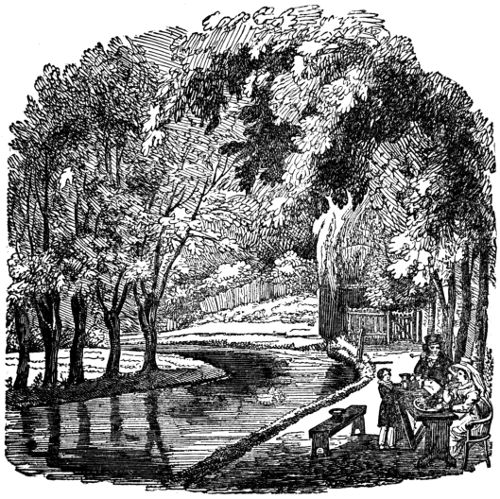
The New River at Hornsey.
————The stream is pure in solitude, But passing on amid the haunts of men It finds pollution there, and rolls from thence A tainted tide.
Southey.
My memory does not help me to a dozen passages from the whole range of authors, in verse and prose, put together; it only assists me to ideas of what I have read, and to recollect where they are expressed, but not to their words. As the “Minor Poems” are not at hand, I can only hope I have quoted the preceding lines accurately. Their import impressed me in my boyhood, and one fine summer’s afternoon, a year or two ago, I involuntarily repeated them while musing beside that part of the “New River” represented in the engraving. I had strolled to “the Compasses,” when “the garden,” as the landlord calls it, was free from the nuisance of “company;” and thither I afterwards deluded an artist, who continues to “use the house,” and supplies me with the drawing of this sequestered nook.
This “gentle river” meanders through countless spots of surprising beauty and variety within ten miles of town. When I was a boy I thought “Sadler’s Well’s arch,” opposite the “Sir Hugh Myddelton,” (a house immortalized by Hogarth,) the prime part of the river; for there, by the aid of a penny line, and a ha’porth of gentles and blood-worms, “mixed,” bought of old Turpin, who kept the little fishing-tackle shop, the last house by the river’s side, at the end next St. John’s-street-road, I essayed to gudgeon gudgeons. But the “prime” gudgeon-fishing, then, was at “the Coffin,” through which the stream flows after burying itself at the Thatched-house, under Islington road, to Colebrooke-row, within half a stone’s throw of a cottage, endeared to me, in later years, by its being the abode of “as much virtue as can live.” Past the Thatched-house, towards Canonbury, there was the “Horse-shoe,” now no more, and the enchanting rear—since despoiled—of the gardens to the retreats of Canonbury-place; and all along the river to the pleasant village of Hornsey, there were delightful retirements on its banks, so “far from the busy haunts of men,” that only a few solitary wanderers seemed to know them. Since then, I have gone “over the hills and far away,” to see it sweetly flowing at Enfield Chase, near many a “cottage of content,” as I have conceived the lowly dwellings to be, which there skirt it, with their little gardens, not too trim, whence the inmates cross the neat iron bridges of the “New River Company,” which, thinking of “auld lang syne,” I could almost wish were of wood. Further on, the river gracefully recedes into the pleasant grounds of the late Mr. Gough the antiquary, who, if he chiefly wrote on the manners and remains of old times, had an especial love and kind feeling for the amiable and picturesque of our own. Pursuing the river thence to Theobalds, it presents to the “contemplative man’s recreation,” temptations that old Walton himself might have coveted to fall in his way: and why may we not “suppose that the vicinity of the New River, to the place of his habitation, might sometimes tempt him out, whose loss he so pathetically mentions, to spend an afternoon there.” He tells “the honest angler,” that the writing of his book was the “recreation of a recreation,” and familiarly says, “the whole discourse is, or rather was, a picture of my own disposition, especially in such days and times as I have laid aside business, and gone a fishing with honest Nat. and R. Roe; but they are gone, and with them most of my pleasant hours,—even as a shadow that passeth away and returns not.”
I dare not say that I am, and yet I cannot say that I never was, an angler; for I well remember where, though I cannot tell when, within a year, I was enticed to “go a fishing,” as the saying is, which I have sometimes imagined was derived from Walton’s motto on the title of his book:—“Simon Peter said, I go a fishing: and they said, we also will go with thee.—John xxi. 3.” This passage is not in all the editions of the “Complete Angler,” but it was engraven on the title-page of the first edition, printed in 1653. Allow me to refer to one of “captain Wharton’s almanacs,” as old Lilly calls them in his “Life and Times,” and point out what was, perhaps, the earliest advertisement of Walton’s work: it is on the back of the dedication leaf to “Hemeroscopeion: Anni Æræ Christianæ 1654.” The almanac was published of course in the preceding year, which was the year wherein Walton’s work was printed.
Advertisement of Walton’s Angler, 1653.
“There is published a Booke of Eighteen-pence price, called The Compleat Angler, Or, The Contemplative man’s Recreation: being a Discourse of Fish and Fishing. Not unworthy the perusall. Sold by Richard Marriot in S. Dunstan’s Church-yard Fleetstreet.”
This advertisement I deem a bibliomaniacal curiosity. Only think of the first edition of Walton as a “booke of eighteen-pence price!” and imagine the good old man on the day of publication, walking from his house “on the north side of Fleet-street, two doors west of the end of Chancery-lane,” to his publisher and neighbour just by, “Richard Marriot, in S. Dunstan’s Churchyard,” for the purpose of inquiring “how” the book “went off.” There is, or lately was, a large fish in effigy, at a fishing-tackle-maker’s in Fleet-street, near Bell-yard, which, whenever I saw it, after I first read Walton’s work, many years ago, reminded me of him, and his pleasant book, and its delightful ditties, and brought him before me, sitting on “a primrose bank” turning his “present thoughts into verse”
The Angler’s Wish.
I in these flowery meads would be: These crystal streams should solace me; To whose harmonious bubbling noise I with my angle would rejoice: Sit here, and see the turtle-dove Court his chaste mate to acts of love: Or, on that bank, feel the west wind Breathe health and plenty: please my mind, To see sweet dew-drops kiss these flowers, And then washed off by April showers; Here, hear my Kenna sing a song; There, see a blackbird feed her young, Or a leverock build her nest: Here, give my weary spirits rest, And raise my low-pitch’d thoughts above Earth, or what poor mortals love: Thus, free from law-suits and the noise Of princes’ courts, I would rejoice: Or, with my Bryan, and a book, Loiter long days near Shawford-brook; There sit by him, and eat my meat, There see the sun both rise and set; There bid good morning to next day; There meditate my time away; And angle on; and beg to have A quiet passage to a welcome grave.
NATURALISTS’ CALENDAR.
Mean Temperature 52·05.
October 11.
This is “Old Michaelmas Day.”
“Duncan’s Victory.”
On the 11th of October, 1797, admiral Duncan obtained a splendid victory over the Dutch fleet off Camperdown, near the isle of Texel, on the coast of Holland. For this memorable achievement he was created a viscount, with a pension of two thousand pounds per annum. His lordship died on the 4th of August, 1804; he was born at Dundee, in Scotland, on the 1st of July, 1731. After the battle of Camperdown was decided, he called his crew together in the presence of the captured Dutch admiral, who was greatly affected by the scene, and Duncan kneeling on the deck, with every man under his command, “solemnly and pathetically offered up praise and thanksgiving to the God of battles;—strongly proving the truth of the assertion, that piety and courage should be inseparably allied, and that the latter without the former loses its principal virtue.”[382]
NATURALISTS’ CALENDAR.
Mean Temperature 51·82.
October 12.
Chronology.
On the 12th of October, 1748, was born at St. John’s near Worcester, Mr. William Butler, the author of “Chronological, Biographical, Historical, and Miscellaneous Exercises,” an excellent work, for young persons especially, a useful compendium in every library, and one to which the editor of the Every-Day Book has been indebted as a ready guide to many interesting and important events.
In the seventh edition of Mr. Butler’s work just mentioned, we are informed by his son, Mr. John Olding Butler, that his father was educated in the city of Worcester. Having acquired considerable knowledge, and especially an excellent style of penmanship, he in 1765 repaired to the metropolis, and commenced his career as a teacher of writing and geography. In these branches of education he attained the highest repute on account of the improvements which were introduced by him in his mode of instruction. His copies were derived from the sources of geography, history, and biographical memoirs. A yet more extensive and permanent benefit was conferred upon young persons by the many useful and ingenious works which he published, a list of which is subjoined. They contain a mass of information, both instructive and entertaining, rarely collected in one form, and are admirably adapted to promote the great design of their author—the moral, intellectual, and religious improvement of the rising generation; to this he consecrated all his faculties, the stores of his memory, and the treasures of his knowledge.
As a practical teacher Mr. Butler had few superiors, and his success in life was commensurate with his merit: he was the most popular instructor in his line.
A strict probity, an inviolable regard to truth, an honourable independence of mind, and a diffusive benevolence, adorned his moral character; and to these eminent virtues must be added, that of a rigid economy and improvement of time, for which he was most remarkable. How much he endeavoured to inculcate that which he deemed the foundation of every virtue, the principle of religion, may be seen in his “Chronological, &c., Exercises:” to impress this principle on the youthful heart and mind was considered by him as the highest duty. Mr. Butler’s professional labours were commenced at the early age of seventeen, and were continued with indefatigable ardour to the last year of his life, a period of fifty-seven years. In estimating the value of such a man, we should combine his moral principle with his literary employments; these were formed by him into duties, which he most conscientiously discharged: and he will be long remembered as one who communicated to a large and respectable circle of pupils solid information, examples of virtue, and the means of happiness; and who, in an age fruitful of knowledge, by his writings instructed, and will long continue to instruct the rising generation, and benefit mankind. His virtues will live and have a force beyond the grave.
Mr. Butler died at Hackney, August 1, 1822, after a painful illness, borne with exemplary patience and resignation. He was one of the oldest inhabitants of that parish, and was interred there, by his own desire, in the burying-ground attached to the meeting-house of his friend, the late Rev. Samuel Palmer.
A list of Mr. Butler’s books for the use of young persons.
1. Chronological Exercises, already mentioned. Price 6s. bound.
2. An engraved Introduction to Arithmetic, designed to facilitate young beginners, and to diminish the labour of the tutor. 4s. 6d. bound.
3. Arithmetical Questions, on a new plan; intended to answer the double purpose of arithmetical instruction and miscellaneous information. 6s. bound.
4. Geographical and Biographical Exercises, on a new plan. 4s.
5. Exercises on the Globes, interspersed with historical, biographical, chronological, mythological, and miscellaneous information, on a new plan. The ninth edition. 6s. bound.
6. A numerous collection of Arithmetical Tables. 8d.
7. Geographical Exercises in the New Testament; with maps, and a brief account of the principal religious sects. 5s. 6d. bound.
8. Miscellaneous Questions, relating principally to English history and biography. Second edition, enlarged. 4s.
Mr. Bourn, son-in-law of Mr. Butler, and his associate in his profession upwards of thirty years, purchased the copyright of the greater part of Mr. Butler’s works. They have passed through a number of editions, and if the Every-Day Book extend a knowledge of their value, it will be to the certain benefit of those for whose use they were designed. The envious and suspicious may deny that there is such a quality as “disinterestedness in human actions,” yet the editor has neither friendship nor intimacy with any one whom this notice may appear to favour. He only knows Mr. Butler’s books, and therefore recommends them as excellent aids to parents and teachers.
NATURALISTS’ CALENDAR.
Mean Temperature 50·10.
October 13.
Translation K. Edward. Conf.
This notice of the day in the church of England calendar and almanacs, denotes it as the festival of the translation of king Edward the Confessor.[383]
Edward the Confessor died on the 5th of January, 1066, and was buried in the abbey church of St. Peter, Westminster. “His queen, Edgitha, survived the saint many years;” she was buried beside him, and her coffin was covered with plates of silver and gold. According to his biographers, in 1102, the body of St. Edward was found entire, the limbs flexible, and the clothes fresh. The bishop of Rochester “out of a devout affection, endeavoured to pluck onely one hayre from his head, but it stuck so firmly that he was defeated of his desire.” This was at the saint’s first translation. Upon miracles “duly proved, the saint was canonized by Alexander III., in 1161.” It appears that “there are commemorated severall translations of his sacred body.” In 1163, “it was again translated by S. Thomas à Becket, archbishop of Canterbury, in the presence of king Henry II. This translation seems to have been made on the 13th of October; for on that day “he is commemorated in our martyrologe, whereas in the Roman he is celebrated on the 5th of January.” It further appears that, “about a hundred years after, in the presence of king Henry III., it was again translated, and reposed in a golden shrine, prepared for it by the same king.[384]
The see of Rome is indebted to Edward the Confessor for a grant to the pope of what was then called Rome-scot, but is now better known by the name of “Peterpenny.” The recollection of this tribute is maintained by the common saying “no penny, no paternoster;” of which there is mention in the following poem from the “Hesperides:”—
Fresh strewings allow To my sepulcher now, To make my lodging the sweeter; A staffe or a wand Put then in my hand, With a penny to pay S. Peter. Who has not a crosse, Must sit with the losse, And no whit further must venture; Since the porter he Will paid have his fee, Or els not one there must enter. Who at a dead lift, Can’t send for a gift, A pig to the priest for a roster Shall heare his clarke say, By yea and by nay, No penny no pater noster.
Herrick.
NATURALISTS’ CALENDAR.
Mean Temperature 50·62.
October 14.
A Lucky Day.
“Some Memorable Remarques upon the Fourteenth of October, being the Auspicious Birth-Day of His Present Majesty The Most Serene King James II. Luc. xix. 42 In Hoc Die Tuo. In This Thy Day. London, Printed by A. R. And are to be sold by Randal Taylor, near Stationers-Hall 1687.” Folio.
In this curious tract, the author purports to set forth “how lucky the Fourteenth of October hath been to the princes of England,” and because he discovers “out of Wharton’s Gesta Britannorum, and the collections of others, that his late royal highness, our magnanimous magnificent sovereign, (James II.,) was also born upon that augural day,” he observes—“It made more than ordinary impression upon me, so that I never saw him, but, I thought, in his very face there were extraordinary instances and tokens of regality.”
There were some, it seems, who, after “his late royal highness” the dukes “recess into Holland,” “exceedingly tryumphed, wishing he might never return; nay, that he durst not, nor would be permitted so to do; using, moreover, opprobrious terms.” These persons, he tells us, he “prophetically characteris’d” in his “Introductio ad Latinam Blasoniam;” hence, he says, “Indignation made me print my ensuing sentiments,” which “found good acceptance among the better and more loyal sort;” and hence, he further says, “things by me forethought, and publickly hinted, being come to pass, my Day Fatality began to be remembred; and one whom I wish very well, desiring I would give him leave to reprint that, and two other of my small pieces together, I assented to his request.” These form the present treatise, from whence we gather that the Fourteenth of October
—————“gave the Norman duke That vict’ry whence he England’s scepter took,”
and was remarkable for the safe landing of Edward III., after being endangered by a tempest at sea on his returning victorious from France. Wherefore, says our author, in Latin first, and then in these English lines—
“Great duke rejoice in this your day of birth, And may such omens still increase your mirth.”
Afterwards he relates, from Matthew Paris, that when “Lewis king of France had set footing here, and took some eminent places, he besieged Calais from 22 of July, to the Fourteenth of October following, about which time the siege was raised, and England thereby relieved.” Likewise “a memorable peace, (foretold by Nostradamus) much conducing to the saving of christian blood, was made upon the Fourteenth of October, 1557, between pope Paul the IV., Henry the II. of France, and Philip the II. of Spain.” Whereon, exclaims our exultant author, “A lucky day this, not only to the princes of England, but auspicious to the welfare of Europe.” He concludes by declaring “that it may be so to his royal highness, as well as it was to the most great queen his mother, are the hearty prayers of Blew-Mantle.”
From the conclusion of the last sentence, and the previous reference to his “Blasoniam,” we find this writer to have been John Gibbon, the author of “An Easie Introduction to Latine Blason, being both Latine and English”—an octavo volume, now only remembered by the few collectors of every thing written on “coat-armour.”
Gibbon speaks of one of his pamphlets “whose title should have been Dux Bonis Omnibus Appellens, or The Swans’ Welcome;” or rather, as he afterwards set it out at large, “Some Remarks upon the Note-worthy Passage, mentioned in the True Domestick Intelligence dated October the Fourteenth 1679, concerning a company of Swans more than ordinary gathered together at his royal highness’s landing.” Instead, however, of its having such a title, he tells us “there was a strange mistake, not only in that, but in other material circumstances; so that many suppose, the printer could never have done it himself, but borrowed the assistance of the evil spirit to render it ridiculous, and not only so, but the very Duke himself and the Loyal Artillery!”, wherefore “the printer smothered the far greatest number of them,” yet, as he adds it to the tract on the Fourteenth of October, we have the advantage to be told “what authors say of the candid Swan,” that all esteem him for a “bird royal,” that “oftentimes in coats and crests we meet him either crown’d or coronally collar’d,” that “he is a bird of great beauty and strength also,” that “shipmen take it for good luck if in peril of shipwreck they meet swans,” that “he uses not his strength to prey or tyrannize over any other fowl, but only to be revenged of such as offer him wrong,” and so forth. Ergo—according to “Blew-mantle,” we should believe that, “the most serene king James II.” was greeted by these honourable birds, “in allegory assembled,” to signify his kindred virtues. If Gibbon lived from 1687, where he published his “Remarques, on the Fourteenth of October” as the auspicious birth-day of James II. until the landing of William III. in the following year—did he follow the swan-like monarch to the court of France, or remain “Blew-mantle” in the Herald’s college, to do honour to the court of “the deliverer?”
Gibbon, in his “Remarques,” on the “auspicious” Fourteenth of October, prints the following epistle, to himself, which may be regarded as a curiosity on account of the superstition of its writer.
A letter from Sir Winston Churchil, Knight; Father to the Right Honourable, John Lord Churchil.
I Thank you for your kind Present, the Observation of the Fatality of Days. I have made great Experience of the Truth of it; and have set down Fryday, as my own Lucky Day; the Day on which I was Born, Christen’d, Married, and, I believe, will be the Day of my Death: The Day whereon I have had sundry Deliverances, (too long to relate) from Perils by Sea and Land, Perils by False Brethren, Perils of Law Suits, &c. I was Knighted (by chance, unexpected by my self) on the same Day; and have several good Accidents happened to me, on that Day: And am so superstitious in the Belief of its good Omen, That I chuse to begin any Considerable Action (that concerns me) on the same Day. I hope HE, whom it most concerns, will live to own your Respect, and Good Wishes, expressed in That Essay of yours: Which discovering a more than common Affection to the DUKE, and being as valuable for the Singularity of the Subject, as the Ingenuity of your Fancy, I sent into Flanders, as soon as I had it; That They on the Other Side the Water may see, ’Tis not all sowre Wine, that runs from our English Press.
“The Right Honourable, John Lord Churchil,” mentioned at the head of this ominous letter, became celebrated as “the great duke of Marlborough.” Sir Winston Churchill was the author of “Divi Britannici, a history of the lives of the English kings” in folio; but his name is chiefly remembered in connection with his son’s, and from his having also been father to Arabella Churchill, who became mistress to the most serene king of Blew-Mantle Gibbon, and from that connection was mother of the duke of Berwick, who turned his arms against the country of her birth.
Sir Winston was a cavalier, knighted at the restoration of Charles II., for exertions in the royal cause, by which his estates became forfeited. He recovered them under Charles, obtained a seat in the house of commons, became a fellow of the royal society, had a seat at the board of green cloth, and died in 1688. He was born in 1620, at Wootton Glanville, in Dorsetshire.[385] His letter on “Fryday” is quite as important as his “Divi Britannici.”
Taking Honey without Killing the Bees.
On the 14th day of October, 1766, Mr. Wildman, of Plymouth, who had made himself famous throughout the west of England for his command over bees, was sent for to wait on lord Spencer, at his seat at Wimbledon, in Surrey; and he attended accordingly. Several of the nobility and persons of fashion were assembled, and the countess had provided three stocks of bees. The first of his performances was with one hive of bees hanging on his hat, which he carried in his hand, and the hive they came out of in the other hand; this was to show that he could take honey and wax without destroying the bees. Then he returned into the room, and came out again with them hanging on his chin, with a very venerable beard. After showing them to the company, he took them out upon the grass walk facing the windows, where a table and table cloth being provided, he set the hive upon the table, and made the bees hive therein. Then he made them come out again, and swarm in the air, the ladies and nobility standing amongst them, and no person stung by them. He made them go on the table and took them up by handfuls, and tossed them up and down like so many peas; he then made them go into their hive at the word of command. At five o’clock in the afternoon he exhibited again with the three swarms of bees, one on his head, one on his breast, and the other on his arm, and waited on lord Spencer in his room, who had been too much indisposed to see the former experiments; the hives which the bees had been taken from, were carried by one of the servants. After this exhibition he withdrew, but returned once more to the room with the bees all over his head, face, and eyes, and was led blind before his lordship’s window. One of his lordship’s horses being brought out in his body clothes, Mr. Wildman mounted the horse, with the bees all over his head and face, (except his eyes;) they likewise covered his breast and left arm; he held a whip in his right hand, and a groom led the horse backwards and forwards before his lordship’s window for some time. Mr. Wildman afterwards took the reins in his hand, and rode round the house; he then dismounted, and made the bees march upon a table, and at his word of command retire to their hive. The performance surprised and gratified the earl and countess and all the spectators who had assembled to witness this great bee-master’s extraordinary exhibition.[386]
Can the honey be taken without destroying the bees? There are accounts to this effect in several books, but some of the methods described are known to have failed. The editor is desirous of ascertaining, whether there is a convenient mode of preserving the bees from the cruel death to which they are generally doomed, after they have been despoiled of their sweets.
NATURALISTS’ CALENDAR.
Mean Temperature 50·85.
October 15.
Exhumation.
It appears from a printed half sheet, of which the following is a copy, that the will of a person who had been resident at Stevenage, was proved on this day in the year 1724, whereby he desired his remains to be kept unburied. It is a curious document, and further information respecting the individual whose caprice was thus indulged will be acceptable.
(Copy) THE ECCENTRIC WILL OF THE LATE HENRY TRIGG, OF STEVENAGE,
Where his Remains are still upon the Rafters of the West End of the Hovel, and may be viewed by any Traveller who may think it worthy of Notice.
The same is recorded in History, and may be depended on as a Fact.
In the Name of God, Amen.
I, HENRY TRIGG, of Stevenage, in the County of Hertford, Grocer, being very infirm and weak in body, but of perfect sound mind and memory, praised be God for it, calling unto mind the mortality of my body, do now make and ordain this my last WILL and TESTAMENT, in writing hereafter following, that is to say:—Principally I recommend my Soul into the merciful hands of Almighty God that first gave me it, assuredly believing and only expecting free pardon and forgiveness of all my sins, and eternal life in and through the only merits, death, and passion of Jesus Christ my Saviour; and as to my body, I commit it to the West End of my Hovel, to be decently laid there upon a floor erected by my Executor, upon the purlins, upon the same purpose, nothing doubting but at the general Resurrection I shall receive the same again by the mighty power of God, and as for and concerning such wordly substance as it hath pleased God to bless me with in this life, I do devise and dispose of the same in manner and form following.
Imprimis.—I give and devise unto my loving brother Thomas Trigg, of Letchworth, in the County of Hertford, Clerk, and to his Heirs and Assigns for ever, all those my Freehold Lands lying dispersedly in the several Common Fields and parish of Stevenage aforesaid, and also all my Copyhold Lands, upon condition that he shall lay my body upon the place before-mentioned: and also all that Messuage, Cottage, or Tenement, at Redcoat’s Green, in the parish of Much Wymondly, together with those Nine Acres of Land, (more or less) purchased of William Hale and Thomas Hale, junr. and also my Cottage, Orchard, and Barn, with Four Acres of Land (more or less) belonging, lying, and being in the parish of Little Wymondly, now in the possession of SAMUEL KITCHENER, labourer; and also all my Cottages, Messuages, or Tenements, situate and being in Stevenage, aforesaid; or, upon condition that he shall pay my brother George Trigg the sum of Ten Pounds per annum for his life; but if my brother should neglect or refuse to lay my body where I desire it should be laid, then upon that condition, I Will and bequeath all that which I have already bequeathed to my brother Thomas Trigg, unto my brother George Trigg, and to his Heirs for ever: and if my brother George Trigg, should refuse to lay my body under my Hovel, then what I have bequeathed unto him as all my Lands and Tenements, I lastly bequeath them unto my Nephew William Trigg, and his Heirs for ever, upon his seeing that my body is decently laid up there as aforesaid.
Item.—I give and bequeath unto my Nephew William Trigg, the sum of Five Pounds at the age of Thirty Years: to his Sister Sarah the sum of Twenty Pounds; to his Sister Rose the sum of Twenty Pounds; and lastly to his Sister Ann the sum of Twenty Pounds, all at the age of Thirty Years: to John Spencer, of London, Butcher, the sum of One Guinea; and to Solomon Spencer, of Stevenage, the sum of One Guinea, three years next after my decease; to my cousin Henry Kimpton, One Guinea, one year next after my decease; and another Guinea, two years after my decease; to William Waby, Five Shillings; and to Joseph Priest, Two Shillings and Sixpence, two years after my decease; to my tenant Robert Wright the sum of Five Shillings, two years next after my decease; and to Ralph Lowd and John Reeves, One Shilling each, two years next after my decease.
Item.—— All the rest of my Goods, and Chattels, and personal Estate, and ready Money, I do hereby give and devise unto my Brother Thomas Trigg, paying my Debts and laying my Body where I would have it laid, whom I likewise make and ordain my full and sole Executor of this my last Will and Testament, or else to them before mentioned; ratifying and confirming this and no other to be my last Will and Testament. In witness whereof I have hereunto set my Hand and Seal, this twenty-eighth day of September, in the year of our Lord, one Thousand seven Hundred and twenty four.
HENRY TRIGG.
Read, Signed, Sealed, and declared by the said Henry Trigg, the Testator, to be his last Will and Testament, in the presence of us, who have subscribed our Names as Witnesses hereto, in the Presence of the said Testator.
John Hawkins, Senr. John Hawkins, Junr. The mark of William Sexton.

Proved in the Archdeaconry of Huntingdon, the 15th of October, 1724, by the Executor Thomas Trigg.
In October, 1743, a cobbler, at Bristol, died of a bite in the finger inflicted by a cat, which was sent to his house by an old woman in revenge for his calling her “Witch,” against which dipping in salt water proved ineffectual. “This, they say, was well attested;” and well it might be; for doubtless the cat was mad, and the woman, bewitched by the unhappy cobbler of Bristol, had no more to do with the bite, than “the old woman of Ratcliff-highway.”
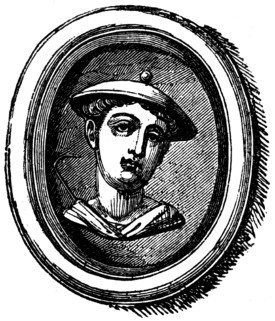
The 15th day of October was dedicated by “the Merchants to Mercury,” and is so noted in the calendar of Julius Cæsar. This name is derived a mercibus, because he was the god of merchandize; and, in that quality, he is sometimes represented as a young man without a beard, holding on his wrists a cock as an emblem of vigilance, and in his hand a purse as its reward. A beautiful head of this deity on hiacynth, in the possession of lord Clanbrassill, when it was charmingly etched by Worlidge, is pictured in the present engraving. It suggests itself as one of the most elegant forms for a seal that can be presented to the eye.
Gather your rose-buds while you may, Old Time is still a-flying; And that same flower that blooms to-day, To-morrow may be dying. The glorious lamp of heaven, the Sun, The higher he is getting, The further still his course is run, And nearer he’s to setting.
The German Showman.
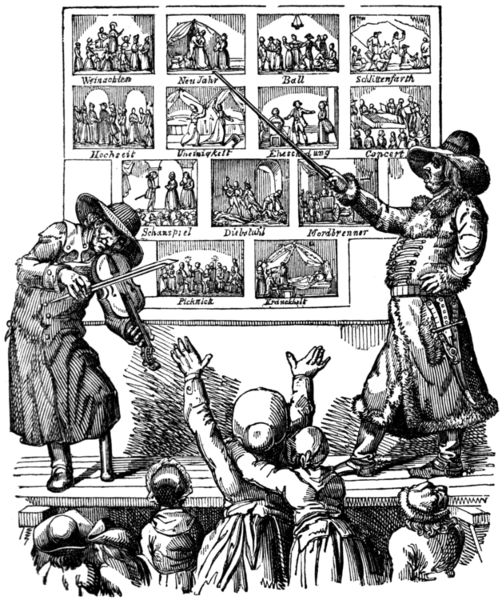
The German Showman.
Enlarged illustration (400 kB).
An elevated stand he takes, And to the fiddle’s squeak, he makes A loud and entertaining lecture On every wonder-working picture:— The children cry “hark!—look at that!” And folks put money in the hat; Or buy his papers that explain The stories they would hear again.
This engraving is taken from one by Chodowiecki, of Berlin, to show the German showman, on his stage of boards and tressils, as he shows his pictures. These are usually prints stretched out, side by side, on an upright frame, or sometimes oil paintings representing characters or situations of interest. For instance, in the present exhibition there is the mode of keeping the festival of the new year, a grand ball, a feast, a wedding, a “high sight” of the court, and, in all, thirteen subjects, sufficiently beyond the intimacy of the populace to excite their curiosity. The showman commonly details so much concerning every thing in his grand exhibition, and so elevates each, as to interest his auditors to the height of desiring further particulars. The stories are printed separately in the shape of ballads or garlands, and “embellished with cuts;” by the sale of these to his auditors he obtains the reward of his oratory.
The qualifications for a German showman are a manly person, sonorous voice, fluent delivery, and imposing manner. In dress he is like a sergeant-major, and in address like a person accustomed to command. He is accompanied in his speeches by a fiddler of vivacity or trick, to keep the people “in merry pin.” This associate is generally an old humourist, with a false nose of strange form and large dimensions, or a huge pair of spectacles. Their united exertions are sure to gratify audiences more disposed to be pleased than to criticise. With them, the show is an affair of like or dislike to the eye, and beyond that the judgment is seldom appealed to on the spot. If the outlines of the showman’s stories are bold, and well expressed, they are sure to amuse; his printed narratives are in good demand; both exhibitors and auditors part satisfied with each other; and they frequently meet again. This is the lowest order of the continental street comedy. In England we have not any thing like it, nor are we likely to have; for, though strange sights almost cease to attract, yet the manager and musician to a rational exhibition of this sort, in the open air, clearly come within the purview of recent acts of parliament, and would be consigned to the tread-mill. What recreation, however, can be more harmless if the subjects are harmless. “Death and the Lady,” the “Bloody Gardener’s Cruelty,” and the numerous tribe of stories to which these garlands belong, continue to be pinned on lines against a few walls of the metropolis, but they cease to attract. The “common people,” as they are called, require a new species of street entertainment and a new literature: both might be easily supplied with infinite advantage to the public morals.