JANUARY. (continued 3)
Reading edition
The Post-office exerted itself to have the roads cleared for the conveyance of the mails, and the government interfered by issuing instructions to every parish in the kingdom to employ labourers in reopening the ways.
In the midland counties, particularly on the borders of Northamptonshire and Warwickshire, the snow lay to a height altogether unprecedented. At Dunchurch, a small village on the road to Birmingham, through Coventry, and for a few miles round that place, in all directions, the drifts exceeded twenty-four feet, and no tracks of carriages or travellers could be discovered, except on the great road, for many days.
The Cambridge mail coach coming to London, sunk into a hollow of the road, and remained with the snow drifting over it, from one o’clock to nine in the morning, when it was dragged out by fourteen waggon horses. The passengers, who were in the coach the whole of the time, were nearly frozen to death.
On the 26th, the wind veered to the south-west, and a thaw was speedily discernible. The great fall of the Thames at London-bridge for some days presented a scene both novel and interesting. At the ebbing of the tide, huge fragments of ice were precipitated down the stream with great violence, accompanied by a noise, equal to the report of a small piece of artillery. On the return of the tide, they were forced back; but the obstacles opposed to their passage through the arches were so great, as to threaten a total stoppage to the navigation of the river. The thaw continued, and these appearances gradually ceased.
On the 27th, 28th, and 29th, the roads and streets were nearly impassable from floods, and the accumulation of snow. On Sunday the 30th a sharp frost set in, and continued till the following Saturday evening, the 5th of February.
The Falmouth mail coach started from thence for Exeter, after having proceeded a few miles was overturned, without material injury to the passengers. With the assistance of an additional pair of horses it reached the first stage; after which all endeavours to proceed were found perfectly useless, and the letters were sent to Bodmin by the guard on horseback. The Falmouth and Plymouth coach and its passengers were obliged to remain at St. Austell.
At Plymouth, the snow was nearly four feet high in several of the streets.
At Liverpool, on the 17th of January, Fahrenheit’s thermometer, in the Athenæum, stood at fifteen degrees; seven below the freezing point. From the ice accumulated in the Mersey, boats could not pass over. Almost all labour without doors was at a stand.
At Gloucester, Jan. 17. The severity of the frost had not been exceeded by any that preceded it. The Severn was frozen over, and people went to Tewkesbury market across the ice on horseback. The cold was intense. The thermometer, exposed in a north-eastern aspect, stood at thirteen degrees, nine below the freezing point. On the eastern coast, it stood as low as nine and ten; a degree of cold unusual in this county.
Bristol, Jan. 18. The frost continued in this city with the like severity. The Floating Harbour from Cumberland basin to the Feeder, at the bottom of Avon-street, was one continued sheet of ice; and for the first time in the memory of man, the skater made his appearance under Bristol-bridge. The Severn was frozen over at various points, so as to bear the weight of passengers.
At Whitehaven, Jan. 18, the frost had increased in severity. All the ponds and streams were frozen; and there was scarcely a pump in the town that gave out water. The market was very thinly attended; it having been found in many parts impossible to travel until the snow was cut.
At Dublin, Jan. 14, the snow lay in a quantity unparalleled for half a century. In the course of one day and night, it descended so inconceivably thick and rapid, as to block up all the roads, and preclude the possibility of the mail coaches being able to proceed, and it was even found impracticable to send the mails on horseback. Thus all intercourse with the interior was cut off, and it was not until the 18th, when an intense frost suddenly commenced, that the communication was opened, and several mail bags arrived from the country on horseback.
The snow in many of the narrow streets of Dublin, after the footways had been in some measure cleared, was more than six feet. It was nearly impossible for any carriage to force a passage, and few ventured on the hazardous attempt. Accidents, both distressing and fatal, occurred. In several streets and lanes the poorer inhabitants were literally blocked up in their houses, and in the attempt to go abroad, experienced every kind of misery. The number of deaths from cold and distress were greater than at any other period, unless at the time of the plague. There were eighty funerals on the Sunday before this date. The coffin-makers in Cook-street could with difficulty complete their numerous orders: and not a few poor people lay dead in their wretched rooms for several days, from the impossibility of procuring assistance to convey them to the Hospital-fields, and the great difficulty and danger of attempting to open the ground, which was very uneven, and where the snow remained in some parts, twenty feet deep.
From Canterbury, January 25, the communication with the metropolis was not open from Monday until Saturday preceding this date, when the snow was cut through by the military at Chathamhill, and near Gravesend; and the stages proceeded with their passengers. The mail of the Thursday night arrived at Canterbury late on Friday evening, the bags having been conveyed part of the distance upon men’s shoulders. The bags of Friday and Saturday night arrived together on Sunday morning about ten o’clock.
Dalrymple, North Britain, January 29.—Wednesday, the 26th, was an epoch ever to be remembered by the inhabitants of this village. The thaw of that and the preceding day had opened the Doon, formerly “bound like a rock,” to a considerable distance above this; and the melting of the snow on the adjacent hills swelled the river beyond its usual height, and burst up vast fragments of ice and congealed snow. It forced them forward with irresistible impetuosity, bending trees like willows, carrying down Skelton-bridge, and sweeping all before it. The overwhelming torrent in its awful progress accumulated a prodigious mass of the frozen element, which, as if in wanton frolic, it heaved out into the fields on both sides, covering acres of ground many feet deep. Alternately loading and discharging in this manner, it came to a door or two in the village, as if to apprize the inhabitants of its powers. The river having deserted its wonted channel, endeavoured to make its grand entry by several courses successively in Saint Valley, and finding no one of them sufficient for its reception, took them altogether, and overrunning the whole holm at once, appeared here in terrific grandeur, between seven and eight o’clock in the evening, when the moon retreated behind a cloud, and the gloom of night added to the horrors of the tremendous scene. Like a sea, it overflowed all the gardens on the east side, from the cross to the bridge, and invaded the houses behind by the doors and windows, extinguishing the fires in a moment, lifting and tumbling the furniture, and gushing out at the front doors with incredible rapidity. Its principal inroad was by the end of a bridge. Here, while the houses stood as a bank on either side, it came crashing and roaring up the street in full career, casting forth, within a few yards of the cross, floats of ice like millstones. The houses on the west side were in the same situation with those on the east. At one place the water was running on the house-eaves, at another it was near the door-head, and midway up the street, it stood three feet and a half above the door. Had it advanced five minutes longer in this direction, the whole village must have been inundated.
During this frost a great number of the fish called golden maids, were picked up on Brighton beach and sold at good prices. They floated ashore quite blind, having been reduced to that state by the snow.
Annexed are a few of the casualties consequent on this great frost. A woman was found frozen to death on the Highgate-road. She proved to have been a charwoman, returning from Highgate, where she had been at work, to Pancras.
A poor woman named Wood, while crossing Blackheath from Leigh to the village of Charlton, accompanied by her two children, was benighted, and missed her way. After various efforts to extricate herself, she fell into a hole, and was nearly buried in the snow. From this, however, she contrived to escape, and again proceeded; but at length, being completely exhausted, and her children benumbed with cold, she sat down on the trunk of a tree, where, wrapping her children in her cloak, she endeavoured by loud cries to attract the attention of some passengers. Her shrieks at length were heard by a waggoner, who humanely waded through the snow to her assistance, and taking her children, who seemed in a torpid state, in his arms, he conducted her to a public-house; one of the infants was frozen to death, and the other was recovered with extreme difficulty.
As some workmen were clearing away the snow, which was twelve feet deep, at Kipton, on the border of Northamptonshire, the body of a child about three years old was discovered, and immediately afterwards the body of its mother. She was the wife of a soldier of the 16th regiment, returning home with her infant after accompanying her husband to the place of embarkation. It was supposed they had been a week in the snow.
There was found lying in the road leading from Longford to Upham, frozen to death, a Mr. Apthorne, a grazier, at Coltsworth. He had left Hounslow at dusk on Monday evening, after having drank rather freely, and proposed to go that night to Marlow.
On his return from Wakefield market, Mr. Husband, of Holroyd Hall, was frozen to death, within little more than a hundred yards of the house of his nephew, with whom he resided.
Mr. Chapman, organist, and master of the central school at Andover, Hants, was frozen to death near Wallop, in that county.
A young man named Monk, while driving a stage-coach near Ryegate, was thrown off the box on a lump of frozen snow, and killed on the spot.
The thermometer during this intense frost was as low as 7° and 8° of Fahrenheit, in the neighbourhood of London. There are instances of its having been lower in many seasons, but so long a continuance of very cold weather was never experienced in this climate within the memory of man.
Frost Fair—1814.
On Sunday, the 30th of January, the immense masses of ice that floated from the upper parts of the river, in consequence of the thaw on the two preceding days, blocked up the Thames between Blackfriars and London Bridges; and afforded every probability of its being frozen over in a day or two. Some adventurous persons even now walked on different parts, and on the next day, Monday the 31st, the expectation was realized. During the whole of the afternoon, hundreds of people were assembled on Blackfriars and London Bridges, to see people cross and recross the Thames on the ice. At one time seventy persons were counted walking from Queenhithe to the opposite shore. The frost of Sunday night so united the vast mass as to render it immovable by the tide.
On Tuesday, February 1, the river presented a thoroughly solid surface over that part which extends from Blackfriars Bridge to some distance below Three Crane Stairs, at the bottom of Queen-street, Cheapside. The watermen placed notices at the end of all the streets leading to the city side of the river, announcing a safe footway over, which attracted immense crowds, and in a short time thousands perambulated the rugged plain, where a variety of amusements were provided. Among the more curious of these was the ceremony of roasting a small sheep, or rather toasting or burning it over a coal fire, placed in a large iron pan. For a view of this extraordinary spectacle, sixpence was demanded, and willingly paid. The delicate meat, when done, was sold at a shilling a slice, and termed “Lapland mutton.” There were a great number of booths ornamented with streamers, flags, and signs, and within them there was a plentiful store of favourite luxuries with most of the multitude, gin, beer, and gingerbread. The thoroughfare opposite Three Crane Stairs was complete and well frequented. It was strewed with ashes, and afforded a very safe, although a very rough path. Near Blackfriars Bridge, however, the way was not equally severe; a plumber, named Davis, having imprudently ventured to cross with some lead in his hands, sank between two masses of ice, and rose no more. Two young women nearly shared a similar fate; they were rescued from their perilous situation by the prompt efforts of two watermen. Many a fair nymph indeed was embraced in the icy arms of old Father Thames;—three young quakeresses had a sort of semi-bathing, near London Bridge, and when landed on terra-firma, made the best of their way through the Borough, amidst the shouts of an admiring populace. From the entire obstruction the tide did not appear to ebb for some days more than one half the usual mark.
On Wednesday, Feb. 2, the sports were repeated, and the Thames presented a complete “Frost Fair.” The grand “mall” or walk now extended from Blackfriars Bridge to London Bridge; this was named the “City-road,” and was lined on each side by persons of all descriptions. Eight or ten printing presses were erected and numerous pieces commemorative of the “great frost” were printed on the ice. Some of these frosty typographers displayed considerable taste in their specimens. At one of the presses, an orange-coloured standard was hoisted, with the watch-word “Orange Boven,” in large characters. This was in allusion to the recent restoration of the stadtholder to the government of Holland, which had been for several years under the dominion of the French. From this press the following papers were issued.
“Frost Fair.
“Amidst the arts which on the Thames appear, To tell the wonders of this icy year, Printing claims prior place, which at one view Erects a monument of That and You.”
Another:
“You that walk here, and do design to tell Your children’s children what this year befell, Come, buy this print, and it will then be seen That such a year as this has seldom been.”
Another of these stainers of paper addressed the spectators in the following terms, “Friends, now is your time to support the freedom of the press. Can the press have greater liberty? here you find it working in the middle of the Thames; and if you encourage us by buying our impressions, we will keep it going in the true spirit of liberty during the frost.” One of the articles printed and sold contained the following lines:
“Behold, the river Thames is frozen o’er, Which lately ships of mighty burden bore; Now different arts and pastimes here you see, But printing claims the superiority.”
The Lord’s prayer and several other pieces were issued from these icy printing offices, and bought with the greatest avidity.
On Thursday, Feb. 3, the number of adventurers increased. Swings, bookstalls, dancing in a barge, suttling-booths, playing at skittles, and almost every appendage of a fair on land, appeared now on the Thames. Thousands flocked to this singular spectacle of sports and pastimes. The ice seemed to be a solid rock, and presented a truly picturesque appearance. The view of St. Paul’s and of the city with the white foreground had a very singular effect;—in many parts, mountains of ice upheaved resembled the rude interior of a stone quarry.
Friday, Feb. 4. Each day brought a fresh accession of “pedlars to sell their wares;” and the greatest rubbish of all sorts was raked up and sold at double and treble the original cost. Books and toys, labelled “bought on the Thames,” were in profusion. The watermen profited exceedingly, for each person paid a toll of twopence or threepence before he was admitted to “Frost Fair;” some douceur was expected on the return. Some of them were said to have taken six pounds each in the course of a day.
This afternoon, about five o’clock, three persons, an old man and two lads, were on a piece of ice above London-bridge, which suddenly detached itself from the main body, and was carried by the tide through one of the arches. They laid themselves down for safety, and the boatmen at Billingsgate, put off to their assistance, and rescued them from their impending danger. One of them was able to walk, but the other two were carried, in a state of insensibility, to a public-house, where they received every attention their situation required.
Many persons were on the ice till late at night, and the effect by moonlight was singularly novel and beautiful. The bosom of the Thames seemed to rival the frozen climes of the north.
Saturday, Feb. 5. This morning augured unfavourably for the continuance of “Frost Fair.” The wind had veered to the south, and there was a light fall of snow. The visitors, however, were not to be deterred by trifles. Thousands again ventured, and there was still much life and bustle on the frozen element; the footpath in the centre of the river was hard and secure, and among the pedestrians were four donkies; they trotted a nimble pace, and produced considerable merriment. At every glance, there was a novelty of some kind or other. Gaming was carried on in all its branches. Many of the itinerant admirers of the profits gained by E O Tables, Rouge et Noir, Te-totum, wheel of fortune, the garter, &c. were industrious in their avocations, and some of their customers left the lures without a penny to pay the passage over a plank to the shore. Skittles was played by several parties, and the drinking tents were filled by females and their companions, dancing reels to the sound of fiddles, while others sat round large fires, drinking rum, grog, and other spirits. Tea, coffee, and eatables, were provided in abundance, and passengers were invited to eat by way of recording their visit. Several tradesmen, who at other times were deemed respectable, attended with their wares, and sold books, toys, and trinkets of almost every description.
Towards the evening, the concourse thinned; rain began to fall, and the ice to crack, and on a sudden it floated with the printing presses, booths, and merry-makers, to the no small dismay of publicans, typographers, shopkeepers, and sojourners.
A short time previous to the general dissolution, a person near one of the printing presses, handed the following jeu d’esprit to its conductor; requesting that it might be printed on the Thames.
To Madam Tabitha Thaw.
“Dear dissolving dame,
“Father Frost and Sister Snow have Boneyed my borders, formed an idol of ice upon my bosom, and all the Lads of London come to make merry: now as you love mischief, treat the multitude with a few CRACKS by a sudden visit, and obtain the prayers of the poor upon both banks. Given at my own press, the 5th Feb. 1814. Thomas Thames.”
The thaw advanced more rapidly than indiscretion and heedlessness retreated. Two genteel-looking young men ventured on the ice above Westminster Bridge, notwithstanding the warnings of the watermen. A large mass on which they stood, and which had been loosened by the flood tide, gave way, and they floated down the stream. As they passed under Westminster Bridge they cried piteously for help. They had not gone far before they sat down, near the edge; this overbalanced the mass, they were precipitated into the flood, and overwhelmed for ever.
A publican named Lawrence, of the Feathers, in High Timber-street, Queenhithe, erected a booth on the Thames opposite Brook’s-wharf, for the accommodation of the curious. At nine at night he left it in the care of two men, taking away all the liquors, except some gin, which he gave them for their own use.
Sunday, Feb. 6. At two o’clock this morning, the tide began to flow with great rapidity at London Bridge; the thaw assisted the efforts of the tide, and the booth last mentioned was violently hurried towards Blackfriars Bridge. There were nine men in it, but in their alarm they neglected the fire and candles, which communicating with the covering, set it in a flame. They succeeded in getting into a lighter which had broken from its moorings. In this vessel they were wrecked, for it was dashed to pieces against one of the piers of Blackfriars Bridge: seven of them got on the pier and were taken off safely; the other two got into a barge while passing Puddle-dock.
On this day, the Thames towards high tide (about 3 p. m.) presented a miniature idea of the Frozen Ocean; the masses of ice floating along, added to the great height of the water, formed a striking scene for contemplation. Thousands of disappointed persons thronged the banks; and many a ’prentice, and servant maid, “sighed unutterable things,” at the sudden and unlooked for destruction of “Frost Fair.”
Monday, Feb. 7. Immense fragments of ice yet floated, and numerous lighters, broken from their moorings, drifted in different parts of the river; many of them were complete wrecks. The frozen element soon attained its wonted fluidity, and old Father Thames looked as cheerful and as busy as ever.
The severest English winter, however astonishing to ourselves, presents no views comparable to the winter scenery of more northern countries. A philosopher and poet of our own days, who has been also a traveller, beautifully describes a lake in Germany:—
Christmas out of doors at Ratzburg. By S. T. Coleridge, Esq.
The whole lake is at this time one mass of thick transparent ice, a spotless mirror of nine miles in extent! The lowness of the hills, which rise from the shores of the lake, preclude the awful sublimity of Alpine scenery, yet compensate for the want of it, by beauties of which this very lowness is a necessary condition. Yesterday I saw the lesser lake completely hidden by mist; but the moment the sun peeped over the hill, the mist broke in the middle, and in a few seconds stood divided, leaving a broad road all across the lake; and between these two walls of mist the sunlight burnt upon the ice, forming a road of golden fire, intolerably bright! and the mist walls themselves partook of the blaze in a multitude of shining colours. This is our second post. About a month ago, before the thaw came on, there was a storm of wind; during the whole night, such were the thunders and howlings of the breaking ice, that they have left a conviction on my mind, that there are sounds more sublime than any sight can be, more absolutely suspending the power of comparison, and more utterly absorbing the mind’s self-consciousness in its total attention to the object working upon it. Part of the ice, which the vehemence of the wind had shattered, was driven shoreward, and froze anew. On the evening of the next day at sunset, the shattered ice thus frozen appeared of a deep blue, and in shape like an agitated sea; beyond this, the water that ran up between the great islands of ice which had preserved their masses entire and smooth, shone of a yellow green; but all these scattered ice islands themselves were of an intensely bright blood colour—they seemed blood and light in union! On some of the largest of these islands, the fishermen stood pulling out their immense nets through the holes made in the ice for this purpose, and the men, their net poles, and their huge nets, were a part of the glory—say rather, it appeared as if the rich crimson light had shaped itself into these forms, figures, and attitudes, to make a glorious vision in mockery of earthly things.
The lower lake is now all alive with skaters and with ladies driven onward by them in their ice cars. Mercury surely was the first maker of skates, and the wings at his feet are symbols of the invention. In skating, there are three pleasing circumstances—the infinitely subtle particles of ice which the skaters cut up, and which creep and run before the skate like a low mist and in sunrise or sunset become coloured; second, the shadow of the skater in the water, seen through the transparent ice; and third, the melancholy undulating sound from the skate not without variety; and when very many are skating together, the sounds and the noises give an impulse to the icy trees, and the woods all round the lake trinkle.
In the frosty season when the sun Was set, and visible for many a mile, The cottage windows through the twilight blazed, I heeded not the summons;—happy time It was indeed for all of us, to me It was a time of rapture! clear and loud The village clock tolled six! I wheel’d about Proud and exulting, like an untired horse That cared not for its home. All shod with steel We hissed along the polished ice, in games Confederate, imitative of the chase And woodland pleasures, the resounding horn, The pack loud bellowing and the hunted hare. So through the darkness and the cold we flew, And not a voice was idle; with the din, Meanwhile the precipices rang aloud, The leafless trees and every icy crag Tinkled like iron, while the distant hills Into the tumult sent an alien sound Of melancholy—not unnoticed, while the stars Eastward, were sparkling clear, and in the west The orange sky of evening died away. Not seldom from the uproar I retired Into a silent bay, or sportively Glanced sideway, leaving the tumultuous throng To cut across the image of a star That gleamed upon the ice; and oftentimes Where we had given our bodies to the wind, And all the shadowy banks on either side Came sweeping through the darkness, shunning still The rapid line of motion, then at once Have I, reclining back upon my heels, Stopped short; yet still the solitary cliffs Wheeled by me even as if the earth had rolled With visible motion her diurnal round! Behind me did they stretch in solemn train Feebler and feebler, and I stood and watched Till all was tranquil as a summer sea.
Wordsworth.
Skating.
The earliest notice of skating in England is obtained from the earliest description of London. Its historian relates that, “when the great fenne or moore (which watereth the walles of the citie on the north side) is frozen, many young men play upon the yce.” Happily, and probably for want of a term to call it by, he describes so much of this pastime in Moorfields, as acquaints us with their mode of skating: “Some,” he says, “stryding as wide as they may, doe slide swiftly,” this then is sliding; but he proceeds to tell us, that “some tye bones to their feete, and under their heeles, and shoving themselves by a little picked staffe doe slide as swiftly as a birde flyeth in the air, or an arrow out of a crosse-bow.”[37] Here, although the implements were rude, we have skaters; and it seems that one of their sports was for two to start a great way off opposite to each other, and when they met, to lift their poles and strike each other, when one or both fell, and were carried to a distance from each other by the celerity of their motion. Of the present wooden skates, shod with iron, there is no doubt, we obtained a knowledge from Holland.
The icelanders also used the shankbone of a deer or sheep about a foot long, which they greased, because they should not be stopped by drops of water upon them.[38]
It is asserted in the “Encyclopædia Britannica,” that Edinburgh produced more instances of elegant skaters than perhaps any other country, and that the institution of a skating club there contributed to its improvement. “I have however seen, some years back,” says Mr. Strutt, “when the Serpentine river was frozen over, four gentlemen there dance, if I may be allowed the expression, a double minuet in skates with as much ease, and I think more elegance, than in a ball room; others again, by turning and winding with much adroitness, have readily in succession described upon the ice the form of all the letters in the alphabet.” The same may be observed there during every frost, but the elegance of skaters on that sheet of water is chiefly exhibited in quadrilles, which some parties go through with a beauty scarcely imaginable by those who have not seen graceful skating. In variety of attitude, and rapidity of movement, the Dutch, who, of necessity, journey long distances on their rivers and canals, are greatly our superiors.
NATURALISTS’ CALENDAR.
Mean Temperature 36·35.
January 23.
1826. Hilary Term begins.
Larking.
It appears that our ingenious neighbours, the French, are rivalled by the lark-catchers of Dunstaple, in the mode of attracting those birds.
To the Editor of the Every-Day Book.
6, Bermondsey New Road
January 18, 1826.
Sir,
In the present volume of your Every-Day Book, p. 91, a correspondent at Abbeville has given an account of lark-shooting in that country, in which he mentions a machine called a miroir, as having been used for the purpose of attracting the birds within shot. Perhaps you are not aware that in many parts of England a similar instrument is employed for catching the lark when in flight, and at Dunstaple. At that place, persons go out with what is called a larking glass, which is, if I may so term it, a machine made somewhat in the shape of a cucumber. This invention is hollow, and has holes cut round it, in which bits of looking-glass are fitted; it is fixed on a pole, and has a sort of reel, from which a line runs; this line, at a convenient distance, is worked backward and forward, so as to catch the rays of the sun: the larks seeing themselves in the glass, as some think, but more probably blinded by the glare of it, come headlong down to it, a net is drawn over them, and thus many are taken, deceived like ourselves with glittering semblances. Yes! lords as we deem ourselves of the creation, we are as easily lured by those who bait our passions or propensities, as those poor birds. This simple truth I shall conclude with the following lines, which, be they good, bad, or indifferent, are my own, and such as they are I give them to thee:—
As in the fowler’s glass the lark espies His feath’ry form from ’midst unclouded skies; And pleased, and dazzled with the novel sight, Wings to the treacherous earth his rapid flight, So, in the glass of self conceit we view Our soul’s attraction, and pursue it too, In every shape wherein it may arise, In gold, or land, or love before our eyes, And in the wary net are captive ta’en, By the sure hand of woman, or of gain.
S. R. Jackson.
NATURALISTS’ CALENDAR.
Mean Temperature 36·57.
January 24.
The scenes and weather which sometimes prevail on the Vigil of St. Paul are described in some verses inserted by Dr. Forster in his “Perennial Calendar.”
St. Paul’s Eve.
Winter’s white shrowd doth cover all the grounde, And Caecias blows his bitter blaste of woe; The ponds and pooles, and streams in ice are bounde, And famished birds are shivering in the snowe. Still round about the house they flitting goe, And at the windows seek for scraps of foode Which Charity with hand profuse doth throwe, Right weeting that in need of it they stoode, For Charity is shown by working creatures’ goode. The sparrowe pert, the chaffinche gay and cleane, The redbreast welcome to the cotter’s house, The livelie blue tomtit, the oxeye greene, The dingie dunnock, and the swart colemouse; The titmouse of the marsh, the nimble wrenne, The bullfinch and the goldspinck, with the king Of birds the goldcrest. The thrush, now and then, The blackbird, wont to whistle in the spring, Like Christians seek the heavenlie foode St. Paul doth bring.
NATURALISTS’ CALENDAR.
Mean Temperature 36·60.
January 25.
Conversion of St. Paul.[39]
This Romish festival was first adopted by the church of England in the year 1662, during the reign of Charles II.
St. Paul’s Day. Buck and Doe in St. Paul’s Cathedral.
Formerly a buck’s head was carried in procession at St. Paul’s Cathedral. This by some antiquaries is presumed to have been the continuation of a ceremony in more ancient times when, according to certain accounts, a heathen temple existed on that site. It is remarkable that this notion as to the usage is repeated by writers whose experience in other respects has obtained them well-earned regard: the origin of this custom, is stated by Stow to the following purport.
Mentioning the opinion already noticed, which, strange to tell, has been urged ever since his time, he says in its refutation, “But true it is I have read an ancient deed to this effect,” and the “effect” is, that in 1274, the dean and chapter of St. Paul’s granted twenty-two acres of land, part of their manor of Westley, in Essex, to sir William Baud, knt., for the purpose of being enclosed by him within his park of Curingham; in consideration whereof he undertook to bring to them on the feast day of the Conversion of St. Paul, in winter, a good doe, seasonable and sweet; and upon the feast of the commemoration of St. Paul in summer, a good buck, and offer the same to be spent (or divided) among the canons resident; the doe to be brought by one man at the hour of procession, and through the procession to the high altar, and the bringer to have nothing; the buck to be brought by all his men in like manner, and they to be paid twelve pence only, by the chamberlain of the church, and no more to be required. For the performance of this annual present of venison, he charged his lands and bound his heirs; and twenty seven years afterwards, his son, sir Walter, confirmed the grant.
The observance of this ceremony, as to the buck, was very curious, and in this manner. On the aforesaid feast-day of the commemoration, the buck being brought up to the steps of the high altar in St. Paul’s church at the hour of procession, and the dean and chapter being apparelled in their copes and vestments, with garlands of roses on their heads, they sent the body of the buck to be baked; and having fixed the head on a pole, caused it to be borne before the cross in their procession within the church, until they issued out of the west door. There the keeper that brought it blew “the death of the buck,” and then the horners that were about the city answered him in like manner. For this the dean and chapter gave each man fourpence in money and his dinner, and the keeper that brought it was allowed during his abode there, meat, drink and lodging, at the dean and chapter’s charges, and five shillings in money at his going away, together with a loaf of bread, with the picture of St. Paul on it. It appears also that the granters of the venison presented to St. Paul’s cathedral two special suits of vestments, to be worn by the clergy on those two days; the one being embroidered with bucks, and the other with does.
The translator of Dupre’s work on the “Conformity between modern and ancient ceremonies,” also misled by other authorities, presumed that the “bringing up a fat buck to the altar of St. Paul’s with hunters, horns blowing, &c. in the middle of divine service,” was of heathen derivation, whereas we see it was only a provision for a venison feast by the Romish clergy, in return for some waste land of one of their manors.
NATURALISTS’ CALENDAR.
Mean Temperature 35·10.
January 26.
“St. George he was for England.”
So says a well-known old ballad, and we are acquainted, by the following communication, that our patron saint still appears in England, through his personal representatives, at this season of the year.
To the Editor of the Every-Day Book.
Sir,
I send you an account of the Christmas drama of “St. George,” as acted in Cornwall, subscribing also my name and address, which you properly deem an indispensable requisite. I thereby vouch for the authenticity of what I send you. Having many friends and relations in the west, at whose houses I have had frequent opportunities of seeing the festivities and mixing in the sports of their farm, and other work-people, at the joyous times of harvest home, finishing the barley mow, (of which more hereafter if agreeable,) Christmas, &c. In some of the latter it is still customary for the master of the house and his guests to join at the beginning of the evening, though this practice, I am sorry to say, is gradually wearing out, and now confined to a few places. I have “footed it” away in sir Roger de Coverley, the hemp-dressers, &c. (not omitting even the cushion dance,) with more glee than I ever slided through the chaine anglaise, or demi-queue de chat, and have formed acquaintance with the master of the revels, or leader of the parish choir, (generally a shrewd fellow, well versed in song,) in most of the western parishes in Cornwall; and from them have picked up much information on those points, which personal observation alone had not supplied to my satisfaction.
You may be sure that “St. George” with his attendants were personages too remarkable not to attract much of my attention, and I have had their adventures represented frequently; from different versions so obtained, I am enabled to state that the performances in different parishes vary only in a slight degree from each other.
St. George and the other tragic performers are dressed out somewhat in the style of morris-dancers, in their shirt-sleeves, and white trowsers much decorated with ribands and handkerchiefs, each carrying a drawn sword in his hand, if they can be procured, otherwise a cudgel. They wear high caps of pasteboard, adorned with beads, small pieces of looking-glass, coloured paper, &c.; several long strips of pith generally hang down from the top, with small pieces of different coloured cloth, strung on them: the whole has a very smart effect.
Father Christmas is personified in a grotesque manner, as an ancient man, wearing a large mask and wig, and a huge club, wherewith he keeps the bystanders in order.
The doctor, who is generally the merry-andrew of the piece, is dressed in any ridiculous way, with a wig, three-cornered hat, and painted face.
The other comic characters are dressed according to fancy.
The female, where there is one, is usually in the dress worn half a century ago.
The hobby-horse, which is a character sometimes introduced, wears a representation of a horse’s hide.
Besides the regular drama of “St. George,” many parties of mummers go about in fancy dresses of every sort, most commonly the males in female attire, and vice versâ.
This Christmas play, it appears, is, or was in vogue also in the north of England as well as in Scotland. A correspondent of yours (Mr. Reddock) has already given an interesting account of that in Scotland, and a copy of that acted at Newcastle, printed there some thirty or forty years since, is longer than any I have seen in the west. By some the play is considered to have reference to the time of the crusades, and to have been introduced on the return of the adventurers from the Holy-Land, as typifying their battles. Before proceeding with our drama in the west, I have merely to observe that the old fashion was to continue many of the Christmas festivities till Candlemas-day, (February 2,) and then “throw cards and candlesticks away.”
Battle of St. George.
[One of the party steps in, crying out—
Room, a room, brave gallants, room, Within this court I do resort, To show some sport And pastime, Gentlemen and ladies, in the Christmas time—
[After this note of preparation, old Father Christmas capers into the room, saying,
Here comes I, old Father Christmas, Welcome, or welcome not, I hope old Father Christmas Will never be forgot.
I was born in a rocky country, where there was no wood to make me a cradle; I was rocked in a stouring bowl, which made me round shouldered then, and I am round shouldered still.
[He then frisks about the room, until he thinks he has sufficiently amused the spectators, when he makes his exit with this speech,
Who went to the orchard, to steal apples to make gooseberry pies against Christmas?
[These prose speeches, you may suppose, depend much upon the imagination of the actor.
Enter Turkish Knight. Here comes I, a Turkish knight, Come from the Turkish land to fight, And if St. George do meet me here I’ll try his courage without fear. Enter St. George. Here comes I, St. George; that worthy champion bold, And, with my sword and spear, I won three crowns of gold. I fought the dragon bold, and brought him to the slaughter, By that I gained fair Sabra, the king of Egypt’s daughter. T. K. Saint George, I pray be not too bold, If thy blood is hot, I’ll soon make it cold. St. G. Thou Turkish knight, I pray forbear, I’ll make thee dread my sword and spear.
[They fight until the T. knight falls.
St. G. I have a little bottle, which goes by the name of Elicumpane, If the man is alive let him rise and fight again.
[The knight here rises on one knee, and endeavours to continue the fight, but is again struck down.
T. K. Oh! pardon me, St. George, oh! pardon me I crave. Oh! pardon me this once, and I will be thy slave. St. G. I’ll never pardon a Turkish Knight, Therefore arise, and try thy might.
[The knight gets up, and they again fight, till the knight receives a heavy blow, and then drops on the ground as dead.
St. G. Is there a doctor to be found, To cure a deep and deadly wound?
Enter Doctor. Oh! yes, there is a doctor to be found, To cure a deep and deadly wound. St. G. What can you cure? Doctor. I can cure the itch, the palsy, and gout, If the devil’s in him, I’ll pull him out.
[The Doctor here performs the cure with sundry grimaces, and St. George and the Knight again fight, when the latter is knocked down, and left for dead.
[Then another performer enters, and on seeing the dead body, says,
Ashes to ashes, dust to dust, If uncle Tom Pearce won’t have him, Aunt Molly must.
[The hobby-horse here capers in, and takes off the body.
Enter Old Squire. Here comes I, old, old squire, As black as any friar, As ragged as a colt, To leave fine clothes for malt.
Enter Hub Bub. Here comes I old Hub Bub Bub Bub, Upon my shoulders I carries a club, And in my hand a frying pan, So am not I a valiant man.
[These characters serve as a sort of burlesque on St. George and the other hero, and may be regarded in the light of an anti-masque.
Enter the Box-holder. Here comes I, great head and little wit, Put your hand in your pocket and give what you think fit. Gentlemen and ladies, sitting down at your ease, Put your hands in your pockets, give me what you please. St. G. Gentlemen and Ladies, the sport is almost ended, Come pay to the box, it is highly commended. The box it would speak, if it had but a tongue; Come throw in your money, and think it no wrong.
The characters now generally finish with a dance, or sometimes a song or two is introduced. In some of the performances, two or three other tragic heroes are brought forward, as the king of Egypt and his son, &c.; but they are all of them much in the style of that I have just described, varying somewhat in length and number of characters.
I am, Sir,
Your constant reader,
W. S.
NATURALISTS’ CALENDAR.
Mean Temperature 36·20.
January 27.
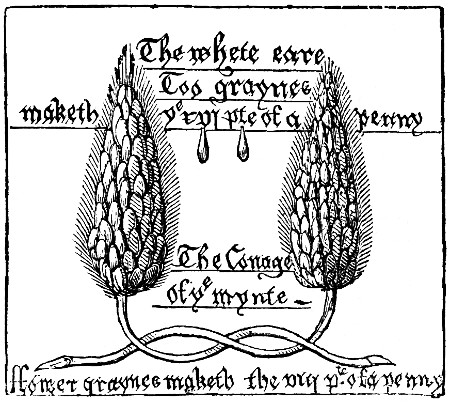
Weights and Measures.
1826. The alteration of the standard this year, in order to its uniformity throughout the kingdom, however inconvenient to individuals in its first application, will be ultimately of the highest public advantage. The difference between beer, wine, corn, and coal measure, and the difference of measures of the same denomination in different counties, were occasions of fraud and grievance without remedy until the present act of parliament commenced to operate. In the twelfth year of Henry VII. a standard was established, and the table was kept in the treasury of the king’s exchequer, with drawings on it, commemorative of the regulation, and illustrating its principles. The original document passed into the collection of the liberal Harley, earl of Oxford, and there being a print of it with some of its pictorial representations, an engraving is here given of the mode of trial which it exhibits as having been used in the exchequer at that period.
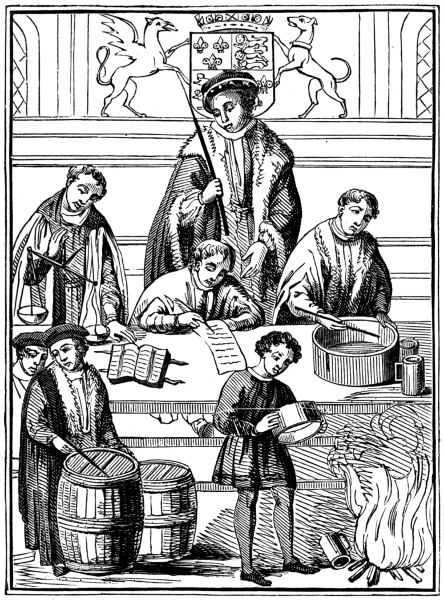
Trial of Weights and Measures under Henry VII.
From the same instrument is also taken the smaller diagram. They are curious specimens of the care used by our ancestors to establish and exemplify rules by which all purchases and sales were to be effected. In that view only they are introduced here. Conformity to the new standard is every man’s business and interest, and daily experience will prove its wisdom and justice. It would be obviously inexpedient to state any of the parliamentary provisions in this work, which now merely records one of the most remarkable and laudable acts in the history of our legislation.
NATURALISTS’ CALENDAR.
Mean Temperature 37·82.
January 28.
An Appearance of the Season.
Apology will scarcely be required for introducing a character, who at this season of the year comes forth in renovated honours, and may aptly be termed one of its ever-blues—
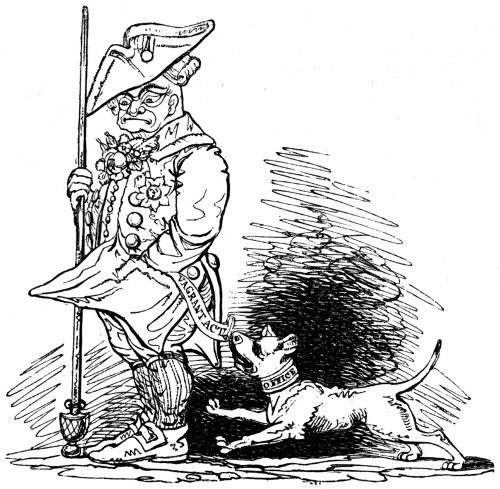
The Beadle—
“The great image of authority!”
Shakspeare.
not a peculiar of either Farringdons, nor him of Cripplegate, or St. Giles in the Fields, or of any ward or precinct within the bills: not this or that “good man”—but the universal parish beadle. “How Christmas and consolatory he looks! how redolent of good cheer is he! He is a cornucopia—an abundance. What pudding sleeves!—what a collar, red, and like a beef steak, is his! He is a walking refreshment! He looks like a whole parish, full, important—but untaxed. The children of charity gaze at him with a modest smile. The straggling boys look on him with confidence. They do not pocket their marbles. They do not fly from their familiar gutter. This is a red-letter day; and the cane is reserved for to-morrow.”
For the pleasant verbal description we are indebted to an agreeable writer in the “London Magazine;”[40] his corporal lineaments are “borrowed” (with permission) from a new caricature,[41] if it may be given so low a name, wherein this figure stands out, the very gem and jewel, in a grouping of characters of all sorts and denominations assembled with “infinite fancy” and “fun,” to illustrate the designer’s views of the age. It is a graphic satire of character rather than caricatura; mostly of class-characters, not persons; wherein the ridicule bears heavily, but is broad and comprehensive enough to shift from one neighbour to another.
The print, wherein our beadle is foremost, though not first, is one of the pleasantest “drolls” of the century, and seems to hit at all that is. In this whimsical representation, a painted show-board, at the window of a miserable garret, declares it to be “The Office of the Peruvian Mining Company.” On the casement of the first floor, in the same hereditament of poverty, is a bill of “Eligant rooms to let.” Wigs in the shop-window illustrate the punning announcement above it—“Nature improved by Rickets,” which is the name of the proprietor, a capital barber, who stands at the door, and points to a ragged inscription depending from the parti-coloured pole of his art, from whence we learn that “Nobody is to be s( )aved during di( )ine service, by command of the magistracy.” He enforces attention to this fact on an unshaved itinerant, with “Subscription for putting down Bartlemy fair” placarded on his back. This fellow has a pole in his right hand for “The preservation of public morals,” and a puppet of punch lolling from his left coat pocket. An apple-stall is taken care of by a fat body with a screaming child, whose goods appear to be coveted by two little beings untutored in the management of the eye. We gather from the “New Times,” on the ground, that the fruit woman is Sarah Crumpage, and that she and Rickets, the former for selling fruit, and the latter for shaving on the Sunday, “were convicted on the oath of the notorious Johnson, and fined ten shillings each.” Next to the barber’s is “the Star eating-house,” with “Ladies School” on the first-floor casement, and “Mangleing took in.” At the angle of the penthouse roofs of these dwellings “an angel’s head in stone with pigeon’s wings” deceives a hungry cat into an attempt to commit an assault upon it from the attic window. Opposite the cook’s door an able-bodied waggoner, with a pennon from his whip, inscribed “Knowledge is Power,” obscures part of another whereon all that remains is “NICK’S INSTITUTION.” A “steeled butcher,” his left hand resting at ease within his apron, cleaver hung, and carelessly capped, with a countenance indicating no other spirit than that of the still, and no disposition to study deeper than the bottom of a porter pot, carries the flag of the “London University:” a well-fed urchin, his son, hangs by his father’s sleeve, and drags along a wheeled toy, a lamb—emblem of many a future “lamb his riot dooms to bleed.” A knowing little Jewboy, with the flag of the “Converted Jews,” relieves the standard-bearer of the “School for Adults” from the weight of his pocket handkerchief, and his banner hides the letter “d” on another borne by a person of uneven temper in canonicals, and hence for “The Church in danger,” we read “The Church in anger.” Close at the heels of the latter is an object almost as miserable, as the exceedingly miserable figure in the frontispiece to the “Miseries of Human Life.” This rearward supporter of “the church in danger,” alias in “anger,” is a poor, undersized, famine-worn, badged charity boy, with a hat abundantly too large for its hydrocephalic contents, and a coat to his heels, and in another person’s shoes, a world too wide for his own feet—he carries a crooked little wand with “No Popery” on it; this standard is so low, that it would be lost if the standard-bearer were not away from the procession. A passionate person in a barrister’s wig, with a shillelagh, displays “Catholic Claims.” Opposite to a church partly built, is a figure clearly designating a distinguished preacher of the established church of Scotland in London, planting the tallest standard in the scene upright on the ground, from whence is unfurled “No Theatre”—the flag-bearer of “The Caledonian Chapel,” stands behind, in the act of tossing up a halfpenny with the standard bearer of “No more State Lotteries.” A black mask bears the “Liberty of the Press.” A well-fed man with bands beneath his chin, rears a high pole, inscribed “No fat Livings,” and “The cause of Greece” follows. A jovial undertaker in his best grave-clothes, raises a mute’s staff, and “No Life in London:” this character looks as if he would bury his wife comfortably in a country churchyard, get into the return-hearse with his companions, and crack nuts and drink wine all the way to town. A little personage, booted and buttoned up, carries a staff in his pocket, surmounted by a crown, and a switch to his chin, the tip whereof alone is visible, his entire face and head being wholly concealed by the hat; this is “The great Unknown”—he has close behind him “Gall and Spurs-him.” “No Treadmill” is exhibited by a merry rogue, half disarmed, with a wooden leg. At a public house, “The Angel and Punch Bowl,—T. Moore,” the “United Sons of Harmony” hold wassail; their flag is hung at one of the windows, from whence many panes are absent, and themselves are fighting at the door, and heartily cheered by the standard bearer of “No Pugilism.” A ferocious looking fellow, riding on a blind horse, elevates “Martin for Ever,” and makes cruel cuts with his whip on the back of a youth who is trying to get up behind him with the banner of “No climbing Boys.” We are now at a corner messuage, denominated “Prospect House Establishment for Young Ladies, by the Misses Grace and Prudence Gregory.” The corner opposite is “Seneca House Academy for Young Gentlemen, by Dr. Alex. Sanderson.” Prospect House has an “Assurance” policy, and from one of its windows one of the “young ladies” drops a work by “H. More”—in eager regard of one of the “young gentlemen” of Seneca-house, who addresses her from his room, with a reward of merit round his neck. This Romeoing is rendered more scenical by a tree, whereon hangs a lost kite, papered with a “Prospectus” of Seneca-house, from whence it appears that pupils bringing a “knife and fork,” and paying “Twenty Guineas per ann.,” are entitled to “Universal Erudition,” and the utmost attention to their “Morals and Principles.” Near this place, the representative of “United Schools” fells to the earth the flag-bearer of “Peace to the World;” while the able supporter of “Irish Conciliation,” endeavours to settle the difference by the powerful use of his pole; the affray being complacently viewed by a half-shod, and half-kilted maintainer of “Scotch Charity.” A demure looking girl is charged with “Newgatory Instruction.” At her elbow, a female of the order of disorder, so depicted that Hogarth might claim her for his own, upholds “Fry for ever,” and is in high converse with a sable friend who keeps “Freedom for the Blacks.” Hopeless idiocy, crawling on its knees by the aid of crutches, presents the “March of Mind.” An excellent slippered fruiterer with a tray of apples and pears, beguiles the eyes of a young Gobbleton, who displays “Missionary penny subscriptions,” and is suffering his hand to abstract wherewithal for the satisfaction of his longings. Here too are ludicrous representations of the supporters of “Whitefield and Wesley,” “Reform,” &c. and a Jewish dealer in old clothes, covered in duplicate, with the pawnbroker’s sign upside down, finds wind for “The Equitable Loan.” A wall round Seneca-house is “contrived a double debt to pay”—proffering seeming security to the “sightless eyeballs” of over-fond and over-fearful parents, and being of real use to the artist for the expression of ideas, which the crowding of his scene does not leave room to picture. This wall is duly chalked and covered by bills in antithesis. A line of the chalkings, by an elision easily supplied, reads, “Ask for War.” One of the best exhibitions in the print is a youth of the “Tract Society,” with a pamphlet entitled “Eternity,” so rolled as to look like a pistol, which he tenders to a besotted brute wearing candidates’ favours in his hat, and a scroll “Purity of Election.” The villainous countenance of the intoxicated wretch is admirable—a cudgel under his arm, his tattered condition, and a purse hanging from his pocket, tell that he has been in fight, and received the wages of his warfare; in the last stage of drunkenness he drops upon a post inscribed “under Government.” Among books strewed on the ground are “Fletcher’s Appeal,” “Family Shakspeare,” “Hohenlohe,” &c.; at the top is a large volume lettered “Kant,” which, in such a situation, Mr. Wirgman, and other disciples of the German philosopher, will only quarrel or smile at, in common with all who conceive their opinions or intentions misrepresented. In truth it is only because the print is already well known among the few lynx-eyed observers of manners that this notice is drawn up. Its satire, however well directed in many ways, is too sweeping to be just every way, and is in several instances wholly undeserved. The designer gives evidence however of great capability, and should he execute another it will inevitably be better than this, which is, after all, an extraordinary production.—In witness whereof, and therefrom, is extracted and prefixed the “Beadle” hereinbefore mentioned.
NATURALISTS’ CALENDAR.
Mean Temperature 36·37.
January 29.
1826. Sexagesima Sunday.
Accession of George IV.
1820. King George III. died. A contemporary kalendarian, in recording this memorable fact, observes, that “the slow and solemn sound of St. Paul’s bell announced the event a short time after, and was heard to a great distance around the country.” He adds, that he was reminded, by this “mournful proclamation of departed royalty,” of the following lines in Heywood’s “Rape of Lucrece,” written to go to a funeral peal from eight bells:
Come list and hark, the bell doth toll For some but now departing soul, Whom even now those ominous fowle, The bat, the nightjar, or screech owl, Lament; hark! I hear the wilde wolfe howle In this black night that seems to scowle, All these my black book shall enscrole. For hark! still still the bell doth toll For some but now departing soul.
This opportunity the same agreeable writer improves to discourse on, thus:
Bells.
The passing bell owes its origin to an idea of sanctity attached to bells by the early Catholics, who believed that the sound of these holy instruments of percussion actually drove the devil away from the soul of the departing Christian. Bells were moreover regarded formerly as dispelling storms, and appeasing the imagined wrath of heaven, as the following lines from Barnaby Googe will show:—
If that the thunder chaunce to rore and stormie tempest shake, A woonder is it for to see the wretches howe they quake, Howe that no fayth at all they have, nor trust in any thing, The clarke doth all the belles forthwith at once in steeple ring: With wondrous sound and deeper farre than he was woont before, Till in the loftie heavens darke, the thunder bray no more. For in these christned belles they thinke, doth lie such powre and might As able is the tempest great, and storme to vanquish quight. I saw myself at Numburg once, a towne in Toring coast, A bell that with this title bolde hirself did prowdly boast: By name I Mary called am, with sound I put to flight The thunder crackes, and hurtfull stormes, and every wicked spright. Such things when as these belles can do, no wonder certainlie It is, if that the papistes to their tolling always flie, When haile, or any raging storme, or tempest comes in sight, Or thunder boltes, or lightning fierce, that every place doth smight.
Naogeorgus.
We find from Brand, that “an old bell at Canterbury required twenty-four men, and another thirty-two men, ad sonandum. The noblest peal of ten bells, without exception, in England, whether tone or tune be considered, is said to be in St. Margaret’s church, Leicester. When a full peal was rung, the ringers were said ‘pulsare classicum.’”
Bells were a great object of superstition among our ancestors. Each of them was represented to have its peculiar name and virtues, and many are said to have retained great affection for the churches to which they belonged, and where they were consecrated. When a bell was removed from its original and favourite situation, it was sometimes supposed to take a nightly trip to its old place of residence, unless exercised in the evening, and secured with a chain or rope. Mr Warner, in his “Hampshire,” enumerates the virtues of a bell, by translating two lines from the “Helpe to Discourse.”
Men’s deaths I tell by doleful knell. Lightning and thunder I break asunder. On sabbath all to church I call. The sleepy head I raise from bed. The winds so fierce I doe disperse. Men’s cruel rage I do asswage.
There is an old Wiltshire legend of a tenor bell having been conjured into the river; with lines by the ringer, who lost it through his pertinacious garrulity, and which say:
In spite of all the devils in hell Here comes our old Bell.[42]
Baron Holberg says he was in a company of men of letters, where several conjectures were offered concerning the origin of the word campana; a klocke, (i. e. bell) in the northern tongues. On his return home, he consulted several writers. Some, he says, think the word klocke to be of the northern etymology; these words, Ut cloca habeatur in ecclesia, occurring in the most ancient histories of the north. It appears from hence, that in the infancy of Christianity, the word cloca was used in the north instead of campana. Certain french writers derive the word cloca from cloche, and this again from clocher, i. e. to limp; for, say they, as a person who limps, falls from one side to the other, so do klocks (bells) when rung. Some have recourse to the latin word clangor, others recur to the greek καλεω, I call; some even deduce it from the word cochlea, a snail, from the resemblance of its shell to a bell. As to the latin word campana, it was first used in Italy, at Nola in Campania; and it appears that the greater bells only were called campana, and the lesser nola. The invention of them is generally attributed to bishop Paulinus; but this certainly must be understood only of the religious use of them; it being plain, from Roman writers, that they had the like machines called tintinnabula.
The use of bells continued long unknown in the east, the people being called to public worship by strokes of wooden hammers; and to this day the Turks proclaim the beginning of their service, by vociferations from the steeple. Anciently priests themselves used to toll the bell, especially in cathedrals and great churches, and these were distinguished by the appellation of campanarii. The Roman Catholics christen their bells, and godfathers assist at the solemnity; thus consecrating them to religious use. According to Helgaudus, bells had certain names given them like men; and Ingulphus says, “he ordered two great clocks (bells) to be made, which were called Bartholomeus and Bettelinus, and two lesser, Pega and Bega.” The time is perhaps uncertain when the hours first began to be distinguished by the striking of a bell. In the empire this custom is said to have been introduced by a priest of Ripen, named Elias, who lived in the twelfth century; and this the Chronicon Anonymi Ripense says of him, hic dies et horas campanarum pulsatione distinxit. The use of them soon became extended from their original design to other solemnities, and especially burials: which incessant tolling has long been complained of as a public nuisance, and to this the french poet alludes:—
Pour honorer les morts, ils font mourir les vivans.
Besides the common way of tolling bells, there is also ringing, which is a kind of chimes used on various occasions in token of joy. This ringing prevails in no country so much as in England, where it is a kind of diversion, and, for a piece of money, any one may have a peal. On this account it is, that England is called the ringing island. Chimes are something very different, and much more musical; there is not a town in all the Netherlands without them, being an invention of that country. The chimes at Copenhagen, are one of the finest sets in all Europe; but the inhabitants, from a pertinacious fondness for old things, or the badness of their ear, do not like them so well as the old ones, which were destroyed by a conflagration.
The Rev. W. L. Bowles has an effusion agreeably illustrative of feelings on hearing the bells ring.
Sonnet.
Written at Ostend, July 22, 1787.
How sweet the tuneful bells responsive peal! As when at opening morn, the fragrant breeze Breathes on the trembling sense of wan disease So piercing to my heart their force I feel! And hark! with lessening cadence now they fall, And now, along the white and level tide, They fling their melancholy music wide; Bidding me many a tender thought recall Of summer days, and those delightful years When by my native streams, in life’s fair prime, The mournful magic of their mingling chime First wak’d my wondering childhood into tears! But seeming now, when all those days are o’er, The sounds of joy once heard, and heard no more.
“The Times”[43] has a literary correspondent, who communicates information that it may be useful to record.
CONSECRATION OF BELLS.
To the Editor of the Times.
Mr. Editor,—Having read in your paper of to-day, that the king of France “has been pleased to grant to the parish of Notre-Dame, at Nismes, two unserviceable pieces of cannon from the arsenal of Montpellier, for the purpose of forming a parish bell” it has occurred to me that the following description of the practice of baptizing bells, used by the Roman Catholics, may not be unacceptable to your readers. This account is a true translation from a book entitled “Pontificale Romanum, Autoritate Pontificia, impressum Venetiis, 1698. Lib. ii. Cap. de Benedictione Signi vel Campanæ.” I have run parallel with their method of baptizing children and bells, in twelve particulars, as follows:—
Of the Baptism of a Child. Of the Baptism of a Bell.
I.
The child must be first baptized, before it can be accounted one of the church. The bell must be first baptized, before it may be hung in the steeple.
II.
The child must be baptized by a priest or a minister. The bell must be baptized by a bishop or his deputy.
III.
In baptizing a child there is used holy water, cream, salt, oil, spittle, &c. &c. In the baptism of a bell, there is used holy water, oil, salt, cream, tapers for lights, &c.
IV.
In baptism, the child receiveth a name. And so it is in the baptism of bells.
V.
The child must have godfathers, &c., &c. The bell must have godfathers, and they must be persons of great rank.
VI.
The child must be washed in water. The bell must be washed in water by the hands of the bishop and priests.
VII.
The child must be crossed in baptism. The bell is solemnly crossed by the bishop.
VIII.
The child must be anointed. The bell is anointed by the bishop.
IX.
The child must be baptized in the name of the Holy Trinity. The bell is washed and anointed, in the name of the Trinity, by the bishop.
X.
At baptism they pray for the child. At the baptism of the bell they pray literally for the bell.
XI.
At the child’s baptism the scriptures are read. There are more psalms read at the baptism of a bell than at the baptism of a child; and a gospel also.
XII.
At child-baptism there are public prayers made. At the baptism of a bell there are more prayers used, and (excepting salvation) greater things are prayed for, and more blessings on the bell, than on the child. But for the better proof of this point, I shall here give part of one of the very curious prayers put up for the bell at its baptism:—
———— Lord grant that wheresoever this holy bell, thus washed (or baptized) and blessed, shall sound, all deceits of Satan, all danger of whirlwind, thunders, lightnings, and tempests, may be driven away, and that devotion may increase in Christian men when they hear it. O Lord, sanctify it by thy Holy Spirit; that when it sounds in thy people’s ears they may adore Thee! May their faith and devotion increase, the devil be afraid, and tremble and fly at the sound of it. O Lord, pour upon it thy heavenly blessing! that the fiery darts of the devil may be made to fly backwards at the sound thereof; that it may deliver from danger of wind and thunder, &c., &c. And grant, Lord, that all that come to the church at the sound of it, may be free from all temptations of the devil. O Lord, infuse into it the heavenly dew of thy Holy Ghost, that the devil may always fly away before the sound of it, &c., &c.
The doctrine of the church of Rome concerning bells is, first, that they have merit, and pray God for the living and the dead; secondly, that they produce devotion in the hearts of believers; thirdly, that they drive away storms and tempests; and, fourthly, that they drive away devils.
The dislike of evil spirits to the sound of bells, is extremely well expressed by Wynkin de Worde, in the Golden Legend:—“It is said, the evil spirytes that ben in the region of th’ ayre, doubte moche when they here the belles rongen: and this is the cause why the belles ringen whan it thondreth, and whan grete tempeste and to rages of wether happen, to the ende that the feinds and wycked spirytes should ben abashed and flee, and cease of the movynge of tempeste.”
As to the names given to bells, I beg leave to add, that the bells of Little Dunmow Priory, in Essex, new cast A. D. 1501, were baptized by the following names:—
Prima in honore Sancti Michaelis Archangeli.
Secunda in honore S. Johannis Evangelisti.
Tertia in honore S. Johannis Baptisti.
Quarta in honore Assumptionis beatæ Mariæ.
Quinta in honore Sancti Trinitatis, et omnium Sanctorum.
In the clochier near St. Paul’s stood the four greatest bells in England, called Jesus’s bells; against these sir Miles Partridge staked 100l., and won them of Henry VIII. at a cast of dice.
I conclude with remarking, that the Abbé Cancellieri, of Rome, lately published a work relative to bells, wherein he has inserted a long letter, written by Father Ponyard to M. de Saint Vincens, on the history of bells and steeples. The Abbé wrote this dissertation on the occasion of two bells having been christened, which were to be placed within the tower of the capitol.
I am, sir,
Your obedient servant,
Sept. 11.
R. H. E.
R. H. E. “wise and good” as he was, and he was both—he is now no more—would not willingly have misrepresented the doctrines of the Romish church, though he abhorred that hierarchy. It seems, however, that he may be mistaken in affirming, that the Romish church maintains of bells that “they have merit, and pray God for the living and the dead.” His affirmation on this point may be taken in too extensive a sense: It is no doubt a Romish tenet that there is “much virtue in bells,” but the precise degree allowed to them at this period, it would be difficult to determine without the aid of a council.
At Hatherleigh, a small town in Devon, exist two remarkable customs:—one, that every morning and evening, soon after the church clock has struck five and nine, a bell from the same steeple announces by distant strokes the number of the day of the month—originally intended, perhaps, for the information of the unlearned villagers: the other is, that after a funeral the church bells ring a lively peal, as in other places after a wedding; and to this custom the parishioners are perfectly reconciled by the consideration that the deceased is removed from a scene of trouble to a state of rest and peace.
When Mr. Colman read his Opera of “Inkle and Yarico” to the late Dr. Mosely, the Doctor made no reply during the progress of the piece. At the conclusion, Colman asked what he thought of it. “It won’t do,” said the Doctor, “Stuff—nonsense.” Every body else having been delighted with it, this decided disapprobation puzzled the circle; he was asked why? “I’ll tell you why,” answered the Critic; “you say in the finale—
‘Now let us dance and sing, While all Barbadoe’s bells do ring.’
It won’t do—there is but one bell in all the island!”
With a citation from the poet of Erin, the present notice will “ring out” delightfully.
Evening Bells.
Those evening bells, those evening bells, How many a tale their music tells, Of youth and home, and that sweet time Since last I heard their soothing chime. Those joyous hours are passed away, And many a friend that then was gay, Within the tomb now darkly dwells, And hears no more those evening bells. And so ’twill be when I am gone, That tuneful peal will still ring on, While other bards shall walk these dells, And sing thy praise, sweet evening bells!
NATURALISTS’ CALENDAR.
Mean Temperature 36·64.
January 30.
King Charles’s Martyrdom, 1644.—Holiday at the Public Offices, 1826.
It is recorded that, after King Charles the First received sentence of death, on Saturday the 27th, he spent the next day in devout exercises. He refused to see his friends, and ordered them to be told, that his time was precious, and the best thing they could do was to pray for him. On Monday the 29th, his children were brought to take their leave of him, viz. the lady Elizabeth and the duke of Gloucester. He first gave his blessing to the lady Elizabeth, bidding her that when she should see her brother James, she should tell him that it was his father’s last desire that he should no more look upon his brother Charles as his eldest brother only, but be obedient to him as his sovereign; and that they should love one another, and forgive their father’s enemies. The king added, “Sweetheart, you will forget this.” “No,” said she, “I shall never forget it as long as I live.” He bid her not grieve and torment herself for him; for it would be a glorious death he should die, it being for the laws and liberties of this land, and for maintaining the true Protestant religion. He recommended to her the reading of “Bishop Andrews’s Sermons,” “Hooker’s Ecclesiastical Polity,” and “Archbishop Laud’s Book against Fisher.” He further told her, that he had forgiven all his enemies, and hoped God would likewise forgive them. He bade her tell her mother, that his thoughts had never strayed from her, and that his love should be the same to the last. After this he took the duke of Gloucester, being then a child of about seven years of age, upon his knees, saying to him, “Sweetheart, now they will cut off thy father’s head:” upon which the child looked with great earnestness upon him. The king proceeding, said, “Mark, child, what I say, they will cut off my head, and perhaps make thee a king: but mark what I say, you must not be a king so long as your brothers Charles and James do live; for they will cut off your brothers’ heads when they can catch them, and cut off thy head too at last: and therefore I charge you do not be made a king by them.” At which the child fetched a deep sigh, and said, “I will be torn in pieces first.” Which expression falling from a child so young, occasioned no little joy to the king. This day the warrant for execution was passed, signed by fifty-nine of the judges, for the king to die the next day, between the hours of ten in the morning and five in the afternoon.
On the 30th, “The king having arrived at the place of execution, made a long address to colonel Tomlinson; and afterwards turning to the officers, he said, ‘Sirs, excuse me for this same: I have a good cause and a gracious God: I will say no more.’ Then turning to colonel Hacker, he said, ‘Take care that you do not put me to pain;’ and said, ‘This and please you—’ A gentleman coming near the axe, he said, ‘Take heed of the axe—pray take heed of the axe.’ Then speaking to the executioner (who was masked) he said, ‘I shall say but very short prayers, and when I thrust out my hands—.’ Then he asked the bishop for his cap, which, when he had put on, he said to the executioner, ‘Does my hair trouble you?’ who desiring it might be all put under his cap, it was put up by the bishop and executioner. Turning to the bishop, he said, ‘I have a good cause, and a gracious God on my side.’ To which the bishop answered, ‘There is but one stage more, which, though turbulent and troublesome, yet it is a very short one; it will soon carry you a very great way. It will carry you from earth to heaven; and there you will find, to your great joy, the prize you hasten to,—a crown of glory.’ The king added, ‘I go from a corruptible to an incorruptible crown, where no disturbance is, no disturbance in the world.’ The bishop replied, ‘You are exchanged from a temporal to an eternal crown, a good exchange.’ Then the king asked the executioner if his hair was well. After which, putting off his cloak, doublet, and his George, he gave the latter to the bishop, saying, ‘Remember.’ After this he put on his cloak again over his waistcoat, inquiring of the executioner if the block was fast, who answered it was. He then said, ‘I wish it might have been a little higher.’ But it was answered him, it could not be otherwise now. The king said, ‘When I put out my hands this way, then—.’ He prayed a few words standing, with his hands and eyes lift up towards heaven, and then stooping down, laid his neck on the block. Soon after which the executioner putting some of his hair under his cap, the king thought he had been going to strike, bade him stay for the sign. After a little time the king stretched forth his hand, and the executioner took off his head at one stroke. When his head was held up, and the people at a distance knew the fatal stroke was over, there was nothing to be heard but shrieks, and groans, and sobs, the unmerciful soldiers beating down poor people for this little tender of their affection to their prince. Thus died the worthiest gentleman, the best master, the best friend, the best husband, the best father, and the best Christian, that the age in which he lived produced.”[44]
Sir Philip Warwick, an adherent to this unfortunate king, says, “His deportment was very majestic; for he would not let fall his dignity, no not to the greatest foreigners that came to visit him and his court: for though he was far from pride, yet he was careful of majesty, and would be approached with respect and reverence. His conversation was free; and the subject matter of it, on his own side of the court, was most commonly rational; or if facetious, not light. With any artist or good mechanic, traveller, or scholar, he would discourse freely; and as he was commonly improved by them, so he often gave light to them in their own art or knowledge: for there were few gentlemen in the world that knew more of useful or necessary learning than this prince did; and yet his proportion of books was but small, having, like Francis the First of France, learnt more by the ear than by study. His way of arguing was very civil and patient; for he never contradicted another by his authority, but by his reason; nor did he by petulant dislike quash another’s arguments; and he offered his exception by this civil introduction, ‘By your favour, Sir, I think otherwise, on this or that ground;’ yet he would discountenance any bold or forward address unto him. And in suits, or discourses of business, he would give way to none abruptly to enter into them, but looked that the greatest persons should in affairs of this nature address to him by his proper ministers, or by some solemn desire of speaking to him in their own persons. His exercises were manly, for he rid the great horse very well; and on the little saddle he was not only adroit, but a laborious hunter, or field-man. He had a great plainness in his own nature, and yet he was thought, even by his friends, to love too much a versatile man; but his experience had thoroughly weaned him from this at last. He kept up the dignity of his court, limiting persons to places suitable to their qualities, unless he particularly called for them. Besides the women who attended on his beloved queen and consort, the lady Henrietta Maria, sister of the French king, he scarcely admitted any great officer to have his wife in the family. His exercises of religion were most exemplary; for every morning early, and evening, not very late, singly and alone, in his own bed-chamber, or closet, he spent some time in private meditation, (for he dared reflect and be alone,) and through the whole week, even when he went to hunt, he never failed, before he sat down to dinner, to have part of the liturgy read to him and his menial servants, came he ever so hungry or late in: and on Sundays and Tuesdays he came, commonly at the beginning of service, well attended by his court lords and chief attendants, and most usually waited on by many of the nobility in town, who found those observances acceptably entertained by him. His greatest enemies can deny none of this; and a man of this moderation of mind could have no hungry appetite to prey upon his subjects, though he had a greatness of mind not to live precariously by them. But when he fell into the sharpness of his afflictions, (than which few men underwent sharper,) I dare say I know it, (I am sure conscientiously I say it,) though God dealt with him, as he did with St. Paul, not remove the thorn, yet he made his grace sufficient to take away the pungency of it; for he made as sanctified an use of his afflictions as most men ever did. As an evidence of his natural probity, whenever any young nobleman or gentleman of quality who was going to travel, came to kiss his hand, he cheerfully would give them some good counsel leading to moral virtue, especially a good conversation; telling them, that if he heard they kept good company abroad, he should reasonably expect they would return qualified to serve their king and country well at home; and he was careful to keep the youth in his time uncorrupted. The king’s deportment at his trial, which began on Saturday the 20th of January, 1648, was very majestic and steady; and though usually his tongue hesitated, yet at this time it was free, for he was never discomposed in mind; and yet, as he confessed himself to bishop Juxon, who attended him, one action shocked him very much; for whilst he was leaning in the court upon his staff, which had a head of gold, the head broke off on a sudden: he took it up, but seemed unconcerned; yet told the bishop, it really made a great impression on him; and to this hour (says he) I know not possibly how it should come. It was an accident I myself have often thought on, and cannot imagine how it came about; unless Hugh Peters, who was truly and really his gaoler, (for at St. James’s nobody went to him but by Peters’s leave,) had artificially tampered upon his staff. But such conjectures are of no use.”
In the Lansdowne collection of MSS. a singular circumstance before the battle of Newbury is thus related:—
“The king being at Oxford went one day to see the public library, where he was shown, among other books, a Virgil, nobly printed and exquisitely bound. The lord Falkland, to divert the king, would have his majesty make a trial of his fortune by the sortes Virgilianæ, which every body knows was not an unusual kind of augury some ages past. Whereupon the king opening the book, the period which happened to come up was part of Dido’s imprecation against Æneas, which Mr. Dryden translates thus:—
Yet let a race untamed, and haughty foes, His peaceful entrance with dire arms oppose; Oppressed with numbers in th’ unequal field, His men discouraged and himself expelled, Let him for succour sue from place to place, Torn from his subjects and his sons’ embrace, First let him see his friends in battle slain, And their untimely fate lament in vain; And when at length the cruel war shall cease, On hard conditions may he buy his peace. Nor let him then enjoy supreme command, But fall untimely by some hostile hand, And lie unburied on the barren sand.
Æneid, b. iv. l. 88.
“It is said, king Charles seemed concerned at this accident, and that the lord Falkland observing it, would likewise try his own fortune in the same manner, hoping he might fall upon some passage that could have no relation to his case, and thereby divert the king’s thoughts from any impression the other might have upon him. But the place that Falkland stumbled upon was yet more suited to his destiny[45] than the other had been to the king’s; being the following expressions of Evander upon the untimely death of his son Pallas, as they are translated by the same hand:—
O Pallas! thou hast failed thy plighted word To fight with caution, not to tempt the sword: I warned thee, but in vain; for well I knew What perils youthful ardour would pursue. That boiling blood would carry thee too far; Young as thou wert in dangers—raw in war! O curst essay in arms,—disastrous doom,— Prelude of bloody fields and fights to come.
Æneid, b. xi. l. 230.”
Remarkable 30th of January Sermon.
On the 30th of January, 1755, the rev. John Watson, curate of Ripponden, in Yorkshire, preached a sermon there which he afterwards published. The title-page states it as “proving that king Charles I. did not govern like a good king of England.” He also printed “An Apology for his Conduct yearly on the 30th of January.” In these tracts he says, “For some years last past I have preached on the 30th of January, and my labours were employed in obviating the mistakes which I knew some of my congregation entertained with regard to the character of king Charles I.; and in proving that if it was judged rebellion in those who took up arms against that unfortunate prince, who had made so many breaches in the constitution, it must be an aggravation of that crime, to oppose the just and wise measures of the present father of his country, king George. The chief reason for publishing the sermon is to confute a commonly received opinion that I applauded therein the act of cutting off the king’s head, which any one may quickly see to be without foundation. For when I say that the resistance he met with was owing to his own mal-administration, nothing else can be meant than the opposition he received from a wise, brave, and good parliament:—not that shown him by those furious men who destroyed both the parliament and him, and whose conduct I never undertook to vindicate. It has been observed that I always provide a clergyman to read prayers for me on the 30th of January; but not to read that service is deemed criminal, because in subscribing the 36th canon I obliged myself to use the form prescribed in the Book of Common Prayer. The office for the 30th of January is no part of the Liturgy of the church of England. By the liturgy of the church I mean the contents of The Book of Common Prayer and Administration of the Sacraments, and other Rites and Ceremonies of the Church, &c., established by the act of uniformity, in the year 1662; and whatever has been added since, I suppose no clergyman ever bound himself by subscription to use; the reason is because the law requires no more.”
Mr. Watson then says, on the authority of Wheatly, in his “Illustration of the Common Prayer,” Johnson in his “Clergyman’s Vade Mecum,” and the author of “The Complete Incumbent,” that the services for the 30th of January and the 29th of May are not confirmed by act of parliament, and that penalties do not attach for the non-celebration of the service on those days. “I cannot in conscience read those prayers,” says Watson, “wherein the king is called a Martyr. I believe the assertion to be false, and therefore why should I tell a lie before the God of Truth! What is a martyr? He is a witness, for so the word in the original imparts. Robert Stephens tells us, that they are martyrs who have died giving a testimony of divinity to Christ, but if this be true king Charles can be no martyr, for he was put to death by those who believed in the divinity of Christ as well as he. What were the grounds then for giving him this glorious title? his dying rather than give up episcopacy? I think lord Clarendon hath proved the contrary: he consented to suspend episcopacy for three years, and that money should be raised upon the sale of the church lands, and only the old rent should be reserved to the just owners and their successors. My charity leads me so far, that I hope king Charles meant well when he told the princess Elizabeth that he should die a martyr, and when he repeated it on the scaffold. But this might be nothing else but a pleasing deception of the mind; and if saying that he died a martyr made him such, then the duke of Monmouth also was the same, for he died with the same words in his mouth, which his grandfather, king Charles, had used before. King Charles II. seems to have had no such opinion of the matter; for when a certain lord reminded his majesty of his swearing in common discourse, the king replied, ‘Your martyr swore more than ever I did,’ which many have deemed a jest upon the title which his father had got. In fact, we, of this generation, should never have judged, that he who swore to preserve the religion, laws, and liberties of his country inviolate, and yet broke through every one of these restraints—that he, who put an English fleet into the hands of the French to crush the protestants there, who were struggling to maintain their religion and liberties—that he, who contrary to the most solemn promises, did sacrifice the protestant interest in France—that he, who concurred with Laud in bringing the church of England to a kind of rivalship, for ornaments, &c., with the church of Rome—that he, who could consent, when he married the French king’s daughter, that their children were to be educated by their mother until thirteen years of age—that he, who gave great church preferments to men who publicly preached up popish doctrines; and that protected known papists from the penalties of the law, by taking several very extraordinary steps in their behalf—that he, who permitted an agent, or a kind of nuncio from Rome, to visit the court publicly, and bestowed such offices as those of lord high treasurer, secretary of state, chancellor of the exchequer, &c., on papists—that he, who by proclamation could command the Lord’s day to be profaned (for I can call it no less) by revels, plays, and many sorts of ill-timed recreations, punishing great numbers of pious clergymen for refusing to publish what their consciences forbad them to read: and to name no more—that he, who could abet the Irish massacre, wherein above three hundred thousand protestants were murdered in cold blood, or expelled out of their habitations. (Vide Temple’s ‘Irish Rebellion,’ page 6) I say, we, at this period of time, should not have thought such a one worthy to be deemed a martyr for the cause of protestantism; but that it has been a custom in the church for near a century to call him so. However, it is time seriously to consider whether it is not proper to correct this error; at least, it should be shown to be no error if we must keep it, for, at present, many of the well-meaning members of the church are offended at it.”
The writer cited, goes on to observe, “My second objection against reading this service is, that I judge it to be contrary both to reason and the contents of the Bible, to say that ‘the blood of king Charles can be required of us or our posterity.’ There is not, I suppose, one man alive who consented to the king’s death. We know nothing of it but from history, therefore none of us were concerned in the fact; with what reason then can it be averred that we ought to be responsible for it, when it neither was nor is in our power to prevent it. But what if we disclaim the sins of our forefathers, or are the posterity of those who fought for the king, are we still to be in danger of suffering? Such seems to be the doctrine of this service, where all, without exception, are called upon to pray that they ‘may be freed from the vengeance of his righteous blood.’ I could prove, from undoubted records, that the family I came from were royalists; but I think it sufficient to say, that I never did nor ever will consent, that a king shall be beheaded, or otherwise put to death; therefore let others say what they will, I look upon myself to be innocent, and why should I plead with God as if I thought myself guilty? But we are told that they ‘were the crying sins of this nation which brought down this heavy judgment upon us.’ I think it is more clear, that a series of ill-judged and ill-timed acts, on the part of the king, brought him into the power of his opposers, and that, afterwards, the ambition of a few men led him to the scaffold. Let it only be remembered, that at the beginning of his reign he entered into a war for the recovery of the Palatinate against the consent of his parliament; and when he could not get them to vote him money enough for his purpose he extorted it illegally from his subjects; refusing to join the parliament in redressing the grievances of the nation; often threatening them; and even counteracting their designs; which, at last, bred so many disputes, that he overstepped all bounds, and had the misprudence to attempt the seizing of five members in the house; on which the citizens came down by land and water, with muskets on their shoulders, to defend the parliament: soon after which so great a distrust arose between the two houses and him, that all likelihood of agreement wholly ceased. This was the cause whereon to make war—sending the queen to Holland to buy arms, himself retiring from the capital, and soon after erecting his standard at Nottingham. Not succeeding, he was made prisoner, and when many expected his restoration, a violent opposition in the army broke forth; a design was formed to change the monarchy into a republic, and to this, and nothing else, he fell a sacrifice. If the real cause of the king’s death was the wickedness of those times, does it not follow that his death was permitted by God as a punishment for that wickedness; and if so, why should we fear that God will still visit for it? Will the just and merciful Judge discharge his vengeance on two different generations of men for the offences committed by one? Such doctrine as this should be banished from every church, especially a christian one; for it has no foundation in reason or revelation.” The reasons of this clergyman of the established church for his dissent from the established usage are still further remarkable.