Book Lotteries.
Reading edition
During the reign of Charles II. lotteries were drawn at the theatres. At Vere-street theatre, which stood in Bear-yard, to which there is an entrance through a passage at the south-west corner of Lincolns’-inn-fields, another from Vere-street, and a third from Clare-market, Killigrew’s company performed during the seasons of 1661 and 1662, and part of 1663, when they removed to the new built theatre in Drury-lane; and the Vere-street theatre was probably unoccupied until Mr. Ogilby, the author of the now useless, though then useful “Itinerarium Angliæ, or Book of Roads,” adopted it, as standing in a popular neighbourhood, for the temporary purpose of drawing a lottery of books, which took place in 1668.
Books were often the species of property held out as a lure to adventurers, by way of lottery, for the benefit of the suffering loyalists. Among these, Blome’s Recreations, and Gwillim’s Heraldry, first edition, may be mentioned. In the Gazette of May 18, 1668, is the following advertisement: “Mr. Ogilby’s lottery of books opens on Monday the 25th instant, at the old Theatre between Lincoln’s-inn-fields and Vere-street; where all persons concerned may repair on Monday, May 18, and see the volumes, and put in their money.” On May 25th is announced, “Mr. Ogilby’s lottery of books (adventurers coming in so fast that they cannot in so short time be methodically registered) opens not till Tuesday the 2d of June; then not failing to draw; at the old Theatre between Lincoln’s-inn-fields and Vere-street.”
A correspondent, under the signature of “A Bibliographer,” communicates to the “Gentleman’s Magazine,” from whence the notice respecting these book lotteries is extracted, one of Ogilby’s Proposals as a curiosity, in which light it is certainly to be regarded, and therefore it has a place here, as follows:—
A Second Proposal, by the author, for the better and more speedy vendition of several volumes, (his own works,) by the way of a standing Lottery, licensed by his royal highness the duke of York, and assistants of the corporation of the royal fishing.
Whereas John Ogilby, esq., erected a standing lottery of books, and completely furnished the same with very large, fair, and special volumes, all of his own designment and composure, at vast expense, labour, and study of twenty years; the like impressions never before exhibited in the English tongue. Which, according to the appointed time, on the 10th of May, 1665, opened; and to the general satisfaction of the adventurers, with no less hopes of a clear despatch and fair advantage to the author, was several days in drawing: when its proceedings were stopt by the then growing sickness, and lay discontinued under the arrest of that common calamity, till the next year’s more violent and sudden visitation, the late dreadful and surprising conflagration, swallowed the remainder, being two parts of three, to the value of three thousand pounds and upward, in that unimaginable deluge. Therefore, to repair in some manner his so much commiserated losses, by the advice of many his patrons, friends, and especially by the incitations of his former adventurers, he resolves, and hath already prepared, not only to reprint all his own former editions, but others that are new, of equal value, and like estimation by their embellishments, and never yet published; with some remains of the first impressions, relics preserved in several hands from the fire; to set up a second standing lottery, where such the discrimination of fortune shall be, that few or none shall return with a dissatisfying chance. The whole draught being of greater advantage by much (to the adventurers) than the former. And accordingly, after publication, the author opened his office, where they might put in their first encouragements, (viz.) twenty shillings, and twenty more at the reception of their fortune, and also see those several magnificent volumes, which their varied fortune (none being bad) should present them.
[438]But, the author now finding more difficulty than he expected, since many of his promisers (who also received great store of tickets to dispose of, towards promotion of his business) though seeming well resolved and very willing, yet straining courtesy not to go foremost in paying their monies, linger out, driving it off till near the time appointed for drawing; which dilatoriness: (since despatch is the soul and life to his proposal, his only advantage a speedy vendition:) and also observing how that a money dearth, a silver famine, slackens and cools the courage of adventurers; through which hazy humours magnifying medium shillings loome like crowns, and each forty shillings a ten pound heap. Therefore, according to the present humour now reigning, he intends to adequate his design; and this seeming too large-roomed, standing lottery, new modelled into many less and more likely to be taken tenements, which shall not open only a larger prospect of pleasing hopes, but more real advantage to the adventurer. Which are now to be disposed of thus: the whole mass of books or volumes, being the same without addition or diminution, amounting according to their known value (being the prices they have been usually disposed at) to thirteen thousand seven hundred pounds; so that the adventurers will have the above said volumes (if all are drawn) for less than two thirds of what they would yield in process of time, book by book. He now resolves to attemper, or mingle each prize with four allaying blanks; so bringing down, by this means, the market from double pounds to single crowns.
The Propositions.—First, whosoever will be pleased to put in five shillings shall draw a lot, his fortune to receive the greatest or meanest prize, or throw away his intended spending money on a blank. Secondly, whoever will adventure deeper, putting in twenty-five shillings, shall receive, if such his bad fortune be that he draws all blanks, a prize presented to him by the author of more value than his money (if offered to be sold) though proffered ware, &c. Thirdly, who thinks fit to put in for eight lots forty shillings shall receive nine, and the advantage of their free choice (if all blanks) of either of the works complete, viz. Homer’s Iliads and Odysses, or Æsop the first and second volumes, the China book, or Virgil. Of which,
The first and greatest Prize contains 1 Lot, Number 1.
An imperial Bible with Chorographical and an hundred historical sculps, valued at 25l.
Virgil translated, with sculps and annotations, val. 5l.
Homer’s Iliads, adorned with sculps, val. 5l.
Homer’s Odysses, adorned with sculps, val. 4l.
Æsop’s Fables paraphrased and sculped, in folio, val. 3l.
A second Collection of Æsopick Fables, adorned with sculps, never * * * * * * * * * * * [Imperfect.] * * *
His Majestie’s Entertainment passing through the city of London, and Coronation.
These are one of each, of all the books contained in the Lottery, the whole value 51l.
The Second Prize contains 1 Lot, Num. 2.
One imperial Bible with all the sculps, val. 25l.
Homer complete, in English, val. 9l.
Virgil, val. 5l.
Æsop complete, val. 6l.
The Description of China, val. 4l.
In all 49 Pound.
The Third Prize contains 1 Lot, Num. 3.
One royal Bible with all the sculps 10l.
Homer’s Works in English, val. 9l.
Virgil translated, with sculps and annotations, val. 5l.
The first and second vol. of Æsop, val. 6l.
The Description of China, val. 4l.
Entertainment, val. 2l.
In all 36 Pound.
1 Lot, Num. 4.
One imperial Bible with all the sculps, val. 25l.
Æsop’s Fables the first and second vol. val. 6l.
In all 31 Pound.
1 Lot, Num. 5.
One imperial Bible with all the sculps, val. 25l.
Virgil translated, with sculps, val. 5l.
In all 30 Pound.
1 Lot, Num. 6.
One imperial Bible with all the sculps, val. 25l.
And a Description of China, val. 4l.
In all 29 Pound.
1 Lot, Num. 7.
One imperial Bible with all the sculps, and a new Æsop, val. 28l.
1 Lot, Num. 8.
One imperial Bible with all the sculps, val. 25l.
1 Lot, Num. 9.
A royal Bible with all the sculps, val. 10l.
A Description of China, val. 4l.
And a Homer complete, val. 9l.
In all 23 Pound.
1 Lot, Num. 10.
A royal Bible with all the sculps, val. 10l.
A Virgil complete, val. 5l.
Æsop’s Fables the first and second vols. val. 6l.
In all 21 Pound.
1 Lot, Num. 11.
One royal Bible with all the sculps, val. 10l.
And a Homer’s Works complete, val. 9l.
In all 19 Pound.
1 Lot, Num. 12.
One royal Bible with all the sculps, val. 10l.
And both the Æsops, val. 6l.
In all 16 Pound.
1 Lot, Num. 13.
One royal Bible with all the sculps, val. 10l.
A Virgil complete in English, val. 5l.
In all 15 Pound.
1 Lot, Num. 14.
One royal Bible with all the sculps, val. 10l.
A Description of China, val. 4l.
In all 14 Pound.
* * * * [Imperfect.] * * *
1 Lot, Num. 16.
One royal Bible with all the sculps, val. 10l.
The second volume of Æsop, val. 3l.
In all 13 Pound.
1 Lot, Num. 17.
One royal Bible with all the sculps, val. 10l.
And an Entertainment, val. 2l.
In all 12 Pound.
1 Lot, Num. 18.
One royal Bible with all the sculps, val. 10l.
1 Lot, Num. 19.
One royal Bible with Chorographical sculps, val. 5l.
One Virgil complete, val. 5l.
In all 10 Pound.
1 Lot, Num. 20.
One royal Bible with Chorographical sculps, val. 5l.
And a Homer’s Iliads, val. 5l.
In all 10 Pound.
1 Lot, Num. 21.
One royal Bible with Chorographical sculps, val. 5l.
And a Homer’s Odysses, val. 4l.
In all 9 Pound.
1 Lot, Num. 22.
One royal Bible with Chorographical sculps, val. 5l.
And a Description of China, val. 4l.
In all 9 Pound.
1 Lot, Num. 23.
One royal Bible with Chorographical sculps, val. 5l.
And Æsop complete, val. 6l.
In all 11 Pound.
1 Lot, Num. 24.
A royal Bible with Chorographical sculps, val. 5l.
And Æsop the first volume, val. 3l.
In all 8 Pound.
1 Lot, Num. 25.
A royal Bible with Chorographical sculps, val. 5l.
And Æsop the second volume, val. 3l.
In all 8 Pound.
1 Lot, Num. 26.
A royal Bible, ruled, with Chorographical sculps, val. 6l.
1 Lot, Num. 27.
A royal Bible with Chorographical sculps, ruled, val. 6l.
1 Lot, Num. 28.
One royal Bible with Chorographical sculps, val. 5l.
10 Lot, Num. 29.
Each a Homer complete, val. 9l.
10 Lot, Num. 30.
Each a double Æsop complete, val. 6l.
520 Lot, Num. 31.
Each a Homer’s Iliads, val. 5l.
520 Lot, Num. 32.
Each a Homer’s Odysses, val. 4l.
570 Lot, Num. 33.
Each a Virgil complete, val. 5l.
570 Lot, Num. 34.
Each a China Book, val. 4l.
570 Lot, Num. 35.
Each the first volume of Æsop, val. 3l.
570 Lot, Num. 36.
Each the second volume of Æsop, val. 3l.
The whole number of the lots three thousand, three hundred, and sixty-eight. The number of the blanks as above ordered; so that the total received is but four thousand, one hundred, and ten pounds.
The office where their monies are to be paid in, and they receive their tickets, and where the several volumes or prizes may be daily seen, (by which visual speculation understanding their real worth better than by the ear or a printed paper,) is kept at the Black Boy, over against St. Dunstan’s church, Fleet-street. The adventurers may also repair, for their better convenience, to pay in their monies, to Mr. Peter Cleyton, over against the Dutch church, in Austin-friars, and to Mr. Baker, near Broad-street, entering the South-door of the Exchange, and to Mr. Roycroft, in Bartholomew-close.
The certain day of drawing, the author promiseth (though but half full) to be the twenty-third of May next. Therefore all persons that are willing to adventure, are desired to bring or send in their monies with their names, or what other inscription or motto they will, by which to know their own, by the ninth of May next, it being Whitson-eve, that the author may have time to put up the lots and inscriptions into their respective boxes.
D. H., one of Mr. Urban’s contributors, mentions that he had seen an undated “Address to the Learned: or, an advantageous lottery for Books in quires; wherein each adventurer of a guinea is sure of a prize of two pound value; and it is but four to one that he has a prize of three, six, eight, twelve, or fifty pounds, as appears by the following proposals:” one thousand five hundred lots, at 1l. 1s. each, to be drawn with the lots out of two glasses, superintended by John Lilly and Edward Darrel, esqrs., Mr. Deputy Collins, and Mr. William Proctor, stationer, two lots of 50l., ten of 12l., twenty of 8l., sixty-eight of 6l., two hundred of 3l., one thousand two hundred of 3l. The undertakers were: Thomas Leigh, and D. Midwinter, at the Rose and Crown, in St. Paul’s Church-yard; Mr. Aylmer, at the Three Pigeons, and Mr. Richard Parker, under the Piazza of the Royal Exchange; Mr. Nicholson, in Little Britain; Mr. Took, at the Middle Temple gate, Fleet-street; Mr. Brown, at the Black Swan, without Temple-bar; Mr. Sare, at Gray’s-inn gate; Mr. Lownds, at the Savoy gate; Mr. Castle, near Scotland-yard gate; and Mr. Gillyflower, in Westminster-hall, booksellers.
Letters patent in behalf of the loyalists were from time to time renewed, and, from the Gazette of October 11, 1675, it appears by those dated June 19, and December 17, 1674, there were granted for thirteen years to come, “all lotteries whatsoever, invented or to be invented, to several truly loyal and indigent officers, in consideration of their many faithful services and sufferings, with prohibition to all others to use or set up the said lotteries,” unless deputations were obtained from those officers.
A Penny Lottery.
The most popular of all the schemes was that drawn at the Dorset-garden theatre, near Salisbury-square, Fleet-street, with the capital prize of a thousand pound for a penny. The drawing began October 19, 1698; and, in the Protestant Mercury of the following day, “its fairness (was said) to give universal content to all that were concerned.” In the next paper is found an inconsistent and frivolous story, as to the possessor of the prize: “Some time since, a boy near Branford, going to school one morning, met an old woman, who asked his charity; the boy replied, he had nothing to give her but a piece of bread and butter, which she accepted. Some time after, she met the boy again, and told him she had good luck after his bread and butter, and therefore would give him a penny, which, after some years’ keeping, would produce many pounds: he accordingly kept it a great while; and at last, with some friend’s advice, put it into the penny lottery, and we are informed that on Tuesday last the said lot came up with 1000l. prize.” However absurd this relation appears, it must be recollected those to whom it was principally addressed had given proof of having sufficient credulity for such a tale, in believing that two hundred and forty thousand shares could be disposed of and appropriated to a single number, independent of other prizes. The scheme of the “Penny Lottery” was assailed in a tract, intituled “The Wheel of Fortune, or Nothing for a Penny; being remarks on the drawing of the Penny Lottery at the Theatre Royal, in Dorset-Garden,” 1698, 4to. Afterwards at this theatre there was a short exhibition of prize-fighters; and the building was totally deserted in 1703.
In 1698-9, schemes were started, called “The Lucky Adventure; or, Fortunate Chance, being 2000l. for a groat, or 3000l. for a shilling:” and “Fortunatus, or another adventure of 1000l. for a penny:” but purchasers were more wary, and the money returned in both cases.—The patentees also advertised against the “Marble-board, alias the Woollich-board lotteries; the Figure-board, alias the Whimsey-board, and the Wyreboard lotteries.”[439]
These patents of the Restoration seem to have occasioned considerable strife between the parties who worked under them. The following verses from “The Post Boy, January 3, 1698,” afford some insight to their estimation among sensible people:—
A Dialogue betwixt the New Lotteries and the Royal Oak.
New Lott. To you, the mother of our schools, Where knaves by licence manage fools, Finding fit juncture and occasion, To pick the pockets of the nation; We come to know how we must treat ’em, And to their heart’s content may cheat ’em. Oak. It cheers my aged heart to see So numerous a progeny; I find by you, that ’tis heaven’s will That knavery should flourish still. You have docility and wit, And fools were never wanting yet. Observe the crafty auctioneer, His art to sell waste paper dear; When he for salmon baits his hooks, That cormorant of offal books, Who bites, as sure as maggots breed, Or carrion crows on horse-flesh feed; Fair specious titles him deceive, To sweep what Sl—— and T——n leave. If greedy gulls you wou’d ensnare, Make ’em proposals wondrous fair; Tell him strange golden show’rs shall fall, And promise mountains to ’em all. New Lott. That craft we’ve already taught, And by that trick have millions caught; Books, bawbles, toys, all sorts of stuff, Have gone off this way well enough. Nay, music, too, invades our art, And to some tune wou’d play her part. I’ll show you now what we are doing, For we have divers wheels agoing. We now have found out richer lands Than Asia’s hills, or Afric’s sands, And to vast treasures must give birth, Deep hid in bowels of the earth; In fertile Wales, and God knows where, Rich mines of gold and silver are, From whence we drain prodigious store Of silver coin’d, tho’ none in ore, Which down our throats rich coxcombs pour, In hopes to make us vomit more. Oak. This project surely must be good, Because not eas’ly understood: Besides, it gives a mighty scope To the fool’s argument—vain hope. No eagle’s eye the cheat can see, Thro’ hope thus back’d by mystery. New Lott. We have, besides, a thousand more, For great and small, for rich and poor, From him that can his thousands spare, Down to the penny customer. Oak. The silly mob in crowds will run, To be at easy rates undone. A gimcrack-show draws in the rout, Thousands their all by pence lay out. New Lott. We, by experience, find it true, But we have methods wholly new, Strange late-invented ways to thrive, To make men pay for what they give, To get the rents into our hands Of their hereditary lands, And out of what does thence arise, To make ’em buy annuities. We’ve mathematic combination, To cheat folks by plain demonstration, Which shall be fairly manag’d too, The undertaker knows not how. Besides —— Oak. Pray, hold a little, here’s enough, To beggar Europe of this stuff. Go on, and prosper, and be great, I am to you a puny cheat.[440]
The “Royal-Oak Lottery,” as the rival if not the parent of the various other demoralizing schemes, obtained the largest share of public odium. The evils it had created are popularly set forth in a remarkable tract, entitled “The Arraignment, Trial, and Condemnation of Squire Lottery, alias Royal-Oak Lottery, London, 1699,” 8vo. The charges against the offender are arrayed under the forms imported by the title-page. The following extracts are in some respects curious, as exemplifying the manners of the times:—
Die Lunæ vicesimo die Martii 1698/9. Anno Regni, &c.
At the Time and Place appointed, came on the Trial of Squire Lottery, alias Royal-Oak Lottery, for abundance of intolerable Tricks, Cheats, and high Misdemeanours, upon an Indictment lately found against him, in order to a National Delivery.
About ten of the Clock, the day and year abovesaid, the Managers came into the Court, where, in the presence of a vast confluence of People of all Ranks, the Prisoner was ordered to the Bar.
Proclamation being made, and a Jury of good Cits which were to try the Prisoner being sworn, the Indictment against Squire Lottery alias Royal-Oak Lottery, was read.
The Jurors’ Names.
Mr. Positive, a Draper in Covent Garden. Mr. Squander, an Oilman in Fleet-street. Mr. Pert, a Tobacconist, ditto. Mr. Captious, a Milliner in Paternoster-Row. Mr. Feeble, a Coffeeman near the Change. Mr. Altrick, a Merchant in Gracechurch-street. Mr. Haughty, a Vintner by Grays-Inn, Holborn. Mr. Jealous, a Cutler at Charing-Cross. Mr. Peevish, a Bookseller in St. Paul’s Church-yard. Mr. Spilbook, near Fleet-bridge. Mr. Noysie, a Silkman upon Ludgate-hill. Mr. Finical, a Barber in Cheapside.
Cl. of Ma. Squire Lottery, alias Royal-Oak Lottery, you stand Indicted by the Name of Squire Lottery, alias Royal-Oak Lottery, for that you the said Squire Lottery, not having the Fear of God in your Heart; nor weighing the Regard and Duty you owe, and of right ought to pay to the Interest, Safety, and Satisfaction of your Fellow-Subjects; have from time to time, and at several times, and in several places, contrary to the known Laws of this Kingdom, under the shadow and coverture of a Royal Oak, propagated, continued, and carried on a most unequal, intricate, and insinuating Game, to the utter ruin and destruction of many thousand Families: And that you the said Squire Lottery, alias Royal-Oak Lottery, as a common Enemy to all young People, and an inveterate Hater of all good Conversation and Diversion, have, for many years last past, and do still continue, by certain cunning Tricks and Stratagems, insidiously, falsely, and impiously, to trepan, deceive, cheat, decoy, and entice divers Ladies, Gentlemen, Citizens, Apprentices, and others, to play away their Money at manifest Odds and Disadvantage. And that you the said Squire Lottery, alias Royal-Oak Lottery, the more secretly and effectually to carry on and propagate your base, malicious, and covetous Designs and Practices, did, and do still encourage several lewd and disorderly Persons, to meet, propose, treat, consult, consent, and agree upon several unjust and illegal Methods, how to ensnare and entangle People into your delusive Game; by which means you have, for many years last past, utterly, intirely, and irrecoverably, contrary to all manner of Justice, Humanity, or good Nature, despoiled, depraved, and defrauded, an incredible number of Persons of every Rank, Age, Sex, and Condition, of all their Lands, Goods, and Effects; and from the Ruins of multitudes built fine Houses, and purchased large Estates, to the great scandal and reflection on the Wisdom of the Nation, for suffering such an intolerable Impostor to pass so long unpunished. What say’st thou, Squire Lottery, art thou guilty of the aforesaid Crimes, Cheats, Tricks, and Misdemeanours thou standest Indicted of, or not Guilty?
Lottery. Not Guilty. But, before I proceed to make my Defence, I beg I may be permitted the assistance of three or four learned Sharpers to plead for me, in case any Matter of Law arise.
This being assented to, the Managers of the Prosecution made their speeches in support of the Charge, and called Captain Pasthope.
1st Man. Sir, Do you know Squire Lottery, the Prisoner at the Bar?
Pasthope. Yes, I have known him intimately for near forty years; ever since the Restoration of King Charles.
1st Man. Pray will you give the Bench and Jury an Account what you know of him; how he came into England, and how he has behaved himself ever since.
Pasthope. In order to make my Evidence more plain, I hope it will not be judg’d much out of form, to premise two or three things.
1st Man. Mr. Pasthope, Take your own method to explain yourself; we must not abridge or direct you in any respect.
Pasthope. In the years 60 and 61, among a great many poor Cavaliers, ’twas my hard fate to be driven to Court for a Subsistence, where I continued in a neglected state, painfully waiting the moving of the Waters for several months; when at last a Rumour was spread, that a certain Stranger was landed in England, that in all probability, if we could get him the Sanction of a Patent, would be a good Friend to us all.
Man. You seem to intimate as if he was a Stranger; pray, do you know what Countryman he was?
Pasthope. The report of his Country was very different; some would have him a Walloon, some a Dutchman, some a Venetian, and others a Frenchman; indeed by his Policy, cunning Design, Forethought, &c. I am very well satisfied he could be no Englishman.
Man. What kind of Credentials did he bring with him to recommend him with so much advantage?
Pasthope. Why, he cunningly took upon him the Character of a Royal-Oak Lottery, and pretended a mighty Friendship to antiquated Loyalists: but for all that, there were those at Court that knew he had been banish’d out of several Countries for disorderly Practices, till at last he pitch’d upon poor easy credulous England for his Refuge.
Man. You say then, he was a Foreigner, that he came in with the Restoration, usurp’d the Title of a Royal Oak, was establish’d in Friendship to the Cavaliers, and that for disorderly Practices he had been banish’d out of several Countries; till at last he was forc’d to fix upon England as the fittest Asylum. But pray, Sir, how came you so intimately acquainted with him at first?
Pasthope. I was about to tell you. In order to manage his Affairs, it was thought requisite he should be provided with several Coadjutors, which were to be dignify’d with the Character of Patentees; amongst which number, by the help of a friendly Courtier, I was admitted for one.
Man. Oh! then I find you was a Patentee. Pray, how long did you continue in your Patentee’s Post? and what were the Reasons that urg’d you to quit it at last?
Pasthope. I kept my Patentee’s Station nine years, in which time I had clear’d 4000l., and then, upon some Uneasiness and Dislike, I sold it for 700l.
Man. Pray, Captain, tell the Court more fully what was the Reason that prevail’d with you to relinquish such a profitable place.
Pasthope. I had two very strong Reasons for quitting my Post; viz. Remorse of Conscience, and Apprehension of consequent Danger. To tell you the truth, I saw so many bad Practices encourag’d and supported, and so many persons of both Sexes ruin’d; I saw so much Villany perfected and projected, and so many other intolerable Mischiefs within the compass of every day’s Proceeding, that partly through the stings of my Mind and the apprehensions I was under of the Mob, with a great deal of Reluctancy I quitted my Post.
Man. Captain, I find you’re nicely qualify’d for an Evidence, pray, therefore, give the Court an Account what Methods the Prisoner us’d to take to advance his business.
Pasthope. The way in my time, and I suppose ’tis the same still, was to send out Sharpers and Setters into all parts of the Town, and to give ’em direction to magnify the Advantage, Equality, and Justice of his Game, in order to decoy Women and Fools to come and play away their Money.
Man. Well, but sure he had no Women or Fools of Quality, Rank, or Reputation, that came to him? According to the common Report that passes upon him, there’s none but the very Scoundrels and Rabble, the very Dregs and Refuse of Fools, will think him worth their Conversation.
Pasthope. Truly, he had ’em of all sorts, as well Lord-fools and Lady-fools, Knight-fools and Esquire-fools, or any other sort of Fools: and, indeed, he made no difference between ’em neither; a Cobler-fool had as much respect as a Lord-fool, in proportion to the money he had in his Pocket; and pro hac vice had as extensive a Qualification to command, domineer, and hector, as the best Fool of ’em all.
Man. Did you never observe any of these Fools to get any money of him? I can’t imagine what it could be that could influence ’em to embark with him, if there was nothing to be got.
Pasthope. There was never any body that ever got any thing of him in the main: now and then one by chance might carry off a small matter; and so ’twas necessary they should, for otherwise his Constitution must dissolve in course.
Man. ’Tis a great mystery to me, that so many People should pursue a Game where every body’s a Loser at last; but pray, Captain, then, what are the odds the Prisoner is reputed to have against those that play with him?
Pasthope. No body can tell you their Advantage; ’tis a cunning intricate Contexture, and truly I very much question whether the original Projector himself had a perfect Idea of the Odds: at a full Table and deep Play, I have seen him clear 600l. in less than an hour.
Man. What are the Odds he owns himself?
Pasthope. Only 32 Figures against 27, which indeed is Odds enough to insure all the money at length. But this, it seems, was an Advantage that was allow’d him, that he might be able to keep a good House, relieve the Poor, and pay an annual Pension to the Crown or the Courtiers.
Man. You say, by his original Agreement he’s to keep a good House: pray after all, what sort of House is it he does keep?
Past. Why, he dines at the Tavern, where any body that has 40 or 50l. to play away with him the Afternoon, may be admitted into his Company.
Man. What, does he entertain none but those that have 40 or 50l. to lose?
Past. He never converses with any Person that has no money: if they have no money, their Company’s burdensom and ungrateful, and the Waiters have Directions to keep ’em out.
Man. Does he do this to the very Persons he has ruin’d, and won all they have? That, methinks, is a pitch of Barbarity beyond the common degree: I hardly ever read or heard of any thing so exaltedly cruel and brutish, in all the Accounts of my Life.
Past. I have seen abundance of Examples of this nature, one, in particular, which I shall never forget; a poor Lady, that had lost 350l. per annum to him, beside two or three thousand pounds in ready money, basely and inhumanly hal’d out of doors, but for asking for a glass of Sack.
Man. You were mentioning his Charity to the Poor too; is there any thing of reality in that?
Past. For my part, I never heard of one good Act he has done in the whole course of his Life: secret Charity is the most meritorious, ’tis true; and perhaps it may be that way he may communicate his, for indeed I never heard of any he did in publick.
Man. You were mentioning too an annual Pension to the Crown; what is it he pays to the Crown?
Past. Indeed I cannot be positive in that: to the best of my remembrance ’tis four thousand pounds per annum: in compensation for which, beside the general liberty he has to cheat and abuse the World, he has the sole Privilege of Licensing all other Cheats and Impostors, commonly known by the Name of Lotteries.
2d Man. You were speaking something, Captain Pasthope, just now, as if the Prisoner was intrusted with these Advantages for the benefit of some poor Cavaliers, which were to be the Patentees, as you call ’em. Pray tell the Jury what kind of Cavaliers these Patentees were.
Past. That was all but a Blind, a pure Trick to deceive the World: the Patentees, in the main, were either Sharpers or broken Tradesman, or some such sort or Vermin, that had cunningly twisted themselves into the business under the shadow of Cavaliers.
Man. Pray, what Opinion had the World of the Prisoner when he first came to be known in England?
Pasthope. The same that it has of him now: all wise men look’d upon him as a Cheat, and a dangerous Spark to be let loose in publick among our English Youth: and indeed I have heard a great many sober men pass very sharp Censures upon the Wisdom of the Court for intrusting him with a Royal Authority.
Man. What kind of Censures were they that they past? do you remember any of them particularly?
Past. Yes, I remember several things that I am almost ashamed to mention. I have heard ’em often reflecting what an intolerable Shame and Scandal it was, that a whole Kingdom should be sacrificed to the Interest of two or three Courtiers, and three or four scurvy mercenary Patentees; that so many thousand Families should be ruin’d, and no notice taken of it; that so many Wives should be seduc’d to rob and betray their Husbands, so many Children and Servants their Parents and Masters, and so many horrid Mischiefs transacted daily under the shadow of this pretended Royal-Oak Lottery, and no manner of means used to suppress it.
2d Man. But, Captain, did you never hear of any Person that got money of the Prisoner in the main?
Past. Not one. I defy him to produce one single person that’s a Gainer, against a hundred thousand he has ruin’d. I’m confident I have a Catalogue by me of several thousands that have been utterly undone by him, within the compass of my own Experience.
Man. What does the Town in general say of him?
Past. The town, here-a-late, is grown so inveterate and incens’d against him, that I am very well assur’d that if he had not been call’d to account in the very nick, the Mob would have speedily taken him into their correction.
Man. Well, Sir, you hear what the Witness has said against you; will you ask him any Questions?
Lottery. Only one; and leave the rest till I come to make my general Defence. Sir, I desire to know whether you was not one that was turn’d out upon the last Renewal of the Patent?
Past. No, Sir, I was not. You might have remember’d that I told you I saw so much of your Falshood and Tricks, and so many innocent People daily sacrific’d, to support a Society of lewd, debauch’d, impertinent, and withal imperious Cannibals, that I thought it my best way to quit your Fraternity, and pack off with that little I had got, and leave you to manage your mathematical Balls, &c. by your self.
Man. I suppose, Sir, you will ask him no more Questions, and so we’ll call another Witness.
Lottery. No, Sir, I have done with him.
Man. Call Squire Frivolous, the Counsellor: Sir, do you know Squire Lottery, the Prisoner?
Frivolous. I have been acquainted with him several years, to my great Cost and Damage. The first time I had the misfortune to know him, was at an Act at Oxford about twenty years ago; where among abundance of other young Fools that he entic’d to sell their Books for Money to play with him, &c. I was one.
Man. What, I hope, he was not so barbarous as to decoy the poor young Gentlemen out of their Books?
Frivolous. Yes, out of every thing they had, and out of the College to boot: For my own part I have reason to curse him, I’m sure; He flatter’d me up with so many Shams and false Pretences, and deluded me with so many chimerical Notions and cunning Assurances, and urg’d me so long from one deceitful Project to another, till at last he had trickt me out of all I had in the world, and then turn’d me over to the scorn and laughter of my Friends and Acquaintance.
Man. Can you give the Bench any particular Names of Persons he has ruin’d?
Frivolous. I have a Collection of Names in my Pocket, which I’m sure he can’t object against, that have lost fourteen or fifteen thousand Pound per Annum, within my own Knowledg and Acquaintance.
Man. That’s a round Sum: But, pray, Mr. Frivolous, for the satisfaction of the Jury, mention a few of their Names.
Frivolous. I suppose, Squire Lottery, you must remember the Kentish Squire in the Blue Coat, that you won the six hundred Pound per Annum of, in less than five months. You remember the Lord’ Steward that lost an Estate of his own of three hundred Pound per Annum, and run four thousand Pound in Arrears to his Lord beside. You remember, I suppose, the West-India Widow, that lost the Cargo of two Ships, valued at fifteen hundred Pound, in less than a month. I know you can’t forget the honest Lady at St. James’s, that sold all her Goods, Plate, and China, for about seven hundred Pound, and paid it all away to you, as near as I remember, in three mornings. I know you can’t forget the three Merchants’ Daughters that play’d away their whole Fortunes, viz. fifteen hundred Pounds apiece in less than two months. You remember the Silkman from Ludgate-hill; the young Draper in Cornhil; the Country Parson; the Doctor of Physick’s Daughter; the Lady’s Woman; the Merchant’s Apprentice; the Marine Captain; the Ensign of the Guards; the Coffeeman’s Neece; the old Justice’s Nephew; and abundance of others, which I have in my Catalogue, that you have cheated out of large Sums, and utterly ruin’d.
Lottery. I desire that he may be ask’d, what it was that influenc’d him at first to make such a Catalogue?
Man. He desires to know upon what account it was that you made this Collection of Names?
Frivolous. I had once a design to have him call’d to an Account, and forc’d to a Restitution; in which case I thought the Names of these Persons might be of some use to me.
Man. What Method did you propose to your self to bring him to a Restitution?
Frivolous. I had a Notion, that if I drew up the Case, and got it recommended to the Honourable House of Commons, they would have thought the Prisoner worth their correction: But this he got intelligence of, and employ’d one of his Agents to make up the matter with me.
Man. What, I suppose you mean he brib’d you with a Sum of Money to decline the Prosecution?
Frivolous. Truly you have hit of the very thing; he knew that I was poor, and he was guilty, and so compounded with me for a few Guineas to let the thing fall: And indeed, if I am not misinform’d, his Art of Bribing, &c. has guarded him so long from the Punishments which the Laws of the Land, and common Justice, have provided for such notorious Offenders.
Other witnesses having been called, the arraigned defended himself as follows:—
Lottery. Sir, I intend to spend as little of your time as I can: I perceive, that, let me say what I will, you are prepar’d to over-rule it, and so I’ll only say a few words, and call three or four Witnesses to prove my reputation, and then leave the good Men and true of the Jury, upon whose Verdict I must stand or fall, to use me as they shall best judg the nature of my Case deserves.
I know, Gentlemen, the tide of Prejudice runs very fierce against me; so that let me say what I will, I’m satisfy’d it will be all to very little purpose; an ill Name to a Person in my condition is certain Death, which indeed makes me a little more indifferent in making my defence.
But, Gentlemen, look upon me, I am the very Image of some of you, a married Protestant; upon which account I’m confident I may rely upon a little of your Justice, if not your Favour.
The Crimes I am charged with are indeed very great, and, what’s worse, there’s some of ’em I can never expect to evince. But then, Gentlemen, I hope you’l consider, that whatever I did, was purely in the prosecution of my occupation; and you know withal what Authority I had for it; so that if by chance, in this long tract of time, every thing should not be so nicely conformable as you expect, I hope you’l take care to lay the Saddle upon the right Horse.
You all know that Covetousness and Cheating are the inseparable Companions of a Gamester; divide him from them, and he’s the most insignificant Creature in Nature. And, Gentlemen, I appeal to your selves, if a little useful lying and falshood be not (in some cases) not only tolerable, but commendable. I dare say you will agree with me in this, that if all the Knaves and Cheats of the Nation were call’d to the Bar and executed, there would only be a few Fools left to defend the Commonwealth.
But, Gentlemen, as I told you before, I won’t spend your time, and therefore I’ll call my Witnesses. Call Captain Quondam.
Cryer. Call Capt. Quondam.
Lottery. Sir, I desire you would give the Court an account what you know of me, as to Life and Conversation.
Quondam. I have known the Prisoner for several years, and have been often in his company upon particular occasions and never saw any thing that was rude or unhandsome by him.
Man. Pray, noble Captain, what Countryman are you?
Quondam. Sir, I am a West-Countryman.
Man. An English West-Country, or a West-India Man? or what?
Quondam. I am a West-Countryman of his Majesty’s own Dominions, of the Kingdom of Ireland, in the County of Cork, and Parish of Durrus in the Barony of West-Carbury, near the great Bogg of Longuar, Gent.
Man. You’re a West-Countryman with a Witness. And, pray, how long have you been in England?
Quondam. Ever since the last year of my Soveraign Lord King James.
Man. And, pray, how long have you been a Captain?
Quondam. I was born so; my Father, my Grandfather, great Grandfather, and most of my Kin, were all Captains before me.
Man. You say you have been often in the Prisoner’s Company; pray where have you been in his Company, and upon what account?
Quondam. I have been in his Company at Epsom, Tunbridge, Lambeth, Islington, and at several other places both in Town and Country.
Man. Well, but you ha’n’t told what was the occasion that brought you so oft into his Company.
Quondam. He desired me to go along with him to help him to divert and entertain his Guests, especially the Ladies that us’d to visit him.
Man. I suppose you’re one of his Dependents: had you never no salary from him?
Quondam. I have had several Favours from him, and I must own I love him very well; and, by my Shoul, I believe he’s a very honest Man, and a good Christian.
Man. Who’s your next evidence?
Lottery. I desire Mr. Scamper may be call’d.
Cry. Call Mr. Scamper.
Lottery. Pray, Mr. Scamper, give the Court an Account what you know of me, as to my manner of living and behaviour in the World.
Scamper. You know, Squire Lottery, your Acquaintance and mine is but of a late Date; I never saw you till last May at Lambeth Wells, and then ’twas but by accident too.
After other witnesses called in his behalf, whose testimony, however, tended to inculpate Squire “Royal Oak,” the evidence was summed up.
“Then the jury withdrew to consider of their verdict, and afterwards they returned into the court, and the prisoner was brought again to the bar and found guilty, according to the indictment, and afterwards received sentence, together with Mr. Auction and Dr. Land-Bank, who were both tryed, convicted, and condemned; and their trials will be published with all possible speed. Finis.”
There is no reason to doubt, that the representations in the preceding satire are substantially correct. Private and fallacious lotteries were at this time become so general, not only in London, but in most other great cities and towns of England, whereby the lower people and the servants and children of good families were defrauded, that an act of parliament was therefore passed 10 and 11 William III. c. 17, for suppressing such lotteries; “even although they might be set up under colour of patents or grants under the great seal. Which said grants or patents,” says the preamble “are against the common good, welfare, and peace of the kingdom, and are void and against law.” A penalty therefore of five hundred pounds was laid on the proprietors of any such lotteries, and of twenty pounds on every adventurer in them. Notwithstanding this, the like disposition to fraud and gaining prevailed again, till fresh laws were enacted for their suppression.[441]
It is observed, that if the lottery office keepers of the present century could be credited, their adventurers enjoyed greater gaming privileges than the world ever produced; and yet it is an indubitable fact, that in the early state lotteries the advantages offered were eminently superior to those of recent times.
The Post Boy of December 27 says, “We are informed that the parliamentary lottery will be fixed in this manner:—150,000 tickets will be delivered out at 10l. each ticket, making in all the sum of 1,500,000l. sterling; the principal whereof is to be sunk, the parliament allowing nine per cent. interest for the whole during the term of thirty-two years, which interest is to be divided as follows: 3750 tickets will be prizes from 1000l. to 5l. per annum during the said thirty-two years; all the other tickets will be blanks, so that there will be thirty-nine of these to one prize, but then each blank ticket will be entitled to fourteen shillings a year for the term of thirty-two years, which is better than an annuity for life at ten per cent. over and above the chance of getting a prize.” Such was the eagerness of the public in subscribing to the above profitable scheme, that Mercers-hall was literally crowded, and the clerks were found incompetent to receive the influx of names. 600,000l. was subscribed January 21; and on the 28th of February the sum of 1,500,000l. was completed.
The rage for lotteries reigned uncontrolled; and the newspapers of the day teemed with proposals issued by every ravenous adventurer who could collect a few valuable articles; and from those, shopkeepers took the hint, and goods of every description were converted into prizes, even neckcloths, snuff-boxes, toothpick-cases, linen, muslin, and plate. The prices of tickets were generally sixpence, a shilling, half a crown, &c. At the latter end of the year just mentioned, the magistrates, being alarmed, declared their intention of putting the act of William and Mary in force, which levied a penalty of 500l. on the proprietor, and 20l. on each purchaser.
Matthew West, a goldsmith, of Clare-street, Clare-market, appears to have been the man who first divided lottery tickets into shares. He advertised, in 1712, that he had sold 100 tickets in the million and an half lottery in twentieths, and purposed pursuing his plan, which was well received.
The lottery for 1714 contained 50,000 tickets at 10l. each, with 6982 prizes and 43,018 blanks; two of the former were 10,000l., with one of 5, another of 4000l., a third of 3000l., and a fourth of 2000l., five of 1000l., ten of 500l., twenty of 200l., fifty of 100l., four hundred of 50l., and six thousand, four hundred, and ninety-one of 20l.
Besides the drawing for prizes and blanks, there was another for the course of payment, and each 1000 tickets was called a course. The payments to the receivers were on the 10th of November and 10th of December, 1713. When the tickets were drawn, they were exchanged for standing orders, and thus rendered assignable by endorsement; all the blanks were repaid the 10l. per ticket at one payment, in the order their course of payment happened to fall, and they bore an interest of four per cent. from Michaelmas 1713. The prizes were payable in the same manner: the first drawn ticket had 500l.; the last 1000l. besides the general chance; 35,000l. per annum was payable weekly from the Exchequer to the paymaster for the discharge of the principal and interest, and the whole funds of the civil list were chargeable for thirty-two years for 35,000l. per annum.[442]
One of the schemes which preceded the bubbles of 1720 was an insurance-office for lottery tickets, opened at Mercers-hall; and 120,000l. was actually subscribed on the following terms: for every ninety-six tickets insured, the proprietors agreed to allow to the company (after the tickets were drawn) 16s. per ticket, and five per cent. on such prizes as occurred to the ninety-six tickets, the company returning the tickets, and in case the prizes did not amount to 288l. valuing the prizes at par; the company to make up the money 3l. for every ticket. For every forty-eight tickets the proprietors agreed to allow 19s. per ticket, and five per cent. on the prizes as above; the company making up the tickets 144l. or 3l. per ticket, and so on down to twelve tickets. The proprietors of the tickets to advance no money for this security; but, when drawn, to allow as above; the tickets to be deposited with the company, and placed by them under seal in the bank of England; if not called for in ninety days after the drawing, to be forfeited.[443]
In 1712, gambling prevailed in smaller private and unlawful lotteries, under the denomination of sales of gloves, fans, cards, plate, &c.; also offices were opened for insurances on marriages, births, christenings, services, &c. and daily advertisements thereof were published in the newspapers. By an act of the tenth of queen Anne, keepers of these lotteries and offices were subjected to a penalty of 500l. In 1716, the spirit of adventure was excited by the sale of chances and parts of chances of tickets, which occasioned parliament again to interfere: all such practices, and all undertakings resembling lotteries, or founded on the state lottery, were declared illegal, and prohibited under a penalty of 100l. beyond the penalties previously enacted against private lotteries.[444]
Lucky Numbers.
The attention of “the Spectator” was directed to the lottery mania prevailing at this period. One of its writers observing, on the predilection for particular numbers, ranks it among the pastimes and extravagancies of human reason, which is of so busy a nature, that it will exert itself on the meanest trifles, and work even when it wants materials. He instances, that when a man has a mind to adventure his money in a lottery, every figure of it appears equally alluring, and as likely to succeed as any of its fellows. They all of them have the same pretensions to goodluck, stand upon the same foot of competition; and no manner of reason can be given, why a man should prefer one to the other, before the lottery is drawn. In this case therefore, caprice very often acts in the place of reason, and forms to itself some groundless imaginary motive, where real and substantial ones are wanting. I know a well-meaning man that is very well pleased to risk his good fortune upon the number 1711, because it is the year of our Lord. I am acquainted with a tacker that would give a good deal for the number 134. On the contrary, I have been told of a certain zealous dissenter, who being a great enemy to popery, and believing that bad men are the most fortunate in this world, will lay two to one on the number 666 against any other number; because, says he, it is the number of the beast. Several would prefer the number 12000 before any other, as it is the number of the pounds in the great prize. In short, some are pleased to find their own age in their number; some that they have got a number which makes a pretty appearance in the cyphers; and others, because it is the same number that succeeded in the last lottery. Each of these, upon no other grounds, thinks he stands fairest for the great lot, and that he is possessed of what may not be improperly called the golden number.
I remember among the advertisements in the “Post Boy” of September the 27th, I was surprised to see the following one:
This is to give notice, that ten shillings over and above the market-price will be given for the ticket in the 1500000l. Lottery, No 132, by Nath. Cliff, at the Bible and Three Crowns in Cheapside.
This advertisement has given great matter of speculation to coffee-house theorists. Mr. Cliff’s principles and conversation have been canvassed upon this occasion, and various conjectures made, why he should thus set his heart upon No 132. I have examined all the powers in those numbers, broken them into fractions, extracted the square and cube root, divided and multiplied them all ways, but could not arrive at the secret till about three days’ ago, when I received the following letter from an unknown hand, by which I find that Mr. Nathaniel Cliff is only the agent, and not the principal, in this advertisement.
“Mr. Spectator,
“I am the person that lately advertised I would give ten shillings more than the current price for the ticket No 132 in the lottery now drawing; which is a secret I have communicated to some friends, who rally me incessantly upon that account. You must know I have but one ticket, for which reason, and a certain dream I have lately had more than once, I was resolved it should be the number I most approved. I am so positive I have pitched upon the great lot, that I could almost lay all I am worth of it. My visions are so frequent and strong upon this occasion, that I have not only possessed the lot, but disposed of the money which in all probability it will sell for. This morning, in particular, I set up an equipage which I look upon to be the gayest in the town; the liveries are very rich, but not gaudy. I should be very glad to see a speculation or two upon lottery subjects, in which you would oblige all people concerned, and in particular
“Your most humble servant, “George Gosling.”
“P.S. Dear Spec, if I get the 12000l. I’ll make thee a handsome present.”
After having wished my correspondent good luck, and thanked him for his intended kindness, I shall for this time dismiss the subject of the lottery, and only observe, that the greatest part of mankind are in some degree guilty of my friend Gosling’s extravagance. We are apt to rely upon future prospects, and become really expensive while we are only rich in possibility. We live up to our expectations, not to our possessions, and make a figure proportionable to what we may be, not what we are. We outrun our present income, as not doubting to disburse ourselves out of the profits of some future place, project, or reversion that we have in view. It is through this temper of mind, which is so common among us, that we see tradesmen break, who have met with no misfortunes in their business; and men of estates reduced to poverty, who have never suffered from losses or repairs, tenants, taxes, or law-suits. In short, it is this foolish sanguine temper, this depending upon contingent futurities, that occasions romantic generosity, chimerical grandeur, senseless ostentation, and generally ends in beggary and ruin. The man who will live above his present circumstances is in great danger of living in a little time much beneath them, or, as the Italian proverb runs, the man who lives by hope will die by hunger.
It should be an indispensable rule in life, to contract our desires to our present condition, and whatever may be our expectations, to live within the compass of what we actually possess. It will be time enough to enjoy an estate when it comes into our hands; but if we anticipate our good fortune, we shall lose the pleasure of it when it arrives, and may possibly never possess what we have so foolishly counted upon.[445]
The Lottery Wheel, 1826.
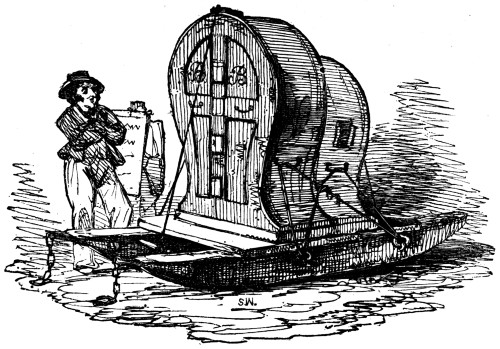
The Lottery Wheel, 1826.
This engraving is slipped on here for the sake of readers who are fond of cuts, rather than as an illustration of any thing immediately preceding. An explanation of it will occur in the ensuing sheet, with several amusing prints relating to the present subject.
Drawing Prizes.
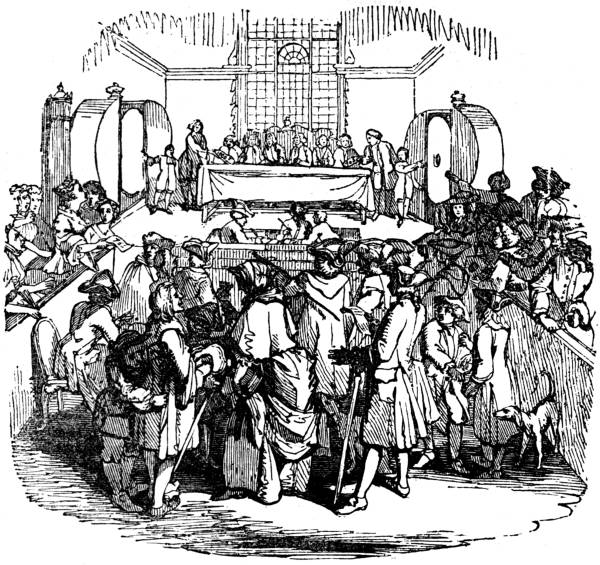
Drawing Prizes.
In “The Examiner”[446] there is an article on Lotteries by Mr. George Smeeton, of Bermondsey: wherein he says, “I am glad to see that Mr. Hone has taken up the subject in his Every-Day Book, by giving us a view of the drawing of the lottery, 1751; and this month (October) I hope he will treat us with a continuation of it. The print by N. Parr, in six compartments, entitled Les Divertissements de la Loterie, is worthy of his attention: it is a lively and true picture of the folly, infatuation, and roguery of the times. If he has not the print (which is rather scarce) I can furnish him with it out of my portfolio.” Mr. Smeeton has obligingly communicated the loan of his engraving, from whence the representation on this page has been selected. The original print, designed by J. Marchant, drawn by H. Gravelot, and engraved by Parr, was “published by E. Ryland, in Ave Mary-lane,” in the year 17— hundred odd; the scissars having snipped away from this copy of the engraving the two figures which particularized the year, it cannot be specified, though from the costume it appears to have been in the reign of George II.
Parr’s print is in six compartments: the four corner ones represent, 1. “Good Luck—£1000 prize;” a scene of rejoicing at the news. 2. “Bad Luck—what, all blanks?” a scene of social disturbance. 3. “Oh—let Fortune be kind;” the desires of a female party in conference with an old woman, who divines by coffee-grounds. 4. “Dear Doctor! consult the stars;” another female party waiting on a fortune-teller for a cast of his office. The middle compartment at the bottom has a view of “Exchange-alley,” with its frequenters, in high business. The middle compartment, above it, is the drawing of the lottery in the view now placed before the reader, wherein it may be perceived that the female visitants are pewed off on one side and the men on the other; and that the pickpockets dextrously exercise their vocation among the promiscuous crowd at the moment when the drawing of a thousand pound prize excites a strong interest, and a female attracts attention by proclaiming herself the holder of the lucky “No. 765.”
To this eager display of the ticket by the fortunate lady, a representation of a scene at the drawing of “the very last lottery that will ever be drawn in England” might be a collateral illustration.
The Unfortunate Lady.
On the 2d of November, 1826, a lady named Free, who had come up from the country to try her fortune in the lottery, complained to the Lord Mayor, at the Mansion-house, that she had been deprived of her property, the sixteenth share of a 30,000l. prize, by the misconduct of those engaged in conducting the drawing. She stated, that she chose the ticket No. 17,092.
The Lord Mayor.—You had some particular reason, then, for selecting that number?
The Complainant replied, it was true, she had; she wished to have a ticket with the number of the year in which she was born, and finding that she could not get that precise number, she took one of 17,000, instead of 1700, as the most fortunate approach. So indeed it turned out to be; for she was sitting in the hall where the lottery was drawn, and heard her number distinctly cried out as one of the 30,000l. prizes, and with her own eyes she distinctly saw the officer stamp it. Nevertheless, another ticket had been returned as the prize.
The Lord Mayor doubted, from the manner in which the tickets were well known to be drawn, whether the complainant’s anxiety had not made her mistake a similar number for her own.
The Complainant.—“Oh no, my lord; it is impossible that I can be mistaken, though other people say I am. I shall not give up my claim, on the word of lottery-office clerks. If there’s any mistake, it is on their part; I trust to my own senses.”
The Lord Mayor observed, that there was scarcely any trusting even to the “senses” on such occasions; and asked her, whether she did not almost feel the money in her pockets at the very time she fancied she heard her number announced?
The Complainant assured his lordship, that she heard the announcement as calmly as could be expected, and that she by no means fainted away. She certainly made sure of having the property; she sat in the hall, and went out when the other expectants came away.
Mr. Cope, the marshal, who stated that he was in attendance officially at the drawing, to keep the peace, declared that he heard all the fortunate numbers announced, and he was sorry to be compelled to state his conviction that this belonging to the lady was not one of them.
The Lord Mayor said, he was afraid the complainant had deceived herself. He dismissed the application, recommending her to go to the stamp-office, and apply to the commissioners, who would do any thing except pay the money to satisfy her.[447]
In allusion to the lady’s name, and his decision on her case, his lordship is said to have observed on her departure, “not Free and Easy.”
Reverting to a former period, for the sake of including some remarkable notices of lotteries adduced by Mr. Smeeton, we find him saying, on the authority of the “London Gazette,” May 17, 1688, that, besides the lottery at the Vere-street theatre, “Ogilby, the better to carry on his Britannia, had a lottery of books at Garraway’s Coffee-house, in ‘Change-alley.”
Mr. Smeeton has the following three paragraphs:—
Lotteries of various kinds seem to have been very general about this period; indeed so much so, that government, issued a notice in the London Gazette, Sept. 27, 1683, to prevent the drawing of any lotteries (and especially a newly-invented lottery, under the name of the riffling, or raffling lottery) except those under his majesty’s letters patent for thirteen years, granted to persons for their sufferings, and have their seal of office with this inscription—‘Meliora Designavi.’
In 1683, prince Rupert dying rather poor, a plan was devised to “raise the wind” by disposing of all his jewels; but as the public were not satisfied with the mode of drawing the lotteries, on account of the many cheats practised on them, they would not listen to any proposals, until the king himself guaranteed to see that all was fair, and also, that Mr. Francis Child, the goldsmith, at Temple-bar, London, would be answerable for their several adventures; as appears by the London Gazette, Oct. 1, 1683:—“These are to give notice, that the jewels of his late royal highness prince Rupert have been particularly valued and appraised by Mr. Isaac Legouch, Mr. Christopher Rosse, and Mr. Richard Beauvoir, jewellers, the whole amounting to twenty thousand pounds, and will be sold by way of lottery, each lot to be five pounds. The biggest prize will be a great pearl necklace, valued at 8,000l., and none less than 100l. A printed particular of the said appraisement, with their divisions into lots, will be delivered gratis, by Mr. Francis Child, at Temple-bar, London, into whose hands such as are willing to be adventurers are desired to pay their money, on or before the first day of November next. As soon as the whole sum is paid in, a short day will be appointed (which, it is hoped, will be before Christmas) and notified in the Gazette, for the drawing thereof, which will be done in his majesty’s presence, who is pleased to declare, that he himself will see all the prizes put in amongst the blanks, and that the whole will be managed with equity and fairness, nothing being intended but the sale of the said jewels at a moderate value. And it is further notified, for the satisfaction of all as shall be adventurers, that the said Mr. Child shall and will stand obliged to each of them for their several adventures. And that each adventurer shall receive their money back if the said lottery be not drawn and finished before the first day of February next.”—Mr. Child was the first regular banker: he began business soon after the Restoration, and received the honour of knighthood. He lived in Fleet-street, where the shop still continues in a state of the highest respectability. A subsequent notice says, “that the king will probably, tomorrow, in the Banquetting-house, see all the blanks told over, that they may not exceed their number; and that the papers on which the prizes are to be written shall be rolled up in his presence; and that a child, appointed either by his majesty or the adventurers, shall draw the prizes.”—What would be said now, if his present majesty were to be employed in sorting, folding, and counting the blanks and prizes in the present lottery?
About 1709, there was the Greenwich Hospital Adventure, sanctioned by an act of parliament, which the managers describe as “liable to none of the objections made against other lotteries, as to the fairness of the drawing, it not being possible there should be any deceit in it, as it has been suspected in others.”—Likewise there was Mr. Sydenham’s Land Lottery, who declared it was “found very difficult and troublesome for the adventurers for to search and find out what prizes they have come up in their number-tickets, from the badness of the print, the many errors in them, and the great quantity of prizes.”—The Twelve-penny, or Nonsuch, and the Fortunatus lotteries, also flourished at the commencement of the eighteenth century.[448]
Lottery of Deer.
In May, 1715, the proprietors of Sion gardens advertised the following singular method of selling deer from their park. They appointed the afternoons of Mondays, Thursdays, and Saturdays, for killing those animals; when the public were admitted at one shilling each to see the operation, or they might purchase tickets from four to ten shillings, which entitled them, it is supposed, by way of lottery, to different parts of the beast,—as they say the quantity killed was to be divided into sixteen lots, and the first choice to be governed by the numbers on the tickets: a ten shilling ticket was entitled to a fillet; eight, a shoulder; seven, a loin, &c. If the full price of the deer was not received on a given day, the keeper held the money till that sum was obtained. They offered to sell whole deer, and to purchase as many as might be offered.[449]
Harburgh Lottery.
In 1723, the resentment of the house of commons was directed against the scheme of a lottery to be drawn at Harburgh, a town of Hanover on the Elbe, opposite Hamburgh, in the king’s German dominions. A committee inquired into this and other lotteries at that time on foot in London. The scheme pretended to raise a subscription for maintaining a trade between Great Britain and the king’s territories on the Elbe. It was a mysterious scene of iniquity, which the committee, with all their penetration, could not fully discover; but they reported, that it was an infamous, fraudulent undertaking, whereby many unwary persons had been drawn in, to their great loss: that the manner of carrying it on had been a manifest violation of the laws of the kingdom: that the managers and agents of this lottery had, without any authority, made use of his majesty’s royal name to countenance the infamous project, and induce his majesty’s subjects to engage or be concerned therein. A bill was brought in to suppress this lottery, and to oblige its managers to make restitution of the money they had received from the contributors. At the same time the house resolved, That John lord viscount Barrington had been notoriously guilty of promoting, abetting, and carrying on the fraudulent undertaking; for which offence he should be expelled the house.[450]
Bank Clerks’ Finesse.
On the 31st of August, 1731, a scene was presented which strongly marks the infatuation and ignorance of lottery adventurers. The tickets for the State Lottery were delivered out to the subscribers at the Bank of England; when the crowd becoming so great as to obstruct the clerks, they told them, “We deliver blanks to-day, but to-morrow we shall deliver prizes;” upon which many, who were by no means for blanks, retired, and by this bold stratagem the clerks obtained room to proceed in their business. In this lottery “her majesty presented his royal highness the duke with ten tickets.”[451]
Love, Death, and the Lottery.
Early in the reign of George II., the footman of a lady of quality, under the absurd infatuation of a dream, disposed of the savings of the last twenty years of his life in two lottery tickets, which proving blanks, after a few melancholy days, he put an end to his life. In his box was found the following plan of the manner in which he should spend the five thousand pound prize, which his mistress preserved as a curiosity:—
“As soon as I have received the money, I will marry Grace Towers; but, as she has been cross and coy, I will use her as a servant. Every morning she shall get me a mug of strong beer, with a toast, nutmeg, and sugar in it; then I will sleep till ten, after which I will have a large sack posset. My dinner shall be on table by one, and never without a good pudding. I will have a stock of wine and brandy laid in. About five in the afternoon I will have tarts and jellies, and a gallon bowl of punch; at ten, a hot supper of two dishes. If I am in a good-humour, and Grace behaves herself, she shall sit down with me. To bed about twelve.”[452]
Fielding’s Farce.
In 1731, Henry Fielding wrote a farce for Drury-lane Theatre, called “The Lottery,” to which, in 1732, he added a new scene. This pleasant representation of characters usually influenced to speculate in such schemes, was acted with considerable success, especially about the time when the lottery was drawn at Guildhall, and may well be conceived as calculated to abate the popular furor. It opens with a lottery-office keeper—
Mr. Stocks, alone.
AIR.
A Lottery is a Taxation, Upon all the Fools in Creation; And, Heaven be prais’d, It is easily rais’d, Credulity’s always in Fashion: For Folly’s a Fund Will never lose Ground, While Fools are so rife in the Nation.
[Knocking without.
Enter 1 Buyer.
1 Buy. Is not this a House where People buy Lottery Tickets?
Stoc. Yes, Sir—I believe I can furnish you with as good Tickets as any one.
1 Buy. I suppose, Sir, ’tis all one to you what Number a Man fixes on.
Stoc. Any of my Numbers.
1 Buy. Because I would be glad to have it, Sir, the Number of my own Years, or my Wife’s; or, if I cou’d not have either of those, I wou’d be glad to have it the Number of my Mother’s.
Stoc. Ay, or suppose, now, it was the Number [1449, 1450] of your Grandmother’s?
1 Buy. No, no! She has no Luck in Lotteries: She had a whole Ticket once, and got but fifty Pounds by it.
Stoc. A very unfortunate Person, truly. Sir, my Clerk will furnish you, if you’ll walk that way up to the office. Ha, ha, ha!—There’s one 10,000l. got!—What an abundance of imaginary rich men will one month reduce to their former Poverty. [Knocking without.] Come in.
Enter 2 Buyer.
2 Buy. Does not your Worship let Horses, Sir?
Stoc. Ay, Friend.
2 Buy. I have got a little Money by driving a Hackney-Coach, and I intend to ride it out in the Lottery.
Stoc. You are in the right, it is the way to drive your own Coach.
2 Buy. I don’t know, Sir, that—but I am willing to be in Fortune’s way, as the saying is.
Stoc. You are a wise Man, and it is not impossible but you may be a rich one—’tis not above—no matter, how many to one, but that you are this Night worth 10,000l.
2 Buy. An belike you, Sir, I wou’d willingly ride upon the Number of my Coach.
Stoc. Mr. Trick, let that Gentleman the Number of his Coach—[Aside.] No matter whether we have it, or no.—As the Gentleman is riding to a Castle in the Air, an airy Horse is the properest to carry him. [Knocking hard without.] Heyday! this is some Person of Quality, by the Impudence of the Footman.
Enter Lady.
Lady. Your Servant, Mr. Stocks.
Stoc. I am your Ladyship’s most obedient Servant.
Lady. I am come to buy some Tickets, and hire some Horses, Mr. Stocks—I intend to have twenty Tickets, and ten Horses every Day.
Stoc. By which, if your Ladyship has any Luck, you may very easily get 30 or 40,000l.
Lady. Please to look at those Jewels, Sir—they cost my Lord upwards of 6000l.—I intend to lay out what you will lend upon ’em.
[Knocking without.
Stoc. If your Ladyship pleases to walk up into the Dining-Room, I’ll wait on you in a Moment.
[Chloe, a lady, holding an undrawn Lottery Ticket, which, from what a fortune-teller told her, what she saw in a coffee dish, and what she dreamt every night, she is confident would come up a prize of ten thousand pounds, desires to consult Mr. Stocks as to how she should lay out the money.]
Enter Stocks.
Stoc. I had the Honour of receiving your Commands, Madam.
Chloe. Sir, your humble Servant—Your Name is Mr. Stocks, I suppose.
Stoc. So I am call’d in the Alley, Madam; a Name, tho’ I say it, which wou’d be as well receiv’d at the Bottom of a Piece of Paper, as any He’s in the Kingdom. But if I mistake not, Madam, you wou’d be instructed how to dispose of 10,000l.
Chloe. I wou’d so, Sir.
Stoc. Why, Madam, you know, at present, Publick Interest is very low, and private Securities very difficult to get—and I am sorry to say, I am afraid there are some in the Alley who are not the honestest Men in the Kingdom. In short, there is one way to dispose of Money with Safety and Advantage, and that is—to put it into the Charitable Corporation.
Chloe. The Charitable Corporation! pray what is that?
Stoc. That is, Madam, a method, invented by some very wise Men, by which the Rich may be charitable to the Poor, and be Money in Pocket by it.
The Charitable Corporation.
This company, erected in 1707, professed to lend money at legal interest to the poor upon small pledges; and to persons of better rank upon security of goods impawned. Their capital, at first limited to £30,000, was by licenses from the crown increased to £600,000, though their charter was never confirmed by act of parliament. In 1731, George Robinson, esquire, member for Marlow, the cashier, and John Thompson, warehouse-keeper of the corporation, disappeared in one day. The alarmed proprietors held several general courts, and appointed a committee to inspect their affairs, who reported, that for a capital of above £500,000 no equivalent was found; inasmuch as their effects did not amount to the value of £30,000, the remainder having been embezzled. The proprietors, in a petition to the house of commons, represented that, by a notorious breach of trust, the corporation had been defrauded of the greatest part of their capital; and that many of the petitioners were reduced to the utmost misery and distress: they therefore prayed parliament to inquire into the state of the corporation, and the conduct of their managers, and extend relief to the petitioners. On this petition a secret committee was appointed, who soon discovered a most iniquitous scene of fraud, perpetrated by Robinson and Thompson, in concert with some of the directors, for embezzling the capital, and cheating the proprietors. Many persons of rank and quality were concerned in this infamous conspiracy. Sir Robert Sutton and sir Archibald Grant were expelled the house of commons, as having had a considerable share in those fraudulent practices, and a bill was brought in to restrain them and other delinquents from leaving the kingdom, or alienating their effects.[453] In 1733, parliament granted a lottery in behalf of the sufferers. On the 1st of August in that year, books were opened at the bank to receive, from those who had given in their names, the first payment of one pound per ticket in the “Lottery for the relief of the Charitable Corporation;”[454] and in 1734 “it was distributed among them, amounting to nine shillings and ninepence in the pound on their loss.”[455]
The “London Journal” of October 30, 1731, observing on the general disposition to adventure says:—
The natural life of man is labour or business; riches is an unnatural state; and therefore generally a state of misery. Life, which is a drug in the hands of idle men, never hangs heavily on the hands of merchants and tradesmen, who judiciously divide their time between the city and country.
This is so true, that a wise man would never leave his children so much money as to put them beyond industry; for that is too often putting them beyond happiness. The heaping up riches for posterity is, generally speaking, heaping up destruction; and entailing of large estates, entailing vice and misery.
These thoughts were occasioned by the present state lottery; which plainly discovers that the people would run into the excesses of the South Sea year, had they the same opportunities. The spring and source of this unreasonable passion, is the luxury of the age. Tradesmen commence gentlemen and men of pleasure, when they should be men of business; and begin where they should end. This sets them a madding after lotteries; business is neglected, and poverty, vice, and misery spread among the people. It is hoped that the Parliament will never come into another lottery. All other gaming should be also discouraged. Who but laments that unfortunate young lady at the Bath, who was ruined by gaming, and rather than submit to a mean dependance, thought it best to resign her life?[456]
The tone of dissuasion from lotteries and gambling in the year 1731, prevails through the writings of the different persons who opposed such schemes and practices. The story of the “unfortunate young lady at the Bath, who was ruined by gaming,” referred to in the last paragraph, and already related in this work, is exceedingly affecting.
Westminster Bridge Lottery.
In the 9th year of George II. parliament passed an act for building this bridge by a lottery, and the following scheme was issued to the public:—
LOTTERY 1736, for raising 100000l. for building a Bridge at Westminster, consisting of 125000 Tickets, at 5l. each.
Prizes 1 — of — 20000 l. — is — 20000 l.
2 10000 20000
3 5000 15000
10 3000 30000
40 1000 40000
60 500 30000
100 200 20000
200 100 20000
400 50 20000
1000 20 20000
28800 10 288000
30616 Prizes, amounting to 523000
94384 Blanks.
First Drawn 1000
Last Drawn 1000
125000 525000
The Prizes to be paid at the Bank in 40 Days after Drawing, without Deduction. N.B. There is little more than Three Blanks to a Prize.[457]
Parliament granted successive lotteries for the building and completion of Westminster-bridge.
An Organ Lottery.
In 1737, Horace Walpole (Lord Orford) says, “I am now in pursuit of getting the finest piece of music that ever was heard; it is a thing that will play eight tunes. Handel and all the great musicians say, that it is beyond any thing they can do; and this may be performed by the most ignorant person; and when you are weary of those eight tunes, you may have them changed for any other that you like. This I think much better than going to an Italian opera, or an assembly. This performance has been lately put into a Lottery, and all the royal family chose to have a great many tickets, rather than to buy it, the price being I think 1000l., infinitely a less sum than some bishopricks have been sold for. And a gentleman won it, who I am in hopes will sell it, and if he will, I will buy it, for I cannot live to have another made, and I will carry it into the country with me.”
In the State Lottery of 1739, tickets, chances, and shares were “bought and sold by Richard Shergold, printer to the honourable the commissioners of the Lottery, at his office at the Union Coffee-house over and against the Royal Exchange, Cornhill.” He advertised, that he kept numerical books during the drawing, and a book wherein buyers might register their numbers at sixpence each; that 15 per cent. was to be deducted out of the prizes, which were to be paid at the bank in fifty days after the drawing was finished; and that “schemes in French and English” were given gratis.[458]
The per centage to be deducted from the prizes in this lottery occasioned the following
Epigram.
This lottery can never thrive, Was broker heard to say, For who but fools will ever give Fifteen per cent to play. A sage, with his accustomed grin, Replies, I’ll stake my doom, That if but half the fools come in The wise will find no room.[459]
Lottery at Stationers’ Hall.
On the 23d of November, 1741, “the drawing of the Bridge Lottery began at Stationers’ Hall.—The Craftsman of the 28th says, that every 100,000l. laid out in a lottery puts a stop to the circulation of at least 300,000l., and occasions almost a total suppression of trade.”[460]
In June, 1743, “the price of lottery tickets having risen from 10l. to 11l. 10s. some persons, who probably wanted to purchase, published a hint to the unwary adventurers, that they gamed at 50 per cent. loss; paying, at that price, 2s. 6d. to play for 5s.; the money played for being only three pound, besides discount and deductions.”[461]
Ticket stuck in the Wheel.
On the 5th of January, 1774, at the conclusion of drawing the State Lottery at Guildhall, No. 11,053, as the last drawn ticket, was declared to be entitled to the 1000l., and was so printed in the paper of benefits by order of the commissioners. It was besides a prize of 100l. But after the wheels were carried back to Whitehall and there opened, the ticket No. 72,248 was found sticking in a crevice of the wheel. And, being the next drawn ticket after all the prizes were drawn, was advertised by the commissioners’ order as entitled to the 1000l., as the last drawn ticket: “which affair made a great deal of noise.”[462]
A Peer’s Substitute for Lotteries.
On the bill, for a lottery to succeed the preceding, being brought into the house of lords, a peer said, that such measures always were censured by those that saw their nature and their tendency. “They have been considered as legal cheats, by which the ignorant and the rash are defrauded, and the subtle and avaricious often enriched. They have been allowed to divert the people from trade, and to alienate them from useful industry. A man who is uneasy in his circumstances, and idle in his disposition, collects the remains of his fortune, and buys tickets in a lottery, retires from business, indulges himself in laziness, and waits, in some obscure place, the event of his adventure. Another, instead of employing his stock in a shop or a warehouse, rents a garret in a private street, and make it his business, by false intelligence, and chimerical alarms, to raise and sink the price of tickets alternately, and takes advantage of the lies which he has himself invented. If I, my lords, might presume to recommend to our ministers the most probable method of raising a large sum for the payment of the troops of the electorate, I should, instead of the tax and lottery now proposed, advise them to establish a certain number of licensed wheel-barrows, on which the laudable trade of thimble and button might be carried on for the support of the war, and shoe-boys might contribute to the defence of the house of Austria, by raffling for apples.”
Chances of Tickets.
The State Lottery of 1751 seems to have encountered considerable opposition. There is a discouraging notice in the “Gentleman’s Magazine” on the 4th of July in that year, that “those inclined to become adventurers in the present lottery were cautioned in the papers to wait some time before they purchased tickets, whereby the jobbers would be disappointed of their market, and obliged to sell at a lower price. At the present rate of tickets the adventurer plays at 35 per cent. loss.”
In the next month, August, the “London Magazine” exhibited the following computation.
IN THE LOTTERY 1751, IT IS
69998 to 2 or 34999 to 1 against a £10000 prize.
69994 to 6 or 11665 to 1 against a 5000 or upwards.
69989 to 11 or 6363 to 1 against a 3000
69981 to 19 or 3683 to 1 against a 2000
69961 to 39 or 1794 to 1 against a 1000
69920 to 80 or 874 to 1 against a 500
69720 to 280 or 249 to 1 against a 100
69300 to 700 or 99 to 1 against a 50
60000 to 10000 or 6 to 1 against a 20 or any prize.
The writer says, I would beg the favour of all gentlemen, tradesmen, and others, to take the pains to explain to such as any way depend upon their judgment, that one must buy no less than seven tickets to have an even chance for any prize at all; that with only one ticket, it is six to one, and with half a ticket, twelve to one against any prize; and ninety-nine or a hundred to one that the prize, if it comes, will not be above fifty pounds; and no less than thirty-five thousand to one that the owner of a single ticket will not obtain one of the greatest prizes. No lottery is proper for persons of very small fortunes, to whom the loss of five or six pounds is of great consequence, besides the disturbance of their minds; much less is it advisable or desirable for either poor or rich to contribute to the exorbitant tax of more than two hundred thousand pounds, which the first engrossers of lottery tickets, and the brokers and dealers strive to raise, out of the pockets of the poor chiefly, and the silly rich partly, by artfully enhancing the price of tickets above the original cost.
The prices of tickets in this lottery was ten pounds. On their rise a Mr. Holland publicly offered to lay four hundred guineas, that four hundred tickets, when drawn, did not amount to nine pounds fifteen shillings on an average, prizes and blanks; his advertisement was never answered.
These animadversions on the scheme, and the resistance offered to the endeavours of the brokers and dealers to effect a rise in the price of tickets, appear, from the following lines published in October, to have been to a certain degree successful—
A New Song From ‘Change-alley, occasioned by a stagnation of the sale of Lottery Tickets.
While guineas were plenty, we thought we might rise, Nor dreamt of a magpye to pick out our eyes; ’Twas twelve would have satisfy’d all our desire, Tho’ perhaps without pain we might see them mount higher. Derry down, down, down derry, &c. How sweet were the pickings we formerly gain’d, From whence our fine daughters their fortunes obtain’d! In our coaches can roll, at the public can smile, Whose follies reward all our labour and toil. Derry down, &c. Then let them spin out their fine scheme as they will, No horseshoe nor magpye shall baffle our skill; In triumph we’ll ride, and, in spite of the rout, Our point we’ll obtain without wheeling about. Derry down, &c. Tho’ sturdy these beggars, yet weak are their brains; Who offer to check us, must smart for their pains; In concert united, we’ll laugh at the tribe, Who play off their engines to damp all our pride. Derry down, &c. Let Holland no longer appear with his brags, His four hundred guineas keep safe in his bags, Nor think we’re such fools to risque any thing down, By way of a wager to humour the town. Derry down, &c.[463]
On the 11th of the next month, November, the drawing of the State Lottery began, when, notwithstanding the united efforts of several societies and public-spirited gentlemen to check the exorbitancy of the ticket-mongers, the price rose to sixteen guineas just before drawing. All means were tried to cure this infatuation by writing and advertising; particularly on the first day of drawing, it was publicly averred, that near eight thousand tickets were in the South Sea House, and upwards of thirty thousand pawned at bankers, &c. that nine out of ten of the ticket-holders were not able to go into the wheel; and that not one of them durst stand the drawing above six days. It was also demonstrated in the clearest manner, that to have an even chance for any prize a person must have seven tickets; that with only one ticket it was six to one; and ninety-nine to one that the prize, if it came, would not be above fifty pounds, and no less than thirty-five thousand to one that the owner of a single ticket would not obtain one of the greatest prizes.—Yet, notwithstanding these and other precautions, people still suffered themselves to be deluded, and the monied men arrogantly triumphed.[464]
A Lottery Job in Ireland.
In August, 1752, a lottery was set on foot at Dublin, under the pretext of raising 13,700l. for rebuilding Essex-bridge, and other public and charitable uses. There were to be 100,000 tickets, at a guinea each. The lords justices of Ireland issued an order to suppress this lottery. The measure occasioned a great uproar in Dublin; for it appears, that the tickets bore a premium, and that though the original subscribers were to have their money returned, the buyers at the advanced price would lose the advance. Every purchaser of a single ticket in this illegal lottery incurred a penalty of 50l. for each offence, and the seller 500l., one third of which went to the informer, a third to the king, and the other third to the poor of the parish; besides which, the offenders were subject to a year’s close imprisonment in the county gaol.[465]
Leheup’s Fraud.
To prevent the monopoly of tickets in the State Lottery, it had been enacted, that persons charged with the delivery of tickets should not sell more than twenty to one person. This provision was evaded by pretended lists, which defeated the object of parliament and injured public credit, insomuch that, in 1754, more tickets were subscribed for than the holders of the lists had cash to purchase, and there was a deficiency in the first payment. The mischief and notoriety of these practices occasioned the house of commons to prosecute an inquiry into the circumstances, which, though opposed by a scandalous cabal, who endeavoured to screen the delinquents, ended in a report by the committee, that Peter Leheup, esq. had privately disposed of a great number of tickets before the office was opened to which the public were directed by an advertisement to apply; that he also delivered great numbers to particular persons, upon lists of names which he knew to be fictitious; and that, in particular, Sampson Gideon became proprietor of more than six thousand, which he sold at a premium. Upon report of these and other illegal acts, the house resolved that Leheup was guilty of a violation of the act, and a breach of trust, and presented an address to his majesty, praying that he would direct the attorney-general to prosecute him in the most effectual manner for his offences.
An information was accordingly filed, and, on a trial at bar in the court of king’s bench, Leheup, as one of the receivers of the last lottery of 300,000l., was found guilty: 1. Of receiving subscriptions before the day and hour advertised; 2. Of permitting the subscribers to use different names to cover an excess of twenty tickets; and 3. Of disposing of the tickets which had been bespoke and not claimed, or were double charged, instead of returning them to the managers. In Trinity term, Leheup was brought up for judgment, and fined 1000l., which he paid in court. As he had amassed forty times that sum by his frauds, the lenity of the sentence was the subject of severe remark.[466]
Lottery Insanity.
November 5, 1757, Mr. Keys, late clerk to Cotton and Co., who had absented himself ever since the 7th of October, the day the 10,000l. was drawn in the lottery, (supposed to be his property,) was found in the streets raving mad, having been robbed of his pocket-book and ticket.[467]
The subjoined verses appeared in 1761:[468]—
A few Thoughts on Lotteries.
A Lottery, like a magic spell, All ranks of men bewitches, Whose beating bosoms vainly swell With hopes of sudden riches: With hope to gain Ten Thousand Pound How many post to ruin, And for an empty, airy sound Contrive their own undoing! Those on whom wealth her stores had shed, May firmly bear their crosses; But they who earn their daily bread, Oft sink beneath their losses. ’Tis strange, so many fools we find, By tickets thus deluded, And, by a trifling turn of mind, From life’s blest bliss excluded. For life’s best blessing, calm content, Attends no more his slumbers, Who dreams of profit, cent. per cent. And sets his heart on numbers. Thro’ all life’s various stages, care Our peace will oft disquiet; Like a free-gift it comes, we ne’er Need be in haste to buy it. He who, intent on shadowy schemes, By them is deeply bubbled, Deserves to wake from golden dreams, With disappointment doubled. Unmoved by Fortune’s fickle wheel, The wise man chance despises; And Prudence courts with fervent zeal— She gives the highest prizes.
Large Division of Tickets.
In some of the old lotteries tickets were divided into a much greater number of shares than of late years. There is an example of this in the following
Advertisement, November, 1766.
Dame Fortune presents her respects to the public, and assures them that she has fixed her residence for the present at Corbett’s, State Lottery-office, opposite St. Dunstan’s-church, Fleet-street; and, to enable many families to partake of her favours, she has ordered not only the tickets to be sold at the lowest prices, but also that they be divided into shares at the following low rates, viz:—