JULY. (continued 3)
Reading edition
Order of the Catalogue.
Days.
Part I. 5th May to 13th 8
— II. 14th 22d 8
— III. 23d 31st 8
— IV. 2d June to 11th 8
— V. 12th 20th 8
— VI. 21st 9th July 17
Addition 10th July to 13th 3
Appendix 14th 18th 5
Days 65
Leicester House.
The first exhibition of the Leverian Museum in London, was at “Leicester house,” Leicester-square. “This house was founded,” Mr. Pennant says, “by one of the Sydnies, earls of Leicester. It was for a short time the residence of Elizabeth, daughter of James I., the titular queen of Bohemia, who, on February 13, 1661, here ended her unfortunate life. It was successively the pouting-place of princes. The late king (George II.) when prince of Wales, after he had quarrelled with his father, lived here several years. His son, Frederick, followed his example, succeeded him in his house, and in it finished his days.”
Mr. Pennant then proceeds, more immediately to our purpose, to observe, “No one is ignorant of the magnificent and instructive museum, exhibited in this house by the late sir Ashton Lever. It was the most astonishing collection of the subjects of natural history ever collected, in so short a space, by any individual. To the disgrace of our kingdom, after the first burst of wonder was over, it became neglected; and when it was offered to the public, by the chance of a guinea lottery, only eight thousand out of thirty-six thousand tickets were sold. Finally, the capricious goddess frowned on the spirited proprietor of such a number of tickets, and transferred the treasure to the possessor of only two, Mr. Parkinson.” Further on, Mr. Pennant says, “I must not omit reminding the reader, that the celebrated museum collected by the late sir Ashton Lever, is transported to the southern end of Blackfriars-bridge by Mr. Parkinson, whom fortune favoured with it in the Leverian lottery. That gentleman built a place expressly for its reception, and disposed the rooms with so much judgment, as to give a most advantageous view of the innumerable curiosities. The spirit of the late worthy owner seems to have been transfused into the present. He spares no pains or expense to augment a collection, before equally elegant and instructive.”
Mr. Pennant, in his “History of Quadrupeds,” likewise makes mention of the Leverian Museum, as “a liberal fund of inexhaustible knowledge in most branches of natural history,” and he especially names “the matchless collection of animals” there exhibited, to which he had recourse while correcting the descriptions for the last edition of his work.
We have gathered from Mr. Pennant, that the Leverian Museum was disposed of by lottery, and his own opinion, as a naturalist, of its merit. The evidence whereon the committee of the house of commons founded its report in behalf of the bill, which afterwards passed and enabled sir Ashton Lever to dispose of his museum in that manner, amply testifies the opinion conceived of it by individuals fully qualified to decide on its importance.
Mr. Tennant who had been upwards of twenty years a collector of subjects of natural history, and had seen all the cabinets of curiosities, both public and private, of any note in Holland, France, and Portugal, and those at Brussels, Dresden, Brunswick, and Vienna, and had also seen the Spanish cabinet while collecting in Holland, said, that he had never seen any collection more rare, more curious, or more instructive than sir Ashton Lever’s, nor any that could be compared with it; that it exceeded all others in the beauty and preservation of the numerous articles it contained, which were better selected than any he had seen elsewhere; and that it contained many specimens that could not be procured at any expense.
Sir William Hamilton gave similar testimony. Having a particular love for natural history, in different journeys to and from Naples, where he was ambassador from Great Britain, he had seen every public and private museum in Holland, France, Germany, Italy, and Sicily, and he thought sir Ashton Lever’s collection was in every respect the finest.
Baron Dimsdale said he had seen the cabinets of curiosities at Moscow and St. Petersburgh, and also those at Paris and Dresden, which are esteemed very curious and valuable, and that they were not, all together, to be compared with sir Ashton Lever’s museum.
After such distinguished and unquestionable testimonials respecting this collection, it would be trifling to adduce a poem in proof that it merited praise; but as a curiosity, which, on account of the youth of its author, sir Ashton Lever himself must have deemed a “curiosity,” the following may be perused with interest.
VERSES,
Addressed to Sir Ashton Lever, by a little Boy of Ten Years old on being favoured with a sight of his Museum.
November 6, 1778.
If I had Virgil’s judgment, Homer’s fire, And could with equal rapture strike the lyre, Could drink as largely of the muse’s spring, Then would I of sir Ashton’s merits sing. Look here, look there, above, beneath, around, Sure great Apollo consecrates the ground. Here stands a tiger, mighty in his strength, There crocodiles extend their scaly length: Subtile, voracious to devour their food, Savage they look, and seem to pant for blood. Here shells and fish, and finny dolphins seen, Display their various colours blue and green. View there an urn which Roman ashes bore, And habits once that foreign nations wore. Birds and wild beasts from Afric’s burning sand, And curious fossils rang’d in order stand. Now turn your eyes from them, and quick survey, Spars, diamonds, crystals, dart a golden ray View apes in different attitudes appear, With horns of bucks, and goats, and shamois deer. Next various kinds of monsters meet the eye; Dreadful they seem, grim-looking as they lie. What man is he that does not view with awe The river-horse that gives the Tigris law? Dauntless he looks, and, eager to engage, Lashes his sides, and burns with steady rage. View where an elephant’s broad bulk appears, And o’er his head his hollow trunk he rears: He seems to roar, impatient for the fight, And stands collected in his utmost might. Some I have sung, much more my muse could name; A nobler muse requires sir Ashton’s fame. I’ve gained my end, if you, good sir, receive This feeble present, which I freely give. Your well-known worth, to distant nations told, Amongst the sons of Fame shall be enroll’d.
T. P.[262]
Kennington, Nov. 8, 1778.
Ticket of Admission to the Leverian Museum.
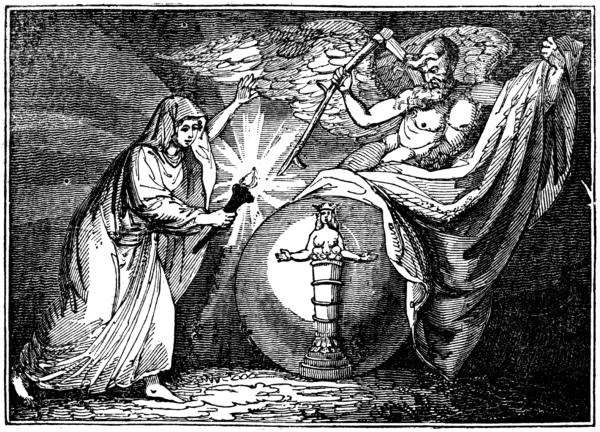
Ticket of Admission to the Leverian Museum. Issued by Mr. Parkinson after he obtained it by Lottery.
It seems appropriate and desirable to give the above representation of Mr. Parkinson’s ticket, for there are few who retain the original. Besides—the design is good, and as an engraving it is an ornament.
And—as a memorial of the method adopted by sir Ashton Lever to obtain attention to the means by which he hoped to reimburse himself for his prodigious outlay, and also to enable the public to view the grand prize which the adventure of a guinea might gain, one of his advertisements is annexed from a newspaper of January 28, 1785.
SIR ASHTON LEVER’s Lottery Tickets are now on sale at Leicester-house, every day (Sundays excepted) from Nine in the morning till Six in the evening, at One Guinea each; and as each ticket will admit four persons, either together or separately, to view the Museum, no one will hereafter be admitted but by the Lottery Tickets, excepting those who have already annual admission.
This collection is allowed to be infinitely superior to any of the kind in Europe. The very large sum expended in making it, is the cause of its being thus to be disposed of, and not from the deficiency of the daily receipts (as is generally imagined) which have annually increased, the average amount for the last three years being 1833l. per annum.
The hours of admission are from Eleven till Four.
Good fires in all the galleries.
The first notice of the Leverian Museum is in the “Gentleman’s Magazine” for May, 1773, by a person who had seen it at Alkerington, near Manchester, when it was first formed. Though many specimens of natural history are mentioned, the collection had evidently not attained its maturity. It appears at that time to have amounted to no more than “upwards of one thousand three hundred glass cases, containing curious subjects, placed in three rooms, besides four sides of rooms shelved from top to bottom, with glass doors before them.” The works of art particularized by the writer in the “Gentleman’s Magazine,” are “a head of his present majesty, cut in cannil coal, said to be a striking likeness; indeed the workmanship is inimitable—also a drawing in Indian ink of a head of a late duke of Bridgewater, valued at one hundred guineas—a few pictures of birds in straw, very natural, by Miss Gregg; a basket of flowers, cut in paper, a most masterly performance; the flowers are justly represented, not the least dot of the apices of the stamina wanting, or the least fault in the proportion; every part is so truly observed, that it was new to me every time I went to see it, and gave me great delight. This curious basket of flowers was executed by Mrs. Groves. There are a great number of antique dresses and parts of dresses of our own and other nations—near two hundred species of warlike instruments, ancient and modern; but as I am no friend to fighting, of these I took no further notice, or else I might have mentioned the tomahawk, the scalping-knife, and many more such desperate diabolical instruments of destruction, invented, no doubt, by the devil himself.”
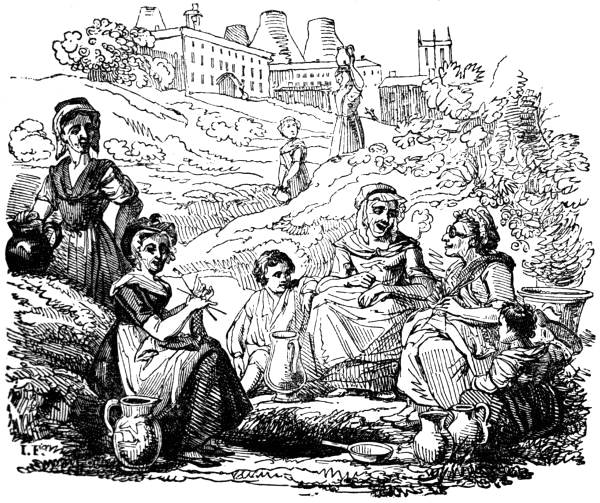
A Summer Scene in the Potteries.
Down in the Potteries it’s “a sight,” The whole day long, from morn till night, To see the girls, and women grown, The child, the damsel, and old crone By the well-sides at work, or singing, While waiting for the water’s springing; Telling what Francis Moore presages, Or who did not bring home his wages. P’rhaps one exclaims, “time runs away!” Her neighbour cries, “Why, what’s to-day?” And, when she knows, feigns mighty sorrow— She thought to-day would be to-morrow? Another thinks another’s daughter Grows monstrous tall——“Halloo! the water!” Up it rises, and they skurry, In a skimble skamble hurry, Shouting and bawling “Where’s the pot?” “Why I was first”—“No, you were not.”— As quick as thought they empt’ the well, And the last comers take a spell, At waiting, while the others go, With their full pitchers, dawdling so, You’d think they’d nothing else to do But to keep looking round at you. However, all are honest creatures, And some have pretty shapes and features: So, if there be an end of lotteries, You may find prizes in the Potteries.
*
NATURALISTS’ CALENDAR.
Mean Temperature 62·52.
July 19.
K. George IV. crowned. Holiday at all the public offices.
“The Glory of Regality.”
This is the title of “A Historical Treatise on the Anointing and Crowning of the Kings and Queens of England, by Arthur Taylor, Fellow of the Society of Antiquaries. London: 1820.” 8vo. pp. 440.
The present notice is designed to acquaint inquirers with the most important and satisfactory work regarding our regal ceremonies that exists. Mr. Taylor’s volume is a storehouse of information concerning the kingly title and office, the regalia, the assistants at the coronation, the tenants of the crown by grand sergeantry performing services, the ceremonial, the processions, and the feast. That part of the book entitled a “Chronicle of the Coronations,” is full of singular details. The “History of the Coronation Oath” is remarkably curious and interesting. There is likewise an appendix of important documents and records, a valuable index, and, according to a good old custom, which modern authors find it convenient to neglect, the reader is referred to every source of information on the subjects treated of, by a list of upwards of two hundred and thirty works resorted to, and quoted by Mr. Taylor, in the course of his labours. Few writers of the present day have achieved a monument of so much diligence as this work.—The trifling sum at which it was published can scarcely have remunerated its erudite author, beyond the expense of the paper and print and wood engravings.
Mr. Arthur Taylor is in the foremost rank of learned typographers; and, better for himself in a pecuniary view, he is printer to the corporation of London, to which office he was elected while travelling in Italy, after the publication of his “Glory of Regality.”
NATURALISTS’ CALENDAR.
Mean Temperature 63·87.
July 20.
St. Margaret.
This saint is in the church of England calendar and the almanacs.
Butler speaks of her merely as a virgin, who is “said” to have been instructed in the faith by a christian nurse, and persecuted by her father, who was a pagan priest; that after being tormented, she was martyred by the sword “in the last general persecution;” that “her name occurs in the litany inserted in the old Roman order,” and in ancient Greek calendars; that, from the east, her veneration was exceedingly propagated in England, France, and Germany during the holy wars; that “Vida, the glory of the christian muses,” honoured her as “one of the titular saints of Cremona, his native city, with two hymns, begging of God through her prayers” a happy death and a holy life; and that “her body is now kept at Monte Fiascone, in Tuscany.”
The Egyptians are not more famous for embalming, than the Romish church is celebrated for the keeping of saints’ bodies—with the additional reputation of a peculiar tact at discovering them. It was not at all uncommon to distinguish their bones, from other mortuary remains, a few centuries after death.
We are told that St. Margaret received the crown of martyrdom in the year 278,[263] therefore her body, “now kept at Monte Fiascone,” may be regarded to have been as well “kept” through one thousand five hundred years, as those of other saints; for it must be observed that none but saints’ bodies “keep.” There is not an instance of the body of any lay individual, however virtuous or illustrious, having remained to us through fifteen centuries.
The illustrious father of the order of the Jesuits, Peter Ribadeneira, rather confusedly relates that St. Margaret was devoured by the devil; and “in an other place it is sayd that he swalowed her into his bely,” and that while in his inside she made the sign of the cross, and she “yssued out all hole and sounde,” though it is added that this account “is apocrifum.” We are told that a devil appeared to her in the likeness of a man, but she caught him by the head, threw him down, set her right foot on his neck, and said, “Lye still thou fende, under the fote of a woman.” In that situation the devil admitted he was vanquished, and declared he would not have cared if a young man had conquered him, but he was very vexed to have been overcome by a young woman. St. Margaret asked him what he was, and he answered that his name was Veltis, that he was one of a multitude of devils who had been enclosed in a brass vessel by Solomon, and that after Solomon’s death this vessel was broken at Babylon by persons who supposed it contained a treasure, when all the devils flew out and took to the air, where they were incessantly espying how to “assayle ryghtfull men.” Then she took her foot from his neck, and said to him, “Flee hens thou wretched fende,” and behold “the earth opened and the fende sanke in.”[264]
However “right comfortable” this relation may be, there is more “delection” in that of St. Margaret being swallowed by the devil; it is a pity it is “apocrifum.”
NATURALISTS’ CALENDAR.
Mean Temperature 63·25.
July 21.
St. Victor of Marseilles.
We are informed by Butler that this saint was a martyr under the emperor Maximian. From his silence as to the saint’s life, it is to be inferred that biographers of saints were rare, while, from his elaborate account of the saint’s death, it is to be inferred that their martyrdoms were attended by able reporters.
The abbey of St. Victor at Marseilles was one of the most celebrated religious foundations in Europe. It claimed to have been the first monastery established in France. Its ruins are striking objects of curiosity to visiters of the town.
St. Victor’s monastery was founded by St. Cassien, patriarch of Constantinople, in the fourth or fifth century. The spot was fixed upon by St. Cassien for his new foundation, from the ground being already considered as sacred by the Marseillais, for we are assured that Mary Magdalen and her brother Lazarus arrived in Provence with a cargo of saints, fixed their residence at Marseilles, and converted a great number of the inhabitants; and that Mary Magdalen after remaining there some time, desirous of being more secluded, withdrew to a grotto in the rock on which the abbey of St. Victor now stands. Still, pressed by crowds, she removed a league from Marseilles to the quarter of Aygalades, where afterwards was founded a monastery of the Carmes. Even here she could not find seclusion, and she finally fixed her retreat at the Sainte Beaume, a grotto in the mountain of St. Pilon, in a more remote part of the country where she ended her days.
On the spot sanctified by her first retreat, a chapel was erected and dedicated to the Holy Virgin under the title of “Nôtre Dame de la Confession.” A little confusion seems here to have been made between Mary Magdalen, in remembrance of whom the spot was considered as sacred, and the virgin mother; for after the monastery was built, a chapel in it was dedicated to the Virgin Mary, while little notice was taken of Mary the penitent.
The monastery of St. Cassien many years after the body of the celebrated St. Victor was interred there, was called the monastery of St. Victor. His foot was said to have been cut off by order of Maximian, for having kicked down a statue of Jupiter when required to sacrifice to it; this foot has been a relic in high esteem ever since. Afterwards his head was cut off, and the head became another relic of very high value. Various miracles are reported to have been wrought at his tomb, particularly in the cure of demoniacs.
It is also related that the tomb of the emperor Maximian, who died and was interred at Marseilles, was discovered about the middle of the eleventh century, and recognised to be his by an inscription. The body was in a leaden coffin, and found entire, having been preserved by an odoriferous liquor with which it was anointed without, and filled within. Two chalices of gold, full of the same liquor, were placed on each side of the head. As a persecutor of the christian church, his body was by order of Raimbaud, archbishop of Aries, thrown into the sea; and it is alleged that for some time after the water of the spot where it was thrown bubbled furiously, as if boiling over a fire, and cast up smoke and flames from the bosom of the deep.
There is a tradition respecting St. Victor in the archives of the abbey, that a dragon of the wood adjoining devoured every thing that came in his way, human beings as well as animals; whereupon St. Victor went forth to fight him, armed cap-à-piè, and mounted on a mettled courser, and that he slew him and freed the country from so terrible a scourge. An effigy of the saint, engaged with his fearful antagonist, was carved in stone, and placed over the porch of the great church: and the same device was adopted as the great seal of the monastery. The carving over the church porch remains to this day, though somewhat defaced: it is the exact counterpart of the English St. George and the dragon. Underneath is inscribed
Massiliam vere. (Victor) civesque tuere.
On the St. Victor’s day, which is the twenty-first of July, there were formerly held at Marseilles a festival and procession in honour of him, called “La Triomphale.” The relics of the saint were carried round the town by the prior of the monastery, attended by the whole community. At the head of the procession marched a cavalier in complete armour, highly ornamented, carrying a lance in one hand, and in the other the standard of the abbey, on which were the arms richly embroidered; he wore a rich scarf, and his horse had a housing of white damask, ornamented with blue crosses. This cavalier was intended to represent St. Victor. He was preceded by twelve cavaliers carrying lighted tapers, and accompanied by a band of music with drums and trumpets. Six pages followed him. As soon as the people heard the music, and saw the standard, they flocked in crowds to join the procession. As it passed along the quay of the port, all the vessels hoisted their colours, and saluted it with a discharge of cannon and musquetry; and the consuls, with the rest of the magistrates, met it at an appointed place, to pay their homage to the saint, and attend him back to the abbey.
This ceremony had been observed every year from time immemorial, till monsieur de Belsunce, the bishop of Marseilles, who distinguished himself so much in the great plague of 1720, prevailed upon the magistrates to consent to the abolition of it, for the following reason. He was about to publish a biography of the bishops, his predecessors, from the first conversion of the town to the christian faith, among whom it was necessary to include St. Victor; and not wishing him to appear otherwise than a christian bishop and martyr, he thought he would not be considered in these lights only, while the people were accustomed to see him every year in a character directly opposite; so that no way appeared of making the impression he desired, except by abolishing the annual ceremony. Until then the relics of St. Victor, who was esteemed the patron saint of Marseilles were always borne in the procession. They were likewise carried in procession at the time of any public calamity; but on these occasions the armed cavalier did not make his appearance.
The grotto, which for a short time had been the residence of Mary Magdalen, was, on the foundation of the monastery converted into a chapel, and a tomb erected to her memory. It was said that no woman could enter this chapel without being immediately struck blind; and for some centuries no female attempted to penetrate the sanctity of the place, till the celebrated queen Joan insisted on admission, when it is said she had sooner passed the portal than she was deprived of her sight. It was afterwards restored, on her putting a balustrade of solid silver round the image of the virgin. This image has been preserved, and a place has been allotted her in the church; but one of the remarkable effects of the French revolution is, that a woman can now look at it without experiencing the least inconvenience.
On the tomb of the Magdalen, which was of white marble, were many curious figures carved in relief—among others a wolf suckling two children; and in the inferior church were seven very fine marble columns of the Corinthian order. These are supposed to have been some of the many spoils of the Pagan temples, which the monks of St. Victor are known to have appropriated to their own use.
It was formerly a popular belief, that in this place were deposited the bodies of seven brothers who were not dead, but lay there to sleep till the general resurrection. What became of them at the demolition of the abbey does not appear.
Among the curiosities of the abbey of St. Victor was a well, with a small column of granite on each side of it. On one of the columns was a figure which was called the impression of the devil’s claw; and the story concerning it was, that the old gentleman, being envious of the superior sanctity of the holy fathers, stole one day into the monastery with a malicious intention to corrupt them. What form he assumed is not stated by the record, but he was soon discovered, and obliged to make his escape; in doing which he stepped over these two columns, and left the impression of his claw upon one of them. The truth was, that the columns were ancient ones, and the devil’s claw the remains of an acanthus’ leaf.
The abbey of St. Victor was secularized under Louis XV. Formerly none but natives of Marseilles could be members of the community, and the city had the right of placing in it, a certain number of youth for education free of expense. These valuable privileges were surrendered, and the canons were in future only to be chosen from among such families of Provence, as could produce a title of a hundred and fifty years’ nobility on the paternal side. From that time the foundation assumed the title of “the noble and illustrious collegiate church of St. Victor.”
In a few years afterwards, the new canons, being all nobles, petitioned the king for a badge to distinguish them from the other chapters of the province; and they obtained permission to wear a cross, or rather a star of enamel, similar to that worn by the knights of Malta, slung round the neck with a deep red ribband. In the centre of the cross was represented on one side the figure of St. Victor with the dragon, and round it “Divi Victoris Massiliensis,” and on the other, the great church of the abbey, with the words “Monumentis et nobilitate insignis.”
The luxury and libertinism of the new canons were matter of notoriety and scandal, and in the great overthrow of the sceptre and priesthood, the abbey of St. Victor became one of the first objects of popular vengeance. So complete was the demolition of many parts of the buildings, that even the very stones were carried away; but in the greater part fragments of the walls are still left standing. Among the ruins are many fragments of carved work, which the monks had appropriated to the decoration of their monastery. The most beautiful of these remains were deposited in the Lyceum at Marseilles.[265]
NATURALISTS’ CALENDAR.
Mean Temperature 61·87.
July 22.
Magdalene.
This name is in the church of England calendar and the almanacs.
The character of Magdalen is ably vindicated from the common and vulgar imputation by the illustrious Lardner, in a letter to the late Jonas Hanway, wherein he urges on the eminent philanthropist, the manifest impropriety of calling a receptacle for female penitents by the name of Magdalen.
St. Mary Magdalen.
Sainte Beaume near Marseilles is a vast cavity in a mountain, thence called the mountain of the Sainte Beaume. Here Mary Magdalen has been reputed to have secluded herself during the latter years of her life, and to have died. The spot is considered as holy ground; and in former times the pilgrimages undertaken to it from very distant parts, occasioned the cavern to be converted into a chapel dedicated to the Magdalen. About the end of the thirteenth century, a convent of Dominican friars was built close to the cavern, and the chapel was from that time served by the monks of the convent. Afterwards an hospice, or inn, for the accommodation of pilgrims, and travellers, was added, and in this state it remained till the revolution.
Miss Plumptre describes an interesting visit to Sainte Beaume:—
From Nans we soon began to ascend the lesser mountains, which form the base of the principal one, and, after pursuing a winding path for a considerable distance, came to a plain called the Plan d’Aulps, at the foot of the great mountain. The whole side of this latter is covered with wood, except an interval in one spot, which presents to the eye an enormous rock, almost perpendicular. As this opened upon us in crossing the plain, monsieur B——, who was acquainted with the spot, said, “Now you can see the convent.” We looked around, but saw no signs of a habitation: “No,” said he, “you must not look round, you must look upwards against the rock.” We did so, and to our utter astonishment descried it about halfway up this tremendous precipice; appearing, when beheld in this point of view, as if it had no foundation, but was suspended against the rock, like any thing hung upon a nail or peg. The sensation excited by the idea of a human habitation in such a place was very singular; it was a mixture of astonishment mingled with awe, and an involuntary shuddering, at the situation of persons living in a spot which had the appearance of being wholly inaccessible: it seemed as if the house could have been built only by magic, and that by magic alone the inhabitants could have been transported into it.
Having crossed the plain, we entered the wood through which the pathway that leads up to the grotto and the convent winds. A more complete or sublime scene of solitude can scarcely be conceived. Though great numbers of the trees were cut down during the revolution, sufficient still remain to form a thick shade.
On arriving at the convent, we found that the appearance we had observed from below, was a deception occasioned by the distance; that it was built on a narrow esplanade on the rock, which just afforded room for the building and a walk before it, guarded on the side of the precipice by a parapet. It was indeed a formidable sight to look over this upon the precipice below. Both the convent and the inn were pillaged in the revolution, and little more than their shells remain.
The grotto is a fine specimen of the wild features of nature. The roof is a natural vault, and the silence of the place is only interrupted by the dripping of water from the roof at the further end, into a basin formed by the rock, which receives it below. This water is remarkably clear and limpid, and is warm in winter, but very cold in summer. It is considered of great efficacy in the cure of diseases, from the miraculous powers with which it is endowed through the sanctity of the place. The cures it performs are confined, therefore, to those who have faith enough to rely upon its efficacy. The great altar of the chapel was very magnificent, all of marble, enclosed within an iron balustrade. The iron is gone, but most of the marble remains, though much broken and scattered about; and what appeared remarkable was that a great many fleurs-de-lys in mosaic, with which the altar was decorated, were left untouched. Behind the altar is a figure in marble of the Magdalen, in a recumbent posture, with her head resting upon her right hand.
Another point of the mountain, directly above the grotto of the Sainte Beaume, is called St. Pilon: it is nearly six hundred feet higher than the esplanade on which the convent stands, and between two-thirds and three-quarters of an English mile perpendicular height above the level of the sea. It is said, that while the Magdalen was performing her penitence in the grotto, she was constantly carried up to St. Pilon by angels seven times a day to pray; and in aftertimes a chapel in form of a rotunda was erected there in commemoration of this circumstance; but this is now destroyed. Very small models of it in bone, containing a chaplet and crucifix, used to be made at the convent, which were purchased by visiters.
Among the illustrious visiters to Sainte Beaume, were Francis I., with his mother, the queen his first wife, and the duchess of Alençon his sister. In commemoration of this visit, which was in 1516, a statue of Francis was erected in the grotto: it remained there nearly to the time of the revolution. In 1517, the duchess of Mantua, accompanied by a numerous train of attendants, made a pilgrimage thither, as she was passing through Provence; sixteen years afterwards it was visited by Eleanor of Austria, second wife to Francis, with the dauphin and the dukes of Orleans and Angoulême. In 1660 it was honoured with the presence of Louis XIV., his mother, the duke of Anjou, and the numerous train by whom they were attended in their progress through the south.
Since this period it does not appear that any persons of note visited the shrine from devotional motives; but it has always been a great object of the devotion of the Provençeaux, particularly of the lower class. It was often made a part of the marriage contract among them, that the husband should accompany the wife in a pilgrimage thither, within the first year after they were married; but even if no express stipulation was made, the husband who did not do so was thought to have failed very much in the attention and regard due to his wife. Whitsun week was the usual time for making these visits, and all the avenues to the grotto were at this time thronged with company, as if it had been a fair. All the way from Nans to the grotto are little oratories by the road side at certain distances, in which there used to be pictures of the Magdalen’s history.
Among the most illustrious guests the grotto ever received, must be reckoned Petrarch. He went at the solicitation of Humbert, dauphin of the Viennois, and of cardinal Colonna, very much against his own inclination. In a letter which he wrote thirty-four years afterwards to his intimate friend Philip of Cabassole, bishop of Cavaillon, he says, “We passed three days and three nights in this holy and horrible cavern. Wearied with the society of persons whom I had accompanied spite of myself, I often wandered alone into the neighbouring forest. I had even recourse to my usual remedy for chasing the ennui which arises from being in company not perfectly agreeable to me. My imagination at such moments recurs to my absent friends, and represents them as if present with me: though my acquaintance with you was not then of long standing, yet you came to my assistance; I fancied that you were seated by me in the grotto, and invited me to write some verses in honour of the holy penitent, towards whom you had always a particular devotion; when I immediately obeyed, and wrote such as first occurred.” The verses are little more than a poetical description of the place.
A carmelite friar of the seventeenth century, whose name was Jean Louis Barthelemi, but who always called himself Pierre de St. Louis, determined to amuse his solitary hours with writing a poem upon some illustrious saint. He hesitated awhile between Elias, whom he considered as the founder of his order, and Mary Magdalen, a female with whom he had been enamoured before his retirement. Love at length decided the question, and he composed a poem in twelve books, which he entitled, “The Magdalenéïde, or Mary Magdalen at the Desert of the Sainte Beaume in Provence, a Spiritual and Christian Poem.” This work cost five years of close application, and came forth one of the most whimsical effusions that ever flowed from the pen of pious extravagance. Some idea of it may be collected from a few extracts literally translated.
Having treated at large of the Magdalen’s irregular conduct in the early part of her life, and of her subsequent conversion, he says, “But God at length changed this coal into a ruby, this crow into a dove, this wolf into a sheep, this hell into a heaven, this nothing into something, this thistle into a lily, this thorn into a rose, this sin into grace, this impotence into power, this vice into virtue, this caldron into a mirror.” Again, speaking of the thirty years which she is reputed to have passed in the grotto and the woods adjoining, deploring the sins of her youth, he says, “The woods might make her pass for a Hamadryad, her tears might make her to be thought a Naiad;—come then, ye curious, and you may behold an aquatic nymph in the midst of a forest.” And again, in a panegyric upon her penitence, is the following very extraordinary passage: “While she occupies herself in expatiating the offences of her preterite time, which was but imperfect, the future is destined to repair the loss;—the present is such that it is indicative of a love which mounts to the infinitive, and in a degree always superlative, turning against herself the accusative.” The poet concludes his work by saying, “If you desire grace and sweetness in verses, in mine will you find them; and if you seek ingenious thoughts, you will find that the points of these are not blunted.”
NATURALISTS’ CALENDAR.
Mean Temperature 62·47.
July 23.
Longevity.
Died, at Elderslie, on the twenty-third of July, 1826, Hugh Shaw, at the great age of 113 years. Till within the previous eighteen months he walked every Saturday to Paisley, and returned, a distance of seven miles. While able to go about, he had no other means of support than what he collected by begging from door to door. After his confinement to the house, he was supported by private bounty. Previous to the last three weeks of his life, he was able to leave his bed every day. Latterly he was blind and deaf. He is said to have left strict charges that, as he had never received parish relief, he should be buried without its aid, even if he were interred without a coffin. His funeral was attended by a number of respectable inhabitants of Paisley, and by a party of the forty-second regiment, wherein he had served.[266]
NATURALISTS’ CALENDAR.
Mean Temperature 64·25.
July 24.
Remarkable Earthquake.
The following communication was received too late for insertion on the fifteenth of the month, under which day the reader will be pleased to consider it to belong.
For the Every-Day Book.
July 15.
On the fifteenth of July, 1757, a violent shock of an earthquake was felt on the western part of Cornwall. Its operations extended from the islands of Scilly, as far east as Leskeard, and as far as Camelford north. The noise exceeded that of thunder; the tremours of the earth were heard and seen in different mines, particularly the following:—In Carnoth Adit in St. Just, the shock was felt eighteen fathoms deep; and in Boseadzhil Downs mine, thirty fathoms. At Huel-rith mine in the parish of Lelant, the earth moved under the miners, quick, and with a trembling motion. In Herland mine, in the parish of Gwinear, the noise was heard sixty fathoms deep. In Chace-water mine, near Redruth, at seventy fathoms deep, a dull and rumbling sound. The effect on the miners may easily be conceived; they are generally a very superstitious race of men.[267]
Cornish Hurling.
“Hurling matches” are peculiar to Cornwall. They are trials of skill between two parties, consisting of a considerable number of men, forty to sixty aside, and often between two parishes. These exercises have their name from “hurling” a wooden ball, about three inches diameter, covered with a plate of silver, which is sometimes gilt, and has commonly a motto—“Fair play is good play.” The success depends on catching the ball dexterously when thrown up, or dealt, and carrying it off expeditiously, in spite of all opposition from the adverse party; or, if that be impossible, throwing it into the hands of a partner, who, in his turn, exerts his efforts to convey it to his own goal, which is often three or four miles’ distance. This sport therefore requires a nimble hand, a quick eye, a swift foot, and skill in wrestling; as well as strength, good wind, and lungs. Formerly it was practised annually by those who attended corporate bodies in surveying the bounds of parishes; but from the many accidents that usually attended that game, it is now scarcely ever practised. Silver prizes used to be awarded to the victor in the games.
Cornish Wrestling and the Hug.
The mode of wrestling in Cornwall is very different from that of Devonshire, the former is famous in the “hug,” the latter in kicking shins. No kicks are allowed in Cornwall, unless the players who are in the ring mutually agree to it. A hat is thrown in as a challenge, which being accepted by another, the combatants strip and put on a coarse loose kind of jacket, of which they take hold, and of nothing else: the play then commences. To constitute a fair fall, both shoulders must touch the ground, at, or nearly, the same moment. To guard against foul play, to decide on the falls, and manage the affairs of the day, four or six sticklers (as the umpires are called) are chosen, to whom all these matters are left.
In the “Cornish hug,” Mr. Polwhele perceived the Greek palæstral attitudes finely revived; two Cornishmen in the act of wrestling, bear a close resemblance to the figures on old gems and coins.
The athletic exercise of wrestling thrives in the eastern part of Cornwall, particularly about Saint Austle and Saint Columb. At the latter place resides Polkinhorne, the champion of Cornwall, and by many considered to be entitled to the championship of the four western counties. He keeps a respectable inn there, is a very good-looking, thick-set man—still he does not look the man he is—“he has that within him that surpasses show.” A contest between him and Cann, the Devonshire champion, was expected to take place in the course of this summer; much “chaffing” passed between them for some time in the country papers, but it appears to be “no go;” no fault of the Cornish hero, “who was eager for the fray”—the Devonshire lad showed the “white feather” it is acknowledged by all. Polkinhorne has not practised wrestling for several years past; while Cann has carried off the prize at every place in Devon that he “showed” at. They certainly are both “good ones.” Parkins, a friend of the Cornish hero, is a famous hand at these games; and so was James Warren, of Redruth, till disabled in February, 1825, by over exertion on board the Cambria brig, bound for Mexico—the vessel that saved the crew and passengers of the Kent East Indiaman. He has been in a very ill state of health ever since; the East India Company and others have voted him remuneration, and many of the sufferers have acknowledged their debt of gratitude to him for saving their lives.
With a view of maintaining the superiority in amusements in which the Cornish delight, John Knill, Esq. of great eminence at St. Ives, bequeathed the income of an estate to trustees, that the same might be distributed in a variety of prizes, to those who should excel in racing, rowing, and wrestling. These games he directed should be held every fifth year for ever, around a mausoleum which he erected in 1782, on a high rock near the town of St. Ives.
The first celebration took place in July, 1801, when, according to the will of the founder, a band of virgins, all dressed in white, with four matrons, and a company of musicians, commenced the ceremony by walking in pairs to the summit of the hill, where they danced, and chanted a hymn composed for the purpose round the mausoleum, in imitation of druids around the cromlechs of the departed brave. Ten guineas were expended in a dinner at the town, of which six of the principal inhabitants partook. Some idea of the joyous scene may be conceived by reading an account of an eye-witness.
“Early in the morning the roads from Helston, Truro, and Penzance were lined with horses and vehicles of every description, while thousands of travellers on foot poured in from all quarters till noon, when the assembly formed. The wrestlers entered the ring; the troop of virgins, dressed in white, advanced with solemn step to the notes of harmony; the spectators ranged themselves along the hills; at length the mayor of St. Ives appeared in his robes of state. The signal was given; the flags were displayed in waving splendour from the towers of the castle; the sight was grand. Here the wrestlers exerted their sinewy strength; there the rowers in their various dresses of blue, white, and red, urged the gilded prows of their boats through the sparkling waves—the dashing of oars—the songs of the virgins—all joined to enliven the picture. The ladies and gentlemen of Penzance returned to an elegant dinner at the Union hotel, and a splendid ball concluded the evening entertainments.”
These games were again celebrated in 1806, 1811, 1816, and 1821, with increased fervour and renewed admiration.
The following chorus was sung by the virgins:—
Quit the bustle of the bay, Hasten, virgins, come away; Hasten to the mountain’s brow Leave, oh! leave St. Ives below; Haste to breathe a purer air, Virgins fair, and pure as fair. Quit St. Ives and all her treasures, Fly her soft voluptuous pleasures; Fly her sons, and all the wiles Lurking in their wanton smiles Fly her splendid midnight-halls, Fly the revels of her balls; Fly, oh! fly the chosen seat, Where vanity and fashion meet. Hither hasten; form the ring, Round the tomb in chorus sing, And on the loft mountain’s brow, aptly dight, Just as we should be—all in white, Leave all our baskets and our cares below.
The celebration of the foregoing game falls in this year, 1826. Should any thing particular transpire more than the foregoing, you shall hear from
Sam Sam’s Son.
July 20, 1826.
NATURALISTS’ CALENDAR.
Mean Temperature 63·70.
July 25.
St. James.
This name in the calendar refers to St. James the Great, who was so called “either because he was much older than the other James, or because our Lord conferred upon him some peculiar honours and favours.”[268] He was put to death under Herod.
“The Death Fetch.”
A new piece under the title of “The Death Fetch, or the Student of Gottingen,” was brought out on this day in 1826, at the English Opera-house, in the Strand. The following notice of its derivation, with remarks on the tendency of the representation, appeared in the “Times” the next morning:—“It is a dramatic resurrection of the story of ‘The Fetches,’ which is to be found in the ‘Tales of the O’Hara Family,’ and has been introduced to the stage by Mr. Benham, the author of those tales. Considering that it is exceedingly difficult, through the medium of a dramatic entertainment, to impress the minds of an audience with those supernatural imaginings, which each individual may indulge in while reading a volume of the mysterious and wonderful, we think Mr. Benham has manifested considerable adroitness in adapting his novel to the stage. We think, at the same time, that his abilities might have been much better employed. The perpetuation of the idea of such absurd phantasies as fetches and fairies—witches and wizards—is not merely ridiculous, but it is mischievous. There was scarcely a child (and we observed many present) who last night witnessed the ‘fetch’ or double of the Gottingen student and his mistress, and who recollects the wild glare of Miss Kelly’s eye, (fatuity itself, much less childhood, would have marked it,) that will not tremble and shudder when the servant withdraws the light from the resting-place of the infant. Such scenes cannot be useful to youth; and, leaving the skill of the actor out of the question, we know not how they can give pleasure to age. This theatre was ostensibly instituted as a sort of stay and support to legitimate ‘English opera;’ and we feel convinced that one well-written English opera, upon the model of the old schooll—that school so well described by general Burgoyne, in his preface to his own excellent work, ‘The Lord of the Manor,’ would do more credit to the proprietor of this theatre, and bring more money to his treasury, than ‘a wilderness of Frankensteins and Fetches.’”
Rightly ordered minds will assent to the observations in the “Times.” Every correct thinker, too, is aware that from causes very easily to be discovered, but not necessary to trace, the “regular houses” must adopt degrading and mischievous representations or close their doors. Nor is any accession to our “stock plays” to be expected; for if perchance a piece of sterling merit were written, its author would be lamentably ignorant of “the business of the stage” were he to think of “offering it.” The “regular drama” is on its last legs.
Leaving the fable of the play of the “Death Fetch” altogether, and merely taking its name for the purpose of acquainting the reader with the attributes of a “fetch,” recourse is had in the outset to the “Tales of the O’Hara Family.” The notions of such of the good people of Ireland, as believe at this time in that “airy thing,” are set forth with great clearness by the author of that work, who is a gentleman of the sister kingdom with well-founded claims to distinction, as a man of genius and literary ability. The following is extracted preparatory to other authorities regarding “fetches” in general.
A Tale of the O’Hara Family.
I was sauntering in hot summer weather by a little stream that now scarce strayed over its deep and rocky bed, often obliged to glance and twine round some large stone, or the trunk of a fallen tree, as if exerting a kind of animated ingenuity to escape and pursue its course. It ran through a valley, receding in almost uniform perspective as far as the eye could reach, and shut up at its extremity by a lofty hill, sweeping directly across it. The sides of the valley bore no traces of cultivation. Briers and furze scantily clothed them; while, here and there, a frittered rock protruded its bald forehead through the thin copse. No shadow broke or relieved the monotonous sheet of light that spread over every object. The spare grass and wild bushes had become parched under its influence; the earth, wherever it was seen bare, appeared dry and crumbling into dust; the rocks and stones were partially bleached white, or their few patches of moss burnt black or deep red. The whole effect was fiercely brilliant, and so unbroken, that a sparrow could not have hopped, or a grass-mouse raced across, even in the distance, without being immediately detected as an intrusion upon the scene.
The desertion and silence of the place, sympathized well with its lethargic features. Not a single cabin met my eye through the range of the valley; over head, indeed, the gables of one or two peeped down, half hidden by their sameness of colour with the weather-tanned rocks on which they hung, or with the heather that thatched them; but they and their inmates were obviously unconnected with the solitude in which I stood, their fronts and windows being turned towards the level country, and thence the paths that led to them must also have diverged. No moving thing animated my now almost supernatural picture; no cow, horse, nor sheep, saunteringly grazed along the margin of my wizard stream. The very little birds flew over it, I conveniently thought, with an agitated rapidity, or if one of them alighted on the shrivelled spray, it was but to look round for a moment with a keen mistrustful eye; and then bound into its fields of air, leaving the wild branch slightly fluttered by his action. If a sound arose, it was but what its own whispering waters made; or the herdsboy’s whistle faintly echoed from far-off fields and meadows; or the hoarse and lonesome caw of the rook, as he winged his heavy flight towards more fertile places.
Amid all this light and silence, a very aged woman, wildly habited, appeared, I know not how, before me. Her approach had not been heralded by any accompanying noise, by any rustle among the bushes, or by the sound of a footstep; my eyes were turned from the direction in which she became visible, but again unconsciously recurring to it, fixed on the startling figure.
She was low in stature, emaciated, and embrowned by age, sun, or toil, as it might be; her lank white hair hung thickly at either side of her face; a short red mantle fell loosely to her knees; under it a green petticoat descended to within some inches of her ankles; and her arms, neck, head, and feet, were bare. There she remained, at the distance of only about twenty yards, her small grey eyes vacantly set on mine; and her brows strenuously knit, but, as I thought, rather to shadow her sight from the sun, than with any expression of anger or agitation. Her look had no meaning in it; no passion, no subject. It communicated nothing with which my heart or thought held any sympathy; yet it was long, and deep, and unwincing. After standing for some time, as if spell-bound by her gaze, I felt conscious of becoming uneasy and superstitious in spite of myself; yet my sensation was rather caused by excitement than by fear, and saluting the strange visitant, I advanced towards her. She stood on a broad slab in the centre of the bed of the stream, but which was now uncovered by the water. I had to step from stone to stone in my approach, and often wind round some unusually gigantic rock that impeded my direct course; one of them was, indeed, so large, that when I came up to it, my view of the old woman was completely impeded. This roused me more: I hastily turned the angle of the rock; looked again for her in the place she had stood—but she was gone.—My eye rapidly glanced round to detect the path she had taken. I could not see her.
Now I became more disturbed. I leaned my back against the rock, and for some moments gazed along the valley. In this situation, my eye was again challenged by her scarlet mantle glittering in the sunlight, at the distance of nearly a quarter of a mile from the spot where she first appeared. She was once more motionless, and evidently looked at me. I grew too nervous to remain stationary, and hurried after her up the stony bed of the stream.
A second time she disappeared; but when I gained her second resting-place, I saw her standing on the outline of the distant mountain, now dwindled almost to the size of a crow, yet, boldly relieved against the back-ground of white clouds, and still manifested to me by her bright red mantle. A moment, and she finally evaded my view, going off at the other side of the mountain. This was not to be borne: I followed, if not courageously, determinedly. By my watch, to which I had the curiosity and presence of mind to refer, it took me a quarter of an hour to win the summit of the hill; and she, an aged woman, feeble and worn, had traversed the same space in much less time. When I stood on the ridge of the hill, and looked abroad over a widely-spreading country, unsheltered by forest, thicket, or any other hiding-place, I beheld her not.
Cabins, or, to use the more poetical name, authorized by the exquisite bard of “O’Connor’s child,” sheelings, were now abundantly strewed around me, and men, women, and children, at work in the fields, one and all assured me no such person had, that day, met their notice, and added, it was impossible she could have crossed without becoming visible to them. I never again beheld (excepting in my dreams) that mysterious visitant, nor have ever been able to ascertain who or what she was.
After having spoken to the peasants, I continued my walk, descending the breast of the mountain which faced the valley, but now avoiding the latter, and sauntering against the thready current of the stream, with no other feeling that I can recollect, but an impatience to ascertain its hidden source. It led me all round the base of the hill. I had a book in my pocket, with which I occasionally sat down, in an inviting solitude; when tired of it, I threw pebbles into the water, or traced outlines on the clouds; and the day insensibly lapsed, while I thus rioted in the utter listlessness of, perhaps, a diseased imagination.
Evening fell. I found myself, in its deepest shades, once more on the side of the mountain opposite that which turned towards the valley. I sat upon a small knoll, surrounded by curves and bumps, wild and picturesque in their solitude. I was listening to the shrill call of the plover, which sounded far and faint along the dreary hills, when a vivid glow of lightning, followed by a clattering thundercrash, roused me from my reverie. I was glad to take shelter in one of the cabins, which I have described as rather numerously strewed in that direction.
The poor people received me with an Irish cead mille phalteagh—“a hundred thousand welcomes”—and I soon sat in comfort by a blazing turf fire, with eggs, butter, and oaten bread, to serve my need as they might.
The family consisted of an old couple, joint proprietors of my house of refuge; a son and daughter, nearly full grown; and a pale, melancholy-looking girl of about twenty years of age, whom I afterwards understood to be niece to the old man, and since her father’s death, under his protection. From my continued inquiries concerning my witch of the glen, our conversation turned on superstitions generally. With respect to the ancient lady herself, the first opinion seemed to be—“the Lord only knows what she was:”—but a neighbour coming in, and reporting the sudden illness of old Grace Morrissy, who inhabited a lone cabin on the edge of the hill, my anecdote instantly occurred to the auditory, one and all; and now, with alarmed and questioning eyes, fixed on each other, they concluded I had seen her “fetch:” and determined amongst themselves that she was to die before morning.
The “fetch” was not entirely new to me, but I had never before been afforded so good an opportunity of becoming acquainted with its exact nature and extent among the Irish peasantry. I asked questions, therefore, and gathered some—to me—valuable information.
In Ireland, a “fetch” is the supernatural fac-simile of some individual, which comes to ensure to its original a happy longevity, or immediate dissolution; if seen in the morning the one event is predicted; if in the evening, the other.
During the course of my questions, and of the tales and remarks to which they gave rise, I could observe that the pale, silent girl, listened to all that was said with a deep, assenting interest: or, sighing profoundly, contributed only a few melancholy words of confirmation. Once, when she sighed, the old man remarked—“No blame to you, Moggy mavourneen, fur it’s you that lives to know it well, God help you, this blessed night.” To these words she replied with another long-drawn aspiration, a look upwards, and an agitation of feature, which roused my curiosity, if not my sympathy, in no ordinary degree. I hazarded queries, shaped with as much delicacy as I could, and soon learned that she had seen, before his death, the “fetch” of her beloved father. The poor girl was prevailed on to tell her own story; in substance as follows:—
Her father had, for some days, been ill of a fever. On a particular evening, during his illness, she had to visit the house of an acquaintance at a little distance, and for this purpose, chose a short cut across some fields. Scarcely arrived at the stile that led from the first into the second field, she happened to look back, and beheld the figure of her father rapidly advancing in her footsteps. The girl’s fear was, at first, only human; she imagined that, in a paroxysm, her father had broken from those who watched his feverish bed; but as she gazed, a consciousness crept through her, and the action of the vision served to heighten her dread. It shook its head and hand at her in an unnatural manner, as if commanding her to hasten on. She did so. On gaining the second stile, at the limit of the second field, she again summoned courage to look behind, and again saw the apparition standing on the first stile she had crossed, and repeating its terrible gesticulations. Now she ran wildly to the cottage of her friend, and only gained the threshold when she fainted. Having recovered, and related what she saw, a strong party accompanied her by a winding way, back to her father’s house, for they dared not take that one by which she had come. When they arrived, the old man was a corpse; and as her mother had watched the death-struggle during the girl’s short absence, there could be no question of his not having left his bed in the interim.
The man who had come into us, and whom my humble host called “gossip,” now took up the conversation, and related, with mystery and pathos, the appearance to himself of the “fetch” of an only child. He was a widower, though a young man, and he wept during the recital. I took a note of his simple narrative, nearly in his own words; and a rhyming friend has since translated them into metre.
The mother died when the child was born, And left me her baby to keep; I rocked its cradle the night and morn, Or, silent, hung o’er it to weep ’Twas a sickly child through its infancy, Its cheeks were so ashy pale; Till it broke from my arms to walk in glee Out in the sharp fresh gale. And then my little girl grew strong, And laughed the hours away; Or sung me the merry lark’s mountain song, Which he taught her at break of day. When she wreathed her hair in thicket bowers, With the hedge-rose and hare-bell, blue; I called her my May, in her crown of flowers, And her smile so soft and new. And the rose, I thought, never shamed her cheek, But rosy and rosier made it; And her eye of blue did more brightly break, Through the blue-bell that strove to shade it. One evening I left her asleep in her smiles, And walked through the mountains, lonely; I was far from my darling, ah! many long miles, And I thought of her, and her only; She darkened my path like a troubled dream, In that solitude far and drear; I spoke to my child! but she did not seem To hearken with human ear; She only looked with a dead, dead eye, And a wan, wan cheek of sorrow— I knew her “fetch!” she was called to die, And she died upon the morrow.
Our young readers are required to observe that these “Tales of the O’Hara Family” are merely tales, invented to amuse the mind, or create wonder. Yet things of this sort are still believed by ignorant people, and in the dark ages they were credited, or affected to be credited, by those who ought to have known better. Mr. Brand has heaped together a great many of these superstitions.
Besides general notices of death, certain families were reputed to have particular warnings; some by the appearance of a bird, and others by the figure of a tall woman in white, who shrieked about the house. This in Ireland is called the banshee, or “the shrieking woman.”
In some of the great families an admonishing demon or genius was supposed to be a visiter. The family of Rothmurchas is alleged to have had the bodack au dun, “the ghost of the hill;” and the Kinchardines “the spectre of the bloody hand.” Gartinberg-house was said to have been haunted by Bodach Gartin, and Tulloch Gorms by Maug Monlack, or “the girl with the hairy left hand.”
The highlanders, like the Irish, imagined their deaths to have been foretold by the cries of the benshi, or “the fairies’ wife,” along the paths that their funerals were to take.
In Wales—the exhalations in churchyards, called corpse candles, denoted coming funerals. Very few of the good people of Carmarthen died without imagining they saw their corpse candles, or death-lights.
In Northumberland, the vulgar saw their waff, or “whiff,” as a death token, which is similar to the Scotch wraith, or the appearance of a living person to himself or others.
In some parts of Scotland, the “fetch” was called the fye. It was observed to a woman in her ninety-ninth year, that she could not long survive. “Aye,” said she, with great indignation, “what fye-token do you see about me?” This is quoted by Brand from the “Statistical Account of Scotland,” vol. xxi. p. 150; and from the same page he cites an anecdote to show with what indifference death is sometimes contemplated.
James Mackie, by trade a wright, was asked by a neighbour for what purpose he had some fine deal in his barn. “It is timber for my coffin,” quoth James. “Sure,” replies the neighbour, “you mean not to make your own coffin. You have neither resolution nor ability for the task.” “Hout away man,” says James, “if I were once begun, I’ll soon ca’t by hand.” The hand, but not the heart, failed him, and he left the task of making it to a younger operator.
This anecdote brought to Mr. Brand’s remembrance what certainly happened in a village in the county of Durham, where it is the etiquette for a person not to go out of the house till the burial of a near relation. An honest simple countryman, whose wife lay a corpse in his house, was seen walking slowly up the village: a neighbour ran to him, and asked “Where in heaven, John, are you going?” “To the joiner’s shop,” said poor John, “to see them make my wife’s coffin; it will be a little diversion for me.”
In Cumberland, wraiths are called swarths, and in other places “fetches.” Their business was to appear at the moment preceding the death of the person whose figure they assumed. “Sometimes,” says Brand, “there is a greater interval between the appearance and the death.”
According to Dr. Jamieson, the appearance of the wraith was not to be taken as indicating immediate death, “although, in all cases, it was viewed as a premonition of the disembodied state.” The season of the day wherein it was seen, was understood to presage the time of the person’s departure. If early in the morning, it was a token of long life and even old age; if in the evening, it indicated that death was at hand.
A worthy old lady of exceeding veracity, frequently acquainted the editor of the Every-Day Book with her supposed superhuman sights. They were habitual to her. One of these was of an absent daughter, whom she expected on a visit, but who had not arrived, when she left her chamber to go to a lower part of the house. She was surprised on meeting her on the stairs, for she had not heard the street door opened. She expressed her surprise, the daughter smiled and stood aside to let her mother pass, who naturally as she descended, reached out her hand to rest it on her daughter’s arm as assistance to her step; but the old lady mistook and fell to the bottom of the stairs. In fact her daughter was not there, but at her own home. The old lady lived some years after this, and her daughter survived her; though, according to her mother’s imagination and belief, she ought to have died in a month or two.
In 1823, the editor of this work being mentally disordered from too close application, left home in the afternoon to consult a medical friend, and obtain relief under his extreme depression. In Fleet-street, on the opposite side of the way to where he was walking, he saw a pair of legs devoid of body, which he was persuaded were his own legs, though not at all like them. A few days afterwards when worse in health, he went to the same friend for a similar purpose, and on his way saw himself on precisely the same spot as he had imagined he had seen his legs, but with this difference that the person was entire, and thoroughly a likeness as to feature, form, and dress. The appearance seemed as real as his own existence. The illusion was an effect of disordered imagination.
NATURALISTS’ CALENDAR.
Mean Temperature 64·20.
July 26.
St. Ann.
She was the mother of the Virgin Mary, and is a saint of great magnitude in the Romish church. Her name is in the church of England calendar, and the almanacs.
There are curious particulars concerning Ann and her husband St. Joachim, in vol. i. col. 1008.
NATURALISTS’ CALENDAR.
Mean Temperature 63·67.
July 27.
Fall of Nanneu Oak.
This is a remarkable incident in the annals of events relating to the memorials of past times.
The Haunted Oak of Nanneu, Near Dolgelly, in Merionethshire.
On the twenty-seventh of July, 1813, sir Richard Colt Hoare, bart., the elegant editor of “Giraldus Cambrensis,” was at Nanneu, “the ancient seat of the ancient family of the Nanneus,” and now the seat of sir Robert Williams Vaughan, bart. During that day he took a sketch of a venerable oak at that place, within the trunk of which, according to Welsh tradition, the body of Howel Sele, a powerful chieftain residing at Nanneu, was immured by order of his rival Owen Glyndwr. In the night after the sketch was taken, this aged tree fell to the ground. An excellent etching of the venerable baronet’s drawing by Mr. George Cuitt of Chester, perpetuates the portrait of this celebrated oak in its last moments. The engraving on the next page is a mere extract from this masterly etching.
It stood alone, a wither’d oak Its shadow fled, its branches broke; Its riven trunk was knotted round, Its gnarled roots o’erspread the ground Honours that were from tempests won, In generations long since gone, A scanty foliage yet was seen, Wreathing its hoary brows with green, Like to a crown of victory On some old warrior’s forehead grey, And, as it stood, it seem’d to speak To winter winds in murmurs weak, Of times that long had passed it by And left it desolate, to sigh Of what it was, and seem’d to wail, A shadeless spectre, shapeless, pale.
Mrs. Radclife.[269]
The charm which compels entrance to Mr. Cuitt’s print within every portfolio of taste, is the management of his point in the representation of the beautiful wood and mountain scenery around the tree, to which the editor of the Every-Day Book would excite curiosity in those who happen to be strangers to the etching. But this gentleman’s fascinating style is independent of the immediate object on which he has exercised it, namely, “the spirit’s Blasted Tree,” an oak of so great fame, that sir Walter Scott celebrates its awful distinction among the descendants of our aboriginal ancestors, by the lines of “Marmion,” affixed to the annexed representation.
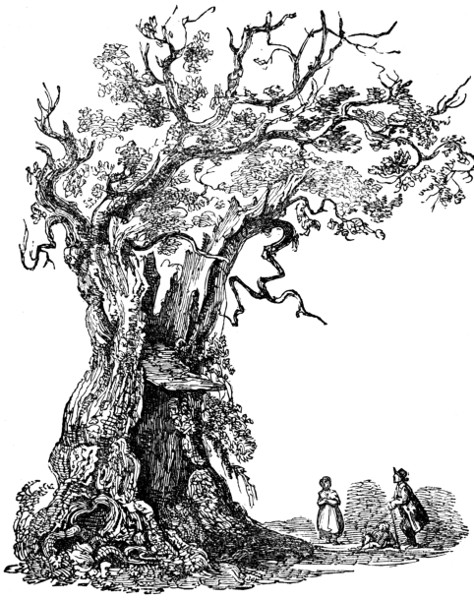
Ceubren yr Ellyll, THE SPIRIT’S BLASTED TREE.
All nations have their omens drear, Their legions wild of woe and fear, To Cambria look—the peasant see, Bethink him of Glendowerdy, And shun “the spirit’s Blasted Tree.”
Marmion.
“The spirit’s Blasted Tree” grew in a picturesque part of Wales, abounding with local superstitions and memorials of ancient times. At the distance of a few miles from the beautiful valley of Tal y Lyn, the aspect of the country is peculiarly wild. The hills almost meet at their basis, and change their aspect. Instead of verdure, they have a general rude and savage appearance. The sides are broken into a thousand forms; some are spiring and sharp pointed; but the greater part project forward, and impend in such a manner as to render the apprehension of their fall tremendous. A few bushes grow among them, but their dusky colour as well as the darkness of the rocks only add horror to the scene. One of the precipices is called Pen y Delyn, from its resemblance to a harp. Another is styled Llam y Lladron, or “the Thieves’ Leap,” from a tradition that thieves were brought there and thrown down. On the left is the rugged and far-famed height of Cader Idris, and beneath it a small lake called Llyn y tri Graienyn, or “the lake of the Three Grains,” which are three vast rocks tumbled from the neighbouring mountain, which the peasants say were “Three Grains” that had fallen into the shoe of the great Idris, and which he threw out here, as soon as he felt them hurting his foot.
From thence, by a bad road, Mr. Pennant, in one of his “Tours in Wales,” reached Nanneu. “The way to Nanneu is a continual ascent of two miles; and perhaps it is the highest situation of any gentleman’s house in Britain. The estate is covered with fine woods, which clothe all the sides of the dingles for many miles.”
The continuation of Mr. Pennant’s description brings us to our tree as he saw it: “On the road side is a venerable oak in its last stage of decay, and pierced by age into the form of a gothic arch; yet its present growth is twenty-seven feet and a half. The name is very classical, Derwen Ceubren yr Ellyll, ‘the hollow oak, the haunt of demons.’ How often has not warm fancy seen the fairy tribe revel round its trunk! or may not the visionary eye have seen the Hamadryad burst from the bark of its coeval tree.”
The inscription beneath Mr. Cuitt’s print mentions, that when sir Richard Colt Hoare sketched this oak, it was within the kitchen-garden walls of sir Robert W. Vaughan.
“Above Nanneu,” Mr. Pennant mentions “a high rock, with the top incircled with a dike of loose stones: this had been a British post, the station, perhaps, of some tyrant, it being called Moel Orthrwn, or ‘the Hill of Oppression.’” Mr. Pennant says, the park is “remarkable for its very small but very excellent venison:” an affirmation which may be taken for correct, inasmuch as the tour of an antiquary in such a region greatly assists tasteful discrimination. Within the park Mr. Pennant saw “a mere compost of cinders and ashes,” the ruins of the house of Howel Sele, whose body is alleged to have been buried in “the spirit’s Blasted Tree” by Owen Glyndwr.
Owen Glyndwr, or Glendower, is rendered popular in England by the most popular of our dramatic poets, from whom it may be appropriate to take the outlines of his poetical character, in connection with the legend of Howel Sele’s singular burial.
The first mention of Owen Glyndwr, in the works of our great bard, is in “King Richard II.” by Henry of Lancaster, afterwards king Henry IV. Before he passes over into Wales, he says in the camp at Bristol—
————————— Come lords, away, To fight with Glendower and his complices, A while to work, and after, holiday.
This line relating to Glendower, Theobald deemed an interpolation on Shakspeare, and it has been so regarded by some subsequent commentators. We have “Owen Glendower,” however, as one of the dramatis personæ in “Henry IV.” wherein he is first mentioned by the earl of Westmoreland as “the irregular and wild Glendower:” king Henry calls him “the great magician, damn’d Glendower;” Hotspur terms him “great Glendower;” and Falstaff tells prince Henry—
“There’s villainous news abroad—that same mad fellow of the north, Percy; and he of Wales, that gave Amaimon the bastinado—and swore the devil his true liegeman—he is there too; that devil Glendower. Art thou not horribly afraid?”
In the conference between “Glendower” and his adherents, he says to Henry Percy:—
———————Sit good cousin Hotspur: For by that name as oft as Lancaster Doth speak of you, his cheeks look pale; and, with A rising sigh, he wisheth you in heaven. Hot. And you in hell, as often as he hears Owen Glendower spoke of. Glend. I cannot blame him: at my nativity The front of heaven was full of fiery shapes, Of burning cressets; and—at my birth, The frame and huge foundation of the earth Shak’d like a coward—— The front of heaven was full of fiery shapes; The goats ran from the mountains, and the herds Were strangely clamorous to the frighted fields. These signs have mark’d me extraordinary; And all the courses of my life do show, I am not in the roll of common men. Where is he living,—clipp’d in with the sea, That chides the banks of England, Scotland, Wales,— Which calls me pupil, or hath read to me? And bring him out, that is but woman’s son, Can trace me in the tedious ways of art, And hold me pace in deep experiments.— I can call spirits from the vasty deep— I can teach thee, cousin, to command the devil.
On occasion of the chiefs taking leave of their wives, before they separate for battle with the king, Glendower gives proof of his supernatural powers. The wife of Mortimer proposes to soothe her husband by singing to him in her native Welsh, if he will repose himself.
Mort. With all my heart, I’ll sit— Glend. Do so. And those musicians that shall play to you, Hang in the air a thousand leagues from hence; Yet straight they shall be here: sit, and attend. [The music plays. Hot. Now, I perceive, the devil understands Welsh— By’r lady, he’s a good musician.
Without going into the history of Owen Glyndwr, it may be observed that he claimed the throne of Wales, and that the presages which Shakspeare ascribed to his birth, are the legends of old chronicles. Howel Sele, of Nanneu, was his first cousin, yet he adhered to the house of Lancaster, and was therefore opposed to Owen’s pretensions. The abbot of Cymmer, in hopes of reconciling them, brought them together, and apparently effected his purpose. Howel was reckoned the best archer of his day. Owen while walking out with him observed a doe feeding, and told him there was a fine mark for him. Howel bent his bow, and, pretending to aim at the doe, suddenly turned and discharged the arrow full at the breast of Glyndwr, who wearing armour beneath his clothes received no hurt. He seized on Sele for his treachery, burnt his house, and hurried him away from the place; nor was it known how he was disposed of till forty years after, when the skeleton of a large man, such as Howel, was discovered in the hollow of the great oak before described; wherein it was supposed Owen had immured him in reward of his perfidy. While Owen was carrying him off, his rescue was attempted by his relation Gryffydd ap Geoyn of Ganllwyd in Ardudwy, but he was defeated by Owen with great loss of men, and his houses of Berthlwyd and Cefn Coch were reduced to ashes.[270]
Sir Walter Scott to illustrate his lines in “Marmion,” inserts, among the notes on that poem, a legendary tale by the rev. George Warrington with this preface:—
“The event, on which this tale is founded, is preserved by tradition in the family of the Vaughans of Hengwyrt; nor is it entirely lost, even among the common people, who still point out this oak to the passenger. The enmity between the two Welsh chieftains, Howel Sele and Owen Glendwr, was extreme, and marked by vile treachery in the one, and ferocious cruelty in the other. The story is somewhat changed and softened, as more favourable to the characters of the two chiefs, and as better answering the purpose of poetry, by admitting the passion of pity, and a greater degree of sentiment in the description. Some trace of Howel Sele’s mansion was to be seen a few years ago, and may perhaps be still visible in the park of Nanneu, now belonging to sir Robert Vaughan, baronet, in the wild and romantic tracts of Merionethshire. The abbey mentioned passes under two names, Vener and Cymmer. The former is retained, as more generally used.”
THE SPIRIT’S BLASTED TREE.
Ceubren yr Ellyll.
Through Nannau’s Chace as Howel passed, A chief esteemed both brave and kind, Far distant borne, the stag-hound’s cry Came murmuring on the hollow wind. Starting, he bent an eager ear,— How should the sounds return again? His hounds lay wearied from the chace, And all at home his hunter train. Then sudden anger flash’d his eye, And deep revenge he vowed to take On that bold man who dared to force His red deer from the forest brake. Unhappy chief! would nought avail, No signs impress thy heart with fear, Thy lady’s dark mysterious dream, Thy warning from the hoary seer? Three ravens gave the note of death, As through mid air they winged their way; Then o’er his head, in rapid flight, They croak,—they scent their destined prey. Ill omened bird! as legends say, Who hast the wonderous power to know, While health fills high the throbbing veins, The fated hour when blood must flow. Blinded by rage alone he passed, Nor sought his ready vassals’ aid: But what his fate lay long unknown, For many an anxious year delayed. A peasant marked his angry eye, He saw him reach the lake’s dark bourne, He saw him near a blasted oak, But never from that hour return. Three days passed o’er, no tidings came;— Where should the chief his steps delay? With wild alarm the servants ran, Yet knew not where to point their way. His vassals ranged the mountain’s height, The covert close, and wide-spread plain; But all in vain their eager search, They ne’er must see their lord again. Yet fancy, in a thousand shapes, Bore to his home the chief once more Some saw him on high Moel’s top, Some saw him on the winding shore. With wonder fraught the tale went round, Amazement chained the hearer’s tongue; Each peasant felt his own sad loss, Yet fondly o’er the story hung. Oft by the moon’s pale shadowy light, His aged nurse, and steward grey, Would lean to catch the stoned sounds, Or mark the flittering spirit stray. Pale lights on Cader’s rocks were seen, And midnight voices heard to moan; ’Twas even said the blasted oak, Convulsive, heaved a hollow groan: And, to this day, the peasant still, With cautious fear, avoids the ground; In each wild branch a spectre sees, And trembles at each rising sound. Ten annual suns had held their course, In summer’s smile, or winter’s storm; The lady shed the widowed tear, As oft she traced his manly form. Yet still to hope her heart would cling As o’er the mind illusions play,— Of travel fond, perhaps her lord To distant lands had steered his way. ’Twas now November’s cheerless hour, Which drenching rain and clouds deface; Dreary bleak Robell’s tract appeared, And dull and dank each valley’s space. Loud o’er the wier the hoarse flood fell, And dashed the foamy spray on high; The west wind bent the forest tops, And angry frowned the evening sky. A stranger passed Llanelltid’s bourne, His dark-grey steed with sweat besprent, Which, wearied with the lengthened way, Could scarcely gain the hill’s ascent. The portal reached,—the iron bell Loud sounded round the outward wall Quick sprang the warder to the gate, To know what meant the clamorous call. “O! lead me to your lady soon; Say,—it is my sad lot to tell, To clear the fate of that brave knight, She long has proved she loved so well.” Then, as he crossed the spacious hall, The menials look surprise and fear: Still o’er his harp old Modred hung, And touched the notes for griefs worn ear. The lady sat amidst her train; A mellowed sorrow marked her look: Then, asking what his mission meant, The graceful stranger sighed and spoke:— “O could I spread one ray of hope, One moment raise thy soul from woe, Gladly my tongue would tell its tale, My words at ease unfettered flow! “Now, lady, give attention due, The story claims thy full belief: E’en in the worst events of life, Suspense removed is some relief. “Though worn by care, see Madoc here, Great Glyndwr’s friend, thy kindred’s foe, Ah, let his name no anger raise, For now that mighty chief lies low. “E’en from the day, when, chained by fate, By wizard’s dream or potent spell, Lingering from sad Salopia’s field, ’Reft of his aid the Percy fell:— “E’en from that day misfortune still, As if for violated faith, Pursued him with unwearied step Vindictive still for Hotspur’s death. “Vanquished at length, the Glyndwr fled Where winds the Wye her devious flood; To find a casual shelter there, In some lone cot, or desert wood. “Clothed in a shepherd’s humble guise, He gained by toil his scanty bread; He who had Cambria’s sceptre borne, And her brave sons to glory led! “To penury extreme, and grief, The chieftain fell a lingering prey; I heard his last few faultering words, Such as with pain I now convey. “‘To Sele’s sad widow bear the tale Nor let our horrid secret rest; Give but his corse to sacred earth, Then may my parting soul be blest.’— “Dim waxed the eye that fiercely shone, And faint the tongue that proudly spoke And weak that arm, still raised to me, Which oft had dealt the mortal stroke. “How could I then his mandate bear Or how his last behest obey? A rebel deemed, with him I fled; With him I shunned the light of day. “Proscribed by Henry’s hostile rage, My country lost, despoiled my land, Desperate, I fled my native soil, And fought on Syria’s distant strand. “O, had thy long lamented lord The holy cross and banner viewed, Died in the sacred cause! who fell Sad victim of a private feud! “Led, by the ardour of the chace, Far distant from his own domain; From where Garthmaelan spreads her shades, The Glyndwr sought the opening plain. “With head aloft, and antlers wide, A red buck roused, then crossed in view, Stung with the sight, and wild with rage, Swift from the wood fierce Howel flew. “With bitter taunt, and keen reproach, He, all impetuous, poured his rage, Reviled the chief as weak in arms, And bade him loud the battle wage. “Glyndwr for once restrained his sword, And, still averse, the fight delays; But softened words, like oil to fire, Made anger more intensely blaze. “They fought; and doubtful long the fray! The Glyndwr gave the fatal wound! Still mournful must my tale proceed, And its last act all dreadful sound. “How could we hope for wished retreat His eager vassals ranging wide? His bloodhounds’ keen sagacious scent, O’er many a trackless mountain tried? “I marked a broad and blasted oak, Scorched by the lightning’s livid glare; Hollow its stem from branch to root, And all its shrivelled arms were bare. “Be this, I cried, his proper grave!— (The thought in me was deadly sin.) Aloft we raised the hapless chief, And dropped his bleeding corpse within.” A shriek from all the damsels burst, That pierced the vaulted roofs below, While horror-struck the lady stood, A living form of sculptured woe. With stupid stare, and vacant gaze, Full on his face her eyes were cast, Absorbed!—she lost her present grief, And faintly thought of things long past. Like wild-fire o’er the mossy heath, The rumour through the hamlet ran: The peasants crowd at morning dawn, To hear the tale,—behold the man. He led them near the blasted oak, Then, conscious, from the scene withdrew: The peasant’s work with trembling haste, And lay the whitened bones to view!— Back they recoiled!—the right hand still, Contracted, grasped a rusty sword; Which erst in many a battle gleamed, And proudly decked their slaughtered lord. They bore the corse to Vener’s shrine, With holy rites, and prayers addressed; Nine white-robed monks the last dirge sang, And gave the angry spirit rest.
It must be remembered that the real history of Howel Sele’s death is to be collected from Mr. Pennant’s account of their sudden feud already related; though he by no means distinctly states whether Glyndwr caused him to be placed in the oak after he had been slain, or “immured” him alive and left him to perish. It is rather to be inferred that he was condemned by his kinsmen to the latter fate. According to Pennant he perished in the year 1402, and we see that his living burial place survived him, pierced and hallowed by the hand of time, upwards of four centuries.
Sir Philip Sidney’s Oak.
In an elegant volume called “Sylvan Sketches, a companion to the park and the shrubbery, with illustrations from the works of the poets by the author of the Flora Domestica,” there is a delightful assemblage of poetical passages on the oak, with this memorial of a very celebrated one:—
“An oak was planted at Penshurst on the day of sir Philip Sidney’s birth, of which Martyn speaks as standing in his time, and measuring twenty-two feet round. This tree has since been felled, it is said by mistake; would it be impossible to make a similar mistake with regard to the mistaker?
“Several of our poets have celebrated this tree: Ben Jonson in his lines to Penshurst, says,—
‘Thou hast thy walks for health as well as sport; Thy mount to which thy Dryads do resort, Where Pan and Bacchus their high seats have made, Beneath the broad beech and the chesnut shade, That taller tree which of a nut was set, At his great birth where all the muses met. There in the writhed bark are cut the names Of many a sylvan taken with his flames.’
“It is mentioned by Waller:—
‘Go, boy, and carve this passion on the bark Of yonder tree, which stands the sacred mark Of noble Sidney’s birth.’
“Southey says, speaking of Penshurst—
———‘Sidney here was born. Sidney than whom no greater, braver man, His own delightful genius ever feigned, Illustrating the vales of Arcady With courteous courage, and with loyal loves. Upon his natal day the acorn here Was planted; it grew up a stately oak, And in the beauty of its strength it stood And flourished, when its perishable part Had mouldered dust to dust. That stately oak Itself hath mouldered now, but Sidney’s name Endureth in his own immortal works.’
“This tree was frequently called the ‘bare oak,’ by the people of the neighbourhood, from a resemblance it was supposed to bear to the oak which gave name to the county of Berkshire. Tradition says, that when the tenants went to the park gates as it was their custom to do to meet the earl of Leicester, when they visited that castle, they used to adorn their hats with boughs from this tree. Within the hollow of its trunk was a seat which contained five or six persons with ease and convenience.”
The Oak of Mamre.
We are told that this oak was standing in the fourth century. Isidore affirms that when he was a child in the reign of the emperor Constantius, he was shown a turpentine tree very old, which declared its age by its bulk, as the tree under which Abraham dwelt; that the heathens had a surprising veneration for it, and distinguished it by an honourable appellation.[271] Some affirm that it existed within the last four centuries.
At the dispersion of the Jews under Adrian, about the year 134, “an incredible number of all ages and sexes were sold at the same price as horses, in a very famous fair called the fair of the turpentine tree: whereupon the Jews had an abhorrence for that fair.” St. Jerome mentions the place at which the Jews were sold under the name of “Abraham’s tent;” where, he says, “is kept an annual fair very much frequented.” This place “on Mamre’s fertile plains,” is alleged to have been the spot where Abraham entertained the angels.[272]
NATURALISTS’ CALENDAR.
Mean Temperature 63·50.
July 28.
St. Declan.
The festival of this saint, who was the first bishop of Ardmore, in the county of Waterford, is held on the twenty-fourth of the month. The brief memoir of St. Declan, by Alban Butler, did not seem to require notice of him on that day; but the manner wherein the feast was celebrated in 1826, is so remarkably particularized in an Irish paper, as to claim attention.
Ardmore and its Patron.
St. Declan is represented to have been the friend and companion of St. Patrick, and, according to tradition, Ardmore was an episcopal see, established in the fifth century by St. Declan, who was born in this county, and was of the family of the Desii. He travelled for education to Rome, resided there for some years, was afterwards ordained by the pope, returned to his own country about the year 402, and about that time founded the abbey and was made bishop of Ardmore. He lived to a great age; and his successor, St. Ulthan, was alive in the year 550. A stone, a holy well, and a dormitory, in the churchyard, still bear the name of St. Declan. “St. Declan’s stone” is on the beach; it is a large rock, resting on two others, which elevate it a little above the ground. On the twenty-fourth of July, the festival of the saint, numbers of the lowest class do penance on their bare knees around the stone, and some, with great pain and difficulty, creep under it, in expectation thereby of curing or preventing, what it is much more likely to create, rheumatic affections of the back. In the churchyard is the “dormitory of St. Declan,” a small low building, held in great veneration by the people in the neighbourhood, who frequently visit it in order to procure some of the earth, which is supposed to cover the relics of the saint.[273]
On the twenty-fourth of July, 1826, several thousand persons of all ages and both sexes assembled at Ardmore. The greater part of the extensive strand, which forms the western side of the bay, was literally covered by a dense mass of people. Tents and stands for the sale of whiskey, &c. were placed in parallel rows along the shore; the whole at a distance bore the appearance of a vast encampment. Each tent had its green ensign waving upon high, bearing some patriotic motto. One of large dimensions, which floated in the breeze far above the others, exhibited the words “Villiers Stuart for ever.”
At an early hour, those whom a religious feeling had drawn to the spot, commenced their devotional exercises by passing under the holy rock of St. Declan. The male part of the assemblage were clad in trowsers and shirts, or in shirts alone; the females, in petticoats pinned above the knees, and some of the more devout in chemises only. Two hundred and ninety persons of both sexes thus prepared, knelt at one time indiscriminately around the stone, and passed separately under it to the other side. This was not effected without considerable pain and difficulty, owing to the narrowness of the passage, and the sharpness of the rocks. Stretched at full length on the ground on the face and stomach, each devotee moved forward, as if in the act of swimming, and thus squeezed or dragged themselves through. Upwards of eleven hundred persons of both sexes, in a state of half nudity, were observed to undergo the ceremony in the course of the day. A reverend gentleman, who stood by part of the time, was heard to exclaim, “O, great is their faith.” Several of their reverences passed and re-passed to and from the chapel close by the “holy rock,” during the day. The “holy rock,” of so great veneration, is believed to be endued with miraculous powers. It is said to have been wafted from Rome upon the surface of the ocean, at the period of St. Declan’s founding his church at Ardmore, and to have borne on its top a large bell for the church tower, and vestments for the saint.