AUGUST. (continued 2)
Reading edition
NATURALISTS’ CALENDAR.
Mean Temperature 62·72.
August 20.
Chronology.
On the twentieth of August, 1589, James VI. of Scotland afterwards James I. of England married the princess Anne of Denmark, daughter to Frederick II. She became the mother of the ill-fated Charles I.
Love Tokens.
To the Editor of the Every-Day Book.
Sir,—It was the custom in England in “olden tyme,” as the ancient chronicles have it, for “enamoured maydes and gentilwomen,” to give to their favourite swains, as tokens of their love, little handkerchiefs about three or four inches square, wrought round about, often in embroidery, with a button or tassel at each corner, and a little one in the centre. The finest of these favours were edged with narrow gold lace, or twist; and then, being folded up in four cross folds, so that the middle might be seen, they were worn by the accepted lovers in their hats, or at the breast. These favours became at last so much in vogue, that they were sold ready made in the shops in Elizabeth’s time, from sixpence to sixteen-pence a piece. Tokens were also given by the gentlemen, and accepted by their fair mistresses; thus ascribed in an old comedy of the time:—
Given earrings we will wear Bracelets of our lover’s hair; Which they on our arms shall twist (With our names carved) on our wrists.
I am, &c. H. M. Lander
King’s Bench Walk, Temple.
For the Every-Day Book.
An Evening Walk.
Love Lane.
’Tis fitter now to ease the brain, To take a quiet walk in a green lane.
Byron.
This observation of our matchless bard, the idol and delight of our own times, though just, few I fear follow—either from want of inclination, or what is as bad, want of time. But there are some whose hours of toil, mental and bodily, do not preclude them from seeking the tranquil haunts of nature. With me, after nervous irritability and mental excitement, it has been, and is a favourite enjoyment, to quit the dusky dwellings of man, and wander among the fields and green lanes of our southern shore, while the sun is declining, and stillness begins to settle around.
Listlessly roving, whither I cared not, I have sauntered along till I felt my unquiet sensations gradually subside, and a pleasing calmness steal upon me. I know of nothing more annoying than that nervous thrilling or trembling, which runs through the whole frame after the mind has been troubled; it seems to me like the bubbling and restless swell of the ocean after a storm—one mass of fretful and impatient water, knowing not how to compose itself. But to come to the green fields. There is a lane leading from the grove at Camberwell called Love-lane; it is well so called—long, winding, and quiet, with scenery around beautifully soft—the lover might wander with the mistress of his soul for hours in undisturbed enjoyment. This lane is dear to me, for with it is linked all my early associations—the bird—the butterfly—the wild white rose—my first love. The bird is there still, the butterfly hovers there, and the rose remains; but where is my first love? I may not ask. Echo will but answer, “where!” yet I may in imagination behold her—I call up the shadowy joys of former times, and like the beautiful vision in “Manfred,” she stands before me:—
A thousand recollections in her train Of joy and sorrow, ere the bitter hour Of separation came, never again To meet in this wide world as we have met, To feel as we have felt, to look, to speak, To think alone as we have thought allow’d.
What happy feelings have been ours in that quiet lane! We have wandered arm in arm, gazed on the scenery, listened to the bird. We have not spoken, but our eyes have met, and thoughts too full for utterance, found answers there. Those days are gone; yet I love to wander there alone, even now; to press the grass that has been pressed by her feet, to pluck the flower from the hedge where she plucked it, to look on the distant hills that she looked on, rising in long smooth waves, when not a sound is heard save the “kiss me dear,” which some chaffinch is warbling to his mate, or the trickling of waters seeking their sandy beds in the hollows beneath the hedgerows. I strolled thither a few evenings ago: the sun was softly sinking, and the bright crimson which surrounded him, fading into a faint orange, tinged here and there with small sable clouds; the night-cloud was advancing slowly darkly on; afar in the horizon were
The light-ships of the sky Sailing onward silently.
One bird, the lark, was singing his evening song among the cool grass; softly, sweetly, it died away, and all was silent deep tranquillity; a pleasing coolness came on the faint breeze over the neighbouring fields, pregnant with odours, refreshing as they were fragrant. It was twilight; the green of the distant hills changed to a greyish hue, their outlines were enlarged, the trees assumed a more gigantic appearance, and soft dews began to ascend; faint upshootings of light in the eastern horizon foretold the rising of the moon; she appeared at length above the clouds, and a deeper stillness seemed to come with her, as if nature, like man at the presence of a lovely women, was hushed into silent admiration; the grey clouds rolled away on each side of her as rolls the white foam of the ocean before the bows of the vessel; her course was begun, and,
“Silently beautiful, and calmly bright Along her azure path I saw her glide Heedless of all those things that neath her light In bliss or woe or pain or care abide. Wealth, poverty, humility, and pride, All are esteemed as nothing in her sight, Nor make her for one moment turn aside. So calm philosophy unmoved pursues Throughout the busy world its quiet way; Nor aught that folly wiles or glory woos, Can tempt awhile its notice or its stay: Above all earthly thoughts its way it goes And sinks at length in undisturbed repose.”
Coldly and calmly the full orb glided through the stillness of heaven. My thoughts were of the past, of the millions who had worshipped her, of the many she had inspired—of Endymion, of the beautiful episode of Nisus and Euryalus in Virgil, of Diana of the Ephesians, of the beautiful descriptions of her by the poets of every age, of every clime. The melancholy yet pleasing feeling which came on me I can hardly describe: my disquietude had ceased; an undisturbed calmness succeeded it; my thoughts were weaned from the grosser materiality of earth, and were soaring upward in silent adoration. I felt the presence of a divinity, and was for a moment happy. Ye who are careworn, whose minds are restless, go at the peaceful hour of eve to the green fields and the hedge-clothed lanes. If you are not poets, you will feel as poets; if you doubt, you will be convinced of Supreme Power and Infinite Love; and be better in head and heart for your journey.
S. R. J.
SONG. BY SAMUEL DANIEL, 1590.
Love is a sickness full of woes, All remedies refusing; A plant that most with cutting grows, Most barren with best using. Why so? More we enjoy it, more it dies, If not enjoyed it sighing cries Heigh ho! Love is a torment of the mind, A tempest everlasting; And Jove hath made it of a kind Not well, nor full, nor fasting. Why so? More we enjoy it, more it dies, If not enjoyed it sighing cries Heigh ho![299]
NATURALISTS’ CALENDAR.
Mean Temperature 61·92.
August 21.
Merlin’s Cave, and Stephen Duck.
We are told on the thirtieth of June, 1735, that her majesty (the queen of George II.) ordered “Mr. Rysbrack to make the bustos in marble of all the kings of England from William the Conqueror, in order to be placed in her new building in the gardens at Richmond.”
On the twenty-first of August, in the same year, we learn that the figures her majesty had ordered for Merlin’s cave were placed therein, viz. 1.—Merlin at a table with conjuring books and mathematical instruments, taken from the face of Mr. Ernest, page to the prince of Wales; 2.—King Henry VIIth’s queen, and 3.—Queen Elizabeth, who come to Merlin for knowledge, the former from the face of Mrs. Margaret Purcell, and the latter from Miss Paget’s; 4.—Minerva from Mrs. Poyntz’s; 5.—Merlin’s secretary, from Mr. Kemp’s, one of his royal highness the duke’s grenadiers; and 6.—a witch, from a tradesman’s wife at Richmond. Her majesty ordered also a choice collection of English books to be placed therein; and appointed Mr. Stephen Duck to be cave and library keeper, and his wife to an office of trust and employment.[300]
Stephen Duck was a versifying thrasher, whom she got appointed a yeoman of the guard, and afterwards obtained orders for, and the living of Byfleet, in Surrey. The poor fellow sought happiness at the wrong end, and drowned himself in 1756.
Contentment, rosy, dimpled maid, Thou brightest daughter of the sky, Why dost thou to the hut repair, And from the gilded palace fly? I’ve trac’d thee on the peasant’s cheek; I’ve mark’d thee in the milkmaid’s smile; I’ve heard thee loudly laugh and speak, Amid the sons of want and toil. Yet, in the circles of the great, Where fortune’s gifts are all combined, I’ve sought thee early, sought thee late, And ne’er thy lovely form could find. Since then from wealth and pomp you flee, I ask but competence and thee!
Lady Manners.
NATURALISTS’ CALENDAR.
Mean Temperature 61·65.
August 22.
Battle of Bosworth.
This is the anniversary of the memorable conflict wherein Richard III. lost his life and crown.
King Richard’s Well.
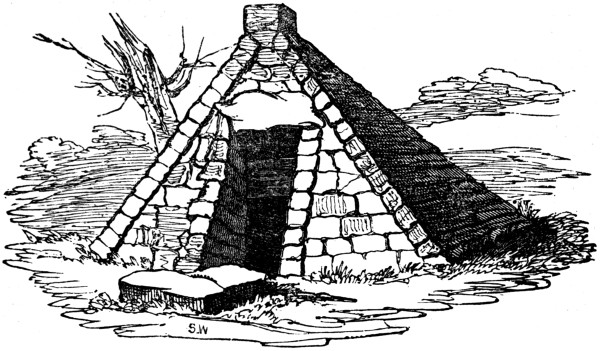
King Richard’s Well.
For the Every-Day Book.
The well of which the above is a representation, is situate on the spot where the celebrated battle of Bosworth field was fought, by which, the long-existing animosities between the rival houses of York and Lancaster were finally closed. The king is said, during the heat of the engagement, to have refreshed himself with water from this spring. A few years ago a subscription was entered into, for the purpose of erecting some memorial of this circumstance, and the late learned Dr. Parr being applied to, furnished an inscription, of which the following is a copy.
AQVA . EX . HOC . PVTEO . HAVSTA SITIM . SEDAVIT RICARDVS . TERTIVS . REX . ANGLIAE CVM . HENRICO . COMITE . DE . RICHMONDIA ACERRIME . ATQVE . INFENSISSIME PRAELIANS ET . VITA . PARITER . AC . SCEPTRO AVTE . NOCTEM . CARITVRVS XI KAL . SEPT . A. D. MCCCCLXXXV.
Translation.
Richard the III. King of England, most eagerly and hotly contending with Henry, Earl of Richmond, and about to lose before night both his sceptre and his life, quenched his thirst with water drawn from this well.—August 22, 1485.
The Roman month was divided into kalends, nones, and ides, all of which were reckoned backwards. The kalends are the first day of the month.—Thus the first of September being the kalends of September, the thirty-first of August would be pridie kalendarum, or the second of the kalends of September; the thirtieth of August would then be the third of the kalends of September. Pursuing this train the twenty-second of August, and the XI of the kalends of September will be found to correspond.
The battle of Bosworth field was fought on the twenty-second of August, 1485, “on a large flat spacious ground,” says Burton, “three miles distant from this town.” Richmond, afterwards Henry VII., landed at Milford-haven on the sixth of August, and arrived at Tamworth on the eighteenth. On the nineteenth he had an interview with his father-in-law, lord Stanley, when measures were converted for their further operations. On the twentieth, he encamped at Atherstone, and on the twenty-first, both armies were in sight of each other the whole day. Richard entered Leicester with his army on the sixteenth, having the royal crown on his head; he slept at Elmesthorpe on the night of the seventeenth. On the eighteenth he arrived at Stapleton, where he continued till Sunday the twenty-first. The number of his forces exceeded sixteen thousand—those of Richmond did not amount to five thousand. On each side the leader addressed his troops with a splendid oration “which was scarcely finished” says an old historian, “but the one army espied the other. Lord! how hastily the soldiers buckled their helms! how quickly the archers bent their bows and brushed their feathers! how readily the billmen shook their bills and proved their staves, ready to approach and join when the terrible trumpet should sound the bloody blast to victory or death!” The first conflict of the archers being over, the armies met fiercely with sword and bills, and at this period Richmond was joined by lord Stanley, which determined the fortune of the day.
In this battle, which lasted little more than two hours, above one thousand persons were slain on the side of Richard. Of Richmond’s army, scarcely one hundred were killed, amongst whom, the principal person was sir William Brandon, his standard bearer. Richard is thought to have despised his enemy too much, and to have been too dilatory in his motions. He is universally allowed to have performed prodigies of valour, and is said to have fallen at last by treachery, in consequence of a blow from one of his followers. His body was thrown across a horse, and carried, for interment, to the Greyfriars at Leicester. He was the only English monarch, since the conquest, that fell in battle, and the second who fought in his crown. Henry V. appeared in his at Agincourt, which was the means of saving his life, (though, probably, it might provoke the attack,) by sustaining a stroke with a battle-axe, which cleft it. Richard’s falling off in the engagement, was taken up and secreted in a bush, where it was discovered by sir Reginald Bray and placed upon Henry’s head. Hence arises the device of a crown in a hawthorn bush, at each end of Henry’s tomb in Westminster-abbey.
In 1644, Bosworth field became again the scene of warfare; an engagement, or rather skirmish, taking place between the parliamentary and royal forces, in which the former were victorious without the loss of a single individual.
G. J.
The late Mr. William Hutton, the historian of Birmingham, wrote an account of “The Battle of Bosworth Field,” which Mr. Nichols published, and subsequently edited with considerable additions. Mr. Hutton apprehended that the famous well where Richard slaked his thirst would sink into oblivion. A letter from Dr. Parr to Mr. Nichols, dated Hatton, September 13, 1813, removes these apprehensions:—
“As to Bosworth Field, six or seven years ago I explored it, and I found Dick’s Well, out of which the tradition is that Richard drank during the battle. It was in dirty, mossy ground, and seemed to me in danger of being destroyed by the cattle. I therefore bestirred myself to have it preserved, and to ascertain the owner. The bishop of Down spoke to the archbishop of Armagh, who said that the ground was not his. I then found it not to be Mrs. Pochin’s. Last year I traced it to a person to whom it had been bequeathed by Dr. Taylor, formerly rector of Bosworth. I went to the spot, accompanied by the rev. Mr. Lynes, of Kirkby-Malory. The grounds had been drained. We dug in two or three places without effect. I then applied to a neighbouring farmer, a good intelligent fellow. He told me his family had drawn water from it for six or seven years, and that he would conduct me to the very place. I desired him to describe the signs. He said there were some large stones, and some square wood, which went round the well at the top. We dug, and found things as he had described them; and, having ascertained the very spot, we rolled in the stones, and covered them with earth. Now lord Wentworth, and some other gentlemen, mean to fence the place with some strong stones, and to put a large stone over it with the following inscription; and you may tell the story if you please.
“Yours, &c. “S. Parr.”
The inscription is given in the preceding notice of the battle of Bosworth by G. J., who likewise obligingly transmitted the drawing of the well in its present state.
The editor is highly favoured by the interesting communication from a gentleman profoundly erudite in genealogical lore.
For the Every-Day Book.
The ravages inflicted by the all-subduing hand of time are not more distinctly traceable in the deserted hall of the dismantled castle, and the moulding fane of the dilapidated abbey, than in the downfall or extinction of ancient and distinguished races of nobility, who in ages long past by have shook the senate and field, have scattered plenty o’er a smiling land, or, as alas! is too frequently the melancholy reverse, shut the gates of mercy on mankind.
Considerations of this nature have suggested a review of the few families remaining in our peerage, whose ancestors enjoyed that distinction.
“Ere yet the fell Plantagenets had spent Their antient rage on Bosworth’s purple field.”
The protracted duration and alternated reverses of the contest between the houses of Lancaster and York, added to the rancorous inveteracy indispensably inherent in a barbarous age, will account for the comparatively rare sprinkling of the immediate descendants of the followers and councillors of the Plantagenets in our present house of peers. In France, on the other hand, the contemporary struggle for the throne laid between an indisputed native prince, Charles VII. and a foreign competitor, our Henry VI. The courtesies of war (imperfect even as they existed in those days) were allowed fairer play, and those who escaped the immediate edge of the foeman’s sword were not handed over to the axe of the executioner.
The awful mortality which befell one eminent branch of our gallant Plantagenets at the period in question, is recorded in emphatic terms by their animated and faithful chronicler, Shakspeare:—
“Two of thy name, both dukes of Somerset, Have sold their lives unto the house of York, And thou shalt be the third, if this sword hold.”
List of English Peerages now existing on the Roll, of which the Date of Creation is prior to the Accession of Henry VII.
Duke of Norfolk.
Duke of Beaufort, as Baron de Botetourt.
Marquis Townshend, as Baron de Ferrars.
Marquis of Hastings, as Baron Hastings.
Earl of Shrewsbury.
Earl of Berkeley, as Baron Berkeley.
Earl Delawarr, as Baron Delawarr and West.
Earl of Abergavenny, as Baron Abergavenny.
Baroness de Roos.
Baron Le Despencer.
Baron de Clifford.
Baron Audley.
Baron Clinton.
Baron Dacre.
Baron de la Zouche.
Baroness Willoughby d’Eresby.
Baroness Grey de Ruthyn.
Baron Stourton.
List of Families now invested with the Dignity of Peerage, whose Ancestors in the Male Line, enjoyed the Peerage before the Accession of Henry VII.
Where a well-grounded doubt exists, an asterisk is prefixed to the name.
Howard
* Spencer
* Montagu
Clinton
Talbot
Stanley
Hastings
Grey
Berkeley
Windsor
Lumley
West
Neville
Devereux
Courtenay
Stourton
Clifford
Willoughby
* Basset
NATURALISTS’ CALENDAR.
Mean Temperature 62·50.
August 23.
Chronology.
August 23, 1305, sir William Wallace, “the peerless knight of Elleslie,” who bravely defended Scotland against Edward I. was executed by order of that monarch on Tower-hill. This distinguished individual is popular in England five hundred years after his death, through the well-known ballad
“Scots wha hae wi’ Wallace bled,” &c.
The Season.
Swallows are now preparing for their departure. On this day, in 1826, the editor observed hundreds of them collecting so high in the air that they seemed of the size of flies; they remained wheeling about and increasing in number upwards of an hour before dusk, when they all took their flight in a south-western direction.
Cheldonizing, or Swallow Singing.
To the Editor of the Every-Day Book
Sir,—The recent, and it is hoped still continued subscriptions in aid of suffering humanity, induce an observation, that to the very remote origin of collecting general alms, may be traced most of the mummeries practised in Christendom in the gothic centuries, and in the English counties, even till within our own memory. Among the Rhodians one method of soliciting eleemosynary gifts, called cheldonizing, or swallow-singing, is corroboratory of the assertion. This benevolence, or voluntary contribution, was instituted by Cleobulus of Lindos, at a time when public necessity drove the Lindians to the expedient of soliciting a general subscription. Theognis speaks of cheldonizing as taking place among the sacred rites practised at Rhodes in the month Boëdromion, or August, and deriving its name from the customary song:—
The swallow, the swallow is here, With his back so black, and his belly so white; He brings on the pride of the year, With the gay months of love and the days of delight. Come, bring out the good humming stuff, Of your nice tit-bits let the swallow partake, Of good bread and cheese give enough, And a slice of your right Boëdromion cake. Our hunger, our hunger it twinges, So give my good masters, I pray; Or we’ll pull off your door from its hinges, And, ecod! we’ll steal young madam away. She’s a nice little pocket-piece darling, And faith ’twill be easy to carry her hence; Away with old prudence so snarling, And toss us down freely a handful of pence. Come, let us partake of your cheer, And loosen your purse strings so hearty; No crafty old grey beards are here, And see we’re a merry boy’s party, And the swallow, the swallow is here!
Plutarch refers to another Rhodian custom, which is particularly mentioned by Phœnix of Colophon, a writer of iambics, who describes the practice being that of certain men going about to collect donations for the crow, and singing or saying—
My good, worthy masters, a pittance bestow, Some oatmeal, or barley, or wheat, for the crow; A loaf or a penny, or e’en what you will, As fortune your pockets may happen to fill. From the poor man a grain of his salt may suffice, For your crow swallows all, and is not very nice; And the man who can now give his grain and no more, May another day give from a plentiful store. Come, my lad, to the door, Plutus nods to our wish, And our sweet little mistress comes out with a dish; She gives us her figs, and she gives us a smile, Heaven bless her, and guard her from sorrow and guile; And send her a husband of noble degree, And a boy to be danc’d on his grand-daddy’s knee; And a girl like herself to rejoice her good mother, Who may one day present her with just such another. God bless your dear hearts all a thousand times o’er! Thus we carry our singing to door after door; Alternately chanting, we ramble along, And treat all who give, or give not, a song.
The song thus concludes—
My good, worthy masters, a pittance bestow, Your bounty, my good, worthy mistresses throw; Remember the crow, he is not very nice, Do but give as you can, and the gift will suffice.
Pamphilius of Alexandria, in his chapter on names, says these men making collections for the crow, were called coronistæ, or crow-mummers; and their songs were named coronismata, as Hagnooles, the Rhodian, relates in his work, entitled “Coronistæ.”
I am, &c. J. H. B.
NATURALISTS’ CALENDAR.
Mean Temperature 62·92.
August 24.
St. Bartholomew.
For St. Bartholomew, see vol. i. col. 1131.
Massacre of St. Bartholomew.
This horrible slaughter is noticed in the same volume at the same place. For particulars of the probable amount of the persons massacred, and the different accounts of historians, the reader is referred to a most able article in the “Edinburgh Review, June, 1826,” on the extraordinary misrepresentations of the event and its perpetrators in Mr. Lingard’s “History of England.”
A Resident in the Fleet.
On the twenty-fourth of August, 1736, a remarkably fat boar was taken up in coming out of Fleet Ditch into the Thames: it proved to be a butcher’s, near Smithfield-bars, who had missed him five months, all which time, it seems, he had been in the common sewer, and was improved in price from ten shillings to two guineas.[301]
The first Pigs in Scotland.
Within the last century (probably about 1720) a person in the parish of Ruthwell, in Dumfriesshire, called the “Gudeman o’ the Brow,” received a young swine as a present from some distant part; which seems to have been the first ever seen in that part of the country. This pig having strayed across the Lochar into the adjoining parish of Carlavroc, a woman who was herding cattle on the marsh, by the sea side, was very much alarmed at the sight of a living creature, that she had never seen or heard of before, approaching her straight from the shore as if it had come out of the sea, and ran home to the village of Blackshaw screaming. As she ran, the pig ran snorking and grunting after her, seeming glad that it had met with a companion. She arrived at the village so exhausted and terrified, that before she could get her story told she fainted away. By the time she came to herself, a crowd of people had collected to see what was the matter, when she told them, that “There was a diel came out of the sea with two horns in his head and chased her, roaring and gaping all the way at her heels, and she was sure it was not far off.” A man called Wills Tom, an old schoolmaster, said if he could see it he would “cunger the diel,” and got a bible and an old sword. The pig immediately started behind his back with a loud grumph, which put him into such a fright, that his hair stood upright in his head, and he was obliged to be carried from the field half dead.
The whole crowd ran some one way and some another; some reached the house-tops, and others shut themselves in barns and byres. At last one on the house-top called out it was “the Gudeman o’ the Brow’s grumphy,” he having seen it before. Thus the affray was settled, and the people reconciled, although some still entertained frightful thoughts about it, and durst not go over the door to a neighbour’s house after dark without one to set or cry them. One of the crowd who had some compassion on the creature, called out, “give it a tork of straw to eat, it will be hungry.”
Next day the pig was conveyed over the Lochar, and on its way home, near the dusk of evening, it came grunting up to two men who were pulling thistles on the farm of Cockpool. Alarmed at the sight, they mounted two old horses they had tethered beside them, intending to make their way home, but the pig getting between them and the houses, caused them to scamper out of the way and land in Lochar moss, where one of their horses was drowned, and the other with difficulty relieved. The night being dark, they durst not part one from the other to call for assistance, lest the monster should find them out and attack them singly; nor durst they speak above their breath for fear of being devoured. At day-break next morning they took a different course, by Cumlongon castle, and made their way home, where they found their families much alarmed on account of their absence. They said that they had seen a creature about the size of a dog, with two horns on its head, and cloven feet, roaring out like a lion, and if they had not galloped away, it would have torn them to pieces. One of their wives said, “Hout man, it has been the Gudeman of the Brow’s grumphy; it frightened them a’ at the Blackshaw yesterday, and poor Meggie Anderson maist lost her wits, and is ay out o ae fit into anither sin-syne.”
The pig happened to lay all night among the corn where the men were pulling thistles, and about day-break set forward on its journey for the Brow. One Gabriel Gunion, mounted on a long-tailed grey colt, with a load of white fish in a pair of creels swung over the beast, encountered the pig, which went nigh among the horse’s feet and gave a snork. The colt, being as much frightened as Gabriel, wheeled about and scampered off sneering, with his tail on his “riggin,” at full gallop. Gabriel cut the slings and dropt the creels, the colt soon dismounted his rider, and going like the wind, with his tail up, never stopped till he came to Barnkirk point, where he took the Solway Frith and landed at Bownes, on the Cumberland side. Gabriel, by the time he got up, saw the pig within sight, took to his heels, as the colt was quite gone, and reached Cumlongon wood in time to hide himself, where he staid all that day and night, and next morning got home almost exhausted. He told a dreadful story! The fright caused him to imagine the pig as big as a calf, having long horns, eyes like trenchers, and a back like a hedgehog. He lost his fish; the colt was got back, but never did more good; and Gabriel fell into a consumption, and died about a year afterwards.
About the same time a vessel came to Glencaple quay, a little below Dumfries, that had some swine on board; one of them having got out of the vessel in the night, was seen on the farm of Newmains next morning. The alarm was spread, and a number of people collected. The animal got many different names, and at last it was concluded to be a “brock” (a badger). Some got pitchforks, some clubs, and others old swords, and a hot pursuit ensued; the chase lasted a considerable time, owing to the pursuers losing heart when near their prey and retreating. One Robs Geordy having rather a little more courage than the rest, ran “neck or nothing,” forcibly upon the animal, and run it through with a pitchfork, for which he got the name of “stout hearted Geordy” all his life after. A man, nearly a hundred years of age, who was alive in 1814, in the neighbourhood where this happened, declared that he remembered the Gudeman of the Brow’s pig, and the circumstances related, and he said it was the first swine ever seen in that country.[302]
NATURALISTS’ CALENDAR.
Mean Temperature 61·80.
August 25.
Islington Cattle Market.
August 25, 1746, a distemper which arose among the horned cattle, broke out afresh in the parts adjacent to London, and “the fair for the sale of Welsh cattle near Islington was kept at Barnet.”[303]
Important to Housekeepers.
The following letter from a lady claims the attention of every good housewife at this particular season.
Blackberry Jam.
To the Editor of the Every-Day Book.
Westbury, Wiltshire, Aug. 15, 1826.
Sir,—The importance that I attach to the above sweet subject,—the uses of “a jam” even may be important,—induces me to offer you the option of republishing a few lines on the occasion, which first appeared in a very condensed form last autumn, in the “Examiner” newspaper. I am anxious to obtain further celebrity, and a wider circulation of the merits which this wholesome dainty justly lay claim, and the success that attended my former little notice of it, encourage me to persevere; for I was informed that after the publication alluded to, the “Herald” copied it, and that subsequently it was cried in the streets of your dingy metropolis.
I can only judge of the prevailing quantity of the kindly blackberry, by the vast profusion that enriches our woody vales, where nature seems resolved to solace herself for the restrictions to which she has been confined by the dreary downs that skirt our beautiful vicinity; and where Falstaff must surely have originated his happy expression of “reasons being plenty as blackberries!” But I am keeping you too long from the subject. The method of preparing the delicate conserve that forms so large a portion of my children’s favourite adjunctive aliment, is so simple, that it can be achieved by the merest novice in the nice department of “domestic management.”
Boil the blackberries with half their weight of coarse moist sugar for three quarters of an hour,[304] keeping the mass stirred constantly. It is a mistake to suppose that a stewpan is a necessary vehicle on the occasion; the commonest tin saucepan will answer the purpose equally well. The more luxurious preserves being made with white sugar, and that of equal weight with the fruit, are necessarily unwholesome; but the cheapness of this homely delicacy, besides its sanative properties renders it peculiarly desirable for scantily furnished tables. It has been a “staple commodity” in my family for some years past, and with the exception of treacle, I find it the most useful aliment in “regulating the bowels” of my children;—you as a “family man,” sir, will excuse, nay, appreciate the observation, and all your readers who have “their quivers full of them,” will not disdain the gratis prescription that shall supersede the guinea fee! Indeed, to the sparing use of butter, and a liberal indulgence in treacle and blackberry jam, I mainly attribute the extraordinary health of my young family. The prodigal use, or rather the abuse, of butter that pervades all classes, has often surprised me: the very cottage children, whose tattered apparel bespeaks abject poverty, I continually meet munching their “hunks” of bread, smeared with butter; how much should I rejoice to see, because I know its superiority in every respect, my favourite jam substituted! But cottage children are far from being objects of my compassion, for they live in the “country,” which comprehensive word conveys delicious ideas of sun, fresh air, exercise, flowers, shady trees, and this wholesome fruit clustering about them, and inviting their chubby fingers at every healthful step. My pity is reserved for their forlorn little brethren, doomed to breathe the unwholesome atmosphere of crowded manufactories, and close narrow alleys in populous cities! What a luxury would a supper be twice a week, for instance, to the poor little “bottoms” in Spitalfields.[305] Who knows but they might receive their first taste for Shakspeare while being fed, like their great prototype in the “Midsummer Night’s Dream,” with blackberries! “Dewberries,” which Titania ordered for the refreshment of her favourite, are so nearly allied to their glossy neighbours, that when the season is far advanced the two are not easily distinguished. Shakspeare, who knew every thing, was of course aware that the dewberry ripens earlier than the blackberry; namely, in the season for “apricots.” It must be confessed that nothing but the associations that are connected with the elegant and romantic name “dewberry,” fit only for the mouth of a fairy to pronounce, could induce me to give a preference to the latter; they are not so numerous, nor consequently so useful. I own I am sanguine respecting the general introduction of blackberries into the London street cries. What an innovation they would cause! what a rural sight, and sound, and taste, and smell, would they introduce into that wilderness of houses! What a conjuring up of happy feelings—almost as romantic as those that are inspired by “bilberries, ho!” When I resided in London, I recollect the wild, and exquisite, and undefinable sensations that were excited by the peculiar and un-city-like cry of these “whorts.”[306] I used to look out at the blue-frocked boys who sold them, with their heavy country faces; capacious “gabardines,” that hinted of Caliban; round hats, that knew no touch of form; and unaccountable laced up boots; with as much astonishment, as if I had beheld and heard purveyors from the wilderness shouting “Manna!” which we all know is “angel’s food!”
I have taken up sadly too much of your time, sir, I feel assured. I intended but to name the method of making blackberry jam, to assure you of its salubrity, and to request you to recommend its general use:—and I have only now to request that you will not suffer the very imperfect manner in which I, who cannot write for the public eye, have handled the subject to deter you from doing it justice.
I am, Sir, Yours respectfully, I. J. T.
P. S. It has just occurred to me to say, why should not grocers, confectioners, fruiterers, and chandlers, speculate in the “new article,” and provide a store of it to meet a probable demand? I should think it might be sold, with a reasonable profit, at sixpence or eightpence a pound.
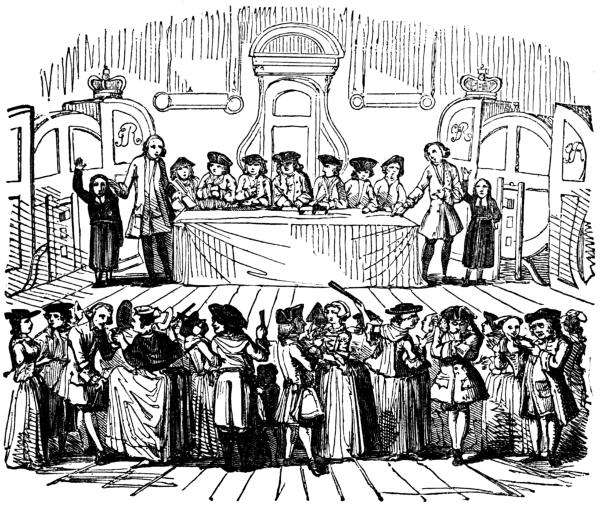
Drawing of the Lottery in Guildhall, 1751.
Death of the Lottery.
In the spring, and for three weeks after midsummer, 1826, the lottery-office keepers incessantly plied every man, woman, and child in the United Kingdom, and its dependencies, with petitions to make a fortune in “the last lottery that can be drawn.” Men paraded the streets with large printed placards on poles, or pasted on their backs, announcing “All Lotteries End for Ever! 18th of July.” The walls were stuck, and hand-bills were thrust into the hands of street passengers, with the same heart-rending intelligence, and with the solemn assurance that the demand for tickets and shares was immense! Their prices had so risen, were so rising, and would be so far beyond all calculation, that to get shares or tickets at all, they must be instantly purchased! As the time approached, a show was got up to proclaim that the deplorable “Death of the Lottery,” would certainly take place on the appointed day; but on some account or other, the pathetic appeal of the benevolent contractors was disregarded, and the gentlemen about to be “turned off,” were as unheeded, and as unlamented as criminals, who say or sing in their last moments—
“Gentlefolks all Pity our fall! Have pity all, Pity our fall!”
At length the stoney-hearted public were “respectfully” informed that “the lords of the treasury had issued a “reprieve,” and that the “drawing” and “quartering” and so forth was, “postponed from Tuesday, 18th July,” to some dull day in October, “when Lotteries will finish for ever?”
Of late years lotteries have been drawn at Coopers’-hall. Formerly they were drawn at the place, and in the manner exhibited in the preceding representation, after an engraving by Cole.
PHRENOLOGY.
Phrenological Illustrations. By George Cruikshank. London: Published by George Cruikshank, Myddelton-terrace, Pentonville. 1826.
“In the name of wonder,” a reader may inquire, “is the Every-Day Book to be a Review.” By no means;—but “George Cruikshank” is a “remarkable person;” his first appearance in the character of an author is a “remarkable event,” in the August of 1826; and, as such, deserves a “remarkable notice.”
Every reader is of course aware, that, as certainly as a hazel-rod, between the fingers of a gifted individual, discovers the precious metals and waters beneath the earth, so certainly, a phrenological adept, by a discriminating touch of the nodosities on the surface of the head, detects the secret sources, or “springs of human action.” To what extent Mr. Cruikshank has attained this quality, or whether he is under obligations to Dr. Combe for “a touch” of his skill, or has bowed his head to Mr. De Ville for “a cast” in plaster, is not so clear, as that his “Phrenological Illustrations” will be as popular, and assuredly as lasting as the science itself—“Cruikshank and Craniology—for ever!”
Be it observed, however, that “Craniology,” which alliterates so well with “Cruikshank,” was only a “proper” term, while the disciples of doctors Gall and Spurzheim were traversing the exterior of the cranium; but after they had gained a knowledge of the interior, and classified and arranged their discoveries, they generalized the whole, and relinquished the term “craniology” for the denomination “phrenology.” This change was obviously imperative, because “craniology” signifies no more than an acquaintance with the outside of the head, and “phrenology” implies familiarity with its contents.
Still, however, the incipient phrenologist must avail himself of “craniology,” as an introduction to the nobler science. To him it is as necessary a guide as topography is to a student in geology, who without that requisite, and supposing him ignorant of the characters of mountains may lose his way, and be found vainly boring Schehalion, or sinking a shaft within the crater of an exhausted volcano. To prevent such mistakes in “phrenology,” the “estate under the hat” has been thoroughly explored, and divided and subdivided: names and numbers have been assigned to each portion, and the entire globe of the microcosm accurately measured, and mapped, “according to the latest surveys.”
Mr. Cruikshank’s “Illustrations of Phrenology” form a more popular introduction to the science than its most ardent admirers could possibly hope. He acknowledges his obligations to doctors Gall and Spurzheim, and implicitly adopts their arrangement of the “organs;” a word, by the by, that signifies those convexities which may be seen by the eye, or touched by the finger, on the exterior of the greater convexity called the head; and which are produced, or thrown up thereon, by the working or heaving of the ideas internally. From this process it appears that a man “bores” his own head, so as to form concavities within and convexities without; and, in the same way, by the power of speech, “bores” the heads of his friends. The term “to bore,” however, as commonly used, signifies “to bother,” or “perplex and confound,” and therefore is not admitted in the nomenclature of “phrenology,” which condescends to level every “bump,” to the right understanding of the meanest capacity.
Of Mr. Cruikshank’s proficiency or rank in the phrenological school, the writer of this article is incompetent to judge; but, as regards his present work, whether he be a master, or only a monitor, is of little consequence; he seems well grounded in rudiments, and more he does not profess to teach. Instead of delivering a mapped head in plaister of Paris with his book, he exhibits an engraving of three “bare polls,” or polls sufficiently bare to discover the position of every convexity or “organ” whereon he duly marks their numbers, according to the notation of doctors Gall and Spurzheim. From hence we learn that we have nine propensities, nine sentiments, eleven knowing faculties, and four reflecting faculties. Adhering to the doctrinal enumeration and nomenclature of the “organs” worked out, or capable of being worked out, by these propensities, sentiments, and faculties, on every human head, he wisely prefers the Baconian as the best method of teaching “the new science,” and exhibits the effects of each of the thirty-three “organs” in six sheets of etchings by himself, from his own views of each “organ.”
It is now proper to hint at the mode wherein the artist has executed his design, and to take each organ according to its number, and under its scientific term.
I.—Amativeness.
Mr. Cruikshank seems to imagine that this organ may induce a declaration of undivided attachment to an intermediate object, in order to arrive at the object sincerely desired: under the circumstances represented, this deviation of “amativeness” may be denominated “cupboard love.”
II.—Philoprogenitiveness.
The tendency of this perplexing organ hastens the necessity of extending our “colonial policy.” This sketch is full of life and spirit.
III.—Inhabitiveness.
The subject of the artist’s point, a “tenant for life,” doubtless has an amazing developement of the organ.
IV.—Adhesiveness.
Is “enough to frighten a horse.” This organ will be further observed on presently.
V.—Combativeness.
Its vigorous cultivation is displayed with much animation.
VI.—Destructiveness.
A familiar illustration of this organ is derived from a common occurrence in almost every market-town. Its contemplation, and a few recent incidents, suggest a query or two. A bull ran into a china shop, but instead of proceeding to the work of demolition, threw his eye around the place, thrust his horn under the arm of a richly painted vase, and ran briskly into the street with his prize. Was this act ascribable to the organ of “colour,” or that of “covetiveness?” An ox walked into a well-furnished parlour, and withdrew without doing further mischief than ogling himself in the looking-glass. Were these “stolen” looks occasioned by “covetiveness,” or “self-love?” Another of the bos tribe rapidly passed men, women, and children, ran up the steps to an open street door, hurried through the passage, ascended every flight of the stair-case, nor stopped till he had gained the front attic, from whence he put his head through the window, and looked down from his proud eminence, over the parapet, upon his “followers.” On this third example may be quoted what Mr. Cruikshank says of another organ, “Inhabitiveness. To this organ is ascribed, in man, Self Love, and in other animals, Physical height. The artist has endeavoured to give his idea of inhabitiveness in plate 2.” On comparing the anecdote last related, with the artist’s idea in the plate he refers to, it is clear that, on this occasion, his view might have been more elevated. In the last-mentioned bull, “Inhabitiveness” seems to have been the prevailing organ. Separately considering the three animals, and their general character, and the tempting objects by which each was surrounded, without their manifestation of any action to denote the existence of “destructiveness,” a question arises, whether counteracting organs may not be cultivated in such animals, to the extent of neutralizing the primary developement.
VII.—Constructiveness.
This is so elegant an exhibition of the propensity in connection with certain vegetable tendencies, that it is doubtful whether developements from the action of the sap in plants, may not admit of classification with our own.
VIII.—Covetiveness.
In this representation, the countenance of a boy is frightfully impressed by the incessant restlessness of the “organ,” combined with “cautiousness.” See No. XII.
IX.—Secretiveness.
Exhibits one of the advantages of this “propensity” in the sex.
X.—Self Love.
Narcissus himself could not be more strongly marked, than this “heart-breaking” personage.
XI.—Approbation. See No. XXXIII.
XII.—Cautiousness.
Prudence and indecision are here united by a decisive touch. The accessory, who assists this “procedure of the human understanding,” is exceedingly
—————“light and airy; Brisk as a bee, blithe as a fairy.”
XIII.—Benevolence.
A “benevolent” individual, receiving loud acknowledgments from the object of his favours.
XIV.—Veneration.
Mr. Cruikshank says, that “Dr. Gall observed this organ chiefly in persons with bald heads.” The artist satisfactorily exemplifies, that when its absence occurs in Englishmen, it is a rare exception to the national character.
XV.—Hope.
This sentiment is always allegorized with an anchor, and Mr. Cruikshank represents a poor animal under its influence, “brought to an anchor.”
XVI.—Ideality.
Mr. Cruikshank says, that “Mr. Forster calls this the organ of mysterizingness. It is supposed that a peculiar developement of this organ, which is remarkably conspicuous in all poets, occurs in persons who are disposed to have visions, see ghosts, demons, &c.” The artist represents certain appearances, which will be recognised as “familiars.”
XVII.—Conscientiousness.
“According to Dr. Spurzheim, this is the organ of righteousness;” but, “Dr. Gall thinks there is no organ of conscience.” Mr. Cruikshank exemplifies the latter opinion, by the surprise of a female on receiving “an unexpected offer.” It will not surprise the reader if he looks at the print.
XVIII.—Firmness.
“Firmness,” he regards in the light of “a character now being consigned rapidly to oblivion.” But, “while there is life there is hope,” and the character alluded to cannot be destroyed without the annihilation of “adhesiveness,” which Mr. Cruikshank defines in the language of the science, and “has endeavoured to give a strong but faithful illustration of, in plate 2;” a representation, alas! too accurate. See No. IV.
XIX.—Individuality.
A more select specimen could not have been produced.
XX.—Form.
This is well represented. “Persons,” says Mr. Cruikshank, “endowed with this organ, are fond of seeing pictures, &c.” They may likewise be frequently detected in jelly-rooms, and the upper boxes of the theatres.
XXI.—Size.
Remarkably developed in “a great man now no more!”
XXII.—Weight.
A compliment from the artist, “to which he is confident no loyal man will offer an objection.”
XXIII.—Colour.
As a specimen of art, this is the most successful of the illustrations.
XXIV.—Space.
An enlarged view of a deep seated organ, bottomed on the character of a people whom we have outrivalled.
XXV.—Order.
This organ as a ruling power, is placed by Mr. Cruikshank in the hand; its developement manifestly generates “Veneration.”
XXVI.—Time.
In Mr. Cruikshank’s words, “the artist’s illustration of it will be familiar to every one.”
XXVII.—Number.
A portrait of an individual in whom the power of this organ is supposed to have been preeminent.
XXVIII.—Tune.
This organ, according to the artist, produces rectitude in the dog.
XXIX.—Language.
XXX.—Comparison.
The organ of “Comparison” is exemplified by full developements from “Long Acre,” and “Little St. Martin’s-lane,” within one door from the residence of “Mr. Thomas Rodd, bookseller, Great Newport-street,” whose stock of books, large as it is, cannot furnish any thing like the “words that burn,” in the artist’s representation of “Language.”[307]
XXXI.—Causality.
“This is nothing more than the organ of Inquisitiveness,” and the artist himself exercises it, by gently feeling his reader’s pulse.
XXXII.—Wit.
There is great difficulty in defining this organ. Mr. Cruikshank’s representation of it is humorous.
XXXIII.—Imitation.
This is an admirable exhibition of the organ, as we may imagine it to be cultivated by “Mr. Mathews-At home!” with decided “Approbation.” See No. XI.
Having hastily gone over the organs of the science, we have an additional one, “The Organ of Drawing.” Mr. Cruikshank says, he “cannot satisfy himself as to the precise seat of this organ, or as to the extent of its sphere of activity, but he has attempted an illustration of it.” He thinks it not improbable “that the possession of this special faculty, now only at his fingers’ ends, may enable him to venture again” if his present efforts are successful. Why they should not be it is difficult to conceive; for however whimsical and ludicrous his “Phrenological Illustrations” may sometimes be, they are so connected with the vocabulary of the science at the commencement of his publication, as to form the horn-book, the primer, the reading made easy, and the grammar of phrenology.
Such a production as this, at such a price, (eight shillings plain, and twelve shillings coloured,) from such an artist, could not have been expected. His inimitable powers have hitherto entertained and delighted the public far more to the emolument of others than himself; and now that he has ventured to “take a benefit” on his own account, there cannot be a doubt that his admirers will encourage “their old favourite” to successive endeavours for their amusement and instruction. His entire talents have never been called forth; and some are of a far higher order than even the warmest friends to his pencil can conceive.
Though the work is to be obtained of all the booksellers in London, and every town in the united kingdom, yet it would be a well-timed compliment to Mr. Cruikshank if town purchasers of his “Phrenological Illustrations” were to direct their steps to his house, No. 25, Myddelton Terrace, Pentonville.
Showers of Blood.
On the 25th of August, 1826, the editor of the Every-Day Book, while writing in his room, took up the open envelope of a letter he had received about ten minutes before, and to his surprise, observed on its inner side, which had been uppermost on the table, several spots which seemed to be blood. They were fresh and wet, and of a brilliant scarlet colour. They could not be red ink, for there was none in the house; nor could they have been formed on the paper by any person, for no one had entered the room; nor had he moved from the chair wherein he sat. The appearances seemed unaccountable, till considering that the window sashes were thrown up, and recollecting an anecdote in the “Life of Peiresc,” he was persuaded that they were easily to be accounted for; and that they were a specimen of those “showers of blood,” which terrified our forefathers in the dark ages, and are recorded by old chroniclers.
It is related, for instance, that in the fifth century, “at Yorke, it rained bloud;” and in 697, “corne, as it was gathered in the harvest time, appeared bloudie,” and “in the furthermost partes of Scotland it rayned bloud.”[308] In 1553, it was deemed among the forewarnings of the deaths of Charles and Philip, dukes of Brunswick, that there were “drops of bloude upon hearbes and trees.”[309]
As a solution of the origin, or cause of bloody spots on the paper, the anecdote in Gassendi’s “Life of Peiresc” is added.
“Nothing in the whole year, 1608, did more please him,—than that he observed and philosophized about—the bloody rain, which was commonly reported to have fallen about the beginning of July; great drops thereof were plainly to be seen, both in the city itself, upon the walls of the churchyard of the great church, which is near the city wall, and upon the city walls themselves; also upon the walls of villages, hamlets, and towns, for some miles round about; for in the first place, he went himself to see those wherewith the stones were coloured, and did what he could to come to speak with those husbandmen, who beyond Lambesk, were reported to have been so affrighted at the falling of the said rain, that they left their work, and ran as fast as their legs could carry them into the adjacent houses. Whereupon, he found that it was a fable which was reported, touching those husbandmen. Nor was he pleased that the naturalists should refer this kind of rain to vapours drawn up out of red earth aloft into the air, which congealing afterwards into liquor, fall down in this form; because such vapours as are drawn aloft by heat, ascend without colour, as we may know by the alone example of red roses, out of which the vapours that arise by heat, are congealed into transparent water. He was less pleased with the common people, and some divines, who judged that it was a work of the devils and witches, who had killed innocent young children; for this he counted a mere conjecture, possibly also injurious to the goodness and providence of God.
“In the mean while an accident happened, out of which he conceived he had collected the true cause thereof. For some months before, he shut up in a box a certain palmer-worm which he had found, rare for its bigness and form; which, when he had forgotten, he heard a buzzing in the box, and when he opened it, found the palmer-worm, having cast its coat, to be turned into a very beautiful butterfly, which presently flew away, leaving in the bottom of the box a red drop as broad as an ordinary sous or shilling; and because this happened about the beginning of the same month, and about the same time an incredible multitude of butterflies were observed flying in the air, he was therefore of opinion, that such kind of butterflies resting upon the walls, had there shed such like drops, and of the same bigness. Wherefore, he went the second time, and found by experience, that those drops were not to be found on the house tops, nor upon the round sides of the stones which stuck out, as it would have happened, if blood had fallen from the sky, but rather where the stones were somewhat hollowed, and in holes, where such small creatures might shroud and nestle themselves. Moreover, the walls which were so spotted, were not in the middle of towns, but they were such as bordered upon the fields, nor were they on the highest parts, but only so moderately high as butterflies are commonly wont to flie.
“Thus, therefore, he interpreted that which Gregory of Tours relates, touching a bloody rain seen at Paris in divers places, in the days of Childebert, and on a certain house in the territory of Senlis; also that which is storied, touching raining of blood about the end of June, in the days of king Robert; so that the blood which fell upon flesh, garments, or stones, could not be washed out, but that which fell on wood might; for it was the same season of butterflies, and experience hath taught us, that no water will wash these spots out of the stones, while they are fresh and new. When he had said these and such like things to Varius, a great company of auditors being present, it was agreed that they should go together and search out the matter, and as they went up and down, here and there, through the fields, they found many drops upon stones and rocks; but they were only on the hollow and under parts of the stones, but not upon those which lay most open to the skies.”
Thus the first mentioned appearances on the paper, may be naturally accounted for, and so
—————“ends the history Of this wonderful mystery.”
On the evening of the same day, the 25th of August, 1826, the editor witnessed the terrific tempest of thunder and lightning, mentioned in the newspapers. He was walking in the London-road near the Surrey obelisk, when the flashes sheeted out more rapidly in succession, and to greater extent than have ever been witnessed in this country, within the memory of man. They were accompanied by a gale of wind that took up light objects, such as hay, leaves, and sticks, and immense clouds of dust to a great height, and impelled people along against their will. The sudden loud claps of thunder, and the red forking of the flashes were tremendously grand and appalling. At one time there was a crashing burst of thunder, and a rushing sound from the electric fluid, like the discharge of a flight of rockets close at hand. This was in the midst of a torrent of rain, which lasted only a few minutes, and was as heavy as from the bursting of a number of water spouts. This storm was literally a tornado.
Lightning was looked upon as sacred both by the Greeks and Romans, and was supposed to be sent to execute vengeance on the earth. Hence persons killed with lightning, being thought hateful to the gods were buried apart by themselves, lest the ashes of other men should receive pollution from them. All places struck with lightning were carefully avoided and fenced round, from an opinion that Jupiter had either taken offence at them, and fired upon them the marks of his displeasure, or that he had by this means pitched upon them as sacred to himself. The ground thus fenced about, was called by the Romans bidental. Lightning was much observed in augury, and was a good or bad omen, according to the circumstances attending it.[310]
When a stormy cloud, which is nothing but a heap of exhalations strongly electrified, approaches near enough to a tower, or a house, or a cloud not electrified; when it approaches so near, that a spark flies from it, this occasions the explosion, which we call a clap of thunder. The light we then see is the lightning, or the thunderbolt. Sometimes we see only a sudden and momentary flash, at other times it is a train of fire, taking different forms and directions. The explosion attending the lightning, shows that it is the vapours which occasion the thunder; by taking fire suddenly, they agitate and dilate the air violently. At every electrical spark a clap is heard. The thunder is sometimes composed of several claps or prolonged and multiplied by echoes.
As soon as we see a flash of lightning, we have only to reckon the seconds in a watch, or how often our pulse beats, between the flash and the clap. Whoever can reckon ten pulsations between the lightning and the thunder, is still at the distance of a quarter of a league from the storm; for it is calculated that the sound takes nearly the time of forty pulsations, in going a league. The lightning does not always go in a direct line from top to bottom. It often winds about and goes zigzag, and sometimes it does not lighten till very near the ground. The combustible matter which reaches the ground, or takes fire near it, never fails to strike. But sometimes it is not strong enough to approach us, and like an ill-charged cannon, it disperses in the atmosphere and does no harm. When, on the contrary, the fiery exhalations reach the ground, they sometimes make terrible havoc.
We may judge of the prodigious force of the lightning by the wonderful effects it produces. The heat of the flame is such, that it burns and consumes every thing that is combustible. It even melts metals, but it often spares what is contained in them, when they are of a substance not too close to leave the passage free. It is by the velocity of the lightning that the bones of men and animals are sometimes calcined, while the flesh remains unhurt. That the strongest buildings are thrown down, trees split, or torn up by the root, the thickest of walls pierced, stones and rocks broken, and reduced to ashes. It is to the rarification and violent motion of the air, produced by the heat and velocity of the lightning, that we must attribute the death of men and animals found suffocated, without any appearance of having been struck by lightning.
“Experience teaches us, that the rain which falls when it thunders, is the most fruitful to the earth. The saline and sulphurous particles which fill the atmosphere during a storm, are drawn down by the rain, and become excellent nourishment for the plants; without mentioning the number of small worms, seeds, and little insects which are also drawn down in thunder showers, and are with the help of a microscope, visible in the drops of water.”[311]
In August, 1769, a flash of lightning fell upon the theatre at Venice, in which were more than six hundred persons. Besides killing several of the audience, it put out the candles, singed a lady’s hair, and melted the gold case of her watch and the fringe of her robe. The earrings of several ladies were melted, and the stones split; and one of the performers in the orchestra, had his violincello shattered in a thousand splinters, but received no damage himself.[312]
NATURALISTS’ CALENDAR.
Mean Temperature 61·97.
August 26.
Chronology.
On the 26th of August, 1635, died Lope de Vega, called the “Spanish Phenix,” aged sixty-three years. His funeral was conducted with princely magnificence by his patron, the duke of Susa, and his memory was celebrated with suitable pomp in all the theatres of Spain.
Lope de Vega was the rival and conqueror of Cervantes in the dramatic art; yet in his youth he embarked in the celebrated Spanish armada, for the invasion of England, and spent part of his life in civil and military occupations.
His invention is as unparalleled in the history of poetry, as the talent which enabled him to compose regular and well constructed verse with as much ease as prose. Cervantes, on this account, styled him a prodigy of nature. His verses flowed freely, and such was his confidence in his countrymen, that as they applauded his writings, which were unrestrained by critical notes, he refused conformity to any restrictions. “The public,” he said, “paid for the drama, and the taste of those who paid should be suited.”
He required only four-and-twenty hours to write a versified drama of three acts, abounding in intrigues, prodigies, or interesting situations, and interspersed with sonnets and other versified accompaniments. In general the theatrical manager carried away what De Vega wrote before he had time to revise it, and a fresh applicant often arrived to prevail on him to commence a new piece immediately. In some instances he composed a play in the short space of three or four hours. This astonishing facility enabled him to supply the Spanish theatre with upwards of two thousand original dramas. According to his own testimony he wrote on an average five sheets every day, and at this rate he must have produced upwards of twenty millions of verses.
He was enriched by his talents, and their fame procured him distinguished honours. He is supposed at one time to have possessed upwards of a hundred thousand ducats, but he was a bad economist, for the poor of Madrid shared his purse. He was elected president of the spiritual college in that capital; and pope Urban VIII. sent him the degree of doctor in divinity with a flattering letter, and bestowed on him the cross of Malta; he was also appointed fiscal of the apostolic chamber, and a familiar of the inquisition, an office regarded singularly honourable at that period. Whenever he appeared in the streets, boys ran shouting after him; he was surrounded by crowds of people, all eager to gain a sight of the “prodigy of nature;” and those who could not keep pace with the rest, stood and gazed on him with wonder as he passed.
Lope de Vega’s inexhaustible fancy and fascinating ease of composition, communicated that character to Spanish comedy; and all subsequent Spanish writers trod in his footsteps, until its genius was banished by the introduction of the French taste into Spain.[313]
NATURALISTS’ CALENDAR.
Mean Temperature 60·77.
August 27.
1688. A Date in Panyer-alley.
The editor has received a present from Mr. John Smith of a wood block, engraved by himself, as a specimen of his talents in that department of art, and in acknowledgment of a friendly civility he is pleased to recollect at so long a distance from the time when it was offered, that it only dwelt in his own memory.
The impression from this engraving, and the accompanying information, will acquaint the reader with an old London “effigy” which many may remember to have seen. It is the only cut in the present sheet; for an article on a popular amusement, which will require a considerable number of engravings, is in preparation, and the artists are busily engaged on them.
Concerning this stone we must resort to old Stow. According to this “honest chronicler,” he peregrinated to where this stone now stands, and where in his time stood “the church of St. Michael ad Bladudum, or at the corne (‘corruptly,’ he says, ‘at the querne,’) so called, because in place thereof, was sometime a corne-market. At the west end of this parish church is a small passage for people on foot thorow the same church;” and he proceeds to throw the only light that seems to appear on this stone, “and west from the said church, some distance, is another passage out of Paternoster-row, and is called (of such a signe) Panyer-alley, which commeth out into the north, over against Saint Martin’s-lane.”
It is plain from Stow’s account, that Panyer-alley derived its name from “a signe,” but what that “signe” was we are ignorant of. It may have been a tavern-sign, and this stone may have been the ancient sign in the wall of the tavern. It represents a boy seated on a panyer, pressing a bunch of grapes between his hand and his foot. By some people it is called “the Pick-my-toe.” The inscription mentions the date when it was either repaired or put up in its present situation in a wall on the east side of the alley, and affirms that the spot is the highest ground of the city.
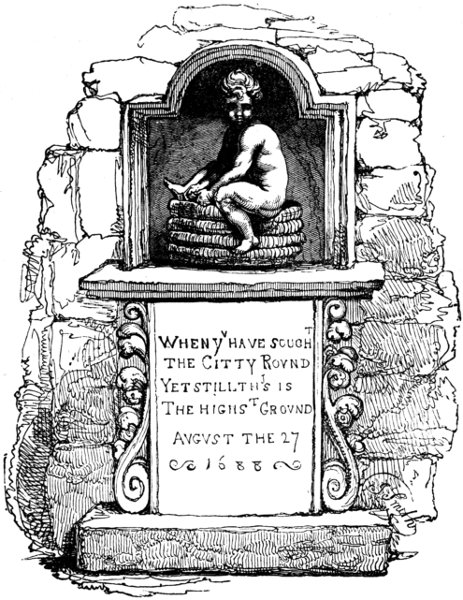
The Effigy in Panyer-alley, Paternoster-row.
While we are at this place, it is amusing to remark what Stow observes of Ivy-lane, which runs parallel with Panyer-alley westward. He says, that “Ivie-lane” was “so called of ivie growing on the walls of the prebend’s houses,” which were situated in that lane; “but now,” speaking of his own days, “the lane is replenished on both sides with faire houses, and divers offices have been there kept, by registers, namely, for the prerogative court of the archbishop of Canturbury, the probate of wils, which is now removed into Warwicke-lane, and also for the lord treasurer’s remembrance of the exchequer, &c.”
Hence we see that in Ivy-lane, now a place of mean dwelling, was one of the great offices at present in Doctors’ Commons, and another of equal importance belonging to the crown; but the derivation of its name from the ivy on the walls of the prebends’ houses, an adjunctive ornament that can scarcely be imagined by the residents of the closely confined neighbourhood, is the pleasantest part of the narration.
And Stow also tells us of “Mount-goddard-street,” which “goeth up to the north end of Ivie-lane,” of its having been so called “of the tippling there, and the goddards mounting from the tappe to the table, from the table to the mouth, and some times over the head.”
Goddards.
These were cups or goblets made with a cover or otherwise. In “Tancred and Gismunda,” an old play, we are told, “Lucrece entered, attended by a maiden of honour with a covered goddard of gold, and, drawing the curtains, she offered unto Gismunda to taste thereof.” So also Gayton, in his “Festivous Notes on Don Quixote,” mentions—
“A goddard, or an anniversary spice bowl, Drank off by th’ gossips.”
Goddard, according to Camden, means “godly the cup,” and appears to Mr. Archdeacon Nares, who cites these authorities to have been a christening cup. That gentleman can find no certain account of the origin of the name.
Perhaps goddard was derived from “godward:” we had looking godward, and thinking godward, and perhaps drinking godward, for a benediction might have been usual at a christening or solemn merry-making; and from thence godward drinking might have come to the godward cup, and so the goddard.
The Cuckoo.
To the Editor of the Every-Day Book.
Sir,—If the following “Address to the Cuckoo,” from my work on birds, should suit the pages of the Every-Day Book, it is quite at your service.
Of the cuckoo, I would just observe, that I do not think, notwithstanding all that Dr. Jenner has written concerning it, its natural history is by any means fully developed. I have had some opportunities of observing the habits of this very singular bird, and in me there is room for believing that, even when at maturity, it is sometimes, if not frequently, fed by other birds. It is very often attended by one, two, or even more, small birds, during its flight, for what purpose is not, I believe, at present known. The “wry-neck,” junx torquilla, called in some provinces the “cuckoo’s maiden,” is said to be one of these. Perhaps it may be novel information to your readers to be told, that there is a bird in the United States of America, called “Cowpen,” emberiza pecoris, by Wilson, which lays her eggs in other bird’s nests, in a similar way to the cuckoo in this country: the “cowpen” is, however, a much smaller bird than the cuckoo.
I am, &c. James Jennings.
Dalby-terrace, City-road, August 28, 1826.
To the Cuckoo.
Thou monotonous bird! whom we ne’er wish away, Who hears thee not pleas’d at the threshold of May Thy advent reminds us of all that is sweet, Which nature, benignant, now lays at our feet; Sweet flowers—sweet meadows—sweet birds and their loves; Sweet sunshiny mornings, and sweet shady groves; Sweet smiles of the maiden—sweet looks of the youth, And sweet asseverations, too, prompted by truth; Sweet promise of plenty throughout the rich vale; And sweet the bees’ humming in meadow and vale; Of the summer’s approach—of the presence of spring, For ever, sweet cuckoo! continue to sing. Oh, who then, dear bird! could e’er wish thee away, Who hears thee not pleas’d at the threshold of May
As every trait in the natural history of birds is interesting, I beg leave to state that I shall be greatly obliged to any reader of the Every-Day Book for the communication of any novel fact or information concerning this portion of the animal kingdom, of which suitable acknowledgment will be made in my work. I understand the late lord Erskine wrote and printed for private circulation, a poem on the rook. Can any of your readers oblige me with a copy of it, or refer me to any person or book so that I might obtain a sight of it? J. J.
NATURALISTS’ CALENDAR.
Mean Temperature 61·35.
August 28.
St. Augustine.
Of this father of the church, whose name is in the church of England calendar, there is a memoir in vol. i. col. 1144.
Chronology.
On the 28th of August, 1736, a man passing the bridge over the Savock, near Preston, Lancashire, saw two large flights of birds meet with such rapidity, that one hundred and eighty of them fell to the ground. They were taken up by him, and sold in Preston market the same day.
Hoax at Norwich.
The following bill was in circulation in Norwich and the neighbourhood for days previous, and on the evening of August 28, 1826, 20,000 sagacious people from the city and country around, on foot, on horseback, in chaises, gigs, and other vehicles, collected below the hill to witness the extraordinary performance.
“St. James’s-hill, back of the Horse-barracks.
“The public are respectfully informed that signor Carlo Gram Villecrop, the celebrated Swiss mountain-flyer, from Geneva and Mont Blanc, is just arrived in this city, and will exhibit, with a Tyrolese pole fifty feet long, his most astonishing gymnastic flights, never before witnessed in this country. Signor Villecrop has had the great honour of exhibiting his most extraordinary feats on the continent before the king of Prussia, Emperor of Austria, the Grand duke of Tuscany, and all the resident nobility in Switzerland. He begs to inform the ladies and gentlemen of this city, that he has selected St. James’s-hill and the adjoining hills for his performances, and will first display his remarkable strength, in running up the hill with his Tyrolese pole between his teeth. He will next lay on his back, and balance the same pole on his nose, chin, and different parts of his body. He will climb up on it with the astonishing swiftness of a cat, and stand on his head at the top; on a sudden he will leap three feet from the pole without falling, suspending himself by a shenese cord only. He will also walk on his head, up and down the hill, balancing his pole on one foot. Many other feats will be exhibited, in which signor Villecrop will display to the audience the much admired art of toppling, peculiar only to the peasantry of Switzerland. He will conclude his performance by repeated flights in the air, up and down the hill, with a velocity almost imperceptible, assisted only by his pole, with which he will frequently jump the astonishing distance of forty and fifty yards at a time. Signor Villecrop begs to assure the ladies and gentlemen who honour him with their company, that no money will be collected till after the exhibition, feeling convinced that his exertions will be liberally rewarded by their generosity. The exhibition to commence on Monday, the 28th of August, 1826, precisely at half-past 5 o’clock in the evening.”
Signor Carlo Gram Villecrop did not make his appearance. The people were drawn together, and the whole ended, as the inventor designed, in a “hoax.”
NATURALISTS’ CALENDAR.
Mean Temperature 61·55.
August 29.
St. John Baptist beheaded.
The anniversary of the baptist’s decollation is in the church of England calendar. His death is known to have been occasioned by his remonstrance to Herod against his notorious cruelties. “In consequence of this,” says Mr. Audley, “Herod imprisoned him in the castle of Machærus, and would have put him to death, but was afraid of the people.” Herodias also would have killed John, had it been in her power. At length, on Herod’s birthday, Salome, the daughter of Herodias, by her former husband, Philip, danced before him, his captains, and chief estates, or the principal persons of Galilee. This so pleased Herod, that he “promised her, with an oath, whatsoever she should ask, even to the half of his kingdom.” Hearing this, she ran to her mother and said, “what shall I ask?” The mother, without hesitation, replied, “the head of John the Baptist.” Herod was exceedingly sorry when he heard such a request; but out of regard to his oaths and his guests, he immediately sent an executioner to behead John in prison. This was instantly done, and the head being brought in a charger, was given to Salome; and she, forgetting the tenderness of her sex, and the dignity of her station, carried it to her mother.
Jerome says, that “Herodias treated the baptist’s head in a very disdainful manner, pulling out the tongue which she imagined had injured her, and piercing it with a needle.” Providence, however, as Dr. Whitby observes, interested itself very remarkably in the revenge of this murder on all concerned. Herod’s army was defeated in a war occasioned by his marrying Herodias, which many Jews thought a judgment on him for the death of John. Both he, and Herodias, whose ambition occasioned his ruin, were afterwards driven from their kingdom, and died in banishment, at Lyons, in Gaul. And if any credit may be given to Nicephorus, Salome, the young lady who made the cruel request, fell into the ice as she was walking over it, which, closing suddenly, cut off her head.
It is added by Mr. Audley, that the abbot Villeloin says in his memoirs, “the head of St. John the Baptist was saluted by him at Amiens, and it was the fifth or sixth he had had the honour to kiss.”
Archbishop Chicheley.
Lord Orford, in a letter dated the 29th of August, says, “I have just been reading a new public history of the colleges of Oxford, by Anthony Wood, and there found a feature in a character that always offended me, that of archbishop Chicheley, who prompted Henry V. to the invasion of France, to divert him from squeezing the overgrown clergy. When that priest meditated founding All Souls college, and ‘consulted his friends, who seem to have been honest men, what great matters of piety he had best perform to God in his old age, he was advised by them to build an hospital for the wounded and sick soldiers, that daily returned from the wars then had in France.’ I doubt his grace’s friends thought as I do of his artifice.—‘But,’ continues the historian, ‘disliking these motions, and valuing the welfare of the deceased more than the wounded and diseased, he resolved with himself to promote his design—which was to have masses said for the king, queen, and himself, &c., while living, and for their souls when dead;’ and that mummery, the old foolish rogue, thought more efficacious than ointments and medicines for the wretches he had made! and of the chaplains and clerks he instituted in that dormitory, one was to teach grammar, and another prick song. How history makes one shudder and laugh by turns!”
An Eccentric Character.
To the Editor of the Every-Day Book.
Sir,—I trouble you with an account of an eccentric character, which may, perhaps, amuse some of your numerous readers, if it should meet your approbation.
Yours, most respectfully, C. C——y, M. R. C. S. E. Ashton Under Lyne,
July 17th, 1826.
Billy Butterworth.
Near the summit of a small hill, called Gladwick Lowes, situated on the borders of Lancashire, near the populous town of Oldham, commanding a very extensive prospect, stands the solitary, yet celebrated hut of “Billy Butterworth.” The eccentric being who bears this name from his manner of dressing an immense beard reaching to his girdle, and many other singularities, has obtained the name of the “hermit,” though from the great numbers that daily and hourly visit him from all parts, he has no real claim to the title.
Billy Butterworth’s hut is a rude building of his own construction, a piece of ground having been given him for the purpose. In the building of this hut, the rude hand of uncultivated nature laughed to scorn the improvements of modern times, for neither saw, nor plane, nor level, nor trowel, assisted to make it appear gracious in the eye of taste; a rude heap of stones, sods of earth, moss, &c. without nails or mortar are piled together in an inelegant, but perfectly convenient manner, and form a number of apartments. The whole building is so firmly put together, that its tenant fears not the pelting of a merciless storm, but snug under his lowly roof appears equally content with the smiles or frowns of fortune.
To give a proper description of the hermit’s hut, would be very difficult, but a brief sketch will enable the reader to form a pretty good idea of the object. It is surrounded by a fancy and kitchen garden, fancifully decorated with rude seats, arches, grottos, &c., a few plaister of Paris casts are here and there placed so as to have a pleasing effect. The outer part of the hut consists of the hermit’s chapel, in which is a half-length figure of the hermit himself. To this chapel the hermit retires at certain hours, in devotion to his Maker; besides the chapel is an observatory, where the hermit amuses his numerous visiters, by exhibiting a small and rather imperfect camera obscura of his own construction, by which he is enabled to explain the surrounding country for four or five miles. Near the camera obscura is a raised platform, almost on a level with the roof of the hermitage—this he calls “the terrace.” From the terrace there is a beautiful view of country.—The towns of Ashton-under-Lyne, Stockport, Manchester, lie in the distance, with the adjacent villages, and the line of Yorkshire hills, from among which “Wild Bank” rises majestically above its neighbours. The hermit makes use of this situation, to give signals to the village at the foot of the hill, when he wishes to be supplied with any article of provision for the entertainment of his visiters, such as liquors, cream, sallads, bread, &c.; of confectionary, he has generally a good stock.
We next come to his summer arbours, which are numerous in his garden, and furnished with table and seats for parties to enjoy themselves separately, without interfering with others. The dovehouse is placed in the garden, where he keeps a few beautiful pairs of doves. Of the out-buildings, the last we shall describe, is the carriage-house. The reader smiles at the word “carriage” in such a situation, and would be more apt to believe me had I said a wheel-barrow. But no! grave reader, “Billy Butterworth” runs his carriage, which is of the low gig kind, drawn by an ass, and on some extra visits, by two asses. A little boy, called Adam, is the postillion, as there is only seating for one in the carriage. The boy acts as a waiter in busy times. In this carriage “Billy Butterworth” visits his wealthy neighbours, and meets with a gracious reception. He frequently visits the earl of Stamford, earl de Wilton, &c. &c. From his grotesque dress and equipage, he excites mirth to a great degree.
The inner part of this hermit’s hut consists of many different apartments, all of which are named in great style; such as the servants’ hall—pavilion—drawing-room—dining-room—library, &c. &c. The walls are lined with drapery, tastefully hung, and the furniture exhibits numerous specimens of ancient carved woodwork. Pictures of all sorts from the genuine oil painting, &c. prints of good line engraving down to the common caricature daubs, are numerously hung in every part of the hut. Natural curiosities are so placed, as to excite the curiosity of the gazing ignoramus.
“Billy Butterworth” is himself a tall man, of rather a commanding figure, with dark hair and dark sparkling eyes. His countenance is of a pleasing but rather melancholy appearance, which is increased by an immensely long black beard which makes him an object of terror to the neighbouring children. On the whole, although he is now in the evening of life, the remains of a once handsome man are very evident. His dress is varied according to the seasons, but always resembling the costume in king Charles’s days; a black cap, black ostrich feather and buckle, long waistcoat, jacket with silk let into the sleeves, small clothes of the same, and over the whole a short mantle.
“Billy Butterworth” has practised these whims, if I may call them so, for twelve or fourteen years in this solitary abode. His reason for this manner of life is not exactly known, but he seems to acknowledge in some degree, that a disappointment in love has been the cause. Let that rest as it will, he has a handsome property, accumulated, it is said, by these eccentric means. Indeed he acknowledged to the author of this, that on fine days in summer, he has realized from selling sweetmeats, and receiving gifts from visiters, five guineas a day. He is so independent now that he will not receive a present from friends. He is communicative as long as a stranger will listen, but if the stranger is inquisitive he ceases to converse any thing more. He is polite and well informed on general topics, and has evidently read much.
While the hermit was lately on a journey to his friends, a mischievous wag advertised “the hut,” &c. to be let. The day fixed upon being rainy, no bidders made their appearance. I send you a copy of the advertisement from a printed one in my possession.
To be Let,
For a term of years, or from year to year; and may be entered upon immediately, all that hut, garden, and premises, with the appurtenances, situate at Gladwick Lowes, near Oldham, in the county of Lancaster, now occupied as an
Hermitage, By Mr. Wm. Butterworth.
This romantic spot being the only place of fashionable resort in the vicinity of the populous town of Oldham, and the unrivalled reputation which it has so long deservedly enjoyed, render it peculiar desirable to any gentleman who may wish to acquire an independency at a trifling risk. The motive for the intended removal of the present proprietor is, his having already secured a comfortable competency, joined to a desire of giving some gentleman of a disposition similar to his own, an opportunity of participating in the advantages which he has so long derived from this delightful retirement.
Among the many curiosities with which his sequestered hut abounds, may be particularized the following valuable articles.
His celebrated self-constructed Bed. A Table,
which is supposed formerly to have belonged to some of the ancient saxon monarchs, and was presented to Mr. B., by her grace the duchess of Beaufort.
Praxitele’s stature of Jupiter Ammon, brought from Greece, by the right honourable the earl of Elgin, and came into the hands of the present possessor, through the medium of the duke of Devonshire, after it had, for a considerable period, formed one of the most permanent ornaments of his grace’s splendid mansion, Chatsworth house.
A capital portrait of Mrs. Siddons, painted by B. West, Esq., P. R. A.
A most excellent and peculiarly constructed Camera Obscura, which distinctly represents objects at the distance of thirty miles.
A sonorous Speaking Trumpet, wonderfully adapted to the present situation.
A brace of pistols, formerly the property of Blind Jack of Knaresborough, by whom they were cut out of solid rock.
A very ancient and most curious Trebduchet, a relic of Ptolemy the Third’s Sarcophagus.
A variety of coins, medals, shells, fossils, and other mineral productions, tastefully classified and arranged.
It would be very desirable if the above could be disposed of with the hermitage, but if not, Mr. B. would be willing to enter into a separate agreement for them. For further particulars, apply to Mr. W. B.
N.B. The stock of pop, peppermint, gingerbread, and Eccles cakes, with the signboards, dials, inscriptions, rams’ horns, and other tasteful and appropriate decorations, will be required to be taken at a valuation.
To be let Monday August 29, 1825.
A Hoax “In Chancery.”
There is a spirit of waggery which contributes to public amusement, and occasionally annoys individual repose. The following lines are in a journal of this day 1826.
A VISION. BY THE AUTHOR OF CHRISTABEL.
“Up!” said the spirit, and ere I could pray One hasty orison, whirl’d me away To a limbo, lying—I wist not where— Above or below, in earth or air; All glimmering o’er with a doubtful light, One couldn’t say whether ’twas day or night; And crost by many a mazy track, One didn’t know how to get on or back; And I felt like a needle that’s going astray (With its one eye out) through a bundle of hay: When the spirit he grinn’d, and whisper’d me, “Thou’rt now in the Court of Chancery!” Around me flitted unnumber’d swarms Of shapeless, bodiless, tailless forms; (Like bottled-up babes, that grace the room Of that worthy knight, sir Everard Home)— All of them, things half-kill’d in rearing; Some were lame—some wanted hearing; Some had through half a century run, Though they hadn’t a leg to stand upon. Others, more merry, as just beginning, Around on a point of law were spinning; Or balanced aloft, ’twixt Bill and Answer, Lead at each end, like a tight rope dancer.— Some were so cross, that nothing could please ’em;— Some gulp’d down affidavits to ease ’em; All were in motion, yet never a one, Let it move as it might, could ever move on. “These,” said the spirit, “you plainly see, Are what they call suits in Chancery!” I heard a loud screaming of old and young, Like a chorus by fifty Vellutis’ sung; Or an Irish dump (“the words by Moore”) At an amateur concert scream’d in score;— So harsh on my ear that wailing fell Of the wretches who in this limbo dwell! It seem’d like the dismal symphony Of the shapes Æneas in hell did see; Or those frogs, whose legs a barbarous cook Cut off and left the frogs in the brook, To cry all night, till life’s last dregs, “Give us our legs!—give us our legs!” Touched with the sad and sorrowful scene, I ask’d what all this yell might mean, When the spirit replied with a grin of glee, “’Tis the cry of the suitors in Chancery!” I look’d, and I saw a wizard rise, With a wig like a cloud before men’s eyes. In his aged hand he held a wand, Wherewith he beckoned his embryo hand, And then mov’d and mov’d, as he wav’d it o’er, But they never got on one inch more, And still they kept limping to and fro, Like Ariels’ round old Prospero— Saying, “dear master, let us go,” But still old Prospero answer’d “No.” And I heard, the while, that wizard elf, Muttering, muttering spells to himself, While over as many old papers he turn’d, As Hume e’er moved for or Omar burn’d. He talk’d of his virtue—though some, less nice, (He own’d with a sigh) preferr’d his Vice— And he said, “I think”—“I doubt”—“I hope”— Call’d God to witness, and damn’d the Pope; With many more sleights of tongue and hand I couldn’t, for the soul of me, understand. Amaz’d and poz’d, I was just about To ask his name, when the screams without The merciless clack of the imps within, And that conjurer’s mutterings, made such a din, That, startled, I woke—leap’d up in my bed— Found the spirit, the imps, and the conjurer fled. And bless’d my stars, right pleas’d to see, That I wasn’t, as yet, in Chancery.
For several years before the appearance of his solemn “Aids to Reflection” in 1825, Mr. Coleridge had been to the world “as though he was not;” and since that “Hand-book” of masterly sayings his voice has ceased from the public. Forgotten he could not be, yet when he was remembered it was by inquiries concerning his present “doings,” and whispers of his “whereabout.” On a sudden the preceding verses startle the dull town, and dwelling on the lazy ear, as being, according to their printed ascription, “by the author of Christabel.” In vindication of himself against the misconception of the wit of their real author, the imputed parent steps forth in the following note.
To the Editor of the Times.
Grove, Highgate, Tuesday Evening.
Sir,—I have just received a note from a city friend, respecting a poem in “The Times” of this morning ascribed to me. On consulting the paper, I see he must refer to “A Vision,” by the author of “Christabel.” Now, though I should myself have interpreted these words as the author, I doubt not, intended them, viz., as a part of the fiction; yet with the proof before me that others will understand them literally, I should feel obliged by your stating, that till this last half hour the poem and its publication were alike unknown to me; and I remain, Sir, respectfully yours, S. T. Coleridge.
This little “affair” exemplifies that it is the fortune of talent to be seldom comprehended.
NATURALISTS’ CALENDAR.
Mean Temperature 61·45.
August 30.
Chronology.
August 30, 1750. Miss Flora Macdonald was married to a gentleman of the same name related to sir Alexander Macdonald, bart. This lady is celebrated in Scottish annals for having heroically and successfully assisted the young Pretender to escape, when a price was set upon his head. Her self-devotion is minutely recorded in the late Mr. Boswell’s “Ascanius,” and Johnson has increased her fame by his notice of her person and character, in his “Tour to the Hebrides.”
NATURALISTS’ CALENDAR.
Mean Temperature 62·95.
August 31.
Grasshoppers.
It was observed at the end of August, 1742, great damage was done to the pastures in the country, particularly about Bristol by swarms of grasshoppers; and the like happened in the same year at Pennsylvania to a surprising degree.[314]
In 1476, “Grasshoppers and the great rising of the river Isula did spoyle al Poland.”[315]
Grasshoppers are infested by a species of “insect parasites” thicker than a horse hair, and of a brown colour. It consumes the intestines, and at first sight in the body of the grasshopper, has been mistaken for the intestines themselves.
The eminent entomologist who mentions this fact, observes that “insects generally answer the most beneficial ends, and promote in various ways, and in an extraordinary degree, the welfare of man and animals.” The evils resulting from them occur partially when they abound beyond their natural limits, “God permitting this occasionally to take place, not merely with punitive views, but also to show us what mighty effects he can produce by instruments seemingly the most insignificant: thus calling upon us to glorify his power, wisdom, and goodness, so evidently manifested, whether he relaxes or draws tight the reins by which he guides insects in their course, and regulates their progress; and more particularly to acknowledge his overruling Providence so conspicuously exhibited by his measuring them, as it were, and weighing them, and taking them out, so that their numbers, forces, and powers, being annually proportioned to the work he has prescribed to them, they may neither exceed his purpose, nor fall short of it.”[316]