Book Lotteries. (continued 3)
Reading edition
The drawing commenced shortly after five o’clock, and ended at twenty minutes past six.
The doors of the various Lottery-offices were also surrounded by persons awaiting the issue of the drawing.
Lottery Puffs.
It is not possible to go into the Literature of the Lottery without occupying more room than can be spared, but young readers and posterity may be amused and surprised by some figures, from among many hundreds of wood-cuts on the bills of schemes, and invitations to buy.
“T. BISH, 4 Cornhill, and 9 Charing-cross, London, and by all his agents in the country,” put forth the following.
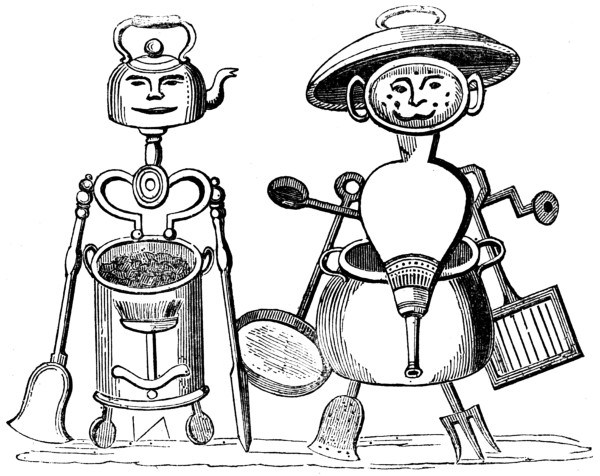
Kitchen Maid.
Mistress Molly, the Cook, At the Scheme only look, In wealth we may both of us roll, If we brush for a Prize In the world we may rise, And our skuttles have plenty of cole.
Cook Maid.
If what you say is true, I am all in a stew, Lest we miss what we so much desire; Should we lose this good plan, For a sup in the pan, All the fat will be soon in the fire!
Except the verses which were placed in the bill beneath the preceding cut, it contained nothing but an announcement of the day when the Lottery was to draw, and the number of capital prizes, subjoined by this information, “Tickets and shares are selling by T. Bish;” who seems to have imagined he could propitiate the “kitchen maid” and “cook maid” in his behalf, as a lottery-office keeper, by exhibiting a tea-kettle and fire implements to personify the one, and certain culinary utensils to personify the other.
“Delightful cut to rear the tender mind”
from the basement to the capital story.
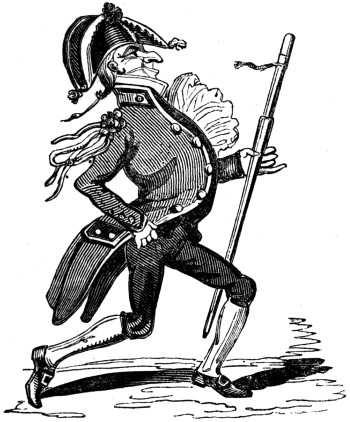
Run, Neighbours, run, the Lottery’s expiring, When Fortune’s merry wheel, it will never turn more; She now supplies all Numbers, you’re desiring, All Prizes, No Blanks, and Twenty Thousands Four. Haste, Neighbours, haste, the Chance will never come again, When, without pain, for little Cash—you’ll all be rich; Prizes a plenty of—and such a certain source of gain, That young and old, and all the world, it must bewitch. Then run, neighbours, run, &c.
This versified address and the engraving are from another bill. The verses may be presumed as sung by the footman, to excite his fellows of the party-coloured cloth to speculate in the never-enough-to-be-sufficiently-magnified-number of chances in favour of their gaining “Four of £20,000, and—Thirty other Capitals! No Blanks!—All in One Day!” Yet if the words, adapted from a popular duet, were regarded as an easy vehicle to effect that benevolent purpose, they could only be so to those who, with the contractors, forgot, or perhaps, with them, did not know, that the original tells of
“a day of jubilee cajolery.”
Surely this must have been a “word of fear” to all except the contractors themselves, who alone would be the gainers by what the body of adventurers hazarded in the “grand scheme” of “cajolery.”
One of the bills of a former Lottery begins as follows:—
BISH The Last Man.
In reminding his best friends, the public, that the State Lottery will be drawn this day, 3d May, Bish acquaints them that it is the very last but one that will ever take place in this kingdom, and he is THE LAST CONTRACTOR whose name will appear singly before the public, as the very last will be a coalition of all the usual contractors. Bish, being “the last man” who appears singly, has been particularly anxious to make an excellent scheme, and flatters himself the one he has the honour to submit must meet universal approbation.
At the back of this bill are the following verses, derived from the “cajolery” duet:—
TO-DAY! OR NOT AT ALL Run, Neighbours, Run!
Run, neighbours, run! To-day it is the Lott’ry draws, You still may be in time if your purse be low; Rhino we all know will stop, of poverty, the flaws, Possess’d of that you’ll find no one to serve you slow: The ministers in parliament of Lotteries have toll’d the knell, And have declar’d from Coopers’-hall dame Fortune soon they will expel. The blue-coat boys no more will shout that they have drawn a capital! Nor run, as tho’ their necks they’d break, to Lucky Bish the news to tell. Run, neighbours, run! &c. Run, neighbours, run! this is you know the third of May, ’Tis the day dame Fortune doth her levee hold; In the scheme, as you may see, are rang’d along in proud array, Of one and twenty thousands six, in notes or gold! A sov’reign cure e’en one of these would be for a consumption, sir, If such disease your pocket has, so if you’ve any gumption, sir, You’ll lose no time, but haste away, and buy a share or ticket, sir, For who can tell but this may be the very hour to nick it, sir? Run, neighbours, run! &c. Run, neighbours, run! the times they say are not the best, And cash ’tis own’d is falling short with high and low; Bankers retire now, while Notaries have little rest, And what may happen next no one pretends to know. Dame Fortune (on whom thousands drew) is going now to shut up shop, So if you’d cash a draft on her, make haste for soon her bank will stop; This very day her wheel goes round, when thousands with her gifts she’ll cheer, For those who can her smiles obtain may gaily laugh throughout the year. Run, neighbours, run! &c.
“Bish,” as the contractor is pleased to call himself, who, after he was “the last man,” dilated into a member of parliament, employed the greatest number of Lottery-laureates of any office keeper of his time; and he and the schemes wherein he engaged were lauded, in prose as well as verse, by his “ready writers.” One of their productions says:—
JOHN BULL’s Wonder
At monsieur Nong-tong-paw’s ubiquity could not be greater than the astonishment of a French gentleman, who popped into BISH’s office the other day to inquire after the capitals.—“You vill be so good to tell me de nombre of de capital you tiré—you draw yesterday?”—“Why, sir, there were....”—“Restez un peu, stay a littel moment.—You will tell me de capital more big dan two hundred pounds.”—“Why, sir, there were four drawn above 200l.: there was No. 7849 30,000l.”—“Ah! ma foi! dat is good dat is de grande chose. Vel, and by whom was it sel?”—“Bish sold it, sir.” “Bish, ha, ha! von lucky dog! vel, allons!”—“There was No. 602, 1000l., sir.”—“Ah, indeed! vel, who was sel dat?”—“Bish, sir.”—“Eh, ma foi! Bish encore? Vel.”—“There was No. 2032, 300l.”—“And who was sel?”—“Bish, sir.”—“Eh, mon dieu! ’tis very grand fortune. Now den de last, and who vas sel dat?”—“Why, sir, the last was No. 6275, 300l., also sold by Bish.”—“Eh, de diable! ’tis von chose impossible, Bish sell all de four?”—“Yes, sir, and in a former lottery he sold all the three thirty thousands.”—“Den he is von golden philosopher. I vill buy, I vill—let me see. Yes, I vill buy your shop.”—His ambition was at last, however, contented with three tickets; so that he has three chances of gaining the two thirty thousands yet in the wheel; and we have no doubt Bish will have the good luck of selling them.
“Bish” is the subject of versified praise, in another bill.
How to be Happy.
Let misers hug their worship’d hoards, And lock their chests with care; Whilst we enjoy what life affords, With spirits light as air. For our days shall haily gaily be, Prizes in store before us, We’ll spend our ev’nings merrily. And BISH we’ll toast in chorus. Let lovers droop for sparkling eyes, And heave the tender sigh: Whilst we embrace the glittering prize, And meagre care defy. For our days shall haily gaily be, Plenty in store before us; Our cash we’ll jingle merrily, And BISH we’ll toast in chorus. Let glory call the sons of war To dare the crimson’d field; Sweet Fortune’s charms are brighter far, Her golden arms we’ll wield. Then our days will haily gaily be, Riches in store before us; We’ll dance through life most merrily, And BISH we’ll toast in chorus.
“Bish” on another occasion steps in with:—
PERMIT ME TO ASK
Have you seen the scheme of the present Lottery?
Do you know that it contains More Prizes than Blanks?
Have you heard how very cheap the tickets are?
Are you aware, that Lotteries are about to be discontinued, the chancellor of the exchequer having said that the Lottery bill, introduced last session of parliament, should be the last?
I need not direct you to Bish’s, as being the luckiest offices in the kingdom, &c.
“Bish” adventured in the “City Lottery,” a scheme devised for getting rid of the houses in Picket-street, Temple-bar, and Skinner-street, Snow-hill; and on that occasion he favoured the world with the following:—
Freeholds and Fortunes. By Peter Pun.
Tune.—“Drops of Brandy.”
Dame Fortune is full of her tricks, And blind, as her portraits reveal, sir; Then the best way the goddess to fix, Is by putting a spoke in her wheel, sir: Her favours the Lott’ry unfolds, Then the summons to BISH don’t scorn sir; For, as her cornucopia he holds, He’s the lad for exalting your horn, sir. Rum ti iddity, &c. With poverty who would be known, And live upon orts in a garret, sir, Who could get a good house of his own, And fatten on roast beef and claret, sir! In the city scheme this you’ll obtain, At Bish’s, where all folks pell-mell come, By a ticket a free-hold you’ll gain, And it cannot be more free than welcome. Rum ti iddity, &c. This house, when you once realize it, Upholders will look sharp as lynxes, For an order to Egyptianize it, With catacomb fal lals and sphynxes; Chairs and tables, a mummy-like crew, With crocodile grooms of the stole, sir, Sarcophagus coal-skuttles too, And at Bish’s you’ll fill them with cole, sir. Rum ti iddity, &c. For when you’re thus furnish’d in state, And a pretty establishment got, sir, Ten to one but it pops in your pate, You’ll want sticks to be boiling the pot, sir; Then to Bish’s away for supplies, For mopusses they are so plenty, You may choose a ten thousand pound prize, And if you don’t like it a twenty. Rum ti iddity, &c. Then Bish for my money, I say, The like of him never was known, sir; As Brulgruddery says in the play, “That man’s the philosopher’s stone, sir.” Then what shall we do for this man, Who makes all your fortunes so handy? Buy his tickets as fast as you can, And drink him in drops of brandy. Rum ti iddity, &c.
“Bish” seems to have deemed “the Philosopher’s stone,” which never existed but in silly imaginations, to be a proper device for drawing customers. It is repeated in
PADDY’S PURSUIT, A NEW SONG.
From the county of Cork in dear Ireland I came, To England’s swate Island a fortune to gain; Where I heard that the strates were all paved with gold, And the hedges grew Guineas! so Paddy was told! I jump’d on dry land to my neck up in water, Which to some spalpeens gave subject for laughter; But, says I, with a grin, as I dragg’d myself out, “I’m not come to England to be food for a trout.” Fal de ral, de ral lal, O whack! Then to London I came, that monstracious city, Where the lads dress so gay, and the ladies look pratty; But, Och! blood-and-ouns! only mark my surprise, When only great stones in the strates met my eyes! No Guineas at all on the bushes there grew; Not a word that they told me, I found, sirs, was true: “Och! why wa’n’t I drown’d, and made food for the fish!” Thus I growled, ’till I lighted on one Master Bish. Fal de ral, &c. Master Bish had found out the Philosopher’s stone, And a Thousand yellow Guineas he gave me for One! Thus Fortune to Pat was monstraciously kind, Tho’ no gold on the bushes or strates I could find! Then honeys attend, and pursue my advice; Och! to 9, Charing-cross, be off in a trice; Buy a Lottery Chance, for the Drawing Day’s near, And perhaps, like friend Paddy, a Fortune you’ll clear. Fal de ral, &c.
“Bish” we find again attempting to attract, with the following:—
THE PHILOSOPHER’S STONE.
———————————— That stone, Philosophers in vain so long have sought,
Says Milton, would not prove more valuable to its possessor than an absolute knowledge of certain numbers which lie hidden in the Wheel of Fortune till Fate declares to the enraptured ears of the adventurer, who has founded his hopes of success on them, their union with certain large sums of money, viz. Twenty, Ten, or Five Thousand Pounds; for there are many such sums yet in the wheel, yet to be determined, yet to be gained by hazarding a mere trifle.
He, who life’s sea successfully would sail, Must often throw a sprat to catch a whale. Apply this proverb then; think, ere too late, What fortune, honour, and what wealth await The very trifling sum[484] of one pound eight.
“Bish,” of course, imagined, or wished, the public to be amazingly surprised at his popularity, and therefore indulged them with this song:
WHAT’S THE MATTER? By Quintin Query, Esq. Tune.—“O Dear, what can the Matter be?”
“O dear, what can the matter be?” To tell, who can be at a loss? The people are running by dozens to Bish’s, To make out their dreams, and fulfil all their wishes, And try to come in for the loaves and the fishes, At 4, Cornhill, and 9, Charing-cross. “O dear, what can the matter be?” I’ll tell you, good friend, if you wish; The people are trying dame Fortune to cozen, And the old women’s tongues are eternally buzzing, About lucky numbers, 19 to the dozen, And all they can talk of is Bish. “O dear, what can the matter be?” I dare say you’re dying to know; The horns blow about, be it rainy or sunny, The walls they are cover’d with bills all so funny, To shew you the way how to finger the money, And you all know that “makes the mare go.” “O dear, what can the matter be?” The bellman he rings such a peal? To tell those whose fortunes are rusted with rickets, To call at good luck’s (that is, Bish’s) two wickets, And a transfer obtain for 500 Whole Tickets; How conceited they’d make a man feel! “O dear, what can the matter be?” For joy you’ll be dancing a jig; For good luck most folks are delighted to choose a day, And a lucky day surely must be a good news day, Then the day of all days is the very next Tuesday; Then, Misfortune’s black Monday a fig!
“Bish,” on another occasion, treated the “gentle public,” like so many children, with another optical delusion.
FORTUNE’S GALANTY SHOW. Tune.—“GALANTY SHOW.”
O pretty show, O raree show, O finey galanty show, O pretty galanty show! Chaunt. Come, all my merry customers, of high, middling, and low degree, Look in at one of these little glasses, and you shall see what you shall see; My fine galanty show you great wonders shall view in, You shall see the high road to Fortune, and that’s better than the road to Ruin. O pretty show, O raree show, O finey galanty show, O pretty galanty show! There you see the New Lott’ry Scheme, such as never was plann’d before! Fewer Tickets, and fewer Blanks, and yet the Prizes are more; And besides the usual 5’s, 10’s, and 20 Thousands (Peep thro’ one of these wickets,) You shall see such a Prize as was never yet known, neither more nor less than 1000 whole Tickets! O pretty show, &c. And there you shall see, (Look a little to the right) Mr. BISH’s Shop on Cornhill: (Now a little to the left) And there’s his other Shop at Charing-cross, where buy Shares if you will; You’ll get a part of the 1000 whole Tickets, I’ll be bound, And that’s very much like getting a part of more than a Hundred Thousand Pounds! O pretty show, &c. Then look straight forward, and there you see Coopers’ Hall, (Isn’t it a fine building?) there the Tickets they draw; And there you see the pretty little Blue-coat Boys, and nicer little fellows you never saw; There you’ll see ’em pulling the Numbers and Prizes out of the very Grand Wheels And when one has a Ticket in the Lottery, and sees such a sight, how narvous one feels! O pretty show, &c. And there—(Rub the glass a little cleaner) there’s a sight I’d not have you miss fora pound, The little Boy draws out a Number (Let me see what Number you have got) aye, that’s it, I’ll be bound; There don’t the Clerk (On the left hand) look exactly as if he was calling it, don’t you see how he cries? And the other little Boy draws, and the other Clerk looks as if he bawl’d out a £20,000 Prize. O pretty show, &c. There you see (’tis no Dream of Castles in the Air, called Utopia) There you see Fortune pouring the Guineas out of—what the deuce is it? a great long hard name—Oh! her Cornucopia! That’s a fine Golden Horn, that holds all the Prizes, I declare, And to get its Contents would be a pretty Horn Fair! O pretty show, &c.
“Bish” was pleased to devise the scheme of a Lottery to be drawn on St. Swithin’s day, wherein wine was added to the prizes, and therefore, and because its novelty was deemed alluring, we find one of his bills beginning with an apostrophising and prophetic couplet:—
Hail, famed St. Swithin! who, with pow’r benign, Instead of rain pour showers of gold and wine!
Another in the same Lottery, beneath a wood-cut of a bunch of grapes, breaks out:—
On the 15th of July what a golden supply Of wine given gratis by BISH, If you can get but a share, you’ll have plenty to spare, And can treat all your friends as you wish.
“Bish,” on the same occasion, throws the “leer of invitation,” with
TRY IN TIME.
Och! Judy, my jewel, come here when I call; We may now get wine gratis, for nothing at all; And gold like paratees pil’d up in a heap, Which is offer’d us too, honey, almost as cheap. But there’s no time to lose if we’re meaning to try, For ’tis all in one day, on the 15th July. And since the grand scheme is beyond all compare, He’s a spalpeen who won’t buy a fortunate share.
“Bish,” in another bill, oddly enough, put an old, one-legged smoker, with a patch over one eye, a carbuncled nose, and his only foot flannelled up for the gout, the effects of drinking, in an arm chair, with the following lines below:—
“Laid up in Port.”
Od’s blood! what a time for a seaman to skulk, Like a lazy land-lubber ashore; If I’m laid up at all, I’ll be laid up in port, And surrounded by prizes galore. Tommy Bish shall fill my glass, And the puppies, as they pass, Sha’n’t run down the old commodore, The rich old commodore, the cosey old commodore, The boozing old commodore he; While I’m friends with mighty Bish, He will crown my ev’ry wish, Tho’ I’ll never more be fit for sea.
Then also, “Bish” favoured his “friends” with the opportunity of singing,
Bacchus and Plutus, or the Union. Tune.—“Derry Down.”
A ROW was kick’d up in the regions above, For Plutus and Bacchus for precedence strove; And in words such as these did their anger express, Till Jove swore he’d kick them both out of the mess. Derry down. First Bacchus advanc’d, tho’ he scarcely could stand, Determin’d, he swore, to have the whip hand; And thus he began.—“Why, you sordid old elf, All your thoughts are employ’d in the scraping of pelf. “Can gold, I would ask, e’er enliven the soul Like the juice of the grape, or a full flowing bowl? Can the glittering bauble such pleasure impart, Or make the blood circle so warm round the heart? “That gold is an evil, there’s many will say, As my vot’ries oft find when the reck’ning’s to pay; Had gold ne’er existed, the true jolly fellow For ever might tipple, and always get mellow. “I swear by old Styx!—that this truth it will stand:” But the wine in his noddle usurp’d the command,— A knock-’em-down argument Bacchus soon found, For quickly he measur’d his length on the ground. “As Bacchus is down,” then says Plutus, “I’ll rise;” And this speech he address’d to the knobs of the skies:— “That gold is a blessing, I’m sure I can prove: The soother of cares, and cementer of love! “You know the old proverb, of poverty, sure, ’Tis something about—‘when she enters the door, That love, through the window, soon toddles away;’ But if there were gold, I’m sure that he’d stay. “I’ll own that my bounties are sometimes misus’d: But pray why should I, sirs, for that be abus’d?” Here Jove stopp’d him short, and with positive air, Insisted that they should their quarrel forbear. “Your claims I admit, sir, and Bacchus’ too; But a plan to unite you, I now have in view; You know Tommy Bish?”—“To be sure!” exclaim all, “’Tis on him, that dame Fortune her bounty lets fall!” “Well,—a Lottery he’s plann’d, with an union rare, Where money and wine each come in for a share; There are three thirty thousands to gratify you; And the twelve pipes of wine, sirs, for Bacchus will do.” Says Bacchus to Plutus—“Then give us your hand, I’ll tipple his wine, till no more I can stand; And as Jove has inform’d us there’s money enough, Why you, Mister Plutus, can finger the stuff. “Besides, I have heard, or my memory’s fail’d, How greatly last Lott’ry his luck has prevail’d; The three twenty thousands, he sold (the rum fish!) Then let us be off, and buy tickets of BISH!” Derry down.
“Bish,” who in the former bill had subjoined, in plain prose, that “lotteries must end for ever,” likewise issued the following—
Duties on wines.
The minister in reducing the duty, so that wines may be sold at one shilling per bottle cheaper, has done much to increase the spirits of the people; at the same time he has adopted another measure that will in a few months DESTROY THE FREE TRADE of every person in the kingdom to obtain for a small sum a great fortune in a few weeks, by having determined to abolish Lotteries, which must soon end for ever; therefore, the present is one of the last opportunities to buy, &c.
“Bish,” according to the old plan, “ever ready to serve his friends,” issued
THE AMBULATOR’S GUIDE to the Land of Plenty.
By purchasing a TICKET, In the present Lottery,
You may reap a golden harvest in Cornhill, and pick up the bullion in Silver-street; have an interest in Bank-buildings; possess a Mansion-house in Golden-square, and an estate like a Little Britain; pour red wine down Gutter-lane; never be in Hungerford-market; but all your life continue a May-fair.
By purchasing a HALF,
You need never be confined within London-wall, but become the proprietor of many a Long-acre; represent a Borough, or an Aldermanbury; and have a snug share in Threadneedle-street.
By purchasing a QUARTER,
Your affairs need never be in Crooked-lane, nor your legs in Fetter-lane; you may avoid Paper-buildings; steer clear of the King’s-bench, and defy the Marshalsea; if your heart is in Love-lane, you may soon get into Sweetings-alley, obtain your lover’s consent for Matrimony-place, and always live in a High-street.
By purchasing an EIGHTH,
You may ensure plenty of provision for Swallow-street; finger the Cole in Coleman-street; and may never be troubled with Chancery-lane; you may cast anchor in Cable-street; set up business in a Fore-street, or a Noble-street; and need never be confined within a Narrow-wall.
By purchasing a SIXTEENTH,
You may live frugal in Cheapside; get merry in Liquorpond-street; soak your hide in Leather-lane; be a wet sole in Shoe-lane; turn maltster in Beer-lane, or hammer away in Smithfield.
In short, life must indeed be a Long-lane, if it’s without a turning. Therefore if you are wise, without Mincing the matter, be Fleet and go Pall-mall to Cornhill or Charing-cross, and enroll your name in the Temple of Fortune, BISH’s.
Lottery for Women in India.
Advertisement.
“BE IT KNOWN, that Six Fair Pretty Young Ladies, with two sweet and engaging young children, lately Imported from Europe, having roses of health blooming on their cheeks, and joy sparkling in their eyes, possessing amiable manners, and highly accomplished, whom the most indifferent cannot behold without expressions of rapture, are to be RAFFLED FOR next door to the British gallery. Scheme: twelve tickets, at twelve rupees each; the highest of the three throws, doubtless, takes the most fascinating, &c.”[485]
The four engravings on this page, with the lines beneath them, are from other Lottery bills.
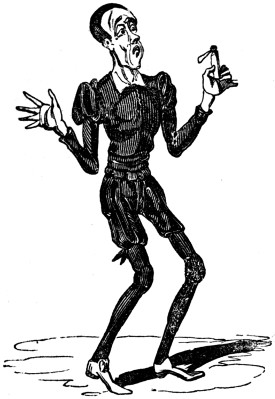
“Throw Physic to the Dogs,” for me The best composing draught’s a Fee; For sinking Chest, low pulse, or cold, There’s no Specific equals Gold.
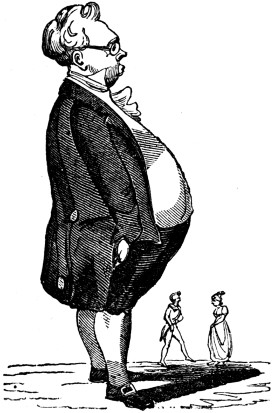
“My Dancing Days are over!”
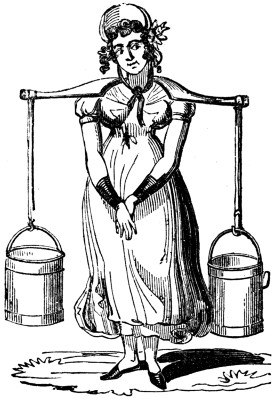
Though the lotteries soon will be over, I’m told, That now is the time to get pailsful of gold; And if there is any real truth in a dream, I myself shall come in for a share of the cream. We hail, ere the Sun, the first breath of the morn, And ’tis said “early birds get the best of the corn,” Of the Four Twenty Thousands perhaps fortune may Have in store one for me, as they’re drawn in One Day!
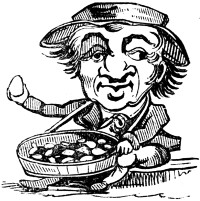
For the gay fruits of nature what wish can you feel, When compar’d with the fruits of the lottery wheel; My basket of fruit I’d exchange with great glee, If one golden pippin they’d only give me.
“Bish, contractor for another Lottery,” during the proceedings in parliament respecting the queen, availed himself of a celebrated answer by one of the witnesses at the bar of the house of lords, and issued the following:—
NON MI RICORDO! OR, A few Questions on a new Subject.
QUESTION.
Good Signor, if your memory serves, A question I would ask or two; Then pray may I the favour beg, That you will answer, if I do?
ANSWER.
Non mi ricordo, I can’t say, Whether my mem’ry serves or no; But let me hear them first, I pray; What I remember you shall know.
QUESTION.
Since Lotteries in this realm began, And many good ones there have been, Do you suppose the oldest man, So good a Scheme at this has seen?
ANSWER.
Non mi ricordo, surely no; Comparisons are idle tales, For such a Lottery Scheme as this, I must confess my memory fails.
QUESTION.
Now what peculiar features, pray, Distinguish this from all the rest? And why do all the people say, “Unquestionably this is best?”
ANSWER.
Non mi ricordo, ’tis in vain For me its merits now to say; To tell them all ’twould take, ’tis plain, From now until the Drawing Day.
QUESTION.
Its merits I will gladly own, But folks will questions ask, and pray If your opinion is requir’d, Just tell me, sir, what you would say?
ANSWER.
Non mi ricordo: read the Scheme, One word will answer all your wish ’Tis BISH’s plan, ’tis BISH’s theme, It must be good, ’tis plann’d by BISH.
“Bish,” in the annexed, puffs at Queen Anne’s prize of “5000 pounds,” as “so small.” This may be imagined to have been asserted under poetical licence; for, in fact, 5000l. in those days was almost equal to the largest prize in modern Lotteries.
THE Bonne Bouche of Lotteries.
Tune.—“Moderation and alteration.”
In the reign of Queen Anne, when first Lott’ries were invented, With very few Prizes Advent’rers were contented; The largest of which, (so small were Fortune’s bounds,) “Paid in faire Plate,” was but 5000 Pounds. Moderation! Moderation! O, what a wonderful Moderation! Soon 5000l. was deem’d but a small Bait, And 10,000 then was the Great Prize of State: Twenty follow’d soon after, then Thirty—bold push! And at last 40,000 was made the Bonne Bouche! Alteration! Alteration! &c. Now the Lott’ry Contractors a New Plan pursue, All former outdoings resolv’d to outdo; And have struck out a Plan to increase Public Gain, By which, One Hundred Thousand Pounds you may obtain. Temptation! Temptation! &c. If two Numbers are drawn in a specifi’d way, 1000 Whole Tickets the Holders repay; And a 1000 Whole Tickets a Chance may reveal, Of all the Great Prizes contain’d in the Wheel. Admiration! Admiration! &c. O, what a subject for Admiration! Now if you could get them, and ’twouldn’t be strange, For the rest of your life, how your fortune would change! A Coach, a Town-House, and a Country-House, too! Leading Man in the County!—O, wou’dn’t that do? Fascination! Fascination! &c. Then of Loans, and such fat things, such slices you’d gain! Then a Member of Parliament’s Seat you’d obtain! Next Knighthood—then Baronet—and in a short space, A Peerage—“My Lord!” and at last, “Please your Grace!” Exaltation! Exaltation! &c. Such things are quite flattering, and surely such are, But a Pleasure far greater remains to declare; Consider, what Power Wealth and Honour procure, To relieve the Oppress’d, and to succour the Poor. Exultation! Exultation! &c. Then with Patriot Ardour your Country to serve, For Riches are Curses, from[486] these if you swerve; And all this may be gain’d, if your Fortune you try, And of BISH, Fortune’s Favorite, a Ticket you buy. Expectation! Expectation! &c.
“Bish,” whose bills may be taken as a specimen of such kind of Lottery advertisements by whomever issued, will be observed to have constantly addressed them to the lowest minds and the meanest capacities. One more may further exemplify the remark:—
THE AGE OF WONDERS. Tune.—“Bang up.”
This is a Wonder working age, by all it is agreed on, And Wonders rise up ev’ry day, for public gaze to feed on; To sketch a few ’tis my intent, while now I’m in the mind, sir, And crown them all with one you’ll own, will leave them far behind, sir. Then push along; for something new, the public taste will dash on: For Wonders now are all the rage, and novelty’s the fashion. The juggling Indians show such feats, a lady’s taste ’twould shock it, They swallow swords, and swallow too the money from our pocket, A gentle fair, by fear unmov’d, with courage she so fraught is, On red-hot iron skips a dance, and bathes in aqua-fortis. Then push along; for something new, the public taste will dash on, For Wonders now are all the rage, and novelty’s the fashion. The greatest Wonder yet to tell, which all the world surprizes, Is BISH’s famous Lottery, and BISH’s wondrous prizes, Three fifty thousands grace the scheme, which yet remain undrawn, sir, A wonder which was never known since any man was born, sir. Then push along, to BISH’s go! of fortune he’s the man, sir, A vote of thanks, nem. con. we’ll pass for such a noble plan, sir.[487]
“Bish” when, what he called, “The Last Lottery of All!” had arrived, very cavalierly turned round on the government; and, on the eve of becoming a candidate for a seat in the house of commons, paid his compliments to his future colleagues in the following address:—
To the Public.
At the present moment, when so many articles, necessary to the comforts of the poorer classes, are more or less liable to taxation, it may surely be a question, whether the abolition of Lotteries, by which the state was a gainer of nearly half a million per annum, be, or be not, a wise measure!
’Tis true, that, as they were formerly conducted, the system was fraught with some evil. Insurances were allowed upon the fate of numbers through protracted drawings, and as the insurances could be effected for very small sums, those who could ill afford loss, imbibed a spirit for gambling, which the legislature very wisely most effectually prevented, by adopting, in the year 1809, the present improved mode of deciding the whole Lottery in one day.
As it is at present conducted, the Lottery is a voluntary tax, contributed to only by those who can afford it, and collected without trouble or expense; one, by which many branches of the revenue are considerably aided, and by means of which hundreds of persons find employment. The wisdom of those who at this time resign the income produced by it, and add to the number of the unemployed, may, as I have observed in a former address, surely be questioned.
Mr. Pitt, whose ability, in matters of financial arrangement, few will question, and whose morality was proverbial, would not, I am bold to say, have yielded to an outcry against a tax, the continuing of which would have enabled him to let the labourer drink his humble beverage at a reduced price, or the industrious artisan to pursue his occupation by a cheaper light. But we live in other times—in the age of improvement!—To stake patrimonial estates at hazard or écarte in the purlieus of St. James’s is merely amusement, but to purchase a ticket in the Lottery, by means of which a man may gain an estate at a trifling risk, is—immoral! nay, within a few hours of the time I write, were not many of our nobility and senators, some of whom, I dare say, voted against Lotteries, assembled betting thousand upon a horse race?
In saying so much, it may be thought that I am somewhat presumptuous, or that I take a partial view of the case. It is, however, my honest opinion, abstracted from personal considerations, that the measure of abolishing Lotteries is an unwise one, and as such I give it to that public, of whom I have been for many years the highly favoured servant, and for whose patronage, though Lotteries cease, my gratitude will ever continue.
As one of the last contractors, I have assisted in arranging a scheme, &c.! &c.!! &c.!!!
After this, perhaps, the reader may exclaim “I am satisfied!” and therefore, as we have the assurance of Mr. Bish that there will “never be another Lottery” to be lamented, the time has arrived for subjoining the following
Epitaph. In Memory of THE STATE LOTTERY, the last of a long line whose origin in England commenced in the year 1569,[488] which, after a series of tedious complaints, Expired on the 18th day of October, 1826. During a period of 257 years, the family flourished under the powerful protection of the British Parliament; the minister of the day continuing to give them his support for the improvement of the revenue. As they increased, it was found that their continuance corrupted the morals, and encouraged a spirit of Speculation and Gambling among the lower classes of the people; thousands of whom fell victims to their insinuating and tempting allurements. Many philanthropic individuals in the Senate, at various times for a series of years, pointed out their baneful influence without effect, His Majesty’s Ministers still affording them their countenance and protection. The British Parliament being at length convinced of their mischievous tendency, His Majesty GEORGE IV., on the 9th July, 1823,[489] pronounced sentence of condemnation on the whole race; from which time they were almost neglected by the British Public. Very great efforts were made by the Partisans and friends of the family to excite the public feeling in favour of the last of the race, in vain: It continued to linger out the few remaining moments of its existence without attention or sympathy, and finally terminated its career unregretted by any virtuous mind.
W. P.
Interesting Addenda.
A few remarkable facts, which were omitted in the proper order of narration, are now inserted.
Ancient Lottery.
About 1612 king James I., “in special favour for the plantation of English colonies in Virginia, granted a Lottery to be held at the west end of St. Paul’s; whereof one Thomas Sharplys, a taylor of London, had the chief prize, which was four thousand crowns in fair plate.”[490]
A Double Mistake.
Old Baron d’Aguilar, the Islington miser, was requested by a relation to purchase a particular ticket, No. 14,068, in the Lottery to be drawn in the year 1802, (but which was sold some few days before). The baron died on the 16th of March following, and the number was the first-drawn ticket on the 24th, and, as such, entitled to twenty thousand pounds. The baron’s representatives, under these circumstances, therefore published an advertisement, offering a reward of 1000l. to any person who might have found the said ticket, and would deliver it up. Payment was stopped. A wholesale linen-draper, in Cornhill, who had ordered his broker to buy him ten tickets, which he deposited in his chest, on copying the numbers, for the purpose of examining them, made a mistake of one figure, and called it 14,168 instead of 14,068, which was the 20,000l. prize. The lottery being finished, he sent ten tickets to be examined and marked. To his utter astonishment, he then found the error of the number copied on his paper. On his demanding payment at the lottery office, a caveat was entered by old d’Aguilar’s executors; but an explanation taking place, the 20,000l. was immediately paid him.
Christopher Bartholomew.
This person, who inherited a good fortune from his parents, was prosperous in his business, and had every prospect of success and eminence in life, fell a victim to an unconquerable itch for gambling in the Lottery. At one time, the White-conduit-house, with its tea-gardens and other premises, as also the Angel-inn, now the best tavern in Islington, were his freeholds: and he rented land to the amount of 2000l. a year, in the neighbourhood of that place, and Holloway. He was remarkable for having the greatest quantity of haystacks of any grower in the neighbourhood of London. He kept his carriage and servants in livery, and was believed to have been worth 50,000l. He was not only the proprietor, but the landlord of White-conduit-house, to which, by his taste in laying out its grounds, and the manner of conducting his business, he attracted great custom. On one occasion, having been unusually successful in the Lottery, he gave a public breakfast at his tea-gardens, “to commemorate the smiles of Fortune,” as he so expressed himself upon the tickets of admission at this fête champêtre.
At times he was very fortunate in the Lottery, and this tended to increase the mania which hurried him to his ruin. He was known to have spent upwards of 2000 guineas in a day for insurance, to raise which, stack after stack of his immense crops of hay were cut down and hurried to market, as the readiest way to obtain the supplies for these extraordinary outgoings; and at last he was obliged to part with his freehold, from accumulated difficulties and embarrassments, and he passed the remaining thirteen years of his life in great poverty, subsisting by the charity of those who knew him in “better days,” and by the paltry emolument he derived from serving as a juryman in the sheriff’s court for the county. His propensity to the Lottery, even under these degrading difficulties, never forsook him. Meeting one day, in the year 1807, with an old acquaintance, he told him he had a strong presentiment, that if he could purchase a particular number in the ensuing Lottery it would prove successful. His friend, after remonstrating with him on the impropriety of persevering in a practice that had been already attended with such evil consequences, was at last persuaded to advance the money to purchase a sixteenth, and go halves with him in the adventure. It was drawn a prize of 20,000l., and from the proceeds from this extraordinary turn of fortune, he was prevailed upon to purchase an annuity of 60l. per annum. Totally addicted, however, to the pernicious habit of insurance, he disposed of his annuity, and lost every shilling of the money; yet such was the meanness of his mind and circumstances, that he frequently applied to persons who had been served by him in his prosperity, for an old coat, or some other article of cast apparel; and not many days before he died, he begged a few shillings to purchase necessaries.
Bartholomew in intellect and manners was superior to the generality of men, and at one time possessed the esteem of all who knew him. His fate may be a warning to all ranks, particularly to those who are in trade, not to engage in hazardous pursuits. He died in a two pair of stairs room, in Angel-court, Windmill-street, in the Haymarket, in March, 1809, aged 68.[491]
A correspondent refers to Rees’s Cyclopædia as containing a good account of Lotteries, with table of chances relative to their schemes; and he adds, that Dr. Kelly, the well-known calculator, assured him he had ascertained that the chances of obtaining certain prizes were even more against the adventurer than would appear by those tables.
When the tickets were publicly drawn in Guildhall, and the drawing was protracted for several weeks, it was a curious sight for an indifferent spectator to go and behold the visages of the anxious crowd; to mark the hopes and the fears that seemed to agitate them, as their numbers or numbers near to theirs were announced. It is a fact, that poor medical practitioners used constantly to attend in the hall, to be ready to let blood, in cases where the sudden proclaiming of the fate of tickets in the hearing of the holders of them, was found to have an overpowering effect upon their spirits. The late Mr. Dalmahoy, of Ludgate-hill, was accustomed to affirm, that he owed his first establishment in a business which afterwards proved so prosperous, to the gratitude of a person, to whose assistance, when a young man, he had stept in, upon one of those critical emergencies.[492]
Origin of Lotteries.
The historian of “Inventions” says, that if, as some had done, he were to “reckon among the first traces of Lotteries every division of property made by lot, it might be said that Joshua partitioned the promised land into Lottery prizes before it was conquered.” In his opinion, the peculiarity of Lotteries consists in their numbers being distributed gratuitously, or, as in public Lotteries, for a certain price; it being left to chance to determine what numbers were to obtain the prizes, the value of which had been previously settled. He speaks of the “conditions and changes invented by ingenuity to entice people to purchase shares, and to conceal and increase the gain of the undertakers;” and, of the “delusion they occasion to credulous and ignorant people, by exciting hopes that have little probability in their favour.” He deems that the hint of modern Lottery was derived from the Romans. The rich persons at Rome, and particularly the emperors, endeavoured to attach the people by distributing among them presents consisting of eatables and other expensive articles, which were named congiaria. Tokens, or tickets, called tesseræ (in Greek συμζολα,) were generally given out, and the possessors, on presenting them at the store or magazine of the donor, received those things which they announced. In many cases, these tickets were distributed to every person who applied for them, and then these donations resembled our distribution of bread, but not our Lotteries, in which chance must determine the number of those who were to participate in the number of things distributed. In the course of time, the Roman populace was called together, and the articles distributed thrown to them from a stage. Such things were called missilia, and belonged to those who had the good fortune to catch them; but as oil, wine, corn, and such like articles, could not be distributed in this manner, and as other articles were injured by the too great eagerness of the people, tokens or tickets were thrown in their stead. These were square pieces of wood or metal, and sometimes balls of wood, inscribed with the names of the articles. Those who had obtained these tesseræ were allowed to transfer or sell them.[493]
Under “Lottery,” an antiquary refers to the pittacia of Petronius. The Romans issued gratis, to their visitors in the Saturnalia, tickets which were all prizes, and marked with inscriptions called apophoreta. The Lotteries of Augustus were mere bagatelles for sport; Nero’s were very costly; those of Heliogabalus ridiculous; as, a ticket for six slaves, another for six flies, &c. these were handed round in vases.[494]
Imitations, on a reduced scale, of the Roman congiaria have amused the continental princes and princesses of modern times. They distribute small presents to their courtiers, by causing trinkets or toys to be marked with numbers; the numbers being written on separate tickets, which are rolled up and put into a small basket or basin.[495]
In Italy, during the middle ages, the merchants or shop-keepers, in order to sell their wares more speedily and advantageously, converted their shops into offices of luck, where each person, for a small sum, was allowed to draw a number from the jar of fortune, which entitled the holder to the article written upon it; but as these shop-keepers gained excessive profits, and cheated the credulous people, by setting on their wares an extravagant price, which was concealed by the blanks, these practices were prohibited, or permitted only under strict inspection, and on paying a certain sum to the poor, or the sovereign.
From hence was derived the modern Lottery of the continent, when articles of merchandise were no longer employed as prizes, but certain sums of money instead, the amount of which was determined by the amount of money received, after the expenses and gain of the conductors were deducted. In these Lotteries, the tickets were publicly drawn by the charity boys, blindfolded. As they could not be conducted without defrauding the adventurers, it was at first believed, through old-fashioned conscientiousness, that it was unlawful to take advantage of the folly and credulity of the people, except for pious or charitable purposes. The gains were sometimes applied to the portioning of poor young women, the redemption of captives, or the formation of funds for the indigent, and other benificent objects. It was vainly imagined, that these public games of hazard would banish others still more dangerous; nor was it foreseen, that the exposure of tickets for sale, and their division into shares, would maintain and diffuse a spirit of gambling. This, however, was the result, and the profit from Lotteries became so great, that princes and ministers were induced to employ them as operations of finance: the people were forbidden to purchase tickets in foreign Lotteries, and, in order that the tickets of the state might be disposed of sooner, and with more certainty, many rulers were so shameless as to pay part of the salaries of their servants in tickets, and to compel guild companies and societies to expend in Lotteries what money they had saved. In 1764, this abuse was mentioned by the states of Wirtemburg among the public grievances, and in 1770 the duke promised that it should be abolished.
So early as 1521, the council of Osnaburg, in Germany, established a Lottery with wearing articles of merchandise for the prizes. In 1615, the magistrates of Hamburgh sanctioned a Lottery for building a house of correction in that city. An engraving is mentioned with the following title, “Representation of the Loto Publico, which was drawn in the large hall of the council-house at Nuremburg, anno 1715.” This is supposed to have been the first Lottery in that city. The first Lottery at Berlin was drawn in July, 1740; it contained 20,000 tickets at five dollars each; there were 4028 prizes; and the capital one was a house worth 24,000 dollars.
In 1549, a Lottery was drawn at Amsterdam for the building a church steeple; and another at Delft in 1595. In the hospital for old men, at Amsterdam, there is a beautiful painting by Daniel Vinckenbooms, which represents the drawing of a Lottery in the night time. He was born about 1578, and died in 1629.
In France, whither the Lottery was introduced from Italy, it was set on foot by merchants, and the only prizes were articles of merchandise: but, in 1539, Francis I. endeavoured to turn them to his own advantage. He permitted them under the inspection of certain members of the government, with a view, as was pretended, of banishing deceptive and pernicious games of chance; but on condition that he should receive for every ticket a teston de dix sols six deniers. It appears, however, from a royal order of recommendation, in February, 1541, that this Lottery was not then completed, and it is not known whether it ever was.
In 1572 and 1588, Louis de Gonzague duc de Nivernois established a Lottery at Paris, for the purpose of giving marriage portions to poor virtuous young women on his estates. The prize tickets were inscribed Dieu vous a élue, or, Dieu vous console; the former insured to the young woman who drew it 500 francs on her wedding-day; the latter, inscribed on the blanks, suggested the hope of better fortune the year following. No Lottery was ever drawn with so much ceremony and parade. Pope Sextus V. promised those who promoted it the remission of their sins: and, before the drawing, which began every year on Palm Sunday, mass was said.
Ladies of quality were induced by this example to establish similar Lotteries for the building or repairing of churches or convents, and other religious or benevolent purposes. Three ladies set on foot a Lottery with tickets at 40 sous each, for redeeming persons who had fallen into slavery among the Turks. Some other ladies instituted a Lottery in behalf of their confessor, who had been made a bishop, that they might buy him a carriage and horses, with other requisites, to support his episcopal dignity.
French history records the institution of many Lotteries as the means employed to make valuable presents to ladies, and other persons of distinction. It is supposed the largest of the kind was one designed by cardinal Mazarine, to increase his splendour and popularity among the courtiers. The tickets were distributed as presents.[496]
Louis XIV., on the days which were not fast days, went to dine at Marly with madame de Maintenon and other ladies. After dinner, the minister who wished to converse with him arrived, and when his business was finished, if they did not walk, he conversed, listened to music, played at cards, or helped to draw Lotteries, the tickets of which cost nothing, but were all prizes. They were composed of trinkets, jewels, and silks; but there were never any snuff-boxes, because he could not endure snuff, or suffer those who used it to approach him.[497]
In the seventeenth century these games of chance grew into Lotteries, in the proper sense of the word. During a scarcity of money which prevailed in 1644, Lawrence Tonti came from Naples to Paris, and proposed that kind of life-rents, or annuities, which are named after him Tontines; though they were used in Italy long before his time. After tedious disputes, his proposal was rejected; for which, in 1556, he substituted, with the royal approbation, a large Lottery in order to raise funds for building a stone bridge and an aqueduct. This Lottery was never completed, and consequently never drawn; and a wooden bridge was constructed, instead of that which had been burnt. The first Lottery on the plan of Tonti was set on foot at Paris in 1660, when the conclusion of peace, and the marriage of Louis XIV., were celebrated. It was drawn publicly, under the inspection of the police. The price of each ticket was a Louis d’or, which at that time was only eleven livres; and the highest prize was a hundred thousand livres. This was gained by the king himself, but he would not receive it, and left it to the next Lottery, in which he had no ticket. In 1661, all private Lotteries were prohibited under severe penalties, and from that time there were no other Lotteries than the Loteries royales.[498]
The ill-famed Italian or Genoese Lottery in Germany was, as its name shows, an invention of the Genoese, and arose from the mode in which the members of the senate were elected; for when that republic existed in a state of freedom, the names of the eligible candidates were thrown into a vessel called seminario, or, in modern times, into a wheel of fortune; and during the drawings of them it was customary for people to lay bets in regard to those who might be successful. That is to say, one chose the name of two or three nobili, for these only could be elected, and ventured upon them, according to pleasure, a piece of money; while, on the other hand, the opposite party, or the undertaker of the bank, who had the means of forming a pretty accurate conjecture in regard to names that would be drawn, doubled the stakes several times. Afterwards the state itself undertook the bank for these bets, which was attended with so much advantage; and the drawing of the names was performed with great ceremony. The venerabile was exposed, and high mass was celebrated, at which all the candidates were obliged to be present.
A member of the senate, named Benedetto Gentile, is said to have first introduced this Lottery, in the year 1620; and it is added, that the name of Gentile having never been drawn, the people took it into their heads that he, and his names, had been carried away by the devil. But at length, the wheel being taken to pieces in order to be mended, the name, which by some accident had never been drawn was found concealed in it.
This mode of Lottery is presumed to have been peculiar to the Genoese, who, for their own benefit established in many continental towns commissioners, to dispose of tickets, and to pay the prizes to those who had been fortunate.
These pernicious Lotteries continued till the end of the eighteenth century, when they were almost every where abolished and forbidden. To the honour of the Hanoverian government, no Lotto was ever introduced into it, though many foreigners offered large sums for permission to cheat the people in this manner. Those who wish to see the prohibitions issued against the Lotto, after making a great part of the people lazy, indigent, and thievish, may find them in Schlozer’s Staats-Anzeigen,
Si son exécrable mémoire Parvient à la postérité, C’est que le crime, aussi bien que la gloire, Conduit à l’immortalité.[499]
The Last Lottery in England.
Elia says, in the “New Monthly Magazine,”—“The true mental epicure always purchased his ticket early, and postponed inquiry into its fate to the last possible moment, during the whole of which intervening period he had an imaginary twenty thousand locked up in his desk—and was not this well worth all the money? Who would scruple to give twenty pounds interest for even the ideal enjoyment of as many thousands during two or three months? ‘Crede quod habes, et habes,’ and the usufruct of such a capital is surely not dear at such a price. Some years ago, a gentleman in passing along Cheapside saw the figures 1069, of which number he was the sole proprietor, flaming on the window of a Lottery office as a capital prize. Somewhat flurried by this discovery, not less welcome than unexpected, he resolved to walk round St. Paul’s, that he might consider in what way to communicate the happy tidings to his wife and family; out upon repassing the shop, he observed that the number was altered to 10,069; and, upon inquiry, had the mortification to learn that his ticket was blank, and had only been stuck up in the window by a mistake of the clerk. This effectually calmed his agitation; but he always speaks of himself as having once possessed twenty thousand pounds, and maintains that his ten minutes’ walk round St. Paul’s was worth ten times the purchase-money of the ticket. A prize thus obtained has moreover this special advantage;—it is beyond the reach of fate, it cannot be squandered, bankruptcy cannot lay siege to it, friends cannot pull it down, nor enemies blow it up; it bears a charmed life, and none of woman-born can break its integrity, even by the dissipation of a single fraction. Show me the property in these perilous times that is equally compact and impregnable. We can no longer become enriched for a quarter of an hour; we can no longer succeed in such splendid failures; all our chances of making such a miss have vanished with the Last of the Lotteries.
“Life will now become a flat, prosaic routine of matter-of-fact; and sleep itself, erst so prolific of numerical configurations and mysterious stimulants to Lottery adventure, will be disfurnished of its figures and figments. People will cease to harp upon the one lucky number suggested in a dream, and which forms the exception, while they are scrupulously silent upon the ten thousand falsified dreams which constitute the rule. Morpheus will stifle Cocker with a handful of poppies, and our pillows will be no longer haunted by the book of numbers.
“And who, too, shall maintain the art and mystery of puffing in all its pristine glory when the Lottery professors shall have abandoned its cultivation? They were the first, as they will assuredly be the last, who fully developed the resources of that ingenious art; who cajoled and decoyed the most suspicious and wary reader into a perusal of their advertisements, by devices of endless variety and cunning; who baited their lurking schemes with midnight murders, ghost stories, crim-cons, bon-mots, balloons, dreadful catastrophes, and every diversity of joy and sorrow to catch newspaper-gudgeons. Ought not such talents to be encouraged? Verily, the abolitionists have much to answer for!”
Here, at last, ends the notices respecting the Lottery, of which much has been said, because of all depraving institutions it had the largest share in debasing society while it existed: and because, after all, perhaps, the monster is “only scotched, not killed.”
November 16.
Extraordinary Lunar Halo.
On the night of this day in 1823, about half past nine o’clock, Dr. T. Forster observed a very remarkable and brilliant phenomenon about the moon. It was a coloured discoid halo, consisting of six several concentric circles; the nearest to the moon, or the first disk around her, being dull white, then followed circles of orange, violet, crimson, green, and vermillion; the latter, or outermost, subtending in its diameter an angle of above ten degrees. This phenomenon was evidently produced by a refraction in the white mist of a stratus, which prevailed through the night, but it varied in its colours, as well as in its brilliancy, at different times.[500]
NATURALISTS’ CALENDAR.
Mean Temperature 43·00.
Whims and Oddities.
The company of odd-looking personages playing at nine-pins in the hollow of the wild mountain, were not greater objects of wonder to Rip Van Winkle, than forty original designs by Mr. Hood will be to the reader who looks for the first time at this gentleman’s “Whims and Oddities.”[501]
All the world knows, or ought to know, that among persons called literary there are a few peculiarly littery; who master an article through confusion of head and materials, and, having achieved the setting of their thoughts and places “to rights,” celebrate the important victory by the triumph of a short repose. At such a minute, after my last toilsome adventure in the “Lottery,” sitting in my little room before the fire, and looking into it with the comfortable knowledge that the large table behind me was “free from all incumbrances,” I yearned for a recreative dip into something new, when Mr. Hood’s volume, in a parcel bearing the superscription of a kind hand, was put into mine. It came in the very nick; and, as I amused myself, I resolved to be thenceforth, and therefrom, as agreeable as possible to my readers.
On the title-page of Mr. Hood’s book is this motto, “O Cicero! Cicero! if to pun be a crime, ’tis a crime I have learned of thee: O Bias! Bias! if to pun be a crime, by thy example I was biassed!—Scriblerus.”
The first engraving that opened on me was of
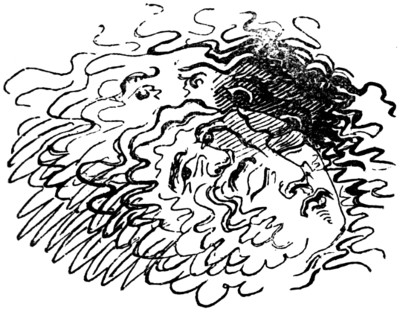
A Dream.
In this figure, “a medley of human faces, wherein certain features belong in common to different visages,—the eyebrow of one, for instance, forming the mouth of another,”—Mr. Hood has successfully “tried to typify a common characteristic of dreams; namely, the entanglement of divers ideas, to the waking mind distinct or incongruous, but, by the confusion of sleep, inseparably ravelled up, and knotted into Gordian intricacies. For, as the equivocal feature, in the emblem, belongs indifferently to either countenance, but is appropriated by the head that happens to be presently the object of contemplation; so, in a dream, two separate notions will mutually involve some convertible incident, that becomes, by turns, a symptom of both in general, or of either in particular. Thus are begotten the most extravagant associations of thoughts and images,—unnatural connections, like those marriages of forbidden relationships, where mothers become cousins to their own sons or daughters, and quite as bewildering as such genealogical embarrassments.”
As an illustration of this kind of dream, the author relates a dismal one, “which originated in the failure of his first and last attempt as a dramatic writer;” and another, wherein the preliminaries were pleasant, and the conclusion was whimsical. “It occurred,” says Mr. Hood, “when I was on the eve of marriage; a season, when, if lovers sleep sparingly, they dream profusely. A very brief slumber sufficed to carry me in the night-coach to Bognor. It had been concerted, between Honoria and myself, that we should pass the honeymoon at some such place upon the coast. The purpose of my solitary journey was to procure an appropriate dwelling, and which, we had agreed, should be a little pleasant house, with an indispensable look out upon the sea. I chose one, accordingly; a pretty villa, with bow-windows, and a prospect delightfully marine. The ocean murmur sounded incessantly from the beach. A decent, elderly body, in decayed sables, undertook, on her part, to promote the comforts of the occupants by every suitable attention, and, as she assured me, at a very reasonable rate. So far, the nocturnal faculty had served me truly. A day-dream could not have proceeded more orderly; but, alas, just here, when the dwelling was selected, the sea view secured, the rent agreed upon, when every thing was plausible, consistent, and rational, the incoherent fancy crept in and confounded all,—by marrying me to the old woman of the house!”
Because it never happened that Mr. Hood in his dreams fancied himself deprived of any sense, he was greatly puzzled by this question,—
“How does a BLIND man dream?”
“I mean” says Mr. H. “a person with the opaque crystal from his birth. He is defective in that very faculty which, of all others, is most active in those night-passages, thence emphatically called Visions. He has had no acquaintance with external images; and has, therefore, none of those transparent pictures that, like the slides of a magic-lantern, pass before the mind’s eye, and are projected by the inward spiritual light upon the utter blank. His imagination must be like an imperfect kaleidoscope, totally unfurnished with those parti-coloured fragments, whereof the complete instrument makes such interminable combinations. It is difficult to conceive such a man’s dream.
“Is it, a still benighted wandering,—a pitch-dark night progress, made known to him by the consciousness of the remaining senses? Is he still pulled through the universal blank, by an invisible power, as it were, at the nether end of the string?—regaled, sometimes, with celestial voluntaries, and unknown mysterious fragrances, answering to our more romantic flights; at other times, with homely voices, and more familiar odours; here, of rank smelling cheeses, there, of pungent pickles or aromatic drugs, hinting his progress through a metropolitan street. Does he over again enjoy the grateful roundness of those substantial droppings from the invisible passenger,—palpable deposits of an abstract benevolence,—or, in his nightmares, suffer anew those painful concussions and corporeal buffetings, from that (to him) obscure evil principle, the Parish Beadle?
“This question I am happily enabled to resolve, through the information of the oldest of those blind Tobits that stand in fresco against Bunhill-wall; the same who made that notable comparison, of scarlet, to the sound of a trumpet. As I understood him, harmony, with the gravel-blind, is prismatic as well as chromatic. To use his own illustration, a wall-eyed man has a palette in his ear as well as in his mouth. Some stone-blinds, indeed, dull dogs without any ear for colour, profess to distinguish the different hues and shades by the touch; but that, he said, was a slovenly, uncertain method, and in the chief article, of paintings, not allowed to be exercised.
“On my expressing some natural surprise at the aptitude of his celebrated comparison,—a miraculous close likening, to my mind, of the known to the unknown,—he told me, the instance was nothing, for the least discriminative among them could distinguish the scarlet colour of the mail guards’ liveries, by the sound of their horns: but there were others, so acute their faculty! that they could tell the very features and complexion of their relatives and familiars, by the mere tone of their voices. I was much gratified with this explanation; for I confess, hitherto, I was always extremely puzzled by that narrative in the ‘Tatler,’ of a young gentleman’s behaviour after the operation of couching, and especially at the wonderful promptness with which he distinguished his father from his mother,—his mistress from her maid. But it appears, that the blind are not so blind as they have been esteemed in the vulgar notion. What they cannot get one way they obtain in another: they, in fact, realize what the author of Hudibras has ridiculed as a fiction, for they set up
————communities of senses, To chop and change intelligences, As Rosicrucian Virtuosis Can see with ears—and hear with noses.”
Never having tried opium, and therefore without experience of “such magnificent visions” as are described by its eloquent historian, “I have never,” says Mr. Hood, “been buried for ages under pyramids; and yet, methinks, have suffered agonies as intense as his could be, from the common-place inflictions. For example, a night spent in the counting of interminable numbers,—an inquisitorial penance,—everlasting tedium,—the mind’s treadmill.”
That “the innocent—sleep,” is an exceptionable position. What happy man, with a happy wife by his side, and the first, sweet, restless plague and pledge of their happiness by hers, has not been awakened to a sense of his felicity, by a weak, yet shrill and spirit-stirring “la-a, la-a, la-a, la-a, la-a-a, la-a-a—a,” of some secret sorrow, “for ever telling, yet untold.”
Happy the man whose only care A few paternal achings are.
Gentle reader of the Benedictine order! I presume not to anticipate the pleasure thou wilt derive from contemplating thyself engaged in a domestic exercise, suited to the occasion,—pacing thy bed-room at “the heavy middle of the night,” holding the little “innocent”
Fondly lock’d in duty’s arms;
its dear eyes provokingly open to the light of the chamber-lantern; thine own closed by drowsiness, yet kept unsealed by affection; thy lips arranged for the piano of carminative sounds—“quivering to the young-eyed cherubim”—
Oh! slumber my darling Thy sire is a knight—
—thy “darling” ceasing its “sweet voice,” to offer more decisively by its looks, “I would out-night you.” Brother Benedict! there is an engraving of thee, and thine, in the book I speak of, mottoed, “Son of the sleepless!”
Let me extract another cut, seemingly a portrait of the alarming “hope of the family,” after thou hast for some few years tried, perchance, “the Locke system; which, after all,” according to Mr. Hood, “is but a canal system for raising the babe-mind to unnatural levels”—
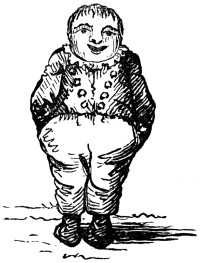
“My son, sir.”
At about the age of “My son, sir,” boys seek to satisfy their curiosity, and gratify their taste. It is the spelling-time of young experience, and they are extremely diligent. Their senses are fresh and undepraved, and covetous of the simplest pleasures.
Every town in England, and every village, with inhabitants and wealth sufficient to consume a hogshead of “brown moist” within a reasonable time, exhibits an empty sugar cask in the open street; it is every little grocer’s pride, and every poor boy’s delight:—
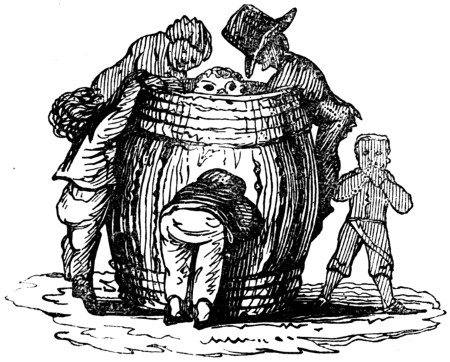
“O! there’s nothing half so sweet in life!”
“Gentle reader, read the motto! read the motto!” Look at the engraving; “show it to your children, and to your children’s children,” and ask them what they think. If you desire an immediate living example to illustrate professor Malthus’s principle, that “population always comes up to the mean of subsistence,” set out a sugar cask, and there will be a swarm of boys about it, from no one knows whither, in ten minutes. The first takes possession of the inside, and is “monarch of all he surveys.” Like the throne, it is an envied, and an unquiet possession. From the emulous, on all sides, he receives vain addresses and remonstrances, and against their threatening hands is obliged to keep a sharp look out; but his greatest enemy, and for whom he keeps a sharp look over, is the grocer’s man. A glimpse of that arch-foe “frightens him from his impropriety” in a twinkling; unless, indeed, from the nearness of the adversary he fail to escape, when, for certain, his companions leave him “alone in his glory,” and then he knows for a truth, that “after sweet comes sour.” The boy there, straddling like the “Great Harry,” has had his wicked will of the barrel to satiety, and therefore vacates his place in favour of him of the hat, on whose nether end “time hath written strange defeatures.” It is not so certain, that the fine, fat, little fellow, with his hands on the edge of the tub, and the ends of his toes on the ground, will ascend the side, as that he who stoops in front is enjoying the choicest pickings of the prize. The others are mere common feeders, or gluttons, who go for quantity; he is the epicure of the party—
He seeks but little here below But seeks that little good;
and, of foretaste, he takes his place at the bung-hole, where the sugar crystallizes, and there revels in particles of the finest candies. “I pity the poor child,” says Mr. Hood, “that is learned in alpha beta, but ignorant of top and taw”—and I pity every poor child who only knows that a sugar tub is sweet, and is ignorant of the sweetest of its sweets. There are as many different pickings in it as there are cuts in a shoulder of mutton, or Mr. Hood’s book. My authority for this information is an acute, pale-faced, sickly, printer’s boy, an adapt in lickerish things, who declared the fact the morning after he had been to see Mr. Mathews, by affirming, with enthusiasm, “I’ve tried it, I’ve analyzed it, and I know it.”
“Ah! little think the gay, licentious proud,”
who spend their money on bulls-eyes and hard-bake, which are modern inventions, of the delicacies within a grocer’s plain, upright and downright, good, old, natural, brown sugar tub—
“O! there’s nothing half so sweet in life.”
Mr. Hood introduces another “sweet pleasure,” with another equally apt quotation:—
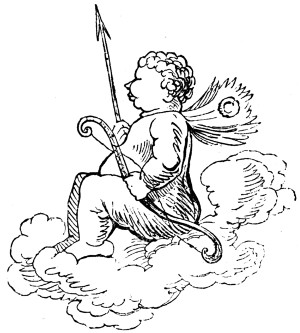
“Tell me, my heart, can this be Love?”
This figure of “The Popular Cupid,” Mr. Hood copied, “by permission, from a lady’s Valentine;” and he says, “in the romantic mythology it is the image of the divinity of Love.” He inquires, “Is this he, that, in the mind’s eye of the poetess, drifts adown the Ganges—
Pillow’d in a lotus flow’r, Gather’d in a summer hour, Floats he o’er the mountain wave, Which would be a tall ship’s grave?
—Does Belinda believe that such a substantial Sagittarius lies ambushed in her perilous blue eye?—I can believe in his dwelling alone in the heart—seeing that he must occupy it to repletion: in his constancy—because he looks sedentary, and not apt to roam: that he is given to melt—from his great pinguitude: that he burneth with a flame—for so all fat burneth: and hath languishings—like other bodies of his tonnage: that he sighs—from his size. I dispute not his kneeling at ladies’ feet—since it is the posture of elephants—nor his promise, that the homage shall remain eternal. I doubt not of his dying—being of a corpulent habit, and a short neck: of his blindness—with that inflated pig’s cheek. But, for his lodging in Belinda’s blue eye, my whole faith is heretic—for she hath never a sty in it.”
Mr. Hood, doubtless, desires that the world should know his “Whims and Oddities” through his own work; its notice here, therefore, while it affords a winter evening’s half hour entertainment, is not to mar his hopes. But it is impossible to close its merry-making leaves without shadowing forth a little more of the volume.
It ought to be observed, that the prints just presented are from engravings in Mr. Hood’s book, of which there are forty drawn by his own pencil; and, that he attaches a motto to each, so antithetical, as to constitute the volume a pocket portfolio of designs to excite risibility. For example:—
He tells a story of his “Aunt Shakerly,” a lady of enormous bulk, who placed Mr. Hood’s baby cousin in the nursing-chair while she took in the news, and then, in her eagerness to read the accidents and offences, unthinkingly sat, with the gravity of a coroner’s inquest, in the aforesaid chair, and thereby unconsciously suppressed “an article of intelligence”—an occurrence which there is little reason to doubt appeared among the “horribles,” in the favourite department of her paper, the next morning. The engraving that pictures this is mottoed, “The Spoiled Child!”
Mr. Hood institutes “A Complaint against Greatness,” through “an unhappy candidate for the show at Sadler’s repository,” described in the following item of the catalogue—“The reverend Mr. Farmer, a four years’ old Durham ox, fed by himself, upon oil-cake and mangel-wurzel.” The complainant, however, says, “I resemble that worthy agricultural vicar only in my fat living.”
This being the season when these condemned animals come up from the country to the metropolis, it seems a fit time to hear the complainant’s description of his journey. “Wearisome and painful was my pilgrim-like progress to this place, by short and tremulous steppings—like the digit’s march upon a dial. My owner, jealous of my fat, procured a crippled drover, with a withered limb, for my conductor; but even he hurried me beyond my breath. The drawling hearse left me labouring behind; the ponderous fly-waggon passed me like a bird upon the road, so tediously slow is my pace. It just sufficeth, oh, ye thrice happy oysters! that have no locomotive faculty at all, to distinguish that I am not at rest. Wherever the grass grew by the way-side, how it tempted my natural longings—the cool brook flowed at my very foot, but this short, thick neck forbade me to eat or drink; nothing but my redundant dewlap is likely ever to graze on the ground!—If stalls and troughs were not extant, I must perish. Nature has given to the elephant a long, flexible tube, or trunk, so that he can feed his mouth, as it were, by his nose: but is man able to furnish me with such an implement? Or would he not still withhold it, lest I should prefer the green herb, my natural, delicious diet, and reject his rank, unsavoury condiments?—What beast, with free will, but would repair to the sweet meadow for its pasture”—
Verily, it is humane thus to lecture man from the mouth of an animal, whose species is annually deformed for butcherly pride, and the loathing of the table—“to see the prize-steak loaded with that rank, yellow abomination, might wean a man from carnivorous habits for ever.” The supplicant for our compassion adds, in behalf of himself and his dumb-fellow creatures, “It may seem presumption in a brute to question the human wisdom; but truly, I can perceive no beneficial ends worthy to be set off against our sufferings. There must be, methinks, a nearer (and a better) way of augmenting the perquisites of the kitchen-wench and the fire-man.” There is an admirable cut of the over-fed petitioner, breathing “O, that this too, too solid flesh would melt!” The figure of the crippled drover is excellent.
Mr. Hood devises a romantic adventure that befel a herd of these animals of the common class, and a little wooden, white-painted house on four wheels, to which a sedentary citizen and his wife had retired to spend their days, “impaled” by the wayside on Hounslow-heath, where—
Having had some quarters of school breeding, They turn’d themselves, like other folks, to reading; But setting out where others nigh have done, And being ripen’d in the seventh stage, The childhood of old age, Began as other children have begun,— Not with the pastorals of Mr. Pope, Or Bard of Hope, Or Paley, ethical, or learned Porson,— But spelt, on sabbaths, in St. Mark, or John, And then relax’d themselves with Whittington, Or Valentine and Orson— But chiefly fairy tales they loved to con, And being easily melted, in their dotage, Slobber’d,—and kept Reading,—and wept Over the White Cat, in their wooden cottage. Thus reading on—the longer They read, of course, their childish faith grew stronger In gnomes, and hags, and elves, and giant grim,— If talking trees and birds reveal’d to him, She saw the flight of fairyland’s fly-waggons, And magic-fishes swim In puddle ponds, and took old crows for dragons,— Both were quite drunk from the enchanted flaggons; When as it fell upon a summer’s day. As the old man sat a feeding On the old babe-reading, Beside his open street-and-parlour door, A hideous roar Proclaim’d a drove of beasts was coming by the way. Long-horned, and short, of many a different breed, Tall, tawny brutes, from famous Lincoln-levels, Or Durham feed; With some of those unquiet, black, dwarf devils, From nether side of Tweed, Or Firth of Forth; Looking half wild with joy to leave the North,— With dusty hides, all mobbing on together,— When,—whether from a fly’s malicious comment Upon his tender flank, from which he shrank; Or whether Only in some enthusiastic moment,— However, one brown monster, in a frisk, Giving his tail a perpendicular whisk, Kick’d out a passage thro’ the beastly rabble; And after a pas seul,—or, if you will, a Horn-pipe, before the basket-maker’s villa, Leapt o’er the tiny pale,— Back’d his beef-steaks against the wooden gable, And thrust his brawny bell-rope of a tail Right o’er the page, Wherein the sage Just then was spelling some romantic fable. The old man, half a scholar, half a dunce, Could not peruse, who could?—two tales at once; And being huff’d At what he knew was none of Riquet’s tuft; Bang’d-to the door, But most unluckily enclosed a morsel Of the intruding tail, and all the tassel:— The monster gave a roar, And bolting off with speed, increased by pain, The little house became a coach once more, And, like Macheath, “took to the road” again!
When this happened the old man’s wife was absent,
Getting up some household herbs for supper, Thoughtful of Cinderella, in the tale, And quaintly wondering how magic shifts Could o’er a common pumpkin so prevail, To turn it to a coach;
nor did she turn round, till house and spouse had turned a corner out of sight.
The change was quite amazing; It made her senses stagger for a minute, The riddle’s explication seem’d to harden; But soon her superannuated nous Explained the horrid mystery;—and raising Her hand to heaven, with the cabbage in it, On which she meant to sup,— “Well! this is fairy work! I’ll bet a farden, Little prince Silverwings has ketch’d me up, And set me down in some one else’s garden!”
Here ends the “fairy tale” of Hounslow-heath.
“She is far from the land!” is a motto to an engraving of a land lady, frightened by voyaging in a Thames wherry, opposite St. Paul’s. Her after alarms at sea are concluded pleasantly:—
“We were off Flamborough-head. A heavy swell, the consequence of some recent storm to the eastward, was rolling right before the wind upon the land:—and, once under the shadow of the bluff promontory, we should lose all the advantage of a saving westerly breeze. Even the seamen looked anxious: but the passengers, (save one,) were in despair. They were, already, bones of contention, in their own misgivings, to the myriads of cormorants and waterfowl inhabiting that stupendous cliff. Miss Oliver alone was sanguine. She was all nods, and becks, and wreathed smiles; her cheeriness increased in proportion with our dreariness. Even the dismal pitching of the vessel could not disturb her unseasonable levity;—it was like a lightening before death—but, at length, the mystery was explained. She had springs of comfort that we knew not of. Not brandy, for that we shared in common; nor supplications, for those we had all applied to; but her ears, being jealously vigilant of whatever passed between the mariners, she had overheard from the captain,—and it had all the sound, to her, of a comfortable promise,—that ‘if the wind held, we should certainly go on shore.’”
The popular ballad of “Sally Brown and Ben the Carpenter,” which first appeared in the “London Magazine,” is inserted in this volume. “I have never been vainer of any verses,” says Mr. Hood, “than of my part in the following ballad. The lamented Emery, drest as Tom Tug, sang it at his last mortal benefit at Covent-garden; and, ever since, it has been a great favourite with the watermen of the Thames, who time their oars to it, as the wherrymen of Venice time theirs to the lines of Tasso. With the watermen, it went naturally to Vauxhall: and, over land, to Sadler’s-wells. The guards, not the mail coach but the life guards, picked it out from a fluttering hundred of others, all going to one air, against the dead wall at Knightsbridge. Cheap printers of Shoe-lane and Cow-cross, (all pirates!) disputed about the copyright, and published their own editions; and, in the mean time, the authors, to have made bread of their song, (it was poor old Homer’s hard ancient case!) must have sung it about the streets. Such is the lot of literature! the profits of ‘Sally Brown’ were divided by the ballad-mongers: it has cost, but has never brought me, a halfpenny.”
A “Recipe for Civilisation,” in Hudibrastic lines, is waggishly ascribed to the “pen of Dr. Kitchiner—as if, in the ingredients of versification, he had been assisted by his Butler.” It is accompanied by a whimsical whole length of “the Cook’s Oracle,” adjusting musical notes on the bars of a gridiron, a ludicrous allusion to the good-humoured Doctor’s diversified attainments in science and popularity.
From an odd poem, attributed to an odd personage, “The Last Man,” two verses are selected, as an example of feelings which the punning on the title-page seemed to have proscribed:—
I’ve buried my babies one by one, And dug the deep hole for Joan, And cover’d the faces of kith and kin, And felt the old church-yard stone Go cold to my heart, full many a time, But I never felt so lone. For the lion and Adam were company, And the tiger him beguiled; But the simple kine are foes to my life, And the household brutes are wild. If the veriest cur would lick my hand I could love it like a child!
Mr. Hood’s pen essays “Walton Redivivus: A New River Eclogue.”
“[Piscator is fishing—near the sir Hugh Middleton’s Head, without either basket or can. Viator cometh up to him, with an angling-rod and a bottle.]”
It is prefaced by a citation “From a Letter of C. Lamb,” in these words:—“My old New River has presented no extraordinary novelties lately. But there Hope sits, day after day, speculating on traditionary gudgeons. I think she hath taken the fisheries. I now know the reasons why our forefathers were denominated East and West Angles. Yet is there no lack of spawn, for I wash my hands in fishets that come through the pump, every morning, thick as motelings—little things that perish untimely, and never taste the brook.”
To face this “Eclogue” there is a motto, “My banks they are furnished,” beneath a whole length figure, so like “poor Jemmy Whittle!”—only not looking so good natured.
“Love me, love my dog,” is a fearful cut—Mr. Hood’s step-mother, and her precious “Bijou”—with a story, and a tail-piece—“O list unto my tale of woe,”—unnaturally natural.
One of the best pieces in the volume is “The Irish Schoolmaster,” who, from a clay cabin, “the College of Kilreen,” hangs out a board, “with painted letters red as blood,” announcing “Children taken in to bate.”
Six babes he sways,—some little and some big, Divided into classes six;—alsoe, He keeps a parlour boarder of a pig, That in the college fareth to and fro, And picketh up the urchins’ crumbs below And eke the learned rudiments they scan, And thus his A, B, C doth wisely know,— Hereafter to be shown in caravan, And raise the wonderment of many a learned man. Alsoe, he schools some tame familiar fowls, Whereof, above his head, some two or three Sit darkly squatting, like Minerva’s owls, But on the branches of no living tree, And overlook the learned family; While, sometimes, Partlet, from her gloomy perch, Drops feather on the nose of Dominie, Meanwhile, with serious eye, he makes research In leaves of that sour tree of knowledge—now a birch. ******* Now, by the creeping shadows of the moon, The hour is come to lay aside their lore; The cheerful pedagogue perceives it soon, And cries, “Begone!” unto the imps,—and four Snatch their two hats and struggle for the door, Like ardent spirits vented from a cask, All blythe and boisterous,—but leave two more, With Reading made Uneasy for a task, To weep, whilst all their mates in merry sunshine bask, Like sportive elfins on the verdant sod, With tender moss so sleekly overgrown, That doth not hurt, but kiss, the sole unshod, So soothely kind is Erin to her own! And one, at hare and hound, plays all alone,— For Phelim’s gone to tend his step-dame’s cow; Ah! Phelim’s step-dame is a canker’d crone! Whilst other twain play at an Irish row, And, with shillelah small, break one another’s brow! But careful Dominie, with ceaseless thrift, Now changeth ferula for rural hoe; But, first of all, with tender hand doth shift His college gown, because of solar glow, And hangs it on a bush to scare the crow: Meanwhile, he plants in earth the dappled bean, Or trains the young potatoes all a-row, Or plucks the fragrant leek for pottage green, With that crisp curly herb, call’d Kale in Aberdeen. And so he wisely spends the fruitful hours, Linked each to each by labours, like a bee; Or rules in learning’s hall, or trims her bow’rs;— Would there were many more such wights as he, To sway each capital academie Of Cam and Isis; for, alack! at each There dwells, I wot, some dronish Dominie, That does no garden work, nor yet doth teach, But wears a floury head, and talks in flow’ry speech!
For the entire of the subjects already extracted from, and for many others not adverted to, even by name, reference should be had to the work itself. There is one design, however, so excellent a specimen of Mr. Hood’s clear conception and decisive execution, that merely in further illustration of his talent it is here introduced.
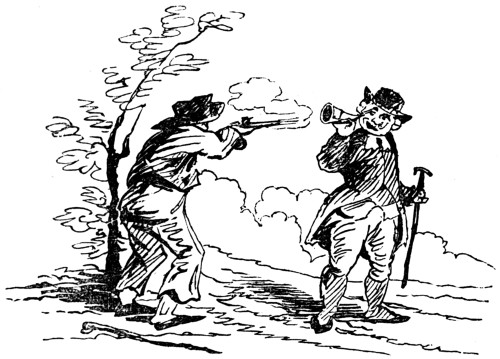
“Very deaf, indeed.”
An engraving of Mr. Hood’s admirable “Parish Beadle,” from his “Progress of Cant,” was inserted in an account of that print on p. 130 of the present volume of the Every-Day Book. Great as was the merit of that print, in point of wit and humour, and curious as it will always be regarded for its multiform developement of character, and relationship to the manners of the age, yet it is largely exceeded, in these respects, by the volume of “Whims and Oddities.” Possessing the rare talent, of illustrating what he writes by his own drawings, Mr. Hood is to be esteemed in a twofold capacity. He has, withall, the remarkable merit of having acquired his knowledge of art by his own teaching; and, what augurs well, the praise which the “Progress of Cant” deserved and obtained, has wholesomely invigorated him to higher mastery. There is a firmness of execution in the designs to the “Whims and Oddities,” surprisingly superior to the general manner of his meritorious etching just mentioned. The book is altogether the most original that the press of late years has produced; and, luckily, it comes like a seasonable visiter, to raise shouts of laughter “round about the coal-fire” in cold weather.
November 17.
Hugh, Bishop of Lincoln.
His name is in the church of England calendar and almanacs on this day, which was ordained his festival by the Romish church, wherein he is honoured as a saint.
St. Hugh was born in Burgundy in 1140, educated in a convent, took the habit of the Chartreuse near Grenoble before he was of age, was ordained priest, and, at the end of ten years, the procuratorship of the monastery was intrusted to him. Henry II. of England, confiding in his prudence and sanctity, induced him to come over and regulate the new monastery of Carthusians, founded by the king at Witham in Somersetshire, which was the first of that order established in England. He was consecrated bishop of Lincoln, 21st September, 1186, exerted his episcopal authority to restore ecclesiastical discipline, especially amongst his clergy, and maintained the claims of the church against the crown itself. In quality of ambassador from king John, he went to France and negotiated a peace; on his return he was seized with a fever, presumed to have been occasioned by his abstemiousness, and died at London, on blessed ashes strewed on the floor, as he directed, in the form of a cross, on the 17th of November, 1200. His body was embalmed, and conveyed with great pomp to Lincoln, where it was met by king John of England and king William of Scotland, with three archbishops, fourteen bishops, above a hundred abbots, and a great number of earls and barons. The two kings put their shoulders under the bier as it was carried into the church.
Alban Butler, from whom these particulars are derived, affirms that three paralytic persons, and some others, recovered their health at St. Hugh’s tomb. He further relates, that, during the saint’s life time, Henry II., being on his way from Normandy to England, in a furious storm, prayed for mercy, through the merits and intercession of St. Hugh, whereon a calm ensued, and the voyage was made in safety.
The Untombed Mariners.
An incident really witnessed in the Bay of Biscay.
The waves roll’d long and high In the fathomless Biscay, And the rising breeze swept sullen by, And the day closed heavily. Our ship was tight and brave, Well trimm’d and sailing free, And she flew along on the mountain wave, An eagle of the sea. The red cross fluttering yet, We lower’d the noble sign, For the bell had struck, it was past sunset, And the moon began to shine. Her light was fitful, flung From a sky of angry gloom, Thick hurrying clouds o’er the waters hung, Their hue was of the tomb. Yet now and then a gleam Broke through of her silent ray, And lit around with her soften’d beam Some spot of that plumbless bay. O’er the bulwark’s side we heard The proud ship break the spray, While her shrouds and sheets by the wild winds stirr’d, Made music mournfully. And we talk’d of battles past, Of shipwreck, rock, and shore, Of ports where peril or chance had cast Our sail the wide world o’er. The watch look’d by the lee, A shapeless log was seen, A helmless ship it appear’d to be, And it lay the waves between. Oh ’twas a fearful sight That helpless thing to see, Swimming mastless and lone at high midnight A corps on the black, black sea! There were souls, perchance, on board, And heaving yet their breath, Men whose cry, amid their despair, was heard Not to meet ocean-death. Our chief on deck up sprung, We lay too in that hollow deep— Below, as our voices and trampling rung, The sleepers sprang from sleep. The boat we loosed and lower’d, There were gallant hearts to go, The dark clouds broke that the moon embower’d, And her lights shone cheering through. And we watch’d that little boat Pull up the mountain wave, Then sink from view, like a name forgot, Within an ancient grave. They go—they climb the hull, As the waters wash the deck, They shout, and they hear but the billows dull Strike on that lonely wreck. The skeletons of men Lay blanch’d and marrowless there, But clothed in their living garb, as when That ’reft ship was their care. Lash’d to their planks they lay, The ropes still round them tied, Though drifted long leagues in that stormy bay, Since they hoped, despaired, and died. Tombless in their decay, Mid the watery solitude, Days dawn’d upon them and faded away, Cold moons their death-sleep view’d. Their names no trace may tell, Nor whither their passage bound, And our seamen leave the desolate hull With death and darkness round. They tread their deck again, And silent hoist their boat— They think of the fate of the unknown men Who for years may wildly float. Those bones, that ocean bier, They well may sadly see, For they feel that the gallant ship they steer, Their sepulchre may be. There is grief for beauty’s woe, Laurels strew the hero’s hearse— Are there none will the generous tear bestow For those untomb’d mariners![502]
NATURALISTS’ CALENDAR.
Mean Temperature 42·02.
November 18.
Chronology.
On the 18th of November, 1777, died William Bowyer, an eminent printer of London, where he was born on the 17th of December, 1699. He had been always subject to a bilious colic, and for the last ten years of his life was afflicted with the palsy; yet he retained a remarkable cheerfulness of disposition, and his faculties, though somewhat impaired, enabled him to maintain the conversation of his literary friends, pursue a course of incessant reading, which was his principal amusement, and correct the learned works, especially the Greek books, printed at his press. Within a few weeks before his death, he sunk under his maladies and the progress of decay. His numerous critical writings afford ample evidence of his ability as a scholar; and as a learned printer, he had no rival for more than half a century. Of his regard to religion and morals, both in principle and practice, his whole life bore unquestionable evidence. His probity was inflexible. The promptitude with which he relieved every species of distress, and his modesty in endeavouring to conceal his benefactions, marked the benevolence and delicacy of his disposition. In the decline of life, and in his testamentary arrangements, he seems to have been influenced by a regard to two great objects; one was to repay the benefactions which had been conferred on his father at a time when he peculiarly needed assistance, and the other was to be himself a benefactor to the meritorious in his own profession. By his will, after liberally providing for his only surviving son, and allotting various private bequests, he appropriated several sums to “the benefit of printing,” particularly with a view to the relief of aged printers, compositors or pressmen, and to the encouragement of the journeyman compositor, whom he particularly describes, and who is required to be capable of reading and construing Latin, and, at least, of reading Greek fluently with accents. These latter bequests he committed to the direction and disposal of the master, wardens, and assistants of the Company of Stationers.