MAY. (continued 3)
Reading edition
Another says, “There were no rates for the poor in my grandfather’s days; but for Kingston St. Michael (no small parish) the church-ale of Whitsuntide did the business. In every parish is (or was) a church-house to which belonged spits, crocks, &c. utensils for dressing provision. Here the housekeepers met, and were merry, and gave their charity. The young people were there too, and had dancing, bowling, shooting at butts, &c. the ancients sitting gravely by, and looking on. All things were civil, and without scandal.”[184]
Mr. Douce tells us, that “At present the Whitsun ales are conducted in the following manner. Two persons are chosen, previously to the meeting, to be lord and lady of the ale, who dress as suitably as they can, to the characters they assume. A large empty barn, or some such building, is provided for the lord’s hall, and fitted up with seats to accommodate the company. Here they assemble to dance and regale in the best manner their circumstances and the place will afford; and each young fellow treats his girl with a riband or favour. The lord and lady honour the hall with their presence, attended by the steward, sword-bearer, purse-bearer, and mace-bearer with their several badges or ensigns of office. They have likewise a train-bearer or page, and a fool or jester, drest in a party-coloured jacket, whose ribaldry and gesticulation, contribute not a little to the entertainment of some part of the company. The lord’s music, consisting of a pipe and tabor, is employed to conduct the dance. Some people think this custom is a commemoration of the ancient Drink-lean, a day of festivity, formerly observed by the tenants, and vassals of the lord of the fee, within his manor; the memory of which, on account of the jollity of those meetings, the people have thus preserved ever since. The glossaries inform us, that this Drink-lean was a contribution of tenants, towards a potation or ale, provided to entertain the lord or his steward.”[185]
At Islington A fair they hold, Where cakes and ale Are to be sold. At Highgate, and At Holloway The like is kept Here every day. At Totnam Court And Kentish Town, And all those places Up and down.
Poor Robin, 1676.
Peppard Revel.
The “Reading Mercury” of May 24, 1819, contains the following advertisement:—
“Peppard Revel will be held on Whit Monday, May 31, 1819; and for the encouragement of young and old gamesters, there will be a good hat to be played for at cudgels; for the first seven couple that play, the man that breaks most heads to have the prize; and one shilling and sixpence will be given to each man that breaks a head, and one shilling to the man that has his head broke.”
NATURALISTS’ CALENDAR.
Mean Temperature 54·35.
May 16.
His Grace the Duke of Baubleshire
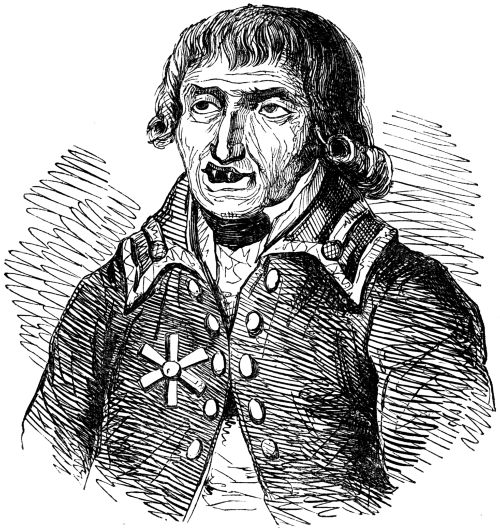
His Grace the Duke of Baubleshire,
Among the peers without compeer, A noble lord of parliament, Upon “his country’s good” intent, Through Durham daily took his walk, And talk’d, “ye gods, how he would talk!” His private riches how immense! His public virtue, how intense Preeminent of all the great, His mighty wisdom ruled the state! His claims, to high consideration, Brought deeper into debt the nation. Was he not, then, a statesman? what, Else, could he be?—for I know not.
A Remarkable Character.
On the sixteenth of May, 1796, died in Durham workhouse, at the advanced age of eighty-five years, the “duke of Baubleshire.” His title was neither ancestral, nor conferred by creation; but, as Napoleon is said to have placed the iron crown on his own head, and vowed to maintain it with his sword, so Thomas French assumed the title of duke of Baubleshire of his own will, and maintained his nobility throughout life, by wearing a star of coloured paper, or cloth, on the breast of his spencer. As a further mark of his quality, he mounted a cockade in his hat, and several brass curtain rings on his fingers. Thus decorated, and with a staff in his hand to support his feeble frame, he constantly tottered through Durham; every street of which ancient city acknowledged his distinction.
At this time it is difficult to conjecture the origin of Thomas French’s title. He assumed it with the decline of his understanding, until which period he had been a labouring man, and supported himself by the work of his hands. In right of his dukedom, he publicly urged his claims to immense possessions. It was his constant usage to stop and accost every one he knew, or could introduce himself to, on points of business, connected with the Baubleshire estates. Though at no time master of a shilling, he incessantly complained of having been defrauded of vast amounts, in cash and bank bills; and parties whom he suspected of these transactions, he threatened to punish with the utmost rigour of the law. He seldom saw a goodly horse, or a handsome carriage, without claiming it, and insisted on his rights so peremptorily and pertinaciously, as to be exceedingly vexatious to the possessors of the property. He fearlessly exhibited charges of misappropriation against individuals of all ranks and conditions. According to his grace’s representations, every covetable personalty in Durham and its vicinage, had been clandestinely obtained from Baubleshire; nor did he make any secret of his intimate and frequent correspondence with the king, on the subject of raising men for carrying on the war, and other important affairs of state. He likewise expressed his opinions on other men’s characters and conduct without reserve; and notwithstanding his abject poverty, his pointed observations frequently inflicted wounds, for which it would have been folly to express resentment.
The duke of Baubleshire was occupied with his numerous concerns, till within three or four days of his death, when he took to his bed; and over burdened by old age, peaceably lay down with the other departed dignitaries of the earth. The present portrait and particulars of him are from a print lithographed at Durham, where he took his title, and where he still lives in ephemeral fame.
NATURALISTS’ CALENDAR.
Mean Temperature 55·30.
May 17.
1826. Ember Week.
Oxford Term begins.
Remarkable Performance.
On the seventeenth of May, 1817, a respectable farmer of Kirton Lindsey for a wager of a few pounds, undertook to ride a poney up two pair of stairs into a chamber of the George Inn, and down again, which he actually performed before a numerous company, whose astonishment was heightened by the rider being upwards of eleven stone weight, and his horse less than thirty. They were weighed after the feat to decide a wager.
NATURALISTS’ CALENDAR.
Mean Temperature 56·65.
May 18.
Chronology.
On the eighteenth of May, 1664, the following public advertisement was issued for the healing of the people by king Charles II.
Notice.
His sacred majesty having declared it to be his royal will and purpose to continue the healing of his people for the evil during the month of May, and then give over till Michalmas next. I am commanded to give notice thereof, that the people may not come up to the town in the interim and lose their labour.
Newes, 1664.
NATURALISTS’ CALENDAR.
Mean Temperature 55·32.
May 19.
“Poor Joe Moody!”
A willing record is given to the memory of an unfortunate young man, in the language of an intelligent correspondent.
For the Every-Day Book.
Poor Joe Moody lived in Ballingdon, a village in Essex; he was an idiot, a good, simple-hearted creature. The character of his infirmity was childishness; he would play at marbles, spin his top, run his hoop, and join the little boys in the village, with whom he was a great favourite, in all their sports. As a boy he was rational, but when he assumed the man, which he would now and then do, the poor fellow was a sad picture of misery. He would sit upon the steps of an old house, and ask if you did not hear the thunder; then he would start as if to restrain the fury of a horse, and he would suddenly become mild again, and say, “I have seen her grave!” and he would weep like a child for hours. The story of his early life I have heard my father thus relate:—
“When I went to school with Joe Moody, he was a fine fellow, and remarkable for his good temper and lively disposition; he could run from us all, and was one of the best cricketers in the town. After he had left school he became acquainted with Harriet F——; she was a very lovely girl, young and amiable, and had been sought by more than one respectable farmer in the neighbourhood; but Joe was preferred by her, and by her parents. I need not say how endeared to each other they were; the sequel shows it too plainly. In a few days they were to have been made happy; friends were invited to the wedding, and a rich old aunt was to be of the party. Joe proposed that Harriet and himself should go and fetch this old lady; a mark of respect which was readily agreed to. With hopes high, and hearts of gaiety, the young folks set off on a fine summer’s morning, with feelings which only youth and love can know. Who can say this shall be a day of happiness? They had scarcely lost sight of home when the sky became overcast, and in a few minutes a dreadful storm burst over their heads. The thunder and lightning were terrific, and the high spirited horse became unmanageable. Poor Joe endeavoured to restrain its fury, but in vain; it left the track of the road; the hood of the chaise struck against the projecting branch of a tree, and both were thrown out with extreme violence to the earth. Joe soon recovered, and his first care was his Harriet—she was a corpse at his feet! Poor Joe spoke not for some weeks; and the first return of imperfect sense, was shown by his swimming a little cork boat which he found.”
This humour was encouraged, and often his melancholy weeping mood was turned by a kind proposition to play a game at marbles. He would come to my father’s house sometimes, and borrow a penny to buy marbles, a string for a kite, or some trifling toy. He never had his hair cut: it was very black and glossy; and used to curl and hang about his shoulders like the hair of Charles II., whom he resembled somewhat in the face. Joe went regularly to church, and as regularly to the grave of his Harriet. In rainy or tempestuous weather, he would sit upon the steps of the door where he first met her, and ask of passing strangers whether they had seen her. He had a fine voice and taste for singing, with which he would sometimes amuse himself, but it generally led him to melancholy. Joe feared but one person in the village, a Mr. S——, who once beat him at school in a boyish fight.
I went to Ballingdon last summer, and asked for Joe: an old man told me he died suddenly on seeing a horse run away—he showed me his grave.
W. Doowruh.
May, 1826.
NATURALISTS’ CALENDAR.
Mean Temperature 55·70.
May 20.
Remarkable Funeral.
On the twentieth of May, 1736, the body of Samuel Baldwin, Esq. was, in compliance with an injunction in his will, immersed, sans ceremonie, in the sea at Lymington, Hants. His motive for this extraordinary mode of interment was, to prevent his wife from “dancing over his grave,” which this modern Xantippe had frequently threatened to do in case she survived him.
Scotch Superstitions in May.
To the Editor of the Every-Day Book.
Sir,—A desultory sketch of the more prominent features, on the darker side of Scotch character, if deemed worthy of insertion, is at your service.
Researches into ancient usages, the way of leading life, and the customs and superstitious belief, which gave tinge and sway to those who peopled the world before us, are often ridiculed as frivolous by casual observers. But the events of centuries past have become classic from their associations with many of our own. Such observers are apt to forget that much in our present manners is as certainly derived from the popular opinions of past ages, as the heaving of the ocean is caused by the submarine ground swell.
Neither the thoughts nor the actions of men, are to be compared or measured by an unvarying standard of consistency or reason. The passions are the real, though unsteady and eccentric guides of our motions; of these, fear is the most predominant; and in its hour of operation, has the most commanding power. Why is it, that a man in a state of inebriety will be little the worse for bruises which would cost the same man sober, his life? It is not the alcohol that gives life its tenacity, but it is the consequent absence of fear which prevents imaginary, being added to real dangers. Like love, it feeds its own flame. In all ages, when earthly objects have ceased to terrify, men have conjured up phantoms for their minds’ excitation, which, when reason told them, were false, because invisible to the senses, they clothed with superhuman attributes; still, however, taking advantage of every incident their fancy misrepresented, to prove, at least, their material effects. Such is witchcraft; which in Scotland, not many years ago, was as generally believed in as Christianity, and which many, who have been excluded from the polish of society, believe in still. Those who ventured to impugn the doctrine, were held to be what the mob did not understand, but what they believed to be something of extraordinary iniquity—“Papists.”
The month of May has always been deemed peculiarly favourable for supernatural appearances. No one will marry in May: but on the first morning of that month, maidens rise early to gather May-dew, which they throw over their shoulder in order to propitiate fate in allotting them a good husband. If they can succeed by the way in catching a snail by the horns, and throwing it over their shoulder, it is an omen of good luck; and if it is placed on a slate, then likewise it will describe by its turning, the initials of their future husband’s name.
Anciently, the month of May was ushered in with many solemn rites, and the first day had the name of “Beltane.” The “Beltane time” was a season of boisterous mirth and riotous festivity. There is still a fair at the town of Peebles, which goes by the name of the Beltane fair. Our king, James I., says,
“At Beltane quhar ilk bodie bownis To Peblis to the play, To hear ye sing and ye soundis The solace suth to say.”
The mob elected a “king and queen of May,” and dressed them fantastically to preside over their ceremonies. There were also peculiar games, and “Clerks’ Plays,” with which the multitude amused themselves at this season.
Among other superstitious observances for which May is reckoned favourable, there is a custom of visiting certain wells, which were believed to possess a charm, for “curing of sick people,” during that month. In 1628, a number of persons were brought before the Kirk Session of Falkirk, accused of going to Christ’s well on the Sundays of May, to seek their health, and the whole being found guilty were sentenced to repent “in linens” three several sabbaths. “And it is statute and ordained that if any person, or persons, be found superstitiously and idolatrously, after this, to have passed in pilgrimage to Christ’s well, on the Sundays of May to seek their health, they shall repent in sacco (sackcloth) and linen three several sabbaths, and pay twenty lib (Scots) toties quoties, for ilk fault; and if they cannot pay it, the baillies shall be recommended to put them in ward, and to be fed on bread and water for aught days.”[186] They were obliged, for the preservation of the charm, to keep strict silence on the way, to and from the well, and not to allow the vessel in which the water was, to touch the ground.
In 1657, a mob of parishioners were summoned to the session, for believing in the powers of the well of Airth, a village about six miles north of Falkirk, on the banks of the Forth, and the whole were sentenced to be publicly rebuked for the sin.—“Feb. 3, 1757, Session convenit. Compeared Bessie Thomson, who declairit scho went to the well at Airth, and that schoe left money thairat, and after the can was fillat with water, they keepit it from touching the ground till they cam hom.” “February 24.—Compeired Robert Fuird who declared he went to the well of Airth, and spoke nothing als he went, and that Margrat Walker went with him, and schoe said ye beleif about the well, and left money and ane napkin at the well, and all was done at her injunction.” “Compeared Bessie Thomson declarit schoe fetchit hom water from the said well and luit it not touch the ground in homcoming, spoke not as sha went, said the beleif at it, left money and ane napkin thair; and all was done at Margrat Walker’s command,” “Compeired Margrat Walker who denyit yat scho was at yat well befoir and yat scho gave my directions.” “March 10. Compeared Margrat Forsyth being demandit if scho went to the well of Airth, to fetch water thairfrom, spok not by ye waye, luit it not touch ye ground in homcoming? if scho said ye belief? left money and ane napkin at it? Answered affirmatively in every poynt, and yat Nans Brugh directit yem, and yat they had bread at ye well, with them, and yat Nans Burg said shoe wald not be affrayit to goe to yat well at midnight hir alon.” “Compeired Nans Burg, denyit yat ever scho had bein at yat well befoir.” “Compeired Rot Squir confest he went to yat well at Airth, fetchit hom water untouiching ye ground, left money and said ye beleif at it.” “March 17. Compeired Rot Cochran, declairit, he went to the well at Airth and ane other well, bot did neither say ye beleif, nor leave money.” “Compeired Grissal Hutchin, declairit scho commandit the lasses yat went to yat well, say ye beleif, but dischargit hir dochter.” “March 21. Compeired Robert Ffuird who declairit yat Margrat Walker went to ye well of Airth to fetch water to Robert Cowie, and when schoe com thair, scho laid down money in Gods name, and ane napkin in Rot Cowie’s name.” “Compeired Jonet Robison who declairit yat when scho was seik, Jean Mathieson com to hir and told hir, that the water of the well of Airth was guid for seik people, and yat the said Jean hir guid sister desyrit hir fetch sum of it to hir guid man as he was seik, bot scho durst never tell him.” These people were all “publicly admonishit for superstitious carriage.” Yet within these few years, a farmer and his servant were known to travel fifty miles for the purpose of bringing water from a charmed well in the Highlands to cure their sick cattle.
The records contain some curious notices concerning witchcraft, which are all certified to “my lord’s court,” the baronial juridical conservator of the public peace; but, if we may judge from the re-appearance of the parties, none, much to the laird of Callander’s honour, ever were punished. I may afterwards give some of these for the amusement of the readers of the Every-Day Book, who will likewise find in the “Scots’ Magazine” for March, 1814, an account of trials for witchcraft at Borroustaunness, which ended in six poor creatures’ condemnation on the twenty-third of December, 1679, to “be wirried at a steak till they be dead, and then to have their bodies burnt to ashes!”
The reputed consequences of the blink of an ill-ee, are either death, or some horrible debility; for which there are some preventitives, such as rolling a red silk thread round the finger or the neck, or keeping a slip of rowntree (mountain ash) in the bonnet; and last, not least, there is a “gruel, thick and slab,” which is reckoned efficacious in averting “Skaith.” At this day, even in the twenty-sixth year of the nineteenth century, an old woman in Falkirk earns a comfortable livelihood by the sale of “Skaith Saw.”
I am, Sir, &c. Robert Kier
Falkirk, May 16, 1826.
NATURALISTS’ CALENDAR.
Mean Temperature 55·42.
May 21.
1826. Trinity Sunday.
For usages on this day, see vol. i. p. 722.
The Season.
It is observed by Dr. Forster in the “Perennial Calendar,” that the sky is generally serene, and the weather mild and agreeable, about this time. A cloudy day, however, frequently happens, and is sometimes succeeded by a day’s rain; but we have noticed frequently, that an overcast sky, when not too obscure, is the best for viewing flowers, and at this time of year often sets off the splendid Vernal Flora to great advantage.
Song to Summer.
Hail, rural goddess of delight! I woo thy smiles from morn till night; Now no more rude Eurus blows O’er mountains of congealed snows; But thy faire handmaid lovely Maie Treads the fresh lawns, and leads the waie. Now, at Flora’s earlie call, The meadows greene and vallies all Pour forth their variegated flowers, To regale the sportive hours. Hence then let me fly the crowde Of busy men, and seke the woode, With some Dryad of the grove, By shades of elm and oak to rove, Till some sequestered spot we find, There, on violet bank reclined, We fly the day-star’s burning heate, Which cannot reach our green retreate; While Zephyr, with light whispering breeze, Softly dances in the trees; And, upon his muskie wing, Doth a thousand odours bring From the blooming mead below, Where cowslips sweet and daisies blow; And from out her grassie bed The harebell hangs her nodding head; Hard bye, some purling stream beside, Where limpid waters gently glide, Iris shows her painted woof Of variegated hues, windproof; And with water lillies there, The nymphs and naids braid the haire; And from out their leafie haunt, The birdes most melodious chant. Then, sweet nymph, at eventide, Let us roam the broke beside, While the lovelorn nightingale Sadlie sings the woods ymel, Till the bittern’s booming note O’er the sounding mashes flote, And the ominous owls do crie, While luckless bats are flitting bye; Then before the midnight houre, When ghostlie sprites and pizgies coure, We will betake us to our cot, And be it there, O sleep, our lot, To rest in balmie slumberings, Till the next cock his matin rings.
Chronology.
To the Editor of the Every-Day Book.
Sir,—As the anniversary of that day, on which the greatest mathematician of his time was removed from this transitory world, is fast approaching, I hasten to send you a brief memorial, selected from various local works, of that truly original and eccentric genius. I also enclose a fac-simile of his hand writing, which was presented to me by a very obliging friend, Robert Surtees, of Mainsforth, Esq., F. S. A., and author of a very splendid and elaborate “History of the County Palatinate of Durham.”
Your’s truly, John Sykes
Newcastle, Tyne, April 25, 1826.
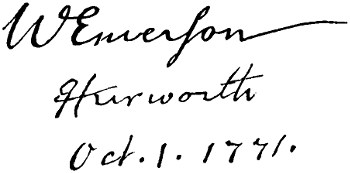
William Emerson was born at Hurworth, a pleasant village, about three miles from Darlington, in the county of Durham, on the 14th of May, 1701. The preceptor of his early years was his own father, of whom he learned writing and arithmetic, and probably the rudiments of Latin. After having studied mathematics with much ardour under able masters, at Newcastle and York, he returned to Hurworth, and again benefited by the knowledge of his father, who was a tolerable master of the mathematics. Some degree of Emerson’s celebrity may be attributed to the treatment which he received from Dr. Johnson, rector of Hurworth, whose niece he had married. The doctor had engaged to give five hundred pounds to his niece, who lived with him, as a marriage portion; but when reminded of the promise, he choose to forget that it had been made, and treated our young mathematician as a person beneath his notice.
The pecuniary disappointment Emerson (who had an independent spirit, and whose patrimony though not large, was equal to all his wants) would easily have surmounted, but the contemptuous treatment stung him to the soul. He immediately went home, packed up his wife’s clothes, and sent them to the doctor, saying, that he would scorn to be beholden to such a fellow for a single rag; vowing at the same time that he would be revenged, and prove himself to be the better man of the two. His first publication, however, did not meet with immediate encouragement, and most probably his other works would never have appeared, at least in the author’s lifetime, if Edward Montague, Esq., his great admirer and friend, had not procured him the patronage of Mr. John Nourse, bookseller and optician, who being himself skilled in the more abstruse sciences, immediately engaged Emerson to furnish a regular course of mathematics for the use of students, and in the summer of 1763, Emerson made a journey to London, to settle and fulfil the agreement.
His devotion to the philosophy of sir Isaac Newton was so uncommonly strong, that every oppugner of this great man was treated by Emerson as dull, blind, bigotted, prejudiced, or mad, and the fire and impetuosity of his temper would on these occasions betray him into language far distant from the strictness of mathematical demonstration. Mr. E. was in person something below the common size, but firm, compact, well made, very active and strong. He had a good open expressive countenance, with a ruddy complexion, a keen and penetrating eye, and an ardour and eagerness of look that was very demonstrative of the texture of his mind. His dress was grotesque frequently; sometimes mean and shabby. A very few hats served him through the whole course of his life; and when he purchased one (or indeed any other article of dress) it was perfectly indifferent to him whether the form or fashion of it was of the day, or of half a century before. One of these hats of immense superficies, had, by length of time, lost its elasticity, and its brim began to droop in such a manner as to prevent his being able to view the objects before him in a direct line. This was not to be endured by an optician; he therefore took a pair of sheers, and cut it off by the body of the hat, leaving a little to the front, which he dexterously rounded into the resemblance of the nib of a jockey’s cap. His wigs were made of brown, or of a dirty flaxen coloured hair, which at first appeared bushy and tortuous behind, but which grew pendulous through age, till at length it became quite straight, having probably never undergone the operation of the comb; and either through the original mal-formation of the wig, or from a custom he had of frequently thrusting his hand beneath it, the back part of his head and wig seldom came into very close contact. His coat or more properly jacket, or waistcoat with sleeves to it, which he commonly wore without any other waistcoat, was of drab colour; his linen was more calculated for warmth and duration than show, being spun and bleached by his wife, and woven at Hurworth. In cold weather he had a custom of wearing his shirt with the wrong side before, and buttoned behind the neck, yet this was not an affectation of singularity, (for Emerson had no affectation, though his customs and manners were singular,) he had a reason for it; he seldom buttoned more than two or three buttons of his waistcoat, leaving all the rest open; in wind, rain, or snow, therefore, he must have found the aperture at the breast inconvenient if his shirt had been put on in the usual manner. When he grew aged, in cold weather, he used to wear what he called shin-covers: these were pieces of old sacking, tied with strings above the knee, and depending down to the shoe, in order to prevent his legs from being scorched when he sat too near the fire. This singularity of dress and figure, together with his character for profound learning, and knowledge more than human, occasioned the illiterate and ignorant to consider him as a cunning man, or necromancer, and various stories have been related of his skill in the black art. He affected an appearance of infidelity on religious matters, and was an example to the vulgar, not a little reprehensible. His diet was as simple and plain as his dress, and his meals gave little interruption either to his studies, employments, or amusements. He catered for himself, and pretty constantly went to Darlington, to make his own markets; yet, when he had provided all the necessary articles, he not unfrequently neglected to return home for a day or two, seating himself contentedly in some public house, where he could procure good ale and company, and passing the hours in various topics of conversation. His style of conversation was generally abrupt and blunt, and often vulgar and ungrammatical. This occasioned a supposition, that his prefaces were not written by himself, an opinion that was one day mentioned to him, and the disparity of his conversation and writing pointed out as the reason. After a momentary pause, he exclaimed, with some indignation, “A pack of fools! who would write my prefaces but myself.” Mr. Emerson often tried to practise the effect of his mathematical speculations, by constructing a variety of instruments, mathematical, mechanical, and musical, on a small scale. He made a spinning-wheel for his wife, which is represented in his book of mechanics. He was well skilled in the science of music, the theory of sounds, and the various scales both ancient and modern. He was a great contributor to the “Lady’s Diary,” under the signature of “Merones,” and for many years unknown, until a transposition of letters discovered his name.[187] During the greater part of his life, his health had been strong and uninterrupted; but as he advanced into the vale of years, internal complaints allowed him but little intermission of pain, and at length deprived him of breath on the twenty-first of May, 1782, aged eighty-one years and one week. He was buried in the churchyard of his native village where he died. About a twelvemonth before his decease, he was prevailed on after much importunity, to sit for his portrait, which was taken by Mr. Sykes, for his friend Mr. Cloudsley of Darlington, surgeon. It is said to be a most striking likeness.
NATURALISTS’ CALENDAR.
Mean Temperature 55·32.
May 22.
Sops and Ale.
At East-Bourn, in “a descriptive account of that village in the county of Sussex,” there is mention of a very singular custom having prevailed for many years under the denomination of “Sops and Ale.” It was productive of much mirth and good humour, being conducted as follows: the senior bachelor in the place was elected by the inhabitants, steward, and to him was delivered a damask napkin, a large wooden bowl, twelve wooden trenchers, twelve wooden knives and forks, two wooden candlesticks, and two wooden cups for the reception of sugar; and on the Saturday fortnight the steward attended at the church-door, with a white wand in his hand, and gave notice that sops and ale would be given that evening at such a place. Immediately after any lady, or respectable farmer or tradesman’s wife became mother of a child, the steward called at the house, and begged permission for “sops and ale;” which was always granted, and conducted in the following order:—Three tables were placed in some convenient room; one of which was covered with the above napkin, and had a china bowl and plates, with silver handled knives and forks placed on it; and in the bowl were put biscuits sopped with wine, and sweetened with fine sugar. The second table was also covered with a cloth, with china, or other earthern plates, and a bowl with beer sops, sweetened with fine sugar, and decent knives and forks. The third table was placed without any cloth; and on it were put the wooden bowl, knives, forks, and trenchers, as before described, with the candlesticks and sugar cups; and in the bowl were beer sops, sweetened with the coarsest sugar. As soon as the evening service was over, having had previous notice from the steward, the company assembled, and were placed in the following order:—those persons whose wives were mothers of twins, were placed at the upper or first table; those whose wives had a child or children, at the second table; and such persons as were married, and had no children, together with the old bachelors, were placed at the third table, which was styled the bachelors’ table, under which title the gentlemen who sat at it, were addressed for that evening, and the gentlemen at the first table were styled benchers. Proper toasts were given, adapted for the occasion, and the company always broke up at eight o’clock, generally very cheerful and good-humoured.
NATURALISTS’ CALENDAR.
Mean Temperature 54·87.
May 23.
Chronology.
This is the anniversary of one of the great duke of Marlborough’s most celebrated engagements, the battle of Ramilles, a place near Namur in the Netherlands, where, on this day, in the year 1706, he gained a memorable victory over the French. It was in this battle that colonel Gardiner, then an ensign in the nineteenth year of his age, received a shot in his mouth, from a musket ball, which, without destroying any of his teeth, or touching the fore part of his tongue, went through his neck, and came out about an inch and a half on the left side of the vertebræ. He felt no pain, but dropped soon after, and lay all night among his dying companions; he recovered in an almost miraculous manner, and became, from a most profligate youth, a character eminent for piety.[188]
NATURALISTS’ CALENDAR.
Mean Temperature 55·57.
May 24.
Jack Ketch and Newgate.
On this day, in 1736, five felons in Newgate were to have been executed; but the prison was so insecure, that, during the night, one of them “took up a board and got out of his cell, and made his escape.” The other four were taken to Tyburn and suffered their sentence; and Jack Ketch “on his return from doing his duty at Tyburn, robbed a woman of three shillings and sixpence.”[189]
NATURALISTS’ CALENDAR.
Mean Temperature 56·42.
May 25.
Corpus Christi Day.
On Corpus Christi day, at about a quarter before one o’clock at noon, the worshipful company of skinners (attended by a number of boys which they have in Christ’s Hospital school, and girls strewing herbs before them) walk in procession from their hall on Dowgate-hill, to the church of St. Antholin’s, in Watling-street, to hear service. This custom has been observed time out of mind.
This notice is communicated by one of the company.
For other customs on this festival, see vol. i. p. 742 to 758.
NATURALISTS’ CALENDAR.
Mean Temperature 58·52.
May 26.
NATURALISTS’ CALENDAR.
Mean Temperature 59·35.
May 27.
Addison’s Library.
1799. On this and the three following days, the library of the celebrated Addison was sold by auction by Messrs. Leigh and Sotheby, at their house in York-street, Covent-garden. The books were brought from Bilton, where Addison had resided, near Rugby, in Warwickshire, and under Mr. Leigh’s hammer produced 456l. 2s. 9d.
There is a portrait of Mr. Leigh, who is since dead, from a drawing by Mr. Behnes.
Mr. Leigh dissolved partnership with Mr. Sotheby, his son supplied his father’s place, and the business was carried on in the Strand. On Mr. Leigh’s death, his surviving partner continued it, as he still does, near the same spot in Waterloo-place, whither he removed in consequence of the premises being required for other purposes. This establishment is the oldest of the kind in London: under Mr. Sotheby’s management its ancient reputation is supported: his sales are of the highest respectability, and attended by the best collectors. Mr. Sotheby sold the matchless niellos and other prints of sir Mark Sykes. For collections of that nature, and for libraries, his arrangements are of a most superior order. One of the greatest treats to a lover of literature is a lounge at Mr. Sotheby’s during one of his sales.
NATURALISTS’ CALENDAR.
Mean Temperature 58·50.
May 28.
Female Order of Merit.
The journals of this day, in 1736, announce that mademoiselle Salle, a famous dancer at Paris, who valued herself highly on her reputation, instituted an order there, of which she was president, by the name of “the Indifferents.” Both sexes were indiscriminately admitted after a nice scrutiny into their qualifications. They had rites, which no one was to disclose. The badge of the order was a ribbon striped, black, white, and yellow, and the device something like an icicle. They took an oath to fight against love, and if any of the members were particular in their regards, they were excluded the order with ignominy.[190]
NATURALISTS’ CALENDAR.
Mean Temperature 58·90.
May 29.
K. Charles II. Restoration.
For customs on this day, see vol. i. p. 711 to 722.
This anniversary is an opportunity for introducing the following curious view.
Boscobel House, Where Charles II. was concealed after the Battle of Worcester.
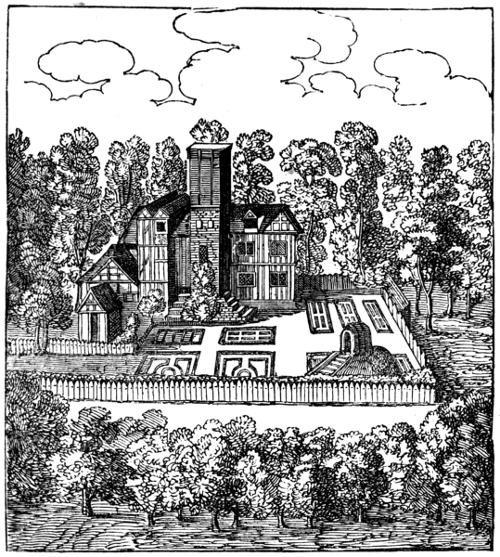
Boscobel House, Where Charles II. was concealed after the Battle of Worcester.
This engraving, from a rare print of great value, represents Boscobel-house, in the state it was when Charles II. and colonel Carlos took refuge there. They remained in the house till they became alarmed for their safety.
Dr Stukely mentions the straits to which Charles was reduced during his concealment at this place. “Not far from Boscobel-house, just by a horse track passing through the wood, stood the royal oak, into which the king and his companion, colonel Carlos, climbed by means of the henroost ladder, when they judged it no longer safe to stay in the house; the family reaching them victuals with the nuthook. The tree is now enclosed in with a brick wall, the inside whereof is covered with laurel, of which we may say, as Ovid did of that before the Augustine palace, ‘mediamque tuebere quercum.’ Close by its side grows a young thriving plant from one of its acorns. Over the door of the enclosure, I took this inscription in marble:—
‘Felicissimam arborem quam in asylum potentissimi Regis Caroli II. Deus O. M. per quem reges regnant hic crescere voluit, tam in perpetuam rei tantae memoriam quam specimen firmae in reges fidei, muro cinctam posteris commendant Basilius et Jana Fitzherbert.
‘Quercus amica Jovi.’”
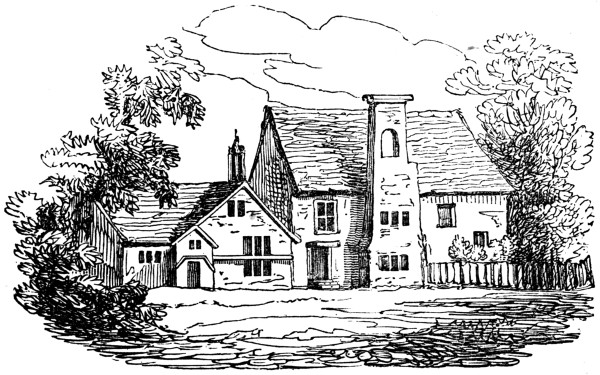
Boscobel House, 1800.
The situation of the house in the above year, is shown by the annexed engraving, from a view of it at that period.
At a small distance from Boscobel is Whiteladies, so called from having been a nunnery of white or Cistercian nuns, extensive ruins of which remain.
NATURALISTS’ CALENDAR.
Mean Temperature 58·37.
May 30.
Clerkenwell, in 1730.
This day, in 1730, being the anniversary of the birth-day of the princesses Amelia and Caroline, Mr. Cook, a publican, discharged twenty-one guns in salute of their royal highnesses as they passed his door, “to drink the water at the wells by the New River Head in the parish of St. James, Clerkenwell.” It appears that “almost every day for the latter part of that month, there was so great a concourse of the nobility and gentry, that the proprietor took about thirty pounds in a morning.”[191] Clerkenwell, therefore, in 1730, was so fashionable as to be the resort of the court for recreation. At that time it had green lanes and bowling-alleys to delight the gentry, and attract the citizens of the metropolis. It is now, in 1826, covered with houses, and without a single public place of reputable entertainment; not even a bowling-green.
NATURALISTS’ CALENDAR.
Mean Temperature 58·72.
May 31.
Death of an Elephant.
With the destruction of the elephant belonging to Mr. Cross, at Exeter Change, described in the present volume, may be paralleled the destruction of another on this day in the year 1820. The particulars are related in the “London Magazine” of April 1, 1826; they seem to have been translated from a “Notice sur l’Elephant mort a Geneve le 31 Mai dernier,” in the “Almanach Historique, nommé Messager Boiteux pour l’An de grace, 1821,” which has been sent to the editor of the Every-Day Book for the purpose of enabling him to lay the annexed engraving before the readers of London, from a print in that “Almanac,” which is printed in quarto “á Vevey, chez Freres Lœrtscher.”
In May, 1820, for about a fortnight a fine Bengal elephant (Elephas Indicus, Cuvier—Elephas Maximus, Linn.) had been exhibited at Geneva. The elephants of this species are taller than those of Africa. They have an elevated cranium, which has two protuberances on its summit; the frontal bone is rather concave, and the head proportionably longer; their tusks are smaller than those of the African elephant. The animal in question had but one; he had lost the other by some accident. He was nine feet high, and of a dark-brown colour, he was ten years old, and had been bought in London six years before. Mademoiselle Garnier, (the niece of his proprietor,) to whom he was much attached, always travelled with him. She was the proprietor of an elephant which had broken loose at Venice a few years previously, and was killed by a cannon-shot, after it had committed considerable ravages in that city.
The present elephant was of a much gentler character, and had excited a general interest during its stay in Geneva, by its docility and intelligence; it performed all the usual tricks which are taught these animals, with a promptitude of obedience, a dexterity, and almost a grace, which were quite remarkable. Whenever mademoiselle Garnier witnessed his exercises, her presence seemed to call forth all these qualities to an extraordinary degree. According to her statement he was so familiar and social that he had more than once appeared on the stage at Lille, Antwerp, &c. playing the principal part in a procession, and seeming proud to carry the lady who acted the princess, before whom he would kneel to take her on his back. So far from being frightened at the lights, the music, and the noise of the house, he seemed delighted to take a part in the ceremony.
Accustomed to liberty, and much as he loved it, he yet endured confinement with patience, and when his keeper came to fasten him up for the night, he used to stretch out his foot to receive the iron ring by which he was chained till morning, to a post deeply fixed in the earth. Unlike these animals in England, he did not travel in a cage, but was led from one town to another by night; he had three drivers, his keeper, properly so called, and two others, one of whom had always inspired him with more fear than attachment.
During the latter part of his stay at Geneva he had exhibited symptoms of excitement and restlessness, arising from two causes—the one, the frequent discharges of musketry from the soldiers who were exercised near his habitation, at which he was greatly irritated; the other, the paroxysms to which these animals are subject for several weeks in the spring. Nevertheless, he had never disobeyed nor menaced his keepers.
His departure was fixed for the 31st of May. He left Geneva at midnight, the gates and drawbridges having been opened for that purpose by permission of the syndic of the guard, the magistrate at the head of the military police. He was driven by his keeper and his two assistants, who carried a lantern. Mademoiselle Garnier was to follow in the morning. He made no difficulty in crossing the drawbridge, and took the road to Switzerland apparently in high spirits. But about a quarter of a league from the town he appeared out of humour with the keeper, and disposed to attack him. The man ran away towards the city; the elephant pursued him up to the gate, which the officer on guard opened, on his own responsibility, wisely calculating that it would be more easy to secure him within the town than without it, and that he might do immense mischief on the high roads, especially as it was the market-day at Geneva. He re-entered the town without hesitation, pursuing, rather than following his keeper and guides, between whom and himself all influence, whether of attachment or of fear, seemed at an end. From this moment he was his own master.
He walked for some time in the place de Saint Gervais, appearing to enjoy his liberty and the beauty of the night. He lay down for a few minutes on a heap of sand, prepared for some repairs in the pavement, and played with the stones collected for the same purpose. Perceiving one of his guides, who was watching him from the entrance of one of the bridges over the Rhone, he ran at him, and would have attacked him, and probably done him some serious injury, if he had not escaped.
Mademoiselle Garnier having been informed of what had passed, hastened to the spot, and trusting to the attachment he had always shown for her, went up to him with great courage, with some dainties of which he was particularly fond, and speaking to him with gentleness and confidence, led him into a place enclosed with walls near the barrack he had inhabited, into which he could not be induced to return. This place, called the Bastion d’Hollande, adjoined a shed containing caissoons, waggons, and gun-carriages; there were also cannon-balls piled up in an adjoining yard. Being left alone, and the gate shut upon him, he amused himself with trying his strength and skill upon every thing within his reach; he raised several caissoons and threw them on their sides, and seemed pleased at turning the wheels; he took up the balls with his trunk, and tossed them in the air, and ran about with a vivacity which might have been ascribed either to gaiety or to irritation.
At two in the morning, the syndic of the guard being informed of the circumstance, went to the spot to consult on the measures to be taken. Mademoiselle Garnier in a state of the utmost distress and agitation, entreated that the elephant might be killed in the most speedy and certain way possible. The syndic, sharing in the general feeling of interest the noble and gentle creature had excited in the town, opposed her desire. He represented that the animal was now in a place of security against all danger, whether to the public or himself; and that as his present state of irritation was, in its very nature, transient, and would soon yield to a proper regimen; but mademoiselle Garnier remembered the occurrences at Venice, and felt the whole weight and responsibility of the management of the animal was on herself alone; for the keeper and guides had decidedly refused to attend upon him again, and she persisted in her demand. The magistrate would not give his consent until it was put into writing and signed.
From that moment arrangements were made for destroying him. The chemists were laid under contribution for drugs, while two breaches were made in the wall, at each of which a four-pounder was placed, which was to be the ratio ultima if the poison failed.
M. Mayor, eminent as a surgeon, and for his learning in natural history, and one of the directors of the museum, had taken great delight in visiting the elephant during his stay, and the animal had evinced a particular affection for him. This induced the magistrate to request M. Mayor to administer the poison. M. Mayor, after mixing about three ounces of prussic acid with about ten ounces of brandy, which was the animal’s favourite liquor, called him by his name to one of the breaches. The elephant came immediately, seized the bottle with his trunk, and swallowed the liquor at one draught, as if it had been his usual drink. This poison, the operation of which, even in the smallest doses, is usually tremendously rapid, did not appear to produce any sensible effect on him; he walked backwards with a firm step to the middle of the enclosure, where he lay down for some moments. It was thought that the poison was beginning to act, but he soon rose again, and began to play with the caissoons, and to walk about in the courtyard of the arsenal. M. Mayor, presuming that the prussic acid which had been kept some time had lost its strength, prepared three boluses of an ounce of arsenic each, mixed with honey and sugar. The elephant came again at his call, and took them all from his hand. At the expiration of a quarter of an hour, he did not appear at all affected by them. A fresh dose was then offered him; he took it, smelt at it for some minutes, then threw it to a distance, and began again to play all sorts of tricks. Sometimes he came to the breach, and, twining his trunk round the mouth of the cannon, pushed it back as if he had some indistinct notion of the danger which threatened him.
It was five in the morning when the first dose of poison was administered; an hour had elapsed, and no symptom of its internal action appeared. Meanwhile the market time drew near, the space around the walls was rapidly filling with inquisitive spectators, and the order was given to fire. The gunner seized the moment in which the elephant, who had advanced to the breach, was retiring, and presented his side. The mouth of the cannon almost touched him. The ball entered near the ear behind the right eye, came out behind the left ear, went through a thick partition on the opposite side of the enclosure, and spent itself against a wall. The animal stood still for two or three seconds then tottered, and fell on his side without convulsion or movement.
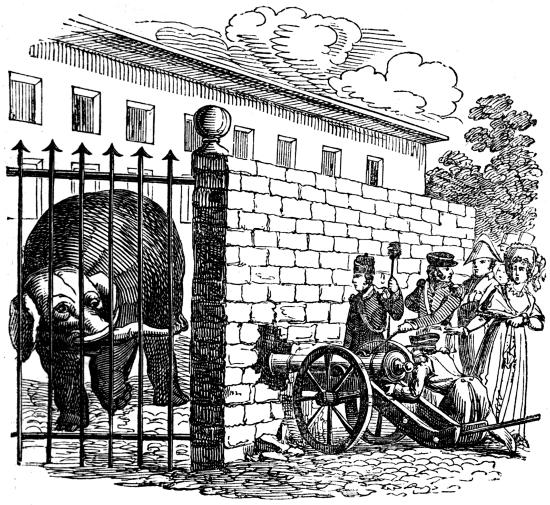
Death of the Elephant at Geneva, May 31, 1820.
The above engraving, from that in the foreign almanac already mentioned, represents the manner wherein his death was effected.
The event circulated through the town with the rapidity of lightning. “They have killed the elephant!” “What had the noble creature done? he was so good, so gentle, so amiable!” “What a pity!” The people ran with one accord to the spot, to satisfy themselves with a nearer view. The eagerness was so great that the authorities were obliged to take steps for keeping order in the crowd, and a small sum of money was demanded from each for the benefit of the proprietor. The same evening, by arrangements entered into with mademoiselle Garnier, for securing the remains of the animal for the museum, the surgeons proceeded to open the body, which they continued to dissect for several successive days. The operations were executed by M. Mayor, the chevalier Bourdet, a naturalist and traveller, and M. Vichet, an eminent pupil of the veterinary surgeon of Alfort. They took an exact measurement of the animal. They traced its silhouette on the wall; and made separate casts of its head, and the two feet of one side. All the principal viscera, except the liver, which decomposed too rapidly, and the brain, which was shattered by the ball, were carefully removed and preserved in a solution of oxygenated muriate of mercury. The spleen was six feet long. The muscular or fleshy parts, as the season would not allow of their slow dissection, were taken away rather by the hatchet than the bistoury. They were given to the public, who were extremely eager and anxious to eat elephant’s flesh, and much tempted by its excellent appearance, dressed as it was with every variety of sauce. They seemed perfectly regardless of the poison, which indeed had not time to develope itself in the muscular system. Three or four hundred persons ate of it without injury, excepting one or two individuals, who brought on a fit of indigestion by indulging to excess. The osseous carcass was put into a state of maceration previous to re-composing the skeleton, in order to its deposit in the museum of natural history. The interest taken in that establishment was so strong, that the large sum required to secure possession of the entire carcass, was raised by subscription in a few days. The skin was found too thick to be tanned by the ordinary process, and as the epidermis began to detach itself naturally, it was carefully separated from the dermis, which it was not essential to preserve entire. The epidermis retained its proper consistency, in order to be supplied by a well-known process in covering the artificial carcass, constructed under the direction of Messrs. Mayor and Bourdet.
If mademoiselle Garnier had not succeeded in enticing the animal to the place where his destruction was effected, the mischief he might have occasioned by remaining at large, till the inhabitants of Geneva had risen from their beds to their daily occupations, can scarcely be imagined; especially as it was on a market-day, when the city is usually thronged with country people, and most persons are necessarily out of doors.
May Custom at Buckingham. Ringing the old Bailiff out.
To the Editor of the Every-Day Book.
Sir,—On this day, unusual bustle set the town of Buckingham alive. It was the festive consecration of the first Sunday after May-day. Having taken care of my horse and left the inn, I heard a band of music approaching the church, which is a cheerful edifice, standing on an eminence with a painted glass window. The bells rung merrily, and the sunshine gave lustre to the surrounding country, beautified by light and shade. The main street was presently lined with townspeople and villagers. My inquiries as to the cause of this “busy hum of men” were soon satisfied by the cry that, “They’re ringing the old bailiff out!” As the musicians (not of the opera band, nor of the Hanover rooms,) came nearer with the accumulating procession, I with difficulty learned the theme of their endeavours to be Weber’s “Hark! follow!” I never heard any thing surpass this murder of melody. Had Weber been present, he would not have regretted he had given the MS. of Der Freischütz, to discharge a trifling debt, which I am informed was really the case. Such discord, however, worked no “incantation” here. All faces smiled, all hearts appeared glad. The cavalcade moved in pairs. First two small children in white with garlands, then, behind them, two, a size larger; then others, increasing in growth and tallness, till six wreathed maidens and their swains moved onwards, dancing and shaking their curly locks in sportive glee around the Maypole, decorated in the habiliments of nature’s sweetest and choicest spring flowers and boughs. Dolls of various dresses were placed in the midst, as though they looked out of bowers for the arrival of kindred playfellows. Then came his worship, the bailiff, a sir John Falstaff-like sort of person, swelling with pleasurable consequence; the shining mace borne on the shoulder intimated his dignity. What a happy day of honour, of triumph, and greatness to him! Then followed the leading men of the town, the burgesses in their corporate robes and nosegays. Their friends paraded aside in their Sunday clothes, like “ladies of olden days” and “squires of high degree.” Favours and flags played on the fresh air, inviting rural enjoyment. Many rosy-faced damosels in their “best bibs and tuckers” illustrated the time by appearing at the windows; infants were held up to behold, and the aged crept to the doors, to take a glimpse of what they might not live to see repeated. As the procession arrived at the churchyard gate, soldiers were arranged in line, preparing to meet and unite in the gaiety of the day. It is thus pleasant to view the military and civil powers, peacefully ornamenting the general harmony of the season. The subordinates and illustrators of this annual custom, opened a passage at the church door, and the bailiff led the way into his seat. The bells rested their metal tongues, and the music ceased awhile. People of all descriptions, in all directions, hurried to their respective pews, with accommodating civility to strangers. The curate opened his book and his duties, the clerk unsheathed his spectacles, confined his nostrils, and the service was reverently performed, with a suitable discourse and decent melody. After this was ended, the bailiff and his friends returned in like order as they came, perambulating the precincts of the town. Then the glory of all true Britons, was manifested by the clatter of knives and forks, at the favourite depôt for provisions, and genuine hilarity closed the “ringing out of the old bailiff,” and the ringing in of the new one.
J. R. Prior.
With the preceding communication from Mr. Prior, are the following verses.
To the Dead Nettle.
Unlike the rose, Thou hast not bards to sing Thy merits as thy beauty grows ’Neath hedges in the spring. Unconscious flower! Thy downcast blossom seems Like widowed thought in sorrow’s hour Away from pleasure’s beams. Young feeling’s eye Surveys thee in thy vernal bed, Protected from the glare of sky, By lovely nature fed. He, that would learn Sermons from thine eternal birth, Might safely to the world return And triumph over earth.
J. R. Prior.
A May-day.
To the Editor of the Every-Day Book.
Sir,—If you think the following lines worth insertion in your Every-Day Book, you are welcome to them.
I am, Sir, &c. H. M. Lander.
King’s Bench Walk, Temple.
Song.
’Tis May! ’tis May! the skylarks sing, The swallow tribe is on the wing, The emerald meads look fresh and gay, And smiles the golden orb of day. ’Tis May! ’tis May! the voice of love Inspiring calls to yonder grove; Then let us to the shades repair, Where health, and mirth, and music are. ’Tis May! ’tis May! air, earth, and flood, With life and beauty are endowed: Myriads of forms creep, glide, and soar, Exultant through the genial hour. ’Tis May! ’tis May! why should not man Embrace the universal plan, Enjoy the seasons as they roll, And love while love inspires the soul. ’Tis May! ’tis May! the flowers soon fade, And voiceless grows the sylvan shade: The insects fall mid autumn’s gloom, And man is hastening to the tomb. ’Tis May! ’tis May! the flowers revive! Again the insect revellers live! But man’s lost bloom no charms restore, His youth once pass’d, returns no more.
Dulce Domum.
To the Editor of the Every-Day Book.
Sir,—It may not, perhaps, be generally known what it was that gave rise to the writing of the old breaking-up song of “Dulce Domum,” so loudly and so cheerfully sung by youngsters previous to the vacation; and as an old custom is involved in it, you may deem both the song and the custom worthy a place in your Every-Day Book. They are subjoined.
I am, Sir, &c. Henry Brandon.
Leadenhall Street, May, 1826.
About two hundred and thirty years ago, a scholar of St. Mary’s college Winchester was, for some offence committed, confined by order of the master, and it being just previous to the Whitsuntide vacation, was not permitted to visit his friends, but remained a prisoner at the college, as report says, tied to a pillar. During this period he composed the well known “Dulce domum,” being the recollections of the pleasures he was wont to join in, at that season of the year. Grief at the disgrace and the disappointment he endured, so heavily affected him, that he did not live to witness the return of his companions, at the end of their holydays.
In commemoration of the above, annually on the evening preceding the Whitsun holydays, the master, scholars, and choristers of the above college, attended by a band of music, walk in procession round the court of the college and the pillar to which it is alleged the unfortunate youth was tied, and chant the verses which he composed in his affliction.
Dulce Domum!
Concinamus, O sodales! Eja! quid silemus? Nobile canticum! Dulce melos, domum! Dulce domum, resonemus. Chorus. Domum, domum, dulce domum; Domum, domum, dulce domum! Dulce, dulce, domum! Dulce domum, resonemus! Appropinquat ecce! felix Hora gaudiorum, Post grave tedium Advenit omnium Meta petita laborum. Domum, domum, &c. Musa, libros mitte, fessa, Mitte pensa dura, Mitte negotium Jam datur otium, Me mea mittito cura. Domum, domum, &c. Ridet annus, prata rident; Nosque rideamus, Jam repetit domum, Daulius advena: Nosque domum repetamus, Domum, domum, &c. Heus! Rogere, fer caballos; Eja, nunc eamus. Limen amabile Matris et oscula, Suaviter et repetamus, Domum, domum, &c. Concinamus ad Penates, Vox et audiatur; Phosphore! quid jubar, Segnius emicans, Gaudia nostra moratur? Domum, domum, &c.
The above was put into an English dress, a copy of which is below:
Sing a sweet melodious measure, Waft enchanting lays around; Home! a theme replete with pleasure! Home! a grateful theme resound! Chorus. Home, sweet home! an ample treasure! Home! with every blessing crown’d! Home! perpetual source of pleasure! Home! a noble strain, resound. Lo! the joyful hour advances; Happy season of delight! Festal songs, and festal dances, All our tedious toil requite. Home, &c. Leave, my wearied muse, thy learning, Leave thy task, so hard to bear; Leave thy labour, ease returning, Leave this bosom, O! my care. Home, &c. See the year, the meadow, smiling! Let us then a smile display, Rural sports, our pain beguiling, Rural pastimes call away. Home, &c. Now the swallow seeks her dwelling, And no longer roves to roam; Her example thus impelling, Let us seek our native home. Home, &c. Let our men and steeds assemble, Panting for the wide champaign; Let the ground beneath us tremble, While we scour along the plain. Home, &c. Oh! what raptures, oh! what blisses. When we gain the lovely gate! Mother’s arms, and mother’s kisses, There, our bless’d arrival wait. Home, &c. Greet our household-gods with singing, Lend, O Lucifer, thy ray; Why should light, so slowly springing, All our promis’d joys delay? Home, &c.
Mr. Brandon’s account of the “procession round the courts of the college,” and the singing of “Dulce Domum,” is sustained by the rev. Mr. Brand, who adds, of the song, that “it is no doubt of very remote antiquity, and that its origin must be traced, not to any ridiculous tradition, but to the tenderest feelings of human nature.” He refers for the English verses to the “Gentleman’s Magazine,” for March, 1796, where they first appeared, and calls them “a spirited translation.” On looking into that volume, it seems they were written by one of Mr. Urban’s correspondents, who signs “J. R.” and dates from “New-street, Hanover-square.” Dr. Milner says, that from “amongst many translations of this Winchester ode,” the present “appears best to convey the sense, spirit, and measure, of the original; the former versions were unworthy of it.” He alleges that the existence of the original can only be traced up to the distance of about a century; yet its real author, and the occasion of its composition, are already clouded with fables.[192]
American Vocal Music.
By the favour of a correspondent in North America, we are enabled to extract from the “Colonial Advocate” of Queenston, the following interesting article, by a Scotch resident, on the state of melody in the region he inhabits. It particularly relates to May.
Scottish Songs.
“Dear Scotia! o’er the swelling sea From childhood’s hopes, from friends, from thee, On earth where’er thy offspring roam, This day their hearts should wander home. Her sons are brave, her daughters fair, Her gowan glens no slave can share, Then from the feeling never stray, That loves the land that’s far away.”
Sung by Mr. Maywood, on St. Andrew’s day, in New York.
I have often thought it a pity that there is no feature in which Canada, and indeed America in general, exhibits more dissimilarity to Scotland, than in its want of vocal music. On the highland hills, and in the lowland vallies, of Caledonia, we are delighted with the music of the feathered choristers, who fill heaven in a May morning with their matin songs. The shepherd whistles “The Yellow Hair’d Laddie”—the shepherdess sings “In April when primroses deck the sweet plain”—all nature seems in harmony. But here all is dulness and monotony,
“We call on pleasure—and around A mocking world repeats the sound!”
Even the emigrant seems to have forgotten his native mountains; and in the five years in which I have sojourned in America, I have not once heard “Roslin Castle” sung by a swain on a blithe summer’s day. Here they are all dull plodding farmers, as devoid of sober melody as the huge forests which surround them are void of grace and beauty: talk to them of poetry and music, and they will sit with sad civility, “as silent as Pygmalion’s wife.”
Now and then you may hear a hoarse raven of an old woodchopper in the barroom of a filthy tavern, roaring in discordant notes, “Yankee Doodle:” or, in a church or meeting-house, you may behold fifteen or twenty men and women picked out of the congregation, stuck up in a particular part of the house and singing the praises of redeeming love, with the voices of so many stentors. The affectation they display, cannot fail to disgust you: the form of godliness is present, but the power thereof is wanting.
The memory of a native Scotsman retraces back those halcyon days, when gladness filled the corn-field—when sober mirth and glee crowned the maiden feast—when the song went merrily round at Yule, to chase away the winter frosts; and coming to the day of universal rest from labour, calls to mind the venerable precentor with his well-remembered solemn tunes, where old and young, infancy and advanced age, willingly joined together in singing his praise—where the fiddle and the flute, the harp and the organ, were useless—where no set people stood up in a corner, as if to say, “we, the aristocracy of this congregation, can offer a sweeter and more acceptable sacrifice than you, with our melodious voices so much better attuned than yours.”
It may, perhaps, appear irreverend in me, to say a word of sacred music in an essay intended for Scottish songs; but I thought the contrast would not be complete without this allusion. A late essayist “On vulgar prejudices against Literature,” uses a fine argument in favour of native poetry.
“Let us ask,” says he, “has Britain a greater claim to distinction among the nations of the world, from any one circumstance, however celebrated it be in arts and arms, than from its being the birthplace of Shakspeare? And if the celebration of the anniversary of Waterloo be held in the farthest settlements of India, so is the anniversary of the birth of Robert Burns, the pastoral poet of Scotland:—
“Encamped by Indian rivers wild, The soldier, resting on his arms, In Burns’s carol sweet recalls The scenes that blest him when a child, And glows and gladdens at the charms Of Scotia’s woods and waterfalls.”
When kingdoms, and states, and cities pass away, what then proves to be the most imperishable of their records, the most durable of their glories? Is it not the lay of the poet? the eloquence of the patriot? the page of the historian? Is it not the genius of the nation, imprinted on these, the most splendid of its annals, and transmitted, as a legacy, and a token of its vanished glory, to the after ages of mankind? And now, when the glories of Greece and Rome are but shadows, does not our blood stir within us at the recital of their mighty achievements, and of their majestic thoughts, which, but for the page of the chronicler would have been long ere now a blank and a vacancy; glory departed without a trace, or figures traced upon the sand, and washed away by the returns of the tide:—
“Oh! who shall lightly say that fame, Is nothing but an empty name? When, but for those, our mighty dead, All ages past a blank would be, Sunk in oblivion’s murky bed, A desert bare, a shipless sea. They are the distant objects seen; The lofty marks of what hath been, Oh! who shall lightly say that fame Is nothing but an empty name? Where memory of the mighty dead To earth-worn pilgrims’ wistful eye The brightest rays of cheering shed, That point to immortality.”
The blue hills and mountains, among which Byron first caught the enthusiasm of song; the green vallies and brown heaths where Scott learnt to tell of Flodden field, and deeds of other days, in verse, lasting as the source of the deep Niagara, yet return an echo to the well-known “Daintie Davie” of Robert Burns.
As down the burn they took their way, And through the flowery dale, His cheek to hers he aft did lay, And love was aye the tale. With “Mary, when shall we return, Sic pleasure to renew?” Quoth Mary, “Love, I like the burn, And aye shall follow you.”
How I should delight to hear such an artless tale sung on the braes of Queenston, or the green knowes and fertile plains around Ancaster.
I once in Montreal heard a gentleman from little York (a native of Perthshire) sing “Daintie Davie” in fine style; but it was the old set, and as it is a very good song, I think the first stanza and chorus may “drive dull care away” from half a dozen of my readers as well as a good hit at that silly body, our sapient attorney-general, or a squib at his forkhead Mr. Solicitor, would have done:—
“Now rosy May comes in wi’ flowers To deck her gay green spreading bowers, And now comes in my happy hours, To wander wi’ my Davie. Chorus. “Meet me on the warlock knowe, Daintie Davie, Daintie Davie, There I’ll spend the day with you, My ain dear Daintie Davie.”
About two years ago, I wrote to a correspondent in Scotland, to send to Dundas about ten reams of our best Scottish, English, and Irish ballads, and to avoid any that were exceptionable in point of morality. This person has since arrived in America; but his ideas on the propriety of introducing ballads into a new country, I found to be different from mine—otherwise I had by this time employed several “wights of Homer’s craft” to disperse the twenty thousand halfpenny songs I then ordered. It would have, perhaps, sown the seeds of music in our land, and hundreds of American presses, may be, would have spread abundantly the pleasing stanzas, until accursed slavery had stopt the strain in the southern regions of republican tyranny.
I can call to mind the time, as well as if it were yesterday, when I first heard “The Maid of Lodi:” it was at a Scottish wedding, at Arthurstone. Sir Ewan, the aged sire of the brave colonel Cameron, who fell at Waterloo, was present with his lady; and, gentle reader, I think it was the youthful minister of the next parish who sung, accompanied by the bride’s youngest sister. It was followed by “Blythe, blythe,” which I must give the reader from memory. News is scarce this week—the king of France is dead, and surely the tidings of the next’s coronation will not arrive in time to fill a paragraph in the “Advocate” for a month to come—so let us have—
Blythe, blythe and merry was she: Blythe was she but and ben; Blythe by the banks of Ern— Blythe in Glenturret glen. By Aughtertye grows the aik, By Yarrow banks the birken shaw; But Phemie was the bonniest lass The flowers of Yarrow ever saw. Blythe, blythe, &c. Her looks were like a flower in May, Her smile was like a simmer morn; She tripped by the banks of Ern, As light’s a bird upon a thorn. Blythe, blythe, &c. Her bonnie face it was sae maek As ony lamb upon a lee: The evening sun was ne’er so sweet As was the blink o’ Phemie’s e’e Blythe, blythe, &c. The highland hills I’ve wander’d wide, And o’er the lowlands I hae been; But Phemie was the bonniest lass That ever trode the dewy green Blythe, blythe, &c.
A young farmer then gave us “The Lothian Lassie;” and as my recollection is pretty good, I shall put Canadian Scots girls in the way to mind it as well as me, by repeating the first stanza: would I could sing it as I have heard it sung:—
Last May a braw wooer cam’d down the lang glen, And sair wi’ his love he did deave me; I said there was naething I hated like men, The deuce gae wi’ ’m to believe me, believe me, The deuce gae wi’ ’m to believe me.
What a chaste pleasure—what a gladdening influence over the most stoical mind, any of the following songs yield, when well sung to their own tunes, by a half dozen young ladies in the parlour, or by a chorus of bonnie lassies in the kitchen, as the former pursue their sewing and knitting, and the latter birr their wheels, and stir the sowens in an evening, in the opulent farmer’s dwelling; or when heard in the most humble cottage of a Scottish peasant. Well might the farmer’s dog, Luath, say, “And I for e’en down joy hae barkit wi’ them.”
Let these classes come to Upper Canada to-morrow, and they will tire of its dulness. Nature’s face is fair enough; but after the traveller leaves the last faint sounds of the Canadian boatsman’s song, as it dies on the still waters of the St. Lawrence, music will be done with.—I had forgotten however, I must now quote the songs alluded to; and I well can from memory:—
1. Gloomy winter’s now awa’.
2. Roy’s wife of Aldivalloch.
3. Beneath the pretty hawthorn that blooms in the vale.
4. And she showed him the way for to woo.
5. I gaed a waefu’ gate yestreen.
6. John Anderson, my Joe, John, when we were first acquent.
7. Thy cheek is o’ the rose’s hue, My only joe and dearie, O.
8. Coming o’er the craigs o’ Kyle.
9. O, lassie, art thou sleeping yet;—and the answer.
10. There’s nae luck about the house, There’s nae luck ava’; There’s little pleasure in the house, When our gudeman’s awa’.
11. The sun had gone down o’er the lofty Ben Lomond.
12. My uncle’s dead—I’ve lands enew.
13. For lack of gold she’s left me, O.
14. O’ a the airths the wind can blaw.
15. When honey-dyed bells o’er the heather was spreading.
16. Loudon’s bonny woods and braes.
17. The Highland Laddie.
18. Upon a simmer’s afternoon. Awee afore the sun gaed down.
19. There’s cauld kail in Aberdeen, the new way.
20. Mirk and rainy was the night.
21. My Pattie is a lover gay.
22. I’m wearin’ awa’, Jean, Like sna’ when its thaw, Jean.
23. Its Logie o’ Buchan, o’ Logie the laird.
24. With the garb of old Gaul, and the fire of old Rome.
25. Come under my plaide.
26. O’ Bessie Bell and Mary Gray.
27. Ye banks and braes of bonny Doon.
28. The laird of the drum, a wooing has gone,— And awa’ in the morning early: And he has spied a weel fa’red May, A shearing her father’s barley.
29. My bonny Lizzie Baillie.
30. Green grow the rushes, O!
I must have done—I have named so many songs to put my readers in mind of
“Auld lang syne;”
and I could add as many more, of truly Scottish origin, that I should like to see in Canada, as would fill up the “Advocate;” but I must stop—the politicians would complain. I have heard a few of these well sung in Canada—the last, a lintie in Queenston braes sings now and then. Would there were ten thousand such in Upper Canada!
The English version of the following line, is not near so pretty as the Scots original, which goes thus:—
“I once was a bachelor, both early and young, And I courted a fair maid with a flattering tongue: I courted her, I wooed her, I honoured her then, And I promised to marry her, but never told her when. O, I never told her when,” &c.
With this may be contrasted a verse of sir Walter Scott’s Mary, in “The Pirate:”—
“O were there an island, Though ever so wild, Where woman could smile, and No man be beguiled— Too tempting a snare To poor mortals were given, And the hope would fix there, That should anchor on heaven.”
This is beguiling on both sides; but the latter stanzas finely express an idea fit for an oriental paradise.
There is another kind of ballads which, though akin to those I have named, are in many points essentially different:—and the first of this class,
“Duncan Gray came here to woo,”
when sung in chorus, would be almost enough to cause the venerable age of eighty-eight to shake a foot all over Scotland. A merry party, of which I was one, once tried “Duncan,” on the Table Rock at Niagara Falls; and when we came to that line, where the poor neglected lover
“Spak o’ loupin ower a linn,”
I thought we should have all died with laughing, the scene was so in unison with the stanza. Moore’s two lovers, who—
“’thout pistol or dagger, a Made a desperate dash down the Falls of Niagara,”
is good; but it is nothing to “Duncan Gray,” sung by half a dozen tenor voices on the Table Rock.
I mean, when I have leisure, to continue these reminiscences of Scottish song, and as I at this time must have taxed the patience, and tried the politeness of my numerous Irish and English readers, I will, in some future number, leave Ramsay, Burns, Tannahill, and Ferguson—for Chaucer and Shakspeare, Goldsmith and Moore.
Tannahill has some pieces, scarce excelled by any of our Scottish poets—he has also a virtue which endears him to me beyond even Robert Burns. He does not often laud in song the drinking of ardent liquors. If, as a printer, I were to publish an American edition of Burns, I think I would leave his songs in praise of Highland whisky out. They have done much harm in his native land; and to spread them here, would be like firing a match.
End of May
This month may close with a delightful sonnet, from one of the best books put forth in recent years for daily use and amusement.
Summer.
Now have young April and the blue eyed May Vanished awhile, and lo! the glorious June (While nature ripens in his burning noon,) Comes like a young inheritor; and gay, Altho’ his parent months have passed away; But his green crown shall wither, and the tune That ushered in his birth be silent soon, And in the strength of youth shall he decay. What matters this—so long as in the past And in the days to come we live, and feel The present nothing worth, until it steal Away and, like a disappointment, die? For Joy, dim child of Hope and Memory, Flies ever on before or follows fast.
Literary Pocket Book
NATURALISTS’ CALENDAR.
Mean Temperature 57·97.