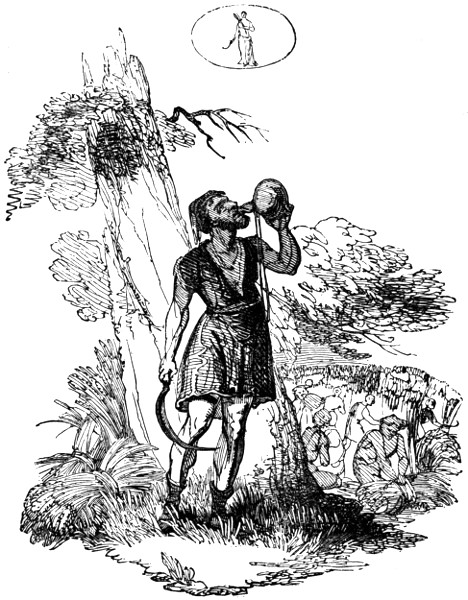
JULY. (continued 4)
Reading edition
At a short distance from this sacred memorial, on a cliff overhanging the sea, is the well of the saint. Thither the crowds repair after the devotions at the rock are ended. Having drank plentifully of its water, they wash their legs and feet in the stream which issues from it, and, telling their beads, sprinkle themselves and their neighbours with the fluid. These performances over, the grave of the patron saint is then resorted to. Hundreds at a time crowded around it, and crush each other in their eagerness to obtain a handful of the earth which is believed to cover the mortal remains of Declan. A woman stood breast high in the grave, and served out a small portion of its clay to each person requiring it, from whom in return she received a penny or halfpenny for the love of the saint. The abode of the saint’s earthly remains has sunk to the depth of nearly four feet, its clay having been scooped away by the finger nails of the pious. A human skull of large dimensions was placed at the head of the tomb, before which the people bowed, believing it to be the identical skull of the tutelar saint.
This visit to St. Declan’s grave completed the devotional exercises of a day held in greater honour than the sabbath, by those who venerate the saint’s name, and worship at his shrine. The tents which throughout the day, from the duties paid to the “patron,” had been thronged with the devotionalists of the morning, resounded from evening till daybreak, with sounds inspired by potations of whiskey; and the scene is so characterised by its reporter as to seem exaggerated.[274]
NATURALISTS’ CALENDAR.
Mean Temperature 63·65.
July 29.
St. Martha.
On the festival of this saint of the Romish church, a great fair is held at Beaucaire, in Languedoc, to which merchants and company resort from a great distance round. It is a great mart for smugglers and contraband traders, and is the harvest of the year both to Beaucaire and Tarascon; for, as the former is not large enough to accommodate the influx of people, Tarascon, in Provence, which is separated from it by the Rhone, is generally equally full.
Tarascon, according to a popular tradition, has its name from a terrible beast, a sort of dragon, known by the name of the tarasque, which, in ancient days, infested the neighbourhood, ravaging the country, and killing every thing that came in its way, both man and beast, and eluding every endeavour made to take and destroy it, till St. Martha arrived in the town, and taking compassion on the general distress, went out against the monster, and brought him into the town in chains, when the people fell upon him and slew him.
St. Martha, according to the chronicles of Provence, had fled from her own country in company with her sister Mary Magdalen, her brother Lazarus, and several other saints both male and female. They landed at Marseilles, and immediately spread themselves about the country to preach to the people. It fell to the lot of St. Martha to bend her steps towards Tarascon, where she arrived at the fortunate moment above mentioned. She continued to her dying day particularly to patronise the place, and was at her own request interred there. Her tomb is shown in a subterranean chapel belonging to the principal church. It bears her figure in white marble, as large as life, in a recumbent posture, and is a good piece of sculpture, uninjured by the revolution. In the church a series of paintings represent the escape of St. Martha and her companions from their persecutors, their landing in Provence, and some of their subsequent adventures. She is the patron saint of Tarascon.
It is presumed that the story of a beast ravaging the neighbouring country had its origin in fact; but that instead of a dreadful dragon it was a hyena. Bouche, however, in his Essai sur l’Histoire de Provence, while he mentions the popular tradition of the dragon, makes no mention of the supposed hyena, which he probably would have done had there been any good ground for believing in its existence.
Be this as it may, the fabulous story of the dragon was the occasion of establishing an annual festival at Tarascon, the reputed origin of which seems no less fabulous than the story itself. According to the tradition, the queen, consort to the reigning sovereign of the country, unaccountably fell into a deep and settled melancholy, from which she could not be roused. She kept herself shut up in her chamber, and would not see or be seen by any one; medicines and amusements were in vain, till the ladies of Tarascon thought of celebrating a festival, which they hoped, from its novelty might impress the mind of their afflicted sovereign.
A figure was made to represent the “tarasque,” with a terrible head, a terrible mouth, with two terrible rows of teeth, wings on its back, and a terrible long tail. At the festival of St. Martha, by whom the “tarasque” was chained, this figure was led about for eight days successively, by eight of the principal ladies in the town, elegantly dressed, and accompanied by a band of music. The procession was followed by an immense concourse of people, in their holyday clothes; and during the progress, alms were collected for the poor. All sorts of gaieties were exhibited; balls, concerts, and shows of every kind—nothing, in short, was omitted to accomplish the purpose for which the festival was instituted.
And her majesty condescended to be amused: that hour her melancholy ceased, and never after returned. Whether the honour of this happy change was wholly due to the procession, or whether the saint might not assist the efforts of the patriotic ladies of Tarascon, by working a miracle in favour of the restoration of the queen’s health, is not on record; but her malady never returned; and the people of Tarascon were so much delighted by the procession of the “tarasque,” that it was determined to make the festival an annual one.
This festival was observed till the revolution; but in “the reign of terror,” the people of Arles, between whom and those of Tarascon a great jealousy and rivalship had for many years subsisted, came in a body to the latter place, and, seizing the “tarasque,” burnt it in the market-place. This piece of petty spite sadly chagrined the Tarasconians. Their “tarasque” was endeared to them by its antiquity, as well as by the amusement it afforded them. For four years the festival of the “tarasque” remained uncelebrated, when an attempt was made to reestablish it; a new “tarasque” was procured by subscription among the people; but this also was seized by the Arletins, and carried over the river to Beaucaire, where it remained ever since.
“However,” said a hostess of Tarascon to Miss Plumptre, “since Buonaparte has happily restored order in France, we are looking forward to better times, and hope before the next festival of St. Martha, to be permitted to reclaim our ‘tarasque,’ and renew the procession.”
“Ah, ladies,” she added, “you have no idea how gay and how happy we all used to be at that time! The rich and the poor, the old and the young, the men and the women, all the same! all laughed, all danced, all sung; there was not a sad face in the town. The ladies were all so emulous of leading the ‘tarasque!’ They were all dressed alike; one was appointed to regulate the dress, and whatever she ordered the rest were obliged to follow. Sometimes the dresses were trimmed with gold or silver, sometimes with lace, so rich, so grand! God knows whether we shall ever see such times again. Ah! it was only because we were so happy that the people of Arles envied us, and had such a spite against us; but they have no reason to envy us now, we have had sorrow enough: ninety-three persons were guillotined here, and you may think what trouble that has spread among a number of families. I myself, ladies, have had my share of sorrow. My husband was not indeed guillotined, but he was obliged to fly the town to avoid it: he never quitted France, but went about from place to place where he was not known, working and picking up a livelihood as well as he could; and it is only since Buonaparte has been first consul that he has ventured to return. Besides, every thing that I had of any value, my linen, my mattresses, my silver spoons and forks, were all taken away by the requisition, and I can only hope to have things comfortably about me again by degrees, if we are so lucky as to get tolerable custom to our inn.” And then she entered upon a long string of apologies for the state of her house. “She was afraid,” she said, “that we should find things very uncomfortable, but it was not in her power to receive ladies and gentlemen as she had been used to do before her misfortunes. A few years hence, if Buonaparte should but live, she hoped, if we should happen to pass that way again, we should see things in a very different state.”[275]
The Season.
“Now,” we perceive in the “Mirror of the Months,” that, “now, on warm evenings after business hours, citizens of all ages grow romantic; the single, wearing away their souls in sighing to the breezes of Brixton-hill, and their soles in getting there; and the married, sipping syllabub in the arbours of White Conduit-house, or cooling themselves with hot rolls and butter at the New River Head.
“Now, too, moved by the same spirit of romance, young patricians, who have not yet been persuaded to banish themselves to the beauty of their paternal groves, fling themselves into funnies, and fatigue their ennui to death, by rowing up the river to Mrs. Grange’s garden, to eat a handful of strawberries in a cup-full of cream.
“Now, adventurous cockneys swim from the Sestos of the Strand stairs to the Abydos of the coal-barge on the opposite shore, and believe that they have been rivalling Lord Byron and Leander—not without wondering, when they find themselves in safety, why the lady for whom the latter performed a similar feat is called the Hero of the story, instead of the Heroine.
“Finally,—now pains-and-pleasure-taking citizens hire cozey cottages for six weeks certain in the Curtain-road, and ask their friends to come and see them ‘in the country.’”
The Feast of Cherries.
There is a feast celebrated at Hamburg, called the “feast of cherries,” in which troops of children parade the streets with green boughs, ornamented with cherries, to commemorate a victory, obtained in the following manner:—In 1432, the Hussites threatened the city of Hamburg with an immediate destruction, when one of the citizens, named Wolf, proposed that all the children in the city, from seven to fourteen years of age, should be clad in mourning, and sent as supplicants to the enemy. Procopius Nasus, chief of the Hussites, was so touched with this spectacle, that he received the young supplicants, regaled them with cherries and other fruits, and promised them to spare the city.
The children returned crowned with leaves, holding cherries, and crying “victory!”—and hence, the “feast of cherries” is an annual commemoration of humane feelings.[276]
To the Gnat.
For the Every-Day Book.
Native of Ponds! I scarce could deem Thee worthy of my praise, Wert thou not joyous in the beam Of summer’s closing days. But who can watch thy happy bands Dance o’er the golden wave, And be not drawn to fancy’s lands,— And not their pleasures crave? Small as thou art to vulgar sight, In beauty thou art born:— Thou waitest on my ears at night, Sounding thine insect horn. The sun returns—his glory spreads In heaven’s pure flood of light; Thou makest thine escape from beds, And risest with a bite. Where’er thy lancet draws a vein, ’Tis always sure to swell; A very molehill raised with pain As many a maid can tell. Yet, for thy brief epitome Of love, life, tone and thrall; I’d rather have a bump from thee, Than Spurz-heim, or from Gall.
J. R. P.
Fish.
It is noted by Dr. Forster, that towards the end of July the fishery of pilchards begins in the west of England. Through August it continues with that of mullets, red surmallets, red gurnards, and several other fish which abound on our south-west coasts. In Cornwall, fish is so cheap and so commonly used as an article of food, that we remember so lately as August, 1804, the then rector of Boconnoc used to have turbot for supper, which he considered as a good foundation for a large bowl of posca, a sort of weak punch drank in that country. Having witnessed on this day in 1822, the grand Alpine view of the lake of Geneva, and the Swiss and Savoyard mountains behind it, from Mount Jura, we are reminded to present the reader with the following excellent lines which we have met with in “Fables, by Thomas Brown, the Younger,” London, 1823.
View of the Alps and the Lake of Geneva from the Jura.
’Twas late, the sun had almost shone His last and best, when I ran on, Anxious to reach that splendid view Before the daybeams quite withdrew; And feeling as all feel, on first Approaching scenes, where they are told Such glories on their eyes shall burst As youthful bards in dreams behold. ’Twas distant yet, and as I ran, Full often was my wistful gaze Turned to the sun, who now began To call in all his outpost rays, And form a denser march of light, Such as beseems a hero’s flight. Oh! how I wished for Joshua’s power To slay the brightness of that hour! But no, the sun still less became, Diminished to a speck, as splendid And small as were those tongues of flame That on the apostles’ heads descended. ’Twas at this instant, while there glowed This last intensest gleam of light, Suddenly through the opening road The valley burst upon my sight; That glorious valley with its lake, And Alps on Alps in clusters swelling, Mighty and pure, and fit to make The ramparts of a godhead’s dwelling. I stood entranced and mute as they Of Israel think the assembled world Will stand upon the awful day, When the ark’s light, aloft unfurled Among the opening clouds shall shine, Divinity’s own radiant sign! Mighty Mont Blanc, thou wert to me That minute, with thy brow in heaven, As sure a sign of Deity As e’er to mortal gaze was given Nor ever, were I destined yet To live my life twice o’er again, Can I the deepfelt awe forget, The ecstacy that thrilled me then. ’Twas all the unconsciousness of power And life, beyond this mortal hour; Those mountings of the soul within At thoughts of heaven, as birds begin By instinct in the cage to rise, When near their time for change of skies; That proud assurance of our claim To rank among the sons of light, Mingled with shame! oh, bitter shame! At having risked that splendid right, For aught that earth, through all its range Of glories, offers in exchange! ’Twas all this, at the instant brought, Like breaking sunshine o’er my thought; ’Twas all this, kindled to a glow Of sacred zeal, which, could it shine Thus purely ever, man might grow, Even upon earth, a thing divine, And be once more the creature made To walk unstained the Elysian shade. No, never shall I lose the trace Of what I’ve felt in this bright place: And should my spirit’s hope grow weak, Should I, oh God! e’er doubt thy power, This mighty scene again I’ll seek, At the same calm and glowing hour; And here, at the sublimest shrine That nature ever reared to thee, Rekindle all that hope divine, And feel my immortality.
NATURALISTS’ CALENDAR.
Mean Temperature 63·80.
July 30.
The Old Gates of London.
On the 30th of July, 1760, the materials of the three following city gates were sold before the committee of city lands to Mr. Blagden, a carpenter in Coleman-street, viz.—
Aldgate, for £177 10 s.
Cripplegate, 91 0
Ludgate, 148 0 [277]
New Bishop of Durham— Bishop Auckland Custom.
To the Editor of the Every-Day Book.
July 30, 1826.
Dear Sir,—In the “Times,” of the twenty-second instant, there is the following paragraph, copied from the Newcastle paper. “The bishop of Durham arrived at his castle at Bishop Auckland, on Friday last. On his entering into the county at Croft-bridge, which separates it from the county of York, he was met by the officers of the see, the mayor and corporation of Stockton, and several of the principal nobility and others of the county. Here a sort of ceremony was performed, which had its origin in the feudal times,” &c.
The origin of the ceremony above alluded to is this. About the commencement of the fourteenth century, sir John Conyers slew with his falchion in the fields of Sockburne, a monstrous creature, a dragon, a worm, or flying serpent, that devoured men, women, and children. The then owner of Sockburne, as a reward for his bravery, gave him the manor with its appurtenances to hold for ever, on condition that he met the lord bishop of Durham, with this falchion, on his first entrance into his diocese, after his election to that see. And in confirmation of this tradition, there is painted in a window of Sockburne church, the falchion just now spoken of; and it is also cut in marble, upon the tomb of the great ancestor of the Conyers’, together with a dog and the monstrous worm or serpent, lying at his feet. When the bishop first comes into his diocese, he crosses the river Tees, either at the Ford of Nesham, or Croft-bridge, at one of which places the lord of the manor of Sockburne, or his representative, rides into the middle of the river, if the bishop comes by Nesham, with the ancient falchion drawn in his hand, or upon the middle of Croft-bridge; and then presents it to the bishop, addressing him in the ancient form of words. Upon which the bishop takes the falchion into his hands, looks at it, and returns it back again, wishing the lord of the manor his health and the enjoyment of his estate.
There are likewise some lands at Bishop’s Auckland, called Pollard’s lands, held by a similar service, viz. showing to the bishop one fawchon, at his first coming to Auckland after his consecration. The form of words made use of is, I believe, as follows:—
“My Lord,—On behalf of myself as well as of the several other tenants of Pollard’s lands, I do humbly present your lordship with this fawchon, at your first coming here, wherewith as the tradition goeth, Pollard slew of old, a great and venomous serpent, which did much harm to man and beast, and by the performance of this service these lands are holden.”
The drawing of the falchion and tomb in Sockburne church, I have unfortunately lost, otherwise it should have accompanied this communication: perhaps some of your numerous readers will be able to furnish you with it.
I remain, Dear Sir, &c. J. F.
The editor joins in his respected correspondent’s desire to see a representation in the Every-Day Book, of “the falchion and tomb in Sockburne church.” A correct drawing of it shall be accurately engraven, if any gentleman will be pleased to communicate one: such a favour will be respectfully acknowledged.
NATURALISTS’ CALENDAR.
Mean Temperature 63·57.
July 31.
Mayor of Bartlemass.
To the Editor of the Every-Day Book.
July 4, 1826.
Sir,—The following is a brief notice of the annual mock election of the “mayor of Bartlemass,” at Newbury, in Berkshire.
The day on which it takes place, is the first Monday after St. Anne’s; therefore, this year if not discontinued, and I believe it is not, it will be held on the thirty-first day of July. The election is held at the Bull and Dog public-house, where a dinner is provided; the principal dishes being bacon and beans, have obtained for it the name of the “bacon and bean feast.” In the course of the day a procession takes place. A cabbage is stuck on a pole and carried instead of a mace, accompanied by similar substitutes for the other emblems of civic dignity, and there is, of course, plenty of “rough music.” A “justice” is chosen at the same time, some other offices are filled up, and the day ends by all concerned getting completely “how came ye so.”
In the same town, a mock mayor and justice are likewise chosen for Norcutt-lane, but whether on the same day or not I cannot say; how long these customs have existed, or whence they originated I do not know; they were before I, or the oldest man in the town, can remember.
A Shoemaker.
The Season.
By the “Mirror of the Months,” the appearance of natural scenery at this season is brought before us. “The corn-fields are all redundant with waving gold—gold of all hues—from the light yellow of the oats, (those which still remain uncut,) to the deep sunburnt glow of the red wheat. But the wide rich sweeps of these fields are now broken in upon, here and there, by patches of the parched and withered looking bean crops; by occasional bits of newly ploughed land, where the rye lately stood; by the now darkening turnips—dark, except where they are being fed off by sheep flocks; and lastly by the still bright-green meadows, now studded every where with grazing cattle, the second crops of grass being already gathered in.
“The woods, as well as the single timber trees that occasionally start up with such fine effect from out of the hedge-rows, or in the midst of meadows and corn-fields, we shall now find sprinkled with what at first looks like gleams of scattered sunshine lying among the leaves, but what, on examination, we shall find to be the new foliage that has been put forth since midsummer, and which yet retains all the brilliant green of the spring. The effect of this new green, lying in sweeps and patches upon the old, though little observed in general, is one of the most beautiful and characteristic appearances of this season. In many cases, when the sight of it is caught near at hand, on the sides of thick plantations, the effect of it is perfectly deceptive, and you wonder for a moment how it is, that while the sun is shining so brightly every where, it should shine so much more brightly on those particular spots.”
NATURALISTS’ CALENDAR.
Mean Temperature 63·60.