NOVEMBER.
Reading edition
And, when November came, there fell Another limning in, to tell The month’s employment; which we see Providance was, for time to be. Now was the last loud squeaking roar Of many a mighty forest boar, Whose head, when came the Christmas days, Was crown’d with rosemary and bays, And so brought in, with shoutings long, And minstrelsy, and choral song.
*
We can now perceive the departure of “that delightful annual guest, the summer, under the agreeable alias of autumn, in whose presence we have lately been luxuriating. We might, perhaps, by a little gentle violence, prevail upon her to stay with us for a brief space longer; or might at least prevail upon ourselves to believe that she is not quite gone. But we shall do better by speeding her on her way to other climes, and welcoming ‘the coming guest,’ gray-haired winter:”—nor can we do better at this moment than take “note of preparation,” for a grateful adieu to the year and welcome to the comer.
On ushering in the winter we recur to the “Mirror of the Months,” from whence we have derived so many delightful reflections, and take a few “looks” in it, for, perhaps, the last time. At this season last year it presented to us the evergreens, and now, with a “now,” we select other appearances.
Now—as the branches become bare, another sight presents itself, which, trifling as it is, fixes the attention of all who see it. I mean the birds’ nests that are seen here and there in the now transparent hedges, bushes, and copses. It is not difficult to conceive why this sight should make the heart of the schoolboy leap with an imaginative joy, as it brings before his eyes visions of five blue eggs lying sweetly beside each other, on a bed of moss and feathers; or as many gaping bills lifting themselves from out what seems one callow body. But we are, unhappily, not all schoolboys; and it is to be hoped not many of us ever have been bird-nesting ones. And yet we all look upon this sight with a momentary interest, that few other so indifferent objects are capable of exciting. The wise may condescend to explain this interest, if they please, or if they can. But if they do, it will be for their own satisfaction, not ours, who are content to be pleased, without insisting on penetrating into the cause of our pleasure.
Now, the felling of wood for the winter store commences; and, in a mild still day, the measured strokes of the wood-man’s axe, heard far away in the thick forest, bring with their sound an associated feeling, similar to that produced by a wreath of smoke rising from out the same scene: they tell us a tale of
“Uncertain dwellers in the pathless wood.”
THE WOODMAN.
Far removed from noise and smoke, Hark! I hear the woodman’s stroke, Who dreams not as he fells the oak, What mischief dire he brews; How art may shape his falling trees, In aid of luxury and ease:— He weighs not matters such as these, But sings, and hacks, and hews. Perhaps, now fell’d by this bold man, That tree may form the spruce sedan; Or wheelbarrow, where oyster Nan Oft runs her vulgar rig; The stage, where boxers crowd in flocks; Or else a quack’s; perhaps, the stocks; Or posts for signs; or barber’s blocks, Where smiles the parson’s wig. Thou mak’st, bold peasant, oh what grief! The gibbet on which hangs the thief, The seat where sits the grave lord chief, The throne, the cobler’s stall. Thou pamper’st life in ev’ry stage, Mak’st folly’s whims, pride’s equipage; For children, toys; crutches, for age; And coffins for us all.
C. Dibdin.
The “busy flail” too, which is now in full employment, fills the air about the homestead with a pleasant sound, and invites the passer-by to look in at the great open doors of the barn, and see the wheatstack reaching to the roof on either hand; the little pyramid of bright grain behind the threshers; the scattered ears between them, leaping and rustling beneath their fast-falling strokes; and the flail itself flying harmless round the labourers’ heads, though seeming to threaten danger at every turn; while, outside, the flock of “barn-door” poultry ply their ceaseless search for food, among the knee-deep straw; and the cattle, all their summer frolics forgotten, stand ruminating beside the half-empty hay-rack, or lean with inquiring faces over the gate that looks down into the village, or away towards the distant pastures.
Of the birds that have hitherto made merry even at the approach of winter, now all are silent; all, save that one who now earns his title of “the household bird,” by haunting the thresholds and window-cills, and casting sidelong glances in-doors, as if to reconnoitre the positions of all within, before the pinching frosts force him to lay aside his fears, and flit in and out, silently, like a winged spirit. All are now silent except him; but he, as he sits on the pointed palings beside the door-way, or on the topmost twig of the little black thorn that has been left growing in the otherwise closely-clipt hedge, pipes plaintive ditties with a low inward voice—like that of a love-tainted maiden, as she sits apart from her companions, and sings soft melodies to herself, almost without knowing it.
Some of the other small birds that winter with us, but have hitherto kept aloof from our dwellings, now approach them, and mope about among the house-sparrows, on the bare branches, wondering what has become of all the leaves, and not knowing one tree from another. Of these the chief are, the hedge-sparrow, the blue titmouse, and the linnet. These also, together with the goldfinch, thrush, blackbird, &c. may still be seen rifling the hip and haw grown hedges of their scanty fruit. Almost all, however, even of those singing-birds that do not migrate, except the redbreast, wren, hedge-sparrow, and titmouse, disappear shortly after the commencement of this month, and go no one knows whither. But the pert house-sparrow keeps possession of the garden and courtyard all the winter; and the different species of wagtails may be seen busily haunting the clear cold spring-heads, and wading into the unfrozen water in search of their delicate food, consisting of insects in the aurelia state.
Now, the farmer finishes all his out-of-door work before the frosts set in, and lays by his implements till the awakening of spring calls him to his hand-labour again.
Now, the sheep, all their other more natural food failing, begin to be penned on patches of the turnip-field, where they first devour the green tops joyfully, and then gradually hollow out the juicy root, holding it firm with their feet, till nothing is left but the dry brown husk.
Now, the herds stand all day long hanging their disconsolate heads beside the leafless hedges, and waiting as anxiously, but as patiently too, to be called home to the hay-fed stall, as they do in summer to be driven afield.
Now, cold rains come deluging down, till the drenched ground, the dripping trees, the pouring eaves, and the torn ragged-skirted clouds, seemingly dragged downward slantwise by the threads of dusky rain that descend from them, are all mingled together in one blind confusion; while the few cattle that are left in the open pastures, forgetful of their till now interminable business of feeding, turn their backs upon the besieging storm, and hanging down their heads till their noses almost touch the ground, stand out in the middle of the fields motionless, like dead images.
Now, too, a single rain-storm, like the above, breaks up all the paths and ways at once, and makes home no longer “home” to those who are not obliged to leave it; while, en revance, it becomes doubly endeared to those who are.
London is so perfect an antithesis to the country in all things, that whatever is good for the one is bad for the other. Accordingly, as the country half forgets itself this month, so London just begins to know itself again.—Its streets revive from their late suspended animation, and are alive with anxious faces and musical with the mingled sounds of many wheels.
Now, the shops begin to shine out with their new winter wares; though as yet the chief profits of their owners depend on disposing of the “summer stock,” at fifty per cent. under prime cost.
Now, the theatres, admonished by their no longer empty benches, try which shall be the first to break through that hollow truce on the strength of which they have hitherto been acting only on alternate nights.
Now, during the first week, the citizens see visions and dream dreams, the burthens of which are barons of beef; and the first eight days are passed in a state of pleasing perplexity, touching their chance of a ticket for the lord mayor’s dinner on the ninth.
Now, all the little boys give thanks in their secret hearts to Guy Faux, for having attempted to burn “the parliament” with “gunpowder, treason, and plot,” since the said attempt gives them occasion to burn every thing they can lay their hands on,—their own fingers included: a bonfire being, in the eyes of an English schoolboy, the true “beauteous and sublime of human life.”
Ode to Winter. By a Gentleman of Cambridge.
From mountains of eternal snow, And Zembla’s dreary plains; Where the bleak winds for ever blow And frost for ever reigns, Lo! Winter comes, in fogs array’d, With ice, and spangled dews; To dews, and fogs, and storms be paid The tribute of the Muse. Each flowery carpet Nature spread Is vanish’d from the eye; Where’er unhappy lovers tread, No Philomel is nigh. (For well I ween her plaintive note, Can soothing ease impart; The little warblings of her throat Relieve the wounded heart.) No blushing rose unfolds its bloom, No tender lilies blow, To scent the air with rich perfume, Or grace Lucinda’s brow. Th’ indulgent Father who protects The wretched and the poor; With the same gracious care directs The sparrow to our door. Dark, scowling tempests rend the skies, And clouds obscure the day; His genial warmth the sun denies, And sheds a fainter ray. Yet blame we not the troubled air, Or seek defects to find; For Power Omnipotent is there, And ‘walks upon the wind.’ Hail! every pair whom love unites In wedlock’s pleasing ties; That endless source of pure delights, That blessing to the wise! Though yon pale orb no warmth bestows, And storms united meet. The flame of love and friendship glows With unextinguish’d heat.
November 1.
All Saints.[405]
Inscriptions in Churches.
A remarkable colloquy between queen Elizabeth and dean Nowell at St. Paul’s cathedral on the 1st of November, 1561, is said to have originated the usage of inscribing texts of scripture in English on the inner side of the church-walls as we still see them in many parishes.
Her majesty having attended worship “went straight to the vestry, and applying herself to the dean, thus she spoke to him.”
Q.Mr. Dean, how came it to pass that a new service-book was placed on my cushion?
To which the dean answered:
D.May it please your majesty, I caused it to be placed there.
Then said the queen:
Q.Wherefore did you so?
D.To present your majesty with a new-year’s gift.
Q.You could never present me with a worse.
D.Why so, madam?
Q.You know I have an aversion to idolatry and pictures of this kind.
D.Wherein is the idolatry, may it please your majesty?
Q.In the cuts resembling angels and saints; nay, grosser absurdities, pictures resembling the blessed Trinity.
D.I meant no harm: nor did I think it would offend your majesty when I intended it for a new-year’s gift.
Q.You must needs be ignorant then. Have you forgot our proclamation against images, pictures, and Romish relics in churches? Was it not read in your deanery?
D.It was read. But be your majesty assured, I meant no harm, when I caused the cuts to be bound with the service-book.
Q.You must needs be very ignorant, to do this after our prohibition of them.
D.It being my ignorance, your majesty may the better pardon me.
Q.I am sorry for it: yet glad to hear it was your ignorance, rather than your opinion.
D.Be your majesty assured it was my ignorance.
Q.If so, Mr. Dean, God grant you his Spirit, and more wisdom for the future.
D.Amen, I pray God.
Q.I pray, Mr. Dean, how came you by these pictures?—Who engraved them?
D.I know not who engraved them,—I bought them.
Q.From whom bought you them?
D.From a German.
Q.It is well it was from a stranger. Had it been any of our subjects, we should have questioned the matter. Pray let no more of these mistakes, or of this kind, be committed within the churches of our realm for the future.
D.There shall not.
Mr. Nichols, after inserting the preceding dialogue, in “Queen Elizabeth’s Progresses,” remarks—
“This matter occasioned all the clergy in and about London, and the churchwardens of each parish, to search their churches and chapels: and caused them to wash out of the walls all paintings that seemed to be Romish and idolatrous; and in lieu thereof suitable texts, taken out of the holy scriptures, to be written.”
Similar inscriptions had been previously adopted: the effect of the queen’s disapprobation of pictured representations was to increase the number of painted texts.
Mr. J. T. Smith observes, that of these sacred sentences there were several within memory in the old church of Paddington, now pulled down; and also in the little old one of Clapham.
In an inside view of Ambleside church, painted by George Arnald, Esq. A. R. A. he has recorded several, which are particularly appropriate to their stations; for instance, that over the door admonishes the comers in; that above the pulpit exhorts the preacher to spare not his congregation; and another within sight of the singers, encourages them to offer praises to the Lord on high. These inscriptions have sometimes one line written in black, and the next in red; in other instances the first letter of each line is of a bright blue, green, or red. They are frequently surrounded by painted imitations of frames or scrolls, held up by boys painted in ruddle. It was the custom in earlier times to write them in French, with the first letter of the line considerably larger than the rest, and likewise of a bright colour curiously ornamented. Several of these were discovered in 1801, on the ceiling of a closet on the south side of the Painted Chamber, Westminster, now blocked up.
Others of a subsequent date, of the reign of Edward III. in Latin, were visible during the recent alterations of the house of commons, beautifully written in the finest jet black, with the first letters also of bright and different colours.
Hogarth, in his print of the sleeping congregation, has satirized this kind of church embellishments, by putting a tobacco pipe in the mouth of the angel who holds up the scroll; and illustrates the usual ignorance of country art, by giving three joints to one of his legs. The custom of putting up sacred sentences is still continued in many churches, but they are generally written in letters of gold upon black grounds, within the pannels of the fronts of the galleries.[406]
NATURALISTS’ CALENDAR.
Mean Temperature 48·00.
November 2.
All Souls.[407]
Naogeorgus in his satire, the “Popish Kingdome,” has a “description which” Dr Forster says “is grossly exaggerated, like many other accounts of catholics written by protestants.” If the remark be fair, it is fair also to observe that many accounts of protestants written by catholics are equally gross in their exaggerations. It would be wiser, because it would be honest, were each to relate truth of the other, and become mutually charitable, and live like christians. How far Naogeorgus misrepresented the usages of the Romish churchmen in his time, it would not be easy to prove; nor ought his lines which follow in English, by Barnaby Googe, to be regarded here, otherwise than as homely memorials of past days.
All Soulne Day.
For souls departed from this life, they also carefull bee; The shauen sort in numbers great, thou shalt assembled see, Where as their seruice with such speede they mumble out of hande, That none, though well they marke, a worde thereof can vnderstande. But soberly they sing, while as the people offring bee, For to releaue their parents soules that lie in miseree. For they beleeue the shauen sort, with dolefull harmonie, To draw the damned soules from hell, and bring them to the skie; Where they but onely here regarde, their belly and their gaine, And neuer troubled are with care of any soule in paine. Their seruice thus in ordering, and payde for masse and all, They to the tauerne streightways go, or to the parsons hall, Where all the day they drinke and play, and pots about do walk, &c.
Old Hob.
T. A. communicates that there is a custom very common in Cheshire called Old Hob: it consists of a man carrying a dead horse’s head, covered with a sheet, to frighten people. This frolic is usual between All Soul’s day and Christmas.
NATURALISTS’ CALENDAR.
Mean Temperature 47·37.
November 3.
The Beckford Family.
On the 3d of November, 1735, Peter Beckford, Esq. died in Jamaica, worth three hundred thousand pounds.[408] His direct male ancestor, served in a humble capacity in the armament under Penn and Venables, which captured that important island. Mr. Peter Beckford was father of the celebrated alderman Beckford, whose fortune enabled him to purchase the landed estate of the Meroyns in Wiltshire, which, till lately, formed a distinguished part of the possessions of the present Mr. Beckford.
A correspondent communicates a pleasant account of a wake in Wiltshire, during the present month.
Clack Fall Fair.
“See, neighbours, what Joe Ody’s doing.”
The township of Clack stands on an eminence which gives a view of twenty miles round a part of the most beautiful county of Wilts.[409] Clack is attached to Bradenstoke-priory, remarkable for its forest, and the reception of the monks of St. Augustine. Many vestiges remain of the splendour of this abbey, which is now a large farm, and stone coffins have been found here. A carpenter in this neighbourhood recently digging a hole for the post to a gate, struck his spade against a substance which proved to be gold, and weighed two ounces: it was the image of a monk in the posture of prayer, with a a book open before him. A subterraneous passage once led from this place to Malmsbury-abbey, a distance of seven miles. At this ruin, when a boy, I was shown the stone upon which the blood is said to have been spilt by a school-master, who, in a passion, killed his pupil with a penknife.
Clack spring and fall Fairs were well attended formerly. They were held for horses, pigs, cows, oxen, sheep, and shows; but especially for the “hiring servants.” Hamlet’s words,—“Oh, what a falling off is here!” may not inappropriately be applied. Old Michaelmas-day is the time the fall fair is kept, but, really, every thing which constitutes a fair, seemed this year to be absent. A few farmers strolled up and down the main street in their boots, and took refuge in the hospitable houses; a few rustics waited about the “Mop” or “Statue” in their clean frocks twisted round their waists with their best clothes on; a few sellers of cattle looked round for customers, with the pike tickets in their hats; and a few maid servants placed themselves in a corner to be hired: here, there was no want of Clack, for many were raised in stature by their pattens and rather towering bonnets; and a few agriculturists’ daughters and dames, in whom neither scarcity of money nor apparel were visible, came prancing into the courts of their friends and alighting at the uppingstocks, and dashed in among the company with true spirit and bon hommie.
Clack fair was worth gazing at a few years ago. When Joe Ody,[410] the stultum ingenium, obtained leave to show forth in the Blindhouse by conjuring rings off women’s fingers, and finding them in men’s pockets, eating fire and drawing yards of ribands out of his mouth, giving shuffling tricks with cards, to ascertain how much money was in the ploughman’s yellow purse, cutting off cock’s heads, pricking in the garter for love tokens, giving a chance at the “black cock or the white cock,” and lastly, raising the devil, who carries off the cheating parish baker upon his back. These, indeed, were fine opportunities for old women to talk about, when leaning over the hatch of the front door, to gossip with their ready neighbours in the same position opposite, while their goodmen of the house, sat in the porch chuckling with “pipe in one hand and jug in the other.” Then the “learned dog” told person’s names by letters; and here I discovered the secret of this canine sapiency, the master twitched his thumb and finger for the letter at which the dog stopped. I posed, master and dog, however, by giving my christian name “Jehoiada.” A word no fair scholar could readily spell; this shook the faith of many gaping disciples. The “poney” too was greatly admired for telling which lassie loved her morning bed, which would be first married, and which youth excelled in kissing a girl in a sly corner. The being “ground young again,” no less enlivened the spirits of maiden aunts, and the seven tall single sisters; then the pelican put its beak on the child’s head for a night cap, and the monkeys and bears looked, grimaced and danced, to the three dogs in red jackets, with short pipes in their mouths; and the “climbing cat” ascended the “maypole,” and returned into its master’s box at a word. This year’s attractions chiefly were three booths for gingerbread and hard ware—a raree show! a blind fidler—the E. O. table—the birds, rats, and kittens in one cage—and a song sung here and there, called the “Bulleyed Farmers,” attributed to Bowles of Bremhill, but who disclaimed like Coleridge, the authorship of a satiric production.
Thus, fairs, amusements and the works of mortals, pass away—one age dies, another comes in its stead—but who will secure the sports of ancestry inviolate? who search into the workings of the illiterate, and hand them down to posterity, without the uncertain communication of oral tradition, which often obscures the light intended to be conveyed for information.—Thanks be to the art of printing, to the cultivation of reading, and the desire which accompanies both.
NATURALISTS’ CALENDAR.
Mean Temperature 44·40.
November 4.
King William Landed.
On the day appointed for the commemoration of the landing of king William III. (who in fact landed on the 5th[412]) it may be worth notice, that its centenary in 1788 is thus mentioned in the “Public Advertiser” of that year—“This day is appointed to commemorate an event, which, if deserving commemoration, ought never to be forgotten, and yet it is probable it will produce as much good moral or political effect as the events which distinguish Christmas, Good Friday, or Easter, from other days of the year. However, we are not disposed to quarrel with the scheme, the events of a day are few, the remembrance cannot be long. In the City, in Westminster, and in many of the principal towns in England, societies have been formed, cards of invitation sent, sold and bought, and grand dinners are prepared, and have this day been devoured with keen revolution appetites. Not to exclude the females, in some places balls are given; and that the religious may not wholly be disappointed, revolution sermons were this morning preached in several chapels and meeting-houses. Scotland is not behind hand in zeal upon this occasion, although a little so in point of time. To-morrow is their day of commemoration. Over all the kingdom a day of thanksgiving is appointed.”
King William’s Peers.
For the Every-Day Book.
The essential services of king William III. to the cause of civil and religious liberty, his perseverance and prowess as a warrior, his shrewdness and dexterity as a statesman, adapting the most conciliatory means to the most patriotic ends, have been repeatedly dilated on, and generally acknowledged. Here, is merely purposed to be traced how he exercised one of the most exclusive, important, and durable prerogatives of an English monarch, by a brief recapitulation of such of his additions and promotions in the hereditory branch of our legislature as still are in existence.
The ancestor of the duke of Portland was count Bentinck, a Dutchman, of a family still of note in Holland; he had been page of honour to king William, when he was only prince of Orange. He made him groom of the stole, privy purse, a lieutenant-general in the British army, colonel of a regiment of Dutch horse in the British pay, one of the privy-council, master of the horse, baron of Cirencester, viscount Woodstock, and earl of Portland, and afterwards ambassador extraordinary to the court of France. His son was made duke of Portland, and governor of Jamaica, by George I.
William Henry Nassau, commonly called seigneur, or lord of Zuletstein in Holland, was another follower of the fortunes of king William; he was related to his majesty, his father having been a natural son of the king’s grandfather. He was in the year 1695 created baron of Enfield, viscount Tunbridge, and earl of Rochfort.
Arnold Joost Van Keppel, another of Williams’s followers, was the second son of Bernard Van Pallant, lord of the manor of Keppel in Holland, a particular favourite of his majesty, who, soon after his accession to the throne, created him baron of Ashford, viscount Bury, and earl of Albemarle.
Earl Cowper is indebted for his barony of Wingham to queen Anne, and for his further titles of viscount Fordwich, and earl Cowper, to George I.; but he derives no inconsiderable portion of his wealth from his ancestress in the female line, lady Henrietta, daughter and heiress of the earl of Grantham, descended from monsieur d’Auverquerque, who was by that prince raised to the dignity of an English earl, by the title of Grantham, being representative of an illegitimate son of the celebrated shadthalder, prince Maurice.
The heroic marshal Schomberg, who fell in the memorable battle of the Boyne when upwards of eighty years of age, had previously been created by king William, a duke both in England and Ireland. His titles are extinct, but his heir general is the present duke of Leeds, who is at the same time heir male to the celebrated earl of Danby, who cuts so conspicuous a figure in the annals of Charles II., and was by William III. advanced to a dukedom.
The dukedom of Bolton was conferred by William on the marquis of Winchester, whose ancestors had for a century stood enrolled as premier marquisses of England.
Long before they were advanced by William III. to dukedoms, the houses of Russell and Cavendish had been noted as two of the most historical families in the English peerage. Their earldoms were respective creations of Edward VI. and James I. The individual of each house first ennobled, died possessed of the bulk of the extensive landed possessions, and strong parliamentary influence with which his representative is at the present moment invested.
The character and military achievements of John Churchill stand so preeminent in the history of Europe, that it need here only be remarked that from a baron, king William conferred on him the earldom of Marlborough, again advanced by queen Anne to a dukedom, carried on by act of parliament, after his victory of Blenheim, to the issue male of his daughters, and now vested in the noble family of Spencer, earl of Sunderland.
Lord Lumley, advanced to the earldom of Scarborough, was one of the memorable seven who signed the original letter of invitation to the prince of Orange.
Lord Coventry, descended from a lord keeper of the great seal to Charles I., was promoted by William III. to an earldom.
Sir Edward Villiers, a courtier, of the same family as the celebrated duke of Buckingham, received the earldom of Jersey.
The families of Cholmondeley, Fermor, and Ashburnham, were each raised by William III. to the dignity of English barons. They were each of considerable antiquity and extensive possessions. Each was, moreover, peculiarly distinguished for devoted attachment to the cause of Charles I., even when it stood in the extremest jeopardy.
These baronies are now vested respectively in the marquis of Cholmondeley, and the earls of Pomfret and Ashburnham.
The possessions, the influence, the connections of the male representative of the able, the restless, the unfortunate sir Harry Vane, were still of weightier calibre. He received from king William the barony of Barnard, now vested in the earl of Darlington.
P.
NATURALISTS’ CALENDAR.
Mean Temperature 43·27.
November 5.
Powder Plot.
To keep alive the remembrance of this conspiracy, and in contemplation of its anniversary in 1826, a printed quarter sheet was published, “price one penny coloured, and one halfpenny plain.” It consists of a rude wood-cut of “a Guy,” carried about by boys, and the subjoined title with the accompanying verses.
Quick’s New Speech for the Fifth of November,
On the Downfall of Guy Fawkes.
Good gentlefolks, pray, Remember this day, To which your kind notice we bring Here’s the figure of sly Old villainous Guy, Who wanted to murder the king: With powder a store, He bitterly swore, As he skulk’d in the vault to prepare, How the parliament too, By him and his crew, Should all be blown up in the air. So please to remember the fifth of November, Gunpowder treason and plot; We know no reason why gunpowder treason Should ever be forgot. But James all so wise, Did the papists surprise, Who plotted the cruelty great; He guessed their intent, And Suffolk was sent, Who sav’d both the kingdom and state. With a lantern was found, Guy Fawkes under ground, And quick was the traitor bound fast: They said he should die, So hung him up high, And burnt him to ashes at last. So please to remember, &c. So we once a year, Go round without fear, To keep in remembrance the day: With assistance from you, To bring to your view, Guy Fawkes again blazing away: While with crackers and fire, In fullest desire, In his chair he thus merrily burns, So jolly we’ll be, And shout—may you see, Of this day many happy returns. So please to remember, &c. Then hollo boys! hollo boys! shout and huzza, Hollo boys! hollo boys! keep up the day, Hollo boys! hollo boys! let the bells ring, Down with the pope, and God save the king. Huzza! Huzza! Huzza!
There was a publication in 1825, of similar character to the preceding. “Guy” was the subject of the cut, and the topic of the verses was a prayer for—
————“a halfpenny to buy a faggot, And another to buy a match, And another to buy some touch paper, That the powder soon may catch.”
It contained the general averment—
“We know no reason, Why gunpowder treason Should ever be forgot.”
Though it is not requisite to relate more particulars of the “gunpowder treason” than have been already mentioned,[413] yet a friendly finger points to a passage in an old writer, concerning one of the conspirators, which is at least amusing:—“Some days before the fatal stroke should be given, Master Keys, being at Tichmersh, in Northamptonshire, at the house of Mr. Gilbert Pickering, his brother-in-law, (but of a different religion, as a true protestant,) suddenly whipped out his sword, and in merriment made many offers therewith at the heads, necks, and sides of many gentlemen and gentlewomen then in his company. This, then, was taken as a mere frolic, and for the present passed accordingly; but afterwards, when the treason was discovered, such as remembered his gestures, thought thereby he did act what he intended to do, (if the plot had took effect,) hack and hew, kill and slay, all eminent persons of a different religion to themselves.”[414]
A modern writer observes:—“It is not, perhaps, generally known, that we have a form of prayer for prisoners, which is printed in the ‘Irish Common Prayer-book,’ though not in ours. Mrs. Berkeley, in whose Preface of Prefaces to her son’s poems I first saw this mentioned, regrets the omission, observing, that the very fine prayer for those under sentence of death might, being read by the children of the poor, at least keep them from the gallows. The remark is just. If there be not room in our prayer-book, we have some services there which might better be dispensed with. It was not very decent in the late abolition of holydays, to let the two Charleses hold their place, when the Virgin Mary and the saints were deprived of the red letter privileges. If we are to have any state service, it ought to be for the expulsion of the Stuarts. There is no other part of their history which England ought to remember with sorrow and shame. Guy Faux also might now be dismissed, though the Eye of Providence would be a real loss. The Roman catholics know the effect of such prints as these, and there can be no good reason for not imitating them in this instance. I would have no prayer-book published without that eye of Providence in it.”[415]
Purton Bonfire.
To the Editor of the Every-Day Book.
Dear Sir,—At almost every village in England, the fifth of November is regarded in a very especial manner. Some pay greater attention to it than others, but I believe it is invariably noticed by all.
I have been present at Old Purton bonfire, and perhaps the following short notice of it may not be uninteresting.
I before stated (col. 1207) that the green, or close, at Purton, is the spot allotted for amusements in general. This is also the place for the ceremonies on this highly important day, which I am about to describe.
Several weeks before, the boys of the village go to every house begging faggots; and if they are refused they all answer together—
If you don’t give us one We’ll take two, The better for us, sir, And worse for you.
They were once refused by a farmer, (who was very much disliked by the poor for his severity and unkindness,) and accordingly they determined to make him repent. He kept a sharp look out over his faggot pile, but forgot that something else might be stolen. The boys got into his backyard and extracted a new pump, which had not been properly fixed, and bore it off in triumph to the green, where it was burnt amidst the loud acclamations of the young rogues generally.
All the wood, &c. which has been previously collected, is brought into the middle of the close where the effigy of poor Guy is burnt. A figure is made (similar to one of those carried about London streets,) intending to represent the conspirator, and placed at the top of a high pole, with the fuel all around. Previous to lighting it, poor Guy is shot at by all who have the happiness to possess guns for the purpose, and pelted with squibs, crackers, &c. This fun continues about an hour, and then the pile is lighted, the place echoes with huzzas, guns keep up perpetual reports, fireworks are flying in all directions, and the village bells merrily ring. The fire is kept up a considerable time, and it is a usual custom for a large piece of “real Wiltshire bacon” to be dressed by it, which is taken to the public-house, together with potatoes roasted in the ashes of the bonfire, and a jovial repast is made. As the fire decreases, successive quantities of potatoes are dressed in the embers by the rustics, who seem to regard them as the great delicacies of the night.
There is no restraint put on the loyal zeal of these good folks, and the fire is maintained to a late hour. I remember, on one occasion, hearing the guns firing as I lay in bed between two and three o’clock in the morning. The public-house is kept open nearly all night. Ale flows plentifully, and it is not spared by the revellers. They have a noisy chorus, which is intended as a toast to his majesty; it runs thus:—
My brave lads remember The fifth of November, Gunpowder treason and plot, We will drink, smoke, and sing, boys, And our bells they shall ring, boys, And here’s health to our king, boys, For he shall not be forgot.
Their merriment continues till morning, when they generally retire to rest very much inebriated, or, as they term it, “merry,” or “top heavy.”
I hope to have the pleasure of reading other communications in your interesting work on this good old English custom; and beg to remain,
Dear Sir, &c. C. T.
October 20, 1826.
If the collections formerly published as “State Poems” were to receive additions, the following from a journal of 1796, might be included as frolicsome and curious.
Song on the Fifth of November.
Some twelvemonths ago, A hundred or so, The pope went to visit the devil, And if you’ll attend, You’ll find, to a friend, Old Nick can behave very civil. How do’st do, quoth the seer, What a plague brought you here; I suppose ’twas some whimsical maggot— Come draw tow’rds the fire, I pr’thee sit nigher; Here, sirrah, lay on t’other faggot. You’re welcome to hell, I hope friends are well, At Paris, Madrid, and at Rome; But, since you elope, I suppose, honest pope, The conclave will hang out the broom. All jesting aside, His Holiness cried, Give the pope and the devil their dues; Believe me, old dad, I’ll make thy heart glad For faith I have brought thee rare news. There’s a plot to beguile An obstinate isle, Great Britain, that heretic nation, Who so slyly behav’d In hopes to be sav’d By the help of a curs’d reformation. We shall never have done If we burn one by one, Nor destroy the whole heretic race; For when one is dead, Like the fam’d hydra’s head, Another springs up in his place. Believe me, Old Nick, We’ll show them a trick, A trick that shall serve for the nonce, For this day before dinner, Or else I’m a sinner, We’ll kill all their leaders at once. When the parliament sits And all try their wits In consulting of old mealy papers, We’ll give them a greeting Shall break up their meeting And set them all cutting their capers. There’s powder enough And combustible stuff In thirty and odd trusty barrels; We’ll send them together The Lord can tell whither, And decide at one blow all their quarrels. When the king and his son And the parliament’s gone, And the people are left in the lurch, Things will take their old station In yon cursed nation And I’ll be the head of the church. These words were scarce said, When in popt the head Of an old jesuistical wight Who cried you’re mistaken They’ve all sav’d their bacon, And Jemmy still stinks of the fright. Then Satan was struck, And cried ’tis ill luck, But you for your news shall be thanked, So he call’d at the door Six devils or more And toss’d the poor priest in a blanket.
NATURALISTS’ CALENDAR.
Mean Temperature 42·32.
November 6.
Michaelmas Term begins.
Leonard.
St. Leonard is retained in the church of England calendar and almanacs, from his ancient popularity in Romish times. He is the titular saint of many of our great churches, and was particularly invoked in behalf of prisoners.
A list of holydays published at Worcester, in 1240, ordains St. Leonard’s festival to be kept a half-holyday, enjoins the hearing of mass, and prohibits all labour except that of the plough.
St. Leonard was a French nobleman in the court of Clovis I., where he was converted by St. Remigius, or Remy; became a monk, built an oratory for himself in a forest at Nobilac, near Limoges, lived on herbs and fruits, and formed a community, which after his death was a flourishing monastery under the name of St. Leonard le Noblat. He was remarkable for charity towards captives and prisoners, and died about 559, with the reputation of having worked miracles in their behalf.[416]
The legend of St. Leonard relates that there was no water within a mile of his monastery, “wherfore he did do make a pyt all drye, the which he fylled with water by his prayers—and he shone there by so grete myracles, that who that was in prison, and called his name in ayde, anone his bondes and fetters were broken, and went awaye without ony gaynsayenge frely, and came presentyng to hym theyr chaynes or yrens.”
It is particularly related that one of St. Leonard’s converts “was taken of a tyraunt,” which tyrant, considering by whom his prisoner was protected, determined so to secure him against Leonard, as to “make hym paye for his raunsom a thousand shyllynges.” Therefore, said the tyrant, “I shall go make a ryght grete and depe pyt vnder the erth in my toure, and I shall cast hym therin bounden with many bondes; and I shal do make a chest of tree vpon the mouth of the pyt, and shall make my knyghtes to lye therin all armed; and how be it that yf Leonarde breke the yrons, yet shall he not entre into it vnder the erth.” Having done as he said, the prisoner called on St. Leonard, who at night “came and turned the chest wherein the knyghtes laye armed, and closed them therein, lyke as deed men ben in a tombe, and after entred into the pyt with grete lyght,” and he spoke to the prisoner, from whom the chains fell off, and he “toke hym in his armes and bare hym out of the toure—and sette hym at home in his hous.” And other great marvels are told of St. Leonard as true as this.[417]
The miracles wrought by St. Leonard in releasing prisoners continued after his death, but at this time the saint has ceased from interposing in their behalf even on his festival; which, being the first day of Michaelmas term, and therefore the day whereon writs issued since the Trinity term are made returnable, would be a convenient season for the saint’s interposition.
This day the long vacation o’er, And lawyers go to work once more; With their materials all provided, That they may have the cause decided. The plaintiff he brings in his bill, He’ll have his cause, cost what it will; Till afterwards comes the defendant, And is resolved to make an end on’t. And having got all things in fitness, Supplied with money and with witness; And makes a noble bold defence, Backed with material evidence. The proverb is, one cause is good Until the other’s understood. They thunder out to little purpose, With certiorari, habeas corpus, Their replicandos, writs of error, To fill the people’s hearts with terror; And if the lawyer do approve it, To chancery they must remove it: And then the two that were so warm, Must leave it to another term; Till they go home and work for more, To spend as they have done before.
Poor Robin.
NATURALISTS’ CALENDAR.
Mean Temperature 43·40.
November 7.
Origin of the London Gazette.
On the 7th day of November, 1665, the first “Gazette” in England was published at Oxford; the court being there at that time, on account of the plague. On the removal of the court to London, the title was changed to the “London Gazette.” The “Oxford Gazette” was published on Tuesdays, the London on Saturdays: and these have continued, to be the days of publication ever since.
The word gazette originally meant a newspaper, or printed account of the transactions of all the countries in the known world, in a loose sheet or half sheet; but the term is with us confined to that paper of news now published by authority. It derived its name from gazetta, a kind of small coin formerly current at Venice, which was the usual price of the first newspaper printed there.[418]
NATURALISTS’ CALENDAR.
Mean Temperature 42·92.
November 8.
Lord Mayor of London.
On this day the chief magistrate elect of the metropolis is sworn into office at Guildhall, and to-morrow is the grand festival of the corporation.
NATURALISTS’ CALENDAR.
Mean Temperature 44·27.
November 9.
Lord Mayor’s Day.
This “great day in the calendar” of the city, is the subject of the following whimsical adaptation.
Now countless turbots and unnumbered soles Fill the wide kitchens of each livery hall: From pot to spit, to kettle, stew, and pan, The busy hum of greasy scullions sounds, That the fixed beadles do almost perceive The secret dainties of each other’s watch: Fire answers fire, and through their paly flames Each table sees the other’s bill of fare: Cook threatens cook in high and saucy vaunt Of rare and newmade dishes; confectioners, Both pastrycooks and fruiterers in league, With candied art their rivets closing up, Give pleasing notice of a rich dessert.
In the subjoined humorous account of a former civic procession and festival, there are some features which do not belong to the present celebrations.
Lord Mayor’s Day, 1773.
To describe the adventures and incidents of this important day in the city annals, it is very necessary to revert to the preceding evening. It is not now as it was formerly—
“That sober citizens get drunk by nine.”
Had Pope lived in the auspicious reign of George III., he would have indulged us at least two hours, and found a rhyme for eleven.
On the evening of the 8th of November, the stands of several livery companies clogged the passage of Cheapside and the adjacent streets. The night was passed in erecting the temporary sheds, sacred to city mirth, ruby gills, and round paunches. The earliest dawn of the morning witnessed the industry of the scavengers; and the broom-maker was, for once, the first patriot in the city.
This service done, repair we to Guildhall.
At five in the morning the spits groaned beneath the ponderous sirloins. These, numerous as large, proved that the “roast beef of Old England” is still thouht an ornament to our tables. The chandeliers in the hall were twelve in number, each provided with forty-eight wax candles; exclusive of which there were three large glass lamps, two globular lamps under the giants, and wax candles in girandoles. Hustings were raised at each end of the hall for the accommodation of the superior company, and tables laid through the centre for persons of lower rank. One advantage arose from the elevation at the west end of the hall, for the inscription under Beckford’s statue was thereby rendered perfectly legible. Tables were spread in the court of king’s-bench, which was provided with one chandelier of forty-eight candles. All the seats were either matted, hung with tapestry, or covered with crimson cloth, and the whole made a very noble appearance.
By eleven o’clock the windows from Blackfriars-bridge, to the north end of King street, began to exhibit such a number of angelic faces, as would tempt a man to wish for the honour of chief magistracy, if it were only to be looked at by so many fine eyes. There was scarce a house that could not boast a Venus for its tenant. At fifteen minutes past ten the common serjeant entered Guildhall, and in a few minutes the new lord-mayor, preceded by four footmen in elegant liveries of brown and gold, was brought into the hall in a superb sedan chair. Next came alderman Plomer, and then the recorder, who was so much afflicted with the gout, that it required the full exertion of his servant’s strength to support him. Mr. Alderman Thomas arrived soon after, then the two sheriffs, and lastly Mr. Crosby. There being no other alderman, Mr. Peckham could not be sworn into his office. At twenty minutes past eleven the lord mayor left the hall, being preceded by the city sword and mace, and followed by the alderman and sheriffs. The breakfast in the council chamber, at Guildhall, consisted of six sirloins of beef, twelve tureens of soup, mulled wines, pastry, &c. The late lord-mayor waited at the end of King-street to join the procession. As soon as his carriage moved, the mob began to groan and hiss, on which he burst into so immoderate a fit of laughter, evidently unforced, that the mob joined in one laughing chorus, and seemed to wonder what they had hissed at.
The procession by water was as usual, but rather tedious, as the tide was contrary. The ceremonies at Westminster-hall being gone through in the customary manner, the company returned by water to Blackfriars-bridge, where the lord-mayor landed at about three o’clock, and proceeded in solemn state to Guildhall, where the tables groaned beneath the weight of solids and dainties of every kind in season: the dishes of pastry, &c. were elegantly adorned with flowers of various sorts interspersed with bay-leaves; and many an honest freeman got a nose-gay at the city expense. A superb piece of confectionary was placed on the lord-mayor’s table, and the whole entertainment was splendid and magnificent. During the absence of the lord-mayor, such of the city companies as have not barges paraded the streets in the accustomed manner; and the man in armour exhibited to the delight of the little masters and misses, and the astonishment of many a gaping rustic. The lord-mayor appeared to be in good health and spirits, and to enjoy the applausive shouts of his fellow-citizens, probably from a consciousness of having deserved them. Mr. Gates, the city marshal, was as fine as powder and ribbons and gold could make him; his horse, too, was almost as fine, and nearly as stately as the rider. Mr. Wilkes came through the city in a chair, carried on men’s shoulders, just before the procession, in order to keep it up, and be saluted with repeated shouts. The lord-mayor’s coach was elegant, and his horses (long-tailed blacks) the finest that have been seen for many years. There were a great number of constables round Mr. Alderman Townsend’s coach; and a complaint has since been made, that he was grossly insulted. The night concluded as usual, and many went home at morning with dirty clothes and bloody faces.[419]
Some recent processions on lord-mayor’s day are sufficiently described by these lines:—
Scarce the shrill trumpet or the echoing horn With zeal impatient chides the tardy morn, When Thames, meandering as thy channel strays, Its ambient wave Augusta’s Lord surveys: No prouder triumph, when with eastern pride The burnished galley burst upon the tide, Thy banks of Cydnus say—tho’ Egypt’s queen With soft allurements graced the glowing scene, Though silken streamers waved and all was mute, Save the soft trillings of the mellow lute; Though spicy torches chased the lingering gloom, And zephyrs blew in every gale perfume. But soon, as pleased they win their wat’ry way, And dash from bending oars the scattered spray, The dome wide-spreading greets th’ exploring eyes, Where erst proud Rufus bade his courts arise. Here borne, our civic chief the brazen store, With pointing fingers numbers o’er and o’er; Then pleased around him greets his jocund train, And seeks in proud array his new domain. Returning now, the ponderous coach of state Rolls o’er the road that groans beneath its weight; And as slow paced, amid the shouting throng, Its massive frame majestic moves along, The prancing steeds with gilded trappings gay, Proud of the load, their sceptred lord convey. Behind, their posts, a troop attendant gain, Press the gay throng, and join the smiling train; While martial bands with nodding plumes appear, And waving streamers close the gay career. Here too a Chief the opening ranks display, Whose radient armour shoots a beamy ray; So Britain erst beheld her troops advance, And prostrate myriads crouch beneath her lance: But though no more when threatening dangers nigh, The glittering cuisses clasp the warrior’s thigh; Aloft no more the nodding plumage bows, Or polished helm bedecks his manly brows; A patriot band still generous Britain boasts, To guard her altars and protect her coasts; From rude attacks her sacred name to shield, And now, as ever, teach her foe to yield.
Mr. Alderman Wood on the first day of his second mayoralty, in 1816, deviated from the usual procession by water, from Westminster-hall to London, and returned attended by the corporation, in their carriages, through Parliament-street, by the way of Charing-cross, along the Strand, Fleet-street, and so up Ludgate-hill, and through St. Paul’s churchyard, to Guildhall: whereon lord Sidmouth, as high steward of the city and liberties of Westminster, officially protested against the lord-mayor’s deviation, “in order, that the same course may not be drawn into precedent, and adopted on any future occasion.”
During Mr. Alderman Wood’s first mayoralty he committed to the house of correction, a working sugar-baker, for having left his employment in consequence of a dispute respecting wages.—The prisoner during his confinement not having received personal correction, according to the statute, in consequence of no order to that effect being specified in the warrant of committal, he actually brought an action against the lord-mayor in the court of common pleas, for nonconformity to the law. It was proved that he had not been whipped, and therefore the jury were obliged to give a farthing damages; but the point of law was reserved.[420]
On the 6th of September, 1776, the then lord-mayor of London, was robbed near Turnham-green in his chaise and four, in sight of all his retinue, by a single highwayman, who swore he would shoot the first man that made resistance, or offered violence.[421]
NATURALISTS’ CALENDAR.
Mean Temperature 44·72.
November 10.
A Father’s Wishes.
Richard Corbet, bishop of Norwich, wrote the following excellent lines
To his Son, Vincent Corbet,
On his Birth-day, November 10, 1630, being then three years old.
What I shall leave thee none can tell, But all shall say I wish thee well I wish thee, Vin, before all wealth Both bodily and ghostly health: Nor too much wealth, nor wit, come to thee, So much of either may undo thee. I wish thee learning, not for show, Enough for to instruct, and know; Not such as gentlemen require, To prate at table, or at fire. I wish thee all thy mother’s graces, Thy fathers fortunes, and his places. I wish thee friends, and one at court, Not to build on, but support; To keep thee, not in doing many Oppressions, but from suffering any. I wish thee peace in all thy ways, Nor lazy nor contentious days; And when thy soul and body part, As innocent as now thou art.[422]
Bishop Corbet, a native of Ewell in Surrey, was educated at Westminster school, and Christchurch, Oxford; took the degree of M. A. in 1605, entered into holy orders, became doctor of divinity, obtained a prebend in the cathedral of Sarum, and other church preferment, and being a man of ready wit, was favoured by king James I., who made him one of his chaplains. In 1618, he took a journey to France, of which he wrote an amusing narrative. In 1627, his majesty gave him the deanery of Christchurch; in 1629, he was raised to the bishopric of Oxford, and in 1632, translated to that of Norwich. He died in 1635. The poems of bishop Corbet are lively and amusing compositions, such as might have been expected from a man of learning and genius, possessed of a superabundance of constitutional hilarity. The latter quality appears to have drawn him into some excesses, not altogether consistent with the gravity of his profession. After he was a doctor of divinity, being at a tavern in Abingdon, a ballad-singer came into the house, complaining that he could not dispose of his stock; the doctor, in a frolic, took off his gown, and assuming the ballad-singer’s leather jacket, went out into the street, and drew around him a crowd of admiring purchasers. Perhaps he thought he could divest himself of his sacerdotal character with his habit; for it seems he shut himself up in his well-stored cellar, with his chaplain, Dr. Lushington, and taking off his gown, exclaimed: “There goes the doctor;” then throwing down his episcopal hood, “there goes the bishop”—after which the night was devoted to Bacchus. Riding out one day with a Dr. Stubbins, who was extremely fat, the coach was overturned, and both fell into a ditch. The bishop, in giving an account of the accident, observed, that Dr. Stubbins was up to the elbows in mud, and he was up to the elbows in Stubbins. Bishop Corbet was not distinguished as a divine; his sentiments however were liberal, and he inclined to the Arminian party, which then began to prevail in the church of England.[423]
In the bishop’s lines “to his son on his birth-day,” there is something of the feeling in the wise man’s supplication, “Give me neither poverty nor riches.”
NATURALISTS’ CALENDAR.
Mean Temperature 43·72.
November 11.
St. Martin.
The customs of this festival, which is retained in the church of England calendar and almanacs, are related under the day in last year’s volume.
NATURALISTS’ CALENDAR.
Mean Temperature 44·40.
November 12.
Admiral Vernon’s Birth-day.
To the mention of the pageant “at Chancery-lane end,” in honour of admiral Vernon on this day, in the year 1740,[424] may be added some ingenious verses commemorative of Vernon’s exploits. They were written in the same year by John Price, a land-waiter in the port of Poole, and are preserved in Mr. Raw’s “Suffolk Garland,” with the following introduction:—
Admiral Vernon’s Answer to Admiral Hosier’s Ghost.
In Dr. Percy’s “Reliques of Ancient Poetry,” vol. ii. p. 376. is an admirable ballad, intituled “Hosier’s Ghost,” being an address to admiral Vernon, in Porto-Bello harbour, by Mr. Glover, the author of Leonidas. The case of Hosier was briefly this:—
In April, 1726, he was sent with a strong fleet to the Spanish West Indies, to block up the galleons in the ports of that country; but being restricted by his orders from obeying the dictates of his courage, he lay inactive on that station, until he became the jest of the Spaniards. He afterwards removed to Carthagena, and continued cruizing in those seas, till far the greater part of his crews perished by the diseases of that unhealthy climate. This brave man, seeing his officers and men thus daily swept away, his ships exposed to inevitable destruction, and himself made the sport of the enemy, is said to have died of a broken heart. The ballad concludes—
“O’er these waves, for ever mourning, Shall we roam, depriv’d of rest, If to Britain’s shores returning, You neglect my just request: After this proud foe subduing, When your patriot friends you see, Think on vengeance for my ruin, And for England—sham’d in me.”
In 1739, vice-admiral Vernon was appointed commander-in-chief of a squadron then fitting out for destroying the settlements of the Spaniards in the West Indies; and, weighing anchor from Spithead on the 23d of July, arrived in sight of Porto-Bello, with six ships only, under his command, on the 20th of November following. The next day he commenced the attack of that town; when, after a most furious engagement on both sides, it was taken on the 22d, together with a considerable number of cannon, mortars, and ammunition, and also two Spanish ships of war. He then blew up the fortifications, and evacuated the place for want of land forces sufficient to retain it; but first distributed ten thousand dollars, which had been sent to Porto-Bello for paying the Spanish troops, among the forces for their bravery.
The two houses of parliament joined in an address of congratulation upon this success of his majesty’s arms; and the nation, in general, was wonderfully elated by an exploit, which was certainly magnified much above its intrinsic merit.
Hosier! with indignant sorrow, I have heard thy mournful tale And, if heav’n permit, to-morrow Hence our warlike fleet shall sail. O’er those hostile waves, wide roaming, We will urge our bold design, With the blood of thousands foaming, For our country’s wrongs and thine. On that day, when each brave fellow, Who now triumphs here with me, Storm’d and plunder’d Porto-Bello, All my thoughts were full of thee. Thy disast’rous fate alarm’d me; Fierce thy image glar’d on high, And with gen’rous ardour warm’d me, To revenge thy fall, or die. From their lofty ships descending, Thro’ the flood, in firm array, To the destin’d city bending, My lov’d sailors work’d their way. Strait the foe, with horror trembling, Quits in haste his batter’d walls; And in accents, undissembling, As he flies, for mercy calls. Carthagena, tow’ring wonder! At the daring deed dismay’d, Shall ere long by Britain’s thunder, Smoking in the dust be laid. Thou, and these pale spectres sweeping, Restless, o’er this watry round, Whose wan cheeks are stain’d with weeping, Pleas’d shall listen to the sound. Still rememb’ring thy sad story, To thy injur’d ghost I swear, By my hopes of future glory, War shall be my constant care: And I ne’er will cease pursuing Spain’s proud sons from sea to sea, With just vengeance for thy ruin, And for England sham’d in thee.
As we are to-day on a naval topic, it seems fitting to introduce a popular usage among sailors, in the words of captain Edward Hall, R. N., who communicated the particulars to Dr. Forster, on the 30th of October, 1823.
Crossing the Line.
The following is an account of the custom of shaving at the tub by Neptune, as practised on board vessels crossing the Equator, Tropics, and Europa Point. The origin of it is supposed to be very ancient, and it is commonly followed on board foreign, as well as British ships. Europa Point at Gibraltar being one of the places, it may have arisen at the time when that was considered the western boundary of Terra Firma.
On the departure of a vessel from England by either of the aforesaid routes, much ingenuity is exerted by the old seamen and their confederates to discover the uninitiated, and it is seldom that any escape detection. A few days previous to arriving at the scene of action, much mystery and reserve is observed among the ship’s company: they are then secretly collecting stale soapsuds, water, &c., arranging the dramatis personæ, and preparing material. At this time, also, the novices, who are aware of what is going forward, send their forfeits to the captain of the forecastle, who acts as Neptune’s deputy; the forfeit is either a bottle of rum, or a dollar: and I never knew it refused, except from a cook’s mate who had acted negligently, and from a steward’s mate who was inclined to trick the people when serving provisions.
On board of a man-of-war it is generally performed on a grand scale. I have witnessed it several times, but the best executed was on board a ship of the line of which I was lieutenant, bound to the West Indies. On crossing the Tropic, a voice, as if at a distance, and from the surface of the water, cried “Ho, the ship ahoy! I shall come on board:” this was from a person slung over the bows, near the water, speaking through his hands. Presently two men of large stature came over the bows; they had hideous masks on: one personated Neptune—he was naked to his middle, crowned with the head of a huge wet swab, the ends of which reached to his loins to represent flowing locks; a piece of tarpaulin, vandyked, encircled the head of the swab and his brows as a diadem; his right hand wielded a boarding-pike manufactured into a trident, and his body was marked with red ochre to represent fish scales: the other personated Amphitrite, having locks also formed of swabs, a petticoat of the same material, with a girdle of red bunten; and in her hands a comb and looking-glass. They were followed by about twenty fellows, also naked to their middle, with red ochre scales as Tritons. They were received on the forecastle with much respect by the old sailors, who had provided the carriage of an eighteen-pounder as a car, which their majesties ascended, and were drawn aft along the gangway to the quarter-deck by the Tritons; when Neptune, addressing the captain, said he was happy to see him again that way, that he believed there were some Johnny Raws on board that had not paid their dues, and who he intended to initiate into the salt water mysteries. The captain answered, he was happy to see him, but requested he would make no more confusion than was necessary. They then descended on the main deck, and were joined by all the old hands, and about twenty barbers, who submitted their razors, brushes and suds to inspection; the first were made from old iron hoops jagged, the second from tar brushes, and the shaving suds from tar, grease, and something from the pigsty; they had also boxes of tropical pills procured from the sheep pen. Large tubs full of stale suds, with a movable board across each, were ranged around the pumps and engine, and plenty of buckets filled with water. Thus prepared, they divided themselves into gangs of a dozen each, dashed off in different directions, and soon returned with their subjects. The proceedings with each unlucky wight were as follows:—Being seated on a board across a tub of water, his eyes were quickly bandaged, his face lathered with the delightful composition; then a couple of scrapes on each side of the chin, followed by a question asked, or some pretended compassionate inquiry made, to get his mouth open, into which the barber either dashed the shaving-brush, or a pill, which was the signal for slipping the board from under the poor devil, who was then left to flounder his way out of the tub, and perhaps half drowned in attempting to recover his feet, by buckets of water being dashed over him from all quarters; being thus thoroughly drenched and initiated, I have often observed spirited fellows join their former persecutors in the remainder of their work. After an hour or two spent in this rough fun, which all seem to enjoy, Neptune disappears somewhere in the hold to unrobe, the decks are washed and dried, and those that have undergone the shaving business, oil or grease their chins and whiskers to get rid of the tar. This custom does not accord with the usual discipline of a man-of-war; but, as the old seamen look on it as their privilege, and it is only about an hour’s relaxation, I have never heard of any captain refusing them his permission.
E. H.[425]
A Sea-Piece—In Three Sonnets Scene—Bridlington Quay.
At night-fall, walking on the cliff-crowned shore, When sea and sky were in each other lost, Dark ships were scudding through the wild uproar, Whose wrecks ere morn must strew the dreary coast; I mark’d one well-moor’d vessel tempest-tost; Sails reef’d, helm lash’d, a dreadful siege she bore, Her decks by billow after billow cross’d, While every moment she might be no more, Yet firmly anchor’d on the nether sand, Like a chain’d lion ramping at his foes, Forward and rearward still she plunged and rose, ’Till broke her cable;—then she fled to land, With all the waves in chase; throes following throes; She ’scaped,—she struck,—she struck upon the sand. The morn was beautiful, the storm gone by; Three days had pass’d; I saw the peaceful main, One molten mirror, one illumined plane, Clear as the blue, sublime, o’er-arching sky. On shore that lonely vessel caught mine eye; Her bow was sea-ward, all equipt her train, Yet to the sun she spread her wings in vain, Like a maim’d eagle, impotent to fly, There fix’d as if for ever to abide: Far down the beach had roll’d the low neap-tide, Whose mingling murmur faintly lull’d the ear, “Is this,” methought, “is this the doom of pride, Check’d in the outset of thy proud career, Ingloriously to rot by piecemeal here?” Spring-tides return’d, and fortune smiled; the bay Received the rushing ocean to its breast; While waves on waves innumerable press, Seem’d, with the prancing of their proud array, Sea-horses, flash’d with foam, and sporting spray: Their power and thunder broke that vessel’s rest; Slowly, with new-expanding life possest, To her own element she glid away; There, buoyant, bounding like the polar whale, That takes his pastime, every joyful sail Was to the freedom of the world unfurl’d, While right and left the parting surges curl’d. —Go, gallant bark, with such a tide and gale, I’ll pledge thee to a voyage round the world!
Montgomery.
NATURALISTS’ CALENDAR.
Mean Temperature 43·85.
November 13.
Brit.[426]
The “Bridewell Boys,” and Bartholomew and Southwark Fairs.
On the 13th of November, 1755, at a court of the governors of Bridewell hospital, a memorable report was made from the committee, who inquired into the behaviour of the boys at Bartholomew and Southwark fairs, when some of them were severely corrected and continued, and others, after their punishment, were ordered to be stripped of the hospital clothing and discharged.[427]
The “bridewell-boys” were, within recollection, a body of youths distinguished by a particular dress, and turbulence of manners. They infested the streets to the terror of the peaceable, and being allowed the privilege of going to fires, did more mischief by their audacity and perverseness, than they did good by working the Bridewell engine. These disorders occasioned them to be deprived of their distinguishing costume, and put under proper arts’-masters, with ability to teach them useful trades, and authority to controul and regulate their conduct. The bridewell boys at this time are never heard of in any commotion, and may now, therefore, be regarded as peaceable and industrious lads.
NATURALISTS’ CALENDAR.
Mean Temperature 42·85.
November 14.
A Trifling Mistake.
The “Carbonari,” a political association in the Italian states, occasioned considerable disturbance to the continental governments, who interfered to suppress an order of persons that kept them in continual alarm: “His Holiness” especially desired their suppression.
An article from Rome, dated the 14th of November, 1820, says “Bishop Benvenuti, vice-legate at Macerata, having received orders from the holy father to have all the Carbonari in that city arrested and sent to Rome, under a good escort, proceeded forthwith to execute the order. In consequence he had all the colliers by trade (Charbonniers de profession) which he could find within his reach—men, women, and children, arrested, and sent manacled to Rome, where they were closely imprisoned. The tribunal having at length proceeded to examine them, and being convinced that these Carbonari had been colliers ever since they were born, acquitted them, and sent them to their homes. Bishop Benvenuti was deprived of his employment.”[428]
NATURALISTS’ CALENDAR.
Mean Temperature 43·25.
November 15.
Machutus.[429]
Hungerford Revel, Wilts.
To the Editor of the Every-Day Book.
October 20, 1826.
Dear Sir,—In your last week’s number of the Every-Day Book, your correspondent *, *, P. gives a short account of Blackford, the backsword-player, and also mentions one of his descendants who signalized himself at the “Hungerford revel” about two years since. In the year 1820, I visited the latter revel; perhaps a description may be acceptable to you, and amusing to your readers.
I think it may be generally allowed that Wiltshire, and the western counties, keep up their primitive customs more than any counties. This is greatly to the credit of the inhabitants; for these usages tend to promote cheerful intercourse and friendly feeling among the residents in the different villages, who on such occasions assemble together. In Wiltshire I have remarked various customs, particularly at Christmas, which I have never seen or heard of in any other place. If these customs were witnessed by a stranger, I am sure he must fancy the good old days of yore, where every season brought its particular custom, which was always strictly adhered to.
Wiltshire consists of beautiful and extensive downs, and rich meadow and pasture lands, which support some of the finest dairies and farms that can be met with in the kingdom. The natives are a very strong and hardy set of men, and are particularly fond of robust sports; their chief and favourite amusement is backswording, or singlestick, for which they are as greatly celebrated as the inhabitants of the adjoining counties, Somersetshire and Gloucestershire.
At this game there are several rules observed. They play with a large round stick, which must be three feet long, with a basket prefixed to one end as a guard for the hand. The combatants throw off their hats and upper garments, with the exception of the shirt, and have the left hand tied to the side, so that they cannot defend themselves with that hand. They brandish the stick over the head, guarding off the adversary’s blows, and striking him whenever an opportunity occurs. Great skill is often used in the defence. I have seen two men play for upwards of half an hour without once hitting each other. The blood must flow an inch from some part of the head, before either party is declared victor.
Blackford, the backsword player, was a butcher residing at Swindon; he died a few years ago. His “successor” is a blacksmith at Lyddington, named Morris Pope, who is considered the best player of the day, and generally carries off the prizes at the Hungerford revel, which he always attends. This revel is attended by all the best players in Wiltshire and Somersetshire, between whom the contest lies. To commence the fray, twenty very excellent players are selected from each county; the contest lasts a considerable time, and is always severe, but the Wiltshire men are generally conquerors. Their principal characteristics are skill, strength, and courage—this is generally allowed by all who are acquainted with them.
But Hungerford revel is not a scene of contention alone, it consists of all kinds of rustic sports, which afford capital fun to the spectators. They may be laid out thus—
1st. Girls running for “smocks,” &c., which is a well-known amusement at country fairs.
2d. Climbing the greasy pole for a piece of bacon which is placed on the top. This affords very great amusement, as it is a difficult thing to be accomplished. The climber, perhaps, may get near the top of the pole, and has it in his power to hold himself up by both hands, but the moment he raises one hand to unhook the prize, he is almost sure to slide down again with great rapidity, bearing all below him who are so foolish as to climb after him.
3d. Old women drinking hot tea for snuff. Whoever can drink it the quickest and hottest gains the prize.
4th. Grinning through horse-collars. Several Hodges stand in a row, each holding a collar; whoever can make the ugliest face through it gains the prize. This feat is also performed by old women, and certainly the latter are the most amusing.
5th. Racing between twenty and thirty old women for a pound of tea. This occasions much merriment, and it is sometimes astonishing to see with what agility the old dames run in order to obtain their favourite.
6th. Hunting a pig with a soaped tail. This amusement creates much mirth, and in my opinion is the most laughable.—Grunter with his tail well soaped is set off at the foot of a hill, and is quickly pursued; but the person who can lay any claim to him must first catch him by the tail, and fairly detain him with one hand. This is an almost impossible feat, for the pig finding himself pulled back, tries to run forward, and the tail slips from the grasp of the holder. It is pretty well known that such is the obstinate nature of a pig, that on being pulled one way he will strive all he can to go a contrary. In illustration of this circumstance, though known perhaps to some of your readers, I may mention a curious wager a few years ago between a pork butcher and a waterman. The butcher betted the waterman that he would make a pig run over one of the bridges, (I forget which,) quicker than the waterman would row across the river. The auditors thought it impossible; the bet was eagerly accepted, and the next day was appointed for the performance. When the signal for starting was given, the waterman began to row with all his might and main, and the butcher catching hold of the tail of the pig endeavoured to pull him back, upon which the pig pulled forward, and with great rapidity ran over the bridge, pulling the butcher after him, who arrived on the opposite side before his opponent.
7th. Jumping in sacks for a cheese. An excellent caricature of jumping in sacks, published by Hunt, in Tavistock-street, conveys a true idea of the manner in which this amusement is carried on: it is truly laughable. Ten or eleven candidates are chosen; they are tied in sacks up to their necks, and have to jump about five hundred yards. Sometimes one will out-jump himself and fall; this accident generally occasions the fall of three or four others, but some one, being more expert, gets on first, and claims the prize.
About ten years ago, before Cannon the prize-fighter was publicly known, as a native of Wiltshire he naturally visited the Hungerford revel. There was a man there celebrated over the county for boxing; it was said that with a blow from his fist he could break the jaw-bone of an ox; upon the whole he was a desperate fellow, and no one dared challenge him to fight. Cannon, however, challenged him to jump in sacks. It was agreed that they should jump three times the distance of about five hundred yards. The first time Cannon fell, and accordingly his opponent won; the second time, Cannon’s opponent fell, and the third time they kept a pretty even pace for about four hundred yards, when they bounced against each other and both fell, so that there was a dispute who had won. Cannon’s opponent was for dividing the cheese, but he would not submit to that, and proposed jumping again; the man would not, but got out of the sack, and during the time that Cannon was consulting some friends on the course to be pursued, ran off with the cheese. Cannon, however, pursued, and after a considerable time succeeded in finding him. He then challenged him to fight: the battle lasted two hours, and Cannon was victor. This circumstance introduced him to the sporting world.
You must allow me, dear sir, to assure you, that it is not my wish to make your interesting work a “sporting calendar,” by naming “sporting characters.” I tell you this lest you should not incline to read further, especially when you see.
8th. Donkey Racing. I will certainly defy any one to witness these races, without being almost convulsed with laughter. Each candidate rides his neighbour’s donkey, and he who arrives first at the appointed place claims the prize, which is generally a smock-frock, a waistcoat, a hat, &c. &c.
9th. Duck Hunting. This sport generally concludes the whole: it is a very laughable, but certainly a very cruel amusement. They tie a poor unfortunate owl in an upright position, to the back of a still more unfortunate duck, and then turn them loose. The owl presuming that his inconvenient captivity is the work of the duck, very unceremoniously commences an attack on the head of the latter, who naturally takes to its own means of defence, the water: the duck dives with the owl on his back; as soon as he rises, the astonished owl opens wide his eyes, turns about his head in a very solemn manner, and suddenly recommences his attack on the oppressed duck, who dives as before. The poor animals generally destroy each other, unless some humane person rescues them.
Like all other Wiltshire amusements, the Hungerford revel always closes with good humour and conviviality; the ale flowing plentifully, and the song echoing loud and gaily from the rustic revellers. Although the revel is meant to last only one day, the very numerous attendants keep up the minor sports sometimes to the fourth day, when all depart, and Hungerford is once more a scene of tranquility.
The revel takes place about this time of the year, but I really cannot call to my recollection the precise day. Hoping, however, that this is of no material consequence, I beg to remain,
Dear Sir, &c. C. T.
Earl of Warwick, the King Maker.
This nobleman, who at one time is said to have entertained thirty thousand people at the boards of his different manors and estates in England, and who, when he travelled or lodged in any town, was accompanied by four or five hundred retainers, wrote on All Souls’ day the following remarkable letter for the loan of a small sum. It is divested of its ancient spelling.
“To our right trusty and well-beloved Friend, Sir Thomas Toddenham.
“Right trusty and well beloved friend, we greet you well, heartily desiring to hear of your welfare; and if it please you to hear of our welfare, we were in good health at the making of this letter, entreating you heartily, that ye will consider our message, which our chaplain Master Robert Hopton shall inform you of; for we have great business daily and have had here before this time, wherefore we entreat you to consider the purchase, that we have made with one John Swyffham (Southcote) an esquire of Lincolnshire, of 88l. by the year, whereupon we must pay the last payment, the Monday next after St. Martin’s day, which sum is 458l. Wherefore we entreat you with all our heart, that ye will lend us ten, or twenty pounds, or what the said Master Robert wants of his payment, as we may do for you in time for to come, and we will send it you again afore new year’s day, as we are a true knight. For there is none in your country, that we might write to for trust, so well as unto you, for as we be informed, ye be our well willer, and so we entreat you, that ye consider our intent of this money, as ye will that we do for you in time to come.... Written at London, on All Soul’s Day, within our lodging in the Grey Friars, within Newgate.
“Ric. Erle Warwyke.”
This letter is not dated, as to the year, but is known from circumstances to have been written before 1455. Sir Thomas Toddingham was a wealthy knight of Norfolk, who had an unfortunate marriage with one of the Wodehouses. The epistle shows the importance of ten, or twenty pounds, when rents were chiefly received in kind, and the difference between one degree of wealth and another, was exemplified by the number of a baron’s retainers. “Now,” says Burke, “we have a ton of ancient pomp in a vial of modern luxury.”[430]
“Death of the Lottery.”
Introductory to particulars respecting Lotteries, two engravings are inserted, representing exhibitions that appeared in the streets of the metropolis, with the intent to excite adventure in “the last state lottery that will ever be drawn in England.”
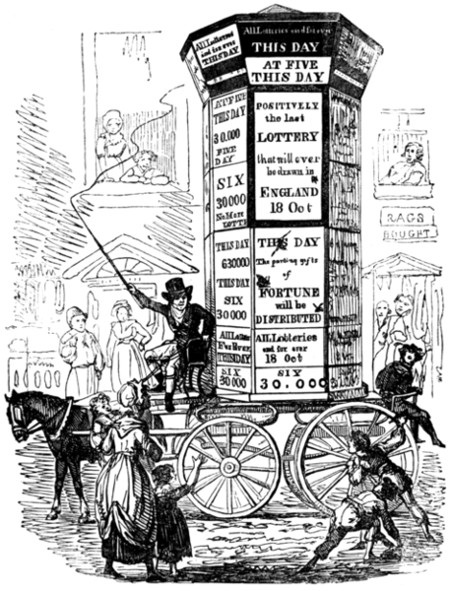
The last Stage of the last State Lottery.
Enlarged illustration (400 kB).
A Ballad, 1826.
A lazy sot grew sober By looking at his troubles, For he found out how He work’d his woe, By playing with Lott’ry bubbles. And just before October, The grand contractors, zealous To share their last ills, With puffs and bills, Drove all the quack-doctors jealous. Their bill-and-cue-carts slowly Paced Holborn and Long Acre, Like a funeral Not mourn’d at all, The bury’ng an undertaker. Clerks smiled, and whisper’d lowly: “This is the time or never There must be a rise— Buy, and be wise, Or your chance is gone for ever.” Yet, of the shares and tickets, Spite of all arts to sell ’em, There were more unsold Than dare be told; Although, if I knew, I’d tell ’em. And so, worn out with rickets, The last “Last Lott’ry” expired; And then there were cries— “We’ve gained a prize By the loss we’ve so long desired: “The lott’ry drew the humble Often aside from his labour, To build in the air, And, dwelling there, He beggar’d himself and neighbour. “If the scheme-makers tumble Down to their proper station, They must starve, or work, Turn thief, or Turk, Or hang, for the good o’ th’ nation.”
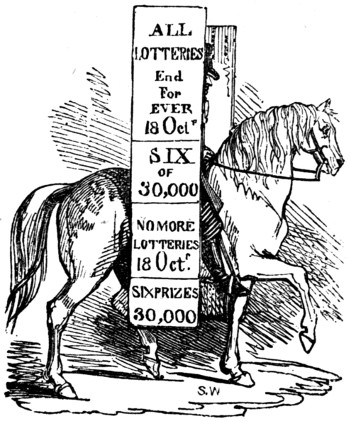
“The Last.”
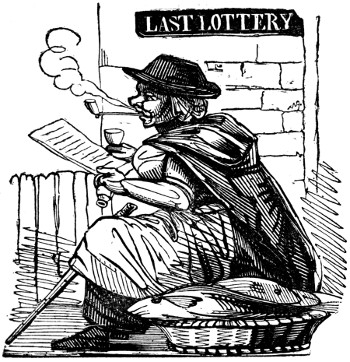
What’s the odds?—while I am floundering here the gold fish will be gone; and as I always was a dab at hooking the right Numbers, I must cast for a Share of the SIX £30,000 on the 18th July, for it is but “giving a Sprat to catch a Herring” as a body may say, and it is the last chance we shall have in England.
Memorandum.
The above engraving is copied from one of the same size to a lottery bill of 1826: its inscription is verbatim the same as that below the original. In after days, this may be looked on with interest, as a specimen of the means to which the lottery schemers were reduced, in order to attract attention to “the last.”
COLLECTIONS RESPECTING LOTTERIES
1569.—The First Lottery.
Dr. Rawlinson, a distinguished antiquary, produced to the Antiquarian society, in 1748, “A Proposal for a very rich Lottery, general without any Blankes, contayning a great No of good prices, as well of redy money as of Plate and certain sorts of Merchandizes, having been valued and prised by the Commandment of the Queenes most excellent Majesties order, to the entent that such Commodities as may chance to arise thereof, after the charges borne, may be converted towards the reparations of the Havens and Strength of the realme, and towards such other public good workes. The No of lotts shall be foure hundred thousand, and no more; and every lott shall be the summe of tenne shillings sterling only, and no more. To be filled by the feast of St. Bartholomew. The shew of Prises ar to be seen in Cheapside, at the sign of the Queenes armes, the house of Mr. Dericke, Goldsmith, Servant to the Queen. Some other Orders about it in 1567-8. Printed by Hen. Bynneman.”
This is the earliest lottery of which we have any account. According to Stow, it was begun to be drawn at the west door of St. Paul’s cathedral, on the 11th of January, 1569, (11th of Elizabeth,) and continued incessantly drawing, day and night, till the 6th of May following.[431] It was at first intended to have been drawn “at the house of Mr. Dericke,” who was the queen’s jeweller.[432] “Whether,” says Maitland, “this lottery was on account of the public, or the selfish views of private persons, my author[433] does not mention; but ’tis evident, by the time it took up in drawing, it must have been of great concern. This I have remarked as being the first of the kind I read in England.” Maitland does not seem to have been acquainted with Dr. Rawlinson’s communication of the printed “Proposal” for it to the society of Antiquaries, which, as it states that the “commodities,” or profits, arising therefrom were to be appropriated to the “reparations of the havens and strength of the realme,” obviates all doubt as to its being “on account of the public.”
In 1586, 28th of the reign of Elizabeth, “A Lotterie, for marvellous rich and beautifull armor, was begunne to be drawn at London, in S. Paules churchyard, at the great west gate, (an house of timber and boord being there erected for that purpose,) on St. Peter’s day in the morning, which lotterie continued in drawing day and night for the space of two or three daies.”[434] Of this lottery it is said, in lord Burghley’s Diary, at the end of Murden’s State papers, “June, 1586, the lottery of armour under the charge of John Calthorp determined.”[435] This is the second English lottery of which mention has been made.
In 1619, 16th of James I., it appears, from the following entry in the register of charitable gifts to the corporation of Reading, that a lottery was held in that town. “Whereas at a Lottery held within the Borough of Reading, in the Year of our Ld. God 1619, Gabriel Barber Gent. Agent in the sd. Lottery for the Councell & Company of Virginia of his own good Will & Charity towarde poor Tradesmen ffreemen & Inhabitants of the sd. Borough of Reading, & for the better enabling such poor Tradesmen to support & bear their Charges in their several Places & Callings in the sd. Corporation from time to time for ever freely gave & delivered to the Mayor & Burgesses of this Corporation the Sum of forty Pounds of lawfull Money of England Upon Special Trust & Confidence, that the sd. Mayor & Burgesses & their Successors shall from time to time for ever dispose & lend these 40l. to & amongst Six poor Tradesmen after the rate of 06l. 13s. 4d. to each Man for the Term of five Years gratis And after those five Years ended to dispose & lend the sd. 40l. by Such Soms to Six other poor Tradesmen for other five Years & so from five years to five years Successively upon good Security for ever Neverthelesse provided & upon Condition that none of those to whom the sd. Summs of mony shall be lent during that Term of five years shall keep either Inn or Tavern or dwell forth of the sd. Borough, but there during that time and terme, shall as other Inhabitants of the sd. Borough reside & dwell.
“Memorand. that the sd. Sum of 40l. came not into the hands & charge of the Mayor & Burgesses until April 1626.”
This extract was communicated to the “Gentleman’s Magazine” in 1778, by a correspondent, who, referring to this gift of “Gabriel Barber, gent., agent in the said lottery,” says, “If it be asked what is become of it now? gone, it is supposed, where the chickens went before during the pious protectorship of Cromwell.”
In 1630, 6th Charles I., there was a project “for the conveying of certain springs of water into London and Westminster, from within a mile and a half of Hodsdon, in Hertfordshire, by the undertakers, Sir Edward Stradling and John Lyde.” The author of this project was one Michael Parker. “For defraying the expences whereof, king Charles grants them a special license to erect and publish a lottery or lotteries; according” says the record, “to the course of other lotteries heretofore used or practised.” This is the first mention of lotteries either in the Fœdera or Statute-book. “And, for the sole privilege of bringing the said waters in aqueducts to London, they were to pay four thousand pounds per annum into the king’s exchequer: and, the better to enable them to make the said large annual payment, the king grants them leave to bring their aqueducts through any of his parks, chases, lands, &c., and to dig up the same gratis.”[436]
In 1653, during the commonwealth, there was a lottery at Grocers’ Hall, which appears to have escaped the observation of the inquirers concerning this species of adventure. It is noticed in an old weekly newspaper, called “Perfect Account of the Daily Intelligence 16-23 November 1653,” by the following
Advertisement.
At the Committee for Claims for Lands in Ireland,
Ordered, That a Lottery be at Grocers-Hall London, on Thursday 15 Decem. 1653, both for Provinces and Counties, to begin at 8 of the clock in the forenoon of the same day; and all persons concerned therein are to take notice thereof.
W. Tibbs.
Under Charles II., the crown, with a view to reward its adherents who resided within the bills of mortality, and had served it with fidelity during the interregnum, granted “Plate Lotteries;” by which is to be understood a gift of plate from the crown, to be disposed of in that manner as prizes, with permission to sell tickets. According to the Gazette, in April 1669, Charles II., the duke of York, (afterwards James II.,) and many of the nobility were present “at the grand plate lottery, which, by his majesty’s command, was then opened at the sign of the Mermaid over against the mews.” This was the origin of endless schemes, under the titles of “Royal Oak,” “Twelve-penny Lotteries,” &c., which will be adverted to presently. They may be further understood by an intimation, published soon after the drawing sanctioned by the royal visitors, in these words, “This is to give notice, that any persons who are desirous to farm any of the counties within the kingdom of England or dominion of Wales, in order to the setting up of a plate lottery, or any other lottery whatsoever, may repair to the lottery office, at Mr. Philips’s house, in Mermaid-court over against the mews; where they may contract with the trustees commissioned by his majesty’s letters patent for the management of the said patent, on the behalf of the truly loyal, indigent officers.”[437] In those times, the crown exceeded its prerogative by issuing these patents, and the law was not put in motion to question them.