APRIL.
Reading edition
On April, in old kalendars, is drawn A gallant hawker, pacing on a lawn, Holding a bell’d and hooded fowl of prey, Ready to loose him in the airy way. For daily, now, descends the solar beam, And the warm earth seems in a waking dream; Insects creep out, leaves burst, and flowers rise, And birds enchant the woods, and wing the skies; Each sentient being a new sense receives, And eloquently looks, to each, it lives.
The name of this month is before observed to have been derived from the verb aperire,[117] which signifies to open, because seeds germinate, and at this season flowers begin to blow; yet Macrobius affirms that it is derived from a Greek word signifying aphrilis, or descended from Venus, or, born of the scum of the sea, because Romulus dedicated the month to Venus. This may be the real derivation; the former is the most natural.
“April,” says the author of the Mirror of the Months, “is spring—the only spring month that we possess—the most juvenile of the months, and the most feminine—the sweetest month of all the year; partly because it ushers in the May, and partly for its own sake, so far as any thing can be valuable without reference to any thing else. It is, to May and June, what ‘sweet fifteen,’ in the age of woman, is to passion-stricken eighteen, and perfect two-and-twenty. It is worth two Mays, because it tells tales of May in every sigh that it breathes, and every tear that it lets fall. It is the harbinger, the herald, the promise, the prophecy, the foretaste of all the beauties that are to follow it—of all, and more—of all the delights of summer, and all the ‘pride, pomp, and circumstance of glorious autumn.’ It is fraught with beauties that no other month can bring before us, and
‘It bears a glass which shows us many more.’
Its life is one sweet alternation of smiles and sighs and tears, and tears and sighs and smiles, till it is consummated at last in the open laughter of May.”
By the same hand we are directed to observe, “what a sweet flush of new green has started up to the face of this meadow! And the new-born daisies that stud it here and there, give it the look of an emerald sky, powdered with snowy stars. In making our way to yonder hedgerow, which divides the meadow from the little copse that lines one side of it, let us not take the shortest way, but keep religiously to the little footpath; for the young grass is as yet too tender to bear being trod upon; and the young lambs themselves, while they go cropping its crisp points, let the sweet daisies alone, as if they loved to look upon a sight as pretty and as innocent as themselves.” It is further remarked that “the great charm of this month, both in the open country and the garden, is undoubtedly the infinite green which pervades it every where, and which we had best gaze our fill at while we may, as it lasts but a little while,—changing in a few weeks into an endless variety of shades and tints, that are equivalent to as many different colours. It is this, and the budding forth of every living member of the vegetable world, after its long winter death, that in fact constitutes the spring; and the sight of which affects us in the manner it does, from various causes—chiefly moral and associated ones; but one of which is unquestionably physical: I mean the sight of so much tender green after the eye has been condemned to look for months and months on the mere negation of all colour, which prevails in winter in our climate. The eye feels cheered, cherished, and regaled by this colour, as the tongue does by a quick and pleasant taste, after having long palated nothing but tasteless and insipid things.—This is the principal charm of spring, no doubt. But another, and one that is scarcely second to this, is, the bright flush of blossoms that prevails over and almost hides every thing else in the fruit-garden and orchard. What exquisite differences and distinctions and resemblances there are between all the various blossoms of the fruit-trees; and no less in their general effect than in their separate details! The almond-blossom, which comes first of all, and while the tree is quite bare of leaves, is of a bright blush-rose colour; and when they are fully blown, the tree, if it has been kept to a compact head, instead of being permitted to straggle, looks like one huge rose, magnified by some fairy magic, to deck the bosom of some fair giantess. The various kinds of plum follow, the blossoms of which are snow-white, and as full and clustering as those of the almond. The peach and nectarine, which are now full blown, are unlike either of the above; and their sweet effect, as if growing out of the hard bare wall, or the rough wooden paling, is peculiarly pretty. They are of a deep blush colour, and of a delicate bell shape, the lips, however, divided, and turning backward, to expose the interior to the cherishing sun. But perhaps the bloom that is richest and most promising in its general appearance is that of the cherry, clasping its white honours all round the long straight branches, from heel to point, and not letting a leaf or a bit of stem be seen, except the three or four leaves that come as a green finish at the extremity of each branch. The other blossoms, of the pears, and (loveliest of all) the apples, do not come in perfection till next month.”
Spring.
The beauties of the seasons are a constant theme with their discoverers—the poets. Spring, as the reproductive source of “light and life and love,” has the preeminence with these children of nature. The authors of “The Forest Minstrel and other poems,” William and Mary Howitt, have high claims upon reflective and imaginative minds, in return for the truth and beauty contained in an elegant volume, which cultivates the moral sense, and infuses a devotional spirit, through exquisite description and just application. The writers have traversed “woods and wilds, and fields, and lanes, with a curious and delighted eye,” and “written not for the sake of writing,” but for the indulgence of their overflowing feelings. They are “members of the Society of Friends,” and those who are accustomed to regard individuals of that community as necessarily incapable of poetical impression, will be pleased by reading from Mr. Howitt’s “Epistle Dedicatory” what he says of his own verses, and of his helpmate in the work:—
And now ’tis spring, and bards are gathering flowers; So I have cull’d you these, and with them sent The gleanings of a nymph whom some few hours Ago I met with—some few years I meant— Gathering “true-love” amongst the wild-wood bowers; You’ll find some buds all with this posy blent, If that ye know them, which some lady fair Viewing, may haply prize, for they are wond’rous rare.
Artists have seldom represented friends—“of the Society of Friends,”—with poetical feeling. Mr. Howitt’s sketch of himself, and her whom he found gathering “true-love,” though they were not clad perhaps “as worldlings are,” would inspire a painter, whose art could be roused by the pen, to a charming picture of youthful affection. The habit of some of the young men, in the peaceable community, maintains its character, without that extremity of the fashion of being out of fashion, which marks the wearer as remarkably formal; while the young females of the society, still preserving the distinction prescribed by discipline, dress more attractively, to the cultivated eye, than a multitude of the sex who study variety of costume. Such lovers, pictured as they are imagined from Mr. Howitt’s lines, would grace a landscape, enfoliated from other stanzas in the same poem, which raise the fondest recollections of the pleasures of boyhood in spring.
Then did I gather, with a keen delight, All changes of the seasons, and their signs: Then did I speed forth, at the first glad sight Of the coy spring—of spring that archly shines Out for a day—then goes—and then more bright Comes laughing forth, like a gay lass that lines A dark lash with a ray that beams and burns, And scatters hopes and doubts, and smiles and frowns, by turns. On a sweet, shining morning thus sent out, It seem’d what man was made for, to look round And trace the full brook, that, with clamorous route, O’er fallen trees, and roots black curling, wound Through glens, with wild brakes scatter’d all about; Where not a leaf or green blade yet was found Springing to hide the red fern of last year, And hemlock’s broken stems, and rustling rank grass sere. But hazel catkins, and the bursting buds Of the fresh willow, whisper’d “spring is coming;” And bullfinches forth flitting from the woods, With their rich silver voices; and the humming Of a new waken’d bee that pass’d; and the broods Of ever dancing gnats, again consuming, In pleasant sun-light, their re-given time; And the germs swelling in the red shoots of the lime. All these were tell-tales of far brighter hours, That had been, and again were on their way; The breaking forth of green things, and of flowers, From the earth’s breast; from bank and quickening spray Dews, buds, and blossoms; and in woodland bowers, Fragrant and fresh, full many a sweet bird’s lay, Sending abroad, from the exultant spring, To every living heart a gladsome welcoming.
Howitt.
April 1.
All Fool’s Day.
In the first volume of the present work, (p. 409,) there is an account of the singular usage of fool-making to-day, which may be further illustrated by a few lines from an almanac of 1760:—
The first of April, some do say, Is set apart for All Fool’s-day; But why the people call it so, Nor I, nor they themselves, do know. But on this day are people sent On purpose for pure merriment; And though the day is known before, Yet frequently there is great store Of these forgetfuls to be found, Who’re sent to flance Moll Dixon’s round; And having tried each shop and stall, And disappointed at them all, At last some tell them of the cheat, And then they hurry from the street, And straightway home with shame they run, And others laugh at what is done. But ’tis a thing to be disputed, Which is the greatest fool reputed, The man that innocently went, Or he that him designedly sent.
Poor Robin.
The custom of making April fools prevails all over the continent. A lady relates that the day is further marked in Provence by every body, both rich and poor, having for dinner, under some form or other, a sort of peas peculiar to the country, called pois chiches. While the convent of the Chartreux was standing, it was one of the great jokes of the day to send novices thither to ask for these peas, telling them that the fathers were obliged to give them away to any body who would come for them. So many applications were in consequence made in the course of the day for the promised bounty, that the patience of the monks was at last usually exhausted, and it was well if the vessel carried to receive the pease was not thrown at the head of the bearer.
There is an amusing anecdote connected with the church of the convent of the Chartreux, at Provence. It was dedicated to St. John, and over the portico were colossal statues of the four evangelists, which have been thrown down and broken to pieces, and the fragments lie scattered about. The first time Miss Plumptre with her party visited this spot, they found an old woman upon her knees before a block of stone, muttering something to herself:—when she arose up, curiosity led them to inquire, whether there was any thing particular in that stone; to which she replied with a deep sigh, Ah oui, c’est un morceau de Saint Jean, “Ah yes, ’tis a piece of Saint John.” The old lady seemed to think that the saint’s intercession in her behalf, mutilated as he was, might still be of some avail.
In Xylander’s Plutarch there is a passage in Greek, relative to the “Feast of Fools,” celebrated by the Romans, to this effect, “Why do they call the Quirinalia the Feast of Fools? Either, because they allowed this day (as Juba tells us) to those who could not ascertain their own tribes, or because they permitted those who had missed the celebration of the Fornacalia in their proper tribes, along with the rest of the people, either out of negligence, absence, or ignorance, to hold their festival apart on this day.”
The Romans on the first day of April abstained from pleading causes, and the Roman ladies performed ablutions under myrtle trees, crowned themselves with its leaves, and offered sacrifices to Venus. This custom originated in a mythological story, that as Venus was drying her wetted hair by a river side, she was perceived by satyrs, whose gaze confused her:—
But soon with myrtles she her beauties veiled, From whence this annual custom was entail’d.
Ovid.
Newcastle. Extract from the Common Council Book.
“April 1, 1695. All-Saints’ parish humbly request the metal of the statue, towards the repair of their bells.”
This refers to a statue of James II. pulled down from the Exchange in consequence of lord Lumley having entered the town and declared for a free parliament. It was an equestrian figure in copper, of the size of Charles I. at Charing-cross. The mob demolished the statue, dragged it to the quay, and cast it into the river. As the parish of All-Saints desired to turn the deposit to some account, the parish of St. Andrews petitioned for a share of the spoil, and it appears by the subjoined extract from the council books, that each was accommodated.
“Ordered that All-Saints have the metal belonging to the horse of the said statue, except a leg thereof, which must go towards the casting of a new bell for St. Andrew’s parish.”
A print of the statue was published “on two large sheets of Genoa paper,” price 5s. by Joseph Barber of Newcastle. There is an engraving from it in “Local Records, by John Sykes, bookseller, Newcastle, 1824,” a book which consists of a chronological arrangement of curious and interesting facts, and events, that have occurred exclusively in the counties of Durham and Northumberland, Newcastle-upon-Tyne, and Berwick, with an obituary and anecdotes of remarkable persons. The present notice is taken from Mr. Sykes’s work.
NATURALISTS’ CALENDAR.
Mean Temperature 44·17.
April 2.
Chronology.
On the 2d of April 1755, Severndroog castle, on the coast of Malabar, belonging to Angria, a celebrated pirate, was taken by commodore James. His relict, to commemorate her husband’s heroism, and to testify her affectionate respect to his memory, erected a tower of the same name on Shooters-hill, near Blackheath, where it is a distinguished land-mark at an immense distance to the circumjacent country.
NATURALISTS’ CALENDAR.
Mean Temperature 44·37.
April 3.
Signs of the Seasons.
It is noticed on this day in the “Perennial Calendar,” that the birds are now arriving daily, and forming arrangements for the hatching and nurture of their future young. The different sorts of nests of each species, adapted to the wants of each, and springing out of their respective instincts, combined with the propensity to construct, would form a curious subject of research for the natural historian. Every part of the world furnishes materials for the aërial architects: leaves and small twigs, roots and dried grass, mixed with clay, serve for the external; whilst moss, wool, fine hair, and the softest animal and vegetable downs, form the warm internal part of these commodious dwellings:—
Of vernal songsters—some to the holly hedge, Nestling, repair, and to the thicket some; Some to the rude protection of the thorn Commit their feeble offspring: the cleft tree Offers its kind concealment to a few, Their food its insects, and its moss their nests: Others apart, far in the grassy dale Or roughening waste, their humble texture weave: But most in woodland solitudes delight, In unfrequented glooms or shaggy banks, Steep, and divided by a babbling brook, Whose murmurs soothe them all the livelong day, When by kind duty fixed. Among the roots Of hazel, pendent o’er the plaintive stream, They frame the first foundation of their domes, Dry sprigs of trees, in artful fabric laid, And bound with clay together. Now ’tis naught But restless hurry through the busy air, Beat by unnumbered wings. The swallow sweeps The slimy pool, to build the hanging house Intent: and often from the careless back Of herds and flocks a thousand tugging bills Pluck hair and wool; and oft, when unobserved, Steal from the barn a straw; till soft and warm, Clean and complete, their habitation grows.
Thomson.
The cavern-loving wren sequestered seeks The verdant shelter of the hollow stump, And with congenial moss, harmless deceit, Constructs a safe abode. On topmost boughs The glossy raven, and the hoarsevoiced crow, Rocked by the storm, erect their airy nests. The ousel, lone frequenter of the grove Of fragrant pines, in solemn depth of shade Finds rest; or ’mid the holly’s shining leaves, A simple bush the piping thrush contents, Though in the woodland concert he aloft Trills from his spotted throat a powerful strain, And scorns the humbler quire. The lark too asks A lowly dwelling, hid beneath a turf, Or hollow, trodden by the sinking hoof; Songster of heaven! who to the sun such lays Pours forth, as earth ne’er owns. Within the hedge The sparrow lays her skystained eggs. The barn, With eaves o’erpendant, holds the chattering tribe: Secret the linnet seeks the tangled copse: The white owl seeks some antique ruined wall, Fearless of rapine; or in hollow trees, Which age has caverned, safely courts repose: The thievish pie, in twofold colours clad, Roofs o’er her curious nest with firmwreathed twigs, And sidelong forms her cautious door; she dreads The taloned kite, or pouncing hawk; savage Herself, with craft suspicion ever dwells.
Bidlake.
NATURALISTS’ CALENDAR.
Mean Temperature 43·37.
April 4.
Cheap Weather Guide.
To the Editor of the Every-Day Book.
Cornhill, March, 1826.
Sir,—The following observations on the leechworm were made by a gentleman who kept one several years for the purpose of a weather-glass:
A phial of water, containing a leech, I kept on the frame of my lower sash window, so that when I looked in the morning I could know what would be the weather of the following day. If the weather proves serene and beautiful, the leech lies motionless at the bottom of the glass, and rolled together in a spiral form.
If it rains, either before or after noon, it is found crept up to the top of its lodging, and there it remains till the weather is settled. If we are to have wind, the poor prisoner gallops through its limped habitation with amazing swiftness, and seldom rests till it begins to blow hard.
If a storm of thunder and rain is to succeed, for some days before it lodges, almost continually, without the water, and discovers very great uneasiness in violent throes and convulsions.
In the frost, as in clear summer weather, it lies constantly at the bottom; and in snow, as in rainy weather, it pitches its dwelling upon the very mouth of the phial.
What reasons may be assigned for these circumstances I must leave philosophers to determine, though one thing is evident to every body, that it must be affected in the same way as that of the mercury and spirits in the weather-glass. It has, doubtless, a very surprising sensation; for the change of weather, even days before, makes a visible alteration upon its manner of living.
Perhaps it may not be amiss to note, that the leech was kept in a common eight-ounce phial glass, about three-quarters filled with water, and covered on the mouth with a piece of linen rag. In the summer the water is changed once a week, and in the winter once a fortnight. This is a weather-glass which may be purchased at a very trifling expense, and which will last I do not know how many years.
I am, &c. J. F.
NATURALISTS’ CALENDAR.
Mean Temperature 44·82.
April 5.
Swallows in 1826.
Our friend J. H. H. whose letter on wild-fowl shooting, from Abbeville, is in vol. i. p. 1575, with another on lark shooting in France in the present volume, p. 91, writes from Southover, near Lewes, in Sussex, on this day, 1826, “How delightful the country looks! I shall leave you to imagine two swallows, the first I have seen, now preening themselves on the barn opposite, heartily glad that their long journey is at an end.” The birds come to us this year very early.
Pump with two Spouts.
In a letter of the 5th of April, 1808, to Dr. Aikin, inserted in his “Athenæum,” Mr. Roots says,—“In the year 1801, being on a tour through the Highlands of Scotland, I visited the beautiful city of Glasgow, and in passing one of the principal streets in the neighbourhood of the Tron church, I observed about five-and-twenty or thirty people, chiefly females, assembled round a large public pump, waiting their separate turns for water; and although the pump had two spouts for the evacuation of the water behind and before, I took notice that one of the spouts was carefully plugged up, no one attempting to fill his vessel from that source, whilst each was waiting till the rest were served, sooner than draw the water from the spout in question. On inquiry into the cause of this proceeding, I was informed by an intelligent gentleman residing in the neighbourhood, that though one and the same handle produced the same water from the same well through either of the spouts, yet the populace, and even better informed people, had for a number of years conceived an idea, which had been handed down from father to son, that the water when drawn from the hindermost spout would be of an unlucky and poisonous nature; and this vulgar prejudice is from time to time kept afloat, inasmuch, as by its being never used, a kind of dusty fur at length collects, and the water, when suffered from curiosity to pass through, at first runs foul; and this tends to carry conviction still further to these ignorant people, who with the most solemn assurances informed me, it was certain death to taste of the water so drawn, and no argument could divest them of their superstitious conceit, though the well had been repeatedly cleaned out, before them, by order of the magistrates, and the internal mechanism of the pump explained. We need not be surprised at the bigotted ignorance of the ruder ages, either in this country or in less civilized regions, when we witness facts so grossly superstitious obtaining in our own time.”
NATURALISTS’ CALENDAR.
Mean Temperature 45·67.
April 6.
Spring.
This period of the year is so awakening to intellectual powers, that for a few days some matters of fact are occasionally deferred in favour of imaginative and descriptive effusions occasioned by the season.
The Poet’s Pen. (From the Greek of Menecrates.)
I was an useless reed; no cluster hung My brow with purple grapes, no blossom flung The coronet of crimson on my stem; No apple blushed upon me, nor (the gem Of flowers) the violet strewed the yellow heath Around my feet, nor Jessamine’s sweet wreath Robed me in silver: day and night I pined On the lone moor, and shiver’d in the wind. At length a poet found me. From my side He smoothed the pale and withered leaves, and dyed My lips in Helicon. From that high hour I SPOKE! My words were flame and living power, All the wide wonders of the earth were mine, Far as the surges roll, or sunbeams shine; Deep as earth’s bosom hides the emerald; High as the hills with thunder clouds are pall’d. And there was sweetness round me, that the dew Had never wet so sweet on violet’s blue. To me the mighty sceptre was a wand, The roar of nations peal’d at my command; To me the dungeon, sword, and scourge were vain, I smote the smiter, and I broke the chain; Or tow’ring o’er them all, without a plume, I pierced the purple air, the tempest’s gloom, Till blaz’d th’ Olympian glories on my eye, Stars, temples, thrones, and gods—infinity.
Pulci
NATURALISTS’ CALENDAR.
Mean Temperature 46·84.
April 7.
Saints.
Our old acquaintance with the saints is not broken: but they are sad intruders on the beauties of the world, and we part from them, for a little while, after the annexed communication of an attempt to honour them.
Sermon at St. Andrew’s.
For the Every-Day Book.
The following anecdote, under the article “Black Friars,” in Brand’s “History of Newcastle-upon-Tyne,” as a specimen of the extreme perversion of mind in the Romish clergy of former times, is curious, and may amuse your readers as much as it has me.
Richard Marshall, who had been one of the brethren, and also prior of the house, in the year 1521, at St. Andrew’s, Scotland, informed his audience there, that Pater noster should be addressed to God and not to the saints. The doctors of St. Andrew’s, in their great wisdom, or rather craftiness, appointed a preacher to oppose this tenet, which he did in a sermon from Matt. v. 3. “Blessed are the poor in spirit.” “Seeing,” says he, “we say good day, father, to any old man in the street, we may call a saint, pater, who is older than any alive: and seeing they are in heaven, we may say to any of them, ‘hallowed be thy name;’ and since they are in the kingdom of heaven, we may say to any of them ‘thy kingdom come:’ and seeing their will is God’s will, we may say, ‘thy will be done,’” &c. When the friar was proceeding further, he was hissed and even obliged to leave the city. Yet we are told, the dispute continued among the doctors about the pater. Some would have it said to God formaliter, to the saints materialiter; others, to God principaliter, to the saints minus principaliter; or primario to God, secundario to the saints; or to God strictè, and to the saints latè. With all these distinctions they could not agree. It is said, that Tom, who was servant to the sub-prior of St. Andrew’s, one day perceiving his master in trouble, said to him, “Sir, what is the cause of your trouble?” The master answered, “We cannot agree about the saying of the pater.” The fellow replied, “To whom should it be said but to God alone?” The master asks, “What then shall we do with the saints?” To which Tom rejoined, “Give them ave’s and crede’s enough, that may suffice them, and too well too.” The readers of the Every-Day Book will probably think that Tom was wiser or honester than his master.
J. F.
NATURALISTS’ CALENDAR.
Mean Temperature 47·10.
April 8.
Flowers.
On this day in the “Perennial Calendar,” Dr. Forster observes, that it may be proper to notice the general appearance of the wild and less cultivated parts of nature at this time. In the fields, the bulbous crowfoot, ranunculus bulbosus, begins to blow. Daisies become pretty common, and dandelions are seen here and there by road sides, and in fields, on a warm soil, are pretty abundant. The pilewort, ficaria verna, still decorates the thickets and shady green banks with its bright yellow stars of gold. It may be observed generally, that the flowers found at this time belong to the primaveral Flora; those of the vernal being as yet undeveloped. By the sides of rivers, streams, and ponds, along the wet margins of ditches, and in moist meadows, and marshes, grows the marsh marigold, caltha palustris, whose golden yellow flowers have a brilliant effect at a small distance.
Prolific gales Warm the soft air, and animate the vales. Woven with flowers and shrubs, and freshest green, Thrown with wild boldness o’er the lovely scene A brilliant carpet, of unnumbered dyes, With sweet variety enchants the eyes. Thick are the trees with leaves; in every grove The feathered minstrels tune their throats to love.
Kleist.
Domestic Antiquities, and a Letter of Lord Thurlow’s.
A gentleman indulges the editor with the following account of a singular household utensil, and a drawing of it, from whence a correct engraving has been made; together with a letter from the late lord chancellor Thurlow, which from his distinguished hand on a singular occurrence, merits preservation.
To the Editor of the Every-Day Book.
April 3, 1826.
Sir,—I shall be happy to communicate any thing in my power, connected with antiquities to the Every-Day Book, which I have taken from the beginning and been highly pleased with; and, first, I send you a drawing for insertion, if you think it worthy, of a carving, in my possession, on an ancient oak board, two feet in diameter.

Ancient Carving. It represents the letters I. h. c. in the centre, surrounded by this legend, viz.
“An harte that is wyse wyll obstine from sinnes and increas in the workes of God.”
As this legend reads backward, and all the carving is incuse, it was evidently intended to give impression to something; I imagine pastry.
An original letter is now before me, from lord chancellor Thurlow, to a Norfolk farmer, who had sent him a hare, and two and a half brace of partridges, enclosed in a large turnip of his own growth. The farmer had not any personal knowledge of his lordship, but, being aware he was a Norfolk man, he rightly conceived that his present would be looked upon with more interest on that account. The following is a copy of the chancellor’s letter:—
Bath, Dec. 31, 1778.
Sir,—I beg you will accept of my best thanks for your agreeable present. It gave me additional satisfaction to be so remembered in my native country; to which I, in particular, owe every sort of respect, and all the world agrees to admire for superiority in husbandry.
I am, Sir, Your most obliged And obedient servant, Thurlow.
Having transcribed his lordship’s answer, you are at liberty to do with that, and the drawing of my carving, as you please; with this “special observance,” that you do not insert my name, which, nevertheless, for your satisfaction, I subscribe, with my abode.
Believe me, Sir, &c. Eta.
⁂ The editor is gratified by the confidence reposed in him by the gentleman who wrote the preceding letter. He takes this opportunity of acknowledging similar marks of confidence, and reiterates the assurance, that such wishes will be always scrupulously observed.
It is respectfully observed to possessors of curiosities of any kind, whether ancient or modern, that if correct drawings of them be sent they shall be faithfully engraven and inserted, with the descriptive accounts.
The gradual disappearance of many singular traces of our ancestors, renders it necessary to call attention to the subject. “Apostle Spoons,” of which there is an engraving in vol. i. p. 178, have been dropping for the last thirty years into the refiner’s melting-pot, till sets of them are not to be purchased, or even seen, except in cabinets. Any thing of interest respecting domestic manners, habits, or customs, of old times, is coveted by the editor for the purpose of recording and handing them down to posterity.
NATURALISTS’ CALENDAR.
Mean Temperature 46·72.
April 9.
An April Day.
Some verses in the “Widow’s Tale,” are beautifully descriptive of the season.
All day the lowhung clouds have dropt Their garnered fulness down; All day that soft grey mist hath wrapt Hill, valley, grove, and town. There has not been a sound to-day To break the calm of nature; Nor motion, I might almost say, Of life or living creature; Of waving bough, or warbling bird, Or cattle faintly lowing; I could have half believed I heard The leaves and blossoms growing. I stood to hear—I love it well, The rain’s continuous sound, Small drops, but thick and fast, they fell, Down straight into the ground. For leafy thickness is not yet Earth’s naked breast to screen, Though every dripping branch is set With shoots of tender green. Sure, since I looked at early morn, Those honeysuckle buds Have swelled to double growth; that thorn Hath put forth larger studs; That lilac’s cleaving cones have burst, The milkwhite flowers revealing; Even now, upon my senses first Methinks their sweets are stealing. The very earth, the steamy air, Is all with fragrance rife; And grace and beauty every where Are flushing into life. Down, down they come—those fruitful stores! Those earth-rejoicing drops! A momentary deluge pours, Then thins, decreases, stops; And ere the dimples on the stream Have circled out of sight, Lo! from the west, a parting gleam Breaks forth of amber light. But yet behold—abrupt and loud, Comes down the glittering rain; The farewell of a passing cloud, The fringes of her train.
NATURALISTS’ CALENDAR.
Mean Temperature 47·17.
April 10.
The Season.
Art, as well as nature, is busily occupied in providing for real wants or natural desires. To gratify the ears and eyes of the young, we have more street organs and shows in spring than in the autumn, and the adventures of that merry fellow “Punch in the Puppet-show,” are represented to successive crowds in every street, whence his exhibitors conceive they can extract funds for the increase of their treasury.
A kind hand communicates an article of curious import, peculiarly seasonable.
Punch in the Puppet Show.
To the Editor of the Every-Day Book.
Sir,—I do not know, whether in the absence of more interesting matter, a few remarks on an old favourite may be allowed. The character I am about to mention, has I am sure at one time or another delighted most of your readers, and I confess to be still amused with his vagaries—I mean “that celebrated wooden Roscius, Mister Punch.” It is very difficult to trace accurately the origin and variation of any character of this description; and I shall, therefore, only offer some unconnected notices.
In some of the old mysteries, wherein you are so well read, “the devil” was the buffoon of the piece, and used to indulge himself most freely in the gross indecencies tolerated in the earlier ages. When those mysteries began to be refined into moralities, the vice gradually superseded the former clown, if he may be so designated; and at the commencement of such change, frequently shared the comic part of the performance with him. The vice was armed with a dagger of lath, with which he was to belabour the devil, who, sometimes, however, at the conclusion of the piece, carried off the vice with him. Here we have something like the club wielded by Punch, and the wand of harlequin, at the present time, and a similar finish of the devil and Punch, may be seen daily in our streets.
About the beginning of the sixteenth century the drama began to assume a more regular form, and the vice, in his turn, had to make way for the clown or fool, who served to fill up the space between the acts, by supposed extemporaneous witticisms; holding, occasionally, trials of wit with any of the spectators who were bold enough to venture with him. The last play, perhaps, in which the regular fool was introduced, was “The Woman Captain” of Shadwell, in the year 1680. Tarleton, in the time of Shakspeare, was a celebrated performer of this description. The fool was frequently dressed in a motley or party-coloured coat, and each leg clad in different coloured hose. A sort of hood covered his head, resembling a monk’s cowl: this was afterwards changed for a cap, each being usually surmounted with the neck and head of a cock, or sometimes only the crest, or comb; hence the term cockscomb. In his hand he carried the bauble, a short stick, having at one end a fool’s head, and at the other, frequently a bladder with peas or sand, to punish those who offended him. His dress was often adorned with morris-bells, or large knobs. We may observe much similarity to this dress, in the present costume of Punch. He degenerated into a wooden performer, about the time that the regular tragedy and comedy were introduced, i. e. in the beginning of the sixteenth century. Strolling players were prohibited a few years afterwards, and some of those performers who had not skill or interest enough to get a situation in any established company, went about the country with puppet shows, or “motions,” as they were then called, wherein Punch was a prominent character, though not by that name, which was a subsequent importation, originally Policinello, or Punchinello; and when this name was introduced from the continent, some modifications were made also in the character to whom the name was attached. The civil wars, and subsequent triumph of puritanism, depressed theatrical proceedings, and Punch with other performers was obliged to hide himself, or act by stealth; but in the jovial reign of Charles II., he, and his brother actors, broke out with renewed splendour, and until the time of George I. he maintained his rank manfully, being mentioned with considerable respect even by the “Spectator.” About this time, however, harlequinades were introduced, and have been so successfully continued, that poor Punch is contented to walk the streets like a snail, with his house on his back, though still possessing as much fun as ever.
Pantomime, in its more extended sense, was known to the Greek and Roman stages, being introduced on the latter by Pylades and Bathyllus, in the time of Augustus Cæsar. From that time to the present, different modifications of this representation have taken place on the continent, and the lofty scenes of ancient pantomime, are degenerated to the bizarre adventures of harlequin, pantaloon, zany, pierrot, scaramouch, &c.
The first pantomine performed by grotesque characters in this country, was at Drury-lane theatre, in the year 1702. It was composed by Mr. Weaver, and called “The Tavern Bilkers.” The next was performed at Drury-lane in 1716, and it was also composed by Mr. Weaver, in imitation of the ancient pantomime, and called “The Loves of Mars and Venus.”
In 1717, the first harlequinade, composed by Mr. Rich, was performed at the theatre in Lincoln’s Inn Fields, called, “Harlequin Executed.” This performer, who acted under the name of Lun, was so celebrated for his taste in composing these entertainments, and for his skill, as a harlequin, that they soon became established in the public favour. He flourished until the year 1761, and all his productions succeeded.
The harlequin on the French stage differed from ours, for he had considerable license of speech, somewhat similar to the theatric fools of the sixteenth century. Many of the witticisms of Dominique, a celebrated harlequin in the time of Louis XIV. are still on record; it is said, indeed, that before his time, harlequin was but a grotesque ignorant character, but that he being a man of wit, infused it into his representation, and invented the character of Pierrot as a foolish servant, to fill up the piece. The old character of zany was similar to our modern clown, who now is generally the possessor of all the wit in the performance. The name of pantaloon is said to have been derived from the watch-word of the Venetians, pianta leone; if so, (which is doubtful) it must have been applied in derision of their fallen state, as compared with their former splendour. A more doubtful origin has been given of the name of harlequin; a young Italian actor of eminence in this style of character, came to Paris in the time of Henry III. of France, and having been received into the house of the president, Achilles de Harlai, his brother actors, are said to have called him harlequino, from the name of his master. There was a knight called Harlequin, an extravagant dissipated man, who spent his substance in the wars of Charles Martel, against the Saracens, and afterwards lived by pillage. Tradition says he was saved from perdition in consequence of his services against the infidels, but condemned for a certain time to appear nightly upon earth, with those of his lineage.
But, as to derivations, some have derived the term merry-andrew, from the time of the Druids, an Drieu, i.e. Arch-Druid,—others, from the celebrated Andrew Borde, the writer and empiric. The merry-andrew used at fairs to wear a patched coat like the modern harlequin, and sometimes a hunch on his back. It has been remarked that the common people are apt to give to some well-known facetious personage, the name of a favourite dish; hence, the jack-pudding of the English; the jean-potage of the French; the macaroni of the Italians, &c.
A word or two more about Punch, and I have done. There are some hand-bills in the British Museum, of the time of queen Ann, from whence I made a few extracts some time ago. They principally relate to the shows at Bartlemy fair, and I observe at “Heatly’s booth,” that “the performances will be compleated with the merry humors of sir John Spendall and Punchinello;” and James Miles, at “the Gun-Musick booth,” among other dances &c., exhibited “a new entertainment between a scaramouch, a harlequin, and a punchinello, in imitation of bilking a reckoning,—and a new dance by four scaramouches, after the Italian manner,” &c.
The famous comedian Edwin, (the Liston of his day) acted the part of Punch, in a piece called “The Mirror,” at Covent-garden theatre: in this he introduced a burlesque song by C. Dibdin, which obtained some celebrity; evidently through the merit of the actor, rather than the song, as it has nothing particular to recommend it.
Can’t you see by my hunch, sir, Faddeldy daddeldy dino, I am master Punch, sir, Riberi biberi bino, Fiddeldy, diddeldy, faddeldy, daddeldy, Robbery, bobbery, ribery, bibery, Faddeldy, daddeldy, dino, Ribery, bibery, bino. That merry fellow Punchinello, Dancing here, you see, sir, Whose mirth not hell Itself can quell He’s ever in such glee, sir, Niddlety, noddlety, niddlety, noddlety, niddlety, noddlety, nino. Then let me pass, old Grecian, Faddeldy, daddeldy, dino. To the fields Elysian, Bibery, bibery, bino. Fiddledy, diddledy, faddledy, daddledy, Robbery, bobbery, ribery, bibery, Faddledy, daddledy, dino, Ribery, bibery, bino. My ranting, roaring Pluto, Faddledy, daddledy, dino, Just to a hair will suit oh, Bibery, bibery, bino. Faddledy, daddledy, &c. Each jovial fellow, At Punchinello, Will, laughing o’er his cup roar, I’ll rant and revel, And play the devil, And set all hell in an uproar, Niddlety, noddlety, nino. Then let me pass, &c.
I therewith conclude this hasty communication, begging you to shorten it if you think proper.
I am, &c. W. S——.
Edwin’s song in the character of Punch is far less offensive than many of the songs and scenes in “Don Juan,” which is still represented. This drama which is of Italian origin, the editor of the Every-Day Book, in his volume on “Ancient Mysteries,” has ventured to conjecture, may have been derived from the adventures of the street Punch. The supposition is somewhat heightened by Edwin’s song as the Punch of Covent-garden.
NATURALISTS’ CALENDAR.
Mean Temperature 48·32.
April 11.
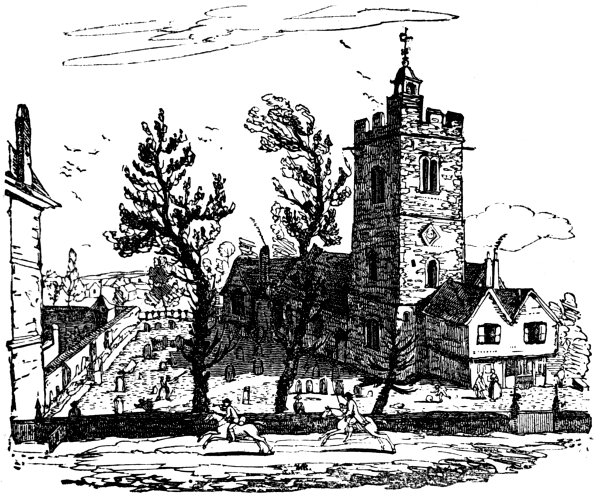
St. Mary Islington Old Church “Merry Islington.”
Islington Parish Dinner.
In March, an anonymous correspondent obligingly enclosed, and begged my acceptance of a ticket, for a parish dinner at Islington, on the 11th of April, 1738. It would have been rudeness to decline the civility, and as the editor was not prepared to join the guests at the great dinner, “not where they eat, but where they are eaten,” he appropriates the ticket to the use for which it was intended by the donor, T. H. of St. John-street.
It would do the reader’s heart good to see this ticket—“printed from a copper plate,” ten inches high, by seven inches wide—as large as a lord mayor’s ticket, and looking much better, because engraved by Toms, a fine firm artist of “the good old school,” which taught truth as an essential, and prohibited refinements, not existing in nature or sensible objects, as detraction of character.
It would do the reader’s heart good, I say, to see the dinner ticket I am now looking at. First, above the invitation—which is all that the lover of a dinner first sees—and therefore, because nothing precedes it, “above all,”—is a capital view of the old parish church, and the churchyard, wherein “lie the remains” of most of the company who attended the parish dinner—it being as certain that the remains of the rest of the company, occupy other tenements, of “the house appointed for all living,” as that they all lived, and ate and drank, and were merry.
This is not a melancholy, but a natural view. It may be said, there is “a time for all things,” but if there be any time, wherein we fear to entertain death, we are not fully prepared to receive him as we ought. It is true, that with “the cup of kindness” at our lips, we do not expect his friendly “shake,” before we finish the draught, yet the liquor will not be the worse for our remembering that his is a previous engagement; and, as we do not know the hour of appointment, we ought to be ready at all hours. The business of life is to die.
I am not a member of a parish club, but I have sometimes thought, if I could “do as others do,” and “go to club,” I should elect to belong to an old one, which preserved the minutes of its proceedings, and its muniments, from the commencement. My first, and perhaps last, serious motion, would be, “That each anniversary dinner ticket of the club, from the first ticket to the last issued, should be framed and glazed, and hung on the walls of the club room, in chronological order.” Such a series would be a never-failing source of interest and amusement. If the parish club of Islington exists, a collection of its tickets so disposed, might be regarded as annals of peculiar worth, especially if many of its predecessors in the annual office of “stewards for the dinner,” maintained the consequence of the club in the eyes of the parish, by respectability of execution and magnitude in the anniversary ticket, commensurate with that of the year 1738, with Toms’s view of the old parish church and churchyard. I regret that these cannot be here given in the same size as on the ticket; the best that can be effected, is a reduced fac-simile of the original, which is accomplished in the accompanying engraving. Let any one who knows the new church of Islington, compare it with the present view of the old church, and say which church he prefers. At this time, however, the present church may be more suitable to Islington, grown, or grown up to, as it is, until it is a part of London; but who would not wish it still a village, with the old edifice for its parish church. That Islington is now more opulent and more respectable, may be very true; but opulence monopolizes, and respectability is often a vain show in the stead of happiness, and a mere flaunt on the ruins of comfort. The remark is, of course, general, and not of Islington in particular, all of whose opulent or respectable residents, may really be so, for aught I know to the contrary. Be it known to them, however, on the authority of the old dinner ticket, that their predecessors, who succeeded the inhabitants from whose doings the village was called “merry Islington,” appear to have dined at a reasonable hour, enjoyed a cheerful glass, and lived in good fellowship.
Immediately beneath the view of the old church on the ticket, follows the stewards’ invitation to the dinner, here copied and subjoined verbatim.
St. Mary, Islington. SIR,
You are desir’d to meet many others, Natives of this place, on Tuesday, ye 11th Day of April, 1738, at Mrs. Eliz. Grimstead’s, ye Angel & Crown, in ye upper Street, about ye Hour of One; Then, & there wth. Full Dishes, Good Wine, & Good Humour, to improve & make lasting that Harmony, and Friendship which have so long reigned among us.
Walter Sebbon John Booth Bourchier Durell James Sebbon Stewards.
N.B.—The Dinner will be on the Table peremptorily at Two.
Pray Pay the Bearer Five Shillings.
“Merry Islington!”—We may almost fancy we see the “jolly companions, every one,” in their best wigs, ample coats, and embroidered waistcoats, at their dinner; that we hear the bells ringing out from the square tower of the old church, and the people and boys outside the door of the “Angel and Crown, in ye Upper Street,” huzzaing and rejoicing, that their betters were dining “for the good of the parish”—for so they did: read the ticket again.
England is proverbially called “the ringing island,” which is not the worst thing to say of it; and our forefathers were great eaters and hard drinkers, and that is not the worst thing to say of them; but of our country we can also tell better things, and keep our bells to cheer our stories; and from our countrymen we can select names among the living and the dead that would dignify any spot of earth. Let us then be proud of our ancient virtue, and keep it alive, and add to it. If each will do what he can to take care that the world is not the worse for his existence, posterity will relate that their ancestors did well in it.
NATURALISTS’ CALENDAR.
Mean Temperature 46·60.
April 12.
Sign of Rain.
One of the “Hundred Mery Tales” teacheth that, ere travellers depart their homes, they should know natural signs; insomuch that they provide right array, or make sure that they be safely housed against tempest. Our Shakspeare read the said book of tales, which is therefore called “Shakspeare’s Jest Book;” and certain it is, that though he were not skilled in learning of the schoolmen, by reason that he did not know their languages, yet was he well skilled in English, and a right wise observer of things; wherein, if we be like diligent, we, also, may attain unto his knowledge. Wherefore, learn to take heed against rain, by the tale ensuing.
Of the herdsman that said, “Ride apace, ye shall have rain.”
A certain scholar of Oxford, which had studied the judicials of astronomy, upon a time as he was riding by the way, there came by a herdman, and he asked this herdman how far it was to the next town; “Sir,” quoth the herdman, “it is rather past a mile and an half; but, sir,” quoth he, “ye need to ride apace, for ye shall have a shower of rain ere ye come thither.” “What,” quoth the scholar, “maketh ye say so? there is no token of rain, for the clouds be both fair and clear.” “By my troth,” quoth the herdsman, “but ye shall find it so.”
The scholar then rode forth, and it chanced ere he had ridden half a mile further, there fell a good shower of rain, that the scholar was well washed, and wet to the skin. The scholar then turned him back and rode to the herdman, and desired him to teach him that cunning. “Nay,” quoth the herdman, “I will not teach you my cunning for naught.” Then the scholar proffered him eleven shillings to teach him that cunning. The herdman, after he had received his money, said thus:—“Sir, see you not yonder black ewe with the white face?” “Yes,” quoth the scholar. “Surely,” quoth the herdman, “when she danceth and holdeth up her tail, ye shall have a shower of rain within half an hour after.”
By this ye may see, that the cunning of herdmen and shepherds, as touching alterations of weathers, is more sure than the judicials of astronomy.
Upon this story it seemeth right to conclude, that to stay at home, when rain be foreboded by signs natural, is altogether wise; for though thy lodging be poor, it were better to be in it, and so keep thy health, than to travel in the wet through a rich country and get rheums thereby.
Home.
Cling to thy home! If there the meanest shed Yield thee a hearth and shelter for thine head, And some poor plot, with vegetables stored, Be all that pride allots thee for thy board, Unsavoury bread, and herbs that scatter’d grow, Wild on the river’s brink or mountain’s brow, Yet e’en this cheerless mansion shall provide More heart’s repose than all the world beside.
Leonidas of Tarentum.
NATURALISTS’ CALENDAR.
Mean Temperature 46·76.
April 13.
Birds.
About this time, according to Dr. Forster, whose observations on the migrations and habits of birds, are familiar to most persons acquainted with the natural history of our island, the bittern, ardea stellata, begins to make a booming noise in marshy places at eventide. The deep and peculiar hollow tone of this bird in the breeding season, can hardly be mistaken for that of any other: it differs essentially from the note of the same bird when on the wing.
The bittern booms along the sounding marsh, Mixt with the cries of heron and mallard harsh.
The bittern sits all day hid among the reeds and rushes with its head erect; at night it rises on the wing, and soars to a vast height in a spiral direction. Those who desire to see it must pursue a swampy route, through watery fens, quagmires, bogs, and marshes. The heron, ardea major, has now a nest, and is seen sailing about slowly in the air in search of its fishy prey, travelling from one fish pond to another, over a large tract of country. It is a bird of slow and heavy flight, though it floats on large and expansive wings.
NATURALISTS’ CALENDAR.
Mean Temperature 46·57.
April 14.
Spring.
Genial weather at the commencement of the year, dresses the meadows with the common and beautiful flowers that delight childhood.
The Cowslip.
Cowslip, of all beloved, of all admired! Thee let me sing, the homely shepherd’s pride; Fit emblem of the maid I love, a form Gladdening the sight of man; a sweet perfume, Sending its balmy fragrance to the soul Daughter of Spring and messenger of May, Which shall I first declare, which most extol, Thy sovereign beauties, or thy sovereign use? With thee the rural dame a draught prepares, A nectarous draught, more luscious to my taste Than all thy boasted wine, besotted Bacchus! Maidens with thee their auburn tresses braid; Or, with the daisy and the primrose pale, Thy flowers entwining, weave a chaplet fair, To grace that pole round which the village train Lead on their dance to greet the jocund May; Jocund I’ll call it, for it lends a smile To thee, who never smil’st but once a year. I name thee not, thou poor unpitied wretch! Of all despised, save him whose liberal heart Taught him to feel your wrongs, and plead your cause, Departed Hanway! Peace be to his soul! Great is that man, who quits the path of fame, Who, wealth forsaking, stoops his towering mind From learning’s heights, and stretches out his arm To raise from dust the meanest of his kind. Now that the muse to thee her debt has paid, Friend of the poor and guardian of the wronged, Back let her pleased return, to view those sports, Whose rude simplicity has charms for me Beyond the ball or midnight masquerade. Oft on that merry morn I’ve joined their throng, A glad spectator; oft their uncouth dance Eyed most attentive; when, with tawdry show, Illsorted ribbons decked each maiden’s cap, And cowslip garlands every rustic hat.
NATURALISTS’ CALENDAR.
Mean Temperature 47·44.
April 15.
Seasonable.
To the Reader.
On Saturday, the 15th of April, 1826, No. 68, and Part XVII., of the Every-Day Book, forming No. 16, and Part IV. of the second volume, were published by Messrs. Hunt and Clarke, of Tavistock-street, Covent-garden. As the removal of the office from Ludgate-hill may be an event of as much interest to the friends of the work as any other belonging to the day it is recorded here with the following explanation which was printed on the wrapper of the part:—
“This step relieves me from cares and anxieties which so embarrassed my progress, in conducting and writing the work, as to become overwhelming; and Messrs. Hunt and Clarke will publish it much earlier than hitherto.
“To subscribers the present arrangement will be every way beneficial.
“They will have the Every-Day Book punctually at a proper hour; and, as I shall be enabled to give it the time and attention essential to a thorough fulfilment of its plan, my exertions will, henceforth, be incessantly directed to that end. I, therefore, respectfully and earnestly solicit the friends of the work to aid me by their contributions. At the present moment they will be most acceptable.
“Correspondents will, from this day, be pleased to address letters and parcels to me, at Messrs. Hunt and Clarke’s, Tavistock-street, Covent-garden.
W. Hone.”
☞ Six Indexes, with a Preface, Title-page, and Frontispiece to the first volume, will be ready for delivery before the appearance of the next sheet; and I hope the labour by which I have endeavoured to facilitate reference to every general and particular subject, may be received as somewhat of atonement, for the delay in these essentials. To guard against a similar accident, I have already commenced the index to the second volume.
W. Hone.
April 15, 1826.
⁂ Volume I. contains 868 octavo pages, or 1736 columns, illustrated by One Hundred and Seventy engravings: Price 14s. in boards.
Progress of the Season.
Song Birds.
If we happen to be wandering forth on a warm still evening during the last week in this month, and passing near a roadside orchard, or skirting a little copse in returning from our twilight ramble, or sitting listlessly on a lawn near some thick plantation, waiting for bed time, we may chance to be startled from our meditations (of whatever kind they may be) by a sound issuing from among the distant leaves, that scares away the silence in a moment, and seems to put to flight even the darkness itself;—stirring the spirit, and quickening the blood, as no other mere sound can, unless it be that of a trumpet calling to battle. That is the nightingale’s voice. The cold spells of winter, that had kept him so long tongue-tied, and frozen the deep fountains of his heart, yield before the mild breath of spring, and he is voluble once more. It is as if the flood of song had been swelling within his breast ever since it last ceased to flow; and was now gushing forth uncontroullably, and as if he had no will to controul it: for when it does stop for a space, it is suddenly, as if for want of breath. In our climate the nightingale seldom sings above six weeks; beginning usually the last week in April. I mention this because many, who would be delighted to hear him, do not think of going to listen for his song till after it has ceased. I believe it is never to be heard after the young are hatched.—Now, too, the pretty, pert-looking blackcap first appears, and pours forth his tender and touching love-song, scarcely inferior, in a certain plaintive inwardness, to the autumn song of the robin. The mysterious little grasshopper lark also runs whispering within the hedgerows; the redstart pipes prettily upon the apple trees; the golden-crowned wren chirps in the kitchen-garden, as she watches for the new sown seeds; and lastly, the thrush, who has hitherto given out but a desultory note at intervals, to let us know that he was not away, now haunts the same tree, and frequently the same branch of it, day after day, and sings an “English Melody” that even Mr. Moore himself could not write appropriate words to.
NATURALISTS’ CALENDAR.
Mean Temperature 48·16.
April 16.
C. L., whose papers under these initials on “Captain Starkey,”[118] “The Ass, No. 2,[119]” and “Squirrels,”[120] besides other communications, are in the first volume, drops the following pleasant article “in an hour of need.”
The Months.
For the Every-Day Book.
Rummaging over the contents of an old stall at a half book, half old iron shop, in an alley leading from Wardour-street to Soho-square yesterday, I lit upon a ragged duodecimo, which had been the strange delight of my infancy, and which I had lost sight of for more than forty years:—the “Queen-like Closet, or Rich Cabinet:” written by Hannah Woolly, and printed for R. C. & T. S. 1681; being an abstract of receipts in cookery, confectionary, cosmetics, needlework, morality, and all such branches of what were then considered as female accomplishments. The price demanded was sixpence, which the owner (a little squab duodecimo of a character himself) enforced with the assurance that his “own mother should not have it for a farthing less.” On my demurring at this extraordinary assertion, the dirty little vendor reinforced his assertion with a sort of oath, which seemed more than the occasion demanded: “and now (said he) I have put my soul to it.” Pressed by so solemn an asseveration, I could no longer resist a demand which seemed to set me, however unworthy, upon a level with his dearest relations; and depositing a tester, I bore away the tattered prize in triumph. I remembered a gorgeous description of the twelve months of the year, which I thought would be a fine substitute for those poetical descriptions of them which your Every-Day Book had nearly exhausted out of Spenser. This will be a treat, thought I, for friend Hone. To memory they seemed no less fantastic and splendid than the other. But, what are the mistakes of childhood!—on reviewing them, they turned out to be only a set of common-place receipts for working the seasons, months, heathen gods and goddesses, &c. in samplars! Yet as an instance of the homely occupations of our great-grandmothers, they may be amusing to some readers: “I have seen,” says the notable Hannah Woolly, “such Ridiculous things done in work, as it is an abomination to any Artist to behold. As for example: You may find in some Pieces, Abraham and Sarah, and many other Persons of Old time, Cloathed, as they go now a-daies, and truly sometimes worse; for they most resemble the Pictures on Ballads. Let all Ingenious Women have regard, that when they work any Image, to represent it aright. First, let it be Drawn well, and then observe the Directions which are given by Knowing Men. I do assure you, I never durst work any Scripture-Story without informing my self from the Ground of it: nor any other Story, or single Person, without informing my self both of the Visage and Habit; As followeth.
“If you work Jupiter, the Imperial feigned God, He must have long Black-Curled-hair, a Purple Garment trimmed with Gold, and sitting upon a Golden Throne, with bright yellow Clouds about him.”
The Twelve Months of the Year.
March.
Is drawn in Tawny, with a fierce aspect, a Helmet upon his head, and leaning on a Spade, and a Basket of Garden Seeds in his Left hand, and in his Right hand the Sign of Aries: and Winged.
April.
A Young Man in Green, with, a Garland of Mirtle, and Hawthorn-buds; Winged; in one hand Primroses and Violets, in the other the Sign Taurus.
May.
With a Sweet and lovely Countenance, clad in a Robe of White and Green, embroidered with several Flowres, upon his Head a garland of all manner of Roses; on the one hand a Nightingale, in the other a Lute. His sign must be Gemini.
June.
In a Mantle of dark Grass green, upon his Head a garland of Bents, Kings-Cups, and Maiden-hair; in his Left hand an Angle, with a box of Cantharides, in his Right the Sign Cancer, and upon his arms a Basket of seasonable Fruits.
July.
In a Jacket of light Yellow, eating Cherries; with his Face and Bosom Sunburnt; on his Head a wreath of Centaury and wild Tyme; a Scythe on his shoulder, and a bottle at his girdle: carrying the Sign Leo.
August.
A Young Man of fierce and Cholerick aspect, in a Flame-coloured Garment; upon his Head a garland of Wheat and Rye, upon his Arm a Basket of all manner of ripe Fruits, at his Belt a Sickle. His Sign Virgo.
September.
A merry and chereful Countenance, in a Purple Robe, upon his Head a Wreath of red and white Grapes, in his Left hand a handful of Oats, withall carrying a Horn of Plenty, full of all manner of ripe Fruits, in his Right hand the Sign Libra.
October.
In a Garment of Yellow and Carnation, upon his head a garland of Oak-leaves with Akorns, in his Right hand the Sign Scorpio, in his Left hand a Basket of Medlars, Services, and Chesnuts; and any other Fruits then in Season.
November.
In a Garment of Changeable Green and Black upon his Head, a garland of Olives with the Fruit in his Left hand, Bunches of Parsnips and Turnips in his Right. His Sign Sagittarius.
December.
A horrid and fearful aspect, clad in Irish-Rags, or course Freez girt unto him, upon his Head three or four Night-Caps, and over them a Turkish Turbant; his Nose red, his Mouth and Beard clog’d with Isicles, at his back a bundle of Holly, Ivy or Misletoe, holding in fur’d Mittens the Sign of Capricornus.
January.
Clad all in White, as the Earth looks with the Snow, blowing his nails; in his Left Arm a Bilet, the Sign Aquarius standing by his side.
February.
Cloathed in a dark Skie-colour, carrying in his Right hand the Sign Pisces.
The following receipt, “To dress up a Chimney very fine for the Summer time, as I have done many, and they have been liked very well,” may not be unprofitable to the housewives of this century.
“First, take a pack-thred and fasten it even to the inner part of the Chimney, so high as that you can see no higher as you walk up and down the House; you must drive in several Nails to hold up all your work; then get good store of old green Moss from Trees, and melt an equal proportion of Bees-wax and Rosin together and while it is hot, dip the wrong ends of the Moss in it, and presently clap it upon your pack-thred, and press it down hard with your hand; you must make hast, else it will cool before you can fasten it, and then it will fall down; do so all round where the pack-thred goes, and the next row you must joyn to that, so that it may seem all in one; thus do till you have finished it down to the bottom: then take some other kind of Moss, of a whitish-colour and stiff, and of several sorts or kinds, and place that upon the other, here and there carelessly, and in some places put a good deal, and some a little; then any kind of fine Snail-shels, in which the Snails are dead, and little Toad stools, which are very old, and look like Velvet, or any other thing that was old and pretty; place it here and there as your fancy serves, and fasten all with Wax and Rosin. Then for the Hearth of your Chimney, you may lay some Orpan-Sprigs in order all over, and it will grow as it lies; and according to the Season, get what flowers you can, and stick in as if they grew, and a few sprigs of Sweet-Bryer: the Flowers you must renew every Week; but the Moss will last all the Summer, till it will be time to make a fire; and the Orpan will last near two Months. A Chimney thus done doth grace a Room exceedingly.”
One phrase in the above should particularly recommend it to such of your female readers, as, in the nice language of the day, have done growing some time: “little toad stools, &c. and any thing that is old and pretty.” Was ever antiquity so smoothed over? The culinary recipes have nothing remarkable in them, besides the costliness of them. Every thing (to the meanest meats) is sopped in claret, steeped in claret, basted with claret, as if claret were as cheap as ditch water. I remember Bacon recommends opening a turf or two in your garden walks, and pouring into each a bottle of claret, to recreate the sense of smelling, being no less grateful than beneficial. We hope the chancellor of the exchequer will attend to this in his next reduction of French wines, that we may once more water our gardens with right Bourdeaux. The medical recipes are as whimsical as they are cruel. Our ancestors were not at all effeminate on this head. Modern sentimentalists would shrink at a cock plucked and bruised in a mortar alive, to make a cullis; or a live mole baked in an oven (be sure it be alive) to make a powder for consumption.—But the whimsicalest of all are the directions to servants—(for this little book is a compendium of all duties,)—the footman is seriously admonished not to stand lolling against his master’s chair, while he waits at table; for “to lean on a chair, when they wait, is a particular favour shown to any superior servant, as the chief gentleman, or the waiting woman when she rises from the table.” Also he must not “hold the plates before his mouth to be defiled with his breath, nor touch them on the right [inner] side.” Surely Swift must have seen this little treatise.
C. L.
Hannah concludes with the following address, by which the self-estimate which she formed of her usefulness, may be calculated:—
“Ladies, I hope you’re pleas’d and so shall I If what I’ve writ, you may be gainers by; If not; it is your fault, it is not mine, Your benefit in this I do design. Much labour and much time it hath me cost, Therefore I beg, let none of it be lost. The money you shall pay for this my book, You’ll not repent of, when in it you look. No more at present to you I shall say, But wish you all the happiness I may.”
H. W.
Chronology.
On the 16th of April, 1788, died, at the age of eighty-one, the far-famed count de Buffon, a man of uncommon genius and surprising eloquence, and often styled the “French Pliny,” because, like that philosopher, he studied natural history. Buffon was, perhaps, the most astonishing interpreter of nature that ever existed.[121] His descriptions are luminous and accurate, and every where display a spirit of philosophical observation; but the grand defect of his work is want of method, and he rejects the received principles of classification, and throws his subjects into groups from general points of resemblance. It may be more strongly objected, that many of his allusions are reprehensible; and, as regards himself, though he pretended to respect the ties of society, he constantly violated private morals. As an instance of his vanity, it is reported that he said, “the works of eminent geniuses are few; they are only those of Newton, Bacon, Leibnitz, Montesquieu, and my own.” He was ennobled by patent; and no less distinguished by academical honours, than by his own talents. He left a son, who, in 1793, was guillotined under Robespierre.[122]
Bubbles.
Worthless speculations, in recent times, have distressed and ruined thousands by their explosion; and yet this has happened with the experience of former sufferers before us as matter of history. In the reign of James I., speculators preyed on public credulity under the authority of the great seal, till the government interposed by annulling the patents. In the reigns of Anne and George I., another race of swindlers deluded the unthinking with private lotteries and schemes of all sorts. The consequences of the South Sea bubble, at a later period, afflicted every family in the nation, from the throne to the labourer’s hut. So recently as the year 1809, there were similar attempts on a less scale, with similar results. The projects of 1824-5, which lingered till 1826, were mining companies.
In the reign of George I., a Mr. Fallowfield issued “proposals for making iron,” wherein he introduces some reflections on the miscarriages of Mr. Wood’s project of “making iron with pulverised ore.” Fallowfield had obtained a patent for making iron with peat, but delayed some time his putting it in practice, because of the mighty bustle made by Mr. Wood and his party. The proceedings of the latter projector furnish a fact under the present day.
It appears from the following statement, that Mr. Wood persisted till his scheme was blown into air by his own experiments.
April 16, 1731. “The proprietors assert that the iron so proposed to be made, and which they actually did make at Chelsea, on Monday, the 16th instant, is not brittle, but tough, and fit for all uses, and is to be manufactured with as little waste of metal, labour, and expense, as any other iron; and that it may and can be made for less than 10l. a ton, which they will make apparent to any curious inquirer.”
Whether this “call” upon the “curious inquirer” was designed to introduce “another call” upon the shareholders is not certain, but the call was answered by those to whom it was ostensibly addressed; for there is a notice of “Mr. Wood’s operators failing in their last trial at Chelsea, the 11th instant (May;) their iron breaking to pieces when it came under the great hammer.”[123] They excused it by saying the inspectors had purposely poisoned the iron! Had the assertion been true, Wood’s project might have survived the injury; but it died of the poison on the 3d of May, 1731, notwithstanding the affirmations of the proprietors, that “they actually did make iron at Chelsea, on Monday the 16th of April.”
NATURALISTS’ CALENDAR.
Mean Temperature 47·95.
April 17.
Chronology.
Sir William Davenant, the reviver of the drama after the restoration of Charles II., and patentee of the theatre in Lincoln’s-inn-fields, died on the 17th of April, 1668. He was the son of an innkeeper at Oxford, where he was born in 1605; and after studying at Lincoln-college, became a page to Greville, lord Brooke, a literary nobleman, who encouraged his attainments. He cultivated acquaintance with the poetic muse, and the eminent wits of his time. His imagination, depraved by sensuality, was unequal to extensive flights in pure regions. He wrote chiefly to the taste of the court, prepared masques for its entertainment, and, on the death of Ben Jonson, had the honour of the laureateship. He served in the army of Charles I. against the parliament; was made lieutenant-general of the ordnance, knighted by the king at the siege of Gloucester, and, on the decline of the royal cause, retired to France, where he became a Roman catholic. In attempting to conduct a French colony to Virginia, he was captured by a parliament cruiser, and imprisoned in Cowes Castle, where he employed himself on “Gondibert,” a heroic poem, which he never finished. On this occasion his life was saved by Milton; and, when public affairs were reversed, Davenant repaid the service by protecting Milton.[124]
Davenant’s face was deformed by the consequences of vicious indulgence. The deficiency of feature exemplified in his portrait, is referred to by a note on a celebrated line in lord Byron’s “Curse of Minerva.”
Davenant and Shakspeare.
Pope is said to have placed Davenant, as a poet, above Donne;[125] but, notwithstanding the authority, it is questionable whether Pope’s judgment could have so erred. He is further said to have observed, that Davenant “seemed fond of having it taken for truth,” that he was “more than a poetical child of Shakspeare;” that he was Shakspeare’s godson; and that Shakspeare in his frequent journies between London and his native place, Stratford-upon-Avon, used to lie at Davenant’s, the Crown, in Oxford. He was very well acquainted with Mrs. Davenant; and her son, afterwards sir William, was supposed to be more nearly related to him than as a godson only. One day when Shakspeare had just arrived, and the boy sent for from school to him, a head of one of the colleges (who was pretty well acquainted with the affairs of the family) met the child running home, and asked him, whither he was going in so much haste? The boy said, “To my godfather, Shakspeare.” “Fie, child,” says the old gentleman, “why are you so superfluous? have you not learned yet that you should not use the name of God in vain?” The imputation is very doubtful.
NATURALISTS’ CALENDAR.
Mean Temperature 47·00.
April 18.
Chronology.
On this day, in the year 17 , there was a solemn mock procession, according to the fashion of the times, in ridicule of freemasonry, by an assemblage of humourists and rabble, which strongly characterises the manners of the period. Without further preface, a large broadside publication, published at the time, is introduced to the reader’s attention, as an article of great rarity and singular curiosity.
The year wherein this procession took place, is not ascertainable from the broadside; but, from the mode of printing and other appearances, it seems to have been some years before that which is represented in a large two-sheet “Geometrical View of the Grand Procession of Scald Miserable Masons, designed as they were drawn up over against Somerset-house, in the Strand on the 27th of April, 1742. Invented, and engraved, by A. Benoist.”
It should be further observed, that the editor of the Every-Day Book is not a mason; but he disclaims any intention to discredit an order which appears to him to be founded on principles of good-will and kind affection. The broadside is simply introduced on account of its scarcity, and to exemplify the rudeness of former manners. It is headed by a spirited engraving on wood, of which a reduced copy is placed below, with the title that precedes the original print subjoined.
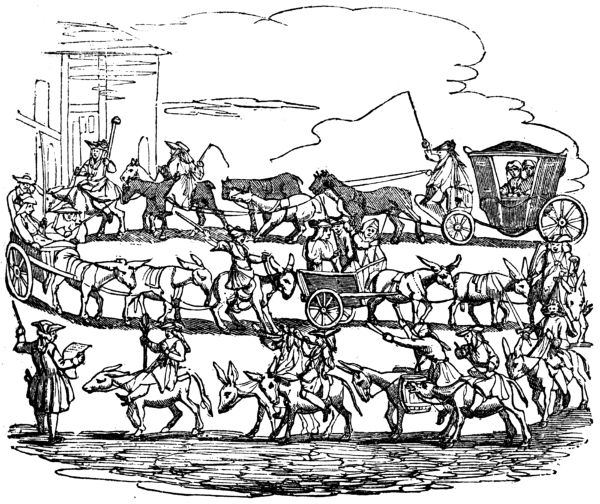
The Solemn and Stately Procession OF THE SCALD MISERABLE MASONS, As it was martiall’d, on Thursday, the 18th of this Instant, April.
The engraving is succeeded by a serio-comic Address, commencing thus:—
The Remonstrance of the Right Worshipful the Grand Master, &c. of the Scald Miserable Masons.
WHEREAS by our Manifesto some time past, dated from our Lodge in Brick-street, We did, in the most explicite manner, vindicate the ancient rights and privileges of this society, and by incontestable arguments evince our superior dignity and seniority to all other institutions, whether Grand-Volgi, Gregorians, Hurlothrumbians, Ubiquarians, Hiccubites, Lumber-Troopers, or Free-Masons; yet, nevertheless, a few persons under the last denomination, still arrogate to themselves the usurped titles of Most Ancient and Honourable, in open violations of truth and justice; still endeavour to impose their false mysteries (for a premium) on the credulous and unwary, under pretence of being part of our brotherhood; and still are determin’d with drums, trumpets, gilt chariots, and other unconstitutional finery, to cast a reflection on the primitive simplicity and decent economy of our ancient and annual peregrination: We therefore think proper, in justification of Ourselves, publicly to disclaim all relation or alliance whatsoever, with the said society of Free-Masons, as the same must manifestly tend to the sacrifice of our dignity, the impeachment of our understanding, and the disgrace of our solemn mysteries: And Further, to convince the public of the candour and openness of our proceedings, We here present them with a key to our procession; and that the rather, as it consists of many things emblematical, mystical, hieroglyphical, comical, satirical, political, &c.
AND WHEREAS many, persuaded by the purity of our constitution, the nice morality of our brethren, and peculiar decency of our rites and ceremonies, have lately forsook the gross errors and follies of the Free-Masonry, are now become true Scald Miserables: It cannot but afford a most pleasing satisfaction to all who have any regard to truth and decency, to see our procession increased with such a number of proselytes; and behold those whose vanity, but the last year, exalted them into a borrowed equipage, now condescend to become the humble cargo of a sand-cart.
[Then follows the following:]
A Key or Explanation of the Solemn and Stately Procession of the Scald Miserable Masons.
Two Tylers, or Guarders,
In yellow Cockades and Liveries, being the Colour ordained for the Sword Bearer of State. They, as youngest enter’d ’Prentices, are to guard the Lodge, with a drawn Sword, from all Cowens and Eves-droppers, that is Listeners, lest they should discover the incomprehensible Mysteries of Masonry.
A Grand Chorus of Instruments,
To wit. Four Sackbutts, or Cow’s Horns; six Hottentot Hautboys; four tinkling Cymbals, or Tea Canisters, with broken Glass in them; four Shovels and Brushes; two Double Bass Dripping-pans; a Tenor Frying-pan; a Salt-box in Delasol; and a Pair of Tubs.
Ragged enter’d ’Prentices,
Properly cloathed, giving the above Token, and the Word, which is Jachin.
The Funeral of Hyram,
Six stately unfledg’d Horses with Funeral Habilaments and Caparisons, carrying Escutcheons of the arms of Hyram Abiff, viz. a Master’s lodge, drawing, in a limping halting posture, with Solemn Pomp, a superb open hearse, nine Foot long, four Foot wide, and having a clouded Canopy, Inches and Feet innumerable in perpendicular Height, very nearly resembling a Brick Waggon: In the midst, upon a Throne of Tubs raised for that Purpose, lays the Corps in a Coffin cut out of one entire Ruby; but, for Decency’s sake, is covered with a Chimney-sweeper’s Stop-cloth, at the head of a memorable Sprig of Cassia.
Around in mournful Order placed, the loving, weeping, drunken Brethren sit with their Aprons, their Gloves they have put in their Pockets; at Top and at Bottom, on every side and every where, all round about, this open hearse is bestuck with Escutcheons and Streamers, some bearing the Arms, some his Crest, being the Sprig of Cassia, and some his Motto, viz. Macbenah.
Grand band of Musick as before.
Two Trophies
Of arms or achievements, properly quarter’d and emblazon’d, as allow’d by the college of arms, showing the family descents, with some particular marks of distinction, showing in what part of the administration that family has excelled. That on the right, the achievement of the right worshipful Poney, being Parte Perpale, Glim, and Leather-dresser, viz. the Utensils of a Link and Black-shoe-Boy: That on the left the trophy of his excellency, —— —— Jack, Grand-master elect, and Chimney-sweeper.
The Equipage
Of the Grand-master, being neatly nasty, delicately squaled, and magnificently ridiculous, beyond all human bounds and conceivings. On the right the Grand-master Poney, with the Compasses for his Jewel, appendant to a blue Riband round his neck: On the left his excellency —— —— Jack, with a Square hanging to a white Riband, as Grand-master elect: The Honourable Nic. Baboon, Esq.; senior grand Warden, with his Jewel, being the Level, all of solid gold, and blue Riband: Mr. Balaam van Assinman, Junior Warden, his Jewel the Plumb-Rule.
Attendants of Honour.
The Grand Sword Bearer, carrying the Sword of State. It is worth observing, This Sword was sent as a Present by Ishmael Abiff (a relation in direct Descent to poor old Hyram) King of the Saracens, to his grace of Wattin, Grand-Master of the Holy-Lodge of St. John of Jerusalem in Clerkenwell, who stands upon our list of Grand-masters for the very same year.
The Grand Secretary, with his Insignia, &c.
Probationists and Candidates close the whole Procession.
Tickets to be had, for three Megs a Carcass to scran their Pannum-Boxes, at the Lodge in Brick-Street, near Hide-Park Corner; at the Barley-Broth Womens at St. Paul’s Church-Yard, and the Hospital-Gate in Smithfield; at Nan Duck’s in Black-Boy-Alley, Chick-Lane; &c. &c. &c.
Note. No Gentlemen’s Coaches, or whole Garments, are admitted in our Procession, or at the Feast.
NATURALISTS’ CALENDAR.
Mean Temperature 47·22.
April 19.
Spring.
This open day may be devoted to the contemplation of appearances and products of the season, presented to us by ministering bards: the first to be ushered in, is an offering from a hand whence nothing can be proffered that will not be especially acceptable.
For the Every-Day Book
The Blackthorn.
The April air is shrewd and keen; No leaf has dared unfold, Yet thy white blossom’s radiant sheen, Spring’s banner, I behold. Though all beside be dead and drear, Undauntedly thy flowers appear. Thou com’st the herald of a host Of blooms which will not fail, When summer from some southern coast Shall call the nightingale. Yet early, fair, rejoicing tree, Sad are the thoughts inspired by thee. All other trees are wont to wear, First leaves, then flowers, and last, Their burden of rich fruit to bear When summer’s pride is past: But thou,—so prompt thy flowers to show, Bear’st but the harsh, unwelcome sloe. So oft young genius, at its birth, In confidence untried, Spreads its bright blossoms o’er the earth, And revels in its pride; But when we look its fruit to see, It stands a fair, but barren tree. So oft, in stern and barbarous lands, The bard is heard to sing, Ere the uncultured soul expands, In the poetic spring; Then, sad and bootless are his pains, And linked with woe his name remains. Therefore, thou tree whose early bough All blossomed meets the gale, Thou stirrest in my memory now Full many a tearful tale: And early, fair, rejoicing tree, Sad are the thoughts inspired by thee.
W. Howitt.
Passing the eye from the hedge-row to the earth, it lights on the “wee-tipp’d” emblem of “modesty” sung by poets of every clime wherein it blows:—
The Daisy.
There is a flower, a little flower, With silver crest and golden eye, That welcomes every changing hour, And weathers every sky. The prouder beauties of the field, In gay but quick succession shine; Race after race their honours yield, They flourish and decline. But this small flower, to nature dear, While moon and stars their courses run Wreaths the whole circle of the year, Companion of the sun. It smiles upon the lap of May, To sultry August spreads its charms, Lights pale October on his way, And twines December’s arms. The purple heath, the golden broom, On moory mountains catch the gale, O’er lawns the lily sheds perfume, The violet in the vale; But this bold floweret climbs the hill, Hides in the forests, haunts the glen, Plays on the margin of the rill, Peeps round the fox’s den. Within the garden’s cultured round, It shares the sweet carnation’s bed; And blooms on consecrated ground In honour of the dead. The lambkin crops its crimson gem, The wild bee murmurs on its breast, The blue fly bends its pensile stem, Lights o’er the skylark’s nest. ’Tis Flora’s page:—in every place In every season fresh and fair It opens with perennial grace, And blossoms every where. On waste and woodland, rock and plain, Its humble buds unheeded rise; The rose has but a summer reign, The daisy never dies.
Montgomery.
The flower aptly described by Mr. Montgomery as “companion of the sun,” is not forgotten by a contemporary “child of song,” from whom, until now, no illustration has graced these pages: the absence may be apologized for, by opening one of his views of nature immediately.
Day Break in the Country.
Awake! awake! the flowers unfold, And tremble bright in the sun, And the river shines a lake of gold,— For the young day has begun. The air is blythe, the sky is blue, And the lark, on lightsome wings, From bushes that sparkle rich with dew, To heaven her matin sings. Then awake, awake, while music’s note, Now bids thee sleep to shun, Light zephyrs of fragrance round thee float For the young day has begun. I’ve wandered o’er yon field of light, Where daisies wildly spring, And traced the spot where fays of night Flew round on elfin wing: And I’ve watch’d the sudden darting beam Make gold the field of grain, Until clouds obscur’d the passing gleam And all frown’d dark again. Then awake, awake, each warbling bird, Now hails the dawning sun, Labour’s enlivening song is heard,— For the young day has begun. Is there to contemplation given An hour like this one, When twilight’s starless mantle’s riven By the uprising sun? When feather’d warblers fleet awake, His breaking beams to see, And hill and grove, and bush and brake, Are fill’d with melody. Then awake, awake, all seem to chide Thy sleep, as round they run, The glories of heaven lie far and wide,— For the young day has begun.
R. Ryan.
Our elder poets are rife in description of the spring; but passing their abundant stores to “Rare Ben,” one extract more, and “the day is done.”
Whence is it———————— ——————Winter is so quite forced hence And lock’d up under ground, that ev’ry sense Hath several objects; trees have got their heads, The fields their coats; that now the shining meads Do boast the paunse, lily, and the rose; And every flower doth laugh as zephyr blows? The seas are now more even than the land; The rivers run as smoothed by his hand; Only their heads are crisped by his stroke. How plays the yearling, with his brow scarce broke, Now in the open grass; and frisking lambs Make wanton ’saults about their dry suck’d dams? Who, to repair their bags, do rob the fields? How is’t each bough a several musick yields? The lusty throstle, early nightingale, Accord in tune, tho’ vary in their tale; The chirping swallow, call’d forth by the sun, And crested lark doth his division run: The yellow bees the air with murmur fill, The finches carol, and the turtles bill.
Jonson.
NATURALISTS’ CALENDAR.
Mean Temperature 48·52.
April 20.
Duchess of Exeter’s Will.
To the Editor of the Every-Day Book.
Sir,—A notice of St. Katherine’s church, near the tower, having already appeared in your first volume, induces me to subjoin, from “Testamenta Vetusta,” by Nicholas Harris Nicolas, Esq.,[126] the will of the duchess of Exeter, who was buried at the east end of the church now no longer existing.
I am, Sir, &c. I. E——tt.
“Ann Holland, Dutchess of Exeter, April 20, 1457. My Body to be buried in the Chapel of the Chancel of the Church of St. Katharine’s, beside the Tower of London, where the Corpse of my Lord and husband is buried, and I forbid my executors to make any great feast, or to have a solemn hearse, or any costly lights, or largess of liveries, according to the glory or vain pomp of the world, at my funeral, but only to the worship of God, after the discretion of Mr. John Pynchebeke, Doctor in Divinity, one of my Executors. To the Master of St. Katharines, if he be present at the dirige and mass on my burial day, vis. viiid.; to every brother of that College being then present, iiis. ivd.; to every priest of the same College then present, xxd.; to every Clerk then present, xiid.; to every Chorister, vid.; to every Sister then present, xxd.; to every bedeman of the said place, viiid.; I will that my executors find an honest priest to say mass and pray for my soul, my lords soul, and all Christian souls, in the Chapel where my Body be buried, for the space of seven years next after my decease; and that for so doing he receive every year xii marks, and daily to say Placebo, Dirige, and Mass, when so disposed.” The duchess’s will was proved on the 15th of May, 1458.
NATURALISTS’ CALENDAR.
Mean Temperature 49·10.
April 21.
A Spring Diversion Of the Recorder of London.
Leaving “hill and valley, dale and field,” we turn for “a passing time” to scenes where, according to the authority subjoined by a worthy correspondent, we find “disorder—order.”
Ancient Pickpockets.
To the Editor of the Every-Day Book.
April 15, 1826.
Sir,—The following notice of an ancient school for learning how to pick pockets is, I conceive, worthy notice in the Every-Day Book.
I am, Sir, &c. T. A.
Kennington.
In the spring of 1585, Fleetwood, the recorder of London, with some of his brother magistrates, spent a day searching about after sundry persons who were receivers of felons. A considerable number were found in London, Westminster, Southwark, and the suburbs, with the names of forty-five “masterless men and cutpurses,” whose practice was to rob gentlemen’s chambers and artificers’ shops in and about London. They also discovered seven houses of entertainment for such in London; six in Westminster, three in the suburbs, and two in Southwark. Among the rest they found out one Watton, a gentleman born, and formerly a merchant of respectability but fallen into decay. This person kept an alehouse at Smart’s quay, near Billingsgate; but for some disorderly conduct it was put down. On this he began a new business, and opened his house for the reception of all the cutpurses in and about the city. In this house was a room to learn young boys to cut purses. Two devices were hung up; one was a pocket, and another was a purse. The pocket had in it certain counters, and was hung round with hawks’ bells, and over them hung a little sacring bell.[127] The purse had silver in it; and he that could take out a counter without any noise, was allowed to be a public foyster;[128] and he that could take a piece of silver out of the purse without noise of any of the bells, was adjudged a clever nypper.[129] These places gave great encouragement to evil doers in these times, but were soon after suppressed.[130]
NATURALISTS’ CALENDAR.
Mean Temperature 48·77.
April 22.
A Jew is a Thief!
“So runs the proverb; so believes the world.”
At least so say a great many who call themselves Christians, and who are willing to believe all evil of the Jews, who, in compliment to their own questionable goodness, they “religiously” hate, with all the soul of “irreligion.” The following account of an individual of the Jewish persuasion, well known to many observers of London characters, may disturb their position: it is communicated by a gentleman who gives his name to the editor with the article.
The Jew near Jewin-street.
For the Every-Day Book.
They who are in the habit of observing the remarkable beings that perambulate the streets of this metropolis, either for profit or pleasure, must have observed “J. Levy,” not, to use a common phrase, “an every-day character,” but one who, for singularity of personal appearance, oddity of dress, simplicity of manner, and constant industry, deserves a place in your Every-Day Book.
For the last eighty years has Levy trudged the streets of “London and its environs,”—followed, latterly, by a dirty lame Jew boy, carrying a huge mahogany closed-up box, containing watches manufactured by makers of all degrees, from Tomkin to Levy of Liverpool—with jewellery of the most costly kind, to trinkets of Birmingham manufacture; and, strange to say, though his dealings have been extensive to a degree beyond imagination, he has hitherto given universal satisfaction.