JUNE.
Reading edition
The shepherds, now, from every walk and steep, Where grateful feed attracts the dainty sheep, Collect their flocks, and plunge them in the streams And cleanse their fleeces in the noontide beams. This care perform’d, arrives another care To catch them, one by one, their wool to shear: Then come the tying, clipping, tarring, bleating; The shearers’ final shout, and dance, and eating. From hence the old engravers sometimes made This lovely month a shearer, at his trade: And hence, the symbol to the season true, A living hand so traces June to you.
The “Mirror of the Months,” the pleasantest of “the year-books,” except “The Months” of Mr. Leigh Hunt, tells us that with June,—“Summer is come—come, but not to stay; at least, not at the commencement of this month: and how should it, unless we expect that the seasons will be kind enough to conform to the devices of man, and suffer themselves to be called by what name and at what period he pleases? He must die and leave them a legacy (instead of they him) before there will be any show of justice in this. Till then the beginning of June will continue to be the latter end of May, by rights; as it was according to the old style. And, among a thousand changes, in what one has the old style been improved upon by the new? Assuredly not in that of substituting the utile for the dulce, in any eyes but those of almanac-makers. Let all lovers of spring, therefore, be fully persuaded that, for the first fortnight in June, they are living in May. We are to bear in mind that all shall thus be gaining instead of losing, by the impertinence of any breath, but that of heaven, attempting to force spring into summer, even in name alone.”
It seems fitting thus to introduce the following passages, and invite the reader to proceed with the author, and take a bird’s eye view of the season.
Spring may now be considered as employed in completing her toilet, and, for the first weeks of this month, putting on those last finishing touches which an accomplished beauty never trusts to any hand but her own. In the woods and groves also, she is still clothing some of her noblest and proudest attendants with their new annual attire. The oak until now has been nearly bare; and, of whatever age, has been looking old all the winter and spring, on account of its crumpled branches and wrinkled rind. Now, of whatever age, it looks young, in virtue of its new green, lighter than all the rest of the grove. Now, also, the stately walnut (standing singly or in pairs in the fore-court of ancient manor-houses, or in the home corner of the pretty park-like paddock at the back of some modern Italian villa, whose white dome it saw rise beneath it the other day, and mistakes for a mushroom,) puts forth its smooth leaves slowly, as “sage grave men” do their thoughts; and which over-caution reconciles one to the beating it receives in the autumn, as the best means of at once compassing its present fruit, and making it bear more; as its said prototypes in animated nature are obliged to have their brains cudgelled, before any good can be got from them.
These appearances appertain exclusively to the spring. Let us now (however reluctantly) take a final leave of that lovely and love-making season, and at once step forward into the glowing presence of summer—contenting ourselves, however, to touch the hem of her rich garments, and not attempting to look into her heart, till she lays that open to us herself next month: for whatever schoolboys calendar-makers may say to the contrary, Midsummer never happens in England till July.
To saunter, at mid June, beneath the shade of some old forest, situated in the neighbourhood of a great town, so that paths are worn through it, and you can make your way with ease in any direction, gives one the idea of being transferred, by some strange magic, from the surface of the earth to the bottom of the sea! (I say it gives one this idea; for I cannot answer for more, in matters of so arbitrary a nature as the association of ideas.) Over head, and round about, you hear the sighing, the whispering, or the roaring (as the wind pleases) of a thousand billows; and looking upwards, you see the light of heaven transmitted faintly, as if through a mass of green waters. Hither and thither, as you move along, strange forms flit swiftly about you, which may, for any thing you can see or hear to the contrary, be exclusive natives of the new world in which your fancy chooses to find itself: they may be fishes, if that pleases; for they are as mute as such, and glide through the liquid element as swiftly. Now and then, indeed, one of larger growth, and less lubricated movements, lumbers up from beside your path, and cluttering noisily away to a little distance, may chance to scare for a moment your submarine reverie. Your palate too may perhaps here step in, and try to persuade you that the cause of interruption was not a fish but a pheasant. But in fact, if your fancy is one of those which are disposed to “listen to reason,” it will not be able to lead you into spots of the above kind without your gun in your hand,—one report of which will put all fancies to flight in a moment, as well as every thing else that has wings. To return, therefore, to our walk,—what do all these strange objects look like, that stand silently about us in the dim twilight, some spiring straight up, and tapering as they ascend, till they lose themselves in the green waters above—some shattered and splintered, leaning against each other for support, or lying heavily on the floor on which we walk—some half buried in that floor, as if they had lain dead there for ages, and become incorporate with it? what do all these seem, but wrecks and fragments of some mighty vessel, that has sunk down here from above, and lain weltering and wasting away, till these are all that is left of it! Even the floor itself on which we stand, and the vegetation it puts forth, are unlike those of any other portion of the earth’s surface, and may well recall, by their strange appearance in the half light, the fancies that have come upon us when we have read or dreamt of those gifted beings, who, like Ladurlad in Kehama, could walk on the floor of the sea, without waiting, as the visiters at watering-places are obliged to do, for the tide to go out.
Stepping forth into the open fields, what a bright pageant of summer beauty is spread out before us!—Everywhere about our feet flocks of wild-flowers
“Do paint the meadow with delight.”
We must not stay to pluck and particularize them; for most of them have already had their greeting—let us pass along beside this flourishing hedge-row. The first novelty of the season that greets us here is perhaps the sweetest, the freshest, and fairest of all, and the only one that could supply an adequate substitute for the hawthorn bloom which it has superseded. Need the eglantine be named? the “sweet-leaved eglantine;” the “rain-scented eglantine;” eglantine—to which the sun himself pays homage, by “counting his dewy rosary” on it every morning; eglantine—which Chaucer, and even Shakspeare—but hold—whatsoever the poets themselves may insinuate to the contrary, to read poetry in the presence of nature is a kind of impiety: it is like reading the commentators on Shakspeare, and skipping the text; for you cannot attend to both: to say nothing of nature’s book being a vade mecum that can make “every man his own poet” for the time being; and there is, after all, no poetry like that which we create for ourselves.
Begging pardon of the eglantine for having permitted any thing—even her own likeness in the poet’s looking-glass—to turn our attention from her real self,—look with what infinite grace she scatters her sweet coronals here and there among her bending branches; or hangs them, half-concealed, among the heavy blossoms of the woodbine that lifts itself so boldly above her, after having first clung to her for support; or permits them to peep out here and there close to the ground, and almost hidden by the rank weeds below; or holds out a whole archway of them, swaying backward and forward in the breeze, as if praying of the passer’s hand to pluck them. Let who will praise the hawthorn—now it is no more! The wild rose is the queen of forest flowers, if it be only because she is as unlike a queen as the absence of every thing courtly can make her.
The woodbine deserves to be held next in favour during this month; though more on account of its intellectual than its personal beauty. All the air is faint with its rich sweetness; and the delicate breath of its lovely rival is lost in the luscious odours which it exhales.
These are the only scented wild flowers that we shall now meet with in any profusion; for though the violet may still be found by looking for, its breath has lost much of its spring power. But, if we are content with mere beauty, this month is perhaps more profuse of it than any other, even in that department of nature which we are now examining—namely, the fields and woods.
The woods and groves, and the single forest trees that rise here and there from out the bounding hedge-rows, are now in full foliage; all, however, presenting a somewhat sombre, because monotonous, hue, wanting all the tender newness of the spring, and all the rich variety of the autumn. And this is the more observable, because the numerous plots of cultivated land, divided from each other by the hedge-rows, and looking, at this distance, like beds in a garden divided by box, are nearly all still invested with the same green mantle; for the wheat, the oats, the barley, and even the early rye, though now in full flower, have not yet become tinged with their harvest hues. They are all alike green; and the only change that can be seen in their appearance is that caused by the different lights into which each is thrown, as the wind passes over them. The patches of purple or of white clover that intervene here and there, and are now in flower, offer striking exceptions to the above, and at the same time load the air with their sweetness. Nothing ran be more rich and beautiful in its effect on a distant prospect at this season, than a great patch of purple clover lying apparently motionless on a sunny upland, encompassed by a whole sea of green corn, waving and shifting about it at every breath that blows.
The hitherto full concert of the singing birds is now beginning to falter, and fall short. We shall do well to make the most of it now; for in two or three weeks it will almost entirely cease till the autumn. I mean that it will cease as a full concert; for we shall have single songsters all through the summer at intervals; and those some of the sweetest and best. The best of all, indeed, the nightingale, we have now lost. So that the youths and maidens who now go in pairs to the wood-side, on warm nights, to listen for its song, (hoping they may not hear it,) are well content to hear each other’s voice instead.
We have still, however, some of the finest of the second class of songsters left; for the nightingale, like Catalani, is a class by itself. The mere chorus-singers of the grove are also beginning to be silent; so that the jubilate that has been chanting for the last month is now over. But the Stephenses, the Trees, the Patons, and the Poveys, are still with us, under the forms of the woodlark, the skylark, the blackcap, and the goldfinch. And the first-named of these, now that it no longer fears the rivalry of the unrivalled, not seldom, on warm nights, sings at intervals all night long, poised at one spot high up in the soft moonlit air.
We have still another pleasant little singer, the field cricket, whose clear shrill voice the warm weather has now matured to its full strength, and who must not be forgotten, though he has but one song to offer us all his life long, and that one consisting but of one note; for it is a note of joy, and will not be heard without engendering its like. You may hear him in wayside banks, where the sun falls hot, shrilling out his loud cry into the still air all day long, as he sits at the mouth of his cell; and if you chance to be passing by the same spot at midnight, you may hear it then too.[193]
Yet by him who holds this “Mirror,” we must not be “charmed” from our repose, but take the advice of a poet, the contemporary and friend of Cowper.
Let us not borrow from the hours of rest, For we must steal from morning to repay. And who would lose the animated smile Of dawning day, for the austere frown of night? I grant her well accoutred in her suit Of dripping sable, powder’d thick with stars, And much applaud her as she passes by With a replenish’d horn on either brow! But more I love to see awaking day Rise with a fluster’d cheek; a careful maid, Who fears she has outslept the custom’d hour, And leaves her chamber blushing. Hence to rest; I will not prattle longer to detain you Under the dewy canopy of night.
Hurdis.
June 1.
Ovid assigns the first of June to “Carna,” the goddess of the hinge; who also presided over the vital parts of man, especially the liver and the heart. Massey, commenting on his taste, cannot divine the connection between such a power and the patronage of hinges. “False notions,” he says, “in every mode of religion, lead men naturally into confusion.”
Carna, the goddess of the hinge, demands The first of June; upon her power depends To open what is shut, what’s shut unbar; And whence this power she has, my muse declare For length of time has made the thing obscure, Fame only tells us that she has that power. Helernus’ grove near to the Tiber lies, Where still the priests repair to sacrifice; From hence a nymph, whose name was Granè, sprung, Whom many, unsuccessful, courted long; To range the spacious fields, and kill the deer, With darts and mangling spears, was all her care; She had no quiver, yet so bright she seemed, She was by many Phœbus’ sister deemed.
Ovid.
The poet then relates that Janos made this Granè (or Carna) goddess of the hinge;
And then a white thorn stick he to her gave, By which she ever after power should have, To drive by night all om’nous birds away, That scream, and o’er our houses hov’ring stray.
NATURALISTS’ CALENDAR.
Mean Temperature 57·05.
June 2.
A Rogue in Grain, June 2, 1759.
To the Editor of the Every-Day Book.
Newark, Notts, May 17, 1826.
Sir,—It appears to me that there have been in “old times,” which we suppose “good times,” rogues in grain. To prove it, I herewith transmit the copy of an advertisement, from the “Cambridge Journal” of 1759. Wishing you an increasing sale to your interesting Every-Day Book, I remain, &c.
Benjamin Johnson.
Advertisement.
WHEREAS I William Margarets the younger, was, at the last Assizes for the County of Cambridge, convicted upon an indictment, for an attempt to raise the price of Corn in Ely-market, upon the 24th day of September, 1757, by offering the sum of Six Shillings a Bushel for Wheat, for which no more than Five Shillings and Ninepence was demanded; And whereas, on the earnest solicitation and request of myself and friends, the prosecutor has been prevailed upon to forbear any further prosecution against me, on my submitting to make the following satisfaction, viz. upon my paying the sum of £50 to the poor inhabitants of the town of Ely; and the further sum of £50 to the poor inhabitants of the town of Cambridge, to be distributed by the Minister and Church-wardens of the several parishes in the said town; and the full costs of the prosecution; and upon my reading this acknowledgment of my offence publicly, and with a loud voice, in the presence of a Magistrate, Constable, or other peace officer of the said town of Ely, at the Market-place there, between the hours of twelve and one o’clock, on a public market-day, and likewise subscribing and publishing the same in three of the Evening Papers, printed at London, and in the Cambridge Journal, on four different days; and I have accordingly paid the two sums of £50, and Costs; and do hereby confess myself to have been guilty of the said offence, and testify my sincere and hearty sorrow in having committed a crime, which, in its consequences, tended so much to increase the distress of the poor, in the late calamitous scarcity: And I do hereby most humbly acknowledge the lenity of the prosecutor, and beg pardon of the public in general, and of the town of Ely in particular. This paper was read by me at the public Market-place at Ely, in the presence of Thomas Aungier, Gentleman, chief constable, on the 2d Day of June, 1759, being a public Market-day there; and is now, as a further proof of the just sense I have of the heinousness of my crime, subscribed and published by me
William Margarets.
Witness, James Day, Under Sheriff of Cambridgeshire.
Longevity.
On the 2d of June, 1734, John Rousey, of the isle of Distrey, in Scotland, died at one hundred and thirty-eight years of age. The son who inherited his estate, was born to him while in his hundredth year.[194] A similar instance of fatherhood, at this advanced period of life, is recorded of the “old, old, very old man, Thomas Parr.”
NATURALISTS’ CALENDAR.
Mean Temperature 57·85.
June 3.
Chronology.
On this day, in the year 1789, died Paul Egede, a Danish missionary, who, with his father Hans, visited Greenland, for the conversion of the natives to christianity, in 1721. Hans was the author of a celebrated work, published in 1729, on the topography and natural history of that country. Paul conducted a new edition of his father’s book, and published a journal of his own residence in Greenland, from 1721 to 1788. He died at the age of eighty-one.[195]
Curious Inscription, Discovered by a Traveller.
Captain Bart, grandson of the renowned Jean Bart, during his stay at Malta, where he had put in from a cruise in the Mediterranean, met with a Carmelite, who had been into Persia as a missionary. This person told him he had availed himself of an opportunity which offered to gratify his curiosity, by visiting the ruins of the ancient and celebrated Persepolis. Chance discovered to him a marble, on which were inscribed some Arabic characters. As he was acquainted with this language, he translated the inscription into Latin. The following is the translation:
dicas scis dicit scit audit expedit
facias potes facit potest facit credit
credas audis credit audit credit fieri potest
expendas habes expendit habet petit habet
judices vides judicat videt judicat est
non quod cumque nam qui quod cumque sæpe quod non
The key is to be obtained thus; the first word of the last line must be taken and joined to the first word of the first line; then the second word of the last line to the second word of the first line, and so on to the end. Afterwards, we must begin again by taking the first word of the next line, and the following moral precepts will be the result:
1. Non dicas quodcumque scis, nam qui dicit quodcumque scit sæpe audit quod non expedit.
Do not tell whatever thou knowest, for he who tells whatever he knows, often hears more than is agreeable.
2. Non facias quodcumque potes, nam qui facit, quodcumque potest sæpe facit quod non credit.
Do not do whatever thou canst, for he who does whatever he can, often does more than he imagines.
3. Non credas quodcumque audis, nam qui credit quodcumque audit sæpe quod non fieri potest.
Do not believe whatever thou hearest, for he who believes whatever he hears, will often believe what is impossible.
4. Non expendas quodcumque habes, nam qui expendit quodcumque habet sæpe petit quod non habet.
Do not spend whatever thou hast, for he who spends whatever he has, will often be compelled to ask for what he has not.
5. Non judices quodcumque vides, nam qui judicat quodcumque videt sæpe judicat quod non est.
Do not judge on whatever thou seest, for he who judges on whatever he sees, will often form an erroneous judgment.[196]
June 3, 1611. “The Lady Arabella” escaped from her confinement.
To the Editor of the Every-Day Book.
Kennington, May 23, 1826.
Sir,—Annexed is an original unprinted letter, from the lady Arabella Seymour, whose misfortunes were of a peculiar kind, and from peculiar causes; those causes are to be traced to that tyrannic dread that weak sovereigns always have of any persons approaching their equals, either in mind, or by family ties. The following notices have been gleaned from the most authentic sources, viz. Lodge’s “Illustrations of British History,” “The Biographia Britannica,” &c. The letter is in the Cotton collection of Manuscripts, in the British Museum, Vespasian. F.III.

Though you be almost a stranger to me but onely by sight, yet the good opinion I generally heave to be held of your worth, together wt the great interest you have in my Lo. of Northamptons favour, makes me thus farre presume of your willingnesse to do a poore afflicted gentlewoman that good office (if in no other respect yet because I am a Christian) as to further me wt your best indeuors to his Lo. that it will please him to helpe me out of this great distresse and misery, and regaine me his Mats. fauor which is my chiefest desire. Whearin his Lo. may do a deede acceptable to God and honorable to himselfe, and I shall be infinitely bound to his Lo. and beholden to you, who now till I receiue some comfort from his Maty. rest
the most sorrowfull creatore liuing

Arabella Stuart, whose name is hardly mentioned in history, except with regard to sir Walter Raleigh’s ridiculous conspiracy, whereby she was to have been placed on a throne, to which she had neither inclination nor pretensions, and by means unknown to herself, was the only child of Charles Stuart, fifth earl of Lennox, (uncle to king James I., and great grandson of king Henry VII.,) by Elizabeth, daughter of sir William Cavendish of Hardwick. She was born about the year 1578, and brought up in privacy, under the care of her grandmother, the old countess of Lennox, who, for many years, resided in England. Her double relation to royalty was obnoxious to the jealousy of queen Elizabeth, and the timidity of king James I., who equally dreaded her having legitimate issue, and restrained her from allying herself in a suitable manner. Elizabeth prevented her from marrying Esme Stuart, her kinsman, and heir to the titles and estates of her family, and afterwards imprisoned her for listening to some overtures from the son of the earl of Northumberland. James, by obliging her to reject many splendid offers of marriage, unwarily encouraged the hopes of inferior pretenders, among whom, says Mr. Lodge, was the fantastical William Fowler, secretary to Anne of Denmark. Thus circumscribed, she renewed a connection with William Seymour, grandson to the earl of Hertford, which, being discovered in 1609, both parties were summoned to appear before the privy council, where they received a severe reprimand. This mode of proceeding produced the very consequence which the king meant to avoid; for the lady, sensible that her reputation had been wounded by the inquiry, was in a manner forced into a marriage, which becoming publicly known, she was committed to close custody, in the house of sir Thomas Parry, chancellor of the duchy of Lancaster, at Vauxhall, and her husband, Mr. Seymour, sent to the Tower. In this state of separation, however, they concerted means for an escape, which both effected on the same day, June 3, 1611. Seymour got safely to Flanders; but his poor wife was retaken in Calais roads, and brought back to the former prison of her husband, the Tower, where the sense of these undeserved oppressions operating severely on her high spirit, she became a lunatic, and languished in that wretched state, augmented by the horrors of a prison, till her death, which occurred on the 27th of September, 1615. Thus ends the eventful story of poor Arabella, a woman, (if we may credit her portrait, prefixed to Lodge’s third volume of “Illustrations of British History,”) of commanding and elegant appearance, and undoubtedly of a firm and vigorous mind; and it is well observed by that author, that “had the life of Arabella Stuart been marked by the same criminal extravagancies, as well as distinguished by similar misfortunes and persecutions, her character would have stood at least as forward on the page of history as that of her royal aunt, Mary of Scotland.” The above letter was, probably, written from the Tower, though, I am sorry to say, there is neither direction nor superscription, and, therefore, to whom can be only matter of surmise.
I am, Sir, &c. A.
The Loves of “The Lady Arabella.”
From an article in the “Curiosities of Literature,” illustrations may be derived to the article of our correspondent A. “The whole life of this lady seems to consist of secret history, which, probably, we cannot now recover:—her name scarcely ever occurs without raising that sort of interest which accompanies mysterious events.” She is reputed to have been learned, and of a poetical genius; yet of her poetry there are no specimens, and her erudition rests on Evelyn’s bare mention of her name in his list of learned women.
On the death of queen Elizabeth, the pope conceived the notion of restoring the papacy in England, by uniting the lady Arabella to an Italian cardinal, of illegitimate descent from our Edward IV. His holiness presumed if he qualified the cardinal for marriage, by depriving him from the priesthood, the junction of Arabella’s relationship to Henry VII., with the churchman’s “natural” pretensions, might secure the crown! Her attachment to the catholic religion is doubtful. Perhaps her disposition was rightly estimated by father Parsons: he imagined “her religion to be as tender, green, and flexible, as is her age and sex; and to be wrought hereafter, and settled according to future events and times.” The pope’s plot failed. Winwood says, “the lady Arabella hath not been found inclinable to popery.” He wrote after the “future events,” contemplated by Parsons, had “wrought.”
Another project for making the lady Arabella queen was after the enthronement of James. The conspirators requested her by letter to address herself to the king of Spain; she laughed at the letter and sent it to James, who, as regarded her, did not think of it more seriously, and so failed a second plot, wherein the name of the illustrious Raleigh was implicated.
In the year 1604, there appears to have been a third design to make her queen, though not of this country. The earl of Pembroke writes to the earl of Shrewsbury—“A great ambassador is coming from the king of Poland, whose chief errand is to demand my lady Arabella in marriage for his master. So may your princess of the blood grow a great queen.” If this was the object of the embassy, nothing came of it.
Before the death of queen Elizabeth, the marriage of the lady Arabella with her kinsman lord Esme Stuart, whom he had created duke of Lennox, and designed for his heir, was proposed by James himself, but Elizabeth “forbad the bans” by imprisoning the proposed bride, who was suspected to have favoured a son of the earl of Northumberland, against whom Elizabeth again interposed. She had other offers. “To the lady Arabella, crowns and husbands were like a fairy banquet seen at moonlight, opening on her sight, impalpable and vanishing at the moment of approach.”
The distresses of this unhappy creature were heightened by her dependence on the crown. She was the cousin of James, and it was his narrow policy to constrain her from a match suitable to her rank, or perhaps to keep her single for life. Her supplies were unequal: at one time she had a grant of the duty on oats; at length he assigned her a pension of 1600l.: but whenever he suspected a natural desire in her heart she was out of favour. No woman was ever more solicited to the conjugal state, or seems to have been so little averse to it. “Every noble youth who sighed for distinction, ambitioned the notice of the lady Arabella.”
Her renewal of an early attachment to Mr. William Seymour, second son of lord Beauchamp, and grandson of the earl of Hertford, forms a story which “for its misery, its pathos, and its terror, even romantic fiction has not executed.” It was detected, and the lady Arabella and Seymour were summoned before the privy council, where Seymour was “censured for seeking to ally himself with the royal blood, although that blood was running in his own veins.” In his answer, “he conceived that this noble lady might, without offence, make the choice of any subject within this kingdom.” He says, “I boldly intruded myself into her ladyship’s chamber, in the court, on Candlemass day last, at what time I imparted my desire unto her, which was entertained; but with this caution on either part, that both of us resolved not to proceed to any final conclusion without his majesty’s most gracious favour first obtained: and this was our first meeting.” The lovers gravely promised to suppress their affections, with what sincerity is not known, for they married secretly; and in July the lady Arabella was arrested, and confined at the house of sir Thomas Parry, at Lambeth, and Seymour committed to the Tower, “for contempt in marrying a lady of the royal family without the king’s leave.”
Arabella wrote a letter to the king, which was “often read without offence, nay, it was even commended by his highness, with the applause of prince and council.” She adverted to her wrongs, and required justice with a noble fortitude, though in respectful terms. She says, “I do most heartily lament my hard fortune, that I should offend your majesty the least, especially in that whereby I have long desired to merit of your majesty, as appeared before your majesty was my sovereign: and though your majesty’s neglect of me, my good liking to this gentleman that is my husband, and my fortune, drew me to a contract before I acquainted your majesty, I humbly beseech your majesty to consider how impossible it was for me to imagine it could be offensive to your majesty, having few days before given me your royal consent to bestow myself on any subject of your majesty’s (which likewise your majesty had done long since). Besides, never having been either prohibited any, or spoken to for any, in this land, by your majesty these seven years that I have lived in your majesty’s house, I could not conceive that your majesty regarded my marriage at all; whereas if your majesty had vouchsafed to tell me your mind, and accept the free-will offering of my obedience, I would not have offended your majesty, of whose gracious goodness I presume so much, that if it were now as convenient in a worldly respect, as malice may make it seem, to separate us, whom God hath joined, your majesty would not do evil that good might come thereof, nor make me, that have the honour to be so near your majesty in blood, the first precedent that ever was, though our princes may have left some as little imitable, for so good and gracious a king as your majesty, as David’s dealing with Uriah.”
She moved the queen, through lady Jane Drummond, to interest James in her favour. A letter from lady Jane communicates his majesty’s coarse and conceited reply, and she concludes by frankly telling the captive wife, “the wisdom of this state, with the example how some of your quality in the like case has been used, makes me fear that ye shall not find so easy end to your troubles as ye expect or I wish.”
To lady Drummond’s prophetic intimation, Arabella answers by sending the queen a pair of gloves “in remembrance of the poor prisoner that wrought them, in hopes her royal hands will vouchsafe to wear them:” and she adds, that her case “could be compared to no other she ever heard of, resembling no other.” She contrived to correspond with Seymour, but their letters were discovered, and the king resolved to change her place of confinement.
James appointed the bishop of Durham to be his jailor on the occasion. “Lady Arabella was so subdued at this distant separation, that she gave way to all the wildness of despair; she fell suddenly ill, and could not travel but in a litter, and with a physician. In her way to Durham, she was so greatly disquieted in the first few miles of her uneasy and troublesome journey, that they would proceed no further than to Highgate. The physician returned to town to report her state, and declared that she was assuredly very weak, her pulse dull and melancholy, and very irregular; her countenance very heavy, pale, and wan; and though free from fever, he declared her in no case fit for travel. The king observed, ‘It is enough to make any sound man sick to be carried in a bed in that manner she is; much more for her whose impatient and unquiet spirit heapeth upon herself far greater indisposition of body than otherwise she would have.’ His resolution however was, that ‘she should proceed to Durham, if he were king!’ ‘We answered,’ replied the doctor, ‘that we made no doubt of her obedience.’—‘Obedience is that required,’ replied the king, ‘which being performed, I will do more for her than she expected.’” Yet he consented to her remaining a month at Highgate. As the day of her departure approached, she appeared resigned. “But Arabella had not, within, that tranquillity with which she had lulled her keepers. She and Seymour had concerted a flight, as bold in its plot, and as beautifully wild, as any recorded in romantic story. The day preceding her departure, Arabella found it not difficult to persuade a female attendant to consent that she would suffer her to pay a last visit to her husband, and to wait for her return at an appointed hour. More solicitous for the happiness of lovers than for the repose of kings, this attendant, in utter simplicity, or with generous sympathy, assisted the lady Arabella in dressing her in one of the most elaborate disguisings. ‘She drew a pair of large French-fashioned hose or trowsers over her petticoats; put on a man’s doublet or coat; a peruke, such as men wore, whose long locks covered her own ringlets; a black hat, a black cloak, russet boots with red tops, and a rapier by her side,’ Thus accoutred, the lady Arabella stole out with a gentleman about three o’clock in the afternoon. She had only proceeded a mile and a half, when they stopped at a poor inn, where one of her confederates was waiting with horses, yet she was so sick and faint, that the ostler, who held her stirrup, observed, that ‘the gentleman could hardly hold out to London.’ She recruited her spirits by riding; the blood mantled in her face, and at six o’clock our sick lover reached Blackwall, where a boat and servants were waiting. The watermen were at first ordered to Woolwich; there they were desired to push on to Gravesend, then to Tilbury, where, complaining of fatigue, they landed to refresh; but, tempted by their freight, they reached Lee. At the break of morn they discovered a French vessel riding there to receive the lady; but as Seymour had not yet arrived, Arabella was desirous to lie at anchor for her lord, conscious that he would not fail to his appointment. If he indeed had been prevented in his escape, she herself cared not to preserve the freedom she now possessed; but her attendants, aware of the danger of being overtaken by a king’s ship, overruled her wishes, and hoisted sail, which occasioned so fatal a termination to this romantic adventure. Seymour indeed had escaped from the Tower; he had left his servant watching at his door to warn all visiters not to disturb his master, who lay ill with a raging toothache, while Seymour in disguise stole away alone, following a cart which had just brought wood to his apartment. He passed the warders; he reached the wharf, and found his confidential man waiting with a boat, and he arrived at Lee. The time pressed; the waves were rising; Arabella was not there; but in the distance he descried a vessel. Hiring a fisherman to take him on board, to his grief, on hailing it, he discovered that it was not the French vessel charged with his Arabella; in despair and confusion he found another ship from Newcastle, which for a good sum altered its course, and landed him in Flanders.”
On the lady Arabella’s escape, “couriers were despatched swifter than the winds wafted the unhappy Arabella, and all was hurry in the seaports. They sent to the Tower to warn the lieutenant to be doubly vigilant over Seymour, who, to his surprise, discovered that his prisoner had ceased to be so for several hours. James at first was for issuing a proclamation in a style so angry and vindictive, that it required the moderation of Cecil to preserve the dignity while he concealed the terror of his majesty. By the admiral’s detail of his impetuous movements, he seemed in pursuit of an enemy’s fleet; for the courier is urged, and the postmasters are roused by a superscription, which warned them of the eventful despatch, ‘Haste, haste, post haste! Haste for your life, your life!’ To these words, in a letter from the earl of Essex to the lord high admiral at Plymouth, were added the expressive symbol of a gallows prepared with a halter, thus .” There is no doubt, as is well expressed, that “the union and flight of these two doves, from their cotes, shook with consternation the grey owls of the cabinet:” even “prince Henry partook of this cabinet panic.”

Meanwhile “we have left the lady Arabella alone and mournful on the seas, not praying for favourable gales to convey her away, but still imploring her attendants to linger for her Seymour; still straining her sight to the point of the horizon for some speck which might give a hope of the approach of the boat freighted with all her love. Alas! never more was Arabella to cast a single look on her lover and her husband! She was overtaken by a pink in the king’s service, in Calais roads; and now she declared that she cared not to be brought back again to her imprisonment should Seymour escape, whose safety was dearest to her!”
Where London’s Tow’re its turrets show So stately by the Thames’s side, Fair Arabella, child of woe! For many a day had sat and sighed. And as shee heard the waves arise, And as shee heard the bleake windes roare, As fast did heave her heartfelte sighes, And still so fast her teares did poure![197]
During a confinement of four years the lady Arabella “sunk beneath the hopelessness of her situation, and a secret resolution in her mind to refuse the aid of her physicians, and to wear away the faster, if she could, the feeble remains of life.” The particulars of her “dreadful imprisonment” are unknown, but her letters show her affliction, and that she often thought on suicide, and as often was prevented by religious fortitude. “I could not,” she says, “be so unchristian as to be the cause of my own death.”
She affectingly paints her situation in one of her addresses to James. “In all humility, the most wretched and unfortunate creature that ever lived, prostrates itselfe at the feet of the most merciful king that ever was, desiring nothing but mercy and favour, not being more afflicted for any thing than for the losse of that which hath binne this long time the onely comfort it had in the world, and which, if it weare to do again, I would not adventure the losse of for any other worldly comfort; mercy it is I desire, and that for God’s sake!”
She “finally lost her reason,” and died in prison distracted. “Such is the history of the lady Arabella. A writer of romance might render her one of those interesting personages whose griefs have been deepened by their royalty, and whose adventures, touched with the warm hues of love and distraction, closed at the bars of her prison-grate—a sad example of a female victim to the state!
‘Through one dim lattice, fring’d with ivy round, Successive suns a languid radiance threw, To paint how fierce her angry guardian frown’d, To mark how fast her waning beauty flew!’”
Her husband, Seymour, regained his liberty. Charles I. created him marquis of Hertford; and, under Charles II., the dukedom of Somerset, which had been lost to his family by attainder for ancient defections, was restored to it in his person. He “retained his romantic passion for the lady of his first affections; for he called the daughter he had by his second lady by the ever beloved name of Arabella Stuart.”[198]
Nothing remains to mark the character of this noble-minded female, but the scanty particulars from whence the present are gathered, with some letters and a few rhapsodies written while her heart was breaking, and her understanding perishing. At that period she wrote the letter here brought to light towards gratifying a natural curiosity for every thing relating to her character and person; with the same intent her handwriting is faithfully traced, and subjoined from her subscription to the original.
Lady Jane Drummond.
The lady Arabella’s suitor to her majesty lady Jane Drummond, was third daughter of Patrick, third lord Drummond. She married Robert, the second earl of Roxburghe, and was mother to Hary, lord Ker. She possessed distinguished abilities, was one of the ladies of the queen’s bedchamber, and governess to the royal children. She died October 7, 1643. Her funeral was fixed on by the royalists as a convenient pretext to assemble for a massacre of the leading covenanters, but the numbers proved too inconsiderable for the attempt. She was hurried in the family vault in the chapel-royal, Holyrood-house: the vault was long open to public view. The editor of “Heriot’s Life,” in 1822, gives her autograph as “Jane Drummond,” and speaks of having seen her coffin and remains thirty years before, shortly after which period he believes the vault to have been closed. In the “Gentleman’s Magazine” of February, 1799, plate II., there is a fac-simile of her autograph, as countess of Roxburghe, from her receipt, dated May 10, 1617, for “500l., part of the sum of 3000l., of his majesty’s free and princely gift to her, in consideration of long and faithful service done to the queen, as one of the ladies of the bedchamber to her majesty.”
NATURALISTS’ CALENDAR.
Mean Temperature 58·15.
June 4.
Remarkable Celebration.
This was king George the Third’s birth-day, and therefore during his reign was kept at court, and in many towns throughout the kingdom.
At Bexhill, on the coast of Sussex, where the inhabitants, who scarcely exceed 800, are remarkable for longevity and loyalty, on the 4th of June, 1819, they celebrated the king’s birth-day in an appropriate and remarkable manner. Twenty-five old men, inhabitants of the parish, whose united ages amounted to 2025, averaging eighty-one each (the age of the king) dined together at the Bell Inn, and passed the day in a cheerful and happy manner. The dinner was set on table by fifteen other old men, also of the above parish, whose united ages amounted to seventy-one each, and six others, whose ages amounted to sixty-one each, rang the bells on the occasion. The old men dined at one o’clock; and at half-past two a public dinner was served up to the greater part of the respectable inhabitants to the number of eighty-one, who were also the subscribers to the old men’s dinner. The assembly room was decorated with several appropriate devices; and some of the old men, with the greater part of the company, enjoyed themselves to a late hour.[199]
Bell Ringing and Hand Bells in Churches.
To the Editor of the Every-Day Book.
Sir,—In pp. 161-2, vol. ii., your correspondent H. H. N. N. of Newark, informs us of the custom of ringing a bell at six o’clock in the morning, and eight in the evening; likewise of a set of “hand bells” kept in the church there; and desires to be informed of their use. Although I cannot inform him of the particular origin of ringing the bell at particular hours in that town, yet by stating the practice in some other towns, it may, perhaps, contribute to unravel its meaning. With regard to the “hand bells,” it seems probable that they were originally placed in churches for the use of the ringers, who employed their leisure in practising and amusing themselves in the evenings when not engaged in the belfry, as is the case at the present time in some parts of London. Although I do not recollect where the hand bells are used in town, yet I have more than once lately heard it mentioned in Fenchurch-street and its neighbourhood, that the ringers were in the practice of amusing themselves with hand bells at a public-house where they assembled for the purpose of practising; and it is more than probable, that some of your readers in that neighbourhood can furnish you with further particulars.
In most of the towns in the west of England, they have a custom of ringing one of the church bells (generally the treble bell) in the morning and evenings. Among other towns I noticed at Dorchester, Dorset, the practice of ringing a bell at six in the morning in the summer, and seven in the winter, at one o’clock at noon, and at eight in the evening, concluding after ringing at eight o’clock with striking as many strokes as the month is days old; and this practice I was there informed was for calling people to work in the morning, the time for dinner, and for leaving work in the evening.
At another town in Dorsetshire, Sherborne, they have an almost endless “ding-dong,” “twing-twang,” or “bim-bome,” throughout the day. Happening to be lately there on a market-day (Saturday) I was awakened in the morning, at four o’clock, by the ringing of the “church treble bell;” at six o’clock the church “chimes” were in play; at a quarter before seven the “almshouse bell” began, and continued to ring till seven, which is said to be for the purpose of calling the scholars of king Edward the Sixth’s grammar school to their studies, who were no sooner assembled than the “school bell” announced the master’s approach. At half-past eight the “almshouse bell” summoned the almsmen and women to prayers; at nine the “chimes;” at eleven the “wholesale market bell;” at twelve the “chimes;” at one the “school bell” for dinner; at half-past one the “retail market bell;” at three the “chimes,” and the church “great bell”[200] tolled twice at a short interval, when, what is appositely enough called the “tanging bell,” rang until the minister and religiously inclined had assembled for prayer; at four the “almshouse bell;” at six the “chimes;” at seven the “school bell” for supper; at eight the “church bell,” which rang a quarter of an hour, and concluded by giving eight strokes; at nine the “chimes,” and the “school bell” for bed.
So much bell ringing and tolling naturally led to an inquiry of the several causes that gave rise to it. By some, the first morning and eight o’clock bell is called the “curfew bell,” and the practice of ringing it is said to have been continued from the time of William the Conqueror, who, by one of his laws, ordered the people to put out their fires and lights, and go to bed at the eight o’clock curfew bell; and others affirmed it to be, for the purpose of summoning the people to their labours.
The practice of ringing a church bell in the morning and evening is common in most towns where they have a bell, although its origin is seldom inquired about or noticed. I have often made inquiries on the subject, and have always received one of the above answers, and am inclined rather to believe its origin is the “curfew bell,” although it now serves more the purpose of warning people to their labours, than for the “extinction and relighting of all fire and candle lights.”
I am, &c.
R. T.[201]
NATURALISTS’ CALENDAR.
Mean Temperature 59·22.
June 5.
1826. First Monday in June.
Heriot’s Hospital, Edinburgh.
A solemn festival in the Scottish metropolis is ordained by the “Statutes of George Heriot’s Hospital,” (cap. ii.) in the following words:—“But especially upon the first Monday in June, every year, shall be kept a solemn commemoration and thanksgiving unto God, in this form which followeth. In the morning, about eight of the clock of that day, the lord provost, all the ministers, magistrates, and ordinary council of the city of Edinburgh, shall assemble themselves in the committee-chamber of the said hospital; from thence, all the scholars and officers of the said hospital going before them two by two, they shall go, with all the solemnity that may be, to the Gray Friars church of the said city, where they shall hear a sermon preached by one of the said ministers, every one yearly in their courses, according to the antiquity of their ministry in the said city. The principal argument of the sermon shall be to these purposes: To give God thanks for the charitable maintenance which the poor maintained in the hospital received by the bounty of the said founder, of whom shall be made honourable mention. To exhort all men of ability, according to their means, to follow his example: To urge the necessity of good works, according to men’s power, for the testimony of their faith: And to clear the doctrine of our church from all the calumnies of our adversaries, who give us out to be the impugners of good works. After the sermon ended, all above named shall return to the hospital, with the same solemnity and order they came from it, where shall be paid to the minister who preached, to buy him books, by the treasurer of the hospital for the time being, out of the treasury or rents of the hospital, the sum of .”
By appointment of the governors, Mr. Robert Douglas, one of the ministers of Edinburgh, preached a sermon on the first Monday of June, of the year 1659, in commemoration of the founder; for this sermon he received the sum of one hundred marks “to buy him books,” agreeably to the statutes. From that time the usage has been continued annually, the ministers of Edinburgh preaching in rotation, according to their seniority of office, in the old Gray Friars church.
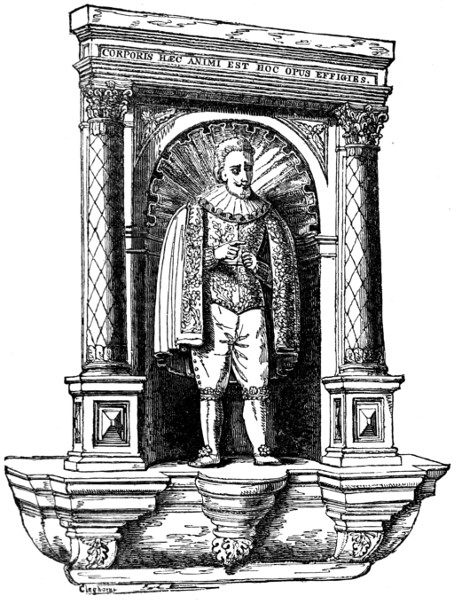
On this occasion the statue of the founder is fancifully decorated with flowers. Each of the boys receives a new suit of clothes; their relations and friends assemble; and the citizens, old and young, being admitted to view the hospital, the gaiety of the scene is highly gratifying.
It was formerly a custom with the boys to dress Heriot’s statue with flowers on the first of May, and to renew them on this anniversary festival when they received their new clothes.[202]
It should seem, therefore, that the floral adornment of the statue annually on this day, is derived from its ancient dressing on the first of May.
The statue stands beneath the centre tower of the north or principal front, and over the middle of a vaulted archway leading to the court-yard of the hospital. Grose says, the Latin inscription above the figure signifies, “that Heriot’s person was represented by that image, as his mind was by the surrounding foundation.”
George Heriot was jeweller to king James VI., subsequently James I., of England. He was born about June, 1563, eldest son to George Heriot, one of the company of goldsmiths in Edinburgh. The elder Heriot died in 1610, having been a commissioner in the convention of estates and parliament of Scotland, and a convener of the trades of Edinburgh at five different elections of the council. The goldsmiths were then the money-dealers in Scotland; they consequently ranked among the most respectable citizens, and to this profession the subject of this memoir was brought up by his father.
It appears that so late as the year 1483, the goldsmiths of Edinburgh were classed with the “hammermen” or common smiths. They were subsequently separated, and an act of the town council on the twenty-ninth of August, 1581, conferred on the goldsmiths a monopoly of their trade, which was confirmed by a charter from James VI., in the year 1586.
A century afterwards, in 1687, James VII. invested the goldsmiths with the power of searching, inspecting, and trying all jewels set in gold, in every part of the kingdom; a license to destroy all false or counterfeit work; to punish the transgressors by imprisonment or fines, and seize the working tools of all unfree goldsmiths within the city.
In January, 1587, George Heriot married Christian, the daughter of Simon Marjoribanks, an Edinburgh merchant. On this occasion, his father gave him 1000 marks, with 500 more to fit out his shop and purchase implements and clothes, and he had 1075 marks with his wife. Their united fortunes amounted to about 214l. 11s. 8d., which Heriot’s last biographer says, was “a considerable sum in those days; but rendered much more useful by the prospect of his father’s business, which would at this time naturally be transferred to the younger and more active man.”
In May, 1588, Heriot became a member of the incorporation of goldsmiths. “Scotland which was then an independent kingdom, with a court in the metropolis, though poor in general, was probably in a state not less favourable to the success of Heriot’s occupation than at present. A rude magnificence peculiar to the age, atoned for want of elegance, by the massy splendour of its ornaments. The nobles were proud and extravagant when their fortunes would permit; and Ann of Denmark, the reigning queen, was fond of show and gallantry.” During this period, Heriot was employed by the court. In 1597, he was made goldsmith to the queen, and so declared “at the crosse, be opin proclamatione and sound of trumpet.” Shortly after, he was appointed jeweller and goldsmith to the king, with a right to the lucrative privileges of that office.
Heriot rose to opulence, and lost his wife; he afterwards married Alison, eldest daughter of James Primrose, clerk to the privy-council, and grandfather of the first earl of Roseberry. On the accession of James to the throne of England, he followed the court to London, where he continued to reside almost constantly. He obtained eminence and wealth, and died there on the twelfth of February, 1624, in the sixtieth year of his age, and was buried at St. Martin’s in the Fields.
Queen Ann of Denmark’s Jewels.
In a volume of original accounts and vouchers relative to Heriot’s transactions with the queen, there are several charges which illustrate the fashion of the times in these expensive decorations, viz.—
For making a brilliant in form of a ship.
For gold and making of a Valentine.
A ring with a heart and a serpent, all set about with diamonds;
Two pendants made like moore’s heads, and all sett with diamonds;
A ring with a single diamond, set in a heart betwixt two hands.
Two flies with diamonds.
A great ring in the form of a perssed eye and a perssed heart, all sett with diamonds.
One great ring, in forme of a frog, all set with diamonds, price two hundreth poundis.
A jewell in forme of a butterfly.
A jewell in forme of a lillye, sett of diamonds.
An anker sett with diamonds.
A jewell in form of a honey-suckle.
A pair of pendants, made lyke two drums, sett with diamondis.
A jewel, in forme of a jolley flower, sett with diamonds.
A jewell in forme of a horne of aboundance, set with 6 rose diamondis, and 12 table diamondis.
A ring of a burning heart set with diamondis.
A ring, in forme of a scallope shell, set with a table diamond, and opening on the head.
A pair of pendentis of two handis, and two serpentis hanging at them.
A parrate of diamondis.
A ring of a love trophe set with diamondis.
Two rings, lyke black flowers, with a table diamond in each.
A daissie ring sett with a table diamond.
A jewell in fashione of a bay leaf, opening for a pictur, and set with diamondis on the one syde.
A pair of lizard pendantis, set with diamondis.
A jewell for a hatt, in forme of a bay leafe, all set with diamonds.
A little watch set all over with diamonds, 170l.
A ryng sett all over with diamondis, made in fashion of a lizard, 120l.
A ring set with 9 diamonds, and opening on the head with the king’s picture in that.
Margaret Hartsyde.
In an account of “jewells and other furnishings,” which were “sould and deliuered to the Queene’s most excellent matie. from the xth. of April, 1607, to the xth. of February followinge, by George Heriote, her Highnes’ jewellor,” there is the following
“Item, deliuered to Margarett Hartsyde a ring sett all about with diamonds, and a table diamond on the head, which she gaue me to vnderstand was by her Mats. direction, price xxx li.”
This item in reference to Margaret Hartsyde is remarkable, because it appears that this female, who had been in the royal household, was tried in Edinburgh on the 31st of May, 1608, for stealing a pearl, worth 110l. sterling belonging to the queen. She pretended that she retained these pearls to adorn dolls for the amusement of the royal infants, and believed that the queen would never demand them; but it appeared that she used “great cunning and deceit in it,” and disguised the jewels so as not to be easily known, and offered them to her majesty in sale. The king by special warrant declared her infamous, sentenced her to pay 400l. sterling as the value of the jewels, and condemned her to be imprisoned in Blackness castle till it was paid, and to confinement in Orkney during her life. In December, 1619, eleven years afterwards, “compeared the king’s advocate, and produced a letter of rehabilitation and restitution of Margaret Hartsyde to her fame.”
Heriot’s Hospital.
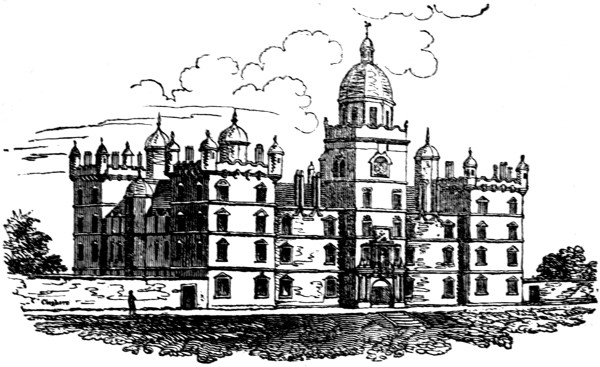
There is a memorial of queen Anne of Denmark’s fondness for dogs in a large whole-length portrait of her, surrounded by those animals, which she holds in leashes. In Heriot’s accounts there are charges for their furniture: e. g.
“Item, for the garnishing of vj doge collers, weighing in silver xix ounces iiij li. xvs.
“Item, for the workmanshipe of the said collers ij li. xs.
“Item, boght to the said collers ij ounces iij quarters of silver lace, at vs. vjd. ounce xvs. id. ob.
“Item, for making wp of the said collers at ijs. the peice xijs.”
Her majesty’s perfumes seem to have derived additions from Heriot. He furnished her with “5 ounces and a half of fyne civett, at li. 4 the ounce:” also
“Item, for fower ounces of fyne musk de Levant, at xxxviijs. the ounce vij li. xijs.
“Item, for a glass of balsome, ij li.
“Item, for a glass of whyte balsome, and a glasse of black balsome j li. xs.”
There are no particulars of the private life of Heriot. From small beginnings, he died worth 50,000l., and acquired lands and houses at Roehampton, in Surrey, and St. Martin’s in the Fields, London. It does not appear that he had children by either of his wives, but he had two illegitimate daughters. To one of these, named in his will as “Elizabeth Band, now an infant of the age of ten years or therabout, and remaining with Mr. Starkey at his house at Windsor,” he gave his copyholds in Roehampton. To the other, whom he mentions as “Margaret Scot, being an infant about the age of four years, now remaining with one Rigden, a waterman, at his house in the parish of Fulham,” he left his two freehold messuages in St. George’s in the Fields, which he had lately purchased of sir Nicholas Fortescue, knight, and William Fortescue, his son: his leasehold terms in certain garden plots in that parish, held of the earl of Bedford, he bequeathed to Margaret Scot; and he directed 200l. to be laid out at interest, and paid to them severally when of age or married. He gave 10l. to the poor of St. Martin’s parish, 20l. to the French church there, and 30l. to Gilbert Primrose, preacher at that church; and after liberally providing for a great number of his relations, he bequeathed the residue of his estate to the provosts, bailiffs, ministers, and ordinary town-council of Edinburgh, for the time being, for and towards the founding and erecting of a hospital in the said town, and purchasing lands in perpetuity, to be employed in the maintenance and education of so many poor freemen’s sons of the town as the yearly value of the lands would afford means to provide for. He appointed the said town council perpetual governors of the institution, which he ordained should be governed by such orders or statutes as he made in his lifetime, or as should be formed and signed after his decease by Dr. Balcanquel, one of his executors.
Heriot’s Statue at his Hospital, Edinburgh.
“So stands the statue that adorns the gate.”
Heriot’s Hospital.
The residue of Heriot’s estate amounted to 23,625l. 10s. 3d. which sum was paid by his executors, on the 12th of May, 1627, to the town-council of Edinburgh. He had directed a large messuage in Edinburgh, between Gray’s close and Todrick’s wynd, to be appropriated to the hospital; but the governors, in conjunction with Dr. Balcanquel, finding it unfit for the purpose, purchased of the citizens of Edinburgh, eight acres and a half of land near the Grass Market, in a field called the “High Riggs,” and they commenced to lay the foundation of the present structure on the 1st of July, 1628, according to a plan of Inigo Jones. The stones were brought from Ravelstone, near Edinburgh; and the building was conducted by William Aytoune, an eminent mason or architect, with considerable deviations from Inigo Jones’s design, in accommodation to the supervening taste of Heriot’s trustees. In 1639, the progress of the work was interrupted by the troubles of the period till 1642. When it was nearly completed, in 1650, Cromwell’s army occupied it as an infirmary for the sick and wounded. It remained in such possession till general Monk, in 1658, on the request of a committee of governors, removed the soldiers to the new infirmary in the Canongate, at the expense of Heriot’s trustees; and on the 11th of April, 1659, the hospital being ready, thirty boys were admitted. In the following August they were increased to forty; in 1661, to fifty-two; in 1753, to one hundred and thirty; in 1763, to one hundred and forty; and in 1822, the establishment maintained one hundred and eighty.
The children of Heriot’s eldest daughter, Elizabeth Band, were among the early objects who benefited by the endowment. She had married in England, but being reduced to great difficulties, resorted to Edinburgh for relief. The magistrates allowed her one thousand merks Scots annually, till her sons were admitted into their grandfather’s hospital. She had 20l. afterwards to support her journey to London, and a present of one thousand merks.
Heriot’s hospital cost 30,000l. in the erection. The first managers purchased the barony of Broughton, a burgh of regality, about a quarter of a mile northward of the city, a property which, from local circumstances, seemed likely to rise in value. On this and other adjacent land, the “new town” of Edinburgh now stands. The greater part of the valuable grounds from the bottom of Carlton-hill eastward, reaching to Leith, and to the east road to Edinburgh, is the property of the hospital, which will derive great additional revenue when the buildings on these lands complete the connection of Leith with Edinburgh. In 1779, Heriot’s hospital possessed a real income of 1800l. per annum: its annual income in 1822 was supposed to have amounted to upwards of 12,000l.
The statutes of the hospital ordain, that the boys should be taught “to read and write Scots distinctly, to cypher, and cast all manner of accounts,” and “the Latin rudiments, but no further.” The governors, however, have wisely gone so much “further,” as to cause the boys to be instructed in Greek, mathematics, navigation, drawing, and other matters suitable to the pursuits they are likely to follow in life. The majority of the boys are apprenticed to trades in Edinburgh, with an allowance of 10l. a year for five years, amounting to an apprentice fee of 50l.; and to each, who on the expiration of his servitude produces a certificate of good conduct from his master, 5l. is given to purchase a suit of clothes. Those destined for the learned professions are sent to the university for four years, with an allowance of 30l. annually. Six or eight are generally at college, in addition to ten bursers selected by the governors from other seminaries, who have each an annual allowance of 20l.
George Heriot confided to his intimate friend “Mr. Walter Balcanquel, doctor in divinity and master of the Savoy,” the framing and ordaining of the rules for the government of his hospital; and accordingly in 1627, Dr. Balcanquel, “after consulting with the provosts, baillies, ministers, and council of Edinburgh,” compiled the statutes by which the institution continues to be governed. By these it is directed that “this institution, foundation, and hospital, shall for all time to come, perpetually and unchangeably be called by the name of George Heriot his Hospital,” and that “there shall be one common seal for the said hospital engraven with this device, Sigillum Hospitalis Georgii Heriot, about the circle, and in the middle the pattern of the hospital.”
And “because no body can be well governed without a head, there shall be one of good respect chosen master of the hospital, who shall have power to govern all the scholars and officers;” and therefore the governors are enjoined to have a special care, “that he be a man fearing God; of honest life and conversation; of so much learning as he be fit to teach the catechism; a man of that discretion, as he may be fit to govern and correct all that live within the house; and a man of that care and providence, that he may be fit to take the accounts of the same; a man of that worth and respect, as he may be fit to be an assessor with the governors, having a suffrage given unto him in all businesses concerning the hospital. He shall be an unmarried man, otherwise let him be altogether uncapable of being master. He shall have yearly given unto him a new gown. Within the precincts of the hospital he shall never go without his gown: in the hall he shall have his diet, he and the schoolmaster, in the upper end, at a little table by themselves.”
The schoolmaster, whose duties in teaching are already expressed by the quality of the learning defined to the boys, also “must be unmarried.”
It is charged on the consciences of the electors, “that they choose no burgess’s children, if their parents be well and sufficiently able to maintain them, since the intention of the founder is only to relieve the poor; they must not be under seven years of age complete, and they shall not stay in the hospital after they are of the age of sixteen years complete: they shall be comely and decently apparelled, as becometh, both in their linens and clothes; and their apparel shall be of sad russet cloth, doublets, breeches, and stockings or hose, and gowns of the same colour, with black hats and strings, which they shall be bound to wear during their abode in the said hospital, and no other.”
Further, it is provided, that “there shall be a pair of stocks placed at the end of the hall in the hospital, in which the master shall command to be laid any officer, for any such offences as in his discretion shall seem to deserve it; and the master likewise shall have authority to lay in the same stocks any vagrant stranger of mean quality, who, within the precincts of the hospital, shall commit any such offence as may deserve it: the officer for executing the master’s command; in this point of justice, shall be the porter of the hospital.” The porter is to be “a man, unmarried, of honest report—of good strength, able to keep out all sturdy beggars and vagrant persons;—he shall have every year a new gown, which he must wear continually at the gate; and if, at any time, he dispose himself to marry, he shall demit his place, or else be deprived of the same.”
The last of many officers ordained is “one chirurgeon-barber, who shall cut and poll the hair of all the scholars in the hospital; as also look to the cure of all those within the hospital, who any way shall stand in need of his art.”
These extracts are rather curious than important; for it is presumed, that any who are interested in acquiring further knowledge, will consult the statutes “at large.” They are set forth in “The Life of George Heriot,” published at Edinburgh in 1822, from whence the preceding particulars of the hospital and its founder are derived. They especially provide for the strict religious instruction of the boys—“while in the hospital the greatest care is bestowed on them in regard to morals and health; they have certain hours allowed them daily for exercise; and their amusements generally partake of a manly character.”
It may be quoted as an amusing incident in the annals of the establishment, that “a singular occurrence took place with the boys of Heriot’s hospital in 1681-2, the year in which the earl of Argyle was tried, and convicted of high treason, for refusing the test oath without certain qualifications. We extract the following account of it from Lord Fountainhill’s Chronological Notes of Scottish Affairs, just published: ‘Argyle was much hated for oppressing his creditors, and neither paying his own nor father’s debts, but lord Halifax told Charles II. he understood not the Scots law, but the English law would not have hanged a dog for such a crime.’ Every lawyer of common sense, or ordinary conscience, will be of the same opinion. Lord Clarendon, when he heard the sentence, blessed God that he lived not in a country where there were such laws, but he ought to have said such judges. The very hospital children made a mockery of the reasoning of the crown lawyers. The boys of Heriot’s hospital resolved among themselves, that the house-dog belonging to the establishment held a public office, and ought to take the test. The paper being presented to the mastiff, he refused to swallow the same unless it was rubbed over with butter. Being a second time tendered, buttered as above mentioned, the dog swallowed it, and was next accused and condemned, for having taken the test with a qualification, as in the case of Argyle!”
The Dog of Heriot’s Hospital.
There is “An Account of the Arraignment, Tryal, Escape, and Condemnation of the DOG of Heriot’s Hospital in Scotland, that was supposed to have been hang’d, but did at last slip the halter.”
From this exceedingly rare folio paper of two pages, “Printed for the author, M. D. 1682,” now before the editor of the Every-Day Book, he proceeds to extract some exponences in the case of “the dog of Heriot’s hospital,” by which “the reasoning of the crown lawyers,” in the case of the duke of Argyle, was successfully ridiculed.
Its waggish author writes in the manner of a letter, “to show you that the act, whereby all publick officers are obleadged to take the Test is rigorously put in execution; and therby many persons, baith in Kirk and State, throughout the haill Kingdome, by reasone they are not free to take the said Test, are incontinently turned out of their places.”
He then relates that this severity occasioned “the loune ladds belonging to the hospittal of Hariot’s Buildings in Edenbrough, to divert themselves with somewhat like the following tragi-commedy.”
He proceeds to state, that they “fell intil a debate amongist themselves, whither or no, ane mastiffe Tyke, who keept the outmost gate, might not, by reasone of his office of trust, come within the compass of the act, and swa, be obleadged to take the Test, or be turned out of his place.”
In conclusion, “the tyke thereupon was called, and interrogat, whither he wold take the test, or run the hazard of forfaulting his office.”
Though propounded again and again, “the silly curr, boding no ill, answered all their queries with silence, whilk had been registrat as a flat refusal, had not on of the lounes, mair bald then the rest, taken upon him to be his advocat, who standing up, pleaded that silence might as wel be interpreted assent, as refusal, and therupon insisted that it might be tendered to him in a way maist plausible, and in a poustar maist agreeable to his stomack.”
The debate lasted till all agreed “that ane printed copy should be thrumbled, of as little boulke as it could, and therafter smured over with tallow, butter, or what else might make maist tempting to his appetit: this done he readily took it, and after he had made a shift, by rowing it up and down his mouth, to separat what was pleasant to his pallat, and when all seemed to be over, on a sudden they observed somehat (ilke piece after another) droped out of his mouth, qwhilk the advocats on the other side said was the test, and that all his irksome champing and chowing of it, was only, if possible, to seperat the concomitant nutriment, and that this was mikel worse then an flat refusal, and gif it were rightly examined, would, upon Tryal, be found no less then Leising-making.”
The tyke’s advocate “opponed, that his enemies having the rowing of it up, might perhaps (through deadly spite) have put some crooked prin intil it; and that all the fumbling and rowing of it up and down his mouth, might be by reason of the prin, and not through any scunnering at the test itself; and that there was nought in the hail matter, that looked like Leising-making, except by interpretation, and his adversaries allowed to be the only interpreters.” Finally, he required that his client should have a fair trial before competent judges, “qwhilk was unanimously granted;” and on the trial “ther fell out warm pleading.”
The advocates against the tyke set forth, “that he was ou’r malapert, to take so mikel upon him; and that the chaming and cherking of the test belonged nought to him, nor to none like him, who served only in inferior offices; that his trust and power reached nought so far, and by what he had done, he had made himself guilty of mair nor abase refusal as was libelled.”
Those who defended the tyke, pleaded “that he could be guilty of nather, since he had freely taken it in his mouth, willing to have swallowed it down; and that ther was no fault in him, but in its self, that it passed not; since it fell a sqwabeling, one part of it hindering another;” that if it would “have agreed in its self to have gone down all one way, he wold blaithly swallowed it, as he had done many untouthsome morsel before, as was well known to all the court.”
To this was answered, that “all his former good service could not excuse his present guilt.”
“Guilt!” quoth another, “if that be guilt he hath many marrows, and why should he be worse handled than all the rest?”
Notwithstanding what was urged in the tyke’s behalf, the jury found he had so mangled the test, and abused it, that it was “interpretative treason,” and found him “guilty of Leising-making:” wherefore he was ordered to close prison till he should be again called forth and receive sentence “to be hanged like a dog.”
While he was removing from the court, there chanced “a curate” to be present, and ask, “what was the matter, what ailed them at the dog?” whereto one answered, “that he, being in publick trust, was required to take the test, and had both refused it and abused it, whereupon he was to be hanged;” whereat the curate, storming, said, “They deserved all to be hanged for such presumptuous mockery;” but the boys, laughing aloud, cried with one consent, that “he, and his brethren, deserved better to be hanged than any of them, or the tyke eather, since they had swallowed that which the tyke refused.”
The verdict created no small dissension; “some suspected deadly fewd in the chanselor of the jury, alleadging that ane enemy was not fit to be a judg; this was answered, that he was of more noble extract then to stain his honor with so base an act, and that his own reputation wold make him favored; another objected that a tyke’s refusing so good a test, might be ill example to creatures of better reason; to this a pakie loun answered, that it could not be good, since Lyon Rampant, King of Tykes, nor none of his royal kin, wold not so much as lay ther lips, to it far less to swallow it, and therefore——”
Here the speaker was interrupted “by one that was a principal limmer among them (a contradiction reconciler) who would needs help him with a logical distinction, wherby he, like an Aberdeen’s man, might cant and recant again.”
There were other conjectures, “requiring the judgment of the learn’d to determine which has been maist suitable:” e.g.
One fancied, that “the tyke might take the test secundum quid, though not simpliciter;”
Another, that he might take it “in sensu diviso, though not in sensu composito;”
A third, that “though it was deadly to take it with verbal interpretatione, yet it might be taken safe enough with mental reservatione;”
A fourth thought, that “though his stomach did stand at it, in sensu univoco, yet it might easily digest it in sensu et æquivoco;”
In this manner suppositions multiplied, and to one who proposed a “jesuitical” distinction, it was answered, that “the tyke would neither sup kail with the div’l, nor the pope, and therefore needed not his long spoon; well, said ane other, this is mair nor needs, since we are all sure that the tyke could not have kept his office so long, but he most needs have swallowed many a buttered bur before this time, and it was but gaping a little wider and the hazard was over.”
“Nay,” quoth his neighbour, “the hazard was greater than ye imagine, for the test, as it was rowed up, had many plyes and implications in it, one contrary to another; and swa the tyke might been querkened ere it had been all over, ilk ply, as it were, rancountering another, wresling and fighting.”
Then it was proposed, as the tyke had actually swallowed the better part, if not the whole test, that though he had brought it up again, yet it were better to try if he would swallow it again; “but this project was universally rejected, baith by the maist charitable, as bootless, and by the mair severe, or too great a favor.”
As regarded the condemned tyke, “matters being thus precipitat, and all hopes of reprieve uncertain, a wylie loun advised him to lay by the sheep’s (which had done him so little good) and put on the fox’s skin;” wherefore, like a sensible dog, “hiding his own tail between his legs, and griping another’s train, he passed through all the gates undiscovered and swa was missing:—
‘Thus he was forc’d when light did fail, To give them the flap with a fox’s tail.’”
What became of him was unknown, and “the news of the tyke’s escape being blazed abroad, the court assembleth to consult what was then anent to be done.”
By one it was said that “the affronting escape, and other misdemeaners of that tyke were so great, that the highest severity was too little;”
Another said, “sine he is gone, let him go, what have we more to do, but put another in his place;”
A third said, “his presumptuous and treasonable carriage, would be of ill example to others, unless due punishment followed thereupon;”
A fourth said, “had he not been confident of his own innocency he wold never have byden a tryal, and since he met with such a surprising verdict, what could he do less than flee for his life? wold not the best in the court, if he had been in his circumstances done the like?”
A fifth said, “if he had been condemned, and hanged in time, he had not played us this prank, but seeing we have missed himself, let us seaze well on what he hath left behind him.”
Then further debate ensued, and, thereupon, the conclusion; which was ordered to be published as follows:—
Proclamation.
“Whereas ane cutt lugged, brounish coloured Mastiff Tyke, called Watch, short leged, and of low stature; who being in Office of Public Trust, was required to take the Test, and when it was lawfully tendered to him, he so abused it, and mangled it; whereupon he, after due Tryal for his presumption, was convict of Treason, and sincesyn hath broken Prison, whereupon the Court adjudges him, To be hanged like a Dog, whenever he shall be apprehended; and in the mean time declares his Office, his hail Estat heiratable and moveable, and all causualties belonging to him, to be echeated and forfaulted, and ordeans the colectors of the Court to uplift his Rents and Causualties, and to be countable to the Court, both for diligence and intermission, and also discharges all persons to reset or harbor the Fugitive Trator, and likeways, gives assurance to all persons, who shall either apprehend him, or give true information of him, swa that thereupon he bees apprehended, the person swa doing, shall have 500l. for his pains. Given at our Court, &c.”
A Remark.
A great deal of the ingenious argument in this extremely scarce witticism, was probably adduced by the “Heriot’s boys,” when they indulged in the practical humour of administering the test to the hospital dog as an “office bearer.” Independent of its ability, and because the editor of these sheets does not remember to have met with it in any collection of papers on public affairs, he has rather largely extracted from it, hoping that, as it is thus recorded, it will not be altogether misplaced. Of course, every reader may not view it in that light; but there are some who know, that such materials frequently assist the historian to the proof of questionable facts, and that they are often a clue to very interesting discoveries: by such readers, apology will not be required for the production.
It has been said of George Heriot, that “his vanity exceeded his charity.”[203] But an assertion justly urged respecting many founders who sought posthumous notoriety by sordid disregard to the welfare of surviving relatives, cannot be applied to George Heriot. It was not until he had bestowed ample largesses on his kinsfolk, that he munificently endowed his native town with a provision for rearing the children of its citizens. To stay the fame of the deed, was not in the power of the hand that bestowed the gift; and when the magistrates of Edinburgh honour Heriot’s memory, they incite others to emulate his virtue. Their predecessors received his donation with a spirit and views correspondent to those of the donor: as faithful stewards they husbanded his money, and laid it out to so great advantage, that when the hospital was completed, though the building alone cost more than the amount of Heriot’s bequest, the fund had accumulated to defray the charges, and leave a considerable surplus for the maintenance of the inmates; with a prospect, which time has realized, of further increase from the increasing value of the land they purchased and annexed to the foundation as its property for ever. It did not escape the penetration of Heriot’s mind, and, in fact, he must naturally have taken into account, that such an institution in the metropolis of Scotland would derive contributions from other sources, and flourish, as it yet flourishes, a treasure-house of charity.
The prudent and calculating foresight by which Heriot rendered his fortune splendid, was exercised in deliberating the management of the inmates on his projected establishment. He had the wisdom to distrust the quality of his judgment on matters wherein his observation and knowledge were necessarily limited, and committed the drawing up of the statutes to his friend Dr. Balcanquel. There is no evidence to what extent the founder himself had any share in these rules for effectuating his intentions; but when the age wherein they were compiled is regarded, it will scarcely be alleged that he could have elected from his friends, a better executor of the best of his good wishes.
The acquisition of such experience as Dr. Balcanquel’s, in his capacity of master of the Savoy, is strong testimony of Heriot’s discrimination and manly sense. The statutes of Dr. Balcanquel, who had assisted at the synod of Dort, and was successively dean of Westminster and Durham, are free from the overlegislating disposition of his times, which while it sought to distinguish, confused the execution of purposes. To the liberal laws, and the liberal spirit wherein they have been interpreted, some of the most highly-gifted natives of Edinburgh owe the cultivation of their talents.
Each of the windows of Heriot’s hospital is remarkable for being ornamented in a different manner, with the exception of two on the west side whereon the carvings exactly agree. The north gate is adorned with wreathed columns, and devices representing the modes of working in the business of a jeweller and goldsmith.[204]
Heriot’s boys, with a daring which seems to require some check, on account of its risk, and the injury it must necessarily occasion in the course of time, have a practice of climbing this front by grasping the carvings. The insecurity of this progress to a fearful eminence, has surprised and alarmed many a spectator “frae the south.”
Inscriptions of various benefactions are placed in the council-room. There is one which records the liberality of a well-known gentleman, viz.
1804 Dr. John Gilchrist, several Years Professor of the Hindostanee Language in the College of Fort William, Bengal, presented 100l. sterling to this Hospital, as a small testimony of Gratitude for his Education in so valuable a Seminary.
There are several engravings of his portrait. One of them by J. Moffat, Edinburgh, engraved in 1820, after a picture by Scougal, in the council-room of the edifice, is inscribed “George Heriot, Jeweller to King James VI., who, besides founding and endowing his stately hospital at Edinburgh, bequeathed to his relations above 60,000l. sterling. Obiit. 1623. Ætatis Anno 63.” His arms on this print are surmounted by the motto, “I distribute cheerfully.”
In the “Fortunes of Nigel,” by the author of “Waverely,” Heriot is introduced, with a minute description of his dress and person, seemingly derived from real data, whereas there is little other authority for such markings, than the imagination of the well-known “Great Unknown.”
The striking magnificence of Heriot’s hospital is recorded by an expression of too great force to be strictly accurate. It was observed by a foreigner, before the palace of Holyrood-house was built by Charles II., that there was at Edinburgh a palace for beggars, and a dungeon for kings.[205]
Chronology.
On the fifth of June, 1826, Carl Maria Von Weber, the eminent musical composer, died in London, of a long standing pulmonary affection, increased probably by the untowardness of our climate. He gave a concert ten days before, wherein he composed an air, and accompanied Miss Stephens on the pianoforte, to the following
Song.
From Lalla Rookh.
From Chindara’s warbling fount I come, Call’d by that moonlight garland’s spell; From Chindara’s fount, my fairy home, Where in music, morn and night, I dwell. Where lutes in the air are heard about, And voices are singing the whole day long, And every sigh the heart breathes out Is turn’d, as it leaves the lips, to song! Hither I come From my fairy home, And if there’s a magic in Music’s train, I swear by the breath Of that moonlight wreath, Thy lover shall sigh at thy feet again. For mine is the lay that lightly floats, And mine are the murmuring, dying notes, That fall as soft as snow on the sea, And melt in the heart as instantly! And the passionate strain that, deeply going, Refines the bosom it trembles through, As the musk-wind over the waters blowing, Ruffles the waves, but sweetens it too! So, hither I come From my fairy home, And if there’s a magic in Music’s train, I swear by the breath Of that moonlight wreath, Thy lover shall sigh at thy feet again.
These words seem to have been kindred to Von Weber’s feelings. His last opera was “Oberon:” its performance at Covent-garden derives increased interest from his premature decease. Mr. Planché adapted it for our stage, and published it as represented and superintended by its illustrious composer. There are two genuine editions of this drama, one in octavo, at the usual price, and the other in a pocket size, at a shilling, with an excellent portrait of Von Weber.
NATURALISTS’ CALENDAR.
Mean Temperature 57·72.
June 6.
Important to Anglers.
To the Editor.
The Every-Day Book has presented a more striking view of the changes of manners and customs than any book which has gone before it; yet even the editor himself, I think, never dreamed of this revolution of habits extending from the walkers on the earth to the inhabitants of “the waters which are under the earth.”
How little do men dream, when they are advocating the cause of any class of people, in what manner those very people shall repay their services. Poor Izaak Walton! He cried up anglers as the very perfection of human nature. They were the most meek, loving, and patient of God’s creatures. They were too much imbued with nature’s tranquillizing spirit to be ambitious; too excellent christians to be jealous; and all this, good, simple-hearted fellow as he was, because he was such a man himself. I have naturally great faith in the influence of nature, and, therefore, though I never could resist a smile at Izaak’s zealous eulogies on the art—calling all times, people, and places, to do honour to it; pressing kings, prophets, apostles, and even Jesus Christ himself, into the ranks of his admired anglers—yet, I involuntarily permitted his warm and open-hearted eloquence to more than half persuade me of the superior natures of his piscatorial protegées; in short, that they were such men as himself.
In one of my summer rambles through the peak of Derbyshire I entered Dovedale. It was in June, and on one of the most delightful evenings of that delightful month. There had been rain in the day, and the calm splendour of the declining sun fell upon a scene not more fantastically sublime in its features, than it was beautiful in its freshness. The air was deliciously cool, balmy, and saturated with the odour of flowers. The deep grass in the bottom of the valley was heavy with its luxuriance. The shrubs waved and sparkled, with their myriad drops, upon lofty crags and stern precipices; and the Dove, that most beautiful of swift and translucent streams, went sounding on its way with a voice of gladness in full accordance with every thing around it. I have seen it many times,—and the finest scenes, often seen, are apt to lose some of their effect,—yet I never felt more completely the whole fascination of the place. It put me, as such things are apt to do, into a ruminating and poetical mood,—a humour to soliloquize and admire, and to see things perhaps a little more fancifully than an etymologist, or a mathematician might.
It was exactly when that species of ephemera, the drake-fly, the glory of trouts and of trout-takers, was in season. They were fluttering by thousands over the stream, and dropping every moment into it, where many a luxuriating mouth was ready to receive them. The anglers were half as numerous as they; from the bottom of Dove-dale to Berresford Hall, the whilom residence of Cotton, and the resort of Walton, scarcely a hundred yards but “maintained its man.” I pleased myself with fancying I saw amongst them many a face which belonged to a disciple of Izaak worthy of the master and the art, and, had I not entered into talk with them, I might have thought so now.
But, I asked one if there was not once a very famous angler, who frequented the Dove. “Oh aye!” said he, “I know whom you mean; you mean old Dennel Hastings. For fishing and shuting he was the cob of all this country!” Alas! poor Izaak! I thought; but I glanced at the man’s fish-basket as I passed. It was empty, and I set him down as a fellow not more ignorant of Izaak than of the patient mystery. But soon after, I cast my eye upon an old and venerable figure. His basket was stored with beautiful trouts, till the lid would not shut down. His grey hair clustered thick and bushily beneath his well-worn hat, as if it was accustomed to grow in the sun and the breeze, and to be “wet with the dews of heaven.” His features were such as the father of anglers himself might have worn,—good; and apparently accustomed to express a mixed spirit of bonhommie and simplicity, but were then sharpened into the deepest intensity of an angler’s vigilant enjoyment. This, thought I, is surely the man, and I asked him if he had read “Walton’s Complete Angler.” Yes, he had it, and he had Major’s new edition, too: and, turning to me with an air of immense knowingness and importance, said—“If he was alive now he could not take a single fin.” “No,” I replied, “how is that? He could take plenty in his day; and though I do not deny that there may have been great improvement in the art, yet, skill then successful would be equally so now, unless there has been a revolution amongst the fish, and they have grown wiser. “Ay, there you have it,” he added, the fish are wiser: they wont take the same baits.” I instinctively glanced at the bait then upon the hook of my oracle, and—heaven and earth! it was Walton’s favourite bait—the drake-fly. I walked on. The romance of angling was destroyed. The glory, like a morning dream, had passed away from the whole piscatorial race; and, from esteeming an angler after the fashion of Izaak Walton, I fell into great temptation of deeming him something worse than, as exhibited in Swift’s definition, “a stick and a string, a worm at one end and a fool at the other.”