JULY. (continued 2)
Reading edition
NATURALISTS’ CALENDAR.
Mean Temperature 63·87.
July 10.
Chronology.
On the tenth of July, 1740, died sir Charles Crispe, bart. of Oxfordshire. He was great-grandson of sir Nicholas Crispe, bart. who spent 100,000l. in the service of king Charles I. and II. He took out a commission of array for the city of London, for which the parliament offered 1000l. reward to bring him alive or dead. The city of London sent him commissioner to Breda, to invite over king Charles II. who took him in his arms, and kissed him, and said, “Surely the city has a mind highly to oblige me, by sending over my father’s old friend to invite me.” He was the first who settled a trade to the coast of Africa.[252]
NATURALISTS’ CALENDAR.
Mean Temperature 62·85.
July 11.
Chronology.
On the eleventh of July, 1804, general Hamilton of New-York was killed in a duel by colonel Burr, the vice-president of the United States.
Memorandum. To Men of Honour.
Whereas certain persons who contemn the obligations of religion, are nevertheless mindful of the law of the land: And whereas it is supposed by some of such persons, that parties contemplating to fight a duel and bound over before a magistrate to keep the peace, may, notwithstanding, fight such duel in foreign parts: Be it known, that the law which extends protection to all its subjects, can also punish them for breach of duty, and that, therefore, offences by duelling beyond sea, are indictable and punishable in manner and form, the same as if such duels were fought within the United kingdom.
After this warning against a prevailing offence, we may become acquainted with the character of an unoffending individual, through the pen of a respected friend to this work.
CHEAP TOMMY.
For the Every-Day Book.
If I forget thee, worthy old Tam Hogg, May I forget that ever knives were cheap:— If I forget thy barrow huge and steep, Slow as a snail, and croaking like a frog:— Peripatetic, stoic, “cynic dog,” If from my memory perish thee, or thine, May I be doomed to gnaw asunder twine, Or shave with razor that has chipped a log! For in thy uncouth tabernacle dwelt Honest philosophy; and oh! far more Religion thy unstooping heart could melt, Nor scorned the muse to sojourn at thy door; What pain, toil, poverty didst thou endure, Reckless of earth so heaven might find thee pure!
In my native village of Heanor, in Derbyshire, some sixteen or seventeen years ago, there appeared a singular character, whose arrival excited a sensation, and became an epoch in its history. Some boys who had been strolling to a distance brought an account that a little man, with a barrow as large as a house, was coming along the lane, at “a snail’s gallop.” Forth sallied a troop of gazers who found a small, thick-set, round-faced man, in an old, red, soldier’s jacket, and cocked hat, sitting on the handle of his barrow, which was built and roofed after the manner of a caravan; and was a storehouse of some kind of merchandise, what they yet knew not. He sat very quietly as they came round him, and returned their greetings in a way short and dry, and which became markedly testy and impatient, as they crowded more closely, and began to ask questions. “Not too fast, my masters; not too fast! my first answer can’t overtake your twentieth question.” At length he rose, and, by the aid of a strong strap passed over his shoulders, heaved up the handles of his barrow, and placing his head against it, like a tortoise under a stone, proceeded at a toilsome rate of some few hundred yards per hour. This specimen of patient endurance amazed the villagers. A brawny labourer would have thought it a severe toil to wheel it a mile; yet this singular being, outdoing the phlegmatic perseverance of an ass, casting Job himself in the background for patience, from league to league, from county to county, and from year to year, urged on his ponderous vehicle with almost imperceptible progression.
It was soon found that he was not more singular in appearance, than eccentric in mind. A villager, thinking to do him a kindness, offered to wheel his barrow, but what was the surprise of the gazers to see him present the man payment when he had moved it a considerable way, and on its being refused, to behold him quietly raise the barrow, turn it round, and wheel it back to the identical spot whence the villager set out.
On reaching the hamlet, he took up his quarters in a stable, and opened his one-wheeled caravan, displaying a good assortment of cutlery ware. It was there I first saw him, and was struck with his grave and uncomplying air, more like that of a beadle stationed to keep off intruders, than of a solicitous vender of wares. He was standing with a pair of pliers, twisting wire into scissor-chains; keeping, at the same time, a shrewd eye upon the goods. The prices were so wonderfully low that it was whispered the articles could not be good, or they were stolen: yet I did not perceive that either idea was sufficient to dissuade the people from buying, or from attempting to get them still lower. Then it was that his character and temper showed themselves. He laid aside the goods attempted to be chaffered for, saying,—“You shall not have them at all, I tell no lies about them nor shall you.” In fact his goods were goods. So much so, that many of them are in use in the village to this day: he desired only such a profit as would supply the necessities of one who never slept in a bed, never approached a fire for the sake of its warmth, nor ever indulged in any luxury. His greatest trial appeared to be to bear with the sordid spirit of the world. When this did not cross him he became smiling, communicative, and, strange as it may seem, exceedingly intelligent. I well recollect my boyish astonishment when he quoted to me maxims of Plato and Seneca, and when I heard him pouring out abundance of anecdote from the best sources. He had a real spirit of kindliness in him, though the most immediately striking features of his mind were shrewdness and rigid notions of truth; which, as he practised it himself, he seemed to expect from the whole world. He had a tame hedgehog which partook his fare, slept in a better nest than himself, and was evidently a source of affectionate enjoyment. He was fond of children; but he had a stern spirit of independence which made him refuse gifts and favours, unless permitted to make some return. My mother frequently sent him warm messes in the wintry weather, and he brought her a scissor-chain and a candlestick of brass-wire. He was a writer of anagrams, acrostics, and so forth; and one epitaph written for one of his bystanders was,—
“Too bad for heaven, too good for hell, So where he’s gone I cannot tell.”
He always slept with his barrow chained to his leg; and on Sundays kept himself totally shut up, except during service time, standing the day through, reading his bible.
When his character was known, he grew to be a general favourite. His stable became a sort of school, where he taught, to a constant audience, more useful knowledge than has emanated from many a philosopher, modern or antique. The good-will he excited evidently pleased the old man; he came again, and again, till at length years rolled away without his reappearance, and he was considered as dead. But not so. For ten or eleven years he was still going on his pilgrimage, a wanderer and an outcast; probably doing voluntary penance for some sin or unhappiness of youth; for he carefully kept aloof of his native country, Scotland, and though he spoke of one living sister with tearful eyes, he had not seen her for many, many years. In 1820 he had found his way to Midsomer Norton, near Bristol, where he was hooted into the town by a troop of boys, a poor, worn-down object, of the most apparent misery. This I accidentally learnt, a short time ago, from a little book, the memorial of his last days, written by the worthy clergyman of that place, and published by Simpkin and Marshall, London.
What a tale would the history of those years have displayed. What scenes of solitary travel, exhaustion, suffering, insults, and occasional sympathy and kindness, breaking, like cheering sunbeams, through the ordinary gloom. His barrow was gone! Poverty had wrung from him, or weakness had compelled him to abandon, that old companion of his travels. I have often thought what must have been his feelings at that parting. Poor old man, it was his house, his friend, his dog, his everything. What energies had he not expended in propelling it from place to place. It could not have been left without a melancholy pang,—without seeming to begin a more isolated and cheerless existence. But I cannot dwell upon the subject. It is sufficient to say that he found in the rev. William Read, who wrote the little book just mentioned, an excellent friend in the time of final need. That he retained the same eccentric, yet consistent character to the last; displaying, in a concluding scene of such bodily wretchedness and sufferings as has seldom been paralleled, the same astonishing endurance, nay ebullient thankfulness of heart; and that his piety seems to have worn off much of his asperity of manner.
A didactic poem called “The Flower Knot,” or, “The Guide Post,” was found after his death, a composition of no ordinary merit, from which we will quote two passages, and bid a final adieu to our old friend under every name of Thomas Hogg, Tam Hogg, or Cheap Tommy.
Wit.
“Pope calls it feather—does he not say right? ’Tis like a custard weak, and bears no weight; But had it not that wiping feather been The poet’s lines had never shone so clean. Wisdom on foot ascends by slow degrees; But wit has wings, and soars aloft with ease. The sweetest wine makes vinegar most sour, So wit debased is hell’s consummate power.”
Hope.
“Fountain of song, it prayer begins and ends; Hope is the wing by which the soul ascends. Some may allege I wander from the path, And give to Hope the proper rights of Faith. Like love and friendship, these, a comely pair, What’s done by one, the other has a share: When heat is felt, we judge that fire is near, Hope’s twilight comes,—Faith’s day will soon appear. Thus when the christian’s contest doth begin Hope fights with doubts, till Faith’s reserves come in. Hope comes desiring and expects relief; Faith follows, and peace springs from firm belief. Hope balances occurrences of time; Faith will not stop till it has reached the prime. Just like copartners in joint stock of trade, What one contracts is by the other paid. Make use of Hope thy labouring soul to cheer, Faith shall be giv’n, if thou wilt persevere. We see all things alike with either eye, So Faith and Hope the self-same object spy. But what is Hope? or where, or how begun? It comes from God, as light comes from the sun.”
H.
In consequence of this interesting narrative concerning Thomas Hogg, the “little book—the memorial of his last days” by the rev. Mr. Read, was procured by the editor. It is entitled “The Scottish Wanderer,” and as our kind correspondent “H.” has only related his own observations, probably from apprehension that his narrative might be deemed of sufficient length, a few particulars are extracted from Mr. Read’s tract respecting the latter days of this “singular character.”
Mr. Read commences his “Memoir of Thomas Hogg,” by saying—“On Sunday the ninth of January 1820, as I was proceeding in the services of the day, my attention was attracted by a wretched object seated in the nave of the church. There was an air of devout seriousness about him, under all the disadvantages of tattered garments and squalid appearance, which afforded a favourable presentiment to my mind. When the service was over the stranger disappeared.”
Mr. Read conceived that he was some poor passing beggar, who had been allured by the fire in the stove, but to his surprise on the following Sunday the same object presented himself, and took his station, as before, near the stove. He seemed to be a man decrepit with age: his head resting upon his bosom, which was partly exposed, betokened considerable infirmity. Under a coarse and dirty sackcloth frock was to be seen a soldier’s coat patched in various places, which was strangely contrasted with the cleanliness of his shirt. His whole appearance was that of the lowest degree of poverty. His devout attention induced Mr. Read when the service was concluded to inquire who this old man was. “Sir,” replied his informant, “he is a person who works at the blacksmith’s shop; he is a remarkable man, and carries about with him a bible, which he constantly reads.”
In the course of the week Mr. Read paid him a visit. He found him standing by the side of the forge, putting some links of iron-wire together, to form a chain to suspend scissors. The impressions of wretchedness excited by his first appearance were greatly heightened by the soot, which, from the nature of his occupation, had necessarily gathered round his person; and after a few general observations Mr. Read went to Mr. H. S., the master of the shop, who informed him that on Tuesday the fourth of January, in the severely cold weather which then prevailed, this destitute object came to his shop, almost exhausted with cold and fatigue. In his passage through the neighbouring village of P——, he had been inhumanly pelted with snow-balls by a party of boys, and might probably have perished, but for the humanity of some respectable inhabitants of the place, who rescued him from their hands. Having reached Mr. S.’s shop, he requested permission to erect, in a shed which adjoined the shop, his little apparatus, consisting of a slight table, with a box containing his tools. The benevolent master of the premises kindly stationed him near the forge, where he might pursue his work with advantage. In the evening, when the workmen were about to retire, Mr. S. asked him where he intended to lodge that night. The old man inquired if there were any ox-stall or stable near at hand, which he might be permitted to occupy. His benefactor offered his stable, and the poor creature, with his box and table upon his back, accompanied Mr. S. home, where as comfortable a bed as fresh straw, and shelter from the inclemency of the weather, could afford, was made up. One of Mr. S.’s children afterwards carried him some warm cider, which he accepted with reluctance, expressing his fears lest he should be depriving some part of the family of it.
The weather was very cold: the thermometer, during the past night, had been as low as six or seven degrees of Fahrenheit. In the morning he resumed his post by the side of the forge. Mr. S. allowed him to retain his station as long as he needed it; and contracted so great a regard for him, as to declare, that he never learned so complete a lesson of humility, contentment, and gratitude, as from the conduct of this man.
The poor fellow’s days continued to be passed much in the manner above described; but he had exchanged the stable, at night, for the shop, which was warmer, as soon as his benevolent host was satisfied respecting his principles; and with exemplary diligence he pursued his humble employment of making chains and skewers. He usually dined on hot potatoes, or bread and cheese, with occasionally half a pint of beer. If solicited to take additional refreshment, he would decline it, saying, “I am thankful for the kindness,—but it would be intemperate.”
At an early hour in the afternoon of the first Saturday which he spent in this village, he put by his work, and began to hum a hymn tune. Mr. S. asked him if he could sing. “No, sir,” he replied. “I thought,” added Mr. S., “I heard you singing.” “I was only composing my thoughts a little,” said the poor man, “for the sabbath.”
On Mr. Read being informed of these particulars, he was induced to return to the stranger with a view to converse with him. He says “There was a peculiar bluntness in his manner of expressing himself, but it was very far removed from any thing of churlishness or incivility. All his answers were pertinent, and were sometimes given in such measured terms as quite astonished me. The following was a part of our conversation.—‘Well, my friend, what are you about?’ ‘Making scissor-chains, sir.’ ‘And how long does it take you to make one?’ With peculiar archness he looked up in my face, (for his head always rested upon his bosom, so that the back part of it was depressed nearly to the same horizontal plane with his shoulders,) and with a complacent smile, said, ‘Ah! and you will next ask me how many I make in a day; and then what the wire costs me; and afterwards what I sell them for.’ From the indirectness of his reply, I was induced to conclude that he was in the habit of making something considerable from his employment, and wished to conceal the amount of his gains.” It appeared, however, that he was unable, even with success in disposing of his wares, to earn more than sixpence or sevenpence a day, and that his apparent reluctance to make known his poverty proceeded from habitual contentment.
Mr. Read asked him, why he followed a vagrant life, in preference to a stationary one, in which he would be better known, and more respected? “The nature of my business,” he replied, “requires that I should move about from place to place, that, having exhausted my custom in one spot, I may obtain employment in another. Besides,” added he, “my mode of life has at least this advantage, that if I leave my friends behind me, I leave also my enemies.”
When asked his age, he replied, with a strong and firm voice, “That is a question which I am frequently asked, as if persons supposed me to be a great age: why, I am a mere boy.”
“A mere boy!” repeated Mr. Read; “and pray what do you mean by that expression?”—“I am sixty-five years of age, sir; and with a light heel and a cheerful heart, hope to hold out a considerable time longer.” In the course of the conversation, he said, “It is not often that I am honoured with the visits of clergymen. Two gentlemen, however, of your profession once came to me when I was at ——, in ——, and I expressed a hope that I should derive some advantage from their conversation. ‘We are come,’ said they, ‘with the same expectation to you, for we understand that you know many things.’ I told them that I feared they would be greatly disappointed.” He then stated that the old scholastic question was proposed to him, “Why has God given us two ears and one mouth?” “I replied,” said he, “that we may hear twice as much as we speak;” adding, with his accustomed modesty, “I should not have been able to have given an answer to this question if I had not heard it before.”
Before they parted, Mr. Read lamented the differences that existed between persons of various religious persuasions. The old man rejoined in a sprightly tone, “No matter; there are two sides to the river.” His readiness in reply was remarkable. Whatever he said implied contentment, cheerfulness, and genuine piety. Before Mr. Read took leave of him, he inquired how long he intended to remain in the village. He answered, “I do not know; but as I have house-room and fire without any tax, I am quite satisfied with my situation, and only regret the trouble I am occasioning to my kind host.”
Until the twentieth of the month Mr. Read saw but little of him. On the morning of that day he met him creeping along under a vast burden; for on the preceding Monday he had set out on a journey to Bristol, to procure a fresh stock of wire, and with half a hundred weight of wire upon his back, and three halfpence in his pocket, the sole remains of his scanty fund, he was now returning on foot, after having passed two days on the road, and the intervening night before a coal-pit fire in a neighbouring village. The snow was deep upon the ground, and the scene indescribably desolate. Mr. Read was glad to see him, and inquired if he were not very tired. “A little, a little,” he replied, and taking off his hat, he asked if he could execute any thing for me. An order for some trifling articles, brought him to Mr. Read on the following Wednesday, who entered into conversation with him, and says, “he repeated many admirable adages, with which his memory appeared to be well stored, and incidentally touched on the word cleanliness. Immediately I added, ‘cleanliness is next to godliness;’ and seized the opportunity which I had long wanted, but from fear of wounding his mind hesitated to embrace, to tell him of the absence of that quality in himself. He with much good nature replied, ‘I believe I am substantially clean. I have a clean shirt every week: my business, however, necessarily makes me dirty in my person.’ ‘But why do you not dress more tidily, and take more care of yourself? You know that God hath given us the comforts of life that we may enjoy them. Cannot you afford yourself these comforts?’ ‘That question,’ said he emphatically, but by no means rudely, ‘you should have set out with. No, sir, I cannot afford myself these comforts.’”
Mr. Read perceiving his instep to be inflamed, and that he had a miserable pair of shoes, pressed a pair of his own upon him.
On the following day he visited him, and found him working upon his chains while sitting,—a posture in which he did not often indulge. Mr. Read looked at his foot, and found the whole leg prodigiously swollen and discoloured. It had inflamed and mortified from fatigue of walking and inclemency of the weather during the journey to Bristol. Mr. Read insisted on his having medical assistance. “The doctor is expected in the village to-day, and you must see him: I will give orders for him to call in upon you.” “That is kind, very kind,” he replied. At this moment an ignorant talker in the shop exclaimed in a vexatious and offensive manner, that he would not have such a leg (taking off his hat) “for that, full of guineas.” The old man looked up somewhat sharply at him, and said, “nor I, if I could help it.” The other, however, proceeded with his ranting. The afflicted man added, “You only torture me by your observations.” This was the only instance approaching to impatience he manifested.
It appears that of late he had slept in one corner of the workshop, upon the bare earth, without his clothes, and with the only blanket he had, wrapped round his shoulders. It was designed to procure him a bed in a better abode; but he preferred remaining where he was, and only requested some clean straw. He seemed fixed to his purpose; every thing was arranged, as well as could be, for his accommodation.
Early the next morning Mr. Read found the swelling and blackness extending themselves rapidly towards the vital parts. The poor fellow was at times delirious, and convulsed; but he dozed during the greater part of the day. It was perceived from an involuntary gesture of the medical gentleman on his entrance, that he had not before witnessed many such objects. He declared there was but little hope of life. Warm fomentations, and large doses of bark and port wine were administered. A bed was provided in a neighbouring house, and Mr. Read informed the patient of his wish to remove him to it, and his anxiety that he should take the medicines prescribed. He submitted to every thing proposed, and added, “One night more, and I shall be beyond the clouds.”
On the Saturday his speech was almost unintelligible, the delirium became more frequent, and his hands were often apparently employed in the task to which they had been so long habituated, making links for chains; his respiration became more and more hurried; and Mr. Read ordered that he should be allowed to remain quite quiet upon his bed. At certain intervals his mind seemed collected, and Mr. R. soothed him by kind attentions. He said, “There are your spectacles; but I do not think they have brought your bible? I dare say you would like to read it?” “By-and-by,” he replied: “I am pretty well acquainted with its contents.” He articulated indistinctly, appeared exhausted, and on Sunday morning his death-knell was rung from the steeple. He died about two o’clock in the morning without a sigh. His last word was, in answer to the question, how are you?—“Happy.”
A letter from a gentleman of Jedburgh, to the publishers of Mr. Read’s tract, contains the following further particulars respecting this humble individual.
At school he seldom associated with those of his own age, and rarely took part in those games which are so attractive to the generality of youth, and which cannot be condemned in their own place. His declining the society of his schoolfellows did not seem to arise from a sour and unsocial temper, nor from a quarrelsome disposition on his part, but from a love of solitude, and from his finding more satisfaction in the resources of his own mind, than in all the noise and tumult of the most fascinating amusements.
He was, from his youth, noted for making shrewd and sometimes witty remarks, which indicated no ordinary cast of mind; and in many instances showed a sagacity and discrimination which could not be expected from his years. He was, according to the expressive language of his contemporaries, an “auld farrend” boy. He began at an early period to make scissor-chains, more for amusement than for profit, and without ever dreaming that to this humble occupation he was to be indebted for subsistence in the end of his days. When no more than nine or ten years of age, he betook himself to the selling of toys and some cheap articles of hardware; and gave reason to hope, from his shrewd, cautious, and economical character, that he would gradually increase his stock of goods, and rise to affluence in the world. His early acquaintances, considering these things, cannot account for the extreme poverty in which he was found at the time of his death. He appears to have been always inattentive to his external dress, which, at times, was ragged enough; but was remarkable for attention to his linen—his shirts, however coarse, were always clean. This was his general character in the days of his youth. On his last visit to Jedburgh, twenty-nine years before his death, he came with his clothes in a most wretched condition. His sisters, two very excellent women, feeling for their brother, and concerned for their own credit, got a suit of clothes made without delay. Dressed in this manner, he continued in the place for some time, visiting old acquaintances, and enjoying the society of his friends. He left Jedburgh soon after; and, from that time, his sisters heard no more of their brother.
Hogg’s father was not a native of Jedburgh. Those with whom I have conversed seem to think that he came from the neighbourhood of Selkirk, and was closely connected with the progenitor of the Ettrick Shepherd. He, properly speaking, had no trade; at least did not practise any: he used to travel through the country with a pack containing some hardware goods, and at one time kept a small shop in Jedburgh. All accounts agree that the father had, if not a talent for poetry, at least a talent for rhyming.
He appears to have had a most excellent mother, whom he regularly accompanied to their usual place of public worship, and to whom he was indebted for many pious and profitable instructions, which seem to have been of signal service to her son when she herself was numbered with the dead and mouldering in the dust.
During the time of his continuance in Jedburgh and its vicinity, he evinced a becoming regard to the external duties of religion; but nothing of that sublime devotion which cheered the evening of his days, and which caused such astonishing contentment in the midst of manifold privations. My own belief is, from all the circumstances of the case, that the pious efforts of his worthy mother did not succeed in the first instance, but were blessed for his benefit at an advanced period of life. The extreme poverty to which he was reduced, and the corporal ailments under which he had laboured for a long time, were like breaking up the fallow ground, and causing the seed which had been sown to vegetate.
We must here part from “the Scottish Wanderer.” Some, perhaps, may think he might have been dismissed before—“for what was he?” He was not renowned, for he was neither warrior nor statesman, but to be guileless and harmless is to be happier than the ruler of the turbulent, and more honourable than the leader of an army. If his life was not illustrious, it was wise; for he could not have been seen, and sojourned in the hamlets of labour and ignorance, without exciting regard and communicating instruction. He might have been ridiculed or despised on his first appearance, but where he remained he taught by the pithy truth of his sayings, and the rectitude of his conduct: if the peripatetic philosophers of antiquity did so much, they did no more. Few among those who, in later times, have been reputed wise, were teachers of practical wisdom: the wisdom of the rest was surpassed by “Cheap Tommy’s.”
NATURALISTS’ CALENDAR.
Mean Temperature 64·07.
July 12.
A Vicious Swan.
In July, 1731, “an odd accident happened in Bushy-park to one of the helpers in the king’s stables, riding his majesty’s own hunting horse, who was frighted by a swan flying at him out of the canal, which caused him to run away, and dash out his brains against the iron gates; the man was thrown on the iron spikes, which only entering his clothes did him no hurt. Some time before, the same swan is said to have flown at his highness the duke, but caused no disaster.”[253]
This, which is noticed by a pleasant story in column 914 as the “swan-hopping season,” is a time of enjoyment with all who are fond of aquatic pleasures. On fine days, and especially since the invention of steam-boats, crowds of citizens and suburbans of London glide along the Thames to different places of entertainment on its banks.
Annual Excursion to Twickenham.
To the Editor of the Every-Day Book.
Sir,—As it is the object of the Every-Day Book to preserve a faithful portraiture of the prominent features and amusements of the age, as well as the customs of the “olden time,” I subjoin for insertion a brief account of an unobtruding society for the relief of the distressed; with the sincere hope that its laudable endeavours may be followed by many others.
A number of respectable tradesmen, who meet to pass a few social hours at the house of Mr. Cross, Bethnal-green, impressed by the distresses of the thickly-populated district in which they reside, resolved to lay themselves and friends under a small weekly contribution, to allay, as far as possible, the wretchedness of their poorer neighbours. They feel much gratification in knowing that in the course of two years their exertions have alleviated the sorrows of many indigent families. Nearly four hundred friends have come forward as subscribers to assist them in their praise-worthy undertaking; yet such is the misery by which they are surrounded—such are the imperative demands on their bounty, that their little fund is continually impoverished.
In furtherance of their benevolent views they projected an annual excursion to Twickenham, sometime in the month of July; the profits from the tickets to be devoted to the Friend-in-Need Society. I have joined them in this agreeable trip, and regard the day as one of the happiest in my existence. A few gentlemen acted as a committee, and to their judicious arrangements much of the pleasure of the day is due. The morning was particularly favourable: at eight o’clock the “Diana” steam-packet left her moorings off Southwark-bridge, and bore away up the river with her long smoky pendant; a good band of music enlivened the scene by popular airs, not forgetting the eternal “Jagher chorus.” I arrived on board just at starting, and having passed the usual “how d’ye does,” seated myself to observe the happy circle. They appeared to have left “old care” behind them; the laugh and joke resounded from side to side, and happiness dwelt in every countenance. There was no unnecessary etiquette; all were neighbours and all intimate. As soon as we began to get clear of London, the beautiful scenery formed a delightful panoramic view. Battersea, Wandsworth, Putney, Kew, and Richmond, arose in succession; when, after staying a short time at the latter place to allow those who were disposed to land, we proceeded on to Twickenham Aite, an island delightfully situated in the middle of the Thames, where we arrived about twelve o’clock. Preparation had been made for our reception: the boat hauled up alongside the island for the better landing; tents were erected on the lawn; a spacious and well-stocked fruit-garden was thrown open for our pleasure; and plenty of good cheer provided by “mine host” of the “Eel-pie house.” On each side of the lawn might be seen different parties doing ample justice to “ham sandwiches, and bottled cider.” After the repast, the “elder” gentlemen formed into a convivial party; the “report of the society” was read; and, afterwards, the song and glee went merrily round; while the younger formed themselves in array for a country-dance, and nimbly footed to the sound of sweet music “under the greenwood tree:” the more juvenile felt equal delight at “kiss-in-the-ring,” on the grass-plat.
He must have been a stoic indeed who could have viewed this scene without feelings of delight, heightened as it was by the smiles of loveliness. These sports were maintained until time called for our departure; when having re-embarked, the vessel glided heavily back, as if reluctant to break off such happy hours. The dance was again renewed on board—the same hearty laugh was again heard; there was the same exuberance of spirits in the juniors; no one was tired, and all seemed to regret the quickly approaching separation. About nine o’clock we safely landed from the boat at Queenhithe stairs, and after a parting “farewell,” each pursued the way home, highly delighted with the excursion of the day, enhanced as it was by the reflection, that in the pursuit of pleasure we had assisted the purposes of charity. J. H. C.
Kingsland-road, July, 1826.
Swan-hopping.
It appears that formerly—“When the citizens, in gaily-decorated barges, went up the river annually in August, to mark and count their swans, which is called swan-hopping, they used to land at Barn Elms, and, after partaking of a cold collation on the grass, they merrily danced away a few hours. This was a gala-day for the village; and happy was the lad or lass admitted into the party of the fine folks of London. This practice has, however, been long discontinued.”[254]
“Swan-hopping”—Explained.
The yearly visit of members of the corporation of London to the swans on its noble river, is commonly termed “Swan-hopping.” This name is a vulgar and long used corruption of “Swan-upping,” signifying the duties of the official visiters, which was to “take up” the swans and mark them. The ancient and real term may be gathered from the old laws concerning swans, to have been technically and properly used. They were manorial and royal birds; and in proof of their estimation in former times, a rare and valuable quarto tract of four leaves, printed in 1570, may be referred to. It mentions the “vpping daies;” declares what persons shall “vp no swannes;” and speaks of a court no longer popularly known, namely, “the king’s majesties justices of sessions of swans.” This curious tract is here reprinted verbatim, viz:—
THE Order for Swannes both by The Statutes, and by the Auncient Orders and Customes, used within the Realme of England.
The Order for Swannes.
First, Ye shall enquire if there be any person that doth possesse any Swanne, and hath not compounded with the Kings Maiesty for his Marke (that is to say) six shillings eight pence, for his Marke during his life: If you know any such you shall present them, that all such Swans and Cignets, may be seazed to the King.
2. Also you shall enquire, if any person doth possesse any Swan, or Cignet, that may not dispend the cleare yearly value of five Markes of Freehold, except Heire apparant to the Crowne: then you shall present him. 22 Edw. iv. cap. 6.
3. Also, If any person or persons doe drive away any Swanne or Swannes, breeding or prouiding to breed; be it vpon his own ground; or any other mans ground: he or they so offending, shall suffer one yeeres imprisonment, and fine at the Kings pleasure, thirteene shillings four pence. 11 Hen. vii.
4. If there be found any Weares vpon the Riuers, not hauing any Grates before them; It is lawfull for every Owner, Swan-Masters, or Swanne-herdes, to pull vp, or cut downe the Birth-net, or Gynne of the said Weare or Weares.
5. If any person, or persons, be found carrying any Swan-hooke, and the same person being no Swan-herd, nor accompanied with two Swan-herds: every such person shall pay to the King. Thirteene shillings four pence, (that is to say) Three shillings foure pence to him that will informe, and the rest to the King.
6. The auncient custome of this Realme hath and dothe allow to every owner of such ground where any such Swan shall heirie, to take one Land-bird; and for the same, the Kings Maiestie must have of him that, hath the Land-bird, Twelve pence, Be it vpon his owne ground, or any other.
7. It is ordained, that if any person, or persons, do convey away or steale away the Egge, or Egges of any Swannes, and the same being duely proued by two sufficient witnesses, that then euery such offender shall pay to the King thirteene shillings foure pence, for euery Egge so taken out of the Nest of any Swanne.
8. It is ordained, that euery owner that hath any Swans, shall pay euery yeare yearly for euery Swan-marke, foure pence to the Master of the Game for his Fee, and his dinner and supper free on the Upping daies: And if the saide Master of the Game faile of the foure pence, then he shall distraine the Game of euery such owner, that so doth faile of payment.
9. If there be any person or persons, that hath Swannes, that doe heirie vpon any of their seuerall waters, and after come to the co’mon Riuer, they shall pay a Land-bird to the King, and be obedient to all Swanne Lawes: for diuers such persons doe use collusion, to defraud the King of his right.
10. It is ordained, that euery person, hauing any Swans, shal begin yearly to mark, the Monday next after St. Peters day, and no person before; but after as conueniently may be, so that the Master of the Kings Game, or his Deputy, be present. And if any take vpon him or them, to marke any Swanne or Cignet, in other manner, to forfeit to the Kings Maiestie for euery Swan so marked fortie shillings.
11. It is ordained, that no person or persons being Owners, or Deputies, or seruants to them, or other, shall go on marking without the Master of the Game, or his Deputie be present, with other Swan-herds next adioyning, vpon paine to forfeit to the Kings Maiesty, fortie shillings.
12. It is ordained, that no person shall hunt any Duckes, or any other chase in the water, or neere the haunt of Swans in Fence-time, with any Dogge or Spaniels: viz. from the feast of Easter to Lammas: vpon paine for euery time so found in hunting, to forfeit sixe shillings eight pence.
13. It is ordained, that if any person doth set any snares or any manner of Nets, Lime, or Engines, to take Bittorns or Swans, from the Feast of Easter to the Sunday after Lammas day; He or they to forfeit to the Kings Maiestie for euery time so setting, six shillings eight pence.
14. It is ordained that no person take vp any Cignet unmarked, or make any sale of them, but that the Kings Swan-herd, or his Deputie be present, with other Swan-herds next adioyning, or haue knowledge of the same: vpon paine to forfeit to the Kings Maiestie fortie shillings.
15. It is ordained that the Swan-herdes of the Duchie of Lancaster, shall vp no Swannes, or make any sale of them, without the Master of the Swannes or his Deputy be present: vpon paine to forfeite to the Kings Maiestie forty shillings.
16. And in like manner, the Kings Swan-herd shal not enter into the Libertie of the Duchie, without the Duchies Swanherd be there present: vpon the like paine to forfeite forty shillings.
17. It is ordained, that if any Swannes or Cignets be found double marked, they shall be seaz’d to the Kings vse, till it be prooved to whom the same Swans or Cignets doe belong: And if it cannot be prooved to whome they doe belong, that then they be seazd for the King, and his Grace to be answered to the value of them.
18. It is ordained that no person make sale of any white Swans nor make delivery of them, without the Master of the Game be present or his Deputy, with other Swan-herds next adioyning; vpon paine to forfiet forty shillings: whereof six shillings eight pence to him that will informe: and the rest to the Kings Maiestie.
19. It is ordained, that no person shall lay Leapes, set any Nets, or Dragge, within the common streames or Riuers vpon the day time, from the Feast of the Inuention of the Crossse, vnto the Feast of Lammas: vpon paine so oft as they be found so offending, to forfeit twenty shillings.
20. It is ordained, that if the Master of the Swans, or his Deputy, do seaze, or take vp any Swa’nes, as strayes, for the Kings Maiesty, that he shall keepe them in a Pit within twenty foote of the Kings streame, or within twenty foote of the common High-way, that the Kings subiects may have a sight of the said Swans so seazed, vpon paine of forty shillings.
21. It is ordained, that if any person doe raze out, counterfeit, or alter the Marke of any Swanne, to the hindering or losse of any mans Game, and any such offendor duly prooved before the Kings Maiesties Commissioners of Swannes, shal suffer one yeares imprisonment, and pay three pounds six shillings eight pence, to the King.
22. It is ordained, that the Commons (that is to say) Dinner and Supper, shall not exceed above twelve pence a man at the most: If there be any Game found where the dinner or supper is holden, vpon that Riuer, the owner being absent and none there for him, the Master of the Game is to lay out eight pence for him, and he is to distraine the Game of him that faileth the paiment of it.
23. It is ordained, that there shall be no forfeiture of any white Swanne or Cignet, but only to the Kings Grace, as well within the Franchise and Liberties, as without, and if any doe deliver the Swanne or Signet so seazed, to any person, but only to the Master of the Kings Game, or to his Deputy, to the Kings vse; he is to forfeit sixe shillings eight pence; and the Swannes to be restored vnto the Master of the Game.
24. It is ordained, that no person shall take any Gray Swans, or Cignets, or white Swans flying, but that he shall within foure dayes next after, deliver it, or them, to the Master of the Kings Game, and the Taker to haue for his paines eight pence. And if he faile, and bring him not, he forfeits forty shillings to the King.
25. It is ordained, that no person, having any Game of his own shall not be Swan-herd for himselfe; nor keeper of any other mans Swannes: upon paine to forfeit to the Kings Maiestie forty shillings.
26. It is ordained, that no Swan-herd, fisher, or fowler, shall vex any other Swan-herd, fisher or fowler, by way of action, but only before the Kings Maiesties Justices of Sessions of Swans, vpon paine of forfeiting to the Kings Grace forty shillings.
27. The Master of the Kings Game, shal not take away any vnmarked Swan coupled with any other mans Swan, for breaking of the brood: and when they doe Heirie, the one part of the Cignets to the King, and the other to the owner of the marked Swanne.
28. Also, any man whatsoever he be, that killeth any Swanne with dogge, or Spaniels, shall forfeit to the King forty shillings, the owner of the Dogge to pay it, whether he be there or no. Also, the Maister of the Swannes, is to have for every White Swanne and Gray vpping, a penny, and for every Cignet two pence.
29. It is ordained, that if any Heirie be leyed with one Swan, the Swan and the Cignets shall be seazed for the King, till due proofe be had whose they are, and whose was the Swan, that is away; Be it Cobbe or Pen.
30. Lastly, If there be any other misdemeanour, or offence committed or done by the owner of any Game, Swan-herd, or other person whatsoeuer, contrary to any law, ancient custome, or vsage heretofore vsed and allowed, and not before herein particularly mentioned or expressed, you shal present the same offence, that reformation may be had, and the offendors punished, according to the quantitie and qualitie of the seuerall offences.
FINIS. God Saue the King.
It may be presumed that “the Order for Swannes” fairly illustrates the origin of the term “swan hopping;” perhaps the “order” itself will be regarded by some of the readers of the Every-Day Book as “a singular rarity.”
“SWAN WITH TWO NECKS,” Lad-lane.
The sign of the “Swan with two necks,” at one of our old city inns, from whence there are “passengers and parcels booked” to all parts of the kingdom, is manifestly a corruption. As every swan belonging to the king was marked, according to the swan laws, with two nicks or notches; so the old sign of this inn was the royal bird so marked, that is to say, “the swan with two nicks.” In process of time the “two nicks” were called “two necks;” an ignorant landlord hoisted the foul misrepresentation; and, at the present day, “the swan with two nicks” is commonly called or known by “the name or sign” of “the swan with two necks.”
“A Southern Tourist,” in the “Gentleman’s Magazine,” for 1793, giving an account of his summer rambles, which he calls “A naturalist’s stray in the sultry days of July,” relates that he “put up for the night at the Bush-inn, by Staines-bridge,” and describes his sojournment there with such mention of the swans as seems fitting to extract.
“The Swan at Staines.”
“This inn is beautifully situated: a translucent arm of the Thames runs close under the windows of the eating-rooms, laving the drooping streamers of the Babylonian willows that decorate the garden, and which half conceal the small bridge leading into it. In these windows we spent the evening in angling gudgeons for our supper, and in admiring a company of swans that were preening themselves near an aite in the river. The number of these birds on the Thames is very considerable, all swimming between Marlow and London, being protected by the dyers and vintner’s companies, whose properties they are. These companies annually send to Marlow six wherries, manned by persons authorized to count and to mark the swans, who are hence denominated swan-hoppers. The task assigned them is rather difficult to perform; for, the swans being exceeding strong, scuffling with them amongst the tangles of the river is rather dangerous, and recourse is obliged to be had to certain strong crooks, shaped like those we suppose the Arcadian shepherds to have used.”
The swan is a royal bird, and often figured in the princely pleasures of former kings of England.
In Edward the fourth’s time none was permitted to keep swans, who possessed not a freehold of at least five marks yearly value, except the king’s son: and by an act of Henry the Seventh, persons convicted of taking their eggs were liable to a year’s imprisonment, and a fine at the will of the sovereign.[255]
More anciently, if a swan was stolen in an open and common river, the same swan or another, according to old usage, was to be hanged in a house by the beak, and he who stole it was compelled to give the owner as much corn as would cover the swan, by putting and turning the corn upon the head of the swan, until the head of the swan was covered with corn.[256]
In the hard winter of 1726, a swan was killed “at Emsworth, between Chichester and Portsmouth, lying on a creek of the sea, that had a ring round its neck, with the king of Denmark’s arms on it.”[257]
For indications of the weather, by the flight of the swans on the Thames, see vol. i. col. 505.
It is mentioned by the literary lord Northampton, as formerly “a paradox of simple men to thinke that a swanne cannot hatch without a cracke of thunder.”[258]
The Swan’s Death Song.
The car of Juno is fabled to have been drawn by swans. They were dedicated to Venus and Apollo. To the latter, according to Banier, because they were “reckoned to have by instinct a faculty of prediction;” but it is possible that they were consecrated to the deity of music, from their fabled melody at the moment of death.
Buffon says, the ordinary voice of the tame swan is rather low than canorous. It is a sort of creaking, exactly like what is vulgarly called the swearing of a cat, and which the ancients denoted by the imitative word drensare. It would seem to be an accent of menace or anger; nor does its love appear to have a softer. In the “Mémoires de l’Académie des Inscriptions” is a dissertation by M. Morin, entitled, “Why swans, which sung so well formerly, sing so ill now.”
The French naturalist further remarks, that “swans, almost mute, like ours in the domestic state, could not be those melodious birds which the ancients have celebrated and extolled. But the wild swan appears to have better preserved its prerogatives; and with the sentiment of entire liberty, it has also the tones. The bursts of its voice form a sort of modulated song.” He then cites the observations of the abbé Arnaud on the song of two wild swans which settled on the magnificent pools of Chantilly. “One can hardly say that the swans of Chantilly sing, they cry; but their cries are truly and constantly modulated; their voice is not sweet; on the contrary, it is shrill, piercing, and rather disagreeable; I could compare it to nothing better than the sound of a clarionet, winded by a person unacquainted with the instrument. Almost all the melodious birds answer to the song of man, and especially to the sound of instruments: I played long on the violin beside our swans, on all the tones and chords. I even struck unison to their own accents, without their seeming to pay the smallest attention: but if a goose be thrown into the basin where they swim with their young, the male, after emitting some hollow sounds, rushes impetuously upon the goose, and seizing it by the neck, plunges the head repeatedly under water, striking it at the same time with his wings; it would be all over with the goose, if it were not rescued. The swan, with his wings expanded, his neck stretched, and his head erect, comes to place himself opposite to his female, and utters a cry, to which the female replies by another, which is lower by half a tone. The voice of the male passes from A (la) to B flat (si bémol); that of the female, from G sharp (sol dièse) to A. The first note is short and transient, and has the effect of that which our musicians call sensible; so that it is not detached from the second, but seems to slip into it. Fortunately for the ear, they do not both sing at once; in fact, if while the male sounded B flat, the female struck A, or if the male uttered A, while the female gave G sharp, there would result the harshest and most insupportable of discords. We may add, that this dialogue is subjected to a constant and regular rhythm, with the measure of two times.”
M. Grouvelle observes, that “there is a season when the swans assemble together, and form a sort of commonwealth; it is during severe colds. When the frost threatens to usurp their domain, they congregate and dash the water with all the extent of their wings, making a noise which is heard very far, and which, whether in the night or the day, is louder in proportion as it freezes more intensely. Their efforts are so effectual, that there are few instances of a flock of swans having quitted the water in the longest frosts, though a single swan, which has strayed from the general body, has sometimes been arrested by the ice in the middle of the canals.”
Buffon further remarks, that the shrill and scarcely diversified notes of the loud clarion sounds, differ widely from the tender melody, the sweet and brilliant variety of our chanting birds. Yet it was not enough that the swan sung admirably, the ancients ascribed to it a prophetic spirit. It alone, of animated beings, which all shudder at the prospect of destruction, chanted in the moment of its agony, and with harmonious sounds prepared to breathe the last sigh. They said that when about to expire, and to bid a sad and tender adieu to life, the swan poured forth sweet and affecting accents, which, like a gentle and doleful murmur, with a voice low, plaintive, and melancholy, formed its funeral song. This tearful music was heard at the dawn of day, when the winds and the waves were still: and they have been seen expiring with the notes of their dying hymn. No fiction of natural history, no fable of antiquity, was ever more celebrated, oftener repeated, or better received. It occupied the soft and lively imaginations of the Greeks: poets, orators, even philosophers adopted it as a truth too pleasing to be doubted. And well may we excuse such fables; they were amiable and affecting; they were worth many dull, insipid truths; they were sweet emblems to feeling minds. The swan, doubtless, chants not its approaching end; but, in speaking of the last flight, the expiring effort of a fine genius, we shall ever, with tender melancholy, recal the classical and pathetic expression, “It is the song of the swan!”
Shakspeare nobly likens our island to the eyrie of the royal bird:—
——————I’ the world’s volume Our Britain seems as of it, but not in it; In a great pool, a swan’s nest.
Nor can we fail to remember his beautiful allusions to the swan’s death-song. Portia orders “sweet music” during Bassanio’s deliberation on the caskets:—
Let music sound while he doth make his choice: Then if he lose, he makes a swan-like end— Fading in music.
And after the Moor has slain his innocent bride, Æmilia exclaims while her heart is breaking, and sings—
Hark, canst thou hear me? I will play the swan, And die in music—Willow, willow, willow.
After “King John” is poisoned, his son, prince Henry, is told that in his dying frenzy “he sung,”—the prince answers—
———’Tis strange that death should sing.— I am the cygnet to this pale faint swan, Who chants a doleful hymn to his own death; And from the organ-pipe of frailty, sings His soul and body to their lasting rest.
The muse of “Paradise” remarks, that
————The swan with arched neck Between her white wings mantling, proudly rowes Her state with oary feet: yet oft they quit The dank, and rising on stiff pennons, tour The mid æreal sky.
Opportunities for observing the flight of the wild swan are seldom, and hence it is seldom mentioned by our poets. The migrations of other aquatic birds are frequent themes of their speculation.
To a Water-fowl.
Whither, ’midst falling dew, While glow the heavens with the last steps of day, Far through their rosy depths, dost thou pursue Thy solitary way? Vainly the fowler’s eye Might mark thy distant flight to do thee wrong. As darkly painted on the crimson sky Thy figure floats along. Seek’st thou the plashy brink Of weedy lake, or maize of river wide, Or where the rocky billows rise and sink On the chafed ocean’s side? There is a Power whose care Teaches thy way along that pathless coast,— The desert and illimitable air,— Lone wandering, but not lost. All day thy wings have fann’d, At that far height, the cold thin atmosphere; Yet stoop not, weary to the welcome land, Though the dark night is near. And soon that toil shall end; Soon shalt thou find a summer home, and rest, And scream among thy fellows; reeds shall bend Soon o’er thy shelter’d nest. Thou’rt gone, the abyss of heaven Hath swallow’d up thy form; yet on my heart Deeply hath sunk the lesson thou hast given, And shall not soon depart. He, who from zone to zone Guides through the boundless sky the certain flight, In the long way that I must tread alone, Will lead my steps aright.
NATURALISTS’ CALENDAR.
Mean Temperature 64·02.
July 13.
The Cornish Falstaff.
For the Every-Day Book.
Anthony Payne, the Falstaff of the sixteenth century, was born in the manor-house at Stratton, in Cornwall, where he died, and was buried in the north aisle of Stratton church, the 13th of July, 1691. In early life he was the humble, but favourite attendant of John, eldest son of sir Beville Granville, afterwards earl of Bath, whom he accompanied throughout many of his loyal adventures and campaigns during the revolution and usurpation of Cromwell. At the age of twenty he measured the extraordinary height of seven feet two inches, with limbs and body in proportion, and strength equal to his bulk and stature. The firmness of his mind, and his uncommon activity of person, together with a large fund of sarcastic pleasantry, were well calculated to cheer the spirits of his noble patron during the many sad reverses and trying occasions which he experienced after the restoration. His lordship introduced Payne to Charles the Second; “the merry monarch” appointed him one of the yeomen of his guard. This office he held during his majesty’s life; and when his lordship was made governor of the citadel of Plymouth, Payne was placed therein as a gunner. His picture used to stand in the great hall at Stowe, in the county of Cornwall, and is now removed to Penheale, another seat of the Granville family. At his death the floor of the apartment was taken up in order to remove his enormous remains. As a Cornishman, in point of size, weight, and strength he has never been equalled.
The nearest to Anthony Payne was Charles Chillcott, of Tintagel, who measured six feet four inches high, round the breast six feet nine inches, and weighed four hundred and sixty pounds. He was almost constantly occupied in smoking—three pounds of tobacco was his weekly allowance; his pipe two inches long. One of his stockings would contain six gallons of wheat. He was much pleased with the curiosity of strangers who came to see him, and his usual address to them was, “Come under my arm, little fellow.” He died 5th of April, 1815, in his sixtieth year.
Ancient Cornish names of the Months.
January was called Mis (a corruption of the Latin word mensis, a month) Genver, (an ancient corruption of its common name, January,) or the cold air month.
February, Hu-evral, or the whirling month.
March, Mis Merh, or the horse month; also, Meurz, or Merk, a corruption of March.
April, Mis Ebrall, or the primrose month; Abrilly, or the mackerel month; also Epiell, a corruption of its Latin appellative, Aprilis.
May, Miz Me, or the flowery month; Me, being obviously a corruption of May, or Maius, the original Latin name.
June, Miz Epham, the summer month, or head of summer.
July, Miz Gorephan, or the chief head of the summer month.
August, Miz East, or the harvest month.
September, Mis Guerda Gala, or the white straw month.
October, Miz Hedra, or the watery month.
November, Miz Dui, or the black month.
December, Miz Kevardin, or in Armoric Miz Querdu, the month following the black month, or the month also black.
Sam Sam’s Son.
June 21, 1826.
NATURALISTS’ CALENDAR.
Mean Temperature 63·55.
July 14.
Chronology.
On the 14th of July, 1766, the Grand Junction Canal, connecting the Irish sea to the British ocean, was commenced by Mr. Brindley.
French Revolution.
From the destruction of the Bastille this day in the year 1789,[259] the commencement of the French revolution is dated.
Miss Plumptre mentions a singular allegorical picture in the Hotel de Ville, or Guildhall, of the city of Aix. It represented the three orders of the state—the nobles, the clergy, and the tiers-état—in their relative situations before the revolution. In the middle is a peasant, with the implements of his profession about him, the scythe, the reaping-hook, the pioche, which is a sort of pick-axe used in Provence to turn up the ground in steep parts where a plough cannot be used, a spade, a vessel for wine, &c. On his shoulders he supports a heavy burden, intended to represent the state itself; while on one side of him is a noble, and on the other an ecclesiastic, in the costume of their respective orders, who just touch the burden with one hand, while he supports it with his whole strength, and is bowed down by it. The intention of the allegory is to show, that it is on the peasantry, or tiers-état, that the great burden of the state presses, while the nobles and clergy are scarcely touched by it. Above the burden, which is in the form of a heart, is the motto, nihil aliud in nobis, “There is nothing else in our power.” From the costume of the figures, which is that of the sixteenth century, it is conjectured that the picture was of that date; but no tradition is preserved of the time when, or the person by whom it was executed.
This remarkable painting hung in the guard-room, on one side of the door of the room where the consuls of Aix held their meetings for the settling the impositions of the rates and taxes; a room which was consequently in theory the sanctuary of equity, the place where to each member of the community was allotted the respective proportion which in justice was demanded of him for supporting the general good of the whole. “This,” says Miss Plumptre, “was a very fine piece of satire, and it is only surprising that it should have been suffered to hang there: it probably had occupied the place so long, that it had ceased from time immemorial to excite attention; but it shows that even two centuries before the revolution there were those who entertained the opinions which led finally to this tremendous explosion, and that these opinions did not then first start into existence.”
Origin of the Jacobin Club.
The Brétons were even from the commencement of the revolution among the most eager in the popular cause, and the original republican party arose among them. Bailly, the first president of the national constituent assembly, and afterwards the celebrated mayor of Paris, mentions, in a posthumous work, that an association was formed at Versailles as early as in June, 1789, even before the taking of the Bastille, of the deputies of Brétagne to the tiers-état, which was known by the name of the comité Bréton; and he goes on to say:—“This may be called the original of the society afterwards so celebrated as the Jacobin Club, and was disapproved by all who did not belong to it. The Brétons were certainly excellent patriots, but ardent, vehement, and not much given to reflection; nor have I any doubt but that the first idea of establishing a republic was engendered by the overstrained notions of liberty cherished in this club. To them, consequently, must be imputed the origin of those fatal divisions which afterwards arose between the adherents of a limited monarchy, and those who would not be satisfied with any thing short of a republic;—divisions which occasioned so many and so great misfortunes to the whole country.”
This province was, in the sequel, reputed to be one of the parts of France the most attached to the Bourbon interest, because the arbitrary proceedings of the convention had afforded a handle for another set of anarchists to rise in opposition to them. In this conflict it would be difficult to determine on which side the greatest want of conduct was shown,—which party was guilty of the greatest errors.
Superstitions of Brittany.
Like the people of Wales, who boast that their ancestors were never conquered by the Saxons, the Brétons affirm that their country alone, of all the provinces of Gaul, was never bowed to the Frankish yoke; and that they are the true descendants of the ancient Armoricans, its first known inhabitants. They allow the Welsh to be of the same stock as themselves, and are proud of affinity with a people who, like themselves, firmly and effectually resisted a foreign yoke; but they claim precedence in point of antiquity, and consider themselves as the parent stock from which Britain was afterwards peopled. Indeed from the great resemblance between the Brétons and the Welsh, a strong argument may be drawn to conclude that they had a common origin. As Wales is to England the great repository of its ancient superstitions, so is Brittany to France. Here was the prime seat of the Druidical mysteries, nor were they banished till the conversion of the country to Christianity. In the southern provinces, when Woden and Thor ceded their places to Apollo and Diana, the gods of Roma Antica were installed in their seats, till they in their turn were displaced by the legions of the papal hierarchy: but the deities established in Brittany by the Celto-Scythian inhabitants maintained their ground till they were overpowered by the army of popish saints, whose numbers so far exceeded the Celtic deities, that it was impossible to resist the invasion. Yet if the ancient deities were conquered, and honoured no longer under their original names, their influence remained. The wonders attributed to them were not forgotten. Their remembrance was still cherished, their miracles were transferred to another set of champions, and the Thors and Wodens were revived under the names of St. Pol, St. Ferrier, &c.
The old religion of the Druids secured unbounded authority over the minds of the people. This engine was too powerful to be lightly relinquished; and the papacy instead of directing them to the sublime contemplation of one all-powerful, all-commanding governor of the universe, through whom alone all live and move and have their being, transferred to new names the ancient reveries of a supernatural agency perpetually interposing in all the petty affairs of mankind. The operators in this agency, genii, fairies, dæmons, and wizards, were all comprehended under the one denomination of saints. Enchanters and dragons were exchanged for pious solitaries and wonderful ascetics, who calmed tempests with a word, walked on the waves of the ocean as on dry land, or wafted over it upon cloaks or millstones; who metamorphosed their staves into trees, and commanded fountains to rise under their feet; by whom the sick were healed; whose shadows were pretended to have raised the dead; and whose approach might be perceived by the perfume their bodies spread throughout the air.
Two of the most illustrious and wonder-working saints of the country, Saint Pol de Léon and Saint Jean du Doigt, were established at only a short distance from Morlaix; the former a little to the north-west of the town, the latter a little to the north-east. The town of St. Pol de Léon stands on the coast. From the boldness and beauty of the workmanship of the cathedral, it was supposed that it could hardly have been executed by mortal hands; it would have been to the honour of the saint to have ascribed it to him, as a notable worker of miracles, but, by the most fervent, the architecture is attributed to the devil.
Miss Plumptre says, “The name of this episcopal see has become familiar in England, from its bishop having made a very conspicuous figure in his emigration hither, and having here at length ended his days. I did not find the character of this prelate more popular among his fellow-countrymen in Brétagne, than it had been among his fellow-emigrants in London: they gave him the same character,—of one of the most haughty, insolent, and over-bearing among the ecclesiastical dignitaries in France; and while the Brétons had in general an almost superstitious veneration for their clergy, they regarded this bishop with very different sentiments.”
The honour of having given birth to St. Pol de Léon is ascribed to England about the year 490. When a boy he gave an earnest of what might in future be expected of him. The fields of the monastery in which he was a student, were ravaged by such a number of birds, that the whole crop of corn was in danger of being devoured. St. Pol summoned the sacrilegious animals to appear before the principal of the monastery, St. Hydultus, that they might receive the correction they merited. The birds, obedient to his summons, presented themselves in a body; but St. Hydultus, being of a humane disposition, only gave them a reproof and admonition, and then let them go, even giving them his benediction at their departure. The grateful birds never after touched the corn of the monastery. In a convent of nuns hard by, situated on the sea-shore, and extremely exposed to the tempestuous winds of the north, lived a sister of St. Pol. She represented the case of the convent to her brother; when he ordered the sea to retire four thousand paces from the convent; which it did immediately. He then directed his sister and her companions to range a row of flints along the shore for a considerable distance; which was no sooner done than they increased into vast rocks, they so entirely broke the force of the winds, that the convent was never after incommoded.
For some reason or other, it does not appear what, St. Pol de Léon took a fancy to travel, and walked over the sea one fine morning from England to the Isle of Batz. Immediately on landing there, by a touch of his staff—for saints used a staff instead of a wand, which was the instrument employed by fairies—he cured three blind men, two who were dumb, and one who was a cripple with the palsy.
A count de Guythure, who was governor of Batz at the saint’s arrival laboured under a mortal uneasiness of mind, on account of a little silver bell belonging to the reigning king of England, the possession of which, in defiance of the injunction contained in the tenth commandment, he coveted exceedingly. St. Pol ordered a fish to swallow the bell, and bring it over: this was instantly performed; but the saint had provided a rival to himself, for the bell became a no less celebrated adept in miracles than he was, and between them both the want of physicians in the country was entirely precluded. The bell was afterwards deposited among the treasures in the cathedral of St. Pol de Léon.
But the Isle of Batz was visited with even a heavier affliction than the mortal uneasiness of its governor; it was infested by a terrible dragon, which devoured men, animals, and every thing that came in its way. St. Pol, dressed in his pontificial robes and accompanied by a young man whom he had selected for the purpose, repaired to the monster’s cavern, and commanded him to come forth. He soon appeared, making dreadful hissings and howlings; a stroke of the saint’s staff silenced him: a rope thrown round his neck, and an order to lead him away finished all opposition. St. Pol conducted him to the northernmost point of the island; another stroke of his staff precipitated the monster into the sea, and he never more returned.
The count de Guythure, charmed with the saint, resigned his splendid palace to him, and retired to Occismor on the continent, the place where the town now stands. The saint converted the palace into a monastery; and, there being no water, had recourse to his staff again, and produced a fountain of fresh water still existing on the sea-shore, which is not affected by the overflowing of the sea.
St. Pol was afterwards bishop of Occismor, on which occasion the place changed its name. Here he continued to work miracles, till, growing weary of mankind, he retired again to the Isle of Batz, where he died at the age of a hundred and two years. The inhabitants of the island and the people of Occismor disputed for his body; the dispute was settled by each agreeing to accept half. They were about to carry this agreement into execution, when the body suddenly disappeared, and was afterwards found on the sea-shore at Occismor, which was considered as a plain indication that the saint himself chose that for the place of his interment. Such are the kind of fables related of this saint.
An occurrence in the town of St. Pol de Léon about the end of the seventeenth century, has only this of prodigy in it, that such facts are not common. A seigneur of the neighbourhood had accumulated debts to so large an amount, that he was entirely unable to discharge them, and knew not what means to pursue for extricating himself from his embarrassments. Three of his tenants, farmers, offered to undertake the management of his affairs, if he would resign every thing in trust to them for a certain term of years; and they proffered to allow him half the revenue he had drawn from them, and with the remainder to pay off his debts, taking to themselves only what profit they might be able to derive from the speculation. The seigneur agreed to the proposal, and every part of the agreement was punctually performed by the farmers. At the term agreed on the estates were returned to the owner, not merely disencumbered, but exceedingly increased in value, and in a state of excellent cultivation, while the farmers had at the same time made a fair profit to themselves. At the final conclusion of the agreement they made a present to the seigneur’s lady of eight horses, that she might come to church, as they said, in a manner suitable to her rank.
In Brittany, mingled with the legends of saints are its still more ancient superstitions. There is scarcely a rock, a fountain, a wood, or a cave, to which some tale of wonder is not attached. From thence omens and auguries are drawn regarding the ordinary occurrences of life. Every operation of nature is attributed by the Brétons to miraculous interposition: they believe that the air, the earth, and the waters are peopled with supernatural agents of all sorts and descriptions.
Likewise there are fountains, into which if a child’s shirt or shift be thrown and it sinks, the child will die within the year; if it should swim, it is then put wet on the child, and is a charm against all kinds of diseases. The waters of some fountains are poured upon the ground by those who have friends at sea, to procure a favourable wind for them during four-and-twenty hours.
Another mode of procuring a favourable wind is to sweep up the dust from a church immediately after mass, and blow it towards the side on which the friends are expected to return. The croak of the raven and the song of the thrush are answers to any questions put to them; they tell how many years any one is to live, when he is to be married, and how many children he is to have. Any noise which cannot be immediately accounted for foretells some misfortune, and the howling of a dog is as sure forerunner of death in a family of Brittany as in England. The noise of the sea, or the whistling of the wind heard in the night, is the lamentation of the spirit of some one who has been drowned, complaining for want of burial.
A dæmon or spirit of some kind, called the Teusarpouliet, often presents himself to the people under the form of a cow, a dog, a cat, or some other domestic animal; nay, he will sometimes in his assumed form do all the work of the house.
Jean gant y Tan, “John and his fire,” is a dæmon who goes about in the night with a candle on each finger, which he keeps constantly turning round very quick. What end this is to answer does not appear; there seems none, but the pleasure of frightening any body who may chance to meet him.
Another nocturnal wanderer is a spectre in white carrying a lantern; he appears at first like a mere child, but as you look at him he increases in size every moment, till he becomes of a gigantic stature, and then disappears. Like the other he seems to have no object in his walks except to frighten people. One of the servants in the house where Miss Plumptre resided very gravely gave her an account of a rencontre which she once had with this gentleman. She had been out on an errand, and returning home over the Place du Peuple she saw a light coming towards her, which she thought at first was somebody with a lantern; but as it came near she perceived the white figure, and it began to increase in size,—so then she knew what it was, and she put her hands before her face, and ran screaming home. Her master, she said, laughed at her for a fool, and said it was her own fancy, because he had never happened to see the spectre; nay, she did not know whether he would believe in it if he did see it; but nobody should persuade her out of her senses; she saw it as plain as ever she saw any thing in her life, and she had never ventured since to go out by herself after dark without a lantern, for the spectre never presents himself before people who carry a light.
The Cariguel Ancou, or “Chariot of death,” is a terrible apparition covered with a white sheet, and driven by skeletons; and the noise of the wheels is always heard in the street passing the door of a house where a person is dying.
The Buguel-nos is a beneficent spirit of a gigantic stature, who wears a long white cloak, and is only to be seen between midnight and two in the morning. He defends the people against the devil by wrapping his cloak round them; and while they are thus protected they hear the infernal chariot whirl by, with a frightful noise, the charioteer making hideous cries and howlings: it may be traced in the air for a long time after, by the stream of light which it leaves behind it.
There are a set of ghostly washerwoman called ar cannerez nos, or “nocturnal singers,” who wash their linen always by night, singing old songs and tales all the time: they solicit the assistance of people passing by to wring the linen; if it be given awkwardly, they break the person’s arm; if it be refused, they pull the refusers into the stream, and drown them.
In the district of Carhaix is a mountain called St. Michael, whither it is believed all dæmons cast out from the bodies of men are banished: if any one sets his foot at night within the circle they inhabit, he begins to run, and will never be able to cease all the rest of the night. Nobody therefore ventures to this mountain after dark.
The Brétons throw pins or small pieces of money into certain wells or springs, for good luck; in others the women dip their children, to render them inaccessible to pain. They watch the graves of their friends for some nights after their interment, lest the devil should seize upon them, and carry them off to his dominions.
In the district of Quimperlé there is a fountain called Krignac: to drink three nights successively of this at midnight is an infallible cure for an intermittent fever; or, if it should not succeed it is a sure sign that the patient’s time is come, and he has nothing to do but quietly wait the stroke of death.
If a person who keeps bees has his hives robbed, he gives them up immediately, because they never can succeed afterwards. This idea arises from an old Bréton proverb, which says, Nesquét a chunche, varlearch ar laër “No luck after the robber.” But why the whole weight of the proverb is made to fall upon the bee-hives, it might be difficult to determine.
In other parts of the country they tie a small piece of black stuff to the bee-hives, in case of a death in the family, and a piece of red in the case of a marriage; without which the bees would never thrive. On the death of any one, they draw from the smoke of the fire an augury whether his soul be gone to the regions of the blessed or the condemned: if the smoke be light and mount rapidly, he is gone to heaven; if it be thick and mount slowly, he is doomed to the regions below. If the left eye of a dead person do not close, his nearest relation is to die very soon.
The Brétons have the legend of St. Guénolé, whose sister had an eye plucked out by a goose; the saint took the eye out of the goose’s entrails, and restored it to its place without its appearing in any way different from what it was before.
They tell you likewise of St. Vincent Ferrier, who, while he was celebrating mass at Vannes, perceived that he had lost his gloves and parapluie; and recollecting that he had left them at Rome went thither to seek them, and returned and finished his mass, without one of his congregation having perceived his absence.
They have also a narrative of a wolf who ate up a poor man’s ass. St. Malo ordered the wolf to perform the functions of the ass, which he continued to do ever after; and though sometimes shut up in the stable with the sheep, never offered to touch them, but contentedly fed on thistles, and such other provender as his predecessor used to have.
A peasant boy in the district of Lesneven was never able to pronounce any other words than O itroun guerhes Mari, “O lady Virgin Mary.” This he was perpetually repeating, and he passed among the country people for an idiot. As he grew up he would live no longer with his parents in their cottage, but slept in the hollow of a tree, and ran about the woods making his usual cry; in the coldest weather he plunged into the water up to his neck, still uttering his usual words, and came up without receiving any injury. After he died, a lily sprang from the spot where he was interred. “A miracle!” was the immediate cry, and a church was built over the grave, dedicated to Notre Dame de Follgoat, “Our lady of the madman of the woods,” where notable miracles were afterwards performed.
Certain ruins near the coast, a little to the south of Brest, are reputed to be those of a palace which belonged to the Courils, a sort of pigmies, who deal in sorceries, are very malicious, and are great dancers. They are often seen by moonlight skipping about consecrated stones or any ancient druidical monument; they seize people by the hand, who cannot help following them in all their movements; and when the spirits have made them dance as long as they please, they trip up their heels, leave them sprawling on the ground, and go laughing away.
There are in more than one place near the western coast stones set up in the same manner as those at Stonehenge. A species of genii, called Gaurics, are supposed to dance among them; and the stones are called, in general, Chior-gaur, or “The giants’ dance.” In one of the places where some of these stones are to be seen, the people of the neighbourhood, if asked what they mean, say that it was a procession to a wedding which was all in a moment changed into stone for some crime, but they do not know what. In another place they are reputed to be the funeral procession of a miser, who received this punishment because in his lifetime he had never given any thing to the poor.
These are only a few out of the innumerable superstitions which prevail throughout Bretagne, but they are sufficient to give a perfect idea of the power which imagination has over the minds of these people.[260]
NATURALISTS’ CALENDAR.
Mean Temperature 63·30.
July 15.
St. Swithin.
For this saint, and his supposed miraculous power over the weather, see vol. i. p. 953.
On this day in the year 1743 died, “in earnest,” the wife of one Kirkeen, who was twice at Dublin ready to be buried; but came to life to her loving husband’s great disappointment, who fearing the like accident immediately put her into a coffin, had it nailed up, and buried her the next day.
As wrapp’d in death like sleep Xantippe lay, ’Twas thought her soul had gently stole away; Th’ officious husband, with a pious care, Made no delay her funeral pile to rear: Too fast, alas! they move the seeming dead, With heedless steps the hasty bearers tread, And slipping thump the coffin on the ground, Which made the hollow womb of earth resound; The sudden shock unseal’d Xantippe’s eyes, O! whither do you hurry me? she cries; Where is my spouse?—lo! the good man appears, And like an ass hang down his dangling ears; Unwillingly renews his slavish life, To hug the marriage chain, and hated wife. For ten long tedious years he felt her pow’r, At length ’twas ended in a lucky hour; But now the husband, wiser than before, Fearing a fall might former life restore, Cries, “Soft, my friends! let’s walk in solemn measure, Nor make a toil of that which gives us pleasure.”[261]
NATURALISTS’ CALENDAR.
Mean Temperature 62·60.
July 16.
Silence of the Birds.
Dr. Forster observes, there is one circumstance that will always render the country in July and August less pleasing than in the other summer and spring months, namely, that the birds do not sing. Aves mutae might be regularly entered into the calendar for these two months.
Silence girt the woods; no warbling tongue Talked now unto the echo of the groves. Only the curled streams soft chidings kept; And little gales that from the greene leafe swept Dry summer’s dust, in fearefull whisperings stirred, As loth to waken any singing bird.
NATURALISTS’ CALENDAR.
Mean Temperature 62·37.
July 17.
A Penance.
“The Times” of July 17, 1826, says that on Sunday last Isaac Gaskill, bone-setter and farmer, of Bolton-by-the-Sands, did penance for the crime of incest in the parish church of that place. As the punishment is not very common, we subjoin, as a matter of curiosity to some of our readers, the
Form of Penance.
“Whereas, I, good people, forgetting my duty to Almighty God, have committed the detestable sin of incest, by contracting marriage, or rather the show or effigy of marriage, with Mary Ann Taylor, the sister of my late wife, and thereby have justly provoked the heavy wrath of God against me, to the great danger of my own soul, and the evil example of others; I do earnestly repent, and am heartily sorry for the same, desiring Almighty God, for the merits of Jesus Christ, to forgive me both this and all other offences, and also hereafter so to assist me with his Holy Spirit, that I never fall into the like offence again; and for that end and purpose I desire you all here present to pray with me, and for me, saying, ‘Our father,’” &c.—Westmoreland Chronicle.
Ninepenny Marl.
To the Editor of the Every-Day Book.
Sir,—There is an ancient game, played by the “shepherds of Salisbury Plain,” and “village rustics” in that part of the country, called “Ninepenny Marl.” Not having read any account of it in print, I hasten to describe it on your historical and curious pages. Decyphering and drawing lines on the sand and ground are of great antiquity; and where education has failed to instruct, nature has supplied amusement. The scheme, which affords the game of “Ninepenny Marl,” is cut in the clay, viz.:—
or it might be drawn upon the crown of a hat with chalk. In cottages and public houses, it is marked on the side of a pair of bellows, or upon a table, and, in short, any plain surface. “Marl” is played, like cards, by two persons; each person has nine bits of pipe, or stick, so as to distinguish it from those of the opponent. Each puts the pipe or stick upon one of the points or corners of the line, alternately, till they are all filled. There is much caution required in this, or your opponent will avail himself of your error, by placing his man on the very point which it is necessary you should occupy; the chief object being to make a perfect line of three, either way, and also to prevent the other player doing so. Every man that is taken is put into the square till no further move can be made. But if the vanquished be reduced to only three, he can hop and skip into any vacant place, that he may, if possible, even at the last, form a line, which is sometimes done by very wary manœuvres. However simple “Ninepenny Marl” may appear, much skill is required, particularly in the choice of the first places, so as to form the lines as perfectly and quickly as possible. This game, like cards, has its variations. But the above imperfectly described way is that to which I was accustomed when a boy. I have no doubt, Mr. Editor, many of your country readers are not wholly ignorant of the innocent occupation which “Ninepenny Marl” has afforded in the retirement of leisure; and with strong recollections of its attractions,
I am, Sir, Your obliged correspondent, *, *, P.
P—— T—, July, 1826.
P. S. “The shepherds of Salisbury Plain” are so proverbially idle, that rather than rise, when asked the road across the plain, they put up one of their legs towards the place, and say, “Theek woy!” (this way)—“Thuck way!” (that way.)
NATURALISTS’ CALENDAR.
Mean Temperature 63·17.
July 18.
The Leverian Museum.
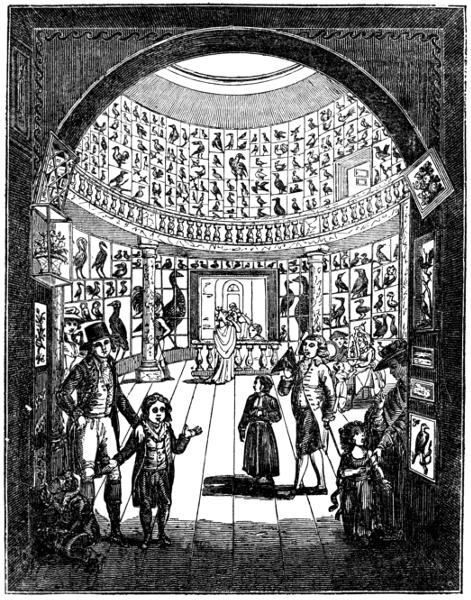
The Leverian Museum.
On Friday the eighteenth of July, 1806, the sale of the magnificent collection of natural history and curiosities formed by sir Ashton Lever, was concluded by Messrs. King and Lochee, of King-street, Covent-garden.
It is impossible to give an adequate account of the “Leverian Museum,” but its celebrity throughout Europe seems to require some further notice than a bare mention: a few facts are subjoined to convey an idea of its extent, and of the gratification the lovers of natural history and antiquities must have derived from its contemplation.
The last place wherein the Leverian collection was exhibited, was in a handsome building on the Surrey side of the Thames, near Blackfriars-bridge, consisting of seventeen different apartments, occupying nearly one thousand square yards. In these rooms were assembled the rarest productions in the animal, vegetable, and mineral kingdoms, with inimitable works of art, and the various dresses, manufactures, implements of war, &c. of the Indian nations in North and South America, Otaheite, Botany-bay and other foreign parts, collected by the late captain Cook and other navigators.
The preceding engraving represents the rotunda of the museum, from a print published about twenty years before the sale took place. It is an accurate record of the appearance of that part of the edifice, until the auction, which was held on the premises, finally broke up the rare assemblage of objects exhibited. After the sale the premises were occupied for many years by the library, apparatus, and other uses of the Surrey Institution. They are now, in 1826, used for recreation of another kind. On the exterior of the building is inscribed “Rotunda Wine Rooms.” It is resorted to by lovers of “a good glass of wine” and “a cigar,” and there is professional singing and music in “the Rotunda” every Tuesday and Thursday evening.
The last editor of Mr. Pennant’s “London,” in a note on his author’s mention of the Leverian Museum, remarks its dispersion, by observing that “this noble collection, which it is said was offered to the British Museum for a moderate sum, was sold by auction in 1806. The sale lasted thirty-four days. The number of lots, many containing several articles, amounted to four thousand one hundred and ninety-four.”
This statement is somewhat erroneous. An entire copy of the “Catalogue of the Leverian Museum,” which was drawn up by Edward Donavan, Esq. the eminent naturalist, is now before the editor of the Every-Day Book, with the prices annexed. It forms an octavo volume of four hundred and ten pages, and from thence it appears that the sale lasted sixty-five days, instead of thirty-four, and that the lots amounted to 7879, instead of 4194, as stated by Mr. Pennant’s editor.