MARCH.
Reading edition
Now husbandman and hinds in March prepare, And order take, against the teeming year, Survey their lands, and keep a good look out To get their fields and farms well fenc’d about. Now careful gard’ners, during sunny days, Admit to greenhouses the genial rays: Vines, espaliers, and standard trees demand The pruner’s skilful eye, and ready hand; And num’rous shoots and roots court the kind toil Of transplantation, or another soil.
*
In the “Mirror of the Months” it is observed, that at this season a strange commotion may be seen and heard among the winged creatures, portending momentous matters. The lark is high up in the cold air before daylight, and his chosen mistress is listening to him down among the dank grass, with the dew still upon her unshaken wing. The robin, too, has left off, for a brief season, his low plaintive piping, which it must be confessed was poured forth for his own exclusive satisfaction, and, reckoning on his spruce looks and sparkling eyes, issues his quick peremptory love-call, in a somewhat ungallant and husband-like manner.
The sparrows, who have lately been sulking silently about from tree to tree, with ruffled plumes and drooping wings, now spruce themselves up till they do not look half their former size; and if it were not pairing-time, one might fancy that there was more of war than of love in their noisy squabblings.
Now, also, the ants first begin to show themselves from their subterranean sleeping-rooms; those winged abortions, the bats, perplex the eyes of evening wanderers by their seeming ubiquity; and the owls hold scientific converse with each other at half a mile distance.
Now, quitting the country till next month, we find London all alive, Lent and Lady-day notwithstanding; for the latter is but a day after all; and he must have a very countrified conscience who cannot satisfy it as to the former, by doing penance once or twice at an oratorio, and hearing comic songs sung in a foreign tongue; or, if this does not do, he may fast if he please, every Friday, by eating salt fish in addition to the rest of his fare.
During this month some birds that took refuge in our temperate climate, from the rigour of the arctic winters, now begin to leave us, and return to the countries where they were bred; the redwing-thrush, fieldfare, and woodcock, are of this kind, and they retire to spend their summer in Norway, Sweden, and other northern regions. The reason why these birds quit the north of Europe in winter is evidently to escape the severity of the frost; but why at the approach of spring they should return to their former haunts is not so easily accounted for. It cannot be want of food, for if during the winter in this country they are able to subsist, they may fare plentifully through the rest of the year; neither can their migration be caused by an impatience of warmth, for the season when they quit this country is by no means so hot as the Lapland summers; and in fact, from a few stragglers or wounded birds annually breeding here, it is evident that there is nothing in our climate or soil which should hinder them from making this country their permanent residence, as the thrush, blackbird, and other of their congeners, actually do. The crane, the stork, and other birds, which used formerly to be natives of our island, have quitted it as cultivation and population have extended; it is probable, also, that the same reason forbids the fieldfare and redwing-thrush, which are of a timorous, retired disposition, to make choice of England as a place of sufficient security to breed in.[73]
In this month commences the yeaning season of those gentle animals whose clothing yields us our own, and engages in its manufacture a large portion of human industry and ingenuity. The poet of “The Fleece” beautifully describes and admonishes the shepherd of the accidents to which these emblems of peace and innocence are exposed, when “abroad in the meadows beside of their dams.”
Spread around thy tend’rest diligence In flow’ry spring-time, when the new-dropt lamb, Tott’ring with weakness by his mother’s side, Feels the fresh world about him; and each thorn, Hillock, or furrow, trips his feeble feet: O, guard his meek sweet innocence from all Th’ innumerous ills, that rush around his life: Mark the quick kite, with beak and talons prone, Circling the skies to snatch him from the plain; Observe the lurking crows; beware the brake, There the sly fox the careless minute waits; Nor trust thy neighbour’s dog, nor earth, nor sky; Thy bosom to a thousand cares divide. Eurus oft slings his hail; the tardy fields Pay not their promis’d food; and oft the dam O’er her weak twins with empty udder mourns, Or fails to guard, when the bold bird of prey Alights, and hops in many turns around, And tires her also turning: to her aid Be nimble, and the weakest, in thine arms, Gently convey to the warm cote, and oft, Between the lark’s note and the nightingale’s, His hungry bleating still with tepid milk; In this soft office may thy children join, And charitable habits learn in sport: Nor yield him to himself, ere vernal airs Sprinkle thy little croft with daisy flowers.
Dyer.
March 1.
St. David’s Day.
To the particulars connected with this anniversary, related in vol. i. p. 317-322, may be added that Coles, in his “Adam in Eden,” says, concerning leeks, “The gentlemen in Wales have them in great regard, both for their feeding, and to wear in their hats upon St. David’s day.”
It is affirmed in the “Royal Apophthegms” of James I., that “the Welchmen in commemoration of the Great Fight by the Black Prince of Wales, do wear Leeks as their chosen ensign.”
Mr. Brand received through the late Mr. Jones, Welsh bard to the king, as prince of Wales, a transcript of the following lines from a MS. in the British Museum.
I like the leeke above all herbes and flowers. When first we wore the same the feild was ours. The leeke is white and greene, wherby is ment That Britaines are both stout and eminent; Next to the lion and the unicorn, The leeke’s the fairest emblyn that is worne.
Harl. MS. 1977.
The bishop’s “Last Good Night,” a single sheet satire, dated 1642, has a stanza which runs thus:—
“Landaff, provide for St. David’s day, Lest the leeke, and red-herring run away: Are you resolved to go or stay? You are called for, Landaff: Come in, Landaff.”
There is the following proverb on this day:—
“Upon St. David’s day, put oats and barley in the clay.”
Ray.
NATURALISTS’ CALENDAR.
Mean Temperature 42·27.
March 2.
Strange Narrative.
A rare quarto tract alleges some extraordinary appearances in Ireland on this day in the year 1679. It is here reprinted verbatim, beginning with the title-page: viz.
A true Account of divers most strange and prodigious Apparitions seen in the Air at Poins-town, in the county of Tipperary, in Ireland: March the second, 1678-9. Attested by Sixteen Persons that were Eye-witnesses. Published at Dublin, and thence communicated hither. Licensed, 1679. London: printed for L. C., 1679.
Upon the second day of this present month, being Sunday in the evening, near sun-set, several gentlemen and others, hereinafter named, walked forth into the fields, and the sun going down behind a hill, and appearing somewhat bigger than ordinary, they discourst about it, directing their eyes towards the place where the sun set.
When one of the company observed in the air, near the place where the sun went down, an arm of a blackish blew colour, with a ruddy complexioned hand at one end and at the other end a cross piece, with a ring fastned to the middle of it, like one end of an anchor, which stood still a while, and then made northwards, and so disappeared; while they were startled at the sight which they all saw, and wondred what it should be and mean, there appeared at a great distance in the air, from the same part of the sky, something like a ship coming towards them; and so near to them it came, that they could distinctly perceive the masts, sails, tacklings, and men; she then seemed to tack about, and sailed with the stern foremost, northwards, upon a dark, smooth sea, (not seen before,) which stretched itself from south-west to the north-west; having seemed thus to sail for some few minutes, she sunk by degrees into the sea, her stern first, and as she sunk, they perceived her men plainly running up the tackling, in the fore-part of the ship, as it were, to save themselves from drowning.
The ship disappearing, they all sate down on a green bank, talking of, and wondring at what they had seen, for a small space, and then appeared (as that ship had done) a fort, or high place strongly fortifyed, with somewhat like a castle on the top of it: out of the sides of which, by reason of some clouds of smoake, and a flash of fire suddenly issuing out, they concluded some shot to be made. The fort then immediately was divided into two parts, which were in an instant transformed into two exact ships, like the other they had seen, with their heads towards each other. That towards the south, seemed to chase the other with its stern foremost, northwards, till it sunk with its stern first, as the first ship had done. The other ship sayled sometime after, and then sunk with its head first. It was observed, that men were running upon the decks in these two ships, but they did not see them climb up, as in the last ship, excepting one man, whom they saw distinctly to get up with much haste upon the very top of the bowsprit of the second ship, as they were sinking. They supposed the two last ships were engaged and fighting, for they saw like bullets rouling upon the sea, while they were both visible.
The ships being gone, the company rose, and were about to go away, when one of them perswaded the rest to stay, and said, he saw some little black thing coming towards them, which he believed would be worth their observation, then some of the rest observed the same; whereupon, they sate down again, and presently there appeared a chariot, somewhat like that which Neptune is represented riding in, drawn with two horses, which turned as the ships had done, northward. And immediately after it, came a strange frightful creature, which they concluded to be some kind of serpent, having an head like a snake, and a knotted bunch or bulk at the other end, something resembling a snail’s house.
This monster came suddenly behind the chariot, and gave it a sudden violent blow, then out of the chariot straight leaped a bull and a dog, which following him seemed to bait him: these also went northward, as the former phenomena had done, the bull first holding his head downward, then the dog, and then the chariot, till they all sunk down one after another, about the same place, and just in the same manner as the former.
These last meteors being vanished, there were several appearances like ships, and other things, in the same place, and after that like order with the former; but the relators were so surprised and pleased with what they had seen, especially with the bull and dog, that they did not much observe them; and besides, they were not so visible as the rest, the night drawing on so fast, that they could not well discern them.
The whole time of the vision or representation lasted near an hour, and it was observable, that it was a very clear and a very calm evening, no cloud seen, no mist, nor any wind stirring. All the phenomena came out of the west, or south-west. They seemed very small, and afar off, and at first seemed like birds at a good distance, and then being come to the place, where there was the appearance of a sea, they were discerned plainly in their just proportion. They all moved northwards, the ships, as appeared by their sails, went against the wind; they all sunk out of sight, much about the same place. When they disappeared, they did not dilate themselves, and become invisible as clouds do, but every the least part of them, was as distinctly seen at the last, as they had been all along. The height of the scene on which these meteors moved, was about as much above the horizon, as the sun is being half an hour high. Of the whole company, there was not any one but saw all those things, as above written; all agreed in their notions and opinions about them, and were all the while busie talking concerning what they saw, either much troubled, or much pleased, according to the nature of the appearance.
The names of the persons who saw the foregoing passage:
Mr. Allye, a minister, living near the place. Lieutenant Dunstervile and his son. Mr. Grace, his son-in-law.
Lieutenant Dwine, Mr. Dwine, his brother,
} Scholars and Travellers.
Mr. Christopher Hewelson. Mr. Richard Foster. Mr. Adam Hewelson. Mr. Bates, a schoolmaster. Mr. Larkin. Mrs. Dunstervile, her daughter-in-law, her maiden-daughter. Mr. Dwine’s daughter. Mrs. Grace, her daughter.
This account was given by Mr. C. Hewelson and Mr. R. Foster, two of the beforenamed spectators: and when it was related, a servant of Mr. C. H., being present, did confirm the truth of it; affirming, that he and others of the servants being then together at Poins-town, in another place, saw the very same sights, and did very much wonder at them. Finis.
This wonderful wonder is worthy of preservation, for the very reason that renders it scarcely worthy of remark. It was a practice, before the period when the preceding tract was printed, for partisans to fabricate and publish strange narratives in behalf of the side they pretended to aid, with the further view of blackening or injuring those whom they opposed. Such stories were winked at as “pious frauds,” and found ready sale among the vulgar. As parties declined, the business of the writers and venders of such productions declined, and some among them of desperate fortune resorted to similar manufactures on any subject likely to astonish the uninformed. The present “True Account” may be regarded as a curious specimen of this kind of forgery. The pamphlet was printed in London; the scene being laid in Ireland, it probably never reached Poins-town, and if it even travelled thither, the chance is that there were only a few who could read it, and certainly none of those few were interested in its contradiction. At the present time it is common in Somersetshire to hear a street-hawker crying, “A wonderful account of an apparition that appeared in Hertfordshire,” and selling his papers to an admiring crowd; the same fellow travelling into Hertfordshire, there cries the very same “Apparition that appeared in Somersetshire;” and his printed account equally well authenticates it to a similarly constituted audience.
NATURALISTS’ CALENDAR.
Mean Temperature 42·80.
March 3.
St. Winwaloe.
This saint is called Winwaloc, by father Cressy, and Winwaloke by father Porter.
St. Winwaloe’s father, named Fragan, or Fracan, was nearly related to Cathoun, one of the kings or princes of Wales. In consequence of Saxon invasions, Fragan emigrated from Wales to Armorica, where the spot he inhabited is “called from him to this day Plou-fragan.” Whether Winwaloe was born there or in Wales is uncertain; but he was put under St. Budoc, a British abbot of a monastery in Isleverte, near the isle of Brebat, from whence with other monks he travelled, till they built themselves a monastery at Landevenech, three leagues from Brest.
He died in 529, at an advanced age.[74]
Father Cressy says, that St. Winwaloe worked many miracles; “among which the most stupendous was his raising a young man to life.” He further tells, that “St. Patrick presented himself to him in a vision, with an angelicall brightnes, and having a golden diadem on his head,” and told him he paid him a visit, to prevent Winwaloe, who desired to see him, “so tedious a journey by sea and land.” St. Patrick in this interview foretold St. Winwaloe so much, that the father of his monastery released him with the other monks before-mentioned, that they might become hermits; for which purpose they travelled, till, wanting a ship, St. Winwaloe struck the sea with his staff, which opened a passage for them, and they walked through singing, and dryshod, “himself marching in the front, the waters on both sides standing like walls.” Father Cressy says, that St. Winwaloe never sat in the church; that “every day he repeated the hundred and fifty psalms;” that to his bed he had neither feathers nor clothes, “but instead of feathers he strewed under him nutshells, and instead of blankets, sand mingled with pebbles, and two great stones under his head;” that he wore the same clothes night and day; that his bread was made with half of barley and half of ashes; that his other diet was a mixture of meal and cabbage without fat; and that “he took this refection once, only in two, and sometimes three dayes.”
Besides other particulars, Cressy adds, that “a town in Shropshire, called even in the Saxons’ time Wenlock, (which seems a contraction from Winwaloc,) from him took its denomination.”
He vanquisheth the Devil, &c.
So father Porter entitles one of his particulars concerning St. Winwaloe, which he relates in his “Flowers of the Saincts” in these words: “The devill envying soe great sanctitie, endeavoured with his hellish plotts to trouble and molest his pious labours, appeared unto him as he prayed in his oratorie, in the most uglie and horrid shapes that the master of wickednes could invent, vomitting out of his infernall throate manie reprochfull wordes against him; when he nothing dismayed thereat, courageously proceeded in his devotions, and brandishing the chief armes of life, the holy crosse, against that black messenger of death, he compelled him to vanish away in confusion.”
St. Winwaloe and the cruel Goose.
Bishop Patrick, in his “Reflexions upon the Devotions of the Roman Church,” cites from the latin “Acts of the Saints,” a miracle which is quite as miraculous as either of the preceding. “A sister of St. Winwaloc had her eye plucked out by a goose, as she was playing. St. Winwaloc was taught by an angel a sign whereby to know that goose from the rest, and having cut it open, found the eye in its entrails, preserved by the power of God unhurt, and shining like a gem; which he took and put it again in its proper place, and recovered his sister; and was so kind also to the goose as to send it away alive, after it had been cut up, to the rest of the flock.”
WINNOLD FAIR, NORFOLK.
A correspondent, whose signature has before appeared, transmits the annexed communication concerning the hamlet of Winnold, and the fair held there annually on this day.
For the Every-Day Book.
A priory, dedicated to St. Winwaloe, was founded by the family of the earls of Clare, before the seventh year of king John, (1206,) in a hamlet, (thence called, by corruption, the hamlet of Whinwall, Winnold, or Wynhold,) belonging to the parish of Wereham, in Norfolk, as a cell to the abbey of Mounstroll, of the order of St. Bennet, in the diocese of Amiens, in France. In 1321, the abbot and convent sold it to Hugh Scarlet, of London, who conveyed it to the lady Elizabeth de Burso, the sister and coheir of Gilbert, earl of Clare, and she afterwards gave it to West Dereham abbey, situate a few miles from Wereham. At the general dissolution it was valued, with West Dereham, at 252l. 12s. 11d. (Speed,) and 228l. (Dugdale.) Little of the priory is now remaining, except a part which is thought to have been the chapel.
A fair for horses and cattle on this day, which was originally kept in this hamlet of Winnold, has existed probably from the foundation of the priory, as it is mentioned in the tenth of Edward III. (1337,) when the priory and the fair were given to West Dereham abbey. Though the abbey and priory, as establishments, are annihilated, the fair (probably from its utility) has continued with reputation to the present day. Soon after the dissolution, it was removed to the adjoining parish of Wimbotsham, and continued to be held there till within the last thirty years, when it was again removed a few miles further, to the market town of Downham, as a more convenient spot, and is now kept in a field there, called, for reasons unknown, “the Howdell,” and is at this time a very large horse and cattle fair; but, though it has undergone these removals, it still retains its ancient, original appellation of “Winnold Fair.”[75] This fair, which is perhaps of greater antiquity than any now kept in the kingdom, will probably preserve the memory of St. Winnold, in the west of Norfolk and the adjoining counties, for centuries to come, above the whole host of his canonized brethren. He is also commemorated, by the following traditional West Norfolk proverbial distich:—
“First comes David, next comes Chad, And then comes Winnold as though he was mad.”
noticing the two previous days in March, (the first and second,) and in allusion to the prevalence of windy weather at this period. Whether St. Winnold, in the zenith of his fame, was remarkable for an irascibility of temper, I am not enabled to say; yet it rarely happens when the first few days in March are not attended with such boisterous and tempestuous weather, generally from the north, that he might not improperly be termed the Norfolk “Boreas.”
K.
NATURALISTS’ CALENDAR.
Mean Temperature 42·10.
March 4.
A Flower of the Season.
The fair author of the “Flora Domestica” inquires, “Who can see, or hear the name of the daisy, the common field daisy, without a thousand pleasurable associations? It is connected with the sports of childhood and with the pleasures of youth. We walk abroad to seek it; yet it is the very emblem of home. It is a favourite with man, woman, and child: it is the robin of flowers. Turn it all ways, and on every side you will find new beauty. You are attracted by the snowy white leaves, contrasted by the golden tuft in the centre, as it rears its head above the green grass: pluck it, and you will find it backed by a delicate star of green, and tipped with a blush-colour, or a bright crimson.
‘Daisies with their pinky lashes’
are among the first darlings of spring. They are in flower almost all the year; closing in the evening, and in wet weather, and opening on the return of the sun.”
In the poem of a living poet are these elegant stanzas:
To the Daisy.
A nun demure, of lowly port; Or sprightly maiden of Love’s court, In thy simplicity the sport Of all temptations; A queen in crown of rubies drest; A starveling in a scanty vest; Are all, as seem to suit thee best, Thy appellations. A little Cyclops, with one eye Staring to threaten or defy, That thought comes next, and instantly The freak is over; The freak will vanish, and behold! A silver shield with boss of gold, That spreads itself, some fairy bold In fight to cover. I see thee glittering from afar; And then thou art a pretty star, Not quite so fair as many are In heaven above thee! Yet like a star, with glittering crest, Self-poised in air, thou seem’st to rest;— May peace come never to his nest, Who shall reprove thee. Sweet flower! for by that name at last, When all my reveries are past, I call thee, and to that cleave fast; Sweet silent creature! That breath’st with me in sun and air, Do thou, as thou art wont, repair My heart with gladness, and a share Of thy meek nature.
Wordsworth.
This evergreen of flowers is honoured by the same delightful bard in other poems; our young readers will not find fault if they are again invited to indulge; and the graver moralist will be equally gratified.
To the Daisy.
In youth from rock to rock I went, From hill to hill, in discontent Of pleasure high and turbulent, Most pleased when most uneasy; But now my own delights I make,— My thirst at every rill can slake, And gladly Nature’s love partake Of thee, sweet daisy! When soothed awhile by milder airs, Thee Winter in the garland wears That thinly shades his few grey hairs; Spring cannot shun thee; Whole summer fields are thine by right; And Autumn, melancholy wight, Doth in thy crimson head delight When rains are on thee. In shoals and bands, a morrice train, Thou greet’st the traveller in the lane; If welcomed once, thou count’st it gain; Thou art not daunted, Nor carest if thou be set at naught: And oft alone in nooks remote We meet thee, like a pleasant thought, When such are wanted. Be violets in their secret mews The flowers the wanton Zephyrs choose; Proud be the rose, with rains and dews Her head impearling; Thou liv’st with less ambitious aim, Yet hast not gone without thy fame Thou art indeed by many a claim The poet’s darling. If to a rock from rains he fly, Or some bright day of April sky, Imprisoned by hot sunshine lie Near the green holly, And wearily at length should fare; He need but look about, and there Thou art!—a friend at hand, to scare His melancholy. A hundred times, by rock or bower, Ere thus I have lain couched an hour, Have I derived from thy sweet power Some apprehension; Some steady love; some brief delight; Some memory that had taken flight; Some chime of fancy, wrong or right; Or stray invention. If stately passions in me burn, And one chance look to thee should turn, I drink out of an humbler urn A lowlier pleasure; The homely sympathy that heeds The common life, our nature breeds; A wisdom fitted to the needs Of hearts at leisure. When, smitten by the morning ray, I see thee rise alert and gay, Then, cheerful flower! my spirits play With kindred gladness: And when, at dusk, by dews opprest Thou sink’st, the image of thy rest Hath often eased my pensive breast Of careful sadness. And all day long I number yet, All seasons through, another debt, Which I, wherever thou art met, To thee am owing; An instinct call it, a blind sense; A happy genial influence, Coming one knows not how nor whence, Nor whither going. Child of the year! that round dost run Thy course, bold lover of the sun, And cheerful when the day’s begun As morning leveret, Thy long-lost praise thou shalt regain; Dear shalt thou be to future men As in old time;—thou, not in vain, Art Nature’s favourite.
NATURALISTS’ CALENDAR.
Mean Temperature 42·10.
March 5.
1826.—Mid Lent Sunday.
For particulars of this day, see vol. i. p. 358.
FLOWERS.
Yes—Flowers again! It is the season of their approach; therefore make ready for their coming, and listen to the fair herald who is eloquent in praise of their eloquence. She tells us, in her “Flora Domestica,” and who dare deny? that “flowers do speak a language, a clear and intelligible language: ask Mr. Wordsworth, for to him they have spoken, until they excited ‘thoughts that lie too deep for tears;’ ask Chaucer, for he held companionship with them in the meadows; ask any of the poets, ancient or modern. Observe them, reader, love them, linger over them; and ask your own heart, if they do not speak affection, benevolence, and piety. None have better understood the language of flowers than the simple-minded peasant-poet, Clare, whose volumes are like a beautiful country, diversified with woods, meadows, heaths, and flower-gardens:
Bowing adorers of the gale, Ye cowslips delicately pale, Upraise your loaded stems; Unfold your cups in splendour, speak! Who decked you with that ruddy streak, And gilt your golden gems? Violets, sweet tenants of the shade, In purple’s richest pride arrayed, Your errand here fulfil; Go bid the artist’s simple stain Your lustre imitate, in vain, And match your Maker’s skill. Daisies, ye flowers of lowly birth, Embroiderers of the carpet earth, That stud the velvet sod; Open to spring’s refreshing air, In sweetest smiling bloom declare Your Maker, and my God.”
Clare.
NATURALISTS’ CALENDAR.
Mean Temperature 39·69.
March 6.
NATURALISTS’ CALENDAR.
Mean Temperature 40·22.
Merriment in March.
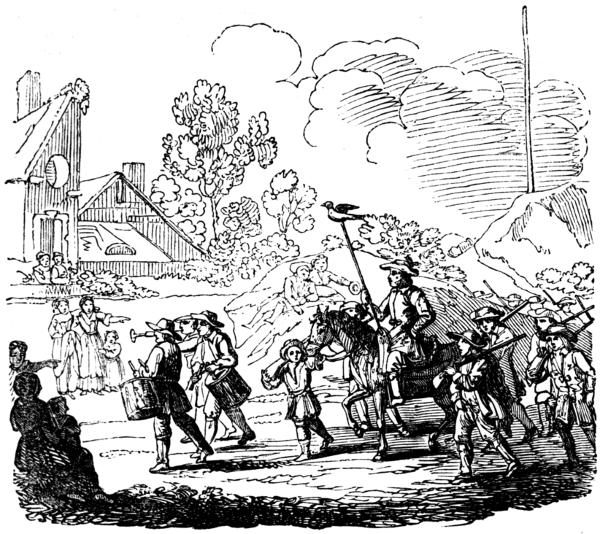
Merriment in March.
The wooden bird on horseback showing, By beat of drum with pipers blowing, They troop along huzzaing, tooting, To hold their annual game of shooting.
*
This is a French sport, which, according to a print from whence the present representation was taken, is peculiar to the month of March. The inscription on the engraving just mentioned, is—
MARS. REJOUISSANCES DU PAPEGUAY.
Les Triomphes d’un Conquérant Font voir plus de magnificence: Mais au défaut de l’opulence, Ceux cy ne coutent point de Sang.
The “Papeguay,” Papegai, or Papegaut, is “a wooden bird to shoot at, a shaw fowl.”[76] This wooden bird in the print is carried on a pole by the man on horseback, attended by those who are about to partake of the sport, and preceded by music. It seems to be a rustic amusement, and, perhaps, some light may be thrown on it by the following account from Miss Plumtre’s “Residence in France.” She says, that in connection with the church of St. John, at Aix, which formerly belonged to the knights of St. John of Jerusalem, there is a ceremony which used to be called Le Bravade de St. Jean d’Aix, instituted in the year 1272, on the return of the army which had followed Louis IX. or St. Louis, in his last expedition to Egypt and the Holy-land. According to Miss Plumptre, it was held on the eve of St. John the Baptist. A large bird of any kind was tethered in a field without the town, so that it could fly only to a certain height, and the youth of the place, those only of the second order of nobles, took aim at him with their bows and arrows in presence of all the nobility, gentry, and magistracy. He who killed the bird was king of the archers for the year ensuing, and the two who had gone the nearest after him were appointed his lieutenant and standard-bearer; he also nominated several other officers from among the competitors. The company then returned into the town, the judges of the contest marching first, followed by the victors: bonfires were made in several parts, round which the people danced, while the king and his officers went from one to the other till they had danced by turns at them all. The same diversions were repeated the following day; and both evenings the king, at the conclusion of them, was attended home by his officers and a concourse of people, among whom he distributed largesses to a considerable amount.
At the first institution of this ceremony, the intention of which was to incite the young men to render themselves expert marksmen, the king enjoyed very extensive privileges during the year; but in latter times they had been reduced to those of wearing a large silver medal which was presented to him at his accession, of enjoying the right of shooting wherever he chose, of partaking in the grand mass celebrated by the order of Malta at their church on the festival of St. John, and of being exempted from lodging soldiers, and paying what was called Le droit de piquet, a tax upon all the flour brought into the town. After the invention of the arquebuse, instead of shooting at a live bird with arrows, they fired at a wooden bird upon a pole, and he who could bring it down was appointed king: any one who brought it down two years together was declared emperor, and in that quality exempted for life from all municipal taxes. This ceremony continued till the revolution.
It appears from hence that this custom of shooting at a wooden bird on St. John’s eve is very similar to that which the engraving represents, as the merriment of the Papeguay, or wooden bird, belonging to the month of March.
Anecdotes of Browne Willis, The Antiquarian.
To the portrait of this eminent antiquary at p. 194, is annexed the day of his birth, in 1682, and the day whereon he died, in 1760. That engraving of him is after an etching made “in 1781, at the particular request of the Rev. William Cole, from a drawing made by the Rev. Michael Tyson, from an original painting by Dahl.” Mr. Cole, in a letter to Mr. Steevens, speaks of the etching thus: “The copy pleases me infinitely; nothing can be more exact and like the copy I sent, and which, as well as I can recollect, is equally so to the original. Notwithstanding the distance of time when Dahl drew his portrait and that in which I knew him, and the strange metamorphose that age and caprice had made in his figure, yet I could easily trace some lines and traits of what Mr. Dahl had given of him.” Agreeably to the promise already given, some particulars remain to be added concerning the distinguished individual it represents.
Browne Willis was grandson of Dr. Thomas Willis, the most celebrated physician of his time, and the eldest son of Thomas Willis, esq., of Bletchley, in the county of Bucks. When at Westminster school, “the neighbouring abbey drew his admiration: here he loved to walk and contemplate. The solemnity of the building, the antique appearance, the monuments, filled his whole mind. He delighted himself in reading old inscriptions. Here he first imbibed the love of antiquities, and the impression grew indelible.” At seventeen he was admitted a gentleman commoner of Christ Church college; in 1705 he represented the town of Buckingham in parliament, where he constantly attended, and often sat on committees; in 1707 he married; in 1718 he became an active member of the society of antiquaries; in 1720 the university of Oxford conferred on him the degree of M. A. by diploma; and in 1740 he received from it the degree of LL.D. On the 11th of February, 1760, he was buried in Fenny Stratford chapel, an edifice which, though he founded it himself, he was accustomed to attribute to the munificence of others, “who were in reality only contributors.” Of his numerous antiquarian works the principal are “Notitia Parliamentaria, or an History of the Counties, Cities, and Boroughs in England and Wales,” 3 vols. 8vo. “Mitred Abbies, &c.” 2 vols. 8vo. “Cathedrals of England,” 3 vols. 4to. and 4 vols. 8vo.—He attained a most extensive erudition in the topographical, architectural, and numismatic remains of England by devoting his life to their study, which he pursued with unabated ardour, uncheered by the common hope of deriving even a sufficiency from his various publications to defray their expenses. In a letter to his friend Dr. Ducarel, when he was seventy-four years of age, he says, “I am 100l. out of pocket by what I have printed; except my octavo of Parliaments, which brought me 15l. profit, though I gave it all away, and above 20l. more to build Buckingham tower steeple; and now, as I hoped for subscription to this book, (his last work, the History of the Town and Hundred of Buckingham) am like to have half the impression on my hands. Sold only 69 copies, of which to gentlemen of Buckinghamshire, only 28.” In the same year, 1756, he writes to one of his daughters, “I have worked for nothing; nay, except in one book, have been out of pocket, and at great expense in what I printed.” He considerably impaired his fortune by the scrupulosity and magnitude of his researches and collections, which he persevered in till he grew so weak and infirm that he had not strength to reach down and turn over his books, or draw up particulars with his own hands. Yet even then, in his seventy-eighth year, he amused himself by inquiries concerning “Bells,” and obtained returns of the contents of belfries in nearly six hundred parishes of the county of Lincoln, which he entered in the “Parochiale Anglicanum.”
An account of Dr. Willis was read to the society of antiquaries, by his friend Dr. Ducarel, who sums up his character in these words:—“This learned society, of which he was one of the first revivers, and one of the most industrious members, can bear me witness that he was indefatigable in his researches; for his works were of the most laborious kind. But what enabled him, besides his unwearied diligence, to bring them to perfection, was, his being blessed with a most excellent memory. He had laid so good a foundation of learning, that, though he had chiefly conversed with records, and other matters of antiquity which are not apt to form a polite style, yet he expressed himself, in all his compositions, in an easy and genteel manner. He was, indeed, one of the first who placed our ecclesiastical history and antiquities upon a firm basis, by grounding them upon records and registers; which, in the main, are unexceptionable authorities. During the course of his long life, he had visited every cathedral in England and Wales, except Carlisle; which journeys he used to call his pilgrimages. In his friendships none more sincere and hearty; always communicative, and ever ready to assist every studious and inquisitive person: this occasioned an acquaintance and connection between him and all his learned contemporaries. For his mother, the university of Oxford, he always expressed the most awful respect and the warmest esteem. As to his piety and moral qualifications, he was strictly religious, without any mixture of superstition or enthusiasm, and quite exemplary in this respect: and of this, his many public works, in building, repairing, and beautifying of churches, are so many standing evidences. He was charitable to the poor and needy; just and upright towards all men. In a word, no one ever deserved better of the society of antiquaries; if industry and an incessant application, throughout a long life, to the investigating the antiquities of this national church and state, is deserving of their countenance.”
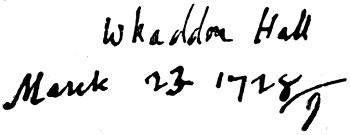
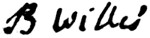
The editor of the Every-Day Book possesses an unprinted letter written by Dr. Willis to the learned bishop Tanner, when chancellor of Norwich. A copy of this letter is subjoined, together with a fac-simile of its date and the place from whence it was addressed, in Dr. Willis’s hand-writing, and a further fac-simile of his autograph at the conclusion. The epistle is written on a proof impression of “The Ichnography or Platform of the Cathedral Church of Christ Church in Oxford,” one of the plates in Dr. Willis’s “Cathedrals,” relative to which, as well as other works, he sought information from his distinguished brother antiquary. This letter is a good specimen of Dr. Willis’s epistolary style of communication, and of that minuteness of investigation which is indispensable to antiquarian labours: it likewise testifies his solicitude for the education of his eldest son “Tom,” who died four years before himself, and expresses a natural desire that Dr. Tanner would visit his ecclesiastical foundation at Fenny Stratford.
Copy.
To The Rev. Dr. Tanner Chancellor of Norwich att Norwich
Dear Mr. Chancellor,
I am honoured with yours just now received, and though weary with a journey being come home to night after 3 days absence, and lying out of my Bed which I have not done since Sir Thomas Lee’s Election in January, yet I cannot omitt paying my duty to you and thanking you for the favour and satisfaction yours gave mee—I have printed above 20 Prebendal Stalls of Lincoln but it does not goe on so fast as I would have it, else I should soon come to Ely, but I doubt I shall stay a long time for the draughts, wherefore I pray when you write to Dr. Knight press his getting them done out of hand—I have here one of Christ-church which I write upon that you may give your opinion—I shall be very glad you approve it, wee cannot well put in more references. As to the Prebendarys of Lincoln, since I have wrote 5 or 6 letters to the Bishop without an answer, I am obliged to be contented. I should be glad of Thomas Davies’s Epitaph from Bexwell. He was vicar of Siston co: Leicester and A.M. as my Account says. I have only 4 or 5 to enquire after that I shall be so eager to find, viz. Joshua Clark (Prebendary) of Cester, who died 1712. I have wrote to his 2 successors and cannot hear one word: The others I want are John Davenport, Mr. Davies’s predecessor in Sutton Prebend, and Henry Morland or Merland who died about 1704; but I would more particularly enquire after Thomas Stanhope, who, about 1668, was installed into the Prebend of Sutton cum Buckingham—I shall be thankfull for any Information of him, as I am of all opportunitys of hearing from you, and design to lay by your papers of Ely to send you again: but I am teized sadly about Bishop Lloyd of Norwich’s great Seal, and the circumscription round it, and have had 2 letters this week on that account: what my importunate correspondent wants is, the circle of writing round the Episcopal Seal in which he wrote his name Gulielimus: I am ashamed to repeat this Impertinence to which I pray a quick answer, especialy as to another subject of the greatest consequence of all, which is about placing my Eldest Son at Christ-church, where I design to make him a commoner, for he must study hard—I am to consult about a Tutor, and would gladly have one you have a confidence in; there are recommended Mr. Allen, Mr. Bateman, and Mr. Ward; now if you can answer for ever an one of these, and that he will, on your friendshipp or the Dean’s, have a more particular eye to Tom, whom I dont design to continue above 2 or 3 years at most, I shall be very thankfull for your recommendation. And so pray dear Mr. Chancellor write soon and advise mee, but I hope your affairs will call you to Oxford, and that you will take mee in your way and see Stratford chapell, which is very near, and your ever obliged and devoted Servant in all things,
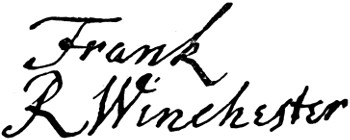
Browne Willis’s letter is franked by Dr. Richard Willis, bishop of Winchester, who was translated to that see from the bishopric of Salisbury, in 1723. A fac-simile of his autograph, on this occasion, is annexed.
The character of Dr. Willis, by Dr. Ducarel, records his “pilgrimages” to “every cathedral in England and Wales, except Carlisle.” The antiquity, and the purposes of religious buildings, were objects of his utmost veneration; and he had the remarkable propensity of visiting churches on the festival-day of the saint to whom they were dedicated. In Fenny Stratford chapel he placed the following lines, “to the memory of Thomas Willis, M.D.,” his grandfather, through whom he derived his patrimonial estates:—
In honour to thy mem’ry, blessed Shade! Was the foundation of this chapel laid. Purchas’d by thee, thy son, and present heir, Owes these three manors to thy sacred care. For this, may all thy race thanks ever pay, And yearly celebrate St. Martin’s day!
B. W.
A letter he wrote within three months before his death particularizes his regard of festival-days.
Mr. Nichols transcribes a letter which he wrote very late in life, dated Nov. 13, 1759: “Good Mr. Owen, This comes to thank you for your favour at Oxford at St. Frideswide’s festival; and as your Bodleian visitation is over, I hope you are a little at liberty to come and see your friends; and as you was pleased to mention you would once more make me happy with your good company, I wish it might be next week, at our St. Martin’s anniversary at Fenny Stratford, which is Thursday se’nnight, the 22d instant, when a sermon will be preached by the minister of Buckingham: the last I am ever like to attend, so very infirm as I am now got; so that I stir very little out of the house, and it will therefore be charity to have friends come and visit me.”
Mr. Gough’s manuscripts relate of Dr. Willis, that “he told Mr. S. Bush he was going to Bristol on St. Austin’s-day to see the cathedral, it being the dedication day.” It is added, that “he would lodge in no house at Bath but the Abbey-house: he said, when he was told that Wells cathedral was 800 years old, there was not a stone of it left 500 years ago.”
Miss Talbot, “in an unprinted letter to a lady of first-rate quality,” dated from the rectory house of St. James’s parish, (Westminster,) January 2, 1739, humorously describes him and says, “As by his little knowledge of the world, he has ruined a fine estate, that was, when he first had it, worth 2000l. per annum, his present circumstances oblige him to an odd-headed kind of frugality, that shows itself in the slovenliness of his dress, and makes him think London much too extravagant an abode for his daughters; at the same time that his zeal for antiquities makes him think an old copper farthing very cheaply bought for a guinea, and any journey properly undertaken that will bring him to some old cathedral on the saint’s day to which it was dedicated.” Further on, Miss Talbot adds, relative to Dr. Willis on St. George’s day, “To honour last Sunday as it deserved, after having run about all the morning to all the St. George’s churches, whose difference of hours permitted him, he came to dine with us in a tie-wig, that exceeds indeed all description. ’Tis a tie-wig (the very colour of it is inexpressible) that he has had, he says, these nine years; and of late it has lain by at his barber’s, never to be put on but once a year, in honour of the Bishop of Gloucester’s (Benson) birth-day.”
These peculiarities of Dr. Willis are in Mr. Nichols’s “Literary Anecdotes,” from which abundant depository of facts, the particulars hereafter related are likewise extracted, with a view to the information of general readers. On the same ground, that gentleman’s collection is mentioned; for—it is not to be presumed that any real inquirer into the “Literary History” of the last or the preceding century can be ignorant, that Mr. Nichols’s invaluable work is an indispensable assistant to every diligent investigator. It is certainly the fullest, and is probably the most accurate, source that can be consulted for biographical facts during that period, and is therefore quoted by name, as all authors ought to be by every writer or editor who is influenced by grateful feelings towards his authorities, and honest motives towards the public.
Dr. Willis was whimsically satirized in the following verses by Dr. Darrell of Lillington Darrell.
AN EXCELLENT BALLAD.
To the Tune of Chevy-Chace.
Whilome there dwelt near Buckingham, That famous county town, At a known place, hight Whaddon Chace, A ’squire of odd renown.— A Druid’s sacred form he bore, His robes a girdle bound: Deep vers’d he was in ancient lore, In customs old, profound. A stick torn from that hallow’d tree Where Chaucer us’d to sit, And tell his tales with leering glee, Supports his tott’ring feet. High on a hill his mansion stood But gloomy dark within; Here mangled books, as bones and blood Lie in a giant’s den. Crude, undigested, half-devour’d, On groaning shelves they’re thrown; Such manuscripts no eye could read, Nor hand write—but his own. No prophet he, like Sydrophel, Could future times explore; But what had happen’d, he could tell, Five hundred years and more. A walking Alm’nack he appears, Stept from some mouldy wall, Worn out of use thro’ dust and years, Like scutcheons in his hall. His boots were made of that cow’s hide, By Guy of Warwick slain; Time’s choicest gifts, aye to abide Among the chosen train. Who first receiv’d the precious boon, We’re at a loss to learn, By Spelman, Camden, Dugdale, worn, And then they came to Hearne. Hearne strutted in them for a while; And then, as lawful heir, Browne claim’d and seiz’d the precious spoil, The spoil of many a year. His car himself he did provide, To stand in double stead; That it should carry him alive, And bury him when dead. By rusty coins old kings he’d trace, And know their air and mien: King Alfred he knew well by face, Tho’ George he ne’er had seen. This wight th’ outside of churches lov’d, Almost unto a sin; Spires Gothic of more use he prov’d Than pulpits are within. Of use, no doubt, when high in air, A wand’ring bird they’ll rest, Or with a Bramin’s holy care, Make lodgments for its nest. Ye Jackdaws, that are us’d to talk, Like us of human race, When nigh you see Browne Willis walk Loud chatter forth his praise. Whene’er the fatal day shall come, For come, alas! it must, When this good ’squire must stay at home, And turn to antique dust; The solemn dirge, ye Owls, prepare, Ye Bats, more hoarsly screek; Croak, all ye Ravens, round the bier, And all ye Church-mice squeak.
The Rev. W. Cole says, “Browne Willis had a most passionate regard for the town of Buckingham, which he represented in Parliament one session, or part of a session. This he showed on every occasion, and particularly in endeavouring to get a new charter for them, and to get the bailiff changed into a mayor; by unwearied application in getting the assizes held once a year there, and procuring the archdeacon to hold his visitations, and also the bishop there, as often as possible; by promoting the building of a jail in the town; and, above all, by procuring subscriptions, and himself liberally contributing, to the raising the tower of the church 24 feet higher. As he cultivated an interest opposite to the Temple family, they were never upon good terms; and made verses upon each other on their several foibles.”
The same Mr. Cole, by way of notes on the preceding poem, relates the following anecdotes of Dr. Willis, which are subjoined to it by Mr. Nichols. “Mr. Willis never mentioned the adored town of Buckingham without the addition of county-town. His person and dress were so singular, that, though a gentleman of 1000l. per annum, he has often been taken for a beggar. An old leathern girdle or belt, always surrounded the two or three coats he wore, and over them an old blue cloak. He wrote the worst hand of any man in England,—such as he could with difficulty read himself, and what no one, except his old correspondents, could decipher. His boots, which he almost always appeared in, were not the least singular part of his dress. I suppose it will not be a falsity to say they were forty years old, patched and vamped up at various times. They are all in wrinkles, and don’t come up above half way of his legs. He was often called in the neighbourhood, Old Wrinkle Boots. They are humorously historized in the above poem. The chariot of Mr. Willis was so singular, that from it he was called himself, The old Chariot. It was his wedding chariot, and had his arms on brass plates about it, not unlike a coffin, and painted black. He was as remarkable probably for his love to the walls and structures of churches, as for his variance with the clergy in his neighbourhood. He built, by subscription, the chapel at Fenny Stratford; repaired Bletchley church very elegantly, at a great expense; repaired Bow-Brickill church, desecrated and not used for a century, and added greatly to the height of Buckingham church tower. He was not well pleased with any one, who in talking of, or with him, did not call him Squire. I wrote these notes when I was out of humour with him for some of his tricks. God rest his soul, and forgive us all. Amen!” Cole and Willis were friends. Our antiquary presented a living to Mr. Cole, who appears to have been very useful to him as a transcriber, seeker after dates, and collector of odds and ends. In erudition, discrimination, arrangement, and literary powers, Cole was at an immense distance from him. Dr. Willis’s writing he calls “the worst hand of any man in England.” This was not the fact. Cole’s “hand” was formal, and as plain as print; it was the only qualification he possessed over Dr. Willis, whose writing is certainly peculiar, and yet, where it seems difficult, is readily decipherable by persons accustomed to varieties of method, and is to be read with ease by any one at all acquainted with its uniform character.
On Dr. Willis’s personal appearance, Mr. Cole says, in a letter to Mr. Steevens, “When I knew him first, about 35 years ago, he had more the appearance of a mumping beggar than of a gentleman; and the most like resemblance of his figure that I can recollect among old prints, is that of Old Hobson the Cambridge carrier. He then, as always, was dressed in an old slouched hat, more brown than black, a weather-beaten large wig, three or four old-fashioned coats, all tied round by a leathern belt, and over all an old blue cloak, lined with black fustian, which he told me he had new made when he was elected member for the town of Buckingham about 1707.” Cole retained affection for his memory: he adds “I have still by me as relics, this cloak and belt, which I purchased of his servant.” Cole’s letter with this account he consented that Mr. Steevens should allow Mr. Nichols to use, adding that he gave the permission “on a presumption, that there was nothing disrespectful to the memory of Mr. Willis, for what I said I don’t recollect.” On this, Mr. Nichols remarks, “The disrespect was certainly levelled at the mere external foibles of the respectable antiquary, whose goodness of heart, and general spirit of philanthropy were amply sufficient to bear him out in those whimsical peculiarities of dress, which were irresistible sources of ridicule.”
Cole, however, may be suspected to have somewhat exaggerated, when he so generalized his description of Dr. Willis, as to affirm that “he had more the appearance of a mumping beggar than of a gentleman.” Miss Talbot, of whom it was said by the duchess of Somerset to lady Luxborough, “she censures nobody, she despises nobody, and whilst her own life is a pattern of goodness, she does not exclaim with bitterness against vice,” seems, in her letter to the lady of quality before cited, to have painted Dr. Willis to the life. She says, “With one of the honestest hearts in the world, he has one of the oddest heads that ever dropped out of the moon. Extremely well versed in coins, he knows hardly any thing of mankind, and you may judge what kind of education such an one is likely to give to four girls, who have had no female directress to polish their behaviour, or any other habitation than a great rambling mansion-house in a country village.”
It must be allowed, notwithstanding, to the credit of Mr. Cole, that she adds, “He is the dirtiest creature in the world;” but then, with such a character from the mouth of a fine lady, the sex and breeding of the affirmant must be taken into the account, especially as she assigns her reasons. “It is quite disagreeable,” she says, “to sit by him at table: yet he makes one suit of clothes serve him at least two years, and then his great coat has been transmitted down, I believe, from generation to generation, ever since Noah.” Thus there may be something on the score of want of fashion in her estimate.
Miss Talbot’s account of Dr. Willis’s daughters is admirable. “Browne distinguishes his four daughters into the lions and the lambs. The lambs are very good and very insipid; they were in town about ten days, that ended the beginning of last week; and now the lions have succeeded them, who have a little spirit of rebellion, that makes them infinitely more agreeable than their sober sisters. The lambs went to every church Browne pleased every day; the lions came to St. James’s church on St. George’s day, (which to Browne was downright heresy, for reasons just related.) The lambs thought of no higher entertainment than going to see some collections of shells; the lions would see every thing, and go every where. The lambs dined here one day, were thought good awkward girls, and then were laid out of our thoughts for ever. The lions dined with us on Sunday, and were so extremely diverting, that we spent all yesterday morning, and are engaged to spend all this, in entertaining them, and going to a comedy, that, I think, has no ill-nature in it; for the simplicity of these girls has nothing blameable in it, and the contemplation of such unassisted nature is infinitely amusing. They follow Miss Jenny’s rule, of never being strange in a strange place; yet in them this is not boldness.” Miss Talbot says, she could give “a thousand traits of the lions,” but she merely adds, “I wondered to have heard no remarks on the prince and princess; their remarks on every thing else are admirable. As they sat in the drawing-room before dinner, one of them called to Mr. Secker, ‘I wish you would give me a glass of sack!’ The bishop of Oxford (Secker) came in, and one of them broke out very abruptly, ‘But we heard every word of the sermon where we sat; and a very good sermon it was,’ added she, with a decisive nod. The bishop of Gloucester gave them tickets to go to a play; and one of them took great pains to repeat to him, till he heard it, ‘I would not rob you, but I know you are very rich, and can afford it; for I ben’t covetous, indeed I an’t covetous.’ Poor girls! their father will make them go out of town to-morrow, and they begged very hard that we would all join in entreating him to let them stay a fortnight, as their younger sisters have done; but all our entreaties were in vain, and to-morrow the poor lions return to their den in the stage-coach. Indeed, in his birth-day tie-wig he looked so like ‘the father’ in the farce Mrs. Secker was so diverted with, that I wished a thousand times for the invention of Scapin and I would have made no scruple of assuming the character, and inspiring my friends with the laudable spirit of rebellion. I have picked out some of the dullest of their traits to tell you. They pressed us extremely to come and breakfast with them at their lodgings, four inches square, in Chapel-street, at eight o’clock in the morning, and bring a stay-maker and the bishop of Gloucester with us. We put off the engagement till eleven, sent the stay-maker to measure them at nine, and Mrs. Secker and I went and found the ladies quite undressed; so that, instead of taking them to Kensington Gardens, as we promised, we were forced, for want of time, to content ourselves with carrying them round Grosvenor-square into the Ring, where, for want of better amusement, they were fain to fall upon the basket of dirty sweetmeats and cakes that an old woman is always teizing you with there, which they had nearly despatched in a couple of rounds. It were endless to tell you all that has inexpressibly diverted me in their behaviour and conversation.”
Mr. Nichols contents himself with calling Miss Talbot’s letter “a very pleasant one”—it is delightfully pleasant: that its description may not be received in an ill sense, he carefully remarks, that “it would be thought highly satirical in any body else,” but he roguishly affirms that “Dr. Taylor could tell a thousand such stories of Browne Willis and his family;” and then he selects another. “In the summer of 1740, after Mr. Baker’s death, his executor came to take possession of the effects, and lived for some time in his chambers at college. Here Browne Willis waited upon him to see some of the MSS. or books; and after a long visit, to find and examine what he wanted, the old bed-maker of the rooms came in; when the gentleman said, ‘What noise was that I heard just as you opened the door?’ (he had heard the rustling of silk)—‘Oh!’ says Browne Willis, ‘it is only one of my daughters that I left on the staircase. This, we may suppose, was a lamb, by her patient waiting; else a lion would have been better able to resist any petty rudenesses.’” Afterwards we have another “trait” of the same kind: “Once after long teasing, the young ladies prevailed on him to give them a London jaunt; unluckily the lodgings were (unknown to them) at an undertaker’s, the irregular and late hours of whose business was not very agreeable to the young ladies: but they comforted themselves with the thoughts of the pleasure they should have during their stay in town; when to their great surprise and grief, as soon as they had got their breakfast, the old family coach rumbled to the door, and the father bid them get in, as he had done the business about which he came to town.” Poor girls!
The late Rev. John Kynaston, M.A., fellow of Brazen-nose college, who had seen the preceding paragraphs, writes to Mr. Nichols, “Your anecdotes of the lions and the lambs have entertained me prodigiously, as I well knew the grizzly sire of both. Browne Willis was indeed an original. I met with him at Mr. Cartwright’s, at Aynhoe, in Northamptonshire, in 1753, where I was at that time chaplain to the family, and curate of the parish. Browne came here on a visit of a week that summer. He looked for all the world like an old portrait of the era of queen Elizabeth, that had walked down out of its frame. He was, too truly, the very dirty figure Miss Talbot describes him to be; which, with the antiquity of his dress, rendered him infinitely formidable to all the children in the parish. He often called upon me at the parsonage house, when I happened not to dine in the family; having a great, and as it seemed, a very favourite point to carry, which was no less than to persuade me to follow his example, and to turn all my thoughts and studies to venerable antiquity; he deemed that the summum bonum, the height of all human felicity. I used to entertain Mr. and Mrs. Cartwright highly, by detailing to them Browne’s arguments to debauch me from the pursuit of polite literature, and such studies as were most agreeable to my turn and taste; and by parcelling out every morning after prayers (we had daily prayers at eleven in the church) the progress Browne had made the day before in the arts of seduction. I amused him with such answers as I thought best suited to his hobby-horse, till I found he was going to leave us; and then, by a stroke or two of spirited raillery, lost his warm heart and his advice for ever. My egging him on served us, however, for a week’s excellent entertainment, amid the dulness and sameness of a country situation. He represented me at parting, to Mr. Cartwright, as one incorrigible, and lost beyond all hopes of recovery to every thing truly valuable in learning, by having unfortunately let slip that I preferred, and feared I ever should prefer, one page of Livy or Tacitus, Sallust or Cæsar, to all the monkish writers, with Bede at the head of them.
———“quot sunt quotve fuerunt Aut quotquot aliis erunt in annis. Sic explicit Historiola de Brownio Willisio!”
An Itinerary of Browne Willis “in search of the antique,” must have been excessively amusing. “Among the innumerable stories that are told of him, and the difficulties and rebuffs he met with in his favourite pursuits, the following may suffice as a specimen:—One day he desired his neighbour, Mr. Lowndes, to go with him to one of his tenants, whose old habitation he wanted to view. A coach driving into the farm-yard sufficiently alarmed the family, who betook themselves to close quarters; when Browne Willis, spying a woman at a window, thrust his head out of the coach, and cried out, ‘Woman, I ask if you have got no arms in your house.’ As the transaction happened to be in the rebellion of 1745, when searches for arms were talked of, the woman was still less pleased with her visitor, and began to talk accordingly. When Mr. Lowndes had enjoyed enough of this absurdity, he said, ‘Neighbour, it is rather cold sitting here; if you will let me put my head out, I dare say we shall do our business much better.’ So the late Dr. Newcome, going in his coach through one of the villages near Cambridge, and seeing an old mansion, called out to an old woman, ‘Woman, is this a religious house?’ ‘I don’t know what you mean by a religious house,’ retorted the woman; ‘but I believe the house is as honest an house as any of yours at Cambridge.’”
On another occasion, “Riding over Mendip or Chedder, he came to a church under the hill, the steeple just rising above them, and near twenty acres of water belonging to Mr. Cox. He asked a countryman the church’s name—‘Emburrough.’ ‘When was it dedicated?’ ‘Talk English, or don’t talk at all.’ ‘When is the revel or wake?’ The fellow thought, as there was a match at quarter-staff for a hat in the neighbourhood, he intended to make one; and, struck with his mean appearance besides, challenged him in a rude way, and so they parted. This anomalous proposition must have been as embarrassing as the situation presumed in the play, ‘Dr. Pangloss in a tandem, with a terrier between his legs!’”
There is a very characteristic anecdote of Browne Willis, and Humfrey Wanley, a man of singular celebrity, and library keeper to the literary earl of Oxford: it is of Wanley’s own relation in his Diary. “Feb. 9, 1725-6. Mr. Browne Willis came, wanting to peruse one of Holmes’s MSS. marked L, and did so; and also L 2, L 3, and L 4, without finding what he expected. He would have explained to me his design in his intended book about our cathedrals; but I said I was about my lord’s necessary business, and had not leisure to spend upon any matter foreign to that. He wanted the liberty to look over Holmes’s MSS. and indeed over all this library, that he might collect materials for amending his former books, and putting forth new ones. I signified to him that it would be too great a work; and that I, having business appointed me by my lord, which required much despatch, could not in such a case attend upon him. He would have teazed me here this whole afternoon, but I would not suffer him. At length he departed in great anger, and I hope to be rid of him.” It is reported of the lion, that he is scared by the braying of the least noble of the beasts.
The Rev. Mr. Gibberd performed the “last offices” at the funeral of his friend Dr. Willis, who parted from life “without the usual agonies of death.” This gentleman says, “He breathed almost his last with the most earnest and ardent wishes for my prosperity: ‘Ah! Mr. Gibberd, God bless you for ever, Mr. Gibberd!’ were almost the last words of my dying friend.” Mr. Gibberd’s character of him may close these notices. “He was strictly religious, without any mixture of superstition or enthusiasm. The honour of God was his prime view in almost every action of his life. He was a constant frequenter of the church, and never absented himself from the holy communion; and as to the reverence he had for places more immediately set apart for religious duties, it is needless to mention what his many public works, in building, repairing, and beautifying churches, are standing evidences of. In the time of health he called his family together every evening, and, besides his private devotions in the morning, he always retired into his closet in the afternoon at about four or five o’clock. In his intercourse with men, he was in every respect, as far as I could judge, very upright. He was a good landlord, and scarce ever raised his rents; and that his servants, likewise, have no reason to complain of their master, is evident from the long time they generally lived with him. He had many valuable and good friends, whose kindness he always acknowledged. And though, perhaps, he might have some dispute, with a few people, the reason of which it would be disagreeable to enter into, yet it is with great satisfaction that I can affirm that he was perfectly reconciled with every one. He was, with regard to himself, peculiarly sober and temperate; and he has often told me, that he denied himself many things, that he might bestow them better. Indeed, he appeared to me to have no greater regard to money than as it furnished him with an opportunity of doing good. He supplied yearly three charity schools at Whaddon, Bletchley, and Fenny-Stratford: and besides what he constantly gave at Christmas, he was never backward in relieving his poor neighbours with both wine and money when they were sick, or in any kind of distress.” Thus, then, may end the few memorials that have been thrown together regarding an estimable though eccentric gentleman “of the old school.” If he did not adorn society by his “manners,” he enriched our stores of knowledge, and posterity have justly conferred on his memory a reputation for antiquarian attainments which few can hope to acquire, because few have the industry to cultivate so thorough an intimacy with the venerable objects of their acquaintance.
An “antiquary” is usually alarming. Those who are not acquainted with him personally, imagine that he is necessarily dull, tasteless, and passionless. Yet this conception might be dissipated by reference to the memoirs of the eminent departed, or by courting the society of the distinguished living. A citation in the notice of Grose[77] tells us that
“society droops for the loss of his jest:”
that antiquary’s facetiousness enlivened the dullest company, and with the convivial he was the most jovial. Pennant’s numerous works bear internal evidence of his pleasant mindedness. Jacob Bryant, “famous for his extensive learning, erudition,” and profound investigations concerning “Heathen Mythology,” and the situation and siege of “Troy,” was one of the mildest and most amiable beings: his society was coveted by youth and age, until the termination of his life, in his eighty-ninth year. Among the illustrious lovers of classic or black letter lore, were the witty and humorous George Steevens, the editor of Shakspeare; Dr. Richard Farmer, the learned author of the masterly “Essay on the Genius and Learning of Shakspeare,” is renowned by the few who remember him for the ease and variety of his conversation; Samuel Paterson, the celebrated bibliopolist, was full of anecdote and drollery; and the placid and intelligent Isaac Reed, the discriminating editor of “the immortal bard of Avon,” graced every circle wherein he moved. It might seem to assume an intimacy which the editor of this work does not pretend to, were he to mention instances of social excellence among the prying investigators of antiquity yet alive: one, however, he cannot forbear to name—the venerable octogenarian John Nichols, esq. F.S.A. of whom he only knows, in common with all who have read or heard of him, as an example of cheerfulness and amenity during a life of unwearied perseverance in antiquarian researches, and the formation of multiform collections, which have added more to general information, and created a greater number of inquirers on such subjects, than the united labours of his early contemporaries.
Still it is not to be denied, that seclusion, wholly employed on the foundations of the dead, and the manners of other times, has a tendency to unfit such devotees for easy converse, when they seek to recreate by adventuring into the world. Early-acquired and long-continued severity of study, whether of the learned languages, or antiquities, or science, or nature, if it exclude other intimacies, is unfavourable to personal appearance and estimation. The mere scholar, the mere mathematician, and the mere antiquary, easily obtain reputations for eccentricity; but there are numerous individuals of profound abstraction, and erudite inquiry, who cultivate the understanding, or the imagination, or the heart, who are, in manner, so little different from others, that they are scarcely suspected by the unknown and the self-sufficient of being better or wiser than themselves. Hence, “in company,” the individual whom all the world agrees to look on as “The Great Unknown,” may be scarcely thought of, as “The Antiquary”—the “President of the Royal Society” pass for “quite a lady’s man”—and Elia be only regarded as “a gentleman that loves a joke!”
NATURE AND ART. “Buy my images!”
“Art improves nature,” is an old proverb which our forefathers adopted without reflection, and obstinately adhered to as lovers of consistency. The capacity and meshes of their brain were too small to hold many great truths, but they caught a great number of little errors, and this was one. They bequeathed it to “their children and their children’s children,” who inherited it till they threw away the wisdom of their ancestors with their wigs; left off hair powder; and are now leaving off the sitting in hot club rooms, for the sake of sleep, and exercise in the fresh air. There seems to be a general insurrection against the unnatural improvement of nature. We let ourselves and our trees grow out of artificial forms, and no longer sit in artificial arbours, with entrances like that of the cavern at Blackheath hill, or, as we may even still see them, if we pay a last visit to the dying beds of a few old tea-gardens. We know more than those who lived before us, and if we are not happier, we are on the way to be so. Wisdom is happiness: but “he that increaseth knowledge, increaseth sorrow.” Knowledge is not wisdom; it is only the rough material of wisdom. It must be shaped by reflection and judgment, before it can be constructed into an edifice fitting for the mind to dwell in, and take up its rest. This, as our old discoursers used to say, “brings us to our subject.”
“Buy my images!” or, “Pye m’imaitches,” was, and is, a “London cry,” by Italian lads carrying boards on their heads, with plaster figures for sale. “In my time,” one of these “images” (it usually occupied a corner of the board) was a “Polly”—
A Parrot.
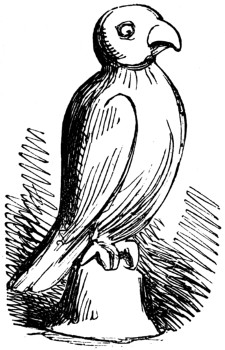
A Parrot.
This representative of the most “popular” of “all the winged inhabitants of air,” might have been taken for the likeness of some species between an owl and the booby-bird; but then the wings and back were coloured with a lively green, and the under part had yellow streaks, and the beak was of a red colour, and any colour did for the eyes, if they were larger than they ought to have been. “In my time” too, there was an “image” of a “fine bow pot,” consisting of half a dozen green shapes like halbert tops for “make believe” leaves, spreading like a half opened fan, from a knot “that was not,” inasmuch as it was delicately concealed by a tawny coloured ball called an orange, which pretended to rest on a clumsy clump of yellowed plaster as on the mouth of a jar—the whole looking as unlike a nosegay in water as possible. Then, too, there was a sort of obelisk with irregular projections and curves; the top, being smaller than the bottom, was marked out with paint into a sort of face, and, by the device of divers colours, it was bonnetted, armed, waisted, and petticoated—this was called a “fine lady.” A lengthened mass became by colourable show, “a dog”—like ingenuity might have tortured it into a devil. The feline race were of two shapes and in three sizes; the middle one—like physic in a bottle, “when taken, to be well shaken,” moved its chalk head, to the wonder and delight of all urchins, until they informed themselves of its “springs of action,” at the price of “only a penny,” and, by breaking it, discovered that the nodding knob achieved its un-cat-like motion, by being hung with a piece of wire to the interior of its hollow body. The lesser cat was not so very small, considering its price—“a farthing:”—I speak of when battered button tops represented that plentiful “coin of the realm.” Then there was the largest
Cat.
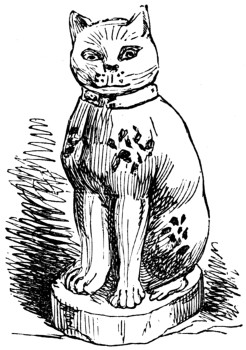
Cat.
The present representation favours the image too much. Neither this engraving, nor that of the “parrot,” is sufficiently like—the artist says he “could not draw it bad enough:” what an abominable deficiency is the want of “an eye”—heigho! Then there were so many things, that were not likenesses of any thing of which they were “images,” and so many years and cares have rolled over my head and heart, that I have not recollection or time enough for their description. They are all gone, or going—“going out” or “gone out” for ever! Personal remembrance is the frail and only memorial of the existence of some of these “ornaments” of the humble abodes of former times.
The masterpieces on the board of the “image-man,” were “a pair,”—at that time “matchless.” They linger yet, at the extreme corners of a few mantle-pieces, with probably a “sampler” between, and, over that, a couple of feathers from Juno’s bird, gracefully adjusted into a St. Andrew’s cross—their two gorgeous eyes giving out “beautiful colours,” to the beautiful eyes of innocent children. The “images,” spoken of as still in being, are of the colossal height of eighteen inches, more or less: they personate the “human form divine,” and were designed, perhaps, by Hayman, but their moulds are so worn that the casts are unfeatured, and they barely retain their bodily semblance. They are always painted black, save that a scroll on each, which depends from a kind of altar, is left white. One of the inscriptions says,
“Into the heaven of heavens I have presumed, &c.”
and all, except the owners, admire the presumption. The “effigy” looks as if the man had been up the chimney, and, instead of having “drawn empyrean air,” had taken a glass too much of Hodges’s “Imperial,” and wrapped himself in the soot-bag to conceal his indulgence and his person—this is “Milton.” The other, in like sables, points to his inscription, beginning,
“The cloud-capt towers, the gorgeous palaces, &c.”
is an “insubstantial pageant” of “the immortal Shakspeare,”
“cheated of feature by dissembling nature,”
through the operation of time.
“Such were the forms that o’er th’ incrusted souls Of our forefathers scatter’d fond delight.”
Price, and Alison, and Knight, have generalized “taste” for high-life; while those of the larger circle have acquired “taste” from manifold representations and vehicles of instruction, and comprehend the outlines, if they do not take in the details of natural objects. This is manifested by the almost universal disuse of the “images” described. With the inhabitants of every district in the metropolis, agreeable forms are now absolute requisites, and the demand has induced their supply. There are, perhaps, as many casts from the Medicean Venus, Apollo Belvidere, Antinous, the Gladiator, and other beauties of ancient sculpture, within the parish of St. George, in the East, as in the parish of St. George, Hanover-square. They are reposited over the fire-places, or on the tables, of neighbourhoods, wherein the uncouth cat, and the barbarous parrot were, even “in my time,” desirable “images.” The moulds of the greater number of these deformities, are probably destroyed. It was with difficulty that the “cat” could be obtained for the preceding column, and an “image” of the “parrot” was not procurable from an “image-man.” Invention has been resorted to for the gratification of popular desire: two plaster casts of children, published in the autumn of 1825, have met with unparalleled sale. To record the period of their origin they are represented in the annexed engraving, and, perhaps, they may be so perpetuated when the casts themselves shall have disappeared, in favour of others more elegant.
The “common people” have become uncommon; A few remain, just here and there, the rest Are polish’d and refined: child, man, and woman, All, imitate the manners of the best; Picking up, sometimes, good things from their betters, As they have done from them. Then they have books; As ’twas design’d they should, when taught their letters; And nature’s self befriends their very looks: And all this must, and all this ought to be— The only use of eyes, I know of, is—to see.
*
Street Images in 1826.
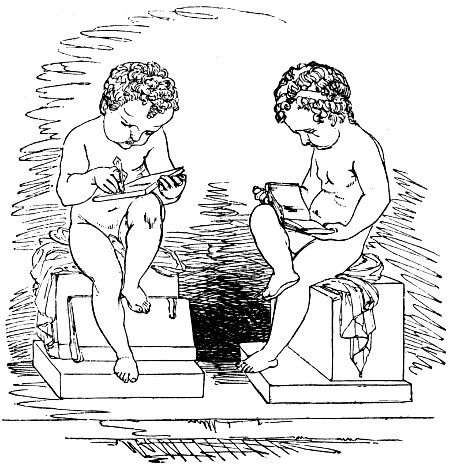
Street Images in 1826. Height of each 16 inches and a half.
When these agreeable figures first appeared, the price obtained for them was four shillings. As the sale slackened they were sold for three shillings; now, in March, 1826, the pair may be bought for two shillings, or eighteen pence. The consequence of this cheapness is, that there is scarcely a house without them.
There can be no doubt that society is improving in every direction. As I hinted before, we have a great deal to learn, and something to unlearn. It is in many respects untrue, that “art improves nature;” while in many important respects it is certain, that “nature improves art.”
The Brothers.
There are things in nature which the human voice can scarcely trust itself to relate; which art never can represent, and the pen can only feebly describe. Such a scene occurred at Lyons, in the year 1794.
The place of confinement to which those were hurried, who had been condemned to suffer by the revolutionary tribunal, was called “the Cave of Death.” A boy not fifteen years of age was sent thither. He had been one of the foremost in a sortie made during the siege, and for this was doomed to perish. His little brother, scarcely six years old, who had been accustomed to visit him at his former prison, no longer finding him there, came and called at the iron grate of the vault. His brother heard him, and came to the grate: the poor infant passed his little hands between the vast bars to embrace him, while the elder raising himself on the points of his feet could just reach to kiss them. “My dear brother,” said the child, “art thou going to die, and shall I see thee no more? why didn’t you tell them that you are not yet fifteen?”—“I did, brother, I said all that I could say, but they would hear nothing. Carry a kiss to my mother, and try to comfort her; nothing grieves me but that I leave her ill; but don’t tell her yet, that I am going to die.” The child was drowned in tears, his little heart seemed ready to burst:—“Good-by, brother,” he repeated again and again; “but I’m afraid you didn’t say that you are not yet fifteen.”—He was at length so suffocated with sobs that he could speak no more, and went away. Every one who passed by, seeing his distress, asked him what was the matter. “’Tis the wicked men that make me cry,” said he; “they are going to kill my brother who is so good, and who is not yet fifteen.”
With any being of a human form, Who, reading such a narrative as this Could be unshaken to the inmost soul, I would not share a roof, nor sit, nor stand, Nor converse hold, by word, or look, or pen. Well, Reader! thou hast read—hast thou no tears? If thou wert stranger to the tale till now, And weep’st not—go! I dare not, will not, know thee Thy manner may be gentle, but thy heart Is ripe for cruelty—Go hence, I say!
March 7.
The Season.
The earth has now several productions for our gratification, if we stoop to gather and examine them. Young botanists should commence their inquiries before the season pours in its abundance. They who are admirers of natural beauties, may daily discover objects of delightful regard in the little peeping plants which escape the eye, unless their first appearance is narrowly looked for.
The Primrose.
Welcome, pale Primrose! starting up between Dead matted leaves of ash and oak, that strew The every lawn, the wood, and spinney through, ’Mid creeping moss and ivy’s darker green; How much thy presence beautifies the ground: How sweet thy modest, unaffected pride Glows on the sunny bank, and wood’s warm side. And when thy fairy flowers, in groups, are found, The schoolboy roams enchantedly along, Plucking the fairest with a rude delight: While the meek shepherd stops his simple song, To gaze a moment on the pleasing sight; O’erjoy’d to see the flowers that truly bring The welcome news of sweet returning spring!
Clare.
It is remarked by the lady of the “Flora Domestica,” that “this little flower, in itself so fair, shows yet fairer from the early season of its appearance; peeping forth even from the retreating snows of winter: it forms a happy shade of union between the delicate snowdrop and the flaming crocus, which also venture forth in the very dawn of spring.” The elegant authoress observes further: “There are many varieties of the primrose, so called, (the polyanthus and auricular, though bearing other names, are likewise varieties,) but the most common are the sulphur-coloured and the lilac. The lilac primrose does not equal the other in beauty: we do not often find it wild; it is chiefly known to us as a garden-flower. It is indeed the sulphur-coloured primrose which we particularly understand by that name: it is the primrose: it is this which we associate with the cowslips and the meadows: it is this which shines like an earth-star from the grass by the brook side, lighting the hand to pluck it. We do indeed give the name of primrose to the lilac flower, but we do this in courtesy: we feel that it is not the primrose of our youth; not the primrose with which we have played at bo-peep in the woods; not the irresistible primrose which has so often lured our young feet into the wet grass, and procured us coughs and chidings. There is a sentiment in flowers: there are flowers we cannot look upon, or even hear named, without recurring to something that has an interest in our hearts; such are the primrose, the cowslip, the May-flower, the daisy, &c. &c.” The poets have not neglected to pay due honours to this sweet spring-flower, which unites in itself such delicacy of form, colour, and fragrance; they give it a forlorn and pensive character. The poems of Clare are as thickly strewn with primroses as the woods themselves; the two following passages are from “The Village Minstrel.”
“O, who can speak his joys when spring’s young morn From wood and pasture opened on his view, When tender green buds blush upon the thorn, And the first primrose dips its leaves in dew. ***** “And while he pluck’d the primrose in its pride, He ponder’d o’er its bloom ’twixt joy and pain; And a rude sonnet in its praise he tried, Where nature’s simple way the aid of art supplied.”
NATURALISTS’ CALENDAR.
Mean Temperature 39·54.
March 8.
At this season there is a sweetness in the fresh and open air, which never “comes to town.” Residents in cities, therefore, must seek it at some distance from their abodes; and those who cannot, may derive some pleasure from a sonnet, by the rural bard quoted just now.
Approach of Spring.
Sweet are the omens of approaching Spring When gay the elder sprouts her winged leaves When tootling robins carol-welcomes sing, And sparrows chelp glad tidings from the eaves. What lovely prospects wait each wakening hour, When each new day some novelty displays, How sweet the sun-beam melts the crocus flower, Whose borrow’d pride shines dizen’d in his rays: Sweet, new-laid hedges flush their tender greens: Sweet peep the arum-leaves their shelter screens: Ah! sweet is all that I’m denied to share: Want’s painful hindrance sticks me to her stall;— But still Hope’s smiles unpoint the thorns of Care Since Heaven’s eternal spring is free from all!
Clare.
NATURALISTS’ CALENDAR.
Mean Temperature 40·05.
March 9.
NATURALISTS’ CALENDAR.
Mean Temperature 40·15.
THE ELEPHANT,
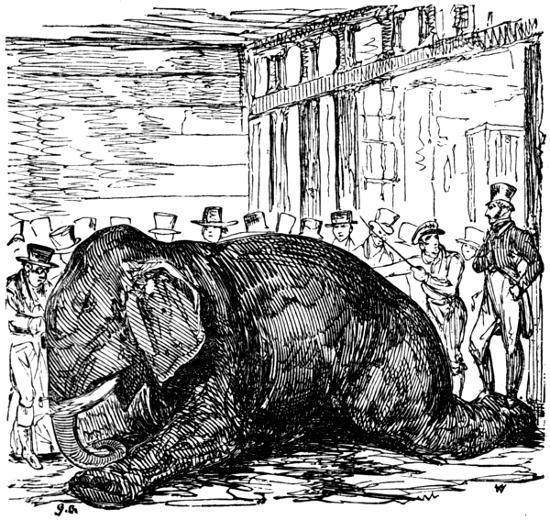
THE ELEPHANT, As he laid dead at Exeter Change.
In the position he liked best He seem’d to drop, to sudden rest; Nor bow’d his neck, but still a sense Retain’d of his magnificence; For, as he fell, he raised his head And held it, as in life, when dead.
VISIT TO MR. CROSS, PROPRIETOR OF THE ELEPHANT.
The most remarkable incident in the metropolis, since “the panic” in the neighbourhood of the Royal Exchange, in January, 1826, was the death of the celebrated elephant at Exeter Change, in March of the same year; not that it is attempted to insinuate comparison between these events, as to their nature or consequences, but it may fairly be observed, that each produced what is commonly called “a sensation” in town and country, and that each originated in peculiar excitement.
Wishing to record the death of the elephant in this work, and to relate only what is true, I resorted to Mr. Cross, whose menagerie has sustained a bereavement that can only be supplied, if it ever can be supplied, at a vast expense, and after a long lapse of time. On explaining my wish and purpose, Mr. Cross readily assented to furnish me with the information I desired, and communicated the following particulars. I committed them to paper during my interviews, and after digesting them into order, submitted the whole to his revision. Except as to mere language and occasional illustrations, the narrative is, in fact, the narrative of Mr. Cross. It differs in many essential respects from other accounts, but it only so differs, because every statement is accurately related from Mr. Cross’s lips. Circumstances which occurred during his temporary absence at the critical moment, were supplied to me in his presence by Mr. Tyler, the gentleman who arranged and cooperated with Mr. Herring, during the exigency that rendered the destruction of the elephant imperative.
The first owner of the lordly animal, now no more, was Mr. Harris, proprietor of Covent-garden theatre. He purchased it in July, 1810, for nine hundred guineas on its arrival in England, aboard the Astel, Captain Hay, and the elephant “came out” as a public performer the same year, in the procession of a grand pantomime, called “Harlequin Padmanaba.” Mrs. Henry Johnstone was his graceful rider, and he was “played up to” by the celebrated columbine, Mrs. Parker, whose husband had a joint interest with Mr. Harris in the new performer. During his “engagement” at this theatre, Mr. Polito “signed articles” with Messrs. Harris and Parker for his further “appearance in public” at the Royal Menagerie, Exeter Change. On the death of Mr. Polito, in 1814, Mr. Cross, who for twenty years had been superintendent of the concern, became its purchaser, and the elephant, thus transferred, remained with Mr. Cross till the termination of his life. From his “last farewell” to the public at Covent-garden theatre, he was stationary at the menagerie, from whence he was never removed, and, consequently, he was never exhibited at any other place.
On the elephant’s first arrival from India he had two keepers; these accompanied him to Exeter Change, and to their controul he implicitly submitted, until the death of one of them, within the first year after Mr. Cross’s proprietorship, when the animal’s increasing bulk and strength rendered it necessary to enlarge his den, or rather to construct a new one. The bars of the old one were not thicker than a man’s arm. With Mr. Harrison, the carpenter, who built his new den, and with whom he had formed a previous intimacy, he was remarkably docile, and accommodated himself to his wishes in every respect. He was occasionally troublesome to his builder from love of play, but the prick of a gimblet was an intimation he obeyed, till a desire for fresh frolic prompted him to further interference, and then a renewal of the hint, or some trifling eatable from the carpenter’s pocket, abated the interruption. In this way they went on together till the work was completed, and while the elephant retained his senses, he was happy in every opportunity that afforded him the society of his friend Harrison. The den thus erected will be particularized presently: it was that wherein he remained till his death.
About six years ago this elephant indicated an excitement which is natural to the species, and which prevails every year for a short season. At the period now spoken of, his keeper having gone into his den to exhibit him, the animal refused obedience; on striking him with a slight cane, as usual, the elephant violently threw him down: another keeper seeing the danger, tossed a pitchfork to his comrade, which the animal threw aside like a straw. A person then ran to alarm Mr. Cross, who hurried down stairs, and catching up a shovel, struck the animal violently on the head, and suddenly seizing the prostrated man, dragged him from the den, and saved his life.
This was the first appearance of those annual paroxysms, wherein the elephant, whether wild or confined, becomes infuriated. At such a period it is customary in India to liberate the elephants and let them run to the forests, whence, on the conclusion of the fit, they usually return to their wonted subjection. Such an experiment being impossible with Mr. Cross, he resorted to pharmacy, and, in the course of fifty-two hours, succeeded in deceiving his patient into the taking of twenty-four pounds of salts, twenty-four pounds of treacle, six ounces of calomel, an ounce and a half of tartar emetic, and six drams of powder of gamboge. To this he added a bottle of croton oil, the most potent cathartic perhaps in existence; of this, a full dram was administered, which alone is sufficient for at least sixty full doses to the human being; yet, though united with the preceding enormous quantity of other medicine, it operated no apparent effect. At this juncture Mr. Nyleve, a native East Indian, and a man of talent, suggested to Mr. Cross the administration of animal oil, as a medicine of efficacy. Six pounds of marrow from beef bones were accordingly placed within his reach, as if it had been left by accident; the liquorish beast, who would probably have refused it had it been tendered him in his food, swallowed the bait. The result justified Mr. Nyleve’s prediction. To my inquiry whether the marrow had not accelerated an operation which would have succeeded the previous administration, Mr. Cross answered, that he believed the beef marrow was the really active medicine, because, after an interval of three weeks, he gave the same quantity wholly unaccompanied, and the same aperient effect followed. He never, however, could repeat the experiment; for the elephant in successive years wholly refused the marrow, however attempted to be disguised, or with whatever it was mixed.