MARCH. (continued 4)
Reading edition
Pennant says, the last sermon which was preached at this place was before James I., who came in great state from Whitehall, on Midlent Sunday, 1620; but Mr. Ellis, the learned and indefatigable editor of the new edition of Dugdale’s “History of St. Paul’s Cathedral,” says, there is a sermon in print, entitled, “The White Wolfe, preached at Paul’s Crosse, February 11, 1627;” and according to the continuator of “Stow’s Annals,” Charles I., on the 30th of May, 1630, having attended divine service in the cathedral, “went into a roome, and heard the sermon at Paule’s Crosse.”—[Stow’s Annals, p. 1045.]
Thus this cross stood till it was demolished, in 1643, by order of parliament, executed by the willing hands of Isaac Pennington, the fanatical lord mayor of London for that year, who died in the Tower a convicted regicide.
The engraving at the head of this article is from a drawing in the Pepysian library, and appears to have been the same that was erected circa 1450.
There is a large painting of this cross as it appeared on Sunday, 26th of March, 1620, when king James I., his queen, Charles, prince of Wales, the archbishop of Canterbury, &c. attended with their court. It has been engraved in Wilkinson’s “Londina Illustrata.”
I am, Sir, &c. &c. T. A.
Good Friday at Lisbon.
To a protestant, the observance of this holiday in catholic countries is especially remarkable. In 1768, the late rev. George Whitefield published “An Account of some Lent and other Extraordinary Processions and Ecclesiastical Entertainments seen at Lisbon; in four Letters to an English Friend.” Very early in the morning of Good Friday, he had gone on board a vessel at Bellem for the purpose of sailing, but the wind dying away he returned ashore. “But how was the scene changed! Before, all used to be noise and hurry; now all was hushed and shut up in the most awful and profound silence. No clock or bell had been heard since yesterday noon, and scarce a person was to be seen in the street all the way to Lisbon. About two in the afternoon we got to the place where (I had heard some days ago) an extraordinary scene was to be exhibited: it was ‘the crucifixion of the Son of God, represented partly by dumb images, and partly by living persons, in a large church belonging to the convent of St. De Beato.’ Several thousands crowded into it, some of which, as I was told, had been waiting there ever since six in the morning. I was admitted, and very commodiously situated to view the whole performance. We had not waited long before the curtain was drawn up. Immediately, upon a high scaffold, hung in the front with black baize, and behind with silk purple damask laced with gold, was exhibited to our view an image of the Lord Jesus, at full length, crowned with thorns, and nailed on a cross, between two figures of like dimensions, representing the two thieves. At a little distance on the right hand was placed an image of the virgin Mary, in plain long ruffles, and a kind of widow’s weeds. The veil was purple silk, and she had a wire glory round her head. At the foot of the cross lay, in a mournful pensive posture, a living man dressed in woman’s clothes, who personated Mary Magdalen; and not far off stood a young man, in imitation of the beloved disciple. He was dressed in a loose green silk vesture and bob-wig. His eyes were fixed on the cross, and his two hands a little extended. On each side, near the front of the stage, stood two sentinels in buff, with formidable caps and long beards; and directly in the front stood another yet more formidable, with a large target in his hand. We may suppose him to be the Roman centurion. To complete the scene, from behind the purple hangings came out about twenty little purple-vested winged boys, two by two, each bearing a lighted wax taper in his hand, and having a crimson and gold cap on his head. At their entrance upon the stage, they gently bowed their heads to the spectators, then kneeled and made obeisance, first to the image on the cross, and then to that of the virgin Mary. When risen, they bowed to each other, and then took their respective places over against one another, on steps assigned for them on the front of the stage. Opposite to this, at a few yards’ distance, stood a black friar in a pulpit hung with mourning. For a while he paused, and then breaking silence, gradually raised his voice till it was extended to a pretty high pitch, though I think scarcely high enough for so large an auditory. After he had proceeded in his discourse about a quarter of an hour, a confused noise was heard near the great front door; and turning my head, I saw four long-bearded men, two of whom carried a ladder on their shoulders; and after them followed two more, with large gilt dishes in their hands, full of linen, spices, &c.; these, as I imagined, were the representatives of Nicodemus and Joseph of Arimatlian. On a signal given from the pulpit, they advanced towards the steps of the scaffold; but, upon their first attempting to mount it, at the watchful centurion’s nod, the observant soldiers made a pass at them, and presented the points of their javelins directly to their breasts. They are repulsed. Upon this, a letter from Pilate is produced. The centurion reads it, shakes his head, and with looks that bespoke a forced compliance, beckons the sentinels to withdraw their arms. Leave being thus obtained, they ascend; and having paid their homage by kneeling first to the image on the cross and then to the virgin Mary, they retired to the back of the stage. Still the preacher continued declaiming, or rather, as was said, explaining the mournful scene. Magdalen persists in wringing her hands, and variously expressing her personated sorrow; while John (seemingly regardless of all besides) stood gazing on the crucified figure. By this time it was nearly three o’clock, and the scene was drawing to a close. The ladders are ascended, the superscription and crown of thorns taken off; long white rollers put round the arms of the image; and then the nails knocked out which fastened the hands and feet. Here Mary Magdalen looks most languishing, and John, if possible, stands more thunderstruck than before. The orator lifts up his voice, and almost all the hearers expressed their concern by weeping, beating their breasts, and smiting their cheeks. At length the body is gently let down; Magdalen eyes it, and gradually rising, receives the feet into her wide spread handkerchief; while John (who hitherto had stood motionless like a statue), as the body came nearer the ground, with an eagerness that bespoke the intense affection of a sympathizing friend, runs towards the cross, seizes the upper part of it into his clasping arms, and, with his disguised fellow-mourner, helps to bear it away. And here the play should end, was I not afraid that you would be angry with me if I did not give you an account of the last act, by telling you what became of the corpse after it was taken down. Great preparations were made for its interment. It was wrapped in linen and spices, &c. and being laid upon a bier richly hung, was carried round the churchyard in grand procession. The image of the virgin Mary was chief mourner; and John and Magdalen, with a whole troop of friars with wax tapers in their hands, followed. Determined to see the whole, I waited its return, and in about a quarter of an hour the corpse was brought in, and deposited in an open sepulchre prepared for the purpose; but not before a priest, accompanied by several of the same order, in splendid vestments, had perfumed it with incense, sang to, and kneeled before it. John and Magdalen attended the obsequies, but the image of the virgin Mary was carried away, and placed in the front of the stage, in order to be kissed, adored, and worshipped by the people. And thus ends this Good Friday’s tragi-comical, superstitious, idolatrous droll. I am well aware that the Romanists deny the charge of idolatry; but after having seen what I have seen this day, as well as at sundry other times since my arrival here, I cannot help thinking but a person must be capable of making more than metaphysical distinctions, and deal in very abstract ideas indeed, fairly to evade the charge.”
Good Friday at Seville.
The rev. Blanco White relates the celebration of the day at Seville in the following terms:—
The altars, which, at the end of yesterday’s mass, were publicly and solemnly stripped of their clothes and rich table-hangings by the hands of the priest, appear in the same state of distressed negligence. No musical sound is heard, except the deep-toned voices of the psalm, or plain chant singers. After a few preparatory prayers, and the dramatized history of the passion, already described, the officiating priest (the archbishop at the cathedral), in a plain albe or white tunic, takes up a wooden cross six or seven feet high, which, like all other crosses, has for the last two weeks of Lent been covered with a purple veil, and standing towards the people, before the middle of the altar, gradually uncovers the sacred emblem, which both the clergy and laity worship upon their knees. The prelate is then unshod by the assistant ministers, and taking the cross upon his right shoulder, as our saviour is represented by painters on his way to Calvary, he walks alone from the altar to the entrance of the presbytery or chancel, and lays his burden upon two cushions. After this, he moves back some steps, and approaching the cross with three prostrations, kisses it, and drops an oblation of a piece of silver into a silver dish. The whole chapter, having gone through the same ceremony, form themselves in two lines, and repair to the monument, from whence the officiating priest conveys the deposited host to the altar, where he communicates upon it without consecrating any wine. Here the service terminates abruptly; all candles and lamps are extinguished; and the tabernacle, which throughout the year contains the sacred wafers, being left open, every object bespeaks the desolate and widowed state of the church from the death of the saviour to his resurrection.
The ceremonies of Good Friday being short, and performed at an early hour, both the gay and the devout would be at a loss how to spend the remainder of the day but for the grotesque passion sermons of the suburbs and neighbouring villages, and the more solemn performance known by the name of Tres Horas,—three hours.
The practice of continuing in meditation from twelve to three o’clock of this day,—the time which our saviour is supposed to have hung on the cross,—was introduced by the Spanish Jesuits, and partakes of the impressive character which the members of that order had the art to impart to the religious practices by which they cherished the devotional spirit of the people. The church where the three hours are kept is generally hung in black, and made impervious to daylight. A large crucifix is seen on the high altar, under a black canopy, with six unbleached wax candles, which cast a sombre glimmering on the rest of the church. The females of all ranks occupy, as usual, the centre of the nave, squatting or kneeling on the matted ground, and adding to the dismal appearance of the scene by the colour of their veils and dresses.
Just as the clock strikes twelve, a priest in his cloak and cassock ascends the pulpit, and delivers a preparatory address of his own composition. He then reads the printed meditations on the seven words, or sentences, spoken by Jesus on the cross, allotting to each such a portion of time as that, with the interludes of music which follow each of the readings, the whole may not exceed three hours. The music is generally good and appropriate, and if a sufficient band can be collected, well repays to an amateur the inconvenience of a crowded church, where, from the want of seats, the male part of the congregation are obliged either to stand or kneel. It is, in fact, one of the best works of Haydn, composed a short time ago for some gentlemen of Cadiz, who showed both their taste and liberality in thus procuring this masterpiece of harmony for the use of their country. It has been lately published in Germany under the title of the “Sette Parole.”
Every part of the performance is so managed, that the clock strikes three about the end of the meditation, on the words, It is finished. The picture of the expiring saviour, powerfully drawn by the original writer of the Tres Horas, can hardly fail to strike the imagination when listened to under the influence of such music and scenery; and when, at the first stroke of the clock, the priest rises from his seat, and in a loud and impassioned voice, announces the consummation of the awful and mysterious sacrifice, on whose painful and bloody progress the mind has been dwelling so long, few hearts can repel the impression, and still fewer eyes can conceal it. Tears bathe every cheek, and sobs heave every female bosom. After a parting address from the pulpit, the ceremony concludes with a piece of music, where the powers of the great composer are magnificently displayed in the imitation of the disorder and agitation of nature which the evangelists relate.
The passion sermons for the populace might be taken for a parody of the three hours. They are generally delivered in the open air, by friars of the Mendicant orders, in those parts of the city and suburbs which are chiefly, if not exclusively, inhabited by the lower classes. Such gay young men, however, as do not scruple to relieve the dulness of Good Friday with a ride, and feel no danger of exposing themselves by any unseasonable laughter, indulge not unfrequently in the frolic of attending one of the most complete and perfect sermons of this kind at the neighbouring village of Castilleja.
A movable pulpit is placed before the church door, from which a friar, possessed of a stentorian voice, delivers an improved history of the passion, such as was revealed to St. Bridget, a Franciscan nun, who, from the dictation of the virgin Mary, has left us a most minute and circumstantial account of the life and death of Christ and his mother. This yearly narrative, however, would have lost most of its interest but for the scenic illustrations, which keep up the expectation and rivet the attention of the audience. It was formerly the custom to introduce a living saint Peter—a character which belonged by a natural and inalienable right to the baldest head in the village—who acted the apostle’s denial, swearing by Christ, he did not know the man. This edifying part of the performance is omitted at Castilleja; though a practised performer crows with such a shrill and natural note as must be answered with challenge by every cock of spirit in the neighbourhood. The flourish of a trumpet announces, in the sequel, the publication of the sentence passed by the Roman governor; and the town crier delivers it with legal precision, in the manner it is practised in Spain before an execution. Hardly has the last word been uttered, when the preacher, in a frantic passion, gives the crier the lie direct, cursing the tongue that has uttered such blasphemies. He then invites an angel to contradict both Pilate and the Jews; when, obedient to the orator’s desire, a boy gaudily dressed, and furnished with a pair of gilt pasteboard wings, appears at a window, and proclaims the true verdict of heaven. Sometimes, in the course of the preacher’s narrative, an image of the virgin Mary is made to meet that of Christ, on his way to Calvary, both taking an affectionate leave in the street. The appearance, however, of the virgin bearing a handkerchief to collect a sum for her son’s burial, is never omitted; both because it melts the whole female audience into tears, and because it produces a good collection for the convent. The whole is closed by the descendimiento, or unnailing a crucifix, as large as life, from the cross, an operation performed by two friars, who, in the character of Joseph of Arimathea and Nicodemus, are seen with ladders and carpenters’ tools letting down the jointed figure, to be placed on a bier and carried into the church in the form of a funeral.
I have carefully glided over such parts of this absurd performance as would shock many an English reader, even in narrative. Yet, such is the strange mixture of superstition and profaneness in the people for whose gratification these scenes are exhibited, that, though any attempt to expose the indecency of these shows would rouse their zeal “to the knife,” I cannot venture to translate the jokes and sallies of wit that are frequently heard among the Spanish peasantry upon these sacred topics.[94]
Judas is a particular object of execration on Good Friday, in the Spanish and Portuguese navy. An eye-witness relates the following occurrences at Monte Video. “The three last days had been kept as days of sorrow; all the ships in the harbour expressed it by having their colours hoisted only half-mast high, as a token of mourning, and the yards crossed as much as possible, to make them resemble a crucifix, while apparent solemnity prevailed both on shore and in the harbour; but immediately on a signal, when the minute arrived, all being in waiting, the yards were squared, the colours hoisted wholly up, and the guns fired from all the ships in the harbour, while the bells on shore were set ringing promiscuously, as fast as possible; and at the bowsprit, or yard-arm of the ships was suspended an effigy of Judas, which they began to dip in the river, acting with the greatest possible enthusiasm and ridiculous madness, beating it on the shoulders, dipping it, and then renewing their former ridiculous conduct.”[95]
Relics of the Crucifixion.
Sir Thomas More, in his “Dialogue concernynge Heresyes, 1528,” says, “Ye might upon Good Friday, every yere this two hundred yere, till within this five yere that the turkes have taken the towne, have sene one of the thornes that was in Cristes crowne, bud and bring forth flowers in the service time, if ye would have gone to Rodes.” The printing press has done more mischief to miracles of this sort than the Turks.
Patience seems to have been wearied in supplying relics to meet the enormous demand. Invention itself became exhausted; for the cravings of credulity are insatiable. If angels are said to weep at man’s “fantastic tricks before high heaven,” protestants may smile, while, perhaps, many catholics deplore the countless frauds devised by Romish priests of knavish minds, for cajoling the unwary and the ignorant. “The greater the miracle the greater the saint,” has been assuredly a belief; and, according to that belief, the greater the relics, the greater the possessors must have appeared, in the eyes of the vulgar. In this view there is no difficulty in accounting for hordes of trumpery in shrines and reliquaries.
The instruments of the crucifixion—the very inscription on the cross—the crown of thorns—the nails—the lance—are shown to the present hour, as the true inscription, the true thorns, the true nails, and the true lance. So also there are exhibitions of the true blood, yet it is a printed truth, that what is exposed to worshippers in churches by ecclesiastics for true blood, is doubted of by the rev. Alban Butler. In a note to his article on “The Invention of the Holy Cross,” he states a ground for his incredulity, quite as singular as that whereon holders of the true blood maintain their faith. His words are: “The blood of Christ, which is kept in some places, of which the most famous is that at Mantua, seems to be what has sometimes issued from the miraculous bleeding of some crucifix, when pierced in derision by Jews or Pagans, instances of which are recorded in authentic histories.”[96] Though, as a catholic priest and biographer well acquainted with these “authentic histories,” Mr. Butler might have set them forth, yet he abstains from the disclosure; and hence on their superior credibility in his eyes, to the credibility of the declarations and testimonials urged by the owners of the blood itself, we may choose between their requisition to believe that the blood is the true blood, and Mr. Butler’s belief, that it is the blood of bleeding crucifixes. So stands the question of credibility.
Concerning the alleged implements of the crucifixion, it would be curious to examine particulars; but we are limited in room, and shall only recur to one—
“The Holy Lance.”
Respecting this weapon, reference should be first made to the great authority cited above. Mr. Butler, speaking of other instruments of Christ’s crucifixion, which he maintains to be genuine, says:—
“The holy lance which opened his sacred side, is kept at Rome, but wants the point. Andrew of Crete says, that it was buried, together with the cross. At least, St. Gregory of Tours, and venerable Bede, testify, that, in their time, it was kept at Jerusalem. For fear of the Saracens it was buried privately at Antioch; in which city it was found, in 1098, under ground, and wrought many miracles, as Robert the monk, and many eye-witnesses, testify. It was carried first to Jerusalem, and soon after to Constantinople. The emperor, Baldwin II., sent the point of it to Venice, by way of pledge for a loan of money. St. Lewis, king of France, redeemed this relick by paying off the sum it lay in pledge for, and caused it to be conveyed to Paris, where it is still kept in the holy chapel. The rest of the lance remained at Constantinople, after the Turks had taken that city, till, in 1492, the sultan Bajazet sent it by an ambassador, in a rich and beautiful case, to pope Innocent VIII., adding, that the point was in the possession of the king of France.”
This is Mr. Butler’s account of the “holy lance,” without the omission of a word, which should be recollected for reasons that will be obvious.
St. Longinus.
It is now necessary to observe, that there is not any account of this saint in Alban Butler’s “Lives of the Saints,” though (in the Breviar Roman. Antiq. 1543) the 15th of March is dedicated to him for his festival, and though the saint himself is declared, in the Romish breviary, to have been the Roman soldier who pierced the side of the saviour with the lance; and that, “being almost blind by the blood which fell, it is supposed on his eyes, he immediately recovered his sight and believed;” and that, furthermore, “forsaking his military profession he converted many to the faith,” and under the president Octavius suffered martyrdom.[97]
Cardinal Vigerius.
This dignitary, who died in 1516, was bishop of Præneste, and arch-priest of the Vatican church. He wrote a book to prove that Christ’s tunic ought to give place to the eminence of Longinus’s lance. The occasion of the work unfolds the history of the holy lance. In 1488, the sultan Bajazet II., being in fear of his brother, who had become prisoner to the king of France, offered that sovereign, if he would keep his brother in France, all the relics which his late father Mahomet had found in Constantinople when he took that city. Bajazet’s letter came too late; the court of France had already promised to put his brother in the custody of Innocent VIII. “When the sultan knew this, he wrote to the pope, and endeavoured to gain him by presents, and amongst others by the iron of the lance that pierced our saviour’s side, which he had before offered to the grand master, and assured him of the punctual payment of 40,000 ducats every year, on condition that he would not let his brother go upon any pretence whatsoever.” It appears, however, that Bajazet retained the relic called the “seamless coat,” and that this gave rise to a great dispute in Italy, as to whether the holy lance presented to the pope, or the holy coat, which Bajazet reserved for himself, was the most estimable; and hence it was assigned to cardinal Vigerius to make it clear that the pope had the best relic. He executed the task to the satisfaction of those who contended for the precedence of the lance.[98]
The TRUE Lance. Utrum horum?

Before speaking further on the lance itself, it must not be forgotten that Alban Butler has told us, “the holy lance kept at Rome wants the point,” and that after various adversities, the point was “conveyed to Paris, where it is still kept in the holy chapel.” But Richard Lassels, who in his “Voyage of Italy, 1670,” visited the church of St. Peter’s, Rome, says, the cupola of that church rests upon “vast square pillars a hundred and twenty feet in compass, and capable of stairs within them, and large sacristyes above for the holy reliques that are kept in them; to wit—the top of the lance wherewith our saviour’s side was pierced—under the top of the lance the statue of Longinus.” So that at Rome, where according to Mr. Butler, the “holy lance” itself is kept, he omits to mention that there is a top of the lance, besides the other top “in the holy chapel” at Paris. In that cathedral, too, we have the statue of St. Longinus, whom Mr. Butler also, for good reasons no doubt, omits to mention in his twelve volumes of “Lives of the Saints.”
But there is another “holy lance.” It is kept in the church of the hospital of Nuremberg, with the crown and sceptre and other regalia of Charlemagne. Misson so particularly distinguishes it, that his account shall be given verbatim. After mentioning the sword of Charlemaigne, which its keepers pretend “was brought by an angel from heaven;” he says, “they also keep many relics in this church; and among others St. Longin’s lance.” There is no reason to doubt, therefore, that the ecclesiastics of Nuremberg deemed Longinus a saint, as well as the ecclesiastics of St. Peter’s at Rome. Misson goes on to say, “They are not ignorant that this pretended lance is to be seen in above ten other places of the world; but, they say, theirs came from Antioch; it was St. Andrew who found it; one single man with it discomfited a whole army; it was the thing of the world which Charlemaigne loved most. The other lances are counterfeits, and this is the true one.” It is requisite to observe Misson’s very next words, which, though they do not seem connected with this “true lance” of Nuremberg, are yet connected with the issue. He proceeds to say, “They have also an extraordinary veneration for a piece of the cross, in the midst of which there is a hole that was made by one of the nails. They tell us, that heretofore, the emperors placed their greatest hopes of prosperity and success, both in peace and war, in the possession of this enlivening wood, with the nail and other relics that are kept at Nuremberg.” Misson then adds, by way of note, the following
List of these Relics.
The lance.
The piece of the wood of the cross.
One of the nails.
Five thorns of the crown that was put on Christ’s head.
Part of the chains with which St. Peter and St. Paul were bound at Rome.
A little piece of the manger.
A tooth of St. John Baptist.
One of St. Anne’s arms.
The towel with which Christ wiped the feet of his apostles.
A piece of St. John the Evangelist’s gown.
A piece from the table cloth which Christ used at his last supper with his disciples.
These relics, accompanying Misson’s account of the “true lance” of Nuremberg, are here enumerated, because his statement as to the existence of the lance, in connection with those relics, is corroborated by a rare print, sixteen inches and a quarter wide, by thirteen inches high, published by the ecclesiastics of Nuremberg, in the possession of the editor of the Every-Day Book. It represents the whole of these relics at one view, except the five thorns. The true lance, being placed in the print angle-ways, measures nineteen inches and three quarters, from the point of the sheath to the rim of the iron shaft. The preceding column contains a reduced fac-simile of this “true” relic. It is not denied that the “holy lance” at Paris, “where it is still kept in the holy chapel,” is also “true”—they are without a shadow of doubt, equally “true.” See Butler and Misson, and Misson and Butler.
By the by, it must be remembered, that the genuine lantern which Judas carried, was also “kept at Rome,” when Misson was there; and that, at the same time, Judas’s lantern was also at St. Denis in France—both genuine.[99]
The romance of “Spomydon,” printed by Wynkyn de Worde, celebrates the exploits of Charlemagne, for the recovery or the relics of the passion in the following lines:—
Cherles—wanne fro the hethen houndes The spere and nayles of crystes woundes And also the croune of thorne And many a ryche relyke mo Maugre of them he wanne also And kylled them euen and morne.
Pilate.
There is a tradition at Vienne, that in the reign of the emperor Tiberius, Pontius Pilate was exiled to that city, where he died not long after, of grief and despair, for not having prevented the crucifixion of the saviour; and his body was thrown into the Rhone. There it remained, neither carried away by the force of the current, nor consumed by decay, for five hundred years; until the town being afflicted with the plague, it was revealed to the then archbishop, in a vision, that the calamity was occasioned by Pilate’s body, which unknown to the good people of Vienne was lying at the foot of a certain tower. The place was accordingly searched and the body drawn up entire, but nothing could equal its intolerable odour. Wherefore, it was carried to a marsh two leagues from the town, and there interred; but for a long series of years after, strange noises were reported by certain people to issue from this place continually; these sounds were believed to be the groans of Pontius Pilate, and the cries of the devils tormenting him. They also imagined, the neighbourhood of his body to be the cause of violent storms of thunder and lightning which are frequent at Vienne; and as the tower, where the body was found, has been several times struck by lightning, it has acquired the name of the tower of Mauconseil.[100]
It will be seen from the subjoined letter of a correspondent, who communicates his name to the editor, that remains of the ancient disguises are still to be seen in the proceedings of those persons in this country, who, towards the termination of the fast of Lent, collect materials for good cheer to make an Easter festival.
Paste Eggs.
To the Editor of the Every-Day Book.
Liverpool, Good Friday, 1826.
Sir,—Having been much entertained lately by your accounts of “festivals, and fairs, and plays,” I am induced to contribute, in some small degree, to the store of amusement in your interesting every-day miscellany. The subject on which I am to treat, is a custom that prevails in the neighbourhood of West Derby, on this day; it is known by the denomination of “paste egging,” and is practised by the humbler classes of the juvenile peasantry.
The parties who are disposed to partake in the fun, disguise themselves in the most fantastic habiliments—such as clothes turned inside out, with strange patches on, some with masks, veils, ribbands, &c.; some with faces blacked, and (perhaps, your fair readers may not excuse me for telling them that,) even the females disguise their sex! Thus equipped, they betake themselves (in numbers of from about four to a dozen of both sexes) to the different farm-houses, and solicit contributions towards the “festival” of Easter Sunday. The beginning of my tale seems to indicate the sort of gifts that are expected; these gifts are generally made up of great numbers of eggs and oatmeal cakes. One of the party usually carries a basket for the cakes, another for the eggs, and (as our best feasts can scarcely be got up without a portion of the one thing needful,) a third is the bearer of a small box for pecuniary contributions.
Conscious of the charms of music, they generally exhilarate their benefactors with some animated songs, appropriate to the occasion, and sung in excellent taste; and by these means seldom fail to return homeward with a plentiful supply of their “paste egg,” and no trivial aid in money. With these materials, a festival is got up on Easter Sunday evening. The different parties meet at the village alehouse, where “Bacchus’s blisses and Venus’s kisses,” accompany the circling bowl, and associate the village host in a universal compact of mirth and merriment.
I cannot discover any reasonable account of the origin of this custom; and must, therefore, Mr. Editor, subscribe myself, your faithful servant,
Will. Honeycomb.
NATURALISTS’ CALENDAR.
Mean Temperature 43·27.
March 25.
Annunciation, or Lady Day.
QUARTER DAY.
For the Every-Day Book.
Relentless, undelaying quarter-day! Cold, though in Summer, cheerless, though in Spring, In Winter, bleak; in Autumn, withering— No quarter dost thou give, not for one day, But rent and tax enforceth us to pay; Or, with a quarter-staff, enters our dwelling, Thy ruthless minion, our small chattels selling, And empty-handed sending us away!— Thee I abhor, although I lack not coin To bribe thy “itching palm:” for I behold The poor and needy whom sharp hunger gnawing Compels to flit, on darksome night and cold, Leaving dismantled walls to meet thy claim:— Then scorn I thee, and hold them free from blame!
X.
The Last Day of Lent.
Lady Morgan describes the “sepulchres,” in the churches of Italy, to have been watched night and day by hundreds clad in deep mourning from the dawn of Holy Thursday till Saturday at mid-day, when the body is supposed to rise from the grave, and the resurrection is announced by the firing of cannon, the blowing of trumpets, and the ringing of bells which from the preceding Thursday had been carefully tied up to protect them from the power of the devil. “On this day, the whole foreign population of Rome rolls on, in endless succession, to the Vatican. The portico, colonnades, and vestibules, both of the church and palace, assume the air of the court of a military despot. Every epoch in the military costume is there gaudily exhibited. Halberdiers in coats of mail, and slate-coloured pantaloons, which pass upon the faithful for polished steel armour; the Swiss in their antique dresses of buff and scarlet, and lamberkeens; the regular troops in their modern uniforms; the guardia nobile, the pope’s voltigeurs, all feathers and feebleness, gold and glitter; generals of the British army, colonels and subalterns of every possible yeomanry, with captains and admirals of the navy, and a host of nondescripts, laymen, and protestant clergymen, who ‘for the nonce’ take shelter under any thing resembling an uniform, that may serve as a passe-partout, where none are courteously received but such as wear the livery of church or state militant;—all move towards the portals of the Sistine chapel, which, with their double guards, resemble the mouth of a military pass, dangerous to approach, and difficult to storm. The ladies press with an imprudent impetuosity upon the guards, who, with bayonets fixed and elbows squared, repress them with a resistance, such as none but female assailants would dare to encounter a second time. Thousands of tickets of admission are shown aloft by upraised hands, and seconded by high-raised voices; while the officer of the guard, who can read and tear but one at a time, leaves the task of repulsion to the Swiss, who manfully second their ‘allez fous en’ with a physical force, that in one or two instances incapacitated the eager candidates for further application. A few English favoured by the minister, and all the princes and diplomatists resident at Rome, pioneered by their guards of honour, make their way without let or molestation. One side of the space, separated from the choir by a screen, is fitted up for them apart; the other is for the whole female congregation, who are crushed in, like sheep in a fold. The men, if in uniform or full court dresses, are admitted to a tribune within the choir; while the inferior crowd, left to shift for themselves, rush in with an impetuosity none can resist; for though none are admitted at all to the chapel without tickets, yet the number of applicants (almost exclusively foreign) is much too great for the limited capacity of the place. A scene of indescribable confusion ensues. The guards get mingled with the multitude. English peers are overturned by Roman canons. Irish friars batter the old armour of the mailed halberdiers with fists more formidable than the iron they attack. Italian priests tumble over tight-laced dandies; and the ‘Via via’ of the Roman guard, and the ‘Fous ne restez pas issi’ of the Swiss mingle with screams, supplications and reproofs, long after the solemn service of the church has begun. The procession of the sacrament to the Paoline chapel succeeds; its gates are thrown open, and its dusky walls appear illuminated with thousands of tapers, twinkling in the rays of the noonday sun, through an atmosphere of smoke. Few are able to enter the illuminated chapel, or to behold the deposition of the sacrament; and many who are informed of the programme of the day, by endeavouring to catch at all the ceremonies, scarcely attain to any.”[101]
Easter Eve in Spain.
Mr. Blanco White says, that the service in the cathedral of Seville begins this morning without either the sound of bells or of musical instruments. The paschal chandle is seen by the north side of the altar. It is, in fact, a pillar of wax, nine yards in height, and thick in proportion, standing on a regular marble pedestal. It weighs eighty arrobas, or two thousand pounds, of twelve ounces. This candle is cast and painted new every year, the old one being broken into pieces on the Saturday preceding Whitsunday, the day when part of it is used for the consecration of the baptismal font. The sacred torch is lighted with the new fire, which this morning the priest strikes out of a flint, and it burns during service till Ascension-day. A chorister in his surplice climbs up a gilt-iron rod, furnished with steps like a flag-staff, and having the top railed in, so as to admit of a seat on a level with the end of the candle. From this crow’s nest, the young man lights up and trims the wax pillar, drawing off the melted wax with a large iron ladle.
High mass begins this day behind the great veil, which for the two last weeks in Lent covers the altar. After some preparatory prayers, the priest strikes up the hymn Gloria in excelsis Deo. At this moment the veil flies off, the explosion of fireworks in the upper galleries reverberates in a thousand echoes from the vaults of the church, and the four-and-twenty large bells of its tower awake, with their discordant though gladdening sounds, those of the one hundred and forty-six steeples which this religious town boasts of. A brisk firing of musketry, accompanied by the howling of the innumerable dogs, which, unclaimed by any master, live and multiply in the streets, adds strength and variety to this universal din. The firing is directed against several stuffed figures, not unlike Guy Fawkes of the fifth of November, which are seen hanging by the neck on a rope, extended across the least frequented streets. It is then that the pious rage of the people of Seville is vented against the arch-traitor Judas, whom they annually hang, shoot, draw, and quarter in effigy.
The church service ends in a procession about the aisles. The priest bears the host in his hands, visible through glass as a picture within a medallion. The sudden change from the gloomy appearance of the church and its ministers, to the simple and joyous character of this procession, the very name of pasqua florída, the flowery passover, and, more than the name, the flowers themselves, which well-dressed children, mixed with the censer-bearers, scatter on the ground, crowd the mind and heart with the ideas, hopes, and feelings of renovated life, and give to this ceremony, even for those who disbelieve the personal presence of a Deity triumphant over death, a character of inexpressible tenderness.[102]
Papal Conversion of the Jews.
The day before Easter Sunday at Rome, two or more Jews are procured to be baptized. An eye-witness of a couple of these converts, says, “The two devoted Israelites prepared for this occasion, attired in dirty yellow silk gowns, were seated on a bench within the marble front of the baptistery, which resembles a large bath, both in form and shape, conning their prayers out of a book, with most rueful visages. Fast to their sides stuck their destined godfathers, two black-robed doctors of divinity, as if to guard and secure their spiritual captives. The ancient vase at the bottom of the font, in which, according to an absurd legend, Constantine was healed of his leprosy by St. Sylvester, stood before them filled with water, and its margin adorned with flowers. The cardinal bishop, who had been employed ever since six o’clock in the benediction of fire, water, oil, wax, and flowers, now appeared, followed by a long procession of priests and crucifixes. He descended into the font, repeated a great many prayers in Latin over the water, occasionally dipping his hand into it. Then a huge flaming wax taper, about six feet high, and of proportionate thickness, painted with images of the virgin and Christ, which had previously been blessed, was set upright in the vase; more Latin prayers were mumbled—one of the Jews was brought, the bishop cut the sign of the cross in the hair, at the crown of his head, then, with a silver ladle, poured some of the water upon the part, baptizing him in the usual forms, both the godfathers and he having agreed to all that was required of them. The second Jew was then brought, upon whom the same ceremonies were performed; this poor little fellow wore a wig, and, when the cold water was poured on his bare skull, he winced exceedingly, and made many wry faces. They were then conveyed to the altar of the neighbouring chapel, where they were confirmed, and repeated the creed. The bishop then made the sign of the cross upon their foreheads, with holy oil, over which white fillets were immediately tied to secure it; he then pronounced a long exhortation, in the course of which he frightened them so that the little Jew with a wig began to cry most bitterly, and would not be comforted. This being over, the Jews were conducted, with great ceremony, from the baptistery to the door of the church, where they stopped, and, after some chanting by the bishop, they were allowed to pass the threshold; they were then seated within the very pale of the altar, in order that they might witness a succession of various ceremonies.”[103]
Greek Preparation for Easter.
The Rev. J. Conner describes the ceremonies of the Greek church at Jerusalem on Easter-eve. “I went to the church to spend the night there, that I might view all the different observances. It is a general belief among the Greeks and Armenians, that, on Easter-eve, a fire descends from heaven into the sepulchre. The eagerness of the Greeks, Armenians, and others, to light their candles at this holy fire, carried an immense crowd to the church, notwithstanding the sum which they were obliged to pay. About nine at night, I retired to rest, in a small apartment in the church. A little before midnight, the servant roused me to see the Greek procession. I hastened to the gallery of the church. The scene was striking and brilliant. The Greek chapel was splendidly illuminated. Five rows of lamps were suspended in the dome; and almost every individual of the immense multitude held a lighted candle in his hand.” The ceremonies on Easter Sunday were very grand.
NATURALISTS’ CALENDAR.
Mean Temperature 42·85.
March 26.
Easter Sunday.
There is little trace in England of the imposing effect of this festival in papal terms.
It is affirmed, that at Queen’s-college, Oxford, the first dish brought to the table on Easter-day, is a red herring, riding away on horseback, that is to say, a herring placed by the cook, something after the likeness of a man on horseback, set on a corn sallad.[104] This is the only vestige of the pageants which formerly were publicly exhibited by way of popular rejoicing for the departure of the forty days Lent fast, and the return to solid eating with the Easter festival.
The custom of eating a gammon of bacon at Easter, still maintained in some parts of England, is founded on the abhorrence our forefathers thought proper to express, in that way, towards the Jews at the season of commemorating the resurrection.[105]
Lifting at Easter, and pace or paste eggs, with other usages derived from catholic customs, are described and traced in vol. i. p. 421.
Since these “Caps well fit; by Titus in Sandgate and Titus every where,” a curious little duodecimo, printed at Newcastle in 1785, has come into the editor’s hands, from whence is extracted the following—
Paste Egg Tale
Once—yes once, upon a Paste-Egg-Day, Some lords and ladies met to play; For then such pastimes bore the bell. Like old Olympicks—full as well; And now, our gentry on the green, Throng’d forth, to see, and to be seen, Moment this, for assignation, And all the courtesy of fashion. A poor old woman, passing by, Gaz’d at the ring with curious eye Sometimes frowning, sometimes smiling. In thought approving—or reviling. Not yet quite froze, by want or age, Her fancy could at times engage; Her age might reckon eighty-five, But curiosity alive, She fix’d her barnacles to nose The better to observe the shows. Discover’d soon—some wags stept forth, And ask’d her, what such sights were worth, What did she think of genteel modes, Where half believ’d themselves half-Gods? And t’other half, so wondrous wise, Believe that bliss—in trifling lies? They begg’d that she would frank declare What she thought such people were? The grey-hair’d matron rubb’d her eyes, Then turn’d her glasses to the skies; As if to catch some thought in cue, To give them truth and laughter too. Next, humbly beg’d for some Paste Eggs, With leave to sit,—to rest her legs. Then down she squats, and round they throng, Impatient for some jokelike song; Of eggs they brought her number nine, All nicely mark’d, and colour’d fine, One, was blacker than the sloe, Another, white as driven snow. Red, crimson, purple, azure, blue, Green, pink, and yellow, rose to view. She closely peel’d them, one by one, Broke this, and that, till all were done. Then shrugg’d her shoulders,—wav’d her head, But not one syllable she said. Amaz’d, at silence so profound; The quality press closer round; And gently urg’d her, more and more, To answer what they ask’d before? And how did one so ripe in years, Estimate a life like theirs? What semblance, worthy observation, Suited the heirs of dissipation? Whilst she, kept pressing up and down As seeking how their wish to crown. What had she apropos to say Of persons so superbly gay? In throth—quo’ she, I’m short and plain Long speaking only gives me pain; And faith I have ye, gentlefolks, As clear in view, as whites or yokes, So like those eggs—I can but smile, In every cast of light and style. Your transient colours, fleet as theirs, Your flimsiness, in spite of airs; In substance, scarce more rare or new, Some parboil’d—some par-rotten too: Of little worth, in wisdom’s eye, And thrown, at last, like egg-shells by. They heard—they frown’d—but fled the green, As if a thunderbolt had been.
Lostwithiel Custom.
A very singular custom formerly prevailed at Lostwithiel, in Cornwall, on Easter Sunday. The freeholders of the town and manor having assembled together, either in person or by their deputies, one among them, each in his turn, gaily attired and gallantly mounted, with a sceptre in his hand, a crown on his head, and a sword borne before him, and respectfully attended by all the rest on horseback, rode through the principal street in solemn state to the church. At the churchyard stile, the curate, or other minister, approached to meet him in reverential pomp, and then conducted him to church to hear divine service. On leaving the church, he repaired, with the same pomp and retinue, to a house previously prepared for his reception. Here a feast, suited to the dignity he had assumed, awaited him and his suite; and, being placed at the head of the table, he was served, kneeling, with all the rites and ceremonies that a real prince might expect. This ceremony ended with the dinner; the prince being voluntarily disrobed, and descending from his momentary exaltation, to mix with common mortals. On the origin of this custom, but one opinion can be reasonably entertained, though it may be difficult to trace the precise period of its commencement. It seems to have originated in the actual appearance of the prince, who resided at Restormel castle in former ages; but on the removal of royalty, this mimic grandeur stepped forth as its shadowy representative, and continued for many generations as a memorial to posterity of the princely magnificence with which Lostwithiel had formerly been honoured.[106]
The Biddenden Maids.
To the Editor of the Every-Day Book.
Tenterden, February, 1826.
Sir,—I beg to enclose you a specimen of a Biddenden cake, and a printed account, which you may perhaps think worth insertion in the Every-Day Book.
The small town of Biddenden is about four miles from Tenterden, on the right of the road. It is at present populous, though the clothing manufacture, which first occasioned the increase of the population of this part of the county, in the reign of Edward III. when the Flemings first introduced it, has for many years failed here: several good houses, still remaining, discover the prosperity of the former inhabitants. The church is a handsome regular building, and its tower a structure of a considerable height and strength; a portion of the old part is still remaining. In this there is a free grammar school, endowed with a good house and garden, and a salary of 20l. per annum. Two maiden sisters left some land adjoining the glebe to the parish, of the rent of 20l. a year, which is held by the churchwardens, and distributed in bread to the poor on Easter-day. A representation of the donors is impressed on the leaves, and on the cakes, which were formerly thrown from the roof of the church.
In the high chancel against the north wall is a monument, with a bust in white marble, executed by Scheemaker, of sir John Norris, who died in 1749; admiral of the British fleets, and vice-admiral of England.
I am, &c.
J. J. A. F.
The “Biddenden cake,” transmitted through this obliging correspondent, appears to have been made some years ago, and carefully preserved; the “printed account” accompanying it, is “adorned” by a wood cut figure of the founders of the endowment, improved by the engraver from the impressions on the cakes. But, altogether setting aside that wood cut, the annexed engraving is an exact representation of the baker’s impress on the cake sent to the editor, and is of the exact size of the cake. A verbatim copy of the “printed account” on a half sheet of demy, circulated at this time, is subjoined to the present engraving.
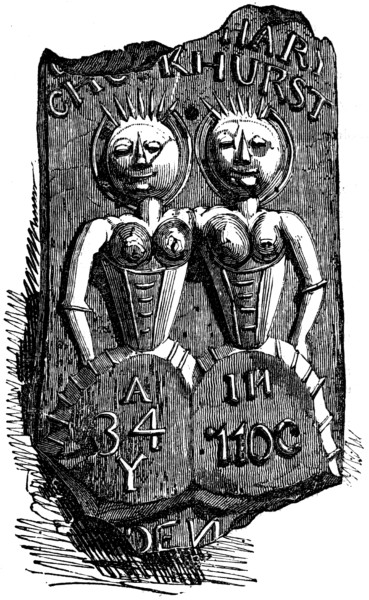
The Biddenden Cake.
Copy of the printed Narrative before referred to.
A NEW AND ENLARGED ACCOUNT OF THE BIDDENDEN MAIDS IN KENT, BORN JOINED AT THE HIPS AND SHOULDERS:
With a well authenticated Account of a similar Phenomenon of Two Brothers.
On Easter Sunday in every year after Divine Service in the afternoon at the Parish of Biddenden, in the County of Kent, there are by the Churchwardens, given to Strangers about 1000 Rolls, with an impression on them similar to the Plate. The origin of this Custom is thus related.
In the year 1100 at Biddenden, in Kent, were born Elizabeth and Mary Chulkhurst, Joined together by the Hips and Shoulders, and who lived in that state, Thirty Four Years!! at the expiration of which time, one of them was taken ill and after a short period died; the surviving one was advised to be separated from the corpse which she absolutely refused by saying these words, “as we came together, we will also go together,” and about six hours after her sister’s decease, she was taken ill and died also. A Stone near the Rector’s Pew marked with a diagonal line is shewn as the place of their interment.
The moon on the east oriel shone, Through slender shafts of shapely stone, The silver light, so pale and faint, Shewed the twin sisters and many a saint, Whose images on the glass were dyed; Mysterious maidens side by side. The moon beam kissed the holy pane, And threw on the pavement a mystic stain.
It is further stated, that by their will, they bequeathed to the Churchwardens of the Parish of Biddenden, and their successors, Churchwardens for ever, certain pieces or parcels of Land in the Parish, containing about 20 Acres, which is hired at 40 Guineas per annum, and that in commemoration of this wonderful Phenomenon of Nature, the Rolls and about 300 Quartern Loaves and Cheese in proportion, should be given to the Poor Inhabitants of the Parish.
This account is entirely traditionary, the Learned Antiquarian Hasted, in his account of the Charities of the Parish, states the Land “was the gift of two Maidens, of the name of Preston: and that the print of the women on the cakes has only been used within these 80 years, and was made to represent two poor widows, as the general objects of a charitable benefaction.” It is probable that the investigation of the learned Antiquary, brought to light some record of the name of the Ladies, for in the year 1656, the Rev. W. Horner, then Rector of the Parish, claimed the Land, as having been given to augment his glebe, but was non-suited in the court of Exchequer. In the pleadings preserved in the Church, the names of the Ladies are not stated, not being known. There are also two other Places where such Phenomena are said to have occurred.
If these statements weaken the credibility of the tradition, the following account of a Lusus Naturæ, compiled from the London Medical Repository, for 1821, page 138, will unquestionably confirm the opinion of many as to the probability of the Phenomenon of the Biddenden Maids,—Mr. Livingstone, the Surgeon of the British Factory at Canton, relates that there was shewn at Macao, A-ke, a boy about sixteen years of age, to whom was attached another Male Child, united at the pit of the stomach by the neck, as if his head was plunged into Ake’s breast. At the time of their birth they were nearly of an equal size, but the parasite has not much increased since that period. The skin of A-ke joins regularly and smoothly, the neck of the parasite, so that he can turn his brother on either of his sides upon himself, but the natural position is breast to breast; on the whole the parasite is well formed being about two feet in length.—A-ke thinks that at one period their feelings were reciprocal, but for some time he has not perceived it except in one particular act, when his brother never fails to do the same, he however feels the slightest touch applied to his brother.
A-ke has generally a sickly appearance, but excepting the parasite, is well formed; about 4 feet 10 inches high; is easily fatigued in walking or ascending a flight of steps being obliged to support his brother with his hands. When fatigued he breathes with difficulty, and is only relieved by laying down.
CHAMBERS and EXALL, Printers, (King’s Arms Printing Office) TENTERDEN.
The preceding “account” is an enlargement of a preceding one of the same size, on a larger type, with this imprint, “Biddenden: Printed and Sold by R. Weston—1808. [Price Two-pence.]” R. Weston’s paper does not contain the story of “A-ke,” which is well calculated to make the legend of the “Biddenden Maids,” pass current with the vulgar.
Our Tenterden correspondent adds, in a subsequent letter, that, on Easter Sunday, Biddenden is completely thronged. The public houses are crowded with people attracted from the adjacent towns and villages by the usage, and the wonderful account of its origin, and the day is spent in rude festivity.
To elucidate this annual custom as fully as possible, all that Mr. Hasted says of the matter is here extracted:—
“Twenty acres of land, called the Bread and Cheese Land, lying in five pieces, were given by persons unknown, the yearly rents to be distributed among the poor of this parish. This is yearly done on Easter Sunday in the afternoon, in six hundred cakes, each of which have the figures of two woman impressed on them, and are given to all such as attend the church; and two hundred and seventy loaves, weighing three pounds and a half a piece, to which latter is added one pound and an half of cheese, are given, to the parishoners only, at the same time.
“There is a vulgar tradition in these parts, that the figures on the cakes represent the donors of this gift, being two women, twins, who were joined together in their bodies, and lived together so, till they were between twenty and thirty years of age. But this seems without foundation. The truth seems to be, that it was the gift of two maidens of the name of Preston, and that the print of the women on the cakes has taken place only within these fifty years, and was made to represent two poor widows as the general objects of a charitable benefaction. William Horner, rector of this parish in 1656 brought a suit in the exchequer for the recovery of these lands, as having been given for an augmentation of his glebe land, but he was nonsuited. The lands are bounded on the east by the glebe, on the south by the highway, and one piece on the north of the highway; they are altogether of the yearly value of about 31l. 10s.”[107]
Allusion is made by the rev. Mr. Fosbroke, to a custom in the thirteenth century of seizing all ecclesiastics who walked abroad between Easter and Pentecost, because the apostles were seized by the Jews after Christ’s passion; and making them purchase their liberty by money.[108]
Mr. Brand relates, “that on Easter Sunday, is still retained at the city of Durham in the Easter holidays: on one day the men take off the women’s shoes, or rather buckles, which are only to be redeemed by a present: on another day the women make reprisals, taking off the men’s in like manner.” The annexed letter shows that the practice in that city is not quite out of fashion, though buckles are.
To the Editor of the Every-Day Book.
Durham, March 3, 1826.
Sir,—To contribute towards the information you desire to convey concerning popular customs, &c. I will describe one, much practised in Durham, which I think you have not noticed in the former volume of your interesting work.
On Easter Sunday it is a common custom here, for a number of boys to assemble in the afternoon, and as soon as the clock strikes four, scour the streets in parties, and accost every female they may happen to meet, with “pay for your shoes if you please,” at the same time, stooping to take them off; which, if they do, and do not immediately get a penny or two-pence, they will actually carry off by main force. I have known the boys have, at least, a dozen odd shoes; but generally, something is given, which in the evening they either spend in public houses, or divide. On Easter Monday, the women claim the same privilege towards the male sex. They begin much earlier in the day, and attack every man and boy they can lay hold of to make them pay for their shoes; if the men happen to wear boots, and will not pay any thing, the girls generally endeavour to seize their hats and run off. If a man catches the girl with the hat, it is usually thrown or handed about to the great amusement of the spectators, till the person is baffled out of a sixpence to redeem the right of wearing it again: but this, like all other old customs, has greatly fallen off lately, and is now chiefly practised by a few children.
I am, &c. J. B.
A contributor to the “Gentleman’s Magazine” in August, 1790, says that, at Rippon, in Yorkshire, “on Easter Sunday, as soon as the service of the church is over, the boys run about the streets, and lay hold of every woman or girl they can, and take their buckles from their shoes. This farce is continued till the next day at noon, when the females begin, and return the compliment upon the men, which does not end till Tuesday evening; nay, I was told that, some years ago, no traveller could pass through the town without being stopped and having his spurs taken away, unless redeemed by a little money, which is the only way to have your buckles returned.”
Pressing in Church.
On the morning of Easter Sunday, 1596, during the reign of queen Elizabeth, the lord mayor and aldermen of London received the royal command to raise a thousand men with the utmost expedition; wherefore they repaired with their deputies, constables, and other officers, to the churches, and having caused the doors to be shut, took the people during divine service from their worship, till the number was completed, and having armed them, the men, so raised and equipped, were marched the same night for Dover, in order to their embarkation for France; but in the mean time, Elizabeth having received advice of the reduction of Calais by the Spaniards, they were countermanded, and returned to the city in about a week after their departure.[109]
Easter Day Customs At Twickenham and Paddington.
According to Mr. Lysons, “There was an ancient custom at Twickenham, of dividing two great cakes in the church upon Easter-day among the young people; but it being looked upon as a superstitious relic, it was ordered by parliament, 1645, that the parishioners should forbear that custom, and, instead thereof, buy loaves of bread for the poor of the parish with the money that should have bought the cakes. It appears that the sum of £1. per annum is still charged upon the vicarage for the purpose of buying penny loaves for poor children on the Thursday after Easter. Within the memory of man they were thrown from the church-steeple to be scrambled for; a custom which prevailed also, some time ago, at Paddington, and is not yet totally abolished.” A correspondent imagines that the Paddington custom of throwing bread from the church-steeple, which exists also in other parishes, was derived from largesses bestowed on the poor by the Romish clergy on occasion of the festival, and that it has been continued since the Reformation, and, therefore, since the institution of poor rates, without due regard to its original object.
Biddenden Custom.
Since the former sheet was printed, an article occurs to the editor in the “Gentleman’s Magazine,” which it seems proper to notice. The writer there states, that “Biddenden is a parish of great extent, as most parishes in the weald of Kent are;” that this part of the country is called the weald, “from the growth of large timber, oak particularly;” that the town of Biddenden is about five miles equi-distant from three several market towns, Cranbrook, Smarden, and Tenterden; and is distant about fifteen miles from Maidstone. On the same authority, is now added that it does not furnish any antique inscriptions, nor does the weald in general yield the inquirer any thing antique or invaluable to repay his search. In the reign of queen Elizabeth, John Mayne, esq. endowed a good house and garden with 20l. per annum, for a free grammar school, which owing to the salary being fixed at that amount by the founder, is neither eligible to persons qualified under the regulations, nor is it capable of being increased. The visitation of the school, was formerly in the archbishop of Canterbury, but is so no longer, and the schoolmaster is appointed by the lord. The archbishop is patron of the rectory, which, in the reign of Henry VIII., was valued so high as 35l. The fair here is on the 8th of November. Mr. Urban’s correspondent noticing “the two maided-sisters who grew together from the waist downwards,” refers to accounts of similar wonders, and waggishly ends his list by directing to the “Memoirs of Scriblerus, by A. Pope,” as an authority corroborative of the apocryphal “Biddenden Maids.”
Paste Eggs.
A correspondent, T. A., mentions this custom in Cheshire: “Children go round the village and beg eggs for their Easter dinner; they accompany it by a short song, which I am sorry I am unable to present to you, but the burthen of it is addressed to the farmer’s dame, and asking ‘an egg, bacon, cheese, or an apple, or any good thing that will make us merry,’ ends with
‘And I pray you, good dame, an Easter egg.’”
In Cumberland and Westmorland, and other parts of the north of England, boys beg, on Easter eve, eggs to play with, and beggars ask for them to eat. These eggs are hardened by boiling, and tinged with the juice of herbs, broom-flowers, &c. The eggs being thus prepared, the boys go out and play with them in the fields; rolling them up and down, like bowls, upon the ground, or throwing them up, like balls, into the air.[110]
Sugar Cupping In the Peak of Derbyshire.
To the Editor of the Every-Day Book.
Tideswell, Derbyshire, March 31, 1826.
Sir,—The pleasure and instruction I have derived from the perusal of your interesting miscellany, induce me to offer to your notice a custom in this neighbourhood denominated Sugar-cupping, which, like similar remnants of the “olden time,” is gradually running into disuse.
Last Sunday, being Easter-day, I walked to the “Dropping Tor,” the rendezvous of the “sugar-cuppers,” but, owing to the extreme inclemency of the weather, no one was there, nor was it, I believe, once visited during the day. From frequent inquiry of the oldest persons in the neighbourhood, I can learn nothing but that, on Easter Sunday, they were used, when children, to go to the “Dropping Tor,” with a cup in one pocket and a quarter of a pound of sugar in the other, and having caught in their cups as much water as was desired from the droppings of the spring, they dissolved the sugar in it, and drank it. The natural consequences resulting from the congregation of a quantity of “young men and maidens” followed, and they returned home. I was anxious to discover some jargon repeated by the youthful pilgrims, as an invocation to the saint of the spring, or otherwise; but I could not collect any thing of the kind. I conjecture this custom to be peculiar to this part. If you, or any of your correspondents, can furnish more satisfactory information respecting it, some of your readers will not regret I have troubled you with the hint.
With respect, I am, Your obedient servant, A Peakril.
Further notice of this usage at “the Peak,” will be acceptable to the editor, who is neither acquainted with the practice nor its origin. At some wells it is customary, on certain days, for persons to strew flowers, or hang garlands on the brink. Accounts of this nature, especially if accompanied by a drawing of the place, are very desirable. We have hitherto had no water customs, yet springs were very early objects of veneration. These remains of ancient respect will be duly respected when communicated.
Easter Day at Rome.
On this day the pope himself goes in grand procession to the cathedral of St. Peter, and assists at the high mass. The church is lined with the guarda nobile, in their splendid uniforms of gold and scarlet, and nodding plumes of white ostrich feathers, and the Swiss guards, with their polished cuirasses and steel helmets. The great centre aisle is kept clear by a double wall of armed men, for the grand procession, the approach of which is proclaimed by the sound of trumpet from the farther end of the church. Priests advance, loaded with still augmenting magnificence, as they ascend to the higher orders. Cloth of gold, and embroidery of gold and silver, and crimson velvet, and mantles of spotted ermine, and flowing trains, and attendant train-bearers, and mitres and crucifixes glittering with jewels, and priests and patriarchs, and bishops and cardinals, dazzle the eye, and fill the whole length of St. Peter’s. Lastly, comes the pope, in his crimson chair of state, borne on the shoulders of twenty palfrenieri, arrayed in robes of white, and wearing the tiara, or triple crown of the conjoined Trinity, with a canopy of cloth of silver floating over his head; preceded by two men, carrying enormous fans, composed of large plumes of ostrich feathers, mounted on long gilded wands. He stops to pay his adorations to the miraculous Madonna in her chapel, about half-way up; and this duty, which he never omits, being performed, he is slowly borne past the high altar, liberally giving his benediction with the twirl of the three fingers as he passes.
He is then set down upon a magnificent stool, in front of the altar, on which he kneels, and his crown being taken off, and the cardinals taking off their little red caps, and all kneeling in a row, he assumes the attitude of praying. Having remained a few minutes, he is taken to a chair prepared for him, to the right of the throne. There he reads from a book, and is again taken to the altar, on which his tiara has been placed; and, bareheaded, he repeats—or as, by courtesy, it is called, sings—a small part of the service, throws up clouds of incense, and is removed to the crimson-canopied throne. High mass is celebrated by a cardinal and two bishops, at which he assists. During the service, the Italians seem to consider it quite as much of a pageant as foreigners, but neither a new nor an interesting one; they either walk about, and talk, or interchange pinches of snuff with each other, exactly as if it had been a place of amusement, until the tinkling of a little bell, which announces the elevation of the host, changes the scene. Every knee is now bent to the earth, and every voice hushed; the reversed arms of the military ring with an instantaneous clang on the marble pavement, as they sink on the ground, and all is still as death. This does not last above two minutes till the host is swallowed. Thus begins and ends the only part that bears even the smallest outward aspect of religion. The military now pour out of St. Peter’s, and form an extensive ring before its spacious front, behind which the horse guards are drawn up, and an immense number of carriages, filled with splendidly dressed women, and thousands of people on foot, are assembled. Yet the multitude almost shrunk into insignificance in the vast area of the piazza; and neither piety nor curiosity collect sufficient numbers to fill it. The tops of the colonnades all round, however, are thronged with spectators; and it is a curious sight to see a mixture of all ranks and nations,—from the coronetted heads of kings, to the poor cripple who crawls along the pavement,—assembled together to await the blessing of their fellow mortal. Not the least picturesque figures among the throng are the contadini, who, in every variety of curious costume, flock in from their distant mountain villages, to receive the blessing of the holy father, and whose bright and eager countenances, shaded by their long dark hair, turn to the balcony where the pope is to appear. At length the two white ostrich-feather fans, the forerunners of his approach, are seen; and he is borne forward on his throne, above the shoulders of the cardinals and bishops, who fill the balcony. After an audible prayer he arises, and, elevating his hands to heaven, invokes a solemn benediction upon the multitude, and the people committed to his charge. Every head uncovers; the soldiers, and many of the spectators, kneel on the pavement to receive the blessing. It is given with impressive solemnity, but with little of gesture or parade. Immediately the thundering of cannon from the castle of St. Angelo, and the peal of bells from St. Peter’s, proclaim the joyful tidings to the skies. The pope is borne out, and the people rise from their knees.[111]
Greek Easter.
The “Picture of Greece in 1825,” by Messrs. Emerson and Humphreys, and count Pecchio, contains some particulars of the celebration of the Greek church. They say,
“To-day being the festival of Easter, Napoli presented a novel appearance, viz. a clean one. This feast as the most important in the Greek church, is observed with particular rejoicings and respect. Lent having ceased, the ovens were crowded with the preparations for banquetting. Yesterday every street was reeking with the blood of lambs and goats; and to-day, every house was fragrant with odours of pies and baked meats; all the inhabitants, in festival array, were hurrying along to pay their visits and receive their congratulations; every one, as he met his friend, saluted him with a kiss on each side of his face, and repeated the words Χριστος ανεστη—‘Christ is risen.’ The day was spent in rejoicings in every quarter; the guns were fired from the batteries, and every moment the echoes of the Palamede were replying to the incessant reports of the pistols and trophaics of the soldiery. On these occasions, the Greeks (whether from laziness to extract the ball, or for the purpose of making a louder report, I know not,) always discharge their arms with a bullet: frequent accidents are the consequence. To-day, one poor fellow was shot dead in his window, and a second severely wounded by one of these random shots. In the evening, a grand ceremony took place in the square: all the members of the government, after attending divine service in the church of St. George, met opposite the residence of the executive body; the legislative being the most numerous, took their places in a line, and the executive passing along them from right to left, kissing commenced with great vigour, the latter body embracing the former with all fervour and affection. Amongst such an intriguing factious senate as the Greek legislation, it requires little calculation to discern that the greater portion of these salutations were Judas’s kisses.”
Turkish Easter.
The journals of 1824, contain the following extract, from a private letter, dated Tangiers, in Africa:—“The day after my arrival I was present at the celebration of this country’s Easter, a religious ceremony which greatly resembles our Easter, and is so called.—At break of day, twenty salutes of cannon announce the festival. At this signal, the pacha proceeds to a great plain ranged outside the city, where he is received by all the troops of the garrison, ranged under arms. An unfortunate ram is laid upon an altar there; the pacha approaches it, and plunges a knife into its throat; a Jew then seizes the bleeding animal, hoists it on his shoulders, and runs off with it to the mosque. If the animal still lives at the moment he arrives there, which very seldom fails to occur, the year will be a good one: if the contrary happens, great lamentations and groanings are made—the year will be bad. As soon as the victim is dead, a great carnage begins. Every Moor sacrifices, according to his means, one or more sheep, and this in the open street; the blood streams down on all sides; men and women imbrue themselves in it as much as they please; they cry, sing, dance, and endeavour to manifest the joy that animates them in a thousand forms. As soon as night appears, the town resounds with discharges of musketry, and it is not till the end of eight days that this charming festival concludes.”
Prophecy Concerning Easter.
For the Every-Day Book.
Notwithstanding the flood of information which has been poured over the country during the last half century, superstition, at once the child and mother of ignorance, still holds no inconsiderable sway over the minds of men. It is true, that the days of ghosts and apparitions are nearly over, but futurity is as tempting as ever, and the seventh son of a seventh son is still potent enough to charm away the money and bewilder the senses of the credulous, and Nixon’s and Mother Shipton’s prophecies still find believers. The coincidences by which these legendary predictions are sometimes fulfilled, are often curious. The present year may be said to witness the accomplishment of one. It has been said—
When my Lord falls in my Lady’s lap, England beware of some mishap.
Meaning thereby, that when the festival of Easter falls near to Lady-day, (the 25th of March,) this country is threatened with some calamity. In the year 1818, Easter-day happened on the 22d of March, and in the November of that year, queen Charlotte died. In 1826, Easter-day happening on the 26th of March, distress in the commercial world may be regarded as a fulfilment of the prediction. Spanish history affords a curious instance of this kind. It is related, that Peter and John de Carvajal, who were condemned for murder, (A. D. 1312,) on circumstantial evidence, and that very frivolous, to be thrown from the summit of a rock, Ferdinand IV., then king of Spain, could by no means be prevailed upon to grant their pardon. As they were leading to execution, they invoked God to witness their innocence, and appealed to his tribunal, to which they summoned the king to appear in thirty days’ time. He laughed at the summons; nevertheless, some days after, he fell sick, and went to a place called Alcaudet to divert himself and recover his health, and shake off the remembrance of the summons if he could. Accordingly, the thirtieth day being come, he found himself much better, and after showing a great deal of mirth and cheerfulness on that occasion with his courtiers, and ridiculing the illusion, retired to rest, but was found dead in his bed the next morning. (See Turquet’s general History of Spain 1612, p. 458, cited in Dr. Grey’s notes to Hudibras, part iii. canto 1. lines 209, 210.)
The same author (Dr. Grey,) quotes from Dr. James Young, (Sidrophel vapulans, p. 29,) that Cardan, a celebrated astrologer lost his life to save his credit; for having predicted the time of his own death, he starved himself to verify it: or else being sure of his art, he took this to be his fatal day, and by those apprehensions made it so. The prophecy of George Wishart, the Scottish martyr, respecting the death of cardinal Beatoun, is a striking feature in a catalogue of coincidences. In such light may be cited the stories of the predicted death of the duke of Buckingham, in the time of Charles I., that of lord Lyttleton in later days, and many others.
Lord Bacon, who, on many points illuminated the sixteenth with the light of the nineteenth century, after referring in his chapter on prophecies (see his Essays) to the fulfilment of many remarkable fulfilments, delivers his opinion on that point in the following words:—“My judgment is, that they ought all to be despised, and ought to serve but for winter talk by the fireside. Though when I say despised, I mean for belief.——That that hath given them grace, and some credit consisteth in these things. 1st. that men mark when they hit, and never when they miss; as they do, also of dreams. 2d. that probable conjectures and obscure traditions many times turn themselves into prophecies: while the nature of man which coveteth divination, thinks it no peril to foretell that, which indeed they do but collect.——The 3d. and last (which is the great one) is, that almost all them, being infinite in number, have been impostures, and by idle and crafty brains, merely contrived and feigned after the event passed.”
J. W. H.
Easter Day.
The editor is favoured with a hint, which, from respect to the authority whence it proceeds, is communicated below in its own language.
To the Editor of the Every-Day Book.
Harley street, March 22, 1826.
Sir,—Before I slip from town for the holidays, let me observe that it may be useful, and more useful perhaps than you imagine, to many of your readers, if you were to mention the earliest day whereon Easter can occur: for, as not only movable feasts, but law terms, and circuits of judges, and the Easter recess of parliament, depend on this festival, it influences a vast portion of public business, and of the every-day concerns of a great number of individuals in the early season of the year.
The earliest possible day whereon Easter can happen, in any year, is the 22d of March. It fell on that day in 1818, and cannot happen on that day till the year 2285.
The latest possible day whereon Easter can happen, is the 25th of April.
We can have no squabble this year concerning the true time of Easter. The result of the papers on that subject in the first volume of your excellent publication, vindicated the time fixed for its celebration, in this country, upon those principles which infallibly regulate the period.
In common with all I am acquainted with, who have the pleasure of being acquainted with your Every-Day Book, I wish you and your work the largest possible success. I am, &c.
Alpha.
P.S. It occurs to me that you may not be immediately able to authenticate my statement; and, therefore, I subscribe my name for your private satisfaction.
—— ———.
Easter King.
As the emperor, Charles V., was passing through a small village in Arragon, on Easter-day, he was met by a peasant, who had been chosen the paschal, or Easter king of his neighbourhood, according to the custom of his country, and who said to him very gravely, “Sir, it is I that am king.” “Much good may it do you, my friend,” replied the emperor, “you have chosen an exceedingly troublesome employment.”
NATURALISTS’ CALENDAR.
Mean Temperature 43·95.
March 27.
Easter Monday.
This is the day for choosing churchwardens in the different parishes, and for merry-making afterwards.
From the “Mirror of the Months.”
Now, at last, the Easter week is arrived, and the poor have for once in the year the best of it,—setting all things, but their own sovereign will, at a wise defiance. The journeyman who works on Easter Monday should lose his caste, and be sent to the Coventry of mechanics, wherever that may be. In fact, it cannot happen. On Easter Monday ranks change places; Jobson is as good as sir John; the “rude mechanical” is “monarch of all he surveys” from the summit of Greenwich-hill, and when he thinks fit to say “it is our royal pleasure to be drunk!” who shall dispute the proposition? Not I, for one. When our English mechanics accuse their betters of oppressing them, the said betters should reverse the old appeal, and refer from Philip sober to Philip drunk; and then nothing more could be said. But now, they have no betters, even in their own notion of the matter. And in the name of all that is transitory, envy them not their brief supremacy! It will be over before the end of the week, and they will be as eager to return to their labour as they now are to escape from it; for the only thing that an Englishman, whether high or low, cannot endure patiently for a week together, is, unmingled amusement. At this time, however, he is determined to try. Accordingly, on Easter Monday all the narrow lanes and blind alleys of our metropolis pour forth their dingy denizens into the suburban fields and villages, in search of the said amusement, which is plentifully provided for them by another class, even less enviable than the one on whose patronage they depend; for of all callings, the most melancholy is that of purveyor of pleasure to the poor.
During the Monday our determined holiday-maker, as in duty bound, contrives, by the aid of a little or not a little artificial stimulus, to be happy in a tolerably exemplary manner. On the Tuesday, he fancies himself happy to-day, because he felt himself so yesterday. On the Wednesday he cannot tell what has come to him, but every ten minutes he wishes himself at home, where he never goes but to sleep. On Thursday he finds out the secret, that he is heartily sick of doing nothing; but is ashamed to confess it; and then what is the use of going to work before his money is spent? On Friday he swears that he is a fool for throwing away the greatest part of his quarter’s savings without having any thing to show for it, and gets gloriously drunk with the rest to prove his words; passing the pleasantest night of all the week in a watchhouse. And on Saturday, after thanking “his worship” for his good advice, of which he does not remember a word, he comes to the wise determination, that, after all, there is nothing like working all day long in silence, and at night spending his earnings and his breath in beer and politics! So much for the Easter week of a London holiday-maker.
But there is a sport belonging to Easter Monday which is not confined to the lower classes, and which fun forbid that I should pass over silently. If the reader has not, during his boyhood, performed the exploit of riding to the turn-out of the stag on Epping-forest—following the hounds all day long at a respectful distance—returning home in the evening with the loss of nothing but his hat, his hunting whip, and his horse, not to mention a portion of his nether person—and finishing the day by joining the lady mayoress’s ball at the Mansion-house; if the reader has not done all this when a boy, I will not tantalize him by expatiating on the superiority of those who have. And if he has done it, I need not tell him that he has no cause to envy his friend who escaped with a flesh wound from the fight of Waterloo; for there is not a pin to choose between them.
Epping Hunt.
In 1226, king Henry III. confirmed to the citizens of London, free warren, or liberty to hunt a circuit about their city, in the warren of Staines, &c.; and in ancient times the lord mayor, aldermen, and corporation, attended by a due number of their constituents, availed themselves of this right of chace “in solemn guise.” From newspaper reports, it appears that the office of “common hunt,” attached to the mayoralty, is in danger of desuetude. The Epping hunt seems to have lost the lord mayor and his brethren in their corporate capacity, and the annual sport to have become a farcical show.
A description of the Epping hunt of Easter Monday, 1826, by one “Simon Youngbuck,” in the Morning Herald, is the latest report, if it be not the truest; but of that the editor of the Every-Day Book cannot judge, for he was not there to see: he contents himself with picking out the points; should any one be dissatisfied with the “hunting of that day,” as it will be here presented, he has only to sit down, in good earnest, to a plain matter-of-fact detail of all the circumstances from his own knowledge, accompanied by such citations as will show the origin and former state of the usage, and such a detail, so accompanied, will be inserted—
“For want of a better this must do.”
On the authority aforesaid, and that, without the introduction of any term not in the Herald, be it known then, that before, and at the commencement of the hunt aforesaid, it was a cold, dry, and dusty morning, and that the huntsmen of the east were all abroad by nine o’clock, trotting, fair and softly, down the road, on great nine-hand skyscrapers, nimble daisy-cutting nags, flowing-tailed chargers, and ponies no bigger than the learned one at Astley’s; some were in job-coaches, at two guineas a-day; some in three-bodied nondescripts, some in gigs, some in cabs, some in drags, some in short stages, and some in long stages; while some on no stages at all, footed the road, smothered by dust driven by a black, bleak north-easter full in the teeth. Every gentleman was arrayed after his own particular taste, in blue, brown, or black—in dress-coats, long coats, short coats, frock coats, great coats, and no-coats;—in drab-slacks and slippers;—in gray-tights, and black-spurred Wellingtons;—in nankeen bomb-balloons;—in city-white cotton-cord unmentionables, with jockey toppers, and in Russian-drill down-belows, as a memento of the late czar. The ladies all wore a goose-skin under-dress, in compliment to the north-easter.
At that far-famed spot, the brow above Fairmead bottom, by twelve o’clock, there were not less than three thousand merry lieges then and there assembled. It was a beautiful set-out. Fair dames “in purple and in pall,” reposed in vehicles of all sorts, sizes, and conditions, whilst seven or eight hundred mounted members of the hunt wound in and out “in restless ecstasy,” chatting and laughing with the fair, sometimes rising in their stirrups to look out for the long-coming cart of the stag, “whilst, with off heel assiduously aside,” they “provoked the caper which they seemed to hide.” The green-sward was covered with ever-moving crowds on foot, and the pollard oaks which skirt the bottom on either side were filled with men and boys.
But where the deuce is the stag all this while? One o’clock, and no stag. Two o’clock, and no stag!—a circumstance easily accounted for by those who are in the secret, and the secret is this. There are buttocks of boiled beef and fat hams, and beer and brandy in abundance, at the Roebuck public-house low down in the forest; and ditto at the Baldfaced Stag, on the top of the hill; and ditto at the Coach and Horses, at Woodford Wells; and ditto at the Castle, at Woodford; and ditto at the Eagle, at Snaresbrook; and if the stag had been brought out before the beef, beer, bacon, and brandy, were eaten and drank, where would have been the use of providing so many good things? So they carted the stag from public-house to public-house, and showed him at threepence a head to those ladies and gentlemen who never saw such a thing before, and the showing and carting induced a consumption of eatables and drinkables, an achievement which was helped by a band of music in every house, playing hungry tunes to help the appetite; and then, when the eatables and drinkables were gone, and paid for, they turned out the stag.
Precisely at half-past two o’clock, the stag-cart was seen coming over the hill by the Baldfaced Stag, and hundreds of horsemen and gig-men rushed gallantly forward to meet and escort it to the top of Fairmead bottom, amidst such whooping and hallooing, as made all the forest echo again; and would have done Carl Maria Von Weber’s heart good to hear. And then, when the cart stopped and was turned tail about, the horsemen drew up in long lines, forming an avenue wide enough for the stag to run down. For a moment, all was deep, silent, breathless anxiety; and the doors of the cart were thrown open, and out popped a strapping four-year-old red buck, fat as a porker, with a chaplet of flowers round his neck, a girth of divers coloured ribbons, and a long blue and pink streamer depending from the summit of his branching horns. He was received, on his alighting, with a shout that seemed to shake heaven’s concave, and took it very graciously, looking round him with great dignity as he stalked slowly and delicately forward, down the avenue prepared for him; and occasionally shrinking from side to side, as some supervalorous cockney made a cut at him with his whip. Presently, he caught a glimpse of the hounds and the huntsmen, waiting for him at the bottom, and in an instant off he bounded, sideways, through the rank, knocking down and trampling all who crowded the path he chose to take; and dashing at once into the cover, he was out of sight before a man could say “Jack Robinson!” Then might be seen, gentlemen running about without their horses, and horses galloping about without their gentlemen; and hats out of number brushed off their owners’ heads by the rude branches of the trees; and every body asking which way the stag was gone, and nobody knowing any thing about him; and ladies beseeching gentlemen not to be too venturesome; and gentlemen gasping for breath at the thoughts of what they were determined to venture; and myriads of people on foot running hither and thither in search of little eminences to look from; and yet nothing at all to be seen, though more than enough to be heard; for every man, and every woman too, made as loud a noise as possible. Meanwhile the stag, followed by the keepers and about six couple of hounds, took away through the covers towards Woodford. Finding himself too near the haunts of his enemy, man, he there turned back, sweeping down the bottom for a mile or two, and away up the enclosures towards Chingford; where he was caught nobody knows how, for every body returned to town, except those who stopped to regale afresh, and recount the glorious perils of the day. Thus ended the Easter Hunt of 1826.