OCTOBER. (continued 2)
Reading edition
NATURALISTS’ CALENDAR.
Mean Temperature 50·72.
October 16.
The Season.
An appearance at this time of the year, already noticed, appears to have surprised our countrymen in Lancashire. Though there is no doubt that the authorities who communicate the intelligence believe it very remarkable, yet it is doubtful whether the occurrence may not be more frequent in that part of England than they have had the opportunity of remarking. Their account is to the following purport:—
On Sunday, October 1, 1826, a phenomenon of rare occurrence in the neighbourhood of Liverpool was observed in that vicinage, and for many miles distant, especially at Wigan. The fields and roads were covered with a light filmy substance, which by many persons was mistaken for cotton; although they might have been convinced of their error, as staple cotton does not exceed a few inches in length, while the filaments seen in such incredible quantities extended as many yards. In walking in the fields the shoes were completely covered with it, and its floating fibres came in contact with the face in all directions. Every tree, lamppost, or other projecting body had arrested a portion of it. It profusely descended at Wigan like a sleet, and in such quantities as to affect the appearance of the atmosphere. On examination it was found to contain small flies, some of which were so diminutive as to require a magnifying glass to render them perceptible. The substance so abundant in quantity was the gossamer of the garden, or field spider, often met with in the country in fine weather, and of which, according to Buffon, it would take 663,552 spiders to produce a single pound.[387]
NATURALISTS’ CALENDAR.
Mean Temperature 58·45.
October 17.
A Lying-in Custom.
A lady who is pleased to grace these columns by her pen, transmits a very minute description of a very “comfortable thing” at this time of the year, which may well be extended from a particular usage at an interesting period, to a general one.
Sugared Toast.
To the Editor of the Every-Day Book.
Westbury, September 10, 1826.
Sir,—I suspect that although you solicit the aid of correspondents in furnishing your excellent miscellany with accounts of local customs, you scarcely expect to receive one which appertains to that important time, when mothers increase their care, and fathers receive the additional “tender juveniles” with joy or sorrow, “as it may happen!” If you should give publicity to the following strange “feast,” (more honoured in the breach than in the observance,) I shall feel gratified, as it may not only lead to an elucidation of its meaning and origin, but will tend to convince your readers, that you will not despise their efforts at contribution, however humble. I am not a native of this part of the country, or, as the good people say here, I am not “one o’ Westbury,” for I have resided till lately in and near London, where the manners customs, and habits, are a hundred years in advance of those of the western part of the kingdom; hence, many of the usages that obtain around us, which now excite my surprise, would have passed as a thing of course, had I been always among them.
On the “confinement” of a lady,—but I must, before I proceed, define a lady “of these parts,” by the unerring test of her husband’s qualifications: if he can maintain his own, and her station in their little world, he is then “well to do,”—“a rich fellow enough, go to—a fellow that hath had losses, and which is more, a householder; one who hath two gowns to his back, and every thing handsome about him;”—one who recreates in his own gig; keeps a “main” of company; patronises the tiny theatre; grows his own pines, and tries to coax his forced plants into the belief that the three dozen mould candles which he orders to be lighted in his hot-house every evening, are “shedding delicious light,” left by the “garish god of day,” for their especial benefit, during his nocturnal rambles![388] The wife of such a man, sir, I designate a lady and when such a lady’s accouchement takes place, her “dear five hundred friends” are admitted to see her the next day. In London, the scale of friendship is graduated woefully lower; for visiters there, bear the pangs of absence from the interesting recluse a whole fortnight.
You are, doubtless, anxious to come to the “pith and marrow” of this communication, and I will tantalize you no longer. In “these” parts of the country, it is the custom, when a lady shall have been “as well as can be expected,” for thirteen or fourteen days, for the husband to enjoy what is called “the gentleman’s party,” viz: all his friends, bachelor and Benedict, are invited to eat “sugared toast,” which, (as the cookery-books always say,) “is thus prepared”—Rounds of bread are “baked,” (videlicit toasted,) each stratum spread thick with moist sugar, and piled up in a portly punch bowl, ready for action: “strong beer,” (anglice, home-brewed ale,) is in the mean time heated, and poured boiling hot over the mound of bread; which is taken immediately to the expectant guests, who quickly come to the conclusion of the gothic “mess.” How they contrive to emancipate the toast from the scalding liquid, I never could, by any effort of ingenuity and research, decide to my own satisfaction. A goodly slice you know, sir, it would be entirely impracticable to achieve; for in half a minute from the time of the admission of the “hot beer,” the toast must be “all of a swam,” (as we elegantly say here,) and, resembling the contents of the witch’s cauldron, “thick and slab.” Whether a soup ladle and soup plates are in requisition on the occasion, I am equally unable to ascertain; but on the final dismissal of this gentlemanly food, (for I by no means would insinuate that the congregation is limited to one act of devotion,) they magnanimously remunerate the “nurse,” by each putting money into the empty bowl, which is then conveyed to the priestess of their ignoble orgies! Of all the “mean and impotent conclusions” of a feast, defend me from that, which pays its “pic nic” pittance to an old crone, who is hired to attend the behests of the “lady,” but who by some strange mutation becomes the directress of the “gentleman’s” revels, and the recipient of the payment from his guests, for “sugar’d toast!”
Should this “custom,” be thought worthy of being admitted into the Every-Day Book, you will “tell” of something more than Herrick “dreamt of in his philosophy;” and the following couplet might “blush to find its fame” among his descriptive lines that adorn your title-page; after
“Bridegrooms, brides, and of their bridal cakes,”
might come—
“I tell of times when husbands rule the roast, And riot in the joys of ‘sugar’d toast;’ I tell of groves, &c.”
I am, Sir, Yours very respectfully, I. J. T.
NATURALISTS’ CALENDAR.
Mean Temperature 50·60.
October 18.
Death of the Lottery.
If any thing can be believed that is said by the lottery people respecting the lottery, before the appearance of the next sheet of the Every-Day Book the lottery will be at an end for ever.
Particulars respecting the last moments of this “unfortunate malefactor,” will be very acceptable if transmitted immediately; and in order to an account of lotteries in the ensuing sheet, information and anecdotes respecting them are most earnestly desired.
Forged Notes in Shop Windows.
A newspaper of this day in the year 1818, contains a paragraph which marks the discontent that prevailed in London, in consequence of a regulation adopted by the Bank of England at that time.
“The new mode adopted by the Bank, of stamping the forged notes presented to them for payment, and returning them to the parties who may have received them, has at least the good effect of operating as a caution to others, not to receive notes without the greatest caution. It has, however, another effect often productive of public inconvenience; for such are the doubts now entertained as to the goodness of every note tendered in payment, that many will not give change at all; and the disposition to adhere to this practice seems every day to be getting more general. In almost every street in town, forged notes are seen posted on tradesmen’s windows, and not unfrequently this exhibition is accompanied with the words ‘Tradesmen! beware of changing notes.’ The operation of stamping the forged notes, was at first performed by the hand, but now so arduous has this labour become, that a machine is erected for the purpose, and it would seem from the never-ceasing quantity of such paper in circulation, that it will be necessary to erect a steam-engine, so that hundreds may undergo the operation at once.”[389]
NATURALISTS’ CALENDAR.
Mean Temperature 51·32.
October 19.
Garrick.
“Garrick was, and Kemble is no more.”
On this day in the year 1741, the “British Roscius,” as he is emphatically termed, made his first appearance as “a gentleman who never appeared on any stage.” A remarkable event, precursing the revival of the drama, by Garrick, and its perfection by Kemble, deserves notice as a memorial of what “has been:” particularly as we have arrived at a period when, in consequence of managers having been outmanaged, and the public tricked out of its senses, the drama seems to have fallen to rise no more.
Leadenhall-street, October, 1826.
Sir,—The following is a copy of the play-bill that announced the first appearance of Mr. Garrick.
I am, Sir, yours truly, H. B.
October 19, 1741.
Goodman’s Fields.
At the late Theatre in Goodman’s Fields, this day will be performed a Concert of Vocal and Instrumental Music, divided into two parts.
Tickets at Three, Two, and One Shilling.
Places for the boxes to be taken at the Fleece Tavern, near the Theatre.
N. B. Between the two parts of the Concert will be presented an Historical Play, called the Life and Death of
King Richard the Third, containing the distresses of King Henry VI. The artful acquisition of the Crown by King Richard, The murder of the young King Edward V. and his brother, in the Tower. The landing of the Earl of Richmond,
And the death of King Richard in the memorable battle of Bosworth Field, being the last that was fought between the Houses of York and Lancaster.
With many other true historical passages.
The part of King Richard by a Gentleman.
(Who never appeared on any stage.)
King Henry, by Mr. Giffard; Richmond, Mr. Marshall; Prince Edward, by Miss Hippisley; Duke of York, Miss Naylor; Duke of Buckingham, Mr. Peterson; Duke of Norfolk, Mr. Blades; Lord Stanley, Mr. Pagett; Oxford, Mr. Vaughan; Tressel, Mr. W. Giffard; Catesby, Mr. Marr; Ratcliff, Mr. Crofts; Blunt, Mr. Naylor; Tyrrell, Mr. Puttenham; Lord Mayor, Mr. Dunstall; The Queen, Mrs. Steel; Duchess of York, Mrs. Yates;
And the part of Lady Anne, By Mrs. Giffard.
With Entertainments of Dancing
By Mons. Fromet, Madam Duvall, and the two Masters and Miss Granier.
To which will be added a Ballad Opera of one act, called The Virgin Unmask’d.
The part of Lucy by Miss Hippisley.
Both of which will be performed gratis by persons for their diversion.
The Concert will begin exactly at six o’clock.
NATURALISTS’ CALENDAR.
Mean Temperature 51·10.
October 20.
Wrestling.
A writer in a journal of this month, 1826,[390] gives the following account of several wrestling matches between men of Devonshire and Cornwall, on the 19th 20th and 21st of September preceding, at the Eagle-tavern-green, City-road. He says, “the difference in the style of wrestling of these two neighbouring shires, is as remarkable as that of the lineaments of their inhabitants. The florid chubby-faced Devon-man is all life and activity in the ring, holding himself erect, and offering every advantage to his opponent. The sallow sharp-featured Cornwall-man is all caution and resistance, bending himself in such a way, that his legs are inaccessible to his opponent, and waiting for the critical instant, when he can spring in upon his impatient adversary.”
The account of the matches at the Eagle-tavern then proceeds in the following manner:—
The contest between Abraham Cann and Warren, not only displayed this difference of style, but was attended with a degree of suspense between skill and strength, that rendered it extremely interesting.—The former, who is the son of a Devonshire farmer, has been backed against any man in England for 500l. His figure is of the finest athletic proportions, and his arm realizes the muscularity of ancient specimens: his force in it is surprising; his hold is like that of a vice, and with ease he can pinion the arms of the strongest adversary, if he once grips them, and keep them as close together, or as far asunder, as he chooses. He stands with his legs apart, his body quite upright, looking down good humouredly on his crouching opponent.—In this instance, his opponent Warren, a miner, was a man of superior size, and of amazing strength, not so well distributed however, throughout his frame; his arms and body being too lengthy in proportion to their bulk. His visage was harsh beyond measure, and he did not disdain to use a little craft with eye and hand, in order to distract his adversary’s attention. But he had to deal with a man as collected as ever entered the ring. Cann put in his hand as quietly as if he were going to seize a shy horse, and at length caught a slight hold between finger and thumb of Warren’s sleeve. At this, Warren flung away with the impetuosity of a surprised horse. But it was in vain; there was no escape from Cann’s pinch, so the miner seized his adversary in his turn, and at length both of them grappled each other by the arm and breast of the jacket. In a trice Cann tripped his opponent with the toe in a most scientific but ineffectual manner, throwing him clean to the ground, but not on his back, as required. The second heat began similarly, Warren stooped more, so as to keep his legs out of Cann’s reach, who punished him for it by several kicks below the knee, which must have told severely if his shoes had been on, according to his county’s fashion. They shook each other rudely—strained knee to knee—forced each other’s shoulders down, so as to overbalance the body—but all ineffectually.—They seemed to be quite secure from each other’s efforts, as long as they but held by the arm and breast-collar, as ordinary wrestlers do. A new grip was to be effected. Cann liberated one arm of his adversary to seize him by the cape behind: at that instant Warren, profiting by his inclined posture, and his long arms, threw himself round the body of the Devon champion, and fairly lifted him a foot from the ground, clutching him in his arms with the grasp of a second Anteæus.—The Cornish men shouted aloud, “Well done, Warren!” to their hero, whose naturally pale visage glowed with the hope of success. He seemed to have his opponent at his will, and to be fit to fling him, as Hercules flung Lycas, any how he pleased. Devonshire then trembled for its champion, and was mute. Indeed it was a moment of heart-quaking suspense.—But Cann was not daunted; his countenance expressed anxiety, but not discomfiture. He was off terra-firma, clasped in the embrace of a powerful man, who waited but a single struggle of his, to pitch him more effectually from him to the ground.—Without straining to disengage himself, Cann with unimaginable dexterity glued his back firmly to his opponent’s chest, lacing his feet round the other’s knee-joints, and throwing one arm backward over Warren’s shoulder, so as to keep his own enormous shoulders pressed upon the breast of his uplifter. In this position they stood at least twenty seconds, each labouring in one continuous strain, to bend the other, one backwards, the other forwards.—Such a struggle could not last. Warren, with the weight of the other upon his stomach and chest, and an inconceivable stress upon his spine, felt his balance almost gone, as the energetic movements of his countenance indicated.—His feet too were motionless by the coil of his adversary’s legs round his; so to save himself from falling backwards, he stiffened his whole body from the ankles upwards, and these last being the only liberated joints, he inclined forwards from them, so as to project both bodies, and prostrate them in one column to the ground together.—It was like the slow and poising fall of an undermined tower.—You had time to contemplate the injury which Cann the undermost would sustain if they fell in that solid, unbending posture to the earth. But Cann ceased bearing upon the spine as soon as he found his supporter going in an adverse direction. With a presence of mind unrateable, he relaxed his strain upon one of his adversary’s stretched legs, forcing the other outwards with all the might of his foot, and pressing his elbow upon the opposite shoulder. This was sufficient to whisk his man undermost the instant he unstiffened his knee—which Warren did not do until more than half way to the ground, when from the acquired rapidity of the falling bodies nothing was discernible.—At the end of the fall, Warren was seen sprawling on his back, and Cann whom he had liberated to save himself, had been thrown a few yards off on all-fours. Of course the victory should have been adjudged to this last. When the partial referree was appealed to, he decided, that it was not a fair fall, as only one shoulder had bulged the ground, though there was evidence on the back of Warren that both had touched it pretty rudely.—After much debating a new referree was appointed, and the old one expelled; when the candidates again entered the lists. The crowning beauty of the whole was, that the second fall was precisely a counterpart of the other. Warren made the same move, only lifting his antagonist higher, with a view to throw the upper part of his frame out of play. Cann turned himself exactly in the same manner using much greater effort than before, and apparently more put to it, by his opponent’s great strength. His share, however, in upsetting his supporter was greater this time, as he relaxed one leg much sooner, and adhered closer to the chest during the fall; for at the close he was seen uppermost, still coiled round his supine adversary, who admitted the fall, starting up, and offering his hand to the victor. He is a good wrestler too—so good, that we much question the authority of “The Times,” for saying that he is not one of the crack wrestlers of Cornwall.—From his amazing strength, with common skill he should be a first-rate man at this play, but his skill is much greater than his countrymen seemed inclined to admit.—Certain it is, they destined him the first prize, and had Cann not come up to save the honour of his county, for that was his only inducement, the four prizes, by judiciously matching the candidates, would no doubt have been given to natives of Cornwall.
Blackford, the Backsword Player.
To the Editor of the Every-Day Book.
Sir,—Your correspondent C. T. p. 1207, having given a description of “Purton Fair,” my grandmother and father born there, the birth-place of Anne Boleyn, I feel interested in the spot of my progenitors. C. T., speaking of old “Corey Dyne,” the gipsy, says a man named Blackford was the most noted Backsword-player of his day. He bore off the prizes then played for in London, Bath, Bristol, and Gloucester. When very young, at Lyneham grammar-school, I recollect this frontispiece despoiler broke fourteen heads, one after another; in the fifteenth bout, however, he pretty nearly found his match in the person of Isaac Bushel, a blacksmith of this place, who could bite a nail asunder, eat a shoulder of mutton with appendages, or fight friend or foe for love or money. It was a saying, “Bushel could take enough to kill a dozen men;” nor was his head unlike his name: he was the village Wat Tyler.
When the Somerset youths played with the Wiltshire on a stage on Calne-green, two years since, one of Blackford’s descendants gave a feeling proof of head-breaking with other heads of this blood-letting art, in which stratagem is used to conceal the crimson gush chiefly by sucking. Like fencing, attitude and agility are the great assistants to ensure success in backsword-playing; the basket is also of great service to the receiving of blows, and protecting the muscles of the wrist. The greatest exploits remembered at Purton by the present memorialist, arose out of the “Coronation of George the Third.” All the festivities of the seasons were concentrated, and May games and Christmas customs, without regard to usage, in full exercise. The belfry was filled day after day; any one that could pull a rope might ring, which is no easy task; the bells are deep, and two or three men usually raise the tenor. Some of the Blackfords lie in Purton churchyard.
October 5. *, *, P.
The autumnal dress of a man in the fourteenth century is introduced, from the transcript of an illumination, in a manuscript which supplied the Spring and Summer dress of that age, before presented.
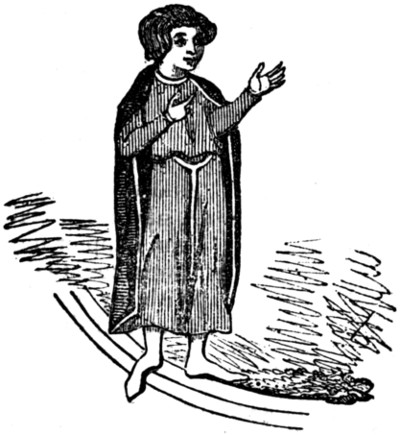
And here as suitable to the season may be subjoined some lines by a correspondent.
Autumnal Feelings. For the Every-Day Book.
The flowers are gone, the trees are bare, There is a chillness in the air, A damp that in the spirit sinks, Till the shudd’ring heart within me shrinks: Cold and slow the clouds roll past, And wat’ry drops come with the blast That moans, amid the poplars tall, A dirge for the summer’s funeral. Every bird to his home has gone, Save one that loves to sing alone The robin;—in yon ruin’d tree He warbles sweetly, mournfully His shrill note comes upon the wind, Like a sound of an unearthly kind; He mourns the loss of his sunny bowers, And the silent haunts of happy hours. There he sits like a desolate thing, With a dabbled breast and a dripping wing, He has seen his latent joys decline, Yet his heart is lighter far than mine; His task is o’er—his duty done, His strong-wing’d race on the wind have gone, He has nothing left to brood upon; He has still the hope of a friendly crumb When the wintry snow over earth shall come, And a shelter from the biting wind, And the welcome looks of faces kind. I wander here amid the blast, And a dreary look I backward cast; The best of my years I feel are fled, And I look to the coming time with dread My heart in a desert land has been, Where the flower of hope alone was green; And little in life’s decline have I To expect from kindred’s sympathy. Like the leaves now whirl’d from yonder spray, The dreams I have cherish’d day by day, On the wings of sorrow pass away. Yet I despair not—time will bring To the plumeless bird a new bright wing, A warmer breeze to the now chill’d flower, And to those who mourn a lighter hour; A gay green leaf to the faded tree, And happier days, I trust, to me. ‘Twas best that the weeds of sorrow sprung With my heart’s few flowers, while yet ’twas young, They can the sooner be destroy’d, And happiness fill their dreary void.
S. R. J.
NATURALISTS’ CALENDAR.
Mean Temperature 50·77.
October 21.
Battle of Trafalgar.
In a dreadful engagement off Cape Trafalgar, on the 21st of October, 1805, between the English fleet, consisting of twenty-seven sail of the line and four frigates, and the combined fleets of France and Spain, consisting of thirty-three sail and seven frigates, which lasted four hours, twenty sail of the enemy were sunk or destroyed, and the French commander-in-chief, (admiral Villeneuve,) with two Spanish admirals, were made prisoners. The gallant Nelson was wounded about the middle of the action, and died nearly at its close.—“Thus terminated the brilliant career of our peerless Naval Hero, who was, beyond dispute, preeminent in courage, in a department of the British service where all our countrymen are proverbially courageous: who, to unrivalled courage, united skill equally conspicuous and extraordinary; who, in consequence of these rare endowments, never led on our fleets to battle that he did not conquer; and whose name was a tower of strength to England, and a terror to her foes.”[391]
NATURALISTS’ CALENDAR.
Mean Temperature 50·62.
October 22.
Child played for.
In October, 1735, a child of James and Elizabeth Leesh, of Chester-le-street, in the county of Durham, was played for at cards, at the sign of the Salmon, one game, four shillings against the child, by Henry and John Trotter, Robert Thomson, and Thomas Ellison, which was won by the latter, and delivered to them accordingly.[392]
NATURALISTS’ CALENDAR.
Mean Temperature 49·97.
The Roman Station at Pancras.
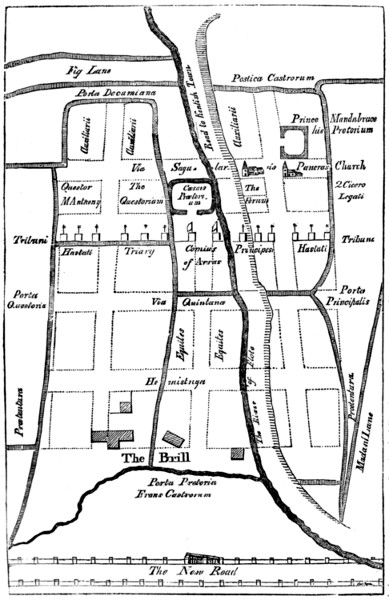
The Roman Station at Pancras. Cæsar’s Camp, called the Brill.
Enlarged illustration (270 kB).
Roman Remains at Pancras.
A former notice of some antiquities in this vicinity, seems to have occasioned the subjoined article on similar remains. Its initials will be recognised as those of a correspondent, whose communications have been acceptable, and read with interest.
Roman Remains at Pancras.
Sir,—In the ninetieth number of your Every-Day Book, (the present volume, col. 1197-1204,) a very interesting article appeared on the subject of the Roman remains near Pentonville, and thinking you may be inclined to acquaint your readers with “Cæsar’s Camp” at St. Pancras, situate near the old church, which are likely in the course of a short time to be entirely destroyed by the rage for improvement in that neighbourhood, I forward you the following particulars.
The only part at present visible is the prætorium of Cæsar, which may be seen in the drawing that accompanies this, but the ditch is now nearly filled up. I visited the spot about a week ago, and can therefore vouch for its existence up to that time, but every thing around it begins to bear a very different aspect to what it did about two years back, when my attention was particularly called to the spot from having read Dr. Stukeley’s remarks on the subject. At that time I was able to trace several other vestiges, which are entirely destroyed by the ground having been since dug up for the purpose of making bricks.
The following extracts are taken from the second volume of Dr. Stukeley’s “Itinerary.” The plan of the camp is taken from the same work. I shall feel pleasure if you will call attention to it, as you have already to the Roman remains at Pentonville.
I am, Sir, yours respectfully, S. G.
October 9, 1826.
Dr. Stukeley’s Account of Cæsar’s Camp.
October, 1758.
Cæsar’s camp was situate where Pancras church is—his prætorium is still very plain—over against the church, in the footpath on the west side of the brook; the vallum and the ditch visible; its breadth from east to west forty paces, its length from north to south sixty paces. When I came attentively to consider the situation of it, and the circumjacent ground, I easily discerned the traces of his whole camp. A great many ditches or divisions of the pastures retain footsteps of the plan of the camp, agreeable to their usual form, as in the plate engraved; and whenever I take a walk thither, I enjoy a visionary scene of the whole camp of Cæsar as described in the plate before us; a scene just as if beheld, and Cæsar present.
His army consisted of forty thousand men. Four legions with his horse. The camp is in length five hundred paces—the thirty paces beyond, for the way between the tents and vallum, (where a vallum is made,) amounts to five hundred and sixty; so that the proportion of length to breadth is as three to two.
This space of ground was sufficient for Cæsar’s army according to Roman discipline, for if he had forty thousand men, a third part of them were upon guard.
The front of the camp is bounded by a spring with a little current of water running from the west, across the Brill, into the Fleet brook. This Brill was the occasion of the road directly from the city, originally going alongside the brook by Bagnigge; the way to Highgate being at first by Copenhagen-house, which is straight road thither from Gray’s-inn-lane.
This camp has the brook running quite through the middle of it: it arises from seven springs on the south side of the hill between Hampstead and Highgate by Caen wood, where it forms several large ponds, passes by here by the name of Fleet, washes the west side of the city of London, and gives name to Fleet-street. This brook was formerly called the river of wells, from the many springs above, which our ancestors called wells; and it may be thought to have been more considerable in former times than at present, for now the major part of its water is carried off in pipes to furnish Kentish-town, Pancras, and Tottenham-court; but even now in great rains the valley is covered over with water. Go a quarter of a mile higher towards Kentish-town and you may have a just notion of its appearance at that place, only with this difference, that it is there broader and deeper from the current of so many years. It must further be considered that the channel of this brook through so many centuries, and by its being made the public north road from London to Highgate, is very much lowered and widened since Cæsar’s time. It was then no sort of embarrassment to the camp, but an admirable convenience for watering, being contained in narrow banks not deep. The breadth and length are made by long tract of time. The ancient road by Copenhagen wanting repair, induced passengers to make this gravelly valley become much larger than in Cæsar’s time. The old division runs along that road between Finsbury and Holborn division, going in a straight line from Gray’s-inn-lane to Highgate: its antiquity is shown in its name—Madan-lane.
The recovery of this noble antiquity will give pleasure to a British antiquary, especially an inhabitant of London, whereof it is a singular glory. It renders the walk over the beautiful fields to the Brill doubly agreeable, when at half a mile distance we can tread in the very steps of the Roman camp master, and of the greatest of the Roman generals.
We need not wonder that the traces of this camp so near the metropolis are so nearly worn out; we may rather wonder that so much is left, when a proper sagacity in these matters may discern them, and be assured that somewhat more than three or four sorry houses are commemorated under the name of the Brill, (now called Brill-place-Terrace;) nor is it unworthy of remark, as an evident confirmation of our system, that all the ditches and fences now upon the ground, have a manifest respect to the principal members of the original plan of the camp.
In this camp Cæsar made the two British kings friends—Casvelham and his nephew Mandubrace.
I judge I have performed my promise in giving an account of this greatest curiosity, so illustrious a monument of the greatest of the Roman generals, which has withstood the waste of time for more than eighteen centuries, and passed unnoticed but half a mile off the metropolis. I shall only add this observation, that when I came to survey this plot of ground to make a map of it by pacing, I found every where even and great numbers, and what I have often formerly observed in Roman works; whence we may safely affirm the Roman camp master laid out his works by pacing.[393]
With the hope that the preceding article may draw attention to the subject, the editor defers remark till he has been favoured with communications from other hands.
The Antiquary.
The following lines were written by an old and particular friend of the erudite individual who received them:—
To Richard Gough, Esq. O tu severi Religio loci!
Hail, genius of this littered study! Or tell what name you most delight in For sure where all the ink is muddy, And no clean margin left to write in, No common deity resides. We see, we feel thy power divine, In every tattered folio’s dust, Each mangled manuscript is thine, And thine the antique helmet’s rust. Nor less observed thy power presides Where plundered brasses crowd the floor, Or dog’s-eared drawings burst their binding Hid by Confusion’s puzzling door Beyond the reach of mortal finding. Than if beneath a costly roof Each moulding edged by golden fillet, The Russian binding, insect proof, Blushed at the foppery of ——— Give me, when tired by dust and sun, If rightly I thy name invoke, The bustle of the town to shun, And breathe unvext by city smoke. But, ah! if from these cobwebbed walls, And from this moth-embroidered cushion, Too fretful Fortune rudely calls, Resolved the cares of life to push on— Give me at least to pass my age At ease in some book-tapestried cell, Where I may turn the pictured page, Nor start at visitants’ loud bell.[394]
October 23.
St. Surin.
St. Surin, or St. Severin, which is his proper name, is a saint held in great veneration at Bordeaux; he is considered as one of the great patrons of the town. It was his native place, but he deserted it for a time to go and preach the gospel at Cologne. When he returned, St. Amand, then bishop of Bordeaux, went out with a solemn procession of the clergy to meet him, and, as he had been warned to do in a vision, resigned his bishopric to him, which St. Surin continued to enjoy as long as he lived. St. Amand continued at Bordeaux as a private person; but surviving St. Surin, he was at his death restored to the station from which he had descended with so much gentleness and resignation. It is among the traditions of the church of St. Surin at Bordeaux, that the cemetery belonging to it was “consecrated by Jesus Christ himself, accompanied by seven bishops, who were afterwards canonized, and were the founders of the principal churches in Aquitaine.”[395]
On an oval marble in Egham church, Surrey, are the following lines written by David Garrick, to the memory of the Reverend Mr. Thomas Beighton who was vicar of that church forty-five years, and died on the 23d of October, 1771, aged 73.
Epitaph.
Near half an age, with every good man’s praise, Among his flock the shepherd passed his days; The friend, the comfort, of the sick and poor, Want never knock’d unheeded at his door. Oft when his duty call’d, disease and pain Strove to confine him, but they strove in vain. All mourn his death: his virtues long they try’d: They knew not how they lov’d him till he died. Peculiar blessings did his life attend: He had no foe, and Camden was his friend.
NATURALISTS’ CALENDAR.
Mean Temperature 48·00.
October 24.
An October Sunday Morning in Cockneyshire.
For the Every-Day Book.
“Vat’s the time, Villiam?” “Kevarter arter seven.”
The “Mirror of the Months” seems to reflect every object to the reader’s eye; but not having read more of that work than by extract, in the Every-Day Book, I think an addendum, par hazard, may not be without truth and interest.
Rise early,—be abroad,—and after you have inspired sufficient fog to keep you coughing all day, you will see Jewboys and girls with their fathers and mothers veering forth from the purlieus of Houndsditch with sweetmeats, “ten a penny!” which information is sung, or said, ten thousand times before sunset. Now Irishmen, (except there be a fight in Copenhagen fields,) and women, are hurrying to and from mass, and the poorest creatures sit near the chapels, with all their own infants, and those of others, to excite pity, and call down the morning smile of charity.—Now newsboys come along the Strand with damp sheets of intelligence folded under their arms in a greasy, dirty piece of thick (once) brown paper, or a suitable envelope of leather. Now water-cress women, or rather girls, with chubby babies hanging on one arm, and a flat basket suspended from the shoulder by a strap, stand at their station-post, near the pump, at a corner of the street.[396] Now mechanics in aprons, with unshorn, unwashed faces, take their birds, dogs, and pipes, towards the fields, which, with difficulty, they find. Now the foot and horse-guards are preparing for parade in the parks—coaches are being loaded by passengers, dressed for “a few miles out of town”—the doors of liquor-shops are in motion—prayers at St. Paul’s and Westminster are responded by choristers,—crowds of the lower orders create discord by the interference of the officious street-keeper—and the “Angel” and “Elephant and Castle” are surrounded by jaunty company, arriving and departing with horses reeking before the short- and long-stage coaches.—Now the pious missionary drops religious tracts in the local stands of hackney coachmen, and paths leading to the metropolis.—Now nuts and walnuts slip-shelled are heaped in a basket with some dozens of the finest cracked, placed at the top, as specimens of the whole:—bullace, bilberries, sliced cocoa-nuts, apples, pears, damsons, blackberries, and oranges are glossed and piled for sale so imposingly, that no eye can escape them.—Now fruiterers’ and druggists’ windows, like six days’ mourning, are half shuttered.—Now the basket and bell pass your house with muffins and crumpets.[397]—Placards are hung from newsvenders’, at whose taking appearances, gossips stand to learn the fate of empires, during the lapse of hebdomadal warfare.—Now beggars carry the broom, and the great thoroughfares are in motion, and geese and game are sent to the rich, and the poor cheapen at the daring butcher’s shop, for a scrag of mutton to keep company in the pot with the carrots and turnips.—Now the Israelites’ little sheds are clothed with apparel, near which “a Jew’s eye” is watching to catch the wants of the necessitous that purchase at second-hand.—Now eels are sold in sand at the bridges, and steam-boats loiter about wharfs and stairs to take up stray people for Richmond and the Eel-pie house.—The pedestrian advocate now unbags his sticks and spreads them in array against a quiet, but public wall.—Chesnuts are just coming in, and biscuits and cordials are handed amongst the coldstreams relieving guard at Old Palace Yard, where the bands play favourite pieces enclosed by ranks and files of military men, and crowds of all classes and orders.—Now the bells are chiming for church,—dissenters and methodists are hastening to worship—baker’s counters are being covered with laden dishes and platters—quakers are silently seated in their meetings,—and a few sailors are surveying the stupendous dome of St. Paul’s, under which the cathedral service is performing on the inside of closed iron gates.—Now the beadle searches public-houses with the blinds let down.—Now winter patterns, great coats, tippets, muffs, cloaks and pelisses are worn, and many a thinly-clad carmelite shivers along the streets. With many variations, the “Sunday Morning” passes away; and then artizans are returning from their rustication, and servants are waiting with cloths on their arms for the treasures of the oven—people are seeking home from divine worship with appetites and purple noses—‘beer’ is echoed in every circle,—and post meridian assumes new features, as gravities and gaieties, in proportion to the weather, influence the cosmopolitan thermometer.
*, *, P.
NATURALISTS’ CALENDAR.
Mean Temperature 48·47.
October 25.
Crispin.
On this, the festival day of St. Crispin, enough has been already said[398] to show that it is the great holyday of the numerous brotherhood of cordwainers. The latter name they derive from their working in Spanish leather manufactured at Cordovan; their cordovan-ing has softened down into cordwaining.
Shoes and buckles.
The business of a shoemaker is of great antiquity. The instrument for cleaning hides, the shoemaker’s bristles added to the yarn, and his knife, were as early as the twelfth century. He was accustomed to hawk his goods, and it is conjectured that there was a separate trade for annexing the soles.[399] The Romans in classical times, wore cork soles in their shoes to secure the feet from water, especially in winter; and as high heels were not then introduced, the Roman ladies who wished to appear taller than they had been formed by nature, put plenty of cork under them.[400] The streets of Rome in the time of Domitian were blocked up by cobblers’ stalls, which he therefore caused to be removed. In the middle ages shoes were cleaned by washing with a sponge; and oil, soap, and grease, were the substitutes for blacking. Buckles were worn in shoes in the fourteenth century. In an Irish abbey a human skeleton was found with marks of buckles on the shoes. In England they became fashionable many years before the reign of queen Mary; the labouring people wore them of copper; other persons had them of silver, or copper-gilt; not long after shoe-roses came in.[401] Buckles revived before the revolution of 1689, remained fashionable till after the French revolution in 1789; and finally became extinct before the close of the eighteenth century.
In Robert Hegg’s “Legend of St. Cuthbert,” reprinted at the end of Mr. Dixon’s “Historical and Descriptive View of the city of Durham and its Environs,” we are told of St. Goodrick, that “in his younger age he was a pedlar, and carried his moveable shop from fair to fair upon his back,” and used to visit Lindisfarne, “much delighting to heare the monkes tell wonders of St. Cuthbert; which soe enflamed his devotion, that he undertooke a pilgrimage to the holy sepulchre; and by the advice of St. Cuthbert in a dreame, repayred againe to the holy land, and washing his feete in Jordan, there left his shoes, with a vow to goe barefoot all his life after.”
NATURALISTS’ CALENDAR.
Mean Temperature 47·87.
October 26.
Royal Debts.
On this subject a curious notice is extracted from “the Postman, October 26-28, 1708”—viz.
Advertisement.
The Creditors of King Charles, K. James, and K. William, having found out and discovered sufficient Funds for securing a perpetual Interest for 4 Millions, without burdening the people, clogging the Trade or impairing the Revenue; and all their debts not amounting to near that Sum; the more to strengthen their interest, and to find the greater favour with the Parliament, have agreed that the Army and Transports Debentures and other Parliament Debts may if they please, joyn with them, and it is not expected that any great Debts shall pay any Charge for carrying on this Act, until it be happily accomplished, and no more will be expected afterwards than what shall be readily agreed to before hand, neither shall any be hindered from taking any other measures, if there should be but a suspicion of miscarriage, which is impossible if they Unite their Interest. They continue to meet by the Parliament Stairs in Old Palace-yard, there is a Note on the Door, where daily attendance is given from 10 in the Morning till 7 at Night; if any are not apprehensive of the certainty of the Success, they may come and have full satisfaction, that they may have their Money if they will.
Nelson
The notice of the battle wherein this illustrious admiral received his death-wound, (on the 21st,) might have been properly accompanied by the following quotation from a work which should be put into the chest of every boy on his going to sea. It is so delightfully written, as to rivet the attention of every reader whether mariner or landsman.
“The death of Nelson was felt in England as something more than a public calamity: men started at the intelligence, and turned pale, as if they had heard of the loss of a dear friend. An object of our admiration and affection, of our pride and of our hopes, was suddenly taken from us; and it seemed as if we had never, till then, known how deeply we loved and reverenced him. What the country had lost in its great naval hero—the greatest of our own, and of all former times—was scarcely taken into the account of grief. So perfectly, indeed, had he performed his part, that the maritime war, after the battle of Trafalgar, was considered at an end: the fleets of the enemy were not merely defeated, but destroyed: new navies must be built, and a new race of seamen reared for them, before the possibility of their invading our shores could again be contemplated. It was not, therefore, from any selfish reflection upon the magnitude of our loss that we mourned for him: the general sorrow was of a higher character. The people of England grieved that funeral ceremonies, public monuments, and posthumous rewards, were all which they could now bestow upon him, whom the king, the legislature, and the nation, would alike have delighted to honour; whom every tongue would have blessed; whose presence in every village through which he might have passed would have awakened the church bells, have given schoolboys a holiday, have drawn children from their sports to gaze upon him, and ‘old men from the chimney corner’ to look upon Nelson, ere they died. The victory of Trafalgar was celebrated, indeed, with the usual forms of rejoicing, but they were without joy; for such already was the glory of the British navy, through Nelson’s surpassing genius, that it scarcely seemed to receive any addition from the most signal victory that ever was achieved upon the seas: and the destruction of this mighty fleet, by which all the maritime schemes of France were totally frustrated, hardly appeared to add to our security or strength; for while Nelson was living, to watch the combined squadrons of the enemy, we felt ourselves as secure as now, when they were no longer in existence.—There was reason to suppose, from the appearances upon opening the body, that, in the course of nature, he might have attained, like his father, to a good old age. Yet he cannot be said to have fallen prematurely whose work was done; nor ought he to be lamented, who died so full of honours, and at the height of human fame. The most triumphant death is that of the martyr; the most awful, that of the martyred patriot; the most splendid, that of the hero in the hour of victory: and if the chariot and the horses of fire had been vouchsafed for Nelson’s translation, he could scarcely have departed in a brighter blaze of glory.”[402]
NATURALISTS’ CALENDAR.
Mean Temperature 48·25.
October 27.
Fleet Market.
On the 27th of October, 1736, Mr. Robinson a carpenter, and Mr. Medway a bricklayer, contracted to build Fleet-market, by the following midsummer, for 3970l.[403]
NATURALISTS’ CALENDAR.
Mean Temperature 47·50.
October 28.
(St. Simon and St. Jude.)
“Wardens!”
A correspondent says, that about, or before this time, it is the custom at Bedford, now abouts, for boys to cry baked pears in the town with the following stanza—
“Who knows what I have got? In a pot hot? Baked Wardens—all hot! Who knows what I have got?”
NATURALISTS’ CALENDAR.
Mean Temperature 46·30.
October 29.
October in London.
On looking into the “Mirror of the Months,” we find “a lively portraiture” of the season.—“October is to London what April is to the country; it is the spring of the London summer, when the hopes of the shopkeeper begin to bud forth, and he lays aside the insupportable labour of having nothing to do, for the delightful leisure of preparing to be in a perpetual bustle. During the last month or two he has been strenuously endeavouring to persuade himself that the Steyne at Brighton is as healthy as Bond-street; the pavé of Pall Mall no more picturesque than the Pantiles of Tunbridge Wells; and winning a prize at one-card-loo at Margate, as piquant a process as serving a customer to the same amount of profit. But now that the time is returned when ‘business’ must again be attended to, he discards with contempt all such mischievous heresies, and reembraces the only orthodox faith of a London shopkeeper—that London and his shop are the true ‘beauteous and sublime’ of human life. In fact, ‘now is the winter of his discontent’ (that is to say, what other people call summer) ‘made glorious summer’ by the near approach of winter; and all the wit he is master of is put in requisition, to devise the means of proving that every thing he has offered to ‘his friends the public,’ up to this particular period, has become worse than obsolete. Accordingly, now are those poets of the shopkeepers, the inventors of patterns, ‘perplexed in the extreme; since, unless they can produce a something which shall necessarily supersede all their previous productions, their occupation’s gone.—It is the same with all other caterers for the public taste; even the literary ones. Mr. Elliston, [or his fortunate successor, if one there be,] ‘ever anxious to contribute to the amusement of his liberal patrons, the public,’ is already busied in sowing the seeds of a new tragedy, two operatic romances, three grand romantic melo-dramas, and half a dozen farces, in the fertile soil of those poets whom he employs in each of these departments respectively; while each of the London publishers is projecting a new ‘periodical,’ to appear on the first of January next; that which he started on the first of last January having, of course, died of old age ere this!”
Beginning of “Fires.”
In October, fires have fairly gained possession of their places, and even greet us on coming down to breakfast in the morning. Of all the discomforts of that most comfortless period of the London year which is neither winter nor summer, the most unequivocal is that of its being too cold to be without a fire, and not cold enough to have one. A set of polished fire-irons, standing sentry beside a pile of dead coals imprisoned behind a row of glittering bars, instead of mending the matter, makes it worse; inasmuch as it is better to look into an empty coffin, than to see the dead face of a friend in it. At the season in question, especially in the evening, one feels in a perpetual perplexity, whether to go out or stay at home; sit down or walk about; read, write, cast accounts, or call for the candle and go to bed. But let the fire be lighted, and all uncertainty is at an end, and we (or even one) may do any or all of these with equal satisfaction. In short, light but the fire, and you bring the winter in at once; and what are twenty summers, with all their sunshine (when they are gone,) to one winter, with its indoor sunshine of a sea-coal fire?[404]
Mr. Leigh Hunt, who on the affairs of “The Months” is our first authority, pleasantly inquires—“With our fire before us, and our books on each side, what shall we do? Shall we take out a life of somebody, or a Theocritus, or Dante, or Ariosto, or Montaigne, or Marcus Aurelius, or Horace, or Shakspeare who includes them all? Or shall we read an engraving from Poussin or Raphael? Or shall we sit with tilted chairs, planting our wrists upon our knees, and toasting the up-turned palms of our hands, while we discourse of manners and of man’s heart and hopes, with at least a sincerity, a good intention, and good nature, that shall warrant what we say with the sincere, the good-intentioned, and the good-natured?”—He then agreeably brings us to the mantlepiece. “Ah—take care. You see what that old looking saucer is, with a handle to it? It is a venerable piece of earthenware, which may have been worth, to an Athenian, about twopence; but to an author, is worth a great deal more than ever he could—deny for it. And yet he would deny it too. It will fetch his imagination more than ever it fetched potter or penny-maker. Its little shallow circle overflows for him with the milk and honey of a thousand pleasant associations. This is one of the uses of having mantlepieces. You may often see on no very rich mantlepiece a representative body of all the elements, physical and intellectual,—a shell for the sea, a stuffed bird or some feathers for the air, a curious piece of mineral for the earth, a glass of water with some flowers in it for the visible process of creation,—a cast from sculpture for the mind of man;—and underneath all, is the bright and ever-springing fire, running up through them heavenwards, like hope through materiality.”
NATURALISTS’ CALENDAR.
Mean Temperature 46·02.
October 30.
Yeomen of the Guard.
On this day in the year 1485, when king Henry VII. was crowned at Westminster, he instituted the body of royal attendants, called yeomen of the guard, who in later times acquired the appellation of “beef-eaters.”
NATURALISTS’ CALENDAR.
Mean Temperature 47·17.
October 31.
Hallow Eve.
The superstitious observances of this night, described in the former volume, are fast disappearing. In some places where young people were accustomed to meet for purposes of divination, and frequently frighten each other into fits, as of ancient custom, they have little regard to the old usages. The meetings on Hallow-eve are becoming pleasant merry-makings; the dance prevails till supper-time, when they take a cheerful glass and drink to their next happy meeting.
NATURALISTS’ CALENDAR.
Mean Temperature 47·62.