JANUARY.
Reading edition
Then came old January, wrapped well In many weeds to keep the cold away; Yet did he quake and quiver like to quell, And blow his nayles to warm them if he may; For they were numb’d with holding all the day An hatchet keene, with which he felled wood, And from the trees did lop the needlesse spray; Upon a huge great earth-pot steane he stood, From whose wide mouth there flowed forth the Romane flood.
Spenser
Laus Deo!—was the first entry by merchants and tradesmen of our forefathers’ days, in beginning their new account-books with the new year. Laus Deo! then, be the opening of this volume of the Every-Day Book, wherein we take further “note of time,” and make entries to the days, and months, and seasons, in “every varied posture, place, and hour.”
January, besides the names already mentioned,[1] was called by the Anglo-Saxons Giuli aftera, signifying the second Giul, or Yule, or, as we should say, the second Christmas.[2] Of Yule itself much will be observed, when it can be better said.
To this month there is an ode with a verse beautifully descriptive of the Roman symbol of the year:[3]
’Tis he! the two-fac’d Janus comes in view; Wild hyacinths his robe adorn, And snow-drops, rivals of the morn He spurns the goat aside, But smiles upon the new Emerging year with pride: And now unlocks, with agate key, The ruby gates of orient day.
CLIMATE.
Mr. Luke Howard is the author of a highly useful work, entitled “The Climate of London, deduced from Meteorological Observations, made at different places in the neighbourhood of the Metropolis: London, 1818.” 2 vols. 8vo. Out of this magazine of fact it is proposed to extract, from time to time, certain results which may acquaint general readers with useful knowledge concerning the weather of our latitude, and induce the inquisitive to resort to Mr. Howard’s book, as a careful guide of high authority in conducting their researches. That gentleman, it is hoped, will not deem this an improper use of his labours: it is meant to be, as far as regards himself, a humble tribute to his talents and diligence. With these views, under each month will be given a state of the weather, in Mr. Howard’s own words: and thus we begin.
JANUARY WEATHER
The Sun in the middle of this month continues about 8 h. 20 m. above the horizon. The Temperature rises in the day, on an average of twenty years, to 40·28° and falls in the night, in the open country to 31·36°—the difference, 8·92°, representing the mean effect of the sun’s rays for the month, may be termed the solar variation of the temperature.
The Mean Temperature of the month, if the observations in this city be included, is 36·34°. But this mean has a range, in ten years, of about 10·25°, which may be termed the lunar variation of the temperature. It holds equally in the decade, beginning with 1797, observed in London, and in that beginning with 1807, in the country. In the former decade, the month was coldest in 1802, and warmest in 1812, and coldest in 1814. I have likewise shown, that there was a tendency in the daily variation of temperature through this month, to proceed, in these respective periods of years, in opposite directions. The prevalence of different classes of winds, in the different periods, is the most obvious cause of these periodical variations of the mean temperature.
The Barometer in this month rises, on an average of ten years, to 30·40 in., and falls to 28·97 in.: the mean range is therefore 1·43 in.; but the extreme range in ten years is 2·38 in. The mean height for the month is about 29·79 inches.
The prevailing Winds are the class from west to north. The northerly predominate, by a fourth of their amount, over the southerly winds.
The average Evaporation (on a total of 30·50 inches for the year) is 0·832 in., and the mean of De Luc’s hydrometer 80.
The mean Rain, at the surface of the earth, is 1·959 in.; and the number of days on which snow or rain falls, in this month, averages 14,4.
A majority of the Nights in this month have constantly the temperature at or below the foregoing point.[4]
Long ere the lingering dawn of that blythe morn Which ushers in the year, the roosting cock, Flapping his wings, repeats his larum shrill; But on that morn no busy flail obeys His rousing call; no sounds but sounds of joy Salute the ear—the first-foot’s[5] entering step, That sudden on the floor is welcome heard, Ere blushing maids have braided up their hair; The laugh, the hearty kiss, the good new year Pronounced with honest warmth. In village, grange, And burrow town, the steaming flaggon, borne From house to house, elates the poor man’s heart, And makes him feel that life has still its joys. The aged and the young, man, woman, child, Unite in social glee; even stranger dogs, Meeting with bristling back, soon lay aside Their snarling aspect, and in sportive chace, Excursive scour, or wallow in the snow. With sober cheerfulness, the grandam eyes Her offspring round her, all in health and peace; And, thankful that she’s spared to see this day Return once more, breathes low a secret prayer, That God would shed a blessing on their heads.
Grahame
January 1.
The Saints of the Roman calendars and martyrologies.
So far as the rev. Alban Butler, in his every-day biography of Roman catholic saints, has written their memoirs, their names have been given, together with notices of some, and especially of those retained in the calendar of the church of England from the Romish calendar. Similar notices of others will be offered in continuation; but, on this high festival in the calendar of nature, particular or further remark on the saints’ festivals would interrupt due attention to the season, and therefore we break from them to observe that day which all enjoy in common,
New Year’s Day.
Referring for the “New-year’s gifts,” the “Candlemas-bull,” and various observances of our ancestors and ourselves, to the first volume of this work, wherein they are set forth “in lively pourtraieture,” we stop a moment to peep into the “Mirror of the Months,” and inquire “Who can see a new year open upon him, without being better for the prospect—without making sundry wise reflections (for any reflections on this subject must be comparatively wise ones) on the step he is about to take towards the goal of his being? Every first of January that we arrive at, is an imaginary mile-stone on the turnpike track of human life; at once a resting place for thought and meditation, and a starting point for fresh exertion in the performance of our journey. The man who does not at least propose to himself to be better this year than he was last, must be either very good, or very bad indeed! And only to propose to be better, is something; if nothing else, it is an acknowledgment of our need to be so, which is the first step towards amendment. But, in fact, to propose to oneself to do well, is in some sort to do well, positively; for there is no such thing as a stationary point in human endeavours; he who is not worse to-day than he was yesterday, is better; and he who is not better, is worse.”
It is written, “Improve your time,” in the text-hand set of copies put before us when we were better taught to write than to understand what we wrote. How often these three words recurred at that period without their meaning being discovered! How often and how serviceably they have recurred since to some who have obeyed the injunction! How painful has reflection been to others, who recollecting it, preferred to suffer rather than to do!
The author of the paragraph quoted above, expresses forcible remembrance of his youthful pleasures on the coming in of the new year.—“Hail! to thee, January!—all hail! cold and wintry as thou art, if it be but in virtue of thy first day. The day, as the French call it, par excellence, ‘Le jour de l’an.’ Come about me, all ye little schoolboys that have escaped from the unnatural thraldom of your taskwork—come crowding about me, with your untamed hearts shouting in your unmodulated voices, and your happy spirits dancing an untaught measure in your eyes! Come, and help me to speak the praises of new-year’s day!—your day—one of the three which have, of late, become yours almost exclusively, and which have bettered you, and have been bettered themselves, by the change. Christmay-day, which was; New-year’s-day, which is; and Twelfth-day, which is to be; let us compel them all three into our presence—with a whisk of our imaginative wand convert them into one, as the conjurer does his three glittering balls—and then enjoy them all together,—with their dressings, and coachings, and visitings, and greetings, and gifts, and “many happy returns”—with their plum-puddings, and mince-pies, and twelfth-cakes, and neguses—with their forfeits, and fortune-tellings, and blindman’s-buffs, and sittings up to supper—with their pantomimes, and panoramas, and new penknives, and pastrycooks’ shops—in short, with their endless round of ever new nothings, the absence of a relish for which is but ill supplied, in after life, by that feverish lingering and thirsting after excitement, which usurp without filling its place. Oh! that I might enjoy those nothings once again in fact, as I can in fancy! But I fear the wish is worse than an idle one; for it not only may not be, but it ought not to be. “We cannot have our cake and eat it too,” as the vulgar somewhat vulgarly, but not less shrewdly, express it. And this is as it should be; for if we could, it would neither be worth the eating nor the having.”[6]
WASSAIL!
The Wassail Bowl.
Health, my lord king, the sweet Rowena said, Health, cry’d the chieftain, to the Saxon maid; Then gayly rose, and ’midst the concourse wide, Kiss’d her hale lips, and plac’d her by his side: At the soft scene such gentle thoughts abound, That health and kisses ’mongst the guests went round; From this the social custom took its rise, We still retain, and must for ever prize.
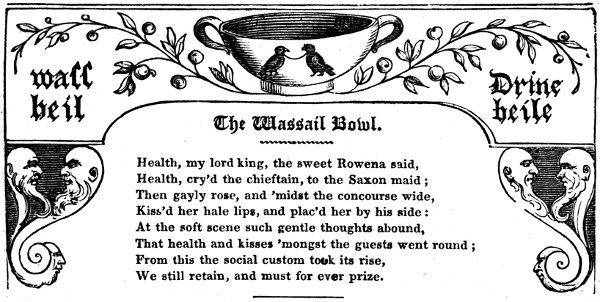
Now, on New-year’s-day as on the previous eve, the wassail bowl is carried from door to door, with singing and merriment. In Devonshire,
A massy bowl, to deck the jovial day, Flash’d from its ample round a sunlike ray. Full many a cent’ry it shone forth to grace The festive spirit of th’ Andarton race, As, to the sons of sacred union dear, It welcomed with lambs’ wool the rising year.
Polwhele.
Mr. Brand says, “It appears from Thomas de la Moore,[7] and old Havillan,[8] that was-haile and drinc-heil were the usual ancient phrases of quaffing among the English, and synonymous with the ‘Come, here’s to you,’ and ‘I’ll pledge you,’ of the present day.”
In the “Antiquarian Repertory,” a large assemblage of curious communications, published by Mr. Jeffery, of Pall-mall, in 4 vols. 4to. there is the following paper relating to an ancient carving represented in that work, from whence the above engraving is taken. The verses beneath it are a version of the old lines in Robert of Gloucester’s chronicle, by Mr. Jeffery’s correspondent.
For the Antiquarian Repertory.
In the parish of Berlen, near Snodland, in the county of Kent, are the vestiges of a very old mansion, known by the name of Groves. Being on the spot before the workmen began to pull down the front, I had the curiosity to examine its interior remains, when, amongst other things well worth observation, appeared in the large oak beam that supported the chimney-piece, a curious piece of carved work, of which the preceding is an exact copy. Its singularity induced me to set about an investigation, which, to my satisfaction, was not long without success. The large bowl in the middle is the figure of the old wassell-bowl, so much the delight of our hardy ancestors, who, on the vigil of the new year, never failed (says my author) to assemble round the glowing hearth with their cheerful neighbours, and then in the spicy wassell-bowl (which testifies the goodness of their hearts) drowned every former animosity—an example worthy modern imitation. Wassell, was the word; Wassell, every guest returned as he took the circling goblet from his friend, whilst song and civil mirth brought in the infant year. This annual custom, says Geoffrey of Monmouth, had its rise from Rouix, or Rowen, or as some will have it, Rowena, daughter of the Saxon Hengist; she, at the command of her father, who had invited the British king Voltigern to a banquet, came in the presence with a bowl of wine, and welcomed him in these words, Louerd king wass-heil; he in return, by the help of an interpreter, answered, Drinc heile; and, if we may credit Robert of Gloster,
Ruste hire and sitte hire adoune and glad dronke hire heil And that was tho in this land the verst was-hail As in language of Saroyne that we might evere iwite And so well he paith the fole about, that he is yut vorgute.
Thomas De Le Moor, in his “Life of Edward the Second,” says partly the same as Robert of Gloster, and only adds, that Wass-haile and Drinc-hail were the usual phrases of quaffing amongst the earliest civilized inhabitants of this island.
The two birds upon the bowl did for some time put me to a stand, till meeting with a communicative person at Hobarrow, he assured me they were two hawks, as I soon plainly perceived by their bills and beaks, and were a rebus of the builder’s name. There was a string from the neck of one bird to the other, which, it is reasonable to conjecture, was to note that they must be joined together to show their signification; admitting this, they were to be red hawks. Upon inquiry, I found a Mr. Henry Hawks, the owner of a farm adjoining to Groves; he assured me, his father kept Grove farm about forty years since, and that it was built by one of their name, and had been in his family upwards of four hundred years, as appeared by an old lease in his possession.
The apple branches on each side of the bowl, I think, means no more than that they drank good cider at their Wassells. Saxon words at the extremities of the beam are already explained; and the mask carved brackets beneath correspond with such sort of work before the fourteenth century.
T. N.
The following pleasant old song, inserted by Mr. Brand, from Ritson’s collection of “Antient Songs,” was met with by the Editor of the Every-day Book, in 1819, at the printing-office of Mr. Rann, at Dudley, printed by him for the Wassailers of Staffordshire and Warwickshire. It went formerly to the tune of “Gallants come away.”
A CARROLL FOR A WASSELL-BOWL.
A jolly Wassel-Bowl, A Wassel of good ale, Well fare the butler’s soul, That setteth this to sale; Our jolly Wassel. Good Dame, here at your door Our Wassel we begin, We are all maidens poor, We pray now let us in, With our Wassel. Our Wassel we do fill With apples and with spice, Then grant us your good will To taste here once or twice Of our good Wassel. If any maidens be Here dwelling in this house, They kindly will agree To take a full carouse Of our Wassel. But here they let us stand All freezing in the cold; Good master, give command, To enter and be bold, With our Wassel. Much joy into this hall With us is entered in, Our master first of all, We hope will now begin, Of our Wassel. And after his good wife Our spiced bowl will try, The Lord prolong your life, Good fortune we espy, For our Wassel. Some bounty from your hands, Our Wassel to maintain. We’ll buy no house nor lands With that which we do gain, With our Wassel. This is our merry night Of choosing King and Queen, Then be it your delight That something may be seen In our Wassel. It is a noble part To bear a liberal mind, God bless our master’s heart, For here we comfort find, With our Wassel. And now we must be gone, To seek out more good cheer; Where bounty will be shown, As we have found it here, With our Wassel. Much joy betide them all, Our prayers shall be still, We hope and ever shall, For this your great good will, To our Wassel.
From the “Wassail” we derive, perhaps, a feature by which we are distinguished. An Englishman eats no more than a Frenchman; but he makes yule-tide of all the year. In virtue of his forefathers, he is given to “strong drink.” He is a beer-drinker, an enjoyer of “fat ale;” a lover of the best London porter and double XX, and discontented unless he can get “stout.” He is a sitter withal. Put an Englishman “behind a pipe” and a full pot, and he will sit till he cannot stand. At first he is silent; but as his liquor gets towards the bottom, he inclines towards conversation; as he replenishes, his coldness thaws, and he is conversational; the oftener he calls to “fill again,” the more talkative he becomes; and when thoroughly liquefied, his loquacity is deluging. He is thus in public-house parlours: he is in parties somewhat higher, much the same. The business of dinner draws on the greater business of drinking, and the potations are strong and fiery; full-bodied port, hot sherry, and ardent spirits. This occupation consumes five or six hours, and sometimes more, after dining. There is no rising from it, but to toss off the glass, and huzza after the “hip! hip! hip!” of the toast giver. A calculation of the number who customarily “dine out” in this manner half the week, would be very amusing, if it were illustrated by portraits of some of the indulgers. It might be further, and more usefully, though not so agreeably illustrated, by the reports of physicians, wives, and nurses, and the bills of apothecaries. Habitual sitting to drink is the “besetting sin” of Englishmen—the creator of their gout and palsy, the embitterer of their enjoyments, the impoverisher of their property, the widow-maker of their wives.
By continuing the “wassail” of our ancestors, we attempt to cultivate the body as they did; but we are other beings, cultivated in other ways, with faculties and powers of mind that would have astonished their generations, more than their robust frames, if they could appear, would astonish ours. Their employment was in hunting their forests for food, or battling in armour with risk of life and limb. They had no counting-houses, no ledgers, no commerce, no Christmas bills, no letter-writing, no printing, no engraving, no bending over the desk, no “wasting of the midnight oil” and the brain together, no financing, not a hundredth part of the relationships in society, nor of the cares that we have, who “wassail” as they did, and wonder we are not so strong as they were. There were no Popes nor Addisons in the days of Nimrod.
The most perfect fragment of the “wassail” exists in the usage of certain corporation festivals. The person presiding stands up at the close of dinner, and drinks from a flaggon usually of silver having a handle on each side, by which he holds it with each hand, and the toast-master announces him as drinking “the health of his brethren out of the ‘loving cup.’” The loving cup, which is the ancient wassail-bowl, is then passed to the guest on his left hand, and by him to his left-hand neighbour, and as it finds its way round the room to each guest in his turn, so each stands up and drinks to the president “out of the loving cup.”
The subsequent song is sung in Gloucestershire on New-year’s eve:—
Wassail! Wassail! over the town, Our toast it is white, our ale it is brown: Our bowl it is made of a maplin tree, We be good fellows all; I drink to thee. Here’s to * * * *[9], and to his right ear, God send our maister a happy New Year; A happy New Year as e’er he did see— With my Wassailing bowl I drink to thee. Here’s to * * * *[10], and to his right eye, God send our mistress a good Christmas pie: A good Christmas pie as e’er I did see— With my Wassailing bowl I drink to thee. Here’s to Filpail,[11] and her long tail, God send our measter us never may fail Of a cup of good beer; I pray you draw near, And then you shall hear our jolly wassail. Be here any maids, I suppose here be some; Sure they will not let young men stand on the cold stone; Sing hey O maids, come trole back the pin, And the fairest maid in the house, let us all in. Come, butler, come bring us a bowl of the best: I hope your soul in Heaven may rest: But if you do bring us a bowl of the small, Then down fall butler, bowl, and all.
Hogmany.
Of this usage in Scotland, commencing on New-year’s eve, there was not room in the last sheet of the former volume, to include the following interesting communication. It is, here, not out of place, because, in fact, the usage runs into the morning of the New Year.
DAFT DAYS—HOGMANY.
To the Editor of the Every-Day Book.
Sir,
The annexed account contains, I believe, the first notice of the acting in our Daft Days. I have put it hurriedly together, but, if of use, it is at your service.
I am, Sir, &c. John Wood Reddock.
Falkirk, December, 1825.
During the early ages of christianity, when its promulgation among the barbarous Celts and Gauls had to contend with the many obstacles which their ignorance and superstition presented, it is very probable that the clergy, when they were unable entirely to abolish pagan rites, would endeavour, as far as possible, to twist them into something of a christian cast; and of the turn which many heathen ceremonies thus received, abundant instances are afforded in the Romish church.
The performance of religious MYSTERIES, which continued for a long period, seems to have been accompanied with much licentiousness, and undoubtedly was grafted upon the stock of pagan observances.—It was discovered, however, that the purity of the christian religion could not tolerate them, and they were succeeded by the MORALITIES, the subjects of which were either historical, or some existing abuse, that it was wished to aim a blow at. Of this we have an interesting instance in an account given by sir William Eure, the envoy of Henry the Eighth to James the Fifth, in a letter to the lord privy seal of England, dated 26th of January 1540, on the performance of a play, or morality, written by the celebrated sir David Lindsay. It was entitled The Satire of the Three Estates, and was performed at Linlithgow, “before the king, queene, and the whole counsaill, spirituall and temporall,” on the feast of Epiphany. It gives a singular proof of the liberty then allowed, by king James and his court witnessing the exhibition of a piece, in which the corruptions of the existing government and religion were treated with the most satirical severity.
The principal dramatis personæ were a king, a bushop, a burges man, “armed in harness, with a swerde drawn in his hande,” a poor man, and Experience, “clede like ane doctor.” The poor man (who seems to have represented the people) “looked at the king, and said he was not king in Scotland, for there was another king in Scotland that hanged Johne Armstrong with his fellows, Sym the laird, and mony other mae.” He then makes “a long narracione of the oppression of the poor by the taking of the corse-presaunte beits, and of the herrying of poor men by the consistorye lawe, and of mony other abusions of the spiritualitie and church. Then the bushop raised and rebuked him, and defended himself. Then the man of arms alleged the contrarie, and commanded the poor man to go on. The poor man proceeds with a long list of the bushop’s evil practices, the vices of cloisters, &c. This is proved by EXPERIENCE, who, from a New Testament, showes the office of a bishop. The man of arms and burges approve of all that was said against the clergy, and allege the expediency of a reform, with the consent of parliament. The bushop dissents. The man of arms and burges said they were two and he but one, wherefore their voice should have the most effect. Thereafter the king in the play ratified, approved, and confirmed all that was rehearsed.”
None of the ancient religious observances, which have escaped, through the riot of time and barbarism, to our day, have occasioned more difficulty than that which forms the subject of these remarks. It is remarkable, that in all disputed etymological investigations, a number of words got as explanatory, are so provokingly improbable, that decision is rendered extremely difficult. With no term is this more the case, than HOGMENAY. So wide is the field of conjecture, as to the signification of this word, that we shall not occupy much space in attempting to settle which of the various etymologies is the most correct.
Many complaints were made to the Gallic synods of the great excesses committed on the last night of the year and first of January, by companies of both sexes dressed in fantastic habits, who ran about with their Christmas boxes, calling tire lire, and begging for the lady in the straw both money and wassels. The chief of these strollers was called Rollet Follet. They came into the churches during the vigils, and disturbed the devotions. A stop was put to this in 1598, at the representation of the bishop of Angres; but debarred from coming to the churches, they only became more licentious, and went about the country frightening the people in their houses, so that the legislature having interfered, an end was put to the practice in 1668.
The period during the continuance of these festivities corresponded exactly with the present daft days, which, indeed, is nearly a translation of their French name fêtes de fous. The cry used by the bachelettes during the sixteenth century has also a striking resemblance to the still common cry “hogmenay trololay—gi’ us your white bread and nane o’ your grey,” it being “au gui menez, Rollet Follet, au gui menez, tiré liré, mainte du blanc et point du bis.”
The word Rollet is, perhaps, a corruption of the ancient Norman invocation of their hero, Rollo. Gui, however, seems to refer to the druidical custom of cutting branches from the mistletoe at the close of the year, which were deposited in the temples and houses with great ceremony.
A supposition has been founded upon the reference of this cry to the birth of our Saviour, and the arrival of the wise men from the east; of whom the general belief in the church of Rome is, that they were three in number. Thus the language, as borrowed from the French may be “homme est né, trois rois allois!” A man is born, three kings are come!
Others, fond of referring to the dark period of the Goths, imagine that this name had its origin there. Thus, minne was one of the cups drunk at the feast of Yule, as celebrated in the times of heathenism, and oel is the general term for festival. The night before Yule was called hoggin-nott, or hogenat, signifying the slaughter night, and may have originated from the number of cattle slaughtered on that night, either as sacrifices, or in preparation for the feast on the following day. They worshipped the sun under the name Thor. Hence, the call for the celebration of their sacrifices would be “Hogg-minne! Thor! oel! oel!” Remember your sacrifices, the feast of Thor! the feast!
That the truth lies among these various explanations, there appears no doubt; we however turn to hogmenay among ourselves, and although the mutilated legend which we have to notice remains but as a few scraps, it gives an idea of the existence of a custom which has many points of resemblance to that of France during the fêtes du fous. It has hitherto escaped the attention of Scottish antiquaries.
Every person knows the tenacious adherence of the Scottish peasantry to the tales and observances of auld lang syne. Towards the close of the year many superstitions are to this day strictly kept up among the country people, chiefly as connected with their cattle and crops. Their social feelings now get scope, and while one may rejoice that he has escaped difficulties and dangers during the past year, another looks forward with bright anticipation for better fortune in the year to come. The bannock of the oaten cake gave place a little to the currant loaf and bun, and the amories of every cottager have goodly store of dainties, invariably including a due proportion of Scotch drink. The countenances of all seem to say
“Let mirth abound; let social cheer Invest the dawnin’ o’ the year, Let blithsome Innocence appear To crown our joy, Nor envy wi’ sarcastic sneer, Our bliss destroy. When merry Yuleday comes, I trow You’ll scantlings find a hungry mou; Sma’ are our cares, our stomacks fu’ O’ gusty gear An’ kickshaws, strangers to our view Sin’ fairnyear. Then tho’ at odds wi’ a’ the warl, Among oursels we’ll never quarrel Though discard gie a canker’d snarl To spoil our glee, As lang’s there pith into the barrel We’ll drink and gree!”
Ferguson’s Daft Days.
It is deemed lucky to see the new moon with some money (silver) in the pocket. A similar idea is perhaps connected with the desire to enter the new year rife o’ roughness. The grand affair among the boys in the town is to provide themselves with fausse faces, or masks; and those with crooked horns and beards are in greatest demand. A high paper cap, with one of their great grandfather’s antique coats, then equips them as a guisard—they thus go about the shops seeking their hogmenay. In the carses and moor lands, however, parties of guisards have long kept up the practice in great style. Fantastically dressed, and each having his character allotted him, they go through the farm houses, and unless denied entrance by being told that the OLD STYLE is kept, perform what must once have been a connected dramatic piece. We have heard various editions of this, but the substance of it is something like the following:—
One enters first to speak the prologue in the style of the Chester mysteries, called the Whitsun plays, and which appear to have been performed during the mayoralty of John Arneway, who filled that office in Chester from 1268 to 1276. It is usually in these words at present—
Rise up gudewife and shake your feathers! Dinna think that we’re beggars, We are bairns com’d to play And for to seek our hogmenay; Redd up stocks, redd up stools, Here comes in a pack o’ fools.[12] Muckle head and little wit stand behint the door, But sic a set as we are, ne’er were here before.
One with a sword, who corresponds with the Rollet, now enters and says:
Here comes in the great king of Macedon, Who has conquer’d all the world but Scotland alone. When I came to Scotland my heart grew so cold To see a little nation so stout and so bold, So stout and so bold, so frank and so free! Call upon Galgacus to fight wi’ me
If national partiality does not deceive us, we think this speech points out the origin of the story to be the Roman invasion under Agricola, and the name of Galgacus (although Galacheus and Saint Lawrence are sometimes substituted, but most probably as corruptions) makes the famous struggle for freedom by the Scots under that leader, in the battle fought at the foot of the Grampians, the subject of this historical drama.
Enter Galgacus.
Here comes in Galgacus—wha doesna fear my name? Sword and buckler by my side, I hope to win the game!
They close in a sword fight, and in the “hash smash” the chief is victorious. He says:
Down Jack! down to the ground you must go— Oh O! what’s this I’ve done? I’ve killed my brother Jack, my father’s only son! Call upon the doctor.
Enter Doctor (saying)
Here comes in the best doctor that ever Scotland bred.
Chief. What can you cure?
The doctor then relates his skill in surgery.
Chief. What will ye tak to cure this man?
Doctor. Ten pound and a bottle of wine.
Chief. Will six not do?
Doctor. No, you must go higher.
Chief. Seven?
Doctor. That will not put on the pot, &c.
A bargain however is struck, and the Doctor says to Jack, start to your feet and stand!
Jack. Oh hon, my back, I’m sairly wounded.
Doctor. What ails your back?
Jack. There’s a hole in’t you may turn your tongue ten times round it!
Doctor. How did you get it?
Jack. Fighting for our land.
Doctor. How mony did you kill?
Jack. I killed a’ the loons save ane, but he ran, he wad na stand.
Here, most unfortunately, there is a “hole i’ the ballad,” a hiatus which irreparably closes the door upon our keenest prying. During the late war with France Jack was made to say he had been “fighting the French,” and that the loon who took leg bail was no less a personage than Nap. le grand! Whether we are to regard this as a dark prophetic anticipation of what did actually take place, seems really problematical. The strange eventful history however is wound up by the entrance of Judas with the bag. He says:
Here comes in Judas—Judas is my name, If ye pit nought sillar i’ my bag, for gude-sake mind our wame! When I gaed to the castle yett and tirl’t at the pin, They keepit the keys o’ the castle wa’, and wad na let me in. I’ve been i’ the east carse, I’ve been i’ the west carse, I’ve been i’ the carse o’ Gowrie, Where the clouds rain a’ day wi’ peas and wi’ beans! And the farmers theek houses wi’ needles and prins! I’ve seen geese ga’in’ on pattens! And swine fleeing i’ the air like peelings o’ onions! Our hearts are made o’ steel, but our body’s sma’ as ware, If you’ve onything to gi’ us, stap it in there!
This character in the piece seems to mark its ecclesiastical origin, being of course taken from the office of the betrayer in the New Testament; whom, by the way, he resembles in another point; as extreme jealousy exists among the party, this personage appropriates to himself the contents of the bag. The money and wassel, which usually consists of farles of short bread, or cakes and pieces of cheese, are therefore frequently counted out before the whole.
One of the guisards who has the best voice, generally concludes the exhibition by singing an “auld Scottish sang.” The most ancient melodies only are considered appropriate for this occasion, and many very fine ones are often sung that have not found their way into collections: or the group join in a reel, lightly tripping it, although encumbered with buskins of straw wisps, to the merry sound of the fiddle, which used to form a part of the establishment of these itinerants. They anciently however appear to have been accompanied with a musician, who played the kythels, or stock-and-horn, a musical instrument made of the thigh bone of a sheep and the horn of a bullock.
The above practice, like many customs of the olden time, is now quickly falling into disuse, and the revolution of a few years may witness the total extinction of this seasonable doing. That there does still exist in other places of Scotland the remnants of plays performed upon similar occasions, and which may contain many interesting allusions, is very likely. That noticed above, however, is the first which we remember of seeing noticed in a particular manner.
The kirk of Scotland appears formerly to have viewed these festivities exactly as the Roman church in France did in the sixteenth century; and, as a proof of this, and of the style in which the sport was anciently conducted in the parish of Falkirk, we have a remarkable instance so late as the year 1702. A great number of farmers’ sons and farm servants from the “East Carse” were publicly rebuked before the session, or ecclesiastical court, for going about in disguise upon the last night of December that year, “acting things unseemly;” and having professed their sorrow for the sinfulness of the deed, were certified if they should be found guilty of the like in time coming, they would be proceeded against after another manner. Indeed the scandalized kirk might have been compelled to put the cutty stool in requisition, as a consequence of such promiscuous midnight meetings.
The observance of the old custom of “first fits” upon New-year’s day is kept up at Falkirk with as much spirit as any where else. Both Old and New Style have their “keepers,” although many of the lower classes keep them in rather a “disorderly style.” Soon as the steeple clock strikes the ominous twelve, all is running, and bustle, and noise; hot-pints in clear scoured copper kettles are seen in all directions, and a good noggin to the well-known toast, “A gude new year, and a merry han’sel Monday,” is exchanged among the people in the streets, as well as friends in the houses. On han’sel Monday O. S. the numerous colliers in the neighbourhood of the town have a grand main of cocks; but there is nothing in these customs peculiar to the season.
Falkirk, 1825.
J. W. R.
ANNUAL JOCULAR TENURE.
The following are recorded particulars of a whimsical custom in Yorkshire, by which a right of sheep-walk is held by the tenants of a manor:—
Hutton Conyers, Com. York.
Near this town, which lies a few miles from Ripon, there is a large common, called Hutton Conyers Moor, whereof William Aislabie, esq. of Studley Royal, (lord of the manor of Hutton Conyers,) is lord of the soil, and on which there is a large coney-warren belonging to the lord. The occupiers of messuages and cottages within the several towns of Hutton Conyers, Baldersby, Rainton, Dishforth, and Hewick, have right of estray for their sheep to certain limited boundaries on the common, and each township has a shepherd.
The lord’s shepherd has a preeminence of tending his sheep on every part of the common; and wherever he herds the lord’s sheep, the several other shepherds are to give way to him, and give up their hoofing-place, so long as he pleases to depasture the lord’s sheep thereon. The lord holds his court the first day in the year, to entitle those several townships to such right of estray; the shepherd of each township attends the court, and does fealty, by bringing to the court a large apple-pie, and a twopenny sweetcake, (except the shepherd of Hewick, who compounds by paying sixteen pence for ale, which is drank as after mentioned,) and a wooden spoon; each pie is cut in two, and divided by the bailiff, one half between the steward, bailiff, and the tenant of the coney-warren before mentioned, and the other half into six parts, and divided amongst the six shepherds of the above mentioned six townships. In the pie brought by the shepherd of Rainton an inner one is made, filled with prunes. The cakes are divided in the same manner. The bailiff of the manor provides furmety and mustard, and delivers to each shepherd a slice of cheese and a penny roll. The furmety, well mixed with mustard, is put into an earthen pot, and placed in a hole in the ground, in a garth belonging to the bailiff’s house; to which place the steward of the court, with the bailiff, tenant of the warren, and six shepherds, adjourn with their respective wooden spoons. The bailiff provides spoons for the stewards, the tenant of the warren, and himself. The steward first pays respect to the furmety, by taking a large spoonful, the bailiff has the next honour, the tenant of the warren next, then the shepherd of Hutton Conyers, and afterwards the other shepherds by regular turns; then each person is served with a glass of ale, (paid for by the sixteen pence brought by the Hewick shepherd,) and the health of the lord of the manor is drank; then they adjourn back to the bailiff’s house, and the further business of the court is proceeded in.
Each pie contains about a peck of flour, is about sixteen or eighteen inches diameter, and as large as will go into the mouth of an ordinary oven. The bailiff of the manor measures them with a rule, and takes the diameter; and if they are not of a sufficient capacity, he threatens to return them, and fine the town. If they are large enough, he divides them with a rule and compasses into four equal parts; of which the steward claims one, the warrener another, and the remainder is divided amongst the shepherds. In respect to the furmety, the top of the dish in which it is put is placed level with the surface of the ground; all persons present are invited to eat of it, and those who do not, are not deemed loyal to the lord. Every shepherd is obliged to eat of it, and for that purpose is to take a spoon in his pocket to the court; for if any of them neglect to carry a spoon with him, he is to lay him down upon his belly, and sup the furmety with his face to the pot or dish, at which time it is usual, by way of sport, for some of the bystanders to dip his face into the furmety; and sometimes a shepherd, for the sake of diversion, will purposely leave his spoon at home.[13]
NEW-YEAR’S DAY IN SUSSEX.
To the Editor of the Every-Day Book.
Sir,
A practice which well deserves to be known and imitated is established at Maresfield-park, Sussex, the seat of sir John Shelley, bart. M. P. Rewards are annually given on New-year’s day to such of the industrious poor in the neighbourhood as have not received parish relief, and have most distinguished themselves by their good behaviour and industry, the neatness of their cottages and gardens, and their constant attendance at church, &c. The distribution is made by lady Shelley, assisted by other ladies; and it is gratifying to observe the happy effects upon the character and disposition of the poor people with which this benevolent practice has been attended during the few years it has been established. Though the highest reward does not exceed two guineas, yet it has excited a wonderful spirit of emulation, and many a strenuous effort to avoid receiving money from the parish. Immediately as the rewards are given, all the children belonging to the Sunday-school and national-school lately established in the parish, are set down to a plentiful dinner in the servants’ hall; and after dinner they also receive prizes for their good conduct as teachers, and their diligence as scholars.
I am, &c. J.S.
ODE TO THE NEW YEAR. BY
A Gentleman of Literary Habits and Means.
For the Every-day Book.
All hail to the birth of the year, See golden haired Phœbus afar; Prepares to renew his career, And is mounting his dew spangled car. Stern Winter congeals every brook, That murmured so lately with glee; And places a snowy peruke, On the head of each bald pated tree. Now wild duck and widgeon abound, Snipes sit by the half frozen rills Where woodcocks are frequently found, That sport such amazing long bills. The winds blow out shrilly and hoarse, And the rivers are choking with ice; And it comes as a matter of course, That Wallsends are rising in price. Alas! for the poor! as unwilling I gaze on each famishing group; I never miss giving a shilling, To the parish subscription for soup. The wood pigeon, sacred to love, Is wheeling in circles on high; How charming he looks in the grove! How charming he looks in the pie! Now gone is St. Thomas’s day, The shortest, alas! in the year. And Christmas is hasting away, With its holly and berries and beer, And the old year for ever is gone, With the tabor, the pipe, and the dance; And gone is our collar of brawn, And gone is the mermaid to France. The scythe and the hour glass of time, Those fatal mementos of woe, Seem to utter in accents sublime, “We are all of us going to go!”
We are truly and agreeably informed by the “Mirror of the Months,” that “Now periodical works put on their best attire; the old ones expressing their determination to become new, and the new ones to become old; and each makes a point of putting forth the first of some pleasant series (such as this, for example!), which cannot fail to fix the most fugitive of readers, and make him her own for another twelve months at least.”
NATURALISTS’ CALENDAR.
Under this head it is proposed to place the “Mean temperature of every day in the Year for London and its environs, on an average of Twenty Years,” as deduced by Mr. Howard, from observations commencing with the year 1797, and ending with 1816.
For the first three years, Mr. Howard’s observations were conducted at Plaistow, a village about three miles and a half N. N. E. of the Royal Observatory at Greenwich, four miles E. of the edge of London, with the Thames a mile and a half to the S., and an open level country, for the most part well-drained land, around it. The thermometer was attached to a post set in the ground, under a Portugal laurel, and from the lowness of this tree, the whole instrument was within three feet of the turf; it had the house and offices, buildings of ordinary height, to the S. and S. E. distant about twenty yards, but was in other respects freely exposed.
For the next three years, the observations were made partly at Plaistow and partly at Mr. Howard’s laboratory at Stratford, a mile and a half to the N. W., on ground nearly of the same elevation. The thermometer had an open N. W. exposure, at six feet from the ground, close to the river Lea.
The latter observations were made at Tottenham-green, four miles N. of London, which situation, as the country to the N. W. especially is somewhat hilly and more wooded, Mr. Howard considers more sheltered than the former site; the elevation of the ground is a trifle greater, and the thermometer was about ten feet from the general level of the garden before it, with a very good exposure N., but not quite enough detached from the house, having been affixed to the outer door-case, in a frame which gave it a little projection, and admitted the air behind it.
On this day, then, the average of these twenty years’ observations gives
Mean Temperature 36·57.
It is, further, proposed to notice certain astronomical and meteorological phenomena; the migration and singing of birds; the appearance of insects; the leafing and flowering of plants; and other particulars peculiar to animal, vegetable, and celestial existences. These observations will only be given from sources thoroughly authentic, and the authorities will be subjoined. Communications for this department will be gladly received.
January 2.
St. Concord.
Is said, by his English biographer Butler, to have been a sub-deacon in a desert, martyred at Spoletto, about the year 178; whereto the same biographer adds, “In the Roman Martyrology his name occurs on the first, in some others on the second of January.” The infallible Roman church, to end the discord, rejects the authority of the “Roman Martyrology” and keeps the festival of Concord on the second of January.
NATURALISTS’ CALENDAR.
Mean Temperature 35·92.
January 3.
THE RIDDLE OF THE YEAR, By Cleobulus.
There is a father with twice six sons; these sons have thirty daughters a-piece, party-coloured, having one cheek white and the other black, who never see each other’s face, nor live above twenty-four hours.
Cleobulus, to whom this riddle is attributed, was one of the seven wise men of Greece, who lived about 570 years before the birth of Christ.
Riddles are of the highest antiquity; the oldest on record is in the book of Judges xiv. 14-18. We are told by Plutarch, that the girls of his times worked at netting or sewing, and the most ingenious “made riddles.”
NATURALISTS’ CALENDAR.
Mean Temperature 35·60.
January 4.
Prepare for Twelfth-day.
The “Mirror of the Months,” a reflector of “The Months” by Mr. Leigh Hunt, enlarged to include other objects, adopts, “Above all other proverbs, that which says, ‘There’s nothing like the time present,’—partly because ‘the time present’ is but a periphrasis for Now!” The series of delightful things which Mr. Hunt links together by the word Now in his “Indicator,” is well remembered, and his pleasant disciple tells us, “Now, then, the cloudy canopy of sea-coal smoke that hangs over London, and crowns her queen of capitals, floats thick and threefold; for fires and feastings are rife, and every body is either ‘out’ or ‘at home’ every night. Now, if a frosty day or two does happen to pay us a flying visit, on its way to the North Pole, how the little boys make slides on the pathways, for lack of ponds, and, it may be, trip up an occasional housekeeper just as he steps out of his own door; who forthwith vows vengeance, in the shape of ashes, on all the slides in his neighbourhood, not, doubtless, out of vexation at his own mishap, and revenge against the petty perpetrators of it, but purely to avert the like from others!—Now the bloom-buds of the fruit-trees, which the late leaves of autumn had concealed from the view, stand confessed, upon the otherwise bare branches, and, dressed in their patent wind-and-waterproof coats, brave the utmost severity of the season,—their hard, unpromising outsides, compared with the forms of beauty which they contain, reminding us of their friends the butterflies, when in the chrysalis state.—Now the labour of the husbandman is, for once in the year, at a stand; and he haunts the alehouse fire, or lolls listlessly over the half-door of the village smithy, and watches the progress of the labour which he unconsciously envies; tasting for once in his life (without knowing it) the bitterness of that ennui which he begrudges to his betters.—Now, melancholy-looking men wander ‘by twos and threes’ through market-towns, with their faces as blue as the aprons that are twisted round their waists; their ineffectual rakes resting on their shoulders, and a withered cabbage hoisted upon a pole; and sing out their doleful petition of ‘Pray remember the poor gardeners, who can get no work!’”
Now, however, not to conclude mournfully, let us remember that the officers and some of the principal inhabitants of most parishes in London, preceded by their beadle in the full majesty of a full great coat and gold laced hat, with his walking staff of state higher than himself, and headed by a goodly polished silver globe, go forth from the vestry room, and call on every chief parishioner for a voluntary contribution towards a provision for cheering the abode of the needy at this cheerful season:—and now the unfeeling and mercenary urge “false pretences” upon “public grounds,” with the vain hope of concealing their private reasons for refusing “public charity:”—and now, the upright and kind-hearted welcome the annual call, and dispense bountifully. Their prosperity is a blessing. Each scattereth and yet increaseth; their pillows are pillows of peace; and at the appointed time, they lie down with their fathers, and sleep the sleep of just men made perfect, in everlasting rest.
NATURALISTS’ CALENDAR.
Mean Temperature 36·42.
January 5.
TWELFTH-DAY EVE. Agricultural Custom.
In the parish of Pauntley, a village on the borders of the county of Gloucester, next Worcestershire, and in the neighbourhood, “a custom, intended to prevent the smut in wheat, in some respect resembling the Scotch Beltein, prevails.” “On the eve of Twelfth-day all the servants of every farmer assemble together in one of the fields that has been sown with wheat. At the end of twelve lands, they make twelve fires in a row with straw; around one of which, made larger than the rest, they drink a cheerful glass of cyder to their master’s health, and success to the future harvest; then, returning home, they feast on cakes made of caraways, &c. soaked in cyder, which they claim as a reward for their past labours in sowing the grain.”[14]
Credulity and Incredulity.
In the beginning of the year 1825, the flimsiest bubbles of the most bungling projectors obtained the public confidence; at the close of the year that confidence was refused to firms and establishments of unquestionable security. Just before Christmas, from sudden demands greatly beyond the amounts which were ready for ordinary supply, bankers in London of known respectability stopped payment; the panic became general throughout the kingdom, and numerous country banks failed, the funds fell, Exchequer bills were at a heavy discount, and public securities of every description suffered material depression. This exigency rendered prudence still more circumspect, and materially retarded the operations of legitimate business, to the injury of all persons engaged in trade. In several manufacturing districts, transactions of every kind were suspended, and manufactories wholly ceased from work.
EXCHEQUER BILLS.
To the Editor of the Every-Day Book.
Sir,
As just at this time it may be interesting to many of your readers, to know the origin of Exchequer bills, I send you the following account.
In the years 1696 and 1697, the silver currency of the kingdom being, by clipping, washing, grinding, filing, &c. reduced to about half its nominal value, acts of parliament were passed for its being called in, and re-coined; but whilst the re-coinage was going on exchequer bills were first issued, to supply the demands of trade. The quantity of silver re-coined, according to D’Avenant, from the old hammered money, amounted to 5,725,933l. It is worthy of remark, that through the difficulties experienced by the Bank of England (which had been established only three years,) during the re-coinage, they having taken the clipped silver at its nominal value, and guineas at an advanced price, bank notes were in 1697 at a discount of from 15 to 20 per cent. “During the re-coinage,” says D’Avenant, “all great dealings were transacted by tallies, bank-bills, and goldsmiths’ notes. Paper credit did not only supply the place of running cash, but greatly multiplied the kingdom’s stock; for tallies and bank-bills did to many uses serve as well, and to some better than gold and silver; and this artificial wealth which necessity had introduced, did make us less feel the want of that real treasure, which the war and our losses at sea had drawn out of the nation.”
I am, &c. J. G.
THE CHRISTMAS DAYS. A Family Sketch.
Bring me a garland of holly, Rosemary, ivy, and bays; Gravity’s nothing but folly, Till after the Christmas day Fill out a glass of Bucellas; Here!—boys put the crown on my head: Now, boys!—shake hands—be good fellows, And all be—good men—when I’m dead. Come, girls, come! now for your kisses. Hearty ones—louder—loud—louder! How I’m surrounded with blisses! Proud men may here see a prouder. Now, you rogues, go kiss your mother:— Ah! ah!—she won’t let you?—pho! pho! Gently—there, there now!—don’t smother:— Old lady! come, now I’ll kiss you. Here take the garland, and wear it; ‘Nay, nay!’ but you must, and you shall; For, here’s such a kiss!—come, don’t fear it; If you do—turn round to the wall. A kiss too for Number Eleven, The Newcome—the young Christmas berry— My Alice!—who makes my girls seven, And makes merry Christmas more merry. Another good glass of Bucellas, While I’ve the crown on my head; Laugh on my good girls, and good fellows, Till it’s off—then off to bed. Hey!—now, for the Christmas holly, Rosemary, ivy, and bays; Gravity’s nothing but folly, Till after the Christmas days.
December 30, 1825.
NATURALISTS’ CALENDAR.
Mean Temperature 37·47.
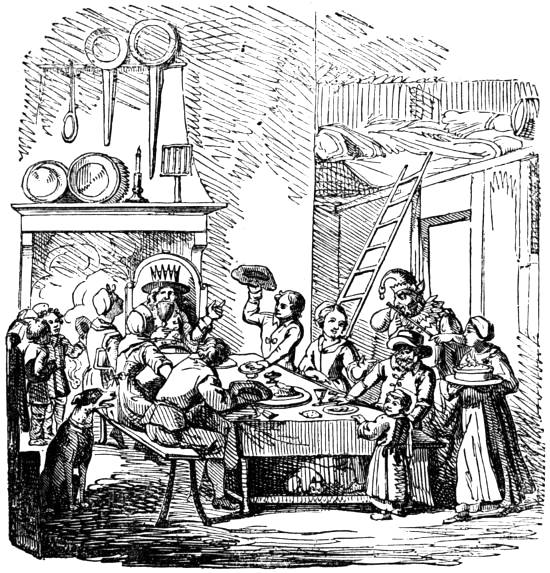
“The King drinks!”
The bean found out, and monarch crown’d, He dubs a fool, and sends him round, To raise the frolic when it’s low— Himself commands the wine to flow. Each watches for the king to quaff, When, all at once, up springs the laugh; They cry “The king drinks!” and away They shout a long and loud huzza! And when it’s ended comes the dance, And—thus is Twelfth-night spent in France.
*
January 6.
Epiphany.—Old Christmas-day. Holiday at the Public-offices.
Twelfth-day.
It is only in certain rural parts of France that the merriments represented above still prevail. The engraving is from an old print, “I. Marriette ex.” inscribed as in the next column.
“L’Hiver. Les Divertissements du Roi-boit.
Loin dicy mille soins facheux, Que porte avec soy la coronne; Celle quá table Bacchus donne Ne fit jamais de malheureux.”
This print may be regarded a faithful picture of the almost obsolete usage.
During the holidays, and especially on Twelfth-night, school-boys dismiss “the cares and the fears” of academic rule; or they are regarded but as a passing cloud, intercepting only for an instant the sunshine of joy wherewith their sports are brightened. Gerund-grinding and parsing are usually prepared for at the last moment, until when “the master’s chair” is only “remembered to be forgotten.” There is entire suspension of the authority of that class, by whom the name of “Busby” is venerated, till “Black Monday” arrives, and chaises and stages convey the young Christmas-keepers to the “seat of government.”
Dr. Busby’s Chair.
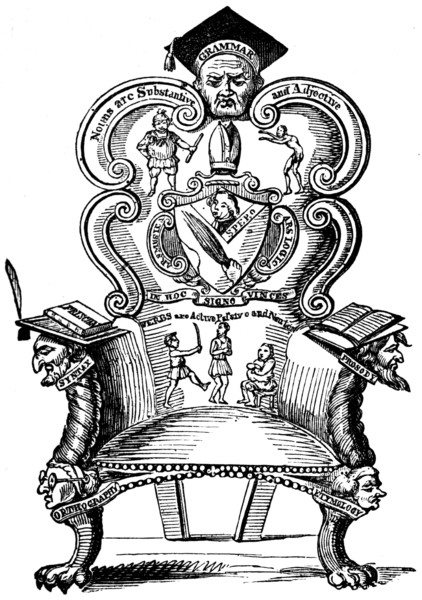
Dr. Busby’s Chair.
Him! sui generis, alone, Busby! the great substantive noun! Whose look was lightning, and whose word Was thunder to the boys who heard, Is, as regards his long vocation, Pictured by this his great location. Look on it well, boys, and digest The symbols!—learn—and shun the rest!
The name of Busby!—not the musical doctor, but a late magisterial doctor of Westminster school—celebrated for severe discipline, is a “word of fear” to all living who know his fame! It is perpetuated by an engraved representation of his chair, said to have been designed by sir Peter Lily, and presented by that artist to king Charles II. The arms, and each arm, are appalling; and the import of the other devices are, or ought to be, known by every tyro. Every prudent person lays in stores before they are wanted, and Dr. Busby’s chair may as well be “in the house” on Twelfth-day as on any other; not as a mirth-spoiler, but as a subject which we know to-day that we have “by us,” whereon to inquire and discuss at a more convenient season. Dr. Busby was a severe, but not an ill-natured man. It is related of him and one of his scholars, that during the doctor’s absence from his study, the boy found some plums in it, and being moved by lickerishness, began to eat some; first, however, he waggishly cried out, “I publish the banns of matrimony between my mouth and these plums; if any here present know just cause or impediment why they should not be united, you are to declare it, or hereafter hold your peace;” and then he ate. But the doctor had overheard the proclamation, and said nothing till the next morning, when causing the boy to be “brought up,” and disposed for punishment, he grasped the well-known instrument, and said, “I publish the banns of matrimony between this rod and this boy: if any of you know just cause or impediment why they should not be united, you are to declare it.”—The boy himself called out, “I forbid the banns!” “For what cause?” inquired the doctor. “Because,” said the boy, “the parties are not agreed!” The doctor enjoyed the validity of the objection urged by the boy’s wit, and the ceremony was not performed. This is an instance of Dr. Busby’s admiration of talent: and let us hope, in behalf of its seasonableness here, that it was at Christmas time.
The King drinks.
We recur once more to this subject, for the sake of remarking that there is an account of a certain curate, “who having taken his preparations over evening, when all men cry (as the manner is) The king drinketh, chanting his masse the next morning, fell asleep in his memento; and when he awoke, added, with a loud voice, The king drinketh.” This mal-apropos exclamation must have proceeded from a foreign ecclesiastic: we have no account of the ceremony to which it refers having prevailed in merry England.
An excellent pen-and-ink picture of “Merry England”[15] represents honest old Froissart, the French chronicler, as saying of some English in his time, that “they amused themselves sadly after the fashion of their country;” whereon the portrayer of Merry England observes, “They have indeed a way of their own. Their mirth is a relaxation from gravity, a challenge to ‘Dull Care’ to ‘be gone;’ and one is not always clear at first, whether the appeal is successful. The cloud may still hang on the brow; the ice may not thaw at once. To help them out in their new character is an act of charity. Any thing short of hanging or drowning is something to begin with. They do not enter into their amusements the less doggedly because they may plague others. They like a thing the better for hitting them a rap on the knuckles, for making their blood tingle. They do not dance or sing, but they make good cheer—‘eat, drink, and are merry.’ No people are fonder of field-sports, Christmas gambols, or practical jests. Blindman’s-buff, hunt-the-slipper, hot-cockles, and snap-dragon, are all approved English games, full of laughable surprises and ‘hair-breadth ’scapes,’ and serve to amuse the winter fireside after the roast beef and plum-pudding, the spiced ale and roasted crab, thrown (hissing-hot) into the foaming tankard. Punch (not the liquor, but the puppet) is not, I fear, of English origin; but there is no place, I take it, where he finds himself more at home or meets a more joyous welcome, where he collects greater crowds at the corners of streets, where he opens the eyes or distends the cheeks wider, or where the bangs and blows, the uncouth gestures, ridiculous anger and screaming voice of the chief performer excite more boundless merriment or louder bursts of laughter among all ranks and sorts of people. An English theatre is the very throne of pantomime; nor do I believe that the gallery and boxes of Drury-lane or Covent-garden filled on the proper occasions with holiday folks (big or little) yield the palm for undisguised, tumultuous, inextinguishable laughter to any spot in Europe. I do not speak of the refinement of the mirth (this is no fastidious speculation) but of its cordiality, on the return of these long-looked-for and licensed periods; and I may add here, by way of illustration, that the English common people are a sort of grown children, spoiled and sulky, perhaps, but full of glee and merriment, when their attention is drawn off by some sudden and striking object.
“The comfort, on which the English lay so much stress, arises from the same source as their mirth. Both exist by contrast and a sort of contradiction. The English are certainly the most uncomfortable of all people in themselves, and therefore it is that they stand in need of every kind of comfort and accommodation. The least thing puts them out of their way, and therefore every thing must be in its place. They are mightily offended at disagreeable tastes and smells, and therefore they exact the utmost neatness and nicety. They are sensible of heat and cold, and therefore they cannot exist, unless every thing is snug and warm, or else open and airy, where they are. They must have ‘all appliances and means to boot.’ They are afraid of interruption and intrusion, and therefore they shut themselves up in in-door enjoyments and by their own firesides. It is not that they require luxuries (for that implies a high degree of epicurean indulgence and gratification,) but they cannot do without their comforts; that is, whatever tends to supply their physical wants, and ward off physical pain and annoyance. As they have not a fund of animal spirits and enjoyments in themselves, they cling to external objects for support, and derive solid satisfaction from the ideas of order, cleanliness, plenty, property, and domestic quiet, as they seek for diversion from odd accidents and grotesque surprises, and have the highest possible relish not of voluptuous softness, but of hard knocks and dry blows, as one means of ascertaining their personal identity.”
Twelfth-day, in the times of chivalry, was observed at the court of England by grand entertainments and tournaments. The justings were continued till a period little favourable to such sports.
In the reign of James I., when his son prince Henry was in the 16th year of his age, and therefore arrived to the period for claiming the principality of Wales and the duchy of Cornwall, it was granted to him by the king and the high court of parliament, and the 4th of June following appointed for his investiture: “the Christmas before which,” sir Charles Cornwallis says, “his highnesse, not onely for his owne recreation, but also that the world might know what a brave prince they were likely to enjoy, under the name of Meliades, lord of the isles, (an ancient title due to the first-borne of Scotland,) did, in his name, by some appointed for the same purpose, strangely attired, accompanied with drummes and trumpets, in the presence, before the king and queene, and in the presence of the whole court, deliver a challenge to all knights of Great Britaine.” The challenge was to this effect, “That Meliades, their noble master, burning with an earnest desire to trie the valour of his young yeares in foraigne countryes, and to know where vertue triumphed most, had sent them abroad to espy the same, who, after their long travailes in all countreyes, and returne,” had nowhere discovered it, “save in the fortunate isle of Great Britaine: which ministring matter of exceeding joy to their young Meliades, who (as they said) could lineally derive his pedegree from the famous knights of this isle, was the cause that he had now sent to present the first fruits of his chivalrie at his majesties’ feete; then after returning with a short speech to her majestie, next to the earles, lords, and knights, excusing their lord in this their so sudden and short warning, and lastly, to the ladies; they, after humble delivery of their chartle concerning time, place, conditions, number of weapons and assailants, tooke their leave, departing solemnly as they entered.”
Then preparations began to be made for this great fight, and each was happy who found himself admitted for a defendant, much more an assailant. “At last to encounter his highness, six assailants, and fifty-eight defendants, consisting of earles, barons, knights, and esquires, were appointed and chosen; eight defendants to one assailant, every assailant being to fight by turnes eight severall times fighting, two every time with push and pike of sword, twelve strokes at a time; after which, the barre for separation was to be let downe until a fresh onset.” The summons ran in these words:
“To our verie loving good ffreind sir Gilbert Houghton, knight, geave theis with speed:
“After our hartie commendacions unto you. The prince, his highnes, hath comanded us to signifie to you that whereas he doth intend to make a challenge in his owne person at the Barriers, with sixe other assistants, to bee performed some tyme this Christmas; and that he hath made choice of you for one of the defendants (whereof wee have comandement to give you knowledge), that theruppon you may so repaire hither to prepare yourselfe, as you may bee fitt to attend him. Hereunto expecting your speedie answer wee rest, from Whitehall this 25th of December, 1609. Your very loving freindes,
Notingham. | T. Suffolke. | E. Worcester.”
On New-year’s Day, 1610, or the day after, the prince’s challenge was proclaimed at court, and “his highnesse, in his own lodging, in the Christmas, did feast the earles, barons, and knights, assailants and defendants, untill the great Twelfth appointed night, on which this great fight was to be performed.”
On the 6th of January, in the evening, “the barriers” were held at the palace of Whitehall, in the presence of the king and queen, the ambassadors of Spain and Venice, and the peers and ladies of the land, with a multitude of others assembled in the banqueting-house: at the upper end whereof was the king’s chair of state, and on the right hand a sumptuous pavilion for the prince and his associates, from whence, “with great bravery and ingenious devices, they descended into the middell of the roome, and there the prince performed his first feats of armes, that is to say, at Barriers, against all commers, being assisted onlie with six others, viz. the duke of Lenox, the earle of Arundell, the earle of Southampton, the lord Hay, sir Thomas Somerset, and sir Richard Preston, who was shortly after created lord Dingwell.”
To answer these challengers came fifty-six earles, barons, knights, and esquiers. They were at the lower end of the roome, where was erected “a very delicat and pleasant place, where in privat manner they and their traine remained, which was so very great that no man imagined that the place could have concealed halfe so many.” From thence they issued, in comely order, to the middell of the roome, where sate the king and the queene, and the court, “to behold the barriers, with the several showes and devices of each combatant.” Every challenger fought with eight several defendants two several combats at two several weapons, viz. at push of pike, and with single sword. “The prince performed this challenge with wonderous skill and courage, to the great joy and admiration of the beholders,” he “not being full sixteene yeeres of age untill the 19th of February.” These feats, and other “triumphant shewes,” began before ten o’clock at night, and continued until three o’clock the next morning, “being Sonday.” The speeches at “the barriers” were written by Ben Jonson. The next day (Sunday) the prince rode in great pomp to convoy the king to St James’, whither he had invited him and all the court to supper, whereof the queen alone was absent; and then the prince bestowed prizes to the three combatants best deserving; namely, the earl of Montgomery, sir Thomas Darey (son to lord Darey), and sir Robert Gourdon.[16] In this way the court spent Twelfth-night in 1610.
On Twelfth-night, 1753, George II. played at hazard for the benefit of the groom porter. All the royal family who played were winners, particularly the duke of York, who won 3000l. The most considerable losers were the duke of Grafton, the marquis of Hartington, the earl of Holderness, earl of Ashburnham, and the earl of Hertford. The prince of Wales (father of George III.) with prince Edward and a select company, danced in the little drawing room till eleven o’clock, and then withdrew.[17]
Old Christmas-day.
According to the alteration of the style, OLD Christmas-day falls on Twelfth-day, and in distant parts is even kept in our time as the festival of the nativity. In 1753, Old Christmas-day was observed in the neighbourhood of Worcester by the Anti-Gregorians, full as sociably, if not so religiously, as formerly. In several villages, the parishioners so strongly insisted upon having an Old-style nativity sermon, as they term it, that their ministers could not well avoid preaching to them: and, at some towns, where the markets are held on Friday, not a butter basket, nor even a Goose, was to be seen in the market-place the whole day.[18]
To heighten the festivities of Christmas, 1825, the good folks of “London and its environs” were invited to Sadler’s Wells, by the following whimsical notice, printed and distributed as a handbill:
“SOVEREIGNS WILL BE TAKEN, during the Christmas holidays, and as long as any body will bring them to SADLER’S WELLS; nay so little fastidious are the Proprietors of that delectable fascinating snuggery, that, however incredible it may appear, they, in some cases, have actually had the liberality to prefer Gold to Paper. Without attempting to investigate their motives for such extraordinary conduct, we shall do them the justice to say, they certainly give an amazing quantum of amusement, All in One Night, at the HOUSE ON THE HEATH, where, besides the THREE CRUMPIES, AND THE BARON AND HIS BROTHERS, an immense number of fashionables are expected on MERLIN’S MOUNT, and some of the first Cambrian families will countenance HARLEQUIN CYMRAEG, in hopes to partake of the Living Leek, which being served up the last thing before supper, will constitute a most excellent Christmas carminative, preventing the effects of night air on the crowds who will adorn this darling little edifice. In addition to a most effective LIGHT COMPANY engaged here, a very respectably sized Moon will be in attendance to light home a greater number of Patrons than ever this popular petted Palace of Pantomime is likely to produce. We say nothing of warmth and comfort, acquired by recent improvements, because these matters will soon be subjects of common conversation, and omit noticing the happiness of Half-price, and the cheering qualities of the Wine-room, fearful of wounding in the bosom of the Manager that innate modesty which is ever the concomitant of merit; we shall therefore conclude, by way of invitation to the dubious, in the language of an elegant writer, by asserting that the Proof of the Pudding is in—VERBUM SAT.”
NATURALISTS’ CALENDAR.
Mean Temperature 37·12.
January 7.
1826. Distaff’s Day.[19]
STANZAS ON THE NEW YEAR.
I stood between the meeting years, The coming and the past, And I ask’d of the future one, Wilt thou be like the last? The same in many a sleepless night, In many an anxious day? Thank Heaven! I have no prophet’s eye To look upon thy way! For Sorrow like a phantom sits Upon the last Year’s close. How much of grief, how much of ill, In its dark breast repose! Shadows of faded Hopes flit by, And ghosts of Pleasures fled: How have they chang’d from what they were! Cold, colourless, and dead. I think on many a wasted hour, And sicken o’er the void; And many darker are behind, On worse than nought employ’d. Oh Vanity! alas, my heart! How widely hast thou stray’d And misused every golden gift For better purpose made! I think on many a once-loved friend As nothing to me now; And what can mark the lapse of time As does an alter’d brow? Perhaps ’twas but a careless word That sever’d Friendship’s chain; And angry Pride stands by each gap, Lest they unite again. Less sad, albeit more terrible, To think upon the dead, Who quiet in the lonely grave Lay down their weary head. For faith and hope, and peace, and trust, Are with their happier lot: Though broken is their bond of love, At least we broke it not.— Thus thinking of the meeting years, The coming and the past, I needs must ask the future one, Wilt thou be like the last? There came a sound, but not of speech, That to my thought replied, “Misery is the marriage-gift That waits a mortal bride: “But lift thine hopes from this base earth, This waste of worldly care, And wed thy faith to yon bright sky, For Happiness dwells there!”
L. E. L.[20]
NATURALISTS’ CALENDAR.
Mean Temperature 35·85.
January 8.
1826. First Sunday after Epiphany.
Chronology.
On the 8th of January, 1753, died sir Thomas Burnet, one of the judges of the court of Common Pleas, of the gout in his stomach, at his house in Lincoln’s-inn fields. He was the eldest son of the celebrated Dr. Gilbert Burnet, bishop of Salisbury; was several years consul at Lisbon; and in November, 1741, made one of the judges of the Common Pleas, in room of judge Fortescue, who was appointed master of the rolls. On November 23, 1745, when the lord chancellor, judges, and association of the gentlemen of the law, waited on his majesty with their address, on occasion of the rebellion, he was knighted. He was an able and upright judge, and a great benefactor to the poor.[21]
THE NEW YEAR NEW MOON
To the Editor of the Every-Day Book.
Sir,
Encouraged by your various expressions of willingness to receive notices of customs not already “imprinted” in your first volume, I take the liberty of presenting the first of several which I have not yet seen in print.
I am, sir, Your constant reader, J. O. W.
Chelsea.
MONEY AND THE MOON.
Gentle reader,
If thou art not over-much prejudiced by the advances of modernization, (I like a long new-coined word,) so that, even in these “latter days,” thou dost not hesitate to place explicit reliance on ancient, yet infallible “sayings and doings,” (ancient enough, since they have been handed down to us by our grandmothers—and who would doubt the weight and authority of so many years?—and infallible enough, since they themselves absolutely believed in their “quite-correctness,”) I will tell thee a secret well worth knowing, if that can be called a secret which arises out of a well-known and almost universal custom, at least, in “days of yore.” It is neither more nor less than the possession throughout “the rolling year” of a pocket never without money. Is not this indeed a secret well worth knowing? Yet the means of its accomplishment are exceedingly simple (as all difficult things are when once known.) On the first day of the first new moon of the new year, or so soon afterwards as you observe it, all that you have to do is this:—on the first glance you take at “pale Luna’s silvery crest” in the western sky, put your hand in your pocket, shut your eyes, and turn the smallest piece of silver coin you possess upside down in your said pocket. This will ensure you (if you will but trust its infallibility!) throughout the whole year that “summum bonum” of earthly wishes, a pocket never empty. If, however, you neglect, on the first appearance of the moon, your case is hopeless; nevertheless and notwithstanding, at a future new moon you may pursue the same course, and it will be sure to hold good during the then current month, but not a “whit” longer.
This mention of the new moon and its crest brings to mind a few verses I wrote some time ago, and having searched my scrap-book, (undoubtedly not such a one as Geoffery Crayon’s,) I copied them from thence, and they are here under. Although written in the “merry merry month of May,” they may be read in the “dreary dark December,” for every new moon presents the same beautiful phenomenon.
A Simile.
Hast thou ne’er marked, when first the crescent moon Shines faintly in the western horizon, O’er her whole orb a slight soft blush o’erspread, As though she were abashed to be thus seen From the sun’s couch with silver steps retreating? Hast thou ne’er marked, that when by slow degrees, Night after night, her crescent shape is lost, And steadily she gains her stores of light, Till half her form resplendently proclaims An envious rival to the stars around— Then mark’st thou not, that nought of her sweet blush Remains to please the gazer’s wistful sight, And that she shines increasingly in strength, Till she is full-orb’d, mistress of the sky?— So is it with the mind, when silently Into the young heart’s void steals timorous love. Then enter with it fancy’s fairy dreams, Visions of glory, reveries of bliss; And then they come and go, till comes, alas! Knowledge, forced on us, of the “world without!” How soon these scenes of beauty disappear! How soon fond thought sinks into nothingness! How soon the mind discovers that true bliss Reposes not on sublunary things, But is alone when passion’s blaze is o’er In that high happy sphere, where love’s supreme.
Here it may not be out of place to endeavour to describe, as familiarly as possible, the cause of the lunar appearance. Hold a piece of looking-glass in a ray of sunshine, and then move a small ball through the reflected ray: it is easy to conceive that both sides will be illumined; that side towards the sun by the direct sunbeam, and the side towards the mirror, though less powerfully, by the reflected sunbeam. In a somewhat similar manner, the earth supplies the place of the mirror, and as at every new moon, and for several days after the moon is in that part of her orbit between the earth and the sun, the rays of the sun are reflected from the earth to the dark side of the moon, and consequently to the inhabitants of that part of the moon, (if any such there be, and query why should there not be such?) the earth must present the curious appearance of a full moon of many times the diameter which ours presents.
J. O. W.
NATURALISTS’ CALENDAR.
Mean Temperature 36·05.
January 9.
1826. Plough Monday. The first Monday after Twelfth day.[22]
Chronology.
On the 9th of January, 1752, William Stroud was tried before the bench of justices at Westminster-hall, for personating various characters and names, and defrauding numbers of people, in order to support his extravagance. It appeared by the evidence, that he had cheated a tailor of a suit of velvet clothes, trimmed with gold; a jeweller of upwards of 100l. in rings and watches, which he pawned; a coachmaker of a chaise; a carver and cabinet-maker of household goods; a hosier, hatter, and shoemaker, and, in short, some of almost every other business, to the amount of a large sum. He sometimes appeared like a gentleman attended with livery servants; sometimes as a nobleman’s steward; and, in the summer time, he travelled the west of England, in the character of Doctor Rock; and, at the same time, wrote to London for goods, in the names of the Rev. Laroche, and the Rev. Thomas Strickland. The evidence was full against him; notwithstanding which, he made a long speech in his own defence. He was sentenced to six months’ hard labour in Bridewell, and, within that time, to be six times publicly whipped.
Such offences are familiar to tradesmen of the present times, through many perpetrators of the like stamp; but all of them are not of the same audacity as Stroud, who, in the month following his conviction, wrote and published his life, wherein he gives a very extraordinary account of his adventures, but passes slightly over, or palliates his blackest crimes. He was bred a haberdasher of small wares in Fleet-street, married his mistress’s sister before his apprenticeship determined, set up in the Poultry, became a bankrupt, in three months got his certificate signed, and again set up in Holborn, where he lived but a little while before he was thrown into the King’s Bench for debt, and there got acquainted with one Playstowe, who gradually led him into scenes of fraud, which he afterwards imitated. Playstowe being a handsome man, usually passed for a gentleman, and Stroud for his steward; at last the former, after many adventures, married a girl with 4000l., flew to France, and left Stroud in the lurch, who then retired to Yorkshire, and lived some time with his aunt, pretending his wife was dead, and he was just on the brink of marrying advantageously, when his real character was traced. He then went to Ireland, passed for a man of fashion, hired an equipage, made the most of that country, and escaped to London. His next grand expedition was to the west of England, where he still personated the man of fortune, got acquainted with a young lady, and pursued her to London, where justice overtook him; and, instead of wedlock, bound him in the fetters of Bridewell.
On the 24th of June, 1752, Stroud received “his last and severest whipping, from the White Bear to St. James’s church Piccadilly.”[23]
NATURALISTS’ CALENDAR.
Mean Temperature 36·12.
January 10.
Winter in London.
On the 10th of January, 1812, it is observed, that London was this day involved, for several hours, in palpable darkness. The shops, offices, &c., were necessarily lighted up; but, the streets not being lighted as at night, it required no small care in the passenger to find his way, and avoid accidents. The sky where any light pervaded it, showed the aspect of bronze. Such is, occasionally, the effect of the accumulation of smoke between two opposite gentle currents, or by means of a misty calm. The fuliginous cloud was visible, in this instance, from a distance of forty miles. Were it not for the extreme mobility of our atmosphere, this volcano of a hundred thousand mouths would, in winter, be scarcely habitable![24]
Winter in the Country.
All out door work Now stands; the waggoner, with wisp-wound feet, And wheelspokes almost filled, his destined stage Scarcely can gain. O’er hill, and vale, and wood, Sweeps the snow-pinioned blast, and all things veils In white array, disguising to the view Objects well known, now faintly recognised. One colour clothes the mountain and the plain, Save where the feathery flakes melt as they fall Upon the deep blue stream, or scowling lake, Or where some beetling rock o’erjutting hangs Above the vaulty precipice’s cove. Formless, the pointed cairn now scarce o’ertops The level dreary waste; and coppice woods, Diminished of their height, like bushes seem. With stooping heads, turned from the storm, the flocks Onward still urged by man and dog, escape The smothering drift; while, skulking at a side, Is seen the fox, with close downfolded tail, Watching his time to seize a straggling prey; Or from some lofty crag he ominous howls, And makes approaching night more dismal fall.
Grahame.
Mr. Paul Pry in the Character of Mr. Liston. “Just popp’d in, you know!”
LETTER from PAUL PRY.
To the Editor of the Every-Day Book.
Sir,
I hope I don’t intrude—I have called at Ludgate-hill a great many times to see you, and made many kind inquiries, but I am always informed you are “not at home;” and what’s worse, I never can learn when you’ll be “at home;” I’m constantly told, “it’s very uncertain.” This looks very odd; I don’t think it correct. Then again, on asking your people what the Every-Day Book is all about? they say it’s about every thing; but that you know is no answer—is it? I want something more than that. When I tell ’em so, and that I’m so much engaged I haven’t time to read, they say the book is as useful to people engaged in business as to people out of business—as if I was in business! I wish to acquaint every body, that I am not in business, and never was in business, though I’ve a deal of business to do; but then it’s for my own amusement, and that’s nobody’s business, you know—as I also told ’em. They say it’s impossible to describe the contents of the book, but that all the particulars are in the Index; that’s just what I wanted; but behold! it is “not out”—that is, it is not in—I mean not in the book—you take. Excuse my humorsomeness: I only wish to know when I can get it? They say in a few days, but, bless you, I don’t believe ’em; for though I let ’em know I’ve a world of things to communicate to you, when you’ve time to see me, and let me ask you a few questions, they won’t credit me, and why should I credit them—I was not born yesterday, I assure you. I’m of a very ancient stock, and I’ve some notion you and I are kinsmen—don’t you think we are? I dare say there’s a likeness, for I’m sure we are of the same disposition; if you aren’t, how can you find out so much “about every thing.” If I can make out that you are one of the Pry family, it will be mutually agreeable—won’t it? How people will stare—won’t they?
I suppose you’ve heard how I’ve been used by Mr. Liston—my private character exposed on the public stage, and the whole town roaring at the whole of the Pry family. But we are neither to be cried down nor laughed down, and so I’d have let the play-goers know, if the managers had allowed me to sing a song on New-year’s night, in imitation of Mr. Liston when he’s a playing me. Will you believe it—they burst out a laughing, and would not let me go on the boards—they said the audience would suppose me to be the actor himself; what harm would that have done the theatre?—can you tell? They said, it would hurt Mr. Liston’s feelings—never considering my feelings! If ever I try to serve them or their theatre again, I’ll be—Liston! They shall be matched, however, if you’ll help me. I’ve copied out my song, and if you’ll print it in the Every-Day Book, it will drive ’em mad. I wish, of all things, that Mr. Cruikshank could see me in the character of Liston—he could hit me I know—don’t you think he could?—just as I am—“quite correct”—like he did “Guy Faux” last 5th of November. I never laughed so much in all my life as when I saw that. Bless you, I can mimic Liston all to nothing. Do get your friend George to your house some day—any day he likes—it’s all one to me, for I call every day; and as I’m an “every-day” man, you know, why you might pop me at the head of the song in your Every-Day Book—that’s a joke you know—I can’t help laughing—so droll! I’ve enclosed the song, you see.
[The wish of this correspondent is complied with, and the manner wherein, it is presumed, he would have sung the song, is hinted at parenthetically.]
MR. PAUL PRY’S SONG, Intended to have been sung by him at the Theatre, In the Character of MR. LISTON, ON NEW YEAR’S EVE.
Tune——Mr. Liston’s.
(Pryingly.) I hope I don’t intrude!— (Fearfully.) I thought I heard a cough— (Apologetically.) I hope I am not rude— (Confidentially.) I say—the Year’s going off! (Inquisitively.) Where can he be going to? (Ruminatively.) It’s very odd!—it’s serious!— (Self-satisfactively.) I’m rather knowing too!— (Insinuatively.) But isn’t it mysterious? (Comfortably.) ’Twas better than the other— (Informingly.) The one that went before;— (Consolingly.) But then there’ll be another— (Delightedly.) And that’s one comfort more! (Alarmedly.) I’m half afraid he’s gone! (Kindlily.) Must part with the old fellow! (Hastily.) Excuse me—I must run—(Exit.) (Returns.) Forgot my umbrella. (Determinedly.) I’ll watch the new one though, (Circumspectly.) And see what he’ll be at—(Exit.) (Returns.) Beg pardon—didn’t bow—(Bows and exit.) (Returns.) Bid pardon—left my hat. (Lingeringly.) It’s always the wish of Paul, (Seriously.) To be quite correct and right— (Respectfully.) Ladies and gentlemen—all— (Retreatingly.) I wish you very good night! (Recollectively.) And—ladies and gentlemen—all! (Interjectively.) You laugh so much, I declare— (Vexedly.) I’m not Mr. Liston!—I’m Paul!— (Lastly.) I wish you a happy New Year!—(Exit finally.)
If you print this in the Every-Day Book it will send Liston into fits—it will kill him—won’t it? But you know that’s all right—if he takes me off I’ve a right to take him off—haven’t I? I say, that’s another joke—isn’t it? Bless you, I co’d do as good as that for ever. But I want to see you, and ask you how you go on? and I’ve lots of intelligence for you—such things as never were known in this world—all true, and on the very best authority, you may take my word for it. Several of my relations have sent you budgets. Though they know you won’t publish their names unless they like it, they don’t choose to sign ’em to their letters for private reasons,—why don’t you print ’em? They cann’t give up their authors you know, (that’s impossible,) but what does that signify? And then you give ’em so much trouble to call and make inquiries—not that they care about that, but it looks so. However, I’m in a great hurry and so you’ll excuse me.—Mind though I shall pop in every day till I catch you. I hope you’ll print the song—it’s all my own writing, it will do for Liston, depend on it. What a joke—isn’t it a good one?
Pryory Place,
Yours eternally,
January 6, 1826.
Paul Pry.
P. S. Don’t forget the Index—I want to learn all the particulars—multum in parvo—all quite correct.
P. S. I’m told you’ve eleven children—is it true? What day shall you have another?—to-day?—Twelfth-day? that would be a joke—wouldn’t it? I hope I don’t intrude. I don’t wish to seem curious.
NATURALISTS’ CALENDAR.
Mean Temperature 36·07.
January 11.
Feast Week.
This is a term in many parts of England for an annual festivity celebrated on the occasion described in the subjoined communication.
For the Every-Day Book. THE FEAST WEEK.
This festival, so called, is supposed to be nearly coeval with the establishment of Christianity in this island. Every new church that was founded was dedicated to some peculiar saint, and was naturally followed by a public religious celebration, generally on the day of that saint, or on the Sunday immediately following. Whatever might be the origin, the festival part is still observed in most of the villages of several of the midland and other counties. It is a season much to be remembered, and is anticipated with no little pleasure by the expecting villagers. The joyful note of preparation is given during the preceding week; and the clash, and splash, and bustle of cleansing, and whitewashing, and dusting, is to be seen and heard in almost every cottage. Nor is the still more important object of laying in a good solid supply for a hungry host of visitors forgotten. Happy those who can command a ham for the occasion. This is a great favourite, as it is a cut-and-come-again dish, ready at hand at all times. But this is mostly with the tip-topping part. Few but can boast of a substantial plum-pudding!—And now the important day is arrived. The merry bells from the steeple announce the event; and groups of friends and relations, not forgetting distant cousins and children, are seen making their way, long before the hour of dinner, to the appointed spot. This is Sunday; and in the afternoon a portion of these strangers, clean and neatly dressed, are seen flocking to the village church, where the elevated band in the gallery, in great force both in noise and number, contribute lustily to their edification, and the clergyman endeavours to improve the solemnity of the occasion by an appropriate address. During the early part of the ensuing week, the feast is kept up with much spirit: the village presents a holiday appearance, and openhousekeeping, as far as may be, is the order of the day; the bells at intervals send forth an enlivening peal; all work is nearly suspended; gay stalls of gingerbread and fruit, according to the season of the year, together with swings and roundabouts, spread out their allurements to the children; bowls, quoits, and nine-pins, for the men; and the merry dance in the evening, for the lasses. Fresh visitors keep dropping in; and almost all who can make any excuse of acquaintance are acknowledged, and are hospitably entertained, according to the means of their village friends. As the week advances, these means gradually diminish; and as an empty house has few attractions, by the end of the week the bustle ceases, and all is still and silent, as if it had never been.